INTRODUCTION
Echinococcus species are cestodes that cycle among domestic and sylvatic animals, with occasional spillover into people. Two zoonotic Echinococcus species are distributed in Canada – Echinococcus canadensis and Echinococcus multilocularis. Previously, E. canadensis was known as the sylvatic strain of Echinococcus granulosus (or the G8 and G10 cervid genotypes); however, recent molecular evidence based on mitochondrial genes support the nomenclature change (Sweatman and Williams, Reference Sweatman and Williams1963; Thompson et al. Reference Thompson, Boxell, Ralston, Constantine, Hobbs, Shury and Olson2006; Nakao et al. Reference Nakao, McManus, Schantz, Craig and Ito2007; Moks et al. Reference Moks, Jogisalu, Valdmann and Saarma2008). Echinococcus canadensis circulates in a two-host assemblage, utilizing large canids (wolves, coyotes [Canis latrans] and dogs [Canis familiaris]) as definitive hosts; and ungulates, primarily cervids (moose [Alces alces], elk [Cervus canadensis], caribou [Rangifer tarandus] and deer [Odocoileus spp.]) as intermediate hosts (Sweatman, Reference Sweatman1952). Echinococcus canadensis has a widespread distribution across Canada, and is found in every province and territory except the Maritime Provinces and the island of Newfoundland (Sweatman, Reference Sweatman1952; Schurer et al. Reference Schurer, Shury, Leighton and Jenkins2013). Echinococcus multilocularis is reported only in western Canada and is thought to occur as two geographically and genetically segregated populations (i.e. the Northern Tundra Zone and the North Central Region) (Eckert et al. Reference Eckert, Gemmell, Meslin and Pawlowski2001). Echinococcus multilocularis predominantly utilizes smaller carnivores (coyotes, dogs, foxes [Vulpes spp.], and domestic cats [Felix catus]) as definitive hosts and a wide variety of small mammals as intermediate hosts (e.g. voles, mice, lemmings, shrews and muskrats), although aberrant intermediate hosts (such as people, domestic dogs, etc.) do occasionally occur (Rausch, Reference Rausch, Thompson and Lymbery1995; Jones and Pybus, Reference Jones, Pybus, Samuel, Pybus and Kocan2001; Jenkins et al. Reference Jenkins, Peregrine, Hill, Somers, Gesy, Barnes, Gottstein and Polley2012).
Wolves have long been considered the most important definitive host for E. canadensis, but with the exception of one experimentally infected animal, wolves infected with E. multilocularis have not been reported in North America (Rausch and Richards, Reference Rausch and Richards1971; Rausch, Reference Rausch, Thompson and Lymbery1995, Reference Rausch2003; Craig and Craig, Reference Craig and Craig2005; Jenkins et al. Reference Jenkins, Castrodale, de Rosemond, Dixon, Elmore, Gesy, Hoberg, Schurer, Simard and Thompson2013). This could be explained by a variety of factors, including the difficulty in harvesting and identifying adult cestodes of Echinococcus species (in part due to zoonotic risk), wolf predation preferences, and variable host specificity. The recent advent of molecular tools has facilitated species level differentiation, as well as identification of genotypic variations. The objectives of this study are to report the occurrence and identity of Echinococcus cestodes harvested from Canadian wolves, and to better define the geographic and host distribution of these parasites.
MATERIALS AND METHODS
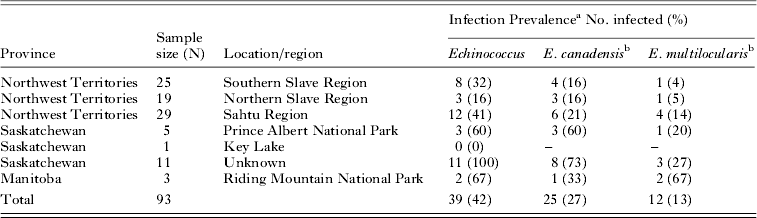
Wolves were harvested by trappers, hunters and wildlife personnel from Saskatchewan (SK), Manitoba (MB) and the Northwest Territories (NT) for other purposes (2009 to 2011), and intestines were examined under University of Saskatchewan animal care research ethics approval protocol 20090126 (Table 1). The small intestines were ligated, excised and frozen at −80 °C for a minimum of 7 days prior to processing in order to inactivate eggs of Echinococcus infective for people (Eckert et al. Reference Eckert, Gemmell, Meslin and Pawlowski2001). Echinococcus strobilate adults were harvested from the intestines of 39 wolves using the scraping, filtration and counting technique (Gesy et al. Reference Gesy, Pawlik, Kapronczai, Wagner, Elkin, Schwantje and Jenkins2013), morphologically identified to genus level, and stored in 70% ethanol. Freezing and ethanol fixation precluded definitive morphological identification of the adult cestodes to species level. Two to nine individual, intact, adult cestodes were selected from each wolf, and DNA was extracted from individual cestodes (Catalano et al. Reference Catalano, Lejuene, Liccioli, Verocai, Gesy, Jenkins, Kutz, Fuentealba, Duignan and Massolo2012). PCR analysis of all lysed worms was conducted using taeniid-specific primers to amplify a 470 bp region of the NADH dehydrogenase subunit 1 (NAD1) mitochondrial gene of E. canadensis (Bowles and McManus, Reference Bowles and McManus1993). Similarly, a 395 bp region of NAD1 of E. multilocularis was amplified using species-specific primers for any samples that did not amplify using the primers for E. canadensis (Trachsel et al. Reference Trachsel, Deplazes and Mathis2007). PCR products were resolved by electrophoresis (110 V, 30 min) on a 1·5% agarose gel stained by RedSafe nucleic acid staining solution (ChemBio Ltd, Hertfordshire, UK), and viewed under UV light. PCR products with positive bands were purified using the QIAquick PCR Purification Kit (Qiagen Inc., Valencia, CA), and sent for sequencing (Macrogen Inc., Seoul, Korea). Forward and reverse DNA sequences were aligned using a Staden Software Package (Pregap 4, Gap 4). The aligned sequences were entered into GenBank™ (National Center for Biotechnology Information) and compared by BLASTn search to previously published sequences for identification at the species and, for E. canadensis, at the genotype levels.
Location and occurrence of Echinococcus species infection in wolves examined by necropsy (Canada)

a Based on morphological identification.
b Based on molecular identification of selected cestodes (2–9 per wolf); samples from 9 wolves could not be identified beyond the genus level.
RESULTS
Overall, adult cestodes of Echinococcus spp. (based on morphological identification) were detected in 39 of 93 wolves (prevalence of 42%). The median intensity of infection was approximately 2420 worms (range: 60, 24 250). Echinococcus cestodes were successfully characterized using molecular techniques in 30 of the 39 wolves. Based on NAD1 sequence data, E. multilocularis was identified in 12 of the 30 wolves, representing a minimum prevalence of 13% (12 of 93 wolves). Seven of the E. multilocularis positive wolves were co-infected with E. canadensis G10. The minimum prevalence of E. canadensis in these wolves was 27% (25 of 93). Of these, 26% (24 of 93) had E. canadensis G10, 5% (5 of 93) had E. canadensis G8 (4 had both genotypes).
Sequences from the G10 genotype of E. canadensis were most similar (99% identical) to a reindeer isolate from Finland (accession no. AF525297.1), and sequences from the G8 genotype were most similar (99% identical) to a moose isolate from the USA (AB235848.1). Sequences from E. multilocularis cestodes were most similar (99–100% identical) to a human liver cyst from Poland (JX266826.1), an M2 European genotype (AJ237640.1), and a European-type haplotype found in a domestic dog from British Columbia, Canada (JF751034.1). Sequences of suitable length and quality were submitted to Genbank™ and assigned accession numbers as follows: E. canadensis G8 KC848478-KC848483; E. canadensis G10 KC848484-KC848493; E. multilocularis KC848462-848477.
Both E. canadensis G10 and E. multilocularis were found in all of the sample regions (Fig. 1); however, E. canadensis G8 was not found in the North Slave Region of the NT or Riding Mountain National Park (RMNP), MB. Mixed infections of E. multilocularis and E. canadensis G10 were observed in all locations except the South Slave Region of the NT.
The occurrence of Echinococcus multilocularis and E. canadensis (genotypes G8 and G10) in wolves across five sampling regions in Canada (N = 93; NT – Northwest Territories, SK – Saskatchewan, MB – Manitoba).

DISCUSSION
To our knowledge, this is the first report of E. multilocularis in naturally infected North American wolves (Rausch, Reference Rausch, Thompson and Lymbery1995, Reference Rausch2003; Craig and Craig, Reference Craig and Craig2005; Jenkins et al. Reference Jenkins, Castrodale, de Rosemond, Dixon, Elmore, Gesy, Hoberg, Schurer, Simard and Thompson2013). Wolves infected by E. multilocularis have previously been reported in Europe, Russia and China (Wang et al. Reference Wang, Wu and Ding1989; Rausch, Reference Rausch, Thompson and Lymbery1995; Craig and Craig, Reference Craig and Craig2005). Our study suggests that the significance of wolves for sylvatic transmission of this cestode in North America may be significantly underestimated. Previously, the northern distribution of this parasite was thought to track that of the Arctic fox, which was considered to be the most important definitive host at Arctic latitudes. We found a minimum infection prevalence of 13% of 93 wolves; in contrast, prevalence of E. multilocularis in Arctic foxes in mainland regions of Alaska and the western Canadian Arctic is 2–9% (Jenkins et al. Reference Jenkins, Castrodale, de Rosemond, Dixon, Elmore, Gesy, Hoberg, Schurer, Simard and Thompson2013). Compared with canids from RMNP, our reported median infection intensity of adult Echinococcus cestodes is higher than that previously reported in wolves, and is far higher than that of red foxes (Samuel et al. Reference Samuel, Ramalingam and Carbyn1978). In addition, wolves travel long distances and could contribute to range expansion of E. multilocularis (Martinek et al. Reference Martinek, Kolarova, Hapl, Literak and Uhrin2001). Wolves are known to consume a wide variety of prey species, including ungulates and rodents (Kuyt, Reference Kuyt1972). Tundra wolves utilize rodents as a greater part of their diet than timber wolves, and would be expected to encounter E. multilocularis with higher frequency (Pimlott et al. Reference Pimlott, Shannon and Kolenosky1969; Kuyt, Reference Kuyt1972; Choquette et al. Reference Choquette, Gibson, Kuyt and Pearson1973). Our results show that timber wolves residing in southern regions of western Canada also encounter E. multilocularis. This most likely reflects a high prevalence of infection in rodent intermediate hosts as well as maintenance in other definitive hosts, including coyotes, red foxes, dogs and cats.
The current study is the first demonstration of wolves naturally infected with multiple species and genotypes of Echinococcus, although mixed infections have previously been reported in dogs (Stefanic et al. Reference Stefanic, Shaikenov, Deplazes, Dinkel, Torgerson and Mathis2004; Xiao et al. Reference Xiao, Nakao, Qiu, Budke, Giraudoux, Craig and Ito2006; Zhang et al. Reference Zhang, Bart, Giraudoux, Craig, Vuitton and Wen2006). Mixed infections of Echinococcus species and genotypes may be explained by the finding that exposure to larval stages of Echinococcus (hydatid cysts) by definitive hosts does not elicit a sufficient immune response to prevent a subsequent infection (Jenkins and Rickard, Reference Jenkins and Rickard1985). Presumably, a definitive host could develop mixed infections through the consumption of various intermediate hosts harbouring different species and genotypes of Echinococcus. Mixed infections probably occur more frequently than suggested by our results, as this study was limited by the number of adult Echinococcus cestodes processed per wolf, and by the number of cestodes for which we successfully amplified DNA. We observed co-infection of wolves with E. canadensis G8/G10 genotypes in SK and NT, and co-infection with E. multilocularis/E. canadensis G10 in MB, SK and NT. Although we did not find the E. canadensis G8 strain in a mixed infection with E. multilocularis, this likely reflects the relative rarity of this genotype as well as the need for more widespread geographic sampling. Interestingly, mixed infections with Taenia spp. were also observed in 13 of the 93 (14%) wolves sampled, suggesting that cross-protective immunity does not occur for other taeniid species (M. Pawlik and E. Jenkins, unpublished results).
These findings of Echinococcus in wildlife may cause concern in both the animal and public health sectors. Echinococcus infection does not cause significant pathology in definitive hosts, and although hydatid cyst growth in ungulate hosts is usually asymptomatic, pulmonary infections may restrict vital capacity and endurance. Limited evidence is available to demonstrate that infected ungulates are more likely to be removed from herds by hunters or natural predators (Rau and Caron, Reference Rau and Caron1979; Joly and Messier, Reference Joly and Messier2004). In contrast, rodents are seriously compromised by their role as intermediate hosts of E. multilocularis (Rausch and Schiller, Reference Rausch and Schiller1956). Echinococcus species are zoonotic, and although people are aberrant dead-end hosts, infection can cause severe long-term health consequences, including death (McManus et al. Reference McManus, Zhang, Li and Bartley2003). Cystic hydatid disease associated with E. canadensis is thought to be less pathogenic than that associated with the pastoral species in the E. granulosus species complex; however, severe clinical disease has been reported in people infected with the G8 strain in Alaska (Castrodale et al. Reference Castrodale, Beller, Wilson, Schantz, McManus, Zhang, Fallico and Sacco2002). Alveolar echinococcosis caused by E. multilocularis is especially dangerous for people, and the western coast of Alaska has been considered a highly endemic focus. This may in part reflect the unique ecology of the disease (especially on islands in the Bering Strait) as well as the possibility of Asian strains of this parasite (Nakao et al. Reference Nakao, Xiao, Okamoto, Yanagida, Sako and Ito2009). More work is needed to determine the significance of finding European-type strain(s) of E. multilocularis in wolves in northern and western Canada, and their relationship to strains from elsewhere in the circumpolar North. The observation of E. multilocularis in wolves is an important finding for wildlife managers, veterinarians, and public health personnel in western Canada.
ACKNOWLEDGEMENTS
We gratefully acknowledge Michael Pawlik, Brent Wagner, the Canadian Cooperative Wildlife Health Centre, Chelsea Himsworth, Todd Shury, Karl Cox, Dean Cluff and the hunters and trappers who provided animal tissues.
FINANCIAL SUPPORT
Graduate student stipend was funded by the Canadian Institutes of Health Research Strategic Training Program in Public Health and the Agricultural Rural Ecosystem (PHARE), and the Western College of Veterinary Medicine Enhancement fund. Research was funded by a Discovery Grant from the Natural Sciences and Engineering Research Council, the Department of Environment and Natural Resources of the Northwest Territories, the Saskatchewan Health Research Foundation, and the Presidents NSERC research fund of the University of Saskatchewan.