Introduction
The World Bank argues that ‘plural politics and broad based popular participation’ are rapidly becoming features of modern governance. The proportion of countries with some form of democratic participation increased from 28% in 1974 to 61% by the end of the 1990s, and continues to rise to date. The bank insists that government arrangements that provides space for ‘participatory politics by giving more voice to people will hasten decentralization . . . a trend that will most likely be felt in large countries with marked ethnic divisions and deeply rooted local identities’ (World Bank, 2000: 43–5).
The value of participation for development cannot be over emphasized since development depends mainly on local communities taking their own fate into their hands. It is therefore no surprise that the many international organizations, such as the World Bank and World Health Organization, stress the need for participation in local development. Supported by various scholars, these institutions consider community participation a core element of sustainable development, particularly for social service delivery (see, for example, Dola and Dolbani, Reference Dola and Dolbani2006; WHO, 2002). The link between participation and development can be seen as a part of the broad concept of ‘democratic decentralization’, which puts much emphasis on the links between people and local governments as a strategy for development.
Participation and decentralization have a symbiotic relationship. On the one hand, successful decentralization requires some degree of local participation (Baganda, Reference Baganda2007). Sub-national governments’ proximity to their constituents will enable them to respond better to local needs and to match public spending to private needs efficiently if some sort of information flow between citizens and the local governments exists. On the other hand, the process of decentralization can itself enhance the opportunities for participation by placing more power and resources at a closer, more familiar, more easily influenced level of government (Ayee, Reference Ayee2013). In environments with poor traditions of citizen participation, decentralization can be an important first step in creating regular, predictable opportunities for citizen–state interaction. The very act of introducing decentralization ensures a certain degree of participation because citizens will be voting for elected councilors. This tends to increase local interest in politics and so involves people in the political process (Blair, Reference Blair2000). However, that is not all about political participation; other dimensions of political involvement include campaigning, demonstrating, lobbying decision making, and so on.
Conceptualization of decentralization
Decentralization defies a precise definition since different scholars look at different dimensions of the concept. Rondinelli (Reference Rondinelli1981) refers to decentralization as the transfer of the authority to plan, make decisions, and manage public functions from a higher level of government to any individual organization or agency at a lower level. According to Smith, decentralization denotes ‘reversing the concentration of administration at a single center and conferring powers on local government’ (Smith, Reference Smith1985: 1). In political studies, decentralization means the territorial distribution of power. Its focus is on the extent to which power and authority are dispersed through the geographical hierarchy of the state, and the institutions and processes through which such dispersal occurs (Ayee, Reference Ayee2008). These definitions highlight the transfer of power, competence, and authority as well as resources from central government and its agencies to lower level governmental structures to efficiently and effectively carry out responsibilities of local relevance in a participatory manner at that level.
Several categories of decentralization abound in the literature because of the substantial degree to which it varies in scale and scope. Rondinelli (Reference Rondinelli1981) differentiates between delegation, de-concentration, devolution, and privatization, or deregulation. Delegation denotes the transfer of responsibility for the provision of public goods and services to parastatal or semi-autonomous institutions, which act on behalf of and are directly liable to the central government. Deconcentration refers to the outsourcing of central government functions to local or regional offices of the same. Sub-national officials are appointed by the center and are subject to directives from above. Devolution means the creation of autonomous sub-national administrations, which dispose of full discretion over most local affairs (Steiner, Reference Steiner2005). They are not or only to a minor extent accountable to the central government. Privatization or deregulation implies the transfers of previously public functions, or at least the right to implementation of those, to private organizations and companies (Steiner, Reference Steiner2005).
The other categorization of decentralization is that which distinguishes between administrative, political (or democratic), fiscal, and economic decentralization (Litvack and Seddon, Reference Litvack and Seddon1999; Steiner, Reference Steiner2005). Administrative decentralization is the hierarchical and functional transfer of executive powers between different levels of government. Political decentralization denotes citizens or their elected representatives being given increased influence in political decision-making at the local level. While fiscal decentralization refers to the autonomy of local authorities to determine local revenue and expenditure and their assignments. Economic decentralization means the transfer of certain functions from the public to the private sector (Steiner, Reference Steiner2005).
Decentralization impacts development through offering opportunities, facilitating empowerment, and enhancing security (World Bank, 2000). Considering the definition of devolution – that sub-national units of governments have full discretion over local affairs – decentralization can grant opportunities and facilitate empowerment. It brings about increased opportunities for people to participate in public decision making from which they are generally excluded in a highly centralized government system (World Bank, 2000; Cook and Sverrisson, Reference Crook and Sverrisson2001). This in itself represents a form of poverty alleviation as poor people are given voice and thus power, given citizen voices are heard (Goetz and Gaventa Reference Goetz and Gaventa2001). At the same time, participation can increase the supervisory power of local people and this in turn can lead to higher accountability of public officials (Steiner, Reference Steiner2005). By virtue of local governments being close to the local people, residents are better positioned to monitor their activities and influence their actions (Asante, Reference Asante2005).
Decentralization enhances security by reducing local people's (particularly the poor) vulnerability to different threats like economic shocks, natural disasters, and ill health, as well as disability and domestic and personal violence (Steiner, Reference Steiner2005). It also facilitates the development of community infrastructure, development planning and regulation, and other services that support local socio-economic development (LGASA, 2002). Decentralized local governments are also major employers and purchasers in their own right (Dollery et al., Reference Dollery, Crase and Johnson2006). Moreover, municipal authorities control land use, provide essential services such as water, sewerage, and waste disposal to their constituents (Dollery et al., Reference Dollery, Crase and Johnson2006).
Conceptualization of participation
Participation is a slippery concept with no precise meaning; thus, there are many definitions but only three are offered here. First, according UNESCO participation refers to a ‘collective sustained activity for the purpose of achieving some common objectives, especially a more equitable distribution of benefits of development’ (UNESCO, 1979: 15). Second, to Pearse and Stifel, participation is ‘the organized efforts to increase control over resources and regulative institutions in given social situations, on the part of groups and movements of those hitherto excluded from such control’ (Pearse and Stifel, Reference Pearse and Stifel1979: 1). This definition emphasizes, from the perspective of excluded parties, that the elements of power and control over key decisions remain the core issues of participation. Third, participation necessarily raises questions about mutual influence and the control of resources and decisions, This is the reason why the World Bank defines participation as ‘a process through which stakeholders influence and share control over development initiatives, decisions and resources which affects them’ (cited in Ondrik, Reference Ondrik2003: 1).
This study adopts the latter two definitions because they are the most penetrating in terms of promising to empower individuals, groups, and associations in civil society to claim their right to jointly make policy, appropriate the resources for putting it into effect, and be co-responsible for its outcomes with state actors (Mohammed, Reference Mohammed2013).
Link between decentralization and participation
The central idea of participation is to give citizens a meaningful role in local government decisions that affect them (Blair, Reference Blair2000) That role is engendered through decentralization which devolves decision-making mechanisms to facilitate the active participation of communities in articulating local priorities and helping to ensure that programs are appropriate to local needs (Francis and James, Reference Francis and James2003).
The number of countries adopting decentralization, and the magnitude of implementation has made decentralization a key global trend in public administration and management over the last three decades (Ahmad et al., Reference Ahmad, Devarajan, S. and Shah2005; Steiner, Reference Steiner2005). Ahmad and others report that in the period 1980–2005 ‘over 75 countries had attempted to transfer responsibilities of the state to lower tiers of government’ (Ahmad et al., Reference Ahmad, Devarajan, S. and Shah2005: 1).
It is imperative to state that while the earlier focus of decentralization was on the transfer of resources and functions to improve administrative and service delivery outcomes, a recent shift in focus has been on the government's relationship with the citizens (Cheema and Rondinelli, Reference Cheema and Rondinelli2007). The re-orientation has been prompted by what Hayden (Reference Hayden, Cheema and Rondinelli2007: 216) refers to as ‘an assumption that development . . . is the product of what people decide to do themselves to improve their livelihoods’. The citizen-centric nature of decentralization efforts now has peoples’ empowerment and participation in decision making at its core. Indeed Steiner (Reference Steiner2005: 6) citing Litvack and Seddon (Reference Litvack and Seddon1999) argues that, ‘the potential of decentralization for higher popular participation through local elections and opportunities for people to get involved in public decision-making has played a key role in the drive towards decentralization’.
This has been in the context of growing attention to democratic governance, the core principles of which include participation, transparency, accountability, subsidiarity, and separation of powers (Cheema, Reference Cheema, Cheema and Rondinelli2007). From this perspective, decentralization is touted as a conducive means of achieving the principles that Cheema (Reference Cheema, Cheema and Rondinelli2007: 171) refers to as ‘providing an institutional framework at the sub-national level through which groups and citizens can organize themselves and participate in political and economic decisions affecting them’. Robinson (Reference Robinson2007: 1) proffers that such an arrangement is predicated on the belief that the local government units will ‘be more responsive to the needs of the citizens and take their preferences into account in determining the type of services to be provided, the level of resources required, and the optimal means of ensuring effective delivery’. This requires local government units that have the political space and capacity to make and effect decisions. It is for this reason that decentralization has been favored and promoted internationally (Blunt and Turner, Reference Blunt, Turner, Cheema and Rondinelli2007).
The touted benefits of decentralization led Ghana to launch an elaborate decentralization program in 1988. The launching was occasioned by the promulgation of the military government of the Provisional National Defense Council's (PNDC) Law 207 of 1988, which aimed at ‘giving power to the people’ and bringing ‘democracy to the doorsteps of the people’, which was the political philosophy of the government at the time (Ayee, Reference Ayee2008). This law was further strengthened by the 1992 Constitution and the Local Government Act 1993 (Act 462). The constitution and the enabling acts provided the legal framework, backing, and the rationale for Ghana's decentralization program. For example, Article 35 (paragraph 6[d]) of the Directive Principles of State Policy of the 1992 Constitution enjoins the state to make democracy a reality by taking appropriate measures to give ‘possible opportunities to the people to participate in decision-making at every level in national life and in government’. With the return to constitutional rule in 1993, the pace of decentralization was expected to be accelerated. Accordingly, the government of the New Patriotic Party (2001–08) gave fresh impetus to the decentralization policy. The present government under the National Democratic Congress (NDC) has made decentralization one of its policy instruments to turn Ghana into a democratic developmental state (Ayee, Reference Ayee2013: 2).
In Ghana, as elsewhere, the literature on decentralization and participation has over concentrated on how decentralization enhances participation (Ahmad et al., Reference Ahmad, Devarajan, S. and Shah2005; Kauzya, Reference Kauzya, Cheema and Rondinelli2007), design and emerging mechanisms of participation in sub-national governments (Kauzya, Reference Kauzya, Cheema and Rondinelli2007), and the factors influencing citizen participation in local governments (Michels, Reference Michels2011). However, scant attention has been paid to the extent and quality of participation that has been engendered by decentralization and the outcomes of the participatory efforts. This study is a modest attempt at filling that gap. The extent and quality of participation are determined by the opportunities for participation, mechanisms of participation, depth of participation, diversity and knowledge of participants, information parity, and participants’ skills and virtues. The outcomes of participation are gauged by the impact of participation on policy and the legitimacy of participation. These criteria are used in this study to assess the quality and effectiveness of participation.
Theoretical underpinning of decentralization and participation
Midgley (Reference Medoff1986) and Sewell and Coppock (Reference Sewell, Coppock, Sewell and Coppock1977) argue that involvement of citizens in the development process has two main dimensions. The first is philosophical and the second is pragmatic. The former is grounded on political theories of democracy, which posit that people have the right to be informed and consulted. They also have the right to air their views on government policies that affect them (Tosun, Reference Tosun2000). In modern democratic government, elected representatives have, however, failed to represent people at the local community level, and at least significant segments of communities have feelings of alienation towards governmental decision-making (Tosun, Reference Tosun2000). The obsession with avoiding the failure of plans and in getting the decision making process right has led to the decision makers' inability to correctly determine public preferences. Therefore, planners and politicians have difficulties in obtaining public support, either at the ballot box or after implementation (Tosun, Reference Tosun2000: 615).
In Sub Saharan Africa, policy choices and outcomes have consistently been disappointing, and the lessons from these failures have often not been learned. The ineffectiveness of policies in Africa is attributed in part to the non-participatory approaches that are adopted in the development and implementation of projects and programs (Mohammed, Reference Mohammed2013). Many regimes here are either autocratic or in a transition from autocratic to democratic rule, or in the throes of democratic consolidation. In such systems, few people may make authoritative allocation of values for the rest of society, with the consequence that those policies fail to meet the public interest.
Other reasons for the participation deficit are: non-democratic means are used for mobilizing power, including violent challenges to government; patronage and coercion are employed to secure compliance; and factional struggles and regime uncertainty are prevalent (Gulhati, Reference Gulhati1990; Ohemeng, Reference Ohemeng2005). Similar reasons for the exclusionary nature of policy making in Africa have been offered by Edigheji (Reference Edigheji2008) and Mhone (Reference Mhone, Mhone and Edigheji2003). These authors state that the exclusionary character of policymaking is due to: state capture by special interests being a basis for primitive accumulation by politicians and state officials; policies being made without regard to economic logic, human well-being, and democratic governance; and policy making being dominated by professional politicians and state officials (Edigheji, Reference Edigheji2008; Mhone, Reference Mhone, Mhone and Edigheji2003).
Some people argue that a panacea to the participation deficit, particularly at the local level in Africa, is to introduce decentralization. Most proponents of decentralization argue for it not just as an end in itself, but also rather as a means to enhance development. Many arguments have been advanced in favor of decentralization. It has been argued that decentralization increases citizen or popular participation in political, economic, and social activities (Blair, Reference Blair2000; Ribot, Reference Ribot2002; Robertson, Reference Robertson2002; Van de Walle, Reference Van de Walle2003). The assumption is that as government comes closer to the people, more people will participate and will have a meaningful role in local government decisions that affect them (Blair, Reference Blair2000: 22, 23).
Decentralization allows for the inclusion of women and minorities in policy decision-making (Robertson, Reference Robertson2002; Van de Walle, Reference Van de Walle2003). For Ribot (Reference Ribot2002), decentralization draws on local knowledge and preferences about development, hence it better addresses local needs than centralization, leading to improved rural development. It breeds a sense of ownership of local development, self-reliance, local empowerment, and sub-national autonomy (Conyers, Reference Conyers2000), which ultimately leads to sustainability (Robertson, Reference Robertson2002).
Decentralization is advanced for its potential to resolve implementation bottlenecks of rural development planning and it is predicated on the supposition that decisions that are more relevant to local needs and conditions are more likely to be effective (Ribot, Reference Ribot2002: 9). Proponents of decentralization claim that it leads to improved quality and quantity of service provision (Robertson, Reference Robertson2002; Ribot, Reference Ribot2002).
The UNDP (2002) highlights the role of decentralization in enhancing democracy and good governance. The main argument in favor of political decentralization is that decision-making that is more appropriately left to the local or regional government is essential for promoting democracy and good governance (Ayee, Reference Ayee2013).
Although some scholars (Van de Walle, Reference Van de Walle2003) cite a number of benefits, which decentralization promises for development, some others believe that on the ground these benefits have rarely been achieved. Gaventa (Reference Gaventa2001) declares that poor people are excluded from participation in governance, and state institutions are often neither responsive nor accountable to the poor. Francis and James (Reference Francis and James2003) conducted research in Uganda on Balancing Rural Poverty Reduction and Citizen Participation under Uganda's Decentralization Program. One of the key findings of the study was that ‘decentralization structures and processes did not constitute a genuinely participatory system of local governance’ (Francis and James, Reference Francis and James2003: 334).
From his study on decentralization processes in Uganda, Watson, as cited in Baganda (Reference Baganda2007), an independent consultant for the UK Department for International Development (DFID), bemoaned that ‘the poor are infrequently consulted on their priorities. . .the poor have useful things to say but unfortunately rarely is anyone listening’. He concludes, ‘the poor are still disadvantaged by the decentralization processes’.
I argue that the benefits of citizen engagement can only be realized if participation is characterized by discussions and exchange of arguments in which individuals justify their opinions and are ready to modify their stands. Discussants have capacity to analyze the issues and discuss the problems and to offer promising solutions to them. And there is free public reasoning, equality, inclusion of different interests, and mutual trust. Unfortunately, these elements seem to be non-existent in participatory exercises in Africa, including Ghana.
Local government system in Ghana
Local government in Ghana dates far back to the pre-independence era through what was known as Indirect Rule, which centered on native authorities made up of Traditional Chiefs or local royalty (ILGS, 2006). Although both the pre- and post–independence (1957) periods have witnessed several local government legal and constitutional amendments, the most significant was the 1988 Provisional National Defense Council's (PNDC) Local Government Law 207, Legislative Instrument 1589. This was the landmark legislation that provided the legal framework for the beginning of Ghana's decentralized local government system of today. In the current 1992 Constitution, the PNDC Law 207 has been strengthened as an entrenched provision in Chapter 20, while Article 240 specifically provides the broad framework for Ghana's decentralization. In the last decade, the passages of other relevant laws have also augmented Article 240.
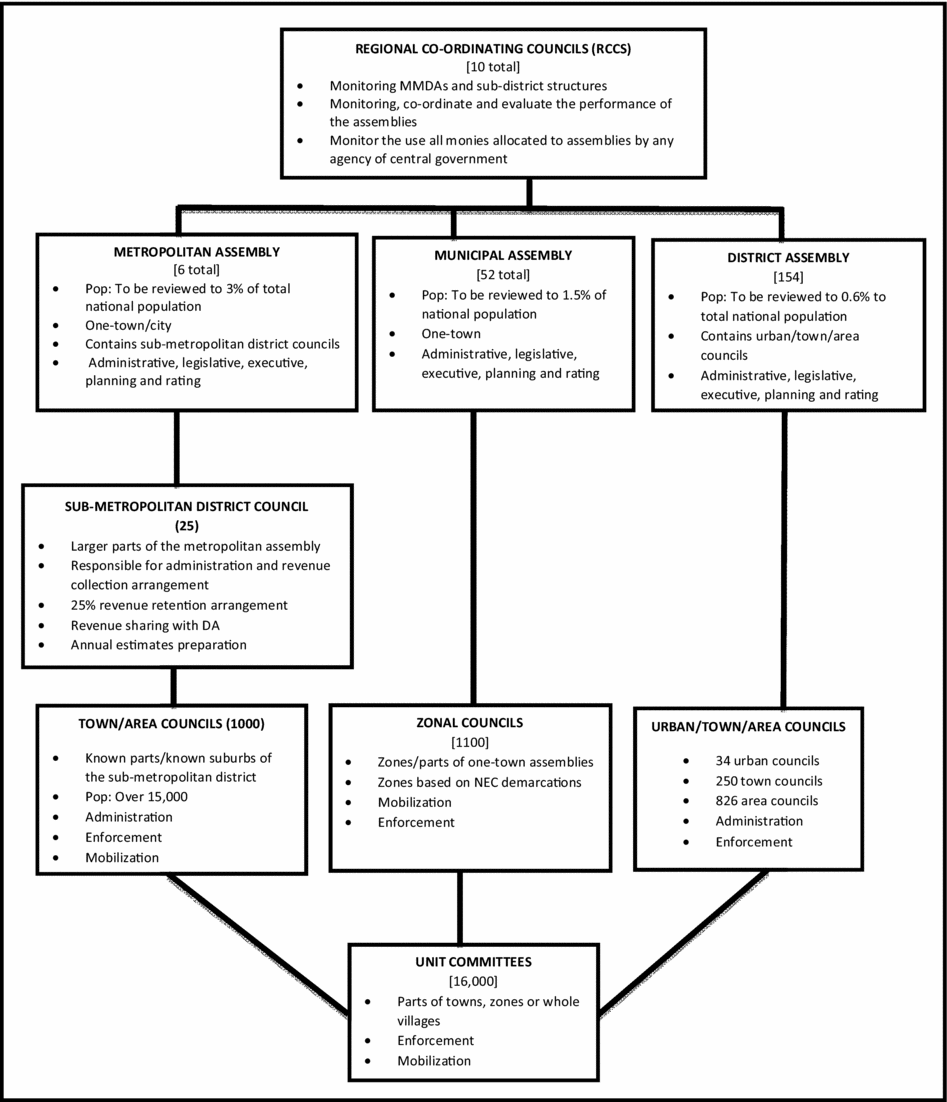
Ghana is a unitary state whose government is structurally organized into four layers: national government, including line ministries and de-concentrated entities; ten regions with Regional Coordinating Councils (RCCs) responsible to the centre; 215 Metropolitan, Municipal and District Assemblies (MMDAs); and sub-district structures – urban, zonal and town councils, and unit committees (see Figure 1). The MMDAs constitute a hybrid form of decentralized authority, combining elected and appointed officials; 70% of MMDA members are elected by universal adult suffrage and 30% are nominated by the president. The Chief Executive, the political head of the district, is nominated by the president and subject to approval by two-thirds of the MMDA members present and voting (Ayee, Reference Ayee2013).
The local government structure and responsibilities

Below the MMDAs come several sub-district structures, which operate at three levels. First, the Metropolitan Assemblies are divided into sub-metropolitan district councils. Second, there are Urban Councils where populations are greater than 15,000 and Town Councils where populations are between 5,000 and 15,000. These councils are not elected bodies. They are composed of representatives from the District Assemblies and Unit Committees (UCs) as well as representatives of the Metropolitan/Municipal/District Chief Executives (MMDCEs). They promote citizens’ participation in planning, implementation, and monitoring of local services. Unit Committees cover both urban and rural areas. Their members are partly elected (ten elected members) and partly appointed (five members are appointed by the MMDCE).
Within the structure, District/Municipal/Metropolitan Assemblies (MMDAs) appear to be the most ‘influential’ as they are entrusted with wide political and administrative authority at the local level (Gyimah–Boadi, Reference Gyimah-Boadi2009). For example, Section 10 (5) of the Local Government Act 462 stipulates that all programs and projects, including those approved under the District Development Plan and other development programs by government ministries and departments and non–governmental organizations, are supposed to be coordinated and executed by/or under the supervision of the MMDAs. They also have responsibility for 86 functions, sole control over certain public services, and the prerogative to make decisions regarding some executive and policy issues (Gyimah–Boadi, Reference Gyimah-Boadi2009).
Despite having these powers, in reality local governments seem to be controlled and used for various political maneuverings by the central government (Antwi–Boasiako, Reference Antwi-Bosiako2010). For example, the autonomy of local authorities is atrophied by the Local Government Act 462, which gives the President the authority to appoint 30% of its membership (Gyimah–Boadi (Reference Gyimah-Boadi2009). This, critics argue, encourages allegiance of Presidential appointees to the central government and their political parties, rather than to the local people (Antwi–Boasiako, Reference Antwi-Bosiako2010).
The RCCs are entities in Ghana's 10 administrative regions with delegated authority to coordinate and harmonies district-level development. They monitor, coordinate, and evaluate the performance of the MMDAs and report to the centre (Ayee, Reference Ayee2013).
Methodology
The empirical basis for the study is content analysis of published documents and 200 interviews (made up of 30 non-elite interviews and ten elite interviews for each of five districts). The sample for the non-elite interviewees in each district was derived using a random sampling method. A list of households generated by the Ghana Statistical Service was used as the sampling frame for the selection of the communities and households in each district. In addition, ten elite interviews each were conducted with functionaries of local governments in each district. The respondents were selected because of their responsibilities connected with the design and implementation of the decentralization policy. These included the District Coordinating Director (chief bureaucrat of the local government), District Finance Officer, District Planning Officer, and two councilors. Two district assemblies from the northern part of the country and two from the southern part were chosen. The fifth district, Tamale Metropolitan Assembly, was selected because it had existed for a long time prior to the elaborate decentralization program that was launched in Ghana in 1988 and invigorated in subsequent years. It is therefore expected to have a rich store of information, experience, and lessons about how decentralized government works. The choice of the first four councils were dictated by the desire to ensure regional balance and by the fact that access and participation of respondents had to be negotiated, and these factors varied from district to district. The cases are Sisala East District Assembly (SEDA) and Sisala West District Assembly (SWDA) – both created from the former Sisala District Assembly (both rural areas in the northern part of Ghana) – and Ga East District Assembly (GEDA) and Ga West District Assembly (GWDA) – both from the former Ga District Assembly (both largely pre-urban areas in the south). This paper, therefore, examined the relationship between decentralization and participation based on evidence from two rural areas, two pre-urban areas, and one urban area.
Evidence of citizen participation in local government
The literature predicts that decentralization will lead to popular participation of local people in matters that concern them (Blair, Reference Blair2000; Ribot, Reference Ribot2002). This supposition was tested against the evidence. The indicators of participation that were applied are for example: transmission of information of councilors to electorates, frequency of meetings between councilors and electorates, community input into the district planning process, and voter turnout at local government elections, as well as the manner of choosing the political head and councilors of a local government.
Transmission of information by councilors to electorates
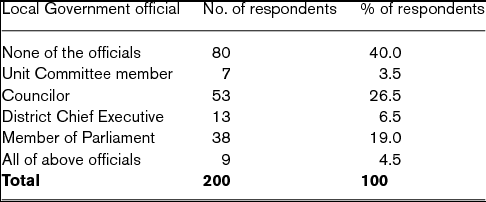
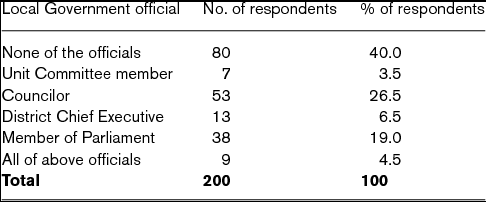
A local government as a whole is mandated by the Local Government Act, 1993 (Act 462) to be accountable to the local people on its actions to improve their lot. But the councilor, as the direct representative of an electorate, has a direct and much greater responsibility in keeping his constituents informed about the decisions and actions being taken to address their needs. He/she does this by not only collecting, collating, and presenting their views and concerns to the council but also relaying back to the constituents the policies and decisions of the local government. This opens the window of opportunity for local people to participate in local government affairs. The councilor's performance in terms of keeping the electorates informed of council activities was measured against the performance of other functionaries. Respondents were asked to state which council officials usually kept them informed about the decisions and development activities of the local government (see Table 1).
Respondents' sources of information
Sources: Field worksheet, 2014.
Table 1 shows that a greater proportion of the people (40%) get no information at all from their local government officials. However, 26.5% did indicate that they got information from their councilors, with 19% intimating that they are kept informed by their member of parliament. Only 6.5% of the respondents got information from the district chief executive – the political head of the district. The low level of information flow between local people and their government is indicative of low participation in local government affairs. This is inimical to the emergence of a vibrant local democracy and good governance because citizens are not fully informed of government activities and decisions so they cannot criticize them or make suggestions for their modification, which is essential for enhancing accountability, transparency, and responsiveness of local governments to the needs of their people (Ayee, Reference Ayee2013).
Frequency of meeting between councilors and electorates
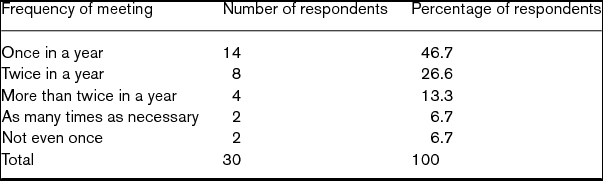
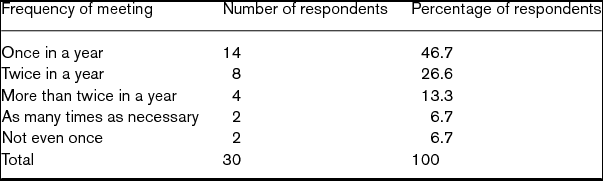
Section 18 of the Local government Act, 1992 (Act 462) and the Model Standing Orders for Local Governments issued by the Ministry of Local Government and Rural Development (MLGRD) under the authority of Section 18 (6) of Act 462 provide that local governments meet at least three times a year, excluding the inaugural meeting. This means effectively that a councilor who is up and doing will afford his/her people the opportunity to participate in local government decision making process by meeting them at least six times a year – once before each scheduled council meeting and one after each session. The responses from 30 councilors (six from each local government case study) are represented here (see Table 2).
Frequency of meeting between councilor and electorates
Source: Field Worksheet, 2014.
The table shows that majority of the councilors (46.7%) met with their electorates once a year, with 26.7% intimating that they met with them twice year. This means that none of the councilors met their electorates half of the required number of times. A majority of the councilors blamed the difficulties of juggling their full time jobs with representation work (which does not attract pay) for their inability to frequently meet with their constituents.
This means local people are neither regularly updated on local government policies and programs nor have the opportunity to have an input into council deliberations.
Respondent councilors were further asked about the nature of the issues discussed at their meetings with the electorate. Eighty five percent of them said the bulk of the issues discussed were problems of underdevelopment, such as lack of portable water and sanitation facilities, schools and clinics as well as poor state of roads, lack of agriculture inputs. Further, the councilors were asked to state how they had addressed the underdevelopment problems of their constituencies. An overwhelming 89% indicated that they could not address even one tenth of the repertoire of problems because of lack of funds, which was blamed on defaults on intergovernmental transfers, meagerness or delay in the release of external grants, and the dwindling of local governments’ own sources of revenue generation. However, one councilor from the Sissala West District said, ‘I was able to provide a six unit block of classrooms for primary school children who were studying under trees.’ He said the identification of the school as a felt need and its construction was done in a bottom-up manner that involved the local people in all the processes. The head teacher of the school confirmed the councilor's claim, agreeing that ‘the provision of the school block was done in a participatory fashion and this has enhanced the teaching and learning processes’.
Community input into district planning process
The National Development Planning System Act, 1994 (Act 480), through the guidelines provided by the National Development Planning Commission (NDPC), required that the District Medium Term Development Plan (MTDP) be designed in a participatory manner. The guidelines require the collection of disaggregated data in consultation with relevant stakeholders, including traditional authorities, civil society organizations, and sub-district councils as well as communities. It also requires the holding of periodic meetings to build consensus on issues (NDPC, 2003). In essence, district planning authorities are required to consider the views expressed by all stakeholders especially their views at the hearing before the adoption of the proposed district development plan (Section 3 (10 of Act 480).
To determine whether the MTDP was designed in a participatory fashion, respondents were asked a number of questions. First, respondents were asked whether they have ever attended public hearings on the MTDP. A majority 72% of the respondents answered in the negative, with the minority 28% saying they had. Those respondents who had never attended such hearings could be presumed to have had either no interest or opportunity or capacity to engage. So a question was then asked whether those who had never attended such hearings were willing to attend if they were given the opportunity. A majority 38 interviewees (90.4%) out of the 42 respondents intimated that they were willing to attend if they were given the opportunity. The remaining four respondents (9.5%) indicated their unwillingness to attend even if they were afforded the opportunity did not cite lack of interest as a reason. The reasons for their unwillingness to attend included lack of capacity to engage meaningfully, the conviction that their input would not be reflected in the final policy document, and suspicion of the local government's inability to translate well-designed policies into outcomes.
The elite interviews with local government officials confirmed some of the reasons for the lack of interest in and unwillingness of the local people to participate in public affairs. For example, the planning officers across the five case study districts said poor participation was not due to lack of interest or unwillingness to engage, but rather lack of ample opportunity to engage. They cited financial, logistical, human resource, and timing challenges for the poor participation rates at the hearings. For example, out of the five district planning officers interviewed, only two had documents indicating dates when such hearings were held at various zonal levels, the concerns raised, and how they were addressed. The other three officers had no such records because the hearing activities were neither designed nor executed due to resource constraints.
Those respondents (48%) who had opportunity to attend the hearings said the dialogue sessions were designed for the people to either endorse or reject proposals presented to them by the local governments. They intimated that the forums were not spaces where genuine attempts at contesting ideas, shifting positions, and making comprises, as well as agreeing together courses of action, could be forged.
Elections and selection of representatives
Participation is one of the building blocks of local governance and democracy. Bowman and Hampton (Reference Bowman and Hampton1983: 16) share this view when they assert that ‘the strongest argument for local government as a democratic institution is on grounds of participation’. Indicators of participation are expressed in such activities and values as more elections, more elected members, and more political choices (Bowman and Hampton, Reference Bowman and Hampton1983: 10).
In respect of the study districts voter turnout, and power to select councilors are two key defining factors of what participation may mean. These elements are now discussed in turn.
Voter turnout
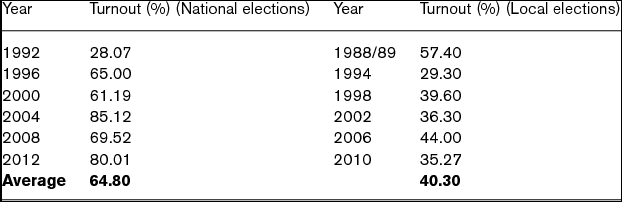
Despite the fact that local government elections have been conducted regularly, most Ghanaians do not vote when given the opportunity. This is evidenced by the poor voter turnout nationwide in the six consecutive elections held in 1988/89, 1994 1998, 2002, 2006, and 2010. These contrasts sharply with turnout at national elections (see Table 3).
Comparison of voter turnout at national and local elections

Sources: Electoral Commission of Ghana (2010).
As the figures show, apart from the first local election held in 1988/89 which recorded a voter turnout of 57.4% (which outperformed the dismal participation rate in the first national election in 1992 of 28.07%), all subsequent turnouts were far lower than those of national level elections. For example, compare the 85.12% national election turnout in 2004 with that of the local in 2002 of 36.30%. The average turnout for the six consecutive national elections between 1992 and 2012 was 64.8%, which is far higher than the local election average for six consecutive elections from 1988/89 to 2010 of 40.3%.
The voter turnouts at the local elections in the case of the study districts appear to mirror the picture countrywide in the said six consecutive elections For example, the turnout in GEDA was 13.8% in the 2006 elections and this dropped to 8.7% in the 2010 elections. For GWDA, the turnouts were 15.8% and 16.8%, with TAMA recording 38.1% and 36.2% in the 2006 and 2010 elections respectively. The figures for SEDA were 68% and 62.9%, while those for SWDA were 55% and 68% respectively. The higher participation rates of SEDA and SWDA is explained by the greater trust the residents there have in government in delivering goods and services compared to their counterparts in GEDA and GWDA. This differential trust in the jurisdictions is highlighted by the comments of two respondents. A resident of SWDA acknowledged that when the ‘government promises it delivers on the promise’. In contrast, a resident of GEDA complained that, ‘local government failure is eminent because garbage is left uncollected for weeks and intra city roads among others are deteriorating beyond repair’. The decline in trust in public institutions is acknowledged in the literature, with levels of trust often lowest for political representatives (Bouckaert and Van de Walle, Reference Bouckaert and Van de Walle2003). Declining trust in public institutions has troubled governments which worry that low levels of trust may be bound up with falling democratic participation, a reduced willingness on the part of citizens to be engaged in other civic activities, and wider problems of governmental legitimacy (Pharr and Putnam, Reference Pharr and Putnam2000).
The factors that influence the low voter participation rates in local elections, as adduced by respondents, are demographic characteristics (age, level of education, and religiosity), psychological characteristics (interest in politics), and system characteristics (voluntary voting, Sunday voting, separate dates for national and local elections). In terms of demographic characteristics, respondents in the age bracket 25–60 years and above (76%) tended to vote more regularly than those in the range of 18–24 years. This finding is consistent with the works of other scholars who found a significant impact of age on electoral participation (Topf, Reference Topt, Klingermann and Fuchs1995; Oprenhuis, Reference Opprenhuis1995).
Some respondents (51%) also attributed electoral participation to interest in politics and noted that those who have low interest in politics tend to vote less regularly. This evidence confirms Oprenhuis’ (1995) finding that interest in politics and strength of party attachment, impacted turnout relatively strongly in the 1989 European Parliament elections.
An overwhelming majority of interviewees (89%) believed that the non-concurrence of national elections with local elections and the voluntary voting system in Ghana are largely to blame for the low turnout. For example, an electoral officer said it is reasonable to believe 'holding national elections (with higher turnout) and local elections (with lower turnout) on the same day will increase local ballots cast almost immediately to levels equivalent to the figures for the national’. By scheduling local elections to coincide with national elections, he added, ‘it becomes almost costless for voters who participate in national elections to also vote in local elections by simply checking off further the ballot’.
The low voter turnout in local elections is disturbing in at least two important respects. First, there is good chance that elected officials and the policies they develop will tend to serve only a small proportion of the population (Hajnal and Hills, Reference Hajnal and Hills2002). Second, the emergence of a democratic citizenry is undermined because local people are not engaged and empowered in the larger democratic process and they do not believe in their own political efficacy (Oliver, 2001).
Representation
Chapman (Reference Chapman1995: 20) argues that ‘representation of local community views and their incorporation into policies at the local sphere is an essential part of recognizing councils as government bodies’. In terms of representation, the findings are a mixed bag. Two of the five study districts showed modest increases in the numbers of electoral areas following decentralization. In GEDA, the number of electoral areas and elected representatives increased from less than 18 to 25, while the corresponding figures in GWDA were from 14 to 19. However, the figures for SEDA and SWDA tumbled from 25 to 21 for the former and 26 to 21 for the latter. For TAMA, the number of electoral areas and elected representatives increased from 54 to 64. This evidence implies that the effect of decentralization on representation is not uniform because of the size and uneven spreads of the population, which does not allow representatives to be drafted from all over a municipality.
However, the increase in electoral areas and representatives has not been matched by a corresponding increase in quality, balance, and outcomes of representation. Low quality of representation is a function of low education, skills, and knowledge of councilors. This militates against the effective functioning of councilors as representatives of the people. This is confirmed by a SWDA councilor who decried that ‘it makes it difficult to assign councilors with relevant expertise to the different committees of the local governments where most of the in-depth deliberations take place’. The chief bureaucrat of GWDA agrees when he asserted that, ‘the low level of education robs councilors of substantive expertise in sectoral policy making’. This evidence corroborates Boon and Meilby's observation that mere participation does not necessarily mean equal consideration of the ideas, equal influence, or equal satisfaction of all participants (Boon and Meilby, Reference Boon and Meilby2000). As result, a majority, 68% of the respondents, are aggrieved that local government policies and programs do not reflect and address the aspirations and needs of the local people.
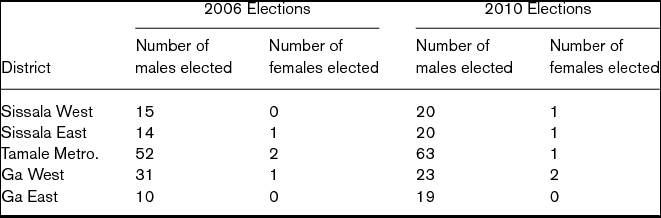
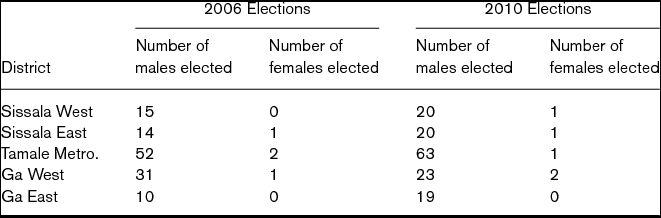
In respect of balanced representation, highly educated and professional people dominated both the appointed and elected members of the case study districts, while the poor, disabled, and women, as well as people from rural areas, were grossly under represented. The gender composition of elected representatives in the 2006 and 2010 local government elections in the study districts confirms the gender imbalance (see Table 4).
Gender composition of elected councilors, 2006 and 2010 elections
Source: Electoral Commission of Ghana (2010).
Reasons for the negligible representation of women by respondents included inability to implement gender-sensitive decentralization policy, low educational attainment and lack of access to economic resources, and cultural perspectives and practices. For example, in respect of gender-sensitive decentralization policy, one elite respondent said, ‘although there is a government directive to reserve 50% of appointed membership for women, this is not enforceable’. Thus, the negligible elected female numbers cannot be augmented by the appointment window. This offends Mukhhopadhway's (Reference Mukhopadhway2005) view that decentralization is a political project and to realize its objectives it demands ‘strategies to mobilize voice of subordinate groups in society and the forging of institutionalized spaces for participation and accountability’ (Mukhhopadhway, Reference Mukhopadhway2005: 11). In other words, Ghana's decentralization policy lacks affirmative action provision and it is not gender-sensitive enough to compel an increase in women's representation. This is in contrast to the situation in countries such as Uganda, Tanzania, and South Africa that have legislated 30% seats for women (Mukhopadhway, Reference Mukhopadhway2005).
The findings also showed most of the electorates in Ghana prefer women representatives who have higher educational attainment. This evidence is consistent with Crook and Manor's (Reference Crook and Minor1998) view that unlike South Asia, West African countries tend to discuss the success of local government in terms of whether ‘high quality’ people were elected and appointed (Crook and Manor, Reference Crook and Minor1998: 280). In the case of Ghana, they found that ‘elected representatives still tended to come disproportionately from the male, educated and professional strata of society’ (Crook and Manor, Reference Crook and Minor1998: 275). This means Ghanaians prefer educated people as their councilors. Medoff (Reference Medoff1986) observed that the general educational attainment for women influences their support for a woman candidate. Three of the study districts (TAMA, SEDA, and SWDA) have the lowest female education in the country (GSS, 2008) which explains why women in these districts may not be elected as councilors.
As regards economic resources, most respondents (87%) agreed that vying for a political position involves resources like money and time, which most women and the poor lack. This was acknowledged by the Ghana Gender Assessment Report, which revealed that females experience greater poverty, heavier time burdens, and lower rates of utilization of productive resources compared to their male counterparts (GSS, 2008: 8). The situation is worst in northern Ghana (GSS, 2008), where majority of the case districts are located.
In relation to culture, the traditional notion that the public space is for men while the home is the domain of women precludes the latter from decision-making and the opportunity to speak at public gatherings. While traditionally male politicians can devote their time and energies to politics, women have to split their efforts between domestic and public activities (Mahamadu, Reference Mahamadu2010: 26). Thus, when the cultural perspectives of the role of women in society are infused into the local government system, it will be quite challenging for females to have access to political representation especially at the local level.
A majority 74% of the respondents believe that participation deficits have led to the prevalence and persistence of problems like poverty which affect minority groups. These problems such as domestic violence and high levels of non-attendance or dropout rates of female children at the basic educational level have neither been aired nor deliberated for solutions in these study districts. Because the poor are also not represented, pro-poor spending by the study districts is negligible. For example, a Tumu resident in SEDA, complained that ‘the bulk of the council's capital expenditure goes to the construction of modern administrative offices, staff bungalows, purchase of vehicles rather than the provision of education, health and transport infrastructure that benefit the poor’.
Presidental appointment of DCEs
Article 243 (1) of the 1992 Constitution and Section 20 (1) of the Local Government Act, 1993 (Act 462) empower the President to appoint district chief executives (mayors) for local governments who will then be approved by two-thirds of the councilors present and voting. This study assessed whether the president's nominees were endorsed or rejected by the districts and what implications the outcomes of the ballot had for local political participation.
The president's nominees for GEDA and GWDA were endorsed with at least two-thirds of the councilors present and voting. A majority of the respondents in the two districts (82%) said their local governments are carrying out their developmental activities without hindrance. But one councilor complained that the ‘appointment rather than election of the DCEs has made them more as agents for support mobilization for the president and the ruling party rather than instruments for enticing participation to realize local community aspirations’.
Unlike the overwhelming endorsement of the DCEs in GEDA and GWDA, in SEDA the president's nominee for DCE was rejected. The nominee polled 12 out of 28 votes, representing a 42.8% approval rating, which fell short of the 60% required for approval. The reasons for his disapproval included his perceived incompetence, his disrespect for councilors, and the political pressure on councilors from the ruling NDC party executives at the regional and national levels to endorse the nominee (Osman, Reference Osman2013). Although councilors in SWDA endorsed incumbent President Mahama's nominee for DCE, they failed to do so with former President Kuffour's DCE designate when the then candidate polled the votes of 10 out of the 18 councilors present and voting in 2005.
Complaints about the unsuitability of some nominees have precipitated into open protests, demonstrations, and rejections (Ayee, Reference Ayee2013). The rejection of the president's nominees reminds us that the public wants to be regarded as ‘citizens, whose agency matters and whose right to participate directly or indirectly in decisions that affect them should be actively facilitated’ (Holmes, Reference Holmes2012: 1). Such an ‘approach honors the fundamental principle of a democratic state – that power is to be exercised through, and resides in, its citizens’ (Holmes, Reference Holmes2012: 1).
Presidential appointment of one-third of the councilors
Article 242(d) of the 1992 Constitution states that, 30% of all members of a district assembly (local government) should be appointed by the president in consultation with traditional authorities and other interest groups in the district. Compliance with this provision was investigated in the case study districts. A majority (85%) of the respondents said that the requirement for the president to consult with relevant stakeholders before the appointments are done is not respected, as the president solely makes the appointments. This means local people are excluded entirely from the process of appointing one-third of councilors. This undermines empowered participatory processes which call for ‘relative equity of power and effectiveness, with real opportunities to have a say’ (McCoy and Scully, Reference McCoy and Scully2003: 118).
Discussion
The analysis has shown that although the spaces for participation have been established and expanded following the introduction of the decentralization programme in Ghana, this has not translated into increased citizen participation in affairs that concern them. The level of participation of local citizens was tested in a range of arenas, including transmission of information from councilors to electorates, frequency of meeting of councilors with electorates, community input into district planning processes, elections and representations, president's appointment of DCEs and one-third of the councilors.
With regard to transmission of information from councilors to the electorates, the evidence showed that the process was irregular and was full of gaps which had never been filled despite persistent calls to fill them. Thus, the quality of participation was undermined because most respondents felt that they did not know what decisions had been taken and which projects and programs were being planned for their communities. Brown (Reference Brown, Bomers and Peterson1982) asserts that such information asymmetry and gaps accentuate the power differences between official actors and local citizens, which may restrict the quality or outcomes of participation. Bridgman and Davis (Reference Bridgman and Davis2004) agree, insisting that from the perspective of excluded parties the elements of power and control over decisions remain the core issue of participation.
With regard to the development of the District Medium Term Plans (DMTPs), meaningful participation was not fully realized in the cases studied. In the main, citizen engagement entails a pledge to involve citizens in policy-making via citizen deliberation, with deliberation seeking to furnish government with a detailed understanding of citizens’ viewpoints and values (Abelson et al., Reference Abelson, Forest, Eyles, Smith, Martin and Gauvin2003). On the contrary, the participatory episodes studied here, although supplying information, did not give a good understanding of citizen standpoints and ideals. For example, during the public hearings on the district planning process, local authorities proposed development projects and programmes with associated budgets, land use plans, and timeframes for policy development and implementation. These proposals, as majority of the respondents queried, did not fit with the developmental priorities and agendas of local people.
With respect to elections, participation had consistently been very low. Given that the actions of local government can affect citizens in significant ways, there is a reasonable chance that elected officials and the policies they develop will tend to serve only a small proportion of the population (Hajnal and Hills, Reference Hajnal and Hills2002).
In terms of representation, theory predicts that decentralization will address gender inequalities (Robertson, Reference Robertson2002: 4) and allow for the incorporation of women and minorities in policy decision-making (Van de Walle, Reference Van de Walle2003). The under representation of some groups, such as women, the disabled, and the poor, meant some perspectives on problems such as poverty, inequity, and marginalization could either not reach onto the policy agenda or be given the deserved attention.
Conclusion
Evidence shows that, contrary to theory, formal and informal procedures for participation are inadequate and irregular. Although the spaces for participation have been established and expanded, these are dominated by men with educated and professional backgrounds, as well as the rich and influential with access to power at the center. Women, the poor, and disabled, as well as people from rural peripheries, are excluded from the process. Their exclusion is attributable to a gender-insensitive decentralization policy, lack of socio-economic resources, low educational attainment, cultural practices, and patronage politics.
Deliberation points to the collective examination of issues, sharing of opinions, and building on others’ perspectives, fostering mutual learning, reflection, common ground, and reasoned decision-making. It also permits for the opportunity for new policy options to evolve (CPRN, 2000; Abelson et al., Reference Abelson, Forest, Eyles, Smith, Martin and Gauvin2003). All of these qualities conflict with the mechanisms of participation in the cases studied. For example, discussion documents were rendered in English and not in native Ghanaian languages in the District Medium Term Development Planning process and this affected meaningful participation of those who had no competence in the language. Moreover, the forums were for the local people to either endorse or reject the proposals presented to them by council officials rather than being avenues for contesting ideas and co-making decisions.
Moreover, theory suggests that unlike consultation, participation affords opportunity for participants to have more power over the agenda and eventually the decisions that are made (Phillips and Orsini, Reference Phillips and Orsini2002). However, the evidence suggests government determines the policy issue and how it is framed, and the information that is shared with participants. Yet, with the application of deliberation, engagement affords citizens a chance to exercise more power during the discussion itself. Such discussions allow for myriad perspectives and solutions to be generated naturally, including those not suggested in articulated policy options (Woodford and Preston, Reference Woodford and Preston2011). However, in all the cases and episodes of participation investigated here top-down processes were discernible. Pre-dialogue workbooks and scenarios limited deliberation within the bounds of the local governments’ intent. For example, not all aspects of policy change were explored in the DMTP – how to tackle illegal mining, which is destroying the environment and denying communities from eking a living from the land, was not contemplated in government proposals. Later criticism by the public led to its insertion.
The literature suggests decentralization will enhance democracy and good governance (UNDP, 2002). Yet the appointment of DCEs and one-third of councilors by the President is contrary to this prediction. The local people do not have the opportunity to elect the DCE and he/she is seen as an imposition by the President to whom he/she is accountable rather than to the people. This feeds into the accusation of patronage politics, which is partly responsible for the emergence of political tensions in the country (Ayee, Reference Ayee2013).
The paper concludes that decentralization cannot compel the predicted level of participation unless these structural conditions inhibiting engagement and empowerment of especially marginalized groups are addressed.
About the author
Abdulai Kuyini Mohammed holds a PhD from the University of Tasmania, Australia. He is a lecturer at the Department of Political Science, University of Ghana. His current research areas include public sector reforms in Ghana, Local government finance in Africa, Civic engagement in public policy making in Africa, and Non-governmental organizations and democratic consolidation in Africa.