Discourse plays a critical role in the conduct of political life. Two of the most prominent forms of discourse—religious and secular—have received considerable attention from political theorists, most notably in the long-running debate about the promise of political liberalism and the role of religion in the public square. Although the specific logic of this debate is important to examine, the philosophical merits of the arguments involved often hinge on certain assumptions about the effect that religious and secular discourses might have on the general public. However, to date, these assumptions have passed largely unexamined. Is it true that religious arguments constitute, as Rorty (Reference Rorty2003) would say, a “conversation stopper”? Or are religious justifications interchangeable with secular reasons?
To contribute to this on-going debate, we engage experimental evidence with treatments situated on the issue of assisted dying in the UK. The results show that religious and secular discourses have a variety of important political effects, including an impact on the willingness of participants to engage with, and vote for, prospective candidates for public office. These findings suggest that religious reasons are not necessarily conversation stoppers, but neither are they wholly interchangeable with secular justifications. Rather, the use of religious reasons produces significant distortions in political perceptions among members of the public, with the result that secular arguments are considerably more likely to elicit a positive response.
The article proceeds as follows. First, we set out an overview of the respective literatures on the issue of religious justifications in public debate. Second, we explain the methodology of the experiment, and third, we report on the results of the survey experiment and discuss some of the possible implications.
THE DISCOURSE OF RELIGIOUS ACTORS
Religious actors seek to influence public policy issues using a wide variety of methods. Like other organized interests, the range of strategies employed in this endeavor includes the lobbying of elected officials, utilizing links to political figures and institutions, participation in protests, promoting campaigns, mobilizing their memberships, and engaging in numerous forms of political debate. The use of discourse is central to these activities, providing one of the key means by which religious actors attempt to persuade wider publics as to the merits of a specific position, as well as to challenge and delegitimize points of view that differ from their own (see Hofrenning Reference Hofrenning1995; Knutson Reference Knutson2013).
Academic research into the way in which religious actors engage in the use of discourse covers a diversity of themes. Examples of the breadth of coverage here include religious and secular discourse in Islamic societies (An-Na'im Reference An-Na'im and Moghissi2005; Pfeifer Reference Pfeifer2019), Islamist discourses on human rights (Carle Reference Carle2005), conflicts over evolutionary theory (Silva Reference Silva2018), the discourse of Buddhist nationalist groups (Walton and Jerryson Reference Walton and Jerryson2016), the discourse of South Korean evangelical Christians (Yi et al. Reference Yi, Jung and Phillips2017), religion in Swedish public discourse (Lövheim and Axner Reference Lövheim and Axner2011), abortion discourse in Singapore (Tan Reference Tan2010), the use of religious discourse on the Internet (Karaflogka Reference Karaflogka2002), the rhetoric of the U.S. Christian Right (Jelen Reference Jelen2005; Wilson and Djupe Reference Wilson and Djupe2020), the discourse of conservative Christian groups in the UK (Kettell Reference Kettell2016a; Reference Kettell2016b), as well as religious discourse on sexual rights (Hunt Reference Hunt2010; Thomas and Olson Reference Thomas and Olson2012), assisted dying, and same-sex marriage (Djupe, Lewis, and Jelen Reference Djupe, Lewis and Jelen2016; Kettell Reference Kettell2018).
While fair procedures are an important part of the policy-making process, political theorists also point to the importance of engaging in accessible means of justification for policy positions. Many scholars argue that societies containing a plurality of often irreconcilable worldviews require a common language that all reasonable citizens can use in order to meaningfully take part in democratic deliberation (Rawls Reference Rawls1971). According to this viewpoint, comprehensive doctrines, including some ideological frameworks and religious propositions, are said to be unintelligible to citizens who do not subscribe to their foundational tenets, meaning that a discursive framework held in common (often described as “public reason”) is required to ensure that laws can be justified in terms that citizens can understand and accept (for discussions, see Rorty Reference Rorty2003; Quong Reference Quong2004; Habermas Reference Habermas2006; Sajo Reference Sajo2009; Laborde Reference Laborde, D'Costa, Evans, Modood and Rivers2013; Ciszewski Reference Ciszewski2016).
Critics of this public reason criterion have challenged what they see as the illiberal and undemocratic implications of a conceptual framework that seems designed to exclude religious views from the public square (e.g., Perry Reference Perry2001; Maclure Reference Maclure2006; Chaplin Reference Chaplin2009). Moreover, its parameters remain open to question. Opinions differ as to whether it should apply to all levels of society (e.g., Quong Reference Quong2004) or be restricted to elites in the process of legislative decision-making (Rawls Reference Rawls1971; Habermas Reference Habermas2006; North Reference North2012), whether it should govern underlying motivations for policy choices in addition to their public justifications (see Audi Reference Audi2000; Sajo Reference Sajo2009; Ciszewski Reference Ciszewski2016), and whether the public and private spheres can be conceptually distinguished from each other in the way that supporters of public reason suggest (Bader Reference Bader, Levey and Modood2009). The criteria for deciding what qualifies as a “religious” and a “secular” argument is also up for debate (see Carter Reference Carter1993; Audi Reference Audi2000).
Despite the claims made in these theoretical discussions, empirical research has found little evidence that religious leaders actually use theological rhetoric when engaging in public debate. Indeed, a number of studies have suggested that religious actors engaging in high-profile political deliberations have sought to downplay overtly religious arguments in favor of a discourse grounded in the secular language (see Jelen Reference Jelen2005; Graham Reference Graham2013; Beyerlein and Eberle Reference Beyerlein and Eberle2014; Hunt Reference Hunt2014; Thomas Reference Thomas2014; Kettell Reference Kettell2018; Reference Kettell2019). This is said to provide a more effective means of framing viewpoints and policy positions and of making those arguments potentially more accessible to a wider audience. Such an approach is thought to be especially valuable in societies that have experienced processes of secularization, where religious language may not be well understood nor regarded as a legitimate form of reasoning by large sections of the general public.
EXPERIMENTAL CONTRIBUTIONS
One venue where the reaction to religious and secular rhetoric has been tested head to head is in experimental contexts. These tests were not composed for the purposes of adjudicating debates over public reason, but the results are relevant in that they help us build expectations for how religious rhetoric may be received. Although there are many contexts in which religious communication takes place (for comprehensive reviews, see Djupe and Calfano Reference Djupe, Calfano, Djupe, Rozell and Jelen2019; Djupe and Smith Reference Djupe, Smith, Djupe, Rozell and Jelen2019; Knoll and Bolin Reference Knoll, Bolin, Djupe, Rozell and Jelen2019), we focus on the most relevant context to the public reason debate—issue communication from public officials (or candidates). As noted above, this is the context where many agree that the use of public reason nears the level of moral (although not legal) requirement.
The simplest and oldest line of experimentation has concentrated on the most negative possibility—namely, that people will not vote for a religious minority representing a party that they would otherwise support. The results on this are mixed, changing across time and by the group being examined, but are limited since all of it is situated in the United States. For instance, one study found little bias in FL against a Jewish candidate running to be vice president in 2000 (Kane et al. Reference Kane, Craig and Wald2004), and another found that Republican anger against Mitt Romney's candidacy could be mitigated by more inclusive messages from religious elites (Calfano et al. Reference Calfano, Friesen and Djupe2013b). A study using a list experiment by Benson et al. (Reference Benson, Merolla and Geer2011), however, found substantial bias against atheists and Muslims running for office.
Although there is very little evidence to suggest that majority religious affiliation reduces support in the United States—as majority religious identity tends to signal trustworthiness (e.g., Boas Reference Boas2014; Reference Boas2016; McDermott Reference McDermott2009; Weber and Thornton Reference Weber and Thornton2012) —research has also found that cues and rhetoric signaling a particular faith or religiosity tend to be divisive. “Prayerful consideration” as a decision-making process to run for office has been found to appeal to religious voters, but less to secularFootnote 2 ones (McLaughlin and Wise Reference McLaughlin and Wise2014). Signaling religiosity by a candidate through church attendance has the same effect—dividing the electorate on secular-religious lines (Castle et al. Reference Castle, Layman, Campbell and Green2017)—although there are ways in which candidates can send coded “God talk” cues to religious voters without alienating secular voters (Calfano and Djupe Reference Calfano and Djupe2009). Berinsky and Mendelberg (Reference Berinsky and Mendelberg2005) show that exposure to discredited stereotypes of Jews helped voters see the candidate as liberal (another Jewish stereotype in the United States). Nevertheless, whether using coded or overt cues, each cue effect hinges on available stereotypes, suggesting that religious cue effects are operating on a surface, heuristic level.
However, there is also evidence that people consume religious rhetoric and think through the implications. The most typical is situated in the ingroup—some denominational religious leaders were found to be able to influence the immigration attitudes of members (Wallsten and Nteta Reference Wallsten and Nteta2016). But outside of the ingroup, research has also found that the use of a religious decision-making process grants credibility and trust to religious actors (though not universally), leading to greater adoption of their arguments (Djupe and Calfano Reference Djupe and Calfano2009). Similarly, Djupe et al. (Reference Djupe, Lewis and Jelen2016) found that a religious leader offering a religious justification for denying services to LGBT citizens was granted greater credibility and tolerance by people outside of that religious tradition. Americans are simply not much averse to hearing “god talk”, though the non-religious are slightly more averse than others, suggesting that some populations embrace free speech norms and their right not to be persuaded by it (Evans Reference Evans2018).
The final way in which religious cues influence voting behavior is through identity effects (for a comprehensive review, see Miles Reference Miles2019). Though this literature is quite vast and varied, perhaps the most relevant parts are consistent with a heuristic, social perception approach. Group conflict, real or imagined, triggers positive ingroup feelings and trust as well as negative outgroup feelings and distrust (e.g., Jelen Reference Jelen1993; McDermott Reference McDermott2009; Gervais et al. Reference Gervais, Shariff and Norenzayan2011). More specifically, individuals in the Unite States draw on ideological identity labels to fuel affective polarization without underlying policy coherence (Mason Reference Mason2018). That dynamic is not unique to the United States, of course; voters in the UK demonstrate a link between their religion and party support despite heterogeneous demography and issue positions (Tilley Reference Tilley2015). In this way, identity cues may generate negative, outgroup sentiments regardless of shared political positions.
While identity shapes how individuals see others, that is not the only way in which identity plays a role. In addition, group identity shapes how individuals are seen by society. Groups may develop reputations—such as pious, strong, conservative, or untouchable—in part through social roles that help the reputation spread throughout society (e.g., Ross, Amabile, and Steinmetz Reference Ross, Amabile and Steinmetz1977). Upon repeated interactions approached on the bases of those biases, error-prone stereotypes may harden into reality (e.g., Snyder and Swann Reference Snyder and Swann1978). As noted above, researchers have observed some of these patterns with respect to religious politicians, who have historically gained trust (e.g., McDermott Reference McDermott2009) and conservative credentials (Calfano and Djupe Reference Calfano and Djupe2009) as a result.
Further explorations are warranted, in part because of the ramifications posed by identity effects of these kinds for the public reason debate. In one understanding, identity-based evaluation of candidates is a further layer exacerbating religious divides, precluding debate, and not just stopping it once invoked. But the social perception perspective has a different implication. Public reason is concerned with divides between groups that end democratic processes, but social perception biases are often shared by people across those divides. Therefore, people who share biases are reasoning together based on shared, if flawed, grounds and pose no threat to democratic processes.
THE ASSISTED DYING DEBATE
This paper contributes directly to these debates by empirically testing the effectiveness of religious and secular forms of language centered on the issue of assisted dying. This is a controversial practice that enables terminally ill patients (normally with fewer than 2 years to live) to end their own lives with the aid of a qualified physician or carer. It is an issue that goes to the heart of debates about the relationship between medical technologies, science, and the state. The topic also highlights the political effects of religiosity. Studies have consistently found that people who frequently attend a place of worship, who profess a strong belief in God, and who consider religion to be important in their lives are less likely to express support for assisted dying compared to those who are less or not religious (Verbakel and Jaspers Reference Verbakel and Jaspers2010; Sharp Reference Sharp2016). These findings are mirrored in the UK, where assisted dying remains illegal despite high levels of public support. Although a majority of religious citizens approve of legalization (with attitudes having become increasingly liberal since the 1970s), they tend to be less supportive than citizens who have fewer or no religious convictions (Clements Reference Clements2014; NatCen 2019). The majority of religious organizations (with a few notable exceptions) remain strongly opposed (Kettell Reference Kettell2019).
Despite this, public debate on assisted dying in the UK has been conducted in largely secular terms. While religious actors in support of legalization have deployed theological arguments emphasizing the need for compassion in the face of unnecessary suffering, and while (the more numerous) religious opponents have maintained that killing is prohibited by scripture and that life is a gift from God (and therefore not within the purview of individuals to dispense with as they please), the prevailing discourse has mostly fulfilled the public reason criterion. Campaigners in favor of legalization have typically based their case on arguments grounded in the secular principles of personal autonomy (i.e., the right of individual citizens to live and die in dignity according to their own ethical values) and a humanitarian desire to avoid unbearable and unnecessary suffering, especially given the futility of prolonging medical treatment for an individual who no longer considers their life to be worthwhile. Most religious opponents of assisted dying have framed their objections in a similar way. The principal arguments here include claims that legalization would put vulnerable groups of people at risk (such as the elderly and the infirm), that the greater need is for more resources to be put into palliative care, that legalization would create irresistible pressures to expand the right to die to an ever-wider range of cases (such as mental illness and other non-terminal conditions), and that changing the law would damage doctor–patient relations (on these points, see Verbakel and Jaspers Reference Verbakel and Jaspers2010; Kettell Reference Kettell2019).
Hypotheses
The public reason debate concerns the conditions that enable all members of society to accept the results of the democratic process. If this is couched in a language that they can understand and uses arguments that they can accept, then the citizenry is more likely to view the outcome as legitimate. As such, the most optimistic expectation for the reaction to religious cues in a religiously plural democracy is that they are widely translatable. For instance, people will understand that “sin” is equivalent to “wrongdoing”. Secular arguments will have the same effect as religious arguments, capturing widely held values to which society adheres. We express this as Hypothesis #1: Religious cues will have no significant impact on citizen views about public policy arguments and/or the actor presenting them.
The studies discussed above, however, are not so sanguine about the way in which religious and secular arguments may be received. They suggest two primary ways in which religious rhetoric may intervene in policy debates. In many societies, religious cues accompany strong stereotypes that individuals rely on to make decisions. In the United States, for instance, the active stereotype is that religious actors are conservative (e.g., Djupe and Calfano Reference Djupe and Calfano2009; Castle et al. Reference Castle, Layman, Campbell and Green2017). This heuristic judgment may substitute for processing other available information and, in effect, stop the conversation. That is, even if the religious actor is making a liberal policy argument, the fact that they provide religious cues may send the signal that they are more conservative. Therefore, Hypothesis #2 is that religious cue-givers will be seen as more conservative, regardless of their policy positions.
Two other features of this expectation are notable. First, this heuristic may be widely available and thus may exert sample-level effects—i.e., everyone, on average, may show evidence of this bias. Even though heuristic reliance may distort a policy debate, if it does not distort it unevenly between groups, then arguably the public is reasoning similarly. In this way, public reason requirements are not abridged since groups who do not share the religious or ideological ethos can understand and accept the message similarly to those who do.
An alternate role that religious rhetoric may play is by triggering between-group identity effects. If secular citizens see evidence of religion attached to a policy position, they may reject it as the outgroup, despite evidence that they share a political affiliation or stance (e.g., Tilley Reference Tilley2015; Evans Reference Evans2018; Mason Reference Mason2018). This hypothesis is the principal worry from a public reason perspective. The same may not be true for religious citizens, since secular information is not the same as anti-religious information. Instead, secular arguments are most often seen as areligious arguments that could be produced by a religious or irreligious source. In this way, Hypothesis #3 is that the effects of religious rhetoric should be more pronounced for secular than religious participants.
METHODOLOGY
The test for this study involved a survey with an embedded experiment modeled on a version of a questionnaire used in Calfano, Djupe, and Wilson (Reference Calfano, Djupe and Wilson2013a). Participation was entirely voluntary, and all responses were anonymous.Footnote 3 The experiment was a simple 2 × 2 design that varied: (1) support and opposition to an assisted dying policy, and (2) whether the supporting argument was secular or religious. The composition of the treatment led with a generic image of a fictitious candidate for Parliament—a white woman called “Leslie Smith” who was described as being married, aged 45, and working as a consultant. This description was followed by an expression of her view on the legalization of assisted dying for terminally ill patients with fewer than 6 months to live. This view consisted of one of four randomly allocated statements that were designed to capture the differing religious and secular positions outlined above. For naturalism, the arguments contained in these statements were taken directly from public debates on the issue. These statements were:
(1) Religious, opposing: “Human beings are made in God's image. Life is the greatest gift from God. This prohibits the deliberate ending of a human life, including our own. Legalization would be sinful.”
(2) Secular, opposing: “Research from around the world shows that legalization would endanger the most vulnerable in our society, break the relationship of trust that exists between patients and doctors, and create pressures to expand the right to die to an ever-wider range of cases.”
(3) Religious, supporting: “God calls on us to show compassion. The golden rule of any religion is to help all those in need. Legalization would put these ethics into practice. I believe that it would be sinful to oppose a measure that can reduce human suffering.”
(4) Secular, supporting: “Legalization gives people greater autonomy over their own lives and reduces human suffering. Safeguards ensure that the most vulnerable members of society are protected. Research from around the world shows that legalization produces no adverse social effects.”
Participants were then asked a series of questions about Leslie Smith's qualities as a candidate, including her perceived political orientation (left–right), her degree of religiosity, the extent to which she was considered to be an advocate for personal responsibility, and whether or not participants would consider taking advice from her.Footnote 4 These constitute the primary dependent variables in this study.
We pursue two analytical strategies. First, we look to see whether the treatments produced sample-level differences in perceptions of and support for the candidate. By evaluating the perceived ideology and religiosity of the candidate, we can determine whether religious and secular rhetoric are interchangeable for each policy position. Second, we also assess the possibility that religious and secular participants see the world differently. This entails testing the effects of the treatments, conditional on the religious/secular identity of the participant. As will be seen, the first aim is accomplished by showing the interactions, so in the name of efficiency, we only present the interaction results.
The sample was composed of responses from 332 participants in an introductory Politics class at the University of Warwick, with the experiment conducted during the final (exam revision) lecture to maximize participation. The concern for all samples used in experimentation is external validity—can results found with “college sophomores in the lab” (Sears Reference Sears1986) add to scientific literatures as being suggestive of how representative populations would react? The discussion of student samples has focused on whether there is a crucial variation in the sample, whether the sample looks like the population, and whether students respond like adults. Students have been found, for instance, to have identities that are less stable, belong to social networks that are in flux, have weaker attitudes, possess greater compliance with authority figures and stronger cognitive skills. In addition, they tend to be less religious and less political than the average adult (on these points see, e.g., Sears Reference Sears1986; Kam, Wilking, and Zechmeister Reference Kam, Wilking and Zechmeister2007; Druckman and Kam Reference Druckman, Kam, Druckman, Green, Kulkinski and Lupia2011).
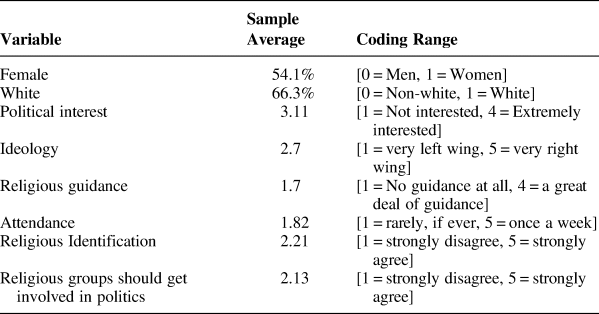
These concerns are largely alleviated by the composition of the sample. The sample was split nearly evenly by gender (54% women), was majority white (66%), moderate on average (2.7 on a 5-point scale), politically interested (3.1 on a 1–4 scale), and not very religious (averaging just below “several times a year” for attendance at a place of worship). These statistics and scale notations are shown in the Appendix (Table A1). This helps to confirm that there is variation in the sample. It is more non-white than the UK as a whole (being 87% white, according to the 2011 census), and, critically, it is roughly as non-religious as the British public—55% of the sample claims the identity “None, nothing, secular” compared to 52% found by the 2019 British Social Attitudes Survey (NatCen 2019). Alongside this, Druckman and Kam (Reference Druckman, Kam, Druckman, Green, Kulkinski and Lupia2011) provide evidence that student samples can respond in similar ways to adult samples on most types of questions, those with both homogeneous (the same across the population) as well as heterogeneous treatment effects. That said, the usual caution should be employed—this is only one study with a sample of limited scope.
The other element of external validity concerns whether the treatment–participant interaction is plausible. If experiments address how the world could be, then a critical question is whether participants could reasonably be exposed to the rhetoric we employ. Alongside the ongoing debate over assisted dying that we discussed above, recent years have seen the emergence in the UK of high-profile political tensions over issues such as the legalization of same-sex marriage and cases of alleged employment discrimination on religious grounds, several of which were ultimately resolved only by the European Court of Human Rights. In this context, participants in the survey were likely to have been exposed to both religious and secular forms of argumentation and were therefore reasonably well-placed to respond to them.
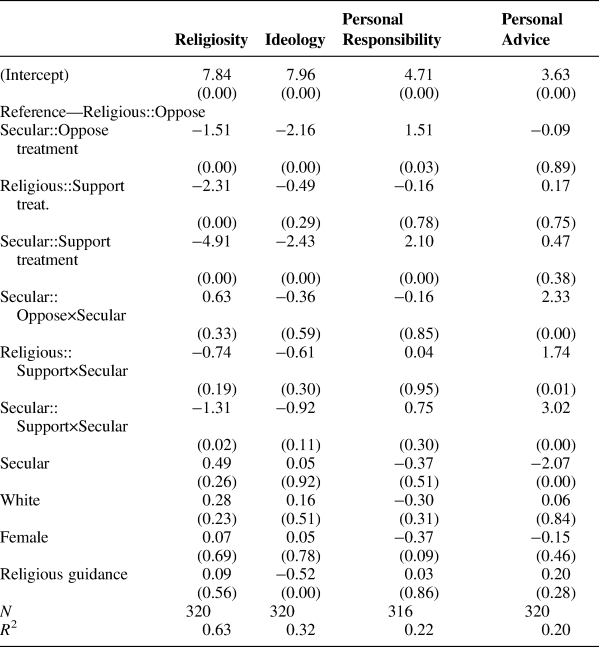
The number of surveys returned varied somewhat by treatment, as one cell (secular, opposed) was returned by fewer participants (64) compared to the others (87, 87, 94). However, this treatment group did not stand out from the others in terms of its demographic composition. On two of three measures, the sample was effectively randomized. There were no significant deviations across treatments on gender (ANOVA, p = 0.80) and pre-university attendance at a place of worship (p = 0.88). There was a significant variation on race and ethnicity (p < 0.01), with white proportions ranging from 0.53 to 0.77. Therefore, the analyses employ models to assess treatment effects which control for these variables to help adjust for treatment composition variation. Tables with full model results are available in the Appendix Table A2. We focus on the figures of the effects of interest—interactions of religious/secular respondents with the treatments—in the text.
In each figure, we translate statistical tests into the equivalent visual representations of uncertainty. That is, while it is commonplace to simply use 95% confidence intervals on all visuals, comparison of multiple 95% intervals is a much more restrictive test than assessing whether a mean difference is different from zero with 95% confidence; it is actually equivalent to a p < 0.01 test (Knol, Pestman, and Grobbee Reference Knol, Pestman and Grobbee2011). Multiple sources recommend translating statistical tests into confidence intervals that mimic the desired test—the non-overlap of two 84% confidence intervals is the equivalent of a single 95% test of significance, such as a t-test (Goldstein and Healy Reference Goldstein and Healy1995; Payton, Greenstone, and Schenker Reference Payton, Greenstone and Schenker2003; Knol et al. Reference Knol, Pestman and Grobbee2011; MacGregor-Fors and Payton Reference MacGregor-Fors and Payton2013).
One final potential issue is the well-known “WEIRD problem”—namely that much scholarly research tends to use participants drawn from countries that are Western, Educated, Industrialized, Rich, and Democratic (Henrich et al. Reference Henrich, Heine and Norenzayan2010), reducing the extent to which their findings can be generalized to wider (‘non-WEIRD’) populations. In this particular case, given that the central terms of the debate about the value of religion and public reason refer to WEIRD countries (particularly in the United States and Western Europe), we did not consider this issue to pose any special difficulties.
RESULTS: RELIGIOSITY
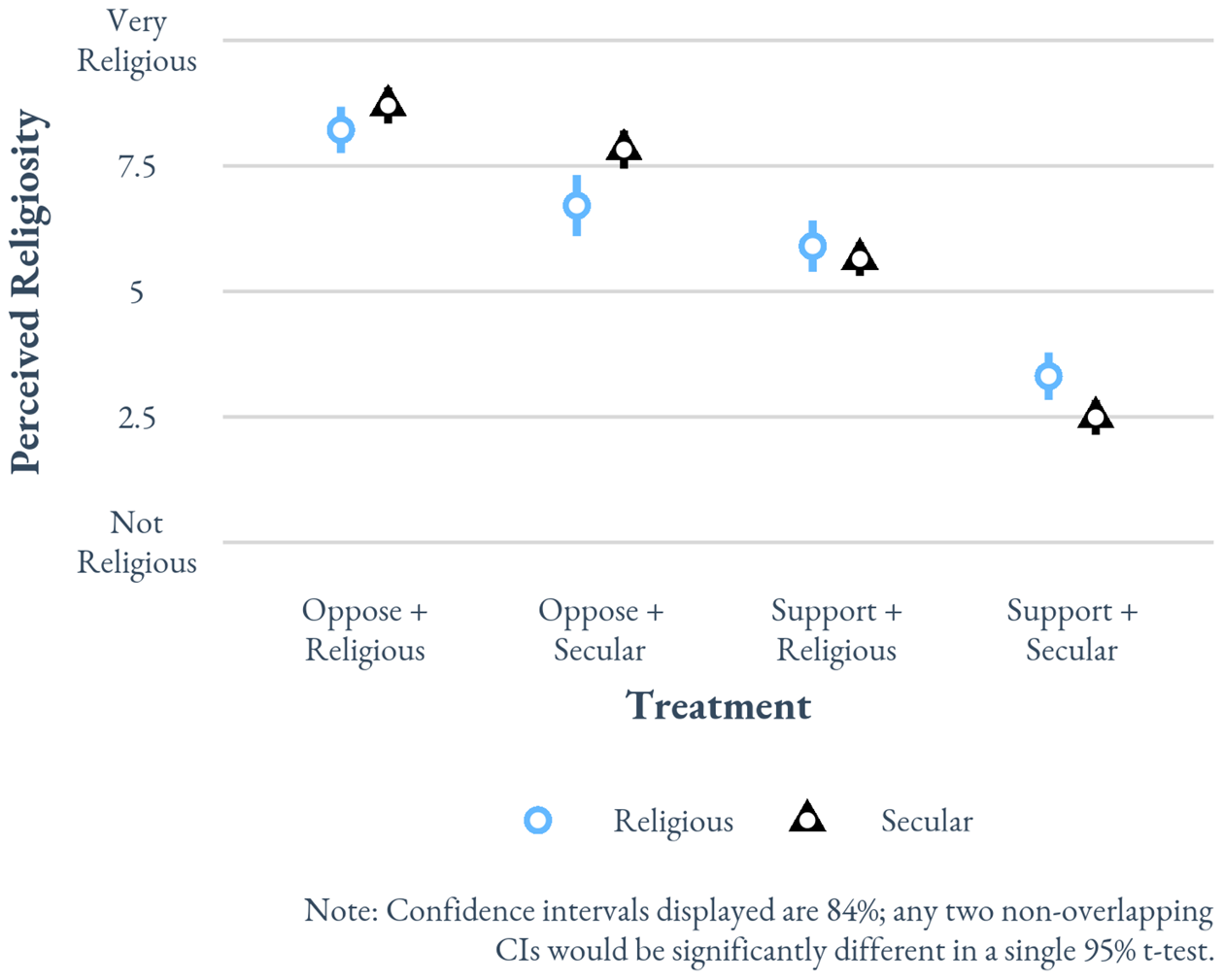
The survey asked participants how religious they thought the candidate was, which could be a straightforward exercise of seeing religious cues in play and attributing them to the candidate. The simple expectation is therefore that the two conditions with religious cues, regardless of position, would be viewed as more religious. However, the results in Figure 1 show something slightly different. It is clear that participants factored in the stance of the candidate—those candidates against assisted dying were viewed as being more religious than those in support of legalization. That is true for both secular and religiously identified participants. There is one significant difference between secular and religious people within the treatments (on the religiosity of the oppose, secular candidate), but the overall pattern is the same. Within each stance, the religious cue-giver is seen as having greater religiosity, though it is almost superfluous for the candidates opposed to assisted dying.
How Perceptions of the Religiosity of an Elected Official Shift with Secular and Religious Arguments Depending on Stance and Religious Identity

Apparently, a conservative stance on what might be termed a moral issue is de facto sending a clear religious signal. That is unexpected when taking a liberal position, so the addition of the religious cue improves their perceived religious identity, though it is still less than what is ascribed to the candidates that oppose assisted dying. Another way to view the results, though, is as a reflection of the extent to which religion is well integrated into the political life of the UK (e.g., Tilley Reference Tilley2015), such that adding a religious argument does not shift perceptions appreciably, especially on the conservative side. This is not the pattern of religion as a conversation stopper.
RESULTS: IDEOLOGY
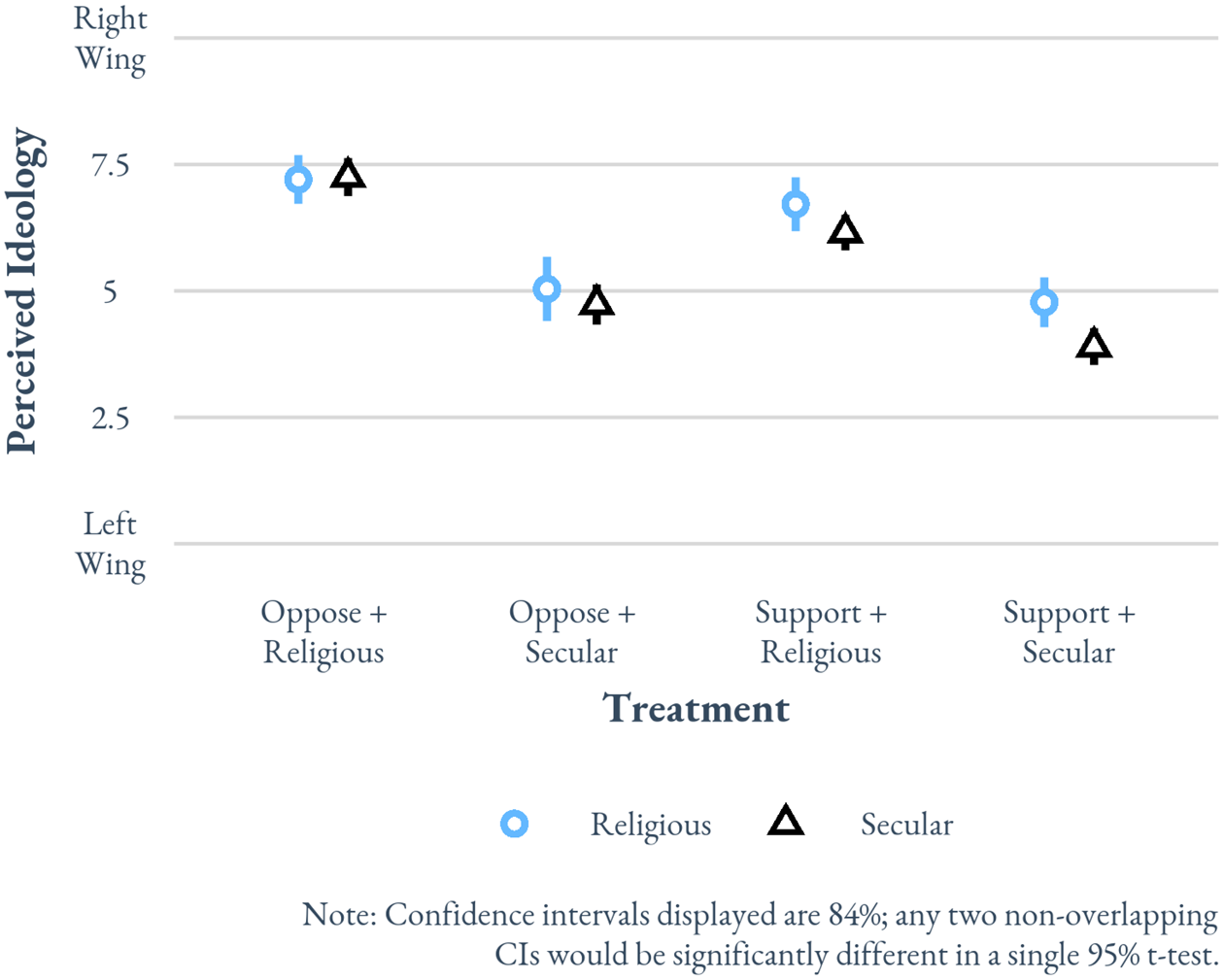
Figure 2 shows the same analysis, but with the perceived political ideology of the candidate as the dependent variable. Simple expectations are that candidates opposed to assisted dying would be seen as conservative (right wing), while those in support would be seen as liberal (left wing). The results, however, suggest some interplay with religious rhetoric. Those candidates using religious rhetoric are seen as being more conservative, regardless of their position. That is, the candidate in support of assisted dying but using religious language is seen as more conservative than the candidate opposed to the policy and using secular language. Still, the issue position does have an impact—among the candidates using religious rhetoric, those opposed are seen as more conservative.
How Perceptions of the Ideology of an Elected Official Shift with Secular and Religious Arguments Depending on Stance and Participant Religious Identification

In this case, it is surprising to note that the observed pattern is not a function of the religious identity of the participant—these are sample-level effects. Religious participants have the same view of these candidates as their secular counterparts. Again, this is not a pattern we would expect if religion were a conversation stopper. Religion appears quite well integrated into public policy decisions, especially on the right. That, of course, poses a problem because religious rhetoric is stereotyped as conservative even when it is justifying more liberal positions. In this way, it could be argued that religion is more of a thinking stopper, because it provides such a powerful heuristic for conservatism.
RESULTS: PERSONAL RESPONSIBILITY
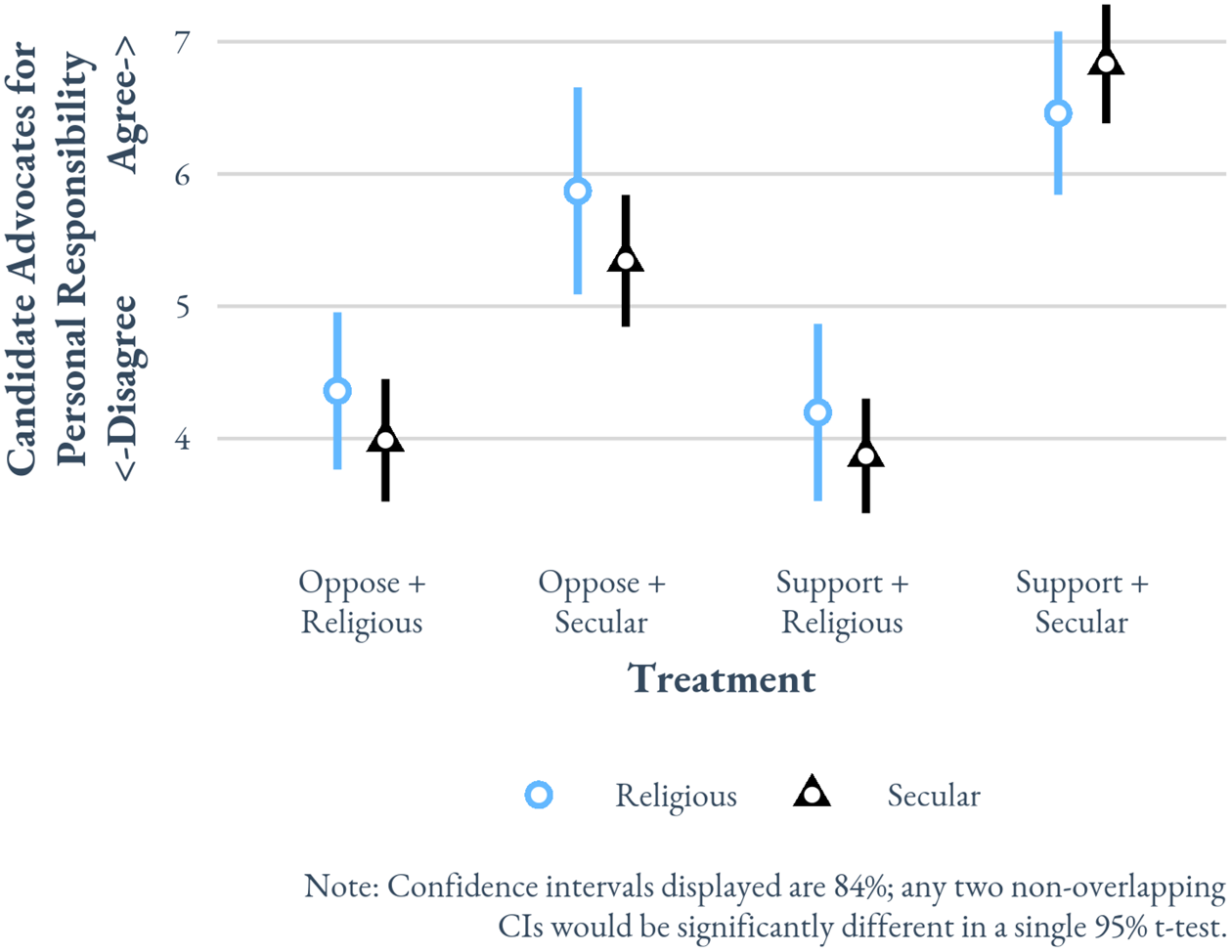
In order to assess what participants meant by identifying the candidates as being right or left wing, we asked them to assess the extent to which the candidate backed a politics of personal responsibility. To us, this signaled that the candidate would be concerned with the individual and individual choices. This might be juxtaposed with a communitarian concern for community standards and the health of the group. Religious groups vary on this dimension, of course, but religion has often been associated with pressing moral standards that are intended to impinge on particular individuals more than others. The treatments do not draw a bright line on this score, but the religious, support condition emphasizes the individual in its rhetoric, which leads us to suspect that the legalization side would be seen as more individual-oriented and the opposing side would be seen as less so.
Figure 3 shows the results that accord with the stereotype of religion as communitarian. Here, both religious rhetoric conditions are seen as being less focused on individual responsibility, while the secular condition candidates are seen as being more focused on it. Religious cue-giving candidates are seen uniformly—religious rhetoric candidates are indistinguishable from each other by both religious and secular participants. The secular rhetoric candidates show more variation. In particular, secular participants see the secular, support candidate as distinguishably more focused on personal responsibility. Religious participants show a pattern suggestive of that same distinction, but that difference is not statistically significant.
How Participants View the Candidate's Ideological Nature Hinges on Rhetoric, not the Participants' Religious Identity

One possible reason for these findings is that religious rhetoric does not lend itself well to expressions of individual rights, though there is ample evidence to suggest otherwise. Thus, even when religious language was used to support the legalization of assisted dying, respondents may have felt as though the candidate was doing this with recourse to communitarian reasons and concerns. From a religious perspective, the moral approach to assisted dying is shaped by notions of divine will—in this case, the view that it would be sinful to oppose measures to alleviate suffering—as opposed to liberal notions of human rights deriving from the individuals themselves. At the same time, however, we emphasize that, even if these findings show a bias in judgment about the specific form of arguments being used by the candidates, both religious and secular participants are reasoning together, and are not being divided by this bias.
RESULTS: TAKING ADVICE
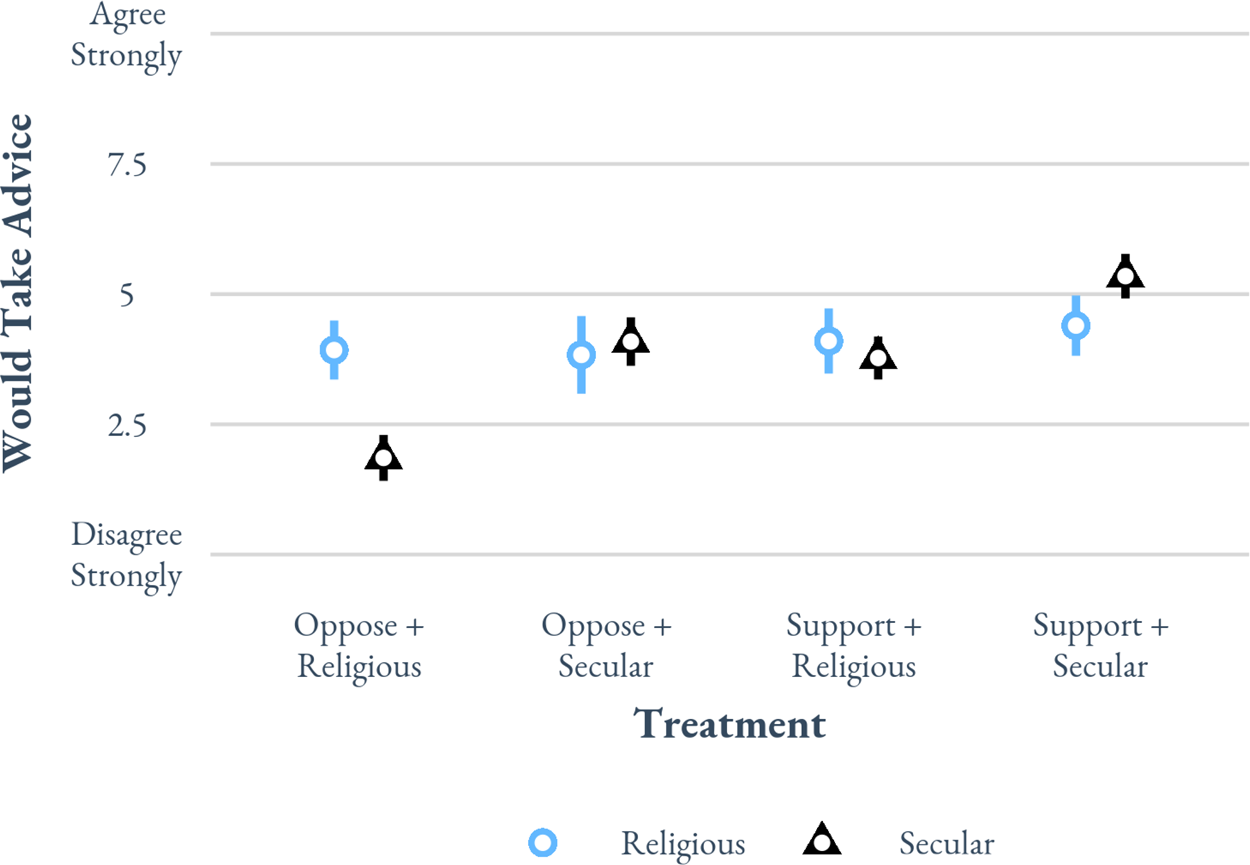
The survey included an item that addresses whether participants would respond positively to information from the hypothetical candidate for public office or would remain closed off to it. More specifically, the question asked, “Other things being equal, I would take personal advice from Leslie Smith.” The offered response options ranged from strongly disagree to strongly agree. Perhaps unsurprisingly, enthusiasm for taking advice from an adult in this sample population was tepid at best. In only one case (secular respondents supporting the secular, support candidate) did the level of support clear 5, the scale midpoint. Still, support was distinguishable among many groups in a similar pattern to previous analyses.Footnote 5
Secular participants show the least support for the religious, oppose candidate, which is to be expected, but their support shows the same fealty to secular rhetoric as before. That is, among the two candidates who share the same position, support by secular participants for the candidate employing a religious argument is considerably lower. Their willingness to take advice from the oppose, secular candidate is numerically (but not statistically) ahead of the support, religious candidate. Religious participants, on the other hand, are indistinguishable from each other. There is some suggestion that they support legalizing assisted dying more than they oppose it, since they show a slightly (but not statistically) higher willingness to take advice from the secular, support candidate than from the religious, oppose candidate.
RESULTS: RELIGIOUS GUIDANCE
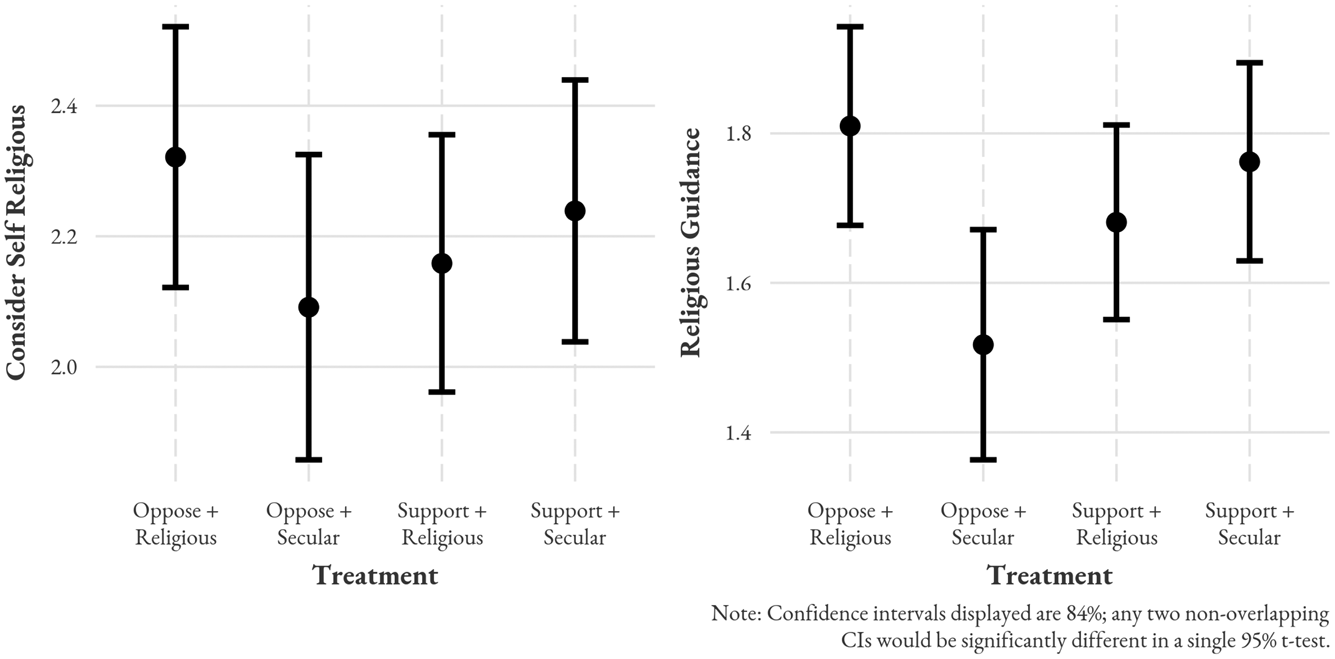
It is possible (if remotely) that reading about candidates taking positions that people may disagree with can change their salient self-reports. As such, we sought to see whether the treatments had an effect on participant religiosity. This is not an ideal design, however, since we do not have prior reports to enable the documentation of the individual change. Instead, we can only assess whether group means vary across the conditions. In an analysis of whether the respondent considers herself to be a religious person (strongly disagree to strongly agree), there is no variation across the conditions (controlling for gender and race—see Appendix Figure A1). However, there is one significant contrast in religious guidance levels between the two oppose conditions. Participants in the oppose, secular condition report lower levels of guidance (p = 0.03) compared to the oppose, religious condition. We do not wish to make too much of this finding since it is not mirrored in other measures, but it does signal that people can be conservative without religion. Guidance in the oppose, secular condition is not distinguishable from the levels seen in either support condition. As a result, guidance was included in each of the other models to guard against mediating effects.
CONCLUSION
Scholars engaged in debates around the use of public reason typically contend that religious arguments should have no role in the processes of democratic deliberation and that political discourse ought to take place using a form of language that all reasonable citizens can understand. This view is predicated upon various assumptions about the nature of religious argumentation, not least being that it amounts to some form of conversation stopper, effectively impeding the possibility of open democratic debate. The results of the study conducted here provide qualified empirical support for these assertions. They show that, while religion is not the automatic bar to conversation that some have made it out to be, the use of religious discourse can nevertheless have a distorting effect on policy debates. There is widespread evidence sufficient to reject Hypothesis #1 that religious arguments are easily translatable and will have no distorting effects on public debate.
One of the key findings affirms the close link between religious cues and the assumption of conservative attitudes. Both secular and religious participants perceived candidates taking a conservative stance on assisted dying (opposing legalization) as being more likely to be religious, and saw candidates using religious rhetoric as being more likely to be conservative, even when they supported a liberal position (changing the law). Critically, however, this pattern does not appear to violate the concerns over public reason since the stereotype is employed by both groups across the identity divide. Distortions in policy debates linked to religion are not problematic as long as everyone understands the language cues in the same way. This supports Hypothesis #2.
Similarly, candidates using religious rhetoric were seen to be more community focused and less concerned with promoting personal responsibility. Differences were also found in terms of the willingness of participants to vote for candidates based on their perceived religious views. Secular participants were more willing to vote for secular candidates and, conversely, less ready to vote for candidates using religious rhetoric, regardless of their policy views; the effects were much more muted for religious participants. This is a problem from a public reason perspective since secular participants are clearly rejecting views based on a stereotype. In contrast, religious participants were influenced more by the candidate's views on the policy issue of assisted dying—the religious and secular cues made little difference to their candidate support (in support of Hypothesis #3). One way to read these results is that religious rhetoric can produce a dampening effect on public responsiveness to policy positions, and that the use of a secular discourse is more likely to elicit a positive result since it is not rejected by the religious and is affirmed by the secular.
These findings have clear implications for religious actors engaged in policy debates, but also for scholars engaged in debates around the use of public reason. Religious language is not considered to be wholly alien, but it has limited power to persuade. Moreover, religious cues produce distortions, but not always in ways consonant with identity conflict. In this sample, participants understood religion to stand for conservatism consistently across the key identity divide. Though not ideal from a deliberative perspective, it is arguably not a problem from a public reason perspective and this insight is a new one in this literature.
It would be wrong to simply assume that religion is a conversation stopper, but further studies are needed into the real-world effects of secular and religious language across issue areas and differing national contexts. In particular, we need to understand the contexts in which religion's involvement in public debate plays these different roles—as a partner, as a heuristic distorter, and as a conversation stopper.
Appendix
Sample Composition Statistics and Variable Coding

VARIABLE LANGUAGE
Dependent Variables

Independent Variables/Controls


• This was collapsed to 0=non-white, 1=white.


• This was collapsed to 1:3=religious, 4:5=secular.
OLS Regression Results Used to Make Manuscript Tables

Treatment Effects on Self-Reported Religious Identity and Religious Guidance

RESULTS: VOTE SUPPORT
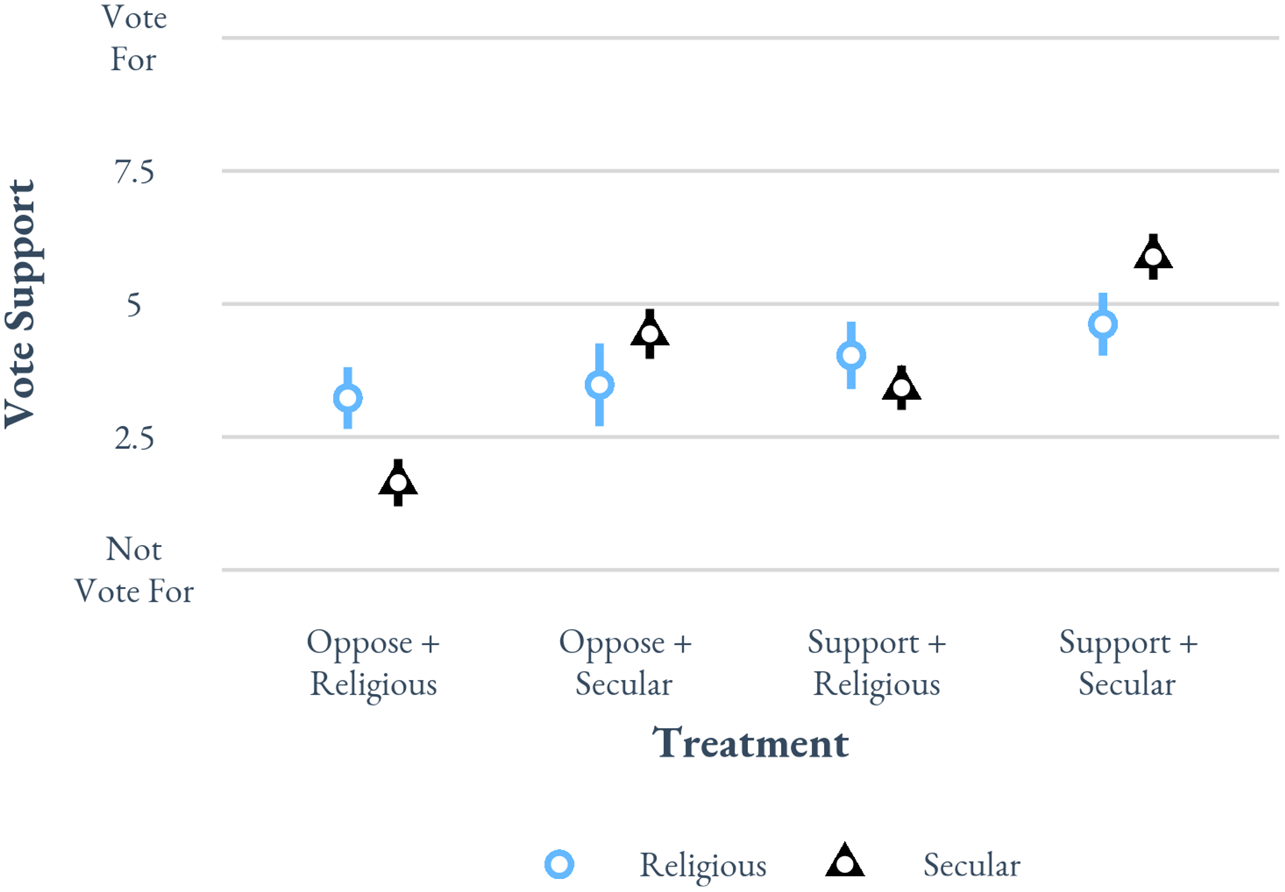
While this is clearly hypothetical, the study also tried to gauge the extent to which participants would offer to vote for candidates if they had the opportunity. Notably, support for any candidate was tepid at best (see Figure A2). In a similar fashion to the results of the analysis of whether respondents would take personal advice from a candidate (see Figure 4 in the main text), there is only one case (secular respondents electing to vote for the secular, support candidate) in which the level of support clears the scale midpoint. The general pattern of vote support follows that presented by analyses discussed earlier.
Prospective Candidate Support by Treatment and Religious Identity

Willingness to Take Personal Advice from the Candidate by Treatment and Religious Identity