Introduction
The latest Ediacaran marks a fundamental biotic revolution in the history of life on Earth. Following the last of the snowball glaciations and a measurable rise in oxygen (Xiao et al., Reference Xiao, Narbonne, Zhou, Laflamme, Grazhdankin, Moczydłowska-Vidal and Cui2016), the Ediacara biota, the first large and morphologically complex eukaryotes, emerged (Laflamme et al., Reference Laflamme, Darroch, Tweedt, Peterson and Erwin2013; Droser and Gehling, Reference Droser and Gehling2015; Droser et al., Reference Droser, Tarhan and Gehling2017; Muscente et al., Reference Muscente, Bykova, Boag, Buatois, Mángano, Eleish, Prabhu, Pan, Meyer, Schiffbauer, Fox, Hazen and Knoll2019). The phylogenetic affinities of the Ediacara biota are controversial, however, they likely represent a diverse assemblage of stem+ crown-group animals, in addition to potential higher-order non-metazoan groups (Xiao and Laflamme, Reference Xiao and Laflamme2009; Erwin et al., Reference Erwin, Laflamme, Tweedt and Sperling2011; Gold et al., Reference Gold, Runnergar, Gehling and Jacobs2015; Dececchi et al., Reference Dececchi, Narbonne, Greentree and Laflamme2017, Reference Dececchi, Narbonne, Greentree and Laflamme2018; Bobrovskiy et al., Reference Bobrovskiy, Hope, Ivantsov, Nettersheim, Hallmann and Brocks2018; Darroch et al., Reference Darroch, Smith, Laflamme and Erwin2018a; Dunn et al., Reference Dunn, Liu and Donoghue2018, Reference Dunn, Liu and Gehling2019).
The latest Ediacaran fossil assemblages are subdivided into three biological assemblages (Waggoner, Reference Waggoner1999; Boag et al., Reference Boag, Darroch and Laflamme2016). The oldest Ediacaran communities from the Avalon assemblage (Liu et al., Reference Liu, Kenchington and Mitchell2015) consist predominantly of the fractally quilted Rangeomorpha (Narbonne et al., Reference Narbonne, Laflamme, Greentree and Trusler2009; Brasier et al., Reference Brasier, Antcliffe and Liu2012; Dececchi et al., Reference Dececchi, Narbonne, Greentree and Laflamme2018), the frondose Arboreomorpha (Laflamme et al., Reference Laflamme, Narbonne and Anderson2004; Dececchi et al., Reference Dececchi, Narbonne, Greentree and Laflamme2017), and the possible sponge Thectardis (Clapham et al., Reference Clapham, Narbonne, Gehling, Greentree and Anderson2004; Sperling et al., Reference Sperling, Peterson and Laflamme2011). The younger White Sea assemblage represents the zenith of Ediacaran diversity and disparity (Droser et al., Reference Droser, Gehling and Jensen2006, Reference Dunn, Liu and Donoghue2017; Shen et al., Reference Shen, Zhang and Hoffman2008; Erwin et al., Reference Erwin, Laflamme, Tweedt and Sperling2011; Darroch et al., Reference Darroch, Sperling, Boag, Racicot, Mason, Morgan, Tweedt, Myrow, Johnston, Erwin and Laflamme2015, Reference Darroch, Smith, Laflamme and Erwin2018a) with numerous sites spread out over a large paleogeographic and paleobathymetric range (Boag et al., Reference Boag, Darroch and Laflamme2016). The White Sea Assemblage includes the first occurrence of metazoans such as Kimberella (Fedonkin and Waggoner, Reference Fedonkin and Waggoner1997; Fedonkin et al., Reference Fedonkin, Simonetta, Ivantsov, Vickers-Rich and Komarower2007) and Dickinsonia (Ivantsov, Reference Ivantsov2007; Gold et al., Reference Gold, Runnergar, Gehling and Jacobs2015; Evans et al., Reference Evans, Droser and Gehling2017; Hoekzema et al., Reference Hoekzema, Brasier, Dunn and Liu2017; Bobrovskiy et al., Reference Bobrovskiy, Hope, Ivantsov, Nettersheim, Hallmann and Brocks2018), in addition to a diverse array of other enigmatic forms (see review by Droser et al., Reference Droser, Tarhan and Gehling2017). The youngest Ediacaran communities are from the Nama assemblage, which underwent a noticeable decrease in the diversity of soft-bodied Ediacara biota (Darroch et al., Reference Darroch, Sperling, Boag, Racicot, Mason, Morgan, Tweedt, Myrow, Johnston, Erwin and Laflamme2015, Reference Darroch, Smith, Laflamme and Erwin2018a), possibly in response to ecological stresses associated with an increase in metazoan ecosystem engineering (Laflamme et al., Reference Laflamme, Darroch, Tweedt, Peterson and Erwin2013; Darroch et al., Reference Darroch, Sperling, Boag, Racicot, Mason, Morgan, Tweedt, Myrow, Johnston, Erwin and Laflamme2015, Reference Darroch, Boag, Racicot, Tweedt, Mason, Erwin and Laflamme2016, Reference Darroch, Laflamme and Wagner2018b), although intervals of ocean anoxia have also been suggested as responsible for driving pulses of biotic turnover (Kimura and Watanabe, Reference Kimura and Watanabe2001; Zhang et al., Reference Zhang, Xiao, Kendall, Romaniello, Cui, Meyer, Gilleaudeau, Kaufman and Anbar2018; Wood et al., Reference Wood, Liu, Bowyer, Wilby, Dunn, Kenchington, Hoyal Cuthill, Mitchell and Penny2019).
The Nama assemblage is typically composed of low-diversity populations of Ediacaran clades such as Rangeomorpha (Rangea; Vickers-Rich et al., Reference Vickers-Rich, Ivantsov, Trusler, Narbonne, Hall, Wilson, Greentree, Fedonkin, Elliott, Hoffmann and Schneider2013) and Erniettomorpha (Swartpuntia, Ernietta, Pteridinium; Narbonne et al., Reference Narbonne, Saylor and Grotzinger1997; Ivantsov et al., Reference Ivantsov, Narbonne, Trusler, Greentree and Vickers-Rich2016), and diverse organic-walled (e.g., Gaojiashania, Wutubus; Chen et al., Reference Chen, Zhou, Xiao, Wang, Guan, Hua and Yuan2014) or weakly biomineralized (e.g., Corumbella; Walde et al., Reference Walde, Weber, Erdtmann and Steiner2019; cloudinomorphs; Selly et al., Reference Selly, Schiffbauer, Jacquet, Smith, Nelson, Andreasen, Huntley, Strange, O'Neil, Thater and Bykova2019; Yang et al., Reference Yang, Steiner, Schiffbauer, Selly, Wu, Zhang and Liu2020) tubular metazoans of controversial affinities (Schiffbauer et al., Reference Schiffbauer, Huntley, Oneil, Darroch, Laflamme and Cai2016). The difficulty with evaluating the proposed terminal-Ediacaran extinction and subsequent Cambrian explosion is the scarcity of biologically diverse fossil localities spanning this interval (Wood, Reference Wood2011; Darroch et al., Reference Darroch, Smith, Laflamme and Erwin2018a; Muscente et al., Reference Muscente, Boag, Bykova and Schiffbauer2018).
Stratigraphic and sedimentological studies of the Kushk Series in the Kushk and Chahmir areas of Central Iran (Vaziri and Laflamme, Reference Vaziri and Laflamme2018; Vaziri et al., Reference Vaziri, Majidifard and Laflamme2019) have resulted in the discovery of over 250 fossil specimens representing a diverse latest Ediacaran assemblage of both soft-bodied and biomineralized fossil taxa (Vaziri et al., Reference Vaziri, Majidifard and Laflamme2018). These deep-water calcareous marine shale deposits preserve: (1) a Nama-type assemblage of cloudinomorphs, Corumbella, erniettomorphs, and rangeomorphs; (2) the youngest kimberellomorphs (Kimberella persii Vaziri, Majidifard and Laflamme, Reference Vaziri, Majidifard and Laflamme2018); and (3) possible sponges (Gibbavasis kushkii Vaziri, Majidifard, Laflamme, Reference Vaziri, Majidifard and Laflamme2018). Here, we provide detailed systematic descriptions for new taxa from this locality, and perform a preliminary paleoecological analysis of diversity, which we compare with contemporaneous and older Ediacaran fossil assemblages.
Geological setting
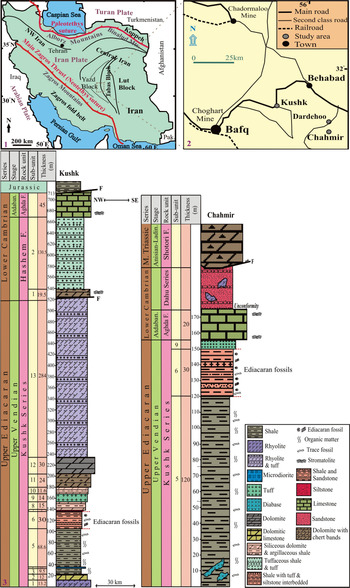
The Ediacaran fossil-bearing beds of the Kushk Series are exposed near lead and zinc mines of the Bafq (Kushk) and Behabad (Chahmir and Dardehoo) regions of Central Iran (Fig. 1; Vickers-Rich et al., Reference Vickers-Rich, Solemani, Farjandi, Zand, Linnemann, Hofmann, Wilson, Cas and Rich2017; Vaziri and Laflamme, Reference Vaziri and Laflamme2018). The Kushk Series is situated between the western margin of the Lut Block and the eastern margin of the Central Iranian Yazd Block, reaching a thickness of 518 m in the Kushk area and thinning to 175 m in the Chahmir area (Fig. 1.1, 1.2). The Kushk Series comprises 13 sub-units that include volcanic rhyolites, microdiorites, tuffs, sandy dolomitic limestones, dolomite, shales, and sandstones that were deposited as part of a homoclinal ramp (Fig. 1.3; Vaziri and Laflamme, Reference Vaziri and Laflamme2018). Fossil beds occur in sub-unit 6 (Fig. 1.3) and can be correlated with the Ediacaran fossil-bearing shales (Lower Shale Member) of the Soltanieh Formation in northern Iran (Stöcklin et al., Reference Stöcklin, Ruttner and Navavi1964; Shahkarami et al., Reference Shahkarami, Mángano and Buatois2017a, Reference Shahkarami, Mángano and Buatoisb). The Kushk mine is located 165 km southeast of the city of Yazd and 45 km northeast of Bafq (Fig. 1). The Chahmir mine is located 128 km east of Bafq and 30 km south of Behabad in Yazd Province. Given the difficulties of protecting Ediacaran-aged fossil sites worldwide, we are withholding providing exact GPS locations of sites. These GPS points will be made available to any Ediacaran research team upon request.
(1) Structural framework of Iran showing major tectonic plates and associated boundaries; (2) the location of study areas in the Bafq and Behabad regions, Central Iran; and (3) stratigraphic section of the Kushk Series in the Kushk (Bafq) and Chahmir (Behabad) areas, Central Iran, showing Ediacaran fossils from the sub-unit 6. Modified from Vaziri and Laflamme, Reference Vaziri and Laflamme2018.

Overall, the Kushk Series consists of a shallow-marine carbonate deposit followed by deep-water calcareous marine shale representing a transgression-regression sequence (Vaziri and Laflamme, Reference Vaziri and Laflamme2018). The 13 sub-units of the Kushk Series represent four main lithofacies within two larger facies associations (Vaziri and Laflamme, Reference Vaziri and Laflamme2018): (1) shallow subtidal facies association (sub-units 2, 7–12; 105 m), and (2) deep subtidal facies association (sub-units 3, 5, 6; 108 m). The basal lithofacies consists of shallow-marine carbonates (thick- to thin-bedded sandy dolomitic limestone; sub-unit 2) deposited as part of a lowstand systems tract (LST), overlain by a thick (108 m) accumulation of fine-grained, thin-bedded, calcareous black shale transitioning into thin-bedded argillaceous gray shale with intercalations of thin-bedded sandstone, pyrite, and tuffs (sub-units 3, 5, 6). It is within these argillaceous gray shales (sub-unit 6) that the Ediacaran fossils were discovered. Specimens were typically collected from float, but when found in situ, were located on the top surfaces of the beds. The absence of evidence for subaerial exposure or shallow-water sedimentary structures, combined with the presence of pyrite within dark-black shales, suggests deposition within a deeper-water basin in an outer ramp setting as part of a transgressive system tract (TST). The subsequent 43 m represents a series of siltstones, tuffaceous shales, siliceous dolomites, and tuffs (sub-units 7–10) suggestive of a shallow, open-marine setting. The final sections (sub-units 11 and 12; 54 m) consist of thick-bedded dolomites with chert bands suggestive of a shallow, open-marine, carbonate-ramp setting deposited as part of a highstand systems tract (HST).
Vickers-Rich et al. (Reference Vickers-Rich, Solemani, Farjandi, Zand, Linnemann, Hofmann, Wilson, Cas and Rich2017) provided a 207Pb/206Pb date (581 ± 8.6 Ma) and a 207Pb/206Pb date (540.7 ± 4.8 Ma) from the fossiliferous sub-unit 6 of the Kushk Series in the Kushk area (Wedge locale) and the Chahmir area (this study), supporting the Ediacaran age of these units. Given the co-occurrence of the terminal-Ediacaran index fossils (Corumbella), our study supports the younger (540.7 ± 4.8 Ma) age for these units, and implies a Nama-assemblage age (ca. 545–539 Ma; Linnemann et al., Reference Linnemann, Ovtcharova, Schaltegger, Gärtner, Hautmann, Geyer, Vickers-Rich, Rich, Plessen, Hofmann and Zieger2019) for the Kushk Series (Vaziri et al., Reference Vaziri, Majidifard and Laflamme2018, Reference Vaziri, Majidifard and Laflamme2019).
Materials and methods
More than 250 fossil specimens were collected over a four-year period (2014–2018). All specimens were washed, photographed, and measured as part of the identification process. The overall majority of specimens were collected from float, but when found in situ, were located on the top surfaces of the beds (negative epirelief).
Rarefaction
We quantified the relative species richness of the Kushk communities, alongside both older and younger Ediacaran communities from Newfoundland, Australia, and Russia, using rarefaction analyses similar to those performed in Darroch et al. (Reference Darroch, Sperling, Boag, Racicot, Mason, Morgan, Tweedt, Myrow, Johnston, Erwin and Laflamme2015). For sampling intensity 1:n (where n = the number of individuals within each dataset), individuals were randomly selected without replacement, and the number of unique species was recorded. This process was iterated 100 times for each dataset, and richness estimates taken as the mean value of all iterations. The distributions of iterated values for each n were also used to calculate 95% confidence intervals around mean values, to allow statistical comparison between localities for any given sampling intensity (i.e., if confidence intervals for two localities do not overlap at any given sampling intensity, then estimated richness at that sample size is significantly different between the two localities). All rarefaction analyses were performed at species level; however, previous studies have demonstrated that community indices using genus-level identification in Ediacaran communities are typically identical (Darroch et al., Reference Darroch, Sperling, Boag, Racicot, Mason, Morgan, Tweedt, Myrow, Johnston, Erwin and Laflamme2015).
Comparative datasets
Comparative datasets were compiled from Newfoundland (‘Avalon’ assemblage; data from Clapham et al., Reference Clapham, Narbonne and Gehling2003); South Australia (‘White Sea’ assemblage; data from Gehling and Droser, Reference Gehling and Droser2013; Coutts et al., Reference Coutts, Gehling and García-Bellido2016), Russia (‘White Sea’ assemblage; data from Zakrevskaya, Reference Zakrevskaya2014), and Namibia (‘Nama’ assemblage; data from Darroch et al., Reference Darroch, Sperling, Boag, Racicot, Mason, Morgan, Tweedt, Myrow, Johnston, Erwin and Laflamme2015). Several of these datasets were modified to reflect more recent systematic work, in particular on the Mistaken Point surfaces from Newfoundland (details given in Darroch et al., Reference Darroch, Laflamme and Clapham2013, Reference Darroch, Sperling, Boag, Racicot, Mason, Morgan, Tweedt, Myrow, Johnston, Erwin and Laflamme2015, Reference Darroch, Laflamme and Wagner2018b). In addition, because a majority of discoidal Ediacaran fossils (including Aspidella) have been interpreted as representing holdfast structures (and moreover, holdfasts than cannot convincingly be tied to any one frondose taxon—see Burzynski et al., Reference Burzynski, Narbonne, Dececchi and Dalrymple2017), Aspidella was excluded. Similarly, Liu et al. (Reference Liu, McIlroy, Antcliffe and Brasier2011, Reference Liu, McIlroy, Matthews and Brasier2012; although see Laflamme et al., Reference Laflamme, Schiffbauer, Narbonne, Noffke and Chafetz2011) have suggested that the Ivesheadiomorphs preserved around Mistaken Point represent taphomorphs of other taxa whose morphology has been decayed and obscured by the growth of microbial mats over carcasses, and so these too were excluded. Lastly, Helminthoidichnites recorded from the Nilpena communities is a convincing bilaterian trace fossil (Buatois et al., Reference Buatois, Narbonne, Mángano, Carmona and Myrow2014), and as such, counts of this ichnotaxon cannot be used to infer the relative abundance of the associated tracemaker. Aulozoon has likewise been claimed as a trace fossil (Seilacher, Reference Seilacher2007; Seilacher and Gishlick, Reference Seilacher and Gishlick2014; although see Buatois and Mangano, Reference Buatois, Mángano, Mángano and Buatois2016). Consequently, both Helminthoidichnites and Aulozoon were also removed from analyses.
‘Single bed’ vs. ‘amalgamated’ communities
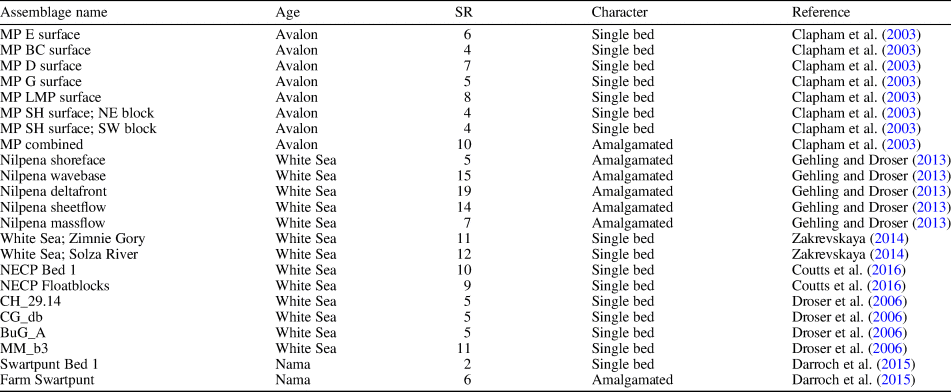
The communities being considered here comprise species-abundance data that have both been compiled from single bedding planes, and amalgamated through multiple bedding planes (referred to as ‘single bed’ and ‘amalgamated’ beds, respectively; see Table 1). Given that all the Mistaken Point datasets are from single bedding planes, we also combined all bedding plane species lists to form an artificially amalgamated assemblage (‘MP Combined’); this allows for more realistic comparisons with our community data from the Kushk Series, which was collected from multiple different bedding horizons. All analyses were performed using the open-access statistical software R (R Core Team, 2019).
Summary of datasets and references used in rarefaction analyses. SR = species richness.

Repository and institutional abbreviation
Type and paratype specimens examined in this study are deposited at the Museum of Earth Sciences, Geological Survey of Iran (GMM), North East Territory in Mashhad, Iran.
Systematic paleontology
Ediacaran fossils have previously been reported from the Lower Shale Member (Chopoqloo Shale) of the Soltanieh Formation from northern Iran (Hamdi, Reference Hamdi1995; Jafari et al., Reference Jafari, Shemirani and Hamdi2007) and deep-marine shale deposits of the Kushk Series in Central Iran (Hahn and Pflug, Reference Hahn and Pflug1980; Hamdi, Reference Hamdi1995). These important discoveries hinted at a diverse assemblage of Ediacaran fossils, which included the original report of Permedusites changazensis Hahn and Pflug, Reference Hahn and Pflug1980, in addition to several characteristic Ediacaran fossils (e.g., Dickinsonia, Pteridinium, Spriggina; however, see below), suggesting correlations with sections from South Australia (Glaessner, Reference Glaessner1984). Although Ediacaran taxonomy and phylogeny are contentious (see review in Laflamme et al., Reference Laflamme, Darroch, Tweedt, Peterson and Erwin2013), recent reinterpretations of the fossil material, combined with new field discoveries (e.g., Vickers-Rich et al., Reference Vickers-Rich, Solemani, Farjandi, Zand, Linnemann, Hofmann, Wilson, Cas and Rich2017; Vaziri et al., Reference Vaziri, Majidifard and Laflamme2018, Reference Vaziri, Majidifard and Laflamme2019), question the validity of these earlier species designations. Most notably, specimens of Corumbella werneri Hahn et al., Reference Hahn, Hahn, Leonardos, Pflug and Walde1982 were incorrectly assigned to Palaeoplatoda, Pteridinium, and Kushkia by Hamdi (Reference Hamdi1995, pls. 60, 61, 64), whereas specimens of cloudinomorphs (Selly et al., Reference Selly, Schiffbauer, Jacquet, Smith, Nelson, Andreasen, Huntley, Strange, O'Neil, Thater and Bykova2019) were incorrectly identified as Yazdia and Spriggina (Hamdi, Reference Hamdi1995, pls. 62, 63). To the best of our knowledge, the revised taxonomic listing below includes all currently known Ediacaran species from the Kushk Series of Iran.
One difficulty with the Kushk material concerns the number of specimens; as such, we have divided the Systematic Paleontology into two distinct sections representing our cautious interpretation of taxa that are currently limited to a single specimen. Given that these fossils are morphologically distinct from all other Kushk specimens, and at times share morphological characters with previously named Ediacaran macrofossils, we took the conservative approach of not erecting new taxa to accommodate these specimens. We also include in this section cloudinomorph specimens preserved as external molds that cannot be attributed to a specific species. It is our hope that continued field studies in this region will aid in bringing clarity to this issue.
Section 1
Multiple-specimen fossils.
Phylum, Class, Order, Family indeterminate
Genus Convolutubus new genus
- Reference Vaziri and Laflamme2018
“unknown tubular organism” Vaziri et al., p. 3, fig. 2f.
Type species
Convolutubus dargazinensis n. gen. n. sp. by monotypy.
Diagnosis
Same as for type species by monotypy.
Etymology
Convolutubus, a combination of Latin Convolutus (ringed), and tubus (tube).
Holotype
Ku/14/09a (type: GMM98-FC-150), Ku/14/08 (paratype: GMM98-FC-151) from the Ediacaran Period, sub-unit 6 of the Kushk Series in the Kushk area (Dargazin), Bafq, Behabad Central Iran. Specimens reposited at the Geosciences Museum of Mashhad, Geological Survey of Iran—North East territory.
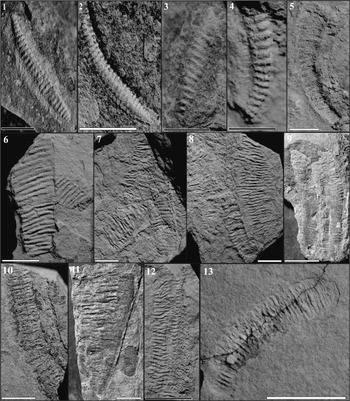
(1–5) Convolutubus dargazinensis n. gen. n. sp. Note that (1) represents the paratype (GMM98-FC-151) and (2) the type specimen (GMM98-FC-150). (6–13) Corumbella werneri. Scale bars = 1 cm (white), or 0.5 cm (black).

Diagnosis
Convolutubus dargazinensis n. gen. n. sp. is a curved cylindrical non-mineralizing tube consisting of a series of closely spaced transverse annulations characterized by a prominent perpendicular lineation. Tube does not branch, divide, or show any surficial textures. Annulations are split by one (perhaps more) prominent perpendicular lateral longitudinal lineation that runs along the entire length of the tube, dividing the annulae into two sections. When present, longitudinal lineation is typically offset from the center of the tube, resulting in annulae of different sizes on either side of the divide.
Occurrence
From sub-unit 6 of the Kushk Series in the Kushk area (Dargazin), Bafq and Chahmir area, Behabad, Central Iran (this study).
Description
Description and measurements based on 16 specimens. Curved cylindrical tube composed of 4–30, straight to curved, parallel prominent elements (annulae), 7–40 mm in length and 2–5 mm in width, which can be preserved in positive or negative hyporelief. Annulae are closely spaced, prominent, and typically sausage-shaped. Running along the entire length of the tube is a distinct positive lineation that divides the annulae in two. The linneation does not appear to be restricted to a specific location within the tube, ranging from medial to lateral locations, likely in response to being oriented in different positions during burial and preservation (i.e., how it was imprinted onto the sediment).
Etymology
Convolutubus dargazinensis (Convolutubus from the Dargazin region of the Kushk area, Central Iran).
Materials
Sixteen specimens; figured specimens Ku/14/08 (paratype: GMM13950F116), Ku/14/09a,b (a = type: GMM13950F113), Ku/14/13, Ku/14/48 and Ch/14/14; from the Kushk (Dargazin) and Chahmir areas.
Remarks
Despite a simple morphology, Convolutubus dargazinensis n. gen. n. sp. can be differentiated from other tubular forms from the latest Ediacaran. Cloudinomorphs such as Cloudina consist of biomineralized funnel-shaped tubes (Conway Morris et al., Reference Conway Morris, Mattes and Menge1990) constructed from nested, repeating, collared cylindrical units commonly referred to as ‘funnel-in-funnel’ structures (or collars), and clearly distinguishable from the non-mineralizing sausage-shaped annulations in Convolutubus n. gen. In Iran, as well as in Namibia, the calcifying tube can be lost during diagenesis, revealing a deep negative impression where the skeleton once was. Convolutubus n. gen. on the other hand leaves a much shallower impression in the sediment, akin to the other soft-bodied Ediacara biota preserved in the region. Funnel- or hook-shaped mineralized (Rajatubulus) and non-mineralized (Saarina and Conotubus) tubes are also distinct. Rugatotheca has a similar curvature to Convolutubus n. gen., however it clearly tapers and is skeletonized (Yang et al., Reference Yang, Steiner, Zhu, Li, Liu and Liu2016). Units in both Saarina and Rajatubulus (Yang et al., Reference Yang, Steiner, Zhu, Li, Liu and Liu2016) include a prominent, overlapping, flared collar that is readily distinguished from the sausage-shaped units in Convolutubus n. gen., while the straight-sided (bent, not curved) Costatubus is constructionally different from the curvature seen in Convolutubus n. gen., and lacks the prominent lineation found in Convolutubus n. gen. Convolutubus n. gen. can be differentiated from Gaojiashania based on the similarity of all tubular units, which are distinctly different from the accordion-like shape with prominent rings separated by depressed “buckets” of Gaojiashania (Cai et al., Reference Cai, Hua and Zhang2013). Multiconotubus is superficially similar, however the conical shape (and cone-in-cone morphology) is unlike the parallel-sided Convolutubus n. gen. (Cai et al., Reference Cai, Cortijo, Schiffbauer and Hua2017). Sinotubulites can be distinguished by its species-specific triangular, pentagonal, and hexagonal cross sections (Yang et al., Reference Yang, Steiner, Zhu, Li, Liu and Liu2016), and by the disorganized nature of the tubular units. Albeit superficially similar, the ribbon-like nature of Shaanxilites readily allows for its distinction from Convolutubus n. gen. (Meyer et al., Reference Meyer, Schiffbauer, Xiao, Cai and Hua2012). Annulatubus (Carbone et al., Reference Carbone, Narbonne, Macdonald and Boag2015) is morphologically similar to Convolutubus n. gen., however it is much larger (width >15 mm compared to <5 mm), while Wutubus (Chen et al., Reference Chen, Zhou, Xiao, Wang, Guan, Hua and Yuan2014) can be differentiated due to the absence of a central positive lineation that divides the annulae and by the prominent tapering at the proximal anchoring site not seen in the Convolutubus n. gen.
Phylum, Class, Order, indeterminate
Family Corumbellidae Hahn et al., Reference Hahn, Hahn, Leonardos, Pflug and Walde1982
Genus Corumbella Hahn et al., Reference Hahn, Hahn, Leonardos, Pflug and Walde1982
Type species
Corumbella werneri Hahn et al., Reference Hahn, Hahn, Leonardos, Pflug and Walde1982 (OSU 46401) from Pantanal, Western Malo Grosso do Sul, southwestern Brazil (Hahn et al., Reference Hahn, Hahn, Leonardos, Pflug and Walde1982, p. 4–9, tables 1–3, figs. 3–5, 9, 11).
Corumbella werneri Hahn et al., Reference Hahn, Hahn, Leonardos, Pflug and Walde1982
Figure 2.6–2.13
Description
Description and measurements based on 108 specimens. Narrow, elongate to slightly curved, ringed, annulated tubes (or ribbons; 5–75 mm long and 1–35 mm in width) with positive prominent rings and numerous narrow parallel longitudinal grooves. Rings appear corrugated, and can be disarticulated or disrupted during preservation. Rings are separated by deep furrows that are depressed and smooth. Annulated rings meet at a central midline; each side is parallel and rings alternate along the midline.
Remarks
The affinities of Corumbella are controversial, and as such we follow the systematic paleontology of Walde et al. (Reference Walde, Weber, Erdtmann and Steiner2019) who, based on taphonomic and ultrastructural studies, inferred a possible annelid (tube-worm) affinity. It should be noted that Hahn et al. (Reference Hahn, Hahn, Leonardos, Pflug and Walde1982) and most recently Pacheco et al. (Reference Pacheco, Galante, Rodrigues, Leme, Bidola, Hagadorn, Stockmar, Herzen, Rudnitzki, Pfeiffer and Marques2015) interpreted Corumbella as a scyphozoan cnidarian, while several authors have also suggested links with conulariids (Van Iten, Reference Van Iten1992a, Reference Van Itenb; Van Iten et al., Reference Van Iten, Leme, Pacheco, Simoes, Fairchild, Rodrigues, Galante, Boggiani, Marques, Goffredo and Dubinsky1996; Ivantsov and Fedonkin, Reference Ivantsov and Fedonkin2002). Babcock and colleagues (Reference Babcock, Grunow, Sadowski and Leslie2005) suggested similarities with the modern Stephanoscyphistoma, and possibly with conulariids, based on the implied squarish cross-section of the tubes.
Phylum, Class, Order, Family indeterminate
Genus Gibbavasis Vaziri, Majidifard, and Laflamme, Reference Vaziri, Majidifard and Laflamme2018
Type species
Gibbavasis kushkii Vaziri, Majidifard, and Laflamme, Reference Vaziri, Majidifard and Laflamme2018 (type GMM98-FC-152; paratype GMM98-FC-153) from the Kushk Series, Chahmir area, Behabad, Central Iran (Vaziri et al., Reference Vaziri, Majidifard and Laflamme2018, figs. 2i, 4). Specimens reposited at the Geosciences Museum of Mashhad, Geological Survey of Iran—North East territory.
Gibbavasis kushkii Vaziri, Majidifard, and Laflamme, Reference Vaziri, Majidifard and Laflamme2018
Figure 3.1–3.3
Holotype
Gibbavasis kushkii (holotype GMM98-FC-152; paratype GMM98-FC-153) from the Kushk Series, Chahmir area, Behabad, Central Iran.
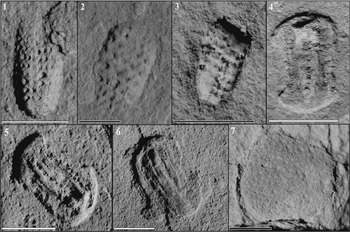
(1–3) Gibbavasis kushkii (1), type: GMM98-FC-152; (2), paratype: GMM98-FC-153. (4–6) Kimberella persii (4, 5), type: GMM98-FC-155; (6), paratype: GMM98-FC-154). (7) Kuckaraukia multituberculata Ch-14-30. Scale bars = 1 cm (white), or 0.5 cm (black).

Remarks
Gibbavasis kushkii was interpreted as a potential sponge by Vaziri et al. (Reference Vaziri, Majidifard and Laflamme2018). The prominent positive-relief bosses are interpreted as a taphonomic inversion of an originally negative pit infilled with sediment, and may have served as an entryway for water currents. Gibbavasis is most similar in construction to the terminal Ediacaran fossil Ausia (also from the Nama Assemblage), however Gibbavasis is an order of magnitude smaller (Gibbavasis typically <0.5 cm compared to Ausia >4 cm) and vase-shaped rather than fan-shaped (Vaziri et al., Reference Vaziri, Majidifard and Laflamme2018).
Class, Order, Family indeterminate
Genus Kimberella Glaessner and Wade, Reference Glaessner and Wade1966
Type species
Kimberella quadrata Glaessner and Wade, Reference Glaessner and Wade1966 (SAM P12734) from the Rawnsley Quartzite, Wilpena Group, Pound Subgroup, Flinders Ranges, South Australia.
Kimberella persii Vaziri, Majidifard, and Laflamme, Reference Vaziri, Majidifard and Laflamme2018
Figure 3.4–3.6
Holotype
Kimberella persii (holotype GMM98-FC-155; paratype GMM98-FC-154) from the Kushk Series, Chahmir area, Behabad, Central Iran.
Remarks
Nine specimens of Kimberella persii allow for an expanded description. It consists of an oval-shaped (rarely cylindrical) form. Outer rim up to 25 mm in length and 5–15 mm in width (at widest point), with clear anterior-posterior differentiation. A prominent central ridge running along the longest axis (7–25 mm long) is divided into multiple individual units, and is bracketed by two parallel-sided smooth furrows (0.5–2 mm in width) on either side, and a smooth marginal zone (width 1–6 mm) that strongly terminates at a distinct marginal rim. Despite a relatively large number of specimens from the White Sea allowing for a detailed description of the morphology of Kimberella (see Fedonkin et al., Reference Fedonkin, Simonetta, Ivantsov, Vickers-Rich and Komarower2007; Ivantsov, Reference Ivantsov2009), the range in expression of the individual characters is large and accommodates the inclusion of Kimberella persii, despite some differences. Kimberella persii includes a shared oval morphology with anterior-posterior differentiation and several zones arranged concentrically. It's size fits nicely within the rather large range of K. quadrata (2–3 mm to 150 mm; Fedonkin et al., Reference Fedonkin, Simonetta, Ivantsov, Vickers-Rich and Komarower2007). The outer periphery bears numerous, radially oriented and equally spaced ridges (“ribs” of Fedonkin et al., Reference Fedonkin, Simonetta, Ivantsov, Vickers-Rich and Komarower2007). The inner zone includes a longitudinal invagination surrounded by well-defined units (regularly spaced “annulation” or “segmentation” of Fedonkin et al., Reference Fedonkin, Simonetta, Ivantsov, Vickers-Rich and Komarower2007). Kimberella persii can be distinguished from K. quadrata by the smooth (rather than crenulated) outer margin (however this is not always present) and the absence of a differentiated probosis or well-defined anterior differentiation (Fedonkin et al., Reference Fedonkin, Simonetta, Ivantsov, Vickers-Rich and Komarower2007).
Kimberella (Kimberia) quadrata was originally described as a medusoid jellyfish from the late Precambrian Pound Quartzite of the Ediacara Hills, South Australia (Glaessner and Wade, Reference Glaessner and Wade1966; Wade, Reference Wade1972). Subsequent investigations (e.g., Fedonkin and Waggoner, Reference Fedonkin and Waggoner1997; Fedonkin et al., Reference Fedonkin, Simonetta, Ivantsov, Vickers-Rich and Komarower2007; Ivantsov, Reference Ivantsov2009) reinterpreted Kimberella as a mollusk-like bilaterian with a high dorsal non-mineralized shell and a retractable proboscis presumably used to feed upon microbial mats (i.e., Radulichnus). The dorsal shield of Kimberella appears to correspond with the periostracum of Mollusca, as seen in monoplacophorans (Fedonkin et al., Reference Fedonkin, Simonetta, Ivantsov, Vickers-Rich and Komarower2007).
Phylum, Class, Order, Family indeterminate
Genus Kuckaraukia Ivantsov, Novikov, and Razumovskiy in Razumovskiy et al., Reference Razumovskiy, Ivantsov, Novikov and Korochantsev2015
Type species
Kuckaraukia multituberculata Ivantsov, Novikov, and Razumovskiy in Razumovskiy et al., Reference Razumovskiy, Ivantsov, Novikov and Korochantsev2015 (PIN 5525/004) from South Urals, Bashkirian anticlinorium, right bank of Kukkarauk Creek; late Vendian, Asha Group, Basa Formation (Razumovskiy et al., Reference Razumovskiy, Ivantsov, Novikov and Korochantsev2015, p. 452, pl. 1, figs. 1–7).
Kuckaraukia multituberculata Ivantsov, Novikov, and Razumovskiy in Razumovskiy et al., Reference Razumovskiy, Ivantsov, Novikov and Korochantsev2015
Figure 3.7
Holotype
Kuckaraukia multituberculata Ivantsov, Novikov, and Razumovskiy, Reference Razumovskiy, Ivantsov, Novikov and Korochantsev2015 (PIN 5525/004) from South Urals, Bashkirian anticlinorium, right bank of Kukkarauk Creek; late Vendian, Asha Group, Basa Formation (Razumovskiy et al., Reference Razumovskiy, Ivantsov, Novikov and Korochantsev2015, p. 452, pl. 1, figs. 1–7).
Remarks
Description and measurements based on four specimens. Shallow and flat-bottomed, circular to elliptical form surrounded by a low, narrow ridge. Central area includes several randomly distributed positive bumps that range in size (up to 0.1 mm). Kuckaraukia multituberculata has been described as a cast of the upper side of a discoid biogenic structure interpreted as a solitary or colonial organism of unknown affinity (Razumovskiy et al., Reference Razumovskiy, Ivantsov, Novikov and Korochantsev2015). Kuckaraukia is reconstructed as a disk consisting of a relatively resistant bottom layer with loosely packed resistant spherical elements (forming the positive bumps) and a less-resistant upper layer (Razumovskiy et al., Reference Razumovskiy, Ivantsov, Novikov and Korochantsev2015).
Phylum, Class, Order, Family indeterminate
Genus Persimedusites Hahn and Pflug, Reference Hahn and Pflug1980
Type species
Persimedusites chahgazensis Hahn and Pflug, Reference Hahn and Pflug1980 (SMF 34230) from the Kushk Series, Kushk and Chahmir mines, Bafq and Behabad regions, Central Iran (Hahn and Pflug, Reference Hahn and Pflug1980, p. 453, pl. 1, figs. 1–4).
Persimedusites chahgazensis Hahn and Pflug, Reference Hahn and Pflug1980
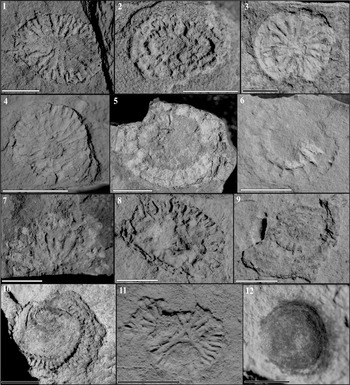
Figure 4.1–4.10
- Reference Arrouy, Warren, Quaglio, Guimaraes Simoes, Boselli-Rosa and Gomes Peral2016
Aspidella plexus Arrouy et al., p. 3, fig. 2a-g.
(1–10) Persimedusites chahgazensis. (1) Ku-14-01; (2) Ku-14-03a; (3) Ku-16-02; (4) Ch-14-04; (5) Ku-16-01; (6) Ku-16-03; (7) Ch-14-15; (8) Ch-14-12; (9) Ch-14-19; (10) Ch-16-02. (11) Anfesta stankovskii, Ch-14-03. (12) Chuaria sp., Ku-14-49. Scale bars = 1 cm (white), or 0.5 cm (black). All specimens identified with field specimen numbers (collected, but not reposited in a museum; currently in collections at the University of Toronto).

Holotype
Persimedusites chahgazensis Hahn and Pflug, Reference Hahn and Pflug1980 (SMF 34230) from the Kushk Series, Kushk and Chahmir mines, Bafq and Behabad regions, Central Iran (Hahn and Pflug, Reference Hahn and Pflug1980, p. 453, pl. 1, figs. 1–4).
Diagnosis
Revised from Hahn and Pflug, Reference Hahn and Pflug1980. Circular to oval form with numerous units emanating radially from a central region and expanding distally. Units cylindrical to cone-shaped and can be divided distally into paired sub-units to form a “Y” shape. Rare specimens exhibit concentric rings that crosscut the radial units.
Description
Measurements and description based on 41 specimens. Spherical to oval-shaped, 5–38 mm along largest diameter and 5–25 mm in shortest diameter, consisting of 14–24 prominent units arranged radially and separated by grooves. Units 3–15 mm in width, and in five specimens, the units divide at their distal tips (e.g., Fig. 2.1). Seventeen specimens show concentric rings that crosscut the radial units. The central region is typically smooth and higher relief when compared to the outer perimeter.
Remarks
Hahn and Pflug (Reference Hahn and Pflug1980) described Persimedusites chahgazensis as a medusae (jellyfish), however, in the absence of diagnostic cnidarian characters, this affinity is questionable. In order to remove the emphasis on Scyphomedusae terminology previously used in the diagnosis and description of this form, we are formally re-describing Persimedusites with taxonomically independent terminology. Arrouy et al. (Reference Arrouy, Warren, Quaglio, Guimaraes Simoes, Boselli-Rosa and Gomes Peral2016) reported specimens that we interpret as Persimedusites chahgazensis from the Cerro Negro Formation, La Providencia Group, Argentina as Aspidella. If we are correct, this greatly expands the geographic range of this taxon, and further supports a late Ediacaran (Nama assemblage) age for the Iranian units.
Section 2
Problematica and single-specimen fossils.
Phylum, Class, Order, and Family uncertain
Genus Anfesta stankovskii Fedonkin, Reference Fedonkin, Sokolov and Iwanowski1984
Figure 4.11
Holotype
Anfesta stankovskii Fedonkin, Reference Fedonkin, Sokolov and Iwanowski1984 (PIN3993/260-A) from the Zimnii Bereg and Karakhta River of the White Sea, Arkhangelsk Region, Russia (Fedonkin, Reference Fedonkin, Sokolov and Iwanowski1984).
Diagnosis
Revised from Fedonkin (Reference Fedonkin, Sokolov and Iwanowski1984, Reference Fedonkin1985). Discoidal form with three elongated cylindrical ridges that radiate from the center at an angle of 120˚. Each ridge is rounded at the proximal and distal ends. Between each elongated ridge are several shorter and smaller ridges that can bifurcate into a “Y” shape distally.
Occurrence
Ust Pinega Formation, Valdai Group, Verkovka and Yorga formations on the Karakhta River in Onega Peninsula and Zimnii Bereg of the White Sea, Arkhangelsk Region, Russia (Fedonkin, Reference Fedonkin, Sokolov and Iwanowski1984; Grazhdankin, Reference Grazhdankin2004; Ivantsov, Reference Ivantsov2004); Kushk Series in the Chahmir area, Behabad, Central Iran (this study).
Description
Description and measurements based on one specimen (Ch/14/03). Small, hemispherical form (11 mm in diameter), with three prominent positive ridges (5 mm in length, 1 mm in width) that meet centrally to form a triangular positive relief structure with a negative-relief smaller triangle in the center. Between the major ridges are several (<8) smaller secondary ridges that, in rare cases, bifurcate into two ridges.
Remarks
Fedonkin (Reference Fedonkin, Sokolov and Iwanowski1984, Reference Fedonkin1985) described Anfesta stankovskii as a new species of Cnidaria within the class ‘Trilobozoa,’ which may no longer be valid (Laflamme et al., Reference Laflamme, Darroch, Tweedt, Peterson and Erwin2013). In order to remove the emphasis on Cnidarian terminology previously used in the diagnosis and description of this form, we are formally re-describing Anfesta with taxonomically independent terms. The single specimen of Anfesta from the Kushk Series is different from the type material of Anfesta stankovskii of the White Sea region in including a prominent, triangular central depression formed at the proximal intersection of the primary ridges. Until additional specimens are recovered, we cannot be certain if this represents a taphonomic or taxonomic characteristic. As such, we include the Kushk specimens with Anfesta stankovskii. Anfesta is very similar to Skinneria Wade, Reference Wade1969 and Albumares Fedonkin in Keller and Fedonkin, Reference Keller and Fedonkin1977 (Fedonkin, Reference Fedonkin, Sokolov and Iwanowski1984), but the prominent tri-lobed central ridge is diagnostic for Anfesta. Albumares is similar, however it has a three-fold/three-lobed architecture with numerous dendritic secondary units within each of the three lobes (rather than contained within a circular form as seen in Anfesta). Finally, it is important to distinguish the lone specimen of Anfesta from Persimedusites, given how common the latter fossil is from the Kushk (41 specimens). Although similar in their overall circular morphology, even the most poorly preserved specimens of Persimedusites lack the central three-fold division seen in Anfesta, and in almost all cases the central region is represented by a smooth central boss. Furthermore, several specimens of Persimedusites include two radial divisions (one around the outer margin, and a second located more centrally), which is not shared with Anfesta.
Class Chuariaphyceae Gnilovskaya and Ishchenko in Gnilovskaya et al., Reference Gnilovskaya, Ishchenko, Kolesnikov, Korenchuk and Udal1988
Order Chuariales Ischenko in Gnilovskaya et al., Reference Gnilovskaya, Ishchenko, Kolesnikov, Korenchuk and Udal1988
Family Chuariaceae Wenz, Reference Wenz and Schindewolf1938
Genus Chuaria Walcott, Reference Walcott1899
Type species
Chuaria circularis Walcott, Reference Walcott1899 (USNM 33800) from Kwagunt Valley, Grand Canyon, Arizona, USA (Walcott, Reference Walcott1899, p. 235, pl. 27, fig. 9).
Chuaria sp.
Figure 4.12
Remarks
Chuaria is one of the oldest globally distributed Precambrian (Tonian to Ediacaran) carbonaceous macrofossils. This single specimen is preserved as negative epirelief, consisting of a sub-circular black carbonaceous disc (8–10 mm in diameter). The central area is smooth and flat, with narrow concentric rings along the peripheral edge. Wang et al. (Reference Wang, Yuan, Chuanming, Du and Gong2011) interpreted Chuaria as a multicellular eukaryotic algae based on characteristics of the cell walls, while Tang et al. (Reference Tang, Pang, Yuan and Xiao2017) suggested it may represent a vegetative stage of a simple multicellular (unlikely colonial) organism, with possible eukaryotic affinities. Chuaria, in addition to Tawuia and Vendotaenia (Hamdi, Reference Hamdi1995; Jafari et al., Reference Jafari, Shemirani and Hamdi2007), is also known from the Lower Shale Member (Chopoqloo Shale) of the Soltanieh Formation in the Alborz Range of Northern Iran, providing additional biostratigraphic links between these two regions. Chuaria is superficially similar to other circular fossils such as Beltanelliformis or Nemiana, however these taxa are rarely (if ever) found in isolation (instead found in large aggregates), typically attain much larger sizes (cm scale), and are usually preserved in high relief (either positive or negative).
Phylum, Class, Order, indeterminate
Grade Cloudinomorph Selly et al., Reference Selly, Schiffbauer, Jacquet, Smith, Nelson, Andreasen, Huntley, Strange, O'Neil, Thater and Bykova2019
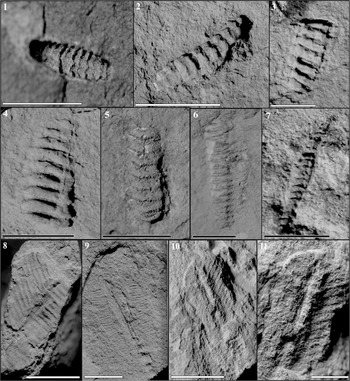
Figure 5.1–5.7
Remarks
Thirty-seven external molds of cloudinomorphs have been investigated, and consist of straight to slightly curved cylindrical tubes (length 5–30 mm, width 1–5 mm) with minor tapering at the distal tip, and composed of up to 34 prominent parallel annulations that meet along a midline ridge/groove. Given the recent indication that cloudinomorphs (Selly et al., Reference Selly, Schiffbauer, Jacquet, Smith, Nelson, Andreasen, Huntley, Strange, O'Neil, Thater and Bykova2019) may potentially span the Ediacaran-Cambrian transition (Yang et al., Reference Yang, Steiner, Zhu, Li, Liu and Liu2016; Zhu et al., Reference Zhu, Zhuravlev, Wood, Zhao and Sukhov2017; Cai et al., Reference Cai, Xiao, Li and Hua2019), dedicated taxonomic studies of this group continue to be warranted.
(1–7) Hollow molds of cloudinomorphs. (1) Ku-14-03abc; (2) Ku-16-23; (3) Ch-16-14; (4) Ku-16-34; (5) Ch-14-24; (6) Ch-14-64; (7) Ch-16-37. (8) ?Pteridinium, Ku-14-67. (9) ?Swartpuntia, Ku-14-61. (10, 11) ?Trepassia illuminated from two different orientations to accentuate the rangeomorph branches as seen in (11), Ku-14-15. Scale bars = 1 cm (white), or 0.5 cm (black). All specimens identified with field specimen numbers (collected, but not reposited in a museum; currently in collections at the University of Toronto).

Unidentified Erniettomorph Type 1
Figure 5.8
- Reference Vaziri and Laflamme2018
Erniettomorph (Ku/14/67) Vaziri et al., p. 3, fig. 2g
Remarks
Originally described in broad terms by Vaziri et al. (Reference Vaziri, Majidifard and Laflamme2018) as an “Erniettomorph” based on the unornamented (lacking secondary branches), parallel, cylindrical primary branches that alternate along the midline. The specimen consists of a flattened leaf-shaped body (length 30 mm, width 14 mm), with at least 16 prominent straight and parallel elements/branches that alternate along a central midline. Given the incomplete nature of the only specimen, the closest comparison would be ?Pteridinium, however additional specimens are required to confirm the diagnosis. We note that Ku/14/67 (Fig. 4.1) is considerably smaller than all known specimens of Pteridinium.
Although fragmentary, this specimen is unique. Given the local prominence and similarity of Corumbella and Convolutubus n. gen. in the Kushk, it is important to distinguish them from the specimen of ?Pteridinium. The branching/annulations in Corumbella are disorganized, twisted, and lack a consistent shape whereas the primary branches of ?Pteridinium are comparatively rigid and parallel along their entire length. The central lineation is comparable between ?Pteridinium and Convolutubus n. gen., however the seam in Convolutubus n. gen. is narrower and typically offset from the center. The overall shape of Convolutubus n. gen. is also typically curved and narrower.
Unidentified Erniettomorph Type 2
Figure 5.9
Remarks
This fragmentary specimen is morphologically distinct from ‘Unidentified Erniettomorph type 1’ and consists of two petaloids attached longitudinally to a transversely ornamented central stalk. The size of Ku/14/61 (length 27 mm, width 15 mm) is similar to the ontogenetic size distribution witnessed in other Ediacara biota (e.g., Laflamme et al., Reference Laflamme, Narbonne, Greentree and Anderson2007; Liu et al., Reference Liu, McIlroy, Matthews and Brasier2012). This specimen shares several characteristics with Swartpuntia, including the ornamented central stalk and the unornamented (unbranching) cylindrical primary branches (>30 thin, cylindrical, and unornamented branches), however only two distinct petaloids are present in Ku/14/61 and the primary branches are more disorganized than typically seen in Swartpuntia. These distinctions may represent a taphonomic (i.e., a response to decay), ontogenetic (i.e., smaller specimens are less structurally rigid), or taxonomic differentiation. Additional specimens are necessary to refine this designation.
Unidentified Rangeomorph Type 1
Figure 5.10–5.11
- Reference Vaziri and Laflamme2018
Rangeomorph with at least 4 petaloid leaves (Ku/14/15) Vaziri et al., p. 3, fig. 2h, i.
Remarks
Ku/14/15 could represent a juvenile specimen of ?Trepassia, given the similarity in overall shape consisting of an elongated (21 mm long, 10 mm wide), parallel-sided Rangeomorph frond with multiple, single-sided and tightly constrained primary branches (Laflamme et al., Reference Laflamme, Narbonne, Greentree and Anderson2007; “undisplayed,” per Brasier et al., Reference Brasier, Antcliffe and Liu2012), and double-sided secondary branches (displayed and unfurled, per Brasier et al., Reference Brasier, Antcliffe and Liu2012). Furthermore, Ku/14/15 is similar in overall size to the smallest juvenile specimens documented by Laflamme et al. (Reference Laflamme, Narbonne, Greentree and Anderson2007) from the basal sections of the Mistaken Point Formation. A notable difference is the presence of a third (maybe 4th?) petaloid, which has yet to be reported in Trepassia. Additional specimens may result in the identification of novel characters that would allow for effective species differentiation; however, until this is the case, we prefer the conservative approach of not assigning this single specimen to a new species.
Results
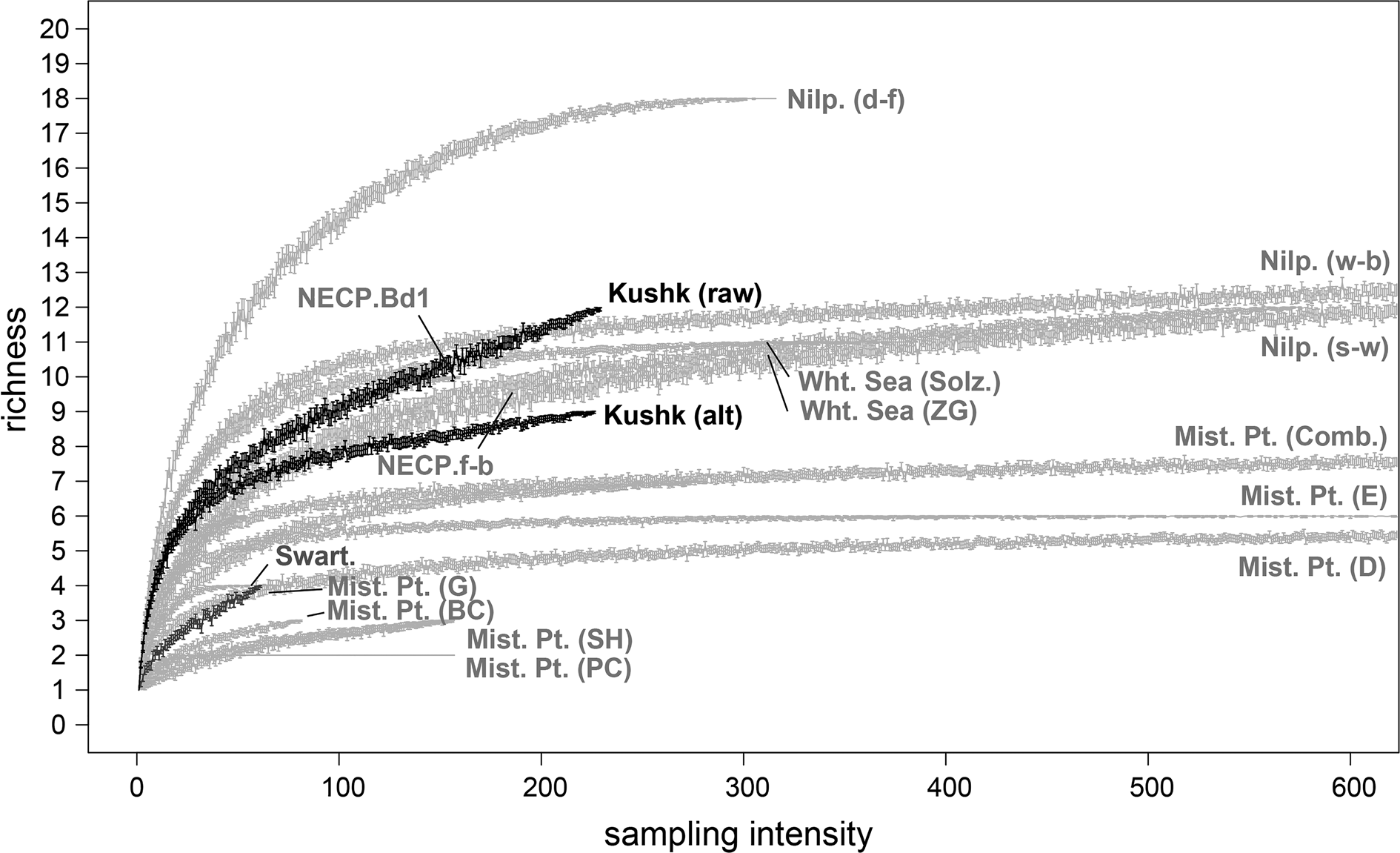
Rarefaction analyses illustrate that the diversity in the Kushk community is high—equivalent to many of the apex diversity White Sea communities described from South Australia and Russia. At any given sampling intensity, the Kushk community is richer than any of the individual Mistaken Point surfaces (even our artificially amalgamated community), and is over twice as rich as the latest Ediacaran (‘Nama’) community preserved at Farm Swartpunt. At intermediate sampling intensities (50–150 individuals), the only communities richer than the Kushk are those from the Solza River (Zakrevskaya, Reference Zakrevskaya2014) and the delta-front and sheet-flow assemblages from Nilpena (Gehling and Droser, Reference Gehling and Droser2013). One of the most striking results of this study is that, despite the very high richness of the Iranian sections, the Iranian communities are noticeably undersaturated (Fig. 6), suggesting that with continued worker effort an even greater diversity of taxa likely will be discovered. Given the typical low diversity of late Ediacaran fossil localities, the Kushk Series represents a unique opportunity to gain a greater insight on the effects and patterns of the end-Ediacaran biotic turnover (potentially extinction; see Darroch et al., Reference Darroch, Sperling, Boag, Racicot, Mason, Morgan, Tweedt, Myrow, Johnston, Erwin and Laflamme2015, Reference Darroch, Smith, Laflamme and Erwin2018a; Muscente et al., Reference Muscente, Bykova, Boag, Buatois, Mángano, Eleish, Prabhu, Pan, Meyer, Schiffbauer, Fox, Hazen and Knoll2019) and the development of the metazoan Wormworld (Schiffbauer et al., Reference Schiffbauer, Huntley, Oneil, Darroch, Laflamme and Cai2016). Our results accentuate the need for continued fieldwork in the region.
Results of rarefaction analysis comparing the diversity of Ediacaran assemblages (modified from Darroch et al., Reference Darroch, Sperling, Boag, Racicot, Mason, Morgan, Tweedt, Myrow, Johnston, Erwin and Laflamme2015). Kushk Formation datasets (this paper) highlighted in black; ‘Kushk (raw)’ for rarefaction of the raw data, while ‘Kushk (alt)’ is a rarefaction with tentatively identified specimens (e.g., ?Pteridinium and ?Swartpuntia; see systematic paleontology), removed. Community data from Swartpunt (‘Swart.’)—currently the only other Nama-assemblage dataset—also highlighted in dark gray. Abbreviations: ‘BC’ = Bristy Cove; ‘comb.’ = combined; ‘D’ = D-surface; ‘d-f’ = delta front; ‘E’ = E-surface; ‘f-b’ = fault block; ‘G’ = G-surface; ‘Mist. Pt.’ = Mistaken Point; NECP = ’north Ediacara Conservation Park’; ‘Nilp.’ = Nilpena; ‘PC’ = ’Pigeon Cove’; ‘SH’ = ’Shingle Head’; ‘Solz.’ = Solza River; ‘s-w’ = shore face; ‘w-b’ = wave-base; ‘Wht. Sea’ = White Sea; ‘ZG’ = Zimnie Gory.

Discussion
The discovery of a diverse, late Ediacaran (Nama assemblage) fossil community that includes soft-bodied Ediacara biota (Rangeomorphs and Erniettomorphs), soft-bodied (or weakly mineralized) metazoans (Corumbella, Kimberella, Gibbavasis), calcifying metazoans (external molds of cloudinomorphs), and eukaryotic algae (Chuaria) accentuates the need for continued exploratory programs targeting latest Ediacaran strata worldwide. The Kushk Series is a stark contrast to the typically depauperate nature of Nama-aged deposits from Namibia and SW USA that consist almost exclusively of organic-walled and skeletonized tubular fauna (Schiffbauer et al., Reference Schiffbauer, Huntley, Oneil, Darroch, Laflamme and Cai2016), with abundant, but low-diversity communities of Ediacara biota (Darroch et al., Reference Darroch, Sperling, Boag, Racicot, Mason, Morgan, Tweedt, Myrow, Johnston, Erwin and Laflamme2015, Reference Darroch, Laflamme and Wagner2018b; Smith et al., Reference Smith, Nelson, Strange, Eyster, Rowland, Schrag and Macdonald2016).
The latest Ediacaran ‘Nama’ interval is a critical interval for community paleoecology. Indices such as richness, evenness, and measures of ecological ‘complexity’ can help frame hypotheses surrounding the nature of the Ediacaran–Cambrian transition, including putative extinction events (Darroch et al., Reference Darroch, Sperling, Boag, Racicot, Mason, Morgan, Tweedt, Myrow, Johnston, Erwin and Laflamme2015, Reference Darroch, Smith, Laflamme and Erwin2018a, Reference Darroch, Laflamme and Wagnerb; Schiffbauer et al., Reference Schiffbauer, Huntley, Oneil, Darroch, Laflamme and Cai2016; Muscente et al., Reference Muscente, Boag, Bykova and Schiffbauer2018; Tarhan et al., Reference Tarhan, Droser, Cole and Gehling2018). However, there is currently a dearth of Nama-aged community data relative to older Ediacaran assemblages, which has made ecological characterization of this interval difficult. Darroch et al. (Reference Darroch, Sperling, Boag, Racicot, Mason, Morgan, Tweedt, Myrow, Johnston, Erwin and Laflamme2015, Reference Darroch, Laflamme and Wagner2018b) analyzed what is currently the only other Nama-aged Ediacaran community with species abundance data (Farm Swartpunt in southern Namibia), establishing that this community possessed both low species richness compared to older assemblages from similar paleoenvironments, and a rank-abundance structure consistent with ecological stress. Both these signals comprised initial support for a ‘biotic replacement’ model for Ediacaran–Cambrian transition, whereby the ‘ecosystem engineering’ activities of a burgeoning Cambrian-type metazoan fauna that is recorded, for example, in the increasing intensity of infaunal burrowing (Cribb et al., Reference Cribb, Kenchington, Koester, Gibson, Boag, Racicot, Mocke, Laflamme and Darroch2019) and the emergence of macroscopic predation, drove the extinction of soft-bodied Ediacara biota. However, these new data from the Kushk Series offer a counterpoint to this narrative—the community is over twice as diverse as that recorded in southern Namibia, and moreover, appears undersaturated.
There are several possible explanations for this finding: (1) Farm Swartpunt records a paleoenvironment that wouldn't ordinarily host diverse benthic communities, and thus is an anomaly; (2) the interactions between soft-bodied Ediacara biota and Cambrian-type metazoans in this interval were not antagonistic, and instead any putative extinction events were driven by environmental perturbations (i.e., ‘catastrophe’ of Laflamme et al., Reference Laflamme, Darroch, Tweedt, Peterson and Erwin2013); and (3) whereas the soft-bodied community at Swartpunt is comprised solely of erniettomorphs and rangeomorphs (both groups with uncertain relationships to Metazoa), the Kushk community comprises both a minority of soft-bodied Ediacara biota and a majority of more recognizable metazoans, including kimberellomorphs, sponges, and Corumbella, and thus is structured in a fundamentally different way.
Although model (1) cannot currently be discounted, neither Narbonne et al. (Reference Narbonne, Saylor and Grotzinger1997) nor Darroch et al. (Reference Darroch, Sperling, Boag, Racicot, Mason, Morgan, Tweedt, Myrow, Johnston, Erwin and Laflamme2015) noted any sedimentary features or fabrics in the fossil-bearing horizons at Swartpunt that would indicate a marginal or restricted paleoenvironment (rather, the rocks apparently record a shallow open-marine and sand-dominated setting near fair-weather wave base), and Darroch et al. (Reference Darroch, Sperling, Boag, Racicot, Mason, Morgan, Tweedt, Myrow, Johnston, Erwin and Laflamme2015) uncovered no geochemical evidence for oxygen limitation using iron speciation data. Model (2) remains a plausible explanation for the turnover pulses recognized in the late Ediacaran (see, e.g., Smith et al., Reference Smith, Nelson, Strange, Eyster, Rowland, Schrag and Macdonald2016), although linking the major perturbations in the global carbon cycle to plausible extinction drivers in this interval remains problematic (see Darroch et al., Reference Darroch, Smith, Laflamme and Erwin2018a; Rooney et al., Reference Rooney, Cantine, Bergmann, Gómez-Pérez, Al Baloushi, Boag, Busch, Sperling and Strauss2020). In contrast, model (3) paints a more complex picture of late Ediacaran paleoecology, suggesting that low-diversity communities of erniettomorphs and rangeomorphs existed as part of a larger ecological mosaic alongside mixed communities dominated by a more Cambrian-type metazoan fauna. Although testing among these models is the subject on ongoing work, future discoveries of Nama-aged Ediacaran communities reporting species-abundance data will almost certainly shed fresh light on these questions, and help to characterize more accurately the paleoecology of this critical interval in Earth history.
Ediacaran-aged sections outcrop extensively in northern and Central Iran, but to date, Ediacaran fossils have only been reported from the Lower Shale Member (Chopoqloo Shale) of the Soltanieh Formation in the Alborz Mountains of northern Iran, and shale deposits of the Kushk Series in the Kushk and Chahmir areas, Central Iran. The Ediacaran-Cambrian boundary has been proposed from several key localities in Iran, most notably in Alborz and near Kerman. Strata in the Alborz Mountains show continuous sedimentation from late Proterozoic through Cambrian (Hamdi et al., Reference Hamdi, Brasier and Zhiwen1989; Hamdi, Reference Hamdi1995; Shahkarami et al., Reference Shahkarami, Mángano and Buatois2017a, Reference Shahkarami, Mángano and Buatoisb), however the exact location of the Precambrian-Cambrian boundary is controversial. Earlier studies placed the boundary near the top of the Lower Shale Member (between members 2 and 3 of the Soltanieh Formation) due to reports of early skeletal fossils (“small-shelly-fossils” such as Protohertzina anabarica Missarzhevsky, Reference Missarzhevsky1973), while the overlying Upper Shale Member contains Tommotian (Cambrian) fossils (Hamdi et al., Reference Hamdi, Brasier and Zhiwen1989; Brasier et al., Reference Brasier, Magaritz, Cortield, Luo, Wu, Lin, Jiang, Hamdi, He and Fraser1990; Hamdi, Reference Hamdi1995). Recent studies (e.g., Shahkarami et al., Reference Shahkarami, Mángano and Buatois2017a, Reference Shahkarami, Mángano and Buatoisb) have instead suggested that the Precambrian-Cambrian boundary be placed at the base of the Soltanieh Formation due to the presence of the Anabarites trisulcatus-Protohertzina anabarica Zone (Hamdi et al., Reference Hamdi, Brasier and Zhiwen1989) in the dolomites above and below the Lower Shale Member, supporting an Ediacaran age for the member (Hamdi et al., Reference Hamdi, Brasier and Zhiwen1989; Hamdi, Reference Hamdi1995). In addition to the biostratigraphic studies in the region, geochemical studies of the fossiliferous successions in the Alborz Mountains of Northern Iran have identified a negative δ13C excursion (Kimura et al., Reference Kimura, Matsumoto, Kakuwa, Hamdi and Zibaseresht1997), which could aid immensely in identifying the Ediacaran-Cambrian boundary, and allow these basins to be correlated globally.
The apparent extinction of the Ediacara biota in the latest Neoproterozoic may have occurred in one or more pulses (see Darroch et al., Reference Darroch, Smith, Laflamme and Erwin2018a; Muscente et al., Reference Muscente, Bykova, Boag, Buatois, Mángano, Eleish, Prabhu, Pan, Meyer, Schiffbauer, Fox, Hazen and Knoll2019), and is the subject of ongoing scientific debate, with several models proposed. Whereas one model (‘catastrophe’) proposes global-scale environmental perturbations as an extinction driver, analogous to the ‘Big 5’ Phanerozoic mass extinctions (e.g., Kimura and Watanabe, Reference Kimura and Watanabe2001; Amthor et al., Reference Amthor, Grotzinger, Schroeder, Bowing, Ramezani, Martin and Matter2003; Zhang et al., Reference Zhang, Xiao, Kendall, Romaniello, Cui, Meyer, Gilleaudeau, Kaufman and Anbar2018, Reference Zhang, Xiao, Romaniello, Hardisty, Li, Melezhik, Pokrovsky, Cheng, Shi, Lenton and Anbar2019), other models (‘biotic replacement’) suggest the evolution of metazoan ecosystem engineering and the establishment of predator-prey arms races as drivers of biotic turnover (Darroch et al., Reference Darroch, Sperling, Boag, Racicot, Mason, Morgan, Tweedt, Myrow, Johnston, Erwin and Laflamme2015, Reference Darroch, Smith, Laflamme and Erwin2018a; Schiffbauer et al., 2019). Although robust tests of ‘catastrophe’ will rely on more comprehensive geochemical work and global correlations among basins, support for ‘biotic replacement’ will hinge on a deeper understanding of Ediacaran paleoecology, in particular establishing how the Ediacara biota interacted with the emerging metazoan fauna (Darroch et al., Reference Darroch, Smith, Laflamme and Erwin2018a). More in-depth paleoecological analysis of the Kushk fossil communities will therefore shed vital new light on ecological interactions in a transitional late Ediacaran community, shortly before the onset of the Cambrian and final disappearance of almost all Ediacaran biota.
Conclusions
Deep-water calcareous marine shales of the Kushk Series in the Bafq and Behabad regions of Central Iran preserve diverse Ediacaran fossils. Ediacaran metazoans, such as Kimberella and Gibbavasis, filled an important gap between their first occurrence in the Ediacaran and the diverse animal assemblages of the Cambrian. The discovery of the terminal-Ediacaran index fossil Corumbella indicates a latest Ediacaran age (Nama-Assemblage, ca. 545–539 Ma) for the Kushk Series, and allows for correlations with sections from Namibia, South America, southwestern USA, and China. These new fossil finds describe a transitional ecosystem comprising both metazoans and plausible non-metazoan Ediacara biota immediately prior to the second pulse of Ediacaran extinction at the Cambrian boundary that has the potential to shed valuable new light on the drivers of the Ediacaran–Cambrian transition.
Acknowledgments
The research was supported by an Early Researcher Award (ERA), Natural Science and Engineering Research Council of Canada (NSERC) Discovery Grant (RGPIN 435402), and a Research and Scholarly Activity Fund to Laflamme. Darroch acknowledges generous support from the Alexander von Humboldt Foundation, which is sponsored by the Federal Ministry for Education and Research in Germany. Thanks are extended to the Bafgh Mining Company and Iran Zinc Mines Development Company for providing research opportunity in the Kushk and Chahmir mining areas; B. Hamdi (Geological Survey of Iran) and D. Jahani (Islamic Azad University, North Tehran Branch) for useful information on the geology of study areas; and M.M. Zand, H. Omidi, and A. Shariati (Kushk Mine), and N. Zamani (Chahmir Mine) for useful information and companionship in the field.