Introduction
Selection by farmers over thousands of years has enriched the genetic pool of many crops, including fruit trees, by promoting intraspecific diversity (Frankel et al., Reference Frankel, Brown and Burdon1995). These kinds of farmer-selected crop varieties are often referred to as traditional varieties or landraces. Camacho Villa et al. (Reference Camacho Villa, Maxted, Scholten and Ford-Lloyd2005) defined a landrace as ‘a dynamic population(s) of a cultivated plant that has historical origin, distinct identity and lacks formal crop improvement, as well as often being genetically diverse, locally adapted and associated with traditional farming systems’. Applying this definition, traditional mango varieties in Myanmar can be considered as landraces.
Mango (Mangifera indica L.) is one of the most important fruit crops in Myanmar because of its agronomic and cultural value. The bibliographic record of mango cultivation in Myanmar can be traced back to the 5th century AD (Hirano et al., Reference Hirano, Khain Pann Witt, Kawase and Watanabe2008). Although the exact number is not known, more than 200 landraces are recognized in the country (K. Win, pers. commun., 2008). A broad range of diversity has been nurtured through the long history of mango cultivation but so far, no formal breeding has been carried out in Myanmar. Most of the mango production is consumed domestically, but exports have grown in recent years (Kyaw Htu, Reference Kyaw2007). The traditional varieties ‘Yin Kwe’ and ‘Sein Ta Lone’ (Supplementary Fig. S1, available online only at http://journals.cambridge.org) are two of the most popular varieties in Myanmar. ‘Yin Kwe’ is a representative traditional variety that is grown throughout the country. Its fruiting period is relatively long, and it bears numerous fruits (Myanma Agriculture Service, 2005). ‘Yin Kwe’ is also used as a rootstock of other varieties. ‘Sein Ta Lone’ is one of the most popular varieties because of the aroma and sweetness of its fruits. This variety is traded at higher prices in the domestic market as well as in border trades due to the excellent fruit quality. ‘Sein Ta Lone’ is distributed in the central (Central Myanmar) and southern (Lower Myanmar) parts of the country.
Single sequence repeat (SSR) markers for mango have been designed by several researchers as a tool to study genetic variation (Duval et al., Reference Duval, Bunel, Sitbon and Risterucci2005; Honsho et al., Reference Honsho, Nishiyama, Eiadthong and Yonemori2005; Schnell et al., Reference Schnell, Olano, Quintanilla and Meerow2005; Viruel et al., Reference Viruel, Escribano, Barbieri, Ferri and Hormaza2005). The broad genetic background and genetic distinctiveness of mango in Myanmar have been revealed by SSR analyses comparing Myanmar mango varieties with those from other parts of the world (Hirano et al., Reference Hirano, Than Htun and Watanabe2010). A high degree of genetic variability is expected within varieties considered to be landraces, but the genetic variation within most varieties of mango in Myanmar is still unknown.
The method of propagation might be one of the most influential factors affecting heterogeneity and genetic variation within traditional mango varieties in Myanmar. For example, a landrace that is propagated using rooted cuttings or grafts will remain more homogeneous than one that is propagated by self-pollination or by open crosses with other landraces. The level of genetic variation may affect the uniformity of a variety because the genetic variation may change the morphological characteristics. It is, therefore, essential to study the genetic variation within and between varieties and to understand its relationship with traditional propagation practices. This study evaluated the genetic variation within two economically important varieties, ‘Yin Kwe’ and ‘Sein Ta Lone’, by using SSR markers. The degree of variation was assessed in light of the traditional propagation practices used for the two varieties. The study results will not only provide an example of the relationship between traditional management and genetic variation but will also provide insights into conservation and sustainable utilization of the species in Myanmar.
Materials and methods
Plant materials
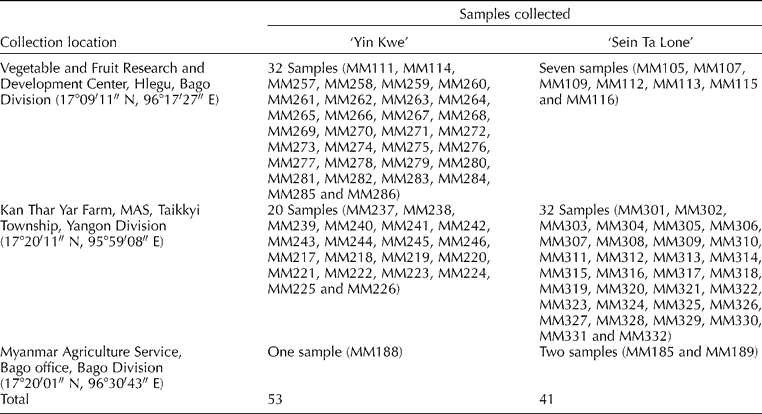
Leaves of ‘Yin Kwe’ and ‘Sein Ta Lone’ were sampled in different orchards of the Yangon Division in Myanmar in January and February 2008. One or two young leaves were collected per tree and kept in a plastic bag with silica gel until the leaves were completely dried. The collection consisted of 53 individuals of ‘Yin Kwe’ and 41 individuals of ‘Sein Ta Lone’ (Table 1). Traditional propagation practices used for the two varieties were assessed through observation of the seed nursery and interviewing local specialists who are actively involved in mango cultivation and harvesting practices in the Yangon and Bago districts. Orchards, nurseries and local retailers of seedlings were also visited to observe the local propagation methods.
Collection locations and number of samples

SSR analysis
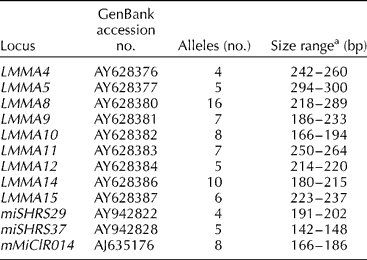
DNA was extracted from dried leaves of each accession by using the CTAB; Cetyltrimethyl Ammonium Bromide method (Doyle and Doyle, Reference Doyle and Doyle1987). A total of 24 SSR markers designed to amplify dinucleotide-repeat microsatellite loci were tested (Duval et al., Reference Duval, Bunel, Sitbon and Risterucci2005; Schnell et al., Reference Schnell, Olano, Quintanilla and Meerow2005; Viruel et al., Reference Viruel, Escribano, Barbieri, Ferri and Hormaza2005). PCR conditions and procedures were the same as in Hirano et al. (Reference Hirano, Than Htun and Watanabe2010). Each reaction mixture contained 1 × Ex Taq Buffer (Takara Bio Inc., Otsu, Shiga, Japan), 1.5 mM MgCl2, 0.2 mM of each dNTP, 0.5 U of Ex Taq polymerase (Takara Bio Inc.) and 10 ng of genomic DNA in a 10 μl total reaction volume. PCR conditions were 95°C for 5 min; followed by 35 cycles of 94°C for 1 min, 60°C for 1 min and 72°C for 1 min; followed by a final extension of 72°C for 5 min. After checking for amplification of target loci by electrophoresis in 1.5% agarose gel, samples were analyzed by capillary electrophoresis with an automated DNA sequencer (ABI model 3130; Applied Biosystems Inc., Carlsbad, CA, USA). The fragment patterns were scored using the Gene Mapper 3.0 software (Applied Biosystems Inc.). The extracted data were exported as allele sizes and formatted for further statistical analysis. Mango is diploid, so to identify markers that detected single loci, any markers that produced more than two alleles (bands)/individual were eliminated. Consequently, we selected 12 SSR loci for further analysis (Table 2).
SSR markers used in this study

a Including length of tail sequences (18 bp total).
Data analysis
Genetic parameters were calculated for 94 individuals (41 ‘Sein Ta Lone’ and 53 ‘Yin Kwe’) over the 12 SSR loci. Genotypes showing one and two bands were scored as homozygous and heterozygous, respectively. For the purpose of this analysis, the two homozygous classes were grouped together. The genetic variation at each locus was measured in terms of the number of observed alleles. Observed heterozygosity (H o) and expected heterozygosity (H e) (Hartl and Clark, Reference Hartl and Clark1997) were calculated for each locus. Hardy–Weinberg equilibrium was tested for each locus in both varieties using Genepop version 4.0.7. The polymorphic information content (PIC) value for each marker was calculated using the PowerStats program, version 1.2 (Tereba, Reference Tereba1999).
Nei's genetic distance (Nei et al., Reference Nei, Tajima and Tateno1983) between each individual was measured using Population 1.2.30 (Langella, Reference Langella1999). Using the same program, a dendrogram was constructed with the neighbour-joining method. Bootstrap permutations were performed 1000 times.
To present a graphical representation of genetic relationships between each accession of the two landraces, principal coordinates analysis was carried out on a matrix of Nei's genetic distances and a scatterplot of the first two principal coordinates.
The F statistic, F st, was calculated in an analysis of molecular variance (AMOVA; Peakall et al., Reference Peakall, Smouse and Huff1995) framework, which also allowed for significance testing by random permutation (999 permutations). A codominant allelic distance matrix was used as input into the AMOVA analysis. The F st statistic measures the proportion of the genetic variance between populations relative to the total variance, giving an indication of the degree of population differentiation. The F is and F it measures within-population variation and total-population variation, respectively. Each value was calculated as follows: F st = AP/(WI+AI+AP); F is = AI/(WI+AI); F it = (AI+AP)/(WI+AI+AP), where AP is the estimate variance among population (varieties in this case), AI is the estimate variance among individuals and WI is the estimate variance within individuals (Peakall et al., Reference Peakall, Smouse and Huff1995). All calculations were performed using the program GenAlEx6.1 (Peakall and Smouse, Reference Peakall and Smouse2006).
Results
Genetic variation revealed by SSR
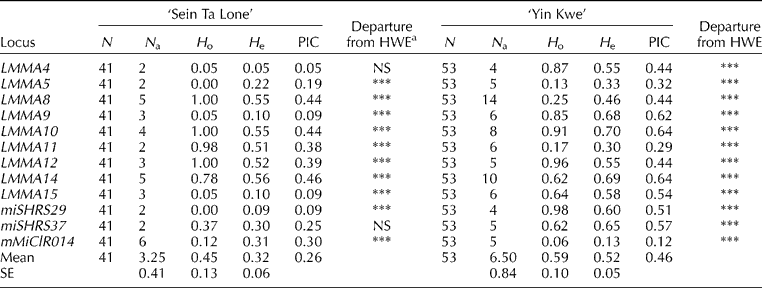
We assessed the allelic variation of two representative traditional varieties of mango, ‘Yin Kwe’ and ‘Sein Ta Lone’, by means of SSR analysis of 85 alleles at 12 loci (Table 2). Forty-seven alleles were detected only in ‘Yin Kwe’, and six alleles were detected only in ‘Sein Ta Lone’ (data not shown). The number of effective alleles (N a)/locus ranged from 2 to 6 (mean 3.25) for ‘Sein Ta Lone’ and from 4 to 14 (mean 6.50) for ‘Yin Kwe’, respectively (Table 3). The average H o was 0.45 and 0.59 for ‘Sein Ta Lone’ and ‘Yin Kwe’, respectively. ‘Yin Kwe’ showed a higher level of genetic diversity, with an average genetic distance (D a) of 0.29, whereas D a within ‘Sein Ta Lone’ was 0.09.
SSR markers used in this study and summary statistics for each variety

a HWE, Hardy–Weinberg equilibrium.
NS, not significant; ***, Highly significant (P < 0.001).
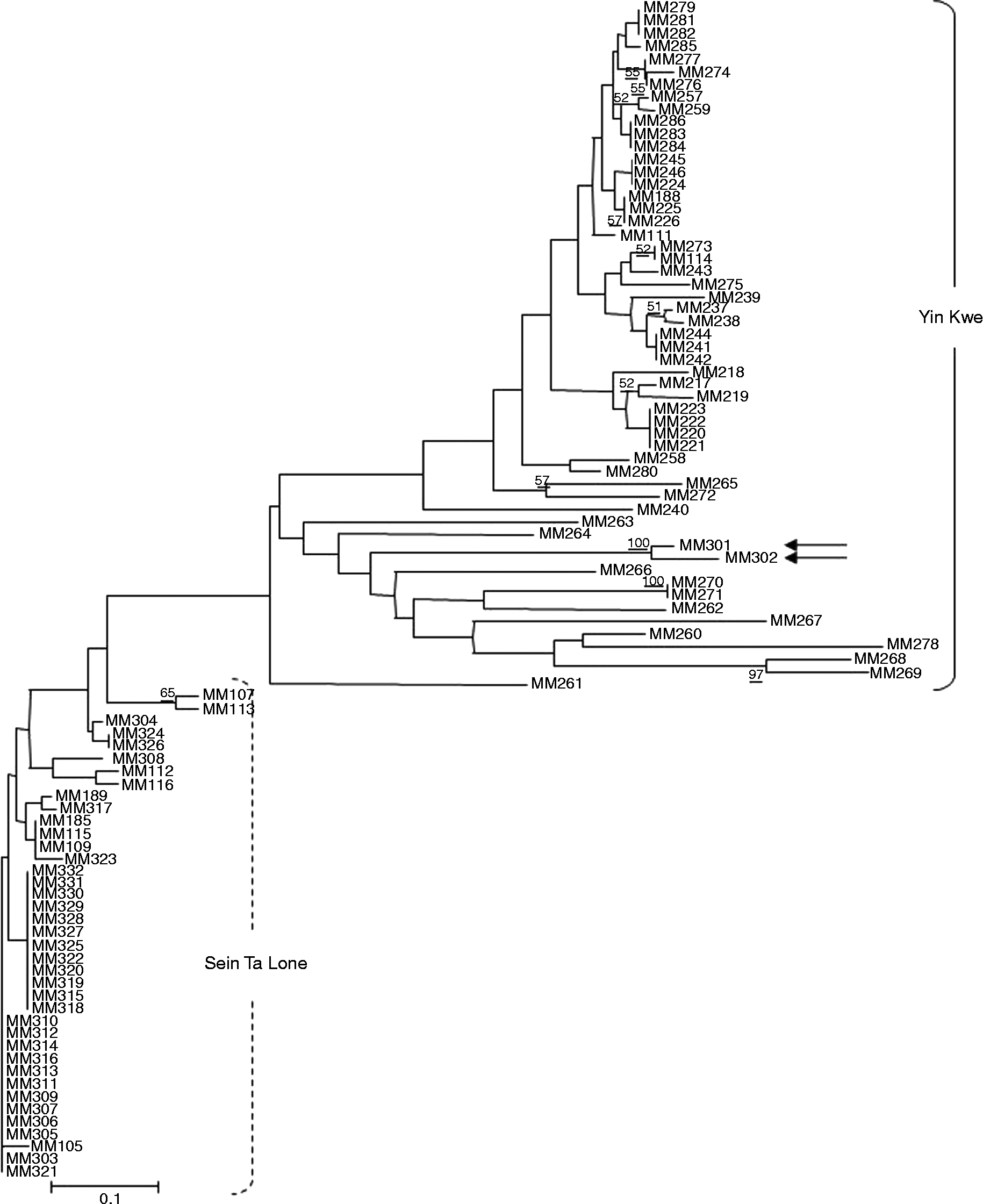
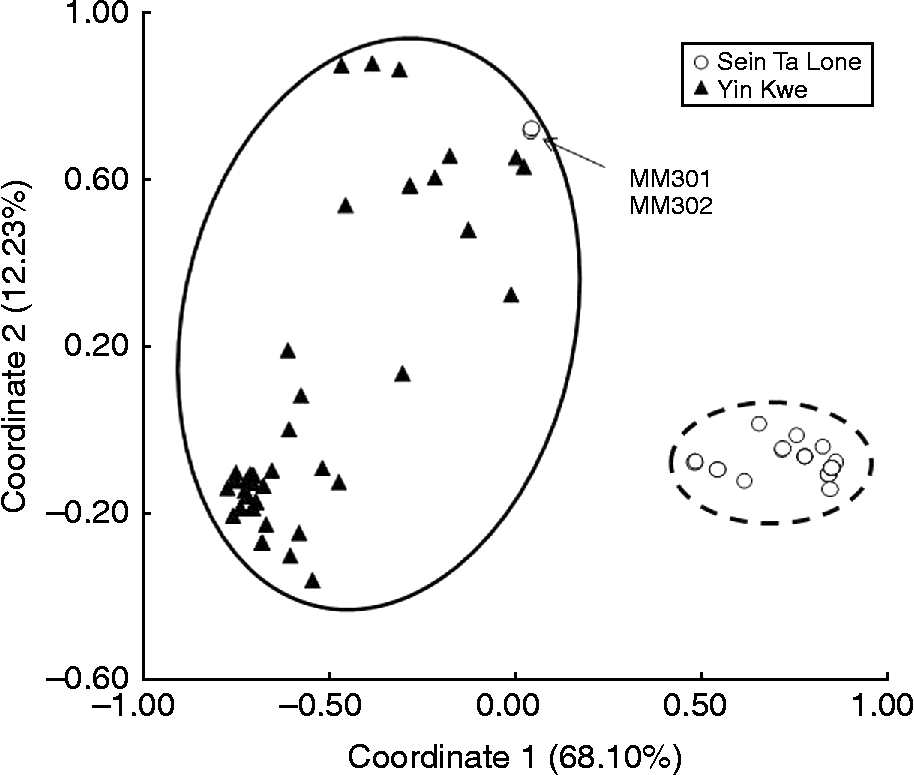
The two varieties were clearly separated in the neighbour-joining tree, except for two individuals of ‘Sein Ta Lone’ (MM301 and MM302) that were grouped within the ‘Yin Kwe’ part of the tree (Fig. 1). Principal coordinates 1 and 2 accounted for 68.1 and 12.2% of the total variance, respectively (Fig. 2). The principal coordinates plot demonstrated two major clusters of ‘Sein Ta Lone’ and ‘Yin Kwe’ on the PC1 axis, with the exception of ‘Sein Ta Lone’ individuals MM301 and MM302.
Neighbour-joining dendrogram of ‘Yin Kwe’ and ‘Sein Ta Lone’. Underlined numbers on branches indicate bootstrap values obtained by using 1000 permutations. Only bootstrap values larger than 50 are indicated. Arrows indicate individuals of ‘Sein Ta Lone’ that fell within the ‘Yin Kwe’ portion of the tree.

Principal coordinates plot of ‘Sein Ta Lone’ and ‘Yin Kwe’. Filled triangles indicate ‘Yin Kwe’, and open circles indicate ‘Sein Ta Lone’. Arrows indicate the same individuals as in Fig. 1.

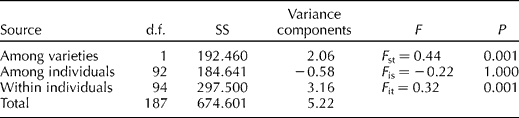
The AMOVA and F statistics results showed that most of the genetic variance existed within individuals (39% of total variance and F it = 0.32, P = 0.001) and among varieties (61% of total variance and significant F st = 0.44, P = 0.001) (Table 4). The estimated F is (among individuals within a variety) was negative ( − 0.22) because of the negative estimated value of the variance components among individuals; this negative estimate indicates that the true value of the estimation is zero. A negative value of F is indicates an excess of heterozygotes. Taken together, these results indicated clear genetic differentiation of these two varieties and a different level of genetic diversity within each variety.
AMOVA and F values for the mango varieties ‘Sein Ta Lone’ and ‘Yin Kwe’

d.f., degrees of freedom; SS, sum of squares.
Traditional propagation methods and the usage of ‘Sein Ta Lone’ and ‘Yin Kwe’ in Lower Myanmar
‘Sein Ta Lone’ originated in Central Myanmar (near Mandalay), and it is believed to be relatively new to Lower Myanmar. Local specialists and nursery workers reported that most ‘Sein Ta Lone’ is clonally propagated through grafting. In almost all cases, ‘Sein Ta Lone’ was grafted onto a stock of ‘Yin Kwe’. The scion of ‘Sein Ta Lone’ was generally chosen from the most productive adult tree within the orchard or nursery. ‘Sein Ta Lone’ was reported to be a polyembryonic type of mango. Polyembryonic mangoes can produce several nucellar embryos within a single seed; these embryos are genetically identical to the mother plant.
The long cultivation history of ‘Yin Kwe’ in Myanmar was reported to us by local specialists. ‘Yin Kwe’ is commonly grown in home gardens, and it is widely distributed across the country. There was no evidence of grafted trees of ‘Yin Kwe’. According to the local specialists, ‘Yin Kwe’ is the best variety for rootstocks in Lower Myanmar due to its adaptation to the local environment. ‘Yin Kwe’ was also reported to be polyembryonic. Local farmers remove all the seedlings from each seed except the most vigorous one; the seedlings are grown for about 1 year and then used as rootstocks for other varieties.
Discussion
In this study, significant levels of genetic variation were observed within the traditional varieties ‘Sein Ta Lone’ and ‘Yin Kwe’. Higher levels of genetic variation and heterogeneity were observed in ‘Yin Kwe’ than in ‘Sein Ta Lone’ in terms of number of alleles per locus, genetic diversity indices and genetic distances among individuals. The propagation practices were considerably different between these two traditional varieties. The different uses of the two varieties were an important factor to explain the differences in propagation modes and degree of genetic variation. ‘Sein Ta Lone’ was propagated mainly by grafting to maintain its genetic integrity, because the fruit quality and uniformity are important for both producers and consumers. Sets of individuals with zero genetic distances from one another were frequently observed in ‘Sein Ta Lone’; these individuals were assumed to be ramets of the same genet. In contrast, no evidence of grafting was found for ‘Yin Kwe’. Since the variety is well adapted to Lower Myanmar, it was often used as a rootstock without regard to the degree of uniformity. ‘Yin Kwe’ contained a high level of genetic variation even though it is polyembryonic. In other studies, genetic variation within a commercial variety and within selections of polyembryonic mango has also been reported (Schnell and Knight, Reference Schnell and Knight1991; Bally et al., Reference Bally, Graham and Henry1996). Schnell and Knight (Reference Schnell and Knight1991) reported 0–64% of zygotic off types in different varieties of polyembryonic mango and showed different levels of genetic variation in polyembryonic seedling populations.
The other possible reason for the differences in genetic variation is the history of each traditional variety. ‘Sein Ta Lone’ was recently introduced into Lower Myanmar, whereas ‘Yin Kwe’ has a long history of cultivation in the region. In the case of ‘Sein Ta Lone”, the number of introduced genotypes might have been limited, leading to the low level of genetic variation (e.g. a founder effect). The average H o of ‘Yin Kwe’ was equivalent to the heterozygosity observed at the country or regional level for cultivated varieties (Schnell et al., Reference Schnell, Brown, Olano, Meerow, Campbell and Kuhn2006) and Mexican landraces (Gálvez-López et al., Reference Gálvez-López, Hernández-Delgado, González-Paz, Becerra-Leor, Salvador-Figueroa and Mayek-Pérez2009) of mango. ‘Yin Kwe’ was frequently used as a rootstock in Lower Myanmar because it is well adapted to the local environment. The broad genetic variation and adaptation to the local environment supported the long history of cultivation of ’Yin Kwe' in Lower Myanmar.
Clear genetic differentiation between ‘Yin Kwe’ and ‘Sein Ta Lone’ was demonstrated by both F st and AMOVA (Table 4). The value of F st was much higher than the threshold for significant population differentiation (F st = 0.25; Hartl and Clark, Reference Hartl and Clark1997). Mango is considered to be an insect-pollinated tree species that favours cross-pollination (Davenport and Núñes-Elisea, Reference Davenport, Núñes-Elisea and Litz1997), which might result in less differentiation. Both ‘Yin Kwe’ and ‘Sein Ta Lone’ are polyembryonic varieties. The outcross rates of these varieties are not known, but a high amount of clonal regeneration by nucellar embryos (apomixis) might have maintained their genetic integrity and the high F st value between these varieties.
Although almost all the ‘Sein Ta Lone’ accessions were grouped closely together in the principal coordinates plot, two individuals (MM301 and MM302) were closer to some of the ‘Yin Kwe’ individuals (Fig. 2). In the dendrogram, these two individuals were grouped together with ‘Yin Kwe’ (Fig. 1). There are several possible reasons for these results. First, there might have been misidentification of the variety at the orchard. We collected the leaf samples when the fruits, the most prominent key for variety identification, were not available. Second, the sampled leaves might have arisen from the rootstock rather than from the scion. Finally, there might be a greater degree of variation within ‘Sein Ta Lone’ than was previously believed. These two individuals possessed unique alleles not found either in the other ‘Sein Ta Lone’ or ‘Yin Kwe’ accessions. Large-scale genetic analysis of ‘Sein Ta Lone’, including samples from the place of origin, might reveal greater genetic diversity within this variety.
No large-scale mango breeding programmes have been carried out in Myanmar. The characteristics of traditional varieties of mango have been created by repeated natural selection, formation of zygotic embryos by selfing or hybridization, and mutation. Local farmers have selected and maintained desirable genotypes during the long cultivation history of mango. Although both ‘Yin Kwe’ and ‘Sein Ta Lone’ are considered to be landraces, the differences in propagation methods related to the use and history of each variety might have greatly affected their levels of genetic variation. The information on genotypes and genetic variation of these traditional mango varieties obtained in this study can be used as background information for their future variety registration and to develop a strategy for their in situ and ex situ conservation.
Acknowledgements
We thank Myanmar Agriculture Service/Department of Agricultural Planning for facilitating our collection expedition and interviews in Myanmar. We extend our appreciation to Dr. K. Intabon and Ms. M. Okubo for helping to collect samples during collection expedition in Myanmar. This research was funded by Grant-in-Aid for Scientific Research no. 21405017.