Introduction
There are 9.9 million new dementia cases worldwide every year (Alzheimer's Disease International, 2015). As a result of the rising prevalence of dementia, the number of informal caregivers who provide ongoing care and assistance to relatives, spouses, and friends with a neurodegenerative disease is also expected to increase. While some caregivers report having positive experiences in their caregiver role, numerous studies have demonstrated that caregivers report significantly more perceived stress than non-caregivers (Pinquart and Sörensen, Reference Pinquart and Sörensen2003).
Feelings of distress can lead to the culmination of various stress hormones, including cortisol. Although this biological stress response is adaptive under conditions of acute stress, excessive exposure to cortisol is related to a number of negative health outcomes, including impaired cognitive function. As cortisol is able to cross the blood-brain barrier, the hippocampus and the prefrontal cortex (PFC) are particularly vulnerable to the impact of stress due to the dense concentration of cortisol receptors in these brain areas. More importantly, these regions are implicated in learning and memory, attention, and executive functions (for review, see Lupien et al., Reference Lupien, Maheu, Tu, Fiocco and Schramek2007).
Studies on informal caregivers, who typically experience prolonged significant physical, psychosocial, and monetary stress, show increased levels of salivary cortisol throughout the day (Gallagher-Thompson et al., Reference Gallagher-Thompson2006). Unfortunately, the medical co-morbidities and functional limitations that are associated with aging can make caregiving even more stressful (Norton et al., Reference Norton2010). Thus, older adult caregivers may be particularly vulnerable to the effects of chronic stress on cognitive function.
Only recently have scientists begun to empirically investigate the effects of caregiving on cognitive function. Vitaliano et al. (Reference Vitaliano2005) compared caregivers of spouses with dementia (mean age = 72.2 years) with non-caregiving controls on a measure of vocabulary. Although both groups were comparable at the start of the study, caregivers showed small but significant decline in verbal recognition relative to non-caregivers over the course of two years. Similarly, Caswell et al. (Reference Caswell, Vitaliano and Croyle2003) showed that spousal caregivers of persons with dementia (mean age = 74.27 years) performed significantly worse than non-caregiving spouses on a measure of processing speed and attention (i.e. the Digit Symbol test); however, results were rendered non-significant when the covariate of self-reported distress was entered into the model. In a longitudinal analysis, Vitaliano et al. (Reference Vitaliano2009) compared Digit Symbol performance between 122 caregiving spouses (mean age = 71.7 years) and 117 demographically matched non-caregiver spouses at enrolment, one year later, and two years after enrolment. Results showed that caregivers had slower processing speed at all time points than non-caregivers. Further, this relationship was mediated by depression, which was significantly higher in the caregiver group than the matched controls. These results have significant implications as the Digit Symbol test predicts problem solving and ability to carry out functions necessary for independent living, which are essential skills when caring for someone with dementia at home.
Lee et al. (Reference Lee, Kawachi and Grodstein2004) conducted a study examining the effects of caregiver stress on measures of global cognitive function, immediate and delayed verbal recall, verbal fluency, and working memory. All tests were telephone-based and were administered to 13,740 females aged 70 years and over, in the Nurses’ Health Study. They found that women who self-identified as caring for a disabled or ill spouse had a higher risk of poor performance on the Telephone Interview of Cognitive Status (TICS), a measure of global cognitive function, and poorer performance on immediate and delayed recall of the TICS 10-word list. However, no group differences were found for digit span backward, verbal fluency, and verbal recall of a short paragraph. Although all of the aforementioned studies were conducted in the USA, these results were replicated in the Netherlands by de Vugt et al. (Reference de Vugt2006), who found that relative to controls, caregivers (mean age = 68.4 years) performed significantly worse on a global measure of cognition, verbal memory, and information processing speed. However, no group differences were found for cognitive flexibility.
In a landmark study, Norton et al. (Reference Norton2010) conducted a population-based longitudinal study that found that older adult caregivers of spouses with dementia were six times more likely to develop dementia themselves compared with non-caregiving spouses, even after adjustment for age, gender, education, socioeconomic status, and APOE genotype. The risk of developing dementia increased when the duration of caregiving was included in the analyses. Accordingly, it may be speculated that older adults are particularly at risk for the deleterious cognitive outcomes of caregiving.
Although these studies provide preliminary evidence for the effects of caregiving on cognitive function, results are limited by the restricted cognitive assessments administered. Further, the majority of research to date has focused on American caregivers in their seventh decade of life. Not only is it important to examine the effect of caregiver burden on cognitive and psychosocial well-being across various national populations, but it is also important to examine whether the effect of caregiver burden can impact cognitive functioning earlier in late life.
The primary objective of this study was to determine whether older adult caregivers of persons with dementia or a related neurodegenerative disease would display significant differences in performance on measures of cognitive function relative to healthy, non-caregiving older adults. It was hypothesized that relative to non-caregivers, caregivers would show decreased performance on measures of attention and cognitive flexibility, verbal learning and delayed recall, and verbal fluency. The secondary goal was to replicate previous findings that caregivers report poorer psychological well-being than non-caregivers, by comparing outcomes on self-reported measures of perceived stress, quality of life, mood, and self-esteem.
Methods
Participants and recruitment
In order to examine the stated study objectives, two sample cohorts were recruited and tested.
Non-caregivers. As part of a larger study exploring the benefits of mindfulness training in healthy community-dwelling older adults, a total of 97 healthy, non-caregiving older adults aged 60 years and over were recruited through a combination of online recruitment advertisements, educational community talks/events, and through the Ryerson Senior Participant Pool, which is a Ryerson University-maintained database of older adult participants.
Caregivers. As part of a larger study exploring the benefits of mindfulness training in caregivers of persons with dementia and neurodegenerative-related disease, a total of 57 caregivers of persons with dementia or a related neurodegenerative disease were recruited through partnerships with community organizations and a combination of online and print advertisements. Eligible individuals were required to be at least 50 years of age and living independently in the community. They were required to be a primary caregiver for a relative or spouse with an age-related neurodegenerative disease. Identification as a primary caregiver was by self-report and the caregiver was not required to live with the care recipient.
All participants were required to have English language proficiency, and have normal or corrected-to-normal hearing and vision. Participants were excluded if they endorsed any medical or psychiatric conditions that might significantly affect cognitive performance, such as uncontrolled diabetes or a neurological disorder. Last, individuals were excluded if they had received cognitive testing in the past year using a similar cognitive battery due to potential learning effects. The minimum age requirement of 50 years old, which was lower than the non-caregiver study sample, was a decision based on the average age range of caregivers in Canada (45–65 years of age) and was recommended in discussion with community partners who supported the larger study.
Procedure
Following consent, all participants completed the following neuropsychological measures: the Mini-Mental State Examination (MMSE) (Folstein et al., Reference Folstein, Folstein and McHugh1975), the Trail Making Test – Parts A and B (TMT-A and TMT-B) (Reitan and Wolfson, Reference Reitan and Wolfson1993), the Controlled Oral Word Association Task (COWAT) (Benton, Reference Benton1989), and the California Verbal Learning Test – Second Edition (CVLT-II) (Delis et al., Reference Delis, Kramer, Kaplan and Ober2000). Participants also completed the following psychosocial measures: the Perceived Stress Scale (PSS) (Cohen et al., Reference Cohen, Kamarch and Mermelstein1983), the Quality of Life Scale (QOLS) (Flanagan, Reference Flanagan1978), and the Rosenberg Self-Esteem Scale (RSES) (Rosenberg, Reference Rosenberg1965). Non-caregivers additionally completed the Geriatric Depression Scale (GDS) (Yesavage et al., Reference Yesavage1983), and caregivers completed the Center for Epidemiologic Studies Depression Scale (CES-D) (Radloff, Reference Radloff1977) to measure depressive symptoms. Both study protocols were approved by Ryerson University's Research Ethics Board (REB 2012-263 and 2014-118).
Statistical analyses
All outcome data were first assessed for normality and homogeneity of variance and met these assumptions. Using the Outlier Labeling Rule, outliers were discovered. Data for both samples were analyzed with and without outliers and given that exclusion of outliers did not significantly change statistical outcomes, all reported analyses contain the outlier data points. One-way analysis of covariance (ANCOVAs) were performed to test the hypotheses, using age, sex, and education as a priori covariates in all analyses.
Results
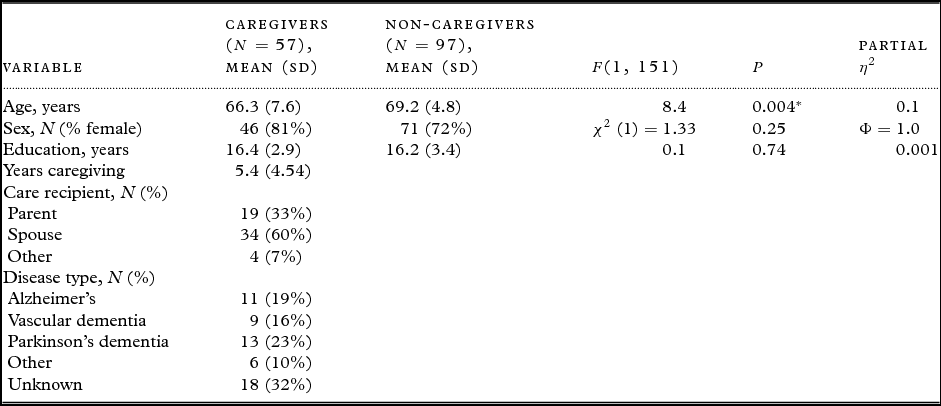
Demographic characteristics of the participants are shown in Table 1. The caregivers and non-caregivers did not differ in sex distribution or level of education, but the caregivers were significantly younger than the non-caregivers.
Demographic characteristics of participants

*p < 0.01.
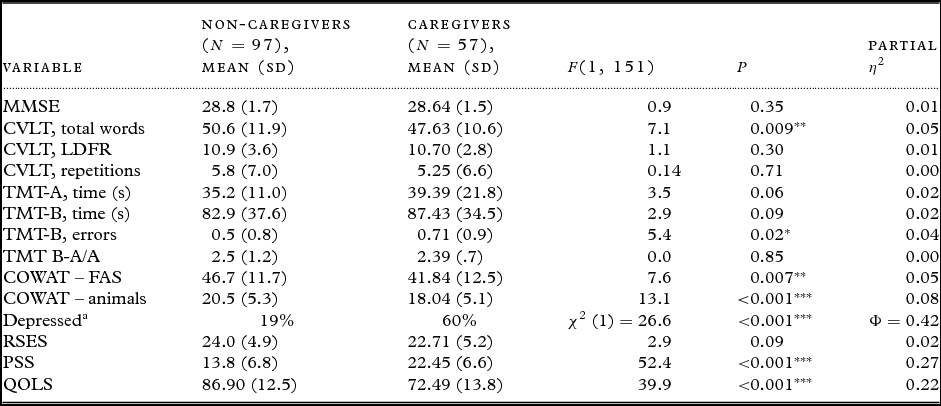
As shown in Table 2, ANCOVAs suggested no significant differences between groups on CVLT-II Long Delay Free Recall or TMT-B completion time. With regard to supplementary measures of executive function, several significant differences were found: caregivers made more errors on the TMT-B, generated fewer words on both components of the COWAT (FAS and Animals), and learned significantly fewer words on the CVLT-II.
Non-caregivers compared with caregivers, controlling for age, sex, and education

*p < 0.05.
**p < 0.01.
***p < 0.001.
MMSE = Mini-Mental State Examination; CVLT, Total Words = California Verbal Learning Test-II, total words learned over five trials (0-80); CVLT, LDFR = CVLT Long Delay Free Recall (0–16); TMT = Trail Making Test; COWAT = Controlled Oral Word Association Task; RSES = Rosenberg Self-Esteem Scale (0–30); PSS = Perceived Stress Scale (0–40); QOLS = Quality of Life Scale (16–112).
a In the non-caregiving sample, the GDS was used to assess depressive symptoms (mean score = 5.22, SD = 5.37, cut-off for depression is 10), while in the caregiving sample the CES-D was used (mean score = 19.15, SD = 11.00, cut-off for depression is 16). As such, the percentage of participants endorsing clinically significant levels of depressive symptomatology is reported.
In terms of psychosocial variables, caregivers scored higher on perceived stress and lower on quality of life. Caregivers were also more likely to meet the cut-off score for depression on the CES-D compared with non-caregivers on the GDS (see Table 2).
To explore whether the relationship between caregiver status and cognitive function was mediated through perceived stress, a mediation analysis using PROCESS macro was conducted. No significant mediation effect was found for any of the aforementioned relationships between caregiver status and cognitive outcomes (all p’s > 0.10).
Discussion
Given that caregiving is associated with chronic stress, depression, and low quality of life, and each of these factors is independently associated with impaired cognitive function, this study examined whether caregivers would have significantly lower scores on measures of cognitive function relative to controls. Contrary to expectations, there were no statistically significant group differences on time to complete TMT-B or measures of episodic memory. However, among the supplementary measures of executive function, several significant between group differences were found: caregivers made significantly more errors on the TMT-B, named fewer words on both components of the COWAT, and learned fewer words over repeated trials on the CVLT-II than the non-caregivers.
Our observations suggest that executive functions may be more vulnerable to the effects of psychological distress than episodic memory. Indeed, empirical evidence suggests that while architectural changes to the hippocampus typically require several weeks of stress exposure to occur, neurons in the PFC can begin to transform in as little as a single exposure (McEwen, Reference McEwen2008). As mentioned, the frontal lobes have a high density of cortisol receptors, which makes this region particularly vulnerable to the detrimental effects of chronic stress (McEwen, Reference McEwen1998). Indeed, exposure to chronic stress has been shown to correlate negatively with grey matter volume in the PFC (Radley and Morrison, Reference Radley and Morrison2005) and impair executive functions. As such, it is possible that the current sample is displaying early observable effects of chronic stress on frontal lobe function. This is especially concerning as the caregiver group was, on average, younger than the non-caregiver group.
Although the mean completion time on the TMT-B among caregivers was not statistically significantly slower than the non-caregivers, caregivers made significantly more errors on the test. Several studies have suggested that TMT-B errors are actually a more sensitive measure of executive dysfunction than completion time. For example, Mahurin et al. (Reference Mahurin2006) examined the correlates of TMT-B error scores versus completion time, and found that slower completion times were more likely explained by impairments in visuomotor scanning, while errors were uniquely associated with tests of mental tracking and working memory – factors associated with executive function.
Participants in the present study also showed relative impairment in both phonemic and semantic fluency. Tasks of verbal fluency are thought to place considerable demands on executive processes because they require participants to efficiently organize verbal information, self-monitor, engage in effortful retrieval of information, and inhibit responses (Rosser and Hodges, Reference Rosser and Hodges1994). The phonemic fluency component of the COWAT is typically thought to be related to the left frontal region of the brain, which is hypothesized to mediate the executive processes of suppressing habitual responses to verbal categories (Perret, Reference Perret1974) and active search and retrieval of information (Baldo and Shimamura, Reference Baldo and Shimamura1998), providing further evidence that caregivers show impaired executive function relative to the non-caregivers.
Caregivers also showed relative impairment on the semantic component of the task, which is considered more demanding on the medial temporal area of the brain. This finding is at odds with caregivers’ performance on the CVLT-II delayed recall task, which is also hypothesized to tap into this brain region. One possible reason for this discrepancy is that semantic fluency is thought to draw on executive processes more than long delay free recall. To address this question, Henry and Crawford (Reference Henry and Crawford2004) conducted a meta-analysis of 31 studies examining verbal fluency performance in adults with focal lesions in the frontal, temporal, or non-frontal regions; and healthy controls. Results indicated that semantic fluency is indeed sensitive to focal temporal lesions, as patients with temporal pathology were considerably more impaired on semantic fluency than patients with frontal lesions. However, both semantic and phonemic fluency were equally sensitive to frontal dysfunction, suggesting that semantic fluency, like phonemic fluency, draws on executive processes. Thus, it appears that in the current study, the relative impairment caregivers showed on semantic fluency may be mediated by its reliance on executive function, given that caregivers showed no impairment on delayed recall component of the CVLT-II.
The final measure that significantly differed between caregivers and non-caregivers was the total amount of words learned over the five CVLT-II learning trials. Relative to the delayed-recall component of the CVLT-II, which is a measure of verbal retention, the learning component has generally been considered to be more sensitive to executive function. This is because the CVLT-II list is unstructured and requires participants to actively organize the information in order to efficiently encode it.
Overall, our neuropsychological results provide compelling evidence that caregiving is associated with impairments on measures of caregivers’ ability to perform complex, executive functions. Further, these associations are not mediated by perceived stress. These findings are clinically significant for a number of reasons. For instance, taking medications as prescribed involves more than just remembering to take them – it also involves taking them at the right time, in the right sequence, in the right circumstances, and having working knowledge about the purpose of each medication. Moreover, difficulty with inhibition, executive memory, and learning could lead to serious issues such as juggling appointments and meetings, difficulty recounting events to physicians, thinking quickly and creatively to solve novel problems, etc.
Our second goal was to replicate previous evidence that caregivers report significantly poorer psychological well-being relative to non-caregivers. Consistent with our hypothesis, results demonstrated that caregivers reported greater perceived stress, lower quality of life, and were more likely than non-caregivers to meet the cut-off score for clinical depression risk. These findings are comparable with a meta-analysis by Pinquart and Sörensen (Reference Pinquart and Sörensen2003), which integrated 84 studies and demonstrated that caregivers reported feeling significantly more stressed and depressed, and reported lower levels of subjective well-being, physical health, and self-efficacy than controls.
The finding that 60% of caregivers in the current study were identified as at risk for clinical depression, having met the clinical cut-off score on the CES-D (i.e. 16 or greater) is important. The sample's mean score on the CES-D was substantially higher than caregiver samples in other recent studies. For example, Schulz et al. (Reference Schulz2003) found that in a sample of 217 informal caregivers of persons with dementia in the United States, the average CES-D score was 15.8. Considering the relatively high prevalence of depression in the current sample, it is possible the current sample of caregivers may have been caring for a more complex set of care recipients than in other studies. However, this explanation is speculative and deserves further inquiry.
Overall, subjective quality of life has been less studied in this population. In healthy populations, the average score on the QOLS is 90 (Burckhardt and Anderson, Reference Burckhardt and Anderson2003). Thus, it follows that our non-caregiver group had a similar QOLS score. However, the caregivers had a mean score that was significantly lower than the controls. Given that caregiver's QOL is significantly related to the care recipient's QOL (Thomas et al. Reference Thomas2006), exploring methods to improve quality of life is imperative.
Although this study presents several compelling findings, some limitations need to be considered when interpreting the results. Due to sample size constraints, we were unable to adjust for all exploratory covariates. The covariates used in the final analyses were theory-driven and essential to include even in spite of the loss of degrees of freedom. It is also important to recognize that group differences may have been driven by increased depressive symptomatology in the caregiver group. Although exploratory analyses did not reveal a significant mediation effect (data not shown), this null finding may be attributed to the sample size. In terms of sample characteristics, the majority of the sample identified as Caucasian, which limits the generalizability of the results to other ethnicities and cultures in Canada.
Overall, these findings point to the importance of preventative interventions that target caregivers. Despite being significantly younger than the control group, caregivers showed significantly poorer performance on several measures of executive function and psychological well-being. Historically, much of the health care system's attention has been placed on the patient with a neurodegenerative disease and not the caregiver. These data contribute to a growing body of literature that consistently points to the need for immediate action to improve the welfare of informal caregivers.
Conflict of interest
The authors have no conflicts of interest to declare.
Description of authors’ roles
Dr. Fiocco, the study PI, conceptualized and designed both studies, and contributed to data analysis. Ms. Mallya ran the data analyses and interpreted the results. Both authors contributed to data acquisition and preparation of the manuscript.
Acknowledgments
This work was supported by the Mind and Life Institute's 1440 Award and partially supported by the Ryerson Health Research Fund (PI: Dr. Fiocco). Sasha Mallya was funded by the Ontario Mental Health Foundation Doctoral Studentship. This work was also supported by in-kind contributions from the Mississauga Halton Local Integration Network, North York Senior Center, and Chartwell. We wish to express our gratitude to all of the participants for their contributions to this study. The sponsors had no role in the design, methods, participant recruitment, data collection, analysis, or preparation of the paper.