Most (if not all) language learners will have had the experience of being told that an utterance—although perfectly grammatical and comprehensible—is unacceptable because one simply does not say it like that in the language in question. Recourse to this type of response generally indicates that the string uttered by the nonnative speaker (NNS) is phraseologically odd and that the student and teacher have stumbled onto the vast expanse of what can very generally be referred to as multiword units. A multiword unit is just that: a single unit composed of more than one word, or, to put it another way, a string whose co-occurrence restrictions are arbitrary and that is, as a result, more or less fixed. These fixed expressions cover a wide range of strings, including (but certainly not limited to) idioms, collocations, discourse organizers, acquisitional formulas, and (the object of the current study) conventional expressions.
Multiword units have received increasing attention in SLA research (e.g., Meunier & Granger, Reference Meunier and Granger2008), and it is now generally accepted that mastery of such strings by NNSs is as important as it tends to be elusive. Whereas the native speaker (NS) is able to pick out the subset of sequences that are natural in the speech community in question from among the infinite possibilities accorded by any natural grammar (an ability known as nativelike selection; Pawley & Syder, Reference Pawley, Syder, Richards and Schmidt1983), the NNS generally employs fewer such strings and is less successful in identifying them in his or her second language (L2). Multiword units have been argued to be important in acquisition on the basis of their pervasive (and even unavoidable) nature. Although the identification of multiword units is still subject to debate, most researchers agree that such strings are widespread in language. For example, Erman and Warren (Reference Erman and Warren2000) estimated that more than 50% of written English consists of prefabs (i.e., multiword units), whereas Altenberg (Reference Altenberg and Cowie1998) calculated that 80% of language is made up of recurrent word strings. Finally, Pawley and Syder (1983) claimed that “the stock of lexicalized sentence stems known to the ordinary mature speaker of English amounts to hundreds of thousands” (p. 192). In addition to their pervasiveness, such strings have been argued to play an important role in communicative competence. In his study of routine formulas, Coulmas (Reference Coulmas1979) claimed that many multiword units are:
obligatory to a greater or lesser extent. Their obligatoriness serves a very important social function: the more obligatory a formula is, the more it is something like a password giving access to the group where it is habitually employed in some particular situation. The misuse of, or failure to use, an obligatory formula is very revealing, while the correct usage helps to establish the user’s membership of [sic] a group. (p. 252)
Despite the high stakes surrounding the appropriate use of multiword units, “it is well known that even advanced learners who have learned a great many words and ‘grammar rules’ nevertheless often fail to combine words the way native speakers do” (Boers & Lindstromberg, Reference Boers and Lindstromberg2009, p. 1).
Second language acquisition research targeting various subgroups of multiword units has attempted to address both linguistic and psycholinguistic issues concerning their acquisition. On the linguistic side of things, authors such as Nesselhauf (Reference Nesselhauf2003) and Warga (Reference Warga2005) have shown that NNSs use many fewer multiword units than do NSs, whereas researchers including Roever (Reference Roever2005) and Kecskes (Reference Kecskes2000) have found that NNSs’ knowledge of such sequences and of when NSs prefer to use them is lacking. In contrast, psycholinguistic questions that mainly target the mental representation of such strings have been central in both first language (L1) and SLA investigations into multiword units. As early as the 1970s, experiments have shown that NSs process certain phraseological strings significantly more quickly than they do nonphraseological ones (e.g., Swinney & Cutler, Reference Swinney and Cutler1979), a finding that has proven to be particularly robust when it comes to idioms (i.e., strings that are either syntactically noncompositional or semantically opaque). The dominant interpretation of this finding states that such strings are processed more quickly because they are lexicalized chunks that are stored and retrieved whole from the lexicon (Wray, Reference Wray2002, p. 9). This chunking is hypothesized to speed up the processing of such strings and to facilitate their fluent production. In the last 10 years, more and more authors have become interested in nonnative processing of multiword units, although the results that are currently available are not yet able to provide a clear idea as to how such strings are processed by NNSs.
The current study addresses both linguistic and psycholinguistic issues as they relate to one type of multiword unit—namely, conventional expressions. Such strings, defined by Bardovi-Harlig (Reference Bardovi-Harlig2009) as “those sequences with a stable form that are used frequently by speakers in certain prescribed social situations” (p. 757), are important for successful participation in a linguistic community (Coulmas, Reference Coulmas1979), and, as such, one goal of this project is to investigate NNSs’ ability to judge the appropriateness of such strings in various contexts, an ability essential in nativelike selection (Pawley & Syder, Reference Pawley, Syder, Richards and Schmidt1983). The second goal is to evaluate claims that multiword units benefit from facilitated processing by testing a sampling of conventional expressions in an online task. This type of multiword unit has not, to the best of my knowledge, been investigated in previous processing studies, neither in those whose participants were NSs nor in those testing NNSs. In what follows, I begin by reviewing SLA research into phraseological phenomena relevant to the current project and start with a brief discussion of the terminology and definition adopted in this article.
LITERATURE REVIEW
Terminology and Definition
As mentioned by Roberts (Reference Roberts1993), the study of multiword units has interested scholars as far back as Saint Augustine, who noted that sequences such as in saeculum could be treated as units for the purposes of translation (Kelly, 1979, p. 121; cited in Roberts). Since then, the number of terms used to designate the recurrent word patterns of interest to researchers has grown, with Wray (Reference Wray2000) providing a list of 47 terms that have been used to “describe aspects of formulaicity in the literature” (p. 465). Although, as stated by Wray, this terminological abundance is, in part, a reflection of the wide range of phenomena considered to be multiword units, Granger and Paquot (Reference Granger, Paquot, Granger and Meunier2008) identify “the vast and confusing terminology associated” (p. 27) with this field as one of the factors that prevents the domain of phraseology from coming into its own.
In their chapter “Disentangling the Phraseological Web,” Granger and Paquot (Reference Granger, Paquot, Granger and Meunier2008) suggest that much of the confusion surrounding terminology is due to the existence of two major approaches to the study of phraseology—what they call phraseological or traditional approaches versus distributional ones. Phraseological approaches rely on linguistic criteria to identify sequences whose co-occurrence restrictions cannot be directly derived from the basic semantic and syntactic restrictions of the language in question. Largely developed within the field of lexicology, such approaches have a long history and are generally used to identify referential phrasemes (e.g., collocations, idioms), textual phrasemes (e.g., textual sentence stems), or communicative phrasemes (e.g., proverbs, commonplaces). Distributional approaches, which come to us from corpus linguistics, arrived on the scene much later (Sinclair, Reference Sinclair1991). The goal of such approaches is to identify significant patterns in natural language. In practice, this corresponds to identifying significant word co-occurrences, in which significant can be defined with respect to overall frequency or to statistical co-occurrence measures (e.g., mutual information [MI] scores and t scores; see Gries, Reference Gries, Aquilino and Moises2010). Granger and Paquot argue that boundaries between phraseological and nonphraseological are quite different depending on the type of approach adopted and that the recognition of this difference at the outset can help in clarifying questions surrounding terminology and definitions.
The current study belongs to the phraseological tradition and concentrates on conventional expressions, which constitute a subset of what Granger and Paquot (Reference Granger, Paquot, Granger and Meunier2008) referred to as communicative phrasemes. Conventional expressions have also been referred to as routine formulas (Coulmas, Reference Coulmas1979), as situation-bound utterances (Kecskes, Reference Kecskes2000), and as énoncés liés (“bound utterances”; Fónagy, Reference Fónagy and Martins-Baltar1998). Like all multiword units, conventional expressions are stable in form and relatively frequent. What sets them apart is the fact that they are crucially bound to certain social situations, a connection described by Fónagy (Reference Fónagy and Martins-Baltar1998) in the following way:
Des situations récurrentes constituent la charpente de la vie quotidienne. Chaque situation récurrente déclenche un nombre très limité d’énoncés mémorisés, bien inférieur à celui des énoncés grammaticaux qui auraient pu faire l’affaire, mais qui ne sont pas validés par la composante pragmatique. (p. 132)
“Recurrent situations constitute the framework for everyday life. Each recurrent situation triggers a very limited number of memorized utterances, whose number is significantly lower than the number of grammatical utterances that could have done the job just as well, but which are not validated by the pragmatic component.”
This quote highlights two of the major questions—one linguistic, the other psycholinguistic—that surround conventional expressions in SLA: Is the NNS able to identify which expressions are associated with which recurrent situations? Do the recurrent situations in the learner’s L2 community actually trigger the activation of (perhaps memorized) conventional expressions for the NNS? The current study set out to examine precisely these two issues, which have only begun to be addressed in the literature.
Knowledge of Conventional Expressions
Studies into NNSs’ knowledge of conventional expressions have examined, on the one hand, recognition of or familiarity with such strings and, on the other, sociopragmatic and pragmalinguistic knowledge of them. Two studies, both authored by Bardovi-Harlig, have tried to determine whether NNSs are familiar with conventional expressions in their L2. In her 2008 study, Bardovi-Harlig reported on 61 learners of English as a L2 at four levels of proficiency who completed three written tasks: one receptive task (via self-report recognition), one production task (via a discourse-completion task [DCT]), and one task that tested both receptive and production abilities (via a modified vocabulary knowledge scale). As noted in her discussion, the self-report recognition task resulted in very high (close to ceiling) levels of recognition, scores that the author acknowledged were probably inflated due to the generosity of the self-report measure. In a second study, published in 2010, 149 L2 learners of English at four levels of proficiency and 49 NSs completed an aural familiarity task. Of the 60 experimental items, 35 had been identified as conventional expressions for the community in which the study was conducted, whereas the remaining 25 consisted of modified versions—either lexically (excuse the mess/excuse the dirt) or grammatically (no problem/no problems)—of one of the conventional expressions. Participants listened to each item and were asked to determine whether they felt they heard the sequences often, sometimes, or never. Overall, conventional expressions were reported to be heard significantly more often than their modified counterparts. Although raw scores suggested that recognition of conventional expressions increased with proficiency, the only significant difference found was between NSs and NNSs as a group. Native speakers also rejected modified expressions significantly more often than did NNSs. However, within the NNS groups, the most advanced NNSs rejected modified expressions more often than the lower level NNSs, which was suggestive of development.
A small number of studies (e.g., Roever, Reference Roever2005; Scarcella, Reference Scarcella1979) have attempted to gauge whether NNSs understand the mappings between form and function (i.e., pragmalinguistic knowledge) and between function and context (i.e., sociopragmatic knowledge) as concerns conventional expressions. For example, Roever (Reference Roever2005) analyzed the results from a 12-item multiple-choice routines task in which learners of English in both host and foreign language environments read short contexts and chose the most natural response from four possibilities. Roever’s results showed that even limited experience (i.e., less than 3 months) in the host environment resulted in significant improvement in the selection of the correct conventional expression (proficiency was held constant). The drawback to this type of task, however, is that we are necessarily testing preference from among of a set of distractors, which, in Roever’s study, ranged from strings that were formulaic but inappropriate to strings that were not especially formulaic to strings that were somewhat unconventional. It is thus not clear whether the selection of the targeted expression in this sort of task can necessarily be construed to indicate that the NNS believes the string selected to be acceptable or appropriate or, rather, if the targeted expression was chosen simply as the best option out of the proposed responses.
The Processing of Multiword Units
Although much work has looked into the processing of different sorts of multiword units, to my knowledge, no such study has yet explored the processing of conventional expressions. Still, many authors consider that what generally distinguishes multiword units from nonphraseological strings is the mental representation or processing of multiword units. More precisely, it is often claimed that a multiword unit is stored as such in the mental lexicon and, thus, is retrieved as a whole. Its storage and processing, then, would be on par with that of an individual lexical item. This vision of multiword units is evident in one of the dominant definitions of formulaic sequence, proposed by Wray (Reference Wray2002), a definition that Myles (Reference Myles2004) goes so far as to describe as “uncontroversial” (p. 142). For Wray, a formulaic sequence is
a sequence, continuous or discontinuous, of words or other elements, which is, or appears to be, prefabricated: that is, stored and retrieved whole from memory at time of use, rather than being subject to generation or analysis by the language grammar. (p. 9)
The lynchpin of this definition is the presumed fundamental storage and processing difference between formulaic (i.e., multiword units) and nonformulaic (i.e., generated strings) sequences. The holistic lexical storage described in this definition is widely assumed to offer “processing benefits to speakers and hearers, by providing a short cut to production and comprehension” (Wray, Reference Wray1999, p. 213), which is thought to explain, at least in part, the pervasiveness of multiword units. The benefits conferred by the use of multiword units most frequently cited include faster processing, more time for discourse planning, and greater fluency. For example, Skehan (Reference Skehan1998) suggested:
We rely on such chunks to ease processing problems, using them to “buy” processing time while other computation proceeds, enabling us to plan ahead for the content of what we are going to say, as well as the linguistic form. (p. 40)
Schmitt and Carter (Reference Schmitt, Carter and Schmitt2004) posited that “there is little doubt that the automatic use of acquired formulaic sequences allows chunking, freeing up memory and processing resources” (p. 12), and Wood (Reference Wood2002) argued that “a great proportion of the most familiar concepts and speech acts can be expressed formulaically, and if a speaker can pull these readily from memory as wholes, fluency is enhanced” (p. 7).
Of these three processing benefits, it is faster processing that has received the most attention, and the number of studies examining the speed with which NSs and NNSs process multiword units has grown steadily since the 1970s. However, such studies have concentrated almost exclusively on two types of multiword units: those defined with respect to distributional characteristics (i.e., overall frequency or probability of co-occurrence) and a subset of referential phrasemes (i.e., idioms).
Processing Distributionally Defined Multiword Units
Several studies have attempted to determine whether NSs and NNSs show different processing profiles as a function of either a string’s absolute frequency or its strength of co-occurrence (MI scores or t scores). With respect to measures of absolute frequency, we have known since at least the 1950s that lexical frequency significantly influences reaction times (RTs; see Howes, Reference Howes1957; Howes & Solomon, Reference Howes and Solomon1951), with more frequent lexical items being reacted to significantly more quickly than less frequent ones. On the basis of such results, a similar asymmetry is expected to be evident for multiword units that are more frequent versus those that have lower frequencies. Experiments that have put this hypothesis to the test have generally found that NSs respond significantly more quickly to frequent strings (Durrant & Doherty, Reference Durrant and Doherty2010; Ellis & Simpson-Vlach, Reference Ellis and Simpson-Vlach2009; Jiang & Nekrasova, Reference Jiang and Nekrasova2007;Footnote 1 Siyanova & Schmitt, Reference Siyanova and Schmitt2008; Siyanova-Chanturia, Conklin, & van Heuven, Reference Siyanova-Chanturia, Conklin and Schmitt2011). A similar result has been reported for NNSs (Ellis, Simpson-Vlach, & Maynard, Reference Ellis, Simpson-Vlach and Maynard2008; Jiang & Nekrasova, Reference Jiang and Nekrasova2007; Siyanova & Schmitt, Reference Siyanova and Schmitt2008), although it also appears that NNSs are not always as sensitive to small changes in frequency as are NSs (Siyanova & Schmitt, Reference Siyanova and Schmitt2008).
Although both NSs and NNSs appear to be sensitive to the frequency of multiword units in their processing of such strings, different patterns of processing speed as a function of MI scores (which indicate the strength of co-occurrence among the lexical items in a multiword unit) have been found for NSs and NNSs. Ellis et al. (Reference Ellis, Simpson-Vlach and Maynard2008) looked at the processing of multiword units on the basis of both frequency and MI scores for three-, four-, and five-word sequences. In a first task, 11 NNSs and 11 NSs were asked to judge whether or not a string was English, whereas 6 NNSs and 6 NSs were recruited to read aloud the same test strings in Task 2. For Task 1, each participant saw 108 multiword units as well as scrambled versions of each string, whereas participants in Task 2 read aloud the 108 multiword units. Forced-entry multiple regression analyses showed that the speed of NS responses in Tasks 1 and 2 was significantly predicted by length of the expression and the MI score (the stronger the string cohered, the faster the NSs responded). Significant predictors for the nonnative responses on both tasks, in contrast, included length and frequency (higher frequency strings were responded to more quickly). Thus, the speed of NNS reactions was not found to be determined by the strength of co-occurrence as measured by MI scores.
Processing Referential Phrasemes
Some of the earliest attempts at assessing the processing of multiword units targeted those strings that have long been considered to be at the core of phraseology: idioms.Footnote 2 As a result of their characteristic noncompositionality (syntactic or semantic), most authors agree that idioms are most likely stored as a single lexical unit, which should result in faster processing profiles when compared with nonphraseological strings, as an idiom will not have to be built up from its component parts. The assumption that idioms will be processed more quickly than nonidioms has, for the most part, been borne out in the literature on NS processing, which includes experiments on adults (Swinney & Cutler, Reference Swinney and Cutler1979), children (Qualls, Treaster, Blood, & Hammer, Reference Qualls, Treaster, Blood and Hammer2003), university students (Cronk & Schweigert, Reference Cronk and Schweigert1992), and aphasics (Nenonen, Niemi, & Laine, Reference Nenonen, Niemi and Laine2002). The faster processing of idioms by NSs is generally accepted, and current debate mainly concentrates on how best to model idiom processing (e.g., Tabossi, Wolf, & Koterle, Reference Tabossi, Wolf and Koterle2009).
Several recent studies have attempted to assess the processing of idioms by NNSs, the results of which are contradictory. On the one hand, Conklin and Schmitt (Reference Conklin and Schmitt2008) and Underwood, Schmitt, and Galpin (Reference Underwood, Schmitt, Galpin and Schmitt2004) found evidence of facilitated processing of idioms for NNSs. However, in Schmitt and Underwood (Reference Schmitt, Underwood and Schmitt2004) and Siyanova-Chanturia, Conklin, and Schmitt (Reference Siyanova-Chanturia, Conklin and Schmitt2011), no significant difference was found for NNSs when RTs on idioms were compared to those on matched nonidioms.
Overview and Research Questions
To date, only a few studies into NSs’ and NNSs’ knowledge of conventional expressions have been conducted, and, as was pointed out in the previous review, the task designs used were sometimes problematic. Notably, Bardovi-Harlig (Reference Bardovi-Harlig and Han2008) hypothesized that her recognition task was overly generous, and I suggested in the previous section that the use of a multiple-choice format, such as the one used in Roever (Reference Roever2005), does not allow us to know whether respondents found the answers they selected truly acceptable in the proposed contexts. The current project introduces a new measure of knowledge concerning conventional expressions that specifically targets the knowledge of mappings between form and function/context. Thus, the first research question guiding this project was as follows:
1. Do NNSs and NSs distinguish conventional expressions from grammatical but nonconventional, matched conditions on a contextualized judgment task?
In terms of the processing of multiword units, it has been claimed that such strings are stored and retrieved whole from memory and that this particular psycholinguistic status confers processing benefits on speakers and hearers. Previous studies have found some evidence of facilitated processing on certain multiword units, showing, for instance, that NSs and NNSs alike are sensitive to frequency effects but that differences in co-occurrence strength most strongly affect NS processing. Many studies have also demonstrated that NSs react to idioms more quickly than they do to matched, nonidiomatic conditions, although the results from similar studies with NNSs are not as clear cut. The current study set out to determine whether processing benefits are, in fact, associated with conventional expressions, a subset of multiword units whose processing has not, to the best of my knowledge, been examined in previous studies. Although conventional expressions are considered to be multiword units, these strings differ from those whose processing has already been investigated insofar as conventional expressions are situationally bound. The second research question that guides this study is as follows:
2. Is there evidence of a processing advantage for conventional expressions?
a. Do NNSs and NSs react to a word within a conventional expression significantly faster than they do to a matched near synonym in the same frame?
b. Do NNSs and NSs react to a word within a conventional expression significantly faster when that word is found in the conventional expression as opposed to when it is found in an alternate frame?
INVESTIGATING PRAGMATICS AND PROCESSING
Phase One: Identifying Conventional Expressions
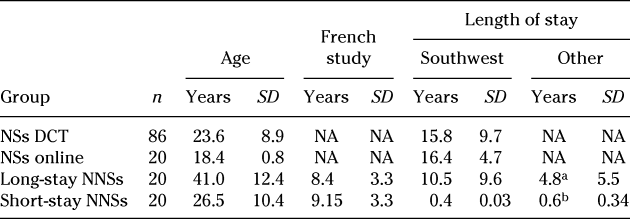
The identification of conventional expressions is challenging, both for reasons common to the identification of all multiword units and for reasons that are specific to conventional expressions. In general, multiword units are considered to be stable in form and frequent in use, characteristics whose operationalization varies widely in the literature. Although stability in form may seem to be straightforward, many studies consider that a single multiword unit can have several surface variants. These surface variants can range from arguably minor differences, such as the grouping together of full and contracted strings (e.g., I am vs. I’m; Bardovi-Harlig, Reference Bardovi-Harlig2009), to much more generous views of what constitutes a single multiword unit (e.g., je vais/peux aider/faire “I am going to/can help/do”; Warga, Reference Warga2005, p. 80). What it means for a multiword unit to be frequent is equally difficult to define. Whether absolute frequency (e.g., on the basis of a corpus) or relative frequency (how many times a sequence occurred relative to how many times it could have occurred) measures are used, several different cutoffs have been adopted in the literature. If all multiword units are stable in form and frequent, conventional expressions differ from other units insofar as such strings are situationally bound and community wide in use. Thus, the identification of conventional expressions for any given speech community logically requires research into how members of a given community express themselves in particular situations. The first phase of this project was thus dedicated to the identification of conventional expressions in use in the community in which the research project was carried out (located in the southwest of France). For this phase, a 35-item written DCT was elaborated and piloted. The final version was completed by 86 NSs of French living in the community under study (demographic details for the DCT and online experiment participants are provided in Table 2). The participants were instructed to read each context, to imagine themselves in the context described, and to respond as they would have if the situation presented itself. A multiple-response format was adopted (e.g., Golato, Reference Golato2003), which allowed participants to provide up to four different responses per context; a total of 116 to 179 responses were provided for each context. Responses were analyzed to identify potential conventional expressions using four criteria: (a) multiword format, (b) syntactic coherence, (c) stable form, and (d) high frequency.
Criterion (a) reflects this project’s focus on phrasal phenomena, whereas criterion (b) was adopted to exclude sequences such as et le “and the,” repetitions, and open slots. The operationalization of stable form (criterion c) allowed for certain variants (e.g., negative strings with and without the negative particle ne were considered instances of the same string). Finally, a measure of relative frequency was adopted in defining high frequency (criterion d). This measure was intended to compare how frequently a string was used to how often it could have potentially been used. Absolute frequency counts for strings provided in response to each context were not always informative because responses provided in the DCT were sometimes complex, with respondents varying in the number and type of speech acts realized. For this reason, responses to each context were first analyzed into speech acts performed and were then analyzed on the basis of semantic formulas used to realize each speech act. A response provided for context 35 Late—boss, in which the respondent speaks with his or her boss after having arrived 30 min late for an important meeting, will be analyzed as an example:
(1) Context: Tu as un rendez-vous important avec ton patron lundi matin. Malheureusement, ton réveil n’a pas sonné et tu arrives en retard de 30 minutes. Quand tu vois ton patron, tu lui dis:
“You have an important appointment with your boss Monday morning. Unfortunately, your alarm clock didn’t go off and you arrive 30 minutes late. When you see your boss, you say to him:”
Response: Bonjour, je suis navrée j’ai eu un petit imprévu. Ça ne se reproduira plus.
“Hello, I am sorry something unexpected cropped up. It won’t happen again.”
In this case, the respondent realizes two speech acts: a greeting (bonjour) and an apology (je suis navrée j’ai eu un petit imprévu. Ça ne se reproduira plus). Within the apology, three semantic formulas are apparent: the head act in the form of an illocutionary-force-indicating device (je suis navrée), an explanation (j’ai eu un petit imprévu), and a promise of forbearance (Ça ne se reproduira plus). In the calculation of relative frequency adopted for this project, comparisons were made between all strings used to express each semantic formula in the same context, thus comparing strings that ostensibly competed to fulfill the same function. In each context, semantic formulas realized by at least 25% of all respondents were maintained in the analysis; any string used by at least 50% of respondents who had realized the semantic formula in question was considered to be a conventional expression for the purposes of this study. In the case of the example given in (1), 63 of 86 respondents (73.3%) used an illocutionary-force-indicating device to realize the speech act apology, of which 35 (55.6%) used the string je suis vraiment désolé (“I am really sorry”). This string was thus identified as a conventional expression for the community under study. This analysis identified 31 conventional expressions, of which 13 were retained for testing in the online contextualized naturalness judgment task (see the Appendix for a full list).Footnote 3
Phase Two: The Online Contextualized Naturalness Judgment Task
For this online task, participants read a context (taken from the DCT) followed by a response (including either a conventional expression or a modified version) and then had to decide whether the response was natural in the context. This task yielded two dependent variables: naturalness judgments and RTs. The aim of this task was to examine the ability of NSs and NNSs of French to distinguish between conventional expressions and slightly modified but grammatical sequences (essentially testing participants’ judgments of form-function/context mappings with respect to such expressions) as well as their processing of the same sequences (so as to determine whether such expressions enjoy processing benefits). To accomplish these two goals, the 13 conventional expressions retained for testing were subjected to two manipulations (word and frame), which are detailed in the following subsections.
Manipulation of Word
For the manipulation of word, a single word from each conventional expression (original word) was replaced with a near-synonym substitute (substitute), thus creating two versions of each conventional expression that differed by only one word (see the Appendix). Substitutes, which were taken from the analogical dictionary Le Petit Robert (Rey, Reference Rey2001), were matched to the original words as closely as possible in terms of lexical frequencyFootnote 4 and length.Footnote 5 The two versions of each conventional expression were paired with the same context in the online task. Differences in naturalness judgments between these two conditions are analyzed to respond to Research Question 1, whereas RT comparisons on the original word versus the substitute are examined to determine whether the conventional expression (i.e., the original word) shows processing advantages over the modified form (i.e., the substitute), thus responding to Research Question 2a.
Manipulation of Frame
Whereas most online experiments provide a single RT comparison, a second such comparison was built into the current experiment. It is for this reason that a lexical item from each conventional expression was inserted into an alternate (but nonconventional) frame, which allowed for RT comparisons on the same lexical item in a conventional and in an alternate frame (Research Question 2b). Thus, for each original word-substitute pair identified in the word manipulation, an alternate frame was created. These frames were paired with one of the DCT contexts but, crucially, had not appeared in the NS responses from Phase 1. Moreover, a verification task was administered to 43 NSs living in the southwest of France. For this task, each experimental item (context + response) was presented in offline fashion, with the original words and substitutes replaced by a blank space that respondents were instructed to fill in. Results from the task showed that the original words and substitutes were both provided as responses in the alternate frames, whereas conventional frames were almost exclusively filled in with the missing original word.
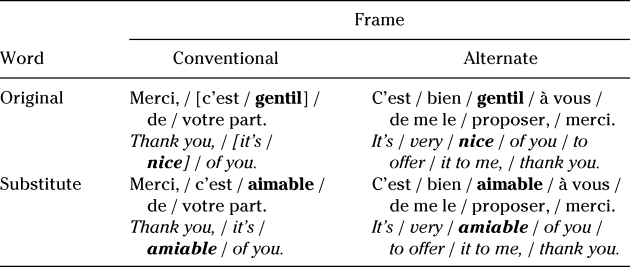
Table 1 provides an overview of the four conditions in the online naturalness judgment task, using the conventional expression c’est gentil “it’s nice” as an example. Each conventional expression underwent manipulations of word and frame, which yielded a total of 52 experimental items (13 expressions × 4 conditions). Hereafter, the condition including a conventional expression (i.e., conventional frame + original word) will be referred to as the conventional expression condition, whereas the conditions that resulted from the two manipulations will be referred to as (a) conventional frame + substitute, (b) alternate frame + original word, and (c) alternate frame + substitute. An additional 28 distracters were included for a total of 80 items.
Manipulation of word and frame

Note.
The square brackets delimit the conventional expression, the original word or substitute is in bold, and the slashes show the segmentation of responses.
Participants
Sixty participants, all of whom were living in the southwest of France, completed this experiment. Participants were equally distributed among three groups: 20 NSs of French, 20 NNSs who had spent between 4 and 6 months in the Southwest (i.e., short-stay NNSs), and 20 NNSs who had spent more than 1 year in the Southwest (i.e., long-stay NNSs). None of the participants for this experiment had completed the DCT or the verification task. Participants were compensated for their time with 10 euros.
Native speakers who participated in this project ranged in age from 17 to 21 (M = 18.4). Participants had spent an average of 16.4 years in the southwest of France, and all subjects reported French to be their only L1. The NNSs were all Anglophones who had reported English to be their L1. Short-stay NNSs were either university students or lecturers in the southwest of France at the time of testing, with an average length of stay of 5 months (range = 4–6 months). Participants ranged in age from 20 to 57 (M = 26.5) and reported having an average of 9.2 years of formal education in French; nine had already spent time in a French-speaking country (M = 7.6 months). Most of the long-stay NNSs (n = 15) had settled in France permanently; the remaining five had spent between 1 and 2 years in the region but had plans to return to their countries of origin. Unsurprisingly, the long-stay NNSs were, on average, older than their short-stay counterparts (M = 41 years of age). Length of residence in the Southwest varied between 1.3 and 33 years, with an average of 10.5 years. Seven of the participants had spent time in other regions of France or other Francophone countries, with time of residence averaging 4.8 years. Finally, years of formal French study were slightly less than that reported by the short-stay participants (M = 8.4 years), implying that the important difference between these two groups is the time spent abroad. The demographic details for the participants in this project (for both the DCT and the online task) are provided in Table 2.
Demographic details
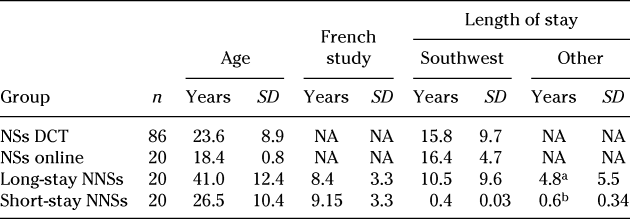
a n = 7.
b n = 9.
Task Administration
Participants completed a background questionnaire before beginning the online task. After reading the instructions and completing four practice items, participants began the actual experiment (created using the program Linger [Version 2.94]), which used a noncumulative moving window presentation. The task was presented on either a laptop or a desktop computer, and items were presented in a randomized order. For each item, participants pressed the space bar to bring up a context. After reading the context, the participant pressed the space bar again, which caused the context to disappear and the first segment of the response to appear. With each subsequent press of the space bar, the current segment of the response disappeared and the following segment appeared; the lapse of time between each press of the space bar was recorded in milliseconds and is used as the dependent variable for Research Question 2. Segments ranged in length from 1 to 4 words, and the original words and substitutes were always the sole members of their segments. At the end of the response, which was marked by appropriate punctuation and a closing quotation mark, a final press of the space bar brought up the question Est-ce que c’est naturel ici? “Is it natural here?” to which participants could respond oui “yes,” non “no,” or indécis “cannot decide.” The F key corresponded to an affirmative response, the J key to a negative response, and the space bar to a cannot decide response. The administration of the task took between 30 and 60 min.
Analysis
Two types of data were collected using this task: naturalness judgments and RTs. With respect to Research Question 1, which asks whether NNSs and NSs distinguish conventional expressions from grammatical but nonconventional, matched conditions on a contextualized judgment task, the analysis examines naturalness judgments by comparing acceptance rates for the original conventional expression versus the modified version in the same context. If participants are sensitive to the form of conventional expressions, we expect a significant difference in the judgments on these two conditions. The second research question investigates whether conventional expressions do indeed enjoy the facilitated processing that many researchers associate with all multiword units. Two analyses are carried out on the RT data collected: The first compares RTs on the original word versus the substitute in a conventional frame (manipulation of word, Research Question 2a), whereas the second examines RTs on the original word in a conventional frame versus RTs on the same lexical item in an alternate frame (manipulation of frame, Research Question 2b). If conventional expressions enjoy processing benefits, we would expect an asymmetry in RTs such that conventional expressions would lead to significantly faster reactions than nonconventional expressions.
RESULTS
Naturalness Judgments
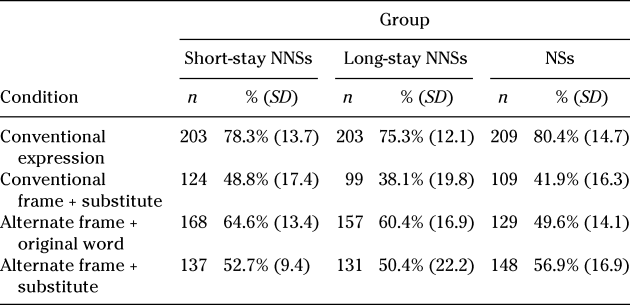
Each of the four conditions presented in this experiment was grammatical and semantically felicitous in the contexts with which it was paired. However, only the original conventional expressions had been found to be used frequently by NSs living in the community in which the project was carried out. As can be seen by the aggregate results presented in Table 3, all three groups judged the conventional expression condition to be natural at least 75% of the time. The percentage of items in the other conditions judged to be natural is much lower. These observations were confirmed by a 2 (Word) × 2 (Frame) × 3 (Group) mixed-design, repeated-measures ANOVA, which revealed a main effect of word, F(1, 57) = 170.539, p < .001, due to elevated yes judgments on items including the original word, as well as a main effect of frame, F(1, 57) = 9.586, p = .003, reflecting the greater number of affirmative judgments for conventional frames. The interaction between word and frame was also found to be significant, F(1, 57) = 109.22, p < .001. The between-subjects variable of group was not significant, F(2, 57) = .969, p = .386, and had no interactions, which indicates that the three groups behaved in a nondistinct fashion. However, the three-way interaction was significant, F(2, 57) = 3.805, p = .028.
Aggregate yes judgments by group and by condition
Note.
Yes and no judgments were largely complementary, with cannot decide accounting for no more than 5% of responses.
The interaction between word and frame was further explored using planned t tests, for which the results of the three groups were collapsed, given that their judgment patterns had not been found to significantly differ. These tests revealed the significance of this interaction to be due to distinct judgment patterns for each of the four conditions. In particular, the conventional expression condition was accepted significantly more frequently than both the conventional frame + substitute condition, t(59) = 13.626, p < .001, and the alternate frame + original word condition, t(59) = 10.349, p < .001, which confirmed that conventional expression items were indeed judged to be natural at significantly higher levels than the other conditions. Moreover, the alternate frame + original word condition received significantly more affirmative judgments than the alternate frame + substitute condition, t(59) = 3.914, p < .001, substantiating the main effect of word, which found that strings that included the original word—regardless of frame—were judged as more acceptable than those including substitutes. Finally, the alternate frame + substitute condition was responded to more favorably than the conventional frame + substitute condition, t(59) = 3.496, p = .001, a finding that underscores the low levels of acceptance for the items involving a substitute inserted into a conventional frame.
Reaction Times
Two sets of RT data were examined: RTs on the target segments (original words and substitutes) and, in the case of Research Question 2a, on the segments immediately following the original words or substitutes. In both datasets, z scores for skewness and kurtosis revealed that the data were not normally distributed. For this reason, the RT data were log-transformed, after which extreme outliers (more than 3 SD away from the mean for any given item) were replaced with the mean for that group on that item. For the target segments, this procedure affected 1% (n = 32) of the data, whereas, for following segments, 1.3% (n = 41) of the data points were replaced.
After having log-transformed the data, residuals were calculated to account for length differences between original words and substitutes. Although matched in length as closely as possible, original words were, on average, one letter shorter than the substitutes (6.8 letters for original words, 7.9 letters for substitutes). Residuals were calculated by running a single linear regression model in which all log-transformed RTs (dependent variable) were plotted against the length in letters of the words reacted to (independent variable). The resulting regression line predicted RTs on the basis of the length of a word. The predicted values were then subtracted from the observed values, yielding the residuals, which served as the dependent variable in all statistical analyses. This procedure allowed us to effectively factor out the effect of length.
General Patterns
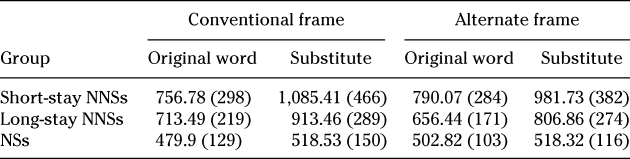
The first RT analysis examined the speed of reactions on target segments using a 2 (Word) × 2 (Frame) × 13 (Item) × 3 (Group) mixed-design, repeated-measures ANOVA. The main effect of word was found to be significant, F(1, 57) = 42.232, p < .001, due to overall faster RTs on the original words. Frame was not found to significantly impact the RTs, F(1, 57) = 1.833, p = .181. Crucially, the interaction between word and frame reached significance, F(2, 57) = 17.27, p < .001. The variable of item was found to be significant, F(12, 46) = 18.686, p < .001,6 and this main effect was qualified by interactions with word, F(12, 46) = 7.815, p < .001, with frame, F(12, 46) = 2.975, p < .001, and with group, F(24, 94) = 3.568, p < .001. Finally, the main effect of group was found to be significant, F(2, 57) = 18.453, p < .001, which Tukey HSD and Bonferroni post hoc tests showed to be due to a difference between the NSs and both groups of NNSs. However, no significant difference between the short-stay and long-stay NNSs was found (Tukey: p = .363; Bonferroni: p = .527). For this reason, the data from the two NNS groups were collapsed together in all subsequent RT analyses. Average RTs (before log-transformation and calculation of residuals) for each group on each condition are provided in Table 4.
Average RTs in milliseconds
Note.
Standard deviations are given in parentheses.
Manipulation of Word
The aggregate results were followed up with four planned t tests, which allowed us to explore potential asymmetries on original words versus substitutes. No significant difference was found between the conventional expression condition and the conventional frame + substitute condition for NSs, t(19) = .02, p = .984. A significant asymmetry between RTs on these same two conditions was found for the NNSs, t(39) = 7.973, p < .001, who reacted significantly more quickly when the original word (versus the substitute) was found in a conventional frame. However, the planned t test between RTs on the original word and substitute in an alternate frame revealed that NNSs simply tended to respond to original words more quickly, regardless of frame, t(39) = 4.164, p < .001. These results are thus not consistent with a facilitatory effect particular to conventional expressions but rather with faster processing on the set of original words versus the substitutes in this experiment.
Although no effects of facilitation were evident in the data from this manipulation, a third planned t test indicated an inhibitory effect in the nonnative processing of conventional frames into which a substitute had been inserted. More specifically, NNSs were significantly slower to react to a substitute in a conventional frame both with respect to the conventional expression condition, t(39) = 7.973, p < .001, and with respect to the substitute in an alternate frame, t(39) = 3.803, p < .001. There is no reason to expect the second asymmetry: The RTs were measured on the same words, and neither condition with substitutes was found to be conventional. One plausible explanation could be that the presence of the substitute in a conventional frame disrupts the NNS’s parse, essentially surprising the reader, who may have been expecting another word. If, in fact, this interpretation is correct, we might expect evidence of spillover from such inhibition to be visible in the RTs recorded on the segments following the substitutes. For this reason, the RTs on the segments following the original words and the substitutes in conventional frames were analyzed.Footnote 7 A 2 (Word) × 13 (Item) mixed-design, repeated-measures ANOVA with group as the between-subjects factor found that, overall, the segment following the original word was responded to significantly faster than was the same segment following a substitute, F(1, 57) = 32.51, p < .001. Group was found to be significant, F(2, 57) = 16.508, p < .001, due to the faster overall RTs recorded for the NSs; the two NNS groups were not distinct. Although group also significantly interacted with word, F(2, 57) = 3.331, p = .040, planned comparisons showed that both NSs, t(19) = 2.771, p = .007, and NNSs, t(39) = 5.857, p < .001, reacted significantly faster to a segment when it followed an original word than when it followed a substitute. Finally, the variable item also reached significance, F(12, 46) = 9.53, p < .001.
Manipulation of Frame
The manipulation of frame allowed us to determine if the same lexical item was responded to more quickly depending on whether it was found in a conventional expression or in an alternate frame. The results from the aggregate data showed that this was in fact the case in NS processing of such strings. Specifically, the NSs reacted to the original word more quickly when it was found in a conventional frame than when it was found in an alternate frame, t(19) = 3.307, p = .005. Importantly, no such asymmetry was found for substitutes, t(19) = .158, p = .876, showing that this result is not simply due to overall faster processing of lexical items in conventional frames. Nonnative speakers, in contrast, did not respond to original words differently as a function of frame.
DISCUSSION
Naturalness Judgments on Conventional Expressions
Conventional expressions constitute social contracts (Coulmas, Reference Coulmas1979), and their use is associated with a certain social situation in a given linguistic community (Bardovi-Harlig, Reference Bardovi-Harlig2009). Thus, mastery of such expressions involves not only the mastery of their form but also the mastery of the association between a form and its function(s) and between a form and the context(s) in which it is acceptable. Control over these different pragmatic mappings is of particular importance, given that such expressions are associated with many of the most common, everyday situations faced by a member or a potential member of a linguistic community. The mappings are not always transparent, which complicates the task for outsiders and renders the same task particularly difficult for NNSs.
The current project set out to examine mappings of form to function and of form to context with respect to a set of 13 conventional expressions using an online contextualized naturalness judgment task. Looking first for evidence of an overall sensitivity to conventional expression status, it was found that the NSs and NNSs judged the conventional expression items to be more acceptable than the other three conditions, which indicated a sensitivity to the variable of conventionality for all participants. Specifically, sequences identified as conventional were accepted as natural at a rate of 78%, with the other three conditions receiving significantly lower average affirmative scores, ranging from 43% (conventional frame + substitute) to 53% (alternate frame + substitute) and to 58% (alternate frame + original word). With respect to the NS data, the asymmetry between the conventional expression items and the other three conditions lends support to the construct of conventional expressions. Specifically, a set of 13 expressions identified as conventional for one group of NSs (n = 86) living in the southwest of France was judged by a second group of NSs (n = 20) from that same community to be more natural than three matched conditions. This convergence suggests that such expressions are in fact conventional for the community of speakers and not just for the minority that produced them.
Of the four conditions, the patterns of affirmative judgments recorded for the conventional expression items versus the conventional frame + substitute condition are of particular interest, as they test for sensitivity to minimal changes in form in conventional expressions when all else—and, in particular, context—is kept constant. In this dataset, all three groups attributed the highest acceptance scores (75.3–80.4%) to the conventional expressions, whereas the same sequences into which a substitute had been inserted consistently received the lowest naturalness judgments (38.1–48.8%). This strong asymmetry in favor of conventional expression items highlights that participants—NSs and NNSs alike—were sensitive to form and not simply to the grammaticality and semantic content of responses in making their naturalness judgments. For the NNSs, the fact that conventional expressions were judged to be more natural than slightly modified sequences implies sensitivity to form, an ability essential to nativelike selection (Pawley & Syder, Reference Pawley, Syder, Richards and Schmidt1983). Moreover, it is of interest that the response patterns recorded from the three groups did not significantly differ. This result of convergence of NS and NNS response patterns stands out in the small number of studies that have examined knowledge of conventional expressions. Although Roever (Reference Roever2005) found that learners were better able to complete a multiple-choice routines task after as little as 3 months abroad, and Bardovi-Harlig (Reference Bardovi-Harlig, Kasper, Yoshimi, Nguyen and Yoshioka2010) found evidence of development in learners’ ability to judge their familiarity with conventional expressions as a function of proficiency, neither author reported convergence with NS response patterns.
Although many factors may be responsible for explaining this finding of convergence, the high overall proficiency of the NNSs in the current project clearly distinguishes it from previous research. Even if the participants’ command of French was not controlled for in this project, all NNSs were presumably high-proficiency users of this language. In addition to reporting an average of 9 years of formal French instruction, short-stay and long-stay NNSs were all either taking general classes (and not French language classes) at a French university or working in France. The potential importance of proficiency with respect to conventional expressions highlights the need for research into the relationship between grammatical competence and pragmatic competence (see Bardovi-Harlig, Reference Bardovi-Harlig1999, and citations therein). Of course, we may find that both high proficiency and time abroad are necessary to attain the type of results found here (see Bardovi-Harlig & Bastos, Reference Bardovi-Harlig and Bastos2011; Bartning, Forsberg, & Hancock, Reference Bartning, Forsberg and Hancock2009; Forsberg, Reference Forsberg2010).
Reaction Times on Conventional Expressions
Patterns of facilitation and inhibition were revealed in the RT results, providing general evidence of a mental correlate for conventional expressions, although the significant patterns in the NS and in the NNS data differed. Beginning with Research Question 2a (manipulation of word), NS results were not significantly different on the target segment, although a significant asymmetry was found on the following segment: NSs reacted more quickly to a following segment that came after an original word than to the same segment seen after a substitute. The NNSs, in contrast, showed a significant tendency to always respond to original words more quickly than to substitutes, results that were nuanced by the consistently elevated RTs on substitutes in conventional frames. Specifically, the substitutes in a conventional frame were responded to more slowly than both the original words in conventional frames (conventional expression) and the substitutes in alternate frames. Investigation of the following segments revealed a significant asymmetry similar to what was found for NSs: Following segments were responded to more quickly when they followed the original word than when they followed the substitute in a conventional frame. Although multiword units are generally assumed to be associated with ease of processing, these results are most consistent with an inhibition associated with the substitutes in a conventional frame, rather than a generalized facilitation on the original words in the same frame for the NNSs.
The manipulation of frame (Research Question 2b) compared RTs on the same lexical item in two different frames. The NS results on this comparison revealed a significant asymmetry between faster RTs on original words in conventional frames as compared to the same lexical items in alternate frames. Given that this pattern was accompanied by flat results on the substitutes, this asymmetry points to facilitation on the conventional expressions. Thus, for the NSs, it appears that the set of conventional frames did confer processing advantages on the target lexical items found within them. The RTs for the NNSs, however, were not significantly different on these comparisons.
Nature of the Mental Correlate for NSs and NNSs: Two Hypotheses
The processing evidence indicates that, although NS and NNS online patterns were distinct, both groups processed conventional expressions differently from matched conditions. In this final section, two general hypotheses concerning the nature of the mental representation associated with conventional expressions for the two groups are considered in light of the current data. The first hypothesis corresponds to what may be considered the traditional view with regard to the mental representation of multiword units: a holistic representation analysis in which such strings would be stored in the lexicon as a complex lexical unit. The second hypothesis takes a more pragmatically oriented stance to the representation and processing of conventional expressions and considers whether these results may be better explained with reference to a speaker’s pragmatic competence.
Lexicalist hypothesis
The traditional lexicalist hypothesis concerning the mental representation of multiword units finds its roots in the research into idioms. As a result of their characteristic noncompositionality, idiomatic expressions have been argued to be stored as such in the mental lexicon. In other words, the speaker is argued to be unable to assemble such sequences, which justifies their placement in the mental lexicon. This lexical storage explanation was later extended to formulaic language more generally, even in the absence of characteristics that would lead us to believe that lexical storage was necessary (e.g., noncompositionality). This extension is evident in the following quote from Erman and Warren (Reference Erman and Warren2000):
Syntactic or semantic irregularity makes the non-compositional character of a phrase evident, but it is a mistake to believe that whatever is transparent is also compositional. It is probably because of this assumed connection between transparency and compositionality that idiomaticity has been looked upon as a marginal phenomenon. (p. 54)
Thus, the traditional view considers multiword units, in general, to be stored as what amounts to a complex lexical unit in the lexicon. However, the extension of the lexical storage hypothesis beyond what is properly idiomatic to encompass all multiword units may be considered problematic for at least two reasons. First, the evidence advanced in support of the lexical storage hypothesis for sequences that are not idiomatic is most often doubly indirect. Specifically, faster processing is generally equated with holistic lexical storage. This trend, however, is problematic because evidence of a characteristic presumably associated with holistic storage is treated as an unequivocal indication of storage as a whole unit. For example, Qualls et al. (Reference Qualls, Treaster, Blood and Hammer2003) wrote:
The second goal of the present study predicted that the students would show significantly faster response latencies on idioms compared to the matched controls. Our results robustly upheld this prediction, thus, providing developmental data that idioms are stored in the mental lexicon as words. (p. 255)
Underwood et al. (Reference Underwood, Schmitt, Galpin and Schmitt2004) similarly posited, “We now have evidence that the terminal words in formulaic sequences are processed more quickly than the same words when in nonformulaic contexts. This provides evidence for the position that formulaic sequences are stored and processed holistically” (p. 167), and Jiang and Nekrasova (Reference Jiang and Nekrasova2007) described of their study, “In both experiments, the NSs and the NNSs of English responded to formulaic expressions significantly faster than they did to nonformulaic expressions. Our findings provide clear and straightforward support for a holistic view of formula representation and processing” (pp. 441–442). Such unequivocal associations miss the fact that even if faster RTs are consistent with a holistic lexical storage account, there is not an exclusive relationship between facilitation and holistic storage.
Second, a lexical storage account of conventional expressions encounters problems specific to these types of strings. Recall that conventional expressions—as opposed to other multiword units—are situationally bound, meaning that their use is associated with a specific context or social situation (Kecskes, Reference Kecskes2000). In other words, conventional expressions are presumably triggered only in those situations that bind them. In interpreting the facilitation of conventional expressions documented in this study as evidence of holistic storage, the presumed association between these strings and the situations that condition their use is left unexplained. To maintain a wholly lexical account of the current results, it seems that we would be forced to claim that conventional expressions are stored with their triggering contexts, a proposal that requires considerable expansion of the role of the lexicon in grammatical theory.
Pragmatic competence hypothesis
Although the traditional lexicalist hypothesis dominates the literature on multiword units, other explanations are plausible, and it may very well be that conventional expressions differ from other multiword units with respect to their mental correlate. Contrary to idiomatic expressions or collocations, which preserve their idiomatic or collocational properties independent of context of use,Footnote 8 conventional expressions can only be identified in context (i.e., they are situationally bound). This opens the door for the possibility of the same surface string being conventional in certain situations but not in others. For example, the string avec plaisir “with pleasure” was found to be conventional in the current project in the context of accepting an offer. This same string, however, can also occur as an adverbial phrase, as in the following example taken from the corpus Lexique: J’écoute toujours vos histoires avec plaisir “I always listen to your stories with pleasure.” If conventional expressions are indeed associated with processing benefits, we would expect such benefits to be visible when avec plaisir is used to accept an offer but not in the example J’écoute toujours vos histoires avec plaisir. However, following the lexicalist hypothesis, processing benefits demonstrated for conventional expressions would most probably be equated with holistic lexical storage for the string in question. The problem then becomes how the processor would distinguish between the complex lexical unit avec plaisir and the generated sequence avec plaisir. Indeed, the processing benefits argued to be associated with lexical storage would seem to encourage the use of the holistically stored string whenever possible.Footnote 9 This appears to be the case for idioms that have both literal and figurative meanings: Even in literal-interpretation-biasing contexts, the figurative interpretation of idiomatic strings is primed (see Colombo, Reference Colombo, Cacciari and Tabossi1993; Peterson, Burgess, Dell, & Eberhard, Reference Peterson, Burgess, Dell and Eberhard2001), a result that is expected for sequences that are lexically stored. Thus, conventional expressions do not appear to be easily amenable to a straightforward holistic lexical storage account.
The source of this difficulty would appear to lie with the pragmatically determined nature of conventional expressions. In other words, under the traditional lexicalist hypothesis, the specificity of conventional expressions—their situational boundedness—is ignored. For conventional expressions, we expect that the context sets up the expectation for the conventional expression, making its processing faster than on the same sequence in a different (nontriggering) context. If the traditional lexicalist hypothesis is not easily capable of accounting for the situationally bound nature of conventional expressions, such expressions are nonetheless somehow recognized as ensembles, at least in certain contexts. How, then, may we conceive of this relationship between conventional expressions and the contexts in which they are used? One proposal that could account for this state of affairs would suggest that the results found in the current project are more indicative of the architecture of pragmatic competence than that of the mental lexicon. Our pragmatic competence presumably allows us to recognize, interpret, and encode different illocutionary (or speech) acts. It seems logical that this competence may go even further and house associations between an expression and an illocutionary act. Thus, if a situation sets up an expectation for an apology, a request, or a refusal, the (conventional) expressions associated with these speech acts would be activated. Validation of responses containing such expressions would be facilitated (the conventional expression condition in the current project), whereas departures from the expected expressions may result in inhibitions in processing (the conventional frame + substitute condition). It is notable that Wray (Reference Wray2002, Reference Wray2008) has also commented on the possible role played by what seems to correspond to a pragmatic component: “According to the heteromorphic distributed lexicon model (Wray, Reference Wray2002, chapter 13), access to a functionally salient item is not only via the language control areas of the brain, but also any area controlling the action or reaction associated with its use” (Wray, Reference Wray2008, p. 234).
Traditional lexicalist hypothesis versus pragmatic competence hypothesis
In sum, the tendency to extend conclusions drawn from the idiom literature to the vast expanse of what is considered to be multiword units is not without consequences. In a traditional lexicalist account, the situational boundedness of conventional expressions does not have a natural place. Thus, the RT patterns reported on may be better accommodated in a pragmatic component of language processing, whereby conventional means for expressing certain illocutionary acts are directly matched with those speech acts. Contexts would minimally set up expectations for speech acts, which would, in turn, trigger expectations for the use of certain conventional expressions. Of course, the model must be more complicated than described here, as languages may have multiple conventional ways of expressing a speech act, and these expressions are not entirely interchangeable and may be sensitive to variables such as social distance, power, gender, and a host of other sociolinguistic variables. These are nonetheless factors that are clearly germane to pragmatic decisions and pragmatic processing.
There are several testable expectations that can be derived from this proposal, of which I will mention two. First, the proposed association is undoubtedly more complex than a simple illocutionary act-conventional expression match, with different social and contextual variables certainly influencing any such association. Thus, after having identified a context that elicits a certain speech act (e.g., apology), it will be important to examine what strings are judged to be acceptable realizations of that speech act (désolé “sorry,” toutes mes excuses “I’m terribly sorry,” je suis navré “I’m terribly sorry,” etc.) as well as how such strings are processed in the context in question. The resultant patterns may reveal a hierarchy of acceptability for different expressions that realize the same speech act in a given context. Such information would help to provide a description of the contextual restrictions on the expressions examined, a description that would be based on both judgment patterns and psycholinguistic evidence. Second, this proposal predicts that a conventional expression has the potential to be conventional in some contexts but not in others (unlike idioms, which are presumably stored in the lexicon). In other words, the processing of a conventional expression will not be facilitated if it is not associated with the illocutionary act called for by the context. Additional experiments that compare RTs on the same conventional expressions in multiple contexts will be important in verifying this proposal.
CONCLUSION
The motivation for this project grew out of an interest in how NNSs deal with the well-worn ways of saying things in their L2 and, in particular, in how they deal with conventional expressions. Specifically, this project attempted to determine whether two groups of NNSs and a group of NSs of French were able to recognize which strings constitute conventional expressions and whether their processing of such strings differs from similar (but nonconventional) ones. The results collected from the contextualized naturalness judgment task allowed us to respond to both of these questions in the affirmative. First, the analysis of naturalness judgments revealed that NSs and NNSs were sensitive to form in judging conventional (versus modified) expressions. Second, the RTs collected showed clear evidence that conventional expressions have mental correlates in both native and nonnative processing, a finding that was considered in light of the traditional holistic storage hypothesis and a pragmatic competence hypothesis. Results were argued to be most compatible with the pragmatic competence hypothesis account, due to the situational boundedness of conventional expressions. As pointed out in the Discussion section, additional research into the role played by context in the processing of multiword units will be necessary to confirm this conclusion.
Although conventional expressions were found to enjoy a mental correlate in both native and nonnative processing, the significant RT asymmetries were different for these two groups. It is important to point out that these different processing profiles were revealed thanks to a 2 × 2 design that incorporated two RT comparisons (manipulations of word and of frame). Existing L2 processing studies have generally included only one RT comparison. This was the case, for example, in the study reported by Schmitt and Underwood (Reference Schmitt, Underwood and Schmitt2004), in which only frame was manipulated. Although the results from Schmitt and Underwood’s study found no significant processing asymmetries for NNSs, the single RT comparison used would not have been sensitive to inhibitory effects such as those found for the NNSs in the current study. If we accept that native and nonnative processing profiles may differ, as was found to be the case in the current project, multiple RT comparisons become particularly important.
All in all, the results from this study paint a picture of NNSs who appear to be well on their way to nativelike selection, at least with respect to the conventional expressions tested, and for whom these same expressions do, indeed, benefit from facilitated processing. This was the case for both the short-stay NNSs, who had been in the southwest of France for between 4 and 6 months, and for the long-stay NNSs, who had been in the same region for at least a year (and for an average of 10.5 years) at the time of testing. The complete lack of difference—in both naturalness judgments and in RTs—between these two groups of NNSs was not necessarily expected and brings us back to the question of the importance of time in the target language community when it comes to both knowledge and use of multiword units (see Forsberg, Reference Forsberg2010; Roever, Reference Roever2005). However, a recent study by Bardovi-Harlig and Bastos (Reference Bardovi-Harlig and Bastos2011) suggests that it is not time abroad that allows NNSs to improve in their ability to recognize conventional expressions but rather the NNSs’ proficiency in the L2 and the intensity of the interactions in which they engage while abroad. It will be important, in future research, to pinpoint those variables that influence NNS performance on multiword units and, especially, on those units that “reflect, in a sense, a conception of a social system . . . , and [whose] importance for socialization as well as secondary acculturation is quite obvious, because routines are tools which individuals employ in order to relate to others in an accepted way” (Coulmas, Reference Coulmas and Coulmas1981, p. 2), units that I have referred to as conventional expressions.
APPENDIX CONVENTIONAL EXPRESSIONS TESTED IN THE ONLINE TASK