Introduction
Microzooplankton communities in the size range of 20–200 μm (Sieburth et al., Reference Sieburth, Smetacek and Lenz1978) are mostly comprised of ciliates (loricate and aloricate), dinoflagellates and crustacean nauplii (Calbet, Reference Calbet2008). They encompass strict heterotrophs and mixotrophic protist plankton – mixoplankton – combining photo(auto)trophy and phago(hetero)trophy in a single organism (Flynn et al., Reference Flynn, Mitra, Anestis, Anschütz, Calbet, Duarte Ferreira, Gypens, Hansen, John, Martin, Mansour, Maselli, Medić, Norlin, Not, Pitta, Romano, Saiz, Schneider, Stolte and Traboni2019). They constitute key components of marine food webs and rapidly synchronize productivity patterns due to their short generation time (Strom, Reference Strom2002). Their grazing accounts for 60–75% of phytoplankton mortality across a spectrum of oceanic and coastal systems (Calbet and Landry, Reference Calbet and Landry2004).
Microzooplankton is sensitive to environmental variability and can respond rapidly to changes in meteorological-oceanographic conditions (Caron and Hutchins, Reference Caron and Hutchins2013). Changes in species composition, abundance and size structure have been reported as responses to seasonal fluctuations in temperature (Antacli et al., Reference Antacli, Silva, Jaureguizar, Hernández, Mendiolar, Sabatini and Akselman2018; Urrutxurtu, Reference Urrutxurtu2004), salinity (Bojanić, Reference Bojanić2001; Barría de Cao et al., Reference Barría de Cao, Piccolo and Pernillo2011), stratification (Kiørboe, Reference Kiørboe1993; Stoecker et al., Reference Stoecker, Weigel, Stockwell and Lomas2014), depth (Lavrentyev et al., Reference Lavrentyev, Franzè and Moore2019; Romano et al., Reference Romano and Pitta2021), trophic state (Bojanić et al., Reference Bojanić, Vidjak, Šolić, Krstulović, Brautović, Matijević, Kušpilić, Šestanović, Ninčević Gladan and Marasović2012) and chlorophyll-a (Uye et al., Reference Uye, Nagano and Tamaki1996). In coastal environments, plankton communities are further affected by tidal currents or river plumes (Acha et al., Reference Acha, Viñas, Derisio, Alemany and Piola2020). However, disentangling responses to environmental variability is challenging as observed conditions represent the outcome of complex interactions between hydrography and plastic, community-level interactions (Caron and Hutchins, Reference Caron and Hutchins2013; López-Abbate, Reference López-Abbate2021).
The Subtropical Convergence in the South-West Atlantic (SWA) between 30 and 40°S is dominated by the Brazil–Malvinas Confluence (BMC), which spans over the southern Brazilian, Uruguayan and northeastern Argentinean shelves, as well as the adjacent ocean basin. The confluence moves latitudinally with the seasons; thus, a transitional region is alternatively affected by the warmer and saltier tropical water (TW) transported poleward by the Brazil current during summer (December–March), and by the cold and diluted subantarctic water (SAW) of the Malvinas equatorward flow during winter (July–September) (Piola et al., Reference Piola, Palma, Bianchi, Castro, Dottori, Guerrero, Marrari, Matano, Möller, Saraceno, Hoffmeyer, Sabatini, Brandini, Calliari and Santinelli2018). Uruguayan shelf waters (35–38°S) are at the core of the Subtropical Convergence where hydrographic conditions result from the interplay of water masses advected from adjacent zones and modified by continental runoff (Matano et al., Reference Matano, Palma and Piola2010). Low salinity Río de la Plata plume (RPP) waters (ca. 25000 m3 s−1; Hoffmeyer et al., Reference Hoffmeyer, Sabatini, Brandini, Calliari and Santinelli2018) are advected beyond the estuary's mouth and reach maximum northeastern penetration (up to 1000 km) during winter (Piola et al., Reference Piola, Romero and Zajaczkovski2008). This buoyant plume adds hydrographic complexity and makes this an important biogeographic boundary between communities of coastal-brackish, oceanic subtropical and subantarctic origins (Boltovskoy et al., Reference Boltovskoy, Gibbons, Hutchings, Binet and Boltovskoy1999).
Plankton assemblages in the Subtropical Convergence change with prevailing water masses. As a general trend, small diatoms, nanoflagellates and cyanobacteria dominate in oligotrophic TW, while bigger diatoms and dinoflagellates are more abundant in nutrient-rich SAW. Intermediate areas affected by subtropical shelf waters that result from the mixing of tropical and coastal waters (Piola et al., Reference Piola, Palma, Bianchi, Castro, Dottori, Guerrero, Marrari, Matano, Möller, Saraceno, Hoffmeyer, Sabatini, Brandini, Calliari and Santinelli2018) share features from both water masses and may be dominated by nanoflagellates (Carreto et al., Reference Carreto, Montoya, Akselman, Carignan, Silva and Cucchi Colleoni2008; Gonçalves-Araujo et al., Reference Gonçalves-Araujo, de Souza, Borges Mendes, Tavano, Pollery and Eiras Garcia2012). In coastal areas, the winter intrusion of RPP is associated with high satellite chlorophyll-a (Garcia et al., Reference Garcia, Sarma, Mata and Garcia2004; Garcia and Garcia, Reference Garcia and Garcia2008; Ciotti et al., Reference Ciotti, Garcia and Jorge2010), and is a relevant driver of phytoplankton (Carreto et al., Reference Carreto, Montoya, Akselman, Carignan, Silva and Cucchi Colleoni2008), copepod and icthyoplankton communities (Muelbert et al., Reference Muelbert, Acha, Mianzan, Guerrero, Reta, Braga, Garcia, Berasategui, Gomez-Erache and Ramírez2008). Such studies suggested that water masses dramatically influence trophic dynamics by favouring the development of distinct plankton assemblages that may impact the top–down control of microzooplankton communities.
Knowledge of regional microzooplankton derives from investigations further south in Argentinean waters (Thompson et al., Reference Thompson, Alder, Boltovskoy and Brandini1999; Thompson and Alder, Reference Thompson and Alder2005; Santoferrara and Alder, Reference Santoferrara and Alder2009), including the Patagonian shelf (Antacli et al., Reference Antacli, Silva, Jaureguizar, Hernández, Mendiolar, Sabatini and Akselman2018), the Beagle Channel (Barría de Cao et al., Reference Barría de Cao, Abbate, Pettigrosso and Hoffmeyer2013) and the Bahía Blanca estuary (Barría de Cao et al., Reference Barría de Cao, Beigt and Piccolo2005, Reference Barría de Cao, Piccolo and Pernillo2011; Pettigrosso and Popovich, Reference Pettigrosso and Popovich2009; López-Abbate et al., Reference López-Abbate, Molinero, Guinder, Dutto, Barría de Cao, Ruiz Etcheverry, Pettigrosso, Carcedo and Hoffmeyer2015, Reference López-Abbate, Molinero, Perillo, Barría de Cao, Pettigrosso, Guinder, Uibrig, Berasategui, Vitale, Marcovecchio and Hoffmeyer2019). Further observations are available for Brazilian coastal and shelf waters (Eskinazi-Sant'Anna and Björnberg, Reference Eskinazi-Sant'Anna and Björnberg2006; Islabão and Odebrecht, Reference Islabão and Odebrecht2011; Gonçalves-Araujo et al., Reference Gonçalves-Araujo, de Souza, Tavano, Mendes, de Souza, Schultz and Pollery2018; Menezes et al., Reference Menezes, de Macedo-Soares and Freire2019), and Patos Lagoon estuary (Jesus and Odebrecht, Reference Jesus and Odebrecht2002). Information regarding the microzooplankton at the core area along Uruguayan waters, however, is still very limited. Early studies dealt with specific taxa (i.e., Ceratium, Vaz-Ferreira, Reference Vaz-Ferreira1943; loricate ciliates, Balech, Reference Balech1948, and Souto, Reference Souto1970), with a special focus on toxic or potentially toxic species (i.e., Gymnodinium catenatum; Méndez and Ferrari, Reference Méndez and Ferrari2003; see also Wells and Daborn, Reference Wells and Daborn1997). The occurrence of dinoflagellates is frequently reported as part of phytoplankton assemblages in studies focused on primary producers (e.g., Calliari et al., Reference Calliari, Gómez-Erache and Gómez2005, Reference Calliari, Brugnoli, Ferrari and Vizziano2009), but a comprehensive analysis of the microzooplankton assemblage has not been addressed so far, and information is particularly scant for groups lacking protective structures (i.e., aloricate ciliates). Also, and in spite of their relevance in both trophic dynamics and carbon fluxes, microzooplankton's responses to environmental conditions have been so far overlooked.
The present paper provides a first characterization of the species abundance, biomass and diversity of the microzooplankton community at a marine coastal site in Uruguay in all seasons, and analyses its relationship with the environmental variability. Given the hydrographic context within the Subtropical Convergence, it can be expected that Uruguayan waters host a diverse microzooplankton assemblage comprised of temperate and subtropical taxa, subjected to strong seasonal variability. The hypothesis is that the periodic fluctuation of water masses over the continental shelf and the adjacent ocean basin drives environmental variability (i.e., temperature, salinity, nutrients, light) and microzooplankton assemblages at this SWA site. To test the hypothesis, the seasonal and vertical patterns in species abundance, biomass and diversity were analysed along with environmental variables on a monthly basis during an annual cycle. The results provide new insights into the environmental influence on natural microzooplankton communities, which in turn affects energy flow in the marine food web.
Materials and methods
Study area, data collection and samples processing
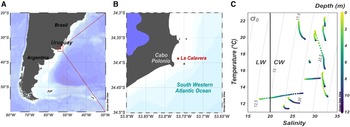
Cabo Polonio is a tombolo resulting from the deposition of sandy sediments by littoral currents during the Quaternary on the coast of Uruguay (Panario et al., Reference Panario, Piñeiro, de Álva, Fernández, Gutierrez and Céspedes1993). The original rocky island is currently connected to the mainland thus defining two large beach arcs: La Calavera, northwards of Cabo Polonio proper (facing east), and Playa Sur (facing south-east). The sampling station is nearly 2 nautical miles offshore La Calavera beach arc at a depth of 12 m on the Uruguayan coast (34°23′S-53°45′W) (Figure 1).
(A–B) Map of the study area: La Calavera beach, Cabo Polonio, Uruguay, South-West Atlantic Ocean; (C) Temperature–salinity diagram of monthly CTD casts performed between 11 July 2019, and 9 June 2020. The straight line indicated the thermohaline limit of water masses: littoral waters (LW) and coastal waters (CW). Isopycnals lines connecting points of constant density are shown.

Environmental conditions were recorded and microzooplankton samples taken monthly over a full year (from 11 July 2019 to 9 June 2020). For simplicity, in the present study, seasons are defined as beginning on the following days: winter = 1 July 2019; spring = 1 October 2019; summer = 1 January 2020; autumn = 1 April 2020. On every occasion, a Conductivity-Temperature-Depth profiler (CTD, SBE 19plus V2, Seabird Electronics, USA) was used to record the vertical distribution of temperature, salinity, the fluorescence of chlorophyll-a, turbidity and photosynthetically active radiation (PAR). Using a 5 L Hydrobios bottle, samples were collected from three discrete standard depths: surface at 0 m, intermediate at 3.5 m and near-bottom at 8.5 m, and analysed for nutrients, chlorophyll-a and microzooplankton taxonomy, abundance and biomass. For inorganic nutrient analyses, 0.5 L aliquots were filtered (Munktell GF/F equivalent, 47 mm diameter), frozen in clean acid-washed bottles and measured following standard protocols in a Thermo Evolution 60 spectrophotometer for nitrite, nitrate, ammonium, phosphate and dissolved reactive silicates. For subsequent analyses, nitrites, nitrates and ammonium were summed and presented as dissolved inorganic nitrogen (DIN). For chlorophyll-a concentration, 0.25–0.45 L aliquots were filtered under a low vacuum and stored at −20°C until analysis, usually 1–2 weeks later. Retained material was extracted in 96% ethanol at 4°C in the dark and, after 24 h, its fluorescence was quantified using a Turner Designs fluorometer (Model No. Trilogy 040) with a non-acidification module (Welschmeyer, Reference Welschmeyer1994).
Microzooplankton community was analysed in samples from the surface and 3.5 m, i.e., the depth at which fluorescence maxima usually occur (own unpublished data, Calliari et al.). Two litres of seawater were concentrated to 100 mL with utmost care by slowly and gentle sieving through a 20 μm-mesh and subsequently preserved with Bouin's solution (10% final concentration). Filtering and preservation of microzooplankton samples may lead to underestimation in microzooplankton numbers due to loss of fragile components (especially aloricate ciliates), and those with an individual size similar and smaller to sieve's pores; also changes in cells morphology may occur due to handling and the action of fixatives. Thus, routine analysis of filtered and preserved samples was complemented by a qualitative observation of fresh unfiltered samples. Bouin's solution is a suitable preservative for taxa devoid of protective structures such as naked ciliates and dinoflagellates as it minimizes cell loss and deformation, thus facilitating proper identification and quantification (Alder and Morales, Reference Alder and Morales2009). In summary, current results provide information on medium-sized and larger components of the whole microzooplankton assemblage. A total of 24 samples were collected representing 12 dates and two depths. Microzooplankton was identified to the lowest possible taxonomic level (i.e., species or genus level, whenever possible) based on morphological characteristics using bibliographic sources and taxonomic keys (e.g., Balech, Reference Balech1988; Montagnes and Lynn, Reference Montagnes and Lynn1991; Barría de Cao, Reference Barría de Cao1992; Lynn and Small, Reference Lynn, Small, Lee, Bradbury and Leedale2002). A special focus was made on dinoflagellates since they represent the most abundant group in the study area, and on ciliates (both, loricate and aloricate) as their study remains elusive. For enumeration, 3–6 replicate ~3 mL subsamples for each date and depth were taken after thorough homogenization of the 100 mL samples, settled in Utermöhl chambers, and analysed under an inverted microscope at 400× and 1000× magnification. Microzooplankton individual cell volumes (V; μm3) were calculated by assigning standard geometric configurations to each taxon (Sun and Liu, Reference Sun and Liu2003), and biomass was calculated in terms of biovolume (μm3 L−1).
Data analysis
Environmental data
To characterize the structure of the water column a {month × depth} environmental data matrix of CTD variables was used to construct TS diagrams using the Ocean Data View software (Schlitzer, Reference Schlitzer2021), and to profile CTD variable's temperature, salinity and fluorescence. Identification of water masses followed Guerrero and Piola (Reference Guerrero, Piola and Boschi1997) and Calliari et al. (Reference Calliari, Brugnoli, Ferrari and Vizziano2009). The light environment was represented by turbidity, and percentage irradiance (%PAR, with surface PAR as reference) and expressed by the diffuse attenuation coefficient for downward irradiance (Kd) by fitting the Beer–Lambert equation. Further analyses and comparisons relied on a subset of that data matrix comprising depth intervals closest to bottle depths, i.e., 0, 3.5 and 8.5 m. All replicates were averaged to obtain monthly values prior to analyses, when necessary. Differences between ‘season’ and ‘depth’ for nutrient concentration were assessed by two-way analysis of variance (ANOVA).
Biological data
Trends in {month × depth} community composition data (e.g., abundance and biomass of different taxa) were assessed for microzooplankton as a whole (i.e., without taxonomical discrimination), and also for meaningful trophic categories. Ciliates were subdivided by size (maximum width), which is closely linked with the oral diameter (Hansen et al., Reference Hansen, Bjornsen and Hansen1994). For loricate ciliates, the lorica oral diameter was used as the hallmark feature (Dolan et al., Reference Dolan, Landry and Ritchie2013). The oral diameter is highly conservative and determines the size of ingested particles, thus defining functional groups with similar prey types (Fenchel, Reference Fenchel1980). Modal oral diameter and modal maximum width were used to define small and large categories, with threshold values of 40 and 55 μm, for loricate ciliates (LC < 40, LC > 40) and aloricate ciliates (AC < 55, AC > 55), respectively. No size delimitation was employed for dinoflagellates as they perform diverse feeding strategies and are thereby considered relatively non-selective feeders (Hansen et al., Reference Hansen, Bjørnsen and Hansen1997). Instead, dinoflagellates were classified into heterotrophic (HD) and mixotrophic dinoflagellates (MD) according to extant published literature.
Differences in microzooplankton abundance and biomass between ‘season’ and ‘depth’ were tested using factorial ANOVA followed by post-hoc Tukey analyses. The taxonomic structure of the microzooplankton along the annual cycle was compared by non-metric Multi-Dimensional Scaling (nMDS; Field et al., Reference Field, Clarke and Warwick1982). The analysis was based on a Bray–Curtis distance matrix of untransformed abundance data using the R-library vegan (R Core Team, 2020). Significant differences in microzooplankton structure between ‘season’ and ‘depth’ were calculated by one-way analysis of similarities (ANOSIM) at a significance level of 5% and R statistic > 0.5. SIMilarity PERcentages analysis (SIMPER) was used to assess the contribution of each species to average between-group Bray–Curtis dissimilarity. Rare species were dropped to avoid over-fitting: only those species present in at least ~8% of the samples were included. Alpha diversity was estimated for each month and depth as (i) taxonomic richness (S′), (ii) Shannon–Wiener index (H′) and (iii) Pielou's evenness index (J′).
Microzooplankton community structure and environmental variability
Spearman's rank correlation (ρ) analysis was used to explore the links between diversity indexes and environmental conditions. To identify those environmental variables driving community structure, a multivariate redundancy analysis (RDA; ter Braak and Prentice, Reference ter Braak and Prentice1988) was performed. First, a detrended correspondence analysis was carried out with the decorana R-function to confirm the suitability of an RDA for the present dataset (Leps and Smilauer, Reference Leps and Smilauer2003). The microzooplankton abundance data were square root-transformed and the environmental variables were standardized and normalized. The explanatory power was assessed as the percentage of explained constrained variance (adjusted R 2) and its significance was tested with one-way ANOVA and permutation tests. The importance of each explanatory variable was evaluated with a ‘forward’ selection procedure considering the corresponding inflation factor. In addition, to evaluate interaction among functional groups and the environment, the association of coexisting environmental variables with the monthly abundance of MD, HD, LC < 40, LC > 40, AC < 55 and AC > 55 were estimated using Pearson's correlation with the R package corrplot visual exploratory tool.
Results
Water column, nutrients and chlorophyll-a
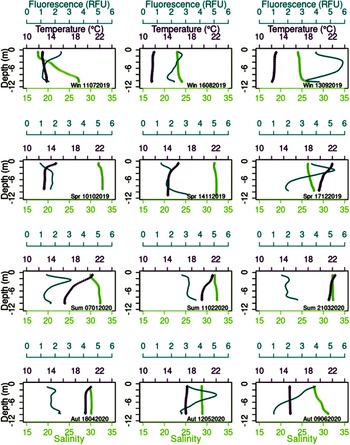
Coastal waters (CW, S < 33.4) dominated during most of the study period, except in winter when colder littoral waters (LW, S < 20, T < 13°C) were observed in the first 4 m of the water column (Figure 1C). The vertical structure was subtle (Figure 2). In winter 2019 and autumn 2020, temperature and salinity profiles were nearly homogeneous except in July 2019 when a strong halocline was present (δS~10 over 6 m). A weak thermocline was observed below 2 m depth in spring 2019 and summer 2020. On most occasions, a subsurface fluorescence maximum was present at around ~3.5 m. Also, during most of the study period, turbidity was low (mean 9 Nephelometric Turbidity unit (NTU), range 2–40 NTU at depth < 7.5 m) except near the bottom where high turbidity (mean 32, range 1.6–133 NTU) and often also high fluorescence suggested bottom re-suspension of fine sediments and senescent phytoplankton.
Monthly vertical variability of CTD-derived environmental variables shown by season (from top to bottom, the first three panels correspond to the winter (Win), the next three to spring (Spr), then to summer (Sum) and the last three to autumn (Aut)) and date (day-month-year) at the study site.

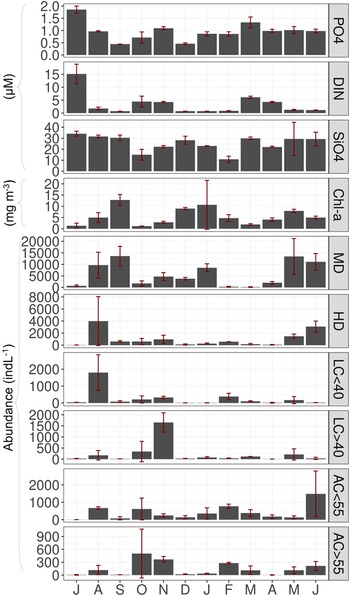
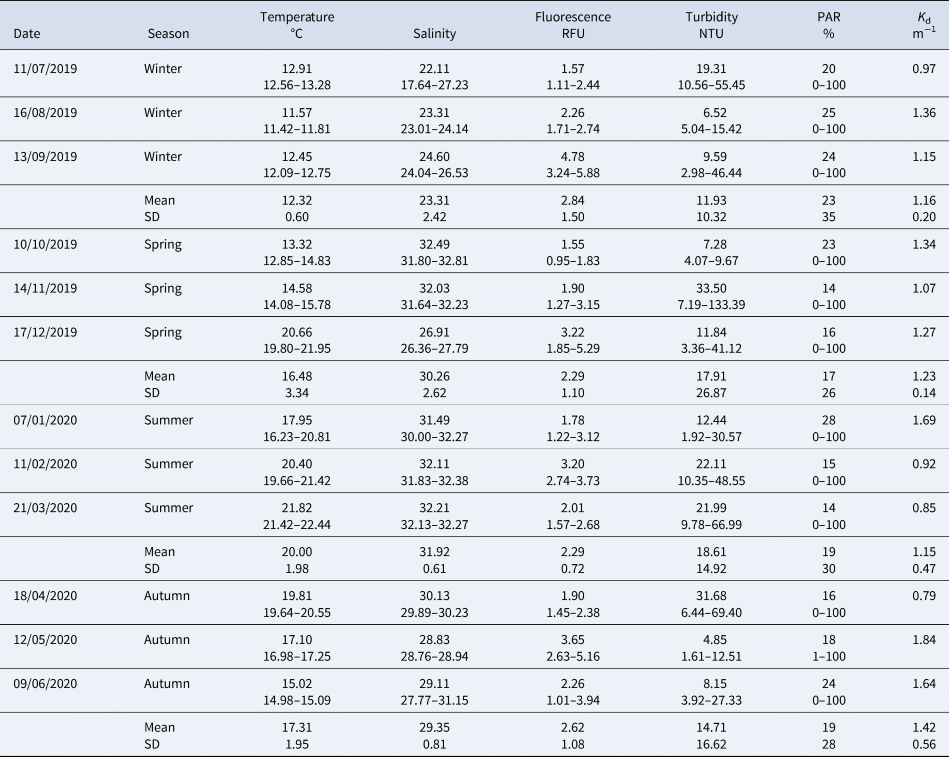
Descriptive statistics of CTD-derived variables are summarized in Table 1. Briefly, temperature varied between 11.4 (August, winter) and 22.4°C (March, summer). Salinity also fluctuated seasonally between 17.6 (July, winter) and 32.8 (October, spring). Fluorescence and turbidity ranged between 0.95 and 5.88 Relative Fluorescence units (RFU), and between 1.61 and 133.39 NTU, respectively, without clear seasonality. PAR% was always <1% at 8.5 m, while at 3.5 m varied between 4 and 30% throughout the year. The K d varied between 0.79 and 1.84 m−1, both extreme values were recorded in autumn, and average values were similar in all seasons. Nutrient concentrations varied throughout the annual cycle and were generally higher in winter and lower in summer and spring (Figure 3). SiO4 (range: 9–40 μM) concentration was highest in winter, lower in summer and lowest in spring (F[3] = 3.88, P < 0.01). No significant differences were detected in PO4 (0.4–2 μM) (F[6] = 0.18, P = 0.98) and DIN (0.7–18 μM) (F[6] = 0.23, P = 0.96) between seasons. No significant differences were detected between depths for PO4, DIN and SiO4 (ANOVA, P > 0.05). In July, inorganic nutrients showed the highest concentration and were closest to the Redfield ratio (N:P = 8:1, N:Si = 0.45:1). Chlorophyll-a ranged between 0.2 (July) and 21.9 mg m−3 (January) (Figure 3), and was highest in autumn and summer (mean 4.7 mg m−3, n = 27) and lower in winter (3.9 mg m−3, n = 21) (F[3] = 2.82, P < 0.03) although a peak was observed in September (14.5 mg m−3). In addition, chlorophyll-a was higher at the surface and 3.5 m (5.4 mg m−3; SD = 3.8, n = 64) compared to 8.5 m (2.5 mg m−3; SD = 2.0, n = 32) (F[2] = 11.07, P < 0.001).
Monthly variability of nutrient concentration (μM), chlorophyll-a (Chl-a; mg m-3) and microzooplankton abundance (indL–1) (MD, mixotrophic dinoflagellate; HD, heterotrophic dinoflagellate, small and large loricate ciliates: LC < 40 and LC > 40 and aloricate ciliates: AC < 55 and AC > 55) registered in the first 3.5 m of the water column at the study site.

Monthly mean and range of the environmental variables sampled at the study site; and mean and standard deviation (SD units) by season.

PAR, irradiance; K d, light attenuation coefficient.
Microzooplankton abundance and biomass
Microzooplankton absolute abundance ranged from 1 indL−1 (July) to 8800 indL−1 (May); the annual average abundance was 350 indL−1 for dinoflagellates and 100 indL−1 for ciliates (both loricate and aloricate). Total biovolume varied between 566 μm3 L−1 (July) and 7.1 × 108 μm3 L−1 (August) (leaving aside Noctiluca scintillans whose average diameter was ca. 410 μm). The annual average biovolume was 1.9 × 107 μm3 L−1 for dinoflagellates, 1.0 × 107 μm3 L−1 for loricate ciliates and 1.7 × 106 μm3 L−1 for aloricate ciliates. Monthly variation in the abundance of microzooplankton groups is shown in Figure 3. It is worth mentioning that estimates corresponding to total counts <10 indL−1 are subject to potentially substantial errors and should be taken with caution. Microzooplankton abundance and biovolume changed seasonally (complete ANOVA tables are provided in Supplementary Table S1). Total abundance was higher in autumn (total [mean, range]: 6.8 × 10⁴, 385 [5–8800] indL−1) and lower in summer (2.6 × 10⁴, 159 [5–5370] indL−1) and spring (3.2 × 10⁴, 156 [2–2555] indL−1). Total biovolume followed a similar seasonal trend but without significant differences. The abundance of dinoflagellates (MD and HD) was also higher in autumn (total [mean, range]: 5.2 × 10⁴ [680, 5–8780] indL−1 for MD and 9.3 × 10³ [206, 5–1685] indL−1 for HD) and lower in summer (1.8 × 10⁴ [380, 5–5370] indL−1 for MD and 2.0 × 10³ [60, 5–525] indL−1 for HD). HD biovolume also varied between seasons (autumn > summer). In summer, AC < 55 abundance and biovolume were highest (total [mean, range]: 3.1 × 10³ [138, 7–570] indL−1 and 1.0 × 10⁷ [4.6 × 10⁵, 1.5 × 10⁴–2.4 × 10⁶] μm3 L−1, respectively); a peak was observed in June (i.e., autumn) associated with a Strombidium species of 35 μm maximum width. The biovolume of AC > 55 was highest in winter (2.6 × 10⁷ [3.3 × 10⁶, 3.0 × 10⁵−8.3 × 10⁶] μm3 L−1), and as in the small aloricate ciliates, it did not differ between depths either. Yet, while the depths selected for microzooplankton analysis were within the mixed layer, some differences were detected for heterotrophic dinoflagellates and loricate ciliates between the upper and intermediate layers. Abundance and biovolume were highest at 3.5 m for HD (total: 1.5 × 10⁴ indL−1, and 1.7 × 109 μm3 L−1, respectively) and for LC > 40 (3.7 × 10³ indL−1 and 7.2 × 108 μm3 L−1, respectively).
Dinoflagellates (both MD and HD) were numerically dominant during most of the study period and represented >65% of total abundance and biovolume, in all seasons (Supplementary Figure S1). The most significant numerical contribution of ciliates occurred in spring for loricates (~20%) and in summer for aloricates (~15%). In certain summer months (i.e., February–March), ciliates dominated microzooplankton abundance (~63–67%, respectively) associated mainly with the presence of Strombidium spp. and AC < 55, and biovolume (>75%) associated mainly with loricate ciliates. In spring, and particularly in October–November, ciliates reached a second peak that surpassed 40–30% of total abundance and 30–55% of total biovolume, associated mainly with large loricates Tintinnopsis gracilis and Tintinnidium spp. During late spring–early summer (i.e., December–January), MD biovolume total contribution was the highest (>90%), while in winter HD biovolume contribution exceeded 40%.
Microzooplankton composition and diversity
A total of 100 taxonomic groups of dinoflagellates and ciliates (loricate and aloricate) were identified in the sample collection, mostly belonging to classes Dinophyceae and Oligotrichea. The complete list is shown in Supplementary Text S1; 68% were identified at the species level, 27% at the genus level and 5% at the order level. The class Dinophyceae consisted of eight orders and 15 families, of which the Protoperidiniaceae and Ceratiaceae (in particular, Protoperidinium and Tripos genera) contributed the most to morpho-species diversity. Dinoflagellates also included several potentially harmful species from the genera Alexandrium, Dinophysis, Gymnodinium, Gonyaulax and Prorocentrum. Loricate ciliates (Choreotrichids) were spread in seven families of which Codonellidae was the most representative. Tintinnopsis was the most diversified genus, comprising ~55% of the total recorded species with agglutinated lorica. Aloricate ciliates comprised five orders and nine families, of which Strombidiids were the most species-rich oligotrichous ciliates. Other, rarer taxa present at low abundance were radiolaria, rotifers, cladocerans of the genus Evadne and Podon, copepodid and nauplii stages.
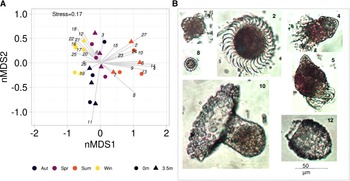
The nMDS ordination based on microzooplankton abundance illustrated large overlapping in samples from different depths but clear seasonal segregation, especially between winter and summer (stress = 0.17) (Figure 4). Microzooplankton assemblages differed between seasons (ANOSIM, P = 1 × 10⁻⁴, global R = 0.58): unidentified nanociliates, mixotrophic ciliates (e.g., Lohmaniella oviformis, Strombidium spp.) and marine Tintinnopsis species occurred mainly in summer, while species from Tripos and Dinophysis genera did so mainly in winter; still, dinoflagellates were dominant throughout the year. No differences in community composition between depths were found (ANOSIM, P = 0.81, global R = 0.10). SIMPER analysis identified dinoflagellates as the dominant group responsible for the biotic characterization of each season (Supplementary Table S2). The species that contributed most to the dissimilarity between seasons were Kryptoperidinium cf triquetrum and Scrippsiella cf acuminata in winter (total 1.8 × 10⁴ and 7.1 × 10³ indL−1, respectively, corresponding to 28 and 11% of total abundance) together with the hyaline loricate ciliate Eutintinnus sp. (2.7 × 10³ indL−1 only recorded in August). In summer, the taxa that contributed most to dissimilarity were nanociliates and the unarmoured dinoflagellate Akashiwo sanguinea (that surpassed 7.7 × 10³ indL−1 and accounted for 42% of total abundance in January), while in autumn–spring were Prorocentrum spp. and Pseliodinium sp. (accounting for 20 and 14%, respectively). Overall, the dissimilarity between microzooplankton communities was highest (~90%) between winter and summer and lowest (~78%) between spring and autumn.
(A) Non-metrical multidimensional scaling (nMDS) at two standard depths (0 and 3.5 m) at the study site. Stress value indicates the goodness of representation of differences among samples. Win, winter; Spr, spring; Sum, summer; Aut, autumn. (1) Mesodinium rubrum, (2) Pelagostrobilidium spirale, (3) Strombidium cf conicum, (4) Strombidium cf epidemum, (5) Strombidium spp., (6) Paratontonia gracillima, (7) Ciliate 2, (8) Nanociliate, (9) Ciliate 3, (10) Tintinnopsis buetschlii var mortensenii, (11) Tintinnopsis radix, (12) Stenosemella sp. 3, (13) Tintinnopsis cylindrica, (14) Tintinnopsis sp. 3, (15) Tintinnopsis sp. 4, (16) Tintinnidium balechi, (17) Tripos dens, (18) Tripos fusus, (19) Tripos cf horridum, (20) Tripos muelleri, (21) Dinophysis acuminata-complex, (22) Dinophysis tripos, (23) Kryptoperidinium cf triquetrum, (24) Polykrikos kofoidii, (25) Katodinium sp., (26) Protoperidinium depressum, (27) Protoperidinium grande. (B) Microzooplankton from Cabo Polonio, inverted microscope images at total magnification of 400×; numbers identify each species/genus and correspond to those of panel A.

Taxonomic richness (S′) ranged between 17 and 48 (in April and August, respectively), Shannon index (H′) between 1.3 and 2.9 (in April and March, respectively) and evenness (J′) between 0.5 and 0.9 (in April and March, respectively). Spring was characterized by the highest values in the three metrics, while in autumn H′ and J′ and in summer S′ were the lowest (ANOVA, all P < 0.05; F[3] = 2.89 for S'; F[3] = 3.68 for H′; F[3] = 2.99 for J′) (Supplementary Figure S2). Differences between depths were detected only for S′, which was higher at 3.5 m (F[1] = 1.47, P = 0.02).
Microzooplankton community structure and environmental conditions
Environmental variables affected microzooplankton abundance and composition. S′ and H′ were negatively correlated to temperature (ρ = −0.75, P < 0.001 and ρ = −0.47, P < 0.01, respectively). In addition, S′ was negatively correlated with turbidity (ρ = −0.37, P < 0.05). In turn, H′ and J′ were negatively correlated with chlorophyll-a (ρ = −0.50 and ρ = −0.60, respectively, P < 0.05).
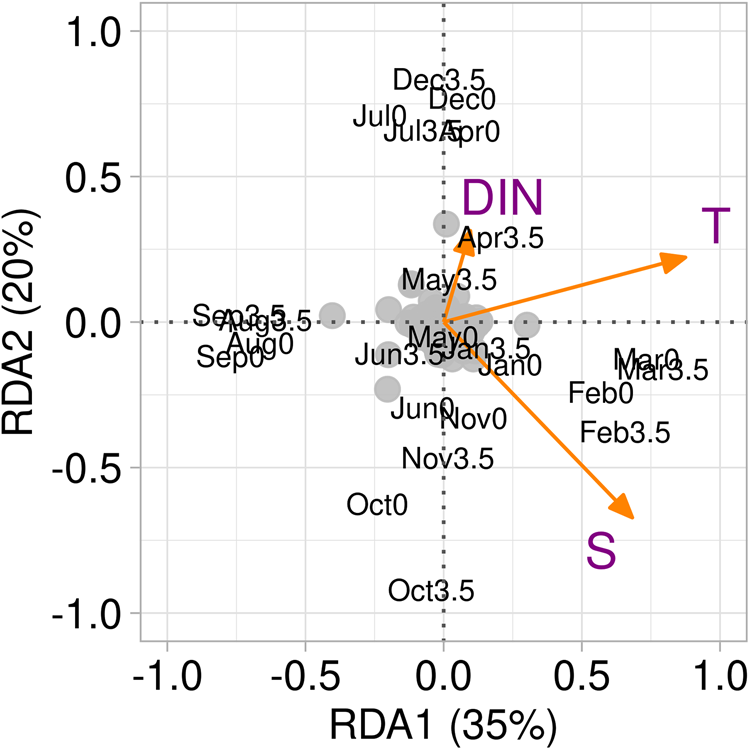
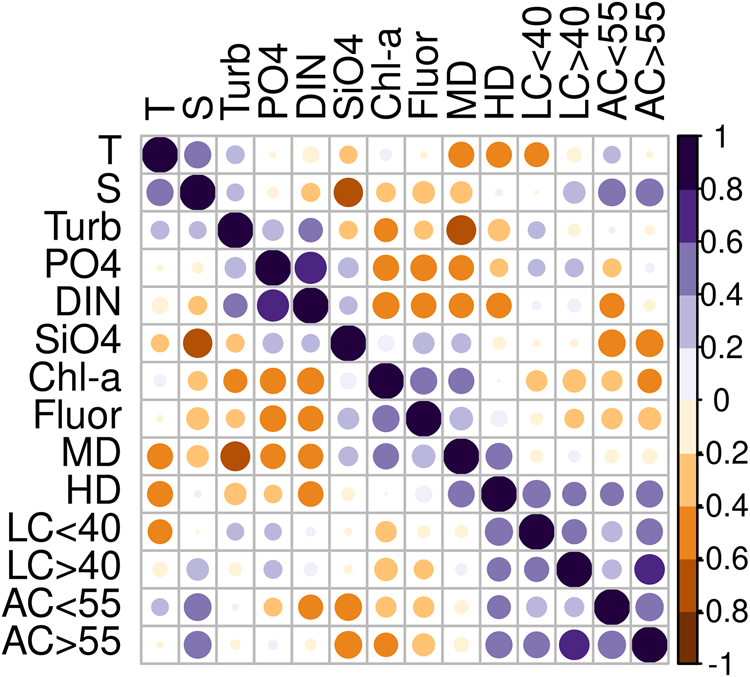
RDA (Figure 5) identified three core environmental variables (temperature, salinity and DIN) which statistically explained overall variance in microzooplankton composition (R 2 = 0.32, P < 0.001). The first two axes (RDA1 and RDA2) accounted for 35 and 20% of the total variance, respectively. Seasonal patterns were clearer along RDA1, as the summer months were located on the positive side of the first axis, while winter months were mainly on the negative side, reflecting warm- and cold-water microzooplankton assemblages. Although several species were dispersed near the centre of the triplot, thus suggesting lower correlations with the first two axes, first-order variability in microzooplankton communities corresponded to a seasonal temperature–salinity gradient, with higher ciliate abundances in summer months and at salinity >32 during spring (i.e., October–November). A second-order effect on microzooplankton community structure was driven by DIN concentration. Correlation matrix analysis revealed significant associations among environmental variables and microzooplankton functional groups (Figure 6; Supplementary Table S3). LC < 40 and HD were positively related and both responded negatively to temperature. Aloricate ciliates were related to salinity (positive), and to SiO4 (negative). MD was related to chlorophyll-a (positive), and to turbidity and temperature (both negative). Nutrients (DIN and PO4) were negatively associated with the concentration of dinoflagellates. In addition, correlation analysis relating specific microplankton genera of dominant ecophysiological groups (sensu Mitra et al., Reference Mitra, Flynn, Tillmann, Raven, Caron, Stoecker, Not, Hansen, Hallegraeff, Sanders, Wilken, McManus, Johnson, Pitta, Våge, Berge, Calbet, Thingstad, Jeong, Burkholder, Gilbert, Granéli and Lundgren2016) and environmental variables (Supplementary Table S4) revealed that non-constitutive generalist mixotrophic species (i.e., Strombidium spp.) thrived under high salinity, while constitutive mixotrophs (i.e., Tripos spp.) and specialists non-constitutive (SNC, i.e., Dinophysis spp., Mesodinium rubrum) were positively associated with fluorescence and chlorophyll-a.
RDA triplot showing only significant vectors (P < 0.05). Species are represented as points, environmental variables as arrows (DIN, dissolved inorganic nitrogen; T, temperature; S, salinity), and each date with the abbreviation of each month (i.e. Jul for July, etc.) followed by 0 or 3.5 indicating depth level.

Pearson's correlations matrix among study site microzooplankton trophic groups abundance (small ciliates: AC < 55 and LC < 40, large ciliates: AC > 55 and LC > 40, hetero- and mixotrophic dinoflagellates: HD and MD, respectively) and environmental variables (temperature: T, salinity: S, turbidity: Turb, nutrient concentration: PO4, DIN, SiO4, chlorophyll-a: Chl-a, fluorescence: Fluor).

Discussion
Temporal sampling at the coastal sea of Cabo Polonio allowed to cover a wide range of environmental conditions (e.g., temperature, salinity, nutrients) in a region subjected to ample hydrographic variability linked to the dynamics of the SWA Subtropical Convergence and under the influence of the nearby land mass. A rich microzooplankton community included subtropical and subantarctic taxa typically found further north or south of the study area, respectively. Briefly, microzooplankton community structure evidenced significant seasonal variability coherent with the evolution of hydrographical conditions.
Environmental variability
Environmental conditions at the study site changed throughout the year cycle in response to regional hydrodynamics and local forcing. In the SWA, slope and open ocean areas at latitudes ca. 35°S are subjected to Brazil–Malvinas currents; that influence extends also over the shelf by the coastal penetration of both western boundary currents (Piola et al., Reference Piola, Palma, Bianchi, Castro, Dottori, Guerrero, Marrari, Matano, Möller, Saraceno, Hoffmeyer, Sabatini, Brandini, Calliari and Santinelli2018). The observed temperature cycle in Cabo Polonio (that yields a thermal range of 11°C) was consistent with an alternating influence of modified subtropical waters in summer and subantarctic in winter. However, evidence is inconclusive as it is difficult to set the boundaries between such influence and the typical mid-latitude seasonal warming/cooling cycle over shallow seas (Mann and Lazier, Reference Mann and Lazier2006). Hence, consideration of salinity variability can aid in the identification of regional forcing on local hydrology. In the SWA, CW (6.5 < T < 21°C and S < 33.4) results from the mixing of oceanic water masses and freshwater from the continental drainage (Thomsen, Reference Thomsen1962; Guerrero and Piola, Reference Guerrero, Piola and Boschi1997). For shallower areas near the coast, it is useful to extend that classification for a broader salinity regime. For instance, within this same region and for the full salinity spectrum (0–36), Calliari et al. (Reference Calliari, Brugnoli, Ferrari and Vizziano2009) defined Río de la Plata (RP) waters as those with S < 20. At the study site, salinity varied over a wide range (>15) and during winter low values prevailed (18 < S < 27, mean = 23.3), i.e., water subjected to strong dilution but still above the estuarine range quoted formerly. These low salinity LW likely resulted from further local dilution of the already low salinity subantarctic shelf water. Despite the absence of significant freshwater point-sources in the vicinity of the study area, important diffuse groundwater discharges are expected (Windom et al., Reference Windom, Moore, Niencheski and Jahnke2006). Also, winter penetration of the RPP likely contributed to the lower salinity. In turn, the highest salinity recorded during summer months (ca. 32) suggests the presence of modified subtropical shelf waters subjected to lower dilution by local freshwater sources. Nutrients and chlorophyll-a concentrations mean values at the study site were higher than those typically reported for shelf waters in the vicinity area (Gonçalves-Araujo et al., Reference Gonçalves-Araujo, de Souza, Borges Mendes, Tavano, Pollery and Eiras Garcia2012, Reference Gonçalves-Araujo, de Souza, Tavano, Mendes, de Souza, Schultz and Pollery2018), similar to that in coastal areas affected by the RPP (Ciotti et al., Reference Ciotti, Odebrecht, Fillman and Möller1995; Garcia et al., Reference Garcia, Sarma, Mata and Garcia2004; Carreto et al., Reference Carreto, Montoya, Akselman, Carignan, Silva and Cucchi Colleoni2008), and lower than those within the RP estuary (Calliari et al., Reference Calliari, Gómez-Erache, Cantonnet, Alonso, Hoffmeyer, Sabatini, Brandini, Calliari and Santinelli2018). Thus, although similarities regarding hydrology, nutrients and chlorophyll-a can be identified in comparison to other areas of the Subtropical Convergence, some particularities emerged likely related to the proximity to land of the sampling site.
Microzooplankton abundance and community structure
The absolute abundance of microzooplankton (total [mean; SD]: 1.8 × 10⁵ [245; 740] indL−1) at the study site was in agreement with the reports for the coastal areas of the SWA in Brazil (Gonçalves-Araujo et al., Reference Gonçalves-Araujo, de Souza, Borges Mendes, Tavano, Pollery and Eiras Garcia2012; Menezes et al., Reference Menezes, de Macedo-Soares and Freire2019) and Argentina (Antacli et al., Reference Antacli, Silva, Jaureguizar, Hernández, Mendiolar, Sabatini and Akselman2018; Santoferrara and Alder, Reference Santoferrara and Alder2009). The range of abundance and mean biovolume by taxa were also similar to those observed in the region (e.g., for loricate ciliates: at 38°S, Barría de Cao et al., Reference Barría de Cao, Beigt and Piccolo2005; and at 23°S, Eskinazi-Sant'Anna and Björnberg, Reference Eskinazi-Sant'Anna and Björnberg2006). Abundance and biovolume were mostly dominated by thecate dinoflagellates, with maxima in autumn and considerable relative contribution of HD in winter. In turn, ciliates encountered more favourable conditions in spring and summer months. In areas with no clear recurrent primary productivity patterns, the dominance of dinoflagellates over loricate and aloricate ciliates may be favoured by more flexible trophic requirements, along with their ability to sustain latent populations during periods of low food supply by resorting to reserves (Sherr and Sherr, Reference Sherr and Sherr2007). The annual pattern of MD mirrored that of the chlorophyll-a, suggesting that this group is an important contributor to total pigment concentration. That agrees well with observations of dinoflagellates as co-dominant contributors to total pigment concentration along with diatoms in coastal and shelf areas of the Subtropical Convergence (Carreto et al., Reference Carreto, Montoya, Akselman, Carignan, Silva and Cucchi Colleoni2008). Vertically, the predominance of HD and LC > 40 at 3.5 m, matching peaks in chlorophyll-a and fluorescence, may reflect the capability of dinoflagellates to control their vertical aggregation at preferred depths (Islabão et al., Reference Islabão, Mendes, Detoni and Odebretch2017).
Microzooplankton at the coastal sea of Cabo Polonio was a taxonomically rich coastal marine association comprising a large set of species, most of which are widely distributed in estuarine, temperate, coastal and shelf waters in Brazil (Eskinazi-Sant'Anna and Björnberg, Reference Eskinazi-Sant'Anna and Björnberg2006; Menezes et al., Reference Menezes, de Macedo-Soares and Freire2019), Argentina (Antacli et al., Reference Antacli, Silva, Jaureguizar, Hernández, Mendiolar, Sabatini and Akselman2018; Barría de Cao et al., Reference Barría de Cao, Pettigrosso, Parodi and Freije2003; Santoferrara and Alder, Reference Santoferrara and Alder2009) and Uruguay (for dinoflagellates: e.g., Balech, Reference Balech1988; Ferrari and Vidal, Reference Ferrari, Vidal, Menafra, Rodríguez-Galllego, Scarabino and Conde2006). During the observed period, a core group of taxa (~20% of the total) with a frequency of occurrence >50% was constituted by widespread species in the SWA known for their ample environmental tolerance (e.g., dinoflagellates: Prorocentrum spp., Dinophysis acuminata-complex and Protoperidinium depressum; ciliates: L. oviformis, Tintinnidium balechi and Tintinnopsis gracilis). Instead, several other taxa occurred with low or moderate frequency throughout the year (~30% of species occurred <10% of the time) under more specific conditions associated with given seasons (e.g., Tintinnopsis tocantinensis, Leprotintinnus nordqvistii and Paratontonia gracillima in summer, Strombidium cf capitatum and S. cf emergens in autumn, Stenosemella species in spring and several unidentified Tintinnopsis and Protoperidinium species mainly in winter). Those taxa were the main contributors to the differentiation of the assemblages at different times of the year.
Environmental drivers of microzooplankton community structure
Environmental variability impacted microzooplankton structure through the seasonal evolution of water masses with contrasting thermohaline properties and nutrients. Distinct assemblages occurred in summer and winter, when subtropical taxa alternated with euryhaline groups associated with colder SAW. The winter season (lowest salinity, highest nutrients concentration and stoichiometry closest to Redfield's) was characterized by high species richness (mean = 38) and the dominance of dinoflagellates, specially pigmented mixotrophic species. In that season, the structure resembled neritic assemblages found in the SWA shelf under the influence of continental runoff and low salinity (e.g., K. cf triquetum, S. cf acuminata, D. acuminata-complex, Dinophysis caudata, Tripos furca and Tripos muelleri) (Ciotti et al., Reference Ciotti, Odebrecht, Fillman and Möller1995), together with brackish loricate ciliates like Tintinnopsis fimbriata and Codonellopsis lusitanica and the eutrophic water species Tintinnopsis uruguayensis (Sivasankar et al., Reference Sivasankar, Ezhilarasan, Sathish Kumar, Naidu, Rao, Kanuri, Ranga Rao and Ramu2018). Those features indicate the importance of LW and the influence of the buoyant RPP on the coast of Cabo Polonio during that season.
In contrast, during summer under higher temperatures, salinity and turbidity, microzooplankton species richness was the lowest (mean = 27), and ciliates were better represented. Typically, marine loricate ciliates L. nordqvistii, T. tocantinensis, Tintinnopsis radix and Tintinnopsis buetschlii occurred exclusively during this season.
Seasonality impacted also the functional structure of the microzooplankton assemblage, i.e., during summer non-constitutive generalist mixotrophs (i.e., Strombidium spp.) were well represented in terms of numbers and biomass levels, while in winter the same was valid for constitutive mixotrophs (i.e., Tripos) and SNC mixotrophs (i.e., Dinophysis spp., Mesodinium rubrum). Seasonal alternation between functional groups was likely related to changes in key environmental attributes. For instance, lowest nutrient concentrations in summer may have favoured the former, as they are better adapted to subsist by predation and are less dependent on photosynthesis. In contrast, the latter groups were favoured under the short-day lengths of the cold season, when nutrients and average fluorescence levels were higher, and turbidity lower. A relevant consequence of the seasonal alternation of functional groups is increased resilience of microzooplankton at the community level regarding its role as a shunt for chemical energy between primary producers and higher trophic levels in the mesozooplankton and micronekton communities, despite significant environmental variability.
Results from community-based ecological parameters (e.g., species richness, diversity and evenness) were complementary to those discussed so far: they mostly captured differences between transition seasons spring and autumn, which were otherwise least different in terms of actual species composition. Differences in diversity metrics resulted from a sharp decrease in the abundance of several species of loricate and aloricate ciliates in autumn compared to spring months; instead, the composition and abundance of mixotrophic dinoflagellate species were rather similar between both periods. So far, it is unclear which processes could have specifically affected loricate and aloricate ciliates, but not mixotrophic dinoflagellates, between spring and autumn. That is a matter that deserves further attention in next investigation.
Top–down control by mesozooplankton predators, particularly copepods, can be a relevant structuring process for microzooplankton assemblages. Copepods are able to predate on actively swimming prey (Jonsson and Tiselius, Reference Jonsson and Tiselius1990; Tiselius et al., Reference Tiselius, Saiz and Kiørboe2013), and they frequently select those over traditional phytoplankton (e.g., diatoms) due to enhanced hydromechanical perception of moving prey and their generally higher nutritive quality (Calbet and Saiz, Reference Calbet and Saiz2005). As a result, heterotrophic prey may constitute >50% of copepods' daily carbon intake (Calliari et al., Reference Calliari, Brugnoli, Ferrari and Vizziano2009). It was beyond the scope of the present study to characterize top–down regulation on microzooplankton, but preliminary results on copepods species and abundance in samples taken concurrently (main taxa: Acartia tonsa, Paracalanus spp., Temora turbinata, Oithona spp.; total copepods abundances ~104–105 ind m−3; own unpublished data) suggest they may actually represent a relevant factor for microzooplankton dynamics in Cabo Polonio.
Finally, microzooplankton assemblages can be expected to shift in response to large-scale regional processes, particularly those linked to climate change. The SWA is undergoing rapid warming. Increased instabilities and eddy generation in the western boundary current that transports heat to higher latitudes lead to enhanced poleward penetration of the Brazil current (Li et al., Reference Li, Roughan and Kerry2022), directly impacting our study area. Also, in recent years, marine heatwaves in the SWA between 32°S and 38°S have increased in frequency, duration and intensity (Manta et al., Reference Manta, de Mello, Trinchin, Badagian and Barreiro2018). Several actual and projected consequences of climate change have been identified for the SWA ecosystem (Franco et al., Reference Franco, Defeo, Piola, Barreiro, Yang, Ortega, Gianelli, Castello, Vera, Buratti, Pájaro, Pezzi and Möller2020), including among the former an intensification of harmful dinoflagellates blooms along Uruguayan coasts (Méndez and Carreto, Reference Méndez, Carreto, Hoffmeyer, Sabatini, Brandini, Calliari and Santinelli2018).
Conclusions
This study provides the first comprehensive assessment of the microzooplankton within a broad area of the SWA, contributing to fill critical information gaps on ciliates and dinoflagellates communities in Uruguayan waters. Current results for Cabo Polonio suggest the existence of coherent patterns in the variability of environmental conditions and that of the microzooplankton. Within that community, a core group of dinoflagellates and ciliates widely distributed in SWA were frequently found along the year cycle under varying environmental conditions, and their abundance was often linked to chlorophyll-a, nutrients and probably also driven by internal regulation mechanisms (e.g., competition, predation). On top of those, several other taxa occurred with a more marked seasonality under narrower environmental conditions, supporting a hypothesized hydrographic modulation on the microzooplankton community structure in this subtropical coastal site.
Supplementary material
The supplementary material for this article can be found at https://doi.org/10.1017/S0025315423000358
Acknowledgements
The authors thank the crew at Estación Experimental de Investigaciones Marinas y Acuicultura de Cabo Polonio for providing logistic support and valuable help during sampling campaigns. The authors thank the anonymous reviewers whose comments improved the manuscript. This study was conducted as part of the PhD dissertation of LS.
Financial support
This work was supported by the Agencia Nacional de Investigación e Innovación of Uruguay [POS_FCE_2018_1_1007793 to LS, FCE_2017_136372 to DC]; PEDECIBA Biología; and Comisión Sectorial de Investigación Científica, Universidad de la República, Uruguay.
Competing interest
None.