Introduction
Mild cognitive impairment (MCI) is defined as a transitional stage between normal aging and dementia. In 1999, Petersen and colleagues (Petersen et al., Reference Petersen, Smith, Waring, Ivnik, Tangalos and Kokmen1999) suggested that MCI is characterized by impaired memory and intact basic functional abilities of daily living; some studies also suggest that MCI can be considered as prodromal of the onset of Alzheimer's disease (AD) (e.g. Petersen et al., Reference Petersen2001). In the last decade, these diagnostic criteria have attracted a great deal of interest due to the importance of identifying cognitive dysfunction in the predementia phase, before functional impairment becomes apparent. In 2006, the International Working Group on MCI revised its criteria with a view to distinguishing between subtypes of MCI based on cognitive dysfunction: in particular, a distinction has been drawn between an amnestic condition (amnestic mild cognitive impairment, aMCI) and a non-amnestic (naMCI) disorder in which single and multiple domains unrelated to memory are impaired (Portet et al., Reference Portet2006).
The main criterion for diagnosing MCI is therefore the presence of a cognitive impairment in memory (aMCI) or other cognitive domains (naMCI), more accentuated than in people of the same age and education with intact functional abilities and without dementia. Focusing on the amnestic type, the following diagnostic criteria have been suggested: (1) memory complaints, preferably corroborated by an informant; (2) memory impairment documented according to appropriate reference values; (3) essentially normal performance in non-memory cognitive domains; (4) generally preserved activities of daily living; and (5) no dementia (e.g. Petersen, Reference Petersen2004).
Epidemiological studies have estimated that the prevalence of MCI in the elderly population ranges from 3% to 19%, and that 11%–33% of people with MCI develop dementia within two years (Gauthier et al., Reference Gauthier2006). It is, therefore, a priority to develop procedures that might help these individuals manage their memory problems, offer them protection against cognitive decline, promote brain plasticity, and thereby attenuate the risk of dementia. This is particularly crucial because there is currently no clear evidence of any benefit of pharmacological treatment for MCI (e.g. Aisen, Reference Aisen2008).
Since memory problems appear to be the key feature for defining aMCI, increasing numbers of studies are attempting to understand how effective cognitive interventions may be for these patients, and most of this research has focused on episodic memory performance. Although the results of single studies have generally appeared positive (e.g. Belleville et al., Reference Belleville, Gilbert, Fontaine, Gagnon, Menard and Gauthier2006), two recent meta-analyses showed that the dimension of the gains was generally in the medium effect size range (see Li et al., Reference Li, Li, Li, Li, Wang and Zhou2011), but considerably lower in studies with an active control group (Zehdner et al., Reference Zehdner, Martina, Altgassenb and Clarec2009). In fact, the meta-analyses showed that, for most measures, the improvement seen in the trained group was no larger than in the active control group, thus suggesting unspecific gains. It is worth noting that these meta-analyses combined different types of intervention (cognitive stimulation with cognitive training of various kinds, e.g. strategy-taught, computer-based training, practicing with different neuropsychological tasks, etc.), making it difficult to establish which program is most appropriate for MCI patients. None of the studies focused on one of the basic mechanisms of cognition, however, i.e. working memory (WM) capacity, the age-related decline of which is well documented (e.g. Borella et al., Reference Borella, Carretti and De Beni2008).
In the context of healthy aging, researchers are increasingly analyzing the feasibility of improving WM capacity by testing the impact of WM training on cognitive processes associated with or implicit in WM. This interest in WM stems from the fact that it is: (i) one of the mechanisms most sensitive to aging; (ii) an early marker of AD (Rosen et al., Reference Rosen, Bergeson, Putnam, Harwell and Sunderland2002); and (iii) associated with MCI (e.g. Missonnier et al., Reference Missonnier2007). WM is also involved in different complex skills relating to everyday life, so any benefits deriving from WM training could have definite, positive consequences in improving an elderly person's functioning and quality of life.
Outcomes of WM training recorded to date in normally aging elderly adults have generally been positive: most studies have reported improvements in tasks practiced directly during the training program (e.g. Busckhuel et al., Reference Buschkuehl2008; Borella et al., Reference Borella, Carretti, Riboldi and De Beni2010; Carretti et al., Reference Carretti, Borella, Zavagnin and De Beni2012; Richmond et al., Reference Richmond, Morrison, Chein and Olson2011). There have also been reports of transfer effects on other tasks (identified by measuring mechanisms related to WM, such as inhibition and processing speed), and on cognitive processes that involve WM, such as fluid intelligence (Borella et al., Reference Borella, Carretti, Riboldi and De Beni2010) or language comprehension (Carretti et al., Reference Carretti, Borella, Zavagnin and De Beni2012). Both Borella et al. and Carretti et al. suggested much the same WM training procedure for elderly adults (aged between 65 and 75 years), which consisted of practicing with a verbal WM training task in which the level of difficulty was adaptive (if a participant succeeded at a given level, the task was made more difficult; if not, the task was made easier), and the requirements of the trained task also changed constantly. According to both authors, such a procedure facilitated a positive outcome of the training by involving multiple processes (encoding, maintenance of information, inhibition of no-longer relevant information, simultaneous management of two tasks, shifting attention, and ability to control attention) and stimulating a flexible approach to the task. The improvement obtained in WM performance and its transfer to other cognitive processes confirmed that the elderly preserve some degree of plasticity, despite the general decline in their cognitive resources, and, as Borella et al. suggested (2010), this may indicate that the training enabled the building of scaffolds to compensate for age-related decline (Park and Reuter-Lorenz, Reference Park and Reuter-Lorenz2009).
In this sense, WM training could be useful for promoting and supporting compensatory mechanisms, already in action in MCI functioning (e.g. Bokde et al., Reference Bokde2010). In fact, it has been demonstrated that aMCI and naMCI groups exhibit considerable impairments in WM measures by comparison with controls, i.e. elderly adults aging “normally” (e.g. Saunders and Summers, Reference Saunders and Summers2011). In addition, the longitudinal data reported by Saunders and Summers (Reference Saunders and Summers2011) suggest that some components of WM (relating to executive functions) are good predictors of the transition from MCI to AD.
The aim of the present study was thus to assess the effect of a WM training, already tested for its efficacy (see Borella et al., Reference Borella, Carretti, Riboldi and De Beni2010), in a group of aMCI individuals between 65 and 75 years old. The training regime was modeled according to Borella et al. (Reference Borella, Carretti, Riboldi and De Beni2010). The benefits of the training on the tasks in which participants were trained were examined, as well as the transfer effects on processes either implicated in WM, e.g. visuospatial WM (the Dot matrix task), short-term memory (measured with the forward and backward digit span; see Bopp and Verhaeghen, 2005), processing speed (pattern comparison task) and inhibition (intrusion errors in WM), or related to WM, such as fluid intelligence (the Cattell task). The transfer effects on long-term memory were also assessed, using the list recall task.
In the light of previous studies, we expected WM capacity to be plastic even in individuals with aMCI, and we consequently predicted that the trained participants would experience an improvement in their performance in the trained WM task, while controls would not. Limited transfer effects were expected, however, based on the above-mentioned studies (and the meta-analyses in particular).
Method
Participants
Twenty participants from 65 to 75 years old with aMCI were recruited from memory clinics in Brescia, Italy. They were selected on the basis of a clinical and neuropsychological evaluation. The diagnosis of aMCI was reached according to the following exclusion criteria proposed by Petersen and colleagues (Petersen et al., Reference Petersen, Smith, Waring, Ivnik, Tangalos and Kokmen1999; Petersen, Reference Petersen2004) including: exclusion criteria for dementia; a performance of at least 1.5 standard deviations (SD) below the norm for age and education on measures assessing episodic memory, measured with the Story Recall test (Spinnler and Tognoni, Reference Spinnler and Tognoni1987), in which participants have to recall a story both immediately and after a delay; no evidence of any deficit in executive function, measured with the Trail Making tests A and B (Reitan, Reference Reitan1958), or language (measured with semantic and phonemic fluency tests (Benton and Hamsher, Reference Benton and Hamsher1983)), or visuospatial ability (measured with Rey's figure copy (Osterrieth, Reference Osterrieth1944)); a score above the cut-off of 24/30 in the Mini-Mental State Examination (MMSE) (Folstein et al., Reference Folstein, Folstein and McHugh1975); a score of 0.5 in the Clinical Dementia Rating (CDR) (Hughes et al., Reference Hughes, Berg, Danziger, Coben and Martin1982); no evidence of difficulties in everyday abilities, as measured on the Basic Activities of Daily Living scale (BADL) (Katz et al., Reference Katz, Downs, Cash and Grotz1970) and Instrumental Activities of Daily Living scale (IADL) (Lawton and Brody, Reference Lawton and Brody1969); no depression, as measured on the Geriatric Depression Scale (GDS, 15 items) (Sheikh and Yvesavage, Reference Sheikh and Yesavage1986); and no evidence of metabolic, endocrine, or nutritional deficiencies.
All participants lived at home. They gave their informed written consent prior to the commencement of the study and they received no financial compensation for their participation. The study was approved by the ethical board of the Faculty of Psychology, Padua University, Italy.
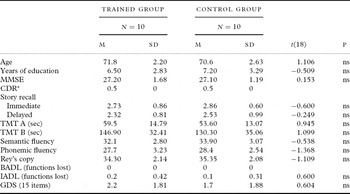
Ten participants were randomly assigned to the experimental group (6 males and 4 females) and the other ten to the control group (4 males and 6 females). The two groups did not differ in terms of age or education (see Table 1). As it is possible to see from Table 1, the average educational level of the sample considered was fairly low compared to other studies. It should be noted, however, that compulsory education spanning eight years was only introduced definitively in Italy in 1962. Beforehand, it was not unusual for people to finish their formal education with primary school. As a consequence, there are still people between 65 and 75 years old with only five years of schooling. On the other hand, as Stigsdotter-Neely and Bäckman (Reference Stigsdotter-Neely and Bäckman1995) pointed out, educational level seems to be unrelated to training outcomes, in normal aging at least.
Demographic characteristics of the trained and the control groups

*t value was not computed since standard deviations were equal to zero. Note: MMSE: Mini-Mental State Examination; CDR: Clinical Dementia Rating; TMT: Trail Making test; BADL: Basic Activities of Daily Living scale; IADL: Instrumental Activities of Daily Living scale; GDS: Geriatric Depression Scale.
Material
The same tasks were used as in the study conducted by Borella et al. (Reference Borella, Carretti, Riboldi and De Beni2010).
Verbal WM: Categorization Working Memory Span test (CWMS, De Beni et al., Reference De Beni, Borella, Carretti, Marigo and Nava2008; see Borella et al., Reference Borella, Carretti, Riboldi and De Beni2010). The task consisted of 20 lists of words, which were organized into a set of word lists of different lengths (from two to six). Each list contained five words of high-medium frequency. Participants listened to the set of lists of audio-recorded words presented at a rate of 1 sec per word and had to tap with their hand on the table whenever they heard an animal noun (processing phase). The interval between the word lists was 2 sec. At the end of the set, participants recalled the last word of each list in consecutive order (maintenance phase), so they needed to remember from two to six words, depending on the set's difficulty level. Two practice trials consisting of two-word lists (and requiring the recall of two words) were administered before the experiment started. The total number of correctly recalled words was used as the measure of WM performance (maximum score 20). Cronbach's α was 0.98 (from De Beni et al., Reference De Beni, Borella, Carretti, Marigo and Nava2008).
Transfer effects
Visuospatial WM task: Dot matrix task (adapted from Miyake et al., Reference Miyake, Friedman, Rettinger, Shah and Hegarty2001). This task involves participants verifying a matrix equation, consisting of an addition or a subtraction presented as lines drawn on a 3 × 3 matrix, and then memorizing sequences of dots presented on a 5 × 5 grid. Participants were given a maximum of 4.5 sec to verify each equation and say “True” or “False.” Immediately after they gave each answer, they were shown a 5 × 5 grid containing a dot in one of its squares for 3 sec and then had to recall the position of the dot in an empty grid. There was one practice trial with two equations, each with one dot. The number of dot locations to recall increased from two to six.
In all, 28 equations and 28 matrices were presented. The total number of dot positions correctly recalled was considered as the dependent variable (maximum score 14). Cronbach's α was 0.79 (from Miyake et al., Reference Miyake, Friedman, Rettinger, Shah and Hegarty2001).
Short-term memory tasks: Forward Digit Span and Backward Digit Span tasks (De Beni et al., Reference De Beni, Borella, Carretti, Marigo and Nava2008). Series of digits were presented at a rate of 1 sec per digit and participants had to repeat the digits in the same (forward) or reverse (backward) order. The series started with three digits and rose to nine for the forward task, and went from two to eight for the backward task. Each level contained two series of digits. After two consecutive recall errors, the task was discontinued. A practice trial of two digits was given for each task before the test started. One point was awarded for each sequence recalled correctly.
The final score corresponded to the total number of correctly recalled sequences (maximum score 14 for both tasks). The test-retest reliability was 0.75 (Forward Digit Span) and 0.60 (Backward Digit Span) (from the dataset in De Beni et al., Reference De Beni, Borella, Carretti, Marigo and Nava2008).
Long-term memory: List recall (from Carretti et al., Reference Carretti, Borella and De Beni2007). Two lists of 15 words of comparable length and imagery value were prepared. Participants heard the list of audio-taped words presented at a rate of 2 sec per word. At the end of the presentation, they were asked to recall as many items on the list as possible, in any order. The final score corresponded to the total number of words recalled correctly. Pre- and post-test word lists contained different words. The test-retest reliability was 0.87 (from the dataset in Carretti et al., Reference Carretti, Borella and De Beni2007).
Inhibition: Intrusion errors in the CWMS. Non-final words incorrectly recalled in the CWMS task were taken as an indication of difficulty in inhibiting information that was no longer relevant. This measure was computed by dividing the number of intrusions committed by the total number of correctly recalled words and multiplying the result by 100. The test-retest reliability was 0.75 (from the dataset in De Beni et al., Reference De Beni, Borella, Carretti, Marigo and Nava2008).
Processing speed: Pattern Comparison task (adapted from Salthouse and Babcock, Reference Salthouse and Babcock1991). In this task, participants had to decide whether or not arrangements of line segments, presented on two pages, were identical. The experimenter used a stopwatch to record the time it took them to complete each page. Three practice trials were run before the experiment started. The dependent variable was the total time taken to provide the answer for the two pages. Cronbach's α was 0.94 (from Salthouse and Babcock, Reference Salthouse and Babcock1991).
Fluid intelligence: Culture Fair Test, scale 3 (Cattell and Cattell, Reference Cattell and Cattell1963). Scale 3 of the Cattell test consists of two parallel forms (A and B), each containing four subtests to be completed in 2.5–4 minutes, depending on the subtest. The subtest requires that participants: (1) complete an incomplete series of figures, choosing which of six options best completes the series; (2) identify figures or shapes that differ from the others; (3) choose items that correctly complete matrices of abstract figures and shapes; and (4) assess the relationship linking a series of items. The dependent variable considered was the number of items answered correctly across the four subsets (maximum score 50). Cronbach's α was 0.63 (from Cattell and Cattell, Reference Cattell and Cattell1963).
For each task, parallel versions were used at the pre- and post-test points, counterbalanced across testing sessions.
Training procedure
Before participants were enrolled for training, they were assessed with the battery of neuropsychological tests (see Participants section) during a single session lasting about an hour and a half. After this diagnostic step, people interested in the program were randomly assigned to the trained or control groups and were recontacted.
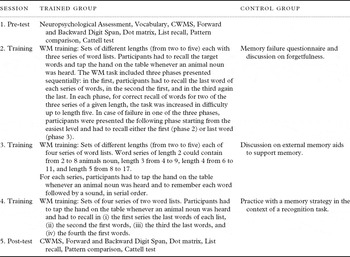
Participants in both groups attended five individual sessions: the first and fifth sessions, which lasted about 90 minutes each, were for pre- and post-testing purposes. The active control group took part in educational activities involving memory (see Table 2), while the trained group attended the WM training proper. For both groups, the training was completed within a two-week time frame, with a fixed two-day break between sessions. The schedule was identical for the two groups, ensuring a matching amount of social interaction.
Description of training sessions by group

Note: CWMS: Categorisation Working Memory Span test.
The WM training consisted of three sessions (sessions 2, 3, and 4), each lasting about 30–40 minutes. During the training sessions, the experimenter presented this group of participants with lists of words, audio-recorded and organized in the same way as for the CWMS task. Participants were asked to recall target words and always tap on the table with their hand when an animal noun arose. Some manipulations were introduced during the three sessions, however, to facilitate a generalized transfer and contain the development of task-specific strategies. The maintenance demand of the CWMS task was manipulated by increasing the number of words successful participants were asked to recall, and by presenting the lowest memory load to participants who were unsuccessful (session 2). The demands of the task also varied, requiring the recall of: (i) the last or first word in each series (sessions 2 and 4); and (ii) words that were preceded by a beep sound (session 3). The processing requirement (tapping on the table when an animal noun occurred) was also manipulated by varying the frequency of these animal words in the lists (session 3) (see Table 2 for a detailed description of the training schedule).
Participants in the active control group were involved in an education program aiming to reflect on how memory works, presenting the different memory systems, focusing on everyday memory failures, and on the importance of external and internal strategies for supporting memory. In the first session, after participants had filled in a questionnaire on memory failures, the experimenter discussed how the different memory systems work, how often participants experienced forgetfulness in activities of everyday life and the strategies they used to cope with it. In the second session, the experimenter introduced the topic of external memory aids, highlighting their role in supporting memory. In the third session, participants were told how to use a memory strategy (visualization) and this was practiced with a list of words in the context of a recognition task.
Results
Pre-test performance between the two groups was compared first. T-test results showed no significant difference between the groups.
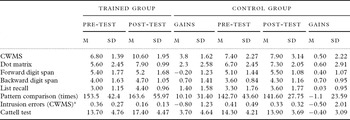
Given the small sample size, a benefit index was calculated for each measure, i.e. post-test performance minus pre-test performance, to identify any benefits of the training (see Buschkuehl et al., Reference Buschkuehl2008; Zincke et al., Reference Zincke, Zeintl, Eschen, Herzog and Kliegel2012); this also enabled us to control for slight variations in pre-test performance. T-tests were then run on the indexes to compare groups (the results did not change when non-parametric statistics were used). Descriptive data, along with the pre- to post-test gains, are given in Table 3.
Descriptive data for pre-test and post-test by group

*a negative value indicates a decrease in intrusion errors.
Criterion task: CWMS
The benefit index (the improvement from the pre-test to the post-test assessment) was higher for the trained group than for the control group, t(18) = 3.79, p < 0.001.
Transfer effects
Dot matrix. There were no differences in the benefit index between the groups.
Forward and Backward Digit Span. There were no differences in the benefit index.
List recall. There was a tendency for trained participants to experience a greater benefit than the control group, t(18) = 1.89, p = 0.079.
CWMS intrusions. The main effect of group was not significant when the proportion of intrusion errors in CWMS was considered.
Pattern comparison. The main effect of group was not significant for the completion times and the number of correct responses in the pattern comparison test.
Cattell test. The benefit index was higher for the trained participants than for the controls, t(18) = 2.33, p < 0.05.
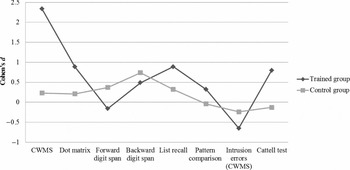
Cohen's d (Reference Cohen1988), expressing the effect size of comparisons, was calculated to gain a better understanding of the range of training-induced benefits and transfer effects. The dimension of the effect size substantially confirmed the findings emerging from the t-test comparisons, i.e. a large (above 0.80) effect size in the case of the trained group, and a small-medium effect size for the control group (see Figure 1).
Cohen's d for the trained and the control groups.

To further document the magnitude of the training-related gains in terms of individual differences within each group, all participants were divided into two groups, i.e. (a) those whose performance improved by 1 SD or more with respect to the mean pre-test performance of the participants as a whole, and (b) those whose gain improved by less than 1 SD.
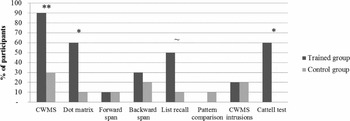
The results are given in Figure 2 and show that, for the CWMS task, the percentage of participants whose performance improved was 90% in the trained group and 30% in the control group (Cramer's V = 0.725, p < 0.01). When the Dot matrix task was taken into account, 60% of participants in the trained group improved in performance, as opposed to 10% in the control group (Cramer's V = 0.524, p < 0.05). In the Cattell test, 60% of the trained participants improved from the pre- to the post-test situations, while none of the controls did so (Cramer's V = 0.655, p < 0.01). Finally, in the List recall task, 50% of the trained participants and only 10% of the controls improved from the pre- to the post-test assessments (Cramer's V = 0.436, p = 0.05).
Percentage of participants by group (trained and control) improving of 1 standard deviation.
**p < 0.01
*p < 0.05
~p = 0.05.

Discussion and conclusion
Memory deficits are typical of aMCI, with shortcomings particularly in episodic memory. Some recent studies have nonetheless suggested that impairments in other memory functions, such as WM, are a common feature of MCI (Saunders and Summers, Reference Saunders and Summers2011). It therefore seems crucial, from both the practical and the theoretical points of view, to understand whether WM training can positively affect cognitive performance in aMCI. This is particularly relevant when we consider the crucial role of WM in everyday activities (such as problem-solving and reading comprehension), and how progression to dementia gradually interferes with independent life.
A WM training already tested for its efficacy with older adults of various ages (65–75-year-olds, Borella et al., Reference Borella, Carretti, Riboldi and De Beni2010 and Carretti et al., Reference Carretti, Borella, Zavagnin and De Beni2012; over 75-year-olds, Borella et al., under review) was therefore administered to a group of subjects with aMCI and the efficacy of this training was compared with an educational activity on memory administered to an active control group. To our knowledge, this is the first study to examine the benefit of training focusing on a basic mechanism of cognition in aMCI (see the meta-analysis by Zehdner et al., Reference Zehdner, Martina, Altgassenb and Clarec2009 and the review by Piras et al. Reference Piras, Borella, Incoccia and Carlesimo2011).
Overall, our results indicate that the verbal WM training considered here is a promising approach to sustaining memory function in aMCI, since it prompted not only specific benefits but also some transfer effects, i.e. a generalized effect on non-trained tasks. The WM performance of our trained group improved substantially from the pre- to the post-test stages, while this was not the case for the control group. A tendency to improve was also seen both in tasks representing the same narrow ability (visuospatial WM tasks), and in different abilities, particularly relating to fluid intelligence (the Cattell test) and long-term memory (list recall tasks). There was no increase in the short-term measures, however, not even when the backward digit span was considered. This latter result confirms that the backward digit span is unsuitable as a measure of WM capacity in aging (Bopp and Veraeghen, 2005).
When the dimensions of the effects were considered, they were in the range of a medium effect size according to Cohen's guidelines (Reference Cohen1988). When the present results were compared with those obtained by Borella et al. (Reference Borella, Carretti, Riboldi and De Beni2010) in healthy young-old people, the dimension of the effect for the criterion task was nearly the same (d = 2.25 for healthy young-old). However, the transfer effects in our participants were less broad and less robust than those obtained in Borella's healthy young-old sample (Dot matrix: d = 1.7; Cattell: d = 1.40 for healthy young-old).
Analyzing the percentage of participants who improved by at least 1 SD confirmed that those who received the WM training had greater and broader gains than controls.
These findings suggest that our training procedure – involving tasks that were always challenging because their difficulty and the type of processing required were constantly manipulated – enabled different cognitive processes to be targeted and a consequently better management of the participants’ cognitive resources, promoting their encoding and maintenance of information, and possibly stimulating plasticity as a result (Borella et al., Reference Borella, Carretti, Riboldi and De Beni2010). All these mechanisms are fundamental not only to the memory domain but also in other aspects of cognition requiring the control of attentional resources. This latter aspect seems to be particularly relevant in the light of the results of the longitudinal study by Saunders and Summers (Reference Saunders and Summers2011), who reported a specific decline also in non-memory functions relating to executive control (i.e. divided attention tasks) in cases of aMCI.
Overall, although the benefits of training were sometimes weak, the pattern of gains reported here suggests that some degree of plasticity still exists in people with MCI (Li et al., Reference Li, Li, Li, Li, Wang and Zhou2011). These results are particularly encouraging, especially for clinicians having to cope with time restrictions, because they show that improvements in WM performance and other associated processes/mechanisms can be achieved with short-training programs, even in aMCI. The transfer gains identified were not as generalized as those reported in the case of healthy older adults (Borella et al., Reference Borella, Carretti, Riboldi and De Beni2010), however. Several hypotheses can be advanced to account for these differences. It may be that our training schedule (three sessions) was not sufficient for aMCI cases to show larger transfer effects. In fact, although the meta-analysis conducted by Li et al. (Reference Li, Li, Li, Li, Wang and Zhou2011) showed that the duration of each session and the number of sessions were negatively associated with the dimension of the gains (see Verhaeghen et al., Reference Verhaeghen, Marcoen and Goossens1992, for similar results with healthy older adults), from the available data it is impossible to establish which is the best balance between the length of each training session, or of the training as a whole, and its effects (in terms of specific and transfer gains). It is to be hoped that future investigations will study this issue in more depth.
Alternatively, transfer gains might first become apparent in the processes more strictly related to WM (visuospatial WM and reasoning ability), or that share the same task format in terms of the information to recall (list recall).
To conclude, the results reported here suggest that WM training could be a valuable method for supporting cognitive flexibility in cases of aMCI, potentially containing the progression of their disease. Indeed, we found a transfer to some of the cognitive components of memory that are part of the core cognitive impairment responsible for the degeneration of MCI into AD. In this regard, the main limit of the present study relates to the small sample size, which means that it can only be considered as a pilot study. Follow-up studies on the WM training in aMCI should include larger numbers of participants. The efficacy of the program considered here should also be tested on better-educated older adults to see if this variable, which is considered a protective factor and correlates with cognitive reserve (Chicherio et al., Reference Chicherio, Ludwig and Borella2012), might favor larger transfer effects. Some studies suggest, however, that level of education is unrelated to training outcomes (e.g. Stigsdotter-Neely and Bäckman, Reference Stigsdotter-Neely and Bäckman1995). It would also be useful to include non-cognitive measures, and to assess their role in explaining the efficacy of the present training. The activities conducted with our control group (filling in questionnaires on memory failures and strategies to prevent them) may have exacerbated their anxiety, given that they already had memory difficulties. We had the impression that this was not the case, however, since the controls reported appreciating the opportunity to discuss some of the problems they encountered in daily life during the informal interview at the end of the training sessions.
Finally, future studies should also include follow-up sessions to ascertain any maintenance effects, and the rate of conversion in AD too (which was not considered in the present study). Because this was the first study (to our knowledge) to propose WM training, our aim was initially to establish whether this was feasible in cases of aMCI, and whether it produced any transfer effects on other cognitive measures. Now that these goals have been achieved, future studies will try to replicate the present approach and also including follow-up sessions and more ecological measures.
Conflict of interest
None.
Description of authors’ roles
Barbara Carretti designed the study, supervised the data collection, was responsible for carrying out the statistical analysis, and wrote the paper.
Erika Borella designed the study, supervised the data collection, assisted with analyzing data, and wrote the paper.
Silvia Fostinelli collected the data and assisted with writing the paper.
Michela Zavagnin designed the study, supervised the data collection, and assisted with writing the paper.