Introduction
This paper is about two things. Firstly, it is about the politics and practicalities of clothing the poor through the agency of the old poor laws in the agricultural south of England during the early nineteenth century. As such, it is concerned with the actual requests made for clothing in a selection of parishes in Berkshire and Hampshire, with the kinds of clothing items that were given as relief, and (to a limited degree) with the question of where parishes sourced that clothing. But it is also about a much wider and in many ways more contentious issue: the relationship between pauper agency, that is, the strategies used by paupers, and the giving and getting of relief under the old poor laws. Using clothing and clothing relief as the ‘lens’ through which to view this issue, it is possible to demonstrate that the poor were highly self-conscious and discriminating in their requests for relief from the parish, filtering their material and practical needs through a fine rhetorical mesh so that such requests to a greater or lesser extent fulfilled, or corresponded to, the expectations and imperatives of those in a position to grant or deny them. This is not to imply a lack of real material need on the part of paupers who made requests for relief including clothing: on the contrary, it will also become clear that something like a ‘crisis’ in the clothing of the labouring poor of England and Wales was evident to contemporaries from at least the last decades of the eighteenth century. Neither is it to suggest that requests for relief which included the issue of clothing were purely a rhetorical or strategic tool, a way of gaining special favour with the vestry in order to extract what was desired. Rather, it is to demonstrate that paupers were aware not only of what kind of relief was most likely to be made available to them, but also of much wider cultural discourses on issues such as clothing, decency and propriety, and that this awareness inevitably fed into their dialogue with parishes, strengthening requests for much needed relief including that of clothing.
Non-elite clothing, and the clothing of the poor in particular, has enjoyed a significant upsurge in interest over the last few years.Footnote 2 So too has the subject of the ‘agency’ of the poor and the survival strategies they employed in order to make ends meet.Footnote 3 More recently, work has emerged which has begun to demonstrate the ways in which the parish poor both conceptualised and projected their own predicament as paupers.Footnote 4 This latter work is unprecedented, and it relies on a hitherto neglected source that gives the lie to the universal lament of social historians, that ‘the voice of the poor themselves does not come to our ears’.Footnote 5 That source is the great body of letters from out-parish paupers to the overseers of their home parishes in which they requested relief, and which exist in their thousands in archives up and down the country. It is hard to understand why such a source should hitherto have been so neglected: the most likely reasons are a natural caution over what is a problematic and unsystematic source, and concerns over questions of ‘authenticity’ and representativeness.Footnote 6 One thing is for certain, however: now that they have been ‘rediscovered’ by historians, they point forcibly to ways in which we can, for the first time, begin to reconstruct the experiences of paupers during the delicate process of negotiating relief in their own words. As such, the following discussion relies heavily on the evidence presented by pauper letters from a selection of parishes in Berkshire and Hampshire, as well as those collected by Thomas Sokoll from Essex.Footnote 7
Pauper letters are both eloquent and revealing of the ways in which the poor constructed their appeals to parish authorities. The dialogue between paupers and overseers was no less conditioned by expectation and convention than any other form of strategic dialogue: yet, as Thomas Sokoll points out, the voice of the poor in the letters was also curiously, almost uniquely, personal, even intimate.Footnote 8 Very often, in their idiomatic spelling and phraseology, the letters seem to record the ‘voice’ of the poor themselves, and for all that we must remain professionally detached from the source of our enquiry, it is just as important to hear that ‘voice’ in its own context. For the purposes of this study, it is also important to note that pauper letters are filled with requests for clothing, as well as references to issues surrounding clothing (or the lack of it) which clearly had a direct bearing on the nature of negotiations for relief. In fact the issue of clothing stands alongside references to illness and ill-health as one of the predominant motifs in the narratives of the out-parish poor, and one of the main purposes of this article is to explain why this should be the case.Footnote 9 ‘Being hungry, what do people do,’ asked E. P. Thompson, ‘How is their behaviour modified by custom, culture and reason?’Footnote 10 His now famous injunction to historians to interpret, rather than simply describe, eighteenth-century food riots could just as well be applied to the requests of the early nineteenth-century poor for relief: being distressed and in great need, what did people do? How were their appeals for relief modified by custom, culture and reason; and, more pertinently, why were their requests filled with appeals for, and references to, clothing? These questions are at the heart of what follows: this article is intended to be an exploration of meaning rather than simply an exercise in describing the needs and requirements of the poor under the old poor law. It will examine the meaning (or meanings) of references to clothing within the rhetorical and strategic requests of the poor for relief.
The moral charge: nakedness and interpretations of decency in pauper letters
Although we are constantly expanding our knowledge of the operation of poor relief in the locality, we still know very little about the actual interface between paupers and parish officials under the old poor laws, or about the mechanics of negotiation.Footnote 11 We see glimpses of this process in qualitative records such as vestry minutes, but of course these are a loaded source, inevitably reflecting only one side of the argument. So we know that, just as with relief in general, the giving of clothing was very much a discretionary affair: in the New Forest parish of Fawley, for example, William Butler applied for two shirts from the vestry in January 1820, and ‘he being a very old man the Vestry allows them’; George Keaton of Bucklebury was given a pair of shoes in 1823, ‘he promising to keep from the parish some time’; Thomas Olden of Broughton was ‘to have a shirt if he will promise the officer to leave of thieving’; and Betsy and Thomas Kingett, and Wm. Adcock of Botley were ‘allowed each a new pair of half boots as a reward for their perseverance in [lamming] the straw and grass flat’.Footnote 12 These are essential insights into the application of relief policy in the locality as it related to clothing under the old poor law, of the carrots and sticks that were employed by officials in allocating relief in general and clothing in particular. On occasion it is even possible to see glimpses of the ways in which clothing (or its withholding) could be used as leverage by vestries to enforce their own economic or moral codes: at Fawley in 1819, John Bundy applied for a pair of Shoes, to which the vestry responded, ‘not granted, keeps a dog’; at Ringwood in 1823, Elizabeth Walter requested several items including a shift, apron and gown, but she was refused and told, ‘sell your cows’.Footnote 13 But on their own, vestry records inevitably leave half the story untold. Pauper letters provide a vital corrective to this kind of historical anopsia. They give us a unique insight into the operation of the poor laws from the point of view of the recipients, rather than solely from the perspective of the administrators. What they demonstrate is that negotiation was never simply a matter of economic or practical need and the fulfilment of that need. In fact, it is entirely possible that the observation of behavioural and linguistic protocols, and the wider cultural context within which relief was sought and given, were every bit as important as the demonstration of need in this process.
This becomes abundantly clear is if we focus on rhetorical appeals for relief that include references to nakedness and inadequate or insufficient clothing on the part of paupers and their families. In this type of appeal, clothing, or the lack of it, is a motif. Often, relief in the form of clothing (or its cash equivalent) is not the actual focus of the appeal at all; rather a pauper's ‘nakedness’ or want of clothing stands as a cipher for extreme distress. It also reflects a much wider and deeper cultural preoccupation with clothing the poor throughout the eighteenth and nineteenth centuries which, as John Styles has recently demonstrated, had its roots in scripture and found tangible expression in the many formal and informal charities which were concerned with clothing the poor.Footnote 14 Thus, Elizabeth Gaines, asking for cash relief for her son (who, despite having a dependent family of his own, is reliant on his parents for support) is clearly aware of this wider context when she emphasises that:
It is not in our power to keep him with the income that my husband has and he have a fammely of small children of his own and he cannot think of distressing them in such a manner besides poor thing he is allmost naked to the world.Footnote 15
The use of this kind of imagery, the motif of nakedness, is common in pauper letters, and this is nowhere better illustrated than in Thomas Sokoll's groundbreaking collection of 758 pauper letters from Essex, where it appears again and again: ‘I have not Cloathing Enough to Cover my Nakedness . . . my chilldren are almost naked’, ‘. . . if you would be so kind as to Send Me a trifull to put afue Clothes on my Boy Back as he is almost naked . . .’, ‘the boy is almost naked for want of clothes’, ‘if youe will Be So Good For to Send only 6 ShillinGs it will Git me somethnG to ware for I am nearly naked my Self’.Footnote 16 Though it may seem obvious, it is important to emphasise that nakedness in these letters was rarely, if ever, intended to reflect the literal condition of the pauper. Rather, it is a rhetorical device, as George Watson's letter from London to Colchester on behalf of his daughter and grandson demonstrates:
[They] are both at this time destitute they have not got a Second thing to put on she has only one Patch.d Gown and scarcely a bit of flannell the Childs Dress is what I bought him 2 years agoe and is now Quite worn out – I Put a New Pr. of Shoes on is feet Last Week stood me in 4s. but it is not in My Power to do more . . . I humbly hope no offence my Daughter has been begging of me to send her & Child home sooner than be both Naked as they are but I thought I had best Write to you Sir.Footnote 17
On the one hand, Watson states that his daughter and grandson have ragged clothing to cover them, yet a few lines later he employs the rhetorical device of absolute nakedness to convey the seriousness of their predicament. But he also brings to the fore another common rhetorical strand in this type of appeal, and one that is perhaps more likely to have had a foundation in the actual material conditions of paupers and their dependents: that of being barefoot or without shoes.
A lack of shoes is a subject that appears at least as often in pauper letters as the motif of ‘nakedness’. Sarah Christopher wrote to the overseers of Fawley that ‘I ham so unwell and my foots is so Bad that I Canot get a bought an I canot Do without the same money I been Nott got a shoes to my foot’; and Sarah Meades wrote, also to Fawley, that ‘I don't know how to come to Fawley again unless I come for good for I have no Shoes to ware’.Footnote 18 Mary House, appealing to her home parish of Pangbourne, states:
[I]t is impossible to support ourselves with my husbands industry and the small allowance I have more especially since the advance in the price of bread my children are barefoot for want of shoes and it is totally out of my power to buy them any.Footnote 19
The image of the barefoot pauper, and in particular, the barefoot pauper child, was, as we shall see, one that was embedded in both popular and ‘polite’ discourse by the first decades of the nineteenth century. In pauper letters, it stands alongside nakedness as a familiar cipher for absolute want. Once again, it is important to emphasise (and to demonstrate) that a lack of adequate clothing, and in particular a lack of shoes, was a very real concern to parishes as much as to paupers in the early nineteenth century. But, in the spirit of E. P. Thompson, it is equally as important to ‘de-code’ the messages contained in pauper letters in order to understand better the nature of the dialogue that surrounded the giving and getting of relief.Footnote 20
The use of motifs such as nakedness and the barefoot pauper clearly had a particular resonance with those who were in a position to make decisions relating to relief: how better to evoke images of destitution and absolute need in the minds of a distant and ‘battle-hardened’ vestry? Stories of nakedness brought into play a number of important subsidiary narratives, not least relating to the issue of ‘decency’. Clearly, nakedness implied a lack of ‘decency’ in a number of ways: the relative indecency of being unable to clothe oneself and one's family in the midst of plenty, and a forced reliance on clothes that in themselves were not ‘decent’, but also the absolute indecency of being forced out into the world without adequate covering for one's body. But as paupers were anxious to emphasise, this state of ‘indecency’ was neither their fault, nor was it any longer within their power to do anything about it at the point at which they appealed to the parish. Mary Head states that her children are shoeless, ‘and it is totally out of my power to buy them any’; Elizabeth Gaines says that ‘it is not in our power’ to rectify her son's state of nakedness. As a result their appeal confers not only an economic, but also a moral responsibility on the parish to restore them to a state of ‘decency’ by clothing them properly. Clearly, paupers were aware when writing such letters that the strength of their appeal for relief lay as much in its rhetorical construction as in the demonstration of actual material need. But if we accept this, then it also raises the question of how far such appeals were simply a rhetorical device? How far was the reliance of paupers on culturally embedded images of nakedness and the barefoot child merely a means to an end, the favourable response from the vestry?
Clothing ‘crisis’: reality and perceptions
The best systematic source for the household accounts of labouring families at the end of the eighteenth century can be found in two well-known works of early social analysis: The Case of the Labourers in Husbandry by David Davies, and The State of the Poor by Frederick Moreton Eden.Footnote 21 Between them, Davies and Eden collected 201 sets of accounts from parishes across England and Wales and 168 of these, or more than three-quarters, show labouring families at the end of the eighteenth century in deficit when household income is matched against yearly expenditure. What they also demonstrate is that clothing was by far the single largest category of expenditure for labourers after daily and weekly subsistence. At Crawley in Hampshire, for example, Davies found that for a family of six, yearly expenditure over and above weekly subsistence was as follows: Rent, £2 0s. 0d.; Fuel, £1 10s. 0d.; Clothing, £4 0s. 0d. At Kegworth, Leicestershire, Eden found that for a family of eight the figures were: Rent, £1 15s. 0d.; Fuel, £1 10s. 0d.; Clothing, £8 5s. 1½d., and the same proportions are more or less repeated throughout their figures.Footnote 22 In other words, when household income was insufficient to fulfil family need, as it appears to have been by at the least the last years of the eighteenth century, clothing was likely to be one of the first areas of expenditure to experience cutbacks. In fact, Davies states in his introduction to The Case of the Labourers that it was his observations in his home parish of Barkham in the mid-1780s that labourers’ families were ‘indifferently fed; badly clothed; some of the children without shoes and stockings’ that led him to undertake his study in the first place.Footnote 23
Davies and Eden's evidence for the late eighteenth century is confirmed elsewhere for the early nineteenth. In 1837, a clothier in Chichester stated:
I have for nine years carried on, in the city of Chichester, a general business of clothing for the labouring poor . . . upon inquiry, I not only found them worse clothed [at the end of that period], but full one-half of the number of children I was in the habit of shoeing were without shoes, which strongly reminded me of poor Irish children.Footnote 24
The clothier attributed this situation directly to the operation of the New Poor Law, but while there does seem to have been some further deterioration in the clothing of the labouring poor after 1834, this was merely the continuation of a long downward trend. A decade earlier, for example, farmer Banyer of Buckden, reported:
I have enquired the price of a material article of expenditure, which is shoes, and I find that it is a very heavy expense upon the labourers; for instance, now it costs our men 30s. a year for shoes . . . my labourers are in the habit of saying that they feel the expense of shoes more than anything.Footnote 25
Evidence of an increasing ‘crisis’ in clothing the poor can also be seen in the significant upsurge of formal and informal charitable bequests of clothes in the last quarter of the eighteenth century,Footnote 26 and it is interesting to note that in the period immediately before the Swing risings, the south of England saw a huge increase in such donations. In January 1830, for example, the Duchess of St. Albans distributed warm clothing to the poor of Brighton; Lady Shelley distributed ‘clothing of every description’ to the poor of Mansfield parish; Admiral Digby and Lady Andover gave out ‘a quantity of warm clothing, counterpains &c. &c. to be made amongst the poor men and women of the parish of hermitage, Dorset’; and the inhabitants of West Meon ‘subscribed upwards of forty pounds which has been applied to the purchase of blankets and clothing for the poor of that parish’.Footnote 27 Clearly, the use of the imagery of nakedness and inadequate clothing or shoes in pauper letters was far from being merely a rhetorical device. It reflected, to a greater or lesser extent, what were observably familiar conditions to many if not most parish officers in England and Wales by the first decades of the nineteenth century. This is a point of some importance, because despite the empirical foundation of such appeals there is no doubt that they were a powerful element in the rhetorical armoury available to paupers when claiming relief, and just as they would have lacked the practical power to move the vestry without material foundation, so they would have little rhetorical power if they existed in a cultural vacuum.
Claims of paupers for assistance that relied on the rhetoric of nakedness or being barefoot were made very much within a broad cultural discourse on the state of the poor, and on the uses and misuses of clothing more generally. On the one hand, images of nakedness and bare feet were extremely familiar in popular culture as a way of conveying a picture of poverty and distress. Take, for example, the ballad ‘Mechanics Lamentation’:
In ‘Ye Tyrants of Old England’, a similar story is told:
This is a thread we can follow in other forms of popular discourse too. John Styles has demonstrated how travellers to Scotland and Ireland emphasised the poverty and wretchedness of the inhabitants by referring to their bare feet and legs, and especially those of the children;Footnote 30 William Cobbett illustrated the growing agricultural depression by noting that ‘as to the labourers, their bodies are clad in disgraceful rags’;Footnote 31 and a correspondent to The Times in 1830 observed that agricultural labourers ‘were a set of miserable-looking creatures, under-fed, feeble, without shoes, and altogether in a shocking plight’.Footnote 32
As the subsistence crisis deepened following the end of the French wars, images of ragged and barefoot labourers were increasingly juxtaposed with others that gave new emphasis to the concept of ‘indecency’ in relation to clothing. Ballads emerged that dealt not with labourers, but with their employers, mostly farmers, who, it was alleged, insisted on slavishly following the latest fashions. These evolved from a tradition of songs lampooning the perceived obsession of the servant class with the fashions of their superiors, and were therefore part of a much longer cultural discourse surrounding notions of ‘correct’ dress (embodied in the medieval Sumptuary Laws) that reflected anxieties about the instability of a hierarchy where nobody could be accurately identified simply by dress alone. But by the first decades of the nineteenth century the trope of the opulently dressed farmer and his family became a much sharper comment on the moral degradation of the new farming class whose taste for ‘luxury’ was indulged at the cost of labourers’ distress, and it is important to note once again that clothing was absolutely central to this kind of demotic analysis.Footnote 33 As the depression in agriculture began to bite deeper and harder in the early 1820s, a degree of grim satisfaction crept into popular songs that farmers would be forced to curtail their extravagance and, as a result, return to more ‘honest’, ‘decent’ forms of dress:
Unsurprisingly, Cobbett too held out the hope that farmers would be forced to adopt a more sober and, by extension, a more ‘decent’ sartorial code:
[O]ut of their ruin the small farmers will rise again into life. Yes, I shall see the scarlet hunting-coats stripped from the backs of the farmers. I shall see the polished boots pulled from their legs.Footnote 35
Here, notions of ‘decency’ are indistinguishable from natural justice: it was clearly considered indecent for farmers to be sporting hunting coats and high boots while their labourers wore rags and went barefoot, and increasingly the motif of farmers forced by post-war hardship to adopt once again the ‘modest’ dress of their forebears became a cipher for the restitution of just social relations in the countryside. Cobbett merely echoed the popular culture of the time when he called for a return to a greater equality of dress between farmers and labourers.
Clearly, then, rhetorical appeals for relief that relied on images of nakedness and bare feet to convey a picture of absolute want were part of a complex and multi-layered dialogue between paupers and parish officials. They had their roots, not only in empirically observable conditions, but in a series of evolving cultural discourses that focussed a harsh and unremitting light on the causes of those conditions. They were strengthened as much by the implicit injustices and ‘indecencies’ that lay behind the degraded clothing conditions of labourers as they were by the explicit elucidation of the ‘indecency’ of being inadequately clothed. The simple fact is that across England and Wales many of the men behind the vestry table to whom such appeals were made were themselves tenant farmers, whether old- or new-fashioned, and they could not have been ignorant of the debate surrounding their conduct, much of the moral underpinning for which had a distinctly sartorial edge. But if paupers were relatively sophisticated in tapping into a broad range of cultural discourses to strengthen their moral case for relief, it can also be demonstrated that they were just as aware of the practical constraints on the giving of relief from the point of view of the vestry, the most important of which in the early nineteenth century was the spiralling cost of poor rates.
Getting paupers a place: service and the appeal to ‘compassionate pragmatism’
It has been well documented that the cost of relief in England, and in the south of England in particular, rose significantly from the last decades of the eighteenth century.Footnote 36 The subsistence crises in the mid-1790s and in 1800–1 caused significant short-lived ‘spikes’ in relief spending, but overall the trend was relentlessly upwards from before 1790 until its peak just after the French wars. By this time, it is no exaggeration to suggest that parishes were overwhelmed by the cost of relief, and one of the main consequences of this was the development, after 1818, of a range of cost-cutting measures.Footnote 37 Parishes became increasingly anxious to reduce costs by any means possible, and one of the ways they attempted to achieve this was by placing paupers, and particularly pauper children, into varying lengths of service within the parish. In many places, this amounted to nothing less than an informal ‘roundsman’ system, whereby pauper children were ‘balloted’ or allocated to local farmers and rate payers in order to get them off the parish books. In 1822, for example, the parish officers of Preston Candover resolved:
In consideration of five lads out of employ . . . Thomas Wigg should go to Mr. Lunn, George Westbrook & James Watmore to Mr. Wm. Thorp, John Westbrook to Mr. B. Thorp and [blank] Aslett to Mr. Wm. Pitt each to remain in his respective situation till Michaelmas next.Footnote 38
What is of particular relevance here is that parishes employed a very specific strategy to get paupers into service: they furnished and maintained them with sufficient quantities of good quality clothing. At Brede, as early as 1791, the workhouse master instigated a drive to get pauper children into service, ‘and the parish of Brede to clothe him/her’.Footnote 39 By the 1820s, this practice was so widespread as to be completely unremarkable in the records: at Enborne, ‘S. Sandford applied for clothes for his daugh. Eliza gone to service, agreed she shd. have a petticoat & pr. of stockings’; at Fawley, ‘Tiller applies for the bastard child of her Daut. who is gone into Service – The Vestry allows her 10/- to provide her with a little Clothing’; at Minstead, ‘Widow Oliver's daughter (Eling) to go to Mr. Wm. Cull's one month as a trial, and if he approves of her he is to take her one year for her clothes’.Footnote 40 The list could be extended almost indefinitely.
Elsewhere, I have described this practice as an example of the ‘compassionate pragmatism’ of parishes when faced with increasing pauper numbers and spiralling costs.Footnote 41 As the example of Brede demonstrates it was certainly not unique to the 1820s. It has its roots in the long-established practice of clothing apprentices, and particularly pauper apprentices, at indenture, as this letter from Thomas O'Farrell to the overseers of Wallingford illustrates:
Gentlemen I have en quired into the afair concerning the girls cloths and she declar'd before Mr. Thomas Blissett . . . that she resd. no more than one shift . . . Mr. Brathwaite says the Parish stands charg'd 40 shillings for cloths for her, but that money was not layd for her when she came to me . . . [I]t was [not as] if there was aney such money layd out when she went to Mrs. Costards for Mrs. Costard told me that she was all [dirtied] up with varment and nasteyness and that she would not undertacke another such a pase of work for 5 pound . . . all the cloths she had when she was bound both good and bad is not worth 20 shillings . . . Mr. Tuckwell promised me in my house she should have a handsome gound for Sundays and other things in proportion but she have not resd them . . .Footnote 42
O'Farrell's letter is interesting on three counts: first, it shows that an agreement was made on her being bound that the girl should come with a full set of clothes to the possible value of forty shillings; second, that the girl was first bound to a Mrs. Costard, and that part of the reason she was passed on was because she was covered with ‘Varment and nasteyness’ when she arrived; and third, that not only was she expected to have clothes fit for service, but she was also expected to bring with her a ‘handsome gound’ for Sundays.
By the 1820s parishes had become much more systematic in clothing paupers, and particularly pauper children, not only for apprenticeship, but for service. But they had also become far more pragmatic. This was, after all, a strategy that was being used increasingly to lower the rates, and a wardrobe (such as the one outlined above) costing forty shillings was clearly a considerable sum for the parish to outlay in more than the most exceptional circumstances. By the nineteenth century, the figure was more likely to be ten or twelve shillings, although the vestry was also far more likely to make an explicit cost benefit analysis when making such a decision. At Amport, for example, eight specific amounts are registered for clothing pauper children for service between 1809 and 1820: the mean figure is eleven shillings, nine pence and three farthings, the mode is ten shillings and sixpence and the highest amount is twenty shillingsFootnote 43. At Fawley, seven amounts are registered between 1820 and 1823: the mean is just under eleven shillings and sixpence, the mode is ten shillings and the highest amount is twenty shillings, although in this last case the vestry was keen to specify that it ‘agrees to allow [the child] 12/- at present and if she goes on well to be advanced 8/- more’.Footnote 44 At Hungerford, it was ‘Ordered that James Woodley have 1 pr. of shoes & a jacket and if he does not continue in his situation the jacket and shoes to be returned to the parish officer’; similarly, at Bishops Waltham:
The Widw. Others be allowed 10s./- for cloathing for her daughter Hannah on her going to a place at Southampton but if she leaves her place in less than two months the 10s./- to be stopt from her weekly allowance.Footnote 45
A further feature of this practice was that children already in service, and therefore no longer technically paupers, were given clothing to remain there, reflecting the anxiety of parishes to keep paupers off the books once they had been found a place: ‘Agreed that Wm Burton do continue Eliz. Connor to Lady Day next provided the parish allow her cloaths and he will buy her a pair of shoes’.Footnote 46 Clearly, parishes saw the temporary or semi-permanent lodging of paupers, and especially pauper children, in service as a very important strategy in mitigating ever-increasing costs, and it was a practice that had at its heart the exchange of relief in the form of clothing, or its cash equivalent.
Unsurprisingly, paupers were well aware of this particular parish imperative, and this is vividly demonstrated in pauper letters. Harriott Hughes wrote from her lodgings on Doctors Commons, London, to her home parish of Pangbourne in 1827:
[B]eing so very short of things at first, [I] must beg of you to send me some shoes and stockings and changes – as I cannot keep my place without being deascent . . . if I am obliged to leave my place we must both come down again which is what I should not wish to do if I can help it, but I have no chance of an other place if I cannot keep this, pleas let me hear from you very soon.Footnote 47
It is clear that the request for clothes for (or to remain in) service formed a pivotal part of the strategy of out-parish paupers. Harriot Hughes’ letter contains the veiled threat that without the requested clothing she would be forced to leave her place, and as a result would have to return to her home parish as a permanent pauper. Once again, this is a common thread (and threat) in the letters, and one that was not confined to the nineteenth century. As early as 1755, Henry Young wrote to his home parish of Wallingford to say that:
This comes to desier the ffavour of your goodness ones more towards my poor daughter Rachell which now are [off] her Unkles at London have sent for her but being so bear in Lining & stockings & shoes I have not wherewith in ye hole world to helpe her & they desiers I would send her up Preaty Clane [clean] which good gentlen be so mercifull at this time it may be ye making of ye poor girle & intier Ridanced ffrom you.Footnote 48
Paupers were well aware that if they could demonstrate a direct link between the relief they requested from the vestry and the securing of a place in service, the vestry was far more likely to look favourably on them than otherwise. By the 1820s, this kind of request is not only commonplace, but routine in the letters of the out-parish poor: ‘we have got places for our two eldest daughters but they are very bad off for clothes and should be very sorry they should lose their situations on that account’, wrote James Sykes to the overseers of Tilehurst; ‘unless they can afford me something to find [my son] in Cloths so that I may make him a little decent to get him into a Place off my Hands I must and will send him down on the Parish Hands’, threatened Arthur Tabrum to the overseer of Chelmsford.Footnote 49
As John Styles has pointed out, ‘cleanliness’ and ‘decency’ were terms that were widely used throughout the eighteenth century to describe the clothing of others, and they carried with them not only a practical connotation, the need to ensure basic cleanliness for health, but a moral one, analagous to Wesley's injunction to ‘Everywhere recommend Decency and cleanliness – Cleanliness is next to Godliness’.Footnote 50 When paupers like Henry Young and Arthur Tabrum used these terms, they were clearly aware, not only of their wide cultural usage, but also of the moral weight they carried. Yet in this context, to be decently clothed is not only to be in a morally desirable state, wherever the responsibility may lie, but also to be quite literally ‘fit for service’. Like many other value judgements involved in the process of negotiating relief, notions of ‘decency’ were flexible and were carefully constructed depending on the precise conditions under which they were applied. Paupers, no less than parish officials, were aware, not only of the humanitarian responsibility that vestries had for the welfare of their poor, but also the likely constraints on that humanitarianism. Once again, this is not to deny the actual material needs experienced by paupers when resorting to relief. It is demonstrably true that masters did expect their servants to arrive ‘decently’, or ‘Preaty Clane’ as Henry Young put it, and with clothes fit for service. But this does not mean that their requests can be shorn of all rhetorical or strategic content or viewed simply as a looking glass in which is innocently reflected the material needs of would-be servants. Instead, we need to give paupers credit for being fully engaged in the process of negotiating relief, of being ‘present at their own making’ as paupers, to paraphrase E. P. Thompson once again.Footnote 51 As historians of a new and exciting demotic source, pauper letters, we could (and no doubt will) find ourselves caught up in long debates about how, and how accurately, they reflect the material needs of paupers, and even whether or not we do those paupers a disservice by suggesting that they dissembled, strategised or calculated in their construction to gain favour with the parish authorities. But we must not lose sight of the fact that they were undoubtedly a rhetorical source, that paupers were engaged in negotiating relief, and that by the 1820s they were likely to be both experienced and sophisticated at doing so. In fact, they had to become experts in this process because, not in spite, of the very real economic and material distress that they experienced in the first third of the nineteenth century, and one of the ways they manifested this was by demonstrating that they were acutely aware of parish imperatives when it came to allocating relief and, to a greater or lesser extent, tailoring their requests accordingly.
Clothing, service and ‘parish pragmatism’ in action: the case of Ringwood
I have looked elsewhere at some length at the clothing that was given by the vestry at Ringwood during this period, and it would be inappropriate to go over the same ground at any length.Footnote 52 But Ringwood is particularly useful for a study of this kind, not because it is exceptional in the nature or quantity of clothing it gave as relief, in fact, the evidence suggests precisely the opposite, but because the existing records are particularly rich, and highly differentiated. For example, the parish officers at Ringwood compiled a ‘Wants Book’ between 1814 and 1829 in which were recorded the details of all requests by the outdoor poor for targeted relief (that is, relief in kind; or, to put it another way, all relief other than subsistence payments in cash). The two volumes that comprise the Wants Book enable us to calculate that clothing and household textiles, including bedding, constituted ninety-two per cent of all requests for relief in kind during this period.Footnote 53 But the Ringwood parish records contain a wealth of other detailed information which is of direct relevance to this study, and which sheds new light on the practice of placing paupers out to service. For example, the vestry minutes show that by 1790, Ringwood had itself already established the system of balloting pauper children to various employers from the workhouse. They record a meeting on the 4th October:
Held this day in order to place out by Ballott sundry poor children now residing in the parish Workhouse of Ringwood aforesaid, the under-mentioned children were accordingly placed out in maner following (that is to say) . . . [ten children named].Footnote 54
By the 1820s, it is clear that there was a regular traffic of pauper children between the workhouse and various masters in the parish. This is made clear in the rough workhouse minutes, which survive for the period between 1826 and 1830. These record all the day-to-day transactions within the workhouse, but by far the single largest category of entry is devoted to the discharge of pauper children to service, and their subsequent readmission.Footnote 55 The case of Louisa Isaac is by no means unusual: in the ten months between October 1828 and July 1829, she was discharged to Farmer Brown's for two months then readmitted to the workhouse; two months afterwards she was discharged to service at Mr. Troubridge's and readmitted five months later; finally she was discharged to service at Mr. Short's in July and readmitted a month later.Footnote 56 Unfortunately, this is where the records end but her case does serve to illustrate the significant ‘traffic’ that existed between paupers and various places of service. The Ringwood Wants Book gives many examples of clothing being given to pauper children explicitly to get them into, or to keep them in, service: in May 1818, Mr. Baily was given ‘20s. to put his son apprentice’; in April 1819, James Gibbs was allowed ‘clothing for daughter to go to service’; and in June 1828, Mr. Roberts was given a ‘frock, shift, shoes and stockings . . . for daughter to go to service’.Footnote 57 But directly attributable entries such as these are almost certainly the tip of the iceberg: at least one third of all relief applications in the ‘Wants Book’ explicitly relate to clothing for children, and it is certain that a high proportion of these relate to clothing for work or service.
It should be noted that there is something of a paradox here: historians have amply demonstrated that yearly service in agriculture was in significant decline by the early years of the nineteenth century, especially in southern England, and among the most plausible reasons given for this were the desire of parishes to prevent servants from gaining settlement by service and the changing attitude of farmers and their families towards boarding labourers.Footnote 58 The ‘changing fashions’ of farmers has already been hinted at above, and much contemporary comment was focused on the refusal of farmers, and in particular, their wives, to put up with young servants under their roofs any more. In 1828, John Ellman of Glynde, Sussex, gave voice to this concern, saying: ‘I am sorry to say . . . they think it a great trouble to have two or three servants in the house to attend to, which their grandmothers did not’.Footnote 59 Yet precisely during this period of significant decline, there seems to be real evidence of vestries, presumably made up in large part by farmers themselves, making ever greater efforts to board out their own dependent paupers, and particularly children, in order to get them off the parish books, and of being prepared to invest significant quantities of clothing (or its cash equivalent) in order to do so. Most, if not all, of the male children put out to service in the parishes mentioned above would have been destined for agricultural labour. While it appears that this was not always, nor even predominantly, for the full yearly period, and while the fact that these were parish paupers meant that no further settlement would be created in the parish by service, it is interesting to note that living-in service was, under specific conditions, still a highly favoured option for the local poor, even for those who were supposedly so vociferously against it. Once again, we are confronted by the ‘compassionate pragmatism’ of vestries caught between the rock of a humanitarian duty towards the poor, and the hard place of exponentially rising poor rates.
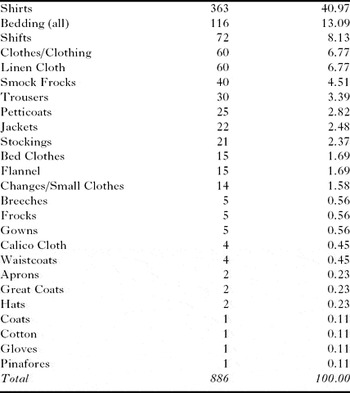
But the issue of the pragmatic parish becomes even more urgent when we look, not at what was being given to paupers by way of clothing relief in Ringwood after 1818, but at what was being taken from them in return for that relief. For Ringwood, it seems, required not only its indoor, but its unemployed outdoor poor to work for a living, and what they seem to have worked at most diligently, at least between 1817 and 1823, is the production and repair of shoes.Footnote 60 In the single year of 1818, for example, outdoor paupers made and repaired shoes to the value of £135 1s. 9d., the cash equivalent of 285 pairs of shoes at a rough figure of seven shillings a pair. This represents almost two hundred pairs of shoes more than was given as outdoor relief in that year. If we add to this quite remarkable productivity the fact that at any one time between one-half and one-third of the able-bodied poor inside the workhouse were engaged in the making of yarn, and the making and mending of cloth and clothes,Footnote 61 what becomes clear is that what John Styles has termed the parish's ‘involuntary consumers’ were also, in Ringwood at least, its ‘involuntary producers’.Footnote 62 When we place the evidence of what was being made by paupers alongside what was being given to them by way of clothing relief, it becomes clear that the majority of the clothing given to paupers was of a type that could be sourced, to a greater or lesser extent, by the poor themselves (Table 1).Footnote 63 It is also important to note that it corresponds closely with the findings of John Styles for clothing allocations by parishes in the north of England in the eighteenth century.Footnote 64 Of course, it may be that Ringwood was exceptional in requiring its outdoor as well as its indoor poor to produce clothing for their own use. Yet in most other aspects of parish policy, and in particular the kinds of pragmatic (especially make-work) schemes after 1818, Ringwood appears to have been entirely typical of parishes in the south of England.Footnote 65 Clearly, much more work needs to be done in this area: in 1776 there were over 1,800 workhouses in England and Wales covering approximately one in seven parishes, and we still have very little idea of the manufacturing capacity of these institutions, let alone the multitude of informal manufacturing schemes for the outdoor poor that are likely to have existed in the first decades of the nineteenth century.Footnote 66 It may well be that such enterprises had a significant impact not only on what was given, but on what was requested, by the parish poor in terms of clothing relief.
Number and percentage of clothing and textile items granted as relief at Ringwood (excluding shoes), 1814–29

Overall, however, the picture presented by the parish of Ringwood suggests a number of things: first, that paupers, and particularly pauper children, were being placed in service or other forms of employment from at least the last decades of the eighteenth century, and that this practice became far more systematised as the relief ‘crisis’ deepened after the end of the French wars; second, that the main strategy used by the parish to facilitate this practice was by giving good clothing relief of a quantity and quality sufficient for service; and third, that it is possible that clothing relief was of particular importance in terms of overall relief policy, not only because it was viewed as a way of facilitating paupers back into work, but because, uniquely, it could be sourced, to a greater or lesser extent, from the labour of paupers themselves. What is also abundantly clear is that paupers were acutely aware of the special place of clothing in relief regimes, and that they were extremely adept at using this knowledge in negotiating for relief. ‘Gentlemen, the Bearer, my son (John Butler) waits on you with this to address as your parishioner in hope of partaking your favour of cloathing’, wrote John Bush to his home parish of Wantage as early as 1766:
[H]aving no other than he appears in which circumstance has in many instances precluded him from employment for means to avoid this necessity. My present situation being out of employ, together with the expenses attending my wifes late lying in has totally deprived me of all ability to assist him in this particular, and having lately had several enquiries for his service if this accommodation is afforded him I am induced to make this application, not doubting but for this good commendable purpose you will extend your assistance and trust it will prove the means of launching him into life & in future enable him to obtain a sufficient support & perhaps establish some other settlement or at least prevent any more trouble to you respecting him. A good place being secure to him on return under your favour, the consideration thereof will I hope render him worthy of your attention & that every good may attend it to all parties is the only wish of your most obedt. Servant.Footnote 67
Conclusion
Historians have calculated that as much as twenty per cent of the population of England was more or less reliant on poor relief by the end of the French wars, and recent research suggests that this figure was likely to have been much higher in the agricultural south of England.Footnote 68 Pauperism, whether permanent or temporary, was a fact of life for huge numbers of English labouring families at the beginning of the nineteenth century. But it is clear that paupers were not without a degree of influence over the systems of relief on which they depended, and that the giving and getting of relief was definitely a two-way process. Pauper letters give us a unique insight into the way in which the hopeful recipients of parish relief were able to combine rhetorically sophisticated conventions, reaching far beyond the narrow confines of parish relations, with known and observably familiar conditions in order to achieve specific results in the locality. On the one hand, it is clear that paupers were fully aware of the need to ‘play by the rules’ of the pragmatic parish, just as they were of what was expected and even required of them in the act of making applications for relief. Time and again, in the pauper letters, they demonstrate a sophisticated understanding of the constraints under which vestries operated, tailoring their requests towards specific types of relief (clothing) for specific circumstances (service or employment) that they knew were likely to be more favourably received. But it is just as clear that paupers themselves were instrumental in making and adapting those rules, not least by implicitly referring to contested cultural discourses from far beyond the vestry room itself. By consistently rehearsing images (such as nakedness and the barefoot child) which were firmly embedded both in popular culture and polite discourse to emphasise their absolute need, paupers used their rhetorical voices to draw parish officials into wider debates about the rights and wrongs of being raggedly clothed in a land of relative plenty. In addition, this meant defining and utilising different notions of ‘decency’ to take account of the many different needs expressed in relief applications, some of which could be used to subtly shift the onus of responsibility and moral obligation from paupers themselves to those behind the vestry table. We do not know if Maria Langford was successful in extracting relief from Wallingford parish, but having detailed her husband's disabling illness and its effect on her and her child, she made it doubly difficult for the gentlemen of the vestry to refuse by signing off her letter: ‘P.S. Sr. I am very willing to work to get my bread, provided I had but necessaries and Raiment fit to appear in’.Footnote 69 When it came to negotiations for relief, and in particular for parish clothing, there is no doubt that paupers had at their disposal a considerable practical and rhetorical armoury that they were highly adept at deploying on the old poor laws’ front line.