I. INTRODUCTION
Among the transition metal oxides, nanostructured titania (TiO2) has attracted much interest by virtue of its intriguing catalytic activity.Reference Subramanian, Wolf and Kamat1–Reference Macak, Zlamal, Krysa and Schmuki3 Recently, it has been demonstrated that ordered arrays of crystalline titania nanotubes (NTs) exhibit enhanced photocatalytic properties as compared to other titania morphologies, largely attributed to their high surface area.Reference Su and Zhou4,Reference Deng, Wang, Liu, Zhu, Huang, Wu and Zhang5 This functionality is greatly affected by the crystallographic structure, surface bonding character, particle size, morphology and the electronic structure. In addition, there is a potential positive correlation between the magnetic structure and photocatalytic behavior in this system.Reference Siegel, Schilfgaarde and Hamilton6,Reference Moreau and Bond7 Thus, investigation of these properties is anticipated to lead to a better understanding of factors promoting higher photocatalytic efficiencies.Reference Zhang and Banfield8–Reference Halverson, Zhu, Erslev, Kim, Neale and Frank10 In this study, ordered arrays of amorphous titania NTs are synthesized by room-temperature electrochemical anodization of titanium foil in the presence of fluorine ions, followed by elevated-temperature crystallization treatments (200–450 °C) in oxygen-rich (O2), oxygen-deficient (Ar) and reducing (H2) environments, to modify the NTs’ crystal structure, morphology and electronic properties. The crystal structure, morphology and magnetic properties of the NTs in their as-anodized and annealed states were examined by x-ray diffractometry (XRD), scanning electron microscopy (SEM) and superconducting quantum interference device (SQUID) magnetometry. These results are compared with those obtained from commercially-available pure-phase anatase nanopowders.
Characterization of the annealed samples reveals direct correlations between the annealing atmosphere, the unit cell volume and the size of the resultant nanocrystallites. Accompanying these relationships are correlations between the NT structure and magnetic behavior, revealing changes in the electronic structure that are in turn relevant to the functional catalytic properties of titania.
II. EXPERIMENTAL
A. Synthesis and annealing of the free-standing TiO2 NTs
A 6-h room-temperature electrochemical anodization process was used to synthesize titania NTs from titanium metal. A 127 µm-thick titanium foil (97.7% pure, Sigma-Aldrich, Milwaukee, WI) was used as the anode and a platinum mesh was used for the cathode that was spaced 4 cm apart. A voltage of 60 V DC was applied in an electrolyte consisting of ethylene glycol (anhydrous 99.8%, Sigma-Aldrich, Milwaukee, WI), potassium fluoride (0.05 M) and 1 vol% deionized water.Reference Varghese, Paulose, Shankar, Mor and Grimes11 The supported NTs were removed from the solution, then immediately rinsed with deionized water and isopropyl alcohol, followed by drying in a gentle airflow. Unsupported NT arrays (i.e., free-standing flakes) were obtained by slightly deforming the titanium substrate.
Free-standing NT flakes were placed in ceramic boats and annealed in a tube furnace for 2 h at 450 °C with heating/cooling rates of 1 °C/min. Each annealing experiment was carried out in a specific gas (99.8% pure oxygen, >99.995% pure argon and >99.995% pure hydrogen) using a fixed flow rate of 30 cm3/min.
B. Characterization of the TiO2 NTs
Finely-pulverized unsupported titania NTs were characterized morphologically, structurally and magnetically in their as-anodized and annealed states and were compared to a commercially available anatase powder (anatase reference, 99.9% pure, Alfa Aesar, Ward Hill, MA). The morphology of NTs was examined by high-resolution field-emission SEM (S4800, Hitachi, Tokyo, Japan). The crystal structure was probed with XRD (PANalytical, X'Pert Pro, Philips, Almelo, Netherlands), and the lattice parameters were calculated by the least square method.Reference Novak and Colville12 The magnetic properties of the NTs were studied by SQUID magnetometry (Quantum Design XL-5) in the range of 3 K ≤ T ≤ 400 K under an applied field H app = 0.4 T. Magnetometry samples were mounted on evacuated silica tubes and data correction techniques were carried out as described by Lewis and Bussmann to account for the diamagnetic moment of the silica sample holder.Reference Lewis and Bussmann13 Similar magnetic measurements were carried out on a 3 × 3 × 2 mm3 piece of single crystal rutile (002), with a field applied parallel and perpendicular to the c-axis.
III. RESULTS AND DISCUSSIONS
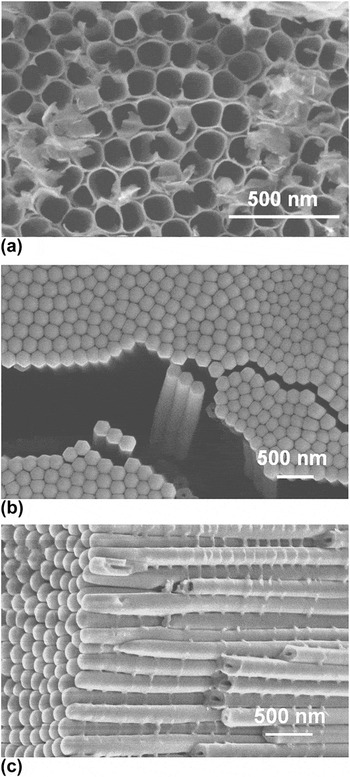
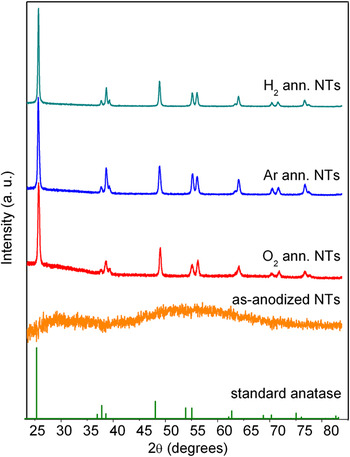
Successful formation of ordered titania NT arrays is achieved upon anodization, Fig. 1. The NTs are open on the top [pore side, Fig. 1(a)] and closed at the bottom [bottom side, Fig. 1(b)], where they are in contact with the titanium substrate prior to being flaked off for study. In their as-anodized state, these highly-ordered and highly-aligned NTs feature an average pore diameter of 100 nm and an average length of 45 μm with a crystallographically amorphous structure confirmed by XRD, Fig. 2. Annealing the NTs produces two simultaneous effects: (i) crystallization and (ii) transformation from a nanotubular to a uniform nanoparticulate morphology.
SEM micrographs of the as-anodized titania NTs, (a) top, (b) bottom, and (c) lateral view.

X-ray diffraction patterns of titania NTs in the as-anodized state and annealed (ann.) for 2 h at 450 °C in H2, Ar, and O2 gases.

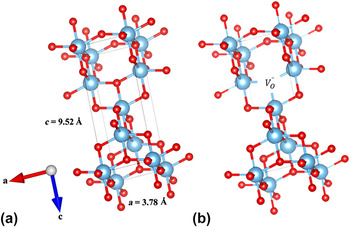
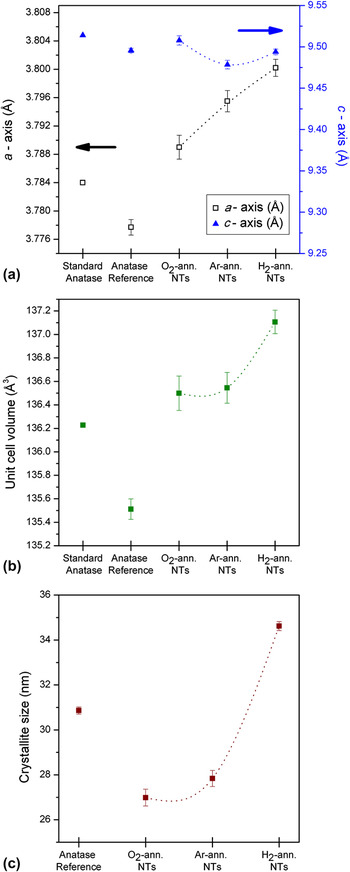
The anatase crystal structure develops in all samples after annealing regardless of the annealing gas, Fig. 2. In the anatase structure (tetragonal symmetry, space group I41/amd), Fig. 3(a), each titanium atom is surrounded by six oxygen atoms forming a lightly distorted octahedron organized into an edge-sharing arrangement of octahedra.Reference Kang and Hybertsen14,Reference Rhodes and Wohlfarth15 This octahedral distortion results in bond lengths that are larger along the c-axis ([001] direction) than those in the basal plane. The XRD data reveal subtle but significant differences in the anatase a-axis parameter upon annealing, producing variations in the anatase unit cell volume that are correlated with the type of annealing gas. Specifically, the anatase a-lattice parameter is expanded in H2-annealed NTs relative to those produced in Ar or oxygen-rich annealing environments, Fig. 4(a). NTs annealed in an oxygen-rich environment possess lattice parameters that are very close to those of the commercially-available anatase powder (denoted as the anatase reference, shown on the same graph in Fig. 4). The anatase c-lattice parameter remains constant in all samples, within experimental errors. These conditions produce a systematic trend in the anatase unit cell volume of the NTs, Fig. 4(b), where annealing the NTs in the oxygen-deficient (Ar) or reducing (H2) environments results in a larger unit cell volume as compared to the NTs annealed in an oxygen-rich atmosphere. All annealed samples exhibit larger unit cell volumes compared to that of bulk standard anatase data (PDF#71–1166, M. D. Jade Software, 5.0.37 Materials Data Inc.). Furthermore, application of the Scherrer formula to the anatase (101) Bragg reflection of the annealed NTs reveals the presence of larger crystallite sizes in samples annealed in the reducing environment, Fig. 4(c), with a trend that is similar to that of the unit cell volumes, Fig. 4(b).
Illustration of the anatase crystal structure of titania: (a) with a stoichiometric ratio of titanium and oxygen atoms and (b) with an oxygen vacancy. The small red spheres and large blue spheres represent oxygen and titanium atoms, respectively.

The crystallographic data are displayed for titania NTs subjected to different annealing atmospheres: (a) measured lattice parameters, (b) the anatase unit cell volume, and (c) crystallite size; the dotted curves are a guide for the eye.

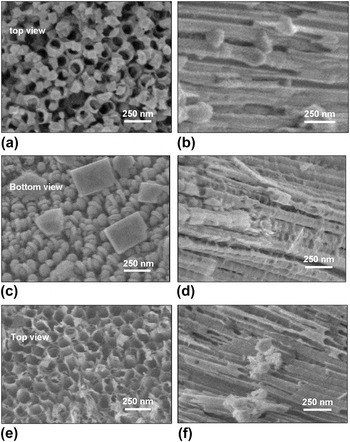
Details of the transformation from nanotubular to nanoparticulate morphologies upon annealing in the three different atmospheres (O2, Ar, and H2) are shown in Figs. 5(a)–5(f). Note that a few additional larger particles are also observed in electron micrographs, presumably only on the surface of the NTs, Figs. 5(a)–5(f). Regardless of the annealing atmosphere, the NT morphology breaks down into regular faceted crystalline nanoparticles during the annealing process, leaving behind a semi-porous nanotubular structure. A comparison of the unannealed amorphous NTs in Fig. 1 with the annealed crystalline NTs in Fig. 5 confirms that the nanocrystallites appear to nucleate and grow as they replace the amorphous NT walls. Further evidence of this process is derived from transmission electron microscopy performed on samples annealed at lower temperatures (270 °C), which confirms that formation of these nanocrystallites is initiated prior to long-range crystallization of the NTs.Reference Hosseinpour, Panaitescu, Lim, Morris, Lewis and Menon16
SEM micrographs of typical perpendicular (left hand side) and parallel (right hand side) views of titania NTs annealed in: (a and b) oxygen-rich, (c and d) oxygen-deficient (Ar), and (e and f) reducing (H2) environments.

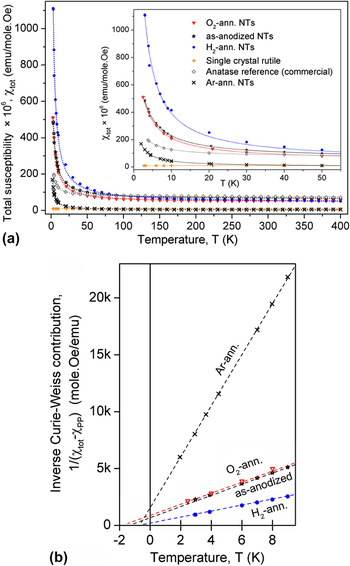
Connections between the NTs’ crystal structure, morphological features and the electronic structure underlying the nanostructured anatase functionality may be appreciated by analysis of the electronic density of states as revealed by the temperature dependence of the magnetic susceptibility. Figure 6 shows that the total magnetic susceptibility, χtot(T), for annealed and as-anodized titania NTs is comprised of two major components: a temperature-dependent Curie-Weiss paramagnetism that increases with decreasing temperature for T < 100 K and a temperature-independent Pauli paramagnetism χpp as indicated byReference Senftle, Pankey and Grant17:
 $${\rm{\chi }}_{{\rm{tot}}} (T) = C/(T - T_0 ) + {\rm{\chi }}_{{\rm{pp}}}\quad ,$$
(a) Temperature dependence of the total magnetic susceptibility, χtot, for titania NTs in the as-anodized state and annealed (ann.) in different gas environments for 2 h at 450 °C. Data from the anatase reference powder and single crystal rutile is included for comparison. The dotted curves are fit to the total measured susceptibility data using Eq. (1) encompassing Curie-Weiss and Pauli paramagnetic contributions. The inset shows the low temperature region (T < 50); (b) temperature trend of the inverse Curie-Weiss susceptibility for the annealed and as-anodized NTs [same symbols as part (a)], with a linear fit to the data (dashed lines) that highlight a negative Curie-Weiss temperature for the as-anodized and O2-annealed NTs.

where C is the Curie-Weiss constant and T 0 is the Curie-Weiss temperature that provides information on the nature of magnetic exchange interactions in the system. In particular, T 0 > 0 characterizes ferromagnetic interactions while T 0 < 0 characterizes antiferromagnetic interactions. The Curie-Weiss paramagnetism is characteristic of electronically-localized magnetism at temperatures above the Curie point; the average effective atomic moment per magnetic entity, $\langle {\rm{\mu }}_{{\rm{eff}}} \rangle$, can be correlated with the Curie-Weiss constant C through the following equationReference Goodenough18,Reference Kittel19
 $$\langle {\rm{\mu }}_{{\rm{eff}}} \rangle = \sqrt {C{{k_{\rm{B}} } \mathord{\left/ {\vphantom {{k_{\rm{B}} } N}} \right. \kern-\nulldelimiterspace} N}} \quad,$$
in which k B is the Boltzmann constant and N is the number of magnetic entities per mole.
The Pauli paramagnetic contribution to the total magnetic susceptibility, derived from delocalized conduction electrons, allows for an estimate of the electronic density of states at the Fermi level, N(E f), through the relationshipReference Ashcroft and Mermin20–Reference Park, Lee, Jung and Jung22
 $$N(E_{\rm{f}} ) = {{{\rm{\chi }}_{{\rm{pp}}} } \mathord{\left/ {\vphantom {{{\rm{\chi }}_{{\rm{pp}}} } {{\rm{2\mu }}}}} \right. \kern-\nulldelimiterspace} {{\rm{2\mu }}}}_{\rm{B}}^{\rm{2}} \quad,$$
where μB is the Bohr magneton. It is important to note that this equivalency provides quantitative information on the nature of the electronic states, which influences photocatalytic functionality associated with the radiation absorption.Reference Stewart and Léonard23
Figure 6(a) and the inset demonstrate that the low-temperature tail of the total susceptibility, dominated by the Curie-Weiss component, is affected by the type of annealing atmosphere. Evolution of the Curie-Weiss component of χtot(T) is examined through the Curie-Weiss constants obtained from a fit of the magnetic data to Eq. (1), summarized in Table I. Note that the O2-annealed NTs exhibit lower values of the Curie-Weiss constant as compared to the H2-annealed NTs (C = 1.99 × 10⁻³ versus 3.67 × 10⁻³ cm3 K/mole). The commercial anatase powder (anatase reference) shows a significantly lower value for the Curie-Weiss constant, C = 0.60 × 103 cm3 K/mole, close to that of the Ar-annealed NTs, while single crystal rutile has only a temperature-independent magnetic susceptibility within the temperature range of study.
Fitting parameters for the measured total magnetic susceptibility,  ${\rm{\chi }}_{{\rm{tot}}} (T) = C/(T - T_0 ) + {\rm{\chi }}_{{\rm{pp}}}$, Eq. (2) From data in Fig. 6 for titania NTs annealed in different gas environments, as well as for commercially available anatase powder (anatase reference). C is the Curie-Weiss constant, T 0 is the Curie-Weiss temperature and χpp is the Pauli paramagnetic contribution to χtot. The average effective atomic moment per magnetic entity,
 $\langle {\rm{\mu }}_{{\rm{eff}}} \rangle$, and the relative density of states at the Fermi level, N(E f), are calculated based on Eqs. (2) and (3), respectively.

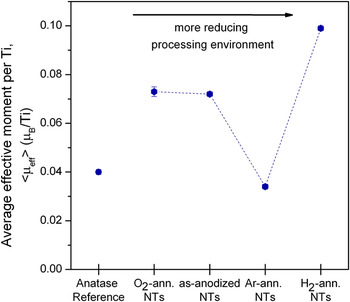
Figure 6(b) displays the temperature-dependent behavior of the inverse Curie-Weiss contribution obtained from the annealed and as-anodized titania NTs. The Curie-Weiss temperatures of the as-anodized and O2-annealed NTs are similar (|T 0| ∼ 2 K), and negative as is also the case of the anatase reference (|T 0| ∼ 1 K), indicating the existence of antiferromagnetic interactions, while Ar-annealed and H2-annealed NTs have T 0 ∼ 0 K.Reference Yang, Dai, Huang and Feng24 The magnitude of the Curie-Weiss constant for the as-anodized and O2-annealed NTs is similar and is approximately one-half of that characterizing the H2-annealed NTs, indicative of a higher average effective magnetic moment per titanium atom for the H2-annealed sample as compared to the other NT samples and is presented in Table I and Fig. 7. The measured values of  $\langle {\rm{\mu }}_{{\rm{eff}}} \rangle _{{\rm{Ti}}}$ for the O2- and H2-annealed NTs is approximately one order of magnitude smaller than the estimated value reported elsewhere for undoped defect-rich titania thin films at T = 0 K.Reference Yoon, Chen, Yang, Goodrich, Zuo, Arena, Ziemer, Vittoria and Harris25 The value of
 $\langle {\rm{\mu }}_{{\rm{eff}}} \rangle _{{\rm{Ti}}}$ for the anatase reference powder is less than half of that for the H2-annealed NTs and is close to the value calculated for the Ar-annealed NTs, implying that annealing the NTs in Ar resulted in a low temperature behavior similar to the commercially available anatase powder.
Calculated effective atomic moment per titanium atom [Eq. (2)] for the as-anodized and annealed nanotubes (ann. NTs); the dotted curve is a guide for the eye.

The magnitude of the temperature-independent magnetic susceptibility χpp for the H2-annealed titania NTs (∼10−5 emu/mole Oe) is one order of magnitude smaller than that of metallic Ti (1.5 × 10⁻⁴ emu/mole Oe).Reference Lide26 According to Eq. (3), a large χpp is associated with a large density of states at the Fermi level, which consequently can result in higher photocurrent values and potentially lead to stronger catalytic activity.Reference Neff, Henkel, Hartmannsgruber, Steinbeiss, Michalke, Steenbeck and Schmidt27,Reference Richter, Jaye, Panaitescu, Fischer, Lewis, Willey and Menon28 As summarized in Table I, the observed trend of χpp for NTs and anatase reference is  ${\rm{\chi }}_{{\rm{pp}}} ({\rm{anatase)}} > {\rm{\chi }}_{{\rm{pp}}} {\rm{(amorphous)}} > {\rm{\chi }}_{{\rm{pp}}} ({\rm{H}}_2 - {\rm{ann}}{\rm{.)}} \approx {\rm{\chi }}_{{\rm{pp}}} ({\rm{O}}_{\rm{2}} - {\rm{ann}}{\rm{.)}} > > {\rm{\chi }}_{{\rm{pp}}} ({\rm{Ar}} - {\rm{ann}}{\rm{.)}}$. This indicates a reduction of the density of states at the Fermi level N(E f) after annealing the NTs, Table I, regardless of the annealing atmosphere.
The structural and magnetic characters of the titania nanostructures described here confirm that titania NTs annealed in a reducing environment exhibit larger anatase unit cells and crystallite sizes. Additionally, these NTs possess a higher effective magnetic moment per titanium atom as compared to NTs annealed in an oxygen-rich atmosphere. Expansion of the unit cell volume and enhanced localized magnetism in nominally pure anatase NTs are consistent with the presence of oxygen vacancies ( $\ddot V_O$, in Kröger-Vink notationReference Kröger and Vink29) in these nanostructures that trap electrons at low temperature. While stoichiometric titania contains only Ti4+ ions and is considered to have a temperature-independent magnetic susceptibility,Reference Guillemot, Porté, Labrugère and Baquey30,Reference Keys and Mulay31 annealing in oxygen-deficient or reducing environments produces charged structural defects, such as oxygen vacancies.Reference Ghicov, Tsuchiya, Macak and Schmuki32 Two Ti ions are reduced from the Ti4+ state to the Ti3+ state for each oxygen vacancy created to achieve localized charge neutrality.Reference Xiao, Liu, Garcia and Sepehri33,Reference Xiong, Li, Yang and Yu34 Figure 3(b) illustrates an anatase unit cell possessing an oxygen vacancy; the electronic orbital structure surrounding the vacancy is deformed to foster donation of electrons from adjacent Ti3+ ions and thus provide localized charge neutrality.Reference Yang, Dai, Huang and Feng24,Reference Yoon, Chen, Yang, Goodrich, Zuo, Arena, Ziemer, Vittoria and Harris25,Reference Xiong, Li, Yang and Yu34,Reference Yoon, Harris, Vittoria and Widom35 Conversion of the quadrivalent Ti4+ cation to the trivalent Ti3+ cation is accompanied by a significant increase in the titanium ionic radius (0.42 Å versus 0.67 Å, or ∼60% increase Reference Lide36). Moreover, there is electrostatic repulsion between the two mutually-exposed cations in the absence of the bridging oxygen anions in the crystal structure. Both of these effects can contribute to the observed unit cell volume expansion.Reference Nah, Paramasivam and Schmuki37–Reference Choi, Jeon, Yang, Park and Song39 Such an expansion in the crystal unit cell upon introducing oxygen vacancies is also reported for other nanostructured transition-metal oxides such as cerium oxide nanoparticles.Reference Zhang, Chan, Spanier, Apak, Jin, Robinson and Herman38,Reference Hailstone, DiFrancesco, Leong, Allston and Reed40 Meanwhile, the larger crystallite size attained during annealing in a reducing environment is consistent with enhanced growth conditions that are facilitated in such an environment, with larger, more defective unit cells donating higher atomic mobility pathways for crystallite growth.Reference Zhang and Banfield8,Reference Inagaki, Nonaka, Tryba and Morawski41
Furthermore, the observed changes in the magnetic moment per titanium atom in the titania NTs upon annealing in a reducing environment are consistent with the creation of oxygen vacancies accompanying reduction of Ti4+ to Ti3+.Reference Ghicov, Tsuchiya, Macak and Schmuki32,Reference Liu, Ma, Li, Li, Wu and Bao42,Reference Fan, Dongmei, Yan and Xurming43 These vacancies can produce a localized magnetic moment, due to magnetic interactions such as double exchange,Reference Yoon, Chen, Yang, Goodrich, Zuo, Arena, Ziemer, Vittoria and Harris25,Reference Yoon, Harris, Vittoria and Widom35 or from Ti3+ ions coupled ferromagnetically in donor bound magnetic polarons.Reference Coey, Venkatesan and Fitzgerald44,Reference Heiman, Wolff and Warnock45 Observation of such a magnetic behavior arising from oxygen vacancies is reported for other pure transition metal oxide nanostructures such as defective titania single crystals,Reference Zhou, Čižmár, Potzger, Krause, Talut, Helm, Fassbender, Zvyagin, Wosnitza and Schmidt46 thin films of titaniaReference Yoon, Chen, Yang, Goodrich, Zuo, Arena, Ziemer, Vittoria and Harris25 and hafnium oxide.Reference Venkatesan, Fitzgerald and Coey47
IV. CONCLUSIONS
In summary, it is demonstrated here that postprocessing of titania NT arrays in gases with oxygen-deficient and reducing properties alters the crystal structure and gives rise to localized magnetic moments, which is consistent with an increase in the density of oxygen vacancies. Annealing the NTs in an oxygen-deficient Ar atmosphere results in the same low-temperature magnetic behavior as that of the commercially available anatase nanopowder. Although the type of annealing atmosphere did not affect the Pauli paramagnetism of the NTs significantly, the process of annealing did affect the magnitude of the Pauli paramagnetism, especially for NTs annealed in an Ar atmosphere possessing a one order of magnitude smaller value of the Pauli paramagnetism. This change in Pauli paramagnetism implies a parallel change in the electronic density of states at the Fermi level, which can be correlated with the catalytic activity of these nanostructures for further tailoring of catalytic properties.Reference Ghicov, Tsuchiya, Macak and Schmuki32,Reference Xiong, Li, Yang and Yu34,Reference Shah, Ali, Zhu, Wang, Song, Zhang, Shah and Xiao48 Considering the suggested magneto-catalysis correlations in the metal oxides, optimization of annealing conditions is expected to lead to enhanced photocatalytic activity of titania that originates from such magneto-structural tailoring.Reference Siegel, Schilfgaarde and Hamilton6,Reference Moreau and Bond7
ACKNOWLEDGMENTS
Research supported by the U.S. National Science Foundation under Grant Nos. DMR-0906608 and DMR-0907007. The authors would like to thank B. A. Assaf for useful conversations and T. Hussey for magnetometry assistance.