Introduction
The genus Lecanactis (Roccellaceae) consists of c. 25 species of lichenized Ascomycetes, widely distributed throughout the world in temperate to tropical latitudes, especially in oceanic climates (Jaklitsch et al. Reference Jaklitsch, Baral, Lücking and Lumbsch2016). The genus has had a rather complex taxonomic history which has seen it gradually subdivided, with well-defined groups of taxa being segregated into distinct genera. Initially this was based on anatomical and morphological data, which saw, for Tasmania at least, the delimitation of the genera Bactrospora (Egea & Torrente Reference Egea and Torrente1993a), Cresponea (Egea & Torrente Reference Egea and Torrente1993b) and Lecanographa (Egea & Torrente Reference Egea and Torrente1994). More recently, molecular data have been applied, leading to a further subdivision of Lecanactis (Ertz et al. Reference Ertz, Tehler, Irestedt, Frisch, Thor and van den Boom2014), albeit with no nomenclatural consequences for the Tasmanian biota, other than the inclusion of the byssoid Sagenidium molle Stirt. in Lecanactis (as L. mollis).
Lecanactis is characterized by: a crustose, leprose or byssoid thallus containing Trentepohlia as the photobiont; apothecioid ascomata that are typically black but may be heavily covered with a grey pruina and usually contain a dark brown, K+ greenish pigment in the cupulate excipulum; 8-spored hemiamyloid asci of the abietina-type (nomenclature after Torrente & Egea (Reference Torrente and Egea1989)), where a faint amyloid reaction is observed in the tholus surrounding a small, blunt ocular chamber; transversely septate, thin-walled, non-halonate, hyaline ascospores; simple to sparsely branched and anastomosed paraphysoids; and ellipsoid to bacilliform conidia, borne in immersed, sessile or emergent pycnidia. Most taxa have a characteristic secondary chemistry with schizopeltic, gyrophoric or lepraric acid being commonly encountered.
McCarthy (Reference McCarthy2020) records eight species of Lecanactis for Australia, with all but three having a tropical distribution. Galloway (Reference Galloway2007) records six species for New Zealand. The most recent taxonomic investigations were undertaken by Egea & Torrente (Reference Egea and Torrente1994) who revised the genus worldwide, and by Kantvilas (Reference Kantvilas2004) who recorded three species for Tasmania. Species of Lecanactis and related genera are frequently associated with narrow ecological niches or fragmented, relict vegetation types, and are therefore often significant for nature conservation and land management (e.g. Kantvilas Reference Kantvilas2004; Kantvilas et al. Reference Kantvilas, Gueidan and Tehler2020). This is certainly the case in Tasmania where several of the species are confined to cool temperate rainforest, which is the climax, old-forest vegetation for much of the island. In this paper, the Tasmanian species are reviewed and a further species of Lecanactis is described, one which grows in highly sheltered rocky underhangs. The Tasmanian species were considered in a broader, continental context, leading to the discovery of several new records for Australia, which are also reported here. In total, eleven Lecanactis species are accepted as occurring in Australia (including Tasmania) and a key to distinguish them is provided.
Material and Methods
The study is based chiefly on collections of the author, housed in the Tasmanian Herbarium (HO), with reference to selected specimens from other herbaria as indicated in the text. Data for those taxa for which specimens were unavailable were drawn from the literature as cited. Anatomical observations and measurements were based on thin, hand-cut sections of the thallus, apothecia and pycnidia, mounted in water, 10% KOH (K), Lugol's iodine, ammoniacal erythrosin and/or lactophenol cotton blue. Ascospore measurements are presented in the format 5th percentile–average–95th percentile, with outlying values in brackets and n signifying the number of observations. Chemical analyses were undertaken by thin-layer chromatography using standard methods (Orange et al. Reference Orange, James and White2010); solvent A was the preferred routine medium. Selected critical chemical analyses were confirmed by Prof. J. A. Elix, Canberra using high-performance liquid chromatography (Elix et al. Reference Elix, Giralt and Wardlaw2003).
Key to Lecanactis in Tasmania and mainland Australia
1 Thallus saxicolous in sheltered underhangs, typically thickly leprose ……… 2
Thallus corticolous or lignicolous, smooth, scurfy or byssoid, never leprose ……… 3
2(1) Thallus containing schizopeltic acid (P−); ascospores 3-septate, 19–30 × 4.5–6 μm ……… L. scopulicola
Thallus containing psoromic acid (P+ yellow); apothecia unknown in Tasmania but ascospores reported as 3(–5)-septate, 21–33 × 3.5–5 μm ……… L. aff. dilleniana
3(1) Thallus byssoid, containing lepraric acid only ……… L. mollis
Thallus smooth or scurfy, containing schizopeltic acid (alone or with lepraric or gyrophoric acids), or gyrophoric acid alone ……… 4
4(3) Exciple heavily carbonized, composed of highly gelatinized hyphae and remaining opaque with the addition of K ……… 5
Exciple composed of intertwined, weakly gelatinized hyphae which become clearly visible with the addition of K ……… 8
5(4) Apothecial disc C+ red; thallus containing gyrophoric acid; ascospores 20–30 × 5–7 μm ……… L. latispora
Apothecial disc C−; thallus containing schizopeltic acid ……… 6
6(5) Thallus containing lepraric acid in addition to schizopeltic acid; ascospores acicular to narrowly fusiform, 6–7-septate, 32–55 × 3.5–5 μm ……… L. subfarinosa
Thallus lacking lepraric acid; ascospores fusiform to narrowly ellipsoid, mostly 3-septate ……… 7
7(6) Ascospores 25–44 × 3.5–6 μm; pycnidia emergent, cylindrical with white, pruinose tips, C+ red (gyrophoric acid) ……… ……… L. abietina
Ascospores 20–32 × 5.5–7 μm; pycnidia immersed, C− ……… L. neozelandica
8(4) Thallus distinctly sulphur yellow; ascospores mostly 3-septate ……… 9
Thallus a shade of grey or white; ascospores mostly more than 3-septate ……… 10
9(8) Ascospores 40–60 × 3.5–5 μm ……… L. sulphurea
Ascospores 25–43 × 3.5–6 μm ……… L. tibelliana
10(8) Ascospores 40–56 × 4–5.5 μm, 5–6-septate ……… L. spermatospora
Ascospores 25–45 × 3.5–6 μm, 3–5-septate ……… L. platygraphoides
The Species
Lecanactis abietina (Ach.) Körb.
Syst. Lich. Germ., 275 (1855).—Lichen abietinus Ach., Kongl. Vetensk. Akad. Nya Handl. 16, 139 (1795); type: Sweden, Småland (lectotype, fide Tehler (Reference Tehler1990)—H-ACH 447A).
Thallus crustose, thin and scurfy, whitish grey to cream-grey, sometimes with a faint pinkish tinge.
Apothecia 0.5–1.5 mm diam., lecideine, sessile and constricted at the base, typically thickly covered with a grey to yellowish grey pruina, seen in section to contain crystals that fluoresce golden whitish in polarized light, dissolve yellowish in K, but soon reprecipitate as feathery clusters of hyaline, acicular crystals. Exciple remaining opaque in K. Hymenium 70–100 μm thick. Ascospores 3(–4)-septate, 25–32.7–40(–44) × 3.5–4.6–5.5(–6) μm (n = 50).
Pycnidia conspicuous and emergent, cylindrical, 0.2–0.3 mm wide, tipped with a coarse, white pruina; macroconidia 11–17 × 2–3.5(–4) μm; microconidia 9–13(–15) × 0.8–1.2 μm.
Chemistry
Thallus K−, C−, KC−, P−, UV+ vivid white to yellowish or purplish white (schizopeltic acid (major)); tips of pycnidia C+ reddish (gyrophoric acid).
Remarks
For further descriptive data, see Kantvilas (Reference Kantvilas2004), Egea & Torrente (Reference Egea and Torrente1994) and Wolseley et al. (Reference Wolseley, Purvis, Rose, Smith, Aptroot, Coppins, Fletcher, Gilbert, James and Wolseley2009). Amongst the corticolous species of the genus, Lecanactis abietina is best recognized by the combination of schizopeltic acid in the thallus, the conspicuous, cylindrical pycnidia with C+ red apices (gyrophoric acid), unique for the genus, and the relatively long and narrow, 3-septate ascospores. These characters readily distinguish it from L. latispora and L. neozelandica, both of which have shorter and broader ascospores and immersed pycnidia; the former also contains gyrophoric acid in the thallus.
The ecology of L. abietina is discussed by Kantvilas (Reference Kantvilas2004). It is a characteristic indicator species of old trees and old forests in cool temperate regions of the world. In Tasmania, it is most commonly found on the dry, flaky bark of mature Nothofagus cunninghamii in cool temperate rainforest, where it is associated with L. mollis and a diverse suite of crustose lichens, including calicioid taxa (Kantvilas Reference Kantvilas1988).
Selected specimens examined
Australia: Tasmania: Mt Victoria Track, 41°20′S, 147°50′E, 900 m, 1981, G. Kantvilas s. n. (HO); Boyd Lookout, 42°49′S, 146°21′E, 550 m, 1981, G. Kantvilas 547/81 & P. James (BM, HO); Meander Forest Reserve, 41°44′S, 146°32′E, 800 m, 1984, G. Kantvilas 666/84 (HO); 0.25 km N of Byron Gap, 42°02′S, 146°04′E, 950 m, 2005, G. Kantvilas 43/05 (HO); Savage River NP, E side of Baretop Ridge, 41°19′S, 145°27′E, 580 m, 2015, G. Kantvilas 75/15 (HO).
Lecanactis aff. dilleniana (Ach.) Körb.
Syst. Lich. Germ., 276 (1855).—Lichen dillenianus Ach., Lichenogr. Suec. Prodr., 57 (1798); type not seen.
Thallus leprose, to 1(−2) mm thick and spreading in continuous, undelimited patches to 30 cm wide, pale greenish grey with an orange-pink tinge when fresh, fading to pale grey in storage; photobiont cells subglobose, 10–20 × 10–18 μm, densely wrapped in fungal hyphae.
Apothecia unknown in Tasmanian specimens, reported (Egea & Torrente Reference Egea and Torrente1994) as being to 1.5 mm diam., with the exciple remaining opaque in K and with 3(–5)-septate ascospores, (21–)23–30(–33) × (3.5–)4–5 μm.
Chemistry
Thallus K−, C−, KC−, P+ yellow, UV− (psoromic acid).
Remarks
The Tasmanian collections are sterile and therefore only provisionally determined. They were all collected from large, overhanging bluffs of Triassic sandstone in dry eucalypt woodland in a localized part of south-eastern Tasmania. Similar habitats have been searched extensively for this lichen in other parts of Tasmania without success. Whereas psoromic acid is a frequently occurring substance, it is unknown in any other Tasmanian lichen with the above morphological characters.
Lecanactis dilleniana is widespread in Europe where it is reported to have a habitat ecology similar to the Tasmanian collections (Wolseley et al. Reference Wolseley, Purvis, Rose, Smith, Aptroot, Coppins, Fletcher, Gilbert, James and Wolseley2009). The species was seen as distinct within Lecanactis (Tehler & Egea Reference Tehler and Egea1997), and resolved as a distinct lineage and placed in the genus Psoronactis Ertz & Tehler by Ertz et al. (Reference Ertz, Tehler, Irestedt, Frisch, Thor and van den Boom2014). As the Tasmanian identifications are provisional, pending the discovery of fertile material, I have elected to retain them under Lecanactis.
Specimens examined
Australia: Tasmania: Bluff River Gorge, 42°31′S, 147°40′E, 2017, G. Kantvilas 37/17 (HO); ibid., 2019, G. Kantvilas 213/19, 215/19 (HO); Eldon Road, 42°29′S, 147°27′E, 300 m, 2019, G. Kantvilas 274/19 (HO).
Lecanactis latispora Egea & Torrente
Biblioth. Lichenol. 54, 90 (1994); type: Australia, Tasmania, South West National Park, 5 km WNW of Strathgordon, along Serpentine River below Serpentine Dam, 42°46′S, 145°59′E, c. 550 m, on leaves of Richea pandanifolia, 10 Mar. 1981, L. Tibell (holotype—UPS).
Thallus crustose, thin, smooth, whitish cream.
Apothecia 0.2–1.5 mm diam., lecideine, sessile, constricted at the base, thickly covered with a whitish grey, C+ red pruina. Exciple remaining opaque in K. Hymenium 90–120 μm thick. Ascospores 3-septate, (20–)21–24.7–29(–30) × 5–6.3–7 μm (n = 50).
Pycnidia immersed, 0.15–0.2 mm wide; macroconidia 8–12 × 2.5–4 μm; microconidia 5–8 × 1–1.2 μm.
Chemistry
Thallus and apothecial pruina K−, C+ red, KC+ red, P−, UV± faint mauve (gyrophoric acid).
Remarks
The presence of gyrophoric acid (thallus and apothecial pruina C+ red) readily distinguishes this species from the two most similar Tasmanian species of the genus, Lecanactis abietina and L. neozelandica, both of which contain schizopeltic acid. It differs further from L. abietina by having markedly shorter and broader ascospores, and immersed pycnidia; see Egea & Torrente (Reference Egea and Torrente1994) and Kantvilas (Reference Kantvilas2004) for further descriptive data and discussion.
Lecanactis latispora is a species of old wet forests. It was originally described from the dead leaves of the tall, rosette shrub Richea pandanifolia, a highly specialized microhabitat for lichens (see Kantvilas Reference Kantvilas2004), but has since been found to have a broader ecological amplitude, occurring on the dead, dry lignum of mature Eucalyptus obliqua and Nothofagus cunninghamii, as well as on the papery bark of Leptospermum lanigerum. Thus, habitat ecology offers little reliable assistance in distinguishing this species from the common L. abietina and the rare L. neozelandica, and chemical and anatomical investigation is mandatory. Previously regarded as endemic to Tasmania, this species is recorded here for the first time from the Auckland Islands, New Zealand, where it grew on the bark of a Metrosideros sp.
Specimens examined
Australia: Tasmania: Yarlington Tier, 42°32′S, 147°18′E, 620 m, 1987, G. Kantvilas 85/87 (HO, PRA); Lake Sydney, 43°17′S, 146°36′E, 680 m, 1998, G. Kantvilas 61/98A (HO); Bermuda Road, 43°04′S, 146°54′E, 480 m, 1998, G. Kantvilas 206/98 (HO); track to Nevada Peak, 42°55′S, 146°40′E, 1100 m, 2005, G. Kantvilas 41/05 (HO); Lake Skinner Track, 42°57′S, 146°41′E, 850 m, 2020, G. Kantvilas 31/20 (HO).—New Zealand: Auckland Islands: Rose Island, 1963, P. W. James 990H (BM, HO).
Lecanactis mollis (Stirt.) Frisch & Ertz
Fungal Diversity 70, 44 (2014).—Sagenidium molle Stirt., Proc. Phil. Soc. Glasgow 10, 305 (1877); type: New Zealand, near Wellington, J. Buchanan (holotype—GLAM).
Thallus byssoid, sometimes rather compacted and crust-like centrally, pale bluish or whitish grey, paler and whitish at the margins.
Apothecia 0.5–1.2 mm diam., lecideine, shortly stipitate, thickly covered with a whitish grey pruina. Exciple remaining opaque in K. Hymenium 90–110 μm thick. Ascospores 5–6-septate, (26–)28–31.0–35 × 5–6.2–7 μm (n = 55).
Pycnidia not seen.
Chemistry
Thallus and apothecial pruina K−, C−, KC−, P−, UV− (lepraric acid).
Remarks
A detailed description and anatomical illustration are provided by Kantvilas (Reference Kantvilas2004). The combination of the byssoid thallus, Trentepohlia photobiont, apothecial anatomy and thallus chemistry readily distinguish it from other Tasmanian byssoid lichens. For many years, this species was included in the genus Sagenidium and discussed and illustrated under this name in the Australasian lichen literature (e.g. Kantvilas Reference Kantvilas1988; Kantvilas & Jarman Reference Kantvilas and Jarman1999), but the observations of Kantvilas (Reference Kantvilas2004) that it was anatomically identical with Lecanactis were subsequently confirmed with molecular data by Ertz et al. (Reference Ertz, Tehler, Irestedt, Frisch, Thor and van den Boom2014).
Lecanactis mollis is a characteristic species of cool temperate rainforest, the climax, old-growth vegetation type for the higher rainfall areas of Tasmania. In such forests, large, eye-catching thalli up to 50 cm wide occur on the dry sides of the oldest trees, as well as on the undersides of larger canopy branches. This species has also occasionally been collected away from rainforest in wet gullies in drier areas. Its occurrence in such habitats is interpreted as being a relic of former times when rainfall was higher and wet, closed, continuous forest was more extensive. As well as being associated with a rich complement of hydrophobic lichens that includes L. abietina, Cliostomum griffithii (Sm.) Coppins, Micarea prasinastra Coppins & Kantvilas and species of Chaenotheca, Arthonia and Lepraria, the byssoid thallus of this species also provides a highly specialized habitat for additional, highly restricted lichenicolous fungi such as Arthonia sagenidii Kantvilas & Vĕzda and Chaenothecopsis sagenidii Tibell. Lecanactis mollis is also known from Victoria and New Zealand (Kantvilas Reference Kantvilas2004).
Specimens examined
Australia: Tasmania: Collinsvale, Myrtle Forest, 42°52′S, 147°09′E, 800 m, 1963, G. C. Bratt 308a & J. A. Cashin (HO); Mueller Rd, 3 km W of Styx Rd, 560 m, 1984, G. Kantvilas 652/84 (A. Vĕzda: Lich. Sel. Exsicc. 2012) (HO); Flash Tier near Seventeen Acre Creek, 42°36′S, 147°53′E, 300 m, 1990, G. Kantvilas 320/90 & J. Jarman (HO); track to Mother Cummings Peak, 41°41′S, 146°31′E, 900 m, 2002, G. Kantvilas 142/02 (HO); King William Saddle, 42°13′S, 146°07′E, 820 m, 2019, J. Jarman s. n. (HO); Norfolk Rd, N of Donaldson River, 41°28′S, 145°05′E, 230 m, 2019, G. Kantvilas 56/19 (HO).
Lecanactis neozelandica Egea & Torrente
Biblioth. Lichenol. 54, 91 (1994); type: New Zealand, North Island, Gisborne, Urewera National Park, 22 km SE of Ruatahuna, 1.5 km S of Lake Waikareiti, along Waikareiti Track, c. 800 m, 38°44′S, 177°09′E, in mixed Nothofagus forest on trunk of N. menziesii, 17 May 1981, L. Tibell 13010 (holotype—UPS).
Thallus thin, effuse, greyish white.
Apothecia 0.2–1 mm diam., lecideine, sessile and constricted at the base, covered with a whitish grey, C− pruina, seen in section to contain crystals that fluoresce golden whitish in polarized light, dissolve yellowish in K, but soon reprecipitate as feathery clusters of hyaline, acicular crystals. Exciple remaining opaque in K. Hymenium 90–110 μm thick. Ascospores (2–)3-septate, (20–)22–26.7–31(–32) × 5.5–6.3–7 μm (n = 50).
Pycnidia immersed, 0.1–0.15 mm wide; macroconidia not seen in Tasmanian specimens, reported (Egea & Torrente Reference Egea and Torrente1994) as 8–13 × 3–3.5(–4) μm; microconidia 5–8 × 1–1.2 μm.
Chemistry
Thallus K−, C−, KC−, P−, UV+ vivid white to yellowish or purplish white (schizopeltic acid).
Remarks
Comprehensive descriptions are provided by Egea & Torrente (Reference Egea and Torrente1994) and Kantvilas (Reference Kantvilas2004). This species is clearly rare in Tasmania and is known there from only a single collection, from the dry papery bark of Leptospermum lanigerum in cool temperate rainforest (Kantvilas Reference Kantvilas2004). Anatomical and chemical observations are required to distinguish it from the superficially similar Lecanactis abietina and L. latispora, both of which may occur in the same type of habitat. It is chemically identical to L. abietina, which has characteristic, emergent, C+ red pycnidia and longer, narrower ascospores, 25–44 × 3.5–6 μm. Indeed, its spores are similar in size to those of L. latispora, but that species differs by containing gyrophoric acid.
Specimen examined
Australia: Tasmania: Manuka Swamp, Huon River, 42°56′S, 146°21′E, 320 m, 1991, G. Kantvilas 91/91 (HO).
Lecanactis scopulicola Kantvilas sp. nov.
MycoBank No.: MB 837340
Thallo leproso, pallide flavescenti, acidum schizopelticum continenti et ascosporis triseptatis, 21–30 μm longis, 5–6 μm latis recognita.
Typus: Australia, Tasmania, southern slope of South Sister, 41°32′S, 148°10′E, 640 m, on rock in shaded underhangs of dolerite cliffs and boulders, 31 August 2006, G. Kantvilas 324/06 (holotypus—HO; isotypus—H).
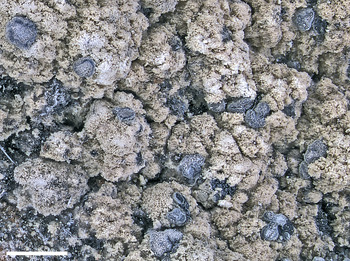
Lecanactis scopulicola habit, showing the lumpy, leprose, pinkish thallus with scattered, grey-black, pruinose apothecia. Scale = 2 mm. Photograph: J. Jarman. In colour online.

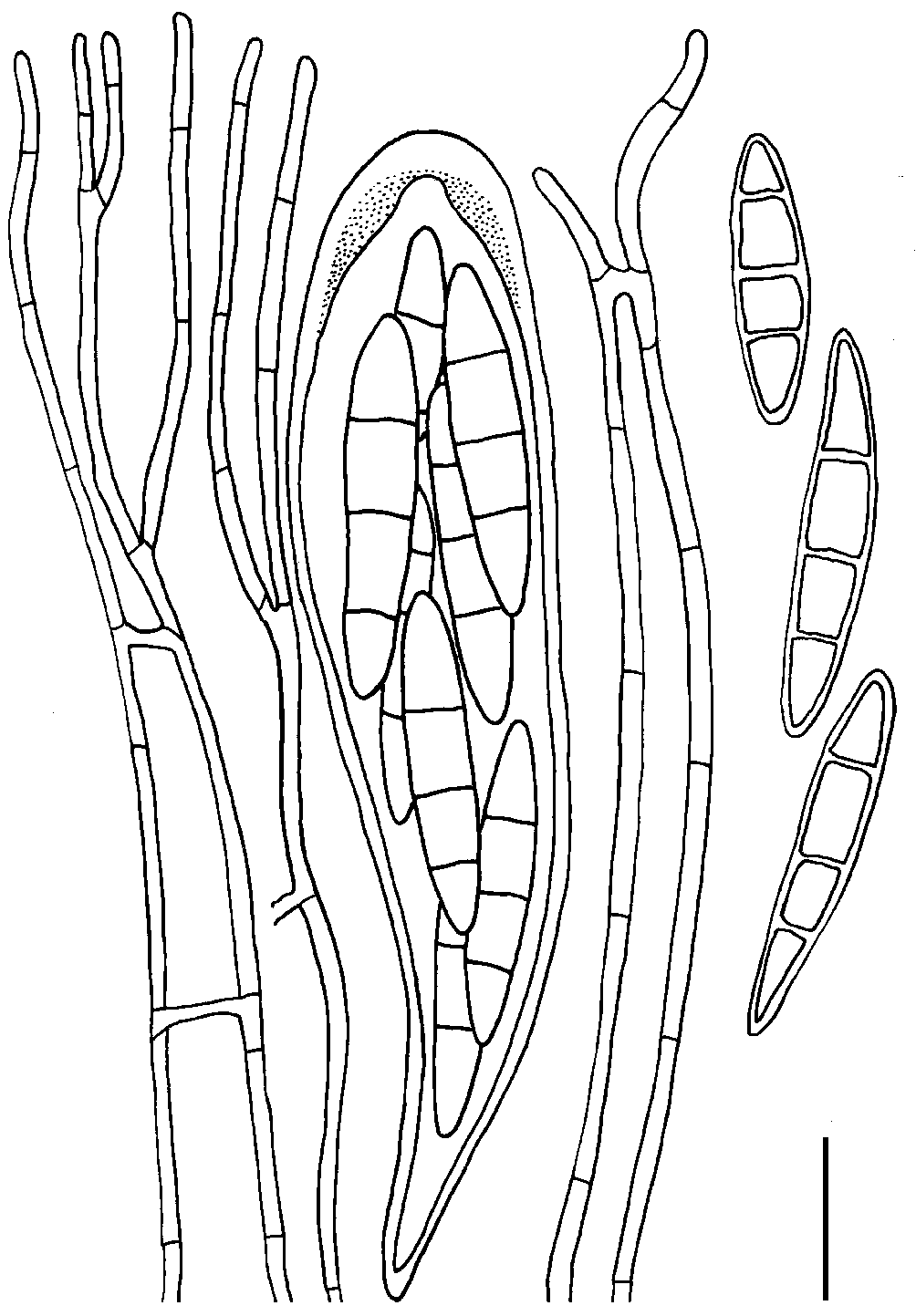
Asci, paraphysoids and ascospores of Lecanactis scopulicola after pretreatment in K, with amyloid parts stippled. Scale = 10 μm.

Thallus leprose, pale yellowish, forming soft cushions 0.5–2 mm thick and to 25 mm wide, contiguous in a continuous lumpy thallus to c. 200 mm across, or rather dispersed over the substratum and intermixed with other lichens; prothallus absent; photobiont Trentepohlia, with cells subglobose, 10–20 μm diam., occurring singly or in short chains or clumps; medullary hyphae 3–4 μm wide, clothed in crystals that dissolve K+ pale yellowish and then reprecipitate in feathery clusters of hyaline, acicular crystals.
Apothecia to 1.3(–2) mm diam., lecideine although sometimes appearing ±zeorine due to adhering yellowish thalline fragments, mostly neatly discoid, single or occasionally in clusters of 5–10, regenerating on moribund apothecia and then somewhat distorted in shape; disc plane at first, later convex, grey-brown to dark grey to blackish, coarsely whitish pruinose; proper exciple black at the upper edge, commonly grey-brown on the underside, coarsely whitish pruinose, clearly evident in young, plane apothecia but later becoming reflexed and inconspicuous, in section cupulate, opaque black-brown, K+ opaque olive green, 30–80 μm laterally, 120–200 μm at the base. Hypothecium yellowish brown, K+ olive greenish, 25–60 μm thick, poorly differentiated from the exciple. Hymenium 85–100 μm thick, hyaline, overlain by a yellow-brown epithecial layer of crystals that fluoresce in polarized light, dissolve in K and reprecipitate in feathery clusters, occasionally divided by vertical bands of dark tissue to 50 μm wide, extending upwards from the hypothecium. Paraphysoids 1.5–2 μm thick, simple to sparingly branched and anastomosed; apices not expanded. Asci 8-spored, 68–82 × 15–20 μm, of the abietina-type: hemiamyloid, with the tholus and wall not amyloid apart from faintly amyloid ‘shoulders’ adjacent to a rather blunt ocular chamber. Ascospores fusiform, hyaline, occasionally grey when overmature, 3-septate, (19–)21–24.8–30 × (4.5–)5–5.3–6 μm (n = 50).
Pycnidia not found.
Chemistry
Schizopeltic acid (major) with traces of demethylschizopeltic acid, porphyrilic acid, methylporphyrilate and lepraric acid; thallus K−, KC−, C−, P−, UV+ yellowish.
Etymology
The specific epithet refers to the habitat of the new species (scopulum, Latin for a cliff or crag).
Remarks
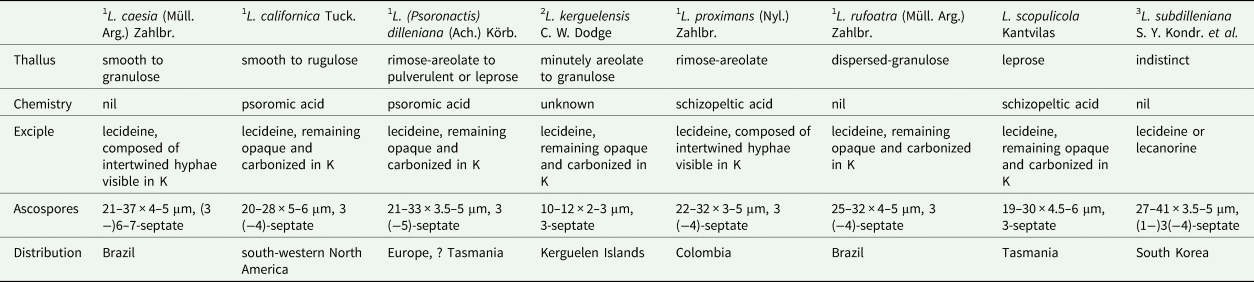
Exclusively saxicolous species of Lecanactis are relatively few. The new species is distinguished from the other known species by the combination of its yellowish, leprose thallus containing schizopeltic acid and its ascospore dimensions (Table 1). The most similar species appears to be L. proximans from Colombia, which contains schizopeltic acid and has similar-sized ascospores but differs in its rimose-areolate thallus and its exciple, which is composed of intertwined, brown hyphae that become clearly visible with the addition of K.
Salient features of saxicolous species of Lecanactis.

1 Egea & Torrente (Reference Egea and Torrente1994)
2 Dodge (Reference Dodge1948)
3 Kondratyuk et al. (Reference Kondratyuk, Lőkös, Farkas, Oh and Hur2015)
Amongst the Tasmanian species of Lecanactis, L. scopulicola is particularly distinctive. The most similar species morphologically is what is referred to in this paper as L. aff. dilleniana. Both taxa have a leprose thallus and occur in sheltered habitats on rocky bluffs. They differ chiefly by their chemistry, with L. dilleniana containing psoromic acid, easily detected by the P+ yellow reaction. In addition, whereas L. scopulicola has been recorded exclusively from dolerite (see below), L. aff. dilleniana is known only from sandstone. A further, as yet unidentified collection (Kantvilas 85/09, HO), from underhangs on a dolerite pinnacle on Maria Island off Tasmania's East Coast, has a crustose thallus containing no substances detectable by TLC and 3-septate ascospores, 30–38 × 3–3.5 μm; this possibly represents a further undescribed species.
The concentration of schizopeltic acid may be extremely low in some sterile collections but can nevertheless be detected by noting the slow precipitation of the characteristic acicular crystals on elution of thallus squashes in K. This substance is also found in two corticolous species, L. abietina and L. neozelandica, both of which have a scurfy or effuse to rimose crustose thallus. The former differs further by its longer and somewhat narrower ascospores, whereas the ascospores of the latter are generally broader.
Ecology and distribution
The new species occurs in shaded, sheltered underhangs of cliffs and tors of Jurassic dolerite, the rock type that dominates central and eastern Tasmania. It has been observed more frequently than it has been collected, owing to the difficult nature of its habitat, typically unassailable with a hammer and chisel because of the hardness and orientation of the rock. Its range encompasses the mid-altitude (mostly < 1000 m elevation) pinnacles of eastern Tasmania that receive c. 600–1000 mm of rainfall annually and are dominated by dry sclerophyll woodland, as distinct from the higher, dolerite peaks of the southern, central and north-eastern highlands which are wetter and support alpine vegetation, moorland or wet forest. Associated species in this habitat include Chiodecton montanum G. Thor, Chrysothrix candelaris (L.) J. R. Laundon, Diploschistes scruposus (Schreb.) Norman, Lecanora swartzii (Ach.) Ach., Lepraria eburnea J. R. Laundon and Porina leptalea (Durieu & Mont.) A. L. Sm. One collection is parasitized by a species of Chaenothecopsis. Virtually every locality within this geographical-ecological envelope that has suitable habitat was found to support this species; westwards, as rainfall increases, the species is absent.
Additional specimens examined
Australia: Tasmania: Den Hill, 42°27′S, 147°05′E, 830 m, 2004, G. Kantvilas 114/04 (HO); Woods Quoin, 42°18′S, 147°05′E, 880 m, 2013, G. Kantvilas 44/13, 50/13 (HO); track to Mt Hobbs, 42°31′S, 147°31′E, 610 m, 2019, G. Kantvilas 194/19 (HO); western slopes of Tanina Bluff, 42°39′S, 147°02′E, 860 m, 2019, G. Kantvilas 269/19 (HO); Lake Hwy near Projection Bluff, 41°43′S, 146°43′E, 1100 m, 2020, J. Jarman s. n. (HO); track to Three Thumbs, 42°36′S, 147°52′E, 470 m, 2019, G. Kantvilas 191/19 (HO); Mt Forestier summit, 42°55′S, 147°51′E, 315 m, 2020, G. Kantvilas 88/20 (HO).
Additional notes on Australian Lecanactis
McCarthy (Reference McCarthy2020) records a further five species of Lecanactis for Australia in addition to the species treated above: L. coniochlora (Mont. & Bosch) Zahlbr., L. quassiae (Fée) Zahlbr., L. platygraphoides (Müll. Arg.) Zahlbr., L. spermatospora Egea & Torrente and L. sulphurea Egea & Torrente, all recorded mainly from the wet, coastal rainforest regions of New South Wales and Queensland. The first two, neither of which is based on an Australian type, refer to a species of Cresponea, a genus that has been treated for Australia by Kantvilas (Reference Kantvilas2020). Both names are of uncertain application as no type material has been traced for either name (Egea & Torrente Reference Egea and Torrente1993b) and they can therefore be deleted from the Australian census. Two further species, both originally described from New Zealand, are recorded here for Australia for the first time, whereas L. platygraphoides, previously known in Australia only from Queensland (McCarthy Reference McCarthy2020), is recorded here for New South Wales. Information concerning these three significant range extensions is given below. Lecanactis sulphurea is also recorded and a fifth accepted species, as mentioned above, is Lecanactis spermatospora (Egea & Torrente Reference Egea and Torrente1994).
Lecanactis platygraphoides (Müll. Arg.) Zahlbr.
Catal. Lich. Univers. 2, 541 (1924).—Opegrapha platygraphoides Müll. Arg., Hedwigia 32, 132 (1893).
Characterized by a smooth, whitish thallus containing schizopeltic acid, heavily white pruinose apothecia with an exciple composed of intertwined, branched hyphae that become clearly visible in K, and fusiform, generally curved, 3–5-septate ascospores, 25–45 × 3.5–6 μm (see also Egea & Torrente Reference Egea and Torrente1994). Previously known from Queensland and New Guinea (Egea & Torrente Reference Egea and Torrente1994), this species is recorded here from New South Wales, where it grew on Lomatia fraseri in Nothofagus moorei-dominated cool temperate rainforest.
Specimen examined
Australia: New South Wales: Dangar Falls, 30°40′S, 151°44′E, 1988, G. Kantvilas s. n. (HO).
Lecanactis subfarinosa (C. Knight) Hellb.
Bih. Kongl. Svenska Vetensk.-Akad. Handl. 21(3/13), 120 (1896).—Lecidea subfarinosa C. Knight, Trans. New Zealand Inst. 8, 319 (1876).
Characterized by a rather thick, whitish, verruculose-scurfy thallus with a byssoid medulla and leading edge, heavily white pruinose apothecia with a persistently opaque exciple, and acicular to narrowly fusiform, straight, 6–7-septate ascospores, 32–55 × 3.5–5 μm (see also Egea & Torrente (Reference Egea and Torrente1994) and Galloway (Reference Galloway2007)). The presence of both lepraric and schizopeltic acids (in combination with the above anatomical characters) is diagnostic, especially as the other Australian taxa contain either one substance or the other. This species has been recorded on the dry rough bark of old trees in Nothofagus moorei-dominated cool temperate rainforest and Ceratopetalum apetalum-dominated warm temperate rainforest.
Specimens examined
Australia: New South Wales: Dangar Falls, 30°40′S, 151°44′E, 1988, G. Kantvilas s. n. (H, HO, S); Mt Wilson, 1988, G. Kantvilas s. n. (HO); South East Forests NP, Goodenia Rainforest, 36°54′03″S, 149°43′00″E, 3765 m, 2010, G. Kantvilas 296/10 (HO).
Lecanactis tibelliana Egea & Torrente
Biblioth. Lichenol. 54, 110 (1994).
Characterized by a rather rugulose, sulphur yellow thallus containing schizopeltic acid, heavily greyish pruinose apothecia with an exciple composed of intertwined, branched hyphae that become clearly visible in K, fusiform, curved, 3-septate ascospores, 25–43 × 3.5–6 μm, macroconidia 12–20 × 2–3 μm and microconidia 9–13 × 1–1.5 μm (see Galloway Reference Galloway2007). Lecanactis sulphurea is superficially similar but has larger ascospores (40–56 × 4–5.5 μm) and conidia (macroconidia 25–34 × 2–3 μm; microconidia 12–23 × 0.8–1.2 μm) (Egea & Torrente Reference Egea and Torrente1994), although the latter were difficult to locate in both species. Previously considered endemic to New Zealand, this species is recorded here from Queensland where it grew on the bark of Callitris macleayana in open dry sclerophyll forest.
Specimen examined
Australia: Queensland: Surprise Creek trail near Wrights Lookout, 16°50′48″S, 145°38′23″E, 2018, G. Kantvilas 432/18 (ATH, HO).
Acknowledgements
I thank Jean Jarman for providing the photograph and for bringing the line drawing to publication standard. Jack Elix confirmed the chemical composition of the new taxon. For her patient companionship in the field in quest of the new species, I thank Brigitte de Villiers.
Author ORCID
Gintaras Kanvilas, 0000-0002-3788-4562.