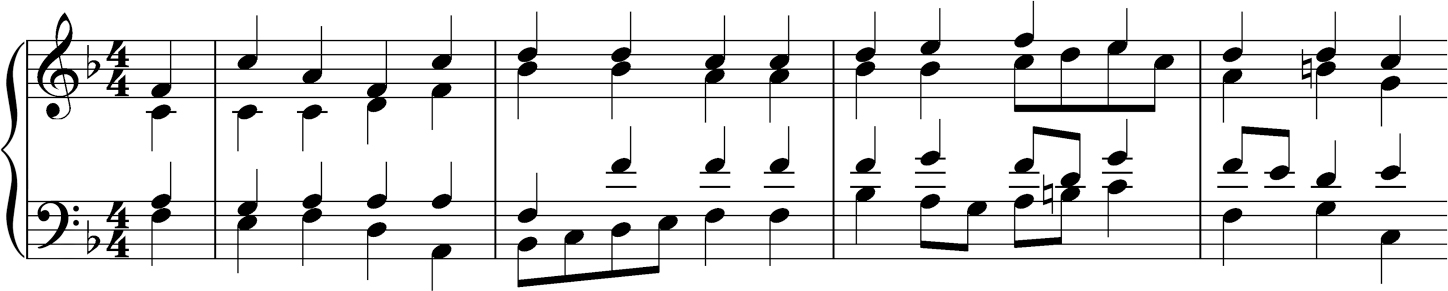
To make the familiar strange and the strange familiar was as much a central feature of Novalis's conception of Romanticism as it is a mainstay of semiotics.Footnote 1 In this spirit, we will begin with what seems like a mundane description of music-theoretical practice. If we enter a music-theory classroom in the Western world, we normally expect to find a number of objects. We see a blackboard, ideally with five-line staves already printed on it. We also expect a piano in the room, and we would probably have some sheet music, perhaps with the quintessential music-theory teaching material: Bach chorale harmonizations. Let's further imagine it is the passage shown in Example 1, the simple opening line of the Lutheran hymn ‘Wie schön leuchtet der Morgenstern’ from Bach's Cantata BWV 1, that is marked on the board. The students may sing the melodic line, and are then asked to fill out the lower parts with correct harmony and voice-leading. Correct or incorrect answers will be marked on the blackboard, better alternatives suggested, demonstrated on the keyboard, sung in all four voices or separately, and discussed with the class. Nothing could be more familiar than this set-up.
J. S. Bach, four-part setting of ‘Wie schön leuchtet der Morgenstern’, from BWV 1.

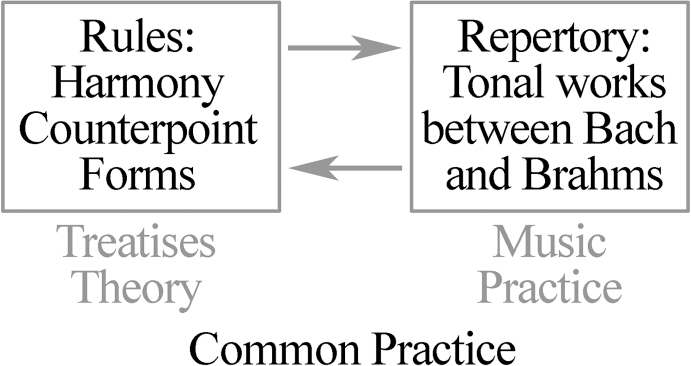
The idea behind these exercises is that these short, compact pieces in four parts teach the foundations of harmony and counterpoint so as to prepare students both for more complex composition tasks and for analysing pieces of music along the same lines. Figure 1a schematically indicates the correlation between music theory and the musical repertory it describes: music theory abstracts rules of counterpoint, harmony and musical form from a given musical repertory, and the rules, in turn, can be applied to other compositions from this repertory in order to gain a better understanding of their structure. The rules and that repertory that we usually study under this banner go by the name of ‘common practice’.Footnote 2 This scintillating term, coined by Walter Piston in his influential textbook Harmony of 1941, is a Saussurian masterpiece, oscillating as it does between an (idealized) historical period and an abstract set of rules. ‘Common practice’ is broadly coterminous, on the one hand, with the repertory of the tonal period of the long eighteenth and nineteenth centuries and, on the other, with the timeless and systematic rules that make up functional tonality.Footnote 3 Both sides seem to come together in a perfect circle.
Common-practice music-theory lesson. Walter Piston's concept of common practice mediates between rules and repertory.

The issue of practice, common or not, leads me to the main question I want to ask here. It can be formulated quite straightforwardly: What does one do when one does music theory? And how can we think about the practice of music theory more broadly? Let's take a second look at the classroom. (And it should be obvious by now that it's not the classroom itself that is of interest here, but what the set-up can tell us about the music theory that is practised there.) What I hope to have shown, by the end of our three music theory lessons, is that it is possible to understand the elements that make up music-theoretical practice in technological terms or, more specifically, as media operating within a discourse network. But we are getting ahead of ourselves. To familiarize ourselves with this strange idea, let us get there step by step.
It is noticeable that there are three elements at work in the theory classroom (musical repertory, visual representation and sonic representation), whereas the diagram shown in Figure 1a makes space for only two sides. We might argue that visual and sonic representations are just two sides of the same coin. But what happens if we prise apart the written representation, the notes on the blackboard, from the sonic representation, the tones played on the piano? We could imagine a more material ecology of music theory that links these three elements, as shown schematically in Figure 1b. We can further insert our earlier observations into this system by specifying the twofold purpose of the musical repertory as geared toward skills in composition and analysis. Of course, it is true that visual and sonic representations are closely connected: notes play an indispensable part in teaching situations for describing, outlining or tracing the relationships between pitches and harmonies, since their written nature is not bound to the linearity of the flow of sounding music and overcomes the temporally limited existence of the tone. Even though it stands to reason that music is primarily concerned with the auditory dimension, it is easy to see, especially in a teaching situation, how the visual dimension makes an extremely valuable contribution. We do well to make a careful distinction between notes, as elements of written music, and tones, as elements of sounding music.
Common-practice music-theory lesson. Diagrammatic set-up of modern music-theory classroom. Three instances – piano, blackboard and notated music – form a closed system.

One useful tool for thinking through the situation in the music-theory classroom is Friedrich Kittler's concept of media, which has the advantage of being so wide-ranging that it can encompass objects as diverse as typewriters, the medieval university and the city.Footnote 4 According to Kittler, a medium fulfils three essential functions: storage, transmission and processing of data streams. It is easy to see how a medium such as diastematic musical notation fulfils these three functions. Stave notation allows the ‘storage’ of music, in that it can be reproduced in performance at liberty across time and space. In effect, it is musical writing that brings forth the fundamental division between composer and performer on which the concept of Western art music has long rested. As for ‘transmission’ in writing, music can be disseminated, and literally ‘carried’ from A to B, in a way that the sounding music cannot; thanks to notation, music transcends the here and now. And it can be ‘processed’ in any number of ways: the music can be manipulated in performance, by means of notation, by being played faster or slower, higher or lower, and even forwards or backwards. (In the last case, admittedly, it becomes questionable whether the piece still retains its identity.Footnote 5)
By focusing, for now, on the role of notation, it might seem that the piano in the model of Figure 1b was a mere supplement to the notation, which allows the composition to be re-produced and to be re-sonified out of its written existence. But, as we shall see later, instruments such as the piano can also fulfil a medial function within such a music-theoretical discourse network or Aufschreibesystem. Literally, this Kittlerian term means ‘writing-down system’, but it is usually rendered in English, more abstractly, as ‘discourse network’.Footnote 6 The Aufschreibesystem can best be understood as a medium writ large, as ‘networks of technological and institutional elements’, and ultimately as production sites of data.Footnote 7
This discourse network of notes, blackboard and piano feels very familiar, all too familiar perhaps. It seems so commonsensical in its perfect circularity between concrete repertory and abstract goals that we do well to remind ourselves that it was not always like this. Let's shake up our sense of what music theory is and how it should be taught by looking at a radically different example of music-theoretical practice.
A lesson in Pythagorean music theory
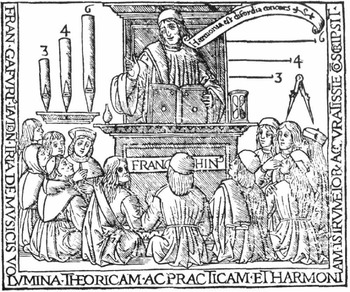
Imagine we went to a music-theory lesson in the sixteenth century. Our classroom would look more like the scene depicted in Figure 2, which shows the frontispiece of De harmonia musicorum instrumentorum opus (1518), the final treatise of Franchinus Gaffurius (1451–1522), in which we see the Italian humanistic music theorist at work. In this illustration Gaffurius's classroom does not have a blackboard; instead, he has other ways of visualizing music. On the back wall we see organ pipes in specific sizes, as well as lines of specific lengths. A compass is available and it is much in use during the lesson. The fact that all these objects seem to hang off the wall suggests beyond doubt that we are dealing with a somewhat idealized representation. Gaffurius stands behind a lectern, with 12 students sitting at his feet, hanging onto every word from the master's lips. A speech band extends from Gaffurius's mouth, saying: ‘Harmonia est discordia concors’ – translated somewhat freely as ‘harmony is discordant things coming together in concord’, a statement with learned Horatian overtones that is as true for music as it is for life. In the context of Gaffurius's music theory, an ever freer, but musically more specific version might be even more apt: ‘Music is the arrangement of proportionately disjunct sounds in pleasing intervals’, which Gaffurius offers in the text.Footnote 8 A small oil lamp and an hourglass on the desk serve to tell Gaffurius when the lecture time is up and when to stop talking.
Music-theory lesson 1518. Gaffurius dazzles his students with Pythagorean ratios. Frontispiece from Franchinus Gaffurius, De harmonia musicorum instrumentorum opus (1518).

Needless to say, the music-theory lesson shown in Figure 2 – which is perhaps more properly called instruction in musica – is not a photographic representation. Some of the features illustrated, such as the hourglass, are real things, while others, such as the three lines on the right, are more abstract representations. It is no coincidence that these lines are three, four and six units long, and the organ pipes are in the same ratios: Gaffurius's teaching is steeped in the Pythagorean tradition, with its interest in the numerical aspects of music. It takes only very basic arithmetic to recognize that the ratios these numbers outline correspond to the most fundamental intervals: octave (6:3 = 2:1), fifth (6:4 = 3:2) and fourth (4:3). More specifically, these ratios describe a conjunct harmonic division, which Gaffurius develops over the entire Book III of his treatise as a ‘most pleasant concord’ and ‘true harmony’.Footnote 9
Ratios such as these were the main subject of music theory from Greek antiquity, throughout the Middle Ages, all the way into the sixteenth and seventeenth centuries. In fact, Gaffurius had just fought a bitter feud over the correct interpretation of these Pythagorean ratios with his rival Giovanni Spataro (1458?–1541), who claimed that 6:5:3 were harmonic proportions. Gaffurius held against this that Spataro's 6:5:3 would not be admissible as harmonic proportions following Pythagorean principles.Footnote 10 This dispute escalated into one of the most vicious spats in music theory, with invective so colourful that it cannot be repeated in polite company.Footnote 11 One of the reasons Gaffurius spent so much time on the correct Pythagorean ratios in his later treatise De harmonia was so as to reassert his position that 6:4:3 are the true harmonic proportions.
One important aspect of the Pythagorean tradition of music theory is that it was never just about sounds, but also, quite literally, about everything else in the universe, at a time when music was firmly embedded in the sciences that make up the quadrivium, alongside astronomy, arithmetic and geometry. In this vein, Gaffurius referenced the Platonic tradition to remind his readers that ‘music perceived by the senses is much surpassed by music perceived by the intellect’.Footnote 12 In other words, for Pythagoreans, hearing music is only one aspect, and not the most important one. The compass that is suspended from the wall in Gaffurius's classroom in Figure 2 underlines this impression, serving as an emblem of music's close ties to the mathematical sciences.
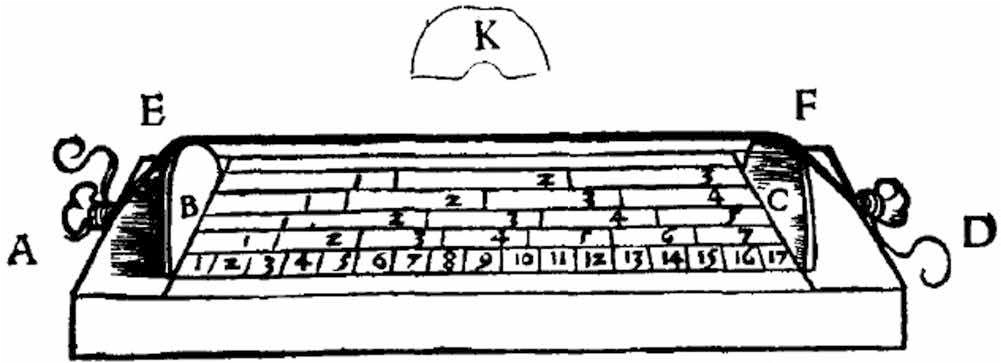
The pose Gaffurius strikes in the classroom follows in the tradition of the many venerable medieval magistri that came before him, and the theory he teaches has a long tradition stretching back through the Middle Ages (transmitted primarily via Boethius) as far as Greek antiquity. What is missing from this image of Gaffurius's lesson is the device that would make these ratios audible, equivalent to the piano in the modern classroom. The instrument of choice for the Pythagoreans was the monochord, and there is no doubt that it was in evidence in Gaffurius's teaching.Footnote 13 (Figure 3 substitutes an image from a slightly later treatise by another humanist, the Swiss music theorist Heinrich Glareanus.) The monochord is a very straightforward device: a single string that is stretched over two bridges so that it can resonate freely. By means of further bridges the length of the string can be divided. This is, in fact, where compass and straight-edge, the tools of the geometer, come in handy.
Gaffurius used a monochord in his lessons, but omits it in his frontispiece. It would have been similar to that depicted in Heinrich Glareanus, Dodecachordon (1547).

In his lesson, Gaffurius would have demonstrated the mathematical properties of musical sound by means of the monochord. And, to be sure, the prose of Gaffurius's treatise discusses at great length how to construct intervals and scales using the monochord. Needless to say, for the kinds of questions that modern music theory tends to be concerned with, above all compositional or analytical issues, the monochord would be quite unsuitable. The way in which it is handled – plucking the string to sound a single pitch, moving the bridge, plucking the string again – is too cumbersome even for most monophonic music. To be sure, monochords with multiple strings existed; one was even featured prominently in Gaffurius's Theorica musicae of 1492.Footnote 14 The more orthodox wing of Pythagoreans, however, proved reluctant to use more than one string, since the demonstration was no longer strictly based on abstract ratios, but relied significantly on the sensuous dimension of sound.Footnote 15
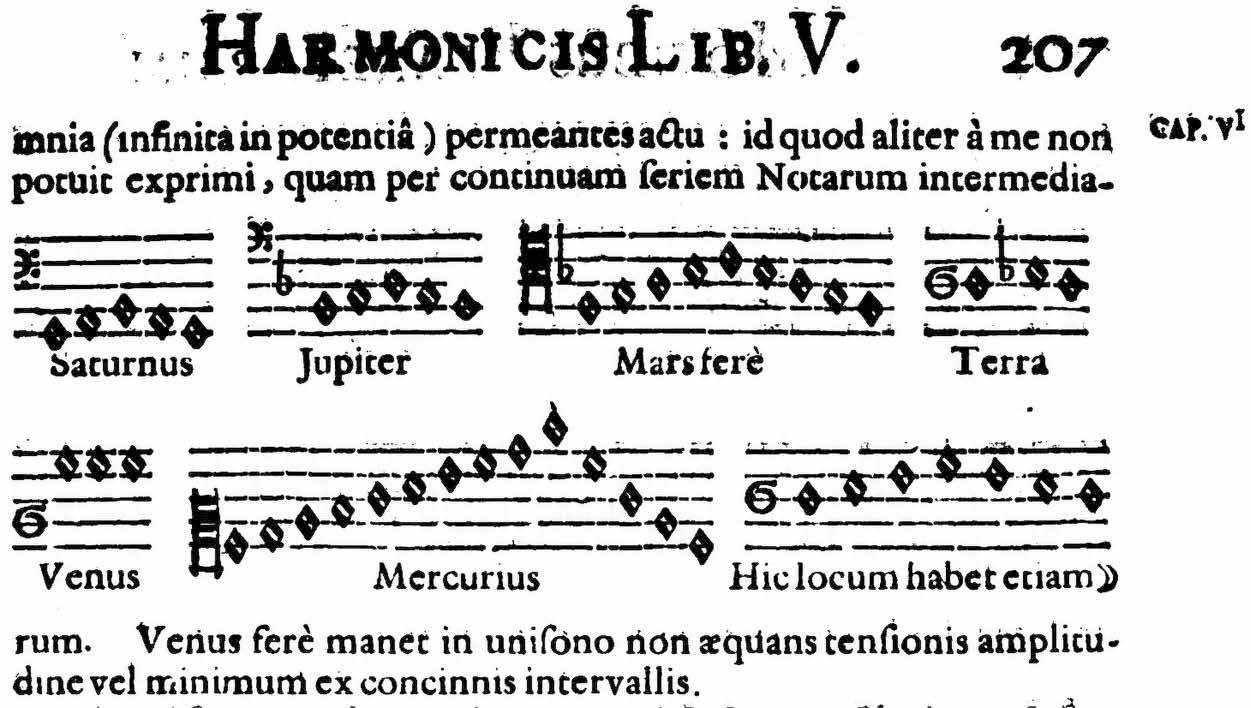
It should be remembered that for Pythagoreans music theory was never just about music. Musical ratios were always heard in relation to a universe conceived in terms of numbers. This opened up a rich field of associations that is sometimes hard to fathom from our modern perspective of what music theory is capable of doing. On the one hand, Pythagorean correspondences lead into the field of astronomy, something most famously expressed perhaps in the important treatise Harmonices mundi (1619), a major work on astronomy by Johannes Kepler (1571–1630).Footnote 16 Kepler proposes no less than his third law of planetary motion and, significantly, he derives this insight from the harmony of the spheres, represented here, in Figure 4, as musical versions of each planetary orbit. The upward and downward scales that Kepler assigns to the individual planets are sounds that the heavenly bodies make in their elliptical rotation around the Sun. The musical notation only partly captures what Kepler is trying to express: we should imagine these scales as glissandos – and very slow ones at that: each scale up and down is completed only after one complete rotation around the sun, that is, one full planetary year. The compass of their celestial scales depends on how far they swerve from an ideal circular rotation: in the case of Earth the deviation corresponds to a semitone, and in the case of Venus a mere quartertone (which Kepler chooses not to mark individually). Most importantly (and puzzlingly for most modern astronomers), this very Pythagorean example is an integral part of the scientific argument that Kepler is making.
Following the Pythagorean doctrine of the ‘harmony of the spheres’, the astronomer Johannes Kepler argues that planetary orbits sound something like the music examples he includes in his Harmonices mundi (1619). While he cannot adequately represent a glissando, this is how he imagines their sound. (The interval for Venus, which only has a very slight elliptical rotation, merely encompasses a quartertone, which Kepler does not notate specifically.)

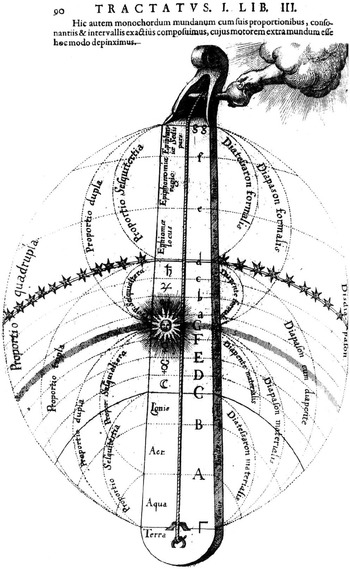
On the other hand, Pythagoreanism in the early modern age leads into hermetic theological traditions, such as the Rosicrucian position articulated by Robert Fludd (1574–1637) in opposition to Kepler's scientism, in Utriusque cosmi … historia (1617–21), with its much-discussed representation of the monochord shown in Figure 5 as reaching from the heavens, tuned up by a divine hand.Footnote 17 The divisions mark the Great Chain of Being, from God and angels, via stars and planets, to the human and animal world. Here the monochord, symbolizing the celestial harmony, explains in one captivating image no less than how the world hangs together.Footnote 18 Both these uses of music theory lead us into very different domains of thinking from the ones to which we are accustomed in the twenty-first century.
Robert Fludd's Rosicrucian treatise imagines a monochord, tuned by a divine hand, as reaching down from the heavens, depicting the Great Chain of Being in Pythagorean ratios. From Utriusque cosmi historia (1617–21).

What exactly is the role that the monochord plays in this music-theoretical set-up? The classicist David Creese, writing about the ancient Greek tradition of music theory, puts it well: the monochord is, he argues, no less than the ‘meta-metonym of musical harmonics’.Footnote 19 It is a musical instrument that unites musical and mathematical aspects in a single device. From this perspective, the instrument appears as ‘an audible diagram: the musician hears numbers; the mathematician sees sounds’.Footnote 20 Against this multisensorial background, it seems that the fact that the monochord is ostensibly missing from Gaffurius's frontispiece is immaterial: the diagram of string lengths represents visually what the monochord would have done musically, and the organ pipes in exactly the same ratios underline once again, in almost exaggerated clarity, what is going on.
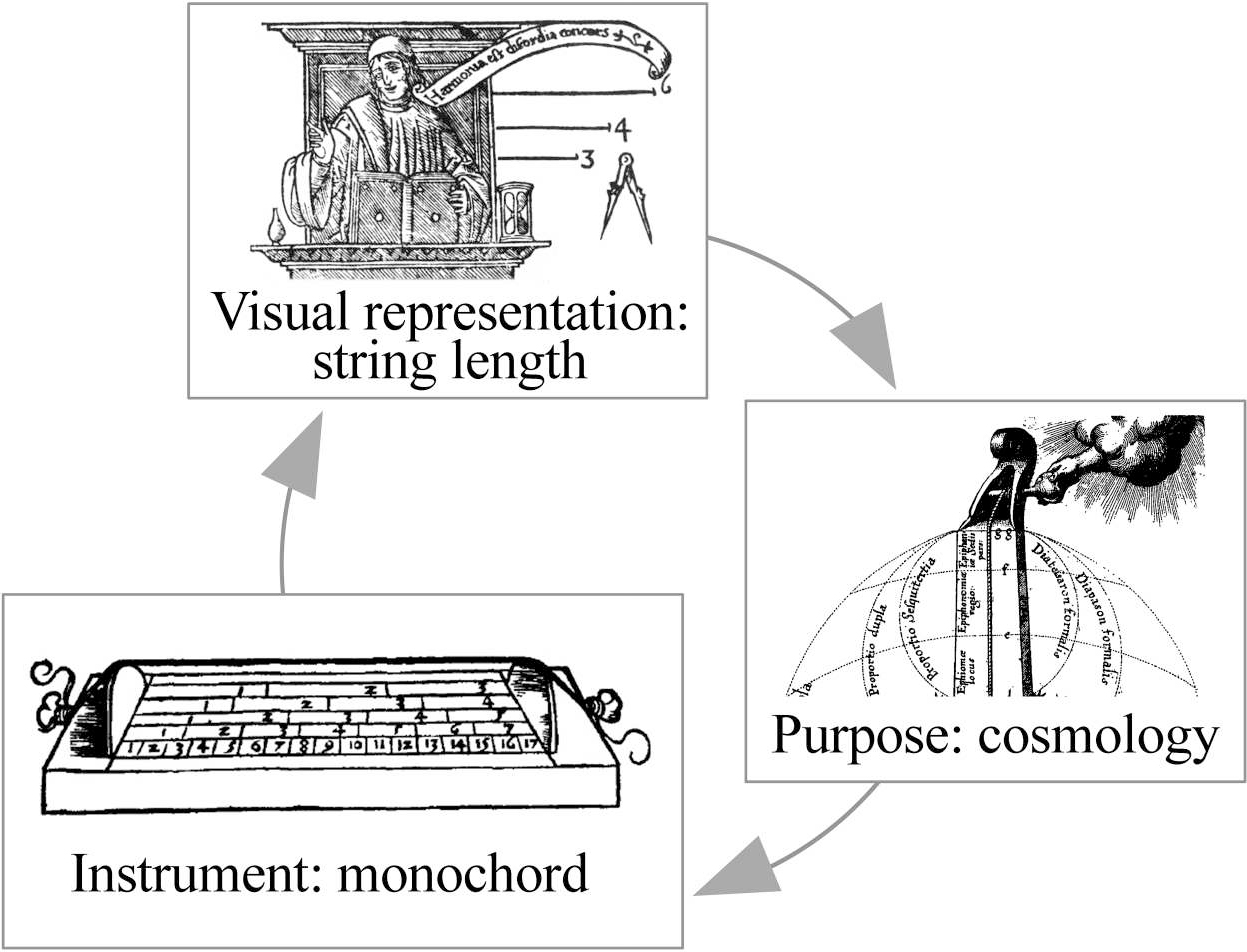
From this perspective we can assemble the music-theoretical discourse network of Gaffurius's humanistic period, as seen in Figure 6. The elements we identified in Gaffurius's teaching – monochord, string lengths and Pythagorean outlook – can be seen as analogous to the set-up in modern music-theory classrooms with which we started, in that they represent sonic and visual representations, as well as the motivation for this system of music theory. These elements form a strong alliance similar to that of the elements of a familiar music-theory classroom, but their alignment is rather different.
Music-theory lesson 1518. Monochord, string lengths and Pythagorean cosmology form a closed system, equivalent in many ways to the common-practice set-up.

String lengths do not seem like much of a written medium in the sense employed in Kittler's Aufschreibesysteme, but it is useful to remind ourselves that this is the appropriate form of visually representing sounds within a Pythagorean framework. (Needless to say, notes did of course exist at the time, and Kepler's example above in Figure 4 – which clearly stretches the representational capabilities of diastematic notation to its limits – provides a useful reminder of what the medium of notation is and is not capable of doing.) After all, the central category within a Pythagorean framework for music theory was not individual pitches but intervals, particularly purely intoned intervals.
This may seem rather abstract from our present perspective, and indeed it is. But it is important to remember that in this Pythagorean set-up composition (let alone analysis) formed only a relatively small part of this form of teaching. The main thrust of Pythagoreanism was to demonstrate that all phenomena of the perceptual world were based on numerical ratios.Footnote 21 And it is no coincidence that the Latin ratio, as well as the Greek logos, can mean ‘reason’ as well as ‘proportions’. Music theory, with its emphasis on precise intervals, was the audible domain in which the universality of ratios could be proved on the smallest scale, as it were, just as astronomy was the visual domain in which Pythagorean ratios could be applied on the largest scale.
As a parenthetical remark, there obviously was composition teaching at the time. But this is irrelevant for our purposes: we are, after all, interested in the discourse networks of music theories, and in our case there is an exceptionally strong connection between the three elements that make up the configuration in Figure 6. The important point here, as before, is the close connection between the material set-up in the classroom, the outlook on what music theory is capable of doing and, ultimately, what music is. We see that music in this context is not represented by notes but rather by string lengths, which can be sounded on the monochord. The Pythagorean approach that Gaffurius pursues connects music with the mathematical sciences – in ways that appear radically interdisciplinary by today's standards.
Instrumental intermission
We should zoom in even more closely on the instrument. All too often the instruments that music theory handles are overlooked; they seem somehow ‘neutral’. This is especially true for the piano. By contrast, this is an attempt to place instruments front and centre in the music-theoretical endeavourFootnote 22 – or rather to give them their place within the music-theoretical discourse network. To put it more strongly, the model instrument is key to the kinds of proposition that we can make. The monochord allows us to make certain demonstrations, whereas the modern piano encourages certain others.
How do we make sense of an instrument in a music-theory setting? We tend to think of the instrument as a more or less transparent device. (A good case can be made that the monochord became the Pythagorean instrument of choice because it kept human intervention – and with it variability – to an absolute minimum.Footnote 23) Recent research in the history of science, however, has drawn attention to the use of instruments as a constitutive force in knowledge generation. There are several different models. First, the venerable French philosopher Gaston Bachelard (1884–1962) claimed that ‘instruments are nothing but theories materialized’ (‘théorèmes réifiés’).Footnote 24 Bachelard argued that the observable phenomena that scientists describe are produced, in an emphatic sense, by the instruments that demonstrate them. There is a certain element of constructivism in Bachelard's argument, which he calls ‘polemical’, in that each experimental demonstration is determined by the circumstance that scientific theory formation precedes experimental observation. This constructivism, however, is held in check by Bachelard's firm conviction of a dialectical interdependence between scientific reality and scientific reason.Footnote 25
This angle, secondly, was amplified and foregrounded by a group of scholars around Bruno Latour, Steven Shapin and Simon Schaffer in the 1980s, who were particularly interested in the sociology of scientific knowledge.Footnote 26 In a series of important research projects, Shapin and Shaffer explored the significance of the materiality of the instruments. Focusing on the rise of experimental science during the Scientific Revolution around Boyle and Newton, they examined the specific make of scientific instruments that only allowed certain claims to be substantiated. This approach lent particular weight to the scientific apparatus. In particular, the material objects – the ‘things’ – of the experimental system gained a level of independence that granted them a certain amount of agency.Footnote 27 It is not without irony that Bachelard's anti-materialism has given rise to an epistemology with pronounced materialist bias. But this more radical version is ultimately a logical consequence of Bachelard's position – it is a ‘theory materialized’.
What remains controversial in a history of science that is focused on the objectivity of its findings is the decision to grant the material apparatus more independence. For ‘things’ are very pointedly not ‘objects’. Objects only come into being in relation to a governing subject that considers them, whereas things have an existence in their own right. As Bill Brown puts it, we ‘encounter’ things, and we only partially capture them.Footnote 28
Latour and others have argued for a view that considers the role of the experimental set-up in terms of networks of action. Within these networks, the experimental apparatus is given considerable space in making an active contribution to knowledge generation. The philosopher of science Davis Baird, however, in a third approach to instrumentality, wants to go one step further: arguing that the sociology of scientific knowledge is still stuck in a narrow understanding of ‘knowledge’ as theory formation, this model does not seem essentially to go further than Bachelard had gone 50 years earlier, when he called instruments ‘theories materialized’. Baird complains that Latour views the purpose of the laboratory as generating scientific papers and argues that this takes far too narrow a view of what goes on at the bench.Footnote 29 He advocates a more radical view in which ‘things’ are taken as containing knowledge in their own right. Generalizing this knowledge into theories, extracting propositions from the instruments, is one possible way of dealing with the purpose of the laboratory, but other goals are also possible. Baird shows an example in which a new electromotor is built on the basis of the principle of Faraday's electromagnetism, while bypassing the process of theory-making altogether.
Perhaps most pertinent in this context, finally, is the ‘experimental system’ of the German historian of science Hans-Jörg Rheinberger.Footnote 30 The question of instruments is for him connected with what he calls ‘epistemic things’. These are, to oversimplify for a moment, in the first place scientific objects – specifically those that exist below the threshold of observation, such as soluble RNA – that contain a certain kernel of knowledge, which the scientist seeks to uncover. Crucially, however, the epistemic thing is more conceptual than material: a laboratory produces epistemic things by employing such objects in the service of scientific experimentation and with a view to generating models that further scientific knowledge. What is particularly attractive about the notion of the epistemic thing is its essential blurriness (‘Verschwommenheit’).Footnote 31 There is no predetermined form of knowledge that inheres in the object. Its role makes sense, or rather comes into focus, only within the particular experimental system within which it is employed – it is ultimately an interpretation that is simultaneously materialized and idealized.Footnote 32 The music-theoretical discourse networks that we have been developing here, in which theoretical and material aspects complement each other, owe much to Rheinberger's concept of the experimental system. And, conversely, it is no coincidence that Kittler gives a nod to Rheinberger when he refers to the monochord as an ‘epistemic thing’.Footnote 33
It is more than a whim of language that the ‘instruments’ of which these historians and philosophers of science speak resonate strongly with those of which historians of music theory speak. (The Greek organon can mean ‘tool’, ‘device’ or ‘instrument’.) Among the thinkers presented here, it is especially Baird who argues that instruments are not merely ‘instrumental’ in the acquisition of knowledge, but that they in fact contain knowledge.
It is not difficult to see how this impulse from the history and philosophy of science can smoothly be linked with media theory. As Sybille Krämer has pointed out, the lowest common denominator of current approaches, irrespective of their particular flavours, is the technological idea that media ‘not only transmit data but also – somehow – bring them forth [hervorbringen]’.Footnote 34 No media seem to fit this better than musical instruments, which – as epistemic things – simultaneously generate musical sounds and knowledge about music. It is not only science that ‘thinks with/in its apparatuses’,Footnote 35 to take up an observation by Bachelard, but also music theory.
A lesson in common-practice music theory
With this new perspective in mind, let us return to our initial set-up, the standard music-theory classroom. As we saw, its pedagogy is not exactly ‘cutting edge’ but can rather be described as having passed the test of time; its roots, as we shall see further, stretch back to the first half of the nineteenth century. Perhaps the set-up is now sufficiently estranged that we can appreciate the things that we would normally take for granted. Let's begin our reconsideration by taking a closer look at the repertory that we study. The Bach chorales have long been praised for their versatility in the classroom, and they fulfil the exemplary role of short exercises in harmony and counterpoint in four parts. This is self-evidently true, so self-evidently, perhaps, that it obscures the unlikely migration of this liturgical genre from Lutheran congregations into the secular music-theory classrooms.
The meteoric rise of the Bach chorales from a humble Protestant workaday genre to the epitome of music-theoretical teaching material goes back to the late eighteenth century: Bach's chorale harmonizations were first collected shortly after his death, starting in the 1770s, and were published by Germany's premier music-publishing house, Leipzig-based Breitkopf & Härtel.Footnote 36 Leading German musicians and theorists such as Johann Kirnberger, Friedrich Wilhelm Marpurg and Carl Philipp Emanuel Bach were centrally involved with this enterprise.Footnote 37 Surprisingly perhaps, the use of these chorale settings in a liturgical context was not central, as was even underscored by the editorial policy: the harmonizations were presented not in open-score format, suitable for singing, but reduced into the double-stave system convenient for the keyboard.Footnote 38 Commentators soon noted that the chorales by the Thomaskantor were more abstract and complex than those of his contemporaries, and Bach's artful harmonizations were stylized – first by Johann Friedrich Reichardt (1752–1814) in the 1780s – as no less than the ‘greatest work of German art’ by the ‘greatest harmonist of all times and nations’.Footnote 39
It was Kirnberger (1721–83), in his Kunst des reinen Satzes (1774–9), who particularly stressed the purity of part-writing, composing four independently ‘flowing melodies’ so as to create ‘a single and perfect whole’. In this, he concluded, Bach ‘excelled all the composers in the world; that is why his chorales […] are to be most highly recommended to all composers as the best models for conscientious study’.Footnote 40 Removed from the church pews and made absolute, the chorales were fully integrated, as ideal teaching material, for musical study. Presented as universal models of harmony and counterpoint, they went on to serve as the foundation of a craft that would lead on the one hand to more complex tasks in composition, and on the other to the analysis of more advanced musical works.Footnote 41
It is one thing to recognize that the sharp focus of music theory on composition and analysis is a historical phenomenon with a determinable beginning (and, presumably, a fixed lifespan), bound up with certain music-historical, cultural and social factors; it is quite another thing to explain how visual and aural representation are bound up in this discourse network. Let's take a closer look at the notes we use in order to take down the four-part composition. Notes are, for all intents and purposes, regarded as identical with the tones of the sounding performance. The two terms are often used interchangeably, and with good reason: there is a clear and necessary relationship between the two, a little bit like that between a recipe and the finished meal. However, it pays to draw the distinctions a bit more carefully and to consider in what ways a written recipe and a nutritious meal are different substances.
We can start prising them apart by comparing the sounds encoded by notes with those encoded by the string lengths we encountered in Gaffurius's Pythagorean discourse network. For this let us turn to a discussion about the nature of sound (or rather, its more ambiguous German cognate ‘Klang’) spearheaded by the conservative music theorist and Thomaskantor Moritz Hauptmann (1792–1868) in Germany in the mid-nineteenth century. Hauptmann raised some fundamental questions about the nature of tonality, specifically in the context of intonation and temperament.Footnote 42 It may seem surprising that some basic issues such as intonation and the purity of tuning were still being debated at a time when the common-practice discourse network, with its focus on harmony and counterpoint (that is to say, composing in triads and tonal structures), was fully established and, in some ways, already on its way out. After all, the necessity of some kind of temperament was an inevitable consequence of the fully fledged admission of thirds and sixths among the consonants all the way back during Gioseffo Zarlino's age in the sixteenth century.
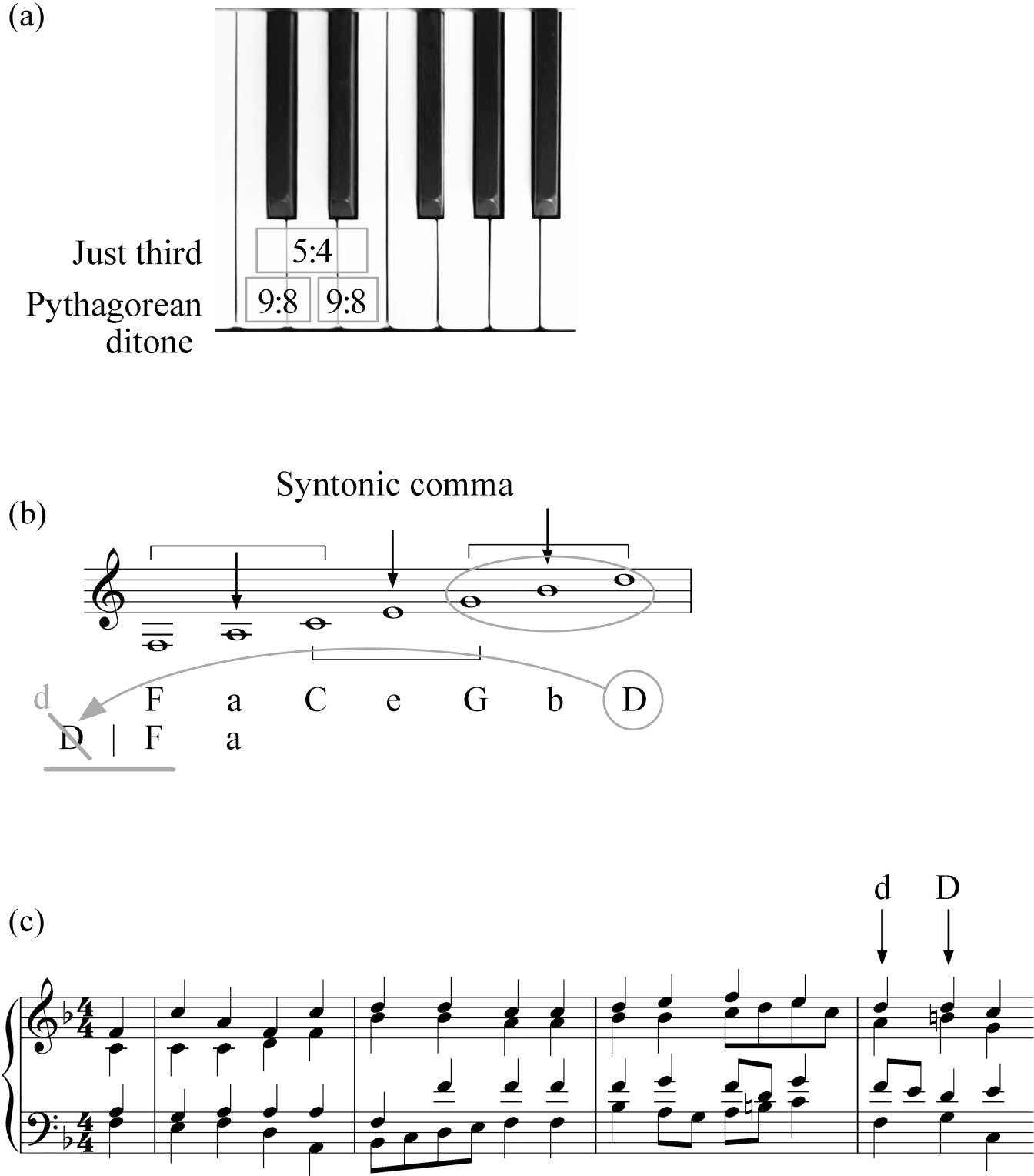
Hauptmann was particularly interested in what happened to purely intoned triads (4:5:6 for major and 10:12:15 or ⅙:⅕:¼ for minor) in the context of Pythagorean scales – that is, scales in which diatonic whole tones are tuned as the ratio 9:8 (and in which, consequently, chromaticism becomes a problem). He was particularly concerned, as indicated in Figure 7a, about the difference that emerged between two Pythagorean whole tones (9:8 × 9:8 = 81:64) and the just major third (5:4 = 80:64); the difference between the two kinds of thirds was known as the syntonic comma (81:80).
Moritz Hauptmann's critique of the common-practice configuration. (a) A just third (5:4 = 80:64) is slightly smaller than two whole tones ([9:8]2 = 81:64). The difference is the syntonic comma. (b) Hauptmann's chain of thirds, which is explicit about tuning differences, demands that the third of each triad be adjusted by a syntonic comma (marked by small letters). In C major, the D minor triad is not a pure triad, as it would require a syntonically adjusted d. (c) The harmonies of Bach's ‘Wie schön leuchtet der Morgenstern’ would require both D and d.

While Hauptmann's theoretical magnum opus pointedly left tuning questions out of the picture, they were clearly at the back of his mind. He explained, using his ‘chain of thirds’ (see Figure 7b), that the syntonic comma applied to the third of each triad (in relation to its root and fifth, which formed a pure interval), and he marked these differences with small and capital letters. Triadic shapes that did not adhere to these specific intervallic combinations were not strictly speaking major or minor triads. This was especially true for the D minor triad in the C major system. As the chain of thirds shows, the G major triad G–b–D in C major was a perfectly normal major triad, but the D minor triad D|F–a had to borrow the D from the other end of the chain, which was a syntonic comma out. As a consequence, the outer interval D–a was not a perfect fifth. Hauptmann went so far as to argue that this triad was better considered as a diminished triad, in perfect symmetrical equivalence to the (actual) diminished triad b–D|F.Footnote 43
For Hauptmann this was a genuine problem. Like most music theorists of his generation, he believed that triads were naturally given – no matter whether their origins are located, as per Hermann von Helmholtz, in the exterior soundwave or, as per Carl Stumpf slightly later, in our interior psychological make-up.Footnote 44 In order to represent the sonorities (‘Klänge’) of the major/minor system adequately (even only in one key, and adhering to diatonic sonorities), we would strictly speaking require two kinds of D at the same time.Footnote 45 Even a simple phrase from a Bach chorale like ‘Wie schön leuchtet der Morgenstern’, with which we started, would therefore be technically out of tune. As Figure 7c shows, if we aim to retain the purity of triads, following Hauptmann's critique, the first D in bar 4 (in the soprano part of the D minor chord in first inversion) is a syntonic comma too low; but if we adjusted it, the following soprano note – which presumably should be at the same level to maintain a unified melody – would be out of tune again (in the context of the G major chord that follows). Either way: in Hauptmann's music-theoretical world, harmonic and melodic purity do not align – something has to give. What lends particular urgency to Hauptmann's critique is the fact that this is not an intricate issue of sophisticated enharmonicism, as is sometimes raised, but a problem embedded in the very fabric of the diatonic scale and the most basic tonal harmonies. Even a very straightforward phrase such as ‘Wie schön leuchtet der Morgenstern’ requires some form of fudging.
It is here that the strong bond between notes and the piano comes into play. As Hauptmann was acutely aware, the piano did not allow for two kinds of D, but instead offered a tempered scale, a scale that Hauptmann considered ‘methodically out of tune’.Footnote 46 Hauptmann never minced his words. Far from being the neutral instrument for which it is normally taken, the piano is a device that turns equal temperament into a musical reality and is in this sense, to put it polemically, complicit in this deception to which all tonal music was subjected.Footnote 47
Let's take a step back. Is Hauptmann not unnecessarily picky? Yes, undoubtedly. Can the lack of ‘two Ds’ really be thought of as deceptive?Footnote 48 No: it is a compromise that was made in order to optimize the use of triadic harmonies within a tonal framework. So, is Hauptmann's critique of the piano as ‘methodically out of tune’ wrong? Not necessarily: his intervention is useful in pointing out an area of music theory that we are otherwise likely to gloss over, or fudge, in the discourse network that makes up the lesson in common-practice music theory. Equal temperament did solve a problem that had beset music ever since the emergence of triadic shapes, or more precisely, since major and minor thirds had been raised to the status of consonances. It was a pragmatic solution, and a mathematically elegant one, but it did not square the circle: the closure of the scale system, the availability of all 12 chromatic scale steps, made possible the full harmonic and transpositional range, but it came at the expense of the purity of each individual triad and harmonic relations. Any solution had to remain a compromise. And finally, we should ask: Was Hauptmann not flogging a dead horse? After all, the problem of these tuning differences had been recognized and discussed widely since the sixteenth century, most famously perhaps by Vincenzo Galilei in the context of enharmonic equivalence.Footnote 49 It is safe to say that the battle was already lost in Hauptmann's age, where equal temperament was fully accepted in practice. What makes Hauptmann's critique – whose argument does not advance significantly further than Galilei's did – so interesting is that he holds the material object, the piano, responsible for the ideological spread of the acceptance of equal temperament.
It seems fair to say that the nineteenth century, that is to say, the generation of music theorists that set up the system now known as common practice, was more attuned to the shortcomings (or rather, the ‘fudging’ that had to go on) than subsequent generations.Footnote 50 What is more, Hauptmann's critique allows us to consider the systemic aspects of music theory as a whole, especially in comparison with the string lengths and the Pythagorean framework that we encountered in our first lesson with Gaffurius. By contrast, in our modern classroom, during the lesson in common-practice music theory, we are no longer required to be interested in the quantitative aspects of music; we are no longer interested in measuring intervals (and, conversely, it is no longer advantageous to do so). One of the consequences of our turn to harmony and counterpoint is that music theory's pretensions to being a science have been largely cut out of the picture.
We see that the kind of music that can be represented, the potential that can be developed, is bound up with the visual and aural means of representation. It would be nearly impossible – or, at the very least, extremely clumsy – to try to represent Bach-style chorales by means of monochord and string lengths. The monochord has no problem accounting for the ‘two kinds of D’, but this would inevitably be at the expense of tonal closure. The notes written on the blackboard and the piano sounding triads in equal temperament form a unit that foregrounds certain important aspects of tonal music, and they provide adequate and extremely useful means of representation for the repertory under consideration. And that means especially that they fudge it where fudging is required.
In other words, where the monochord is the epistemic thing within a discourse network that focuses on music in terms of intervals, the piano's epistemic forte is bound up with a musical universe that conceptualizes triads in terms of perceptual entities, not primarily as intervallic structures. It is not wrong to point out that these instruments are complicit, but there is no evil intent: these are all decisions that music theory made at some point and in pursuit of particular goals.
Technological intermission
It is time to take another step back for another reflection on what we have been saying here. On what basis are we making this comparison between music-theoretical instruments – monochord and piano? Or between our Aufschreibesysteme – our musical visualizations, diastematic notation and string length – for that matter? Isn't that like comparing apples and oranges? Two reminders may be useful here. First, we should not imagine these visual and sonic technologies as a historical succession.Footnote 51 In fact, the technologies coexisted for a long time, sometimes even side by side in the same music-theory treatises, but they were employed in different contexts, to demonstrate different things. Gaffurius is a good example here: his Practica musicae (1496), which discusses rhythmic and contrapuntal structures, makes liberal use of music examples in diastematic notation, whereas his Theorica musicae (1492) and his other more speculative treatises employ diagrams of string lengths.
And secondly, the technologies do not carry meaning within themselves, but they unfold their meaning within the discourse network in which they are employed. Put differently, the origin stories we like to tell ourselves, about how the way in which an invention comes about determines its function, are completely irrelevant, even misleading in this media context.Footnote 52 This is particularly true for diastematic notation, an invention ascribed to Guido of Arezzo in the early eleventh century.Footnote 53 While the principles of notation have remained more or less the same then and now, an objection such as that pertaining to the ‘two Ds’ which we encountered earlier was wholly irrelevant at that time. But that is because the kind of music that was being notated was monophonic. It was not bound up within the specific structures of common-practice tonality – specifically, the kind of conflict between horizontal and vertical intervals to which Hauptmann pointed would have been meaningless. Or, to put it differently, Guido was perfectly at ease explaining the principles of his notation to Bishop Tedald of Arezzo, as Figure 8 shows, using the monochord.
Guido of Arezzo teaches Bishop Tedald (Theodaldus) using a monochord. From Micrologus (c.1026).

It is useful to remember here that technologies are best understood as affordances in this context – as devices that have the ability to make possible certain processes that could not happen without them. In other words, they come to the fore only in the context in which they are employed. They unfold their meaning only within the wider systems of which they form a part. This gives them a very particular role within history: they can emerge or disappear, depending on when and in what context they are being used.Footnote 54 This means two things: on the one hand, even when the same technology reappears at two points in history we cannot assume that its meaning is constant and, on the other, different technologies that ostensibly fulfil an epistemic function can coexist in history – they will play functionally equivalent parts within different discourse networks.
A lesson in early digital music theory
To deepen this last thought, we should look at a music-theoretical discourse network that did not make it into the general musical consciousness and was all but forgotten. It generated a lot of excitement for a brief period of time, and then it disappeared almost without leaving a trace on the collective memory. This third lesson takes us specifically to 1834, that is, to a time that is more or less coeval with the birth of our second lesson, the lesson in common-practice music theory. But unlike the latter case, which we know all too well, the third lesson of 1834 never quite got off the ground, for reasons that we will discuss later. There is therefore a certain utopian quality to this endeavour, since this proposal of what music theory could be like never made it past the drawing board. As such, this ‘utopian’ (or perhaps ‘hypothetical’) music-theory lesson offers a radical alternative to the current music-theoretical discourse network and shows us specifically what happened to the more scientific aspects of music in a post-quadrivial world. We are fortunate that these proposals survived, and even though they did not go very far at the time, they help us gain a better sense of what could have been.
The German tax collector and hobby astronomer Friedrich Wilhelm Opelt (1794–1863) is more famous today for his exact calculations of lunar craters than for his work in music theory. There is a palpable sense that when he advertised his first music-theoretical treatise, Über die Natur der Musik (1834), Opelt truly felt he had discovered the Egg of Columbus, the instrument that would allow him to tie together all aspects of music, a kind of unified field theory of music.Footnote 55Über die Natur der Musik was a short preview in preparation for a much more extensive treatise, the forthcoming Allgemeine Theorie der Musik, which would finally be published in 1852, with a view to whetting the international press's appetite for his oeuvre. He advertised his book widely, garnering press coverage and reviews in English and German.Footnote 56 But in retrospect it seems that those were Opelt's 15 minutes of fame. The Belgian music theorist François-Joseph Fétis remarked laconically, with only slight exaggeration, that he and Gottfried Wilhelm Fink in Leipzig were the only people who actually read this book.Footnote 57
The unlikely centrepiece of his music theory, the epistemic thing, was the siren, a device that had been invented a few years previously, in 1819, by the French engineer Charles Cagniard de la Tour (1777–1859).Footnote 58 Cagniard de la Tour was primarily interested in theories of sound generation, and sought in particular to challenge the theories of sound that were current around the turn of the century. From an acoustical perspective, as Ernst Chladni (1756–1827) and Thomas Young (1773–1829) had forcefully argued, sound is best understood as vibrating air molecules, pressure changes (compressions and rarefactions) transmitted through the air or other substances until they reach our ears.Footnote 59
Cagniard de la Tour's mechanism sought to undercut this theory.Footnote 60 His sirène (mermaid), so called because it worked in the amphibian environments of air and water, generated sounds by creating a series of air puffs. That is to say, the sounds generated by the siren were discrete events, not a continuous alternation of compressed and rarefied air around a neutral middle point. What the siren produced was effectively a series of on/off impulses. It would therefore not be wrong to call it a digital sound generator avant la lettre.Footnote 61
Figure 9 indicates how Cagniard's siren works. Air is pumped from a bellows into the device. At the top of the air chamber is a round disc with a regular series of diagonal bores. Once the air hits these bores they set another metal disc, also with diagonal bores at regular intervals, though pointing in the opposite direction, into rotation. Each time air passes through the two holes an air puff emerges. These air puffs form a kind of rhythmic pulsation. But once the rotation speed passes 20 impulses per second, that is 20 Hz, the audible phenomenon changes: we no longer hear a series of individual air puffs but rather a continuous pitch that rises depending on the speed of rotation.
Cagniard de la Tour's mechanical siren. From Hermann von Helmholtz, On the Sensation of Tone (1867).

With the siren, Cagniard had proved his point. It was possible to produce a discontinuous stimulus, a simple succession of on/off impulses that, given sufficient speed, resulted in a fused percept of rising pitch. He left it to future generations of physicists to work out the precise theoretical implications of his findings. These would result, eventually, in the introduction of Fourier analysis to the field of acoustics at the hands of Georg Simon Ohm (1789–1854), and a reassertion that all sound could be understood in terms of sine waves.Footnote 62
One side effect that Cagniard was not particularly interested in was the perceptual aspect: at 20 Hz, the auditory threshold, the rhythmic pulses would switch into a fused percept and would be heard as pitches. For musicians, by contrast, it was this aspect that was revolutionary, since it demonstrated clearly that the two dimensions of rhythm and pitch, which are separate perceptual parameters, can be shown to exist on a continuum in the physical realm.
Opelt's theories took up the idea that rhythms and pitches form exact analogues and ran with it. Opelt's central conceit was that we need not stop at one voice: multiple pulsations can be translated into musical intervals, even chords. The critical part is that it makes no difference whether the multiple frequencies are marked on the disc as separate regular rows of holes or whether these are merged into a single row (which would invariably follow a more complex pattern). In other words, a compound rhythm can be marked on the siren as a complex pattern of holes; and given sufficient rotation speed, this pattern will be sounded as a pitched interval. Figures 10a–b show one of Opelt's more complex siren discs, and Figure 10c outlines a few of these compound rhythms in Opelt's approximate notation. (And, incidentally, here we can see that conventional rhythmic notation is driven to its limits in trying to convey the complexity of these rhythms.) The category of ‘unmeaning’ for noise, which the announcement of Opelt's work in The Harmonicon lists, is particularly suggestive in this context.Footnote 63
Opelt's multiphonic sirens. His cardboard discs involve more complex successions, allowing compound rhythms to be transformed into intervals and chords. This technical drawing, from Opelt's 1852 treatise, shows the construction of a complex siren.

Opelt's multiphonic sirens. The popular journal Harper's Magazine (1872) depicts the same Opelt siren in action turned with a crank and operated by human breath.

Opelt's multiphonic sirens. His (partly faulty) transcriptions of compound rhythms indicate the successions of holes in his siren disc. From The Harmonicon (1832).

Opelt's musical idea was quite radical. He hoped to revolutionize music theory with this insight, by presenting a theoretical model that developed rhythms, pitches and harmonies – in other words, the basic building blocks of music – out of the siren. What, if anything, does this model do for composed music? We have to do some digging before we get anywhere with this (and, as we shall see, this is symptomatic). There are of course a number of examples of musical compositions that employ sirens as musical instruments, especially in twentieth-century music, such as Paul Hindemith's Kammermusik 1 (1922), George Antheil's Ballet mécanique (1924) and Edgard Varèse's Ionisation (1929–31).
But the more interesting cases are those compositions that employ the rhythmic/pitch correlation. First, electronic music can make good use of this feature. Karlheinz Stockhausen (1928–2007) does so in his iconic composition Kontakte (1954). A moment near the beginning of Part II shows beautifully, in the score and in the sounded music, how a pitch is modulated downwards, slowing down to such an extent that its rhythmic nature becomes audible. He theorized this principle in his important manifesto ‘Wie die Zeit vergeht’ (1957), but insisted that he had this groundbreaking insight in splendid isolation while spending time in the remoteness of the Swiss Alps.Footnote 64 Secondly, the spectralist composer Gérard Grisey (1946–98) uses a related principle in his equally iconic instrumental composition Partiels (1975), in which there are intriguing correlations between upper partials and aspects of the rhythmic structure in the score.Footnote 65 Thirdly, contemporary electronic dance music – techno – has also used this effect fairly straightforwardly, most famously in the track Thousand (1993) by Moby.Footnote 66 But the composition that takes this idea furthest is probably the youthful Quartet Romantic (1915) by Henry Cowell (1897–1965). Cowell uses the same principle to embed a secret meta-composition in the score whose chords are encoded in the proportions between the pulsations in the rhythmic layout of the individual parts. Cowell was probably unfamiliar with Opelt's theory specifically, but he wrote extensively about the mechanism of the siren.Footnote 67
While the mechanism of the siren has had effects on a diverse range of compositional perspectives, it is difficult to see a common thread beyond various developments of the same idea in different directions. The reason is that composition is not one of the main aspects of this theory. These pieces are interesting only insofar as they employ this principle, insofar as they clothe it in an aesthetically interesting guise. The main purpose of Opelt's theory seems to be to draw attention to and explore this particular feature of our perceptual apparatus.
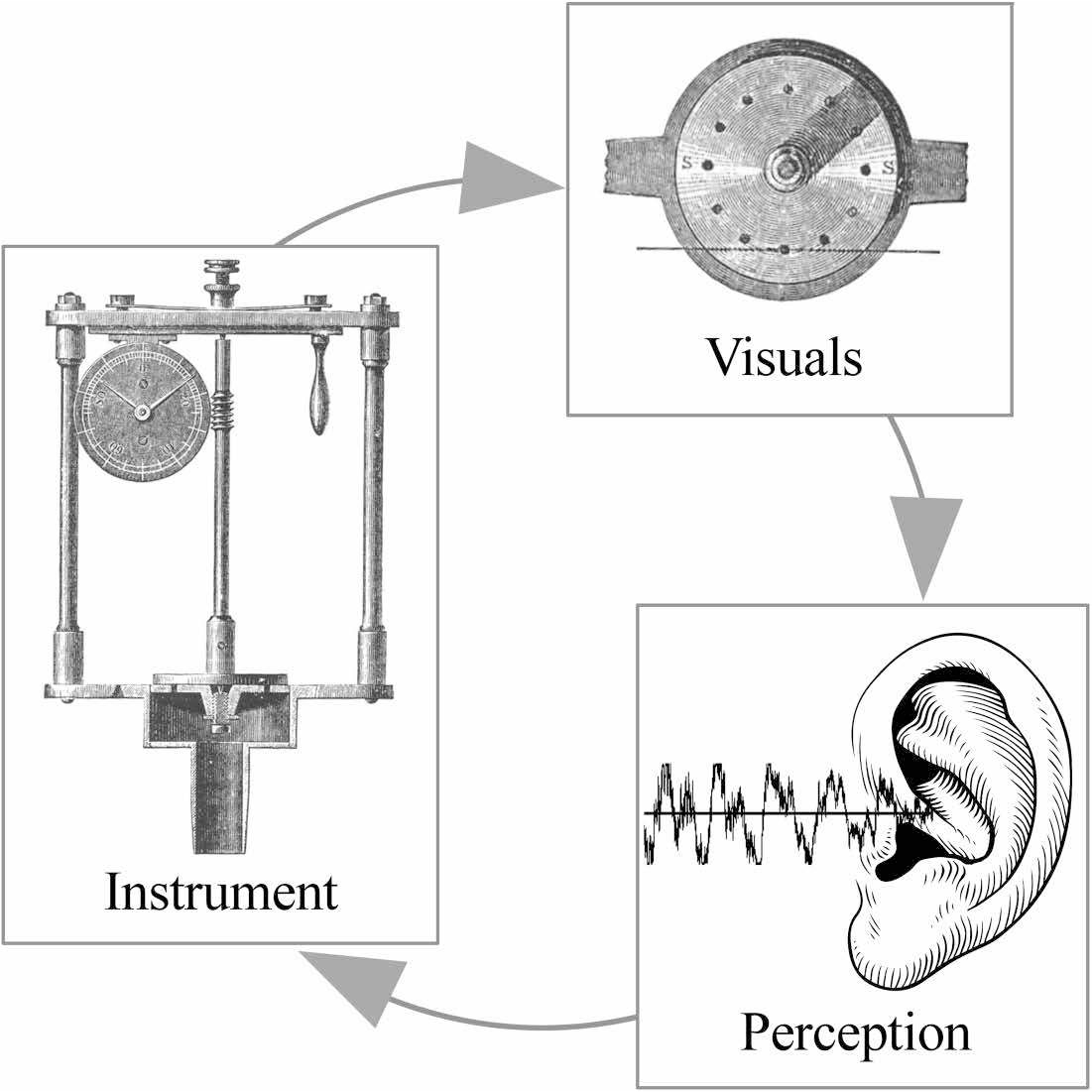
But that is in itself quite remarkable, especially as we turn our attention to assembling the complete discourse network of the music-theory lesson of 1834, derived as it is from Opelt's ‘epistemic thing’, the siren. As Figure 11 indicates schematically, the sound production is digital, the visual representation is based on the series of impulses, or the holes in the metal disc of the siren. The purpose of this kind of music theory is ultimately an enquiry into the nature of acoustics and the limits of human aural perception, something that recent scholars have called aisthetics – its unusual spelling is programmatic, referencing the Greek word aisthesis (= sensation, perception) more directly than conventional aesthetics.Footnote 68
Music-theory lesson 1834. Siren disc, holes and perception form a closed system, equivalent to the other music-theory lessons.
What do we do with this knowledge? Am I suggesting that Opelt, after being forgotten for a century and a half, should now be at the centre of the music-theoretical enterprise? No; it remains a utopian endeavour. But it is a very useful example to show us how instruments – musical or scientific – are an integral part of the music-theoretical system, how the siren unlocks a certain mode of thinking about music and sound. What is more, Opelt's music theory offers a radical alternative, a parallel universe, to the kind of music theory that took off in reality around the same time.
Music theories of the future
In closing, we should ask: why did Opelt's approach never make it? The fact that this happened in the first half of the nineteenth century is no coincidence. The standard story would go something like this: the early nineteenth century was a time when a lot happened in music, especially in central Europe, and when the familiar was made strange by the thinkers of the Romantic generation. First, this is when music aesthetics and the more scientific branch of acoustics part ways. In the eighteenth century, music theory usually still had the trappings of musical science. Around 1800, however, Young and Chladni founded the science of acoustics, while Christian Friedrich Michaelis (1770–1834) transferred Kantian aesthetic principles to music and E. T. A. Hoffmann (1776–1822) wrote his famous review of Beethoven's symphonies that became the foundation charter of Romantic music aesthetics. Put briefly, as a consequence of the rise of the genius composer, music was henceforth no longer centrally concerned with sound: a composition was not primarily an acoustical statement but a spiritual one. Secondly, this is the time when modern musical institutions – music schools and conservatoires (Paris, 1795; Prague, 1811; Vienna, 1819; and Leipzig, 1843) – came into being, and these new institutions – required a new pedagogy. This is when modern music theory, as it is practised today, emerged – with harmony textbooks becoming legion, and theories of form coming to the fore.Footnote 69
A strict media-theoretical approach to this situation would focus particularly on the rise of music as a medium of philosophical aesthetics. Kittler argued that around 1800, or more particularly in the shift from Kant to the generation of Schopenhauer and Hegel, philosophical aesthetics fundamentally changed its outlook, and music was at the fulcrum of these changes.Footnote 70 Kant did consider the possibility of an arithmetical approach to musical tones (that is, as vibrations), which would allow music to exude rationality and therefore make it eligible as a beautiful art, but he ultimately dismissed it as a merely pleasant pastime, placing it at the bottom of his hierarchy of the arts. Hegel and especially Schopenhauer reconsidered music and significantly raised its stature – in Schopenhauer's case, music even reached top position in his own artistic charts. Both of them, significantly, no longer insisted on music's Pythagorean heritage but appreciated tones qua sensations, and considered music as the supreme temporal art, worthy of philosophy in its own right. But, as Kittler cautioned, this re-evaluation came at a price: it introduced a mismatch between the medium of philosophical aesthetics – language – and the sounding, non-representational medium of the object it considered. As Kittler argues, with characteristic hyperbole to be sure, this mismatch would sound aesthetics’ death knell a generation later, when Nietzsche declared that aesthetics was nothing but ‘applied physiology’ and concluded that the appropriate response was not to philosophize but to dance.Footnote 71
Either way, whether we follow the cultural-historical or the media-theoretical narrative, in this climate, in 1834, there was very little interest in Opelt's approach. Opelt's ideas continued to consider music in light of its arithmetic and Pythagorean heritage, essentially in the context of the cultural technique of counting, whereas music as a discourse network had just completed the consistent and consequential transition to a sensory epistemology. Opelt's theory, which tried to base its principles on a scientific footing, attached weights to music, just as it lifted off on its Romantic flight of fancy, that threatened to drag music back down to the drab ground of empirical reality. Opelt remains a footnote in history, which does not quite belong to music theory, nor quite to acoustics. Nonetheless, his theory has a lot to offer. First, Opelt's scientific approach to music theory opens up a novel approach to music theory, which differs both from the purely numerical Pythagorean approach and from the compositional modern approach. And secondly, it highlights the role of the instrument as an epistemic thing. The siren unlocks a mode of thinking about music that neither the monochord nor the piano can. It brings together the acoustical facts of sound with some perceptual aspects of music. It even holds some interest for composition, though perhaps not as much as Opelt would claim. Some aspects might be useful for rethinking music theory.
In many ways, especially from the position of media theory, Opelt's ideas were ahead of their time. It seems that the time of the siren has come only now, in our own computer age, when musical sounds are not merely proto-digital, as sequences of on/off impulses emanating from the siren, but when our everyday musical experience is in fact digitally generated and emerges from binary codes of zeroes and ones. When viewed (or heard) through the recent history of the digital (especially in its early media history as the punch cards familiar from early computers rather than the dematerialized versions that surround us nowadays), Opelt's ideas about music, manifesting itself in metal discs and punched holes, may feel a little less strange. From this perspective it may shed the guise of strangeness and reveal rudiments of an underlying familiarity. Novalis and semiotics, with which we started, make strange bedfellows in this context, but their joint forces afforded us a glimpse into Opelt's utopian music-theory laboratory. What we saw (and heard) there, between the holes punched out of the metal siren discs, was that the rational and the sensuous traditions of thinking about music, that is to say, the traditions of counting and hearing, of science and of art, do not have to be ignorant of each other.
But if music theory, as I have argued, can be seen to be motivated, if sometimes tacitly, by the instruments it employs, we should take another look at the epistemic things of music theory encountered here. What exactly is the lesson they have to teach us? Of the three music-theoretical instruments we have encountered here – monochord, piano and siren – there is one outlier: the piano.Footnote 72
Within music theory it operates only in tandem with diastematic notation. The other two, siren and monochord, both incorporate their notational systems within the apparatus: string lengths and metal disc circles are barely separable from the rest of the instruments. It is worth remembering Creese's multisensory understanding of the monochord as an ‘audible diagram’ that visualizes sounds as much as it sonifies numbers.Footnote 73 We can easily expand Creese's insights to the siren disc, whose punched holes function both as a diagram, spatializing temporal relations, and as a sound source that turns this diagram into musical noise.
We can go further. Creese's idea of the monochord as the ‘meta-metonym’ for musical harmonics corresponds to Krämer's approach to media:
There are not always data on the one hand, and then, on the other hand, the media that are concerned with the data. It is far more the case that media are the production sites of data. These production sites are discourse systems [Aufschreibesysteme], the networks of techniques and institutions that preprocess what will even be considered data in a given epoch.Footnote 74
The monochord and the siren do not use separate forms of writing; they themselves are discourse networks, Aufschreibesysteme of sound. And in many ways it makes sense to think of the monochord as the analogue music-theoretical instrument to the siren's digital realm.
But what about the piano-and-score combination? Why the complication? The piano-and-score network is a textual medium, equivalent to written language. Like the hermeneutic act of textual criticism, the musical notation needs to be interpreted. It is not sounds themselves that are encoded, but notes, which operate on the symbolic level. They record some aspects of sound (pitch and rhythmic relationships), while leaving others unwritten and open to interpretation. If we take the long view of the history of music theory, this model may well turn out to be the exception, not the rule. But it has proved a particularly durable one, not dissimilar to the way in which the print medium, and particularly the book, determines our thinking about texts.
But just as we can get beyond the ‘Gutenberg Galaxy’, so we can also peek outside the textual tradition. Perhaps it is time to follow our Romantic Novalis and our Russian semiotician Shklovsky in striving to make the familiar strange. Seeing as our own time is more and more dominated by the experience of digital music in its various forms, perhaps it is time to take another look at the digital Aufschreibesystem that Opelt's siren prefigured in 1834. Perhaps now, almost two centuries later, we are willing to follow the other path at the fork in the road and think through what a music theory for the digital age would entail. With modern computer technology we have at our disposal considerable technological advantages over Opelt. Will music theory rise to that challenge? One point is clear: this discourse network will be as simple and as complicated – as familiar and as strange – as zero and one.