

Introduction
To keep global warming close to the politically set goal of 1.5°C compared to pre-industrial times, immediate and far-reaching measures to reduce greenhouse gas (GHG) emissions are needed (IPCC, 2018). Several studies conclude that a change toward more plant-based diets can significantly reduce GHG emissions from food consumption (Westhoek et al., Reference Westhoek, Lesschen, Rood, Wagner, De Marco, Murphy-Bokern, Leip, van Grinsven, Sutton and Oenema2014; Tilman & Clark, Reference Tilman and Clark2014; Bryngelsson et al., Reference Bryngelsson, Wirsenius, Hedenus and Sonesson2016; Springmann et al., Reference Springmann, Godfray, Rayner and Scarborough2016). In a recent paper, Springmann et al. (Reference Springmann, Clark, Mason-D'Croz, Wiebe, Bodirsky, Lassaletta, de Vries, Vermeulen, Herrero, Carlson, Jonell, Troell, DeClerck, Gordon, Zurayk, Scarborough, Rayner, Loken, Fanzo, Godfray, Tilman, Rockström and Willett2018) estimate that changes in dietary patterns toward reducing the consumption of animal products can reduce GHG by approximately 29–56%, depending on the targeted diet. However, there are currently no policy instruments in place that aim to initiate such changes. Meat taxes have been discussed in the scientific community (Wirsenius et al., Reference Wirsenius, Hedenus and Mohlin2011; Säll & Gren, Reference Säll and Gren2015), but not implemented in any country as yet. Forced choice restrictions such as mandatory vegetarian days in schools and cafeterias entail the risk of causing psychological reactance and, ultimately, backlash (Lombardini & Lankoski, Reference Lombardini and Lankoski2013).
Our paper contributes to the discussion on how to reduce climate emissions from food consumption by testing a behavioral approach in the form of a simple nudge aimed at increasing the consumption of vegetarian food at a lunch restaurant. A nudge (Thaler & Sunstein, Reference Thaler and Sunstein2008) describes an intervention that changes neither prices, choice sets nor the information that is given to influence a decision, such as what to have for lunch. While there is evidence that nudging can encourage people to make healthier food choices under some circumstances (Just, Reference Just2009; Wisdom et al., Reference Wisdom, Downs and Loewenstein2010; Ellison et al., Reference Ellison, Lusk and Davis2014; Policastro et al., Reference Policastro, Smith and Chapman2015), the evidence on the effectiveness of nudges for promoting sustainable food choices is limited (Carlsson et al., Reference Carlsson, Gravert, Johansson-Stenman and Kurz2019). Our study is one of the first to test whether a behavioral intervention can be used to increase the consumption of vegetarian food. A related study by Kurz (Reference Carlsson, Gravert, Johansson-Stenman and Kurz2019) found that changing the order of the menu by putting the vegetarian option first can significantly increase the share of vegetarian dishes sold. This study supports the findings by Kurz (Reference Kurz2018) in an even cleaner experimental design. Instead of a controlled before–after study, this paper presents a randomized controlled trial to rule out confounding factors. Moreover, while the sample in Kurz (Reference Kurz2018) mostly consisted of students and university employees, this experiment took place in a public restaurant.
Whether behavioral approaches can be fruitful in this setting depends strongly on how malleable the consumption preferences of the consumers are. We conducted a field experiment with a restaurant to test whether changing the convenience of ordering the meat dish changes the ordering behavior of the restaurant's patrons. Over three weeks, customers entering the restaurant were randomly presented with one of two menus. One menu offered a meat dish and a fish dish, with a note that a vegetarian option was available on request. The other menu offered a vegetarian dish and a fish dish, with a note that a meat dish was available on request. The vegetarian and fish menu resulted in 25% lower sales of the meat dish than the meat and fish menu. The results show how a small change in the framing of different options can have a substantial impact on the choices individuals make. This indicates the potential for restaurants to decrease the meat intensity of their offered dishes without banning meat items altogether or changing prices.
Experimental design
The experiment was conducted for three weeks in May 2016 at a restaurant located in Gothenburg, Sweden. During the evening and on weekends, food is served à la carte, but on weekdays, a daily changing lunch menu is available for two hours. Each day, the kitchen prepares two dishes for lunch: one containing meat and one containing fish. On request, the kitchen will also prepare a vegetarian meal. All dishes include salad, bread and tap water. Menus change every week and always cost 110 Swedish krona (approximately US$13), which puts it in the medium-priced category for Gothenburg restaurants according to the TripAdvisor website. On the restaurant's website, the food is described as “modern with tastes from around the world.” The meat and fish options were approximately equally popular before our experiment started. The restaurant is frequented mainly by white-collar employees who work in the service sector and the arts, as the restaurant is located in the city center close to a major museum, a concert hall and a library. It has 52 seats and space for a handful of people at the bar. Our experimental treatments make use of two specific features of the restaurant's setup: the architecture of the restaurant and the design of the lunch menu.
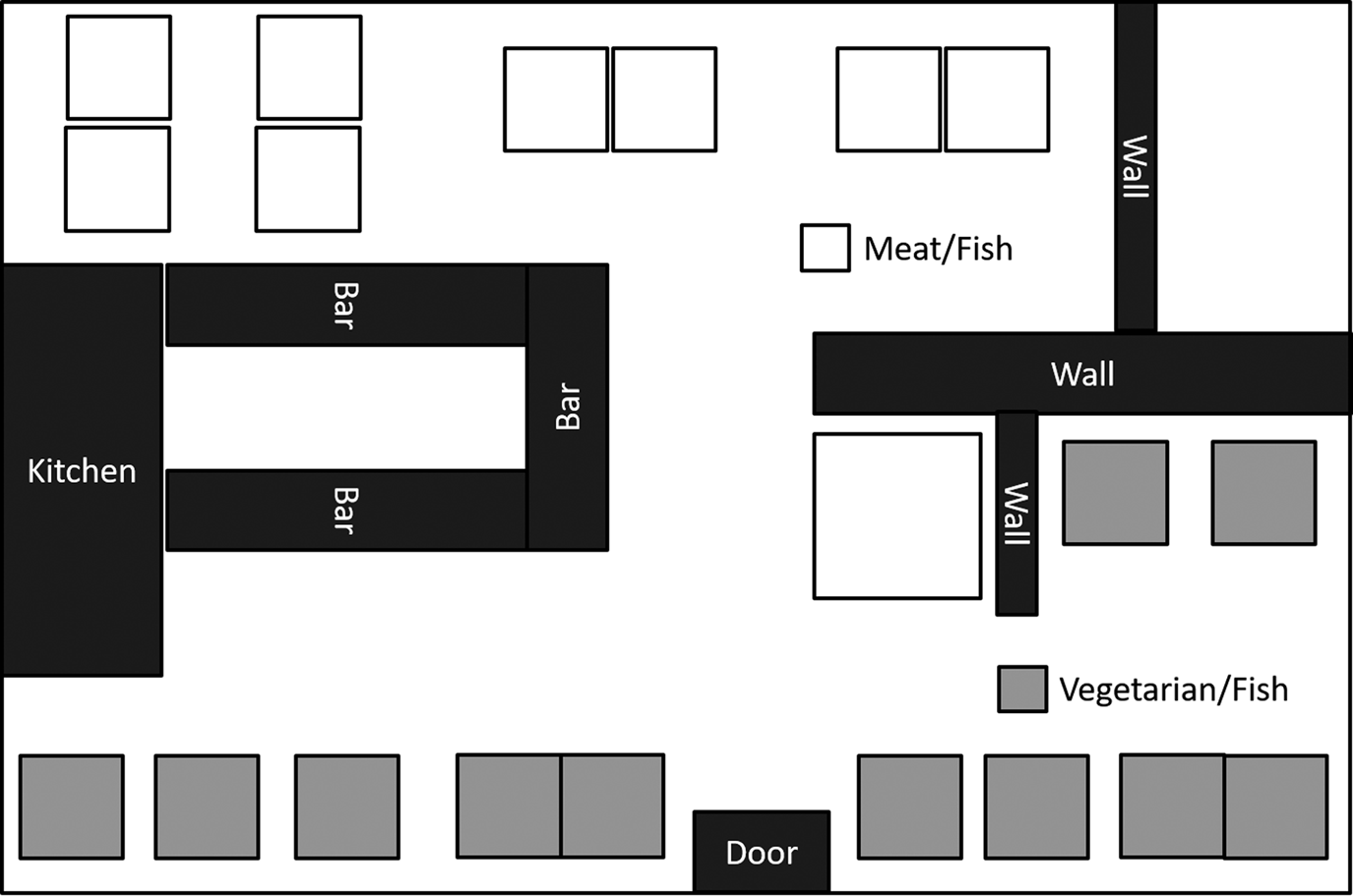
Regarding architecture, the restaurant has two areas, which are separated partly by a wall and partly by a bar acting almost as a physical border (see Appendix Figure A1). The front part, where customers enter, has 30 seats. The back area has 22 seats. The lunch menu is printed each week on A3 coated paperboard and lists the options for the whole week. Proceedings during our experiment were as follows: on arrival, customers were seated by a waiter. If there were several free tables, the waiter pointed out one possibility in the front and one in the back from which the customers could choose.Footnote 1 Once a customer or group of customers was seated, the waiter handed out the menus.
No menus are set up at the wall, at the entrance, or outside the restaurant. Our treatments built on this by letting the waiters hand out different menus to customers seated in the front area versus customers seated in the back. We can rule out that any customers self-selected out of the experiment, as the waiters assured us that no guests left the restaurant after having looked at the menu.
Before the start of our experiment, the weekly lunch menu listed only the options containing meat and fish. A vegetarian dish was available on request and could be customized to a vegan version. Nowhere on the original menu, which was distributed throughout the whole restaurant, was it stated that a vegetarian or vegan dish was available. We collected weekly sales data on the number of vegetarian, meat and fish dishes sold at lunch for four weeks before our intervention.Footnote 2
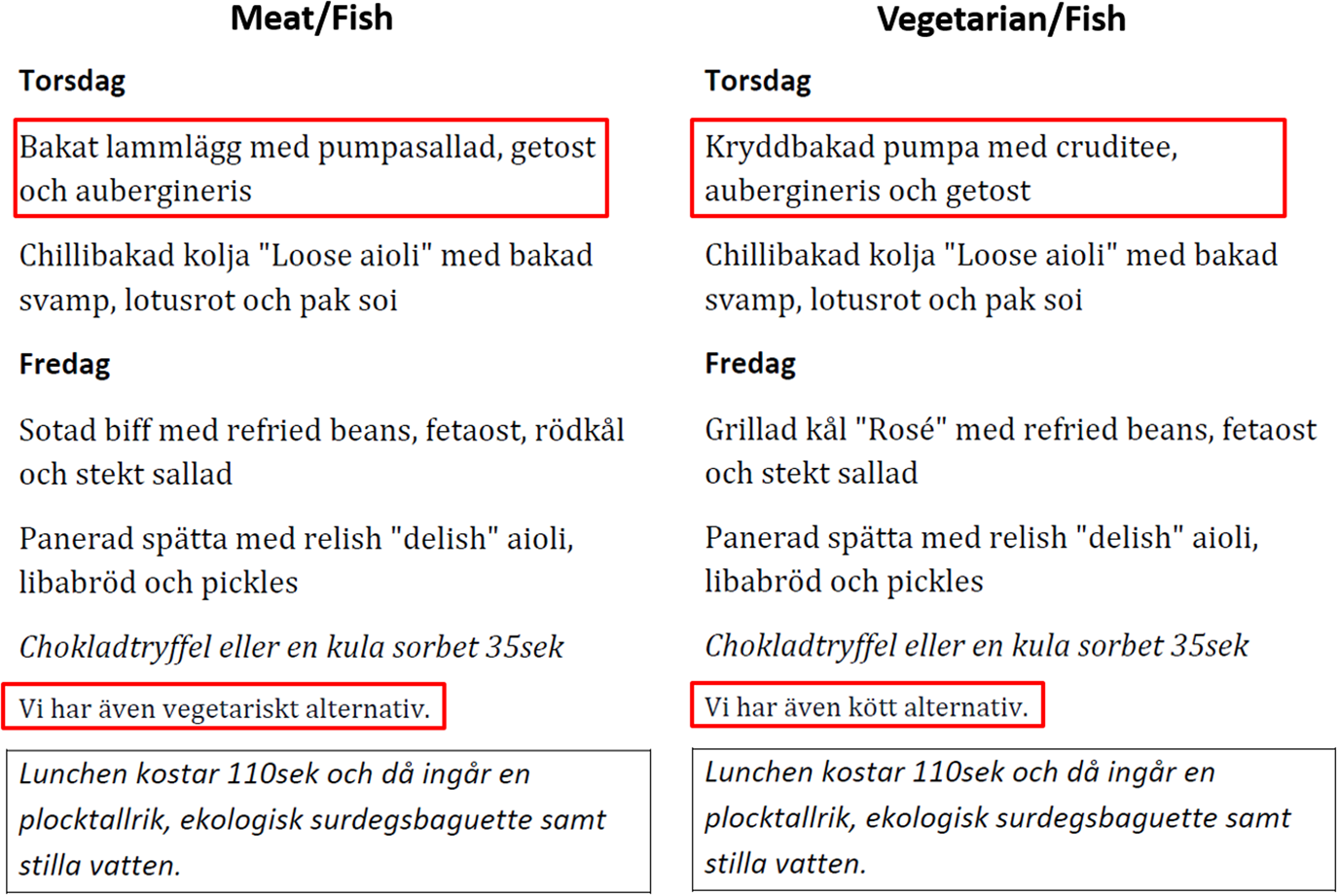
During the intervention, the waiters handed out two different menus at the restaurant. One menu contained, as before, the daily meat and fish options for the whole week, but it had an additional sentence stating, “A vegetarian option is available on request.” We added this sentence to test whether simply giving information about availability could increase the sales of vegetarian dishes. Customers seated in the back part of the restaurant received this menu. The menu distributed to customers seated in the front differed by listing the daily vegetarian and fish dishes but not the meat dish. Comparably to the menu distributed in the back, we added a sentence stating, “An option containing meat is available on request.” Thus, the option to order meat was still available and yet less salient than on the other menu. Customers could ask the waiter what the meat/vegetarian dish was in order to be able to consider it along with the options spelled out on the menu.
On both menus, the fish was the second dish presented on the menu. Consequently, the vegetarian and the meat dishes were presented in the same spot. For simplicity, the vegetarian dish was usually the same as the meat dish except that the meat was replaced by a vegetable, grain or plant protein. An advantage of this setup is that other ingredients would not affect choice and would have a similar climate impact.
The intervention lasted for three weeks, during which we collected daily sales data of the three lunch options by area, front and back. One advantage of the experimental design is that we have two control periods available. The pre-experimental period mainly serves as a control to check whether the behavior of the customers seated in the back part of the restaurant changed during the experimental period. If so, this would indicate that even just adding information on the availability of a vegetarian dish can affect behavior. For evaluating the effect of making the meat less convenient to order, data from the back part of the restaurant served as the control during the intervention period. The control and treatment groups of customers were subject to the same dishes being available and to the same external factors, such as weather conditions, holidays and other daily variations, which could otherwise act as confounding factors. A major advantage of this design is that we can control for an unforeseen event that happened during our study: because of unexpectedly nice weather in May, the restaurant opened its outdoor serving area on 9 May instead of 1 June as originally planned. This led to an increase in seats and customers. The restaurant staff made sure to define different areas of approximately the same size in the outdoor serving area within which to distribute the two different menus. However, the outdoor serving area did not feature any physical border between the two areas.
After the intervention, the control area menu (the one containing the meat and fish options only) was used in the whole restaurant to analyze whether the intervention had any short-term effect after its termination.Footnote 3
Data and results
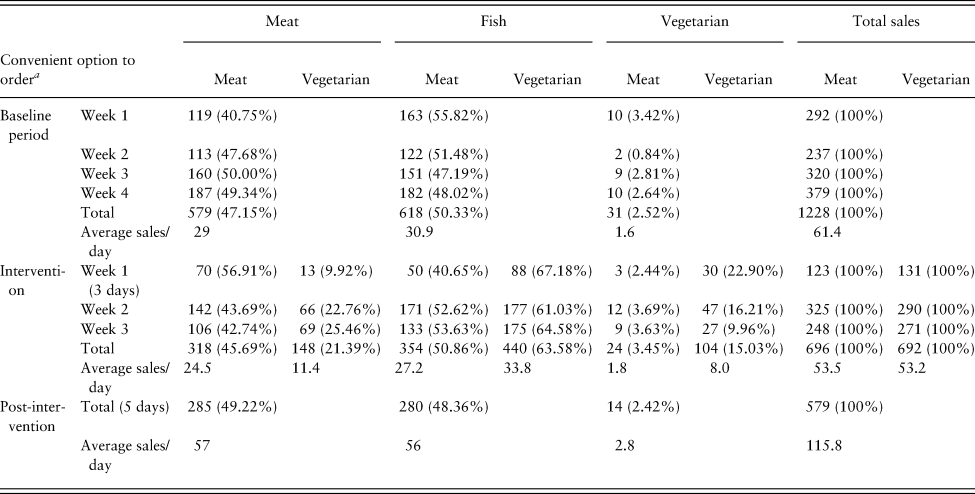
The intervention took place from 2 May until 20 May 2016. During that time, the restaurant did not serve the lunch menu on Ascension Day and the Friday following it, resulting in 13 days of sales data with separate menus. We also collected total weekly sales of the three options for the four weeks before the intervention (4–30 April) and for five days after the intervention (22–27 May). Average sales were around 64 dishes per day during the first five weeks of the experiment (the pre-intervention period and the first week of the intervention) when only the indoor area was open. During the last three weeks of the experiment (two weeks of intervention and one week post-intervention), the restaurant opened its outdoor seating area and sold about 114 dishes per day during the two-hour lunch period. The complete sales data can be found in Appendix Table A1.
The effect of menu design on food choice
First, we present the aggregate results for the whole restaurant. Because the number of meals sold varies over days and weeks, we show the percentages of sales in Figures 1 and 2 for easy visual comparison, but we conduct χ 2 tests using absolute values to test for differences in behavior.Footnote 4 The reported p-values in the text are always from χ 2 tests unless otherwise stated. All absolute values can be found in Appendix Table A1.
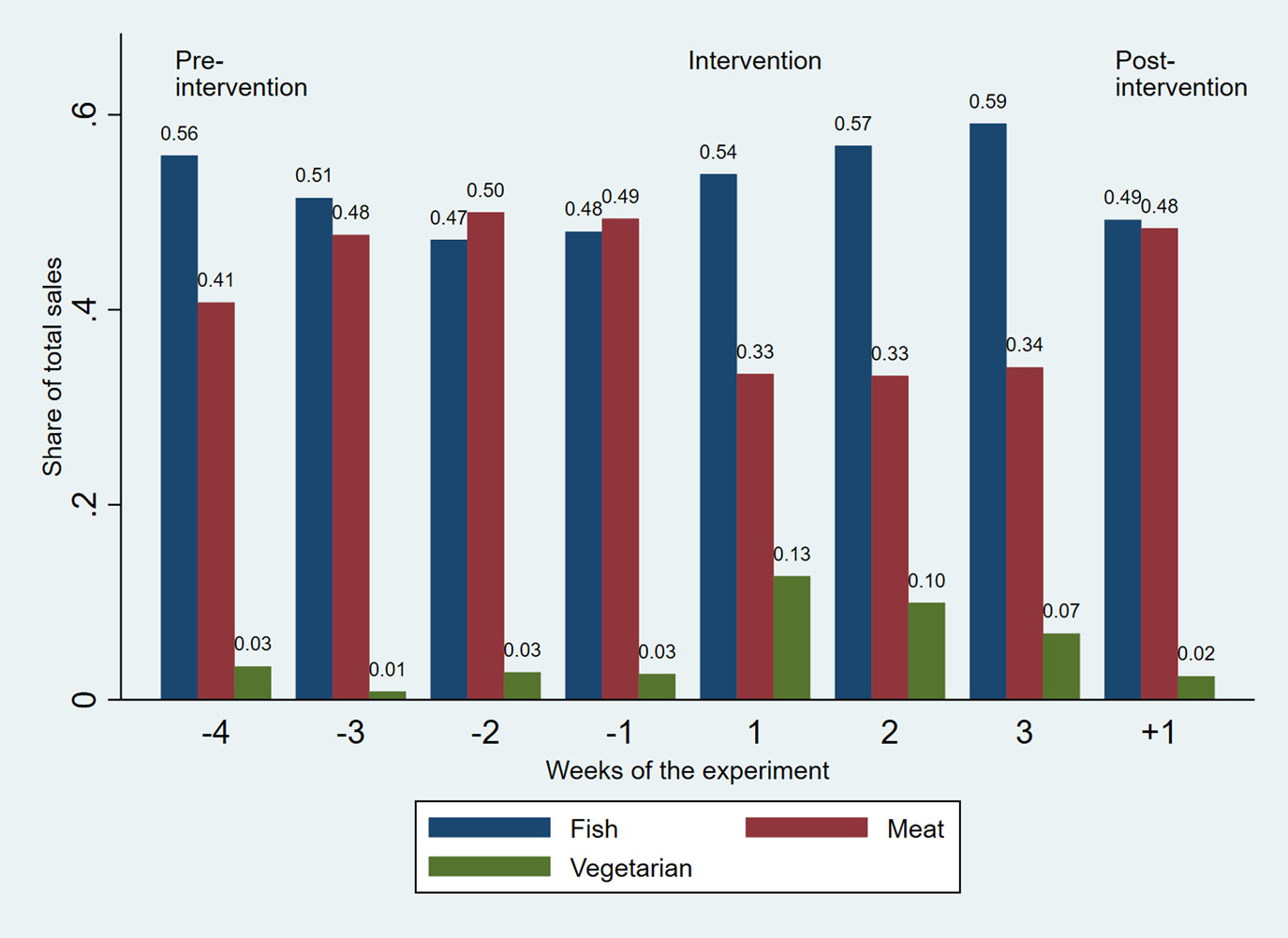
Shares of total sales with intervention during weeks 1–3.

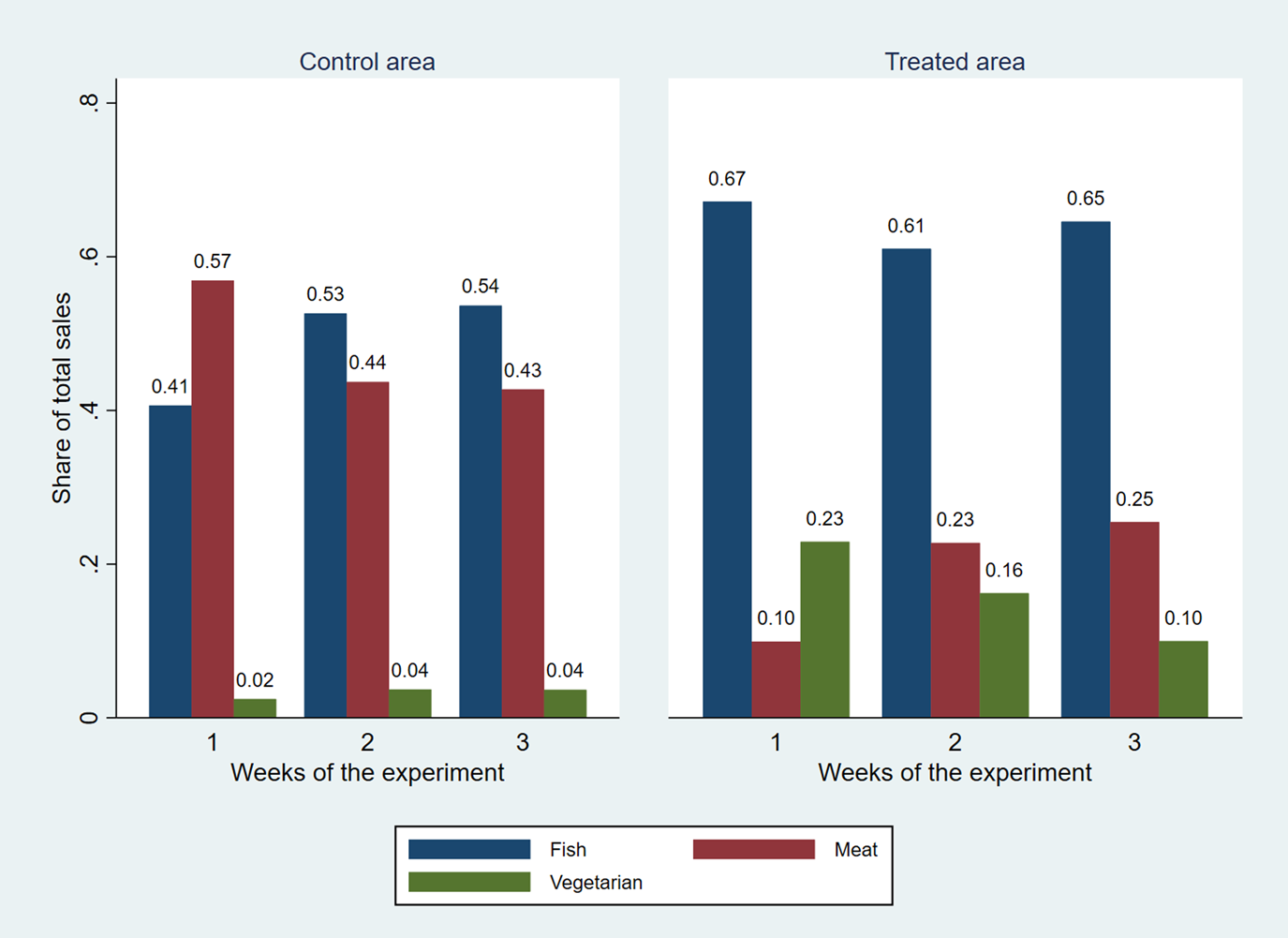
Shares of sales for the two menus separately during the intervention period.

Figure 1 shows the sales shares of the meat, fish and vegetarian options for the four weeks before the intervention, the three experimental weeks and the one-week post-experimental period. On average, only 2.5% of all dishes sold were vegetarian without the vegetarian option on the menu.Footnote 5 The remaining lunches sold were distributed approximately equally across the meat and the fish dishes, given normal fluctuations due to differences in dishes.
In the weeks of the intervention (weeks 1–3), the share of meat dishes sold overall dropped from 47% to 34% on average, a reduction of 38% (p < 0.01). Especially when considering that only about half of the restaurant was treated, this was a large reduction, and it stayed consistent over the three weeks of the experiment. The vegetarian dishes jumped from 3% to 9% on average (a 200% increase; p < 0.01), with a downward trend, which we will examine further in the next section. The increase in sales of fish dishes was around eight percentage points, from 50% to 57% (p < 0.01). The last three columns in Figure 1 show that switching to the old menu layout, though still keeping the note that a vegetarian dish was available, immediately restored the pre-treatment sales shares. Hence, we conclude that the intervention had no lasting effects, which is not surprising given the high share of one-time customers.
Second, we look at the sales for the two menus separately. Figure 2 contains the sales shares for the three-week intervention period. The left panel shows the sales for the meat menu and the right panel for the vegetarian menu.
Of all dishes sold during the experimental period, 15% were vegetarian in the vegetarian area, but only 3.5% were vegetarian in the meat area (p < 0.01). The share of meat dishes sold was 46% on average in the meat menu area, but less than half of that (21%) in the vegetarian menu area (p < 0.01). This drop was larger than the increase in vegetarian sales shares, and consequently, the share of fish dishes sold also increased, from 51% to 64% (p < 0.01). To avoid the risk of repeated observations biasing our results, we also test whether the composition of fish/meat/vegetarian dishes differed between treatment and control for all days individually using χ 2 tests. On 10 out of 13 days the test shows a significant difference (p < 0.10). The drawback of testing individual days compared to the whole period is the lower number of observations for each day, thus decreasing our power. Taken together, we interpret the results as clear evidence for a treatment effect of the intervention.
In absolute terms, a little more than one out of ten people who would have chosen meat in the meat area switched to the vegetarian dish in the vegetarian area, and similarly, one out of ten switched to choosing fish. In the meat menu area, adding a statement about the availability of the vegetarian dish did not affect sales significantly compared to the pre-treatment sales. The share of vegetarian dishes sold remained low (between 2% and 4%) during the whole intervention. Thus, we conclude that merely providing information on the availability of a vegetarian dish was not causing the treatment effect.
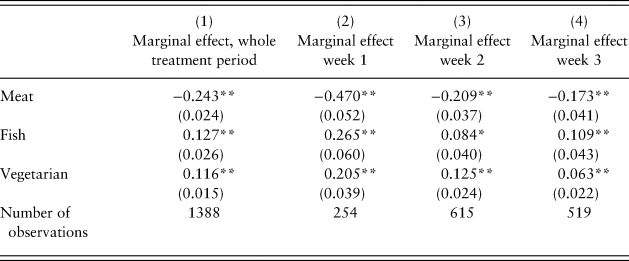
Table 1 shows the marginal effects of having the vegetarian menu instead of the meat menu on the three dishes sold estimated via a multinomial logit model. With the multinomial logit model, the probability of choosing each alternative in the two experimental conditions is estimated parametrically, using treatment status as the only explanatory variable. As can be seen in column (1), the results confirm the non-parametric results from using χ 2 tests: when looking at the whole experimental period, sales of the vegetarian dish are around 11% higher in the treated area than in the control area, and sales of the meat dish are around 24% lower.Footnote 6
Marginal effects of the treatment on the likelihood to consume the following dish, weeks 1–3 of the experiment.

Note: Standard errors in parentheses.
*p < 0.05; **p < 0.01.
Development of the treatment effect over time
Figure 2 shows that there was a decrease in the treatment effect over time. In the treated area, the share of vegetarian dishes goes down from 23% during the first week to 10% during week 3, while the share of meat dishes sold increases. Because our data contain a share of around 20% of potentially repeated observations, the results over time need to be considered with caution. According to the restaurant, most regulars come one to two times per week. Testing specifically for differences in the sales of vegetarian dishes per week shows that all weeks differ significantly from each other at least at a 10% level of significance (week 1 versus week 2: p < 0.01; week 1 versus week 3: p < 0.01; week 2 versus week 3: p = 0.10). In the control area, no significant changes occurred during the intervention period.Footnote 7 Estimating the treatment effects separately for each week via a multinomial logit regression shows that the size of the treatment effect decreases for the vegetarian dish from around 21% in week 1 to 13% in week 2 and 6% in week 3 of the experiment (columns (2) to (4) in Table 1). Correspondingly, the absolute size of the treatment effect for meat falls from –47% in week 1 to –21% week 2 and to –17% in week 3.
What could have caused this trend in the treatment effect? There are several potential explanations for the decline we observe. All walk-in customers should be equally affected by the nudge, whether they visited the restaurant in week 1, 2 or 3 of the experiment. Thus, although the decline of the treatment effect throughout the experiment is quite pronounced, we would not expect it to fade away completely if we had kept the nudge in place for a longer period. However, in connection with the opening of the outdoor seating area, the composition of customers might have changed. Customers who visited during the last two weeks could have differed from customers who visited during the first week and may have reacted less to the nudge.Footnote 8
Another explanation for the decline in the treatment effect could be that the staff was less careful in implementing the experimental design, especially in connection with the opening of the outdoor seating, such as by handing out control menus erroneously in the treated area and vice versa. To the best of our knowledge, however, this was not the case. Any changes in the implementation of the experiment should also have shown up in the control area, but as discussed above, sales patterns concerning the vegetarian dish did not change over time in the control area.
A third explanation is the presence of regular customers who had experience with the pre-intervention menu. The restaurant reports having regular customers, at around 20%. For the first three days of the intervention, we have data on the choices of customers who were identified by the waiters as regulars; 52 out of a total of 254 guests during the first week belong to that group.Footnote 9 Although the data are limited, they paint a clear picture. Of the 23 regulars exposed to the vegetarian menu, 17 ordered fish, 6 ordered the vegetarian dish and none ordered meat. Of the 29 regulars exposed to the meat menu, 17 ordered fish, 12 ordered the meat and none ordered the vegetarian option. The shares match the total sales shares of that week. These customers all had experience with the previous menu featuring a choice of meat or fish and had likely tried both types of dish at some point. One can also assume that because they are regulars, the meat and fish dishes correspond well to their preferences; that is, those customers are regulars because they like the dishes usually featured on the menu.
For those customers, a change in saliency of the dishes and a disruption of habits seem to be the most likely explanations for the initial treatment effect. However, as Wood and Neal (Reference Wood and Neal2009) explain, people can revert to their habitual behavior relatively easily after a deviation to an alternative behavior. Giving in to the nudge in the first place but reverting to familiar (and preferred) choices afterward could generate the declining treatment effect we can observe in Figure 2. A second explanation could be that they were so used to the menu structure that they were more likely to overlook the third option and learned about this at a later point. As we do not have any follow-up data on this group and do not know anything about the behavior of regulars who visited the restaurant more than once during our experiment, we cannot draw firm conclusions on this point. More detailed information and long-term data on regulars are needed to investigate this interesting subgroup further.
Our finding that experienced users change their behavior, at least initially, is in contrast to Löfgren et al. (Reference Löfgren, Martinsson, Hennlock and Sterner2012), who show that experienced users are harder to nudge and override defaults more often than inexperienced users in an experiment using default settings. Our results show that even experienced users change their behavior, at least initially. However, the decision in our experiment – choosing lunch at a regularly visited restaurant – is different from the one studied by Löfgren and colleagues, where the intervention targeted carbon offsetting from flights. Choosing a lunch involves lower stakes and is a frequently repeated action for the regulars. Thus, it will be more responsive to the nudge. Another explanation of the difference in findings could be that regret from trying something new as a result of a nudge will likely be lower in the case of choosing lunch than in the higher-stakes, low-frequency case.
Spillover and peer effects
We should discuss some caveats to the experimental design. A valid concern regarding the experimental setup could be spillover effects between the two areas of the restaurant, especially during the weeks when the outdoor serving area was opened. That could be the case, for example, if customers seated in the meat menu area observed the waiters serving vegetarian dishes to customers in the vegetarian menu area or vice versa, which could influence their choice. Spillover effects could also occur from regular customers who were exposed to one of the menus on one visit to the restaurant and a different menu on another visit. Both types of spillovers would downwardly bias our treatment effect.
Within an area and at the same table, there could also have been reinforcing effects that were captured by the treatment effect. If the first person was nudged to choose either the meat or the vegetarian dish, then others at the table might follow suit or else deliberately deviate from that choice to create variety. In a study with children, Angelucci et al. (Reference Angelucci, Prina, Royer and Samek2015) find reinforcing choices, but in a study with adults in a restaurant, Ariely and Levav (Reference Ariely and Levav2000) present evidence for a love of variety in group choices. Since we have no information on the sequence in which orders were placed, we cannot identify such peer effects.
One point often raised when discussing nudging toward vegetarian food is that customers might not feel satiated or might use the healthy main course as an excuse to order an unhealthy dessert. We recorded the number of desserts ordered for both groups, but as the total number of desserts ordered was very low (≤6 per day), it was not possible to test this hypothesis. Compared with the pre-experimental period, the total sales of desserts did not increase. The menu price included water, which is what most Scandinavians drink for lunch. There was no change in any additional beverages ordered during the experimental period. We thus find no evidence for any compensational behavior in our data. We cannot, however, rule out that individuals may have compensated in the afternoon or evening by eating more meat or making other unhealthy food choices.
Discussion and conclusion
We show that a simple and inexpensive rearrangement of the menu that changes the convenience of ordering meat contributes toward a reduction in meat consumption without measurable negative effects.Footnote 10 Making it less convenient to order meat significantly increased the shares of both vegetarian dishes and fish dishes sold. From a climate change perspective, this is still a positive change, as eating fish entails fewer climate-relevant emissions per kilogram than most kinds of meat (Röös, Reference Röös2014).Footnote 11
How much of a climate impact did the intervention have? A brief example can put it into perspective. On one occasion, the meat dish included a piece of beef, while the vegetarian option was grilled cabbage. A conservative estimate of the CO2 emissions of a 150 g piece of Swedish beef is 4 kg (Röös, Reference Röös2014). For the cabbage, it is 0.03 kg. That day, 42% of customers exposed to the meat menu ordered the beef, but only 16% of those presented with the vegetarian menu did so. With roughly 50 people in each group, that amounted to 84 kg of CO2 from meat in the meat menu group, but only 32 kg from meat in the vegetarian menu group. To put this into perspective, average emissions from driving a car in Sweden are around 0.16 kg of CO2 per kilometer. Both the reduction in CO2 and the cost differential for the restaurant vary depending on the type of meat and the vegetarian substitute served. Another day, the meat dish was grilled chicken, while the vegetarian menu featured tofu. Chicken and soy substitutes such as tofu entail approximately the same amount of climate-relevant emissions per kilogram (Röös, Reference Röös2014). Any overall evaluation of climate benefits also crucially depends on the assumption that customers do not compensate for having chosen a vegetarian lunch by indulging in meat later that day or the day after. Complete information about food choices is quite challenging to obtain, and to the best of our knowledge, no experiment has yet been conducted that examines substitution effects over time. More research in that area is needed in order to identify the total climate effects of nudges aiming at reducing meat consumption.
We conclude that even in restaurants with an initially low share of vegetarian customers, there is room to decrease the share of meat dishes sold in favor of vegetarian and fish dishes without banning options or changing prices, and this can be done in a fast, easy and profitable way. According to the restaurant's management, purchasing costs are around 30% lower for vegetarian than for meat dishes, while personnel costs are slightly higher as the preparation of vegetarian dishes is slightly more time-consuming. However, taking all costs into account, it is not more expensive to produce vegetarian dishes than meat or fish dishes. A higher share of vegetarian dishes could also bring down marginal personnel costs. Overall, the restaurant's management deemed the intervention to have had positive effects on profits but could not quantify the magnitude of this effect.
We find that around two out of ten customers who would have chosen meat switched to either vegetarian or fish dishes. Validating the effect size in other settings would be interesting. Restaurants that either cater to vegetarians or are meat-focused venues such as steakhouses will most likely see smaller effects from the same kind of intervention due to self-selection of the patrons into the restaurant. The most promising settings are restaurants that attract customers based on their quality of food and not on their focus on serving meat or vegetarian food. Restaurants should not present vegetarian food as a special diet that customers need to inquire about, as this creates hassle costs that will tip people on the margin toward choosing the ‘normal’ meat dish instead.
The shift to vegetarian food was strongest in the first week of the intervention. A conservative interpretation of this result leads to the conclusion that the nudge might work best in a setting with a lower share of regular customers so that more people experience the nudge as new. The observed decrease in the treatment effect throughout the intervention shows the need for more research on the impact of nudges over time to formulate recommendations on long-term strategies.
The sizable results in our experiment are a promising first step for further research on how to effectively reduce meat consumption. Although we cannot rule out any negative spillover effects on profits, our evidence points toward the contrary, with stable sales and higher profit, especially when comparing our intervention with a reduction of choice by banning the meat option, which would most certainly keep guests from eating at this restaurant. Nevertheless, more research is needed in order to verify these hypotheses. Public- or private-sector agents that want to limit the climate impact of food consumption should work proactively with restaurants to develop, implement and test customized nudging strategies in order to realize the potential gains from this approach.
Acknowledgements
We thank Åsa Löfgren, Fredrik Carlsson, Randi Hjalmarsson, Katarina Nordblom, Mitesh Kataria and Heiner Schumacher for helpful comments.
Financial support
Christina Gravert is partly funded by the Swedish Environmental Protection Agency.
Appendix
Total sales and sales shares in percentages of the three lunch options available across periods and treatments.

Layout of the restaurant.
Note: Gray squares are tables with the vegetarian/fish menu and white squares are tables with the meat/fish menu.

Examples of the meat/fish and vegetarian/fish menus.
Note: The boxes around the dishes and around the additional sentence were not on the menu but have been added by the authors to aid the reader.