Introduction
The mines in the Red Canyon portion of the White Canyon district in south-eastern Utah have yielded many new mineral species in recent years (e.g. Kampf et al., Reference Kampf, Olds, Plášil, Nash and Marty2021a). Most of the new species are uranyl sulfates and most, especially from the Blue Lizard mine, contain Na as an essential charge-balancing cation. The new species described herein is a uranyl sulfate, but without Na or any other cation (except H). It has been found at three of the mines in Red Canyon, but surprisingly not at the Blue Lizard mine, the world's most prolific occurrence for uranyl sulfate minerals. The mineral was found more recently in the Scenic mine, which is on Fry Mesa, ~18 km northwest of the mines in Red Canyon. The best crystals of the new mineral were found at the Scenic mine and these made possible the full characterisation of the mineral, which has been named scenicite for this mine.
The new mineral and name (symbol Sce) were approved by the Commission on New Minerals, Nomenclature and Classification of the International Mineralogical Association (IMA2021-057, Kampf et al., Reference Kampf, Plášíl, Olds, Ma and Marty2021b). The description is based on one holotype specimen from the Scenic mine and one cotype specimen from the Green Lizard mine. Both are deposited in the collections of the Natural History Museum of Los Angeles County, 900 Exposition Boulevard, Los Angeles, CA 90007, USA, catalogue numbers 76153 (holotype) and 76154 (cotype).
Occurrence
Scenicite was first discovered on a specimen collected underground in the Green Lizard Mine (37°34′37.10′′N 110°17′52.80′′W) by Jerry Baird in 2015. Shortly thereafter, it was identified on specimens collected underground in the Giveaway–Simplot mine (37°33′09.80′′N 110°16′58.50′′W) and the Markey mine (37°32′57′′N 110°18′08′′W). All three of these mines are in Red Canyon, White Canyon district, San Juan County, Utah, USA. In 2020, one of the authors (JM) collected a specimen of scenicite underground in the Scenic mine (37°38′43′′N 110°07′10′′W)on Fry Mesa, also in the White Canyon district. The geology of all of these mines is quite similar (Chenoweth, Reference Chenoweth1993; Kampf, et al., Reference Kampf, Plášil, Kasatkin, Marty and Čejka2017a). The foregoing description of scenicite is based only on material from the Green Lizard and Scenic mines and only these should be considered cotype localities.
The uranium deposits in White Canyon district occur within the Shinarump member of the Upper Triassic Chinle Formation, in channels incised into the reddish–brown siltstones of the underlying Lower Triassic Moenkopi Formation. The Shinarump member consists of medium- to coarse-grained sandstone, conglomeratic sandstone beds and thick siltstone lenses. Ore minerals (uraninite, montroseite, coffinite, etc.) were deposited as replacements of wood and other organic material and as disseminations in the enclosing sandstone. Since the mine closed in 1982, oxidation of primary ores in the humid underground environment has produced a variety of secondary minerals, mainly carbonates and sulfates, as efflorescent crusts on the surfaces of mine walls.
Scenicite is a very rare mineral in the secondary mineral assemblages at all of its occurrences. It occurs on matrix comprised mostly of subhedral to euhedral, equant quartz crystals that are recrystallised counterparts of the original grains of the sandstone. At the Green Lizard mine, it is associated with gypsum, natrozippeite and shumwayite. At the Scenic mine, it is associated with deliensite, gypsum, rietveldite and shumwayite.
Physical and optical properties
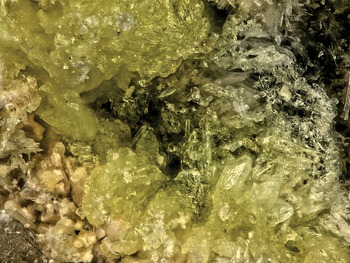
Scenicite crystals are crude blades flattened on {100} and elongated parallel to [010]. Because crystals are generally poorly formed and occur in intergrowths, it was not possible to make morphological measurements; only the {100} form could be discerned with certainty. Crystals are up to ~0.1 mm in length and typically occur in intergrowths (Fig. 1). Crystals are light green yellow and transparent with vitreous lustre. The streak is white. The mineral fluoresces bright greenish-white under a 405 nm laser. The Mohs hardness is ~2, based upon scratch tests. Crystals are brittle with irregular, curved fracture. There is excellent cleavage on {100} and good cleavage on {001}. Scenicite is readily soluble in room-temperature H2O. The density could not be measured because the mineral is soluble in Clerici solution. The calculated density is 3.497 g⋅cm–3 for the empirical formula and 3.506 g⋅cm–3 for the ideal formula.
Scenicite from the Scenic mine (holotype specimen #76153); field of view 0.68 mm across.

Optically, scenicite is biaxial (–), with α = 1.556(2), β = 1.573(2) and γ = 1.576(2) (measured in white light). The 2V measured directly on a spindle stage is 45(3)°; the calculated 2V is 45.2°. Dispersion is r < v, extreme. The optical orientation is X = c, Y = a and Z = b. The mineral is pleochroic with X and Y = colourless, Z = light green–yellow; and X = Y < Z. The Gladstone–Dale compatibility index 1 – (K P/K C) for the empirical formula is –0.005, in the superior range (Mandarino, Reference Mandarino2007), using k(UO3) = 0.118, as provided by Mandarino (Reference Mandarino1976).
Raman spectroscopy
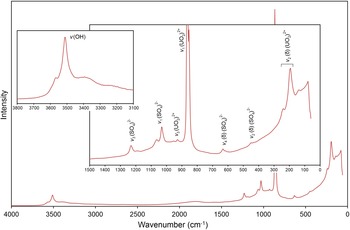
Raman spectroscopy was conducted on a Horiba XploRA PLUS using a 532 nm diode laser, a 100 μm slit, a 1800 gr/mm diffraction grating and a 100× (0.9 NA) objective. The Raman spectrum of scenicite from 4000 to 60 cm–1 is shown in Fig. 2.
Raman spectrum of scenicite recorded with a 532 nm laser.

A broad band consisting of several overlapping vibrations in the 3650 to 3200 cm–1 range (the most prominent are those at 3570, 3510, 3410, 3390 and 3230 cm–1) are attributed to the ν O–H stretching vibrations of the H2O molecules. This entire suite is comparable to that observed both for shumwayite and the synthetic phase (Vlček et al., Reference Vlček, Čejka, Císařová, Goliáš and Plášil2009; Kampf et al., 2017). According to the correlation given by Libowitzky (Reference Libowitzky1999), the approximate O–H···O hydrogen bond-lengths range between 3.2 and 2.7 Å. In the region of the ν2 (δ) H2O bending vibrations, no peaks were observed, which is not unusual in Raman spectroscopy of hydrated minerals. Instead, the higher background observed there is a spectral artefact.
Other assignments [w = weak, vw = very weak, sh = shoulder, ms = medium strong] are the band at 1230 cm–1 (w) with shoulder and 1180 cm–1 (vw), also with a shoulder, are assigned to the split triply degenerate ν3 antisymmetric stretching vibrations of the SO4 tetrahedra. Raman bands at 1080 (sh), 1065 (w) and 1032 (ms) cm–1 are assigned to the ν1 symmetric stretching vibrations of structurally independent SO4 tetrahedra. Some overlaps of these bands with the librations of H2O are present (see Colmenero et al., Reference Colmenero, Plášil and Němec2020).
Very weak Raman bands at 955 and 930 cm–1 are attributed to the ν3 antisymmetric stretching vibrations of two structurally non-equivalent uranyl ions, UO22+. The most prominent Raman bands at 865 (vs) and 854 (s) cm–1 are attributed to the ν1 symmetric stretching vibration of the uranyl ions. The inferred U–O bond-lengths (after Bartlett and Cooney, Reference Bartlett and Cooney1989) of the uranyl groups, ~1.75–1.76 Å (from both ν1 and ν3), are within the range derived from the current X-ray study.
Weak bands at 632 and 618 cm–1 have been assigned to the ν4 (δ) triply degenerated antisymmetric stretching vibrations of SO4 tetrahedra. Weak Raman bands 453 and 433 cm–1 are related to the split ν2 (δ) doubly degenerate bending vibrations of the SO4.
A weak band at 240 cm–1 can be attributed by analogy (see Kampf et al., Reference Kampf, Plášil, Kasatkin, Marty, Čejka and Lapčák2017b; Plášil et al., Reference Plášil, Buixaderas, Čejka, Sejkora, Jehlička and Novák2010; Colmenero et al., Reference Colmenero, Plášil and Němec2020 and others) to the ν2 (δ) doubly degenerate bending vibrations of UO22+. Nevertheless, Colmenero et al. (Reference Colmenero, Plášil and Němec2020) showed that the contribution of the bending energies of the uranyl ions in the structure is distributed over a wider energy region and thus, probably the strong band at 193 cm–1 is actually the result of energy-overlap between ν2 (δ) UO22+ and e.g. U–Oeq–(H2O) stretches and bends. Weak bands at the lowest energies can be assigned to unclassified lattice modes, most probably skeletal vibrations of the entire infinite chains of polyhedra.
Chemical composition
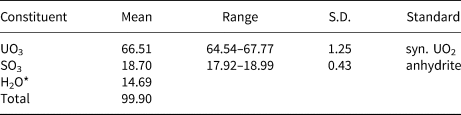
Analyses of scenicite from the Scenic mine (6 points) were performed at Caltech on a JEOL 8200 electron microprobe in wavelength dispersive spectroscopy mode. Analytical conditions were 15 kV accelerating voltage, 10 nA beam current and 5 μm beam diameter. Insufficient material is available for CHN analysis; however, the fully ordered structure unambiguously established the quantitative content of H2O. The crystals did not take a good polish, which accounts for the low analytical total. Analytical data are given in Table 1. The empirical formula (calculated on the basis of 19 O atoms per formula unit) is U1.996S2.005O19H13.997. The ideal formula is [(UO2)(H2O)2(SO4)]2⋅3H2O, which requires UO3 66.65, SO3 18.66, H2O 14.69, total 100 wt.%.
Chemical composition (in wt.%) for scenicite.

* Based on the structure. S.D. – standard deviation.
X-ray crystallography and structure refinement
Powder X-ray diffraction was done using a Rigaku R-Axis Rapid II curved imaging plate microdiffractometer, with monochromatised MoKα radiation. A Gandolfi-like motion on the φ and ω axes was used to randomise the sample and observed d values and intensities were derived by profile fitting using JADE Pro software (Materials Data, Inc.). The powder data are presented in Supplementary Table S1.
The single-crystal structure data were collected at room temperature using the same diffractometer and radiation noted above. Data were collected for crystals from both the Green Lizard and Scenic mines. The resulting structures were essentially identical. The refinement using the Scenic mine data was superior, so only it is reported here.
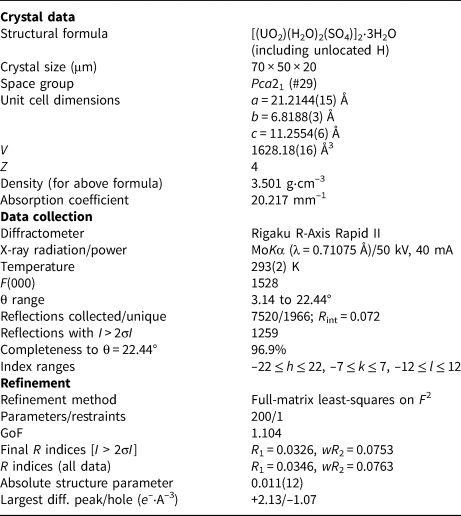
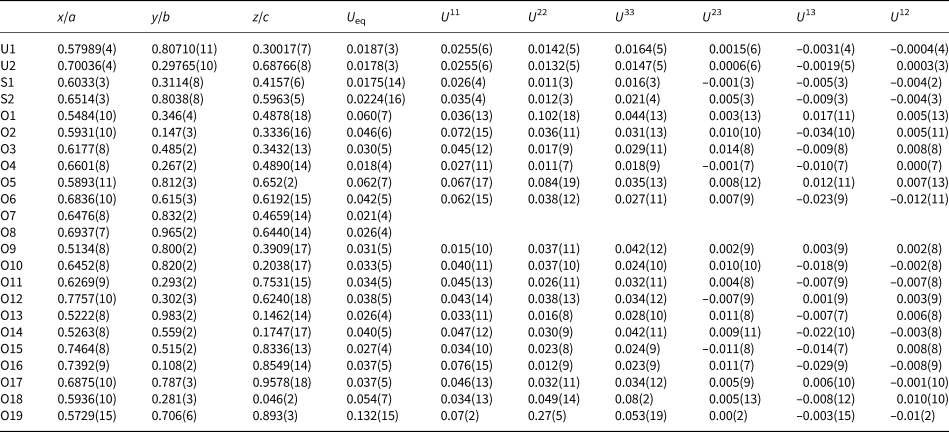
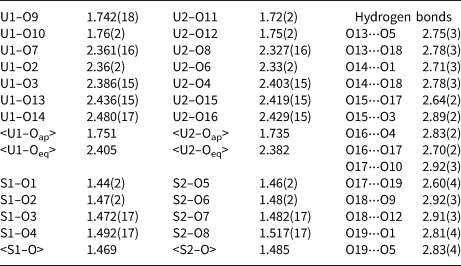
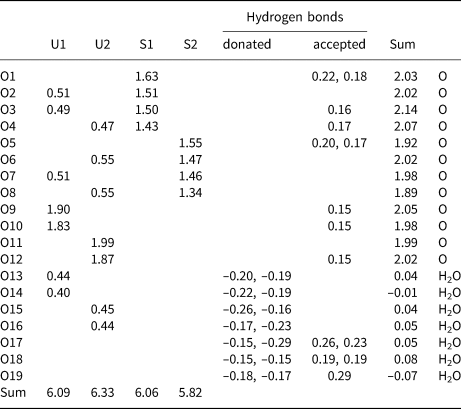
The Rigaku CrystalClear software package was used for processing structure data, including the application of an empirical multi-scan absorption correction using ABSCOR (Higashi, Reference Higashi2001). The structure was solved using the intrinsic-phasing algorithm of the SHELXT program (Sheldrick, Reference Sheldrick2015a) and was found to be the same as that of the synthetic phase reported by Zalkin et al. (Reference Zalkin, Ruben and Templeton1978). Refinement proceeded by full-matrix least-squares on F 2 using SHELXL-2016 (Sheldrick, Reference Sheldrick2015b). All non-hydrogen atom sites were refined successfully with anisotropic displacement parameters except for O7 and O8, which had to be refined isotropically. Difference-Fourier synthesis failed to locate H atom positions. Data collection and refinement details are given in Table 2, atom coordinates and displacement parameters in Table 3, selected bond distances in Table 4, and a bond valence analysis in Table 5. The crystallographic information file has been deposited with the Principal Editor of Mineralogical Magazine and is available as Supplementary material (see below).
Data collection and structure refinement details for scenicite.*

*R int = Σ|F o2–F o2(mean)|/Σ[F o2]. GoF = S = {Σ[w(F o2–F c2)2]/(n–p)}½. R 1 = Σ||F o|–|F c||/Σ|F o|. wR 2 = {Σ[w(F o2–F c2)2]/Σ[w(F o2)2]}½; w = 1/[σ2(F o2)+(aP)2+bP] where a is 0.0285, b is 19.9 and P is [2F c2+Max(F o2,0)]/3.
Atom coordinates and displacement parameters (Å2) for scenicite.

Selected bond distances (Å) for scenicite.

Bond valence analysis for scenicite. Values are expressed in valence units.

Bond valence parameters from Gagné and Hawthorne (Reference Gagné and Hawthorne2015). Hydrogen-bond strengths are based on O–O bond lengths from Ferraris and Ivaldi (Reference Ferraris and Ivaldi1988).
Description and discussion of the structure
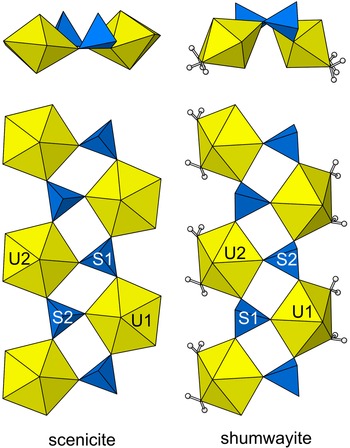
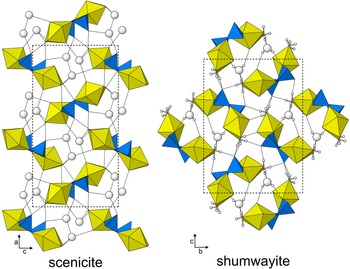
The two U sites (U1 and U2) in the structure of scenicite are surrounded by seven O atoms forming a squat UO7 pentagonal bipyramid. This is the most typical coordination for U6+, particularly in uranyl sulfates, where the two short apical bonds of the bipyramid constitute the uranyl group. Three of the five equatorial O sites of the UO7 bipyramid participate in two different SO4 tetrahedra (centred by S1 and S2); the other two equatorial O sites are H2O groups. The linkages of pentagonal bipyramids and tetrahedra form an infinite neutral [(UO2)(SO4)(H2O)2] chain along [010] (Fig. 3). There are three isolated H2O groups located between the chains. The chains and isolated H2O groups are linked together by hydrogen bonds (Fig. 4).
The uranyl sulfate chains of formula [(UO2)(SO4)(H2O)2] along {010] in scenicite and along [100] in shumwayite. Top views are looking down the lengths of the chains. Note that the H atoms of the H2O groups are shown only for shumwayite because they were not located for scenicite.

The structures of scenicite (viewed down [010]) and shumwayite (viewed down [100]). The O atoms of the isolated H2O groups are shown as large white balls. The H atoms of the H2O groups (small white balls) are shown only for shumwayite. The hydrogen bonds are shown with thin black lines. The unit-cell outlines are shown with dashed lines.

The structure of shumwayite, [(UO2)(SO4)(H2O)2]2⋅H2O (Kampf et al., Reference Kampf, Plášil, Kasatkin, Marty, Čejka and Lapčák2017b), contains topologically identical chains; however, the chains in the two structures are rather different geometrically (Fig. 3). Both structures contain isolated H2O groups between the chains, and the chains and isolated H2O groups are linked together by hydrogen bonds (Fig. 4); however, there is only one isolated H2O group between the chains in the shumwayite structure. Burns (Reference Burns2005) lists eight uranyl sulfates, chromates and selenates, including the synthetic equivalents of scenicite and shumwayite, with topologically identical chains. It is also worth noting that scenicite and shumwayite occur in intimate association at both cotype localities.
Uranyl sulfate minerals that contain no charge-balancing cations other than H are rare; they number just five out of the currently 57 known species: besides scenicite, these include jáchymovite, (UO2)8(SO4)(OH)14⋅13H2O (Čejka et al., Reference Čejka, Sejkora, Mrazek, Urbanec and Jarchovsky1996), shumwayite (Kampf et al., Reference Kampf, Plášíl, Olds, Ma and Marty2017b), uranopilite, (UO2)6(SO4)O2(OH)6⋅14H2O (Burns, Reference Burns2001) and metauranopilite, (UO2)6(SO4)(OH)10⋅5H2O (Frondel, Reference Frondel1952). More than 20 synthetic phases are known in the same ‘cation-less’ U–SO4–H2O/OH system, including the heptahydrated synthetic analogue of scenicite. Interestingly, the heptahydrate is dimorphous, crystallising as the α form (the analogue of scenicite) and the metastable monoclinic β form. The preparation of both phases is straightforward. Zalkin et al. (Reference Zalkin, Ruben and Templeton1978) crystallised the α form from an aqueous solution of uranyl sulfate and (+)-tartaric acid, which they allowed to evaporate slowly. Leroy et al. (Reference Leroy, Tudo and Tridot1965) prepared the β form by mixing stoichiometric amounts of UO3 and sulfuric acid, which they heated and left to crystallise in air. After several days, crystals of a tetrahydrate, UO2SO4(H2O)4, were formed, after which the remaining, less-concentrated mother liquor was left to crystallise slowly again in air and crystals of the β form of the pentahydrate crystallised.
These syntheses may provide some insight into how scenicite formed. Previously, we have noted that very small differences in pH, U:SO4 and H2O content generates a wide variety of crystal-chemically unique uranyl sulfate phases, and such could be the case here; however, differences in stability of the dimorphs may contribute to the formation of scenicite. Cordfunke (Reference Cordfunke1972) reports that the synthetic analogue of shumwayite, UO2SO4⋅2.5H2O, forms from the β phase in a moist environment. Although different synthesis routes for the α form probably exist, it may suggest that organic acid templation is an important step in the crystallisation of scenicite. The paragenetic relationship between scenicite and shumwayite is not clear from the samples we have studied, but like most uranyl minerals in the region, both have crystallised in close proximity to asphaltite and we have noted that other organically templated uranyl minerals (the oxalates uroxite and metauroxite) occur at several localities.
Acknowledgements
Fernando Camara and an anonymous reviewer are thanked for their comments on the manuscript. A portion of this study was funded by the John Jago Trelawney Endowment to the Mineral Sciences Department of the Natural History Museum of Los Angeles County. This research was also financially supported by the Czech Science Foundation (project 20-11949S to JP).
Supplementary material
To view supplementary material for this article, please visit https://doi.org/10.1180/mgm.2022.53
Competing interests
The authors declare none.