INTRODUCTION
The Ixodes ricinus tick complex has been associated with several emerging diseases (Parola and Raoult, Reference Parola and Raoult2001; Gray, Reference Gray2002) mostly through ecosystem modifications (Randolph, Reference Randolph2001). Thus, evaluating and understanding environmental factors for tick abundance appears to be of prime importance for better control of tick-borne diseases.
Numerous studies have investigated the distribution of ticks in woodland, as a key habitat for I. ricinus (Gilot et al. Reference Gilot, Pautou and Moncada1975; Aeschlimann, Reference Aeschlimann1981; Gray, Reference Gray1998). However, other habitats such as grazed permanent pasture, a meeting point for tick, wild fauna, livestock and humans, can host many ticks (Milne, Reference Milne1946; Gray et al. Reference Gray, Kahl, Janetzki, Stein and Guy1995; L'Hostis et al. Reference L'Hostis, Chauvin, Valentin, Marchand and Gorenflot1995b; Mémeteau et al. Reference Mémeteau, Seegers, Jolivet and L'Hostis1998; Walker et al. Reference Walker, Alberdi, Urquhart and Rose2001) and play an important role in the epidemiology of tick-borne diseases. Nevertheless, studies concerning I. ricinus distribution on grazed pastures are scarce. In France, L'Hostis et al. (Reference L'Hostis, Chauvin, Valentin, Marchand and Gorenflot1995b) stated that I. ricinus abundance on pastures was closely related to the vicinity of woodland. Mémeteau et al. (Reference Mémeteau, Seegers, Jolivet and L'Hostis1998) displayed similar results for the presence of ticks, but failed to analyse factors for the abundance of ticks because of data overdispersion. Moreover Walker et al. (Reference Walker, Alberdi, Urquhart and Rose2001) observed in Scotland a lower abundance of I. ricinus nymphs and adults in grassland than in woodland, and Gray et al. (Reference Gray, Kahl, Janetzki, Stein and Guy1995) associated the abundance of ticks on pastures with the availability of hosts in the Connemara region, Ireland.
The purpose of the present study was to identify, using a negative binomial model, the local environmental factors which characterized the abundance of I. ricinus nymphs on grazed permanent pastures, as the most pertinent stage to study tick-borne disease risks (p. 103, Eisen and Lane, Reference Eisen, Lane, Gray, Kahl, Lane and Stanek2002). The study was set in a French region where human Lyme disease (Arzouni, Reference Arzouni1990) and bovine babesiosis (L'Hostis et al. Reference L'Hostis, Chauvin, Valentin, Marchand and Gorenflot1995a) are endemic. As I. ricinus mobility in the free-living nymphal stage is limited to around 1 m in a week (Gray, Reference Gray1985), the presence of individuals in any specific area was believed to be dependent on where they dropped off from their hosts and on their survival ability. Although such parameters are not easily recordable in field conditions, they can be evaluated through variables related to vegetation, climate and host populations (Gray, Reference Gray2002).
MATERIALS AND METHODS
Study area and sites
The study was conducted on grazed permanent pastures for cattle located in the Combrailles, a region of the centre part of France including the Puy-de-Dôme districts of Montaigut, Menat, Pionsat, Saint-Gervais d'Auvergne, Manzat, Pontaumur, and Pontgibaud (latitude: 45·8°–46·2°N; longitude: 2·5°–3·1°E). The Combrailles region is characterized by a patchwork landscape of woodland and pasture for ruminants, a continental climate with oceanic influences, an amount of rainfall ranging from 800 to 1000 mm per year, on average, and an elevation range of 300 to 900 m. Study pastures were chosen as follow: firstly, 5% of cattle farms (n=61) of the Combrailles region having more than 30 animals were randomly selected from the exhaustive database of farms provided by the ‘Etablissement Départemental de l'Elevage’; secondly, interviews with the farmers were conducted at each selected farm to choose a permanent pasture in which at least 5 heifers grazed for at least 3 months in 2002 and in 2003.
Tick sampling
I. ricinus nymphs were collected in 2003 using a drag sampling method (MacLeod, Reference MacLeod1932; Vassallo et al. Reference Vassallo, Pichon, Cabaret, Figureau and Pérez-Eid2000). Tick sampling was performed once in each pasture between 10 am and 4 pm, from 23 April to 11 June, a period corresponding to the spring peak of nymph activity (L'Hostis et al. Reference L'Hostis, Chauvin, Valentin, Marchand and Gorenflot1995b; Randolph et al. Reference Randolph, Green, Hoodless and Peacey2002). To collect the nymphs, a 1 m×1 m white towel was pulled across the vegetation along the transect defined by the pasture inner perimeter, as the predominant location of I. ricinus in permanent pastures in France (L'Hostis et al. Reference L'Hostis, Chauvin, Valentin, Marchand and Gorenflot1995b). Along this transect, the towel was dragged over 10 m to demarcate 10 m2 subtransects (ST). Such an ST size avoided loss of nymphs by their being rubbed off (Vassallo et al. Reference Vassallo, Pichon, Cabaret, Figureau and Pérez-Eid2000) and allowed a precise study of the variation of landscape characteristics within a pasture. Two consecutive STs were separated by a gap of 20 m to ensure statistical independence between data. After collection, nymphs were counted and placed in a vial with 70% ethanol for later identification.
Explanatory variables
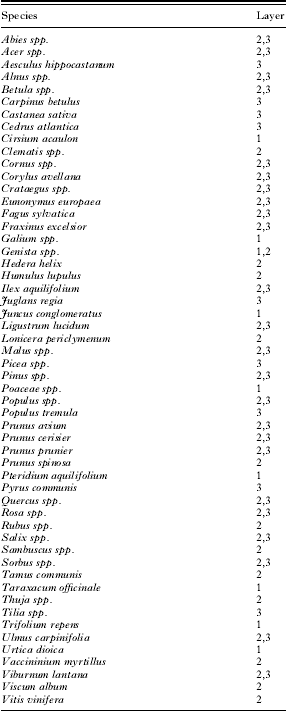
In all, 155 environmental variables were analysed as potential factors for nymph distribution. Pasture variables (n=151) corresponded to date and hour of the start of tick sampling, to geographical coordinates, and to climate, soil, landscape and vegetation descriptors. As tick activity and development are regulated by humidity and temperature (Gray, Reference Gray1998), the corresponding climatic parameters were recorded at local and general levels. Local humidity and temperature were measured on the ground during tick collection using an electronic hygrometer and thermometer. The percentage of cloud cover was estimated at the beginning of tick collection. General climatic data, provided by Météo-France from the meteorological station of Saint-Gervais d'Auvergne, were total amount of rainfall, minimum and maximum temperature and humidity for the day of sampling and for the 10 days before the day of sampling. Moreover, a composite soil sample was collected in each study pasture from 10 mixed subsamples and sent for analysis to a reference laboratory (Laboratoire INRA d'Analyse des Sols, Arras, France). Soil analytical parameters were particulate fractions (% of clay, fine silt, coarse silt, fine sand, and coarse sand), pH, and carbon/nitrogen ratio. Landscape and vegetation variables concerned distances from the pasture to the nearest house, to the nearest road and to the nearest woodland, water presence within the pasture (ponds, brooks), numbers of deciduous, coniferous and mixed woodland within a radius of 2 km around the pasture according to Corine Land Cover data-base (CLC2000, 100 m, European Environment Agency), presence of plant species (Table 1) around the pasture perimeter (tree layer: number of species n=33; bush layer: n=37; field layer: n=9) and percentage of the pasture perimeter with tree or bush layer. Host populations were evaluated through local deer (Capreolus capreolus) and wild boar (Sus scrofa) hunting tables for 2002–2003, and through the number and date of arrival of cattle onto the pasture. In addition, the abundance of I. ricinus nymphs in the nearest woodland was evaluated from the total number of nymphs collected in the woodland on 10 randomly selected ST. ST variables (n=4) included grass height, characteristics of ST border (enclosure-wall, bush, or tree) and of ST outside (i.e. what lies beyond the ST border up to 20 m: road-path-building-river, under cultivation, pasture, bush, or tree), and whether or not the ST-nearest wood distance was less than 20 m.
Vegetation species recorded in grazed permanent pastures of the Combrailles region in France
(1, Field layer; 2, bush layer; 3, tree layer.)

Database
The study data were stored in an Access 2000 (Microsoft France, Courtaboeuf, France) relational database organized in 16 tables. Checking procedures for data validity were conducted, which consisted of inspecting the record forms completed in the field and on implementing automatic procedures to detect and correct erroneous entries.
Statistical analysis
The association between I. ricinus nymph number per ST and environmental factors was screened using generalized linear models (GLM) (McCullagh and Nelder, Reference McCullagh and Nelder1991) through the statistical software ‘R’ (R Development Core Team, 2005). The programmes implemented for data analysis are available on request.
The statistical process included 2 steps. In the first step, variable selection was performed using univariate tests. Quantitative variables were divided into 2 or 3 categories of equal size depending on variable distribution. Kruskall-Wallis tests and rank sum tests were respectively used for qualitative and binary data. Variables with P-value <0·1 were selected as potential candidates for the second analysis step. Prior to the second step, correlations among the candidate variables were analysed using chi-square tests. If variables showed correlation (P-value <0·05), the less significant through the univariate tests was removed. Moreover, plausible biological interactions between candidate variables were tested. In the second analysis step, the selected variables, and interactions were offered to a negative binomial model in which the dependent variable was the number of nymphs per ST. Such a model, commonly used to model parasite burden (Shaw and Dobson, Reference Shaw and Dobson1995), takes account of overdispersion, a phenomenon which was highlighted in the studies of L'Hostis et al. (Reference L'Hostis, Chauvin, Valentin, Marchand and Gorenflot1995b) and of Vassallo et al. (Reference Vassallo, Pichon, Cabaret, Figureau and Pérez-Eid2000). The negative binomial distribution was adjusted for overdispersion using the Breslow procedure (Breslow, Reference Breslow1984) which estimates a Ø dispersion parameter through the glm.poisson.disp function of R (Scrucca, Reference Scrucca2003). The candidate variables were offered to the model with the best fit using backward elimination at P<0·05. Finally, the remaining significant factors for the number of nymphs per ST were displayed and the adjustment of the fitted distribution was assessed using a chi-square test.
RESULTS
Tick population
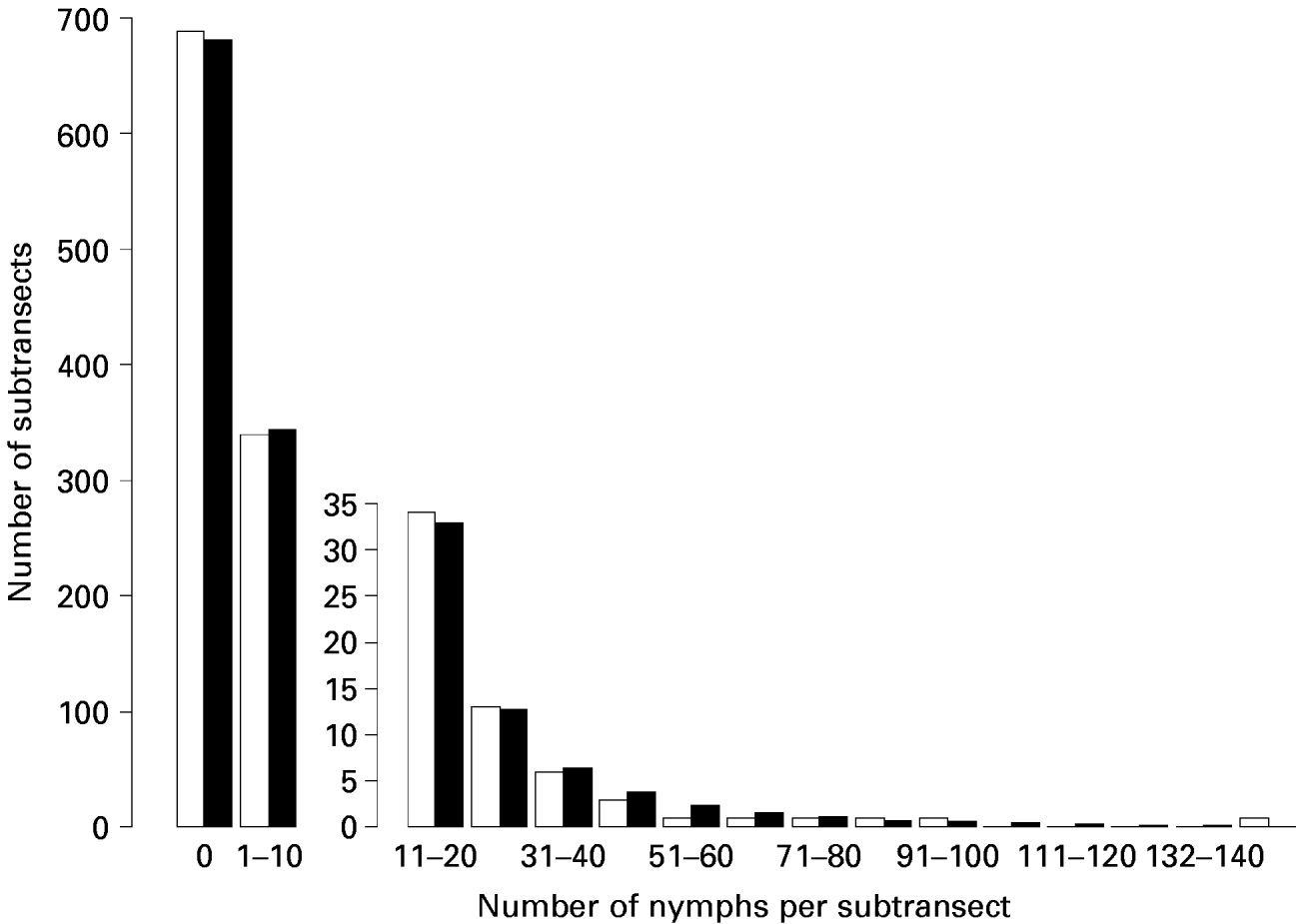
A total of 2772 I. ricinus nymphs were captured on 1089 ST (average number of nymphs per ST=2·55±8·38, range=0 to 143; average ST number per pasture=17·85±7·63, range=7 to 48). No nymphs were captured on 63% of the ST, while 25% of the ST contained 95% of the captured nymphs (Fig. 1). The average density of I. ricinus nymphs per pasture was 27·1 per 100 m2 (±61·7, range=0 to 388·2). Only 3 pastures contained no nymphs, while 26 had more than 1 captured nymph per ST.
Observed (white bars) and predicted (black bars) distributions of tick abundance on grazed permanent pastures of the Combrailles region, France. The number of Ixodes ricinus nymphs per subtransect (10 m2) was predicted by a negative binomial model adjusted with explanatory variables (see Table 3).

Univariate variable selection
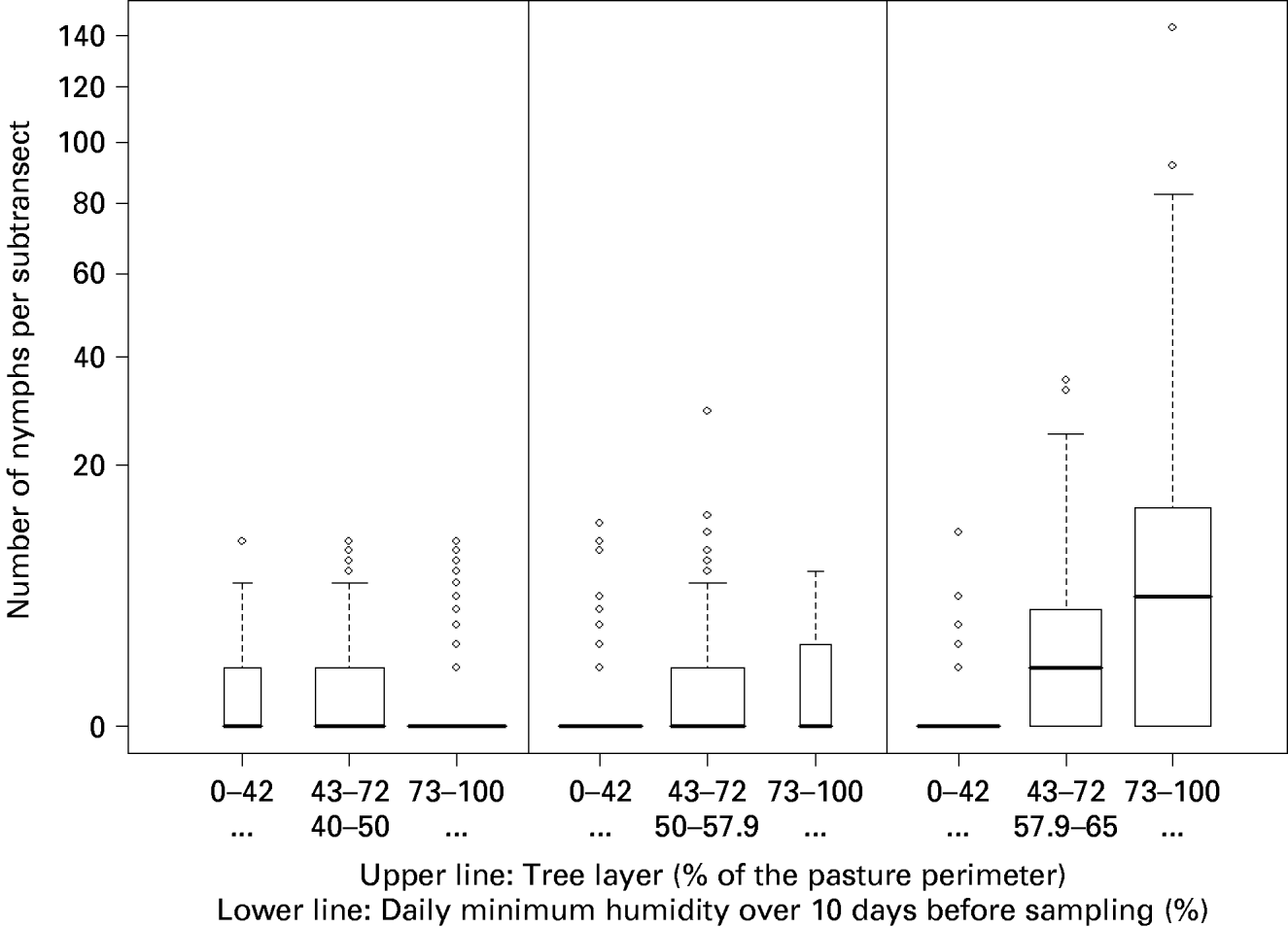
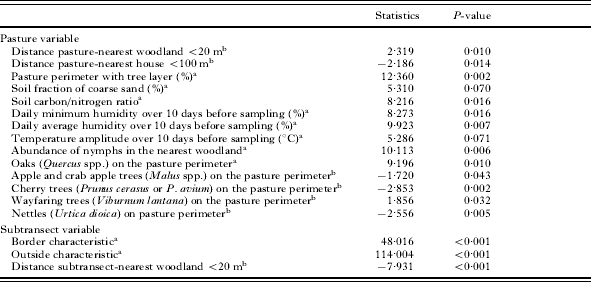
A total of 14 pasture and 3 ST variables were significantly associated with tick distribution at P<0·1 (Table 2). Date and hour of tick sampling were not significant factors, as were pasture geographical coordinates. From the associated variables, 6 pasture variables were removed because they were intercorrelated (average humidity over 10 days before sampling, temperature amplitude over 10 days, oaks on pasture perimeter, pasture-nearest house distance <100 m, fraction of coarse sand, soil carbon/nitrogen ratio). Finally, 8 pasture and 3 ST variables were selected for the GLM analysis. One significant interaction was identified among the selected variables, which concerned 2 pasture variables: minimum humidity over 10 days before sampling (HYG) and percentage of pasture perimeter with tree layer (TREE). As the interaction variable effects were multiplicative, the higher they were the higher was the probability of nymph capture (Fig. 2).
Boxplot of the effects of the interaction between daily minimum humidity over 10 days before tick sampling and percentage of pasture perimeter with tree layer, on the number of Ixodes ricinus nymphs per subtransect on grazed pastures of the Combrailles region, France. The number of I. ricinus nymphs is plotted on a square root scale. The median for each dataset is indicated by the black centre line. The first and third quartiles are the edges of the rectangle and the difference represents the interquartile range. The error bars extend to the most extreme data point that is no more than 1·5 times the interquartile range from the box. The width of each box is proportional to the number of pastures in the category.

Univariate correlations between abundance of Ixodes ricinus nymphs in grazed permanent pastures of the Combrailles region in France and pasture or subtransect variables
(Only variables with a P-value <0·1 are displayed. Statistics and P-values were calculated by Kruskall-Wallis rank correlations or by rank sum tests for respectively qualitative (a) and binary (b) data.)

Abundance analysis
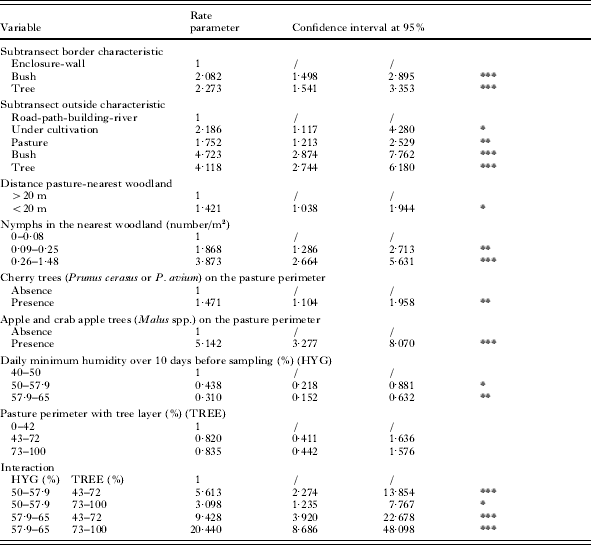
In the final negative binomial model, 8 variables were significant factors for the number of nymphs per ST (Table 3) and the dispersion parameter was 2·58. According to Fig. 1, the distribution predicted by the final model is very close to the observed distribution. Moreover, the chi-square test indicated that the data fit the model (P-value=0·986).
Final negative binomial models for Ixodes ricinus nymph abundance in grazed permanent pastures of the Combrailles region, France
(Estimations of linear predictors were considered as asymptotically normally distributed. The symbols *, ** and *** indicate significant factors at respectively P-value <0·05, P-value <0·01 and P-value <0·001.)

The interaction HYG×TREE was the most significant factor. If a pasture perimeter contained more than 73% of tree layer and if the daily minimum humidity over 10 days before sampling was higher than 57·9%, the expected number of nymphs was increased by a factor of 20·4. The second strongest effect concerned the presence of Malus species (apple and crab apple trees) on the pasture perimeter, which increased the expected number of nymphs by a factor of 5·1. The other significant factors were the presence of bushes or trees at the ST outside (4·7- and 4·1-fold increase respectively), a high abundance of nymphs in the nearest woodland (3·9-fold increase), the presence of trees or bushes at the border of the ST (2·3- and 2·1-fold increase respectively), the presence of cherry trees (Prunus cerasus or P. avium) on the pasture perimeter (1·5-fold increase) and the vicinity of the woodland (1·4-fold increase).
DISCUSSION
I. ricinus is usually associated with woodland and forests, in which densities ranging from 75 to 488 nymphs per 100 m2 have been reported (Walker et al. Reference Walker, Alberdi, Urquhart and Rose2001; Jouda et al. Reference Jouda, Perret and Gern2004; Ferquel et al. Reference Ferquel, Garnier, Marie, Bernede-Bauduin, Baranton, Perez-Eid and Postic2006). However, the species is also present on pastures (Milne, Reference Milne1946; Gray et al. Reference Gray, Kahl, Janetzki, Stein and Guy1995; L'Hostis et al. Reference L'Hostis, Chauvin, Valentin, Marchand and Gorenflot1995b; Mémeteau et al. Reference Mémeteau, Seegers, Jolivet and L'Hostis1998; Walker, Reference Walker2001). In the grazed pastures of the Combrailles region, the average estimated density was 27 nymphs per 100 m2 with a maximum of 388. Such a density is of the same order of magnitude as the average estimation of Ferquel et al. (Reference Ferquel, Garnier, Marie, Bernede-Bauduin, Baranton, Perez-Eid and Postic2006) in the Alsatian forest in Eastern France. Consequently, it can be stated that in France, grazed permanent pastures for cattle represent a favourable environment for I. ricinus.
Tick abundance on pastures would depend on tick survival and reproduction factors, which are investigated in tick distribution studies by studying numerous biological and environmental variables. However, few studies addressed the quantitative variation of tick abundance analysing simultaneously several explanatory factors. Therefore, the present study involved the collection of a wide variety of variables relevant to the ecosystem of the I. ricinus nymphs.
The final negative binomial model highlighted the importance of humidity and woodland vegetation for tick abundance on pasture perimeters. The most discriminating variable was the interaction between daily minimum humidity over 10 days before sampling (HYG) and the percentage of the pasture perimeter with tree layer (TREE). With regards to humidity, numerous authors have underlined its influence on tick populations (MacLeod, Reference MacLeod1935; Gray, Reference Gray1998; Perret et al. Reference Perret, Guigoz, Rais and Gern2000, Reference Perret, Rais and Gern2004). Ticks are sensitive to desiccation and nymphs need at least 80% relative humidity in experimental conditions to survive 15 days at temperatures ranging from 15°C to 30°C (MacLeod, Reference MacLeod1935). In the environment, Ixodes spp. ticks restore their water balance by hiding in the soil upper mat where humidity reaches its maximum (Gray, Reference Gray2002). Once the water balance of the tick is restored, the higher the relative humidity, the longer I. ricinus stays at the tips of grass blades (Perret et al. Reference Perret, Guerin, Diehl, Vlimant and Gern2003) with a subsequent higher probability of being captured by dragging. The presence of woodland and bushy vegetation on the pasture perimeter would play several key roles in the dynamics of tick populations by providing ticks a shelter with sufficient humidity and a thick litter mat (Gilot et al. Reference Gilot, Pautou and Moncada1975), and by contributing to the encouragement of hosts seeking shelter. Rodents and other small vertebrates are natural inhabitants of hedgerows, notably Clethrionomys glareolus and Apodemus spp. (Le Louarn and Quéré, Reference Le Louarn and Quéré2003), which are considered as I. ricinus larvae and nymph hosts (Humair et al. Reference Humair, Rais and Gern1999). Moreover, C. glareolus is able to venture on pastures (Tattersall et al. Reference Tattersall, Macdonald, Hart, Manley and Feber2001). The thickets also provide shelter for roe deer (Capreolus capreolus), which are important hosts for I. ricinus nymphs and adults (Anderson et al. Reference Anderson, Duncan and Linnell1998, p. 99; Eisen and Lane, Reference Eisen, Lane, Gray, Kahl, Lane and Stanek2002). The maintenance of ticks on the pasture perimeter through wild hosts is also supported by the positive effect on tick abundance of the presence of apple and cherry trees on the pasture perimeter. These fruits are attractive to hosts moving between pasture and woodland, such as roe deer (Putman and Moore, Reference Putman and Moore1998; Vourc'h et al. Reference Vourc'h, De Garine-Wichatitsky, Labbé, Rosolowski, Martin and Fritz2002), birds (Stevens and Bont, Reference Stevens and Bont1980) and foxes (cherry stones were observed in faeces of foxes hunted in the Combrailles, unpublished observation). While feeding on fruit, hosts would facilitate the attachment or detachment of I. ricinus and contribute to the maintenance of a significant population of ticks near fruit trees. Also, the peak of tick activity in spring and autumn (L'Hostis et al. Reference L'Hostis, Chauvin, Valentin, Marchand and Gorenflot1995b; Randolph et al. Reference Randolph, Green, Hoodless and Peacey2002) coincides with the period at which the fruit ripens (June for cherries and September for apples). At the present time, this study is the first to raise this question, and thus no comparison with other studies can be made to confirm the consistency of using the presence of fruit trees as an indirect indicator of the through-transit of potential hosts. In the Combrailles study, grazing cattle could be considered as a factor for tick dispersion in the pasture environment. Throughout the pasture period (April to October), heifers and cows were in contact with hedge vegetation where they picked up I. ricinus ticks and which then dropped off over the entire pasture. In such an open area, tick mortality is likely to be high (L'Hostis et al. Reference L'Hostis, Chauvin, Valentin, Marchand and Gorenflot1995b; L'Hostis and Seegers, Reference L'Hostis and Seegers2002). Finally, the contribution of grazing cattle to the dynamics of I. ricinus populations would be double-edged, as cattle can both provide a perfect bloodmeal for the questing tick but also increase mortality of gorged ticks that detach in the central part of a pasture. Consequently, it is necessary to consider a tick source for the maintenance of tick populations in a composite environment including positive and negative zones regarding tick viability. In the Combrailles, as nymph abundance on a pasture was positively linked with tick abundance in the nearest woodland and with the vicinity of woodland, the woodland would represent for I. ricinus a source for colonization of the pasture through host movements. Considering this hypothesis, the hedgerows could represent host corridors contributing to the arrival of ticks in parts of the pasture that were not in the direct vicinity of woodland. This explains why Carroll et al. (Reference Carroll, Ginsberg, Hyland and Hu1992) advised the maintainance of a gap between forest trees and residential lawns to reduce tick bite risk concerning I. scapularis. Transposed to pasture, the recommendation would be to avoid pasture fences coming into contact with hedge vegetation. However, as this probabilistic model performed highlighted correlations, but not a causal mechanism, between tick abundance and environmental factors, the value of recommendations suggested by the authors concerning pasture fences have to be validated through an intervention study. Pasture edges must not be neglected as a potential habitat for I. ricinus. Strategies and studies addressing the ecological relationship between ticks, grazed pastures, and woodland must be built to improve the control and understanding of tick populations and tick-borne diseases.
We are thankful to Ginette Sadot, Valérie Poux, Nelly Dorr and all our colleagues and trainees for their efficient and friendly help in field data acquisition and management. Sincere thanks to the Etablissement Départemental de l'Elevage du Puy-de-Dôme, the Région Auvergne, the Syndicat Mixte pour l'Aménagement et le Développement des Combrailles and all the farmers for their collaborative spirit.