Deficits in language and communication are known to be one of the defining characteristics and diagnostic criteria of autism (American Psychiatric Association, 2000). Individuals with autism form a rather heterogeneous group with respect to their language abilities, which range from mutism and little functional communication to relatively well-developed language. A common characteristic of these individuals, however, is that they all share impairments in pragmatic and conversational skills.
Less is known about grammatical development in this population. It has been argued that it follows the same path as that in typically developing (TD) children matched on mental age (MA), although at a slower rate (Lord & Paul, Reference Lord, Paul, Cohen and Volkmar1997; Tager-Flusberg, Reference Tager-Flusberg1981; Tager-Flusberg et al., Reference Tager-Flusberg, Calkins, Noin, Baumberger, Anderson and Chadwick-Denis1990). However, some results reported in both early and very recent research seem to suggest otherwise. Early studies revealed difficulties in the use of grammatical morphology in spontaneous speech of children with autism, not dissimilar to those seen in children with developmental dysphasia, or specific language impairment (SLI; Bartolucci, Pierce, & Streiner, Reference Bartolucci, Pierce and Streiner1980; Churchill, Reference Churchill1972). Difficulties with grammatical morphemes marking tense (e.g., “John goes,” where the verb is correctly marked for tense vs. the incorrect “John go”) and present progressive (“John is going”) have been confirmed more recently (Eigsti & Bennetto, Reference Eigsti and Bennetto2009; Roberts, Rice, & Tager-Flusberg, Reference Roberts, Rice and Tager-Flusberg2004). Using a computational measure introduced in accounts of the optional infinitive stage (difficulties in marking the finiteness of verb; Wexler, Reference Wexler, Lightfoot and Hornstein1993) in TD and SLI children, Roberts et al. (Reference Roberts, Rice and Tager-Flusberg2004) reported that performance of children with autism was poorer than expected for their general level of both linguistic and cognitive development, indicating a specific morphosyntactic deficit in this population. Note that difficulty with tense marking is argued to be a reliable clinical marker of SLI (Rice & Wexler, Reference Rice and Wexler1996). These findings are particularly interesting in view of reports suggesting a genetic link between autism and SLI (Fombonne, Bolton, Prior, Jordan, & Rutter, Reference Fombonne, Bolton, Prior, Jordan and Rutter1997; Tomblin, Hafeman, & O'Brien, Reference Tomblin, Hafeman and O'Brien2003; Vernes et al., Reference Vernes, Newbury, Abrahams, Winchester, Nicod and Groszer2008), as well as a recent claim that the two disorders could even be on a continuum (Bishop, Reference Bishop, Bock and Goode2003a). Mapping out a detailed linguistic profile in the population with autism is crucial to both establishing reliable differences between autism and other developmental disorders, such as SLI, as well as understanding the heterogeneity of the grammatical abilities of individuals on the autism spectrum.
However, there is little consistent data on the comprehension of complex syntactic structures. Research on grammar in autism traditionally entails investigations of spontaneous speech and analyses of results obtained by standardized tests of language abilities. Although these methods generate a wealth of important data, contexts in which complex grammatical structures are produced are often limited, thus failing to give a reliable picture of an individual's competence. In addition to the studies reporting difficulties with verb inflection mentioned earlier, the few experimental studies of complex grammar suggest that passives (Perovic, Modyanova, Hanson, Nelson, & Wexler, Reference Perovic, Modyanova, Hanson, Nelson and Wexler2007; Tager-Flusberg, Reference Tager-Flusberg1981) and relative clauses (Riches, Loucas, Charman, Simonoff, & Baird, Reference Riches, Loucas, Charman, Simonoff and Baird2009) also seem susceptible to impairment, as well as some operations at the syntactic/semantic/pragmatic interfaces, such as marking of definiteness (Modyanova, Reference Modyanova2009).
The lack of consensus on the issue of whether grammar in autism is simply delayed or also deviant, coupled with a scarcity of studies implementing experimental methods, calls for investigations of formal aspects of grammar in this population in more depth. The aim of our study is to investigate binding in children with autism. Binding is the area of grammar that concerns constraints on the distribution of personal and reflexive pronouns. There is no previous experimental research in this area in the population with autism; however, difficulties with using personal pronouns in spontaneous speech have been reported (Lee, Hobson, & Chiat, Reference Lee, Hobson and Chiat1994). Like young TD children, children with autism have been found to interpret you as I, and vice versa. This phenomenon, termed pronoun reversal, is argued to be due to their difficulties with shifting reference and to general problems with pragmatics. Nothing is known about how children with autism interpret personal versus reflexive pronouns. Experimental research on typical development reports specific difficulties in the interpretation of personal but not reflexive pronouns: even after 6 years of age, TD children frequently interpret sentences involving personal pronouns such as Mary washes her to mean Mary washes herself. This robust phenomenon, termed the delay of Principle B effect (DPBE; to be discussed in more detail in the following section) has been explained by appealing to the distinct nature of the principles that guide the interpretation of reflexive as opposed to personal pronouns: reflexives are interpreted by relying on constraints that are purely syntactic in nature, whereas personal pronouns are regulated by both syntactic and extrasyntactic (i.e., pragmatic) constraints. Syntactic constraints are in place early, but the development of pragmatic constraints takes time (Thornton & Wexler, Reference Thornton and Wexler1999; Wexler & Chien, Reference Wexler and Chien1985); thus, the pattern in typical development is understood as being due to TD children's prolonged maturation of pragmatic and not syntactic principles. In view of reported errors in production of personal pronouns and general difficulties in pragmatics and understanding of intention in autism, an in-depth investigation of the knowledge of constraints regulating the interpretation of both reflexive and personal pronouns in this population seems particularly pressing. If language in autism is delayed, but develops in a fashion parallel to typical development, a similar, or even more exaggerated, pattern of difficulties with pronouns is expected, in line with reported pragmatic deficits in this population. However, if syntactic knowledge is also affected, children may show difficulties interpreting reflexives that cannot be accounted for by a simple language delay. The following section outlines the theory of binding, its acquisition in the typical populations, and spells out the predictions for children with autism, thus providing a rationale for our study.
CONSTRAINTS GOVERNING PERSONAL AND REFLEXIVE PRONOUNS IN TYPICAL ACQUISITION
Our implicit knowledge of the constraints involved in assigning reference leads us to interpret the reflexive pronoun, herself, as referring to only one of the female characters mentioned in sentence (1a) below: Susan. To be interpreted as herself, the noun phrase (NP) Susan (its “antecedent”), has to be “nearest” to the reflexive. The index next to an NP refers to the referent of the NP.
(1)


The personal pronoun her, in (1b), is interpreted as referring to Mary, the NP “furthest away” from the pronoun.
The facts of the distribution of reflexive and personal pronouns have been captured in structural terms by the binding principles of Chomsky (Reference Chomsky1986),Footnote 1 given in (2).
(2)

Footnote 2 As stated above, the binding principles describe the complementary distribution of reflexives and pronouns. This is illustrated in (3a) and (3b): Principle A forces the reflexive to corefer with Mary in (3a), whereas Principle B excludes coreference of pronoun and Mary in (3b).
(3)

Being part of the computational aspects of our linguistic knowledge, compliance with binding principles is expected to be seen early on. Knowledge of Principle A, which demands that a reflexive have a local antecedent in the sentence, is acquired by TD children at least by age 4 (Chien & Wexler, Reference Chien and Wexler1990; Jakubowicz, Reference Jakubowicz1984; Wexler & Chien, Reference Wexler and Chien1985). In Wexler and Chien (Reference Wexler and Chien1985), structure (4) was tested with the aid of a two-choice picture task in 129 children, aged 2 years, 6 months (2;6) to 6;6 (and adult controls). Their performance grew with age; 6-year-olds gave greater than 90% correct performance (chance is 50%).
(4) Cinderella's sister points to herself.
Note that when tested on the constructions above, young children also show their understanding of the c-command component of binding, as possessives allow for two potential antecedents of the relevant pronominal element: one c-commanding (the entire NP, “Cinderella's sister”), the other non-c-commanding (the genitive NP “Cinderella”). Possessive NPs are argued to appear early in typical development (Tomasello, Reference Tomasello and Newman1998), at least by age 4 (Bannard & Matthews, Reference Bannard and Matthews2008; Golinkoff & Markessini, Reference Golinkoff and Markessini1980); thus, any difficulties with these constructions should to be due to children's incomplete mastery of the binding principles, and not of the possessive NP.
In contrast, at around the same age, TD children have a great deal of trouble with constructions that involve personal pronouns:
(5) Cinderella's sister points to her.
In the context of a forced-choice task (where one picture shows the sister pointing to Cinderella, and the other picture shows the sister pointing to herself), the sentence in (5) cannot mean that Cinderella's sister pointed to the sister, but must mean that she pointed to Cinderella. Wexler and Chien (Reference Wexler and Chien1985) report that in the two-choice picture task, children 5.5-year-old children (the same children who do very well in reflexives) were still around chance, and performance increased to less than 60% for the 6-year-olds. This robust pattern, termed DPBE, has been replicated in a number of studies for English (Avrutin & Thornton, Reference Avrutin and Thornton1994; Boster, Reference Boster1991; Chien & Wexler, Reference Chien and Wexler1990; Thornton & Wexler, Reference Thornton and Wexler1999) and has also been observed crosslinguistically (e.g., Dutch: Philip & Coopmans, Reference Philip, Coopmans, Stringfellow, Cahana-Amitay, Hughes and Zukowski1996; Hebrew: Friedmann, Novogrodsky, & Balaban, Reference Friedmann, Novogrodsky, Balaban, Castro, Costa, Lobo and Pratas2010; Icelandic: Sigurjonsdottir, Reference Sigurjónsdóttir1992; Russian: Avrutin & Wexler, Reference Avrutin and Wexler1992). Acquisition of binding has been one of the most fertile areas in the field of language acquisition (for a review, see Guasti, Reference Guasti2002) and the famous phenomenon of DPBE is still debated in the literature, two decades on. It has been noted that very young children may not show the difference in their performance on reflexives versus pronouns (such as 2.5-year-olds in Wexler & Chien, Reference Wexler and Chien1985, or the 3-year-old Hebrew speakers in Ruigendijk, Friedmann, Novogrodsky & Balaban, Reference Ruigendijk, Friedmann, Novogrodsky and Balaban2010), and that the pattern may be more robust in comprehension than in production (Bloom, Barss, Nicol, & Conway, Reference Bloom, Barss, Nicol and Conway1994; Hendriks & Spenader, Reference Hendriks and Spenader2005/2006; but see Ruigendijk et al., Reference Ruigendijk, Friedmann, Novogrodsky and Balaban2010, for data in Hebrew and German that present an argument against the asymmetry in comprehension and production).
What is it that children do not know about the principles that constrain the use of pronouns? Chien and Wexler (Reference Chien and Wexler1990, followed by other researchers) argued that this result is due to the different nature of constraints governing personal pronouns, as opposed to reflexives. Binding principles, as given in (2), regulate syntactic binding only, where the bound item is a bound variable. Reflexives are subject to syntactic binding only. Pronouns can be ambiguous between a coreferential and a bound variable readingFootnote 3: when a bound variable, they are regulated by Principle B, but when interpreted coreferentially, they are subject to constraints that are nonsyntactic in nature (pragmatic, according to Chien & Wexler, Reference Chien and Wexler1990, or subject to a special rule of coreference, as argued by Grodzinsky and Reinhart, Reference Grodzinsky and Reinhart1993).Footnote 4 Children thus have the knowledge of Principle B, the constraint governing the bound variable interpretation, but their difficulties with pronouns are due to limitations in implementing nonsyntactic constraints that govern illicit coreference. Chien and Wexler (Reference Chien and Wexler1990) argue that the high rate of errors in accepting the coreferential reading of (5) should be interpreted as a pragmatic error (failure of “Principle P”).Footnote 5 It is important that the same study reports additional experimental data confirming that children are sensitive to the distinction between binding and coreference. In contexts where a coreferential reading is not available, that is, when pronouns are bound by quantified antecedents, children show no difficulties rejecting an ungrammatical sentence such as (6).
(6) *Every beari is washing heri.
This is because quantifiers, like other operators, have no definite referents and accidental coreference is not an option: there is no ambiguity and no chance for children to fail. The same 5- to 6-year-old children in Chien and Wexler who show a chance performance on structures where the pronoun refers to the referential antecedent, reached 84% correct performance on constructions involving a quantified antecedent. These findings have been confirmed in other languages (Russian: Avrutin & Wexler, Reference Avrutin and Wexler1992; Dutch: Philip & Coopmans, Reference Philip, Coopmans, Stringfellow, Cahana-Amitay, Hughes and Zukowski1996) where children have been shown to accept illicit coreference between a pronoun and a local referential antecedent.Footnote 6
PREDICTIONS FOR CHILDREN WITH AUTISM
The result that TD children as old as 6 are still missing some crucial pragmatic abilities (while the related aspects of grammar have been acquired) provides an important opportunity to test hypotheses concerning language abilities in autism. We formulate these hypotheses as follows:
1. If only pragmatic, but not syntactic knowledge is affected in autism, children with this disorder will show difficulties in interpreting personal but not reflexive pronouns, displaying a pattern parallel to unimpaired development. An even more exaggerated pattern of difficulties with personal pronouns might be expected in autism compared to unimpaired development, in view of reported language delays in this population.
2. If, however, syntactic knowledge is also affected in autism, children may show difficulties interpreting reflexives, because interpretation of these elements is guided by principles that are purely syntactic in nature. A pattern of a worse performance on reflexives as opposed to, or in addition to pronouns, would be a sign of deviance, and cannot be accounted for by a simple language delay because it is not evidenced in the course of typical acquisition.
In the ensuing sections, we present a study of the knowledge of binding in children with autism, aged 6–17. This age range was chosen to account for any initial delays in language development in this population. Following Wexler and Chien (Reference Wexler and Chien1985), whose task was successfully used with over 100 English-speaking TD children, we aim to also test the knowledge of the c-command part of Principles A and B in our participants, by using a possessive subject that introduces both a c-commanding and a non-c-commanding local antecedent to the reflexive or personal pronoun in question. Testing c-command is important because failures of interpretation could be due to failures in calculating c-command or to more general binding principle failures. To examine any effects of verbal as opposed to nonverbal abilities in the population with autism, our participants were carefully matched to TD controls on standardized measures of verbal and nonverbal abilities. Binding principles have never been investigated in children with autism before, nor have the possessive structures; thus, we hope that our investigation will fill an important gap in the literature with respect to comparing the grammar in autism to that of TD children.
METHOD
Participants
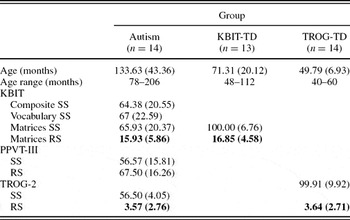
Forty-five children, 18 clinically diagnosed with autism and 27 TD controls, were recruited for the study. The children with autism, aged 6;6–17 (M = 11;6), were recruited with the help of Children's Hospital Boston and autism parent support groups in Massachusetts. Four autistic children (7- to 10-year-olds) were excluded from this group as they were unable to complete the test battery; thus, the complete set of data was obtained from 14 participants with autism (of which 3 were girls). Their overall IQ, as measured by the Kaufman Brief Test of Intelligence (KBIT; Kaufman & Kaufman, Reference Kaufman and Kaufman1990), ranged from 40 to 98 (M = 64.38, SD = 20.55; cf. Table 1). Their scores on different standardized measures reveal some disparity between nonverbal and verbal abilities, but these differences did not prove to be statistically significant: on the Matrices subtest of KBIT, which measures nonverbal IQ, their mean standard score (SS) was 65.93 (SD = 20.37); on the Peabody Picture Vocabulary Test, Third Edition (PPVT-III; Dunn & Dunn, Reference Dunn and Dunn1997), the test of receptive vocabulary, the mean was 56.57 (SD = 15.81); and on the Test for Reception of Grammar, Second Edition (TROG-2; Bishop, Reference Bishop2003b), their mean score was 56.50 (SD = 4.05). It may be noted that these children's scores appeared uniformly poorer on TROG as opposed to PPVT: 12 out of 14 children were at floor on TROG, whereas 4 out of 14 children were at floor on PPVT.
Ages and mean (standard deviation) scores on standardized tests of language and cognition for the group with autism and two control groups

Note: The scores for the measures on which participants with autism were matched to controls are in bold. KBIT, Kaufman Brief Test of Intelligence; TD, typically developing; TROG, Test for Reception of Grammar, Second Edition; SS, standard score; RS, raw score; PPVT-III, Peabody Picture Vocabulary Test, Third Edition.
Unimpaired controls, aged 3–9, were recruited from day care centers and schools in Boston, Massachusetts, and were individually matched to children with autism on the raw scores of one of the two measures: the matrices subtest of KBIT (no more than 1 point off), and TROG-2 (no more than 1 point off), thereby forming two control groups: KBIT-TD and TROG-TD, respectively. The inclusion of the two different measures of nonverbal and verbal abilities allowed us to factor out the influence of general cognition and of general grammar ability on participants’ performance on the particular syntactic structures under investigation. The TROG-TD control group consisted of 14 children, whereas the KBIT-TD group had 13: 1 child with autism scored particularly low on KBIT; thus, no match could be found for him among our typical controls. Independent sample t tests confirmed that there were no statistically significant differences between the raw scores of the group with autism and either of the two control groups on the relevant matching measure. Participants were closely matched for gender: this match was exact in the autism versus KBIT control group, and fairly close in the autism versus TROG group, where 11 out of 14 autistic participants were matched with controls for gender. All participants were native speakers of standard American English dialect.
Procedure
Comprehension of personal and reflexive pronouns was investigated with the aid of a two-choice picture selection task, adapted from Wexler and Chien (Reference Wexler and Chien1985). To make sure that all participants understood the procedure, great care was taken to introduce the task, the characters used in the experimental pictures (the Simpson's family: Mom, Dad, Bart, Lisa, and Maggie), and the verbs depicting different actions used in the experimental sentences (dress, wash, point to, and touch).
The task was first piloted with two children with autism and two children with Williams syndrome, aged 3–6, all with varying degrees of intellectual impairment. A similar version of this task, with the identical procedure but testing a different syntactic construction, was successfully used in another experiment in our lab, with 198 TD children, aged 3–14. The pictures of the five cartoon characters were introduced on the laptop screen individually, for example, “This is Mom, this is Dad, this is Lisa, etc.,” followed by practice items that tested the child's familiarity with each one: the child would be asked to point to the character that matches the name uttered by the experimenter (e.g., Lisa, while the screen shows two pictures, one of Lisa, one of Marge, Lisa's mom). This was followed by the introduction of four verbs used in the experimental pictures: dress, wash, point to, and touch, and finally, by two practice items involving simple transitive constructions: “Mom kisses Dad” and “Bart holds Lisa.” The correct answers to all the practice items and experimental items alternated between pictures presented on the left and right side of the screen, to control for any visual bias. The task was administered to ten unimpaired adults whose performance was at ceiling. All the controls and the 14 participants with autism (excluding the aforementioned four participants with autism who were for this reason excluded) were able to follow the task instructions and successfully completed the introductory items, before the experimental probe was presented to them.
Stimuli
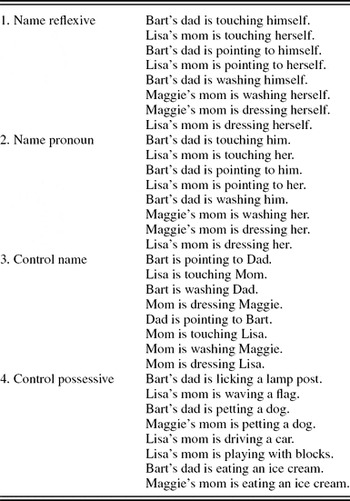
The probe consisted of two experimental conditions involving reflexive (name reflexive [NR]) and personal pronouns (name pronoun [NPr]) and two control conditions involving no pronouns but just proper names (control possessive [CP] and control name [CN]). The complete list of sentences is provided in Table 2.
The complete list of sentences in each test condition

Possessive subjects (“Bart's dad”) were chosen over simple noun phrases (“Homer”), because possessive structure allows for two potential antecedents of the reflexive or pronoun in the experimental conditions: the possessor NP “Bart,” and the entire subject NP consisting of the possessor and possessee, “Bart's dad.” This way, the child has the choice of two local antecedents, one c-commanding the dependent, the other not.
Participants were asked to point to one of the two pictures presented on the laptop computer that matched the sentence uttered by the experimenter. Thus, a sentence “Bart's dad is washing him” (NPr) would be accompanied by two pictures: Picture A, depicting Homer, Bart's dad, washing himself, with Bart standing by, and Picture B, the correct answer, where Homer is washing Bart.
The same two pictures would be used for the reflexive sentence (NR), “Bart's dad is washing himself,” where the correct answer is the aforementioned Picture A. In the control condition CP, which contained no pronominal elements, a sentence such as “Bart's dad is petting a dog” would be accompanied by two pictures: Picture A showing Bart petting a dog, and Picture B showing Homer, Bart's dad, petting a dog (the correct answer). CP sentences tested whether children knew the structure of possessive NPs: whether they knew that the structure “Bart's dad” refers to Bart's dad and not, say, to Bart, which is the first NP in the sentence. If children did well on this control condition, then any problems they have with binding could not be the result of misunderstanding the possessive structure. Furthermore, as is also the case for control condition CN (to be described next), if children did well on this control condition, it shows that they can perform well in this experiment when binding is not involved. Control condition CN contained no possessive structures and no pronominal elements: for example, the sentence “Dad is pointing to Bart” would be accompanied with Picture A showing Homer, Bart's dad, pointing to Bart (the correct answer), and Picture B showing Bart pointing to Homer, his dad.
There were eight sentences in each condition (two for each of the four verbs in the experimental conditions), thus totaling 32 sentences. The order of sentences was automatically randomized for each participant. The test took about 10 min to complete.
The majority of the participants with autism were tested in their homes, but several were tested in their schools. TD controls were all tested at their daycare centers or after school clubs.
RESULTS
Because the outcome variable was binary, and involved repeated measures for each participant in each of the three groups, the data were analyzed using the generalized linear mixed model function with a logit link (Gelman & Hill, Reference Gelman and Hill2007). Mixed logistic regression models have been argued to be more suitable for analyzing data in psycholinguistic research than commonly used repeated measures analyses of variance (e.g., Jaeger, Reference Jaeger2008; Quene & van den Bergh, Reference Quene and van der Bergh2008).
The fixed effects built into the model were Group (autism group and the two control groups: KBIT-TD and TROG-TD), sentence (NPr, NR, CP, and CN), and Group × Sentence interaction.Footnote 7,Footnote 8
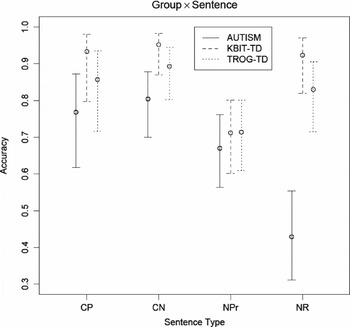
The model revealed significant main effects of group, F (2, 152) = 16.62, p < .001, sentence type, F (3, 152) = 10.13, p < .001, and significant Group × Sentence Type interaction, F (6, 152) = 3.20, p = .005. To investigate the Group × Sentence Type interaction, post hoc contrasts (Sidak corrected) compared mean probability correct of each sentence type both between the groups and within the groups. Variables were considered to be statistically significant at the adjusted level of p = .05. Mean probabilities correct for each sentence type and each group are displayed in Figure 1.
The results of the study. KBIT, Kaufman Brief Test of Intelligence; TD, typically developing; TROG, Test for Reception of Grammar; CP, control possessive; CN, control name; NPr, name pronoun; NR, name reflexive.

The significant Group × Sentence Type interaction indicates different patterns of performance between the three participant groups. The performance of the two TD control groups did not differ on any of the sentence types. All the differences observed concerned the performance of the group with autism relative to that of the controls.
With regard to the control conditions, estimated mean probabilities correct of the group with autism on CN (M = 0.80, 95% confidence interval [CI] = 0.70, 0.88) and CP (M = 0.77, 95% CI = 0.62, 0.87) were no different from those of the TROG group: CN (M = 0.89, 95% CI = 0.80, 0.94), t (152) = 1.57, p = .224, and CP (M = 0.86, 95% CI = 0.72, 0.93), t (152) = 1.06, p = .455, respectively. The other control group, KBIT-TD, had generally higher scores on the control conditions (CN: M = 0.95, 95% CI = 0.87, 0.98; CP: M = 0.93, 95% CI = 0.80, 0.98). The autism group's performance on CN was significantly worse than that of KBIT-TD controls, t (152) = 2.88, p = .014; odds ratio = 4.75, but only approached significance on CP, t (152) = 2.16, p = .093; odds ratio = 3.97.
With regard to the experimental conditions, comparisons of mean probabilities revealed no differences between the groups on NPr (autism group M = 0.67, 95% CI = 0.54, 0.74; KBIT-TD group M = 0.71, 95% CI = 0.60, 0.80; and TROG-TD group M = 0.71, 95% CI = 0.61, 0.80): autism versus KBIT-TD: t (152) = 1.02, p = .671, and autism versus TROG-TD: t (152) = 0.96, p = .671.
However, the performance of the autistic group on NR (M = 0.43, 95%, CI = 0.31, 0.55) was significantly worse than those of both control groups (KBIT-TD, M = 0.92, 95% CI = 0.82, 0.97; and TROG-TD, M = 0.83, 95% CI = 0.71, 0.90): autism group versus KBIT group: t (152) = 6.88, p < .001, odds ratio = 15.24, and autism group versus TROG group: t (152) = 5.10, p < .001, odds ratio = 6.48.
The analysis also allowed for comparisons between the performances on the four different sentence types for each group individually. Comparisons of mean probabilities correct between the four sentence types within the autism group revealed the score on NR to be significantly lower than that of every other sentence type: CP, t (152) = 3.76, p = .001; CN, t (152) = 4.86, p < .001; and NPr, t (152) = 2.65, p = .035. No other differences between sentence types in the autism group were observed.
Within the KBIT-TD control group, the differences were significant between the NPr and every other sentence type: CP, t (152) = 3.45, p = .003; CN, t (152) = 4.29, p < .001; and NR, t (152) = 3.46, p = .003. No other differences between sentence types were observed.
Within the TROG control group, the only statistically significant difference between means was between NPr and CN, t (152) = 3, p = .019.
That the autism group performed worse on the control condition CN, a simple subject–verb–object sentence, than the KBIT-TD group, may raise concerns such as whether these children were able to understand the task, and whether the main result, the extremely poor performance on NR of the autism group, was due to those autistic children who showed difficulties with this control condition. There were five children with autism who scored five out of eight correct on this condition (all other children, including all the controls, reach at least six out of eight correct).Footnote 9 Even when these five children are excluded and the analysis rerun, the results remain the same: the difference on NR is the only observed difference between the autistic group and the two control groups: autism versus KBIT-TD, t (132) = 5.49, p < .001, and for autism versus TROG-TD, t (132) = 4.42, p < .001.
The control condition CP was crucial in revealing whether or not children understand the notion of possessive structures, independently of their performance on pronouns or reflexives. The children with autism showed a slightly lower but not statistically significantly different performance from that of controls. There were several children overall who scored low on CP: three autistic children (one 8-year-old who scored none of the possible eight correct, one 17-year-old who got three of eight correct, and one 6-year-old who scored five of eight correct) and four control children (two 4.5-year-olds who scored four of eight correct, and two 3.5-year-olds who scored five of eight correct). A separate analysis was run with all these children excluded, and results were identical to those reported above: the autism group showed no difference from the controls on any condition except NR: autism versus KBIT-TD, t (124) = 6.10, p < .001, and for autism versus TROG-TD, t (124) = 4, p < .001.
In order to get a better idea of the patterns revealed in the data on experimental conditions, we also report the number of children who scored at least six out of eight items correct on NR and NPr conditions in the autism group as opposed to the controls. On NR, only two children out of 14 in the autism group passed the threshold of six of eight correct (14% of the sample); the other 12 children scored between one and five correct. In contrast, there were 23 out of the total of 27 control children (85% of the sample) who reached at least six of eight correct on NR; the other four control children all scored five of eight correct on this experimental condition. With regard to the NPr condition, 15 control children out of 27 (56% of the sample) scored six of eight or more correct, whereas 5 out of 14 autistic children (36% of the sample) did so. Note that the two children with autism mentioned above, who showed the good performance on NR, also showed a poorer performance on NPr (less than six of eight correct), which is a pattern parallel to TD controls. Their general language abilities, as reflected in their scores on standardized tests, were in line with those of other children in the group (cf. Table 1 for average scores of the autism group on different standardized measures): both children had an SS of 55 on TROG, and SSs of 50 and 58 on PPVT. On KBIT, the measure of nonverbal IQ, one child's SS was 63 and the other's 84, the latter score almost in the average range. It is unlikely, however, that the SS of 84 on KBIT contributed to this child's ability to interpret reflexives correctly: there were other autistic children whose standard scores on some of the measures were also close to or even within the normal range (e.g., two children had KBIT SSs of 98 and 103, and three different children had PPVT SSs of 80, 80, and 87) but who still performed poorly on the reflexive condition.
DISCUSSION
Here we summarize the patterns revealed in the performance of the group with autism and the two groups of matched TD controls, and argue that the results of our sample of children with autism signal the presence of a particular grammatical deficit in this population. We discuss a possible account of this deficit and examine the general implications that these results have for our understanding of the study of language in autism and the linguistic theory of binding.
The results shown by our TD controls are in line with those widely reported in the literature for this chronological age range (3- to 9-year-olds), as reviewed in earlier sections. Children in the older control group, KBIT-TD (average age = 6), showed a worse performance on pronouns, NPr (M = 0.71) and a very good performance on reflexives, NR (M = 0.92), displaying a classic DPBE pattern. The younger TROG-TD control group (average age = 4) showed no statistically significant difference between their performance on the two conditions (NPr: M = 0.71, and NR: M = 0.83). The lack of differential performance on reflexives and pronouns in this control group parallels the pattern reported in Ruigendijk et al. (Reference Ruigendijk, Friedmann, Novogrodsky and Balaban2010) for 3-year-old Hebrew speakers and can therefore be attributed to their young age. However, even these children's performance on pronouns was still worse than their performance on a control condition CN; thus, for both control groups, their only difficulty involved the experimental condition testing personal pronouns, NPr.
In contrast, the pattern demonstrated by the autism group revealed a persistent difficulty with the experimental condition involving reflexives, NR. Comparing the results of the three groups overall, the autism group performed significantly worse on NR than either of the TD control groups: the estimated mean probability correct of children with autism on NR was 0.43, for the KBIT-TD it was 0.92, and TROG-TD it was 0.83. Crucially, on the NPr condition, their performance was no different from either of the control groups’.
Like the KBIT-TD group, the autism group also showed the difference between the NPr and NR, but crucially, this difference goes in the opposite direction: children with autism had more difficulties with NR than with NPr. Recall, however, that there were two autistic children whose results followed the typical pattern of a DPBE: good performance on reflexives, but poor on pronouns. Thus, although the discussion here concerns the large majority of our sample, individual variation needs to be kept in mind. Recall however, that there were no TD control children who showed the atypical pattern, of a better performance on pronouns, and poorer on reflexives.
Children with autism did relatively well on the test of possessive structures, CP, although somewhat worse than the KBIT-TD controls, indicating that possessives seem within reach for the majority of children with this disorder (a discussion on how this performance can relate to the children's performance on NR is provided below). Some individual variation also seems present here, as there were three autistic children, along with four controls, who had difficulties interpreting these sentences. Note that the poorer performance of these children did not affect the results, because the same results were obtained even after these participants were excluded.
The performance of the autism group on the control CN condition was significantly worse than that of KBIT-TD group. Because these are simple subject–verb–object sentences, whose purpose was to ensure that autistic children are able to understand the task, one may wonder whether the extremely poor performance of the autism group on NR was due to these autistic children who showed difficulties with this particular control condition. We do not believe this is the case: when the five children with autism who do less than well on this condition are excluded from the analysis, the robust pattern remains: a significant difficulty with the interpretation of reflexives, not present in the matched controls, and an observable but less severe difficulty with pronouns, comparable to that seen in matched controls. Furthermore, because the autism group's performance on CN was no different from that of TROG-TD, the youngest group matched on grammar comprehension, we attribute this result to general difficulties attending to the task in the autism group.
How do the observed patterns match our predictions outlined earlier? Recall that Prediction 1 stated that if only pragmatic, but not syntactic knowledge were affected, children with autism should show difficulties interpreting personal but not reflexive pronouns. Such a pattern would also be in line with the evidenced language delay in this population: if language development follows the same path as in TD, but develops much slower, a pattern resembling the DPBE, reported widely in the typical acquisition literature, was to be expected. Our data confirm this prediction only with regard to pronouns: the observed difficulties with personal pronouns, comparable to matched TD controls, seem in line both with the “delayed but normal” characterization of language development in autism as well as the reported pragmatic deficits (the nature of these deficits will be discussed in more detail below). However, the extreme difficulty with the reflexive pronouns observed in the data fits in better with Prediction 2, which stated that if syntax were also affected in autism, in addition to pragmatics, our participants should also show difficulties interpreting reflexive pronouns. The pattern of extreme difficulty with reflexive pronouns cannot be explained by a mere delay in grammatical development in autism: the disparity in the command of grammatical constraints governing pronouns as opposed to reflexives, where Principle B is obeyed but Principle A violated, is not evidenced at any stage of typical language development (for a review, see Perovic, Reference Perovic2004) and has been observed in other populations with known grammatical deficits, such as Down syndrome (Perovic, Reference Perovic2004, Reference Perovic2006; Ring & Clahsen, Reference Ring and Clahsen2005).
We argue that the difficulty in the interpretation of reflexives observed in the sample of children with autism in this study signals an impairment that is purely syntactic in nature. Reflexive binding is governed by Principle A of binding theory; thus, we hypothesize that this principle is missing, or is incorrectly represented, in the grammar of children with autism. In particular, the c-command subpart of Principle A is missing in the child with autism. If this is the case, how is the anaphor interpreted? Recall that the subject, the possessive NP, contained two potential antecedents for the reflexive. In sentences such as “Bart's dad is washing himself,” participants with autism tended to incorrectly interpret “himself” as referring to Bart, choosing the picture that shows Bart's dad washing Bart. One could argue that children with autism rely on some linear rule to interpret the reflexive. For instance, assume that the child with autism interprets reflexives as relying on a rule such as “the antecedent of a reflexive is a preceding noun phrase in the same clause.” Such a rule would in fact obtain the correct interpretation for simple sentences involving the reflexive, that is, “Mary points to herself.” However, their poor performance on NR where the subject of the sentence is a possessive could be interpreted as signaling that children with autism do not know the c-command part of Principle A: that the antecedent of a reflexive must c-command the reflexive. Presumably a child with such a rule could choose either Bart or Bart's dad as the antecedent of the reflexive in Bart's dad is pointing to himself. After all, they are both in the same clause as the reflexive.
The suggestion that children use such a linear rule raises two important issues. First, should the existence of this linear rule be interpreted to mean that the child with autism is completely missing the hierarchical rule of c-command? Second, why do our participants (with the exception of three children, as reported earlier) interpret CP sentences correctly?Footnote 10
C-command is a structural notion, considered a primitive of grammar (Koster, Reference Koster1987; Neeleman & van de Koot, Reference Neeleman and van de Koot2002; Williams, Reference Williams1980; although see other accounts which argue that the c-command relation is a consequence of general syntactic operations, for example, Hornstein, Reference Hornstein2001, Reference Hornstein2009). Thus, not having c-command at all would severely impede most grammatical and interpretive understanding. For example, the subject–predicate relationship demands that the subject c-command the predicate. In Lisa is driving a car, Lisa c-commands driving a car. As we have pointed out, very little is known about the grammatical capacities of children with autism, so many possibilities are open. We simply point out here, that not having c-command would be a fairly devastating deficiency.
Turning to the second issue, the aim of the CP condition was to test the c-command relation independently of binding: computing the subject–predicate relationship in these sentences indicates that children with autism show sensitivity to c-command: “Lisa's mom is driving the car” cannot be interpreted as “Lisa is driving the car.” The semantic relationship (possession) between Lisa and mom is usually interpreted as the c-commanding NP being the possessor. However, it could be argued that a linear strategy can also be used to interpret the CP sentences. Assume that the child with autism interprets the second NP as the head of possessive structure, “Bart's dad”; this would always result in the correct interpretation of possessive sentences. If the children also have the (wrong) linear rule for the interpretation of reflexives, where the antecedent of a reflexive is a preceding noun in the same clause, such a grammar would predict children's good performance on CP, but poor or chance performance in NR.
Assuming that children with autism lack c-command altogether, yet can understand simple transitive sentences (as we see in our study) and can understand the possessive relationship (as we see in our study) seems to implicate the existence of several different kinds of linear rules. We have seen the need for a particular two of these, one for the possessive, one for the reflexive. Although this is conceivable, we would have to explain how a child creates such a set of linear rules. It is not entirely obvious how this could be done, but we will leave this matter of learnability here for future study.
Thus, although we are hesitant to argue that c-command in general is missing in the grammar of autism, as this would imply a devastating deficit in this population, we settle for a more conservative hypothesis: we argue that children with autism do not show sensitivity to c-command in establishing the complex syntactic dependency of binding, where the antecedent of a reflexive must c-command the reflexive.
Support for the idea that the ability to establish complex syntactic dependencies may be compromised in autism comes from recent reports that complex syntactic operations involved in the formation of passive and raising structures may also be affected in children and teenagers with autism (Perovic et al., Reference Perovic, Modyanova, Hanson, Nelson and Wexler2007). One theoretical proposal suggests that binding should be reduced to a movement analysis (Hornstein, Reference Hornstein2001). Because there are indications that children with autism have difficulties with raising constructions (such as “John seems to Mary to be driving a car,” which involve movement of the subject “John” from the subject position in the embedded clause to the subject position in the main clause; Perovic et al., Reference Perovic, Modyanova, Hanson, Nelson and Wexler2007), in addition to binding, it may seem as if the child with autism has difficulties with argument movement. This theory, however, would have to find a way to account for why raising and binding are distinguished in other populations, for example, typical development (Hirsch & Wexler, Reference Hirsch, Wexler, Dubinsky and Davies2007), Williams syndrome (Perovic & Wexler, Reference Perovic and Wexler2007), where binding much precedes raising.Footnote 11
To shed more light on the actual difficulties with reflexives in the grammar of autism, it would be relevant to investigate binding in those languages that show a contrast between “strong” and “weak” reflexive elements (zich vs. zichzelf in Dutch, sich vs. sich selbst in German, or the reflexive clitic se vs. the full reflexive sebe in Serbo-Croatian). Perovic (Reference Perovic2004, Reference Perovic, Guijarro Fuentes, Larrañaga and Clibbens2008) reports results of Serbian adolescents with Down syndrome who showed difficulties with the full reflexive sebe, but not with the reflexive clitic se, arguing that this is due to their inability to establish the syntactic relation of binding between the full reflexive and its antecedent. These participants, however, were able to understand inherently reflexive predicates that can only appear with the clitic, and not with the full reflexive. It has been argued that other theories of binding, such as Reinhart and Reuland (Reference Reinhart and Reuland1993), or Reuland (Reference Reuland2001), may be better equipped to deal with the different types of reflexive elements in these languages than the standard binding theory of Chomsky (Reference Chomsky1986; for details, see Perovic, Reference Perovic2004, Reference Perovic2006, Ring & Clahsen, Reference Ring and Clahsen2005). However, further research is needed, with a larger number of participants, to establish the exact nature of the violations of the syntactic principles guiding the interpretation of reflexives in autism.
On the general level, our data have interesting implications for the linguistic theory of binding: they provide evidence that the constraints regulating reflexives and pronouns are different in nature (i.e., there is a difference in how children with autism treat reflexives as opposed to pronouns), or to put it differently, that the fractionation of binding into syntactic and nonsyntactic components is real (Reinhart, Reference Reinhart1983). The well-established result of a difficulty with personal pronouns but not reflexives in the typical acquisition literature, the DPBE phenomenon, proves this fractionation in one direction: it is the pragmatic/processing constraint that is difficult to apply for the TD children who then cannot rule out illicit coreference of pronouns. The pattern revealed here provides evidence for this fractionation in the opposite direction: children with autism cannot apply the constraint that falls within syntax proper. However, although our data demonstrate a pattern reminiscent of the DPBE in our sample of children with autism, it is not immediately obvious how and whether these results can help us decide whether the extra-syntactic constraint governing illicit coreference of pronouns is pragmatic or processing in nature, because opposing arguments have been provided in the literature (cf. Chien & Wexler, Reference Chien and Wexler1990 vs. Grodzinsky & Reinhart, Reference Grodzinsky and Reinhart1993). Further research is needed to establish whether autistic children's performance would differ on quantified as opposed to nonquantified antecedents, the issue crucial in these accounts. If TD children's difficulties with personal pronouns are due to their inability to block illicit coreference, which in turn is a result of their immature pragmatic abilities, one might expect children with autism, in view of their reported pragmatic deficits, to find the interpretation of personal pronouns extraordinarily difficult, even more so than the TD controls. One option would be to consider the possibility that pragmatic abilities involved in ruling out illicit coreference in TD populations are different in nature to those pragmatic abilities that are affected in autism. Children with autism, for example, are known to have difficulties assigning reference to speakers as opposed to addressees, for example, “I” versus “you,” or between the third person, for example, “Mary,” and the first person, “I.” However, when an action is directed toward only one third person referent in the discourse, the difficulty in assigning reference is greatly reduced: the interpretative complexity of determining whether that object is reflexive or nonreflexive is greatly reduced. Further research is needed in this domain as well.
An important issue to consider is how general verbal and nonverbal abilities may have influenced the results of our group with autism. It is interesting to note that the autism group performed worse than either of the two control TD groups on reflexives, revealing that neither of the two measures: nonverbal MA nor the general comprehension of grammar, were reliable predictors of our participants’ knowledge of this subtle aspect of grammar. Although nonverbal abilities, as measured by KBIT Matrices, seemed stronger than their verbal abilities, our participants with autism still performed worse than the much younger TD controls matched on this measure, which suggests the observed deficit cannot be due to a general cognitive deficit in the population with autism. Furthermore, they performed worse than even the TD controls matched on TROG, indicating that the deficit in the interpretation of reflexives is more severe than the general grammatical deficit in this population would suggest. Clearer insights into the relation between general cognitive abilities and the knowledge of this particular aspect of grammar can only be obtained by comparisons of different populations with known intellectual impairments. Although this study focussed on the population with autism only, results from studies on other developmental disorders reveal different patterns, suggesting that comprehension of reflexive and personal pronouns is independent from nonverbal as well as verbal MA. It has been shown that children and adults with Down syndrome also have difficulties with the interpretation of reflexive pronouns (Perovic, Reference Perovic2004, Reference Perovic2006; Ring & Clahsen, Reference Ring and Clahsen2005), in contrast to children and adolescents with Williams syndrome, who demonstrate a good comprehension of both reflexives and pronouns (Clahsen & Almazan, Reference Clahsen and Almazan1998; Perovic & Wexler, Reference Perovic and Wexler2007; Ring & Clahsen, Reference Ring and Clahsen2005; but, for indications of a “DPBE” in younger children with Williams syndrome, see Perovic & Wexler, Reference Perovic and Wexler2007). It is crucial that a recent study suggests that even when matched on chronological age and intellectual and verbal ability, children with autism perform worse than children with Williams syndrome on reflexives, but not on pronouns (Perovic, Modyanova, & Wexler, Reference Perovic, Modyanova and Wexler2009). Why binding should be vulnerable in two disorders as different as Down syndrome and autism remains to be answered.
CONCLUSIONS
The results from the first experimental investigation of binding in the population with autism reported here reveal two clear patterns. Children with autism showed some difficulties interpreting personal pronouns (a “DPBE”), but these were no different from the TD controls functioning at similar levels of verbal and nonverbal abilities, in line with the reported language delays and pragmatic deficits in this population. Howver, they did show significant difficulties interpreting reflexives, significantly worse than either of the two groups of controls, matched on nonverbal MA or receptive grammar. Because for the interpretation of reflexives the syntactic relation between the reflexive element and its antecedent is crucial, in contrast to pronouns, which are interpreted by invoking extrasyntactic mechanisms, the pattern suggests a deficit that is syntactic in nature. This pattern is not seen in typical development, but has been evidenced in other populations with syntactic impairments, that is, Down syndrome (Perovic, Reference Perovic2004, Reference Perovic2006; Ring & Clahsen, Reference Ring and Clahsen2005). The observed pattern is in contrast to the traditional view that there is a pragmatic, but not a syntactic deficit in autism, because such a view predicts problems with pronouns, but not with reflexives. Despite individual variability in our participants with autism, the observed deficiency of children with autism on a complex aspect of grammar such as binding and reports of other deficiencies on passives and raising, suggest that grammatical development in autism may be qualitatively different from that of typical development. Although further studies with greater participant numbers are needed, these data contribute to a more comprehensive picture of the knowledge of complex grammar in autism, an area of research severely neglected in the literature.
ACKNOWLEDGMENTS
This research was supported by the Anne and Paul Marcus Family Foundation; the Brain Development and Disorders Project (BDDP) Postdoctoral Award (to A.P.); and the Brain Infrastructure Grant Program to the Department of Brain and Cognitive Sciences, Massachusetts Institute of Technology, from the Simons Initiative on Autism. We thank all of the participants and their families for taking part and the Autism Resource Center of Central Massachusetts and Children's Hospital, Boston, for help with recruiting. We also thank Lee Mavros-Rushton, the coordinator of BDDP, and all of the students in the Wexler Lab for help with collecting data; Gordon Craig, Christopher Hirsch, Vikki Janke, and Ad Neeleman for helpful discussions; and audiences at the 31st Boston University Conference on Language Development in November 2006; Autism Research UK, Open University, in May 2007; the Symposium on Research on Child Language Disorders, University of Wisconsin, Madison, in 2007; the Generative Approaches to Language Acquisition Conference, Universitat Autònoma de Barcelona, in September 2007; and the Symposia on Innovative Research in Autism, Tours, France, in April 2009, where some of the findings were presented.