Disasters are extraordinary and catastrophic events that occur somewhere in the world every day and are a continuous part of life.Reference Usher and Mayner 1 The World Disasters Report in 2007 noted a 60% increase in disasters in the last decade. 2 Disasters including earthquakes, tsunamis, floods, and cyclones result in high numbers of deaths and injuries, infrastructure damage, personal suffering, and high health and economic loss.Reference Usher and Mayner 1 , Reference Khalaileh, Bond and Alasad 3 Approximately 75,000 people die every year because of unanticipated disasters, with an additional 210 million directly impacted in some way from such events. In 2005, Hurricane Katrina and Hurricane Rita affected more than 1.5 million people in the United States.Reference Slepski 4
Developing nations are particularly vulnerable owing to the lack of funding for disaster preparedness and the impact of disasters on the health care, economics, and social infrastructure of the affected region and subsequently the country.Reference Usher and Mayner 1 , 2 Turkey is one of the countries most affected by disasters and was ranked sixth among the 10 countries most affected by disasters in 2004. Natural and manmade disasters including earthquakes, floods, landslides, building crashes, fire, terrorism, industrial accidents, and traffic accidents frequently occur in Turkey and result in high numbers of deaths and injuries, infrastructure damage, personal suffering, and high health and economic loss. Six hundred forty-four people died and 1966 people were injured in the earthquake that occurred in Van in 2011. 5
A successful disaster response is important in overcoming this public health problem and can be enhanced by disaster preparedness. Worldwide efforts through the leadership of the United Nations and the World Health Organization (WHO) have begun to address issues of disaster mitigation and preparedness. 2
Large-scale emergencies and disasters are often the most difficult events that nurses and other health workers face. Although all health care providers are involved whenever a disaster occurs, nurses as the largest professional group in the multidisciplinary health workforce have a critical role in providing care during a disaster and in the recovery phase of the disaster.Reference Khalaileh, Bond and Alasad 3 , Reference Hammad, Arbon and Gebbie 6 Therefore, the preparedness of nurses to effectively respond to emergencies and disasters is an important consideration. 2 Nurses with the fundamental competencies and knowledge to enable rapid response during times of disaster are needed to provide the required care in disaster response.Reference Usher and Mayner 1
International organizations emphasize the importance of nursing preparedness for disasters. The WHO and the International Council of Nurses (ICN) have collaborated to develop a set of competencies required for disaster nursing. Competencies can be gained with effective training. However, concerns have been raised about current understanding of the required knowledge, skills, abilities, and competencies to adequately prepare for disasters and the effectiveness of undergraduate pre-registration nursing courses to adequately prepare future nurses to respond appropriately in times of emergencies and disasters.Reference Usher and Mayner 1
In Turkey, governments, organizations, and universities have regulations on disaster preparedness. However, little is currently known about the disaster preparedness of nurses, about the content included in undergraduate pre-registration nursing curricula in Turkish undergraduate nursing schools, or about the current level of knowledge and practical experience of nurses related to disasters. Kalanlar et al and Öztekin et al stressed the need to improve undergraduate nursing education curricula related to disaster preparedness and response as result of their studies on undergraduate nursing students’ disaster preparedness in Turkey.Reference Kalanlar and Kublay 7 , Reference Öztekin, Larson and Uğraş 8
Senior class undergraduate nursing students are in the last period of their education and are future health professionals who will be required to be prepared for disaster planning, response, mitigation/recovery, and evaluation in order to be effective in disaster response. Thus, it is important to determine their disaster preparedness to improve the nursing education curricula.
This descriptive study was performed with the aim of determining the disaster preparedness of senior class undergraduate nursing students who have almost completed their nursing education. The results of the study can be useful in improving the content of the undergraduate curricula in preparing nurses for disasters and increasing awareness about the importance of disaster preparedness.
METHODS
Study Design and Sample
This was a descriptive study. Participants were selected from the students of an established undergraduate nursing school in Ankara, Turkey. Disaster nursing is included as a subject in various courses of the school (mainly the “First Aid and Care in Disasters” and “Public Health Nursing” courses). Seventy-three students voluntarily agreed to participate among the 87 students in the senior class of the undergraduate nursing school. The participation rate was 83.9%.
Study Tools
The questionnaire was developed by the researchers on the basis of the literature.Reference Usher and Mayner 1 , 2 , Reference Slepski 4 This tool included 15 open-ended questions regarding the disaster preparedness of the students. Questions were related to features and negative impacts of disasters; competencies that nurses should have for disasters; nursing interventions before, during, and after the disasters; and inclusion of disaster nursing in their curriculum. A pilot study was completed with 10 students and revisions were made on the basis of the pilot study.
Data Collection
Data were collected in May 2011 during final examinations before the students’ graduation. Thus, the students’ disaster preparedness was determined just before the start of their working life. The questionnaires were distributed to the participants in the classroom to prevent interaction and were collected after completion. Explanation was made about voluntarily attendance and the students were not required to write their name to prevent obligation. Completion of the questionnaires took approximately 15 minutes.
Data Analysis
Data were evaluated with SPSS (version 18) for Windows (IBM Corp, Armonk, NY). Descriptive statistics, including frequencies and percentages, were used to describe the characteristics of the sample.
Ethical Considerations
Ethical aspects of the study were considered and institutional permission was obtained. School managers approved the study. All participants completed informed consent forms after receiving an oral and written explanation about the aim and process of the study.
RESULTS
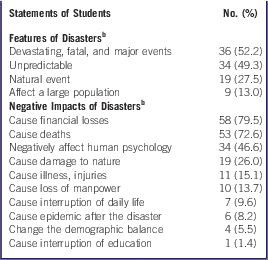
Senior class undergraduate nursing students’ statements about the negative impacts of disasters; competencies that nurses should have for disasters; nursing interventions before, during, and after disasters; and inclusion of disaster nursing in their curriculum were determined in this study. Regarding the features and negative impacts of disasters, we found that 52.2% of the students defined disasters as devastating, fatal, and major events; 49.3% of the students stated that they were unpredictable. A majority of students cited the negative effects of disasters as cost (79.5%) and death (72.6%). Fewer proportions of students indicated the effects of disasters regarding human psychology, damage to nature, illness, injuries, loss of manpower, epidemic after the disaster, change in demographics, and interruption of education and daily life (Table 1).
Nursing Students’ Statements Regarding the Features and Negative Impacts of Disasters (N=73)Footnote a

a Percentages were calculated on the basis of “N.”
b Participants could answer more than one.
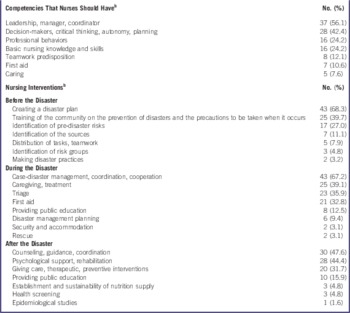
Regarding the competencies that nurses should have for disasters, 56.1% of the students stated the competencies of nurses as leadership, manager, and coordinator; 42.4% of them indicated the competencies as decision-makers, critical thinking, autonomy, and planning. Although at lower rates, the students also stated that they should have competencies such as professional behaviors, basic nursing knowledge and skills, intervention, medical treatment, the teamwork predisposition, first aid, caring, evaluation, triage, and research (Table 2).
Statements of the Nursing Students Concerning Competencies That Nurses Should Have for Disasters and Nursing Interventions Before, During and After the Disasters (N=73)Footnote a

a Percentages were calculated on the basis of “N.”
b Participants could answer more than one.
Statements of the nursing students concerning nursing interventions before, during, and after the disasters were determined. With regard to interventions needed by nurses before disaster, 68.3% of the students stated that “nurses should create a disaster plan” and 39.7% of them stated that “training should be given to the community by nurses on the prevention of disasters and the precautions to be taken when it occurs.” Although the percentage was lower, students also indicated that nurses should identify pre-disaster risks, identify sources, distribute tasks and teamwork, identify risk groups, and carry out disaster practices. Regarding nursing responsibilities during disasters, 67.2% of the students stated that “nurses should make case-disaster management, coordination, cooperation”; lower percentages of students indicated nurses’ roles in caregiving, treatment, triage, and first aid in traumas. They also stated that nurses should take place in the services related to providing education, disaster management planning, rescue, security, and accommodation. Regarding nurses’ interventions after disaster, students stated counseling, guidance, coordination (47.6%) and psychological support and rehabilitation (44.4%). A lower percentage of students stated that nurses have responsibilities in giving care to victims, therapeutic/preventive interventions, providing education, the establishment and sustainability of the nutrition supply, health screening, and epidemiological studies (Table 2).
Although not shown as a table, inclusion of disaster nursing in the curriculum was also investigated in this study. More than half (57.4%) of the students stated that “disaster nursing” was included as a subject within the courses during their education. Students listed “First Aid and Care in Disasters” (56.4%), “Public Health Nursing” (17.9%), and “Infectious Diseases Nursing” (5.1%) as courses including “disaster nursing” as a subject. Students stated that these courses included “definition, causes, and types of disasters” (48.7%); “initiatives before, during, and after disasters” (46.2%); and with a lower percentage “nurses’ roles before, during, and after disasters”; “planning and triage before, during, and after disasters”; “disaster areas of Turkey”; “education before, during, and after disasters”; and “first aid.” It was found that 56.4% of the students considered the education on disaster nursing as “efficient”; however, 35.9% of them considered the education as “partly efficient” or “not efficient.”
DISCUSSION
In this study conducted with the aim of determining the disaster preparedness of a senior class of undergraduate nursing students, it was determined that about half of the students defined disasters as devastating, fatal, major, and unpredictable events and the majority of them stated the negative effects of disasters as cost and death. In the literature, disasters has been defined as “a serious disruption of the functioning of a community or a society involving widespread human, material, economic or environmental losses and impacts, which exceeds the ability of the affected community or society to cope using its own resources.”Reference Hammad, Arbon and Gebbie 6 It can be concluded that although not at a desirable level, the student’s definitions of disasters paralleled those in the literature. In another study, Kalanlar et al found that most students did not know the definition of disaster in a pre-test given before their educational program study on disaster nursing.Reference Kalanlar and Kublay 7
Ensuring disaster preparedness of nurses requires gaining competencies. The focus of the ICN Disaster Nursing Competencies is the generalist nurse. The competencies were organized under 4 areas: mitigation/prevention, preparedness, response, and recovery/rehabilitation. Within the 4 areas, 10 domains were identified: risk reduction, disease prevention, and health promotion; policy development and planning; ethical practice, legal practice, and accountability; communication and information sharing; education and preparedness; care of the community; care of individuals and families; psychological care; care of vulnerable populations; and long-term recovery of individuals, families, and communities. 2 Considering the findings related to students’ statements about nursing competencies and interventions before, during, and after disaster, the senior student nurses stated the correct competencies and roles of nurses related to disaster nursing; however, the low percentages show a low level of disaster preparedness.
Similar studies in the relevant literature show the preparedness levels of nurses or nursing students. In a study conducted by Hammad et al, literature was identified through electronic databases from 2000 to 2011. It was determined that the literature highlights concern about the preparedness of emergency department nurses for disaster response and the capacity of nurses to transition to working in a disaster situation.Reference Hammad, Arbon and Gebbie 9 Öztekin et al determined that the majority of responses of undergraduate students from Istanbul and Miyazaki showed low percentages in areas that were related to issues covered in “preparedness competencies.”Reference Öztekin, Larson and Uğraş 8 Kalanlar et al also stressed incorrect answers of the undergraduate students’ related to roles of nurses in disasters.Reference Kalanlar and Kublay 7
Regarding the students’ statements on the inclusion of disaster nursing in their curriculum, more than half of the students in the present study stated that “disaster nursing” was included as a subject within the courses during their education. Although the International Nursing Coalition for Mass Casualty Education developed detailed competencies for developing disaster preparedness curricula in nursing education programs at all levels in 2003, studies in the literature show insufficient content of disaster nursing in curricula of nursing schools and low preparedness of nurses.Reference Usher and Mayner 1 , 10 In a descriptive study conducted by Usher et al, curricula of 39 schools of nursing were investigated, and the results indicated that few schools included disaster nursing in their curricula.Reference Usher and Mayner 1 Öztekin et al stressed that disaster preparedness needs to have a stronger focus in the nursing curricula. Nursing interventions in disaster situations in “response competencies” were preferred issues to be included in course content.Reference Öztekin, Larson and Uğraş 8 Kalanlar et al also found that the majority of the students were not educated on disaster nursing, and students who were educated on disaster nursing stated a very limited duration of training.Reference Kalanlar and Kublay 7
It was determined that 56.4% of the students considered their education on disaster nursing as “efficient.” Similarly, in a study conducted to assess Jordanian nurses’ perceptions regarding preparedness for disaster management, 65% of the respondents described their current disaster preparedness as weak.Reference Khalaileh, Bond and Alasad 3
CONCLUSIONS
In this study conducted to determine the disaster preparedness of senior class undergraduate nursing students, low percentages and insufficient statements showed low preparedness for disasters. On the basis of the percentage of students considering the disaster nursing training as “inefficient” and “partly efficient,” it can be concluded that there is a need to improve the disaster-nursing content of the curriculum. Schools of nursing and nursing faculty play critical roles in preparing nurses for emergency preparedness and response. Curriculum development or redesign is necessary to include content and clinical experiences related to disasters. In addition, further research is needed to adequately address this issue.