Introduction
Recent progress in radiometric dating methods and palaeoenvironmental studies have made it possible to accurately correlate changes in human subsistence behaviour with landscape changes and variation driven by palaeo-climate fluctuation during the Pleistocene. This has provided new insight into traditional questions such as changing lithic technology and behaviour without migration or diffusion, as well as the movement of populations and extinction. One pioneering study of this kind is the well-known ‘Stage Three Project’ in Europe (van Andel & Davies Reference van Andel and Davies2003).
Traditional lithic studies that have reconstructed the human past based on technological and chronological lithic patterns are giving way to the study of human behavioural diversity in relation to past environmental geography. Recent studies on Upper Palaeolithic assemblages in Japan have started to take a combined approach based on comparison between the lithic technologies that were being used and the local resource environment in each region to better understand the conditions surrounding the development of human behavioural diversity (Kunitake Reference Kunitake2005; Nakazawa et al. Reference Nakazawa, Izuho, Takakura and Yamada2005; Yamada Reference Yamada2006; Morisaki Reference Morisaki2010; Morisaki & Sato Reference Morisaki and Sato2014). Such a novel approach has, in turn, been providing significant results that can be compared with the modern human behaviour debate in Eurasia. Here we discuss how Upper Palaeolithic foragers’ use of varied lithic technology correlated with landscape changes in northern Japan. The study area includes various landscapes and Palaeolithic industries, and it can therefore form the basis of a case study on human behavioural diversity.
Palaeoenvironment in the Japanese islands
Upper Palaeolithic records of the Japanese archipelago are firmly dated to between c. 40–13 ka cal BP (35–12 ka 14C BP) (Izuho & Akai Reference Izuho and Akai2005; Sato et al. Reference Sato, Yamada, Izuho, Sato and Iinuma2011). During this Late Pleistocene period (marine isotope stages 3–2), climatic conditions in the Japanese archipelago changed rapidly from warm to cold in an example of what are known as Dansgaard-Oeschger events (Matsui et al. Reference Matsui, Tada and Oba1998). Before discussing the archaeology, we briefly present an outline of palaeogeography, fauna, flora and the lithic raw material resource environment in the northern part of the Japanese archipelago.
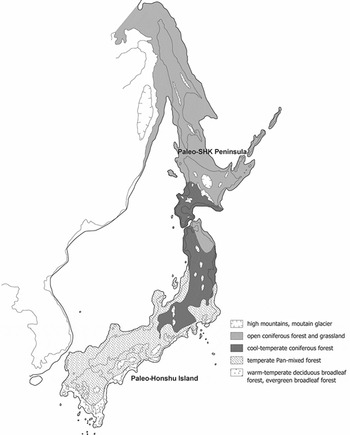
Figure 1 shows the reconstructed palaeogeography of the Japanese archipelago and surrounding region during the Last Glacial Maximum (c. 28–23 ka cal BP). Landmasses of the region during this period mainly consisted of two distinct parts: the Paleo-Sakhalin-Hokkaido-Kurile peninsula and Paleo-Honshu Island. Hokkaido was the southern part of the Paleo-Sakhalin-Hokkaido-Kurile Peninsula (the southern Paleo-Sakhalin-Hokkaido-Kurile Peninsula), connected to it by a land bridge between Sakhalin and Kurile Islands (Kunashiri and Shikotan Island). Honshu was attached to Shikoku and Kyushu, forming Paleo-Honshu Island. This island was not connected to the Paleo-Sakhalin-Hokkaido-Kurile Peninsula at this time, although distances across the straits were shortened to only a dozen kilometres in some places (Matsui et al. Reference Matsui, Tada and Oba1998).
Reconstructed topography and vegetation zones of the Japanese islands and surrounding regions during the Last Glacial Maximum (c. 24–19 ka BP) (after Iwase et al. Reference Iwase, Hashizume, Izuho, Takahashi and Sato2011).

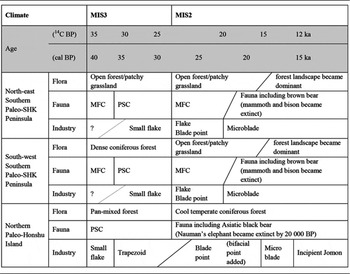
During the latter half of marine isotope stages 3 and 2 the flora comprised species that preferred colder environments than those inhabited in the present (Igarashi Reference Igarashi and Sato2008). The north-eastern parts of the southern Paleo-Sakhalin-Hokkaido-Kurile Peninsula (present Sakhalin and north-eastern Hokkaido) were covered with cold grassland and open forest (Figure 1). Forest environments became dominant in the Paleo-Sakhalin-Hokkaido-Kurile Peninsula by the end of marine isotope stage 2 (Igarashi Reference Igarashi and Sato2008). In the south-western part of the southern Paleo-Sakhalin-Hokkaido-Kurile Peninsula (south-western Hokkaido), dense coniferous forest dominated during marine isotope stage 3, while cold grassland and open forest became prevalent in marine isotope stage 2. In the northern Paleo-Honshu Island pan-mixed forest prevailed during marine isotope stage 3, while cool temperate coniferous forest became dominant under the cold climate of marine isotope stage 2 (Tsuji Reference Tsuji and Amuro2004). At the onset of the Holocene deciduous broadleaf forest started to spread to this area.
Fauna in each region also changed in response to the differences in climate and flora. Late Pleistocene fauna in these areas can be divided into two groups: the Paleoloxodon-Sinomegaceroides complex with Nauman's elephant (Palaeoloxodon naumanni) dominant on Paleo-Honshu Island (Kawamura Reference Kawamura1998), and the mammoth-fauna complex with mammoths (Mammuthus primigenius) on the Paleo-Sakhalin-Hokkaido-Kurile Peninsula (Kirillova Reference Kirillova2003; Kuzmin et al. Reference Kuzmin, Gorbunov, Orlova, Vasilevsky, Alekseeva, Tikhonov, Kirillova and Burr2005; Takahashi et al. Reference Takahashi, Soeda, Izuho, Yamada, Akamatsu and Chang2006; Vasilevsky Reference Vasilevsky and Sato2008). The Paleoloxodon-Sinomegaceroides complex is firmly documented as having migrated to Paleo-Honshu Island via the Korean Peninsula by 130 ka BP at the latest. This group consists of several species of deer (Cervus nippon), brown bear (Ursus arctos), Asian black bear (Ursus thibetanus), Eurasian badger (Meles meles), raccoon dog (Nysterutes procyonoides), least weasel (Mustera nivalis), marten (Martes melampus), fox (Vulpes vulpes), wolf (Canis lupus) and Japanese monkey (Macaca fuscata), in addition to Nauman's elephant (Paleoloxodon naumanni) and giant deer (Sinomegaceroides yabei) (Kawamura Reference Kawamura1998).
Several species of the mammoth-fauna complex, such as mammoth (Mammuthus primigenius), brown bear (Ursus arctos), steppe bison (Bison oriscus), reindeer (Rangifer tarandus), musk ox (Moschus moschiferus), horse (Equus caballus), moose (Alces alces), snow sheep (Ovis nivicola), leopard (Panthera sp.), wolf (Canis lupus) and arctic fox (Alopex lagopus), are reported in the Paleo-Sakhalin-Hokkaido-Kurile Peninsula (Kirillova Reference Kirillova2003; Kuzmin et al. Reference Kuzmin, Gorbunov, Orlova, Vasilevsky, Alekseeva, Tikhonov, Kirillova and Burr2005; Takahashi et al. Reference Takahashi, Soeda, Izuho, Yamada, Akamatsu and Chang2006; Vasilevsky Reference Vasilevsky and Sato2008). This complex was widely distributed across northern Eurasia, migrating from Siberia to the Paleo-Sakhalin-Hokkaido-Kurile Peninsula around 50 ka BP.
Some species associated with the Paleoloxodon-Sinomegaceroides complex, such as giant deer, are also found in the southern Paleo-Sakhalin-Hokkaido-Kurile Peninsula during marine isotope stage 3, while fossil records of the mammoth-fauna complex indicate that bison and moose were present during the cold climate of marine isotope stage 2 (25–12 ka 14C BP) in the northern part of Paleo-Honshu Island. This suggests that the boundaries of these two complexes were fluid, shifting north or south according to climatic changes. Furthermore, it seems that the two, usually geographically distinct groups may have co-existed at times as particular species migrated north or south according to species-specific habitat and temperature preferences (Takahashi et al. Reference Takahashi, Soeda, Izuho, Yamada, Akamatsu and Chang2006). In the southern Paleo-Sakhalin-Hokkaido-Kurile Peninsula, the number of herbivorous animals inhabiting open landscapes gradually decreased as forest environments became dominant by the end of the marine isotope stage 2 (Izuho Reference Izuho2008).
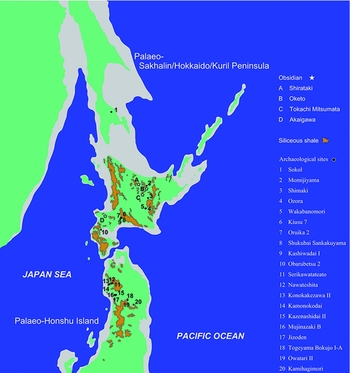
The unique tectonic setting of arc-trench systems in and around the Japanese islands offered an opportunity to procure high-quality lithic raw materials consisting of metamorphic, volcanic and sedimentary rocks. There are two major distributions of high-quality cryptocrystalline lithic raw materials in northern Japan: obsidian resources in the south-east Paleo-Sakhalin-Hokkaido-Kurile Peninsula (Izuho & Sato Reference Izuho and Sato2007) (Figure 2), and siliceous shale widely distributed in the south-west Paleo-Sakhalin-Hokkaido-Kurile Peninsula and in the north of Paleo-Honshu Island (Yamada Reference Yamada2006; Sano Reference Sano, Kuzmin, Keates and Shen2007).
Location of principal archaeological sites and lithic raw material sources referred to in this paper.

Upper Palaeolithic assemblages
Materials and method
The data analysed in this paper are gathered from published Japanese excavation reports of Palaeolithic sites dating from the latter half of marine isotope stage 3 to marine isotope stage 2 in northern Japan. To date, more than 10 000 Palaeolithic sites have been found in Japan (Database Committee of Japanese Palaeolithic Research Association 2010). In northern Japan, which consists of the Tohoku and Hokkaido regions, more than 1300 Palaeolithic sites were discovered, over 450 of which were excavated. Detailed site chronologies based on geochronology, techno-typological analysis and reduction-sequence reconstruction (e.g. Sato Reference Sato1992; Izuho & Akai Reference Izuho and Akai2005; Anzai & Sato Reference Anzai and Sato2006; Izuho & Sato Reference Izuho, Sato, Derevianko and Shunkov2008; Morisaki Reference Morisaki2010) provide a reliable framework for this paper.
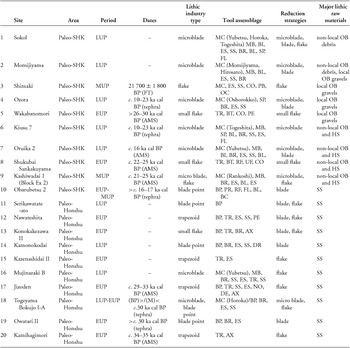
Most published excavation reports that were consulted contained information on lithic-toolkit assemblage and reduction strategies, reconstructed through refit analysis. Furthermore, we conducted a thorough examination of each assemblage to corroborate these findings. Unfortunately, organic remains from the sites are completely decayed and impossible to analyse; lithic materials are, however, preserved from all sites (Figure 2, Table 1).
List of archaeological sites referred to in this paper.

1) Site numbers correspond to Figure 2 .
2) FT = fission track.
3) MB/MC: microblade/core; BP = backed point and/or basally retouched blade point; SP = stemmed point; TR = trapezoid; ES = endscraper; SS = sidescraper; BR = burin; PE = pièce esquillée; NO = notch; DR = drill; BT = beak-shaped tool; PR = perforators; DE = denticulate; BI = biface; BC = blade core; BL = blade; FL = flake; CO = core; PB = pebble; OC = ochre.
4) OB = obsidian; SS = siliceous shale; HS = hard shale.
Forager risk-management studies are a new approach in Japanese Palaeolithic archaeology, meaning that a brief review of the theoretical background and terminology used in our study is warranted. Risk management is most prevalent in stone tool contexts as the interface between the scheduling of subsistence activities and tool manufacture to extract those resources (Torrence Reference Torrence and Bailey1983, Reference Torrence1989, Reference Torrence, Panter-Brick, Layton and Rowley-Conwy2001; Halstead & O’Shea Reference Halstead, O’Shea, Halstead and O’Shea1989; Hiscock Reference Hiscock1994; Bamforth & Bleed Reference Bamforth, Bleed, Barton and Clark1997; Fitzhugh Reference Fitzhugh2001). The amount and type of risk is notably different along the forager-collector continuum (Binford Reference Binford1980). To maintain an adequate tool supply, foragers could employ a strategy of either carrying lithic raw materials or tools with them, or by maintaining stores at locations in the landscape (Kuhn Reference Kuhn1995). These tactics are generally selected according to foraging behaviour; subsequently, each approach demands different strategies in terms of lithic raw material procurement, tool use-life and design elements such as standardisation and toolkit diversity.
Juxtaposing the extremes of the foraging continuum—mobile vs sedentary conditions—stone tool assemblages should exhibit contrasting properties. Mobile foragers would have transported raw materials with them, typically ‘exotic’ types not found locally, or carried replacement items in the form of retouched tools, tool ‘blanks’, microblade inserts and possibly biface or small blade cores (e.g. Kelly Reference Kelly1988; Goodyear Reference Goodyear, Ellis and Othrop1989; Ingbar Reference Ingbar and Carr1994; Kuhn Reference Kuhn1995; Elston & Brantingham Reference Elston, Brantingham, Elston and Kuhn2002; Brantingham Reference Brantingham2003; Hall & Larson Reference Hall and Larson2004). These tools typically exhibit an extended use-life between production and discard (Schiffer Reference Schiffer1976; Shott Reference Shott1989; Shott & Weedman Reference Shott and Weedman2007). Tools would have been standardised, conserving lithic raw materials and time by providing high quantities of cutting edges from raw materials and increasing the efficiency of tool procurement (e.g. Kelly Reference Kelly1988; Kuhn & Bar-Yosef Reference Kuhn and Bar-Yosef1999; Bleed Reference Bleed2001; Rasic & Andrefsky Reference Rasic, Andrefsky and Andrefsky2001; Elston & Brantingham Reference Elston, Brantingham, Elston and Kuhn2002; Eren & Pendergast Reference Eren, Pendergast and Andrefsky2008). Highly standardised serviceable tools, involving easily replaced projectile tips or inserts, were often used by foragers who could not anticipate when a vital tool would be needed (e.g. Bleed Reference Bleed1986; Jochim Reference Jochim and Torrence1989; Torrence Reference Torrence1989; Neeley & Barton Reference Neeley and Barton1994; Elston & Brantingham Reference Elston, Brantingham, Elston and Kuhn2002; Hiscock Reference Hiscock, Elston and Kuhn2002). Finally, toolkits were limited in diversity, reducing weight by increasing the multifuntionality of individual tools (Torrence Reference Torrence and Bailey1983; Shott Reference Shott1989).
Sedentary foragers probably relied on locally available lithic raw material, if it was abundant and of high quality, without concern for its durability (e.g. Gould Reference Gould1980; Torrence Reference Torrence and Bailey1983, Reference Torrence1989; Parry & Kelly Reference Parry, Kelly, Johnson and Morrow1987; Bamforth Reference Bamforth1990; Andrefsky Reference Andrefsky1994; Kuhn Reference Kuhn1995). Specialised tools are more task efficient and highly diverse tool assemblages are typically associated with more sedentary foragers for whom weight is not an issue (Torrence Reference Torrence and Bailey1983; Shott Reference Shott1989). Finally, tool standardisation was probably not a concern for sedentary communities, except possibly within gear transported during hunting or procurement forays. These models serve only as templates to evaluate variations in lithic toolkits and the foraging behaviour they may represent; as such, each must be viewed and interpreted within its individual context.
Based on considerations of individual site and artefact assemblage descriptions, and within the framework of foraging technology theory outlined above, we summarise the characteristics of the assemblages and evaluate the behavioural pattern and technological package associated with each site. Detailed discussion of individual sites is not within the scope of this paper. Our aim is to provide a synthesis of these data.
Characteristics of assemblages and technologies
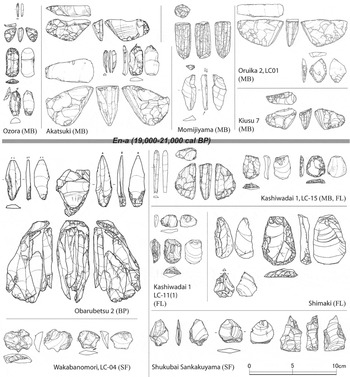
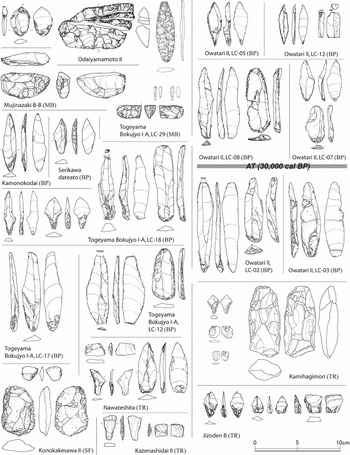
A variety of lithic industries including small flake, trapezoid, blade point, flake and microblade assemblages, and those with mixed technologies, were identified in northern Japan (Izuho & Sato Reference Izuho, Sato, Derevianko and Shunkov2008) (Figures 3&4, Table 1). High-quality non-local cryptocrystalline raw materials, including obsidian and siliceous shale, are prevalent in each industry.
Lithic industries in the southern Paleo-Sakhalin-Hokkaido-Kurile Peninsula: MB = microblade industry; SF = small flake industry; FL = flake industry; BP = blade-point industry; TR = trapezoid industry.

Lithic industries on north-east Paleo-Honshu Island: MB = microblade industry; SF = small flake industry; FL = flake industry; BP = blade-point industry; TR = trapezoid industry.

Small flake industry
The small flake industry, dated to about 40–30 ka cal BP, is characterised by flat and polyhedral flake cores, and by relatively small tools including non-standardised trapezoids with light retouch, scrapers, drills and adzes. While this industry has been found throughout Japan, except in the Okinawa Islands, dozens of sites are clustered in the north-east of Paleo-Honshu Island and the south Paleo-Sakhalin-Hokkaido-Kurile Peninsula.
Many of the small flake industry sites are characterised by short-term occupations coupled with the intensive use of local lithic raw materials such as obsidian gravels and siliceous shale. Therefore, we surmise that foragers equipped with this toolkit devised a strategy of exhaustive and expedient use of local high-quality lithic resources within technological systems associated with high levels of mobility (Morisaki Reference Morisaki2013).
Trapezoid industry
The trapezoid industry, dated to roughly 35–30 ka cal BP, is characterised by polyhedral flake cores and relatively small tools including highly standardised trapezoids with intensive retouch, a small number of basally retouched blade points, scrapers and adzes (Morisaki Reference Morisaki2010). This industry is mainly clustered in the north-west of Paleo-Honshu Island.
The trapezoid industry sites are characterised by various types of occupation, probably including a residential base and several short-term camps. Toolkit diversity and tool standardisation are a little higher than those of the small flake industry (Morisaki Reference Morisaki2013). Trapezoids were intensively manufactured on site using local raw materials of varying quality. Standardised blade points, on the other hand, were made only from high-quality raw materials, such as siliceous shale, and only on limited occasions when sites were located near a source of raw material. This implies that blade points were used only in important, premeditated hunting activity. The dominance of expedient tools suggests that highly scheduled hunting strategies using the trapezoid industry were not yet frequent on north-east Paleo-Honshu Island.
Blade-point industry
The blade-point industry, approximately 32–20 ka cal BP, is characterised by prismatic and conical blade cores, and by relatively large blade-based tools including backed points, basally retouched blade points, burins, endscrapers and sidescrapers. The latter stage of this industry may have had bifacial points. These tools were highly standardised with intensive retouch, and toolkit diversity became higher than the trapezoid industry. The blade-point industry is distributed throughout Paleo-Honshu Island, and it is particularly dense in areas where siliceous shale occurs. A few sites are also known in the south-west of Paleo-Sakhalin-Hokkaido-Kurile Peninsula dating to around 30 ka cal BP (e.g. Obarubetsu 2 site).
Blade-point manufacturing was usually supported by fine-grained raw materials such as obsidian and siliceous shale. Tools and blades were mostly manufactured in a small number of hub sites, and were carried for many other activities at logistic satellite sites (Binford Reference Binford1980). This reduction strategy could have enabled more scheduled foraging activities than the previous trapezoid industry, with an increase in repeated occupation at certain locations and fewer residential movements augmented by short-term, task-specific extraction locations (Binford Reference Binford1980; Morisaki Reference Morisaki2013).
Flake industry
The flake industry, dated to 29–24 ka cal BP, is characterised by polyhedral and unidirectional flake cores with endscrapers and sidescrapers exhibiting intensive retouch; they are highly variable in form but toolkit diversity is extremely low. This industry is found in the south Paleo-Sakhalin-Hokkaido-Kurile Peninsula.
The representative flake assemblage of the Shimaki site consists of considerable numbers of endscrapers and sidescrapers on flakes detached from local obsidian cobbles. Evidence of hunting weapons is scarce. To understand the foraging behavioural strategy associated with this industry, further investigation of inter-site variability is required.
Microblade industry
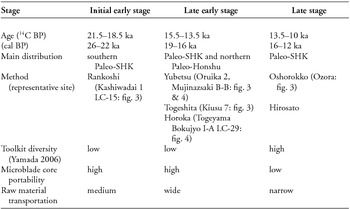
The microblade industry in northern Japan, dated 26–12 ka cal BP, is primarily characterised by the existence of various microblade core types based on reduction sequences (Nakazawa et al. Reference Nakazawa, Izuho, Takakura and Yamada2005; Sato & Tsutsumi Reference Sato, Tsutsumi, Kuzmin, Keates and Shen2007). The microblade industry in Hokkaido is divided into three stages by reduction method, the presence of distinct microblade core types and geochronology (Table 2) (Yamada Reference Yamada2006). The initial early stage (26–22 ka cal BP), in which the Rankoshi method was evident, the late early stage (19–16 ka cal BP), which used the Yubetsu, Togeshita and Horoka microblade core reduction methods, and the late stage (16–12 ka cal BP), in which assemblages contain microblade cores manufactured using the Oshorokko and Hirosato methods (See Nakazawa et al. Reference Nakazawa, Izuho, Takakura and Yamada2005:12–14, fig. 5). The late stage assemblages from all time periods contain highly standardised tools such as microblades, burins, drills, endscrapers and sidescrapers; bifacial stemmed points and axes appeared only during the late period (Nakazawa et al. Reference Nakazawa, Izuho, Takakura and Yamada2005). Site distribution varied over time, as summarised in Table 2. The microblade industry diffused into Paleo-Honshu Island for a short time during the late early stage.
Summary of the microblade industry on the southern Paleo-SHK Peninsula.

Despite high uniformity throughout the microblade industry, it is possible to recognise gradual changes in microblade core portability and tool assemblage variability in the Paleo-Sakhalin-Hokkaido-Kurile peninsula from the early to late stages (Yamada Reference Yamada2006). In the early stage, there is little variability in microblade production technology and tool types across the region; high toolkit diversity and variety in microblade core types emerge in the later stage.
Corresponding to these technological modifications, lithic raw material transportation patterns also changed significantly (Sato & Yakushige Reference Sato, Yakushige, Yamada and Ono2014). In the early stage lithic raw material was transported by long-distance travel. In the late early stage the use of non-local lithic raw materials increased, indicating that the foraging territory had become wider. For example, obsidian from the Shirataki source is found more than 300km away at the Sokol site (Kuzmin et al. Reference Kuzmin, Glascock and Sato2002). The expansion of occupational surfaces at sites leads us to assume that the frequency of residential movements and reoccupations had decreased in this period. More restricted transportation of lithic raw material is also recognised during the late stage.
Discussion
These evaluations allow us to discuss correlations between hunter-gatherer behavioural strategies and environmental changes based on a ‘contextual approach’ (Butzer Reference Butzer1982; Waters Reference Waters1992) in order to reconstruct the human ecosystem during the Upper Palaeolithic in northern Japan. As shown in Table 3, it is clear that there is a correlation between the technologies used by hunter-gatherers and landscape changes throughout the Upper Palaeolithic period; these can be broadly divided into the northern Paleo-Honshu-type and southern Paleo-Sakhalin-Hokkaido-Kurile peninsula-type behavioural strategies.
Correlation of flora, fauna and lithic industry during the Upper Palaeolithic.

PSC: Palaeoloxodon-Shinomegaceroides complex
MFC: Mammoth-fauna complex
The northern Paleo-Honshu strategy and the cool temperate forest
It is clear that the small flake, trapezoid and blade-point industries were distributed throughout north Paleo-Honshu Island and are well suited to exploiting the fauna of the cool temperate forests during the relatively warm period of the late half of marine isotope stage 3. Around 35 ka cal BP, foragers using the small flake industry also appeared on the Paleo-Sakhalin-Hokkaido-Kurile Peninsula, which was covered with dense coniferous forest at that time. This is supported by evidence that medium- and large-sized mammals of the Paleoloxodon-Shinomegaceroides complex, which originally inhabited Paleo-Honshu Island, migrated north to the southern part of the Paleo-Sakhalin-Hokkaido-Kurile Peninsula during the warm period, around 37–38 ka cal BP (Izuho & Takahashi Reference Izuho and Takahashi2005). People hunted some of these animals in fairly dense forests from short-term residences where they used local high-quality lithic raw materials to manufacture relatively expedient trapezoids, scrapers, drills and adzes.
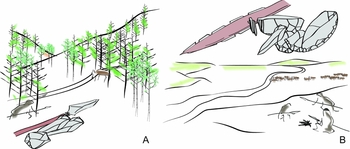
From around 35–30 cal ka BP, basally retouched blade points and backed points appeared within the trapezoid industry assemblages alongside standardised trapezoids. Basally retouched blade points and backed points were crucial hunting weapons made from high-quality non-local raw material sources. They were mostly manufactured at a small number of hub sites then carried for use to logistic satellite sites, which are formed by special purpose activity from the hub sites; local raw material was adequate for the manufacture of expedient trapezoids. Due to the expansion of cool temperate coniferous forest on north Paleo-Honshu Island, which was driven by environmental change towards a cold and dry climate from 35–30 ka cal BP, the blade-point industry became dominant over the trapezoid industry by around 25 ka cal BP. This correlation suggests that foragers adapted their toolkits so that they were highly standardised; the shift allowed foragers to extend occupation at residential sites while hunting game from short-term camps. Hunting focused mainly on medium- and large-sized game, the animals of the Paleoloxodon-Sinomegaceroides complex that dominated the landscape, and some species of the mammoth complex that migrated from the Paleo-Sakhalin-Hokkaido-Kurile Peninsula, at that time under the dry and cold conditions of marine isotope stage 2 (Figure 5: A).
Upper Palaeolithic behavioural responses to landscape change: Paleo-Honshu Island type (A) and Paleo-Sakhalin-Hokkaido-Kurile Peninsula type (B).

The southern Paleo-Sakhalin-Hokkaido-Kurile Peninsula strategy: cold grasslands and open forests
Although the small flake industry and blade-point industry were concentrated in the south-west of Paleo-Sakhalin-Hokkaido-Kurile Peninsula during the relatively warm period of marine isotope stage 3, they quickly gave way to the microblade industry in marine isotope stage 2. The strategies, mainly characterised by the microblade industry in the Paleo-Sakhalin-Hokkaido-Kurile Peninsula, were quite different from the north Paleo-Honshu Island type.
The appearance of a highly portable toolkit and relatively low toolkit diversity, measured by the number of tool types (Yamada Reference Yamada2006), indicate that foragers organised their lithic technology to adapt to the dispersed distribution of lithic raw materials in a cold grassland landscape during the initial early stage of the microblade industry. Foragers changed their residences frequently and covered a wide area. This suggests that the subsistence strategy of foragers was mainly hunting herds of medium- to large-sized herbivores, including bison, reindeer, horse, moose and snow sheep, in grassland environments using slotted point technology (Figure 5: B).
During the late early stage of the microblade industry, the use of non-local lithic raw materials brought over long distances increased, indicating that the foraging territory became wider; the frequency of residential movements and reoccupations decreased at the same time. This means foragers intensified their subsistence strategies in the open landscape of marine isotope stage 2, when the mammoth complex still flourished.
Tool type variability, as well as inter-site assemblage variability, increased remarkably during the late stage of the microblade industry after 16 ka cal BP. Across the region, tool manufacturing was supported by local raw materials, indicating that foragers manufactured, retouched and used lithic tools on site. Comparison of site function, lithic tool diversity and frequency of local lithic raw materials present in assemblages suggests that few residential movements seemed to have occurred. The move towards limited mobility coincided with highly developed collector strategies during this stage, following the gradual spread of forest landscape and fauna (Izuho Reference Izuho2008).
Significance of human behavioural diversity in Japan
Temporal and regional differences in human behaviour, as detailed in this paper, show diverse, rapid and flexible adaptations to dynamic environmental change during marine isotope stages 3–2 in northern Japan; these seem as good as, or rather better than, the results reconstructed in Europe, although lack of organic material is our weakest point. The debate on modern human behaviour in Europe focuses on detailed processes, accurate timings and the degree of human reaction to environmental fluctuation; these are crucial to understanding characteristics of modern human behaviour, their migration to Europe and their outsurviving the Neanderthals. This Japanese case study surely provides a useful insight into how modern humans’ behaviour responded to abrupt environmental change in other parts of the world.
Conclusion
In this paper we have tried to demonstrate that there is a correlation between lithic technologies and landscape changes in northern Japan. Classification of lithic assemblages found during the Upper Palaeolithic period in northern Japan shows that they reflect distinct organisational patterns employed by foragers in contrasting environments. Much of the variability in lithic assemblages over time is the result of Upper Palaeolithic foragers in each region using different subsistence strategies, as well as different seasonal occupations in accordance with their indigenous knowledge about the distribution and composition of animal quarry and lithic raw material resources in the open landscapes of the Paleo-Sakhalin-Hokkaido-Kurile Peninsula and the closed forests of Paleo-Honshu Island.
As the Japanese archipelago seems sensitive to short-term climatic fluctuation, and a number of Palaeolithic sites that retain good data sets are preserved there, the Japanese case study, as proposed here, surely provides useful examples of, and an insight into, how modern humans adapted to environmental change and variation in the past.
Acknowledgements
We would like to thank Mr Fumito Akai who assisted in preparing the figures. Comments from anonymous reviewers were helpful in improving the manuscript. This work was supported by JSPS KAKENHI, grant numbers 21242026 (PI: Hiroyuki Sato) and 24320157 (PI: Masami Izuho).
Supplementary material
To view supplementary material for this article, please visit http://dx.doi.org/10.1017/S0003598X1500023X