Responding to a commission from Alice Tully to celebrate the bicentennial of the United States of America, Olivier Messiaen chose the Utah wilderness as the inspiration for Des Canyons aux étoiles. . . (1974), a work that defines the country in terms of its birds and land – in particular the grandeur of its southwestern geological formations – rather than its culture.Footnote 1 The choice to frame the natural environment as set apart from human society stemmed from the composer's personal aesthetic bias against the concentrated populations, towering skyscrapers, and mechanized civilization of US cities, which he perceived as ‘overwhelming’ and ‘frightening’.Footnote 2 Messiaen sought an alternative compositional model far from the modern metropolis in features of the natural world, as was his creative habit.
Despite the desire to escape civilization, Messiaen's description of choosing Utah for the work's inspiration suggests that his decision was mediated by touristic modes of representation. In an interview with Harriet Watts about the genesis of Des Canyons, he recalled scouring the many geography books in his personal collection, especially a series titled Les Marveilles du Monde [sic]. This photographic encounter led him to conclude that ‘the most beautiful marvels of the world must be the canyons of Utah’.Footnote 3 In their analysis of the ‘tourist gaze’, John Urry and Jonas Larsen note the power of commercial photography to ‘produce desire for bodily travel [and to] script and stage destinations with extraordinary imaginative geographies’.Footnote 4 When Messiaen arrived in Utah in early May 1972,Footnote 5 his view of the landscape had already been conditioned by texts and images designed to support the status of the three canyons featured in Des Canyons – Cedar Breaks, Bryce Canyon, and Zion Park – as marvels worthy of world travel.
In the Watts interview as well as in published conversations with Claude Samuel, Messiaen speaks of choosing a ‘good time of year’ to do his compositional research in Utah, and he appears caught between the desire for an immediate experience free of tourist interference and being a tourist himself. His remarks emphasize the goal of encountering the natural environment without people around to hinder his work: ‘For me, the good time is when I hear bird songs, which is to say, the spring, a season that also makes it possible to avoid throngs of tourists.’Footnote 6 Messiaen's concern may have been partly practical as a less populated canyon will provide the best context for clear hearing, and the spring was especially amenable to territorial singing, according to the composer.Footnote 7 He may also be using the term ‘tourist’ pejoratively to indicate someone seeking a surface-oriented spectacle of nature rather than an intimate, authentic experience.Footnote 8 In any event, his remarks suggest that he believed reduced human presence would lead to more direct encounters with the canyons. Yet Messiaen too is a tourist: his diary entries of May 2–5 itemize landmark views in Bryce Canyon with names that he probably copied from a map (e.g., ‘Fairyland View’ and ‘Rainbow Point’); a photograph of the trip shows him standing against a protective railing;Footnote 9 and he commented on the ‘organized solitude’ created by the inn and gift shop next to the canyon.Footnote 10 Despite his aim of achieving an unmediated interaction with Utah, Messiaen's experience was thoroughly ‘sign-posted’ as much of what he saw had already been marked as ‘worthy of one's gaze’Footnote 11 by the National Park Service. Not only his choice to visit the canyons but also the visit itself was framed in part by touristic ways of seeing.
I highlight the tourist aspects of Messiaen's travel not to cast doubt on his desire for intimate communion with the natural environment but rather to highlight the tension within his experience of Utah as both tourist and one who rejects tourism. Both positions are essential to understanding this biographical moment as well as the music it produced. On the one hand, recognizing how Messiaen's experience was mediated by culturally constructed points of view keeps us from falling into fantasies about the immediacy of Messiaen's connection with Utah or from making anachronistically romanticized interpretations of his music as a direct translation of nature. On the other hand, noting Messiaen's tourist status provides a foil against which to view his pursuit of dwelling authentically in the canyons and the corresponding simulated experiences of dwelling that he cultivates through the music of Des Canyons. Dean MacCannell refers to tourists’ common eagerness to ‘peek into [. . .] back regions’ of a society in the hope of knowing what lies beneath a constructed surface: ‘a desire to see life as it is really lived, even to get in with the natives’.Footnote 12 Although these back regions can reveal an equally ‘staged authenticity’,Footnote 13 the tourist's desire in such cases is to resist ordered and prescribed ways of seeing in favour of more immersive experiences that take the traveller ‘beyond and behind the map’ and to provide ‘escape [from] the ordered landscapes of the tourist traps’.Footnote 14 Whether or not Messiaen's ‘good time of year’ signals naiveté about his culturally and commercially influenced status in the canyons, it implies a drive to achieve (through his visit and music) a more authentic understanding of the canyons by working against the tourists’ presence and the tourist gaze, which are positioned to filter the view around every turn.
Messiaen's attempted navigation away from touristic visuality towards a more authentic mode of being in and interacting with the canyons parallels aspects of the musical experience of Des Canyons for audiences. The duality between Messiaen's desired experience of Utah and the images that mediated his impression of the canyons comprises a tension within the story of Messiaen's visit to the United States, but the opposition of image and experience also needs to be worked out in the way we approach Messiaen's nature-inspired music generally. It is common practice in Messiaen studies to highlight what the composer symbolizes through musical sound (i.e., what he means to communicate), but exploring how his music cultivates particular experiences with that subject matter is equally important. This article emphasizes the latter primarily by attending to ways that Messiaen's music for Des Canyons simulates interactions with landscape and by addressing the political and theological purposes underlying these calculated musical encounters. Suggesting a critical focus on phenomenology over pictorialism, I argue that the Bryce Canyon movement of Des Canyons creates an immersive experience that compromises the listener's ability to maintain distanced observation and interpretation of natural objects. In other words, the music suggests not only images for viewing and naming but also the impression of being enveloped in and interacting with a particular landscape – a fantasy of immediacy mediated by Messiaen's musical imagination. By creating a musical form of travel that emphasizes dwelling over seeing, Messiaen promotes the value of direct encounters with the Utah canyons to a secular, urban audience in the run up to the American bicentennial.
Sites of experience
With detailed prologues and score annotations featuring bird names, theological concepts, and geological elements, Messiaen's works bear a notable extramusical quality, displaying a ‘compulsion to make each musical sound a vivid illustration of something else’Footnote 15 that has become a focus of recent scholarship: in a trilogy of books on the subject, Siglind Bruhn treats his works as texts that signify a ‘“miraculously” ordered universe’ ready to be deciphered;Footnote 16 and in a book entitled Olivier Messiaen's System of Signs, Andrew Shenton argues that the specificity of Messiaen's paratexts signals the composer's aim to close aspects of the music's meaning and enable the communication of embedded messages.Footnote 17 This scholarship catalogues key aspects of Messiaen's symbology and communication methods, confirming for the reader that Messiaen's music produces a plethora of sound images and information. Such work emphasizes recognition and decoding: if one knows the signs and speaks the language, one can understand the message.
This scholarship draws its inspiration from Messiaen's score annotations and commentaries, which often accompany his music inspired by the natural world. For example, the first page of ‘Le Traquet stapazin’ from Catalogue d'oiseaux (1956–58) displays five different birdsongs, each one or two bars long and associated with a different bird. In addition to the names of the birds, Messiaen adds a lengthy preface that describes the bird calls, the scene, and the time of day as well as bar-by-bar parenthetical remarks about what the birds are doing: the herring gull's song sounds as it flies above the sea (bb. 10–11) for example, while the raven sings on the rocks of a cliff (bb. 12–13). The exhaustiveness of textual detail communicates to the score-reader that in his musical translation of natural environment Messiaen strives for a robust and accurate signification of a location's audible and visible features.Footnote 18 The musical discourse often bolsters the impression of straightforward meaning by stacking the labelled ideas alongside each other without transition:Footnote 19 the songs of ‘Le Traquet stapazin’ do not overlap but simply succeed each other in ways that resemble cinematic cuts. This block form approach, which we find throughout Messiaen's oeuvre, erects phrase-level boundaries around each sonic image as if to highlight individual musical ideas as clearly defined pictures within tight stylistic frames.Footnote 20
Messiaen's painstaking signification of flora and fauna in particular geographical contexts notwithstanding, the composer spoke of his environmental works as more than field recordings or sonic translations, treating them personally as storehouses of intimate memories and suggesting that their meaning was to be as much phenomenological as representational in nature:
In each of my works, there's a moment which I've experienced, landscapes I've loved, things, souls, people, birds, trees which or whom I've encountered, and every time I hear or read through these works again, I find these moments, these people, birds and trees again – that gives me great satisfaction; it's as if I were shown a film or photographs of earlier times.Footnote 21
Although such works may represent specific aspects of the natural environment, Messiaen describes his nature music as a vehicle for re-living landscape experiences, which bear autobiographical meaning. His remarks imply that he avoided adopting a ‘spectatorial epistemology’ in his field work – a term used by John Wylie to denote the belief in ‘an external pre-given reality observed and represented from a detached position by an independent perceiving human subject’;Footnote 22 instead transcription was, according to the composer, a form of interaction with the natural environment that challenges a fixed subject–object relationship. He suggests that he conceptualized his musical versions of environments not as mere snapshots of distinct birds and places (despite the reference to photography) but rather as metonyms for a dynamic constellation of emotional and physical encounters with the natural world.
Insofar as Messiaen plays the roles of observer, interpreter, and creator all at once, the personal connections he describes would seem to be psychologically rich but insular; yet Messiaen believed that his audiences could enjoy similarly personal and engaging experiences of their own through his music, even if audience members have never visited the inspiring location and lack the experiential template necessary to decipher the intended musical imagery. Although Messiaen describes recognizing the bird and location in the music as a ‘particular pleasure’ for listeners, he concludes that ‘If the work succeeds, life is revealed on its own without identification being necessary. So many beautiful portraits of past centuries are of characters we don't know, yet they seem to us to be crying out with life and truth!’Footnote 23 Subtly shifting the conversation from the semiotic to the phenomenological, Messiaen proposes that his nature works can act on audiences’ perceptions in meaningful ways, even in the absence of the robust memories that comprise the basis of his own experiences. Messiaen adds nuance to the apparent purpose of his score annotations by implying that underlying his idiomatic symbols of nature is a fundamental expressive vitality that compels the listener to connect personally with an unknown landscape through his music without the need to get the signs completely right. Knowledge of the inspiring location is rendered to be beneficial but ultimately a secondary concern by these remarks as he links the work's success not solely with correct interpretation but rather with the ways in which one experiences ‘life’ in the piece.
A literary detour will help us conceptualize the type of encounter implied by Messiaen's portrait description in which identifying – a quality of observation – is rendered distinct from the less quantifiable notion of life – a quality of experience. In the second volume of Marcel Proust's novel À la recherche du temps perdu (1913–27), the narrator remarks on a painting of Odette de Crécy, the mistress and eventual wife of Charles Swann, by the fictional painter Elstir:
In our minds, the pattern constituted by an Odette de Crécy used to consist not just in her beauty, but also in her personality, her identity, so much so that, faced with the portrait which strips her of that pattern, we are tempted to exclaim not only, ‘How ugly he's made her!’ but, ‘He can't even paint a likeness!’ We have difficulty believing it is the same woman; we cannot recognize her. Despite which, we sense perfectly well the presence of someone we have already seen, but it is someone who is not Odette. Yet the face, the body, the appearance are very familiar to us.Footnote 24
The narrator recognizes that the content of the painting is not Odette as one might know her; in fact, the painting gets her quite wrong because it fails to translate the fullness of her person into the details of an image. He infers that the point of Elstir's painting is to draw one's gaze towards an aesthetic object, recognizable not as Odette herself but as a woman absorbed into the style of Elstir, creating a convincing, comprehensible, and familiar presence through the artwork's unique strategy.Footnote 25 Painting, it occurs to Proust's narrator, is an act of defamiliarization and refamiliarization, whose ‘charm [lies] in a kind of metamorphosis of the things depicted’.Footnote 26 The goal is not to foster pictorial encounters whereby one recognizes and names the images before moving on from them but rather to cultivate curiosity and facilitate deeper exploration of a unique aesthetic experience that ‘surprises us and shakes us out of our habits’.Footnote 27
When Messiaen speaks of ‘life and truth’ in his nature-inspired music, he implies that his works are supposed to elicit a response beyond identification, even for those who could accurately classify the intended imagery. Like Elstir's paintings, Messiaen seeks to foster a dynamic experience via the ‘musical result’ that might be enriched by but ultimately exceed recognition alone.Footnote 28 One implication of Messiaen's criterion for compositional success based on expressive impact and engagement is that even if – unlike Elstir – he aims to produce meticulously accurate representations of the natural world defined by precise labels, his stylistic choices and structural complexity will by nature frame and direct our impressions of his inspiring locations. Thus, his works have the potential not only of imitating the natural environment but also of fostering a particular experience of a landscape, which assumes interpretive shape through the constellation of Messiaen's paratexts, compositional style, and the subject positions – ‘particular attitudes’ and physical responses suggested and conditioned by the musicFootnote 29 – it affords. Recognizing the inevitability that Messiaen's music will alter and add to the setting in the process of creation as a means of activating engagement with sound and subject matter does not imply a loss of meaning or a failure to communicate but rather a productive opportunity for listeners to perceive landscape by proxy in ways that might actually be hindered by the welter of familiarity with the composer's source locations. Messiaen may overestimate his music's ability to absorb the essence of a natural setting, but we should take seriously the ways in which his musical landscapes (to use his words quoted above) ‘cry out’ to us – that is, draw us into a musically intensified and virtualized setting that provokes us to feel and respond to landscape in ways beyond mere identification and verification of the imagery. The seventh movement of Des Canyons, ‘Bryce Canyon et les rochers rouge-orange’,Footnote 30 presents one such site of musical experience in which musical form draws the auditor-as-visitor from the imagined perimeter into a disorientatingly immersive experience of the canyon depths.
From viewing to being
Recent scholarship on the phenomenology of landscape invites us to understand landscape neither as nature detached from an observer nor as cultural symbology mapped onto the land but rather as a place ‘anchored in human, embodied perception’.Footnote 31 This definition focuses on the subjectivity involved in inhabiting a landscape by contrast with models that propose or imply a distanced observer.
Messiaen's remarks on the Utah trip open a hermeneutic window for a phenomenological approach to Des Canyons that would value embodied perception as much as visual recognition. Note how Messiaen's reflections on Bryce Canyon itemize landscape features in the language of transformative immersion:
When one is in [Bryce] canyon, it's extraordinary, it's divine! It's totally deserted and wild. [. . .] It was marvelous, grandiose; we were immersed in total silence – not the slightest noise, except for the bird songs. And we saw those formidable rocks tinted with all the possible shades of red, orange, and violet, those amazing formations created by erosion: the shapes of castles, towers, bridges, windows, columns! We took walks in the canyon for more than a week, and I transcribed all the bird songs. I also took note of all the fragrances of the sagebrush (an aromatic plant growing there in great quantity), the dizzying height of the chasms, and the beautiful shapes and colors of the canyon.Footnote 32
A similar rhetorical strategy drives Messiaen's description of his breathtaking encounter with Cedar Breaks, which inspired the fifth movement:
It's a very impressive spot, an immense amphitheatre with an enormous slash in the earth, very, very deep, it is frightening, and the feeling I had there was religious. I composed a piece entitled, ‘Cedar Breaks is the Gift of Fear’. Fear in a religious sense, not the sort of fear one has of the police, but a fear which is a reverence before something sacred.Footnote 33
Messiaen's lists of landscape features serve purposes beyond cataloguing: with his focus on the disorienting potency of the scenes – ‘vertigo of the abyss’Footnote 34 – and his attempt to summarize multiple views simultaneously, his descriptions articulate astonishing encounters with rather than detached observation from outside the canyons. Although we should be careful not to assume that the musical experience is a direct transfer of Messiaen's interactive corporeal perception, his response to the actual Bryce Canyon runs along a similar path as the music's formal and phenomenological strategy: for Messiaen, the landscape provides ‘a world to live in, not a scene to view’ (to use Wylie's phrase),Footnote 35 and the Bryce Canyon movement simulates a journey from visualization and emotional response to immersion within the canyon's recesses, leading to a shift in perspective based on embodied experience that challenges a purely pictorial reading of the musical landscape.
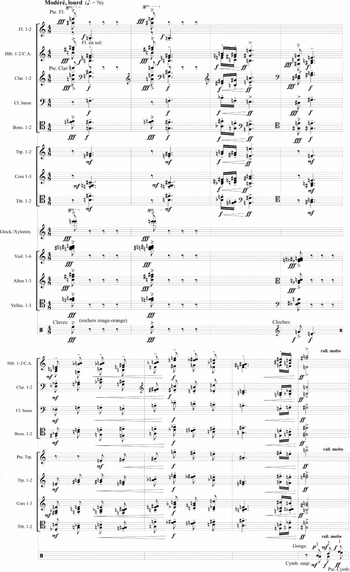
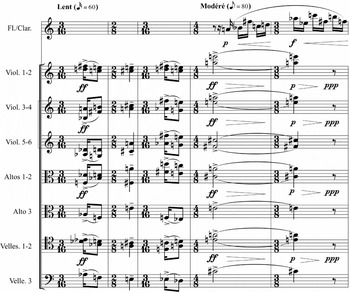
The first encounter with the red-orange rocks of Bryce Canyon features a sequence of harmonies intended to conjure the site's vibrant colours (Example 1). Messiaen deploys a version of his invented first chord of contracted resonance – an altered dominant ninth sonority preceded by a ‘quintuple appoggiatura’Footnote 36 – to evoke, at least in his own mind's eye, red and orange.Footnote 37 The appoggiaturas appear on a staccato accent that precedes a sudden drop in register, reduction of forces to wind instruments, and soft articulation of the altered dominant ninth and its resonance tones, which creates an afterglow that emanates from the brusque initial articulation. A few bars later, Messiaen presents a more languid chorale of harmonies drawn mostly from his third mode of limited transposition, a symmetrical set of intervals that he associates at its first transposition level with orange and gold, according to the preface to the score. Both of these progressions are directional, leading towards the same fanfare climax, a short–short–long pattern that marks a triumphant arrival at E major. Messiaen continues to add colouristic subtlety to the depicted landscape through progressions featuring the chord of transposed inversions, another of the composer's dominant ninth derived harmonies, in subsequent bars.Footnote 38
Messiaen, reduction of ‘Bryce Canyon et les rochers rouge-orange’ from Des Canyons aux étoiles. . ., Fig. 6. © Alphonse Leduc, Paris; reprinted by permission.

This first musical image of Bryce Canyon involves a hermeneutic situation much like that described by Joshua Walden in relation to musical portraiture (i.e., the tradition of representing individual people in sound): ‘a composition's sounds and structures, in conjunction with a name identifying it as a portrait are constructed and heard to evoke abstract attributes of identity such as character, mood, and personality’.Footnote 39 Messiaen, who invoked portraiture to describe the way his nature works act on perception, tells us that this musical excerpt represents the red-orange rocks, therefore unless we have a reason to read against the grain of his labels, the textual cue will likely influence the picture that forms in the mind's eye. Through an intersection of reading the text's indications of colour and perceiving its calculated harmonic equivalent (even without Messiaen's distinct synaesthetic filter), an imagined image of red-orange comes into view. But Walden speaks of the image conjured in musical portraits not as mere pictures of humans divorced from personality but rather as images with features inviting us to imagine and interpret the object in particular ways. Likewise, Messiaen's sonic image of the red-orange rocks suggests that we adopt a particular perspective on the landscape's character. The fanfare that crowns the red and orange chords provides a conventional symbol of monumentality that asks the subject to interpret the landscape as grand, regal, and potent. This fanfare comprises a musical topic, a commonplace musical reference ‘recognizable by members of an interpretive community’.Footnote 40 Although the fanfare's topical associations evolved through musical styles distinct in time and aesthetic from Messiaen's musical language, he makes the connotations of this event clear by coordinating a typical fanfare gesture (short–short–long rhythm and a concluding melodic leap up) with the sudden tonal clarity of E major.Footnote 41 The overtones generated through the particular structure of Messiaen's harmonies may signify specific colours through his personal perceptual code and may ultimately be inaccessible to the subject's senses beyond imagination informed by text, but the horn call becomes a communal event through its rhythmic strategy, melodic profile, and harmonic syntax, which invite the audience to hear and visualize through the filter of similar gestures encountered and interpreted in other musical contexts. Lending tonal and expressive clarity to the conclusion of each progression, the gesture invests the idiomatic harmonic colours with familiar qualities of timelessness, royalty, and power.Footnote 42
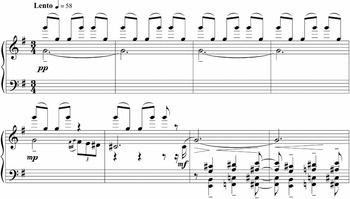
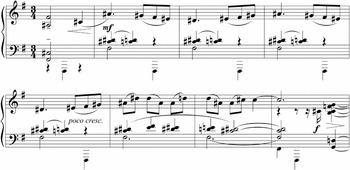
This network of associations surrounding the red-orange rocks suggests a particular response from listeners. From a pictorial perspective, the fanfare acts as a representational marker of landscape qualities, but it also promotes an attitude of awe or reverence. Like Elstir's painting and Messiaen's notion of musical portraits, which ‘cry out with life and truth’ to the auditor, the Bryce Canyon rocks suggest not simply image but rather engaged reaction, a point made clearer by comparing Messiaen's music with Ferde Grofé’s depiction of ‘The Painted Desert’ in his Grand Canyon Suite (1931). Grofé’s programme for the second movement is similar to Messiaen's for Bryce Canyon with its emphasis on the striking colours reflected by vast geological formations: ‘The desert is silent and mysterious, yet beautiful. As the bright rays of the sun are reflected against the majestic crags and spread across the sands in varying hues, the entire scene appears as a canvas thick with the pigments of nature's own blending.’Footnote 43 Although Messiaen and Grofé’s impressions of America's canyons are similar in emphases, the two movements diverge in the responses they solicit from their respective audiences. Like Messiaen, Grofé focuses on harmonic resonance and timbral colour in the opening of his movement, creating mystery in bb. 7–8 through what he calls ‘weird chords’ in the lower parts of the orchestra above a tense pedal pointFootnote 44 (really a Debussian progression of triads with added sixths and seventh chords in parallel motion)Footnote 45 (Example 2a). But despite each composer's use of (albeit distinct) added-note harmonies to capture the vibrant colours of US canyons, these progressions are contextualized to evince different expressive results: whereas Messiaen's fanfare steers the listener's interpretation of foregoing harmonic colour towards contemplation of the landscape's power and importance, Grofé uses his added-note chords to add mystery after a legato tritone descent (bb. 5–6) and then as accompaniment to late Romantic lyrical chromaticism, which recasts the protracted harmonic tension as a mirror for human desire most fully expressed in the effusive melody (Example 2b). Colour may comprise a key component of Grofé’s ‘painted desert’ and Messiaen's version of Bryce Canyon, but their respective topical references frame the encounter with canyon colours differently, affording distinct responses to harmonic materials: in Messiaen's case, the music moves the listener not to internalize the landscape in a negotiation of private emotion or ecstatic reverie but rather to recognize and respect the canyon's immensity in the way one might revere a heroic figure.
Piano arrangement of Ferde Grofé (arr. D. Savino), ‘The Painted Desert’ from Grand Canyon Suite, bb. 1–8. © 1932 (renewed) EMI Catalogue Partnership. All rights controlled and administered by EMI Robbins Catalog Inc. (publishing) and Alfred Music (print). All rights reserved. Used by permission of Alfred Music.

Piano arrangement of Ferde Grofé (arr. D. Savino), ‘The Painted Desert’ from Grand Canyon Suite, bb. 34–41. © 1932 (renewed) EMI Catalogue Partnership. All rights controlled and administered by EMI Robbins Catalog Inc. (publishing) and Alfred Music (print). All rights reserved. Used by permission of Alfred Music.

Although Messiaen's red-orange rocks invite a reactive attitude – possibly the composer's attempt to transfer his own feelings of awe to the listener – the initial canyon portrait keeps the subject largely at a distance: the vibrant harmonic colours and fanfare climax suggest reverence in response to breathtaking sights but not necessarily close corporeal involvement. The fanfare affords an emotional response, but despite Messiaen's belief that harmonic colour has the power to ‘shake our sensibilities’,Footnote 46 the music representing the red-orange rocks emphasizes immensity and potential potency without affording disorientation. But as Messiaen continues to explore harmonic colour following the fanfares, the music moves gradually away from signifying the canyon's power: some of the textures associated with the initial image of Bryce Canyon recur, such as chorales of colouristic harmonies, staccato accents followed by sudden drops in register, and the conclusive E major triad that returns in several phrases, but the fanfare disappears, Messiaen substitutes different transpositions of his invented harmonies, and new rhythmic material intervenes. This defamiliarization process suggests increasing distance from the initial impression and transition towards the next location, which will disrupt the representation with a more overwhelming and transformative experience.
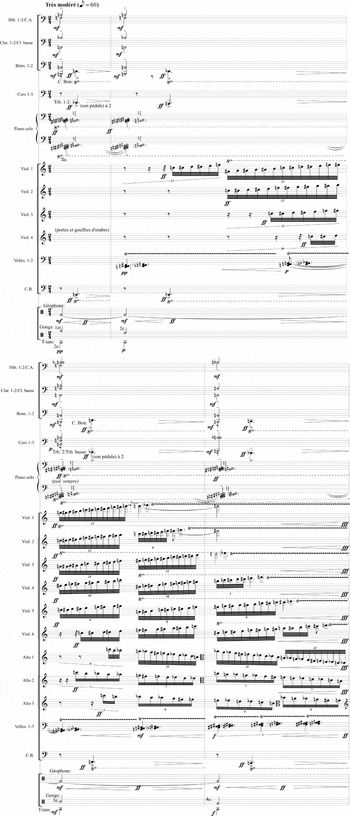
Whereas the initial depiction of the red-orange rocks facilitated a way of imagining and responding, the next phase cultivates a more thorough sense of being in the canyon.Footnote 47 Aiming to counterbalance the vibrant colours of the rocks with an image of darkness within their recesses, Messiaen designates music for the ‘doors and abysses in shadow’ at Figure 17 (Example 3). His musical materials do not evoke darkness in a purely representational sense (even if the dense chromaticism may have signalled as much in Messiaen's mind)Footnote 48 but rather seem designed to induce a form of vertigo by overwhelming the senses and removing topical points of reference. Instead of offering objects for contemplation, the various musical elements are coordinated to exert a visceral force on the subject. Messiaen turns away from the invented resonance chords and modes of limited transposition that evoke canyon colours, electing instead brash cluster chords in the depths of the piano, which in partnership with the woodwinds, supply all the chromatic tones except D; the trilled cellos complete the aggregate a bar later. The seemingly unmediated power of the ever-increasing dissonance is exaggerated further by a blaring trombone in half-step descent and a disorienting canon of rising chromatic demisemiquavers placed in individualized irrational rhythmic groupings. The canon splits the string section into nine, tightly overlapping parts, which form a texture-saturating micropolyphony that effaces the identity of individual lines. Messiaen's strategy of maximizing harmonic dissonance progressively and fracturing the integrity of textural order and melodic or topical identification puts the ability to conceptualize any symbols of the landscape in abeyance.Footnote 49 Daniel Grimley's description of the storm music at the conclusion of Sibelius's Tapiola would fit the shift in subject position created by Messiaen's musical shadows because they too afford ‘a form of immersive audition in which the landscape ultimately consumes the listener [through] a moment of maximal dynamic and chromatic saturation’.Footnote 50 Rather than contemplating the components of landscape, the subject is simply enveloped by the music's comparative excess. Thus the shadows music invites a different mode of being in the landscape, collapsing the distance between observer and observed by shattering the conceptual security of the earlier fanfare, which now seems like a foil for the cognitive challenge that follows. The silence that concludes Messiaen's shadows music leaves the perceiving subject without an image or set of associations upon which to reflect; subjectivity has been consumed by the landscape, swallowed by the caverns.Footnote 51
Messiaen, reduction of ‘Bryce Canyon et les rochers rouge-orange’ from Des Canyons aux étoiles. . ., Fig. 17. © Alphonse Leduc, Paris; reprinted by permission.

When he recounted his own descent into the Utah canyons, Messiaen described a journey in which each position along the way affords a distinct experience that follows from the last:
I'd seen them from on high, with the vertigo of the abyss, that's important, one sees vast black holes against the red of the cliffs. Afterwards my wife and I went down the trails, very carefully, never leaving the paths and we made our way to the depths, all the way to the bottom. From the depths of the abyss, we could see the path circling very high above us, and that is what inspired the title of my work, From the Canyons to the Stars, one progresses from the deepest bowels of the earth and ascends towards the stars.Footnote 52
Messiaen suggests a parallel between his own three-part journey of changing perspectives (the view from above, the descent to the depths, and a progression out of the canyon with attention towards the heavens) and the heavenward focus of canyon representations in Des Canyons as a whole. As we have seen, musically simulated height (awe-inspiring observation), transition, and depth (overwhelming immersion) comprise key subject positions of the Bryce Canyon movement itself.
The movement's form, however, turns the progressive narrative (height–depth–sky) projected by Messiaen's remarks into a temporary loop of ascent and descent, image and engulfment. After the immersive shadows music concludes in silence, Messiaen returns to the piece's introductory birdsongs, which set up a repeat journey that will again shuttle the willing subject between states of reflective observation and enveloping rupture with the same musical strategies. But the return involves subtle variations in transposition levels and lengths of chord progressions and phrases. This repetition with difference requires the subject to rehear the landscape and to reconcile diverse and complementary impressions of each location. The modified repetitionsFootnote 53 suggest that the immersion afforded by the shadows music serves not only as a climactic arrival in the form – a tourist stop – but rather an intensifying factor in a perpetually evolving process of inhabitation with the potential to deepen and transform the subject's experience with each varied return. Anthropologist Tim Ingold's distinction between wayfaring and transport sheds light on the Bryce Canyon movement's ‘modality of travel’: ‘The wayfarer is continually on the move. More strictly, he is his movement. [. . .] the wayfarer is instantiated in the world as a line of travel. [By contrast] transport is destination-oriented. It is not so much a development along a way of life as a carrying across, from location to location, of people and goods in such a way as to leave their basic natures unaffected.’Footnote 54 Messiaen's canyon loop suggests that the journey is composed of more than functional connections between a set of identifiable and sequential destination points, which Ingold associates with the goals of transport;Footnote 55 rather, doubling and altering the journey (including transformations of intervening material) devalues efficiency and situates the subject along a perpetually enriching ‘line of travel’ whereby transitional music marks paths of significance, rather than utilitarian bridges, between distinct subjective states, thus becoming domains of experience in their own right. Through repetition and variation of all parts of the musical journey, Messiaen supports a wayfaring fantasy of progressive immersion, an ongoing and subjectively transformative experience of being drawn in from the red-orange rocks to the shadowy depths.
When the red-orange rocks theme returns for a third time at Figure 40, it affords a different type of engagement. The elements signifying the red-orange rocks now appear in a retrograde canon mostly between strings on the one hand and winds on the other. This varied return sets the subject on yet another phenomenological course, which can be interpreted as a product of the previous encounters. Merging qualities of the red-orange rocks and the shadows music, the expressive impact of the retrograde canon facilitates both contemplation and disorientation: the fanfare transforms from a concluding gesture to a ubiquitous presence, but one hears the proliferating theme as if in a sonic hall of mirrors. Because the music configures a retrograde canon rather than immediate imitation, the echoes are recognizable but delayed or premature, inconsistent and distorted.
This altered primary theme suggests a lingering instability in the relationship between subject and object, bearing a kinship with what Christopher Hitt calls the ‘ecological sublime’, in which a rupture of subjectivity caused by astonishing natural phenomena can ‘restor[e] the wonder, the inaccessibility of nature’ in an era of technological destruction.Footnote 56 Hitt views such phenomenological disruptions as ethical lessons in sustained vulnerability and the limits of our ability to rationalize encounters with the natural world: ‘In an age of exploitation, commodification, and domination we need awe, envelopment, and transcendence.’Footnote 57 Sustained by the distorted echoes, the third type of experience with Bryce Canyon suggests a similar humility for Messiaen's audience as the repeated overwhelming confrontations with the canyon lead to a new perspective and governing attitude towards the original image of red-orange rocks: the music suggests astonishment and uncertainty as the subject listens in a liminal space between observing recapitulated canyon features and reflecting on those observations through the filter of immersive disequilibrium, merging characteristics of formerly distinct points on the loop from outside to inside and back again cultivated throughout the movement. The retrograde canon inhibits conceptual mastery of the canyon, producing instead a lingering awe that exposes the impossibility of detached observation: we receive the canyon now in recognizable but fragmentary form, which disperses the canyon's image and its conceptual security in multiple directions simultaneously.
The transformative experiences within Messiaen's musical version of Bryce Canyon necessitate a revision to the way we have interpreted his portrait metaphor to this point. Proust's description of Elstir's fictional paintings cited above helped us conceptualize Messiaen's music as more than sonic translations of reality and instead as means of provoking emotional encounters with and engaged curiosity towards musically mediated landscapes. Yet, despite the ways the narrator is drawn towards Elstir's painting and its defamiliarized persona, Proust's image remains an engrossing object for viewing much like the red-orange rocks music starts the journey of the Bryce Canyon movement as a dynamic object for contemplation and reverence. Because the immersive effect of Messiaen's shadows music and the disorientations that follow not only provoke responses to the landscape but also cultivate a sense of being in it, Proust can only take us so far. Messiaen's musical portraits must ‘cry out’ to us in another way: in one sense, they call us to engage with landscape through careful observation and response, but they also breach the frame at times to draw us into the imagined setting, affording the perception of being within by overpowering the senses and creating a mode of distracted listening. When Tim Ingold turns to Bruegel's painting The Harvesters as a metaphor for landscape phenomenology, he suggests that we not look at the painting but rather imagine ourselves sitting at a particular place within it:
So accustomed are we to thinking of the landscape as a picture that we can look at, like a plate in a book or an image on a screen, that it is perhaps necessary to remind you that exchanging the painting for ‘real life’ is not simply a matter of increasing the scale. What is involved is a fundamental difference of orientation. In the landscape of our dwelling, we look around.Footnote 58
Ingold's thought-experiment uses an imagined experience of landscape painting to shed light on how we can understand our placement amid our surroundings. A similar orientation is suggested by Messiaen's third encounter with Bryce Canyon, which through a distracted mode of listening prevents the adoption of a single vantage. Rather, the echoes provide a means of observing from within as they fragment and multiply the image in ways that, perhaps mimicking echoes within the canyon, direct our attention in multiple directions at once. In this light, Messiaen's uses of retrograde imitation can be interpreted as a way of replacing representation (looking at) with a spatial dimension (looking around). As a result, the extensive birdsong passage that follows the third red-orange rocks encounter takes on a new aura of wonder: the humility cultivated by the red-orange rocks music supports a properly conditioned attitude for not only looking around but also listening around.
The red-orange rocks music appears in its original form again at the end of the work, but with its stability in question. Interrupted by a reduction in orchestral forces right at the moment of climax, the last fanfare seems more tentative than those preceding it. When the winds join the texture to crescendo to fortississimo on the final chord, projecting the power of the landscape once more, the percussion section follows suit. The barrage of sound tests the limits of intensity for the ensemble and the listener, leaving open the possibility of rupture once again. The movement ends but not the journey as the wayfaring subject wanders towards and through the experiences to come in the next movements.
Place
How close does this musically negotiated experience take us to its inspiring place, Bryce Canyon? The difficulty of arriving in Bryce Canyon is that we hear it through double mediation. First, to engage with Messiaen's interpretation of Utah on its own terms by adopting its implied subject positions is to encounter the setting through the filter of Messiaen's ‘shaping perception’, Simon Schama's term for the means whereby raw matter becomes meaningful as landscape.Footnote 59 Experiencing Bryce Canyon via the music's cues involves adopting another's way of listening, seeing, and feeling, a reality that Messiaen admits.Footnote 60 Not to mention that one of the gestures that defines this landscape appears also throughout the final movement, which depicts an entirely different canyon, Zion Park: the fanfare that marks the monumentality of Bryce Canyon with its step down and large leap up over a short–short–long rhythmic pattern bears more than a passing resemblance to a recurring three-chord figure in the finale (Example 4) as both progressions direct the momentum of two quick homophonic chords towards a triumphant harmonic resolution. Although the Zion Park progressions often feature softer dynamic markings, sometimes use legato articulations, and delay the resolution by making the second chord slightly longer than the first, the intra-work reference is made explicit when the first violin adopts the dramatic step-leap contour – formerly assigned to the trumpet and oboe for the Bryce Canyon fanfare – in the progression that resolves at bar 4 of Example 4. The emphasis on A and E in the chord structure distinguishes the harmony's identity as a major triad with added-sixth (at least in this particular instance). Its implication of harmonic resolution through relative consonance and conclusively elongated duration and its frequent recurrence throughout the movement connect the chord with the sound and function of the E major sonority that dominates moments of arrival in the Bryce Canyon movement. Although the difference in colour associations created by the distinct transposition levels of the correlated harmonies would have certainly mattered to Messiaen, the similarities between themes and textures representing different locations suggest that to journey through one of his musical landscapes may be to traverse many from a stylistic point of view.
Messiaen, reduction of ‘Zion Park et la Cité céleste’ from Des Canyons aux étoiles. . ., Figs. 17–18. © Alphonse Leduc, Paris; reprinted by permission.

A second type of mediation takes place not through the prism of Messiaen's subjectivity and creative choices but rather via the filters that we bring to our hearings of the work: much like the way one might interact with ‘portraits of past centuries’ with which Messiaen says we can make personal connections despite our distance in time and place, his musical landscapes border our own as the sound is absorbed into the terrain of the concert hall and the music marks mental paths through places we remember or imagine foreign to the inspiring location of the work.Footnote 61 The irony of the music's immersiveness is that when the piece draws the subject towards Bryce Canyon, the hermeneutic path – at least from a representational point of view – forks towards Messiaen's destination or our own, but ultimately away from Utah.
Given the emotional and visceral perceptions of landscape produced by the music, an alternative way of classifying Messiaen's version of Bryce Canyon is to describe it not through a binary of authenticity and inauthenticity but rather as a confluence of compositional and perceptual factors that produce a virtual place in its own right. Here again, the distinction between a pictorial reading of Messiaen's music and a phenomenological approach is essential. Arguing that music is itself a type of place ‘replete with its own metaphorical locations, types of motion, departures, arrivals, and returns’, Holly Watkins observes that music's power to produce a sense of place lies at the intersection of embodiment and imagination: it has a locating ‘physical impact on our bodies’ while at the same time it ‘transports us into alternate realities, into virtual environments of its and our own synergistic making’.Footnote 62 Messiaen's Bryce Canyon engages a multitude of terrains, working out Watkins's implication that musical place is not a singular dimension but rather a constellation of physical experiences, stylistic properties, and leaps of interpretation bound up in a process of dislocation and relocation. Messiaen's and our own displacements of Bryce Canyon are best considered not as symptoms of the work's semiotic failure but rather as necessary means of finding particular types of places in his music.
Instead of understanding Messiaen's music inspired by the natural environment as a discourse of straightforward representation, a focus on the placeness of his music entails exploring Des Canyons and similarly themed works as means of journeying through distinct domains of experience, as I have demonstrated above. Crystallizing a position held by various humanistic geographers, Lawrence Buell describes place not as properties of objects in a physical setting but rather as ‘perceived or felt space, space humanized, rather than the material world taken on its own terms’.Footnote 63 The things that mark a place may provide a necessary structure to the environment, but perception more so than taxonomy defines placeness. Thus, to stand in Messiaen's musical canyon as a place is not only to remark on the accurate birdsongs and apt redness of the rocks – if indeed we hear the colours that he prescribes – but also to sense the collapsing distance between self and object conditioned by the music's shifting sonic properties, to note the ways that sound ‘cries out’ for us to feel its power and disorientations, and to invest these fluctuating states of being with associations and memories that might activate their meaning.
So what kinds of meanings did Messiaen hope his listeners would find in the felt space of the musically simulated Bryce Canyon? To explore this question, we return to our initial point of departure in pursuit of the political and theological implications of Messiaen's choice to create such a musical place: Messiaen's desire for intimate experience with Utah's natural environment and the bicentennial commission of Des Canyons.
Politics and theology
Although Messiaen remarked in retrospective interviews that Des Canyons was commissioned by Alice Tully to honour the bicentennial of the United States, references to the occasion are conspicuously absent from materials surrounding the work and its premiere. The score, which appears to contain the original programme notes, mentions Tully and the research trip to Utah and records in detail the people involved in the New York premiere; the only piece of information missing is the reason for the commission. The promotional flyer for the premiere describes the work as ‘an homage to man's faith in a higher order’ and a ‘celebration of the creation of all things which abound in our universe’ and links the work with intended Christian themes of divine power and resurrection instead of an inspiring occasion. A New York Times advertisement for the concert simply describes the event as ‘Olivier Messiaen's New Work’Footnote 64 while a quote by Messiaen in John Rockwell's feature article anticipating the premiere mentions only that Tully offered the commission in response to a successful past performance of the composer's Oiseaux exotiques (1955–56).Footnote 65 Reviews of the premiere in the New Yorker and the New York Times Footnote 66 focus on themes typical of discourse about Messiaen – birdsong, colours, religious symbolism – without any reference to politics, suggesting that in the end, the bicentennial played no role in the public imagination of the occasion, perhaps because the work was completed early and premiered two years before the actual bicentennial year or because Messiaen held a particular aversion to recognizing his works as occasional.Footnote 67 Regardless of the nature of the commission, the omission of politics is unsurprising as Messiaen was a French citizen who generally cultivated the image of ‘a devout artisan with eyes fixed on heaven, unconcerned with worldly affairs’;Footnote 68 and although many of his works stemmed from specific inspiring events or commissions, the composer's relationship with politics has often proved elusive to scholars.Footnote 69 His preferred non-political hermeneutic categories seem to have dominated the promotion of and journalistic response to Des Canyons.
Despite the practical reasons for removing the bicentennial from the public presentation of the piece, Messiaen's remarks in interviews suggest that he took the commission's status as a piece about America and what the subject matter would communicate about his relationship with the country quite seriously: ‘Writing a work for the United States implied that I like the United States, that I even love it. But how to love those skyscrapers I cannot stand? So I searched in my library and found in an art book the most beautiful thing in the United States: Bryce Canyon in Utah.’Footnote 70 To interpret the premature premiere or the lack of references to the upcoming occasion as indications of Des Canyons’s apolitical status is to miss the piece's implicit political statement about the country's natural resources and what Messiaen perceived as its urban priorities. Although heartened by the enthusiastic public reception of the work, Messiaen was baffled by the critics’ lack of understanding, which he attributed to their urban aesthetics: ‘I wonder if they could understand that the beauty of America is not concentrated only in the New York skyscrapers.’Footnote 71 The forcefulness of Messiaen's response seems aimed at reconfiguring what he perceived as an American metropolitan value system, which according to the composer was too heavily conditioned by an appreciation for architecture and technology rather than the country's equally powerful, naturally occurring beauty. He treats skyscrapers as a metonym for America's obsession with the ‘technological sublime’, a term used by Leo Marx to describe the way ‘the awe and reverence once reserved for the Deity and later bestowed upon the visible landscape is directed towards technology or, rather, the technological conquest of nature’.Footnote 72 Messiaen's choice to frame the inspiration for Des Canyons through a city/nature binary and his verbal refusal to be awed by human technological achievement imply a political subtext for the work whereby evocations of the natural environment are linked with Messiaen's desire for audiences to follow his lead away from the cities and into the canyons.
Messiaen's remarks cited above in which he describes his works as portraits that ‘cry out with life and truth’ take on new meaning in this context: if Messiaen saw his musical evocations of the natural environment as a means of connecting audiences meaningfully to a sometimes unfamiliar location, these virtual encounters with the canyons of Utah may also have power to persuade audiences about their real-world value.Footnote 73 The immersive properties of Messiaen's Bryce Canyon movement support his advocacy for dwelling in nature by not only signifying the location but also emplacing urban American listeners in a musical version of the canyon setting with the power to awaken their senses. Messiaen, like those before him who cultivated notions of pastoral escape, believed that nature affords the purest type of existence. Although he was a resident of and teacher in Paris, Messiaen did much of his compositional work in Petichet's Alpine environs.Footnote 74 He spoke of transcribing birdsong in particular as a ‘factor of health’ through which he could deal with the ‘misfortunes and complications of life’Footnote 75 and by which he could escape what he perceived as the ‘horror of cities’.Footnote 76 In an interview with Bernard Gavoty in 1961, Messiaen described birdsong similarly as a ‘refuge’ from the ‘dark hours’ in which the notes lose their meaning and work seems futile.Footnote 77 The personal quality of these remarks reflect the composer's belief in an internal transformation that takes place through engagement with the natural environment. Insofar as Messiaen's music draws listeners into the scene by playing on cyclical subjective states of observation and engulfment, the simulation of a Bryce Canyon experience presents the potential for Messiaen's audience to feel the psychological value of being astonished from within the canyons especially directly and personally.
The work's status as a counterargument against metropolitan values is made more salient by the way Messiaen affords an intensified experience of rocks and birds within Bryce Canyon while intentionally leaving the sights, sounds, and experiences of civilization – and presumably the social and mental complications they created for Messiaen – just outside the frame.Footnote 78 Again, Messiaen's own access to Bryce Canyon during his visit to the United States was marked by unavoidably touristic modes of entering and seeing the national park (e.g., passing by and staying in an inn with ‘cowboy-style rooms’ at the entrance).Footnote 79 Although fully aware of the encroaching presence of commercialism and industry on the Utah canyons, Messiaen designed a musical experience of Bryce Canyon that turns blindly away from markers of tourism: the landmark views itemized in Messiaen's diary are absent from score annotations, which focus the subject's experiences instead on an imagined acultural interior of the territory and what he saw as its superior phenomenological benefits. Focusing on the geological formations themselves to the exclusion of culture, Messiaen – naively or not – separates Bryce Canyon from its complicating human histories of inhabitants (Puebloans, Utes, Paiutes, Navajo, Spanish explorers, Mormons, and the US Army at various points in time), their displacements,Footnote 80 and the development of irrigation methods, roads, lodging, and land agreements that served the development of tourism in the region.Footnote 81 If Messiaen's work is not apolitical, it does promote an ahistorical image of the canyon, supporting his idealization of dwelling in the natural environment apart from society as a ‘factor of health’. Messiaen facilitates this retreat from the civilized border of the canyon by orienting the audience's imaginations primarily vertically rather than horizontally: the work's title – in English, From the Canyons to the Stars – suggests a series of perspectives in which earth is drawn up to the sky, an infinitely unbounded dimension. Messiaen's music facilitates a primarily vertical trajectory within Bryce Canyon through vacillation between signifiers of rocks and birds, through centripetal loops connecting the shadowy depths with colourful heights, and in the force of simulated immersion, which, through textural and harmonic saturation, evokes bewilderment that points one's attention simultaneously downward towards human vulnerability and upward towards divine power. These modes of perception suggest that the listener engage emotionally, physically, and spiritually with the country's geological assets as an exclusive and effective antidote to city life.
In addition to the political implications of Messiaen's subject-positioning in Des Canyons, his construction of Bryce Canyon as a musical place serves a complementary evangelistic purpose as one of many attempts to bridge the sometimes frustrating gap between his compositional and theological priorities on the one hand and his audience's aesthetic interests on the other. In several contexts, Messiaen lamented being a ‘composer-believer’ who ‘speak[s] of faith to atheists’ and an ‘ornithologist’ who ‘speak[s] of birds to people who live in cities’.Footnote 82 Reflecting his Aquinian conviction that God's presence and power are manifested in all creation and are thus accessible through direct experience with nature,Footnote 83 Messiaen lays out two interrelated oppositions, wishing that his audience would embrace the natural environment as a means of developing faith and break free from the twin hindrances of mechanized civilization and secularism. Through the musically mediated experience of Bryce Canyon, Messiaen emplaces listeners in a context with the potential to facilitate their revaluation of faith through awe inspired by nature.
Robert Sholl has argued that much of Messiaen's music is aimed at reorienting listeners in a modernist context towards God's redemptive power and grace;Footnote 84 and if Marx is correct that human technological achievement has come to rival deity as an object of worship and nature encounters as a vehicle for astonishment in Western societies, Messiaen's virtualization of Bryce Canyon works against that cultural trajectory by inviting the observer to feel the landscape as an indicator of divine truth, will, and might – as a set of signs and experiences that might inspire awe leading to worship. In the preface to Des Canyons, Messiaen describes the relationship between the canyons and the stars in theological terms as ultimately a way of perceiving what is beyond the stars (‘the resurrected in paradise’) in order ‘to glorify God in all his creation’, suggesting a link between the ‘physical sky’ and the ‘spiritual sky’.Footnote 85 Thus, Messiaen might agree with Hitt that ‘in an age of exploitation, commodification, and domination we need awe, envelopment, and transcendence’,Footnote 86 but he aims his work to direct such humility indexically towards the Christian God. More than itemizing and describing the landscape objects, Messiaen's music-driven canyon experience seems designed to provoke a response from the secular city-dweller in particular, guiding the urbanite towards nature's physical importance and Christian meaning through an aural simulation of place. Messiaen's Bryce Canyon answers the shocks threatening consciousness in modern city lifeFootnote 87 by providing an equally forceful and potentially transformative experience that would support an eschatological interpretation of the canyon's grandeur.
Messiaen's programme for Des Canyons draws the natural environment into what Robert Fallon calls ‘Messiaen's all-consuming, fantastic Christian cosmology of nature and culture’Footnote 88 as the landscape serves larger themes of ‘suffering, fear, grace, resurrection and the healing power of the beauty of creation’.Footnote 89 But the work also addresses American identity through a Messiaen lens and can thus be read as a unique fulfilment of the bicentennial commission: Messiaen's remarks on Des Canyons situate nature and faith not only as key components of his unique brand of universalism but also as cultural gaps to be filled.
Conclusion
A 1948 Utah tourism brochure declared: ‘COLOR IS LIFE! UTAH IS THE LAND OF COLOR!’Footnote 90 Surely Messiaen would have agreed with this description and its boisterous mode of delivery. However, to classify Des Canyons as a promotion of American tourism would be to miss the point of the work's immersive properties and to misalign Messiaen's goals with the country's long history of advocating for ‘tourism as a patriotic duty’ by mapping ‘quintessentially American places’ to see and experience as symbols of the nation's exceptionalism and spirit.Footnote 91 Although Messiaen himself may have been a tourist travelling to see (in his words) ‘the most beautiful marvels of the world’, the composer's politics in Des Canyons are not touristic in nature. Tourism is a temporary activity contingent on the ability to ‘terminate experience and return to the world’ as conveniently as possible.Footnote 92 Messiaen's work may promote travel, but instead of advocating for growth in the Utah tourism industry, Des Canyons proposes the need for a more thorough transformation of the perceiving subject that remaps the priorities of urban America away from landmark views towards a more permanent attitude of inhabitation.
In his essay on Mount Messiaen, a site in Utah near the canyons named after the composer in honour of Des Canyons, Robert Fallon recounts the history of the location's inhabitants, the remarkable dedication of the mountain to the composer, and the difficulty of finding its location. Fallon fills in historical details with personal reflections on the way ‘the literal, physical geology [. . .] moulded [his] figural understanding of Messiaen’ and vice versa.Footnote 93 His ruminations reflect a unique dialogue between land and memory, geological present and historical past, musical experience and mountain experience. Fallon's scholarly and personal adventure provides a metaphor for what it means to dwell in Messiaen's musical places as we find meanings made possible only when Messiaen's sonic terrain and our inner landscapes meet. Each of us brings unique orientations towards Messiaen's music, his inspiring locations, and their complicated histories. We put these presuppositions in dialogue with Messiaen's challenge to rethink and re-feel our orientation as he advocates both symbolically and phenomenologically for the rewards of natural environment and the Christian redemption to which he believes they point. He hoped that musically negotiated experiences of nature – and the actual pilgrimages they might inspire – would not simply increase tourist travel to particular destinations but rather cause the defining markers of his urban listeners’ inner landscapes – technological existence and atheistic conviction – to be replaced by a love for dwelling in the natural environment, which leads to faith. Certainly not everyone would be willing to allow such a transformation, but no matter our initial orientation towards Messiaen's faith, politics, and aesthetics, we should not underestimate the potential for his musical landscapes to etch themselves onto the terrain of our inner being.