INTRODUCTION
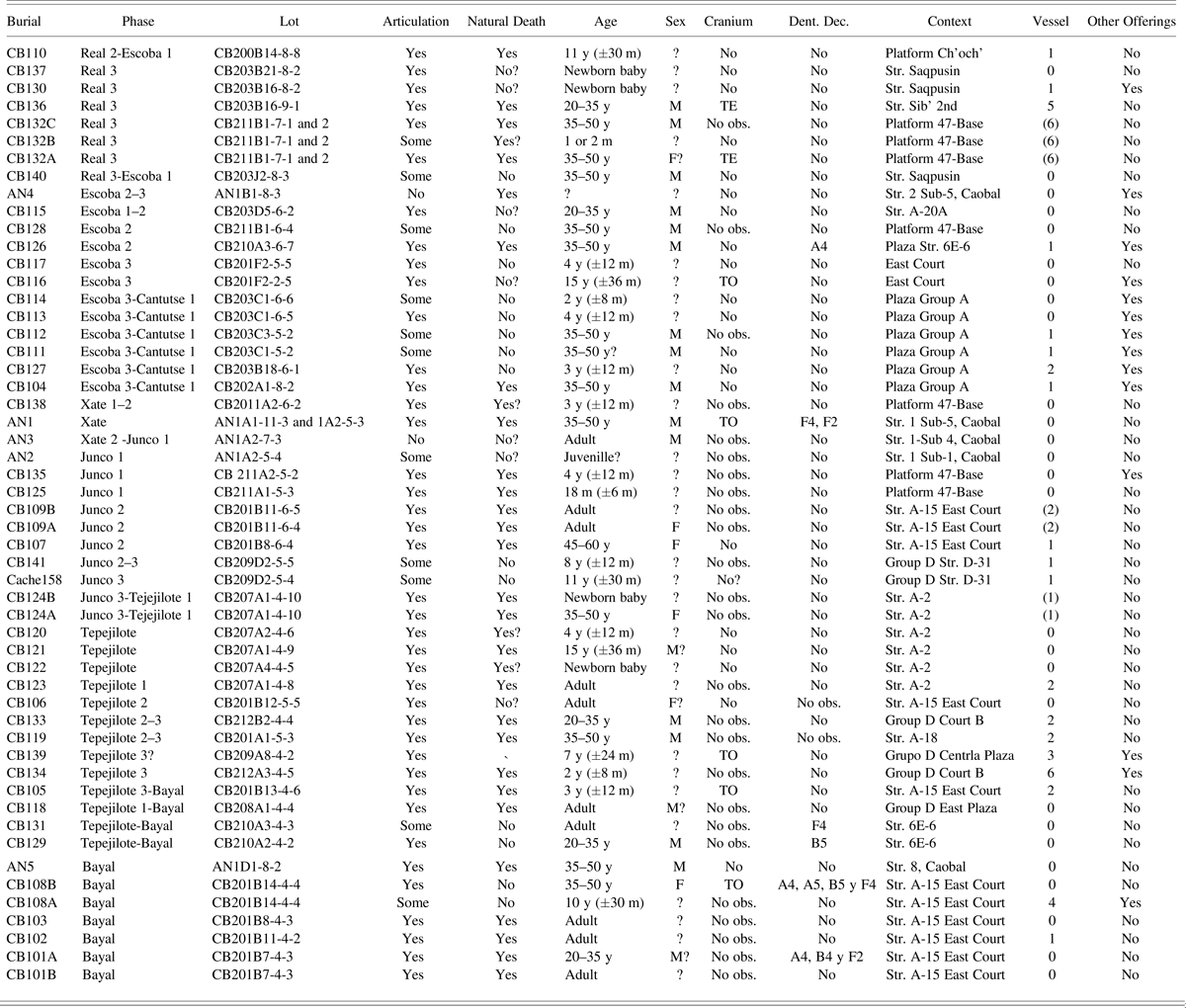
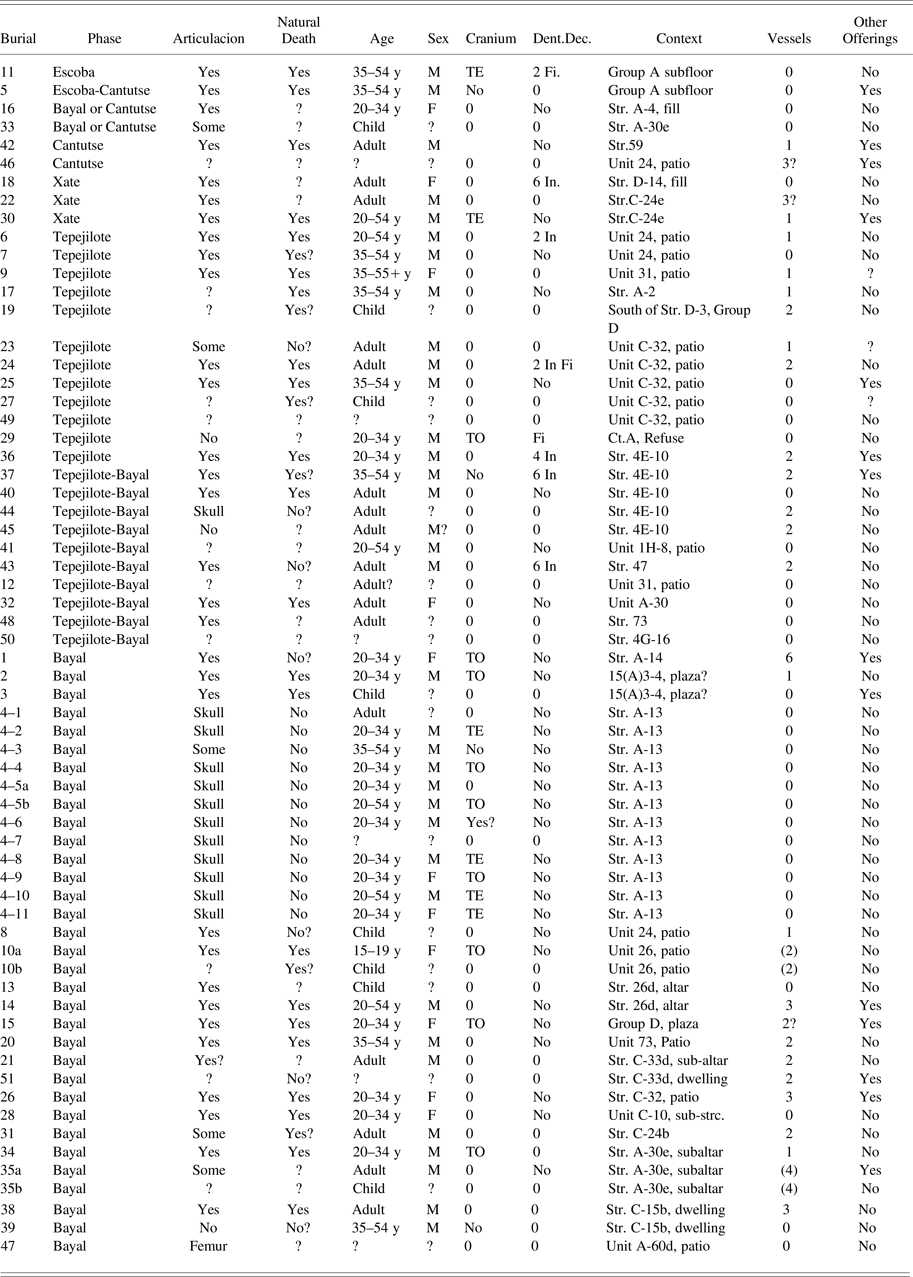
Archaeological investigations at the center of Ceibal by the Ceibal-Petexbatun Archaeological Project (Ceibal Project) have provided substantial bioarchaeological data. In addition to the burials uncovered by Harvard University in the 1960s, this paper focuses on burials found during seven field seasons (2005, 2006, 2008–2012) of the Ceibal Project, whereas some articles in this special section incorporate data from the subsequent seasons. These field seasons of the Ceibal Project resulted in 48 burials with a minimum number of 53 individuals from various contexts, including open plazas and residential groups. Excavations by Harvard University uncovered 51 burials with a minimum number of 58 individuals (Tourtellot Reference Tourtellot and Willey1990). The burials found by the Harvard Project were enumerated from 1 to 51, whereas those uncovered by the Ceibal Project were assigned numbers from 101 to 141 (Tables 1 and 2). These remains provide significant information on sociopolitical changes and interregional interaction at critical points of lowland Maya history, including the emergence of sedentary communities during the early Middle Preclassic, the development of larger polities during the Late Preclassic, the transition to the Classic, and political disintegration during the Late and Terminal Classic.
Ceibal Petexbatun Archaeological Project Burials

Notes: Dent. Dec. = Dental Decoration; y = years; m = months, TO = tabular oblique; TE = tabular erect; F = female; M = male; Str. = structure; No obs. = not observable. For a burial with multiple individuals, the total number of vessels is given in parentheses.
The Harvard Archaeological Project Burials based on Toutellot Reference Tourtellot and Willey1990 and Wright Reference Wright2006.

Notes: Dent. Dec. = Dental Decoration; TO = tabular oblique; TE = tabular erect; F = female; M = male; Str. = structure; No obs. = not observable. 0 = Unknown; y = year; In = inlay in teeth; Fi = filed teeth. For a burial with multiple individuals, the total number of vessels is given in a parentheses.
A central goal of this research is to analyze how the mortuary practices (funeral vs. non-funeral deposits) and biological modifications (such as cranial deformations) changed during the Preclassic and Classic periods at Ceibal. By analyzing mortuary practices and cranial modifications, we want to explore whether the individuals with certain types of cranial deformation were of local or foreign origin. This paper discusses the results of the osteological analysis of Ceibal burials (Table 1) along with brief descriptions of their archaeological contexts with a particular emphasis on new data from the Preclassic period. This discussion is based on the annual reports presented to the Institute of Anthropology and History of Guatemala since 2005 (Burham Reference Burham, Aguilar and Inomata2012; Castillo Aguilar and Cortave Reference Castillo Aguilar, Cortave, Inomata and Román2010; Cortave et al. Reference Cortave, Sharpe, Kratsova, Aguilar and Inomata2011; MacLellan Reference MacLellan, Aguilar and Inomata2012; Munson Reference Munson, Inomata, Triadan, Aoyama and Román2010; Ortíz and Ávila Reference Ortíz, Ávila, Aguilar and Inomata2011; Palomo Reference Palomo, Róman and Inomata2010; Pinzón Reference Pinzón, Aguilar and Inomata2012; Ponciano Reference Ponciano, Aguilar and Inomata2012; Ponciano et al. Reference Ponciano, Inomata, Triadan, Ponciano, Inomata and Triadan2006; Román et al. Reference Román, Inomata, Guirola, Muños, Flores, Inomata, Román, Triadan and Aoyama2008; Triadan Reference Triadan, Román, Inomata and Triadan2010; Triadan and Kravtsova Reference Triadan, Kravtsova, Inomata and Aguilar2011) and the monographs published by the Harvard Project (Tourtellot Reference Tourtellot and Willey1990). The chronology of the burials builds on the recent refinement in the ceramic sequence (Inomata Reference Inomata2017; Inomata et al. Reference Inomata, Triadan, Aoyama, Aguilar and Yonenobu2013).
MORTUARY PRACTICES AT CEIBAL: THEORETICAL AND METHODOLOGICAL ISSUES
Methodology
The skeletal material was studied systematically following morphological and metrical sexing and aging methods as described by Buikstra and Ubelaker (Reference Buikstra and Ubelaker1994). Age at death was inferred by examining the degree of dental wear, referencing previous studies by Wright (Reference Wright1994, Reference Wright2006) in the Pasión River region. “Young adults” refer to individuals between 20 and 35 years of age, “middle adults” to those between 35 and 50 years of age, and “old adults” to those older than 51 years of age. On the basis of dental growth development (Buikstra and Ubelaker Reference Buikstra and Ubelaker1994; Ubelaker Reference Ubelaker1989), individuals who did not reach adulthood were classified in three categories: juveniles (from 11 to 20 years old), children (three to ten years), and infants (one month to two years). It is important to emphasize that these categories represent relative and approximate ages. For adult skeletons, sex was estimated by the morphological features of the skull (Meindl and Lovejoy Reference Meindl and Lovejoy1985) and pelvis (Brooks and Suchey Reference Brooks and Suchey1990; Lovejoy et al. Reference Lovejoy, Meindl, Pryzbeck and Mensforth1985). In some cases, it was possible to infer sex by the size of postcranial bones through comparison with data previously collected from burials found in the Pasión River region (Wright Reference Wright2006) and in Tipu, Belize (Wrobel et al. Reference Wrobel, Danforth and Armstrong2002).
Bone surfaces were examined for natural and intentional cut marks. When anthropogenic marks were found, they were recorded according to location and concentration, following the criteria described by White (Reference White1992). A taphonomic analysis was employed to distinguish different patterns of postmortem body treatment and perimortem acts of violence. The authors had the opportunity to excavate some of the burials uncovered by the Ceibal Project. Information on the original disposition (for example, primary or secondary, flexed or extended.) of each burial was assigned after careful examination during field work, and with the help of in situ photographs and drawings made by archaeologists at the time of the excavation.
Natural and Violent Death
By analyzing various types of information, including the manners of death (natural or violent), articulation of the bones, age and sex of the skeletons, burial reuse, and archaeological contexts, researchers can explore cultural processes that may have affected the human remains. Weiss-Krejci (Reference Weiss-Krejci, Agarwal and Glencross2011) argues that the cause and circumstance of death often directly influence the fate of the corpse. For instance, from their moment of biological death, the body of a sacrificial victim taken in a war would most likely go through processes different than the body of a person who died peacefully at home.
A common issue that bioarchaeologists debate is how to distinguish between sacrificial and natural death (Hammond Reference Hammond, Grove and Joyce1999; McAnany Reference McAnany1995; Robin and Hammond Reference Robin, Hammond and Hammond1991; Weiss-Krejci Reference Weiss-Krejci, Agarwal and Glencross2011; Welsh Reference Welsh1988). Tiesler (Reference Tiesler, Tiesler and Cucina2007) proposes a set of attributes that can help us to make this distinction. She argues that burials resulting from natural or accidental causes tend to include all ages of people such as infants, children, juveniles, and adults. Men and women without any evidence of violent death are expected to be found in a regular burial population. The pre-depositional body treatments expected in a natural death of important people include cinnabar applications, adornments and/or grave goods, and sometimes disarticulation of the bones. In sacrificial and post-sacrificial deposits in the Maya area, Tiesler (Reference Tiesler, Tiesler and Cucina2007) argues, there is a predominance of infants, teenagers, and young adult males. These skeletons may exhibit perimortem marks and anatomically abnormal positions of bones. Although the set of attributes described above provides important clues that can be helpful for researchers to make the distinction between natural and violent death (Hurtado et al. Reference Hurtado, Cetina, Tiesler, Folan, Tiesler and Cucina2007; Palomo Reference Palomo, Vega and Lowe2012; Palomo Reference Palomo2013; Tiesler Reference Tiesler, Tiesler and Cucina2007), it is not always possible to make generalizations. For example, Weiss-Krejci (Reference Weiss-Krejci, Ruiz, Ruz and Ponce de León2005) argues that multiple disarticulated individuals and the lack of grave goods are not always related to sacrificial deaths and that no common methodology exists to distinguish between victims of humans sacrifice and natural death. Disarticulated remains could be products of a variety of cultural practices such as body processing, storage, exhumation, collective reburials, looting and desecration, ritual use of bones, and sequential interments in collective crypts and caves, as well as rites of tomb reentry (Fitzsimmons Reference Fitzsimmons2009; McAnany Reference McAnany1995; Weiss-Krejci Reference Weiss-Krejci, Ruiz, Ruz and Ponce de León2005).
We agree that making the distinction between natural and violent death could be problematic (Weiss-Krejci Reference Weiss-Krejci, Ruiz, Ruz and Ponce de León2005). Human sacrifice did occur in ancient Mesoamerica, however, and the victims may have gone through different ritual processes than those from natural deaths. Therefore, the generalized patterns extracted from the previous studies briefly described above (Tiesler Reference Tiesler, Tiesler and Cucina2007) could be useful in the analysis of human remains if we examine them in particular historical contexts of different regions and periods.
Cranial Deformations and Dental Modifications
Cranial deformations and dental decorations were inscribed on the individual's body for symbolic and cultural reasons. Their bodies were made and transformed through social practice. Important events in a person's life were “rites of passage” through which he or she changed social status (Van Gennep Reference van Gennep, Vizedom and Caffee1960[1909]). Geller (Reference Geller, Gowland and Knüsel2006:286) argues that in ancient cultures “it is often during rites of passage that changes are wrought to the body” (for instance, foreskins are excised, nasal septa are pierced, body parts are tattooed, and dentition are modified). During this process, the individuals involved were challenged physically and mentally, with the modification process leading to a changed body and a new identity (Geller Reference Geller, Gowland and Knüsel2006; Knudson and Stojanowski Reference Knudson and Stojanowski2008:411).
The diverse cranial deformations observed in Mesoamerica result from different techniques with various compression kits. To analyze the types of cranial deformation, we will follow the classification established by Dembo and Imbelloni (Reference Dembo and Imbelloni1938), which was adapted by Romano (Reference Romano1965) and Tiesler (Reference Tiesler2014). This taxonomy distinguishes between the tabular oblique, tabular erect, and the annular cranial morphologies, which are produced with different techniques. For example, when an occipital headboard is held in place by strings around the forehead of an infant, a frontally curve tabular oblique shape will result. In contrast, when a posterior plane of an infant cranium is part of a cradleboard and tied in front, the tabular erect modification is identified (Dembo and Imbelloni Reference Dembo and Imbelloni1938; Tiesler Reference Tiesler2014). The pseudo-circular or annular morphologies are achieved by the use of constriction bands, belts, ropes bandages, or another type of wrappings. The techniques used for annular morphologies modifications can produce both tabular erect and oblique shapes. This is why the compression mechanisms and its cranial variation are not categorical. Even within each type of cranial modification, change in the apparatuses or additional constriction bands with strings produce diverse cranial modifications. The overall degree of modification depends on of the postpartum timing of the procedure and the force and duration of pressure (Tiesler Reference Tiesler2014, Reference Tiesler and Cucina2015). At Ceibal there is bioarchaeological evidence that the three techniques discussed above were used to produce cranial modifications. The analysis of recently uncovered burials from the Middle Preclassic period at Ceibal will enrich our understanding of the earliest cranial modifications techniques at the site.
In the Maya area, there are no historical documents before the Spanish arrival about the tradition of cranial deformations or about the gender of those who managed the techniques and implements used for cranial modifications. There are, however, several clay figurines representing women carrying infants who had in their head different cranial deformation devices. Based on these iconographic representations and some ethnohistoric resources (Tiesler Reference Tiesler2010, Reference Tiesler2014), it is possible to argue that women were in charge of conducting the cranial modification while taking care of the infants during the process.
Likewise, there is not substantial evidence about the techniques and people who performed the dental modifications. Nevertheless, as will be discussed below, the early dental modification appears around the same time as cranial deformation in the bioarchaeological record (Saul and Saul Reference Saul, Saul, Whittington and Reed1997). In contrast to the cranial deformations, dental modifications in Mesoamerica do not appear to have been performed before the individual reached late adolescence or early adulthood (Tiesler Reference Tiesler2014). This is why dental modifications are present only in permanent dentition. To analyze the diverse shapes observed in ancient dental decorations, we will follow the classification developed by Romero (Reference Romero1958).
Mortuary Practices, Status, and Beliefs
In the 1970s, some scholars argued that there was a direct correlation between the elaborateness of grave goods, mortuary practices, and status (Binford Reference Binford and Brown1971; Saxe Reference Saxe1971). In this view, the higher the rank held by the individual, the more grave goods and energy were likely to have been expended on the burial. Other scholars (Van Gennep Reference van Gennep, Vizedom and Caffee1960[1909]; Metcalf and Huntington Reference Metcalf and Huntington1991) argued that world views and beliefs could affect mortuary practices. In the 1980s, subsequent generations of scholars (Hodder Reference Hodder1982, Reference Hodder, Miller and Tilley1984; Parker Pearson Reference Parker Pearson2008; Tilley Reference Saxe1984) argued that funerals were lively, contested events where social roles could be manipulated, acquired, and discarded.
All these different views have made significant contributions to the analysis of ancient human remains. For instance, although there might be some exceptions, high-status individuals (for example, the tomb of the Maya king, Pakal) tended to have a greater quantity and quality of grave goods than commoners or non-ancestors. Nevertheless, in some cases during burials, social roles of high-status individuals or ancestors could be acquired or discarded. For instance, during the funerary rituals, an old warrior could become a venerated ancestor, whereas a brave warrior could become a sacrificial victim stripped of his privileged status.
To analyze the human remains and to reconstruct the past from them, we argue that all these diverse views on mortuary practices and their social implications (see Carr Reference Carr1995) need to be integrated into a multidirectional approach.
CHRONOLOGICAL TRENDS
Early Middle Preclassic Real-Xe Phase (1000–700 b.c.)
The settlement of Ceibal was established at the beginning of the early Middle Preclassic period. Real-Xe pottery dating to 1000–700 b.c. represents one of the earliest ceramic complexes in the Maya lowlands (Inomata Reference Inomata, Vega and Lowe2012a, Reference Inomata2017; Inomata et al. Reference Inomata, Triadan, Aoyama, Aguilar and Yonenobu2013). There are no burials recovered from Real-Xe 1 and 2 contexts (1000–775 b.c.) at Ceibal, however.
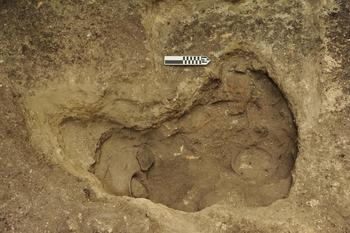
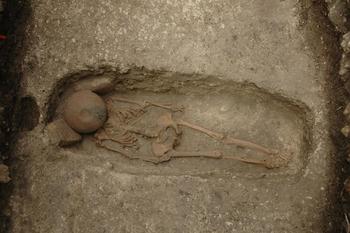
The earliest burials found at Ceibal possibly date to the Real 3 phase (775–700 b.c.), including six burials with a minimum number of eight individuals. One of the most interesting Preclassic interments of Ceibal is Burial 132, which was placed in a pit dug into the natural marl layer in the Karinel Group, a residential complex located near Group A. Burial 132 contained a minimum number of three individuals in a primary context. During the Escoba 2 phase (around 600–450 b.c.) this burial was covered by a corner of a possible residential structure, Tz'unun, and then by Platform 47-Base. Excavators did not find Real 3-phase structures contemporaneous with the burial in this area, and it is probable that the burial was placed in an open area near residential buildings made of perishable materials. The most prominent skeleton (Individual C) was a male between 35 and 50 years old, laying supine with flexed legs (Figure 1). The skull of this individual was in a poor state of preservation and it was not possible to see if he had cranial deformation. Another skeleton (Individual A), found to the left of Individual C, was possibly a female, laying flexed on her left side with her head pointing south. Tabular erect cranial deformation was observed in Individual A. Between the two adult individuals, a total of seven complete vessels characteristic of the Real 3 phase were found (MacLellan Reference MacLellan, Aguilar and Inomata2012). Skeletal remains of an infant (Individual B) were found inside a jar. The growth of the infant's bones suggests one or two months of age (Schaefer et al. Reference Schaefer, Black and Scheuer2009). There are no indications that the adult individuals died in violent ways. The remains of the infant were partially articulated but did not show any sign of violent death, such as cut marks. Was this baby sacrificed or did it die of natural causes? Unfortunately, because of the poor state of preservation, this point remains unclear.
Burial 132, which was placed in a pit dug into the natural marl layer and contained a minimum number of three individuals in a primary context. The photo shows Individual C, a male skeleton that was lying face up with flexed legs. Photograph by Inomata.

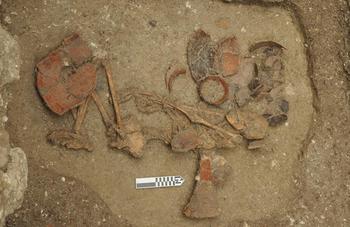
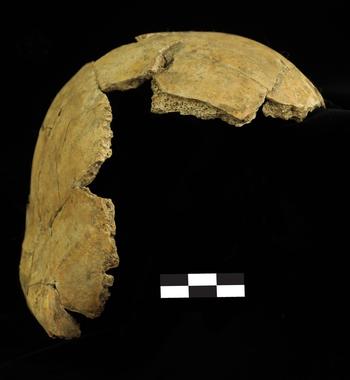
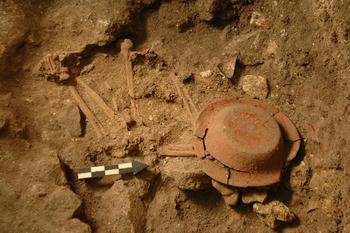
Four probable Real 3-phase burials were associated with the eastern building of the possible E-Group assemblage. Burials 136 was located to the east of Structure Sib’ 2nd (Pinzón Reference Pinzón, Aguilar and Inomata2012). The skeleton was in a flexed position laying on its left side, with its head pointing north and looking west (Figure 2). The individual had tabular erect cranial deformation (Figure 3). No sign of violent death was found. The dental development with a combination of the postcraneal analysis shows that this individual was a young male. The burial location and grave goods suggest that this male adult was an important person of this community. When the next version of the eastern building, Structure Saqpusin, was built in a later part of the Real 3 phase, two articulated newborns were buried separately, both in the fetal position: Burial 137 along the east-west center axis of the building and Burial 130 placed 1.5 m to the north (Pinzón Reference Pinzón, Aguilar and Inomata2012). Measurements of the long bones taken in situ suggest that both individuals were around one month of age (Schaefer et al. Reference Schaefer, Black and Scheuer2009). The remains of the infants were in poor state of preservation and did not show any evidence of disease or violent death. These burials appear to have been placed at the time of construction of Structure Saqpusin and sealed by its floor, however, which suggests that they were dedicatory sacrificial burials. The stratigraphic position of Burial 140, found 4.5 m to the south of Burial 137, is less clear, but it may also date to the Real 3 phase. This adult male was placed on his knees with his arms in the back as if they were bound (Figure 4). This unusual position suggests that this individual was a sacrificial victim.
Burials 136, which was placed to the east of Structure Sib’ 1, the eastern building of the E-Group assemblage. The individual had a tabular erect cranial deformation. Photograph by Inomata.

The cranium from Burial 136, exhibiting tabular erect cranial deformation. Photograph by Palomo.

Burial 140. The adult male was placed on his knees with his arms in the back as if they were bound. Drawing by Palomo.

No dental decorations were found in the burials of this period. Of the eight minimum number of individuals found for this period, at least two of them (Burials 132A and 136) had tabular erect shapes made by cradleboards. Notable for the Ceibal burial record of the Real phase is the paucity, or possibly the total lack, of internments placed under house floors. We suspect that a substantial part of human remains were deposited away from residential complexes, which probably contributes to the difficulty in finding burials dating to this period. This pattern makes a stark contrast with that of the Classic period, in which subfloor burials are prevalent (see below for the social implications of this pattern).
Late Middle Preclassic Escoba-Mamom 1 and 2 Phases (700–450 b.c.)
During the late Middle Preclassic period, the Ceibal residents developed closer connections with other lowland Maya groups (Inomata Reference Inomata2017). Six burials possibly date to these phases. Burial 115 found in front of Structure A-20 contained a prostrate skeleton and some of the bones may have been removed after initial deposition. Although the interpretation of this interment is difficult, its unusual position may point to its sacrificial nature. Burial 128, placed in the Karinel Group, is also difficult to interpret. A lack of the cranium and other bones presents an intriguing possibility that a sacrificial victim was buried in a residential group, but the presence of a tooth in the burial may also imply that the missing bones were removed after initial deposition. Burial 126 contained an adult male skeleton placed in an extended position in a large pit dug into the natural marl layer of the Jul Group outside of Group A. Burial 5 found in the North Plaza, Burial 11 from the East Court, and Burial AN4 from the minor center of Caobal all appear to have been placed in domestic contexts.
Cranial deformation was observed in one skeleton dating to this period: Burial 11 recovered by the Harvard Project, which according to Tiesler (Reference Tiesler2010) had an annular tabular erect head shape made with constriction bands. Dental decoration was observed in two skeletons (Burials 11 and 126). These are the earliest dental decorations found in Ceibal. Burial 126 had both upper lateral incisors filed in an A4 dental decoration (Romero Reference Romero1958). This type of decoration in the lateral maxilla incisors resembles a “T” shape. A similar type of decoration can be seen in later Classic period iconographic representation of deities (for instance, see Ceibal Stela 2). Ceramic vessels, beads of shell and greenstone, and obsidian artifacts were common grave goods found in this period.
Middle to Late Preclassic Transition: Escoba-Mamom 3 and Cantutse-Chicanel 1 Phases (450–300 b.c.)
We found a total of eight individuals (Table 1). Burial 104 was discovered in the northern part of the Central Plaza in Group A. The individual was deposited in the Floor 5 fill, which dates to the Escoba-Cantutse transition. The skeleton was placed in a flexed position on his left side, and his hands were found on top of his mouth; his head was pointing to the north. A large Xexcay Fluted plate was found covering his cranium (Figure 5). A white rock, a worked shell shaped like an ink pot, four unworked shells, 13 obsidian blades, and an obsidian core were also found around the cranium and his right arm (Inomata et al. Reference Inomata, Triadan, Román, Aoyama, Román, Inomata and Triadan2009). The skeleton was complete but in poor condition. The morphological features of the cranium and the pelvis indicate that the individual was a male. The dental wear is compatible with a middle adult. No evidence of dental decoration, cranial deformation or cut marks was found. The articulation of the bones and the grave goods suggest that this individual received a funerary ritual after a non-violent death.
Burial 104. The skeleton was placed in a flexed position on his left side, and his hands were found on top of his mouth. A large Xexcay Fluted plate was covering the cranium. Photograph by Inomata.

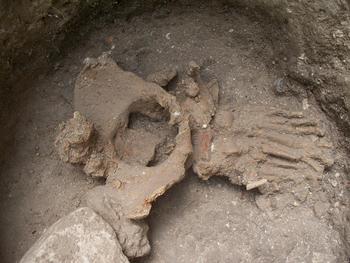
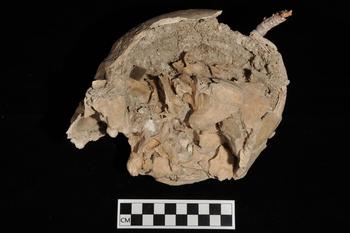
A series of probable sacrificial and post-sacrificial deposits date to the transitional time from the Escoba to Cantutse phase, although there remains some ambiguity in the dates of those burials. Five of them (Burials 111, 112, 113,114, and 127) came from the E-Group plaza and two (Burials 116 and 117) from Platform K'at under the East Court. In the plaza, Burial 111 was mixed with fragments of a smashed large Juventud/Sierra Red cylinder bowl and stones. The skeleton was not complete and in poor condition. It was comprised of vertebrae, ribs, the sternum, one scapula, feet, hands, long bones, and a fragment of a cranium. The fact that the pelvic girdle and both feet were fully articulated (Figure 6) suggests that these elements were placed when soft tissues were still present. The femurs, tibias, and fibula were absent. The skeleton did not have any observable cut marks. It is possible that the remains of this individual were deposited in a bundle, probably covered by perishable materials. Only a small piece of the cranium (the mastoid process) was found, and there were no teeth. The shape of the pelvis and the measurement of the mastoid process suggest that the skeleton was a male.
Burial 111, located in the middle of the Central Plaza, viewed from the north. The pelvic girdle and both feet were fully articulated, suggesting that these elements were placed when soft tissues were still present. Photograph by Palomo.

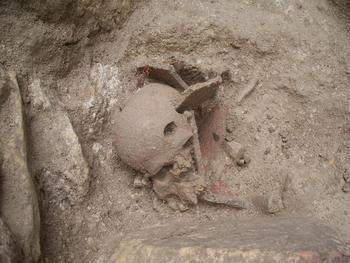
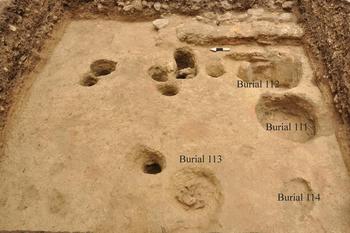
Burial 112, another middle adult male, was also deposited with fragments of a smashed Juventud/Sierra Red cylinder bowl. The skeleton was represented by almost a complete cranium (Figure 7), inferior long bones, both feet, and fragments of vertebrae and ribs. The fully articulated feet were on the bottom of the pit. The mandible, vertebral fragments, and ribs were found above the feet. The lower extremities and the cranium, both partially articulated, were on top of the ribs, which were disarticulated. No evidence of dental decoration or cranial deformation was found. The male sex was inferred from morphological features of the cranium and the thickness of the long bones (Wright Reference Wright2006; Wrobel et al. Reference Wrobel, Danforth and Armstrong2002). The dental wear and the suture fusion of the cranium suggest that the individual was 35 to 50 years old. Several cut marks were found on the surface of the cranium (Palomo Reference Palomo, Róman and Inomata2010, Reference Palomo2013). A hole that measures 30.1 mm by 12.8 mm was found in the left part of the frontal bone. The color and the texture of the bone show no bone generation or postmortem cuts, which tend to have a lighter color than the rest of the unbroken bone. These patterns indicate that the cut marks and the hole were made sometime shortly before or after death. The cranium of Burial 112 was fully articulated. During the cleaning and analysis of the skull, a left fragment of the frontal and temporal broke off uncovering a fragment of an obsidian blade inside the cranium (Figure 8). The full articulation of the cranium suggests that the only probable way that the obsidian blade went inside the skull was through the hole made in the frontal area. It is possible that these two male skeletons (Burials 111 and 112), found next to each other (Figure 9), reflect similar human sacrifice.
Burial 112, located in the middle of the Central Plaza, viewed from the north. A hole measuring 30.1 × 12.8 mm was found in the left part of the frontal bone. Photograph by Palomo.

The cranium from Burial 112, which had an obsidian blade in its interior. Photograph by Palomo.

Burials 111, 112, 113 and 114, located in the middle of the Central Plaza, viewed from the west. Photograph by Inomata.

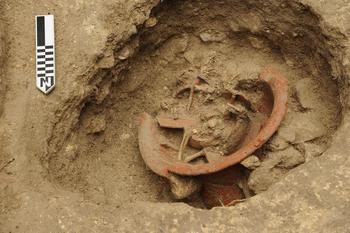
Two children (Burials 113 and 114) were found near Burials 111 and 112 (Figure 9). Burial 113 was almost complete; the bones, however, were poorly preserved and extremely fragmented. The skeleton was articulated in a flexed, sitting position with face down. The dental development demonstrates that the individual was four years ±12 months old (Ubelaker Reference Ubelaker1989). No cut marks or cranial deformations were found. The skeleton was associated with shell beads, which may have formed a necklace. The beads were found near the neck, and between the mandible and maxilla. The other child, Burial 114, was poorly preserved, and its skeleton was incomplete. This individual was represented by an articulated cranium, mandible, both fibulas and tibias, several fragments of ribs, vertebrae, left humerus, right femur, and clavicles. The dental development demonstrates that the individual was two years ± eight months old (Ubelaker Reference Ubelaker1989). Neither cranial deformations nor cut marks were found. The burial had some offerings, including a necklace made of shell, similar to the one found in Burials 113. The shell beads were found inside the mouth, and two green stone beads were found near the cranium. Another individual, Burial 127, was found 6 m to the east of Burial 112. It belonged to a child of three years ± 12 months (Ubelaker Reference Ubelaker1989). The skeleton was almost complete in a flexed, supine position. The individual was placed in a large Sierra Red cylinder bowl covered by a Sierra Red lid (Figure 10). Similar to Burials 113 and 114, this burial also contained beads made of green stone and shell as grave goods. The cranium shows evidence that this individual suffered from anemia. None of these burials from the Central Plaza show evidence of burial reuse or reentry. Based on the context and osteological analysis of the individuals found in the central axis of the Central Plaza (Burials 111, 112, 114, and 127), it is possible that they represent some sort of sacrificial or dedicatory deposit pertaining to public rituals at Ceibal Plaza.
Burial 127. The skeleton was almost complete in a flexed, face-down position. The individual was placed in a large Sierra Red cylinder bowl covered by a Sierra Red lid. Photograph by Inomata.

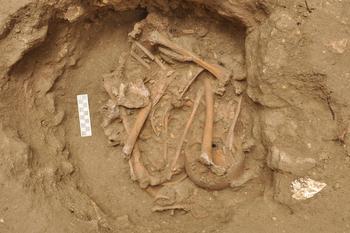
A juvenile (Burial 116) and a child (Burial 117) were found in the East Court of Group A, and both burials date to the Escoba 3 phase. Burial 116 was deposited in a round pit, dug in the patio floor of a probable residential group. It was covered with a layer of fist-size stones. The skeleton belonged to a juvenile of approximately 15 years old (±36 months). The jaw was absent, and some post-cranial bones were not in an anatomical order. For example, the proximal end of a complete femur was on the cranium (Figure 11). The fingers and toes, however, were fully articulated, which indicates that this was a primary burial. The artifacts associated with this individual were several small shells. Burial 117 was deposited in another round pit dug on the same floor as Burial 116. The skeleton was covered with a layer of fist-size stones. The individual was a child, placed in a flexed position on its left side, looking east. No evidence of a violent manner of death was found.
Burial 116, found in the East Court, viewed from the west. The jaw of this individual was absent, and some bones of the postcranium were not in anatomical order. For example, the proximal end of a complete femur was on the cranium. Photograph by Inomata.

Dating to this period, two individuals with cranial deformation were found. Burial 30 uncovered in Structure C-24e by the Harvard Project, had a tabular erect shape made with cradleboard. In contrast, Burial 116 had a tabular oblique shape made with head splints. With respect to grave goods, the burials of this period, in comparison to those of the previous period, were characterized by a greater quantity of objects other than ceramic vessels, such as obsidian blades and cores, and shell and greenstone beads. These offerings were found in both funeral and sacrificial contexts.
Late Preclassic Cantutse-Chicanel 2 and 3 Phases (300–75 b.c.)
During the Late Preclassic period, the Ceibal residents adopted more uniform Chicanel ceramics and were fully committed to lowland Maya construction techniques with an abundant use of masonry. The East Court and the A-24 Platform received few modifications, and construction efforts appear to have focused on pyramids. No burial unequivocally dating to the Cantutse-Chicanel 2 and 3 phases has been found by the Ceibal Project. This may be partly because there was little activity in the A-24 Platform and the East Court, where much of our excavation was done. The depositions of sacrificial victims in the E-Group plaza, which was common during the Escoba-Cantutse transition, apparently did not continue during the later part of the Cantutse phase. The Harvard Project uncovered four individuals dating to this period (Table 2). Most of them were articulated and did no exhibit any indication of violent death (Tourtellot Reference Tourtellot and Willey1990). Only two of the burials had grave goods, which included pendants made of turtle and shells. One male (Burial 30) individual exhibited tabular erect cranial deformation. These four burials appear to have been placed within residential groups, including those outside of the ceremonial core of Group A (Burial 42 in Structure 59 and Burial 46 in Unit 24). The bioarchaeological record shows that the practice of burying the dead in domestic spaces was becoming more common at Ceibal during this period.
Protoclassic Xate Phase (75 b.c.– a.d. 200) and Early Classic Junco-Tzacol Phase (a.d. 200–600)
During the Xate phase, construction activity in Group A declined and an important focus of elite activity appears to have shifted to Group D located on a steep hill. Construction activity further declined during the Junco phase although a Late Classic text mentions an Early Classic ruler, K'an Mo’ Bahlam, reigning around a.d. 415. A total of eight burials with a minimum number of nine individuals were recovered from the Xate phase. Estimated ages varied (Tables 1 and 2). No cranial deformations or dental decorations were found. Ceramic vessels were the most common grave goods during these phases. Three individuals were excavated from Caobal, a minor center located in the periphery of Ceibal, and three other skeletons were found in Group D: one from Platform 47-Base and two from Structure C-24e (Tourtellot Reference Tourtellot and Willey1990).
Burial AN1 from Caobal was found in an intrusive pit dug into a platform floor of Structure 1. The nearly complete, fully articulated skeleton was found in a good state of preservation. The skeletal remains were found covered by five large rectangular capstones. The skeleton was in an extended position, with the head pointing toward the south. Morphological features of the skull and pelvis, as well as measurements of the postcranial bones, indicate that the individual was a male, and the sutures of the cranium and dental wear suggest that he was a middle adult. The skull had an oblique tabular cranial modification. No evidence of violent death was found. Burial AN2 is represented by eroded fragments of left and right tibias and fibulas. In comparison to the bone sizes of other adult burials from Caobal, the small size of these fragments suggests that this individual was a juvenile. Due to the poor state of preservation, however, it was not possible to determine sex and a more precise age range. The semi-articulated skeletal remains of Burial AN2 were deposited directly into the construction fill of a low stone terrace that served as the base for a temple superstructure. Although no formal burial pit or crypt was prepared, there was sufficient skeletal articulation and superposition of cultural layers, suggesting that Burial AN2 was a primary interment. No grave goods were found in association with the individual. Burial AN3 is another semi-articulated skeleton represented by fragments of the clavicle, vertebrae, scapula, and humeri. The absence of the skull and small bones (e.g., phalanges, teeth) suggests that this is a secondary burial. The thickness of the postcranial bones suggests that this individual was an adult male, although the lack of teeth and cranium makes it difficult to estimate a more precise age.
A complete single Xate phase burial (Burial 138) was uncovered from the Karinel Group near Group A of Ceibal. The skeleton was supine, with legs and arms flexed to his right side. No evidence of violent death was found. The dental development shows that the skeleton belongs to a child of three years ±12 months (Ubelaker Reference Ubelaker1989). His head was pointing north, and no grave goods were found. A cache of numerous complete Sierra Red and Achiote Unslipped bowls (Cache 159) was uncovered underneath the burial in the natural marl layer. The burial may have been part of this ritual deposit (MacLellan Reference MacLellan, Aguilar and Inomata2012).
Six burials and one cache containing human remains, with a minimum number of nine individuals, were recovered for the Junco phase. Two individuals come from Group D, two from the Karinel Group, three from Structure A-15, and two from Structure A-2. Burial 141 and Cache 158 were found in front of a now eroded architectural mask of Structure D-31 Sub-2 in Group D (Bazy Reference Bazy, Aguilar and Inomata2012). A radiocarbon determination obtained for a bone contained in Cache 158 points to a Junco 3 date (a.d. 400–500). Burial 141 was probably deposited at the same time as, or slightly before, Cache 158 The skeleton in Burial 141 was in a flexed position with the head pointing to the southeast. The dental development suggests that the individual was approximately eight years ±12 months old (Ubelaker Reference Ubelaker1989). The skeleton was incomplete, missing all long bones of his right extremities (leg and arm). Due to the poor state of preservation, it was not possible to find evidence of sacrifice or violent death. The archaeological context, the incomplete articulated skeleton, and the biographic profile (a child), however, all suggest that this individual represents a sacrificial victim. Cache 158, placed directly above Burial 141, contained two pairs of Aguila Orange bowls in lip to lip positions. A complete skull was found inside one pair. Long bones probably of the same individual were found in another pair of bowls. The dental development shows that the individual was approximately 11 years ±30 months old (Ubelaker Reference Ubelaker1989).
Among the burials dating to the Junco phase, three female skeletons without indications of violent death were found. Burial 107, for instance, was a complete articulated burial of an old female who was buried prostrate in an extended position, with a Caribal Red bowl over her face and a piece of a greenstone in her mouth (Figure 12) in a platform in the East Court (Structure A-15 Sub-4). The sex of the other individuals was not possible to estimate because of the young ages of the skeletons. The ranges of ages varied (Table 1). No cranial deformation or dental decoration was found. Ceramic vessels were the most common grave goods during the Junco phase.
Burial 107. Female skeleton is in an extended position, buried in a platform in the East Court (Structure A-15 Sub-4), viewed from the south. Photograph by Inomata.

Late Classic Tepejilote-Tepeu Phase (a.d. 600–810)
The population of Ceibal increased during the early part of the Late Classic period. In a.d. 735, however, the Ceibal king, Yich'aak Bahlam, was captured by the Dos Pilas-Aguateca ruler, and construction and economic activities at Ceibal declined, possibly subjected to control by the Dos Pilas-Aguateca dynasty. After the decline of Dos Pilas around a.d. 761, Ceibal was governed by an individual named Ajaw Bot of unclear origin, but his reign also ended soon after a.d. 800 (Inomata Reference Inomata1997; Martin and Grube Reference Martin and Grube2008).
A total of 31 burials with a minimum number of 31 individuals were found dating to the Late Classic (Tables 1 and 2). All the burials were single inhumations associated with architectural features. For instance, Burial 139 was a fully articulated young adult found in front of the stairway connected to the triadic complex (Structures D-31, D-32, and D-33) in Group D (Bazy Reference Bazy, Aguilar and Inomata2012). The individual was found lying on his left side with flexed legs. Three vessels were found as grave goods. This young adult displayed a tabular oblique cranial deformation and no dental decorations. The archaeological context suggests that this individual was an elite member, who did not die in a violent manner. Another interesting internment that possibly dates to this period was Burial 105. The skeleton belonged to an infant (three to four years old) that was fully articulated in an extended position. The burial was found in front of a staircase that provided access to the patio of Structure A-15 located in the East Court. The infant was covered in a red pigment, probably cinnabar, and was accompanied by two vessels. The infant displayed a tabular oblique cranial modification and no dental decoration. The archaeological context suggests that this individual was not a sacrificial victim.
None of the skeletons dating to the Late Classic period had evidence of violent manner of death. Only three individuals had a tabular oblique cranial deformation (Burials 105, 139, and 29). Vessels were the most common grave goods. Most of these individuals were male adults, and only two were females.
Terminal Classic Bayal Phase (a.d. 810–950)
The Terminal Classic period was one of major social change, as many centers in the southern Maya lowlands were abandoned. Although Ceibal may have experienced a dynastic disruption, the center revived as one of the most powerful cities during the Terminal Classic period. A new king, probably called Aj Bolon Ha'btal Wat'ul K'atel, came to Ceibal in a.d. 829. He erected magnificent stelae associated with a calendric ceremony held in a.d. 849 (Martin and Grube Reference Martin and Grube2008; Triadan Reference Triadan, Vega and Lowe2012). The Ceibal dynasty gradually declined, however, and the last recorded date at the site corresponds to a.d. 889 (Graham Reference Graham1996): Ceibal was completely deserted soon after.
A total of 29 burials with a minimum number of 44 individuals were recovered from Terminal Classic contexts (Table 1 and 2). Most of the burials were associated with architectural features. Ceramic vessels were common grave goods for this period. For instance, Burial 108B was a female individual found in front of the staircase of the patio in front of Structure A-15, located in the East Court. The skeleton was deposited in a round cist. The grave goods included four vessels of Terminal Classic types. Burial 108B had similar mortuary treatment to Burial 1 excavated in the East Court by the Harvard Project in 1965 (Tourtellot Reference Tourtellot and Willey1990:87–88). Both individuals were females in flexed positions, with tabular oblique deformations and dental decorations. The offerings of Burial 1 included six vessels similar to the ones found in Burial 108B. Although Tourtellot (Reference Tourtellot and Willey1990:87) argued that Burial 1 could represent a sacrificed victim, neither of the two females (B108A and B1) presented evidence of cut marks suggesting a violent manner of death. The similar vessel offerings and mortuary treatments (flexed positions and the use of capstones) of these burials probably reflect a formal pattern of burying important females during the Terminal Classic period (Roman et al. Reference Román, Inomata, Guirola, Muños, Flores, Inomata, Román, Triadan and Aoyama2008:21).
The bioarchaeological record of the Terminal Classic period includes four individuals with tabular erect cranial shapes probably made with cradle devices. All of these individuals, however, were found in a mass deposit (Burial 4) that contained a minimum number of 12 individuals, more than eight of those being male adults. The mass deposit was found in Structure A-13 located at the center of the Central Plaza (Tourtellot Reference Tourtellot and Willey1990). The bioarchaeological context implies that this deposit was connected to a public sacrificial ritual conducted in the Central Plaza.
DISCUSSION
Burial Chronology
The chronology of the burials is based on recent improvements in the ceramic sequence (Inomata Reference Inomata, Aguilar and Inomata2012b) and radiocarbon dates for 11 burials. Although the Ceibal chronology is uniquely refined, we need to keep in mind potential problems of the data set. One problem is that the level of precision and accuracy in dating varies considerably from one burial to another. Whereas some burials can be assigned to specific phases, such as Real 3 and Escoba 3, others date to broader time ranges, such as “Escoba” or “Xate 2/3 or Junco 1/2.” Such uncertainties resulted from a lack of diagnostic ceramic offerings, unclear stratigraphy, or the fact that only four of the 22 Middle Preclassic burials have radiocarbon dates (Burials 104, 110, 112, and 117). Even for the radiometrically dated burials, we need to consider the possibility of freshwater reservoir effects (Inomata et al. Reference Inomata, Aguilar and Inomata2012b). Another problem is that there are considerable differences in the numbers of samples from different phases. Specifically, the larger number of burials dating to the Late and Terminal Classic may be a consequence of sampling biases. The Ceibal sample (Tables 1 and 2) may be affected by the fact that the Harvard Project concentrated on Late and Terminal Classic structures whereas the Ceibal Project focused on the public ceremonial complexes and large platforms of the Preclassic period. Excavations of early Middle Preclassic structures were more limited than those of the Classic because only deep operations reached early remains.
Despite these problems, detailed stratigraphic information and the fine chronology of Ceibal make this burial collection an important basis for the analysis of diachronic trends in mortuary practices. This is particularly true for the samples from the Central Plaza. Extensive excavations in this area have provided substantial data on public mortuary rituals through time. Mortuary practices in residential areas during the Preclassic period, however, are less clear. The number of burials recovered from Preclassic residential contexts, particularly from Middle Preclassic ones, is limited, possibly reflecting mortuary practices different from later periods. Even for the Classic period, when the practice of burying the dead under house floors was apparently well established, we need to pay attention to potential biases. McAnany (Reference McAnany1995:60) points out that not all deceased family members became ancestors as the role of an ancestor were likely reserved for leaders and other prominent members of the groups and that many individuals were probably never interred in domestic or monumental mausoleums. Such practices would introduce gender and age biases into archaeological samples. Of the sexed individuals at Ceibal, there are only 15 skeletons with female attributes as opposed to 55 males (Tables 1 and 2). Most of these women date to the Classic period. Preservation and osteological analysis are other factors that could create gender biases. For example, in deteriorated remains, it is easy to determine male sex by sheer robusticity, whereas the bones of females can be confused with juvenile skeletons. Therefore, female individuals could remain unsexed especially when no assessment of primary sexual markers can be done due to preservation factors.
Although the Ceibal Project conducted intensive and extensive excavations during various seasons (2006–2015) in Preclassic period structures, no burials have been found in residential buildings of the Real phase, with the possible exception of Burial 110 uncovered in Platform Ch'och’ under the A-24 Platform. It is, however, unclear whether Burial 110 dates to the Real or Escoba phase, and we are not certain whether Platform Ch'och’ served a residential function or if this burial was non-sacrificial. Burial 132, found in the Karinel Group, appears to have been placed in an open area near dwellings but many other burials of this period may have been deposited away from residential complexes. Burials placed in domestic contexts continued to be limited during the late Middle Preclassic Escoba phase. Burial AN4, found in Structure 2 Sub-5 at Caobal, may be the only example of a burial found within a potential residential structure. Burial 11, uncovered by the Harvard Project in the East Court, and Burial 5, from the North Plaza, may also represent domestic contexts. The practice of depositing the dead in pits dug in open areas continued, as represented by Burial 126 found in the Jul Group. These pits may have been dug originally for the acquisition of marl or other purposes and later reused for burials. Three burials of the Cantutse-Chicanel phase found by the Harvard Project appear to have been deposited within residential complexes, and the practice of burying the dead inside or in the immediate vicinity of houses possibly was more widely accepted among the Ceibal residents during the Late Preclassic period.
This pattern at Ceibal contrasts with those in Belize, where subfloor burials are present at least in the Bladen phase (800–600 b.c.) at Cuello (Hammond Reference Hammond, Grove and Joyce1999) and possibly during the Early Chaak'k'ax phase (750–600 b.c.) at K'axob (McAnany Reference McAnany2004). In Belize, where there were well-established Archaic populations before 1000 b.c., the occupants may have developed a high degree of sedentism during the early Middle Preclassic period, whereas the transition to full sedentism may have been slower at Ceibal. The construction of substantial ceremonial buildings at Ceibal, which happened earlier than in Belize, indicates that the development of monumental architecture does not necessarily correlate with the degree of sedentism. Moreover, these data from Ceibal lead us to reconsider the argument that domestic groups served as the fundamental units for social integration, the transmission of rights, and ritual activity in Maya society since the inception of the Middle Preclassic period (Inomata et al. Reference Inomata, MacLellan, Triadan, Munson, Burham, Aoyama, Nasu, Pinzon and Yonenobu2015a, Reference Inomata, MacLellan and Burham2015b).
Natural Death and Human Sacrifice
Two of the earliest cases of possible human sacrifice at Ceibal dating to the Real-Xe 3 phase (775–700 b.c.) are infants (Burials 130 and 137). These burials were placed in Structure Saqpusin on the eastern side of the E-Group assemblage, which implies that infants were sacrificed in public rituals. Although we do not have enough data, we may speculate that infants were preferred targets of human sacrifice. Iconographic representations in the Gulf Coast area imply that babies occupied important places in early Mesoamerican religions. Some Preclassic monuments show a mythological character emerging from a niche with an infant or child in his hands (for instance, Altar 5 of La Venta). Some of these infants exhibit attributes of the Olmec maize deity. In this type of representation, it is not clear whether the child is asleep or dead, whereas other monuments depict babies being awake in the arms of important characters or deities (Taube Reference Taube, Clark and Pye2000). In terms of archaeological evidence, however, no infant sacrificial burials contemporaneous with those of Ceibal have been confirmed in other parts of the Maya area. Important information comes from sites associated with Olmec-style art. For instance, at the Early Preclassic site of El Manatí located near San Lorenzo, approximately seven infants were found in the mud of a spring (Ortíz and Rodriguez Reference Ortíz, del Carmen Rodríguez, Grove and Rosemary1999). Some of these infants were found next to wooden sculptures, greenstone beads, as well as jade axe caches similar to those found at La Venta and Ceibal. The biographic profile (all infants), the archaeological context (a ritual place associated with a spring), the articulation of the bones, and greenstone axes and other offerings have led scholars to suggest that these individuals were sacrificial victims (Ortíz and Rodríguez Reference Ortíz, del Carmen Rodríguez, Grove and Rosemary1999). Probable remains of infant sacrifice were also found at Chalcatzingo. The burials were located near a Preclassic altar with iconographic depictions, and excavators date the interments to the end of the Early Preclassic or the beginning of the Middle Preclassic period (Fash Reference Fash and Grove1987). These archaeological finds, along with iconographic representations, give us glimpses of the important role that infants and children played in the Preclassic Mesoamerican worldview.
There is some evidence suggesting that ritual activities possibly connected to warfare were conducted in the plaza during the last part of the Preclassic. For example, Cache 108, found in the Central Plaza and dating to the Real-Xe 3 phase, contained a carved shell depicting a human face with exposed teeth and hollow eyes. It was probably worn upside down as a pectoral, representing a decapitated head (Inomata Reference Inomata, Scherer and Verano2014). Clear parallels to this are found in the Late Classic depictions of trophy heads, shown, for example, in Bonampak murals. Burial 140, possibly dating to the Real-Xe 3 phase and found near the infant burials, contained a male adult with his hands tied behind his back, who may have been a sacrificed war captive.
Sacrificial rituals probably continued during the late Middle Preclassic Escoba-Mamom 1 and 2 phases (700–450 b.c.). Burial 115, found in front of Structure A-20 on the western side of the E-Group assemblage, may have been sacrificial, although evidence remains ambiguous. The interpretation of Burial 128 from the Karinel Group with a disarticulated skeleton is equally difficult, but, if it is a sacrificial victim, it represents the earliest known case of a sacrificial burial placed in a residential group at Ceibal. During the Middle to Late Preclassic transition (Escoba-Mamom 3 and Catutse-Chicanel 1 phases, 450–300 b.c.), burials reflecting possible public sacrificial rituals became even more prominent. Burials 111, 112, 113, 114, and 127 in the Central Plaza show that human sacrifice was well established as an important theme of communal ritual by this time. Victims included male adults, juveniles, and children. Unlike the earlier ones associated with flanking structures, these burials were placed in the central part of the plaza. Possible post holes found in the plaza floor near the burials (Figure 9) suggest that these victims may have been executed in scaffold sacrifice rituals in a manner similar to those depicted in Classic-period iconography (Taube Reference Taube, Benson and Griffin1988). If so, the setting implies that the visibility of sacrifice toward a large audience was strongly emphasized.
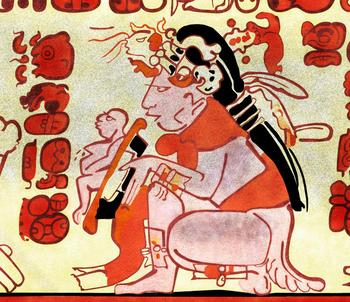
We should note that sacrificial victims were not limited to adult male warriors; children and infants were also important targets. Some of these young individuals were found with necklaces and beads, which may reflect respect, emotional ties, or high status, and it is not clear whether these victims originated from Ceibal or from enemy communities. None of the children's remains from Ceibal exhibited recognizable cut marks. The apparent absence of cut marks may have resulted not only from the poor preservation of these remains but also from particular manners of sacrifice. Some iconographic scenes in Classic Maya vessels depict infants on plates who were cut in the stomach (Figure 13). It is possible that this type of sacrifice did not leave any traces on the bones. Diaphragmatic heart sacrifices of children, also shown in the Classic period iconographic depictions, are not prone to leave marks, either. There are other manners of death, such as strangulation or asphyxia that do not leave cut marks. Alternatively, some of the buried infants may not have been sacrificed. Further analysis of skeletal samples is needed for a better understanding of human sacrifice involving infants and children.
Child sacrifice in a vessel. Cuenco Castillo, Late Classic period. Drawing by Palomo based on a rollout photograph by Nicholas Hellmuth, courtesy of Museo Popol Vuh.

It is unclear whether the sacrificial rituals of children and captives were connected or independent of each other. In Maya art, sacrificed children and prisoners are not represented together, which suggests that sacrifices of captives and children had different meanings and connotations. At Ceibal, however, there are probable sacrificial burials of children and adults that were placed in the same archaeological context along the central axis of the Central Plaza. These deposits urge us to examine the possibility that children and adults were sacrificed in the same event or in a series of related rituals.
Building on osteological evidence from various Maya lowlands centers, Cucina and Tiesler (Reference Cucina, Tiesler, Tiesler and Cucina2007) argue that there were nutritional and health differences between individuals found in non-sacrificial contexts and those from sacrificial deposits. Colonial sources state that some of the sacrificed children and adults were orphans or slaves. In some cases, children were donated voluntarily by their own parents for such rites. In the case of adults, some of them may have been captives taken during warfare (Schele Reference Schele and Boone1984). Another colonial document notes that sacrificial victims should ideally be healthy individuals in good physical conditions (Najera Reference Najera1987). The analysis of the skeletal remains from Ceibal and other sites, however, does not support the idea that the selection of sacrificial victims was based on good health, regardless of sex or age. For instance, the infants and young adults from Ceibal found in possible sacrificial contexts had cranial cribra orbitalia and porotic hyperostosis, which are mostly related to the effects of anemia active during childhood. Another common disease found in these individuals includes hypoplastic defects, which are associated with stress during growth. In other words, most of Ceibal human remains found in sacrificial deposits were of poorer health than those found in non-sacrificial contexts. This evidence implies that individuals found in sacrificial deposits may have been considered less useful to the community for the health reasons (Cucina and Tiesler Reference Cucina, Tiesler, Tiesler and Cucina2007).
Possible sacrificial burials were also deposited in more exclusive settings of residential complexes, such as Burial 117 found in the East Court. An increasing emphasis on themes of violence in ritual was probably a common trend found throughout the Maya lowlands during the Late Preclassic period (Inomata Reference Inomata, Triadan, Aoyama, Aguilar and Yonenobu2013). Mass and disarticulated burials were found in other sites in the Maya area, including Cuello (Robin and Hammond Reference Robin, Hammond and Hammond1991) and Altun Ha (Pendergast et al. Reference Pendergast, Loten and Kislak1979). The increase in sacrificial rituals was probably related to the intensification of warfare during this time in the Maya lowlands (Inomata Reference Inomata, Scherer and Verano2014).
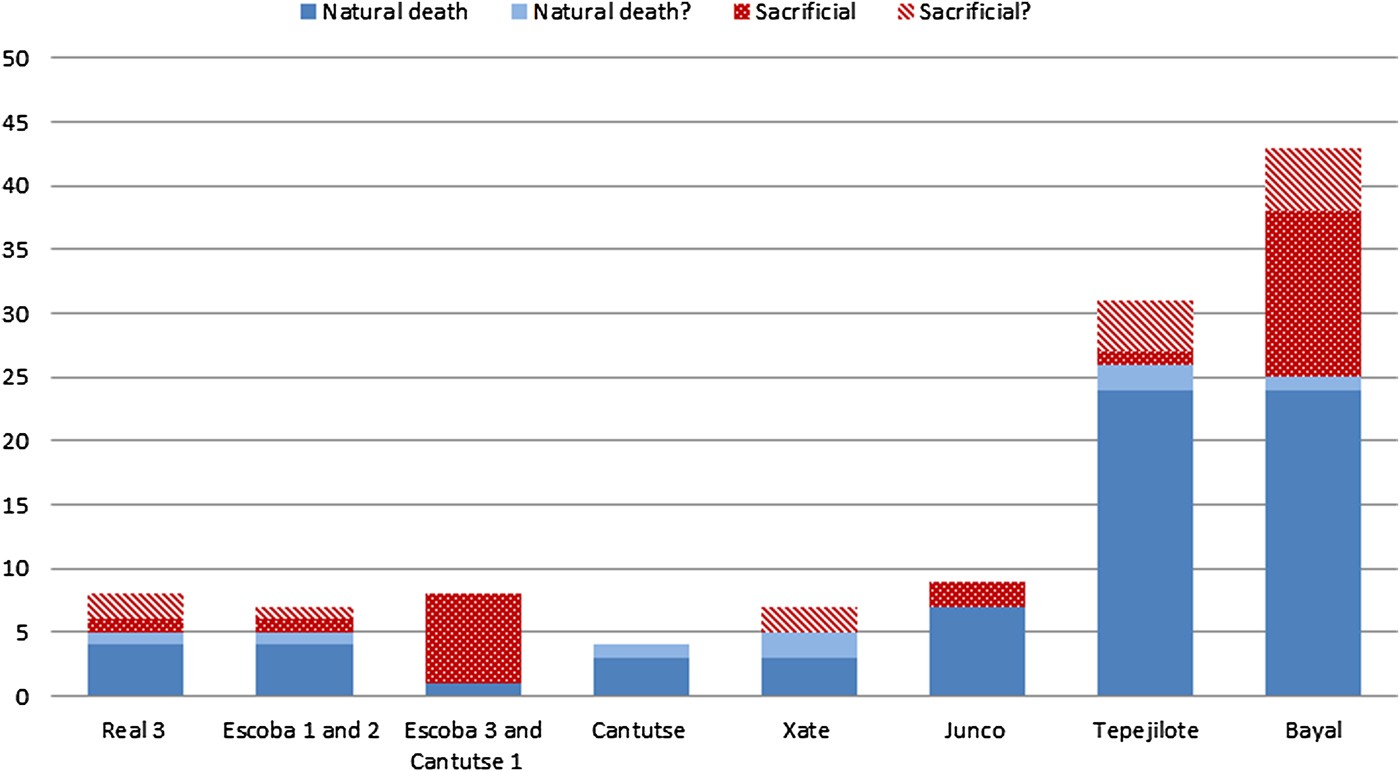
For the Xate and Junco phases, 13 out of the 16 individuals were articulated skeletons (Tables 1 and 2), which were found almost complete, buried inside structures and platforms with vessels as grave goods. The mortuary treatment, the biographic profile, and the archaeological contexts indicate that most of the Protoclassic and Early Classic burials represent funerary behavior resulting from a natural death (Figure 14, Tables 1 and 2). Those from Group D and Caobal that were placed in temples, however, probably represent dedicatory burials containing sacrificial victims.
Frequencies of natural and violent death at Ceibal based on Tourtellot Reference Tourtellot and Willey1990 and Palomo Reference Palomo2013. Real 3 phase (775–700 b.c.); Escoba-Mamom 1 and 2 phases (700–450 b.c.); Escoba-Mamom 3 and Cantutse-Chicanel 1 phases (Escoba-Cantutse transition, 450–300 b.c.); Cantutse-Chicanel 2 and 3 phases (300–75 b.c.); Xate phase (75 b.c.–a.d. 200); Junco-Tzakol phase (a.d. 200–600); Tepejilote-Tepeu phase (a.d. 600–810); Bayal phase (a.d. 810–950).

Our collection includes at least 15 female skeletons. Most of them date to the Classic period and have no evidence of violent death. It could be possible that adult females were not important targets of human sacrifice at Ceibal.
Most of the 31 individuals found from Late Classic contexts were associated with architectural remains, and do not exhibit evidence of human sacrifice. Of the minimum number of 41 individuals recovered from Terminal Classic contexts, 23 skeletons are compatible with natural death, whereas at least 15 individuals could be related to sacrificial activities (Figure 14). These data, as well as the mass Burial 4, implies a resurgence of public sacrificial rituals during this period.
Burial Assemblages
Although some early Middle Preclassic burials from Ceibal had several ceramic vessels as grave goods (for instance, Burials 132 and 136), none of them contained jade artifacts. This pattern contrasts with some contemporaneous or earlier burials found at Chiapa de Corzo, La Venta, Cuello, and Copan, in which artifacts of jade and greenstone were present (Davis-Salazar Reference Davis-Salazar, Wells and Davis-Salazar2007; Drucker et al. Reference Drucker, Heizer and Squier1959; Hammond Reference Hammond, Grove and Joyce1999; Lowe Reference Lowe, Arroyo, Paiz and Mejía2012). During the early Middle Preclassic period, Ceibal residents may not have deposited ritual objects such as the green stone and jade axes in burials of possible emerging elites. Due to the limited sample size, however, we cannot discard the possibility that important individuals were buried somewhere else with greenstone objects. The current archeological data show that Ceibal residents deposited greenstone objects in caches located in public spaces, such as the central axis of the E-Group.
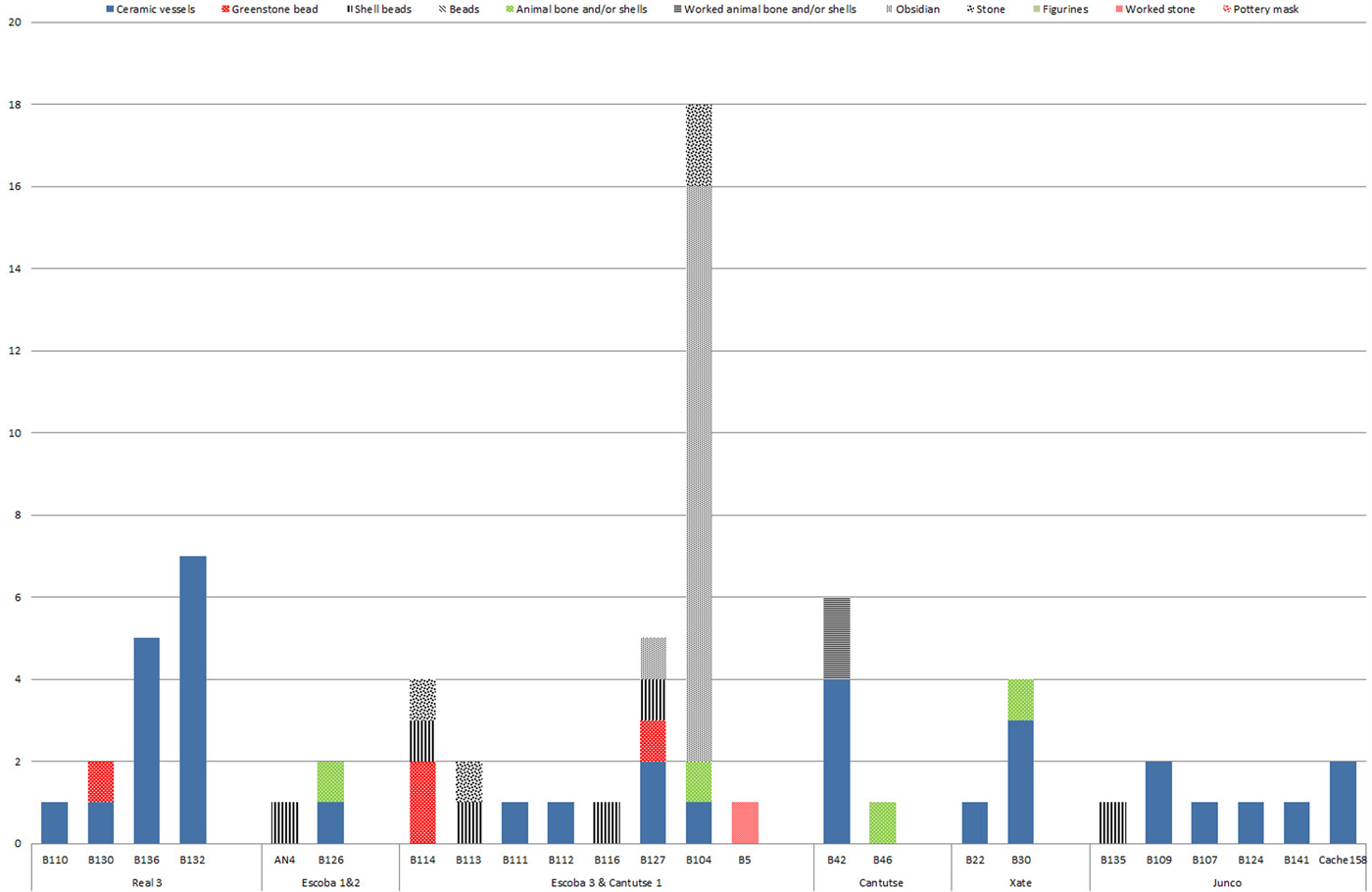
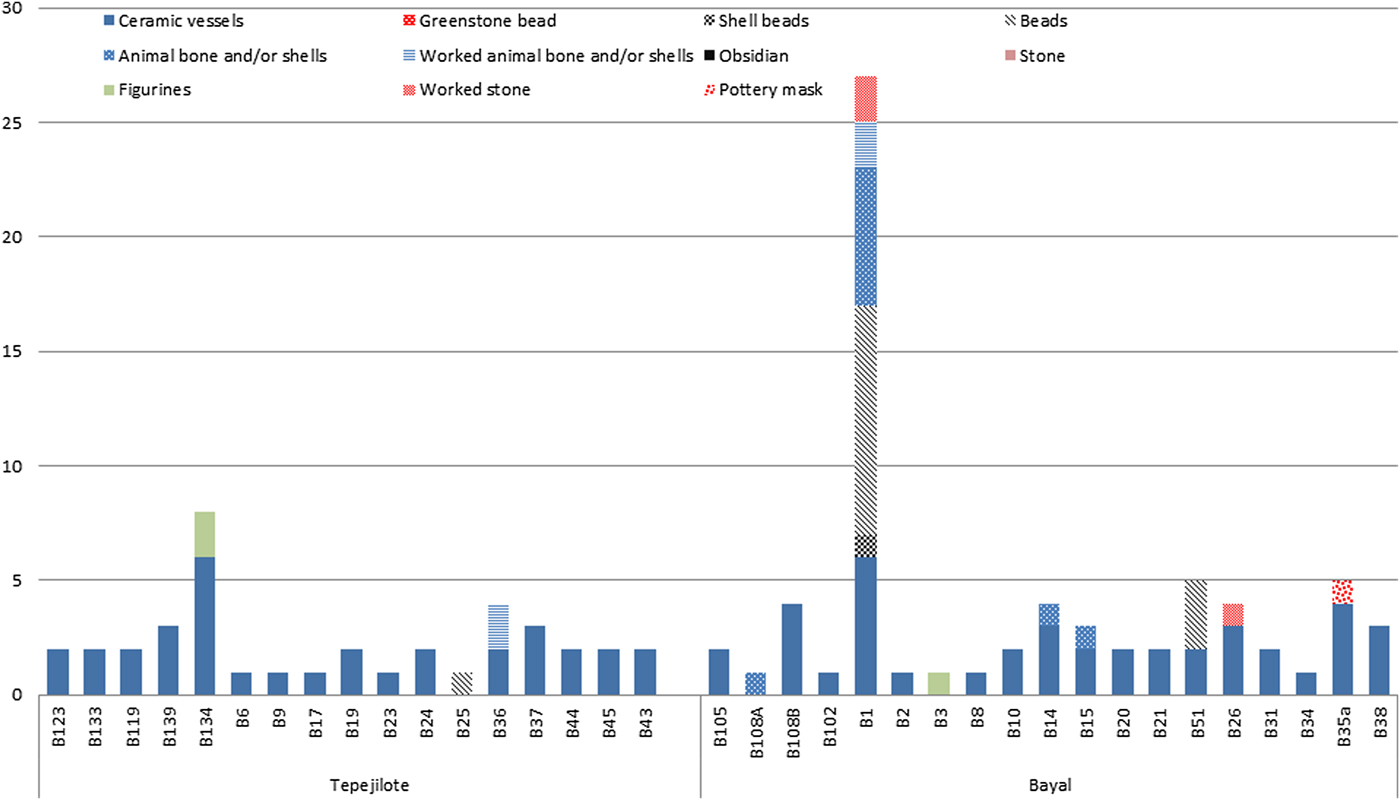
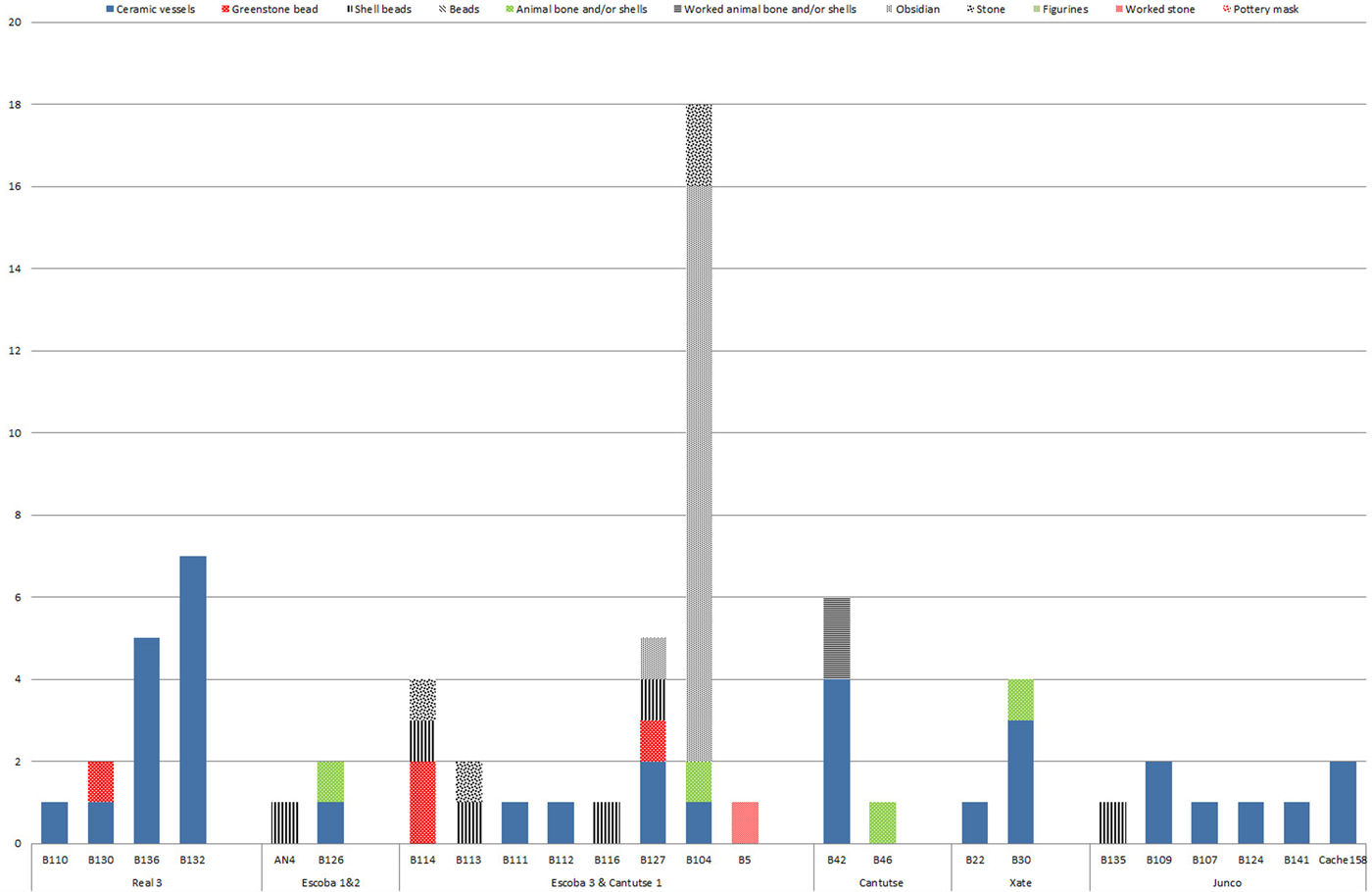
This pattern changed gradually during the following periods. For instance, the burials from the Middle to Late Preclassic transition (Escoba-Mamom 3 and Cantutse-Chicanel 1 phases) there was a greater variability in grave goods (Figures 15 and 16). For instance, Burial 104 was a middle adult male that had a ceramic plate, a white rock, a worked shell shaped like an ink pot, four unworked shells, 13 obsidian blades, and an obsidian core as grave goods. It is likely that social inequality in terms of material possessions was present during this period. Around the same period, however, there were also a great variety of well-made artifacts, such as complete vessels, green stone and shell beads, and obsidian artifacts (including cores and blades) in caches and possible sacrificial deposits containing children and male adult remains. These examples show that potential sacrificial deposits can contain a wide variety of artifacts.
Grave goods based on Tourtellot Reference Tourtellot and Willey1990 and Palomo Reference Palomo2013. Real 3 phase (775–700 b.c.); Escoba-Mamom 1 and 2 phases (700–450 b.c.); Escoba-Mamom 3 and Cantutse-Chicanel 1 phases (Escoba-Cantutse transition, 450–300 b.c.); Cantutse-Chicanel 2 and 3 phases (300–75 b.c.); Xate phase (75 b.c.–a.d. 200); and Junco-Tzakol phase (a.d. 200–600).
Grave goods based on Tourtellot (Reference Tourtellot and Willey1990) and Palomo (Reference Palomo2013). Tepejilote-Tepeu phase (a.d. 600–810) and Bayal phase (a.d. 810–950).
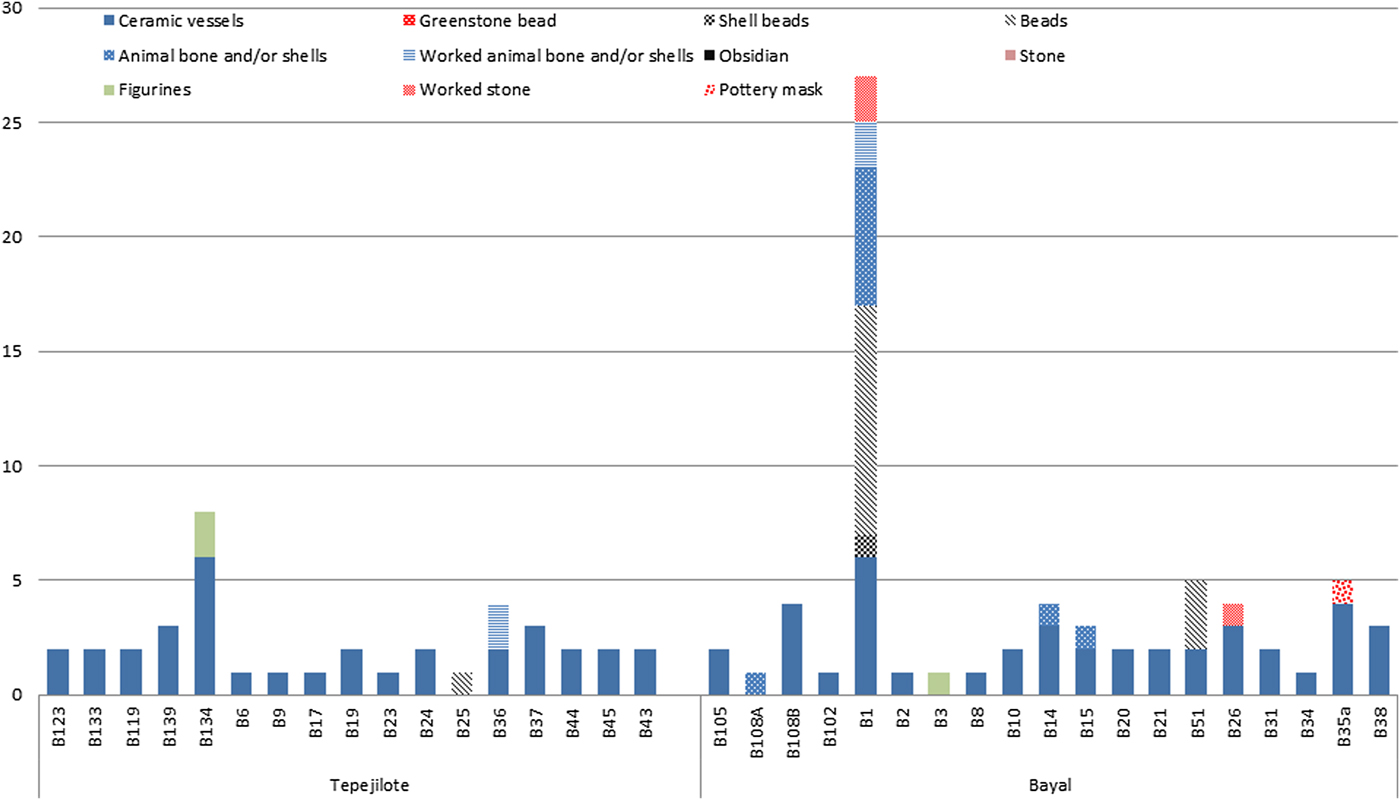
There was a reduction in the variability of grave goods, with a stronger preference for ceramic vessels, from the Late Preclassic Cantutse-Chicanel 2 and 3 phases through the Protoclassic and Early Classic period. Of the nine burials recovered from Xate-phase contexts, four contained a vessel as an offering (Figure 16), and of the seven individuals dating to the Early Classic period, five had vessels.
During the Late Classic period, grave goods did not show considerable changes from the Early Classic pattern. Of the 29 burials recovered from this period, 21 had artifacts consisting mostly of ceramic vessels with an average of two per individual. Burial 134 found in Court B of Group D, a probable elite residential complex, represents one of the most elaborate interments dating to this period. A child (two years ± eight months, Ubelaker Reference Ubelaker1989) was accompanied by two figurines and six vessels in a simple crypt. Above the capstones of the burial, excavators found two layers of ceramic fragments. During the lab season, we confirmed that these broken pieces belonged to three reconstructable vessels and one partial pot. Fragments of the same vessels were found in the two layers and in the crypt, which led us to conclude that they were all deposited in one event at the time of burial.
Cranial Deformation
Recent studies of cranial deformations in Mesoamerica (Romano Reference Romano and Comas1974; Tiesler Reference Tiesler2010, 2012; Weiss-Krejci and Culbert Reference Weiss-Krejci, Culbert and Grube1995) have shown that cranial vault modifications constituted a widely spread and deeply rooted Mesoamerican tradition that was practiced at all levels of society over several millennia. There are many variants of cranial deformations in the bioarchaeological record, and researchers have classified them into three main types (Romano Reference Romano and Comas1974; Tiesler Reference Tiesler2010): tabular erect, tabular oblique, and annular shapes (Figure 17). The earliest cases of lambdoid flattening and tabular oblique shaping were documented at Altar de Sacrificios, Guatemala (Xe phase) (Saul and Saul Reference Saul, Saul and Hammond1999) and Cuello, Belize (Swasey/Bladen phase) (Robin and Hammond Reference Robin, Hammond and Hammond1991). Both erect and oblique cranial deformations were present in Mesoamerica, starting from the Middle Preclassic until the Postclassic period (Tiesler Reference Tiesler2014).
Variations of tabular erect and tabular oblique cranial deformations. The pseudo-circular tabular erect shape is the Olmecoid cranial deformation identified by Tiesler. Drawing by Palomo after Tiesler Reference Tiesler2010:Figure 2.

In her analysis of several cranial deformations, Tiesler identifies nine skulls with a particular annular tabular erect deformation that she calls “Olmecoid” head shape based on their similarity to iconographic representations. This type of cranial deformation was found only at five sites that were not necessarily Olmec: one individual from Ceibal (Burial 11), two from Altar de Sacrificios, three from Chiapa de Corzo (in Chiapas), one from Dzibilchaltun, and one from Caucel (both in Yucatan). Tiesler (Reference Tiesler2010:292) traces the evolution of this form of cranial modification in the Maya area up to its apparent abandonment prior to a.d. 250.
Two early Middle Preclassic (Real-Xe 3) individuals (Burials 132A and 136) have a tabular erect cranial shape (Figures 3 and 18). Although these deformations from Ceibal are tabular erect similar to the “Olmecoid” form identified by Tiesler, they are not the same. The annular Olmecoid shape described by Tiesler (Reference Tiesler2010) is characterized by an almost complete groove visibly separating the skull into an upper and lower lobe, which was likely formed by the circumferential constriction in the upper mastoid and asterion surfaces (Romano Reference Romano and Paillés1980; Tiesler Reference Tiesler2010, Reference Tiesler and Cucina2015). Based on this observable division of the lobe, Tiesler argues that the tabular erect shape in Burial 11 of Ceibal was produced by combining horizontal constriction bands and a cradling device. The crania with tabular erect deformations from Burials 132A and 136, however, did not exhibit horizontal grooves. The tabular erect deformations observed in these burials (Vera Tiesler, personal communication 2013) were probably produced by the use of a cradleboard, but without the application of horizontal constriction bands.
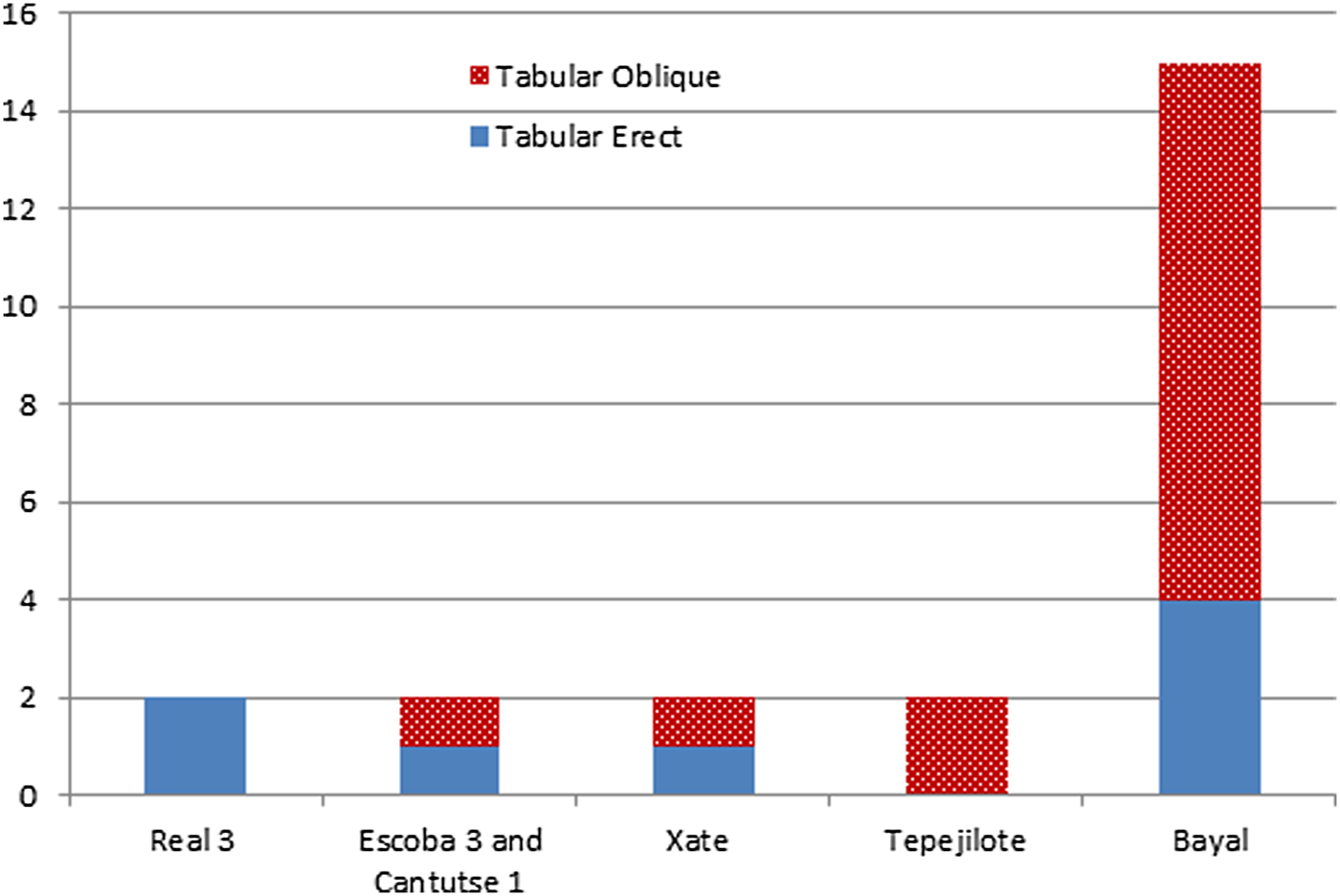
Frequencies of tabular erect and oblique head shapes at Ceibal based on Tourtellot Reference Tourtellot and Willey1990 and Palomo Reference Palomo2013.
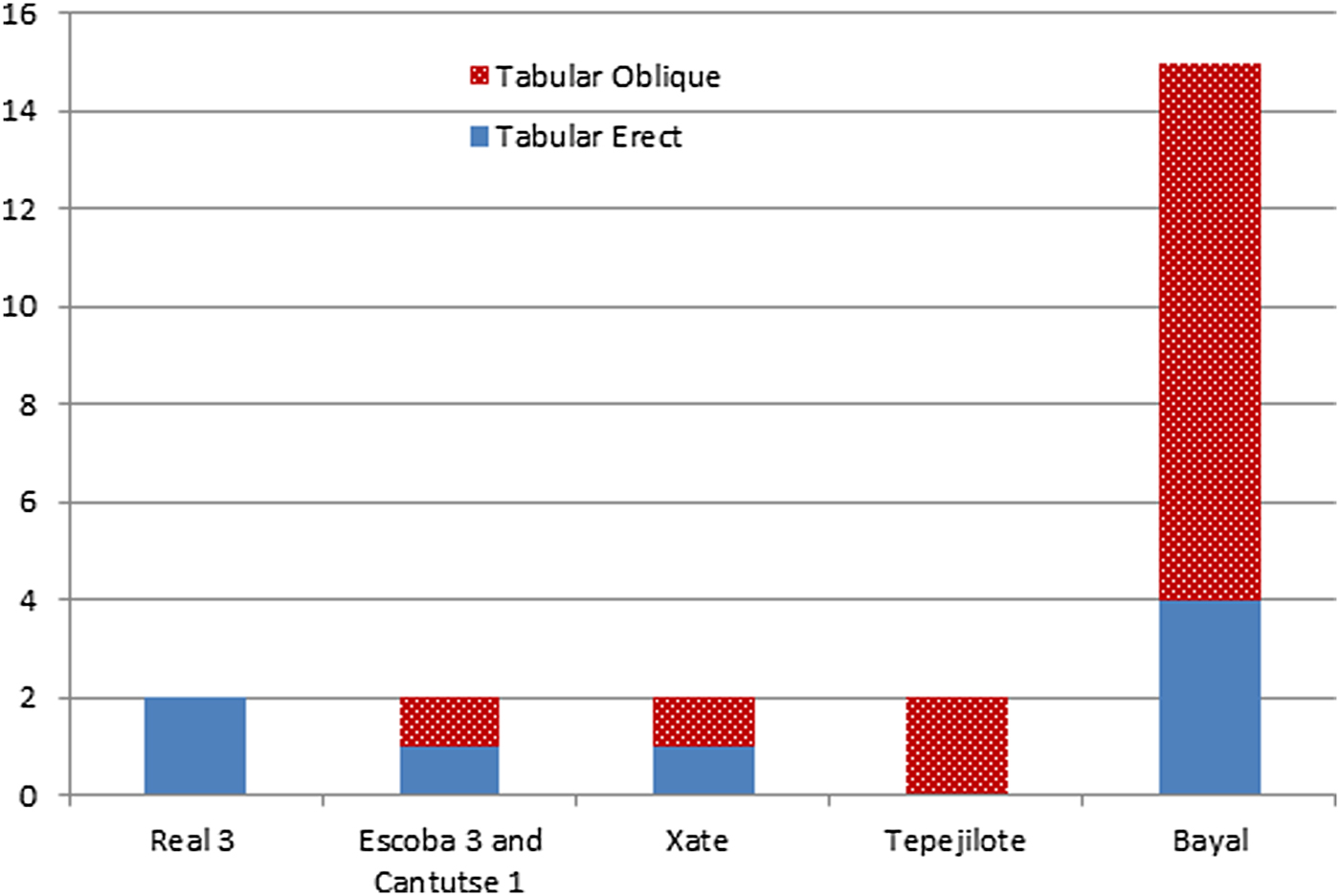
The cultural implications of tabular erect cranial deformations are difficult to infer partly because no human remains have survived into the archaeological record at Gulf Coast Olmec sites, such as La Venta and San Lorenzo. The notions of cranial deformation at those sites are suggested only by iconographic representations. Ceibal offers a unique data set in this regard as it provides both types of information: three skulls and one Olmec-style figurine found in the A-24 Platform (Triadan et al. Reference Triadan, Castillo, Inomata, Palomo, Méndez, Cortave, MacLellan, Burham and Ponciano2017) exhibit tabular erect shapes. Although the Middle Preclassic inhabitants of Ceibal had intense interactions with groups on the southern Gulf Coast, we are not certain whether the tabular erect form of Ceibal reflects influence from that area. Another possibility is that the tabular erect cranial deformation represents a tradition shared by diverse groups, developed and maintained through broad interregional interaction.
Cranial deformations must have embodied peoples' worldviews and ideals of how the human head ought to be shaped. Based on the iconographic analysis of clay figurines, Tiesler (Reference Tiesler2010, Reference Tiesler and Cucina2015) argues that mothers, experienced midwives, and other female kin were most likely in charge of modifying the child's cranial vault during the first few months or year of life, a time when the skull is still malleable. According to some authors (Cyphers and Villamar Reference Cyphers, Villamar, Calderón, Whiting and Guillén2006; Tiesler Reference Tiesler2010), the homogenization of cranial modification practices should have promoted social cohesion and identity, while visibly marking a difference between locals and outsiders. More specifically, it has been suggested that tabular erect cranial deformation from the Middle Preclassic period resembled the Olmec maize deity shown in iconographic depictions (Tiesler Reference Tiesler2010). According to Taube (Reference Taube, Clark and Pye2000), the Middle Preclassic period is the time when iconographic representations of the Maize God with maize foliation emerging from the head became clear. Interestingly, this period may correspond to the spread of sedentary villages in the Maya lowlands, including Ceibal (Inomata Reference Inomata, Vega and Lowe2012a), Cuello (Hammond Reference Hammond, Grove and Joyce1999), and Blackman Eddy (Garber et al. Reference Garber, Brown, Awe, Hartman and Garber2004). These data suggest that the tabular erect shape (especially the variation found in Ceibal during the Real 3 phase) could be connected to the Preclassic maize deity.
There was no evidence of tabular oblique cranial deformations during the early Middle Preclassic period at Ceibal. It seems that, at the beginning of the occupation, Ceibal residents were using cradleboards (in the case of Burials 132 and 136) and horizontal constriction bands (Burial 11; see Tiesler Reference Tiesler2010, Reference Tiesler2014) to produce tabular erect deformations.
During the Escoba 3 phase, the tabular oblique shapes produced by splint head devices appeared for the first time at Ceibal (Figure 19). This was the time when ceramics and architecture Ceibal became increasing similar to those of other parts of the Maya lowlands. There is evidence, however, that the tabular erect head shape continued, as represented by Burial 11, the individual with annular Olmecoid head shape (Tiesler Reference Tiesler2010), and by the individual from Burial 30, who had tabular erect cranial shape made by a cradleboard.
The cranium from Burial 116, exhibiting tabular oblique cranial deformation. Photograph by Inomata.

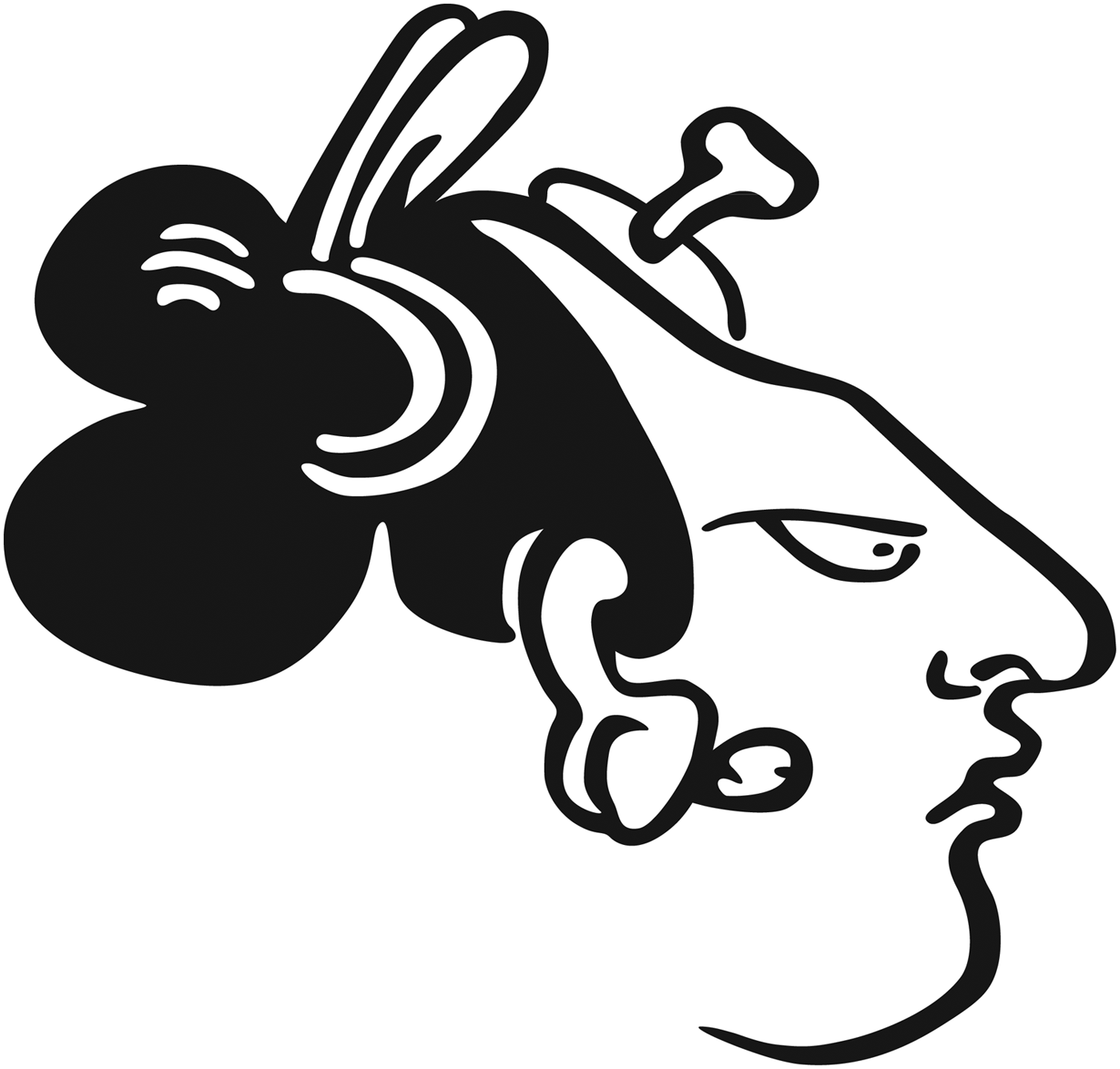
During the following Classic period, the tabular erect shapes produced by horizontal annular constriction bands and cradleboards disappeared at Ceibal, and by the same time tabular oblique shapes became the most representative in the sample. This gradual transition from the tabular erect deformation to the tabular oblique one may be related to changes in iconographic representations of the Maize God. Houston et al. (Reference Houston, Stuart and Taube2006) suggest that the Classic Maya practiced tabular oblique cranial deformation to emulate the corn shaped vault of the Maize God's skull; according to them, the head was the principal focus of Maya identity. Maya iconography shows several representations of a young man with cranial deformation, which Taube has identified as the Classic Maya Maize God (Taube Reference Taube1992). These depictions of the Maize God resemble the tabular oblique modification (Figures 19 and 20). It is possible that the two types of cranial deformations (tabular erect and tabular oblique) represented different versions of the same deity.
Depiction of a Classic Maya cranial deformation from a ceramic painting. Drawing by Palomo based on Kerr No. K5164 (Kerr Reference Kerr2000).

By analyzing the cranial modifications of the human remains excavated by the Harvard Projects at Ceibal and Altar de Sacrificios, Tiesler (Reference Tiesler2014) argues that there was continuity in head-shaping methods from the Late Classic to the Terminal Classic. Tabular oblique deformations produced with the use of head splints were the most common type of deformation during these periods (Tiesler Reference Tiesler and Cucina2015:148). The bioarchaeological sample recovered by the Ceibal Project aligns with Tiesler's suggestion about the predominance and continuity of tabular oblique cranial deformations during the Late Classic and Terminal Classic periods at Ceibal.
Trends in the use of head splint devices to produce tabular oblique modifications were not the same in other parts of Mesoamerica during the Late Classic and Terminal Classic transition. For instance, in the east coast of the Yucatan peninsula, the residents of Kohunlich, tended toward oblique forms during the Late Classic period. Toward the end of the Terminal Classic and through the Early Postclassic period, however, the locals seem to have adopted cradleboards without completely abandoning the oblique shapes, which resulted in the majority of the late dwellers displaying short and board head morphologies (Tiesler Reference Tiesler2014, Reference Tiesler and Cucina2015). Based on statistical analysis of cranial modifications, Tiesler (Reference Tiesler and Cucina2015:148) argues that a stronger cultural substitution occurred in the northeastern communities than those in the Pasión River region.
Interestingly, the Terminal Classic period witnessed a resurgence of the tabular erect cranial deformation at Ceibal. Although the tabular oblique shape continued to be a prevalent mode during this period, four skulls found in a mass deposit (Burial 4) exhibit tabular erect forms (Tourtellot Reference Tourtellot and Willey1990). This discovery leads to the tantalizing question of whether these individuals were sacrificed captives from other places. Regardless of the precise nature of the deformed skulls in Burial 4, their presence probably implies Ceibal's participation in the shifting interaction network.
Identity and Cranial Modifications at Ceibal
The relations of identities with the cranial modifications vary from one context to another at Ceibal. For instance, the tabular erect shapes that date to the early Middle Preclassic appeared at the same time when the green stone cruciform caches were placed in the central axis of the E-Group assemblage. During this period there are many representations of maize deities with tabular erect shapes at many sites in Mesoamerica (Taube Reference Taube, Clark and Pye2000). It is possible that the Middle Preclassic individuals with tabular erect shapes were Ceibal residents trying to emulate the head shape of the Preclassic period deities. Those cultural practices were possibly connected to Preclassic traditions shared by diverse groups, developed and maintained through broad interregional interactions.
During the following Classic period, tabular erect shapes and the use of cradleboards disappeared from the Ceibal bioarchaeological sample. In contrast, many individuals with tabular oblique shapes (Figure 18) were found in non-sacrificial contexts. It is possible that the individuals of the Classic period with tabular oblique deformations represent local residents of Ceibal. These cranial deformations appeared at the same time when Ceibal ceramics and architecture exhibited increasing similarities to those of other parts of the Maya lowlands. We suspect that Classic period individuals with tabular oblique modifications were trying to emulate the head shape of the young Classic Maya maize deity (Houston et al. Reference Houston, Stuart and Taube2006).
During the Late and Terminal Classic periods, tabular oblique shapes were predominant in the sample, and the continuity in cranial deformation methods (see Tiesler Reference Tiesler2014, Reference Tiesler and Cucina2015) supports the idea that individuals with tabular oblique cranial modifications represent Ceibal local residents. Although some of the individuals with tabular oblique shapes were found in elite residential groups at Ceibal and possibly represent high-status individuals, it is known that cranial modifications were practiced at different levels of all social spheres in Maya society.
During the Terminal Classic period, tabular erect shapes re-appeared at Ceibal. The identity and status of the Terminal Classic individuals displaying those tabular erect deformations are intriguing. All Terminal Classic individuals with tabular erect cranial deformations were found in a mass deposit (Burial 4) that was probably connected to public sacrificial activities conducted in the Central plaza. In contrast, all the Terminal Classic individuals with tabular oblique shapes at Ceibal (except two skulls from Burial 4) were found in non-sacrificial contexts, placed in residential groups and other structures. It is probable that Terminal Classic skeletons with tabular oblique modifications found in non-sacrificial contexts were locals and that the skulls found in the mass deposit (Burial 4) with tabular erect shapes represent non-local individuals.
Representations of Postclassic deities, such as the Maya merchant deity, display tabular erect deformations (Rosny Reference Rosny1883:68a; Teisler Reference Tiesler2014:155). These iconographic representations, along with the archaeological contexts of individuals with erect shapes, suggest that tabular erect shapes of the Terminal Classic period could have different meanings and connotations than those observed during the Preclassic period at Ceibal.
Dental Modifications and Dental Morphology Traits at Ceibal
The earliest dental modifications appear roughly at the same time as cranial modifications during the Middle Preclassic. For instance, Saul and Saul (Reference Saul, Saul, Whittington and Reed1997:45–46) document a dental modification in a young female displaying deep grooves (Romero Reference Romero1958, type A-1) in the maxillary incisor dating to the Early Bladen phase (800–700 b.c.) of Cuello in Belize. At Ceibal the earliest example of dental modification was found in Burial 126 that dates to the late Middle Preclassic (Escoba-Mamom 1 and 2 phases, 700–450 b.c.). This individual had filed maxillary lateral incisors (dental decoration type A-4, Romero Reference Romero1958). Similar forms of teeth were displayed by some Maya deities in Classic period iconography (see, for instance, Ceibal Stela 2). Probably these tooth shapes were embedded with ideals of beauty and religious meanings.
Due to their durable nature, teeth present more potential for genetic and metric analysis than other skeletal remains. Population distribution studies have shown that people can be differentiated demographically on the basis or varying frequencies of particular dental traits. By analyzing these dental traits in 113 individuals from the pre-Hispanic Mayan settlements of Ceibal and Altar de Sacrificios (Tourtellot Reference Tourtellot and Willey1990; Saul Reference Saul1972), Austin (Reference Austin1978) argues that there was continuity in the population with no significant evidence of migrants at Altar de Sacrificios. In contrast, there was a greater diversity of dental traits among individuals from Ceibal, suggesting that there was less genetic continuity at this settlement between early and late residents (15 burials dating between 600 b.c.–a.d. 810 constitute the early settlement assemblage, and 30 burials dating to the Bayal phase from a.d. 810–950 compose the late settlement assemblage). This observation concurs with the more recent findings by Scherer (Reference Scherer2007), who, through the analysis of dental metrics, suggest that there was an external gene flow at Ceibal during the Classic period.
Morphological analysis in other archaeological areas of the Maya lowlands indicates intense population dynamics during the Classic and Postclassic periods (Cucina Reference Cucina, Price, Paralta and Sosa2015). For instance, by analyzing dental traits from many burials of the northern and central Maya lowlands, Cucina (Reference Cucina and Cucina2013) and colleagues (Cucina et al. Reference Cucina, Price, Paralta and Sosa2015) argue that samples from inland sites of the Maya lowlands, such as Calakmul, Altar de Sacrificios, Ceibal, and Dzibanche, had dental morphological traits that clustered together, suggesting less gene flow with other coastal and northern groups, such as Noh Bec, Kohunlich, Xcambo, Jaina, Mayapan, and Chichen, whose dental traits clustered far from the Pasion area.
By analyzing dental metrics and morphological traits in burials uncovered from sites located in Belize and the Pasión area (Austin Reference Austin1978; Toutellot Reference Tourtellot and Willey1990), Wrobel (Reference Wrobel2003) argues that the Pasión sites (Altar de Sacrificios and Ceibal) and the Belizean sites had distinct regional clustering. That is to say that there is no evidence of Belizean migrants or gene flow exchanged with Ceibal.
Although the dental traits support the idea that Ceibal was interacting with non-local groups during the Classic period, the origins of those migrants are not knowable from the current data. Nevertheless, the dental analysis described above implies that, if there were migrants at Ceibal, their origins are probably not in the northern Maya lowlands (Cucina Reference Cucina, Price, Paralta and Sosa2015) or Belize (Wrobel Reference Wrobel2003).
SUMMARY AND CONCLUSION
The results of the bioarchaeological analysis show that during the early Middle Preclassic period tabular erect cranial deformation was practiced at Ceibal. None of the early Middle Preclassic burials at Ceibal were found with greenstone artifacts, but because of the limited sample size we cannot tell whether this was a community-wide pattern or whether important individuals were buried somewhere else with greenstone objects. During the Middle Preclassic period, most burials appear to have been placed outside of residential structures. Some of them may be interred in pits dug in open spaces near residential groups, as in the cases of Burials 126 and 132, but others may have been placed in more distant locations. The tabular erect cranial deformations from Ceibal dating to the early Middle Preclassic period show that cradleboards were used among possible local individuals, although this pattern changed in the following periods.
Our sample size continues to be small for the Escoba-Mamom 1 and 2 phases of the late Middle Preclassic period, but the number of burial samples is considerably larger for the transitional period from the Middle Preclassic to the Late Preclassic. The sample dating to the transitional period includes only one individual that was found fully articulated and in a correct anatomical position (Burial 104). The majority of individuals from this time period were incomplete, suggesting probable sacrificial acts (Figure 14). These possible sacrificial victims were found in the public plaza at Ceibal, with the majority of the individuals being male adults, as well as some juveniles and children. Human sacrifice appears to have become an important theme of public ritual during this period, which may be related to the intensification of warfare. The pattern observed in the assemblage of burials implies that there was a shift in the common form of ritual deposits in public plazas during the late Middle Preclassic period, from greenstone celt caches to human burials and ceramic vessels. A change in style of cranial deformation is also observable during this period. Tabular oblique shapes produced by head splints appeared in the sample around the same time as the collapse of the Middle Preclassic centers in the Isthmian region and on the Gulf Coast. Notably, this coincided with the period that Ceibal increased interaction with other Maya centers.
Although our sample sizes for the Protoclassic Xate and Early Classic Junco phase are small, it appears that Ceibal inhabitants were more commonly burying their dead inside structures and platforms, including ceremonial and domestic ones (Tables 1 and 2). Our sample size is substantially larger for the Late Classic period. The practice of burying the dead in or near houses was probably well established. Although hieroglyphic inscriptions show that the Dos Pilas-Aguateca dynasty defeated Ceibal, the bioarchaeological record does not show any increase in sacrificed males. During the Classic period, tabular erect shapes disappeared, and tabular oblique forms produced with head splints became the dominant shape practiced by Ceibal local residents.
We have the largest number of osteological samples for the Terminal Classic period. Although Ceibal inhabitants continued to bury their dead inside structures, we see an increment in possible sacrificial activities. During this period, tabular oblique continued to be the most frequent cranial deformation, but tabular erect deformations reappeared in possible non-local individuals. Head shaping methods at Ceibal showed continuity in using head splints more than cradleboards during the Classic period (Tiesler Reference Tiesler2014, Reference Tiesler and Cucina2015). On the other hand, the dental morphological traits and metric analysis suggest that Ceibal was participating in shifting interregional interactions (Austin Reference Austin1978; Scherer Reference Scherer2007), although this observation does not necessarily equate with the earlier theory of foreign invasions. During the Terminal Classic period, the ratio of probable sacrificial burials increased. Although direct evidence of warfare for this period is limited in comparison to the Late Classic times, the Ceibal residents apparently emphasized the theme of human sacrifice in public rituals during the time of rapid social change before the abandonment of Ceibal slightly after a.d. 900.
RESUMEN
Investigaciones arqueológicas en Ceibal han docuentado varios entierros que comprenden aproximadamente 117 individuos. Los entierros proporcionar importante información sobre los cambios sociopolíticos e interacciónes interregionales reflejadas en los restos óseos y en las prácticas funerarias durante puntos clave de la ocupación de Ceibal, que incluyen la aparición de las comunidades sedentarias a principios del preclásico medio, el desarrollo de sistemas políticos más grandes durante el preclásico tardío, la transición al periodo clásico y la desintegración política durante el clásico tardío y terminal.
Los restos oseos muestran variaciones significativas en tres aspectos: tipo de entierro (articulado y desarticulado), variabilidad de ofrendas funerarias y deformación craneana. La muestra esta compuesta por varios individuos en su mayoría de sexo masculinos asi como jóvenes, niños e infantes. El análisis de los restos oseos reveló que durante la fase Real 3 del preclásico medio, los habitantes de Ceibal aparentemente no enterraban a sus difuntos dentro de estructuras residenciales, práctica que difiere a la observada en otros sitios contemporaneos ubicados en Belice. Durante este periodo se practicaba la deformación tabular erecta en residentes locales, dicha deformacion es simlar a las representaciones observadas en iconografía preclásica. Las ofrendas funerarias más comunes en la fase Real 3 consistían en vasijas. Durante la transición del preclasico medio al preclásico tardio (fases Escoba 3 y Cantutse 1) se observó un incremento de entierros desrticulados en contexto primario en la Plaza Principal y en la Corte Este del Grupo A, estos entierros contienen una mayor variabilidad de ofrendas funerarias, tales como núcleos y navajas de obsidiana, cuentas de concha y piedra, huesos de animal, conchas y vasijas. Basados en el perfil biográfico, contexto arqueológico, la articulación de los huesos y las identificaciones de marcas cortantes se sugiere que algunos de estos individuos pueden estar relacionados a rituales públicos y sacrificios humanos producto de la intensificación de la guerra. Durante la parte final del preclásico medio y el preclásico tardío, Ceibal sostenia interaciones con otros grupos de las tierras bajas mayas lo cual se reflejaba en su ceramica y arquitectura. En esta época se empiezan a observar deformaciones craneanas al estilo tabular oblicuo coexsistiendo con deformaciones tabular erectas. Sin embargo, en el periodo clásico tardío las deformaciones tabular erecta desaparecen en Ceibal. Las deformaciones tabular obliquas continuan presentes en la muestra y probablemente estaban relacionadas a residentes locales y a representaciones mayas del dios del maíz. Durante el clássico tardío y terminal, los habitantes de Ceibal enterraban a la mayoría de sus muertos dentro de estructuras, palacios y plataformas. Las ofrendas funerarias mas comunes para esta época consistian en vasijas. Durante el clásico terminal, la deformación craneana tabular oblicua era la mas representada en entierros locales, sin embargo se documentó un resurgimiento de deformaciones tabulares erectas. Debido a que los individuos con deformaciones tabular erectas se encontraron en contextos no funerarios, se sugiere la posibilidad que estos no eran residentes de origen local. La aparicion de craneos humanos y extremidades inferiores en la plaza y grupos habitacionales, sugiere que durante la última etapa de ocupación en Ceibal se continuaban practicando sacrifios humanos en lugares públicos.
ACKNOWLEDGMENTS
Investigations at Ceibal were carried out with permits generously issued by the Instituto de Antropología e Historia de Guatemala and were supported by grants from the National Geographic Society, the National Science Foundation (BCS-0750808), the National Endowment for the Humanities (RZ-51209-10), the Alphawood Foundation, and the Agnese Nelms Haury Program of the University of Arizona awarded to Inomata and Triadan, as well as funds from the Japanese Ministry of Education, Culture, Sports, Science and Technology KAKENHI (21101003 and 21101002) and Japan Society for the Promotion of Science KAKENHI (21402008 and 26101003) awarded to Kazuo Aoyama. We are grateful to two anonymous reviewers for their thoughtful comments, and Palomo thanks Vera Tiesler for her help in the analysis of cranial deformations.