Introduction
It is generally assumed that cerebral white-matter changes on magnetic resonance imaging (MRI) represent a surrogate marker for vascular damage and are involved in the pathogenesis of depression in older adults (Scheltens et al. Reference Scheltens, Barkhof and Fazekas2003; Blazer & Hybels, Reference Blazer and Hybels2005; Alexopoulos, Reference Alexopoulos2006). Cross-sectional studies have demonstrated a strong association between depressive symptoms and white-matter changes, particularly in frontal pathology (de Groot et al. Reference de Groot, de Leeuw, Oudkerk, Hofman, Jolles and Breteler2000; MacFall et al. Reference MacFall, Payne, Provenzale and Krishnan2001; Firbank et al. Reference Firbank, Lloyd, Ferrier and O'Brien2004). Outcome studies have shown that white-matter changes are associated with worsening clinical course, poorer treatment response and increased mortality (O'Brien et al. Reference O'Brien, Ames, Chiu, Schweitzer, Desmond and Tress1998; Levy et al. Reference Levy, Steffens, McQuoid, Provenzale, MacFall and Krishnan2003; Baldwin et al. Reference Baldwin, Jeffries, Jackson, Sutcliffe, Thacker, Scott and Burns2004). Finally, longitudinal studies suggest that baseline severity of white-matter changes may independently predict future depressive outcomes (Godin et al. Reference Godin, Dufouil, Maillard, Delcroix, Mazoyer, Crivello, Alperovitch and Tzourio2008). Taken together, these findings support the vascular depression hypothesis which proposes that frontostriatal dysfunction as a result of vascular damage predisposes, precipitates and perpetuates depressive symptoms in older adults (Krishnan et al. Reference Krishnan, Hays and Blazer1997).
The Leukoaraiosis and Disability in the Elderly (LADIS) study is a large multi-centre pan-European 3-year longitudinal study of initially non-disabled elderly subjects investigating the relationship between white-matter changes and subsequent development of disability and depressive symptoms. We have reported previously on cross-sectional associations in the baseline sample (Firbank et al. Reference Firbank, O'Brien, Pakrasi, Pantoni, Simoni, Erkinjuntti, Wallin, Wahlund, van Straaten and Inzitari2005; O'Brien et al. Reference O'Brien, Firbank, Krishnan, van Straaten, van der Flier, Petrovic, Pantoni, Simoni, Erkinjuntti, Wallin, Wahlund and Inzitari2006) and longitudinal results in a relatively non-disabled population at short-term (1-year) follow-up (Teodorczuk et al. Reference Teodorczuk, O'Brien, Firbank, Pantoni, Poggesi, Erkinjuntti, Wallin, Wahlund, Gouw, Waldemar, Schmidt, Ferro, Chabriat, Bazner and Inzitari2007).
In this report we examined the role of white-matter changes as an independent predictor of both depressive outcomes in the longer term (at 2 and 3 years). The main hypothesis was that severity of white-matter changes at baseline would be significantly and independently associated with the development of depressive outcomes at both the 2- and 3-year follow-up, even after adjusting for the contribution of potential confounders.
Method
Sample
A total of 639 subjects were recruited between July 2001 and January 2003 from the 11 European centres participating in the LADIS study (Amsterdam, Copenhagen, Florence, Göteborg, Graz, Helsinki, Huddinge, Lisboa, Mannheim, Newcastle upon Tyne and Paris). Most were recruited having presented to centres with mild cognitive disturbances (n=168), minor stroke (n=122), gait disturbances (n=28), psychiatric complaints (n=13) or other neurological disturbances (n=129). Further subjects recruited included those in whom white-matter changes were incidentally found on structural neuroimaging taken in other clinical settings (n=107). Lastly, controls who were found to have white-matter changes were recruited from other studies (n=72).
At entry, subjects were included if they were: (1) aged between 65 and 84 years; (2) living in the community; (3) non-disabled as assessed by the Instrumental Activities of Daily Living (IADL; Lawton & Brody, Reference Lawton and Brody1969) scale (no impairment at all or only one item compromised); (4) accompanied by an informant; and (5) found to have any degree of age-related white-matter changes (ARWMC) on MRI scan, from mild to severe according to categorization into the three severity classes of a revised version of the scale of Fazekas et al. (Reference Fazekas, Chawluk, Alavi, Hurtig and Zimmerman1987).
Subjects were excluded if they had either: (1) severe illness (e.g. cardiac, hepatic, renal failure, neoplastic or other relevant systemic disease) that would increase the likelihood of drop-out; (2) severe unrelated neurological diseases; (3) leucoencephalopathies revealed by brain imaging that turned out to be of non-vascular origin (immunological, demyelinating, metabolic, toxic or infectious); or (4) severe psychiatric disorders.
All procedures were explained to subjects who gave written consent to participate. Further details on the design of the LADIS study have been reported previously (Pantoni et al. Reference Pantoni, Basile, Pracucci, Asplund, Bogousslavsky, Chabriat, Erkinjuntti, Fazekas, Ferro, Hennerici, O'Brien, Scheltens, Visser, Wahlund, Waldemar, Wallin and Inzitari2005).
MRI acquisition
Subjects had a baseline MRI scan at their respective centres. All centres used MRI systems with a field strength of 1.5 T, apart from one centre that had a 0.5 T system. A standard protocol was used (Pantoni et al. Reference Pantoni, Basile, Pracucci, Asplund, Bogousslavsky, Chabriat, Erkinjuntti, Fazekas, Ferro, Hennerici, O'Brien, Scheltens, Visser, Wahlund, Waldemar, Wallin and Inzitari2005). For the white-matter rating, a fluid attenuation inversion recovery (FLAIR) sequence was acquired with the following parameters: field of view 250 mm, 256×256 or 256×192 matrix, 5 mm slice thickness, 0.5 mm slice gap, 19–28 slices, time to echo 100–140 ms, time to repetition 6000–10000 ms, inversion time 2000–2500 ms, and echoes per shot 7–24. Volumetric analysis was performed by a single rater in Amsterdam on a Sparc 5 workstation (SUN, USA) (van Straaten et al. Reference van Straaten, Fazekas, Rostrup, Scheltens, Schmidt, Pantoni, Inzitari, Waldemar, Erkinjuntti, Mantyla, Wahlund and Barkhof2006). No distinction was made between subcortical and periventricular white-matter changes. Areas of white-matter changes around infarcts and lacunes were disregarded.
Major steps in determining ARWMC by the operator were as follows: (1) lesions were marked using a ‘seed’ and local thresholding was performed on each slice using home-developed software (Show Images, version 3.6.1 using a Canay filter); (2) lesions were delineated and the total surface of the outlined area was calculated; and (3) the total volume of ARWMC was established by multiplying by the interslice distance. Further details of the quantification process are described elsewhere (Gouw et al. Reference Gouw, Van der Flier, van Straaten, Barkhof, Ferro, Baezner, Pantoni, Inzitari, Erkinjuntti, Wahlund, Waldemar, Schmidt, Fazekas and Scheltens2006).
Assessment of depressive outcomes
Depressive symptoms were assessed by the self-completed 15-item Geriatric Depression Scale (GDS). The GDS is a self-reported questionnaire specifically developed as a screening instrument for the presence of depressive symptoms in older populations (Yesavage, Reference Yesavage1988). The maximum possible score is 15. Depressive symptoms were assessed at baseline and at 1, 2 and 3 years.
A history of depression was recorded, along with the date of any incident depression. History of depression was defined as a past medical history for a depressive episode requiring treatment or hospital admission. Incident depression was defined as any depressive episode requiring treatment or hospital admission over the course of the study. Both history and incident depression were obtained through subject interview and evaluation of the case-notes.
Assessment of potential mediators or confounders
All subjects had a comprehensive baseline demographic and clinical assessment administered by trained personnel. Information was collected on age, gender, education, occupational status, living conditions, previous medical conditions including stroke (as defined according to the World Health Organization; Hatano, Reference Hatano1976) and hypertension (Chalmers et al. Reference Chalmers, MacMahon, Mancia, Whitworth, Beilin, Hansson, Neal, Rodgers, Ni Mhurchu and Clark1999), prescribed medication, lifestyle (alcohol and smoking) and vascular risk factors.
Further baseline assessments administered were as follows:
(1) Functional status in terms of disability as measured by means of the IADL. This is a scale developed to monitor function and independent living among older adults and measures a broad set of daily activities including shopping for personal items, preparing meals, performing housework and managing personal finances (Lawton & Brody, Reference Lawton and Brody1969).
(2) Functional status in terms of the Disability Assessment for Dementia (DAD) scale. This is a 40-item questionnaire that includes basic items of living (Gelinas et al. Reference Gelinas, Gauthier, McIntyre and Gauthier1999).
(3) The Mini-Mental State Examination (MMSE) to assess cognition (Folstein et al. Reference Folstein, Folstein and McHugh1975).
(4) Standard neurological and cardiovascular examination.
Subjects were re-evaluated at 1, 2 and 3 years. Transition to disability was defined as the change from none or one to at least two impaired IADL items. To increase reliability investigators were issued with a specifically designed handbook that contained guidelines for applying tools. A test of the inter-rater, intercentre reliability of IADL scoring showed good agreement in ratings of each scale item (Κ statistic ranging from 0.69 to 0.85) (Inzitari et al. Reference Inzitari, Simoni, Pracucci, Poggesi, Basile, Chabriat, Erkinjuntti, Fazekas, Ferro, Hennerici, Langhorne, O'Brien, Barkhof, Visser, Wahlund, Waldemar, Wallin and Pantoni2007).
Statistical analysis
Data were collected in each centre and entered into a central electronic database on a specifically developed website (www.unifi.it/LADIS). In a community-dwelling population it is normal for depression rating scales to be heavily skewed towards low values. Hence, for analysis we divided our data into quintiles, using the same GDS range for each quintile as in our previous study (O'Brien et al. Reference O'Brien, Firbank, Krishnan, van Straaten, van der Flier, Petrovic, Pantoni, Simoni, Erkinjuntti, Wallin, Wahlund and Inzitari2006). For the ARWMC volumes, a logarithmic transform was used to produce normally distributed data.
A two-stage ‘step-forward’ regression analysis was used to determine the independent contribution of potential predictors of depressive outcomes. Initially, a univariate analysis was constructed to examine correlations between predictor variables and depressive symptoms at 2 and 3 years, the target variables. Baseline predictor variables included age, sex, baseline depressive symptoms (GDS), history of depression, educational level, smoking status, cognition (MMSE), history of stroke, hypertension and log ARWMC volume. As depressive symptoms (as measured by the GDS) are on an ordinal (i.e. ordered, but not linear) scale, we used Spearman's rank order correlation coefficient (ρ) to determine the correlation.
Variables that correlated significantly were then entered in a stepwise forward method into a multivariate analysis to determine the independent contribution of each predictor variable. In addition to an ordinal logistic regression model of predictors of quintile of depression scale score at 2 and 3 years, a further binary logistic regression was performed to compare predictors of incident depression over the study period.
To examine potential mechanisms by which white-matter changes might depress mood, the prospective variable transition to disability was included as an additional predictor variable in further models.
The significance level was set at p<0.05.
Results
Of the original 639 subjects, 501 subjects completed second-year assessments and 440 subjects completed final assessments, representing an attrition rate of approximately 31% over the 3 years. Complete data were obtained for 399 subjects. Attrition resulted from subject drop-out (n=73), missing data (n=124) and death (n=43). Baseline ARWMC, GDS and age were significantly higher in those without, as compared to those with, follow-up data (ARWMC: median 15.5 v. 13.3 ml; p=0.043 Mann–Whitney; GDS median 3 v. 2; p<0.001, age 75.0 v. 73.6; p<0.001).
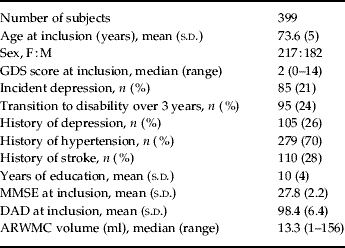
Table 1 summarizes the key characteristics of the subjects who completed all final-year assessments. As expected for a community population, the group GDS score remained stable over time. The mean GDS score was 2.86 at baseline and 2.96 at 3 years; the paired t test found no significant change in GDS over the study (t=−0.8, p=0.4). Eighty-five subjects had at least one depressive episode during the study time period. Cognition declined over the 3 years. The mean MMSE score was 27.85 (s.d.=2.2) at baseline and 27.11 (s.d.=3.5) at 3 years; the paired t test found a significant change over the study (t=4.9, p<0.001).
Characteristics of the study group who completed all final year assessments

F, Female; M, male; GDS, Geriatric Depression Scale; MMSE, Mini-Mental State Examination; DAD, Disability Assessment in Dementia; ARWMC, age-related white-matter changes; s.d., standard deviation.
Data obtained in subjects at baseline.
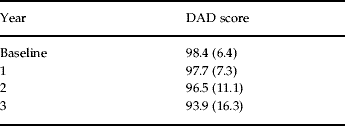
Over the study period the population became more disabled (Table 2). Repeated-measures ANOVA showed a significant difference over the 3 years (F=22, p<0.001). Sixty-eight subjects were classed as having made a transition to disability at 2 years and 95 at 3 years.
Disability in dementia scores over the study period (n=383)

DAD, Disability Assessment in Dementia.
Data are given as mean (standard deviation).
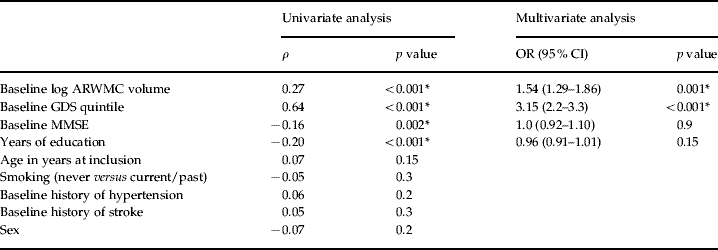
Table 3 shows the results of the step-forward analysis of predictors of 2-year GDS. On univariate analysis log ARWMC volume, baseline GDS, cognition (MMSE) and years of education correlated significantly with depressive symptoms at 2 years. When these variables were entered into the multiple regression model, only baseline log ARWMC volume and baseline GDS remained predictive of depressive symptoms.
Step-forward regression analysis of predictors of quintile GDS at 2 years (n=399)

ARWMC, Age-related white-matter changes; GDS, Geriatric Depression Scale; MMSE, Mini-Mental State Examination; OR, odds ratio; CI, confidence interval.
* p<0.05.
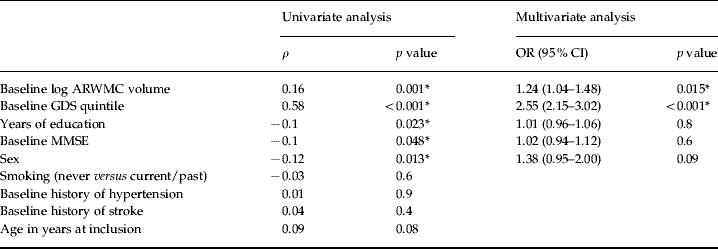
Table 4 shows the results of the step-forward analysis of predictors of 3-year GDS. Again, only baseline GDS and log ARWMC volume significantly and independently predicted quintile GDS at 3 years in the multivariate analysis. Sex, years of education and MMSE were no longer significant.
Step-forward regression analysis of predictors of quintile GDS at 3 years (n=399)

ARWMC, Age-related white-matter changes; GDS, Geriatric Depression Scale; MMSE, Mini-Mental State Examination; OR, odds ratio; CI, confidence interval.
* p<0.05.
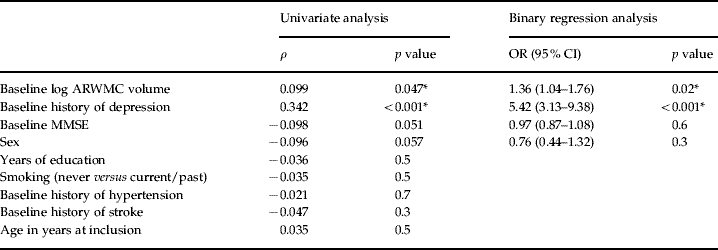
A binary regression model was undertaken to investigate the relationship between white-matter changes and incident depression (Table 5). In the regression model, including all the significant correlators from the univariate analysis, only log ARWMC volume and history of depression independently predicted depressive episodes over the 3 years.
Step-forward regression analysis of predictors of incident depression over 3 years (n=399)

ARWMC, Age-related white-matter changes; GDS, Geriatric Depression Scale; MMSE, Mini-Mental State Examination; OR, odds ratio; CI, confidence interval.
Data obtained in 399 subjects.
* p<0.05.
To examine the influence of disability, further regression models were constructed including in the analysis the prospective variable transition to disability. Baseline severity of white-matter changes continued to significantly and independently predict 2-year depressive symptoms in the new model [odds ratio (OR) 1.49, 95% confidence interval (CI) 1.24–1.8, p<0.001]. However, severity of white-matter changes no longer independently predicted 3-year GDS (OR 1.17, 95% CI 0.97–1.4, p=0.09) or incident depression over the study period (OR 1.27, 95% CI 0.97–1.65, p=0.08). Transition to disability predicted both 3-year GDS (OR 2.11, 95% CI 1.31–3.39, p=0.002) and 3-year incident depression (OR 2.16, 95% CI 1.17–4, p=0.012) but failed to predict GDS at 2 years (OR 1.3, 95% CI 0.76–2.225, p=0.3).
Discussion
The main result of this pan-European study is that baseline severity of white-matter changes in a non-disabled community population independently and significantly predicted depressive episodes and depressive symptoms at both 2 and 3 years. Although the MMSE and years of education were correlated with GDS in the univariate analysis, they did not predict depressive scores in the logistic regression models. As expected, baseline GDS score significantly predicted future depressive symptoms.
These results not only build on our previous finding, that baseline severity of white-matter changes predicts 1-year depressive symptoms (Teodorczuk et al. Reference Teodorczuk, O'Brien, Firbank, Pantoni, Poggesi, Erkinjuntti, Wallin, Wahlund, Gouw, Waldemar, Schmidt, Ferro, Chabriat, Bazner and Inzitari2007), but also demonstrate that such pathology is predictive of the clinically more meaningful depressive episodes. In the shorter study we were unable to demonstrate such an effect, potentially because of the relatively small number of depressive episodes over the 1-year period.
On further analysis, when the prospective variable transition to disability was included in the regression model, the severity of white-matter changes continued to significantly predict GDS at 2 but not 3 years. Furthermore, in the new analysis the baseline severity of white-matter changes no longer predicted incident depression. These findings demonstrate that the independent effect of white-matter changes on mood weakens with time as the community population becomes more disabled. One possible explanation of our findings could be that, in the more disabled 3-year population, transition to disability is also a driver of depressive outcomes and so mediates the effect of the other significant covariates from the univariate analysis. Another explanation could be that disability and depression are both so strongly associated with white-matter changes that it is difficult to determine causality using regression techniques.
Other community studies have investigated the longitudinal relationship between white-matter changes and late-life depression. Recently, the three city (3C)-Dijon study (Godin et al. Reference Godin, Dufouil, Maillard, Delcroix, Mazoyer, Crivello, Alperovitch and Tzourio2008) found that severity of white-matter changes independently predicted future risk of incident depression; however, the influence of transition to disability was not specifically examined. In line with our results, the large Cardiovascular Health study found that, after controlling for functional impairment, total severity of white-matter changes no longer independently predicted future depressive symptoms (Steffens et al. Reference Steffens, Krishnan, Crump and Burke2002). Lastly, the PROSPER (PROspective Study of Pravastatine in the Elderly at Risk of cardiovascular disease) found no longitudinal associations over 3 years between white-matter changes and depressive outcomes in an age- and sex-adjusted logistic regression model (Versluis et al. Reference Versluis, van der Mast, van Buchem, Bollen, Blauw, Eekhof, van der Wee and de Craen2006). However, there were low levels of depressive symptoms in the PROSPER population that, together with the low ARWMC volume of subjects, may have led to negative results.
Previous reports from the LADIS study that severity of white-matter changes predicts disability provide an interesting insight into the potential mechanisms that lead to depression (Inzitari et al. Reference Inzitari, Simoni, Pracucci, Poggesi, Basile, Chabriat, Erkinjuntti, Fazekas, Ferro, Hennerici, Langhorne, O'Brien, Barkhof, Visser, Wahlund, Waldemar, Wallin and Pantoni2007). It is already known that a mutually reinforcing reciprocal relationship exists between disability and depressive symptoms in late life (Ormel et al. Reference Ormel, Rijsdijk, Sullivan, van Sonderen and Kempen2002); disability not only predicts depression but is also a consequence of depression. Taken together with our findings, it is conceivable that white-matter changes, in part, lead to a worsening in functional ability and an amplification loop may then be set up in the more disabled population, as the transition to disability leads to depressive symptoms, which in turn worsen functional ability. Thus, in the more disabled third-year population, the relative influence of a potential indirect pathway mediated by disability may become greater and the independent contribution of white-matter changes on depressive outcomes declines.
Clinically, the value of this study lies in developing our understanding of the evolution of depression and the further implications concerning potential treatment strategies. Importantly, our results suggest a need for tighter control of vascular risk factors; first, because of the strong independent effect of white-matter changes on depressive outcomes, and second, because white-matter pathology is an independent predictor of disability (Inzitari et al. Reference Inzitari, Simoni, Pracucci, Poggesi, Basile, Chabriat, Erkinjuntti, Fazekas, Ferro, Hennerici, Langhorne, O'Brien, Barkhof, Visser, Wahlund, Waldemar, Wallin and Pantoni2007). Furthermore, as a consequence of putative indirect mechanisms, whereby vascular damage may depress mood, rehabilitation-based strategies targeted at improving functional abilities may prove beneficial in the prevention and treatment of late-life depressive illnesses.
The strengths of the study are the large, multi-centre, pan-European design and the size of the population, together with its relatively heterogeneous composition, all of which increase the generalizability of the findings. Further strengths include measurement of all scans by a single operator and the use of a volumetric scale that is less operator dependent and less susceptible to ceiling effects (van Straaten et al. Reference van Straaten, Fazekas, Rostrup, Scheltens, Schmidt, Pantoni, Inzitari, Waldemar, Erkinjuntti, Mantyla, Wahlund and Barkhof2006).
The limitations are, first, attrition over the 3 years makes it possible that the data may reflect methodological problems rather than a real effect. However, our attrition rate is not uncommon for studies of this magnitude. Furthermore, the fact that those who were lost to follow-up had a greater degree of white-matter changes and depressive symptoms make any effect seen in subsequent analyses more impressive. Second, the GDS gives an indication of depressive symptoms over the past week, and therefore it may not capture the phenomenon under investigation. However, we used two depressive outcomes and found the results to be complementary, suggesting we are observing a real effect. Third, arguably some of the symptoms measured on the GDS may in fact represent a dysexecutive syndrome. Although this may be possible, it is becoming increasingly clear that, in older adults, depression is as much a cognitive disorder as a mood disorder and thus such overlapping symptomatology will always occur (Steffens & Potter, Reference Steffens and Potter2008). Lastly, we may have underestimated the number of cases of depression over the study as a result of our definition of incident depression as ‘a depressive episode requiring treatment or hospital admission’. However, this limitation makes a type II error more likely and the fact that we demonstrate significant results over 3 years suggests that the validity of the study has not been compromised.
Future research should be directed at determining the influence of progression in white-matter changes on future depressive outcomes. In addition, the findings from other longitudinal studies using complementary neuroimaging techniques, such as diffusion tensor imaging, should be linked, in order to develop an integrated perspective of the complex pathways that lead to depressive illnesses in later life (Kumar & Ajilore, Reference Kumar and Ajilore2008).
Appendix
List of participating centres and personnel
Helsinki, Finland (Memory Research Unit, Department of Clinical Neurosciences, Helsinki University): T. Erkinjuntti, T. Pohjasvaara, P. Pihanen, R. Ylikoski, H. Jokinen, M.-M. Somerkoski, R. Mäntylä, O. Salonen; Graz, Austria (Department of Neurology and MRI Institute, Medical University Graz): F. Fazekas, R. Schmidt, S. Ropele, B. Rous, K. Petrovic, U. Garmehi, A. Seewann, G. Schrotter; Lisboa, Portugal (Serviço de Neurologia, Centro de Estudos Egas Moniz, Hospital de Santa Maria): J. M. Ferro, A. Verdelho, S. Madureira; Amsterdam, The Netherlands (Department of Radiology and Neurology, VU Medical Centre): P. Scheltens, I. van Straaten, F. Barkhof, A. Gouw, W. van der Flier; Goteborg, Sweden (Institute of Clinical Neuroscience, Goteborg University): A. Wallin, M. Jonsson, K. Lind, A. Nordlund, S. Rolstad, I. Isblad; Huddinge, Sweden (Karolinska Institute, Neurotec Department, Section of Clinical Geriatrics): L.-O. Wahlund, M. Crisby, A. Pettersson, K. Amberla; Paris, France (Department of Neurology, Hopital Lariboisiere): H. Chabriat, K. Hernandez, A. Kurtz, D. Hervé; Mannheim, Germany (Department of Neurology, University of Heidelberg, Klinikum Mannheim): M. Hennerici, C. Blahak, H. Baezner, M. Wiarda, S. Seip; Copenhagen, Denmark (The Memory Disorders Research Group, Department of Neurology, Rigshospitalet, Copenhagen University Hospital): G. Waldemar, E. Rostrup, C. Ryberg, T. Dyrby, O. B. Paulson; Newcastle upon Tyne, UK (Institute for Ageing and Health, University of Newcastle): J. O'Brien, S. Pakrasi, A. Teodorczuk, M. Krishnan, M. Firbank, P. English. The Coordinating Centre is in Florence, Italy (Department of Neurological and Psychiatric Sciences, University of Florence): D. Inzitari (study coordinator), L. Bartolini, A. M. Basile, E. Magnani, M. Martini, M. Mascalchi, M. Moretti, L. Pantoni, A. Poggesi, G. Pracucci, E. Salvadori, M. Simoni.
The LADIS Steering Committee is formed by D. Inzitari (study coordinator), T. Erkinjuntti, P. Scheltens, M. Visser and P. Langhorne, who replaced K. Asplund in 2005.
Acknowledgements
The LADIS study is supported by the European Union within the V European Framework Programme ‘Quality of life and management of living resources’ (1998–2002), contract no. QLRT-2000-00446 as a concerted action. This work was also supported by the UK National Institute for Health Research (NIHR) Biomedical Research Centre for Ageing and Age-Related Disease award to the Newcastle upon Tyne Hospitals National Health Service (NHS) Foundation Trust.
Declaration of Interest
Professor A. Wallin has been on the advisory board and received speaker honoraria from GSK, Janssen-Cilag, Lundbeck, Novartis and Pfizer. Professor G. Waldemar has received consultancy honoraria from Pfizer and Lundbeck.