Composing a text involves at least four major cognitive components. First, planning processes are engaged to prepare the content of the text by retrieving ideas from the writer's long-term memory and by reorganizing them if necessary. These planning processes also allow the scheduling of writing by preparing action plans for composing (Hayes & Grawdol-Nash, Reference Hayes, Grawdol-Nash, Levy and Ransdell1996). Second, translating processes grammatically encode the conceptual structure elaborated during planning by retrieving in the mental lexicon the syntactic and morphological properties of this content (Levelt, Reference Levelt, Hagoort and Brown1999). Orthographic encoding is further needed prior to handwriting (Bonin, Fayol, & Peereman, Reference Bonin, Fayol and Peereman1998; Bonin, Peereman, & Fayol, Reference Bonin, Peereman and Fayol2001; Caramazza, Reference Caramazza1991). Third, with motor execution processes writers graphically transcribe their text. They program their handwriting (or typing) movements and then they execute these movements. Fourth, revision processes (reading and editing) allow writers to compare the segments of the text not yet handwritten or the text already written with their mental representation of the intended text. It is important that these writing processes are not activated linearly. Rather, each process can interrupt any other process at any moment during the composition (Flower & Hayes, Reference Flower, Hayes, Gregg and Steinberg1980).
In a recent study, Kellogg, Olive, and Piolat (Reference Kellogg, Olive and Piolat2007) analyzed the degree to which the verbal, visual, and spatial components of working memory (WM) support the writing processes during sentence production. Consistent with the notion that grammatical, phonological, or orthographic encoding require the use of verbal WM (Chenoweth & Hayes, Reference Chenoweth and Hayes2003; Levy & Marek, Reference Levy, Marek, Torrance and Jeffery1999; Mueller, Seymour, Kieras, & Mueller, Reference Mueller, Seymour, Kieras and Meyer2003), the authors found that writing a definition to either a concrete or an abstract noun slowed the responses made to a concurrent verbal task. They also found that writing definitions of only concrete nouns disrupted the visual task. This outcome is consistent with Kellogg's claim (Reference Kellogg, Levy and Ransdell1996) that planning the content of the message engages visual WM when the referents of concepts are imaged. The spatial task, which required participants to memorize and to match spatial locations concurrently with writing, was not disrupted for either concrete or abstract nouns. The present research extends these earlier findings to text composition. We reexamine the relationship between the verbal, visual, and spatial components of WM and the writing processes when writers are composing a text. Moreover, because activation of the different writing processes changes throughout a writing session, their demands should also vary. Consequently, we also investigated whether the demands that writing places on the different WM components change across a writing session.
The role of WM in text composition has been emphasized since the seminal work of Flower and Hayes (Reference Flower, Hayes, Gregg and Steinberg1980), who argued that writers are overloaded when they compose a text because of the heavy demands the activity places on WM. Kellogg (Reference Kellogg, Levy and Ransdell1996) proposed a model of the relationships between writing and WM by adopting Baddeley's (Reference Baddeley1986) multicomponent model of WM. Accordingly, WM is conceived as a multicomponent system (Baddeley, Reference Baddeley1986). An attentional component, the central executive, regulates and controls information. It is aided by two independent systems: the phonological loop, which is specialized for the short-term storage and processing of verbal and acoustic information, and the visuospatial sketchpad, that temporary holds visuospatial information and that is assumed to be fractionated into two visual and spatial components (Logie, Reference Logie1995; Smith & Jonides, Reference Smith and Jonides1997). In that framework, Kellogg analyzes how the different components of WM systems support the writing process.
Several studies have confirmed that the writing processes impose large attentional demands on the central executive. For instance, Kellogg (Reference Kellogg1987) examined cognitive effort of the writing processes by asking participants to perform, while composing a text, a secondary RT task associated with a directed verbalisation task (see Olive, Kellogg, & Piolat, Reference Olive, Kellogg, Piolat, Olive and Levy2002, for a detailed description of the procedure). Kellogg found that planning and revision processes placed more attentional demands on the central executive than translating processes do. Moreover, it has been shown that planning, translating, reviewing, and transcribing compete with one another for the limited attentional capacity of the central executive (Kellogg, Reference Kellogg2002). McCutchen (Reference McCutchen1996, Reference McCutchen2000) reviewed correlational and experimental studies showing that during writing development, greater fluency of the writing processes frees WM resources and consequently results in better writing performance. In sum, all high-level writing processes engage the central executive component of WM. They require attention to enable their processing and to coordinate the various demands they pose on WM, but they might also engage some central bottleneck (Pashler, 1994), for example, for coordinating linguistic processes (see Ferreira & Pashler, Reference Ferreira and Pashler2002, for an example in spoken language production).
Kellogg (Reference Kellogg, Levy and Ransdell1996) proposed that the writing processes, together with their central executive demands, differently engage the code-specific components of WM (the phonological loop and the visuospatial sketchpad; Baddeley, Reference Baddeley1986). Planning processes would require access to the visuospatial sketchpad when writers visualize images and organize diagrams and other visuospatial representations as they plan. By contrast, translating and aspects of reviewing (specifically, reading) would impose demands on the phonological loop.
Madigan, Johnson, and Linton (Reference Madigan, Johnson and Linton1994) observed that unattended speech, which is thought to load the phonological loop, effectively slowed the writer's fluency in generating sentences. Levy and Marek (Reference Levy, Marek, Torrance and Jeffery1999) examined this effect more closely by asking participants to formulate sentences using five words. Both normal and scrambled unattended speech reduced the number of words successfully included and increased the number of incorrect changes in number and tense, indicating the disruption depended on the phonological properties of the speech rather than its semantic content. More recently, Chenoweth and Hayes (Reference Chenoweth and Hayes2003) found that repeatedly saying the word “tap” while producing text suppresses the inner voice that accompanies writing, the texts produced in that condition contain more mechanical errors, and holistic text quality decreases. Thus, there are now several studies supporting the idea that verbal WM is involved in writing when translating content into language, and more precisely to support short-term maintenance of phonological representations. Other findings on dysgraphia also suggest that verbal WM may support the graphemic buffer at least partially (Miceli, Caltagirone, Capasso, Caramagno, Patria, Turriziani, Zampetti, & Caramazza, submitted).
Less is known about visuospatial WM in writing. When reading the text, a visual component might be involved (Hayes, Reference Hayes, Levy and Ransdell1996). For example, the spatial layout of the text is shown to affect revision of a text (Piolat, Roussey, & Thunin, Reference Piolat, Roussey and Thunin1997). Content of the text, and relationship among the objects mentioned in the text, might also be visual features available during writing. For example, Passerault and Dinet (Reference Passerault and Dinet2000) hypothesized that descriptive composition, because it relies on mental imagery, should impose more demands on visuospatial WM. By contrast, they assumed that argumentative text might not requires visuospatial WM when the topic only involves abstract content. To test that hypothesis, they asked participants to compose either an argumentation or a descriptive text while performing a visual concurrent task that consisted in memorizing visuospatial shapes. As anticipated, writers' fluency was slower when composing the descriptive text than the argumentative one. Lea and Levy (Reference Lea, Levy, Torrance and Jeffery1999) also found that a concurrent visuospatial tracking task affected the fluency of written composition. They showed that the visual concurrent task disrupted writers' fluency by 13% relative to a writing only control condition, whereas a concurrent phonological task disrupted fluency still more (21%) and showed more task errors compared to performance on the visuospatial task. At the same time, the writing task disrupted performance more on the phonological task compared with the visuospatial task, but significant interference was observed for both. By contrast, Kellogg (Reference Kellogg2004) did not found any effect of a visual concurrent task in sentence generation. This difference in outcomes certainly results from differences in nature of the secondary tasks between the two experiments, but also on the fact that composing a full text, by contrasts with sentence generation, probably poses more visuospatial demands because of processing of the physical layout of the text (Hayes, Reference Hayes, Levy and Ransdell1996).
Kellogg (Reference Kellogg, Torrance and Jeffery1999), however, made specific assumptions on the role of visuospatial WM in text production. He argued that visual WM is engaged when processing figurative material during the idea generation phase of planning, and that spatial WM may be needed when organizing information during planning. Galbraith, Ford, Walker, and Ford (Reference Galbraith, Ford, Walker and Ford2005) tested these assumptions by asking undergraduate students to compose a text in three distinct phases: generating ideas, organizing ideas with an outline, and producing text. Participants had also to carry out several concurrent tasks throughout the first two phases. Among these tasks, participants monitored a spatial tracking task and a visual noise task. Galbraith et al. (Reference Galbraith, Ford, Walker and Ford2005) did not find any reliable effect of the visual noise task, suggesting that a purely visual task does not disrupt planning processes. They found, however, that the spatial tracking task affected organization of ideas by reducing quality of content and affecting various aspects of the outline realized before producing text.
Spatial demands presumably come from representation of the spatial layout of the text. Several findings in reading research have shown that changes in the layout of the text affect memory for words location, a phenomenon that most of us have already experienced (Lovelace & Southall, Reference Lovelace and Southall1983; Rothkopf, Reference Rothkopf1971). A similar phenomenon occurs in writing (Le Bigot, Passerault, & Olive, in press). Moreover, when planning, we generally resort to the spatial layout of the sheet to mark the semantic organization of the text, for example, when paragraphing a text (Bond & Hayes, Reference Bond and Hayes1984). Finally, and obviously, handwriting is also a visual–motor integration activity and its visuospatial demands have been investigated (Van der Plaats & van Galen, Reference Van Der Plaats and van Galen1990). For example, when the visual feedback is suppressed during a composition, processing demands of handwriting increase and coordination of the writing processes changes (Olive & Piolat, Reference Olive and Piolat2002). Taken together, these findings suggest that the visual or spatial components of WM may be at times needed in text production (particularly during planning), and that verbal WM is most central to text production.
The studies that we report here evaluated the specific demands that text composition place on the different components of WM. For this purpose, we manipulated the type of WM task writers had to perform while composing their text. By contrast with most previous studies, we examined verbal, visual, and spatial WM in the same experiment. Numerous lines of evidence now indicate that verbal, visual, and spatial systems can be dissociated in WM. Both behavioral and neuroimaging results indicate that the sketchpad is fractionated into separate visual and spatial components (Hecker & Mapperson, Reference Hecker and Mapperson1997; Logie, Reference Logie1995; Logie & Marchetti, Reference Logie, Marchetti, Logie and Denis1991; Sala, Räma, & Courtney, Reference Sala, Räma and Courtney2003; Smith et al., Reference Smith, Jonides, Kœppe, Awh, Schumacher and Minoshima1995). The visual component (the visual cache) is a passive system that stores visual information and spatial locations in the form of static visual representation. The spatial component (the inner scribe) is an active spatial rehearsal system that maintains sequential locations and movements and that also serves to refresh decaying information in the visual cache.
Our participants composed a text in longhand while concurrently performing visual, spatial, or verbal tasks. The tasks were designed to require the same input (visual, Experiment 1, or aural, Experiment 2), to require the same modality of response and to be minimally disruptive of text composition. Ransdell, Levy, and Kellogg (Reference Ransdell, Levy and Kellogg2002) concluded that disrupting both fluency and text quality requires placing a heavy load on the verbal and central executive components of WM, such as retaining six digits while composing. Because the tasks we used in the present experiment are less intrusive than retaining digits (Kellogg et al., Reference Kellogg, Olive and Piolat2007), we anticipated that the primary writing task would unfold with normal fluency and quality. However, achieving this level of writing performance would decrease accuracy and increase reaction time (RT) on the secondary task. We predicted that writing would place more demand on verbal WM because more writing processes draw on verbal WM than on visual or spatial WM. Performance at the verbal task should therefore be lower (long RTs, low accuracy) than on the visual task (short RTs, high accuracy).
EXPERIMENT 1
Experiment 1 analyzed whether text composition taps the verbal, visual, and spatial components of WM and whether these demands change throughout a writing task. For that purpose, participants composed a text while performing concurrent tasks that were verbal, visual, or spatial. Stimuli of the secondary tasks were visually presented. Participants' performance was analyzed by measuring writing performance and concurrent task performance. We also analyzed writers' writing performance.
Method
Participants. Seventy-two undergraduate psychology students (mean age = 21 years, 9 months [21;9]) from the University of Poitiers were assigned in equal numbers to one of the four groups defined by the concurrent tasks (none, verbal, visual, and spatial). All participants were native French speakers. Three additional participants had been tested and replaced: one participant misunderstood the concurrent task instructions, and two others performed the concurrent task near the chance level (about 50% of correct answer). Participants were tested individually and were treated in accordance with the ethical standards.
Tasks and material
Writing task. In each condition, participants composed a 30-min argumentative text about increase of university fees. They were asked to give pros and cons arguments about this increase and to compose a good text, both in style and organization of ideas. Participants composed their text without preparing a first draft. So, they were allowed to cross out parts of their text and to use any sign they wished to move or insert a part of the text. Instructions indicated that the final aspect of the text was not important, that participants had to use their usual handwriting. Finally, participants were able, if needed, to take all the time they wanted to mentally plan their text or to check and edit it. Quality of the texts was evaluated in different ways. First, automatic content analysis assessed the number and nature of the arguments discussed in the texts. Second, holistic quality was evaluated by two independent judges who were blind as to the experimental conditions and hypothesis. They scored language and organization of the text with a 7-point scale (1 = low quality, 7 = high quality).
Concurrent tasks. The verbal, visual, or spatial tasks were performed first in isolation and then concurrently with the composing task. Each of these tasks required detecting whether a visually presented stimulus matched the last one presented (in the traditional variable interval schedule used in writing research, i.e., between 15 and 45 s). Thus, the task required maintaining the most recent stimulus in WM, detecting a new stimulus, matching the new stimulus to the one in memory, deciding to respond or to inhibit responding, and updating the most recent stimulus. The instructions asked participants to respond as rapidly and as accurately as possible to each nonrepetition stimulus by clicking on the mouse of the computer with their nondominant hand that they kept on the mouse for all the experiment. RTs were measured in milliseconds. Mean RTs were calculated by taking into account all her/his RTs (that responses were correct or not). Outliers RTs, for instance, that were longer than the participant's mean RT plus 3 standard deviations, were excluded from calculation of each participant mean RT. Accuracy (percentage of correctly detected targets) was averaged over every stimulus (change or no-change trials).
When the concurrent tasks were performed in isolation, a total of 25 trials were presented and baseline measurements were thus collected, so that the degree of interference in accuracy and in RTs could be determined. The reactions to the first five stimuli were considered as warmup reactions and were not included in the computation of the baseline measures. The instructions and stimuli were presented on the screen of a computer monitor with a modified version of ScriptKell (Piolat, Olive, Roussey, Thunin, & Ziegler, Reference Piolat, Olive, Roussey, Thunin and Ziegler1999). The computer monitor was positioned just behind an inclined inkstand on which the participants composed their text by longhand. In all conditions, large stimuli (about 12 cm) were presented either at the bottom right or bottom left of the screen of the monitor so that they were in the visual field of the participants even when they were looking at their sheet while composing the text. The program randomly selected the position of the stimuli on the computer monitor and the syllable (or shape) that was presented.
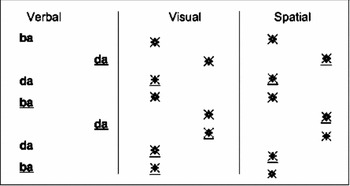
For the verbal concurrent task, the targets were two syllables (ba and da). One of the two syllables appeared in large letters at the bottom left or bottom right of the computer monitor. Thus, in the sequence “ba ba da ba,” the participant was instructed to respond to the first “da” and the final “ba,” without taking into account the position of the stimuli on the computer monitor (see Figure 1). It is desirable to equate the verbal, visual, and spatial tasks with respect to presentation and response modalities, varying only the kind of materials used. Thus, the verbal, visual and spatial concurrent tasks were identical except that abstract shapes instead of syllables were presented for the visual and spatial tasks (see Figure 1). The only difference between these two tasks was the instruction for detecting a change in the stimuli. For the visual concurrent task, participants had to detect a change between the two abstract shapes without taking into account their position on the computer monitor. In the spatial concurrent task participants had to detect a change of the position of the shapes, without taking into account the changes of the shapes.
Examples of sequences of the stimuli used in the three secondary working memory tasks with the targets (underlined) that the participants had to detect.

Procedure. After obtaining informed consent, all participants were told that the experiment was concerned with writing and would last about 45 min. The data were collected in two blocks. The instructions for each condition were read on the computer monitor before beginning each block. The procedure began with the verbal, visual, or spatial task in isolation for about 10 min. After the concurrent task was completed in isolation, participants were presented with the composition task and they were asked to compose their text while concurrently performing the concurrent task for 30 min. Between two and three stimuli were presented by minute. Next, the topic of the text was given and the experimental block was launched.
Results
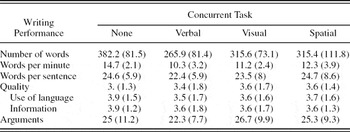
Writing performance. Table 1 presents various scores of writing performance. An analysis of variance (ANOVA) with type of concurrent task (none, verbal, visual, spatial) as a between-participants factor was conducted on all textual variables.
Scores of writing performance in four experimental groups in Experiment 1 with visual presentation of the concurrent stimuli (standard deviations)

A reliable effect of the type of concurrent task was observed on fluency, F (3, 68) = 7.29, mean square error (MSE) = 8.79, p = .0002. Planned comparisons indicated that fluency in the control condition was faster than in the verbal, visual, and spatial conditions. Moreover, participants were less fluent in the verbal than in the spatial condition. By contrast, no reliable effect of the type of concurrent task was observed on the number of words per sentence, F (3, 68) = 0.397, MSE = 51.51. An ANOVA was conducted on the scores of quality with type of judgement (use of language and information) as a within-participant factor. Interjudge reliability scores were .80 for use of language and .82 for information. No reliable effect or interaction was found (Fs < 1).
We also conducted a semantic analysis of the texts to investigate whether the concurrent tasks affected the number of arguments evoked by the participants. For that purpose we used Tropes (Ghiglione, Landré, Bromberg, & Molette, Reference Ghiglione, Landré, Bromberg and Molette1998), a natural language processing and semantic classification software. Tropes indicated that arguments present in all texts related to six fields: economy, education, society, daily life, family, and assessment (from the most to the less frequent). An ANOVA was conducted on the number of argument with the type of concurrent task (none, verbal, visual, spatial) as a between-participants factor. The number of arguments was reliably affected by the type of concurrent task, F (3, 68) = 14.91, MSE = 14.92, p < .0001. Planned comparisons showed that participants in the writing only condition produced more arguments than participants in the verbal, visual and spatial conditions
In sum, without any concurrent task, writers composed their text faster. Because production time was limited, this indicates that they composed longer texts, which thus included more arguments. Moreover, sentence length and text quality were not affected when participants composed their text while performing a concurrent task relative to the writing only condition.
Concurrent task performance. To examine whether performance differed across the concurrent tasks and between the different writing phases, accuracy (in terms of percentage of correct answers) and RT to the targets were analyzed. All post hoc analyses were conducted with the Scheffé test with an α level of .05.
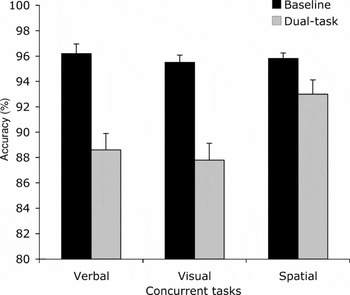
Baseline accuracy to the three tasks was of comparable difficulty (verbal: M = 96.2%, SD = 3.2; visual: M = 95.5%, SD = 2.4; spatial: M = 95.8%, SD = 1.9), F (2, 51) < 1. The accuracy data are shown in Figure 2. Accuracy of responses was then analyzed by entering percentages of correct answers in a 2 (Task) × 3 (Concurrent Task) ANOVA. As expected, accuracy was lower in the dual task (M = 89.8%, SD = 4.8) than in the baseline task (M = 95.8%, SD = 2.5), F (1, 51) = 3.21, MSE = 22.68, p < .05, and significantly varied between the concurrent task tasks, F (2, 51) = 70.52, MSE = 13.76, p < .0001. Post hoc comparisons indicated that accuracy in the spatial condition (M = 94.4%, SD = 3.9) was higher than in the verbal (M = 92.4%, SD = 5.8) and visual (M = 91.6%, SD = 5.9) conditions. The Task × Concurrent Task interaction was significant, F (2, 51) = 3.21, MSE = 13.78, p < .01. More precisely, accuracy significantly dropped in the dual task condition for all concurrent task tasks: verbal, F (1, 17) = 40.18, MSE = 12.71, p < .0001; visual, F (1, 17) = 28.60, MSE = 18.36, p = .0001; spatial, F (1, 17) = 7.41, MSE = 10.47, p < .05, but the decrease in accuracy was higher in the verbal (−7.5%) and visual (−7.6%) concurrent tasks than in the spatial one (−2.8%).
Mean accuracy and standard errors on the verbal, visual, and spatial concurrent tasks in Experiment 1 with visual presentation of the concurrent stimuli.

A preliminary analysis of the RTs in the baseline condition indicated that responses to the spatial stimuli (M = 532 ms, SD = 67) were faster than to the verbal (M = 658 ms, SD = 69) and visual stimuli (M = 677 ms, SD = 98), F (2, 51) = 17.64, MSE = 6,298.88, p < .0001. Then, RTs were entered into a 2 (Task: Baseline, Dual Task) × 3 (Concurrent Task: Verbal, Visual, Spatial) ANOVA with task as a within-participant factor and concurrent task as a between-participants factor. First, as expected, the RTs were reliably longer in dual task condition (M = 910 ms, SD = 151) than in the baseline, single condition (M = 622 ms, SD = 101), F (1, 51) = 368.47, MSE = 6,042.62, p < .0001. A significant main effect of the concurrent tasks was observed, F (2, 51) = 22.51, MSE = 14,680.2, p < .0001. Responses to the spatial stimuli (M = 659; SD = 167) were faster than to the verbal (M = 794 ms, SD = 165) and visual stimuli (M = 845 ms, SD = 199). However, the Task × Concurrent Task interaction was not significant, F (2, 51) = 2.76, MSE = 6,042.62.
Discussion
This first experiment investigated verbal, visual, and spatial demands of text composition. Regarding the extent to which the concurrent tasks disrupted the composition, composing while performing the concurrent tasks slowed participants' fluency. Because composition time was limited, writers in the no concurrent task condition also produced texts that contained more arguments. Regarding now the effect of the different concurrent tasks, writers were more fluent in the spatial condition than in the verbal condition, indicating that the spatial concurrent task disrupted the less the composition. However, writers composed sentences equivalent in length with either a verbal, visual, or spatial concurrent task. Holistic quality of the texts also remained constant through the three concurrent tasks, and the number of arguments contained in the texts did not vary as a function of the type of concurrent task.
Because participants' texts did not vary for the most part with the different concurrent tasks, decreases in accuracy and increases in RT on the concurrent tasks can be interpreted straightforwardly. They did not reflect a trade-off between text composition and the concurrent task that varied in degree across the verbal, visual, and spatial conditions. Second, a comparison of the dual task conditions with writing as a single task showed no reliable differences in holistic quality, content measures, or words per sentence. This indicates that the participants were able to focus attention on the primary task of writing as instructed. The secondary task did slow writing processes, as seen by reduced fluency and the number of arguments generated. However, it did not appear to alter the character of these processes in that quality, content, and sentence length were unaffected.
Comparisons of performance accuracy on the concurrent tasks indicate that text composition mainly requires verbal and visual WM and to a lesser extent spatial WM. Accuracy of performance on the concurrent spatial task was little disrupted by combining it with the writing task (less than 3%). By contrast, accuracy substantially dropped (∼8%) for both the verbal and visual concurrent tasks. Regarding RTs, they were shorter with the spatial task than with the two other tasks. However, the shorter baseline RTs in the spatial task made it difficult to interpret the concurrent task scores directly. To clearly interpret the shortened RT to the spatial task during written composition, it is important that it not also be shortened during baseline trials.
As reviewed by Olive et al. (Reference Olive, Kellogg, Piolat, Olive and Levy2002), numerous experiments have shown that, when composing a text, activation of the writing processes changes with time following a typical pattern of temporal organization. Activation of planning declines throughout writing, activation of translating remains constant, and activation of revision begins to increase after the middle of a writing session. We compared accuracy on the WM tasks across the first, second, and third phase of the total writing session to see if the spatial WM demands increased over time as the writer developed a representation of the spatial layout of the text (Hayes, Reference Hayes, Levy and Ransdell1996).Footnote 1 A significant main effect of the concurrent tasks was observed, F (2, 51) = 4.64, MSE = 89.77, p < .05, showing that accuracy was highest in the spatial condition. The percentage of correct answers decreased reliably across the writing phases, F (2, 102) = 4.141, MSE = 56.409, p < .05, but no reliable interaction was observed, F (4, 102) < 1. Thus, the demands of writing texts on spatial WM were not hidden in the final phase of composition. Instead, participants were able to respond accurately to the spatial task while concurrently writing a text across all phases of composition.
Finally, performance on all of the concurrent tasks dropped under dual task conditions of writing and maintaining secondary stimuli in WM. Response times increased and accuracy decreased relative to the baseline measures. The drop in concurrent performance cannot be attributed solely to the demands on the verbal, visual, and spatial components of WM. The central executive component of WM would be taxed by the need to coordinate the primary task of writing, which by itself imposes large demands on executive attention (Kellogg, Reference Kellogg, Levy and Ransdell1996), with the concurrent secondary tasks. This general slowing in RT points to the executive demands of shifting attention between composing and the concurrent task (D'Esposito et al., Reference D'Esposito, Detre, Alsop, Shin, Atlas and Grossman1995), regardless of whether it involves transient storage of verbal, visual, or spatial representations. Although executive attention plays an important role in written production, it is unlikely, however, that the differences observed between the three concurrent tasks come only from the executive demands of composing. If that were the case, then the accuracy of performance on the verbal, visual, and spatial concurrent tasks would have been equivalent. Instead, our accuracy results indicate that spatial WM played a lesser role than either visual or verbal WM.
EXPERIMENT 2
Experiment 1 showed that composing a text involves the verbal and visual components of WM, and presumably to a lesser extent, spatial WM. Nevertheless, it could be argued that the three concurrent tasks were not equivalent in terms of the coding dimensions that defined the stimuli. The verbal task could be said to involve not just the verbal code of syllables, but also visual and spatial features. That is to say, the syllables were verbal in nature, but they were also presented visually at either a left or a right spatial location. By contrast, the visual and spatial tasks plainly involved only two types of codes (visual and spatial). Experiment 2 addressed this potential confound by switching to an aural presentation of the stimuli. In the concurrent tasks, two syllables were presented trough a stereo headphone in the right or left channel. The verbal task asked participants to detect a change in the syllables, and the spatial task required detecting a change in the channel of presentation. The same materials were presented in the same fashion, thus equating the number of coding dimensions, but the decision made about the stimuli differed. The visual task was not used in this experiment because it was not possible with that third task and with an aural presentation of the stimuli to keep constant the input modality, the output modality and the number of dimensions involved in the tasks. However, because in Experiment 1 the visual and spatial tasks both involved two dimensions relative to the verbal task, findings from this experiment will allow us to rule out the possibility of a confounding variable in Experiment 1. Indeed, if the findings of Experiment 1 were related to the difference in number of dimensions of the concurrent tasks with the aural presentation, then we can expect that the difference between the verbal and spatial task would disappear.
Method
Participants. Sixty undergraduate psychology students (mean age = 20 years) from the University of Poitiers were assigned in equal numbers to one of the three groups defined by the verbal and spatial tasks or by the composition only condition. All participants were native French speakers. One participant in each group was excluded from the analysis for misunderstanding the concurrent task instructions. Participants were tested individually and were treated in accordance with the ethical standards.
Apparatus, material, instructions, and procedure. The design of Experiment 2 was identical to that of Experiment 1 except that the presentation of the stimuli differed. The syllables “ba” and “da” were in this case aurally presented to the participants with a stereo headphone in both the verbal and spatial conditions. Pitch and length of the two syllables were controlled. On each trial, one of the two syllables was presented either in the left or right channel. Choice of the syllable and of the channel was at random. In the verbal condition, participants had to detect whether each syllable they heard was different from the previous one, ignoring their spatial location. In the spatial condition, participants had to detect whether each syllable they heard was presented in a different channel than the previous one, ignoring the nature of the syllable.
Results and discussion
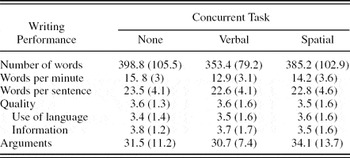
Writing performance. Table 2 presents the different scores of writing performance. A reliable effect of the type of a concurrent task was again observed on fluency, F (2, 54) = 3.67, MSE = 10.72, p = .031. Planned comparisons indicated that fluency in the composition-only condition was faster than in the verbal condition but not than in the spatial condition, the two latter condition being not different. The presence of a concurrent task did not affect the number of arguments, F (2, 54) = 0.531, MSE = 117.162, the number of words per sentence, F (2, 54) = 0.222, MSE = 18.25, nor holistic text quality, F (2, 54) = 0.009, MSE = 4.07.
Scores of writing performance in three experimental groups in Experiment 2 with aural presentation of the concurrent stimuli (standard deviations)

Without any concurrent task, writers composed their text faster than participants with a verbal concurrent task but not with a spatial task, indicating that only the verbal task affected writing, the spatial task being not disruptive of writing. Participants who only composed a text did not produce more arguments and produced texts those quality was not different. Taken together, these findings support the idea that text composition places demands on verbal WM, and little, if any, on spatial WM.
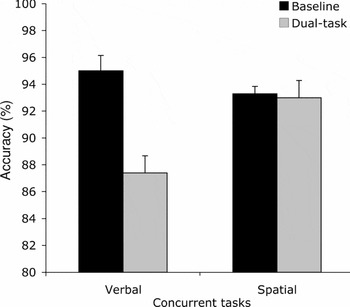
Concurrent task performance. Accuracy (see Figure 3) was lower in the dual task (M = 90.2%, SD = 9.4) than in the baseline task (M = 94.3%, SD = 5.3), F (1, 36) = 7.03, MSE = 45.29, p < .05. There was no main effect of the type of concurrent tasks, F (1, 36) < 1. The Task × WM interaction was, however, significant, F (1, 36) = 5.98, MSE = 45.29, p < .05. More precisely, although baseline accuracy in the verbal and spatial tasks did not differ (M = 95.3%, SD = 5; M = 93.3%, SD = 5.6, respectively), F (1, 36) = 1.27, MSE = 28.33, accuracy in the verbal WM task dropped in dual task condition relative to the baseline condition (−7.9%), whereas it did not change in the spatial task (−0.3%).Footnote 2
Mean accuracy and standard errors on the verbal, visual, and spatial concurrent tasks in Experiment 2 with aural presentation of the concurrent stimuli.

The verbal and spatial baseline RTs were found in a preliminary analysis not to differ significantly (verbal: M = 710 ms, SD = 141; spatial: M = 684 ms, SD = 138), F (1, 36) = 0.317, MSE = 19,475.49. Then, a 2 (Task: Baseline vs. Dual Task) × 2 (Concurrent Task: Verbal vs. Spatial) ANOVA was carried out. First, the RTs were reliably longer in dual task condition (M = 902 ms, SD = 154) than in the baseline, single task condition (M = 698 ms, SD = 138), F (1, 36) = 54.16, MSE = 14,615.31, p < .0001. Responses to the spatial stimuli (M = 774 ms, SD = 163) were somewhat faster overall than to the verbal stimuli, but the difference was not reliable (M = 825, SD = 190), F (1, 36) = 1.76, MSE = 27,610.67. Moreover, as in Experiment 1, the Task × Concurrent Task interaction was not significant, F (1, 36) < 1.
In sum, the concurrent task accuracy findings of Experiment 2 indicate that composition of argumentative texts places high demands on verbal WM task and less on spatial WM. Of major interest, the verbal and spatial concurrent tasks involved stimuli with the same number of dimensions (an aural and a spatial) and did not differ in baseline performance (both on accuracy and on response times). Therefore, by replicating the findings of Experiment 1, both Experiments 1 and 2 provided strong evidence that text composition taps the verbal, visual, and spatial components of WM to different degrees.
GENERAL DISCUSSION
The goal of the present experiments was to evaluate the demands of text composition on the verbal, visual, and spatial components of WM. The findings of Experiment 1 indicate that text composition places large demands on the verbal and visual components of WM and to a lesser extent on the spatial component. Experiment 2 replicated the findings of Experiment 1 and ruled out an artifactual explanation that fewer codes are required to perform the spatial compared with the verbal task. Accuracy of performance on the verbal task dropped substantially more when combined with writing a text compared with the spatial task. Of importance, the aural presentation of the stimuli of the concurrent tasks in Experiment 2 made the two tasks equivalent in the number of dimensions the stimulus involved (verbal and spatial only) and yielded comparable performance when the tasks were performed in isolation. Finally, it should be noted that response times to the verbal, visual, and spatial tasks all slowed when combined with writing, but not differentially so. Thus, only accuracy was sensitive to the different WM storage requirements. In sum, the findings of Experiments 1 and 2 are consistent. They show that text composition places high demands on the verbal and visual components of WM but less on the spatial component.
As expected, text composition involves the verbal component of WM. Conceivably, verbal WM may support formulation of the text, either at the phonological or at orthographical levels of representation involved when translating contents into language. Kellogg et al. (Reference Kellogg, Olive and Piolat2007) did not show any difference between an aural and a written presentation of the same verbal task than the one used in the present experiments. They concluded that verbal demands came from storage of phonological representations. However, because phonological encoding is important but not necessary for writing (e.g., Bonin, Fayol, & Peereman, Reference Bonin, Fayol and Peereman1998; Shelton & Caramazza, Reference Shelton and Caramazza1999), verbal WM probably also support syntactical and grammatical encoding during the translating phase. For instance, Largy and Fayol (Reference Largy and Fayol2001) observed that a load in verbal WM disrupts subject–verb agreement, particularly when the inflection is silent. Chenoweth and Hayes (Reference Chenoweth and Hayes2003) recently showed that verbal WM also supports what they called the inner voice in writing, which reflects elicitation of the subvocal rehearsal process of verbal WM. They indeed showed that articulatory suppression (repeatedly saying one syllable during the composition of a text) reduced the number of words that were produced during an execution period. Verbal WM may also be needed for reading the text produced so far (Hayes, Reference Hayes, Levy and Ransdell1996). When composing a text, reading frequently interrupts the on-going flow of handwriting (Alamargot, Chesnet, Dansac, & Ros, Reference Alamargot, Chesnet, Dansac and Ros2006). Reading research has provided intensive data showing that verbal WM is correlated with reading and comprehension performance (Caplan & Waters, Reference Caplan and Waters1999; Just & Carpenter, Reference Just and Carpenter1992). It is likely that reading in writing also requires verbal WM. Finally, verbal WM may also be involved for buffering orthographic information before it is translated into movements for writing down the text (Miceli et al., submitted).
Visual WM is also needed when composing a text. Kellogg (Reference Kellogg, Levy and Ransdell1996) hypothesized that visual WM is needed only when planning figurative content. Kellogg et al. (Reference Kellogg, Olive and Piolat2007) provided data confirming such prediction. Here, findings of Experiment 1 showed that composing a text places as much demand on visual WM as on verbal WM. Such large visual demands were unexpected. Theoretical assumptions (Kellogg, Reference Kellogg, Levy and Ransdell1996) proposed that among all writing processes, only planning requires visual WM, whereas translating, and reviewing (including reading) involves verbal WM. Empirically, several findings seem to indicate that text composition require verbal WM more than visual–spatial WM (for a review, see Kellogg, Reference Kellogg2004; Lea & Levy, Reference Lea, Levy, Torrance and Jeffery1999; Levy & Ransdell, Reference Levy, Ransdell, Olive and Levy2002). A key difference between our study and the previous research is that we tested visual and spatial tasks separately. It is clear from the present data that visual but not spatial WM is relied upon in text composition. Possibly the importance of visual WM was overlooked in earlier studies that tested combined visual–spatial tasks.
We believe that the high degree of competition between composing a text and performing the visual concurrent task in our research stems from reading the text produced so far. Several findings in reading research strongly support that reading involves a visuospatial representation of the text (Kennedy, Reference Kennedy and Rayner1992; Kennedy, Brooks, Flynn, & Prophet, Reference Kennedy, Brooks, Flynn, Prophet, Hyönä, Radach and Deubel2002). One might anticipate that it is also the case when reading during composing (Bond & Hayes, Reference Bond and Hayes1984; Haas & Hayes, Reference Haas and Hayes1986). At least for the relatively short argumentative texts produced under laboratory conditions, it appears that reading the text produced thus far demands more visual WM compared with spatial WM. Perhaps holding in mind a spatial representation of the text produced thus far would be observed in composing much longer argumentative texts, where having a sense of location within the whole would be a necessity. Finally, visual demands might also come from monitoring of spelling as indicated by Dédeyan, Olive, and Largy's (Reference Dédeyan, Olive and Largy2006) findings on detection of subject–verb agreement errors. These authors observed that error detection interfered with a concurrent visual task with in adults and with a concurrent verbal task interfered in children (fifth grade). These findings support the idea that adults detect errors by visually checking the surface features of the text, whereas children use an algorithmic procedure that requires the verbal component of WM.
Kellogg (Reference Kellogg, Torrance and Jeffery1999) claimed that spatial WM might also be involved when planning and organizing content during the prewriting phase of text composition. Galbraith et al. (Reference Galbraith, Ford, Walker and Ford2005) observed an impact of a concurrent spatial tracking task (but not of a visual noise task) during the outlining phase of a composition. In the present experiments, writers were asked to compose their text without resorting to a preliminary outlining drafting strategy. Thus, spatial demands did not come from such a strategy. Hayes and his collaborators (Bond & Hayes, Reference Bond and Hayes1984; Haas & Hayes, Reference Haas and Hayes1986) have proposed that writers construct a mental representation of the spatial layout of the text. Accordingly, we can argue that spatial demands of text composition may find their source in the mental representation of the spatial layout of the text as well as in the use of specific drafting strategies (linear, hierarchical, concepts maps). We further suggest that the visual demands in contrast come from the retrieval of concrete, imaginal representations from long-term memory during the planning of conceptual content (Kellogg et al., Reference Kellogg, Olive and Piolat2007). In organizing the conceptual content, whether it be represented through images, words, or abstract propositions, the writer may need to rely on spatial WM. Future research needs to examine carefully the role of visual and spatial WM in planning as well as in reading the text produced thus far.
Finally, one limit of our interpretation of our findings on secondary performance deals with the possibility that participants recoded stimuli. Verbal stimuli might have been visually recoded, whereas visual and spatial stimuli might have been verbally recoded. This is most likely to occur with the spatial stimuli, where location can easily be recoded verbally to “left” or “right.” The visual stimuli were chosen by design to be difficult to encode verbally. In any case, such verbal recoding is unlikely to have occurred, given that the verbal task showed more interference in performance accuracy than the spatial task.
In conclusion, the present experiments depicted a clear pattern of results. First, visual interference was surprisingly as large as the verbal interference observed. Second, distinguishing between the visual and the spatial WM tasks revealed differential visual and spatial demands of text composition. These two findings therefore support the view that visual WM plays a larger role in text composition than previously thought.
ACKNOWLEDGMENTS
This research was supported in part by NATO Collaborative Research Grant LST.CLG 974939.