Introduction
The informant questionnaire of cognitive decline in the elderly (IQCODE) is one of the most widely used informant questionnaires (Jorm, Reference Jorm2004; Jorm & Korten, Reference Jorm and Korten1988). The IQCODE aims to measure cognitive decline from a pre-morbid level using an informant report. Items of this questionnaire were developed to cover different aspects of everyday memory and intelligence (Jorm, Reference Jorm2004). The IQCODE is often used to complement screening for dementia, as a decline in everyday cognitive functioning is necessary for a diagnosis of dementia (American Psychiatric Association, 1994).
Since its introduction in 1988, several studies have confirmed the usefulness of the IQCODE as a screening instrument for dementia. Researchers were able to differentiate healthy elderly from patients with Alzheimer's disease (AD) using the IQCODE score (Del Ser, Morales, Barquero, Canton, & Bermejo, Reference Del Ser, Morales, Barquero, Canton and Bermejo1997; Fuh et al., Reference Fuh, Teng, Lin, Larson, Wang, Liu and Liu1995; Harwood, Hope, & Jacoby, Reference Harwood, Hope and Jacoby1997; Jorm et al., Reference Jorm, Broe, Creasey, Sulway, Dent, Fairley and Tennant1996; Jorm, Scott, Cullen, & Mackinnon, Reference Jorm, Scott, Cullen and Mackinnon1991; Morales, Bermejo, Romero, & Del Ser, Reference Morales, Bermejo, Romero and Del Ser1997; Narasimhalu, Lee, Auchus, & Chen, Reference Narasimhalu, Lee, Auchus and Chen2008). Studies in a memory clinic setting indicated that the IQCODE could also distinguish between patients with AD and mild cognitive impairment (MCI). MCI refers to the transitional state between the cognitive changes of normal aging and very early dementia (Petersen & Negash, Reference Petersen and Negash2008; Petersen et al., Reference Petersen, Smith, Waring, Ivnik, Tangalos and Kokmen1999). Patients with MCI have cognitive impairments beyond that expected for age and education, yet they are not demented (Petersen et al., Reference Petersen, Smith, Waring, Ivnik, Tangalos and Kokmen1999).
Conflicting results were found, however, when the IQCODE was used to differentiate between MCI and subjects without objective cognitive impairments. Two studies were able to differentiate MCI from healthy elderly (Ehrensperger, Berres, & Taylor, Reference Ehrensperger, Berres and Taylor2009; Isella et al., Reference Isella, Villa, Russo, Regazzoni, Ferrarese and Appollonio2006). Two other studies found no ability of the IQCODE to distinguish MCI from subjects without objective impairments (de Abreu, Nunes, Diniz, & Forlenza, Reference de Abreu, Nunes, Diniz and Forlenza2008; Sikkes et al., Reference Sikkes, van den Berg, Knol, de Lange-de Klerk, Scheltens, Uitdehaag and Pijnenburg2010). These latter findings are remarkable, since MCI patients have more cognitive deficits than healthy elderly (Grundman et al., Reference Grundman, Petersen, Ferris, Thomas, Aisen, Bennett and Thal2004; Petersen et al., Reference Petersen, Smith, Waring, Ivnik, Tangalos and Kokmen1999). One would expect these deficits to be reflected in the IQCODE score.
One of the possible explanations of the inability of the IQCODE to differentiate between healthy elderly and MCI patients can be found when the IQCODE items are closely inspected. One can identify items clearly related to everyday memory and other items related to complex daily activities. Complex daily activities are known as instrumental activities of daily living (IADL) and consist of those activities necessary to function independently in society (Lawton & Brody, Reference Lawton and Brody1969). One can imagine these subgroups of IQCODE items to differ in their sensitivity for MCI.
Factor analytical studies have investigated the clustering of items of the IQCODE. Several studies found a single factor, identified as a general factor consisting of cognitive decline (Butt, Reference Butt2008; de Jonghe, Schmand, Ooms, & Ribbe, Reference de Jonghe, Schmand, Ooms and Ribbe1997; Fuh et al., Reference Fuh, Teng, Lin, Larson, Wang, Liu and Liu1995; Jorm & Jacomb, Reference Jorm and Jacomb1989; Morales et al., Reference Morales, Bermejo, Romero and Del Ser1997). Two studies, however, did not find a single factor. One study identified two factors: memory/learning and orientation/operation (Morales, Gonzalez-Montalvo, Bermejo, & Del Ser, Reference Morales, Gonzalez-Montalvo, Bermejo and Del Ser1995). Another study also found that not all items were closely related to the underlying construct (Tang et al., Reference Tang, Wong, Chan, Chiu, Wong, Kwok and Ungvari2004). Most of these factor analytical studies were conducted in homogeneous populations, often consisting of a population-based sample of community-dwelling elderly (Butt, Reference Butt2008; Fuh et al., Reference Fuh, Teng, Lin, Larson, Wang, Liu and Liu1995; Jorm & Jacomb, Reference Jorm and Jacomb1989; Morales et al., Reference Morales, Bermejo, Romero and Del Ser1997, Reference Morales, Gonzalez-Montalvo, Bermejo and Del Ser1995). The factor or dimensional structure of the IQCODE has not yet been investigated in a memory-clinic setting, even though the IQCODE is commonly used in this setting. In addition, the previous studies were performed using exploratory factor analytical techniques, where confirmatory techniques would be more appropriate. A next step would be a confirmatory factor analysis for ordered categorical data, or the closely related item response theory (IRT) analysis, in which hypotheses are tested (Takane & De Leeuw, Reference Takane and De Leeuw1987). The advantage of IRT is that it is able to deal with skewed answer patterns and missing item responses. Both of these are frequent in IQCODE scores (Jorm, Reference Jorm2004).
The aim of the current study is to investigate whether different groups of items exist within the short version of the IQCODE, and more specifically, whether memory and IADL dimensions can be found. We expect to find both dimensions in the IQCODE. Our second aim is to investigate whether these groups of items differ in their ability to differentiate among AD, MCI, and subjective memory complaints (SMC).
Methods
Patients
All consecutive patients who visited the Alzheimer Center of the VU University Medical Center between 2004 and 2007, who were diagnosed with probable AD, MCI, or SMC and of whom the informant completed the IQCODE were included in the study.
All patients underwent a standardized dementia screening including past medical history, informant based history, physical and neurological examination, screening laboratory tests, magnetic resonance imaging, and electroencephalography. A neuropsychological test battery was administered, consisting of the Rey Auditory Verbal Learning Test (Rey, Reference Rey1964; Saan & Deelman, Reference Saan and Deelman1986), Visual Association Test (Lindeboom, Schmand, Tulner, Walstra, & Jonker, Reference Lindeboom, Schmand, Tulner, Walstra and Jonker2002), Trailmaking A & B (Reitan, Reference Reitan1958), Category and Letter Fluency (Benton & Hamsher, Reference Benton and Hamsher1989; Luteijn & van der Ploeg, Reference Luteijn and van der Ploeg1982; Schmand, Groenink, & van den Dungen, Reference Schmand, Groenink and van den Dungen2008), Digit Span forward and backward (Lindeboom & Matto, Reference Lindeboom and Matto1994), and Number Location of the Visual Object and Space Perception Battery (Warrington & James, Reference Warrington and James1991). Diagnoses were made in a multidisciplinary consensus meeting. The NINCDS-ADRDA (National Institute of Neurological and Communicative Diseases and Stroke/Alzheimer's Disease and Related Disorders Association) criteria were used for the diagnosis of AD and the Petersen criteria for the diagnosis of MCI (Mc Khann et al., Reference Mc Khann, Drachman, Folstein, Katzman, Price and Stadlan1984; Petersen et al., Reference Petersen, Smith, Waring, Ivnik, Tangalos and Kokmen1999; Petersen & Morris, Reference Petersen and Morris2005). SMC was defined by virtue of their presentation to the memory clinic. No objective deficits in cognitive domains were found in these patients. For the neuropsychological tests, cognitive deficits were defined as a score of 1.5 SDs or more below the mean of healthy controls, matched for age, gender and/or education where appropriate. A total of 180 patients met the criteria for probable AD, 59 for MCI and no objective cognitive deficits were found in 89 subjects. The mean age was 68.4 (SD 10.1) years. The study was approved by the Ethics Committee of the VU University Medical Center and all patients gave written informed consent. The research was completed in accordance with the Helsinki declaration.
Measures
In the current study, we used the Dutch short version of the IQCODE. The short version of the IQCODE consists of 16 items with comparable psychometric qualities as the original questionnaire (de Jonghe et al., Reference de Jonghe, Schmand, Ooms and Ribbe1997; Jorm, Reference Jorm1994; Jorm & Korten, Reference Jorm and Korten1988). The questionnaire is self-administered by an informant of the subject. Informants are asked to rate the patients changes in everyday cognitive functioning during the previous 10 years. Items are scored on a bipolar 5-point scale, with 1 indicating “much improved,” 2 “improved,” 3 “not much change,” 4 “worse,” and 5 “much worse.” The total score of the questionnaire ranges from 16 to 80 and is divided by the number of items completed (with a maximum of 3 missing items), providing a total score between 1 and 5, with higher scores indicating worse performance (Jorm, Reference Jorm2004).
Data Analysis
Statistical analyses were performed with Mplus Version 5.0 (Muthén & Muthén, Reference Muthén and Muthén1998–2007) and SPSS (version 15.0 for Windows; SPSS Inc., Chicago, IL).
Differences between groups on baseline characteristics were tested with independent t tests, Pearson's χ2 or Mann-Whitney tests as appropriate.
To investigate the dimensional structure and structural equation model (SEM), the IQCODE item responses were categorized. The options “much improved” and “improved” were rarely used and were condensed into one single answering category together with the option “not much change.” This led to three answering categories: “improved/not much change,” “worse,” and “much worse.” To model the dimensional structure of the IQCODE, we used a commonly used IRT model for polytomous items, the graded response model (GRM). GRM is developed by Samejima and is an extension of the two-parameter logistic model (Samejima, Reference Samejima1969). It is appropriate to use GRM when item responses are ordered categorical responses. In this model, it is assumed that the ordered-categorical item responses are discrete representations of continuous latent responses (Wirth & Edwards, Reference Wirth and Edwards2007). In two steps, the probability that a patient responds to a particular category can be obtained. In the first step, the cumulative probability (P*) of responding in category j (j = 4,5) or higher on item i for a person with θ disability (the underlying latent variable) is given by:
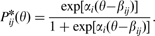
Item parameters are presented with αi as the slope (item discrimination) parameter and βij as the thresholds (item difficulty) parameters of item i. In the second step, from the cumulative probabilities P*, the probability of responding in category j is obtained by:

The estimation method used is the maximum likelihood. It is assumed that the distribution of the person parameter is standard normal. To investigate whether all items fitted the GRM model, item goodness-of-fit was investigated using item tests; S-X2 developed by Orlando & Thissen and generalized for polytomous items by Bjorner (Bjorner, Smith, Stone, & Sun, Reference Bjorner, Smith, Stone and Sun2007; Orlando & Thissen, Reference Orlando and Thissen2003) and the item test by Stone (Stone, Reference Stone2004; Stone & Zhang, Reference Stone and Zhang2003). Items were considered as misfitting if p < .01.
A two-dimensional confirmatory GRM was fitted on the IQCODE with memory items and items related to IADL. Model fit of the two-dimensional GRM was compared with the model fit of a unidimensional GRM using the likelihood ratio (LR) χ2 test. For the two-dimensional GRM model, the cumulative probability is given by:

where k = 1 for the items in the Memory dimension and k = 2 for the items in the IADL dimension.
The relations between the IQCODE, age, gender, education, and diagnosis were modeled using a structural equation model (SEM). SEM is a powerful statistical modeling technique, able to specify latent variable models that provide separate estimates of relations among latent constructs and their manifest indicators and the relations among constructs (Tomarken & Waller, Reference Tomarken and Waller2005). We examined the models hypothesized to explain the relationships among the latent and measured variables. The latent variable consisted of the dimension(s) of the IQCODE as a predictor variable. The measured variables were age, gender, education (all predictor variables), and diagnosis (outcome variable). The level of education was scored on a seven-point Dutch classification system, ranging from “primary school not finished” (score 1) to “university degree obtained” (score 7) (Verhage, Reference Verhage1964). As some educational levels of the Verhage classification were represented by few subjects, we further categorized education into low (1 to 4), mean (5), and high (6 and 7) for the SEM modeling. Starting with a full model with all possible paths between the variables, non-significant paths were removed in a stepwise manner to obtain a parsimonious model. Goodness-of-fit of this final model was compared with the full model using a LR χ2 test. Associations between variables were presented as odds ratios (OR) or regression coefficients with 95% confidence intervals (CI).
In general, statistical significance was set at p < .05.
Results
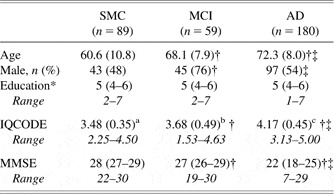
Table 1 shows the comparison between the study groups on demographic and baseline variables.
Comparison between study groups on demographic characteristics

Note. SMC = subjective memory complaints; MCI = mild cognitive impairment; AD = Alzheimer's disease; IQCODE = short Dutch informant questionnaire on cognitive decline in the elderly; MMSE=Mini-Mental State Examination. Data are presented as mean (SD), median (interquartile range), or n (percentage). Differences between groups are tested using the independent t-test, Pearson's χ2, or Mann-Whitney test.
†p < .05 Versus subjects with SMC.
‡p < .05 Versus subjects with MCI.
*The level of education was categorized using the classification of Verhage, ranging from 1 (primary school not finished) to 7 (university degree obtained) (Verhage, Reference Verhage1964).
an = 87.
bn = 59.
cn = 175.
Measurement Model
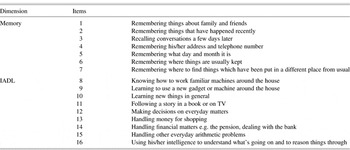
For the confirmatory two-dimensional GRM, the items of the IQCODE were categorized into Memory (item 1 to 7) and IADL (item 8 to 16) items.
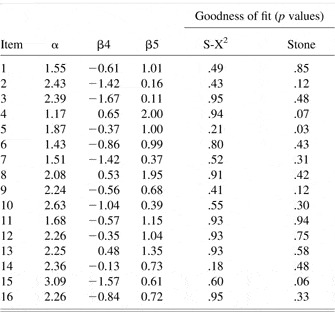
Table 2 shows the content (based on the short IQCODE, http://ageing.anu.edu.au/Iqcode/index.php) and classification of the items. The two-dimensional model provided a significant better fit than the unidimensional model (LR χ2 = 52.2; df = 1; p < .001). However, the correlation between the Memory and IADL dimensions was very high (r = .90), suggesting a highly overlapping content. We therefore decided to continue the analyses with a unidimensional model. The results of this GRM are presented in Table 3. This Table shows the item discriminations and item difficulties together with the p values of the goodness of fit tests for these items. All items fitted well to the model.
Categorization of the Items of the IQCODE to Memory and IADL Dimensions

Note. IQCODE = short Dutch informant questionnaire on cognitive decline in the elderly; IADL = instrumental activities of daily living.
Item discrimination (α) and item difficulty (β) parameters with item goodness-of-fit p values of the unidimensional Graded Response Model

Note. Pearson distribution standard normal.
Structural Models
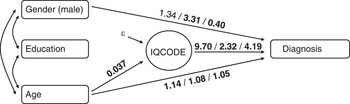
The structural model with the total IQCODE score as latent variable and age, gender, education and diagnosis as measured variables was tested. In a stepwise manner, several relations were removed from the model. First, education was not associated with the IQCODE or diagnosis and was removed from the model. Second, gender was not associated with the IQCODE and was also removed from the model. This resulted in the final model. The fit of the final model was satisfactory (LR χ2 = 5.49; df = 4; p = .24). The path coefficients of the final model are presented in Figure 1. Age was both related to the IQCODE and to diagnosis. Gender was associated with a diagnosis of MCI. The IQCODE dimension was able to differentiate between all patient groups. The odds ratios were 9.70 (95% CI, 5.18–18.16) for AD versus SMC, 2.32 (95% CI, 1.28–4.20) for MCI versus SMC and 4.19 (95% CI, 2.43–7.23) for AD versus MCI.
Path diagram summarizing the unidimensional model with IQCODE, diagnosis, age, gender, and education. Model obtained by structural equation modeling analysis. Circles represent latent variables, squares represent measured variables. Indicators (items) for IQCODE are not shown. Path coefficients to diagnosis are presented as odds ratios for AD versus SMC/MCI versus SMC/AD versus MCI. Path coefficients in bold are p < .05. IQCODE = short Dutch informant questionnaire on cognitive decline in the elderly; AD = Alzheimer's disease; SMC = subjective memory complaints; MCI = mild cognitive impairment.

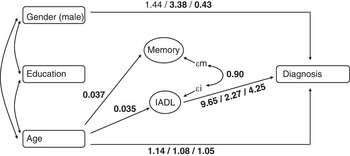
For completeness, we also investigated the structural model with the two-dimensional Memory and IADL model. We also took several steps in the fitting process. Education was not associated with diagnosis, Memory or IADL and was the first to be removed from the model. Next, gender showed no association with the IQCODE, so this path was removed from the model. Finally, Memory was not associated with diagnosis and this path was also removed from the model. The fit of this final model was satisfactory (LR χ2 = 11.05; df = 8; p = .20). The path coefficients among the observed and latent variables of the final model are presented in Figure 2. The odds ratios for the IADL dimension were 9.65 (95% CI, 5.13–18.14) for AD versus SMC, 2.27 (95% CI, 1.25–4.11) for MCI versus SMC and 4.25 (95% CI, 2.44–7.41) for AD versus MCI.
Path diagram summarizing the two-dimensional model with Memory and IADL, diagnosis, age, gender, and education. Model obtained by structural equation modeling analysis. Circles represent latent variables, squares represent measured variables. Indicators (items) for Memory and IADL are not shown. Path coefficients to diagnosis are presented as odds ratios for AD versus SMC / MCI versus SMC / AD versus MCI. Path coefficients in bold are p < .05. IADL = instrumental activities of daily living; AD = Alzheimer's disease; SMC = subjective memory complaints; MCI = mild cognitive impairment.

Discussion
In this study, we investigated whether different dimensions exist within the IQCODE and whether these dimensions differ in their ability to differentiate among AD, MCI, and SMC. We found the two-dimensional model with Memory and IADL to provide a better fit than the unidimensional model. However, the high correlation between both dimensions indicates that the IQCODE can be considered as unidimensional. The unidimensional IQCODE was able to discriminate between AD, MCI and SMC. We investigated the relationship between the IADL and Memory dimensions and diagnosis in an exploratory analysis. Of these two dimensions, IADL was better in discriminating between patient groups.
This is the first study to investigate the dimensional structure of the IQCODE in a memory clinic setting using multidimensional GRM and SEM modeling. The memory clinic setting is an advantage, as the IQCODE is often used in this setting to complement the diagnostic screening process. Advantages of the IQCODE include its ease of use and being a self-administered informant-based questionnaire. The application of sensitive statistical methods is also one of the strengths of this study. An advantage of SEM modeling is that the relations between dimensions are essentially corrected for measurement error (Babyak & Green, Reference Babyak and Green2010).
In this study, we initially found a two-dimensional model with Memory and IADL items, as we hypothesized. However, the high correlation between the two dimensions made it difficult to argue that there are two separate dimensions and we, therefore, continued with a single dimension. In previous studies, a single factor was also found, and it was suggested that the IQCODE is measuring a broad general factor of cognitive decline (Butt, Reference Butt2008; de Jonghe, Reference de Jonghe1997; Fuh et al., Reference Fuh, Teng, Lin, Larson, Wang, Liu and Liu1995; Jorm & Jacomb, Reference Jorm and Jacomb1989; Morales et al., Reference Morales, Bermejo, Romero and Del Ser1997). It is plausible that even though the IQCODE is measuring different aspects of cognitive decline, these aspects are highly comparable.
We also investigated the relationships between the IQCODE, diagnosis, age, gender, and education. The most important finding was that the IQCODE was able to distinguish between AD, MCI and SMC. In previous studies, the short IQCODE was shown to be a useful screening tool for the screening of dementia in a general population and an outpatient neurological clinic, with areas under the curve (AUC) of respectively .85 (Jorm, Reference Jorm1994) and .77 (Del Ser et al., Reference Del Ser, Morales, Barquero, Canton and Bermejo1997). However, when the IQCODE was used to screen for MCI, results were less clear. Our study showed that the IQCODE is able to differentiate between these patient groups in a memory clinic setting. This finding corresponds to the findings of Isella et al. (Reference Isella, Villa, Russo, Regazzoni, Ferrarese and Appollonio2006). Even though our control group differed from this study (i.e., patients with subjective memory complaints instead of healthy elderly) the IQCODE was still able to distinguish between these groups. As it is more difficult to distinguish between MCI and SMC than between MCI and very healthy elderly, these findings underline the relevance of the IQCODE in the diagnostic process.
Another advantage is the questionnaires’ independence of patients’ gender and education. This finding corresponds to the results of previous studies (de Jonghe, Reference de Jonghe1997; Del Ser et al., Reference Del Ser, Morales, Barquero, Canton and Bermejo1997; Fuh et al., Reference Fuh, Teng, Lin, Larson, Wang, Liu and Liu1995; Jorm et al., Reference Jorm, Broe, Creasey, Sulway, Dent, Fairley and Tennant1996). The independence of education is expected, as items correlated with education were removed in the development of the short version of the IQCODE (Jorm, Reference Jorm1994).
The IQCODE was not independent of all patients’ characteristics. Patients’ age was associated with the IQCODE score, suggesting that elderly had greater decline scores. To clearly interpret an IQCODE score, it might be necessary to provide age-adjusted norm scores.
We investigated the relationship between the Memory and IADL dimensions, gender, education, age, and diagnosis in an exploratory analysis. IADL was able to differentiate between all diagnostic groups, whereas Memory showed no relation with diagnosis. This is remarkable, as the IQCODE score has been related to memory test performance (Farias, Mungas, Reed, Haan, & Jagust, Reference Farias, Mungas, Reed, Haan and Jagust2004). However, the relationship between cognitive tests and actual daily functioning is not straightforward. A variation in an individual's “functional reserve” may explain why knowledge of neuropsychological function alone may not provide sufficient information to make judgments about the person's ability to function in real-world settings (Loewenstein & Acevodo, Reference Loewenstein and Acevodo2010).
Our findings are also notable, because MCI patients, according to the original MCI criteria, have cognitive problems without interference in their daily functioning (Petersen et al., Reference Petersen, Smith, Waring, Ivnik, Tangalos and Kokmen1999). Following this definition, one would expect the memory items (cognitive problems) to be more distinctive than the IADL items (daily functioning). However, evidence is rising that MCI patients do already experience difficulties performing complex daily activities (Ahn et al., Reference Ahn, Kim, Kim, Chung, Kim, Kang and Kim2009; Allaire, Gamaldo, Ayotte, Sims, & Whitfield, Reference Allaire, Gamaldo, Ayotte, Sims and Whitfield2009; Burton, Strauss, Bunce, Hunter, & Hultsch, Reference Burton, Strauss, Bunce, Hunter and Hultsch2009; Kim et al., Reference Kim, Lee, Cheong, Eom, Oh and Hong2009; Nygard, Reference Nygard2003). It has been indicated that those MCI patients experiencing difficulties in IADL are particularly vulnerable for developing AD (Peres et al., Reference Peres, Chrysostome, Fabrigoule, Orgogozo, Dartigues and Barberger-Gateau2006). Several authors have suggested that complex daily activities are vulnerable to the early effects of cognitive decline and can therefore be helpful in diagnosing early dementia (Desai, Grossberg, & Sheth, Reference Desai, Grossberg and Sheth2004; Gauthier, Gelinas, & Gauthier, Reference Gauthier, Gelinas and Gauthier1997; Nygard, Reference Nygard2003; Oakley & Sunderland, Reference Oakley and Sunderland1997). As we did not find a contribution of the Memory dimension to diagnosis, our findings support these theories. These findings suggest that the definition of MCI should not exclude interference in daily functioning. However, the limits of IADL impairment for a diagnosis of MCI should be further investigated.
We found the IADL dimension to be almost as good in discriminating between the different patient groups as the total IQCODE. Even though replications in larger and more diverse samples are needed, this finding underlines the importance of measuring IADL in patients who visit a memory clinic. To fully understand the constructs measured by the IQCODE, relations with neuropsychological measures, informant-based and performance-based IADL measures need to be explored in future studies.
These findings might suggest that it would be sufficient to administer only the IADL items when using the IQCODE in a memory clinic for diagnostic purposes. However, the IQCODE's psychometric abilities have been extensively investigated: The IQCODE is able to distinguish between different patient groups, easy to use, has no direct impact on patients and is not influenced by gender or education. We would therefore recommend administering the entire IQCODE in clinical practice. However, our findings can be used in future studies to develop a shorter, more efficient version of the IQCODE.
In conclusion, the IQCODE can be considered as unidimensional and as a useful addition to diagnostic screening in a memory clinic setting, as it was able to distinguish between AD, MCI, and SMC and was not influenced by gender or education.
Acknowledgments
This research received no specific grant from any funding agency, commercial or not-for-profit sectors.