Introduction
Dementia is a syndrome characterized by deterioration in cognitive abilities that impairs the successful performance of activities of daily living (Seeley and Miller, Reference Seeley, Miller, Longo, Fauci, Kasper, Hauser, Jameson and Loscalzo2012). The most prevalent form of dementia is AD (accounting for more than 50% of dementia cases) (Seeley and Miller, Reference Seeley, Miller, Longo, Fauci, Kasper, Hauser, Jameson and Loscalzo2012). Memory disorders are identified as the most common cognitive symptom related to dementia. Internationally, approximately 35.6 million of people were diagnosed with moderate to severe dementia and one-third to one-half of PwD live in residential care with higher costs in some high-income countries (World Health Organization, 2012). Dementia presents with a prevalence of 61.7% in residential care facilities in Spain (López Mongil et al., Reference López Mongil, López Trigo, Castrodeza Sanz, Tamames Gómez and León Colombo2009) and an estimated prevalence of 10.9% in central and north-eastern Spain using door-to-door surveys in community-dwelling people aged 70 or more (de Pedro-Cuesta et al., Reference De Pedro-Cuesta2009).
The report “Dementia: A Public Health Priority” (World Health Organization, 2012) indicates the need to implement, develop and strengthen health and social policies to promote social well-being and improve the QoL of PwD and their caregivers (Hughes et al., Reference Hughes, Berg, Danziger, Coben and Martin1982). The World Health Organization (WHO) defines QoL as “the individuals’ perception of their position in life in the context of the culture and value systems in which they live and in relation to their goals, expectations, standards and concerns.” QoL is a multidimensional construct that includes several areas: physical, psychological and social (WHOQOL Group, 1994). In this context, the study of QoL has become important to analyze the impact of dementia on the individual, which would help defining strategies aimed at alleviating the consequences of this condition (Lawton, Reference Lawton1994).
Although the subjective components are fundamental to QoL measurement, it is difficult to obtain reliable self-assessments when the individual suffers from cognitive impairment, communication problems and lack of insight, as it occurs in the late dementia stages (Logsdon et al., Reference Logsdon, Gibbons, McCurry and Teri2002; Naglie et al., Reference Naglie2006). That is why the use of proxies for assessing the QoL of PwD has been justified. The proxy, to this purpose, may be a person who is in close contact with the PwD as, for example, the main caregiver at home or a professional caregiver. Some studies have demonstrated that proxies can provide important and valid information, and have shown a good correlation between self and proxy ratings, but they also have detected discrepancies. For example, caregivers’ evaluations indicate systematically worse QoL than self-evaluation (Crespo et al., Reference Crespo, de Quirós, Gómez and Hornillos2012). Although PwD experience variations in QoL across the trajectory of the syndrome, there is evidence that they can communicate their preferences and have meaning in their lives when key factors related to QoL are addressed.
Late dementia stages are especially problematic for QoL assessment, which explains why some studies evaluating QoL exclude people in this situation (Logsdon et al., Reference Logsdon, Gibbons, McCurry and Teri2002; Naglie et al., Reference Naglie2006). Also, contradictory results were obtained in these studies, which might be due to the use of different outcome measures. The novelty of this study lies in that we analyze these two aspects simultaneously: a sample of PwD with different dementia stages, using different outcome measures. Therefore, the present study aimed to analyze the characteristics of institutionalized PwD associated to QoL according to two assessment scales (QOL-AD and QUALID), and determining if these associated factors differ by dementia severity.
Methods
Participants
This study followed a cross-sectional, multi-center design. The inclusion criteria was: people aged 60 years or more diagnosed with dementia according to the Diagnostic and Statistical Manual of Mental Disorders, Fourth revision, Task Force (DSM-IV-TR) (American Psychiatric Association, 2000) classification, at any stage of dementia severity. Questionnaires without written informed consent were excluded from the study. A convenience sample of 525 PwD was taken from 14 residential care facilities across 10 Spanish provinces. The residential care facilities offer personalized services such as housing, food services, assistance with activities of daily living and recreational or green areas. These residences were public, private or mixed and were managed by two private companies of similar characteristics, who participated in the research project. Residents are included into a waiting list before going in a public residential care and they pay according to a sliding fee scale. In mixed institutions, some beds are publicly and others privately funded. Residential staff and non-professional caregivers with frequent close contact with the participant provided the information. In addition, QoL questionnaires were completed by PwD who were able to perform this task. Written informed consent was obtained from the PwD or their legal representatives. The study was approved by the Ethics Committee of the Institute of Health Carlos III, Madrid, Spain.
Assessments
The following socio-demographic characteristics were included: sex, age, the existence of children alive; and frequency of contact with family members, friends or neighbors (less or more than once a week). Leisure activities were classified as: active (physical exercise, dancing); passive (watching TV or listening music); cultural (painting, studying or playing a musical instrument); and social (such as going to church). Socio-demographic information was provided by a family or professional caregiver.
Clinician-based measures were: Cornell depression scale (Lucas-Carrasco et al., Reference Lucas-Carrasco, Gómez-Benito, Rejas and Ott2013), Barthel Index (Cid-Ruzafa and Damian-Moreno, Reference Cid-Ruzafa and Damian-Moreno1997), number of chronic health conditions, “Mini-Examen Cognoscitivo” (MEC) (Lobo et al., Reference Lobo1999), and Clinical Dementia Rating (CDR) (Hughes et al., Reference Hughes, Berg, Danziger, Coben and Martin1982). The QoL questionnaires were the QOL-AD (Logsdon et al., Reference Logsdon, Gibbons, McCurry and Teri2002; Leon-Salas et al., Reference Leon-Salas, Logsdon, Olazaran and Martinez-Martin2011) and the QUALID Scale (Garre-Olmo et al., Reference Garre-Olmo2010). All questionnaires were used in their Spanish cross-culturally validated versions.
The Cornell depression scale (Lucas-Carrasco et al., Reference Lucas-Carrasco, Gómez-Benito, Rejas and Ott2013) is a tool specifically developed to assess depression in PwD by proxy. Scores ≥ 6 are indicative of a potential depressive disorder.
The Barthel Index (Cid-Ruzafa and Damian-Moreno, Reference Cid-Ruzafa and Damian-Moreno1997) measures the capacity to carry out activities of daily living. The total score ranges from 0 (total dependence) to 100 (total independence). Ratings of 60 or less indicate severe dependence.
The number of chronic health conditions was assessed through an adapted version of the Cumulative Illness Rating Scale for Geriatrics (Fernandez-Mayoralas et al., Reference Fernandez-Mayoralas2007). The questionnaire inquires about the presence (yes/no) of 20 chronic medical conditions and one open option “others,” providing a sum score of all positive responses. When necessary, this total score was dichotomized according to the median (seven medical conditions in our sample). It was completed by healthcare staff of the residential setting, based on chart review and the clinical condition of the resident.
Cognitive status was appraised using the MEC (Lobo et al., Reference Lobo1999). It consists of 23 questions scoring 35 as the maximum. A core of less than 23 was used as the cut-off point for cognitive impairment in a geriatric population, and 14 as the cut-off point for severe cognitive impairment.
The CDR scale (Hughes et al., Reference Hughes, Berg, Danziger, Coben and Martin1982) ranges from 0 (no impairment) to 3 (severe dementia) in six domains. Scores are combined to obtain a composite score classifying dementia severity in stages: 1 (mild), 2 (moderate) or 3 (severe).
The QOL-AD is a specific instrument to assess QoL in people with AD (Logsdon et al., Reference Logsdon, Gibbons, McCurry and Teri2002; Leon-Salas et al., Reference Leon-Salas, Logsdon, Olazaran and Martinez-Martin2011), which is also suitable for dementia in general (Leon-Salas et al., Reference Leon-Salas, Logsdon, Olazaran and Martinez-Martin2011). It includes 13 items (physical health, energy, mood, living situation, memory, family, marriage, friends, self, ability to do chores, ability to do things for fun, money and life as a whole), rated from 1 (being poor) to 4 (being excellent). The sum score ranged from 13 to 52, where the smaller score indicated the worse QoL. In this study, the caregiver (family or professional) answered this questionnaire, as well as PwD in case their condition allowed it.
The QUALID aims to measure QoL by proxy in people with severe dementia (Garre-Olmo et al., Reference Garre-Olmo2010). The QUALID is composed of 11 items (smiles, appears sad, cries, has a facial expression of discomfort, appears physically uncomfortable, complaints, groans or screams, is irritable or aggressive, enjoys eating, touching or being touched, interacting or being with others, appears emotionally calm and comfortable), rating from 1 to 5, with lower scores representing better QoL.
Data analysis
The main dependent variables were the two QoL questionnaires leading to three measures: QOL-AD rated by the PwD (n = 208) and by proxy (n = 522) and QUALID (by definition rated by proxy, n = 518). The QoL measures were compared by socio-demographic and clinical characteristics, using the Student t-tests after checking for normality assumptions. To form groups with similar sample sizes, mild and moderate categories of the CDR were joined.
In addition, Spearman rank correlation coefficient was used to study the magnitude of the association between the QoL measures and the following variables: Cornell depression scale, Barthel Index, number of chronic health conditions and MEC. The magnitude of the correlation was considered weak for r = 0.10–0.29, moderate for r = 0.30–0.49, and strong for r ≥0.50, in absolute values (Cohen, Reference Cohen1988).
Three multivariate linear regression models were tested, one for each QoL measure, using the following independent variables: age (60–85 years or ≥86 years, according to the median), gender, marital status, education level, children alive, leisure activities, frequency of visits, who answered the questionnaire (family vs. professional), Cornell depression scale, Barthel Index, number of chronic health conditions and the CDR. Worked previously and MEC were not included, because they decreased the number of observations and the explained variance of the models. In addition, MEC presented collinearity with CDR. Also, with the aim of identifying the explanatory variables in the different stages of dementia, we performed linear regression models for QoL measures, as the dependent variables, one for each stage of CDR (mild/moderate and severe).
The assumptions of linear regression (non-collinearity, linearity, homoscedasticity, normality and independence) were confirmed for all models. The statistical analyses were performed with the IBM SPSS 19 program.
Results
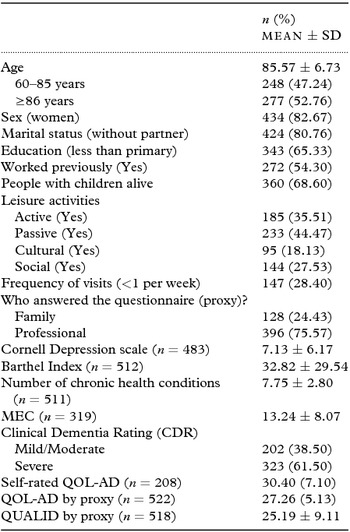
The socio-demographic and clinical characteristics of the sample are shown in Table 1. Only 208 individuals out of 525 (39.61%) were able to answer QOL-AD by themselves, and they had less severe dementia than the rest of the PwD (16.41% and 83.59% severe dementia, respectively; p < 0.001). Almost 70% of the PwD had children alive, and 44.47% participated in some kind of passive leisure.
Socio-demographic, clinical characteristics and applied rating scales

SD: standard deviation; MEC: “mini-examen cognoscitivo” (Spanish version of the MMSE); QOL-AD: quality of life in Alzheimer's disease scale; QUALID: quality of life in late-stage dementia scale.
The Cornell depression scale mean ± standard deviation values showed that participants had a high likelihood of suffering from depression (7.13 ± 6.17). Barthel Index mean value was on the range of severe dependence and the mean number of chronic health conditions was 7.75 ± 2.80. The MEC mean score fell on the severe cognitive impairment range. The number of chronic health conditions was 7.75 ± 2.80, and the most frequent were: memory problems (78.1%), bones disease (71.9%), and genitourinary problems (71.0%). According to the CDR, severe or extremely severe dementia was observed in the 61.50% of the sample. The majority of PwD presented non-specific dementia (49.7%), followed by dementia type Alzheimer (36.4%) and vascular dementia (6.5%), and also there were a lower proportion of mixed dementia, alcohol-related dementia, Lewy's body and Parkinson (4.4%, 1.1%, 1.1%, and 0.8%, respectively).
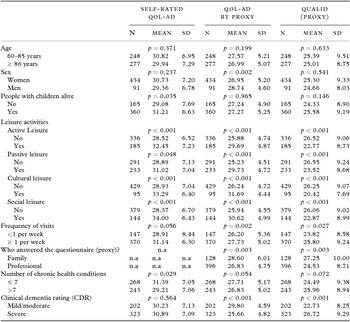
The comparison of the QoL measures by socio-demographic and clinical characteristic (Table 2), showed that a better self-rated QOL-AD score was significantly associated (p < 0.05) with higher education level, PwD with children alive, those who practiced leisure activities and had less chronic health conditions. A QOL-AD score by proxy was significantly associated with males, higher education level, having worked previously, the practice of leisure activities, higher frequency of visits per week, less severe dementia, and when the proxy who completed the questionnaire was a family member. For QUALID, higher QoL was associated (p < 0.05) with the practice of leisure activities, higher frequency of visits per week, less severe dementia, and when the proxy was a family member.
Comparison of quality of life measures by socio-demographic and clinical characteristic

SD: Standard Deviation; n.a.: not applicable; QOL-AD: Quality of Life in Alzheimer’s disease Scale; QUALID: Quality of Life in Late-Stage Dementia Scale; MEC: “Mini-Examen Cognoscitivo” (Spanish version of the MMSE).
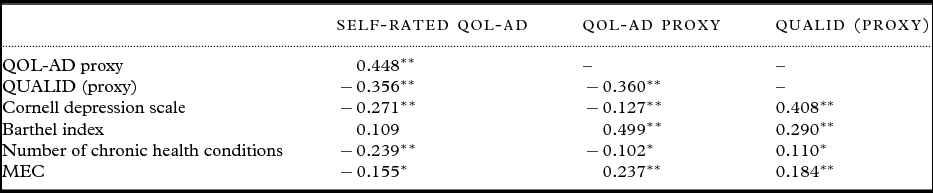
The correlation coefficients between the three QoL measures ranged from 0.36 to 0.45 in absolute values (Table 3). QOL-AD by proxy was strongly associated to Barthel Index (r = 0.50). The self-rated QOL-AD showed a low correlation with all applied scales (0.11 to 0.27). The QUALID displayed a moderate correlation with the Cornell depression scale (0.41).
Correlation between the QoL measures and the rest of applied scales

**Correlation is significant at the 0.01 level (two-tailed).
*Correlation is significant at the 0.05 level (two-tailed).
Regression models of self-rated QOL-AD
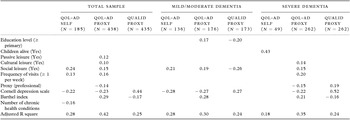
Social leisure, Cornell depression scale and number of chronic health conditions were significantly associated factors to the self-rated QOL-AD in the regression model for the total sample (Table 4). For the group of people with mild/moderate dementia, the factors significantly associated with QoL were social leisure and Cornell depression scale, with an explained variance of 27.77%. For people with severe dementia, self-rated QOL-AD was only associated with having children alive. The variance by this model was 17.94%.
Linear regression models (standardized coefficient) for with QOL-AD and QUALID questionnaires by stage of dementia (clinical dementia rating)

QOL-AD: quality of life in Alzheimer's disease scale; QUALID: quality of life in late-stage dementia scale. Only significant standardized coefficients are showed.
Regression models of QOL-AD rated by proxy
For the total sample (Table 4), education level, passive, cultural and social leisure, frequency of visits, being answered by professional and CDR were the associated factors of QoL, with an explained variance of 41.64%. For the mild/moderate dementia group (Table 4), education level, social leisure, Cornell depression scale and Barthel Index showed a significant association with this QOL-AD rated by proxy, with an explained variance of 29.72%. In the severe dementia model, cultural and social leisure, the questionnaire completed by the professional, the Cornell depression scale and the Barthel Index were associated with QOL-AD by proxy (35.32% explained variance).
Regression models of QUALID rated by proxy
The only significant associated factors for the model with QUALID were the Cornell depression scale and Barthel Index, explaining 25.11% of the variance (Table 4). For people with mild/moderate dementia (Table 4), education level, social leisure and Cornell depression scale were significant associated factors (24.41% explained variance). The severe dementia regression model showed the following significant associated factors: who answered the questionnaire, Cornell depression scale and Barthel Index, with an explained variance of 24.40%.
Discussion
The aim of this study was to identify which factors are associated with three QoL measures (self-rated QOL-AD, QOL-AD by proxy and QUALID, which is rated by proxy) in PwD. Our study adds to the literature by using different QoL measures across mild, moderate, and severe dementia in institutionalized older adults. There are researches that had evaluated the QoL across the stages but in population living in community (Giebel et al., Reference Giebel2014). Other studies had measured the QoL only in people with very severe dementia, which living in long-term care facilities (Clare et al., Reference Clare, Quinn, Hoare, Whitaker and Woods2014). In addition, the majority of the QoL studies in PwD applied one unique measure of QoL, as QOL-AD (Beerens et al., 2013; Giebel et al., Reference Giebel2014; Huang et al., 2015) or QUALID (Clare et al., Reference Clare, Quinn, Hoare, Whitaker and Woods2014). The profile of PwD in our study was comparable to other studies with similar inclusion criteria (Conde Sala et al., Reference Conde Sala, Garre Olmo, Turre Garriga, Lopez Pousa and Vilalta Franch2009; Crespo et al., Reference Crespo, Hornillos and de Quiros2013).
QoL scores by proxy were significantly worse in people with severe dementia than in people in mild/moderate stages. However, when QoL was rated by the PwD themselves, there were no differences between stages. It is known that PwD tend to rate their QoL significantly higher than caregivers (Crespo et al., Reference Crespo, de Quirós, Gómez and Hornillos2012), even when they live in nursing home (Moyle and O’Dwyer, Reference Moyle and O’Dwyer2012); which support that dementia associated with a reduced QoL can be partly caused by environment, staff attitudes and limited relationships (Moyle and O’Dwyer, Reference Moyle and O’Dwyer2012). Moreover, cognitive deficits such as anosognosia can contribute to the stability of self-ratings of QoL over time while proxy-rated QoL can be affected by the severity of dementia (Conde-Sala et al., Reference Conde-Sala, Turró-Garriga, Garre-Olmo, Vilalta-Franch and Lopez-Pousa2014b). In addition, the variable about who answered the questionnaire (family vs. professional) was significantly associated with QoL measures rated by proxy, but only in severe dementia models. Also, the family members evaluated the QoL higher than professional caregiver. Results about the type of proxy are inconsistent across studies and call for further research (Crespo et al., Reference Crespo, de Quirós, Gómez and Hornillos2012; Redondo et al., Reference Diaz-Redondo, Rodriguez-Blazquez, Ayala, Martinez-Martin and Forjaz2014).”
Our results indicate that depression, functional ability and social leisure were significantly associated to QoL, regardless the degree of dementia. By dementia severity, education level was only significant for mild/moderate dementia, whereas cultural leisure, frequency of visits and who answered the questionnaire were factors significantly associated with severe dementia. These results suggest that the factors associated with QoL differ by dementia severity, a finding previously reported by some longitudinal studies (Hoe et al., Reference Hoe, Hancock, Livingston, Woods, Challis and Orrell2009).
Depression has been reported as an associated factor of lower QoL when it is assessed by both PwD and caregiver (Bruvik et al., Reference Bruvik, Ulstein, Ranhoff and Engedal2012; Buckley et al., Reference Buckley2012). Some studies have reported that self-rated QoL is frequently associated with depression (Conde Sala et al., Reference Conde Sala, Garre Olmo, Turre Garriga, Lopez Pousa and Vilalta Franch2009), but this is not always the case with QoL rated by proxy (Beerens et al., Reference Beerens, Zwakhalen, Verbeek, Ruwaard and Hamers2013). In our study, depression is associated with self-assessed QoL in mild/moderate dementia, but not in the most severely affected PwD, a finding that could be explained by cognitive deficits which might impede people with severe dementia were aware of their own mood (Conde-Sala et al., Reference Conde-Sala2014a). Depression is a prevalent psychiatric co-morbidity in the elderly with Alzheimer dementia (Strober and Arnett, Reference Strober and Arnett2009) and negatively affects several dimensions of QoL. However, the depressive symptoms are often under-recognized, being masked by the cognitive impairment. Early diagnosis of depression and its treatment could help to improve the QoL of institutionalized older adults.
Also, in accordance with previous studies (Giebel et al., Reference Giebel, Sutcliffe and Challis2015), functional ability was associated with the QoL, but only when it was assessed by proxy. Cognitive deficits, such as anosognosia or unawareness of difficulties, can explain the lack of relationship with self-assessed QoL (Albrecht and Devlieger, Reference Albrecht and Devlieger1999). These results suggest that assistance for performing the activities of daily living by the residential care's staff could improve the QoL of PwD.
Leisure activities are important for the well-being and QoL of PwD, as they involve social interaction, alleviate loneliness and help maintain health status and cognitive function (Wang et al., Reference Wang, Xu and Pei2012). Previous studies have shown that engagement in pleasant activities may improve the QoL of both the PwD and the caregiver (Siedlecki et al., Reference Siedlecki2009). In our study, those who practiced some kind of leisure activities scored significantly better in QoL scales. In linear regression models, social leisure activities were associated with self- and proxy-assessed QoL for mild and moderate dementia. For severe dementia, social and cultural activities were only related with QoL-AD by proxy. Whether the lack of relationship between leisure and self-assessed QoL in severe dementia is due to cognitive deficits or to other mediating variables such as depression it is unknown and it deserves further research.
In severe dementia, having children alive was the only QoL significant factor for self-rated QOL-AD. This might be accounted for by selection bias, as the group of people with severe dementia who were able to answer by themselves (n = 49), had better cognitive abilities than the group of PwD whose QoL was measured only by proxy.
Taking all models comparing between the measurements and levels of dementia severity, the model with the highest number of associated factors of QoL and explained variance (30%) of our study was QOL-AD by proxy. This suggests that the QOL-AD by proxy, a suitable measure with good psychometric properties (Logsdon et al., Reference Logsdon, Gibbons, McCurry and Teri2002; Leon-Salas et al., Reference Leon-Salas, Logsdon, Olazaran and Martinez-Martin2011), might be more useful than the other QoL measures in studies of institutionalized older adults with different stages of dementia.
This study has several limitations: it did not use a random sample, although its nationwide design gives support to the representativeness of the sample of institutionalized Spanish older people. Another limitation of the study is that QoL associated factors were assessed using a cross-sectional design, which does not allow drawing conclusions about causality or direction of some associations.
Our study also has several strengths, such as analyzing a relatively large sample of institutionalized older adults; the inclusion of PwD in all dementia stages; and the use of two different QoL instruments (QUALID and QoL-AD), as well as perspectives from both PwD and caregivers. The variance explained by our models was larger than other studies (Beer et al., Reference Beer2010; Crespo et al., Reference Crespo, Hornillos and de Quiros2013).
Our results have important implications for caring of institutionalized older adults with dementia, most of them part of a frail population. The main associated factors of QoL for PwD comprise depression, functional ability and social leisure activities. Furthermore, frequency of visits was related with QoL of severe dementia. Efforts aimed at improving their emotional state, their social life and maintaining their functional autonomy can contribute to improve the QoL of PwD, regardless of their dementia severity. Also, it should be pay special attention in social activities and relationships of family and friends in institutionalized older adults with severe dementia.
Conflict of interest
None.
Description of authors’ role
M.J. Forjaz design the study. E. Castro-Monteiro, A. Diaz-Redondo, C. Rodriguez-Blazquez and M. Alhayek drafted the paper. A. Ayala and M. Alhayek performed the statistical analysis. F. Rojo-Perez, P Martinez-Martin and M. J. Forjaz reviewed the paper for important conceptual content. All authors contributed to the study design.
Acknowledgments
This study was funded by the CIEN foundation, Carlos III Institute of Health (Ref. PI 017/09). We thank Salome Martin Garcia and Iluminada Martinez Lopez (EULEN Social Care Services) for contributing to this study with the valuable information of institutionalized older adults with dementia. The Spanish Research Group on QoL and Ageing is formed by: M. J. Forjaz, P. Martinez-Martin, C. Rodriguez-Blazquez, and A. Ayala, at Carlos III Institute of Health; F. Rojo-Perez and G. Fernandez-Mayoralas, at the Spanish National Research Council; B. Frades, B. Leon-Salas, and Marina Avila, at the CIEN Foundation; M. E. Prieto-Flores, Spanish National Distance University; S. Martin and I. Martinez, at EULEN.
This study was carried out with the financial support of the CIEN Foundation, Institute of Health Carlos III (Ref: PI 017/09).