





Introduction
Childhood trauma (CT) – including physical, emotional and sexual abuse and physical and emotional neglect – and other adverse childhood experiences are associated with a fourfold increased risk for mental health difficulties across the lifespan (Kessler et al., Reference Kessler, McLaughlin, Green, Gruber, Sampson, Zaslavsky, Aguilar-Gaxiola, Alhamzawi, Alonso, Angermeyer, Benjet, Bromet, Chatterji, de Girolamo, Demyttenaere, Fayyad, Florescu, Gal, Gureje and Williams2010). Adult mental health therapies typically target the emotional consequences of childhood adversity (i.e. increased anxiety and mood difficulties). This reflects the well-established association between CT and over-sensitization of the brain’s HPA axis and limbic system, which are central to threat detection and emotion regulation. Several effective psychosocial interventions have been developed to target the affective sequelae of CT for both children and adults, including trauma-focused cognitive behavioral therapy (TF-CBT; Cohen, Deblinger, & Mannarino, Reference Cohen, Deblinger and Mannarino2018) and eye movement desensitization and reprocessing (EMDR; Shapiro, Reference Shapiro2018).
CT and mental health difficulties: The cognitive pathway
In targeting the emotional consequences of childhood trauma, there has often been a failure to address its cognitive and social cognitive consequences (reduced general cognitive and social cognitive ability). Social cognition refers to the processing of socially relevant information, including emotion recognition and mental state reasoning. In clinical populations, social cognitive difficulties have been robustly associated with early-life adversity (Rokita, Dauvermann, & Donohoe, Reference Rokita, Dauvermann and Donohoe2018) and, in psychosis, strongly predict both current and future levels of functioning, even after accounting for clinical symptom severity (Cowman et al., Reference Cowman, Holleran, Lonergan, O’Connor, Birchwood and Donohoe2021). We hypothesize that sub-optimal early social environments and early childhood (e.g. attachment) relationships make social cognitive development and learning difficult, because the (social) learning environment is too unpredictable, too unrewarding, or both. This, in turn, results in an impoverished/challenging set of learning and social learning experiences, making it difficult to develop accurate models of the world and one’s place in it.
The association between CT and cognitive difficulties: neurobiological mechanisms
The development of treatments targeting cognitive and social cognitive deficits associated with CT has been held back by the fact that the mechanisms by which CT impacts cognition have been poorly understood. Investigating this ‘cognitive pathway’, we and others have demonstrated that this relationship is mediated via structural changes in pre-frontal gray matter volumes (e.g. the anterior cingulate cortex; Rokita et al., Reference Rokita, Holleran, Dauvermann, Mothersill, Holland, Costello, Kane, McKernan, Morris, Kelly, Corvin, Hallahan, McDonald and Donohoe2020) and white matter microstructure (e.g. the corpus callosum; Corley, Gleeson, et al., Reference Corley, Gleeson, Godfrey, Cowman, Patlola, Cannon, McKernan, Kelly, Hallahan, McDonald, Morris, Burke and Donohoe2024) in the absence of structural changes to the amygdala (Rokita et al., Reference Rokita, Holleran, Dauvermann, Mothersill, Holland, Costello, Kane, McKernan, Morris, Kelly, Corvin, Hallahan, McDonald and Donohoe2020). CT is further associated with functional connectivity changes within the brain’s default mode network, a network associated with reflecting about the self and others (DMN; Dauvermann et al., Reference Dauvermann, Mothersill, Rokita, King, Holleran, Kane, McKernan, Kelly, Morris, Corvin, Hallahan, McDonald and Donohoe2021). These CT-associated brain changes are in turn partly mediated by an increased immune response, as measured by inflammatory markers (e.g. IL-6, TNF-A, CRP) both individually and combined (Corley, Gleeson, et al., Reference Corley, Gleeson, Godfrey, Cowman, Patlola, Cannon, McKernan, Kelly, Hallahan, McDonald, Morris, Burke and Donohoe2024). These mediating effects are further observed to be moderated by common genetic variation associated with risk for serious mental health disorders (Corley, Patlola, et al., Reference Corley, Patlola, Laighneach, Corvin, McManus, Kenyon, Kelly, Mckernan, King, Hallahan, Mcdonald, Morris and Donohoe2024). Finally, we observed these associations in the absence of an association between CT, cognitive function, and HPA axis function as measured by stress reactivity changes in cortisol response (Rokita et al., Reference Rokita, Dauvermann, Mothersill, Holleran, Bhatnagar, McNicholas, McKernan, Morris, Kelly, Hallahan, McDonald and Donohoe2021).
A novel approach to targeting CT-associated social cognitive difficulties
We developed ‘SOCIAbLE’ (Social Cognitive Intervention following Adverse Early Life Experiences) as a novel, immersive, VR-assisted behavioral intervention to target social cognitive difficulties in young adults with a history of CT. Delivered in-person over 8 weeks, SOCIAbLE integrates therapist-led structured therapeutic content with experiential learning via VR, allowing participants to actively practice social cognitive strategies in ecologically valid, simulated social environments. SOCIAbLE is grounded in the principles of Social Cognition and Interaction Training (SCIT; Roberts, Penn, & Combs, Reference Roberts, Penn and Combs2016), a group-based program originally developed for individuals with psychosis. SOCIAbLE adapts SCIT’s structure into an individualized, one-to-one format, combining psychoeducation and cognitive-behavioral strategies facilitated with experiential VR learning. It offers a novel approach for people with a history of childhood adversity to reconnect with the social world and practice skills that can be relearned with the right support (Bowie et al., Reference Bowie, Bell, Fiszdon, Johannesen, Lindenmayer, McGurk, Medalia, Penadés, Saperstein, Twamley, Ueland and Wykes2020).
Aims of the present study
This proof-of-concept study evaluated the feasibility, acceptability, and preliminary outcomes of SOCIAbLE. Feasibility was assessed via recruitment, retention, program completion, and attendance at follow-up assessments (6, 12, and 18 weeks). Tolerability was assessed using measures of cybersickness, and acceptability was explored through qualitative interviews. In terms of preliminary clinical efficacy, we also explored whether participation in SOCIAbLE was associated with, firstly, changes in social cognition and secondly, changes in social function. As a feasibility trial, it was not powered for definitive hypothesis testing regarding clinical outcomes, and statistical comparisons are, therefore, interpreted as exploratory.
Methods
Study design
This was a single-arm, proof-of-concept feasibility and acceptability study evaluating a novel social cognitive intervention (‘SOCIAbLE’) for adults with a history of CT. The study received ethical approval from the Galway Clinical Research Ethics Committee at Merlin Park University Hospital, Galway, Ireland (ref. CA2969). All participants provided written informed consent prior to participation. Although desirable, the present study was not prospectively registered as it was designed as a single-arm proof-of-concept feasibility and acceptability study, in anticipation of a full, prospectively registered, controlled study.
Participants
Eligible participants were adults aged 18–50 years, fluent in English, capable of providing informed consent, and self-reporting a history of early childhood adversity and ongoing social difficulties. Participants were recruited from the community via printed posters and digital advertisements shared via social media platforms and online forums.
Individuals who expressed interest completed a screening interview to determine eligibility on the basis of age, exposure to childhood trauma before age 18, and the exclusion criteria were as follows: substance misuse, current engagement in psychological treatment, history of intellectual disability or neurological disorder (including head injury), or current social difficulties. Screening was based on self-report, and no structured diagnostic interview was conducted. While many participants had sought help for mental difficulties previously, none were receiving psychological therapy at the time of recruitment.
Intervention
SOCIAbLE consisted of eight weekly sessions, each lasting approximately 60 minutes. Sessions were delivered in person by psychologists trained to at least a master’s level, who received extensive training with SOCIAbLE and weekly supervision throughout the trial. Treatment fidelity was monitored using the Therapist Adherence Rating Scale.
SOCIAbLE is a VR-assisted adaptation of SCIT, a group-based intervention originally developed for individuals with psychosis (Roberts et al., Reference Roberts, Penn and Combs2016). SOCIAbLE retains the psychoeducational and CBT elements of SCIT while incorporating immersive experiential learning through VR. VR constituted one component of each session and was integrated alongside psychoeducation, therapist-guided reflection, and skills consolidation.
VR scenarios were delivered using the ENGAGE XR platform (Engage VR Ltd., 2022) via Meta Quest 2 headsets. Pre-existing environments (e.g. hospital, café, lecture hall, office) were customized using built-in digital assets to simulate ecologically valid social interactions aligned with intervention goals. During the sessions, participants interacted in real time with avatars controlled by a research assistant situated in a separate room. The therapist remained in the room during each intervention session to guide the participant and support the learning process. Sessions followed three phases: (1) developing emotion recognition skills (based on human faces); (2) developing theory of mind and awareness of attributional biases, and (3) generalizing learning to the real world, each of which are described in detail in the supplemental information (see Supplementary Material 1).
Assessments
Outcome measures were collected by trained research assistants independent of those delivering the intervention, at four time points: baseline, 6 weeks, 12 weeks (post-intervention), and 18 weeks (follow-up). CT was measured using the Childhood Trauma Questionnaire (Bernstein et al., Reference Bernstein, Stein, Newcomb, Walker, Pogge, Ahluvalia, Stokes, Handelsman, Medrano, Desmond and Zule2003), a widely used brief measure of five commonly reported categories of CT: physical abuse, physical neglect, emotional abuse, emotional neglect, and sexual abuse.
The primary outcome variable was social cognition as indexed by the Bell Lysaker Emotion Recognition Task (BLERT), which measures the ability to correctly identify seven emotional states: happiness, sadness, fear, disgust, surprise, anger, or no emotion from brief video clips (Bryson, Bell, & Lysaker, Reference Bryson, Bell and Lysaker1997). Because social cognition is multidimensional and does not have one single agreed on measure, social cognitive functioning was also assessed using (a) the Reading the Mind in the Eyes Test (RMET; Baron-Cohen et al., Reference Baron-Cohen, Wheelwright, Hill, Raste and Plumb2001), which measures the ability to decode mental state (an aspect of theory of mind) from facial photographs, (b) the CANTAB Emotion Recognition Task (ERT; Fray, Robbins, & Sahakian, Reference Fray, Robbins and Sahakian1996), which measures the ability to identify six basic facial emotions (sadness, happiness, anger, disgust, surprise, and fear) also from facial photos, and (c) the Ambiguous Intentions Hostility Questionnaire (AIHQ; Combs, Penn, Wicher, & Waldheter, Reference Combs, Penn, Wicher and Waldheter2007), which measures attributional style in social situations with negative outcomes and ambiguous causality. The BLERT was selected as our primary measure because the stimuli (video clips) are dynamic rather than static (photographs) and hence were considered more ecologically valid.
Secondary outcome variables included measures of social and occupational functioning, clinical symptoms severity, and non-social cognitive function. Social and occupational functioning was measured using the Social and Occupational Functioning Assessment (SOFAS; Goldman, Skodol, & Lave, Reference Goldman, Skodol and Lave1992), an interviewer-rated global assessment. Clinical symptom severity was assessed using the Generalized Anxiety Disorder 7-item scale (GAD-7; Spitzer, Kroenke, Williams, & Löwe, Reference Spitzer, Kroenke, Williams and Löwe2006), the Patient Health Questionnaire (PHQ-9; Kroenke, Spitzer, & Williams, Reference Kroenke, Spitzer and Williams2001), and the Social Interaction Anxiety Scale (SIAS; Mattick & Clarke, Reference Mattick and Clarke1998). Non-social cognitive function was measured using the Wechsler Logical Memory subtests I and II (Wechsler, Reference Wechsler1945), a brief measure of verbal episodic memory.
Tolerability
Tolerability was assessed in terms of VR-related difficulties with nausea, vestibular, or oculomotor discomfort using the Cybersickness Questionnaire-VR (CSQ-VR; Kourtesis et al., Reference Kourtesis, Linnell, Amir, Argelaguet and MacPherson2023), and participants’ sense of immersion, engagement, and perceived realism during the VR experience was measured by the Presence Questionnaire (PQ; Witmer & Singer, Reference Witmer and Singer1998).
Qualitative interviews
Brief structured interviews were conducted post-intervention with participants who completed the intervention (n = 25). Of these, 24 participants completed a qualitative interview; one participant was unavailable to attend the interview despite completing the intervention. The interview schedule was informed by the Theoretical Framework of Acceptability (TFA; Sekhon, Cartwright, & Francis, Reference Sekhon, Cartwright and Francis2017), which comprises the domains of affective attitude, burden, perceived effectiveness, ethicality, intervention coherence, opportunity costs, and self-efficacy. As with the quantitative assessment, interviews were conducted by a different member of the team to the psychologist who facilitated the intervention. Interviews were conducted either online via video call or in person and lasted approximately 8–30 minutes (M = 17.4). All interviews were audio-recorded and transcribed verbatim.
Data analysis
Quantitative data were analyzed using IBM SPSS v29. Descriptive statistics were used to summarize demographic, clinical, and cognitive characteristics of the sample. Means, standard deviations, ranges, and effect sizes (Hedges’ g) were calculated for participants who completed all eight intervention sessions on all primary and secondary outcome variables (n = 25). Given the exploratory feasibility design, no imputation procedures were applied.
Qualitative interview data were analyzed using deductive framework analysis (Ritchie & Spencer, Reference Ritchie, Spencer, Bryman and Burgess1994), structured around the TFA components (affective attitude, burden, ethicality, intervention coherence, opportunity cost, perceived effectiveness, and self-efficacy; Sekhon et al., Reference Sekhon, Cartwright and Francis2017). After familiarization with the transcripts, participant responses were coded line-by-line using this TFA-based framework, with relevant segments assigned to the corresponding domain. The coded data were charted into a framework matrix, and summaries were developed for each category, capturing key aspects of participants’ experiences. To interpret the data, the data summaries were examined within and across cases to identify patterns of similarity and divergence. Within each TFA component, the charted data were reviewed to identify recurrent patterns and generate themes that reflected the breadth and nuance of participants’ experiences of the intervention, in line with the final interpretive stages of framework analysis.
Results
Sample description
A description of the sample is provided in Table 1. Participants’ mean age was 29.2 years, and 56.3% of participants identified as female. Most were single (53.1%) and lived in shared accommodation (65.6%), and a majority (59.4%) were in full-time education. Reflecting the recruitment criteria, participants had a total CTQ mean score of 59.5 (SD = 13.17; range = 32–88), indicating moderate to high levels of reported childhood adversity. Despite being recruited from the general community, 50% of participants fell within the moderate-to-severe range for symptoms of anxiety (GAD-7) and 43.7% for symptoms of low mood (PHQ-9). Total scores on the SIAS also indicated high levels of social anxiety.
Demographic and clinical description of the sample at baseline assessment

Table 1. Long description
The table presents data for a sample size of n = 32.
* Age: Mean 29.22, S D 9.34.
* Gender: Male 43.80 percent, Female 56.30 percent.
* Ethnicity: Irish 31.30 percent, Irish traveler 6.30 percent, Other white background 28 percent, Other Asian background 12.50 percent, Other including mixed 21.90 percent.
* Relationship and family status: Single 53.10 percent, In a relationship longer than 3 months 15.60 percent, Living with partner 15.60 percent, Married 15.60 percent, Children 5 (15.6 percent).
* Current education status: Not in education 37.50 percent, Part-time 3.10 percent, Full time 59.40 percent.
* Current employment status: Not working 50 percent, Part-time 28.10 percent, Full-time 21.90 percent.
* Accommodation: Lives with parents 15.60 percent, Lives with others 68.80 percent, Lives alone 15.60 percent.
* Childhood adversity (C T Q scores):
- C T Q total: Mean 59.53, S D 13.17.
- Emotional abuse: Mean 15.87, S D 4.61.
- Emotional neglect: Mean 15.56, S D 4.38.
- Physical abuse: Mean 8.56, S D 3.83.
- Physical neglect: Mean 10.66, S D 3.50.
- Sexual abuse: Mean 8.81, S D 5.46.
Abbreviations: CTQ, Childhood Trauma Questionnaire.
Recruitment and retention
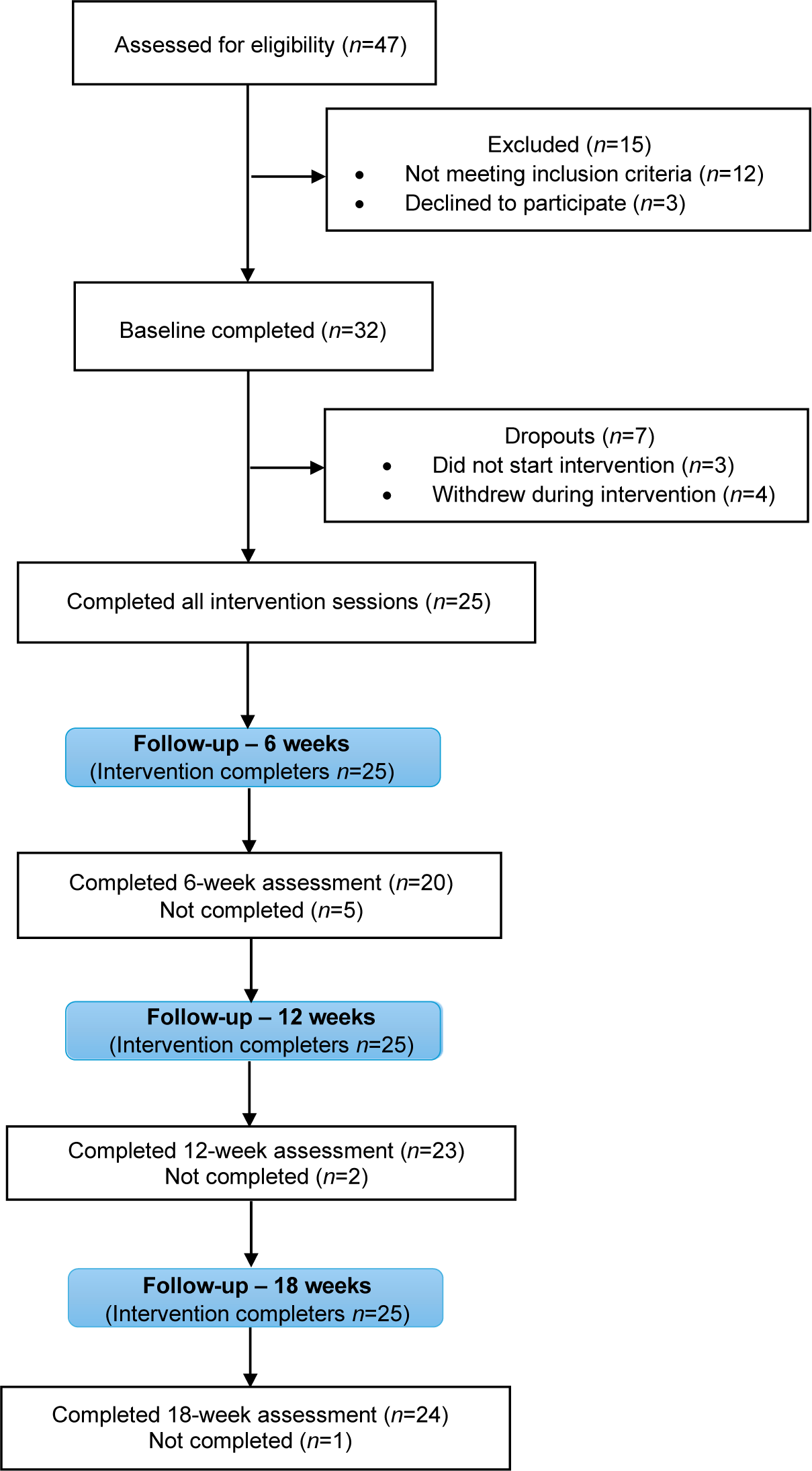
A recruitment flowchart is presented in Figure 1. A total of 47 individuals were assessed for eligibility. Of these, 15 were excluded, 12 for not meeting the inclusion criteria and 3 declined to participate. Thirty-two participants completed baseline assessments and were enrolled in the SOCIAbLE intervention. Three individuals withdrew prior to commencing the intervention (9.4%), and a further four (12.5%) withdrew during the 8-week program; none of these participants completed further assessments after baseline. The remaining 25 participants (78%) completed all intervention sessions and were included in the analysis. Follow-up assessments were scheduled at 6 weeks, 12 weeks (post-intervention), and 18 weeks. Among intervention completers (n = 25), 20 (80%) completed the 6-week assessment, 23 (92%) completed the 12-week assessment, and 24 (96%) completed the 18-week assessment.
Recruitment and retention rates.

Figure 1. Long description
The flowchart begins at the top with Assessed for eligibility (n=47). A lateral branch to the right shows Excluded (n=15), consisting of Not meeting inclusion criteria (n=12) and Declined to participate (n=3). The main path continues down to Baseline completed (n=32). A second lateral branch to the right shows Dropouts (n=7), consisting of Did not start intervention (n=3) and Withdrew during intervention (n=4). The main path continues to Completed all intervention sessions (n=25).
Below this, the flow enters a series of three follow-up phases, each represented by a blue header box followed by an assessment box:
1. Follow-up – 6 weeks (Intervention completers n=25) leads to Completed 6-week assessment (n=20) and Not completed (n=5).
2. Follow-up – 12 weeks (Intervention completers n=25) leads to Completed 12-week assessment (n=23) and Not completed (n=2).
3. Follow-up – 18 weeks (Intervention completers n=25) leads to Completed 18-week assessment (n=24) and Not completed (n=1).
Primary outcome measure
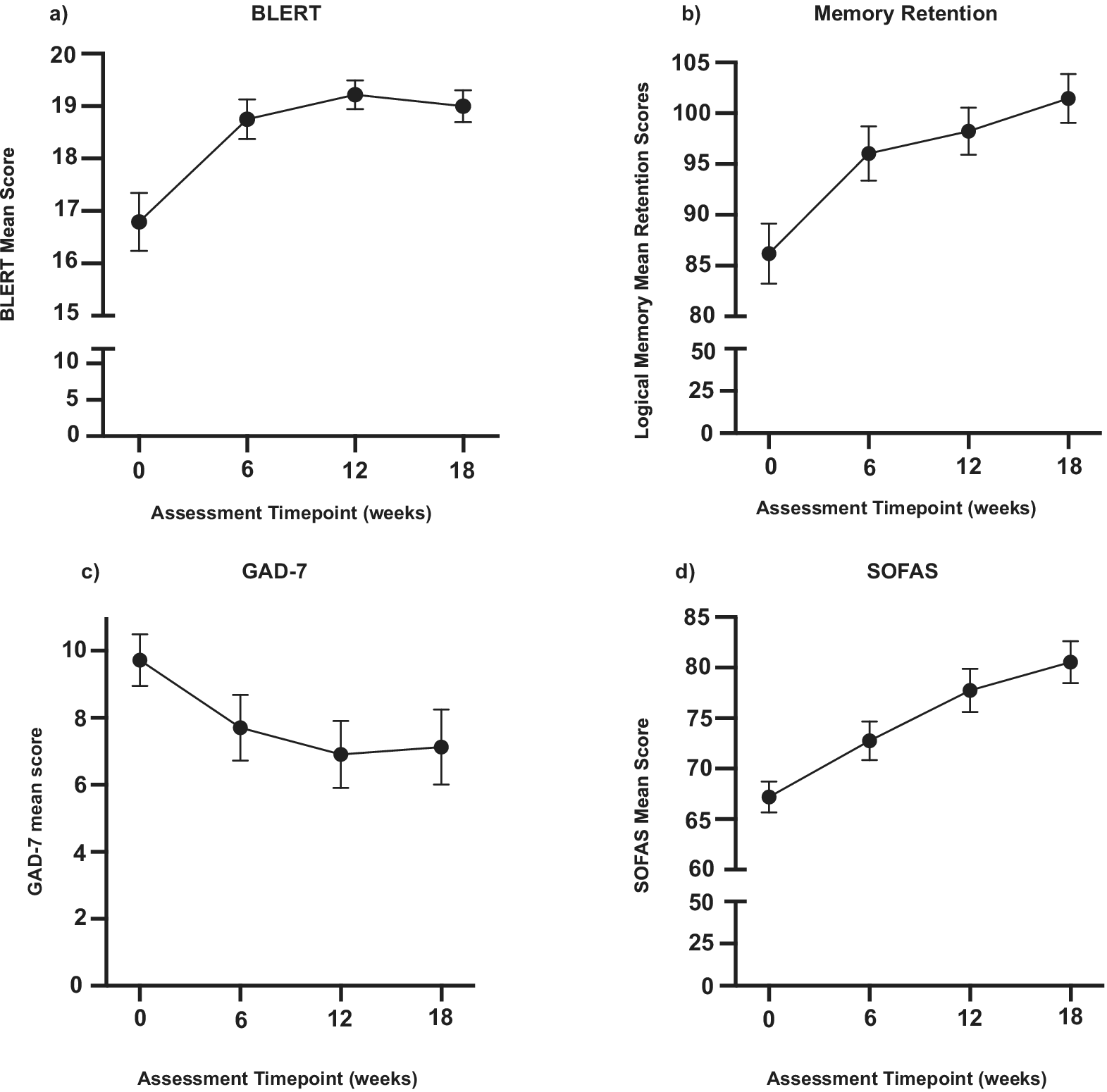
BLERT scores increased relative to baseline across follow-up assessments. Scores increased from baseline (M = 16.79, SD = 2.98) to 6 weeks (M = 18.75, SD = 1.68) to 12 weeks (M = 19.22, SD = 1.31) and remained higher than baseline at 18 weeks (M = 19.00, SD = 1.50). These changes correspond to large effect sizes at both 12 weeks (g = 1.04) and 18 weeks (g = 0.93), as shown in Figure 2. Descriptive statistics and effect sizes for all outcome measures are presented in Table 2.
Mean Change scores for primary (BLERT) and secondary (Logical Memory, GAD-6 and SOFAS) measures from baseline to 18 weeks.

Figure 2. Long description
A four-panel line graph display. All graphs share a common x-axis labeled Assessment Timepoint weeks with intervals at 0, 6, 12, and 18.
Panel a, titled B L E R T. The y-axis is B L E R T Mean Score with a break between 10 and 15. The data shows a sharp increase from a score of approximately 16.8 at week 0 to 18.8 at week 6, peaking at 19.2 at week 12, and slightly declining to 19.0 at week 18.
Panel b, titled Memory Retention. The y-axis is Logical Memory Mean Retention Scores with a break between 50 and 80. The data shows a steady upward trend starting at approximately 86 at week 0, rising to 96 at week 6, 98 at week 12, and reaching approximately 102 at week 18.
Panel c, titled G A D-7. The y-axis is G A D-7 mean score from 0 to 10. The data shows a downward trend, starting at approximately 9.8 at week 0, dropping to 7.8 at week 6, reaching a low of 7.0 at week 12, and slightly rising to 7.2 at week 18.
Panel d, titled S O F A S. The y-axis is S O F A S Mean Score with a break between 50 and 60. The data shows a consistent linear increase from approximately 67 at week 0, to 73 at week 6, 78 at week 12, and 81 at week 18.
All data points include vertical error bars representing variability.
Primary and secondary outcome measure scores at baseline, 6 weeks, 12 weeks, and 18 weeks

Table 2. Long description
The table tracks outcomes across four time points: Baseline (n=32), 6 weeks (n=20), 12 weeks (n=23), and 18 weeks (n=24).
Social Cognition measures:
* B L E R T (0 to 21): Mean increases from 16.79 at baseline to 19.00 at 18 weeks (Hedges’ g = 0.93).
* R M E T: Mean increases from 26.62 at baseline to 29.33 at 18 weeks (Hedges’ g = 0.75).
* C A N T A B E R T accuracy: Mean increases from 30.77 at baseline to 32.48 at 18 weeks (Hedges’ g = 0.44).
* A I H Q-Total: Mean decreases from 54.84 at baseline to 47.08 at 18 weeks (Hedges’ g = minus 0.70).
Social and Occupational Functioning:
* S O F A S: Mean increases from 67.19 at baseline to 80.54 at 18 weeks (Hedges’ g = 1.39).
Memory Function:
* Logical Mem. immediate: Mean increases from 8.53 at baseline to 12.79 at 18 weeks (Hedges’ g = 1.48).
* Logical Mem. delayed: Mean increases from 8.88 at baseline to 14.17 at 18 weeks (Hedges’ g = 1.83).
* Logical Mem. retention: Mean increases from 86.18 at baseline to 101.46 at 18 weeks (Hedges’ g = 1.02).
Clinical measures:
* G A D 7: Mean decreases from 9.72 at baseline to 7.13 at 18 weeks (Hedges’ g = minus 0.51).
* P H Q 9: Mean decreases from 9.53 at baseline to 6.71 at 18 weeks (Hedges’ g = minus 0.56).
* S I A S: Mean decreases from 47.19 at baseline to 32.83 at 18 weeks (Hedges’ g = minus 1.05).
V R measures (6, 12, and 18 weeks only):
* C S Q-V R: Mean increases from 7.50 to 9.63.
* P Q: Mean increases from 92.33 to 94.83.
Abbreviations: BLERT: Bell–Lysaker Emotion Recognition Task; RMET: Reading the Mind in the Eyes Task; CANTAB ERT: Cambridge Neuropsychological Test Automated Battery; AIHQ: Ambiguous Intentions Hostility Questionnaire; SOFAS: Social and occupational functioning assessment scale. Logical mem: Wechsler Logical memory subtest (Immediate and delayed); GAD-7; Generalized Anxiety Disorder 7; PHQ-9, Patient Health Questionnaire; SIAS, Social Interaction Anxiety Scale; VR, Virtual Reality; CSQ-VR, Cybersickness Questionnaire-Virtual Reality; PQ, Presence Questionnaire. Effect sizes (Hedges’ g) were calculated in each case as the difference compared to baseline.
Secondary outcome measures
Social and occupational functioning, measured by the SOFAS, also increased relative to baseline across follow-up assessments, with large effect sizes observed at 12 weeks (g = 1.10) and 18 weeks (g = 1.39).
Improvements on secondary measures of social cognition were consistent with the primary outcome measure, albeit to a more modest degree. Moderate improvements relative to baseline were observed at 12 weeks (RMET: g = 0.53; CANTAB ERT: g = 0.61; AIHQ: g = −0.63) and were maintained at 18 weeks (RMET: g = 0.75; CANTAB ERT: g = 0.44; AIHQ: g = −0.70). For the AIHQ, lower scores indicate reduced hostile attribution bias.
In addition to improved social cognition, participants showed improved general (i.e. non-social) cognitive performance as measured by the Logical Memory verbal memory subtest. Large effect sizes relative to baseline were observed at 12 weeks for immediate recall (g = 1.20), delayed recall (g = 1.23) and retention (g = 0.80), which remained evident at 18 weeks (immediate recall: g = 1.48; delayed recall: g = 1.83; retention: g = 1.02).
Clinical symptoms decreased relative to baseline across measures of anxiety, depression, and social anxiety at 12 weeks (GAD-7: g = −0.60; PHQ-9: g = −0.55; SIAS: g = −0.96), which were maintained at 18 weeks (GAD-7: g = −0.51; PHQ-9: g = −0.56; SIAS: g = −1.05).
Tolerability of VR
Tolerability of the VR component of the SOCIAbLE intervention was assessed using the CSQ-VR and the PQ. CSQ-VR scores indicated low levels of cybersickness across assessment time points, while PQ scores indicated a high level of immersion and engagement in the VR environment. Overall, these findings suggest that the VR component was well tolerated while maintaining a strong sense of presence. Descriptive statistics for VR tolerability measures are presented in Table 2.
Qualitative findings
Participants described SOCIAbLE as meaningful, engaging, and relevant. Many emphasized both emotional and cognitive benefits, highlighting the balance between reflective discussions and the immersive VR environment. The key findings for each of the seven TFA components are summarized below.
Ethicality Many participants viewed their participation as aligning with their beliefs about self-improvement, contribution to research, and helping others. A recurring theme was the dual motivation of self-development and helping others, whereby contributing to research added to their sense of purpose, for example, ‘At first I thought I was just helping out with the study, but then I realised it was helping me too’.
Affective Attitude Participants approached SOCIAbLE with curiosity and openness, often balancing mild apprehension about VR or personal disclosure with optimism. Emotions were predominantly positive, shifting from initial uncertainty to comfort, enjoyment, and engagement. The intervention was perceived as emotionally safe and rewarding, and fostering reflective growth and personal insight, for example, ‘After the first few sessions I kind of felt a bit strange… but the more it went on, the more comfortable I got’ [And] ‘I was looking forward to them every time because I just wanted to see what the next step was’.
Perceived Effectiveness Participants anticipated potential benefits in confidence, social skills, and self-understanding, though expectations ranged from hopeful to uncertain. Many approached SOCIAbLE as a learning opportunity with modest but positive expectations of improvement. SOCIAbLE was perceived as highly effective in supporting emotional regulation, reflective insight, and real-world application of social and coping skills, with the VR providing a safe learning space: ‘Being able to experience that in the VR and knowing that I can just take off the headset and be in a safe space was very helpful… having that practise without consequences’.
Burden Overall, SOCIAbLE was experienced as low burden. Minor technical frustrations were mentioned, such as adjusting to VR controls, occasional glitches, or reduced visual realism. A few participants reported tolerable mild cybersickness and/or eye strain. Cognitive effort (e.g. remembering material between sessions) and role-play-related self-consciousness were mentioned, yet most framed this as productive effort inherent to learning. For example, ‘There was some difficulties with the VR and … just slowed things down a little bit’ And ‘I found it hard to get used to the headset itself’ And ‘Felt a bit dizzy afterwards… wasn’t the biggest fan’.
Self-Efficacy Participants described improvements in confidence, self-awareness, and independence in managing emotions and social interactions as they generalized skills to real-world contexts. Several participants described feeling more authentic and self-assured, with improvements in relationships and a sense of continued personal growth. For example, ‘I’m ready to kind of reap in the benefits of it, like, my day-to-day life… more confidence… I feel like I’m kind of like magnetised towards people… my social circle has expanded… social situations are so much easier for me now’.
Intervention Coherence Participants demonstrated a clear understanding of SOCIAbLE’s aims, structure, and theoretical foundation. Many viewed the program as a structured, skills-based process combining reflection, learning, and practical application, an understanding which deepened over time: ‘It’s sort of a comprehensive training… learn the theory… makes you more aware… gives you awareness and also tools… put into practise with the VR’.
Opportunity Cost Participants reported minimal opportunity costs associated with taking part in SOCIAbLE. The time commitment and effort were manageable and reasonable, and most participants felt that the personal and emotional benefits outweighed any inconvenience.
Discussion
This proof-of-concept study evaluated the feasibility, acceptability, and preliminary efficacy of SOCIAbLE, a novel VR-assisted intervention designed to target social cognitive deficits in adults with a history of CT. Retention was good with approximately three-quarters completing the intervention and follow-up assessments. Qualitative findings indicated that SOCIAbLE was engaging and personally meaningful. Improvements relative to baseline were observed across social cognition (BLERT, RMET, AIHQ), social and occupational functioning (SOFAS), and clinical symptoms (GAD-7, PHQ-9).
Participants showed improved performance on the BLERT emotion recognition measure, with a large effect size observed by week 12 that persisted at 18 weeks. We included a second measure of emotion recognition (CANTAB ERT) and measures of mental state decoding (RMET) and attributional style (AIHQ), because social cognition is multi-componential and difficult to measure accurately. Participants showed moderate effect sizes for improvements across these measures. Improvements were also evident in general cognitive function (Wechsler Logical Memory subtest).
SOCIAbLE was designed to target social cognitive difficulties arising from an early developmental social environment that was too unrewarding and/or too unpredictable to adequately support social cognitive learning. The preliminary evidence that an intervention which creates a safe and predictable environment within which social cognitive skills (emotion recognition, mental state decoding, attributional style awareness) can be learned and practiced is consistent with this view. Given the evidence highlighted in our introduction that CT is associated with deleterious changes in brain structure and function, this evidence of cognitive improvement represents a valuable proof-of-principle that both cognitive and social cognitive performance can improve when adequately supported.
VR social cognition interventions have been trialed in individuals with psychosis (Nijman et al., Reference Nijman, Veling, Greaves-Lord, Vos, Zandee, het Rot, Geraets and Pijnenborg2020, Reference Nijman, Pijnenborg, Vermeer, Zandee, Zandstra, van der Vorm, de Wit-de Visser, Meins, Geraets and Veling2023; Shen et al., Reference Shen, Liu, Wu, Lin and Wang2022; Thompson et al., Reference Thompson, Elahi, Realpe, Birchwood, Taylor, Vlaev, Leahy and Bucci2020) and autism spectrum disorder (Didehbani et al., Reference Didehbani, Allen, Kandalaft, Krawczyk and Chapman2016; Kandalaft et al., Reference Kandalaft, Didehbani, Krawczyk, Allen and Chapman2013). For example, the DiSCoVR program showed improvements in emotion perception and theory of mind (Nijman et al., Reference Nijman, Veling, Greaves-Lord, Vos, Zandee, het Rot, Geraets and Pijnenborg2020), although these effects were not replicated in a subsequent randomized trial (Nijman et al., Reference Nijman, Pijnenborg, Vermeer, Zandee, Zandstra, van der Vorm, de Wit-de Visser, Meins, Geraets and Veling2023). Similarly, VR adaptations of SCIT have improved social functioning (Shen et al., Reference Shen, Liu, Wu, Lin and Wang2022), and VR-based interventions more broadly have shown efficacy across conditions, particularly anxiety and psychosis (Freeman et al., Reference Freeman, Reeve, Robinson, Ehlers, Clark, Spanlang and Slater2017; Freeman et al., Reference Freeman, Lambe, Kabir, Petit, Rosebrock, Yu, Dudley, Chapman, Morrison, O’Regan, Aynsworth, Jones, Murphy, Powling, Galal, Grabey, Rovira, Martin, Hollis and West2022).
The expanding field of digital psychiatry highlights the potential for VR to deliver scalable and engaging interventions (Torous et al., Reference Torous, Bucci, Bell, Kessing, Faurholt-Jepsen, Whelan, Carvalho, Keshavan, Linardon and Firth2021). VR offers a unique capacity to create controlled yet ecologically valid social environments, enabling users to engage with realistic interpersonal scenarios in a safe and adaptable setting. Importantly, these interventions appear to derive their therapeutic effects not only from the technology but also from the integration of immersive environments with targeted, theory-driven therapeutic content (Freeman et al., Reference Freeman, Reeve, Robinson, Ehlers, Clark, Spanlang and Slater2017; Freeman et al., Reference Freeman, Lambe, Kabir, Petit, Rosebrock, Yu, Dudley, Chapman, Morrison, O’Regan, Aynsworth, Jones, Murphy, Powling, Galal, Grabey, Rovira, Martin, Hollis and West2022). Recent reviews further suggest that such immersive environments enhance emotional engagement and facilitate experiential learning through repeated exposure to socially relevant situations, thereby facilitating behavioral change and skill acquisition across a range of conditions (Bell et al., Reference Bell, Pot-Kolder, Rizzo, Rus-Calafell, Cardi, Cella, Ward, Riches, Reinoso, Thompson, Alvarez-Jimenez and Valmaggia2024). VR has been used extensively to treat anxiety-related difficulties using exposure-based paradigms, and in terms of trauma, there has been at least one study focused on PTSD (e.g. van Meggelen et al., Reference van Meggelen, Morina, Van der Heiden, Brinkman, Yocarini, Tielman, Rodenburg, Ee, Schie, Broekman and Franken2022). To our knowledge, however, no studies have been reported that directly targeted cognition or social cognition as primary outcomes in adults with CT. In this context, the present findings provide preliminary evidence that a VR-assisted intervention may be feasible, acceptable, and beneficial for improving social cognitive functioning in adults with a history of CT.
Feasibility and acceptability
Participants described the intervention as being aligned with their needs and supporting personal growth. They emphasized enjoyment, curiosity, and comfort that deepened over time, consistent with participants’ level of engagement with the sessions. The intervention was seen as emotionally safe, with the VR environment allowing participants to practice social interactions without fear of negative consequences. This was despite the minor technical challenges reported in adapting to VR, including mild cybersickness experienced by some. Participants described low perceived burden, noting that the time and commitment were manageable and worthwhile. These insights align with strong usability and presence ratings, reinforcing the intervention’s practicality and tolerability.
Strengths, limitations, and future directions
SOCIAbLE directly targeted aspects of social cognition, an often overlooked yet important treatment target for adults with early life adversity. The integration of VR represents another strength, offering a safe, engaging, and controlled environment for practicing social interactions and skills. Qualitative findings suggest that this experiential approach is empowering, enjoyable, and transformative, supporting engagement and transfer to real-world social situations. The intervention was well tolerated, with good retention and minimal adverse effects. These findings are consistent with existing evidence indicating that VR interventions are acceptable to diverse clinical populations, including those with trauma histories (Jones et al., Reference Jones, Miguel Cruz, Smith-MacDonald, Brown, Vermetten and Brémault-Phillips2022).
This study was carried out as a proof-of-principle pilot feasibility and acceptability study within a single-arm trial. While appropriate given its purposes, this design has several limitations. Participants knew that they were receiving a novel intervention, raising the possibility of expectancy bias. The absence of a control group precluded any causal inference, and improvements may reflect these expectancy effects or other changes over time. No imputation procedures were applied, as this was a small, exploratory feasibility study, and analyses were intended to provide preliminary available-case estimates rather than definitive efficacy inferences. Accordingly, findings should be interpreted cautiously, as analyses among intervention completers may overestimate benefit if participants with missing data were doing less well. Furthermore, while prior psychometric work indicates that the BLERT has acceptable test–retest reliability and small practice effects with repeated administration, modest retest-related improvement cannot be excluded in the present single-arm study, particularly in the absence of parallel forms or a control condition (Pinkham et al., Reference Pinkham, Penn, Green and Harvey2016). Finally, the modest sample size was not powered to make formal statistical comparisons between baseline and follow-up or make generalizations about the changes observed. As SOCIAbLE integrates VR within a broader therapeutic framework, the present feasibility study does not isolate the independent contribution of the VR component. Future controlled trials may benefit from a design that isolates and evaluates the independent contribution of the VR component within the broader therapeutic framework.
We expect that future studies will build on the observations reported here in a double blind, randomized controlled trial design. In so doing, it will be important to take into account the issues raised above when estimating the sample size required to conduct a well-powered trial. Further, use of outcome measures that have parallel forms will be important to avoid potential practice effects. Finally, given the potential for adults to overcome the social cognitive difficulties associated with exposure to CT, we suggest that future studies should include a neuroimaging component to investigate the cortical correlates of any cognitive changes observed.
Conclusions
This study provides preliminary evidence that SOCIAbLE, a VR-assisted social cognitive intervention, is feasible, acceptable, and may improve social cognitive functioning in adults with a history of CT. The quantitative and qualitative findings reported here are consistent with the hypothesis that CT-associated social cognitive difficulties may be successfully targeted, as has been observed in neurodevelopmental disorders. In so doing, this points to the value of carrying out a full randomized controlled trial to test this hypothesis.
Supplementary material
The supplementary material for this article can be found at http://doi.org/10.1017/S0033291726105364.
Acknowledgments
We wish to acknowledge the generous contribution of all the participants who gave their time freely to participate in the study.
Funding statement
This study was generously funded by a European Research Council proof-of-principle grant to GD (grant no. 101113346). The funder had no role in the design or analysis of the data.
Competing interests
The authors declare no conflict of interest.



 Open access

