Introduction
Systems for elderly care are undergoing significant changes that can have important effects on staff working in these settings (Heponiemi et al., Reference Heponiemi2011). Given current shortages and projected further increases in the demand for aged care staff, research on factors that impact on retention and performance capacity of these workforces is particularly critical (Boekhorst et al., Reference Boekhorst, Willemse, Depla, Eefsting and Pot2008; Elliott et al., Reference Elliott, Scott, Stirling, Martin and Robinson2012). Key issues identified in attracting and sustaining a competent and stable workforce in aged care include low staff job satisfaction (Edvardsson et al., Reference Edvardsson, Fetherstonhaugh, McAuliffe, Nay and Chenco2011) and the impact of aged care work on psychological health and well-being (Pitfield et al., Reference Pitfield, Shahriyarmolki and Livingston2011; Elliott et al., Reference Elliott, Scott, Stirling, Martin and Robinson2012). Further, factors such as distributive justice, workload, resource inadequacy, supervisory support, kinship support, and job satisfaction are strongly associated with intent to stay or leave for nurses (Chen et al., Reference Chen, Chu, Wang and Lin2008). Despite the recognized importance of these issues, a recent systematic review concluded that studies reporting prevalence of psychological stress among aged care workers, especially those working in dementia care, are few (Pitfield et al., Reference Pitfield, Shahriyarmolki and Livingston2011).
A dominant approach in this area is the Job-Demand-Control-Support (DCS) model (Karasek and Theorell, Reference Karasek and Theorell1990). Within this model, high strain jobs are those with high demands and low control or support. Workers in high strain positions are more likely to suffer problems such as cardiovascular disease (Johnson and Hall, Reference Johnson and Hall1988) and decreased psychological and physical well-being (Muhonen and Torkelson, Reference Muhonen and Torkelson2003). Yet there is also the proposition that employees with high demands and high control could have increased motivation levels – known as the activation hypothesis (Karasek and Theorell, Reference Karasek and Theorell1990).
Consequently, reviews of the DCS literature recommend that researchers examine interaction effects when applying the DCS model (van der Doef and Maes, Reference van der Doef and Maes1999; Häusser et al., Reference Häusser, Mojzisch, Niesel and Schulz-Hardt2010) and that to avoid artifactual interaction effects and examine the potential for substantive curvilinear relationships squared terms should also be examined in the analytical strategy employed (Ganzach, Reference Ganzach1997). The inclusion of curvilinear effects allows researchers to also examine the extent to which either under- or oversupply of a particular work condition can be harmful (Xie and Johns, Reference Xie and Johns1995; De Jonge et al., Reference De Jonge, Bosma, Peter and Siegrist2000).
The DCS has been applied in the general nursing literature showing utility in predicting job satisfaction, organizational commitment, psychological distress, well-being, motivation, and fatigue (e.g. Hall, Reference Hall2007; Rodwell et al., Reference Rodwell, Noblet, Demir and Steane2009), with very few studies investigating different nursing work environments. A key recent exception is the investigation by Boekhorst et al. (Reference Boekhorst, Willemse, Depla, Eefsting and Pot2008) that found the three characteristics of the DCS-model (demands, control, and social support) predicted job satisfaction and burnout in aged care settings.
Another key element of the psychosocial work environment that has been found to impact on nurse satisfaction and well-being in aged care settings, such as enhancing commitment (Heponiemi et al., Reference Heponiemi2011), is organizational justice, which generally refers to the level of fairness with which employees are treated in the workplace. Organizational justice is associated with four specific dimensions: distributive (perceived fairness of allocation of outcomes), procedural (perceived fairness of employer's decision-making process in allocating outcomes), informational (perceived adequacy and honesty of explanations provided by the employer), and interpersonal justice – the perceived sincerity and respect with which employee is treated (Colquitt, Reference Colquitt2001). Organizational justice has been shown to be associated with job satisfaction, commitment (Heponiemi et al., Reference Heponiemi2011), well-being (Kivimaki et al., Reference Kivimaki, Elovainio, Vahtera, Virtanen and Stansfeld2003), mental distress (Elovainio et al., Reference Elovainio, Kivimaki and Vahtera2002), and quality of patient care (Pekkarinen et al., Reference Pekkarinen, Sinervo, Elovainio, Noro and Finne-Soveri2008). Studies have also shown that procedural injustice is associated with a lower quality of care (Pekkarinen et al., Reference Pekkarinen, Sinervo, Elovainio, Noro and Finne-Soveri2008) and decreased productivity (Heponiemi et al., Reference Heponiemi2007) in long-term elderly care. In the healthcare setting, communication-related stressors, particularly those related to management communication, enacting interpersonal and informational justice, seem to be particularly salient (Anderson et al., Reference Anderson, Issel and McDaniel2003). A number of findings generally support the notion that organizational justice can contribute to job strain over and above the contributions of the DCS variables (Elovainio et al., Reference Elovainio, Kivimaki and Vahtera2002; Kivimaki et al., Reference Kivimaki, Elovainio, Vahtera, Virtanen and Stansfeld2003).
Subsequently, this study seeks to expand the research on the psychosocial work environment of aged care nurses by testing a DCS model extended with organizational justice dimensions. A range of multiplicative (i.e. interaction and curvilinear) variables will be used in order to test the interactions in the DCS model to enable the relative impact of these variables upon the work attitudes and mental health of aged care nurses to be investigated.
Methods
Design and sample
This study is based on a survey of 490 nurses working in aged care facilities in a medium to large Australian healthcare organization, all of whom were invited to take part in this study via a letter from the Chief Executive Officer. Questionnaires and the rationale for undertaking the study were sent to employees using the internal mail service. Once staff had completed the questionnaires they were asked to seal them in envelopes and return them to the first author. The survey had received ethics approval from the participating universities and the healthcare organization. Completed surveys were received from 267 aged care nurses. The majority of respondents were female (94.9%), a large percentage were part time (73.7%), and most were over 40 years old (81.2%). That is, the respondents were broadly comparable to the profile of registered nurses working in aged care across Australia in terms of age and gender, except that the respondents had a notably higher proportion of part-time workers (at 73.7%) than their counterparts, such as those in the state of Victoria (at 55.0%, AIHW, 2010). Most of the sample had been working with the organization for 1–9 years (62.1%), and over one-third of respondents reported obtaining a tertiary or postgraduate qualification (35.2%).
Measures
Well-being was measured with the General Health Questionnaire-12 (GHQ-12; Goldberg and Williams, Reference Goldberg and Williams1988), a measure of well-being previously used in nursing studies (e.g. Arafa et al., Reference Arafa, Nazel, Ibrahim and Attia2003). Depression was measured using a shortened version of the Centre for Epidemiological Studies Depression Scale, the CES-D (Radloff, Reference Radloff1977), which has been shown to have good internal consistency with a Cronbach's α of 0.92 and has been validated as an alternative to the full CES-D (Santor and Coyne, Reference Santor and Coyne1997). Items included “I felt depressed” and “I felt that everything I did was an effort.” Job satisfaction was measured using a six-item job satisfaction scale and includes items such as “I find real enjoyment in my work.” The scale has been shown to have good reliability and validity (e.g. Agho et al., Reference Agho, Price and Mueller1992). The Affective Commitment Scale (Allen and Meyer, Reference Allen and Meyer1990) was used to measure respondents’ commitment to their organization.
Job demands were measured using an 11-item scale developed by Caplan et al. (Reference Caplan, Cobb, French, Harrison and Pinneau1980). Job control was measured using a nine-item scale from Karasek (Reference Karasek1985) that has been successfully employed with studies across a variety of occupations, including nursing (Rodwell et al., Reference Rodwell, Noblet, Demir and Steane2009). Social support from within the organization and from non-work sources was measured using a four-item scale developed by Caplan et al. (Reference Caplan, Cobb, French, Harrison and Pinneau1980). Each item (e.g. “How much can each of these people be relied on when things get tough at work?”) asked for three answers, on separate lines, relating to: (i) the employee's immediate supervisor, (ii) coworkers, and (iii) outside work support. Organizational justice was measured using a 20-item scale developed by Colquitt (Reference Colquitt2001), for measuring four types of justice: procedural, distributive, interpersonal, and informational.
Analysis
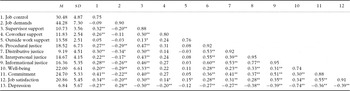
Preliminary checks were used to examine the responses for missing data, outliers, collinearity, multicollinearity, and for appropriate univariate and multivariate distributions as well as the appropriate distributions of residuals (per Tabachnick and Fidell, Reference Tabachnick and Fidell2007). The data set used analyses contained 222 cases, after missing values and outliers were removed (giving an effective response rate of 45.3%). The descriptive statistics, reliabilities, and correlation coefficients for each of the variables are included in Table 1. Multiple regression analyses were used to ascertain which variables significantly predicted the outcome variables and the amount of variance in these outcomes explained by the predictor variables. The data was analyzed using SPSS 18.0.
Means, standard deviations, Cronbach's a coefficients and correlations of study variables

Note: The Cronbach's a coefficients are on the diagonal except for depression which is 0.88. *p < 0.05; **p < 01.
The following transformations were required after checking for violations of the assumptions for multiple regression analyses (Tabachnick and Fidell, Reference Tabachnick and Fidell2007); a square root transform was applied to depression for the depression regression, and a reflect-and-square-root transform was applied to interpersonal fairness for only the job satisfaction regression. The order of blocks of variables that were placed into each regression was: (i) DCS variables, (ii) DCS squared variables, (iii) DCS interaction terms, and (iv) justice variables. DCS variables were centered (by subtracting the mean from each value), then multiplied to create squared and interaction terms, to test non-linear and interaction effects. Squaring each of the terms in the interaction (in this case, each of the DCS variables) and entering them into the regression in the step prior to the interactions is recommended as best practice when examining interaction effects (Ganzach, Reference Ganzach1997). Following the DCS dimensions the justice variables were added to explore their effects above and beyond the DCS model.
Results
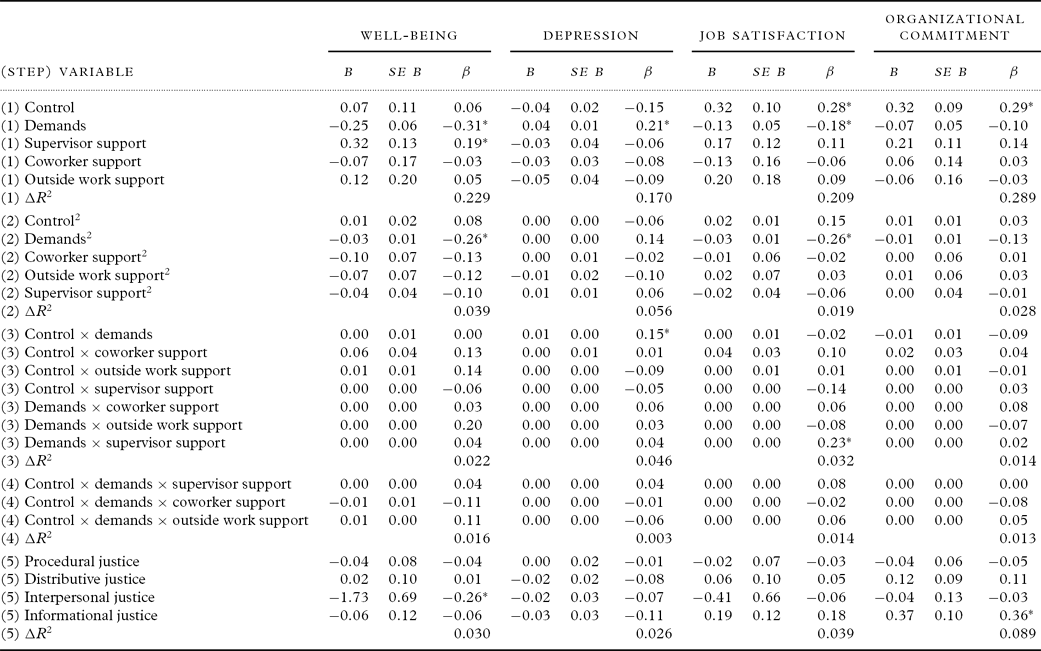
The results of the multiple regressions are presented in Table 2. Each of the regressions had a power of >0.99 and the effect sizes (f 2) for each regression are included below (using GPower3, Faul et al., Reference Faul, Erdfelder, Lang and Buchner2007). The model used in the multiple regression analyses explained a significant amount of variance in the health-related outcome variables of well-being (R 2 = 0.336, f 2 = 0.51, R 2adj = 0.252, F(24,189) = 3.98, p < 0.001) and depression (R 2 = 0.300, f 2 = 0.43, R 2adj = 0.214, F(24,195) = 3.48, p < 0.001). Specifically, demand and demands squared was related to both depression and well-being. Job control was related to depression, whereas supervisor support and interpersonal fairness was related to well-being.
Results of the regression analyses for health and attitudinal outcomes
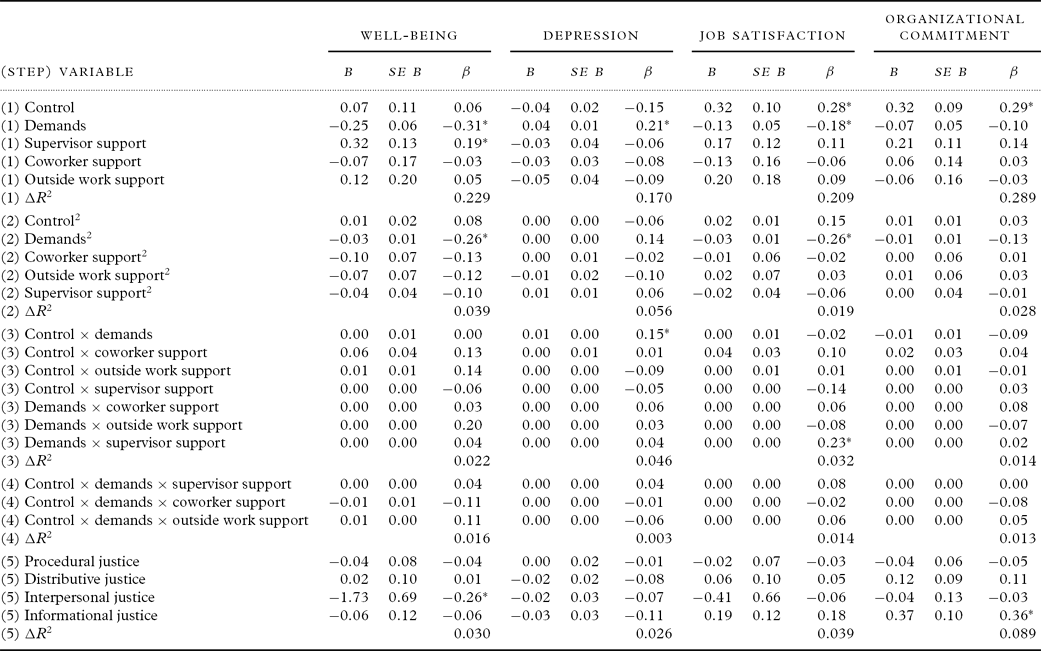
Note: B = regression weight; SE B = Standard Error of the regression weight; β = the standardized regression weight. 2denotes squared. The Depression variable has had a square root transform and interpersonal fairness has had a reflect and square root transform for the job satisfaction regression. *p < 0.05.
The overall model of the multiple regression analyses explained a significant amount of variance in the attitudinal outcome variables of organizational commitment (R 2 = 0.432, f 2 = 0.76, R 2adj = 0.362, F(24,193) = 6.23, p < 0.001) and job satisfaction (R 2 = 0.313, f 2 = 0.46, R 2adj = 0.229, F(24,195) = 3.71, p < 0.001). Specifically, job control was related to both commitment and job satisfaction, whereas demands, demands squared, and the interaction between demands and supervisor support was related to job satisfaction. Moreover, informational fairness was related to organizational commitment.
Discussion
The present study tested an integrated model of the psychosocial work environment and found that both DCS and organizational justice variables were related to the work attitudes and mental health of aged care nurses. The results particularly confirmed the utility of the DCS variables in aged care nursing, ratifying and extending the few previous studies in this area (e.g. Boekhorst et al., Reference Boekhorst, Willemse, Depla, Eefsting and Pot2008; Rodwell et al., Reference Rodwell, Noblet, Demir and Steane2009).
Job demands was negatively related to well-being and positively related to depression indicating a main effect on mental health, as well as negatively relating to job satisfaction. However, these effects are to be interpreted in the context of the more complex curvilinear and interaction effects found. The negative curvilinear effects of job demands on well-being or job satisfaction indicate that when demands are either too low or too high, well-being and satisfaction are negatively impacted. This finding is reminiscent of early work on stress and performance by Selye (Reference Selye1974) demonstrating an inverted-U relationship between stress and performance.
Job control was related to both commitment and satisfaction, suggesting that having decision-making autonomy is important to how the employee feels about their job and the organization they work for, extending Karasek and Theorell (Reference Karasek and Theorell1990) from stress to work attitudes. The social support received by nurses from their supervisor was related to well-being thereby corroborating a growing body of evidence about the importance of nurse supervisors. In addition to the buffering effects of support to reduce strain when demands are high, there is also considerable evidence that support has a direct impact (Cohen and Wills, Reference Cohen and Wills1985) as found in the present study.
The interaction effect of control x demands on depression, as well as the interaction effect of demands and supervisor support for job satisfaction supports the tension and activation hypotheses (Karasek and Theorell, Reference Karasek and Theorell1990), where control or support can buffer negative health consequences and translate pressure into activation. Finding these interaction effects confirms calls for further examination of interactions (e.g. by van der Doef and Maes, Reference van der Doef and Maes1999; Häusser et al., Reference Häusser, Mojzisch, Niesel and Schulz-Hardt2010), until there are sufficient studies to determine the moderating effects, such as context, that explain the inconsistent results. Further, the inclusion of curvilinear effects, whether for interaction-oriented statistical reasons (e.g. per Ganzach, Reference Ganzach1997), or as effects in their own right, confirmed that the oversupply of a particular work condition, especially for demands on well-being and job satisfaction, can have increasingly harmful effects (Xie and Johns, Reference Xie and Johns1995; De Jonge et al., Reference De Jonge, Bosma, Peter and Siegrist2000).
The dimension of interpersonal justice explained additional variance in well-being over and above the effects of the DCS model, extending the findings of Elovainio et al. (Reference Elovainio, Kivimaki and Vahtera2002) to aged care nurses. Informational justice was also related to organizational commitment, clarifying the specific fairness effect of justice on commitment in aged care found by Heponiemi et al. (Reference Heponiemi2011). The lack of effects for distributive or procedural justice may indicate that such organizational systems are a background issue rather than a foreground issue and do not vary with or associate with the outcomes examined here. The two significant justice results demonstrate that justice dimensions more directly reflecting the role of the nurses’ immediate supervisor explained variance in work attitudes over and above the DCS variables, illustrating the importance of transparent, regular communications in positively influencing aged care nurses well-being and wanting to remain with the organization. Together these results highlight the importance of feeling fairly treated in communication interactions with management and confirming at the employee level previous organizational research (e.g. Anderson et al., Reference Anderson, Issel and McDaniel2003).
In summary, both the DCS model and the justice variables contributed to explaining the work attitudes and mental health of aged care nurses. However, the DCS model had greater impact overall than the justice variables. Our results found that job control was more important in predicting work adjustment, whereas job demands were more important in relation to personal adjustment.
Practical implications
Aged care work can be very demanding. High job demands appear to have a negative impact on both personal and work-related adjustment, however it is important to note that very low levels of demand can also be problematic. Job demands need to be carefully balanced and regular stress audits and performance management meetings can provide useful information to assist managers in determining the right level for their nurses. The pattern of results including supervisor support and both interpersonal and informational justice suggest that management training in communication skills, particularly for nurse unit managers – the immediate supervisors of the majority of nurses in this context, would be an important strategy for improving the well-being and commitment of aged care nurses. Being listened to, treated with respect, informed, and assisted by the nurses’ immediate supervisors are all basic and inexpensive strategies for promoting both personal and professional adjustment.
Limitations and directions for future research
This was a cross-sectional study and thus conclusions about causality cannot be drawn. Although this study did not measure individual psychological characteristics of the nursing staff, such as personality, coping style, or mastery which may need to be acknowledged as confounders associated with our variables of interest (Boekhorst et al., Reference Boekhorst, Willemse, Depla, Eefsting and Pot2008), there are studies of similar populations that have shown that psychological characteristics do not significantly influence the appraisal of the characteristics of the DCS model (Waldenstrom et al., Reference Waldenstrom, Lundberg, Waldenstrom and Harenstam2003). The validity of self-reported working conditions and associated issues of common method variance, is also often raised as a limitation of survey studies, even though expert ratings of job conditions and subjective assessments are highly correlated (Spector, 1992). Finally, the 45% response rate of the study was low and the conclusions drawn should be considered in the context of this response rate.
Conclusion
Strategies to optimize the psychosocial work environment are important in aged care in order to design work that promotes employee mental health and positive job attitudes. These outcomes also contribute to cost savings due to their relationship with absenteeism, productivity, quality, and turnover. The contributions of informational and interpersonal justice, along with the main and interaction effects of supervisor support, highlight the centrality of the nurses’ immediate supervisor in addressing the impact of job demands on aged care nurses. Similarly, this study has found that psychosocial variables have utility beyond stress outcomes to the work attitudes of nurses in an aged care setting and present further avenues of research for the retention of nurses and improved patient care provided by healthier, more committed nurses.
Conflict of interest
None.
Description of authors’ roles
John Rodwell designed the study and formulated the research questions, carried out the data collection, and analyzed the data, with the assistance of A. Gulyas. John Rodwell and Angela Martin wrote the paper.
Acknowledgments
This project was part funded by the Australian Research Council. The authors are grateful for statistical support from A. Gulyas.