Tension suffused Asbury College in 1958 as venerated alumnus and missionary E. Stanley Jones addressed a thousand students and faculty members. Jones's indelicate sermon on racial integration shocked the lily-white campus. In starkly corporeal terms, he described holding hands with his black brethren – and of lifting their hands to his lips – while praying together. He pronounced civil rights “a God-touched movement.” He thundered against segregationists, arguing that their recalcitrance on civil rights was hurting the cause of Christ and democracy.
Campus itself, an evangelical holiness enclave in the rolling hills of rural central Kentucky, was split on the issue of integration. There were no blacks at Asbury, which matched the local custom of opposing interracial marriage. It also followed state law, which until eight years before had prohibited integration in higher education. But while campus was conservative, in Jones's estimation it was not marred by a “cantankerous conservatism.” He saw Asbury's heritage of Wesleyan holiness spirituality as bending toward racial egalitarianism. In fact, sentiment in favor of integration was blossoming in the late 1950s as the civil rights movement itself came into full bloom. Jones reported that 85 percent of alumni wanted campus integrated – and that the numbers of students and faculty were even more supportive. Still, campus remained segregated because the college's president refused to challenge a coterie of trustees from the Deep South who were holding the racial line. Jones, a man called the greatest missionary of the twentieth century by Time magazine, was a trustee too. As he railed against the racism of the Southland on this crisp October morning, he never mentioned his trustee colleagues by name. But his tempest was a direct challenge to Asbury's establishment – and everyone in the chapel knew it.Footnote 1
In his speech Jones invoked the most persuasive tropes he could think of: Scripture and American exceptionalism. He quoted the Apostle Paul's exhortation that there is no difference between Greek and Jew. Then he cited the Pledge of Allegiance's language of “liberty and justice for all,” suggesting that American freedom and goodness would overcome hypocrisy. “The best thing that ever happened in the Southland,” he continued, was the Brown v. Board of Education Supreme Court decision three years earlier. “People fight it. People hate it. People try to circumvent it. I give it ten years. In ten years it will all be over,” he exulted. “Our democracy is sounder, and our consciences are clearer.” Jones spoke in confident Whiggish fashion that American liberty and racial equality would prevail.Footnote 2
At the same time, Jones's speech defied the assumption that the American civil rights movement was an entirely homegrown affair. In fact, the global orientation of the address was striking. Drawing from decades of missionary work in Asia, Jones positioned the civil rights movement in the context of the Cold War. He instructed the Asbury students not to give the Communists rhetorical ammunition, but instead to be as interracial as the enemy. Jones also located civil rights in the context of decolonization. A global revolution, he said, was taking place in reaction to imperialism and attitudes of racial supremacy. After describing protests in Asia and Africa, Jones explained that “what's happening here is an eddy in the scheme of what's happening in the world.” He told stories of Indian interracial, nonviolent noncooperation in which Gandhi had worn down the enemy with goodwill and had sparked impressive social change. “It's the rise of man!” he exclaimed. “The old imperialism is gone, is dead, or dying!” As Jones wound down the sermon, which marked the conclusion of a week-long campus revival, his pace slowed and volume softened. “Mind you, I've never seen a finer student body – potentially – than you,” he said. But to “love with the love of God,” and to change the world, “we need something to break down all our prejudices and all our fears and give ourselves to Jesus Christ.” Wanting this moment to be decisive, Jones issued a call to transformation. “I want you to settle it tonight,” he urged in classic evangelical fashion. “If you're not sure of your salvation, come.” He called others to dedicate themselves to full-time Christian service. In a scene that Jones called “breath-taking,” over five hundred students flooded forward and knelt at the altar.Footnote 3
Jones's integration of revival language and social concern was no mere rhetorical flourish. His dual messages – which bridged both American and global frontiers and personal and social realms – had been rigorously cultivated. For nearly thirty years, Jones had been living at the Sat Tal Ashram, located in the foothills of the Himalayas in India. When Asbury students visited Jones there in 1931, they discovered a Christian community that looked and felt very different from American evangelicalism. The ashram sought to reproduce Christian faith in indigenous form. Its members, who had gathered from many nations and castes, lived together, prayed together, discussed spirituality, and practiced simple living. In the context of the Indian caste system, which Jones called “India's curse,” Sat Tal was a community that sought to establish “a miniature kingdom of God.” This egalitarian, caste-defying ashram stood in stark contrast to the segregated campus Jones addressed in 1958. “The American caste system and American materialism,” he told audiences as he toured the United States, “are the greatest hindrances to the acceptance of Christ by the East.”Footnote 4
Jones, a long-time missionary to India, member of the evangelical wing of the Methodist Church, and trustee of Asbury College, represents the strong reflexive motion from East to West carried by American missionaries. His critiques of American racism, birthed from observations of the Hindu caste system, his friendship with Mahatma Gandhi, and life at his beloved Sat Tal Ashram, enjoyed a wide reach that extended beyond Asbury to broader evangelical and mainline audiences in the United States. In his best-selling book Christ of the Indian Road (1925), Jones noted the difficulties that segregation posed to missions abroad. In Christ of the American Road (1944), he contended that segregation was a monumental public relations nightmare as the US sought to position itself as an attractive democratic alternative to Nazism, fascism, and Marxism. Through the 1950s Jones combined global experience and faith-saturated appeals for integration with great success among American Christian cold warriors.
I. Christ of the Indian Road
In 1907 Jones left for India with forty pounds in British gold, a one-way ticket to Bombay, a Hindustani grammar, and a handshake. Only slightly less visible was an evangelical zeal to spread the Gospel. Freshly graduated from Asbury College, Jones had recently participated in a three-day revival so powerful that classes were canceled. The spiritual awakening had begun in his dorm room and launched him on a career of “soul-winning.”Footnote 5
Jones's revivalism, however, met considerable resistance when he landed in Bombay. His targets often resented the missionary's Christian and American identities. “Eastern travelers in America, picking and choosing their facts,” Jones wrote, “can make out a very dark picture of our civilization – the slums of our cities, the lynchings, divorce statistics, crime statistics unparalleled in other cities of the world, and so on.” In fact, for low-caste Dalits, American theology and history bordered on repulsive. They only had to see how race prejudice was embedded in the American founding. “Is it to be wondered at that race and colour prejudice still exists in the West in spite of Christianity? It came in with it. The East feels that these things are still there.” Jones argued that Indians, when presented with Christ as a first-century Palestinian, found him a compelling figure, but hesitated to follow Christ because missionaries presented him as an extender of Western civilization. Instead, preached Jones to American Christians, “Christ must be in an Indian setting. It must be the Christ of the Indian Road.” It was the missionary's job, wrote Jones, to “disentangle Christ from the accretions which the centuries had gathered around him.” This argument was powerfully articulated in Christ of the Indian Road, a runaway best seller that brought him fame in his homeland and represented an important evangelical trajectory toward contextualizing the Gospel. “After living abroad,” he wrote, “you see your country in the total setting of the world.”Footnote 6
A palpable sense of the Cold War as it played out in Southeast Asia shaped Jones's views on caste and race. Compared to most American Protestant conservatives and liberals, who took up hawkish positions, Jones was rather more ambivalent. While a strong critic of atheism and Soviet-style implementation of Communism, he appreciated certain Marxist critiques of Western excesses as well as its stress on interracialism and internationalism. Still, Jones decisively sided with the West in the intense battle for the political and intellectual soul of his adopted state of India. The nation was nonaligned, and US ambassador Chester Bowles and consular officers, especially those in Bombay and West Bengal, feared that India might turn into a reliable ally of Moscow. It certainly seemed plausible to Jones, who felt like he encountered Communists everywhere he turned. In 1952 in front of an audience of thirty thousand people on the southern tip of the subcontinent, Jones desperately sought to sway Indians away from Communism. In the midst of many Communist leaders and a tense atmosphere, Jones reported success. Many “found Christ as their personal Savior.” At a follow-up conference two years later, Jones observed marked improvement. Residents, he suggested, had discovered “they could not have two totalitarianisms in their lives, and they decided to be Christian.”Footnote 7
But Indian Communists fought back. According to scholar Gerald Horne, they “repeatedly zeroed in on Jim Crow” in their bid for supremacy in key districts. Ambassador Bowles reported, “I have met up with many questions on racial tolerance in the United States. In fact, it is a sure-fire question every time I speak.” Egged on by Marxist propaganda, Indians learned that the “Mayflower that carried the Pilgrim Fathers to religious liberty in America went on her next trip for a load of slaves.” In his reports from India to the West, Jones used Orwellian arguments against racial and imperial sins. Segregation was bad not only for the oppressed, who might be swayed to Communism, but also for the oppressor. Just as the British officer in George Orwell's “Shooting an Elephant” short story was forced into following an imperialist script, so too do American Christians who oppress others. “A rattlesnake, if cornered will become so angry it will bite itself,” Jones explained in a memorable aphorism. “That is exactly what the harboring of hate and resentment against others is – a biting of oneself. We think we are harming others in holding these spites and hates, but the deeper harm is to ourselves.” This festering hate, Jones told listeners of an NBC radio broadcast upon his return to the United States, was bilious to the American soul and wholly unattractive to those outside America.
When I landed on the shores of my native land on September 7th, had I obeyed my impulses I should have taken the first boat back to India … I must confess I came to America with deep questionings and concern. From a distance your civilization seemed superficial and your Christianity inadequate.
For ambassadors and missionaries alike, stepping out of the American environment truly sensitized them to problems at home.Footnote 8
Jones, who discovered a critique of his homeland in India, also found resources there. He began to use the vocabulary of caste, calling it India's “curse,” suggesting that the practice directly violated the “kingdom of God,” and comparing the practice to racial segregation in the American South. He also adopted the practices of the ashram, an Indian antidote to the problem of caste. At Travancore, a territory at the southernmost tip of the subcontinent where caste was very strongly entrenched, Jones sat down to a subversive intercaste dinner with high-caste Hindus, outcastes, Indian Christians, Muslims, and Westerners. Jones himself sat between a “Mohammedan” and an outcaste, whose face bore “the marks of centuries of oppression.” His adoption of Indian methods gained Jones a large following and, according to historian Daniel Immerwahr, he was “extraordinarily successful in influencing opinion.” His dictum – that missionaries “must become more Christian and more Indian” – proved understandably appealing in the twilight of the age of imperialism. Jones described the egalitarian practices in verse:
After meeting Gandhi at the Sabarmati Ashram, Jones rhapsodized about the ashram's beautiful soul to supporters in America, writing, “The spirit of the ashram is so beautiful and so self-sacrificial, Gandhi combines strength and humility, unselfishness and service.” Yet Jones confided that this great man who “has been deeply influenced by the teaching of Christ” has “never seen Him.”Footnote 9
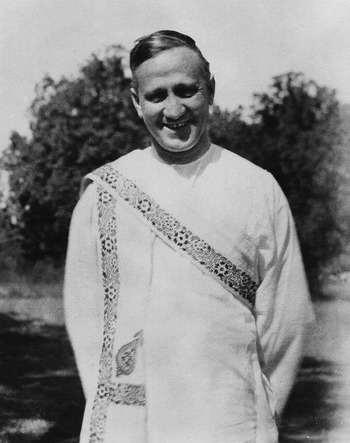
Jones in Indian attire in the 1930s. Courtesy of Asbury Theological Seminary Special Collections.

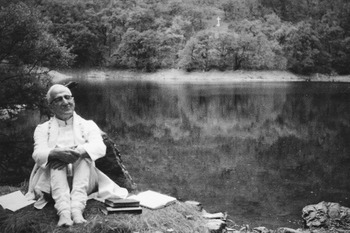
This deep ambivalence about Hindu ashrams inspired Jones to found a Christian alternative. The Sat Tal Ashram, founded in 1930, was to be “truly Christian and truly Indian.” The thirty-five or so ashram participants were housed in fourteen cottages on a four-hundred-acre estate in the Lake District, which featured deep valleys studded with emerald lakes. It was an Edenic setting located 4,500 feet above sea level in a forest with verdant foliage and pine trees, abundant wildlife, and the Himalayas rising in the distance. Life at Sat Tal followed a disciplined schedule that stressed the holistic nature of the ashram, which sought to develop the body, mind, and soul. The soul was nurtured by a private devotional time at 5:15 a.m., Bible teachings, communal worship, and a large painting of Christ with an inscription that read, “Christ is the Guru of this Ashram.” The mind was sharpened by two rigorous lectures and panel discussions on world religions and ethics. The body was strengthened through recreational exercise and grounds maintenance.Footnote 10
Jones explicitly modeled Sat Tal on the Indian form. Defending this strategy to supporters in America, he pointed out that “our gospel is universal in its very nature, but the forms in which it is expressed in the West are not necessarily universal. We have therefore endeavoured to find an expression of Christianity that would be more in line with Indian genius and life.” Ashramites wore Indian clothing made of homespun khaddar, a symbol of the nationalist movement. Jones himself wore a dhoti, a sarong-like wrapping worn instead of trousers. Participants trod barefoot in the chapel and dining hall. Meals consisted almost entirely of Indian food – and nearly no meat, to avoid offending Hindus.Footnote 11
Sat Tal was also intensely egalitarian. In fact, the ashram, in its defiance of caste, took such an idealized form that some Indian participants had difficulty adjusting to the radically integrated activities. The day began with prayers and sharing in a ritual called “Morning of the Open Heart” in which participants repented of constructing racial and class barriers. They confessed personal feelings of fear, resentment, self-centeredness, and anything that interfered with “real community.” Even physical space reinforced the notion of brotherhood. Ashramites sat in a circle on the floor while studying the Bible together. They shared work. Leaders and newcomers, young and old alike, picked up trash, chopped wood, and prepared meals. Inscriptions on ashram walls read, “East and West are alternate beats of the same heart”; “Here everybody loves everybody”; and “Leave behind all race and class distinctions, all ye that enter here.” In keeping with the egalitarian ideal, Sat Tal forbade titles. Participants became Brother Gopal, Brother Biswas, and Brother Stanley. The leveling of gender, ethnicity, economy, and nationality – meant to reflect a romanticized precolonial India – was intended also to be “a foretaste of the Christian India that is to be.”Footnote 12
The Indian ashram experience at Sat Tal was transformative for many participants. One described the fellowship as “very deep and beautiful,” another as being of the “tenderest and deepest kind.” In 1931, after the second Sat Tal Ashram, Jones himself wrote, “It has been a great summer, one of the very best of my life. The intimate fellowships, the hours of communion, the struggle for souls that needed light, the clearing of truth in the mind, the exquisite presence of the living Christ, the enriching of the whole of life.” He marveled at the heterogeneous composition of the gathering, which included religious seekers with Muslim and Hindu backgrounds and Christians from all over the world. To Jones, it foreshadowed the coming kingdom of God. Sat Tal's promotional literature proclaimed, “We will be the World of the Kingdom of God become flesh in a group, the Kingdom in miniature.” Jones meant these words to stand in stark contrast to the religious turmoil and nationalist agitation under British rule. “While India has seethed with clash and strife,” wrote Jones, “our Ashram has been a haven of brotherhood.”Footnote 13
Jones the seasoned missionary was very different from Jones the young Asbury graduate. He remained fundamentally grounded in the experiential piety of historic Methodism. Wesleyan scholar Bill Kostlevy has called him “an unreconstructed holiness evangelist.” But his experience in India had transformed him away from dogmatic apologetics toward a profound concern for social issues. For Jones, the sin of racism had set back the cause of missions and democracy. While marooned outside India during World War II, he told a white Methodist critic from Texas,
If I should be kept back from India permanently, God forbid, then I should consider seriously giving the balance of my working days to help the Negroes of America to an equal status in our democracy and to their fullest development as a people. For the color question has become a world question.
The prediction was spot on – Jones spent many of his days working for civil rights. In the 1910s he had been sent from the shores of America to spread the Gospel. By the 1940s Jones was returning to evangelize his own country.Footnote 14
II. Christ of the American Road
World War II marooned Jones in the United States. Wartime restrictions prohibited travel to India until 1945. Then, in retaliation for his anticolonial sympathies, British authorities refused Jones entry until 1947. Thereafter, until his death in the early 1970s, Jones spent at least half of each year in the United States, feeling that God had called him to socially reform his homeland. Racial integration, in fact, became Jones's overriding political concern in the second half of his career. “Caste,” he preached along with other Christian missionaries, “is doomed.” Inspired by Indian precedents in an era before racial equality had become a national concern, Jones launched an evangelical civil rights campaign.Footnote 15
For Jones and his audiences alike, war heightened passion for racial equality. The considerable irony of a racially segregated America fighting Aryan supremacist Nazism was not lost on many Americans. As historian Andrew Manis has noted, “Hitler's horrors caused ideas of racial superiority to lose their former connotations of benevolence.” Activists such as Walter White, a veteran of both the Pacific and European theatres and then NAACP director in the postwar years, worked hard to conflate southern racism, Aryan supremacy, and Japanese nationalism. It was not difficult, as tens of thousands of African Americans in the India–Burma theater alone suffered persistent indignities – separate water fountains and entertainment seating – while fighting for global freedom. In his 1945 book A Rising Wind White explained, “World War II has immeasurably magnified the Negro's awareness of the disparity between profession and practice of democracy.” The presumption of protecting global democracy against Hitler and Hirohito fell flat as African Americans were denied the privileges of democracy at home and abroad.Footnote 16
Jones, though not a victim himself, was jolted nonetheless by the persistence and ferocity of American racial discrimination. He responded by repeatedly explaining in speeches that segregation offended his fundamental conception of what it meant to be American and Christian. “Two forces, democracy and Christianity, belonging together,” he said, “are in the process of being separated.” As Jones put it in Christ of the American Road – which also cited Japanese internment and limitations on women and the labor movement as examples of “democratic hesitations” – racial segregation pointed to “a false America, a traitorous America, and a greater danger to our democracy than Hitlerism.” His negativity stemmed in large part from his observation that racial conditions had not improved since his childhood in Baltimore and college years in central Kentucky. American democracy did not compare favorably even to India's fledgling democracy. In a 1947 article entitled “India's Caste System and Ours,” Jones put it starkly. “The caste systems of India and America are fundamentally alike – they are both founded on blood.” But if caste was fading quickly (and ultimately abolished by Nehru) in India, it was “still operative in vast portions of America … The center has not given way.” It was a tragic irony, observed Jones, that America and South Africa, the last remaining strongholds of caste, “both claim to be democracies, and both of them profess the Christian religion.”Footnote 17
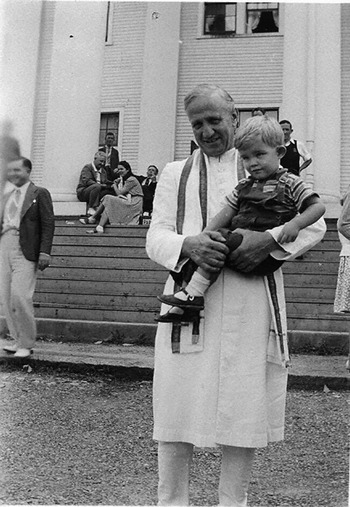
Jones at an integrated Blue Ridge Ashram in North Carolina in the 1940s. Courtesy of Asbury Theological Seminary Special Collections.
In the battle between atheistic Marxism and Christian democracy for the global soul, such hypocrisies mattered. Citizens of nonaligned India, explained Jones to his home constituency, were hyperaware of American racism. In an “Appeal to the People of Alabama” written from Sat Tal, Jones described a photo printed on the front page of a leading Indian newspaper. It pictured a white southern official with his foot on the head of a prostrate Negro. “I am seated in the midst of a very sensitive East,” Jones wrote. “Everything that happens in any part of the world is being felt and felt deeply here in India. You are representing the American nation before Eastern peoples. And the race riots give a push to hesitant peoples – a push toward the arms of the Communists.” As white retrenchment peaked in Alabama in the 1950s, Jones pleaded, “I beg of my fellow country men to return to their normal decent selves and cease this senseless strife.” “In our Christian Group here in the Himalayas we are praying for Alabama. The eyes of the world are upon you.” He relayed the tenacious questions “Don't you lynch Negroes in America?” and “What do you think about the KKK?” “Here in a backwater of India, a place where I thought the least from the outside would penetrate,” wrote Jones, “the loud speaker was speaking and was embarrassing our witness and message.” Segregation was no longer a local issue. It was a national and global issue because “the nation gets the blame for the injustices done to the Negro in any local situation. The enemies of democracy pick up every local wrong done anywhere in America and use it against America.”Footnote 18
Jones also put boots on the ground. Far ahead of most Protestant evangelists, he insisted on interracial seating at his American revivals. If custom or city law mandated that blacks sit in the balcony, he typically instructed groups of whites on the main floor to move to the balcony themselves when the service began. In 1941, for example, black and white ministers from Macon, Georgia invited Jones to spearhead a local movement toward interracial action. At local churches and in a chapel address at Mercer University, he preached to integrated crowds. In these sermons he continued to frame local conditions globally, preaching that if America gave “equality of opportunity to everyone within our own borders,” could become the “mediator of a new world order based on the central idea of democracy.” Hundreds of similar revivals in the South – from Macon, Georgia to Austin, Texas – exposed white southerners (sometimes in crowds of 25,000 or more) to Jones's brand of evangelical piety and racial egalitarianism. Using vigorous spiritual language, Jones reached the Methodist grass roots in denominational, civic, and congregational spheres. Southern blacks remembered the significance of these interracial revivals in oral interviews decades later.Footnote 19
Perhaps his most profound challenge to segregation came in the form of the Christian ashram, which he imported from India to the United States. From the 1940s on, Jones led hundreds of these intensive spiritual retreats, many of them violating racial protocol. A 1951 meeting of 208 men and women in Green Lake, Wisconsin offers a glimpse of the remarkably egalitarian nature of the ashram. Jones, described by a Collier's reporter as “snowy-haired” man with gray luminous eyes, opened the meeting by introducing himself as “Brother Stanley.” He told participants that “barriers of class and cash dissolve completely. An executive bunks with a laborer, a society hostess with a shopgirl.” As Japanese and Chinese, Germans and Americans, and black and white Christians celebrated the Eucharist together, Jones intoned, “If you belong to Christ, and I belong to Christ, then, unbreakably, we belong to each other.” Each, including Jones, who usually picked up trash from the ground, was assigned tasks of manual labor. The most revolutionary aspect for most, even those from the North, was race. For the next four days black and white Ashramites ate together, played together, prayed together, and roomed together. “We no longer see a person of a certain race,” said Jones. “We simply see a person for whom Christ died.” A black man announced, “This has been the first week of my life in an unsegregated world. I have lost my resentment against white people.”Footnote 20
The racial egalitarianism was most striking in the South, where gatherings sometimes had to be canceled because of hostility from local authorities. Still, the ashram movement grew rapidly in the 1950s as Jones drew Christians from a broad spectrum of denominational and political persuasions: from the radical Dave Dellinger (of Chicago Seven fame), who helped start a Newark Ashram, to Lutherans, Catholics, Anabaptists, and conservative evangelicals affiliated with the Church of God and the Church of the Nazarene. In the summer of 1963 alone, four thousand people attended one of the eighteen ashrams held in the US and Canada. There were an additional twenty-five overseas. In each setting the wealthy and poor, black and white, participated in a fascinating blend of a churchly gathering, the Indian ashram, and the “beloved community” ideal of the civil rights movement.Footnote 21
Jones amplified ground-level activism with a wide spectrum of alliances. Along with James Farmer, Bayard Rustin, and Pauline Myers, Jones headlined a key meeting in the March on Washington Movement (MOWM), which protested segregation in the war industries (and which would eventually become the model for the 1963 March on Washington). On 4 July 1943, at an event called We Are Americans Too, Jones delivered a public address entitled “Defeat Hitler, Hirohito and Mussolini by Enforcing the Constitution and Abolishing Jim Crow.” Sounding like Frederick Douglass in front of a “wildly enthusiastic” crowd of five thousand at DuSable High School in Chicago, Jones noted the hypocrisy of racial supremacy and American freedom. The significance of the event, however, rested in an important debate over methods of social change. In private strategy sessions, one hundred leading black activists and Jones (who was the only white person present) debated the utility of civil disobedience. Some felt that civil disobedience was too radical, but Jones and Pauline Myers emerged as key voices in favor of substantial resistance. In an internal speech to delegates entitled “Non-violent Direct Action: What It Is and How It Can Be Applied to Racial Problems in America,” Jones urged “the necessity of disobeying unjust laws” but doing so with discipline and in the spirit of love. Practitioners of this method, he urged, must say, “I don't hate you, but I won't obey you. This law or order is wrong and unjust. Do what you may, I won't strike back and I won't obey.” In the end, delegates voted to target Washington, Richmond, and Chicago with “trained disciplined volunteers who would disobey the Jim Crow laws and then take the consequences.” Covered extensively in the black press, this was an important and controversial decision. In fact, mainstream black groups like the NAACP immediately distanced themselves from the MOWM because of this more militant call for civil disobedience.Footnote 22
Jones at Sat Tal Ashram near the end of his life. Courtesy of Asbury Theological Seminary Special Collections.

Jones deserves a prominent position on the roster of civil rights leaders. He also served on the Advisory Committee for the Congress of Racial Equality (CORE), which organized the Freedom Rides of the early 1960s. He constantly lobbied Presidents and Congress. He was a featured speaker at hundreds of Kiwanis, Lions, and Rotary Club events around the country. In each of these contexts, Jones made specific calls for federal intervention and interracial committees. By the 1960s the irrepressible Jones had become somewhat notorious for his forthright defiance of racial codes in the South.Footnote 23
III. Christ of the Asbury Road
Jones remained solidly evangelical. Despite a lifelong exposure to Hinduism and the adoption of the ashram, he insisted that Christ was the true guru. Even as he recognized social sins and structural solutions, he emphasized personal relationships with God and fellow humans. He instructed white Americans to invite blacks into their homes as a statement of racial justice and to invite the unsaved to be “born again” and to follow “the way of salvation.” He practiced revivalistic techniques of evangelism, sought to reenergize missions in the Protestant mainline, and tried unrelentingly over several decades to convert his friend Gandhi. His personal correspondence featured language like “personal surrender to God” and “decisions for Christ,” and he consistently self-identified as an evangelical. Jones viewed himself as a colleague of evangelist Billy Graham, and Graham reciprocated by lauding Jones's missionary work for ten minutes during the first Sunday meeting of the 1963 Los Angeles Crusade. He called Jones his “good friend and trusted advisor.” The roster of other evangelical relationships was remarkable. When in Washington, Jones regularly stayed with Abraham Vereide, the founder of the prayer breakfast movement. In India he interacted with World Vision founder Bob Pierce and World Vision vice president Samuel Kamaleson. Others included evangelist Leighton Ford, missiologist Donald McGavran, and Senator Mark Hatfield of Oregon.Footnote 24
He was most warmly received in his native Wesleyan circles. While some right-wing evangelicals remained suspicious of his politics regarding civil rights, economics, and diplomacy, Jones remained, as Kostlevy described, a holiness evangelist “who united Wesleyan personal piety and social gospel activism.” Archival records show speaking engagements at dozens of Wesleyan-holiness colleges – including Kansas Wesleyan University, Olivet Nazarene College, Anderson University, Taylor University, Eastern Nazarene College, Greenville College, and Houghton College – and congregations affiliated with the United Methodists, Free Methodists, Evangelical United Brethren, Nazarenes, Church of God, Salvation Army, and National Holiness Association. Jones cultivated especially close ties with his alma mater. He returned from Sat Tal to Asbury dozens of times between the 1920s and the 1960s to deliver commencement addresses, stage revivals, participate in ashrams, and collaborate with Asbury Seminary in leading the American ashram movement. “Eternity alone,” wrote Asbury Seminary's president, “will reveal the results of your ministry here.” He claimed Asbury, and Asbury claimed him.Footnote 25
Jones, who traversed multiple continents, also operated in many religious spaces. A product of American Christianity before the fundamentalist–modernist battles, he insisted on remaining in both evangelical and mainline worlds. In fact, Jones was a darling of the Protestant establishment. Faithful to the Methodist Episcopal Church, he was popular with the mainline magazines Christian Century and World Tomorrow. Like other liberal Protestant voices, such as Edmund Soper, Buell Gallagher, Sherwood Eddy, and George Houser, he earned plaudits for making an international case against racism. Jones joined a speaker circuit that drew huge crowds in Chicago, Detroit, and New York to hear intellectual and political luminaries of the era including Reinhold Niebuhr, Harry Emerson Fosdick, Benjamin Mays, Jane Addams, William Jennings Bryan, and Ralph Bunche. Despite Jones's unpolished holiness style, the mainline literati lauded him as a seer for his “crystalline sincerity and simplicity [which has] penetrated the Eastern mind.”Footnote 26
Given Jones's trenchant critique of Asbury's role in America's injustices, however, it was his reach into evangelical circles that was most remarkable. In 1942, when Asbury proclaimed an “E. Stanley Jones Day,” Jones preached a series of sermons entitled “Christ of the Asbury Road.” The series touched on all of his favorite topics: global Christianity, social justice, personal spirituality, and racial integration. “May I tell you what I should like to see added to this interpretation of the Christ of the Asbury Road?” Jones asked. “You have limited it to a very definitely personal application. It lacks a great social application. I know some people have nervous chills going up and down their backs when I talk like that. I'm going to talk about it anyhow.” He continued,
I am not interested in an individual gospel or a social gospel. An individual gospel without a social gospel is a soul without a body. A social gospel without an individual gospel is a body without a soul. One is a ghost and the other a corpse. I don't want one of them. I want both.
What made this critique tolerable and intelligible was its global origin. Conceived in India, articulated in Christ of the Indian Road, and nurtured at Sat Tal, India, Jones's story followed sacralized missionary pathways. As he wrote to a friend,
There are no local or national problems any longer. Our treatment of the Negro is a part of a world racial problem and should be treated as such … You and I know that the central problem of Missions in the East is the white man's domination. It haunts every gathering, public and private, we have in the East.
Preached to an Asbury audience preoccupied with missions amidst the heightened tension of decolonization and encroaching Marxism, the sermon packed a strong punch.Footnote 27
When in 1958 Jones again traveled from Sat Tal to challenge his alma mater on segregation during its annual revival meetings, he did so as one of the most accomplished Americans of the twentieth century. As observers noted upon his death in 1973, Jones had held integrated meetings in the South long before civil rights was a national concern. Twice nominated for the Nobel Peace Prize, he had helped rejuvenate an ethic of nonviolent resistance among American Christians. Because of his relationships with Gandhi and King, the FBI maintained a file that grew to 117 pages. He had delivered over sixty thousand public addresses (including 736 in one six-month stretch) and written twenty-seven books that had sold 3·5 million copies. He remained vigorous in his “retirement.” A Time magazine article reported that at the age of seventy-nine, Jones could do thirty fast push-ups without breathing hard. “I can do as much now as I could 40 years ago,” he told the reporter, who noted that Jones “has spent a lifetime trying to reconcile East and West, white man and black, the world and Jesus Christ.”Footnote 28
But the cosmopolitan Jones, as he told students and faculty in Hughes Chapel to “embrace the social revolution,” bumped up against a persistent southern parochialism. Colleagues on Asbury's board of trustees opposed to integration and concerned about the loss of donors and students from the South blocked his efforts. In protest Jones sent a letter to President Z. T. Johnson several months later resigning his position on the board. “This is a real blow to the spiritual life of the institution and an equally real blow to the spiritual influence of the College as a great missionary institution,” he wrote. “I am at a loss to see how missionaries can go to the colored races from Asbury College and represent an institution that segregates colored people.”Footnote 29
Jones's protest worked. The resignation – combined with the broader cultural mood and a constituency that overwhelmingly wanted an integrated campus – accomplished its intended purpose. Students, faculty, and missionary alumni rallied to the cause, which continued to take global shape. An alumni survey solicited by the Board of Trustees obtained the following comments: “How can Asbury send missionaries to Africa and still keep negroes out of its school? Its missionary witness is blighted unless it admits negroes.” “As a missionary here in Korea, this fact has been embarrassing.” “Why is Asbury still preaching brotherly love if the Administration and Trustees do not practice it?” Faced with considerable ferment, a small faction of trustees with missionary experience guided the Board through a process that culminated in a new policy of integration. Because of concern over interracial marriage (only 60 percent of those surveyed agreed that blacks should have “unlimited social privileges”), integration took a mild form that only admitted married blacks. By 1962, however, all restrictions had been lifted. Given the nature of Asbury's integration, it was no surprise that the first three black students had international connections. The college admitted two Africans, and the first African American student, Ed Williams of Memphis, was recruited to Asbury by missionaries in Turkey while Williams was serving in the Air Force.Footnote 30
The narrative of desegregation at Asbury echoes a growing literature on the global context of the American civil rights movement. Played out amidst World War II and the Cold War, civil rights was not solely a homegrown movement. Gerald Horne, Tim Borstelmann, Mary Dudziak, and others have demonstrated that global concerns stirred Truman, Eisenhower, and Kennedy to throw their support behind civil rights. A similar phenomenon occurred among American evangelicals. Missionaries and the religious communities that sent them abroad worried that the nation's hypocrisy would drive potential converts away from faith and democracy. Sent out to fight for freedom in Japan, Italy, Southeast Asia, and Africa, American evangelicals brought the battle home to their own churches. Steven Miller and others show how this reflexive motion shaped Billy Graham and the broader Southern Baptist Convention. Further, Jones's ashrams and his vocabulary of caste show how this influence took shape as it traveled from India to the United States. Becoming agents of their targets, evangelicals inverted the missionary enterprise.Footnote 31
The global reflex, however, was not as successful as Jones may have assumed in the wake of his victory at Asbury. In terms of overturning official segregation, Jones's global experience and faith-saturated appeals enjoyed considerable success among American Christian cold warriors. But as the college administration's hesitation over “unlimited social privileges” suggested, campus still did not fully reflect Jones's hope for a “Christ of the Asbury Road.” Racial minorities were slow to come to the formerly segregated campus, and those that enrolled learned that racism, on individual or structural levels, had not disappeared. It was not unlike the abolition of the slave trade in the early nineteenth century, which did not result in the emancipation of Africans already in America.
Jones's Cold War paradigm, which animated his work for racial integration, also circumscribed evangelical activism. The narrative of a pure, even messianic, America, set against a Marxist evil, remained as flawed as the Whiggish assumptions that undergirded it. Jones's manifest optimism about the nation betrayed a Christian Americanism that spoke of color blindness yet privileged white men. Like many liberals at mid-century (and like many conservatives in the decades that followed), Jones often declared that he couldn't see race, that he just saw an American or a Christian. In one famous episode, often recounted by white evangelicals, Jones described meeting George Washington Carver. The two men joined hands, prayed, and then Jones
lifted the back of his hand to my lips, and he lifted the back of my hand to his lips in recognition and gratitude that we both belonged to a kingdom in which there is no room for trivia like race and class. We were in the presence of the future – the man who is to be. We both stood in the kingdom that was race-blind and colorblind.
Jones's color-blind vision may have been radical in the southern context in the 1940s, but the civil rights movement, having secured legal rights, went beyond that to celebrate racial difference. Moreover, much research has shown that a mantra of color blindness often blinds whites to both explicit and subtle structural inequalities. The Evangelical Racial Change movement, as chronicled by Nancy Wadsworth, did not emerge until twenty-five years after Selma. Even then, evangelicals’ inability to recognize systemic racial injustice has resulted, according to sociologist Michael Emerson, in a “lack of support for potentially inequality-reducing national policies.” Jones thus pushed some evangelicals beyond the individualism of their tradition, but evangelicals in his wake failed to develop a more structural understanding of racism.Footnote 32
The heightened global orientation of the twenty-first century may offer new resources. International voices will likely swell to a chorus in the next century as the global South demographically overwhelms Northern and Western centers. As a result of the Immigration Act of 1965, millions of Christians have been entering US borders. Less mediated by missionaries than in the past, these marginalized peoples may begin to speak more directly and immediately to American evangelicals with feedback that looks very different from Jones's messianic, color-blind vision of the nation. These transnational connections may add more color – and perhaps more attention to persistent inequalities – to a tradition long complicit in racial injustice and global imperialism.Footnote 33