Introduction
Neuropsychiatric symptoms associated with Alzheimer's disease (AD) are common, severe, and distressing problems that increase caregiver burden, lead to premature institutionalization, and increase the cost of dementia care (Gauthier et al., Reference Gauthier2010). Agitation and aggression are among the most serious of the neuropsychiatric symptoms associated with AD. They become more common as AD progresses, and occur in approximately 20% of outpatients and 40%–60% of patients in long-term care (Ballard et al., Reference Ballard, Corbett, Chitramohan and Aarsland2009). These behaviors are potentially dangerous to the patient and to others in their environment, and contribute significantly to caregiver stress. In fact, when caregivers of patients with AD are asked about the most serious problem they face, physical aggression is the most frequent response (Rabins et al., Reference Rabins, Mace and Lucas1982). Agitation and aggression are associated with poor prognosis, including more rapid decline, earlier institutionalization, and poorer quality of life. They are also associated with increased cost of care (Ballard et al., Reference Ballard, Corbett, Chitramohan and Aarsland2009).
Given their significance, it is not surprising that the management of agitation and aggression has frequently been a focus of AD treatment trials. Numerous studies have examined both pharmacological and non-pharmacological therapies. Treatment guidelines almost uniformly recommend appropriate assessment and investigation, followed by environmental and behavioral approaches, prior to considering pharmacotherapy (Herrmann and Gauthier, Reference Herrmann and Gauthier2008; Hort et al., Reference Hort2010; Ihl et al., Reference Ihl2011). Multiple medication classes have been examined, including antipsychotics, antidepressants, anticonvulsants, and benzodiazepines. To date, the efficacy of these interventions is modest at best and their use is associated with significant risk for adverse events. For example, the best-studied pharmacological interventions for agitation and aggression in AD are the typical and atypical antipsychotics. While they demonstrate statistically significant benefits, their use is associated with increased risk of cerebrovascular adverse events and mortality, as well as potential extrapyramidal, metabolic and cognitive side effects (Herrmann and Lanctôt, Reference Herrmann and Lanctôt2007). As a result, treatment guidelines suggest that antipsychotics should only be used when agitation and aggression are severe, and represent behaviors that place the patient or others in the environment at risk for harm. There are far fewer studies available for other medication classes. For example, it is unclear if antidepressants, such as the selective serotonin reuptake inhibitors, are as effective or safer than antipsychotics (Seitz et al., Reference Seitz, Adunuri, Gill, Gruneir, Herrmann and Rochon2011). Clearly, safer and more effective pharmacotherapies are required.
Cognitive enhancers such as the cholinesterase inhibitors (ChEIs) and memantine have also been considered as potential treatments for agitation and aggression. While there are signals for a behavioral benefit from the pivotal randomized controlled trials of these drugs, there are few studies that have examined their use in patients with significant pre-existing agitation and aggression, or where these behaviors are a primary outcome measure. In a recent placebo-controlled trial with a withdrawal design, donepezil withdrawal was associated with a statistically significant but not clinically significant worsening of total Neuropsychiatric Inventory (NPI; Cummings et al., Reference Cummings, Mega, Gray, Rosenberg-Thompson, Carusi and Gornbein1994) scores (Howard et al., Reference Howard2012). In contrast, in a randomized, placebo-controlled trial of donepezil for patients with AD with significant agitation, there was no significant benefit detected in patients treated with donepezil (Howard et al., Reference Howard2007).
While a number of studies have suggested that memantine may have specific benefits for agitation and aggression, there are no published studies in community-dwelling patients selected for significant agitation and aggression (i.e. as an inclusion criterion), or where behavior was one of the primary outcome measures. In the recent placebo-controlled trial mentioned above, the addition of memantine to donepezil resulted in a statistically significant but not clinically significant decrease in the NPI score, as compared with the addition of placebo memantine to donepezil (Howard et al., Reference Howard2012). Given the potential benefits of memantine seen in the pivotal studies, we conducted a randomized, placebo-controlled trial of memantine in patients with moderate-to-severe AD, specifically selected for the presence of agitation and aggression at baseline, and using both behavior and cognition as dual primary outcome measures.
Methods
Participants
The trial was conducted from 12 December 2003 to 26 April 2010. Participants were recruited from 32 sites in Canada. The study enrolled 369 patients who had a diagnosis of probable AD according to the National Institute of Neurological and Communicative Disorders and Stroke and the Alzheimer's Disease and Related Disorders Association (NINCDS–ADRDA) criteria (McKhann et al., Reference McKhann, Drachman, Folstein, Katzman, Price and Stadlan1984). Inclusion criteria were as follows: Mini-Mental State Examination (MMSE; Folstein et al., Reference Folstein, Folstein and McHugh1975) score of ≥8 and ≤18 at screening (a substantial protocol amendment in 2004 changed this criterion to MMSE score ≥5 and ≤15 at screening); minimum age of 50 years; ongoing ChEI therapy with donepezil, galantamine, or rivastigmine for the last six months and at a stable dose for the three months prior to screening; a knowledgeable and reliable caregiver to accompany the patient to study visits and oversee the administration of the investigational agent during the trial; residence in the community; and stable medical condition. The study population was enriched based on the requirement that patients presented with neuropsychiatric symptoms at study entry: NPI total score ≥13 and NPI agitation/aggression score ≥1 at screening and at baseline. Patients were permitted to continue receiving stable doses of concomitant medications, including antidepressants, antihypertensives, anti-inflammatory drugs, atypical antipsychotics, anticoagulants, laxatives, diuretics, and sedatives/hypnotics. After entry into the study, initiation of treatment with atypical antipsychotics and/or antidepressants was allowed only after the end of the Week 4 visit, provided that both of the following conditions were fulfilled: (1) there was a clinical deterioration in the behavioral symptoms as measured by the NPI (either an increase of 3 points or more on the NPI total score or an increase of at least 1 point on the aggression/agitation NPI item, when compared with the previous visit); and (2) the patient's condition justified the chronic use of an atypical antipsychotic or antidepressant, as judged by the investigator. Dose adjustment or cessation of atypical antipsychotics and/or antidepressants was allowed only after the end of the Week 4 visit. Exclusion criteria were as follows: unstable medical condition; other psychiatric disorder or evidence of other neurological disorder including, but not limited to, stroke, Parkinson's disease, seizure disorder, or head injury with loss of consciousness within the past five years; dementia complicated by other organic disease; vascular dementia; or a modified Hachinski Ischemia score (Hachinski et al., Reference Hachinski1975) of more than 4 at screening. Written informed consent was obtained from the caregiver, the patient and his or her legally acceptable representative (if different from the caregiver) before the initiation of any study-specific procedures. The study was reviewed and approved by the institutional review board at each site.
Protocol amendments
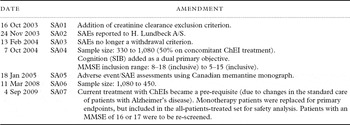
This study was amended a total of seven times (Table 1), with implications on the patient population selected, allowed concomitant medications, and primary efficacy variables.
Summary of protocol amendments

SAE = serious adverse event; ChEI = cholinesterase inhibitor; SIB = Severe Impairment Battery; MMSE = Mini-Mental State Examination.
Due to difficulties in recruiting patients, the study was prematurely terminated and, thus, underpowered. A total of 450 patients were planned for enrollment, 369 patients were enrolled, and 306 patients completed the study, which resulted in a decreased statistical power to show the superiority of memantine over placebo.
Interventions
This study was a prospective, randomized, placebo-controlled, parallel group, fixed-dose trial in which participants were assigned to double-blind treatment for 24 weeks. Patients were randomly and equally allocated to one of the two treatment groups in accordance with a randomization list generated by the sponsor following a standard routine. Enrollment of participants and assignment of participants to the study treatment was carried out by the investigators. All participants, care providers, and raters were blinded; no individual patient randomization code was revealed during the trial. Patients assigned to double-blind memantine treatment were titrated in 5 mg weekly increments from a starting dose of 5 mg/day to 20 mg/day administered once daily at the beginning of Week 4. Active drug and placebo tablets were visually identical and all patients received four tablets of study medication daily (in combinations of memantine (5 mg) and matching placebo tablets). All patients were required to maintain stable ChEI therapy (donepezil, rivastigmine, and galantamine were allowed) at entry dose as prescribed by the patient's physician for the duration of the study; adherence to this protocol was monitored by routine assessment of concomitant medication use. Any change in the dosing regimen or discontinuation of ChEI therapy was recorded, and patients were discontinued from the study if the inclusion criterion of concomitant and stable ChEI therapy was no longer met. No dosage adjustments for memantine treatment were permitted for patients experiencing dose-limiting adverse events. Adherence with study medication was assessed by returned tablets. More than 98% of the patients in both treatment groups had more than 75% compliance.
Outcome measures
The dual primary efficacy parameters were the change from baseline in behavior as assessed by NPI total score, and the change from baseline in cognition as assessed by the Severe Impairment Battery (SIB; Panisset et al., Reference Panisset, Roudier, Saxton and Boller1994). The NPI is a validated scale that assesses behavioral disturbances in patients with dementia. The NPI was assessed at the screening, baseline, Week 4, Week 8, Week 12, Week 18, and Week 24 visits. Patients who discontinued prematurely were evaluated during the premature discontinuation visit. The SIB is a validated scale used to assess cognitive function in patients with moderate-to-severe dementia. The SIB scale was administered at the baseline, Week 12, and Week 24 (or premature discontinuation) visits.
The secondary outcomes included the Clinician's Interview-Based Impression of Change Plus Caregiver Input (CIBIC-Plus), the 19-item AD Cooperative Study–Activities of Daily Living inventory (ADCS-ADL19) total score, and the Cohen-Mansfield Agitation Inventory (CMAI) total score. The CIBIC-Plus is a global rating that is derived through an independent, comprehensive interview with the patient and caregiver by a rater who is barred from knowledge of all other psychometric test scores conducted as part of this protocol, as well as from reported safety data (Schneider et al., Reference Schneider1997). CIBIC-Plus Severity was assessed at baseline and CIBIC-Plus Improvement was assessed at the Week 12 and Week 24 (or premature discontinuation) visits. The ADCS-ADL19 is a 19-item subset of the original 42-item inventory, which focuses on items appropriate for the assessment of later stages of dementia (Galasko et al., Reference Galasko1997). The ADCS-ADL19 was administered as an interview to the patient's caregiver, and focused on the performance of each activity of daily living during the previous four weeks. Possible scores range from 0 to 54. Higher scores reflect higher levels of functioning. The ADCS-ADL19 was assessed at the baseline, Week 12, and Week 24 (or premature discontinuation) visits. The CMAI long form looks specifically at agitated behavior in patients with cognitive impairment (Cohen-Mansfield, Reference Cohen-Mansfield1989). The CMAI was assessed at the baseline, Week 4, Week 8, Week 12, Week 18, and Week 24 (or premature discontinuation) visits.
Concomitant medications and vital signs were recorded at every visit; adverse events were recorded at baseline and all subsequent visits; electrocardiograms, physical, and neurological examinations were performed at the screening and final visits; and laboratory tests were performed at the screening visit.
Sample size
Using a 5% significance level, 225 patients in each arm would provide a statistical power of at least 80% for detecting a standardized effect size of 0.306 on both co-primary endpoints (NPI and SIB). A total of 450 patients should therefore have been enrolled in the study.
Analyses sets
Two populations were considered in the statistical analyses: the safety population (all-patients-treated set (APTS)) – all randomized patients who took at least one dose of study drug (n = 369); and the full-analysis set (FAS) – all randomized patients on current treatment with a ChEI who took at least one dose of study drug and had at least one post-baseline assessment on both co-primary efficacy variables (n = 324).
Statistical analyses
The primary efficacy analyses were performed on the FAS, using the last observation carried forward approach. The primary efficacy analyses were analyses of covariance (ANCOVA) of the changes from baseline to Week 24 in NPI and SIB total scores (considered as co-primary endpoints), with treatment and center as factors and the baseline score as a covariate. In addition, efficacy was analyzed using a mixed-effect model repeated measure and an ANCOVA based on the observed cases approach. The secondary efficacy analyses were ANCOVA of the change from baseline to Week 24 in ADCS-ADL19 score and NPI sub-items with treatment and center as factors (small centers were pooled) and baseline scores as covariates. Descriptive analyses of the total scores and changes from baseline at Week 24 were performed on the CMAI and CIBIC-Plus.
No interim analyses were performed. The statistical software used was SAS® version 9.2, SAS Institute Inc., Cary, NC, USA.
Trial registration
This trial was registered as Clinicaltrials.gov: NCT00857649.
Results
Participants
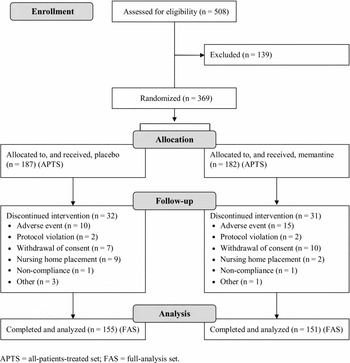
The patient disposition is summarized in Figure 1. Of the 369 patients who entered the study, 187 were randomized to placebo and 182 were randomized to memantine. There was no between-group difference in the percentage of patients who completed the study: 155 patients in the placebo group and 151 patients in the memantine group (corresponding to 83% completers in each group).
Patient disposition.

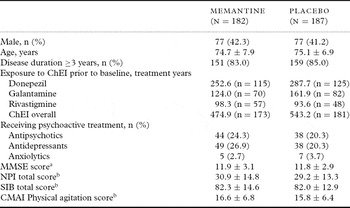
The demographic and clinical characteristics of the two groups at baseline are summarized in Table 2. Overall, at baseline, the mean scores of the efficacy variables were very similar between the two treatment groups. However, patients in the memantine group were more severely agitated compared with the patients in the placebo group, as measured by the CMAI Physical agitation subscore. At baseline, patients in the placebo group had greater exposure to ChEI treatment, and a lower proportion were receiving psychoactive medication treatment compared with the memantine group. Both groups were well balanced with respect to medical comorbidities and use of non-psychoactive medications. There was a higher proportion of patients in the placebo group who had a child as caregiver (28% vs. 18%) whereas in the memantine group the caregiver was more often a spouse (74% vs. 68%).
Patient baseline characteristics (all-patients-treated set)

All data are mean ± standard deviation, unless otherwise indicated.
aAt screening; bfull-analysis set.
ChEI = cholinesterase inhibitor; MMSE = Mini-Mental State Examination; NPI = Neuropsychiatric Inventory; SIB = Severe Impairment Battery; CMAI = Cohen-Mansfield Agitation Inventory.
Efficacy
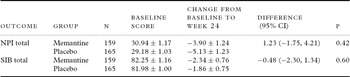
The primary efficacy analyses showed no statistically significant differences between the memantine and placebo groups in mean change from baseline in NPI or SIB total scores at Week 24 (Table 3). On behavior (as measured by the NPI total score), both groups showed significant improvement from baseline to Week 24. On cognition (as measured by the SIB total score), both groups declined during the 24-week study period. Sensitivity analyses of the primary efficacy analysis performed on various subgroups of patients did not change the overall conclusion.
Summary of primary efficacy results (full-analysis set)

All data are mean ± standard error, unless otherwise indicated.
CI = confidence interval; NPI = Neuropsychiatric Inventory; SIB = Severe Impairment Battery.
There were no statistically significant differences between the treatment groups in change from baseline to Week 24 on any of the secondary outcomes including the CIBIC-Plus, ADCS-ADL19, CMAI total scores, NPI sub-item scores, or NPI caregiver distress scores.
Safety
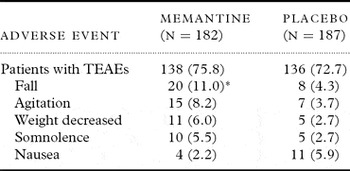
Overall treatment-emergent adverse events are summarized in Table 4. Approximately three quarters of all patients had adverse events, the incidence of which was similar in both treatment groups. One patient in each treatment group died: one from pneumonia and one from suspected lung cancer. The incidence of serious adverse events (SAEs) (including those with fatal outcome) was lower in the placebo group than in the memantine group (6% vs. 10%). In the placebo group, only anemia was reported as an SAE in more than two patients, and in the memantine group, only fall and urosepsis were reported as SAEs by more than two patients. The system organ classes with the highest incidences (≥20%) of adverse events were psychiatric disorders, infections and infestations, and nervous system disorders. The incidence of nausea was twice as high in the placebo group as in the memantine group, while the incidences of fall, agitation, weight decreased, and somnolence were twice as high in the memantine group as in the placebo group. In both treatment groups, the majority of the patients with fall had confounding comorbidities and the events were reported as accidents. Almost all patients with an adverse event of agitation had a baseline NPI total score and/or an agitation domain score above the mean baseline score for the treatment group, and the events seemed to be a worsening of a pre-existing condition or occurring in relation to acute medical conditions. In the memantine group, approximately half of the events of agitation occurred during the first four weeks of treatment. Furthermore, approximately half of all reports of agitation came from a single center. If this center is excluded from the analysis, the incidence of agitation was very similar between the treatment groups.
Adverse events with an incidence ≥5% in either treatment group (all-patients-treated set)

All data are number (%). *p = 0.02 versus placebo, Fisher's exact test.
TEAE = treatment emergent adverse event.
The incidence of severe adverse events was 3% in the placebo group and 9% in the memantine group; no single adverse event was severe in more than one patient. The incidence of adverse events considered related to the study drug by the investigator was 30% in the placebo group and 36% in the memantine group. None of the patients in the placebo group and 3% in the memantine group had severe adverse events considered related to the study medication; most of these events were psychiatric adverse events. The incidence of adverse events that contributed to withdrawal was 5% in the placebo group and 8% in the memantine group. The only adverse event that contributed to withdrawal in more than two patients in either treatment group was agitation, which contributed to withdrawal in one patient in the placebo group and three patients in the memantine group.
No clinically relevant mean changes from baseline in vital signs were seen during the study. The mean weight and body mass index remained fairly constant throughout the study, and the proportions of potentially clinically significant (PCS) weight changes were similar in the two treatment groups. In both treatment groups, the proportion of patients with a PCS weight increase was higher (placebo: 8%; memantine: 6%) than the proportion of patients with a PCS weight decrease (4% in both treatment groups). No patients withdrew from the study due to weight changes.
Discussion
In this study of patients with moderate-to-severe AD with agitation and aggression, there was no significant benefit with memantine compared with placebo, though both groups experienced an improvement in agitation and aggression as well as total neuropsychiatric burden over the course of 24 weeks. Due to difficulties in recruiting patients, the study was prematurely terminated, which resulted in a decreased statistical power to show the superiority of memantine over placebo. For example, with the planned sample size of 450, the study should have been able to detect a 5.8-point difference in NPI total at 24 weeks; the actual sample size would have been able to detect a difference of 7 points. Similarly, there were no differences in cognition or secondary measures of behavior, global change or activities of daily living. Memantine was generally well tolerated, though SAEs leading to study withdrawal were slightly higher with memantine (5% placebo vs. 8% memantine).
In contrast to previous studies with memantine, this study used a unique patient selection procedure, generating a study population enriched for the presence of neuropsychiatric disturbances. All the patients in this study had agitation and aggression at entry, and their total neuropsychiatric burden was much higher than in most previous studies of memantine or the ChEIs. In fact, the baseline NPI scores of 29–31 would be similar to those in many of the outpatient studies of atypical antipsychotics. It is therefore notable that 83% of study participants completed this trial.
There are a number of potential contributors to the failure of this study to demonstrate the superiority of the active drug. The study was conducted over seven years, during which time memantine became widely available in Canada and its use was incorporated into the Canadian Clinical Practice Guidelines. The changes in clinical practice and their effects on enrollment could have influenced the results. Several baseline patient group differences may also have contributed to these results, including the higher CMAI Physical agitation score in the memantine group, and the lower exposure to antipsychotics and antidepressants in the placebo group. These factors suggest that the patients treated with memantine may have been more behaviorally disturbed, historically and at baseline. The baseline differences in exposure to ChEIs, which was greater in the patients treated with placebo, may also have influenced the results. A large number of protocol amendments (seven), some necessary for regulatory purposes, could also have negatively affected the results. The nature of the patient population likely accounted for some of the differences. In previously published memantine studies of community-dwelling patients with moderate-to-severe AD, the neuropsychiatric symptoms were less severe and at least part of the benefit of memantine resulted from a worsening in the placebo groups as well as an improvement in the memantine groups (Wilcock et al., Reference Wilcock, Ballard, Cooper and Loft2008). In this study, patients were already severely behaviorally impaired, making worsening less likely, thus reducing the opportunity to demonstrate a drug–placebo benefit.
In a recent study in patients with moderate-to-severe AD (Howard et al., Reference Howard2012) where the patient population was not enriched based on the presence of neuropsychiatric symptoms, memantine treatment was statistically better for NPI outcomes compared with placebo. In a study of institutionalized patients with moderate-to-severe AD and clinically severe agitation, memantine was not better than placebo on the primary outcome measure (CMAI), though NPI outcomes did favor memantine (Fox et al., Reference Fox2012). It is possible that much of memantine's behavioral benefit is related to delaying emergence, or preventing clinical worsening of behaviors, rather than improving significant pre-existing behaviors (Gauthier et al., Reference Gauthier, Loft and Cummings2008; Wilcock et al., Reference Wilcock, Ballard, Cooper and Loft2008). Similar observations regarding responsiveness and delay of emergence of neuropsychiatric symptoms would appear to be the case with the ChEIs, e.g. donepezil (Gauthier et al., Reference Gauthier2002). In this study with a behaviorally enriched population, all patients were being treated with a ChEI, and the combination of a ChEI and memantine was not superior to ChEI alone. This is in contrast to data where combination treatment with donepezil and memantine was superior to donepezil alone in moderate-to-severe patients with fewer behavioral symptoms at baseline (Tariot et al., Reference Tariot2004; Cummings et al., Reference Cummings, Schneider, Tariot and Graham2006).
The results of this study suggest that even serious neuropsychiatric symptoms like agitation and aggression can improve. While spontaneous remission cannot be ruled out, it is also possible that symptom improvement occurred because of the type of good clinical care that occurs in the context of a clinical trial; this includes close clinical monitoring, stimulating environments, and psychosocial support for the patient and the caregiver.
Conflict of interest
Funding for this study was provided by H. Lundbeck A/S. Nathan Herrmann has received research support and speaker's honoraria from Lundbeck, Pfizer, Sonexa, and Sanofi-Aventis. Serge Gauthier has provided scientific advice or has been an investigator or data monitoring board member for Affiris, Astellas, Bristol-Myers Squibb, Elan, Epix, ExonHit Therapeutics, GE Health Care, GlaxoSmithKline, Lilly, Lundbeck, Merck, Merz, Myriad, Neurochem, Novartis, Pfizer, Roche, Sanofi-Aventis, Schering-Plough, Servier, Sonexa, TauRx Therapeutics, United BioSource Corporation, and Wyeth. Neli Boneva and Ole Lemming are full-time employees of H. Lundbeck A/S.
Description of authors’ roles
Nathan Herrmann helped to design the study, participated in the interpretation of results, and wrote the first and final drafts of the manuscript. Serge Gauthier helped to design the study, participated in the interpretation of results, and reviewed the manuscript. Neli Boneva provided a summary of the results and reviewed the manuscript. Ole Lemming performed the analyses of the data and reviewed the manuscript. All authors contributed to manuscript preparation, and read and approved the final manuscript.