A common adage states that war begins when diplomacy fails. Yet this succinct claim overlooks the important converse fact: most wars end when diplomacy resumes and succeeds. Nearly four-fifths of all interstate wars in the last two centuries have featured some form of negotiation, and two-thirds of all interstate wars have ended through a settlement short of total military victory or defeat.Footnote 1 These statistics indicate that negotiation plays an important role in shaping the nature and trajectory of armed conflict.Footnote 2
Nevertheless, we have a weak theoretical understanding of the motivations and effects of wartime negotiations. Two interrelated factors contribute to this gap. First, scholars have adopted approaches and assumptions that sap negotiations of strategic value. Earlier scholarship on war initiation adopted a costly lottery approach that was not focused on understanding war's bargaining process, either on the battlefield or the table.Footnote 3 Subsequent bargaining models of war, which represent some of the forefront of current research, acknowledge that most wars end through negotiated settlements by including a negotiation mechanism that occurs between bouts of fighting.Footnote 4 Despite its apparent inclusion in these models, diplomatic bargaining is treated as a gradual convergence process that mechanically brings the belligerents’ offers closer and closer throughout the entire conflict, providing a technical off-ramp for wars to end without complete victory or defeat. These are clear advancements, yet they do not problematize whether, when, and why negotiations occur strategically during conflict.
Even if scholars did develop richer theories about wartime negotiations, they would run into the second issue: insufficient data. Extant data sets of diplomatic efforts in interstate conflicts do not extend past the year 1945 and tend to focus on third-party conflict management.Footnote 5 While useful, these resources preclude analysis of longer-term trends and do not fully record the behavior of the belligerents themselves.
These two issues combine to create a cycle. Without data to demonstrate interesting variation in wartime negotiations, we have a much weaker basis for scholars to believe that negotiations deserve further scrutiny. Without useful theoretical reasons to analyze negotiations, we have a weaker basis to collect data on them.
In this research note, I advance this research agenda by introducing new data that permit more nuanced theoretical and empirical understandings of intra-war negotiations. I create and explore daily-level data that track diplomatic activity across the last two centuries of interstate wars. This resource allows for an unprecedented analysis of intra-conflict dynamics and indicates the value of additional scholarship on wartime diplomacy. Strikingly, I find wide variation in the timing, occurrence, and efficacy of negotiations before and after 1945. Negotiations in wars before 1945 tend to be sparse and quickly create peace, while negotiations after 1945 tend to be much more frequent but less productive in forging peace. My data can also help address the natural question of why this is the case. Reviewing several well-established arguments about changes to warfare after 1945, I find that the presence of nuclear belligerents and the institution of alliances help to explain much of this effect.
The data set also allows us to address a range of additional unanswered questions about the role of diplomacy in war's continuation and termination. When and why do states choose to restart negotiations during war? Under what conditions are negotiations more likely to produce peace? In what instances are they more likely to fail? Are there ulterior motives to negotiate that go beyond sincere attempts to forge settlement? Answers to these questions not only enrich our academic understanding of war but are vital to producing implications for policymakers and practitioners of conflict resolution.Footnote 6
Creating Wartime Negotiation Data
The data set consists of information on negotiations for ninety-two interstate conflicts recorded in the Correlates of War Project. There are a total of fifty-seven pre-1945 wars, spanning the Franco-Spanish War of 1823 to World War II. A total of thirty-five post-1945 wars cover the First Kashmir War of 1947–1948 through the Invasion of Iraq in 2003. To ensure consistency and a reasonable degree of domain knowledge, I collect all raw data from myriad sources and code the final negotiation variable. I describe each step in turn.
Raw Data Collection
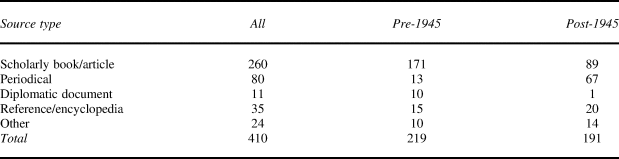
These data are constructed using 410 citations from 355 unique sources that include peer-reviewed historical texts, primary source diplomatic documents, reference materials, and reputable contemporary periodicals that document these interstate conflicts. See Table 1. Sixty-three percent are scholarly historical texts, and 20 percent are periodicals.Footnote 7 Using these sources, I create detailed timelines that record diplomatic activity across the entirety of each conflict. This results in a 290-page document of background information, dates, events, and outcomes.
Sources used to create negotiation data

No historical data set will be perfect, but it is worth addressing three interrelated sources of potential bias and their consequences. First, these data have limited ability to track secret negotiations in modern wars. Historians have gone to great lengths to uncover diplomatic activity through archival materials and have identified negotiations that were entirely unknown to the public during the conflict. Meanwhile, the records needed to track clandestine negotiations remain largely classified for contemporary conflicts. The most recent secret negotiations in my data involve the Vietnam War, where declassified documents recorded American efforts to find an exit from hostilities. One example includes the XYZ meetings—extremely secretive discussions in Paris between former ambassador Edmund Gullion and North Vietnamese representative Mai Van Bo.Footnote 8 It is highly plausible that my data omit other secret activities in recent conflicts. No solutions exist other than further declassification of documents over time, but this does ameliorate concerns that newer conflicts feature better information on negotiations. The opposite case is far likelier to be true.
Second, for reasons of necessity and accessibility, modern wars rely more on contemporary media reports. Table 1 indicates that 6 percent of sources are periodicals in pre-1945 wars; the number rises to 35 percent for post-1945 wars.Footnote 9 Many scholarly historical texts also rely on contemporaneous news reports, so the 6 percent figure is somewhat misleading. Nonetheless, scholarly texts provide an important chance to compile more complete and vetted accounts. War-related activities tend to be deemed newsworthy, but daily coverage in periodicals may still be more irregular, myopic, and prone to misreport some events. I include as many scholarly articles and books as I can to supplement and back these “snapshot” sources, so no war in my data solely relies on news reports.
Third, the vast majority of sources are written in English. Several factors mitigate concerns that wars involving non-English-speaking belligerents have inconsistent accounts. Historians with fluency in relevant languages have analyzed documents from most of these conflicts and written scholarly texts in English. The issue of periodicals notwithstanding, international news organizations such as the New York Times, the Associated Press, and Agence France-Presse have reported diplomatic activities worldwide. I also use supplementary Spanish-language sources for several conflicts, including the 1851–52 La Plata War and the 1909–10 Second Spanish-Moroccan War. That said, I omit three wars because of data limitations: the 1968–73 Second Laotian War, the 1970–71 Communist Coalition War, and the 1987 Sino-Vietnamese Border War. Beyond these three conflicts, I found no major differences in source availability between wars featuring Western states and those with non-Western states. Future iterations of negotiation data would still be strengthened and better validated by analyzing sources from these belligerents’ native languages.
Coding Procedure
The diplomatic timelines must be translated into a tractable quantitative measure of negotiations. I define negotiations as direct or mediated communication between parties with the ostensible aim of creating a mutually acceptable agreement.Footnote 10 This is an important yet somewhat broad conceptual definition, so I use three additional conditions to operationalize it in more concrete terms and in a manner that readily applies across all historical time periods.
First, communications must involve an exchange or assessment of bargaining offers related to a settlement of hostilities. No distinction is made regarding whether these offers are “serious” or whether concessions are made. The word ostensible in the provided definition of negotiation speaks to this point. Such considerations cannot be coded in a consistent manner, especially without detailed information on leaders’ intentions. Second, while talks can occur publicly or in secret, they must take place between officially appointed representatives of each belligerent nation who, in relation to the first condition, must make or assess specific bargaining offers. Third, and on a more technical note, short recesses between talks also qualify as days with negotiations as long as parties explicitly plan to reconvene at a specific later date.
Under these criteria, formal discussions in a summit or conference, mediated or otherwise, clearly count as negotiations. Armistice talks at Kaesong and Panmunjom during the Korean War qualify, as does the London conference of 1864, which addressed the Second Schleswig-Holstein War. “Unofficial” negotiations that have no formal conference also count, as long as offers are exchanged and individuals are assigned to engage in such discussions. During a period of stalemate in the Franco-Turkish War, French politician Henry Franklin-Boullion quietly visited Ankara to discuss a direct proposal from the French government about settlement with Turkish foreign minister Yusur Kemal Bey. This meeting on 9 June 1921 is a negotiation. On the other hand, informal talks that occur among representatives in the halls of the United Nations, as well as preliminary discussions on the possibility of initiating negotiations, do not qualify.
Shuttle diplomacy by a third party also constitutes negotiation because it involves the exchange of bargaining offers between official representatives of the belligerent states. Secretary of State Alexander Haig's frequent travels between the United Kingdom and Argentina during the 1982 Falklands War exemplify this. However, mediation attempts where a third party fails to get the consent of warring states are not included, since no direct communications or exchange of offers takes place.
I use the standards I described to create a binary negotiation variable for each war-day. Every sequence of uninterrupted 1s in this variable is called a negotiation period. The data consist of 189 negotiation periods involving 6,332 war-days across ninety-two wars.
Example Codings
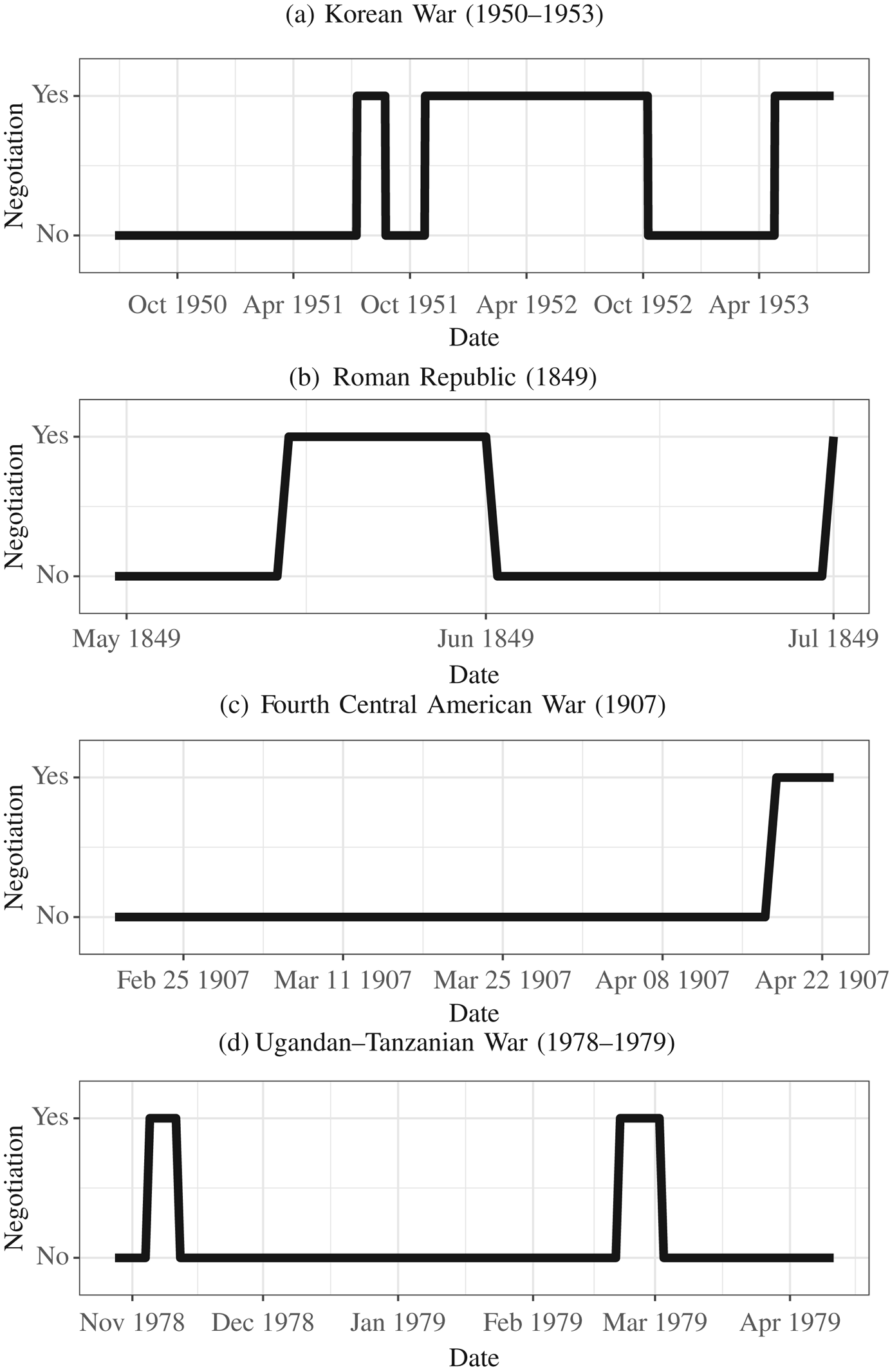
Figure 1 displays the occurrence of negotiations for four conflicts spanning the temporal scope of the data. The Korean War, which has three negotiation periods, is particularly useful for illustrating how the criteria guide the process.Footnote 11
Plots of negotiations for four wars

The Korean War began on 25 June 1950 and featured large swings in both territorial control and activity until early 1951. The United Nations General Assembly and Security Council actively advanced proposals to cease hostilities and begin negotiations through 1950 and early 1951.Footnote 12 None of these efforts constitute negotiations because neither belligerent acceded to direct communications to resolve the conflict.
The first negotiation period opened on 10 July 1951, which was the first day of the plenary session between the United Nations Command (UNC) and the combined North Korean and Chinese delegation in Kaesong.Footnote 13 It ended on 23 August 1951 when the Communists called off talks over alleged UNC bombings in the neutral zone.
The second negotiation period began on 25 October 1951 when talks resumed in Panmunjom—a new and more neutral location that the UNC demanded as a condition for restarting a dialogue. These discussions lasted until 8 October 1952 when the UNC suspended negotiations indefinitely following a months-long deadlock involving the repatriation of prisoners of war (POWs). The third criterion for negotiations is important for properly coding this period. Between 27 July and 8 October 1952, the UNC and Communist delegations shifted from talking almost every day to meeting on a weekly basis. It would be erroneous to consider each weekly meeting a new and separate event because they were all part of a single discussion between the same two groups, and each meeting ended with an agreement to continue talks the following week. I consider all interceding days to be times with negotiation.
The third negotiation period started on 26 April 1953 when Communists presented a new six-point proposal to break through the impasse regarding POWs. It came to an end on 27 July 1953 when the belligerents signed an armistice that formally terminated hostilities. Notably, in the two months before this last period, both sides discussed and agreed upon a small exchange of sick and wounded POWs (Operation Little Switch), which took place in April and May under the auspices of the International Red Cross. Even though talks involved POWs, these discussions are not considered negotiations because they did not involve an exchange or assessment of offers directly related to a settlement of hostilities.
Patterns in Wartime Negotiations
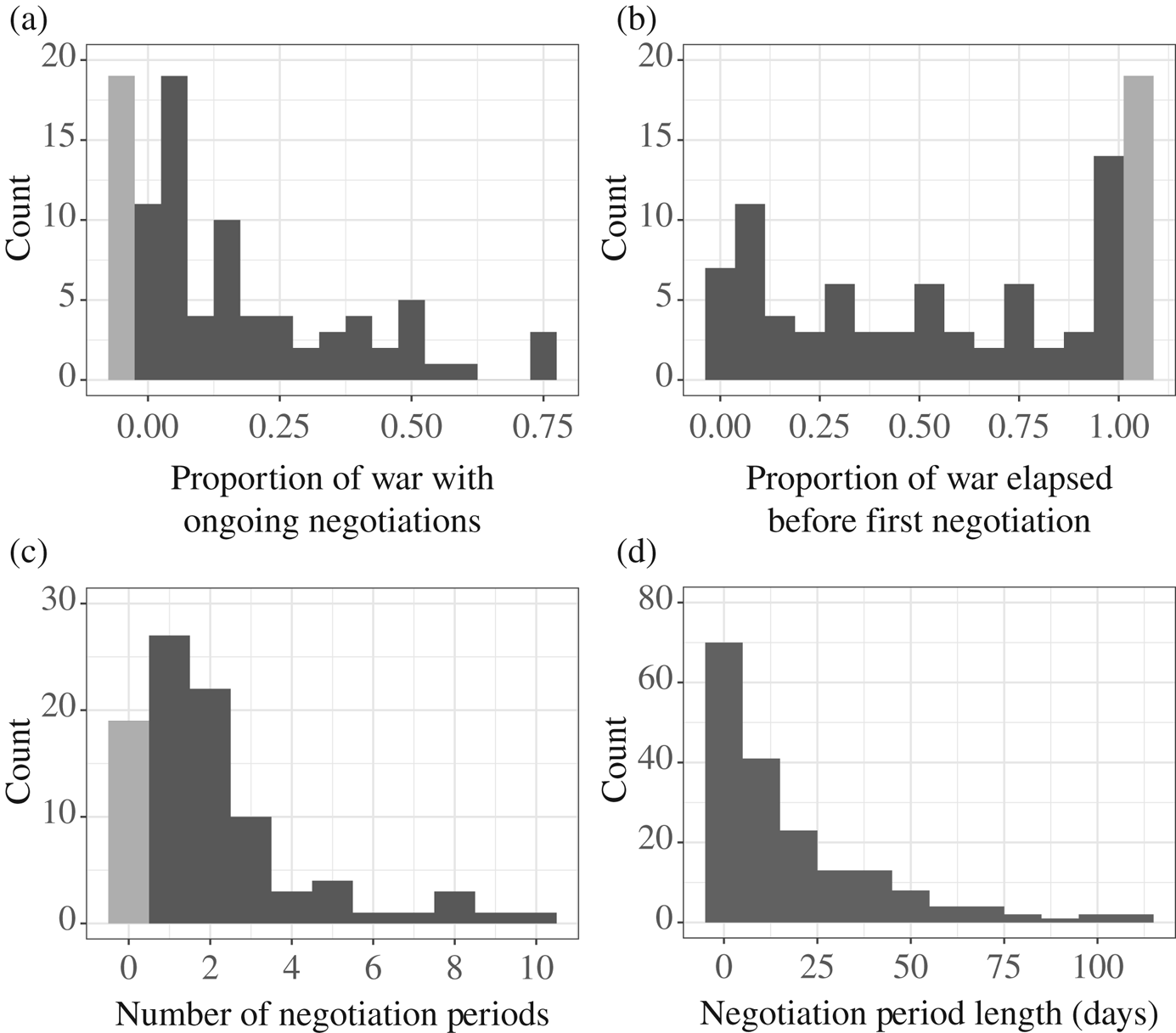
Several descriptive statistics allow us to better grasp the data and their value. Seventy-three of ninety-two conflicts, or 79 percent, experience at least one negotiation, but only about 17.2 percent of all war-days feature negotiations.Footnote 14 Their occurrence within wars also differs widely. Subfigure 2a illustrates what proportion of each war features ongoing negotiations. Subfigure 2b shows the timing of the first negotiation across all COW interstate wars as a function of their overall durations, normalized to a 0-to-1 scale.Footnote 15 Subfigures 2c and 2d show how many negotiation efforts take place in each of the ninety-two wars, as well as the lengths of these individual efforts. Most wars feature no more than a couple negotiation periods, and most of these discussions last no more than three weeks.
Descriptive statistics for negotiations

Figure 2 as a whole attests to substantial heterogeneity in the timing, frequency, and duration of wartime negotiations. These patterns belie the assumption that negotiations are either a war-terminating activity that quickly wraps up hostilities or a constant process that occurs throughout an entire conflict.
Negotiation's Increasing Frequency
A wide collection of research indicates that the nature of war has changed since the end of World War II. Post-1945 conflicts tend to be less likely to involve formal declarations of war,Footnote 16 less likely to involve territorial conquest,Footnote 17 less likely to be decisive,Footnote 18 and less likely to end with formal peace treaties.Footnote 19 Diplomacy may play a significant role in explaining this disparate collection of observations. For example, have wars become less decisive because negotiations have gotten better at stemming conflicts without letting hostilities escalate to a military defeat? Have peace treaties fallen out of favor not only because belligerents want to avoid invoking laws of war, but because they have stopped negotiating? We can begin to address such questions with the new data.
As a necessary condition to help explain differences in post-1945 wars, negotiations must also change in nature around 1945. I use two methods to assess this. The first is a structural break test. To construct the time series for analysis, I record the number of war-days that featured negotiations in each year between 1823 and 2003, as well as the total number of wars and war-days per year. I then apply the structural break test to identify years on which the frequency of negotiations systemically changes, accounting for the number of wars and war-days. The test with the best fit in terms of Bayesian information criterion (BIC) identifies two structural breaks: 1945 and 1972. The break at 1972 reflects the dramatic drop-off in negotiations after the United States’ exit from the Vietnam War. If we limit the test to one structural break, the model identifies 1947. This is largely indistinguishable from 1945, since no wars take place between the end of World War II in late 1945 and the start of the First Kashmir War in 1947. The second approach involves daily-level bivariate logistic regressions. I regress the negotiation variable on an indicator that takes the value 1 for all war-days after the year Y, where Y ranges from 1824 to 2002. The model with lowest BIC uses the cutoff of 1945 or 1946, which are functionally equivalent.Footnote 20
The year 1945 thus appears to mark a shift in the frequency of wartime negotiations. Table 2 breaks down the negotiation variable around this year, and we see that the overall rate of 17.2 percent across the entire data set masks a deeper pattern. Negotiations become more than twice as frequent after 1945, rising from 11.5 to 27.5 percent.Footnote 21
Distribution of the negotiation variable, with row-wise proportions in parentheses

One may believe that these changes simply reflect technological innovations. While seemingly plausible, advancements that would have expedited both remote and in-person communication did not arise around this time. The telegraph and steam locomotive were commonplace by the mid-nineteenth century, and automobiles and planes came into use in the early twentieth century. Neither test I performed identified these time frames as turning points in negotiation. Some may also believe that recent wars simply feature better data on negotiations. My previous discussion of potential biases suggests that this is not a serious concern. It is more likely that we are missing some secret negotiations in post-1945 wars and thus underestimating this systemic effect.
Negotiation's Weakening Efficacy
We now have evidence that the year 1945 marked a turning point when the rate of wartime negotiations rose substantially. This raises the question of whether negotiations also have a different relationship with their purported role of terminating conflicts.
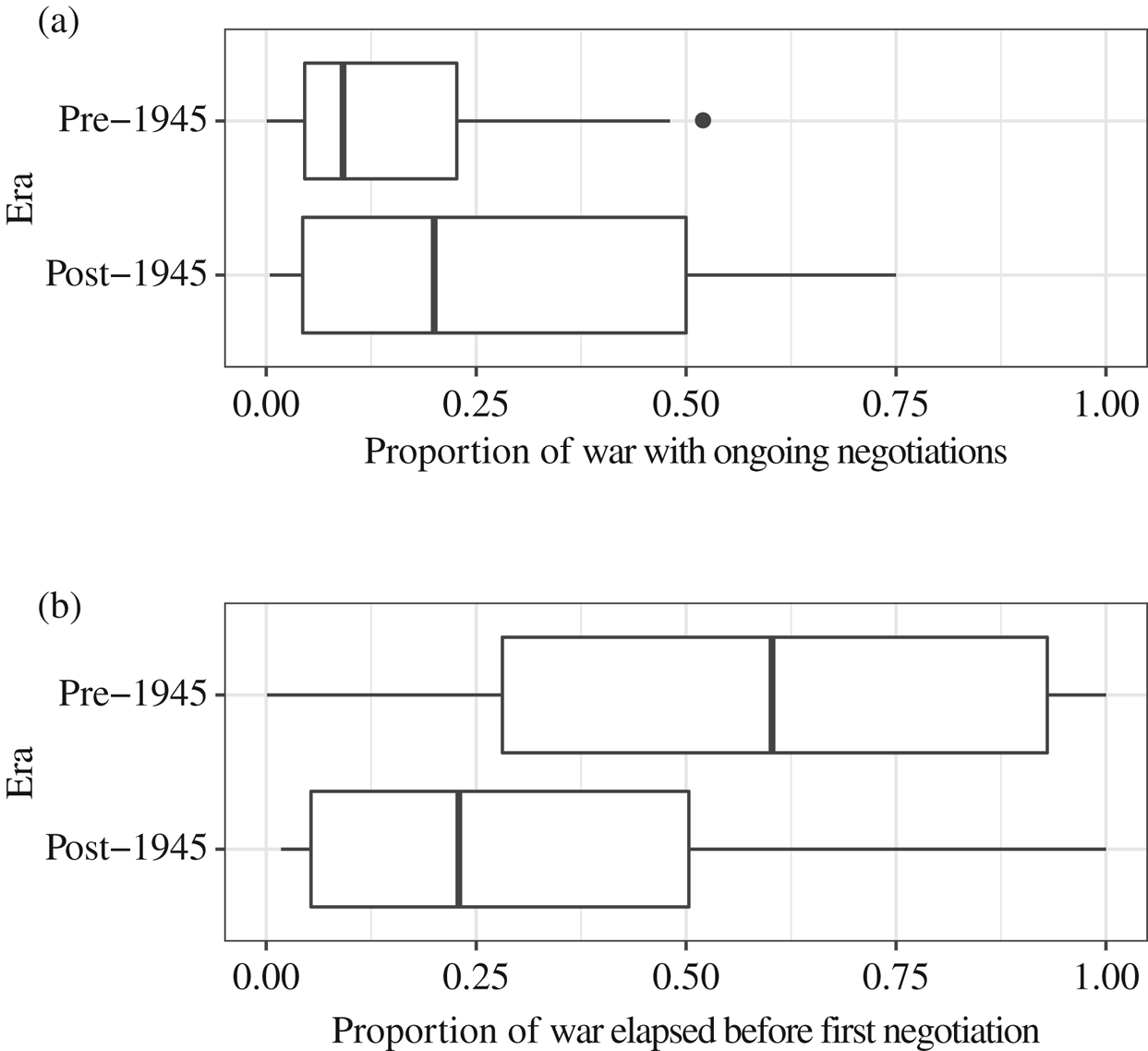
Subfigure 3a breaks apart data from Subfigure 2a to show the distribution of what proportion of each war had ongoing negotiations. This statistic has a noticeably higher mean and variance in post-1945 wars. Subfigure 3a indicates the timing of the first negotiation (if one occurred) according to historical era. The first negotiation tends to take place much earlier in the conflict after 1945. Both observations imply that post-1945 wartime negotiations tend to have a weaker relationship with war termination.
Descriptive statistics for negotiations, disaggregated by historical period

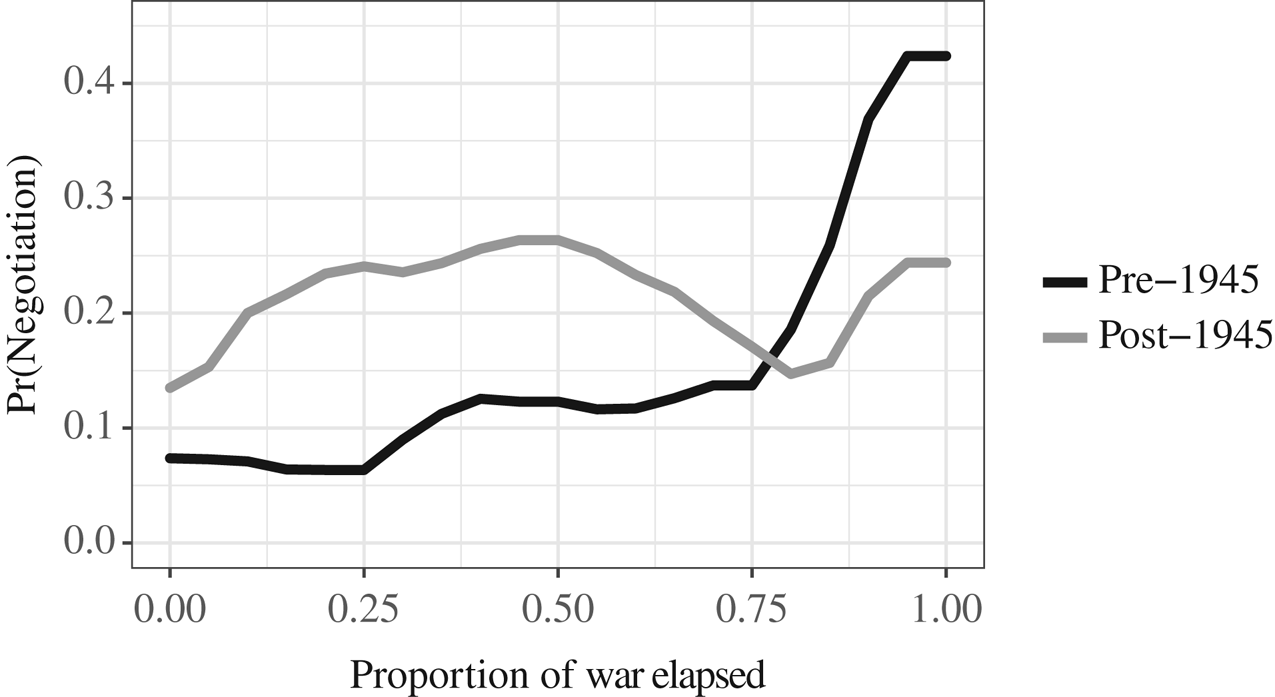
Figure 4 uses kernel regression smoothers to summarize the trajectory of intra-war negotiations before and after 1945. The smoothed lines indicate what proportion of wars experienced negotiations at each point during the overall conflict, again normalized on a 0-to-1 continuum. The contrast across the two time periods is dramatic. Pre-1945 wars feature lower levels of negotiations between the belligerents. However, when talks do occur, they tend to quickly settle the war. The large spike in negotiations at the right-hand side makes this point. Conversely, after 1945, we see a bulge in negotiations in the middle of the plot. Modern wars feature much more frequent negotiations, but many of these initial discussions do not resolve the conflict. A small drop-off occurs before another swell of negotiations emerges and eventually ends hostilities.
Prevalence of negotiations over the course of wars

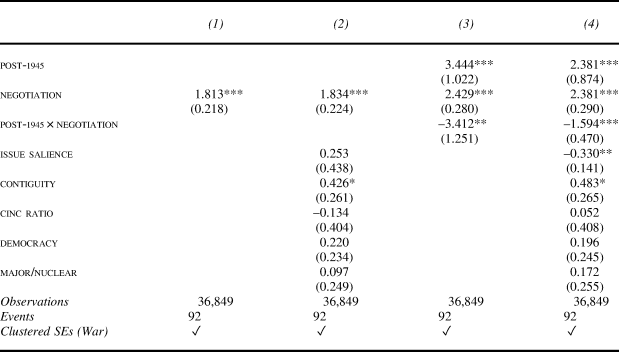
I assess the relationship between negotiations and war termination more explicitly using a Cox proportional hazard model, which is appropriate for analyzing event duration and termination. My main explanatory variable is an interaction between a post-1945 indicator and my negotiation variable (post-1945 × negotiation). Standard errors are clustered by war. Fully specified models include a series of control variables to capture potential confounders.Footnote 22 I capture issue salience using Holsti's three-level classification scheme, which identifies a party's most serious war aims.Footnote 23 I account for geographic land contiguity, which could influence ease of communication, using COW's Direct Contiguity data set.Footnote 24 A series of variables record whether each side features at least one democracy or a major/nuclear power.Footnote 25
It is illuminating to first examine the independent effect of negotiations on the termination of conflict. Models 1 and 2 of Table 3 show that negotiations in isolation have a highly positive impact on the likelihood of wars coming to an end on any given day. This would provide some justification for the costly lottery perspective of war where negotiations are merely a mechanism to codify the outcomes of a conflict once it has effectively come to an end.
Cox proportional hazard models on war termination

Note: * p < .10; ** p < .05; ***p < .01.
These results transform once we account for a shift after 1945. Model 3 of Table 3 features only the interaction but is telling nonetheless. The coefficient for the negotiation variable, which now represents pre-1945 negotiations, increases in magnitude relative to models 1 and 2. However, the interaction term is negative, indicating that negotiations in post-1945 wars have a far diminished impact on war termination. This change is highly robust to the inclusion of all control variables.
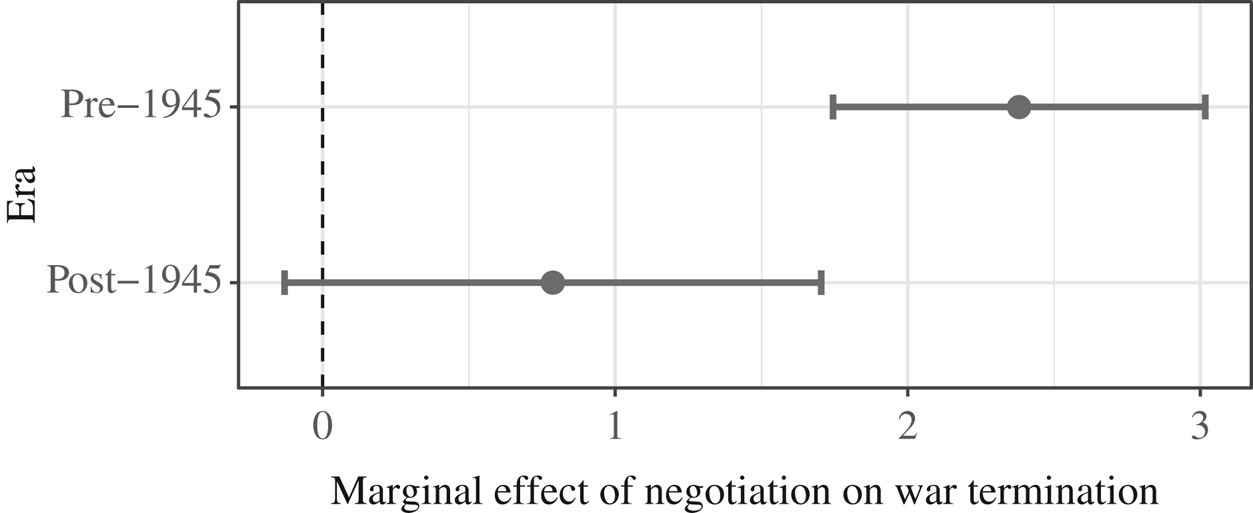
To ease interpretability, Figure 5 uses model 4 to calculate the marginal effect of negotiations on the termination of conflict before and after 1945. The highly positive link between negotiations and war termination is clear before 1945. Compared to the baseline hazard, negotiations in pre-1945 wars increase the likelihood of termination by more than a factor of 10.Footnote 26 The marginal effect of negotiations on termination in post-1945 conflicts remains positive, but its magnitude drops by approximately two-thirds and the effect loses statistical significance at the 95 percent level. Even though post-1945 wars often conclude with negotiated settlements, far more negotiations take place that do not help forge peace.
Marginal effect of negotiations on the termination of conflict, using model 4 from Table 3 (with bands representing 95% confidence intervals)

Pressures to Negotiate in Modern Wars
The results demonstrate that wartime negotiations are a complex event and that their nature has changed over time. What is not as immediately clear, however, is why the most notable shift in diplomatic behavior takes place around 1945.
One possible answer is that the post-1945 international order produces a considerable increase in pressure for negotiations, regardless of the belligerents’ interest in reaching a settlement.Footnote 27 Given that requests for diplomacy may signal weakness and embolden the enemy, states are more likely to engage in negotiations only when deemed absolutely necessary.Footnote 28 If the post-war liberal international order creates new pressures for peace and stability, then belligerents would experience far fewer risks and more benefits from engaging in diplomacy even when they have no genuine incentives to cease hostilities. Negotiations would therefore become more frequent, but also more performative and unproductive. Fred Iklé describes this general dynamic in his seminal work on international diplomacy:
Governments are reluctant to refuse negotiation, no matter how unlikely or undesirable an agreement. They fear that such refusal would impair the good will of groups important to them—their own parliament, the public in allied countries, or other governments … It is not the thoughts behind the prayer that matter, or the purpose pursued, or the deeds before and after—what counts is that the ceremony be performed with the proper gestures.Footnote 29
The Falklands War illustrates how these pressures can even influence major powers. As soon as the conflict began on 2 April 1982, the United Nations Security Council passed Resolution 502 calling for immediate cessation of hostilities and a diplomatic solution. On 5 April US Secretary of State Alexander Haig began aggressively shuttling between London and Buenos Aires but ultimately failed to arrange a peace. Peruvian President Fernando Belaúnde Terry and United Nations Secretary General Javier Pérez de Cuéllar also attempted to mediate. On 5 May, Argentina agreed to mediation and the United Kingdom relented. In her memoirs, then-Prime Minister Margaret Thatcher tellingly writes that she was “under an almost intolerable pressure to negotiate for the sake of negotiation.”Footnote 30 Unenthusiastic bargaining occurred through most of May before British reinforcements landed in the Falklands on 21 May, overtook the islands from Argentinian forces by 13 June, and made the Argentinians sign a document of surrender on 15 June.
Some quantitative evidence lends additional credence to this claim. I turn back to the historical sources used to generate my negotiation data, and I determine whether each of the 189 recorded negotiations periods were driven by external pressure and/or spearheaded by a third party. I do not count third-party mediation efforts that occur solely as a result of a belligerent soliciting them, since this does not reflect any direct external pressure to initiate diplomacy.
Two examples help clarify this distinction. In the Ugandan–Tanzanian War of 1978–1979 described earlier, the Organization of African Unity constantly urged belligerents to negotiate and eventually convened an ad hoc mediation committee in Nairobi. This counts as a positive case of third-party pressure. On the other hand, during the Russo-Finnish War of 1939–1940, Finland asked Sweden to mediate a resolution to the conflict. The failed two-week effort that followed indeed involved a third party, but Sweden had not previously applied pressure to make Finland and Russia negotiate, nor did it volunteer its good offices. This does not count as a negotiation based on third-party pressure.
Table 4 presents the distribution of negotiation periods depending on historical era and whether they are products of third-party activity. In pre-1945 wars, twenty-seven of 116 negotiations, or about 23 percent, emerge from external endeavors to promote peace. Those figures skyrocket to forty-nine of seventy-three negotiations, or about 67 percent, in post-1945 conflicts—nearly a three-fold increase. A χ 2 test of independence resoundingly rejects the null (p ≪ 0.01).
Negotiation periods according to historical era and whether motivated by third-party pressure, with row-wise proportions in parentheses

Evaluating Potential Mechanisms
Extant literature catalogs several changes associated with the post-1945 order that could potentially generate these pressures or make belligerents more receptive to them. The first is institutional. Even though international institutions were not a new concept, they surged in prominence following World War II. The San Francisco Conference, which produced the Charter of the United Nations on 24 October 1945, symbolized the establishment of a postwar order that sought “to maintain or restore international peace and security.”Footnote 31 Since then, a growing number of fixed institutions have been established to maintain stability.Footnote 32 An increasingly intricate and thicker network of alliances also provides deterring and restraining effects that encourage conflict management and resolution.Footnote 33 Importantly, these institutions’ motivations and influence are built upon the remaining factors.
The second of these factors is atomic. The threat of conflicts escalating to nuclear warfare may explain why contemporary wars have been relatively limited.Footnote 34 Belligerents with atomic weapons likely have incentives to seek moderation and increase contact with the adversary to avoid barreling toward catastrophe. Outside actors would share and emphasize these concerns. The Moscow-Washington hotline between the United States and the Soviet Union, installed after the dangerously slow and indirect experience with signaling during the Cuban Missile Crisis, illustrates the motivation to prioritize communication to stem nuclear incidents even when lower-level hostilities still occur.
The third is legal. The 1949 Geneva Conventions and postwar trials in Nuremberg, Tokyo, and Manila represented major steps in formalizing international laws of war. Debate persists on whether compliance rests on self-interests or robust enforcement, but these laws do appear to reflect concrete and potentially perverse shifts in state behavior.Footnote 35 Two critical changes designed to avoid implicating these laws include reductions in formal declarations of war and treaties of peace.Footnote 36 If such laws have led states to avoid language and actions that evoke war, this may also affect belligerents’ willingness to negotiate and acknowledge the existence of a conflict worth resolving.
The last is normative. The brutality of World War II consolidated an aversion to conflict and questions about the legitimacy of war that first emerged after World War I.Footnote 37 Norms regarding sovereignty, territorial integrity, border fixity, and conquest have become firm sources of stability.Footnote 38 Actions that threaten the territorial order may trigger attention from outside parties (including international institutions), pressure to stabilize the conflict, and desire to maintain the status quo.
Further quantitative and qualitative work is necessary to identify what combination of factors is ultimately responsible for shifting the negotiation calculus during war. That said, we can make headway through statistical analysis of my data. I estimate a series of logistic regression models with a lagged dependent variable:
 $$y_{w\comma t} = \alpha y_{w\comma t-1} + \beta _1P_{w\comma t} + \beta _2V_{w\comma t} + \lambda t + \varepsilon _{w\comma t}$$
y w,t is an indicator taking the value 1 when negotiations took place on day t of war w; P w,t is an indicator taking the value 1 when the war-day exists after 31 December 1945; t captures a linear time trend; and ɛw,t constitutes the error term. Standard errors are clustered by war.
V w,t is a placeholder for a series of seven variables that relate to the four aforementioned factors. I add each to the model to see whether it changes the effect of the post-1945 indicator. These variables include:
Institutional
• Whether at least one belligerent was a united nations security council member during the warFootnote 39
• The (logged) number of active alliances between the belligerents and all other statesFootnote 40
Nuclear
• Whether at least one belligerent had nuclear weaponsFootnote 41
LegalFootnote 42
• Number of international humanitarian laws of war codified by the international community
• Number of international humanitarian laws that have undergone ratification by the direct belligerents
Normative
• Whether the war's most salient issue was territorialFootnote 43
• Whether the war was one of conquest.Footnote 44
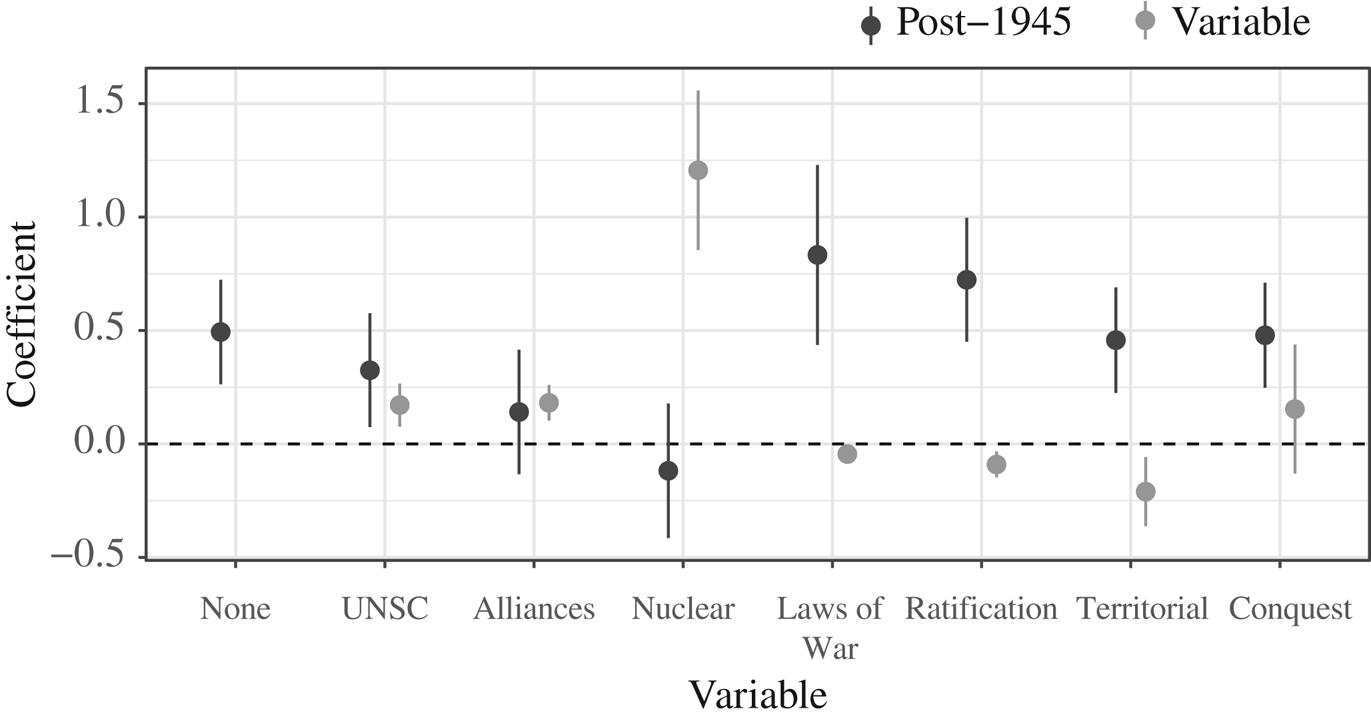
Figure 6 displays the results of these models. On the far left, I report the coefficient and 95 percent confidence intervals for the post-1945 indicator without an additional variable. The result is positive and statistically significant, supporting the finding in Table 2 that post-1945 conflicts have higher rates of negotiation. The coefficient of 0.494 suggests that the odds of negotiating on any given day are 64 percent higher after 1945 than before.Footnote 45
Estimated coefficients for the effect on the likelihood of negotiations at the daily level (with bands representing 95% confidence intervals)

The remainder of the figure illustrates estimated coefficients and 95 percent confidence intervals for the post-1945 indicator as well as each additional variable. Active alliances and nuclear weapons may be explaining a good deal of the impact. Both have highly positive and statistically significant results while making the post-1945 variable statistically indistinguishable from 0. The involvement of a United Nations Security Council member appears to increase the likelihood of negotiations and mildly dilute the post-1945 variable's magnitude. The other variables do not appreciably affect the post-1945 indicator's positive and statistically significant coefficient. Conversely, the existence and ratification of humanitarian laws of war, as well as conflicts involving territory, have negative effects on negotiations. Belligerents trying to evade the trappings of war, including the formulation of peace treaties, become slightly less interested in talking. This is consistent with Fazal's overall argument. Territorial disputes may threaten border fixity, but the dispute's salience and value appear to outweigh the belligerents’ willingness to succumb to pressure to engage in diplomacy. Wars of conquest do not appear to feature different incentives to negotiate. While this is by no means an exhaustive test, atomic and institutional features of the post-1945 order appear significantly responsible for increased pressures to negotiate during war.
Some may suggest an alternative mechanism for why post-1945 negotiations are more frequent but less effective: international pressures for peace may help resolve smaller disputes that may have escalated into war before 1945. In that case, wars that still occur are relatively intractable, and negotiations would be dealing with tougher problems and therefore could be more effective at ending wars than they initially seem.
Several observations suggest this is not the case. First, I turn back to Holsti's three-level classification scheme for issue salience, which identifies each party's most serious war aims: a commercial or policy dispute (0), a territorial or ideological dispute (1), or a matter of regime or state survival (2).Footnote 46 A Mann-Whitney test shows no statistically significant difference in the distribution of this ordinal variable over the two periods (p = 0.882).Footnote 47 Second, statistical analyses in this paper and in Appendix E control for issue salience and still indicate strong relationships between negotiations and the 1945 line. Third, the decline in state death after World War II suggests that the stakes of modern conflicts are lower.Footnote 48
Finally, this claim is based on two untested assumptions. The first is that pressures for peace would filter out smaller disputes. These forces may instead deter major conflicts but fail to stop smaller wars that are less anathema to international stability. The highly positive result for nuclear belligerents in Figure 6 supports this notion. If so, my findings imply that negotiations were even less useful at ending conflicts after 1945. The second assumption is that more difficult wars should involve more negotiations. The opposite case is more plausible. Wars featuring severe information asymmetries or commitment problems should nullify the utility of negotiations as an information-revealing or commitment-making mechanism, and belligerents should be even less inclined to negotiate with each other. The only two exceptions would be if fighting resolved these issues or, as I have suggested, if outside forces pushed the warring parties into inorganic diplomatic interactions.
Conclusion
I introduce and explore new daily-level data on negotiations that took place over the last two centuries of interstate wars. The data reveal complex patterns that challenge our current assumptions regarding wartime diplomacy. They also highlight that the nature of negotiation has not remained fixed over time. Compared to their older counterparts, wars after 1945 have featured more frequent and less productive negotiations that have a very weak relationship with conflict termination. Increased international pressures for peace after World War II, borne of a wide array of motivations including nuclear weapons and alliances, may explain this change.
The new data make a compelling case that wartime negotiations help us better understand how and why conflicts are resolved. Yet they also suggest that negotiations are worth investigating in their own right. Negotiations are not synonymous with war termination; they allow us to get one step further to explore the actual process leading up to the end of hostilities. What remains now is creating a theoretical framework to understand the strategy behind negotiating in war. Why do negotiations happen? When are belligerents more or less likely to seek negotiations? What negotiations are likelier to lead to settlement? What other impacts, if any, do negotiations have besides the termination of hostilities? The widely held notion of negotiations as a constant, information-revealing, war-ending mechanism seems insufficient, especially in modern conflicts.Footnote 49
A vast research agenda is necessary to tackle these questions, but three next steps are worth mentioning here. First, one of the best ways to leverage these new daily-level negotiation data would be to collect and analyze corresponding battle data. Fighting and negotiating lie at the heart of most theories of war termination. Comparing battlefield activity to negotiating behavior could help assess formal models of war and whether a conflict is better understood as a war of attrition, a convergence process, or something more complex.Footnote 50 The relative infrequency and efficacy of negotiations in pre-1945 conflicts indicates that negotiations in these wars tended to be serious and costly efforts to cease further hostilities once informational or credible commitment problems were resolved through fighting—a dynamic closer to a war of attrition. On the other hand, the irregular nature of negotiations in post-1945 wars demands a more nuanced story.
Second, post-1945 belligerents may enter some negotiations to merely assuage external pressures, but this is likely a short-sighted view of what wartime negotiations can accomplish. Practitioners and qualitative scholars of diplomacy often point to consequences of negotiations that are unrelated to forging a settlement, which are termed “side effects.”Footnote 51 Relieving external pressure is itself a side effect, as are mobilizing political support and stalling for time. History shows that some negotiations are meant to settle conflicts, while others have more cynical motives. Additional work is necessary to ascertain the logic behind different approaches to negotiating during contemporary conflicts. If negotiations can indeed be used in an exploitative manner and done so in a systematic way that is shaped by the battlefield, international pressures, domestic politics, or other dimensions, then knowledge about those relationships would be a critical step forward in our theoretical and policy-based understanding of modern wartime diplomacy.
Finally, this work on interstate conflict highlights the need to better understand the logic of diplomacy in civil wars. Scholars have shown that negotiated settlements are on the rise in intrastate conflictsFootnote 52 and that the design of diplomatic agreements—including third-party diplomatic involvement—influences their durability of peace.Footnote 53 But our understanding of intrastate wars and their resolution is incomplete without knowing why belligerents choose to negotiate and then why they opt to settle. Indeed, parties in civil wars arguably have greater incentives and latitude to be strategic in their deployment of diplomacy. Because these conflicts pit rebel groups seeking legitimacy against governments worried about their own reputation, each side may have conflicting interests regarding negotiations.Footnote 54 The intractability of civil wars, as well as the higher leverage that outside parties may have to promote diplomacy, also allows belligerents to use negotiations to accrue side effects that help prolong hostilities. This may help to explain why civil conflicts often feature repeated and extended periods of deadlocked diplomacy.Footnote 55 Whether hostilities occur between or within states, scholars will greatly benefit by understanding wartime negotiations not as a coda to conflict, but rather as a fundamental dimension of war.
Data Availability Statement
Replication files for this research note may be found at <https://doi.org/10.7910/DVN/T7PXKJ>.
Supplementary Material
Supplementary material for this research note is available at <https://doi.org/10.1017/S0020818320000168>.
Acknowledgments
I thank Jim Fearon, Ken Schultz, Justin Grimmer, Mike Tomz, Jonathan Bendor, Melissa Lee, Marc Grinberg, Jennifer Erickson, Şule Yaylacı, and two anonymous reviewers for their thoughtful advice and encouragement. I am also grateful to participants of the Stanford International Relations Workshop, the 2016 Annual Meeting of the Midwest Political Science Association, and the 2019 Annual Convention of the International Studies Association for their helpful comments. All errors are my own.
Funding
I gladly acknowledge the financial support of the National Science Foundation's Graduate Research Fellowship #DGE-114747.