Our thesis is that, at least when it comes to the distribution of schooling, the principles of justice most widely discussed by political philosophers and philosophers of education, whatever plausibility they have as principles of justice within ideal theory, provide inadequate guidance in the nonideal circumstances that we actually face. We shall argue for this by taking a case that is emblematic of decisions faced by policymakers at the state- and district levels, and even by school principals and teachers. Most philosophers involved in the ideal theory debates would think this case involves issues of justice, but the principles in the literature give either no advice for it or, worse, give the wrong advice. Our example concerns charter schools in the United States, and our discussion will use the language of schooling familiar to U.S. readers, Footnote 1 but we think that very similar issues arise in other countries, and in contexts other than that of charter schools.
I. Justice in Education
Public debate about education in the United States has several focal points. Some commentators worry about the low average performance of students in internationally administered tests, relative to students in other rich countries; many worry especially about the relatively poor math and science skills of students at the upper end of the achievement scale. Others are concerned with the apparently weak talent pool for leadership in public schools. Our interest here is in the extremely poor educational performance of students in the bottom third of the achievement distribution, especially those concentrated in urban schools. A widely-cited study demonstrates that the achievement gap between children in the top and bottom income deciles has doubled over the past fifty years while the raw achievement gap between black and white children — that is, the gap between all blacks, and all whites, not controlling at all for social class — has decreased by half (and is, now, half the achievement gap between top-level income and bottom-level income). Footnote 2 Research by Katherine Magnusson and Jane Waldfogel shows that, by 2005-2006, families in the top income quintile were spending nearly $9,000 per child for “enrichment” activities (tutoring, athletic activities, college test preparation, summer camps, and so on), compared with the $1,300 per child that families in the bottom quintile spent. Footnote 3 This makes stark how much more educational investment affluent children enjoy on average versus disadvantaged children. And this, combined with the widespread view (confirmed by most academic researchers) that disadvantaged children, especially in urban areas, attend schools that are substantially more likely to be dysfunctional than the average school, fuels concern with the schooling of children from low income families. Footnote 4
Of course, there are non-justice-related reasons for caring especially about the education of disadvantaged children. The current situation seems socially wasteful; students who leave school without marketable skills are more likely to engage in criminal activity, more likely to have children before they are ready to parent them well, more likely to have stressful and unhealthy lives, and less prepared to make valuable social contributions, either through the formal economy or in civic society. But the philosophical literature about educational justice assumes that we have reasons to be concerned about the educational experience and achievement of disadvantaged students for these students’ own sake, as well as because of the effects on third parties. Among the standard theories of educational justice, three categories can be discerned: equality theories, adequacy theories, and priority theories.
Equality theories demand that educational resources be distributed to counteract some source or sources of inequality of educational success. Variants differ in the sources of unequal success that they deem prima facie unacceptable: equality of educational resources deems educational resource differentials prima facie unacceptable; meritocratic educational equality aims to counteract social class differences; and radical educational equality seeks to counteract both social class and natural talent differences. Footnote 5
Adequacy theories demand that educational resources be distributed so that everyone will have whatever level of educational success is adequate for some specified level of functioning in society. Alternative specifications of the relevant level of functioning include: ability to avoid becoming a criminal; ability to earn a living wage; ability to function as a good deliberative citizen; and ability to deal with others as social equals. Footnote 6
Priority theories demand that educational resources be concentrated to some extent on the least advantaged students, with advantage understood either in terms of educational success or in terms of life-course outcomes. Footnote 7
We shall elaborate the variants of these kinds of theory, and the rationales behind these variants, later. For the moment, we just note that such theories have typically been formulated within ideal theory — the assumption is that the principles tell us how, in a just system, achievement or resources should be distributed. Footnote 8 We should emphasize that we are not criticizing ideal theorizing as a practice here, nor are we arguing for the rejection of any particular principle or principles of educational justice. We are simply trying to show that considerable supplementary philosophical work must be done if these principles are to be able to guide decision-makers well in what we think are a wide range of real cases.
We should first clarify what we mean by educational resources. Much of what we think of as educational resources currently comes in the form of embodied human capital which is difficult to adapt, and difficult to deploy, because its value is often dependent on a context. Footnote 9 Teaching, like any other human improvement profession requires a complex set of skills that must be developed over time. Throughout much of our discussion it may seem as if we think of education as something that is delivered to students — something like an inoculation delivered to the immune system, or money deposited in a bank. But, of course, education is a much more complex process than inoculation. The student is not a patient; learning from the teacher requires voluntary uptake. So among the skills a teacher needs is the ability to elicit the right kind of effort from the student. The teacher must not only know the content she is teaching, and be able to manage a classroom; she must also be sensitive to the states of mind of the students, discerning what mistakes they are making that lead them to the wrong conclusion. A highly effective eleventh and twelfth grade math teacher in an urban school may not only be an ineffective English teacher, but she might be ineffective teaching sixth grade math, and even teaching eleventh and twelfth grade math in a rural school, or even in another urban school. Footnote 10 Furthermore, how effective a teacher is does not depend entirely on her individual developed talent, but also on the effectiveness of fellow teachers and the quality of the management and leadership in their school and their district. So educational resources are socially created over time, and highly complex.
II. The Case: A High Commitment Charter School
Let’s introduce the emblematic case. Since the mid- to late 1990’s, a small number of charter schools have opened up in urban areas with the specific mission of serving, and improving the education of, disadvantaged children. These schools locate in poor neighborhoods and market themselves to the local population with the purpose of enrolling a roughly representative class of children. We are interested in the subset of these schools sometimes known as “high commitment” charter schools, and sometimes (misleadingly, in our opinion) as “no excuses” schools. Footnote 11 Among the most celebrated high commitment charter schools are those belonging to the Knowledge Is Power Program (KIPP) franchise founded by David Levin and Michael Feinberg in Houston in 1994. Footnote 12 KIPP runs a total of 125 schools (37 elementary schools, 70 middle schools, 18 high schools). But others include the Achievement First network (22 schools), the SEED (Schools for Educational Evolution and Development) schools (2 high schools with more planned), Mastery schools (10 middle schools), Uncommon Schools (13 elementary schools, 21 middle schools, 3 high schools) and the Promise Academy in the Harlem Children’s Zone (roughly modeled on KIPP). Like all charter schools, children attend only if their parents apply for a place, and when they are oversubscribed they must select by lottery. Some of the Charter Management Organizations have a common curriculum and even standardized instruction; others, including KIPP, allow for considerable variation of instructional practices from school to school. The schools all have a lengthened school day and year, a rigorous basics curriculum, and a stringent disciplinary regime. Teachers are required to commit a great deal of time and energy — they are expected to visit student homes, and monitor the progress of every student — and within that time they have more support and collaboration from principals and peers than is standard.
These schools are “high commitment” in several senses. From students, the schools demand excellent behavior and citizenship, large amounts of time devoted to schoolwork both inside and outside the school, and a commitment to the culture of the school even at the cost of alienation from the culture of the home. From parents, they demand a commitment to the academic and cultural mission of the school, often formalized with the signing of a contract committing to various items such as reviewing their children’s homework nightly, calling the school by 7:30 am on the day of any absence, donating at least ten hours per year in volunteer work to the school, and making sure their child follows the dress code. Parents agree to abide by that contract for their child to stay in school, and this agreement is backed by the threat of expulsion. The schools can also expel students for disciplinary infractions. From teachers, the schools demand long hours far exceeding the time commitment of teachers in standard public schools, a fervent commitment to student learning, and evidence of success in the form of impressive test score gains.
These schools represent an interesting case for our purposes because there is good empirical evidence that an identifiable subset, on average, benefit the students who attend. In particular, the KIPP and Achievement First networks appear to increase test scores, and positively affect graduation and college enrollment rates. Two recent reports by Mathematica Policy Research Footnote 13 find that KIPP schools produce “positive, statistically significant, and educationally substantial” achievement gains among students who attend them. Footnote 14 While the first report examines only math and reading achievement on standardized tests, the second report is more comprehensive. It finds strong gains in reading and math as well as science and social studies. By the third year after enrollment, the average KIPP middle school had produced about 11 months of additional learning growth in math, 8 months of additional learning growth in reading, 14 months of additional learning growth in science, and 11 months of additional learning growth in social studies. That amounts to a gain of approximately 40 percent of the local black-white score gap in math, 26 percent of the gap in reading, and 33 percent of the gap in science and social studies.
These gains are manifest not only on high-stakes, state standardized tests, but also on a nationally normed, low-stakes test that includes assessment of higher-order thinking skills. This suggests that the achievement gains of KIPP schools do not result from “teaching to the test,” but rather reflect genuine improvements in learning. It also suggests that the learning benefits of KIPP go beyond rudimentary training in basic skills. In short, KIPP schools improve student outcomes across all four academic disciplines, in each of the four academic years subsequent to enrollment, Footnote 15 on both state tests and national norm-referenced tests. Footnote 16
A 2009 report of test score gains among children in the Promise Academies in the Harlem Children’s Zone verifies the potential of high commitment charter schools to improve academic outcomes among disadvantaged students. Footnote 17 This report provides the first empirical examination of the educational effects of the Harlem Children’s Zone, and finds that the program significantly improves the achievement of poor minority children: The program appears to eliminate the middle school black-white test score gap in mathematics, and to halve it in English Language Arts; in elementary school, it appears to eliminate the gap in both subjects. The benefits are roughly equivalent among students of all ability levels. Footnote 18
Given the populations these schools serve, and given the kinds of gains they seem to yield, if there were no costs, most members of all three families of principles we have identified would endorse the presence of the schools and recommend increasing their coverage as much as is consistent with them still yielding their gains. However, although there is no research that explores this question in a rigorous way, there are good reasons to suspect that the same identifiable set of schools imposes some cost on students who do not attend. Because they are schools of choice, all students attending them have parents who are sufficiently connected to the system, and ambitious for their children, to have known about and filled out the application for the schools. The “parent contract” results in children with the least connected and engaged parents being concentrated into the regular public schools; and the unusual scope charter schools have for expulsion for disciplinary infractions has the same effect. Footnote 19 Due to peer effects on academic performance, it is reasonable to conjecture that the increased concentration of extreme disadvantage in regular schools may depress the performance of students there. Footnote 20 If so, then the regular schools would be less appealing places for teachers and principals to work; as a result, at any given salary level, regular schools would be less able, on average, to compete for high quality teachers and managers. Footnote 21 Meanwhile, successful charter schools may deprive regular schools of the human and social capital that comes along with students whose parents are sufficiently well connected and sufficiently attentive to enroll them in charter school lotteries. These are the parents most likely to contribute positively, as volunteers, as PTO members, and as informal lobbyists to the school board and the legislature on behalf of the schools their children attend. The decreased human and social capital resulting from these parents’ exodus from regular schools may further depress the performance of students left behind in those schools. Finally, there may be competition costs. If better educated charter school attendees remain in their communities of origin along with nonattendees, the nonattendees may be disadvantaged, relative to the attendees, in the competition for scarce jobs and other social goods. Precisely because the schools benefit the disadvantaged students who attend, they may harm the disadvantaged students who do not. In all these ways, the demonstrated benefits of KIPP-type charter schools may be purchased at a cost to those disadvantaged students who do not attend them.
Enthusiasts for high commitment charter schools might query the above paragraph in two different ways. First, assuming that children not admitted to KIPP-type schools do, indeed, bear the costs we conjecture about, enthusiasts might argue that we should simply provide a high commitment charter school education for all disadvantaged students in urban areas. We are very skeptical that KIPP-type schools are scalable in this way. KIPP representatives are very open that the KIPP business model depends on attracting young people who do not have families and are willing to work very long hours until they burn out. The supply of such labor is limited. And it might be even more limited if the student population of KIPP-type schools included students whose parents are extremely disconnected from the education system, and students who are extremely disruptive. The schools also depend on leaders who are highly animated by a drive to serve disadvantaged populations and, whether because they are impatient with the licensing requirements or repelled by the bureaucratic limitations of the regular public schools, prefer to work in KIPP-type schools. We are optimistic enough to have great confidence that the supply of such labor is more amenable to scaling up than the supply of teaching labor, but it is not unlimited, and we suspect the limits would be reached before the whole disadvantaged population was served. In addition, most KIPP-type schools attract substantial philanthropic support, which is one factor in their ability to provide high quality education on a smaller budget than regular public schools. Such funds, however, are not unlimited.
Second, charter school enthusiasts might simply question the assumption that other disadvantaged students bear a cost. We know of no empirical studies showing that they do. But, unfortunately, this is because we know of no empirical studies that ask the relevant questions. Researchers finding that KIPP-type schools benefit their attendees are extremely careful to emphasize that their evidence supports only that the schools benefit children who have characteristics relevantly like the children who actually attend them, and carefully warn against assuming that these benefits would be available to populations of children who do not attend them. In a companion paper, written for social scientists, we try to explain what evidence that is currently lacking would be needed by a chartering authority trying to decide whether to charter a KIPP-type school in a particular school district. Footnote 22 We certainly cannot prove that the KIPP-type schools cause the harms we conjecture about, but there are good reasons to worry that they might.
It is important to emphasize that even if high commitment charter schools do impose harms, that is not a conclusive reason to oppose them. We have compelling evidence that they do benefit their attendees who are, almost all, among the disadvantaged. We do not presume that they should be opposed, or that they should be supported. Our argument, in what follows, is just that the standard principles of educational justice in the literature, which we think exhaust the range of principles assumed by people who are predisposed to oppose KIPP-type schools, do not in fact provide much guidance (or, sometimes, provide the wrong guidance), even if we assume that the schools impose the harms we have conjectured about.
III. Why Don ’ t the Principles Provide Enough Guidance?
The philosophical literature about principles of justice in education has tended to stay within the framework of “ideal theory.” That is, philosophers have tended to aim at providing principles that, if implemented fully, would result in an ideally just distribution of educational outcomes. Still, these principles are generally thought to provide some guidance in circumstances wherein perfect justice is unattainable: Each principle implies that we should take steps to move society closer to the ideally just distribution as specified by that principle. We believe that the typical educational arrangements (without charter schools) in regions containing urban districts in the United States are unjust. Many disadvantaged students are educated less well than justice would demand. Suppose, then, that the introduction of a high commitment charter school genuinely would improve the outcomes of students who attend. What we show is that, as long as the school also harms students who do not attend, the principles on which we focus either fail to provide guidance on the decision or give the wrong kind of guidance. So, to get guidance on what seems like an important normative decision in nonideal circumstances, a decision-maker will need more help than most philosophers working on these issues have given.
Recall the three types of principles of educational justice: Equality principles direct us to distribute educational resources to counteract some sources of inequality of educational success; adequacy principles demand that resources be distributed so that everyone attains an adequate level of functioning in society; priority principles demand that educational resources be concentrated on the least advantaged students. In the coming subsections, we consider what guidance these three types of principles provide in the stylized charter school scenario. None of the principles canvassed provides the guidance we think decision-makers should seek.
The problems we will identify only arise in cases where benefits and costs are distributed among the disadvantaged. For any intervention that brings only benefits and no harms, the principles we are concerned with provide clear guidance. But it would be surprising if many large-scale school-based interventions that benefit some of the least advantaged harm none of them, and not surprising if many such interventions harm a considerable portion of the disadvantaged. We think, therefore, that the stylized charter school scenario is representative of a fairly common dilemma faced by decision-makers interested in discerning the judgments rendered by principles of educational justice. These decision-makers should weigh the demands of educational justice among other relevant considerations in their decision-making context, and the principles on offer — at least as they are currently formulated in the literature — fail to provide adequate guidance.
A. Equality principles
Equality of opportunity is widely endorsed, but the principle’s popularity masks a deeply entrenched disagreement about whom we owe equal treatment, and what that equal treatment entails. At its heart, equality of opportunity deems it unfair when some enjoy considerably less favorable life prospects than others, and when this difference is attributable to no morally relevant fault of those on the losing end and no morally relevant merit of those on the winning end. Equality of opportunity principles, then, direct us to equalize life prospects as measured by the opportunity individuals enjoy to attain positive life-course outcomes. When equality of opportunity prevails, whatever inequalities in life prospects remain are attributable to morally relevant differences among individuals, such as the effort they exert to attain an especially favorable social position.
In a society in which education mediates success in competitions for unequally distributed socially produced goods, equality of opportunity commands that all students enjoy an equally good education. The unequally distributed goods include not just income and wealth, but interesting and rewarding jobs, social status, control over one’s daily life, and even health and longevity. Insofar as unequal educational success is not among the morally relevant differences that justify deep life-course inequalities, then, equality of opportunity directs us to ensure that all children be equally well educated.
Unsurprisingly, what constitutes an “equally good education” is open to interpretation. Consider just one variant as an illustration: An Equality of Educational Resources approach mandates that each student should receive an equal share of the stock of educational resources. Footnote 23 This version should not be confused with equal per-student funding. When we talk about equalizing educational resources, we do not mean equalized spending. Within a school in the United States, a good teacher with the same qualifications and experiences as an indifferent teacher will be paid the same amount, but embodies a far more valuable educational resource. A school with difficult working conditions will have to pay considerably more per teacher than a school with propitious working conditions; schools of the former sort will need more per student funding to purchase educational resources of the same value. And a badly managed school may be well funded, but contain few educational resources — bad managers might spend wastefully, for example on expensive math teachers who are poor quality math teachers but good cross country running coaches. Footnote 24 In nonideal circumstances, the Equality of Educational Resources approach appears to direct governments to use schools to reduce inequalities in the value of educational inputs students enjoy.
Though several other variants of equality principles have been developed in the literature, Footnote 25 we can consider a single umbrella principle that is neutral among the different specifications. Understood this way, equality of education (hereafter EE) subsumes various equality principles which share the same essential feature: EE calls for educational resources to be deployed so that relevantly similar students (however “relevant similarity” is to be construed) enjoy an equally valuable education (whether “equally valuable” is to be construed in terms of resources or some other metric). EE includes all equality principles that restrict the range of permissible sources of educational inequality and demand compensation for educational disadvantages caused by the impermissible sources of inequality.
Equality of education is conceptually inclusive because it is strategically vague. It does not specify whether equality is to be measured in terms of inputs (like educational resources) or outputs (like academic achievement). And it does not specify what the legitimate sources of inequality are — whether inequality can be justified only by unequal effort, or unequal effort and natural ability, and so on. Although variants of EE will differ in important ways, they face the same difficulties when confronted with the charter school case.
What guidance does EE offer about whether or not to allow the charter school? We can begin by specifying the various considerations that EE deems morally salient. EE registers the benefit to the potential charter school attendees as a reason in favor of allowing the school, because that benefit constitutes a decrease in the inequality between the disadvantaged attendees and the more advantaged students in the rest of the population. Meanwhile, EE registers the harm to the disadvantaged nonattendees as a reason against allowing the school, because that harm constitutes an increase in the inequality between the disadvantaged nonattendees and everyone else. From the perspective of EE, the relevant consideration is the relative magnitudes of two inequalities: The inequality that the school will narrow between the disadvantaged attendees and the more advantaged students in the total student population, and the inequality that the school will increase (or generate) between the disadvantaged nonattendees and the rest of the population. The bigger the resulting decrease in inequality, relative to the resulting increase in inequality, the stronger the case in favor of introducing the schools.
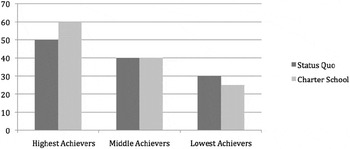
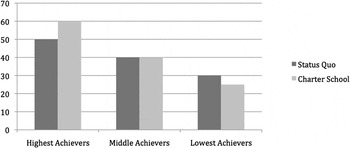
Suppose the school board commissions a study to project the likely consequences of the proposed charter school. There are 10,000 students in the district. Under the no-charter-school status quo, the mean and median student achievement is 70 and the top decile average is 95. (The numbers only serve to enable comparisons among various groups of students, and so we can dispense with the complication of attaching units for the time being.) Assume that the least advantaged group consists in the lowest achieving 3,000 students. Under the status quo (no-charter-school) distribution, 1,000 of these low achieving students achieve at level 50; 1,000 achieve at level 40; and the remaining 1,000 achieve at level 30. If we introduce the charter, achievement among the least advantaged group will be as follows: 1,000 students will achieve at level 60; 1,000 will achieve at level 40; and the remaining 1,000 will achieve at level 25. One-third of the students will achieve more under the charter school distribution than the best off one-third under the status quo distribution; one-third will achieve less under the charter school distribution than the worst-off one-third under the status quo; and the middle-achieving subgroup under either distribution will achieve the same. Footnote 26 For simplicity’s sake, let’s assume that the 7,000 students not in the least advantaged group will be unaffected. Apart from the difference within the least advantaged group of 3,000 students, achievement in the district is constant across the two possible distributions. The projected consequences of the two options for the least advantaged group of 3,000 students are shown graphically in Figure 1.
Achievement Distribution: Least Advantaged Group

The charter school is projected to reduce the inequality between the highest achieving subgroup of the least advantaged group and the rest of the student population. On these grounds, EE favors its introduction. Meanwhile, by lowering the achievement of the lowest achieving subgroup within the least advantaged group (and raising the achievement of other disadvantaged students), the charter is projected to expand the inequality between that subgroup and everyone else. On these grounds, EE opposes its introduction. In this case, EE must respond to multiple salient considerations that bear upon the just course of action.
Principles of justice are often responsive to multiple considerations, and being responsive in this way is, if anything, a mark in a principle’s favor. The moral decisions we face are often complex and multifaceted, and they demand sensitivity to multiple considerations, some of which point in different directions. A moral principle that failed to account for this would be overly simplistic. Indeed, one role of our moral principles is to specify which among the various facets in the moral problems we confront are morally salient. In this role, EE serves us well. It directs our attention to the magnitude of the inequalities affected by the options before us.
But in order to help us navigate the complicated moral questions we confront in the real world, where different considerations tell in favor of different courses of action, we believe that our moral principles must perform a second role: They should help us adjudicate among the various considerations they deem morally salient. Here is where EE falters when benefits favored by principles of equality must be purchased at the cost of harms disfavored by principles of equality. When the magnitudes of the harms and benefits are roughly equivalent, EE fails to adjudicate between the two. Neither the status quo nor the charter school distribution is a more equal distribution of education among students. In some similar cases, there may really be no uniquely just course of action. But the charter school case captures a set of circumstances in which we think principles of justice should render a judgment.
B. Priority principles
Priority principles, which direct us to make the least advantaged group as well off as we can, initially appear more likely to specify the just course of action. As principles of justice for nonideal theory, priority principles maintain that justice gives some priority to the interests of the less advantaged. Footnote 27 Although we think the problems that we will identify are generalizable across priority principles that vary in the weight they give to the disadvantaged, we consider a priority principle that gives absolute priority to the success of the group of students with the least favorable educational prospects. We have seen that poor educational outcomes (like test scores) predict poor overall life-course outcomes (like job security), and so we are initially drawn to principles that direct us to equalize the quality of students’ education. But if EE fetishizes equality and introduces unmanageable or indecisive distributional requirements, then perhaps justice instead demands that we distribute resources so as to simply optimize the prospects of the least well-off. If a measure that benefits the least advantaged also benefits those at the top of the distribution, the benefit at the top offsets any improvement with regard to equality. But from the perspective of priority principles, the benefit at the top is irrelevant. Because priority principles direct us to distribute resources so as to benefit the least advantaged, we refer to these principles as “benefiting the least advantaged” (hereafter BLA) principles.
Two observations about BLA: First, while EE is sensitive to inequalities between individual students, BLA is group-based. It directs us to optimize the condition of the least advantaged group of students — for which the lowest achieving group can serve as a proxy — relative to the position of the least advantaged group under other feasible distributions. Second, BLA principles vary by how they measure advantage and disadvantage for the purposes of identifying the least well-off group. We shall run our analysis twice, first using academic achievement as the metric, and second, using the more plausible metric of all-things-considered valuable life-course outcomes.
Referring back to the projected consequences of the charter school, we can see that BLA does prescribe a particular course of action. The projections show that the school would raise the mean achievement of the least advantaged group of 3,000 students from 40 to 41.7. Relative to the status quo alternative, the charter school clearly benefits the lowest-achieving group of students. We might think, then, that BLA provides the clear guidance we seek. It straightforwardly approves the introduction of the charter school.
But specificity comes at the expense of plausibility. As a group-based principle, BLA is silent regarding intragroup inequalities. It mandates the course of action that results in the distribution with the highest floor. But it says nothing about the distribution within the group that jointly constitutes that floor. Returning to our stylized case, assume that, whether or not the charter school is allowed, the 3,000 students in the least advantaged group will remain sufficiently similar to constitute a single, cohesive least advantaged group. Because the distribution within this group is opaque from the perspective of BLA, the harms imposed on the lowest achieving subgroup within the least advantaged group are deemed irrelevant to our deliberations about justice. BLA is blind to the fact that the introduction of the charter school lowers the achievement of the very worst-off subgroup of 100 students.
This consequence of BLA seems implausible. To be sure, on our assumptions, the school does improve the lot of the least advantaged group of 3,000, raising both the mean and median achievement of its members. This group benefit may outweigh the harm caused to the very worst-off within the group. But BLA does not recognize any morally relevant harm — independent of the group-based calculations — to be outweighed. Surely, harm to the very worst-off matters for justice even if it is ultimately overridden by countervailing considerations. The proposed charter school, by hypothesis, harms a set of particularly disadvantaged students within the least advantaged group. A principle that renders justice blind to this fact is inadequate. BLA does not even register intragroup distributions as salient to the question of justice.
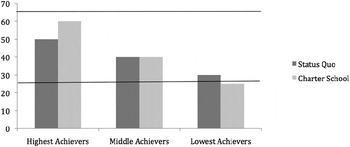
Consider a case in which the intragroup harm seems not only morally salient, but, at least prima facie, also morally weighty enough to override the intergroup benefit. Assume that level 26 is the threshold of educational achievement at which students have attained the basic skills necessary to be employable in routine, menial labor jobs. So below level 26, students have serious difficulty finding any work, but their prospects improve dramatically at that threshold. Assume, too, that level 65 is the threshold at which students can qualify for admission at a four-year university. These crucial thresholds are depicted in the graphical representation of the case in Figure 2.
Achievement Distribution: Least Advantaged Group

By lowering the lowest-achieving subgroup from level 30 to level 25, the charter school very severely damages the life prospects of the students within that subgroup. Whereas all students under the status quo distribution receive an education adequate for basic employability, the worst-off subgroup is virtually unemployable under the charter school alternative. Granted, the highest-achieving subgroup within the least advantaged group is better off under the charter school distribution than under the status quo. But (by hypothesis) these students are not better off relative to any of the crucial thresholds of academic achievement: Under either distribution, they remain below the threshold allowing them to attend a public university. In terms of some of the most profoundly important educational outcomes, the charter school purchases a small benefit at a massive cost.
This possibility illustrates why BLA’s insensitivity to intragroup inequalities is problematic. The benefit of the charter school to the group as a whole seems clearly outweighed by the harm to the most vulnerable subset within that group, so BLA renders the wrong verdict. More generally, BLA will render the intuitively incorrect verdict in many cases like ours: It will approve the course of action that optimizes the prospects of the least advantaged group, no matter what harm is consequently imposed on individuals within that group. This approval is misguided whenever the harm to the individuals is morally weightier than the benefit to the group.
A defender of BLA might object that the discussion above only demonstrates the importance of using the right metric to measure advantage and disadvantage. We have seen that academic outcomes correlate with important life-course outcomes, and that this correlation generates demands of justice in the educational domain. But improvements measured by academic outcomes need not vary proportionally with improvements measured by life-course outcomes. Although some benefit may appear to outweigh corresponding costs when both are measured using a metric of academic outcomes, the weighting may not be the same when we consider the meaning of academic success in terms of life-course outcomes. Because level 26 is the threshold of education needed for basic employability, raising a group of students from level 25 to level 30 may be much more morally urgent than raising an equally-sized group from level 30 to level 35. It may even be more morally urgent than raising an equally-sized group from level 20 to level 25. We do not care about academic achievement for its own sake, but for the sake of the important life-course outcomes it serves.
Might BLA’s plausibility be restored, then, by refining the metric we use? Instead of measuring benefits and harms in terms of students’ academic achievement, why not measure benefits and harms directly in terms of valuable life-course outcomes themselves? By conceptualizing educational costs and benefits in terms of life-course outcomes, we can restore the proportional urgency of equal costs and benefits. With the right metric, perhaps BLA will render the right judgments.
Consider a principle we refer to as “benefitting the least advantaged all things considered” (hereafter BLAATC). The all-things-considered valuable outcomes that BLAATC registers in assessing advantage and disadvantage can stand in for whatever life-course outcomes are of ultimate moral importance — presumably such things as stable employment, income and wealth, social status and self-respect, health and longevity, relationship success, and so on. Even applied within the educational domain, BLAATC identifies the least advantaged group and measures the benefit owed to its members in terms of their prospects for these ultimately morally important outcomes, rather than attending exclusively to academic outcomes students attain.
Does BLAATC render intuitively better judgments than BLA? Consider a case in which BLA and BLAATC sharply diverge: Suppose that some distribution, x, lowers the academic achievement of the lowest-achieving group relative to the status quo, but improves the group’s all-things-considered outcomes by enlarging the stock of human capital among the more advantaged in a way that will ultimately redound to the benefit of the least advantaged. Assume that no alternative feasible distribution could provide a greater all-things-considered benefit to the least advantaged (although there are alternative feasible distributions that would be more to the academic benefit of these least advantaged students). BLAATC supports distribution x, but BLA supports the status quo.
Consider this possibility within the context of the charter school deliberation: Under some circumstances, the charter school may ultimately benefit the lowest-achieving subgroup of disadvantaged students, while harming the academic prospects of these students. According to the projections, the charter school will raise the academic achievement of the students who attend it and harm the achievement of those left behind. But under the right circumstances, the academic benefit to the attendees may translate into an all-things-considered benefit to the nonattendees, notwithstanding the immediate academic cost they suffer. The school may generate a net gain in human capital that benefits the disadvantaged community as a whole if, for example, it equips attendees with the skills to become entrepreneurs and job creators. If the attendees subsequently exercise their entrepreneurial capacities within their communities of origin, their enhanced human capital will mean better job prospects for others within the community, including those harmed academically by the charter school.
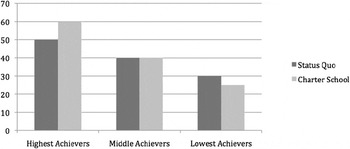
Recall that the charter school is projected to lower the academic outcomes of the lowest-achieving subgroup from 30 to 25. See Figure 3.
Achievement Distribution: Least Advantaged Group

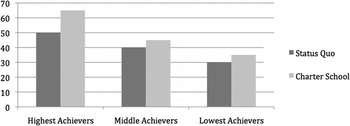
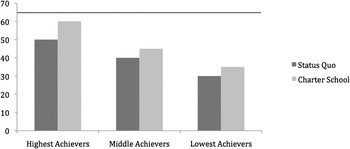
But the charter school might benefit these lowest achievers in terms of their long-term, all-things-considered life prospects. Thus, the picture above is consistent with the picture below, which measures outcomes in terms of all-things-considered life-course prospects. The relevant difference occurs within the lowest-achieving subgroup. See Figure 4.
All-Things-Considered Life Prospects Distribution: Least Advantaged Group

If the projected all-things-considered prospects of students are as pictured, then BLAATC endorses the charter school. Indeed, BLAATC approves the school so long as it raises the all-things-considered prospects of the least advantaged group as a whole. But unlike the case considered earlier, this seems to be the intuitively correct verdict. And unlike BLA, BLAATC seems sensitive to the intuitively salient facts about the scenario: the long-term life-course outcomes of students, rather than their short-term academic achievement. By calibrating the metric to measure advantage and disadvantage in terms of ultimately morally important life-course outcomes, BLAATC enables us to account for the imperfections in the correlation between academic and life-course outcomes. When the two come apart, BLAATC plausibly defers to the ultimately morally important outcomes. By attending directly to ultimately morally important outcomes, BLAATC avoids the implausible weighting of outcomes like employability as less morally important than equal or even smaller short-term academic gains.
BLAATC does indeed employ a more plausible metric than BLA. But changing the metric will not solve all of the problems priority principles encounter. Like BLA, BLAATC is a group-based principle. As such, it is sensitive to intergroup inequalities, but insensitive to intragroup inequalities. For this reason, BLAATC will render many of the same counterintuitive judgments that undermine BLA. Imagine that the original set of projected consequences of the charter school were measured by all-things-considered life-course outcomes. As in the original scenario, the charter school benefits the group as a whole, but harms the lowest-achieving subgroup within it. But now (Figure 5), the benefits and harms reflect all-things-considered outcomes that bear ultimate moral importance:
All-Things-Considered Life Prospects Distribution: Least Advantaged Group

As with BLA, the cost that the charter school imposes on the worst-off subgroup does not even figure into BLAATC’s judgment on whether to introduce the school, except in so far as that cost figures into the average outcomes of the group as a whole. BLAATC supports the school so long as the average outcomes of the group as a whole are improved. But considerations of justice should register the harm to the most extremely disadvantaged students within the least advantaged group as a salient consideration, even if that harm is ultimately overridden by a benefit to the group as a whole. Also as with BLA, BLAATC’s insensitivity to intragroup inequalities results in intuitively implausible judgments in our case. A harm to the absolutely worst-off need not always be morally less weighty than a benefit of greater magnitude to the more advantaged members of the least advantaged group. After all, the delineation of groups is merely a tool for implementing priority principles, and no particular delineation is specified by the principles themselves. The classification of the absolutely worst-off as merely a subgroup of the least advantaged group rather than a group in their own right is a practical — not a principled — calculation. But priority principles turn critically on that practical calculation: If the absolutely worst-off subgroup were considered a group in its own right, the harm its members incur would be decisive against the charter school. Because it is merely a subgroup, the harm is just one readily trumped consideration in the overall calculation of whether or not the group as a whole benefits. The arbitrariness of BLAATC’s (and BLA’s) group specification will result in intuitively implausible verdicts whenever groups are sufficiently heterogeneous that subgroups within them seem to call for independent moral consideration. When the subgroup is substantially worse-off than other members of the full group, BLAATC will implausibly sacrifice the interests of the very most vulnerable for the sake of optimizing the position of the group, whose boundaries are determined by practical considerations alone.
On the face of it, BLAATC is an appealing principle for nonideal circumstances. It measures advantage and disadvantage directly in terms of morally important outcomes, thereby avoiding some of the counterintuitive implications of BLA. But BLAATC remains a group-based principle of justice, with all the problematic consequences that result from treating intragroup inequalities as opaque. And these consequences render it unhelpful for our case.
C. Adequacy principles
Adequacy principles direct us to ensure that everyone meets or exceeds some set threshold for an adequately good share of positive outcomes. These principles have received a great deal of attention, among both policymakers and philosophers, as appealing alternatives to equality and priority principles. While the popular adequacy movement appears to be motivated by the practical calculation that adequacy is a more feasible policy goal than equality, philosophical defenders of adequacy views argue that ensuring everyone an adequate share is all that justice demands. As such, philosophical defenses of adequacy principles seem to imply that inequalities above or below the adequacy threshold are irrelevant from the perspective of justice. Footnote 28
Applied within the domain of education, adequacy principles demand that all students achieve educational outcomes at or above the threshold set for what constitutes an adequately good education. Adequacy theorists differ in their criteria for an adequate education. One prominent recent defender of an adequacy view argues that all students should receive an education adequate to enable them to meet others as equals in the public sphere; Footnote 29 another theorist argues that every student must receive an education adequate for citizenship. Footnote 30 As with equality principles, it will suffice for our purposes to consider adequacy principles as a single umbrella concept, dispensing with complications regarding where precisely the adequacy threshold is to be set.
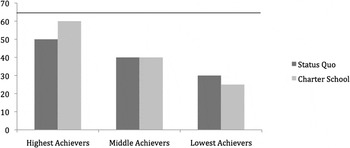
Like priority principles, adequacy principles have considerable initial appeal when applied to the charter school case. Indeed, adequacy principles were initially proposed as alternatives to equality principles, allegedly better suited to guiding deliberation in nonideal circumstances. Footnote 31 And we agree that some thresholds are especially important from the perspective of justice. The importance of certain thresholds of academic achievement (those corresponding to morally important life-course outcomes) was one of the considerations we invoked to demonstrate the implausibility of BLA. Even so, adequacy principles seem no better than equality or priority principles in dealing with the charter school case. Consider a new set of projected consequences of the charter school, pictured in Figure 6.
Achievement Distribution: Least Advantaged Group

Assume that the threshold for an adequately good education is level 65. In the scenario pictured, neither the status quo nor the charter school alternative provides any of the least advantaged students with an adequately good education. Because neither option results in a greater number of students receiving an adequate education, on one interpretation of what it is to implement adequacy better, the principle is silent about the charter. And yet the relevant students are all unfairly bad off, and the charter school benefits them all. Under these circumstances, it seems obvious that principles of justice should approve the school. The case we are discussing seems particularly urgent because it involves multiple constituencies, all of whom are seriously bad off. On any robust conception of adequacy, we will often lack a course of action that moves any of them above the threshold. Even so, it seems that justice demands that we do what we can. Adequacy principles fail to provide guidance regarding how benefits should be allocated when nobody can be benefited sufficiently to raise him or her above the adequacy threshold. Even more troubling, when nobody can be raised above the threshold, adequacy principles fail to register a moral demand that the most seriously bad off be benefited at all. Footnote 32
Perhaps we should interpret “implementing adequacy better” differently, so that the principle favors the option that brings more people closer to the adequacy threshold. Because the charter school brings students closer to the threshold for an adequately good education, we might think that the principle directs the school board to authorize the school. But this interpretation, at best, raises other issues. Notice, first, that in order to pursue this solution, adequacy theorists must give up on the claim that providing an adequate education is the only demand of justice in education. To render the judgment that a distribution is more just on account of students being closer to the adequacy threshold, adequacy theorists must admit proximity to adequacy as another morally relevant consideration. But prioritizing the moral relevance of proximity is problematic.
Suppose that a student is adequately educated when she is able to meet others as an equal in the public sphere. Footnote 33 Is that student better off in virtue of being closer to being able to meet her peers as an equal citizen within the public sphere, even if she cannot yet do it? Probably. Is she better off in virtue of being closer to achieving that outcome even if she will never actually stand in a position of equality? Possibly. But what if we must choose between bringing her closer to that threshold and improving her education in some other way that is not measurable in terms of the threshold for adequacy? If we could instead provide an educational intervention that drastically improves her life prospects without affecting her ability to meet others as equals, must we always prefer bringing her closer to the adequacy threshold? Even when she will never actually reach it? It is far from obvious that a slight increase in a student’s proximity to the adequacy threshold is always morally preferable to any improvement in her prospects as measured using some other scale. Thus, it is not clear that the adequacy theorist can plausibly maintain that meeting the threshold and growing closer to it are the only things that matter from the perspective of justice.
But even if adequacy theorists could defend the moral relevance of proximity, adequacy principles would still fail to provide guidance in many circumstances. Return to the original set of projected consequences of the charter school, keeping in mind that the threshold for an adequately good education is 65. See Figure 7.
Achievement Distribution: Least Advantaged Group

Notice that introducing the charter not only brings 1,000 students closer to the adequacy threshold; it also pushes 1,000 students further away from that threshold. If proximity to the adequacy threshold is what matters, then both subgroups of students must be taken into account. Adequacy principles provide no mechanism by which to weigh benefits to one set of students against costs imposed on another set, where both benefits and costs are understood in terms of proximity to the adequacy threshold. Like the equality principles of justice that they were intended to supplant, adequacy principles fail to provide plausible guidance in the charter school case. More generally, when we need to allocate scarce resources among disadvantaged constituents all of whom are unfairly bad off, adequacy principles often fail to provide any guidance whatsoever.
IV. Conclusion
We believe, though we have not proved, that chartering authorities making decisions for urban districts, when they have an option to charter a school that is likely to improve the quality of education for the children who attend, are often trading off benefits to attendees against costs to nonattendees. And the nonattendees who will bear the costs are likely to be among the most disadvantaged members of the disadvantaged group. Remember that two (possibly overlapping) populations of children are particularly likely to be excluded from KIPP-type charter schools: those whose parents are sufficiently inattentive and disconnected that they do not apply to the school; and those whose behavior is sufficiently disruptive that, even if they are admitted to the school, they are subsequently excluded. In addition, of course, many students who are excluded from KIPP-type schools are just like the students who are included; the former, however, simply lost in the lottery, and it is their existence that enables researchers to study the effects of the schools with some rigor. Those students who lost the lottery are educated in schools with a higher concentration of disruptive and disconnected students than KIPP-type schools have, and a higher concentration than their schools would have if the KIPP schools did not exist.
Disruptive students pose a different kind of practical and normative problem from the other kind of student. Disruptive students impose substantial costs on other students. Some interventions to prevent disruption have a better track record than others, but the effectiveness of any depends on the quality of implementation, which, in turn, depends on the quality of the human capital in the school and the district. And because none comes close to preventing all disruption, the question that arises is what exactly should be done with children who misbehave. One thought, and the thought that is effectively implemented by high commitment charter schools, is that they should be triaged: simply prevent such children from disrupting other children’s education, and do so at the minimal cost. Many people will find this unpalatable, because we do not think that minors are truly responsible for their behavior, and the stakes for those children are very high: failure to graduate high school, especially for black males (who already bear a disadvantage from discrimination) seriously undermines one’s prospects for labor market success and substantially increases one’s chances of spending a substantial amount of time in prison. Footnote 34 But on any account, when the costs to other students are sufficiently high and the probability of successfully getting the disruptive student to comply is sufficiently low, maybe triage should be considered. By contrast, nondisruptive disconnected students, and nondisruptive students just like those who are in the KIPP-type schools, do not pose a serious practical problem for educators (except in so far as they are more prone to fall under the influence of the disruptive students who, because of the charter school, constitute a larger proportion of their peers than they otherwise would). Unfortunately, our standard principles of justice fail to provide guidance just when we need it the most. Equality and adequacy principles are often silent regarding the just course of action in distributing costs and benefits among the least advantaged, and priority principles appear to provide the wrong guidance in many such cases.
We do not think this means that the principles themselves should be rejected, or that the ideals they embody are misguided. Indeed, we have both endorsed equality and priority principles elsewhere; and while we do not think adequacy principles exhaust the demands of justice as their proponents claim, we do believe that there may be particularly urgent obligations to benefit disadvantaged people up to certain morally important thresholds. All these principles rightly call for help on behalf of those who are unfairly bad off. But the limitations illustrated in this essay demonstrate the need for further theoretical refinements. We should develop more fine-grained versions of equality, priority, and adequacy principles that clearly specify the demands of those principles in nonideal circumstances. Or, if the principles themselves are to remain course-grained and unrefined, we need answers to the questions that beset them in nonideal cases. Of course, much of the work to be done in determining what verdicts our principles render in these cases is empirical. We need to know more about the relative magnitudes of the benefits and costs of the various courses of action in our feasibility set. In the charter school case, we need to know how much the school can actually be expected to benefit those who attend it, and at what cost (if any) to those left behind. But philosophers should not think that principles of justice are ready, merely awaiting the empirical details to be fed into them. Much important philosophical work remains.
With regard to equality principles, we need to determine the correct metric to use in measuring costs and benefits. Perhaps a suitable metric can avoid counterintuitive judgments wherein equality principles appear to fetishize mathematical calculations of equality even at the cost of making some very bad-off people worse-off than they need to be. Equality principles also appear inadequate when two courses of action would bring about different distributions roughly equivalent in terms of the amount of equality they feature. In many such cases, it seems to us that justice should offer a judgment, and yet equality principles fail to do so. Perhaps these principles need further theoretical refinement; alternatively, this problem may point to the need to supplement equality principles with other distributive principles, such as priority principles.
Priority principles themselves raise questions in intragroup redistribution cases. Because intragroup distribution often seems to be morally relevant, we need to think carefully about how groups are to be delineated. Perhaps some principled guidance for group delineation is available. If so, proponents of priority principles might have a compelling defense against the troublesome intuitions that arise when a benefit to the group is purchased at a cost — sometimes a serious cost — to some of its most vulnerable members. If group boundaries themselves are responsive to moral considerations, these consequences of priority principles might be more palatable. In any case, those who endorse group-based principles of justice should give serious attention to the task of specifying group boundaries. And like equality principles, priority principles raise questions about measurement. In considering BLA and BLAATC, we saw that different metrics can yield importantly different judgments. If we opt for a metric that registers ultimately morally important outcomes, then there will be considerable philosophical work involved in determining just what those outcomes are.
The shortcomings of adequacy principles also spotlight this need to determine and defend morally important outcomes. If ensuring that everyone reaches some threshold (or thresholds) of adequacy is all that justice requires — or, more plausibly, if it is one particularly urgent thing that justice requires — then we need to think carefully about what those thresholds are, and why they carry the moral importance they do. For example, theorists who think that an adequate education is one that prepares students to be citizens must defend the moral importance of that particular threshold. Why is the attainment of citizenship so crucially important, when what motivates us in the charter school case is simply the fact that some students are unfairly very bad off? Finally, if proponents of adequacy principles really do want to maintain that those principles exhaust the demands of justice, then they need to develop some defense against the extremely strong and lucid set of intuitions that challenge that claim.
We want our principles of justice to be ready, only awaiting the relevant empirical information in order to support judgments in the complicated cases we face in nonideal circumstances. But they are not ready. One possible response to this fact is to say that we are asking too much from principles of justice; that they should point us in a rough direction, but need not be so fine-grained as to guide decision-making in particular contexts. We cannot take the space to argue against that response. But we chose our case quite deliberately. The debates about whether to expand the reach of charter schools in inner cities, and high commitment charter schools in particular, are extremely politically charged, with both sides claiming the moral high ground. We think it is reasonable to be dissatisfied with principles of educational justice that would not help us choose one way or the other even if we had a large quantity of high quality evidence on matters salient to the decision. Considerable effort is expended thinking about which principle or principles are the right ones to use when we confront moral uncertainty. And this is as it should be. But figuring out which principle is best does not exhaust the theoretical work that demands philosophical attention. For any particular principle we settle on, much more must be done to equip it to offer the kinds of verdicts we seek.