Populations living on several remote coral atolls of the Lower Mortlock region of the Federated States of Micronesia (FSM) report that on March 5, 2007, islands were inexplicably flooded by ocean water twice in 1 day. The inundation of seawater was described as occurring “like a rising tide”—slowly and with minimally destructive force. In many places, the sea level covered the island to a height estimated at 12 to 18 inches deep and then receded within a few hours. These events were not associated with tsunamis, storms, or the timing of the tides.
Major agricultural losses were reported due to shoreline inundation and salinity intrusion. Because food sources on these remote atolls are largely locally derived, the damage prompted concerns about the potential for hunger.
BACKGROUND
The most important direct physical effects of a significant rise in mean sea level are coastal erosion, shoreline inundation, and salinity intrusion, primarily into estuaries and groundwater aquifers.Reference Sorensen, Weisman and Lennon1 Coastal erosion destroys shorelines, marshlands, and mangroves, affecting property and island ecological systems. Shoreline inundation may damage shelter and contaminate soil with salinity, resulting in crop failure. Saltwater intrusion can be particularly damaging to the groundwater aquifers of small islands.
The aquifer lens of an ocean island is normally composed of a layer of fresh water derived from rainfall and floating on a denser layer of salt water (derived from the ocean). When saline intrusion occurs, salt water from the inundation mixes with fresh water of the aquifer to create a brackish solution throughout that adversely affects palatability, vegetation, and agriculture. This report describes the effects of 1 acute-onset sea-level-rise disaster on 2 coral atoll populations.
METHODS
Study Design
A cross-sectional survey was performed among the disaster-affected populations of Lukunoch and Oneop islands. Institutional review board requirements were waived according to a standard protocol wing to the emergency nature of the request. Procedures followed were in accordance with US and FSM institutional and national ethical standards on human experimentation and with the Helsinki Declaration. Informed consent to perform the study was obtained from the traditional leadership of the island and from each individual survey respondent. All respondents remained anonymous.
A 2-page survey instrument was developed to assess asset damage and needs at the household level. The household survey evaluated the following indicators: demographics; asset damage; food availability; availability of water, ie, sources, treatment, storage, and use; sanitation; existence of a toilet and soap; health status; and crude mortality.
Population and Setting
Lukunoch Island and Oneop Islands are crescent-shaped islands located 7 miles apart within the Lukunor atoll, in the remote Lower Mortlock region of FSM. Lukunoch is 2.3 miles long and 1800 feet wide at its widest diameter. Oneop is 1 mile long and 1600 feet wide. Each island is composed of 1 very large central communal taro garden surrounded by a tree-lined perimeter of homes. On Lukunoch, this garden was 0.9 miles long and 1000 feet wide. On Oneop, the main garden was 0.7 miles long and 600 feet wide.
The government of FSM estimated the census of Lukunoch to be 1500 persons living among approximately 150 homes and the census of Oneop to be 600 persons living in approximately 60 homes. Baseline health and demographic data were not available for either population. There is 1 local primary health care worker on each island. The dispensary had scant medications in stock at the time of this assessment. Health records included a reporting of births and deaths, but not clinical encounters.
Sample Size Calculation
A sample of 61 households was calculated as necessary to achieve a 95% confidence level and a 5% confidence interval (CI) among approximately 72 households on Oneop Island. All 72 households were surveyed. A sample of 113 households was calculated as necessary to achieve a 95% confidence level and a 5% CI interval among approximately 160 households on Lukunoch. Unfortunately, logistical constraints and inclement weather severely limited the amount of time available on-site, and only 40 households were surveyed. This resulted in poor statistical power (95% CI, 13.5) for Lukunoch data.
Data Collection
On Lukunoch, all homes were located along a single path that encircled the entire island. Starting with the communal house, every fourth household was selected for an interview by use of a systematic random sampling method. A total of 40 Lukunoch Island households were assessed. All 72 households on Oneop were surveyed. Representatives of the government of the FSM interviewed heads of each household in the local language regarding damages and needs for the entire household after receiving 15 minutes of instruction. Respondents consulted with other household members for consensus regarding their responses. Subject matter experts from the US Forest Service (USFS) and US Geological Survey performed a simultaneous on-site inspection of island agriculture and hydrology as another means of evaluating damage to island crops and groundwater.
Statistical Analysis
Prevalence data were analyzed for Lukunoch and Oneop populations, and 95% CIs were produced for Lukunoch data by use of EPI-INFO, version 3.4 (Centers for Disease Control and Prevention, Atlanta, Georgia).
RESULTS
Demographics
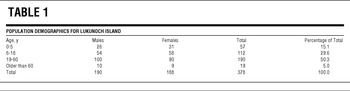
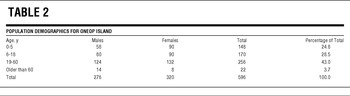
All 974 inhabitants of the 112 total households interviewed on both islands were Micronesian and spoke the Chuukese dialect. The mean number of persons per household in Lukunoch was 9.5 and was 8.3 in Oneop. All households were supported by farming and fishing within a subsistence economic system. Table 1 and Table 2 detail the demographics of the study population.
Population Demographics for Lukunoch Island

Population Demographics for Oneop Island

Structural Losses
No respondents reported a complete loss of their home due to structural damage from floodwaters. On Lukunoch, eight (20%) of 40 households (95%CI, 9%-36%) reported that flood water caused partial damage to their home. Nineteen (20%) of all 76 households on Oneop reported partial damage to their homes. On Lukunoch, none of the respondents interviewed reported complete loss of their well due to salination and 11 (28%) of 40 households (95%CI, 15%-43%) reported damage from salination. Five (6%) of all households on Oneop reported complete loss of their well and 49 (64%) of 76 households reported well salination. Rain catchment systems, in general, were poorly maintained, but not affected by the floodwaters.
Food Losses
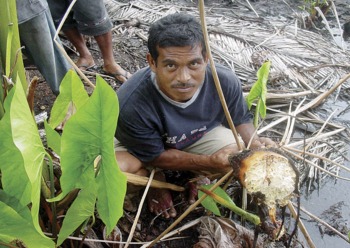
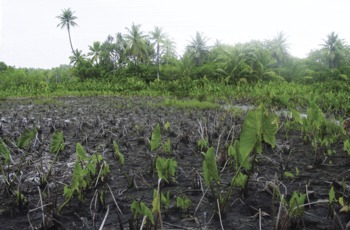
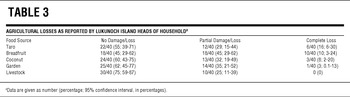
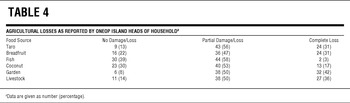
On Lukunoch, half of all households reported at least partial loss of their primary dietary sources of carbohydrates: taro and breadfruit. Of the Lukunoch households, 15% (95% CI, 6%-30%) reported a complete loss of taro and 10% (95% CI, 3%-24%) reported a complete loss of breadfruit. On Oneop, nearly all households reported at least a partial loss of taro and breadfruit. Of all Oneop households, 31% reported a complete loss of taro and 31% reported a complete loss of breadfruit. USFS inspections revealed that the taro crops located in the very large communal garden in the center of Lukunoch were nearly completely destroyed, along with most of the breadfruit trees. The taro garden on Oneop had less damage, mostly confined to one end of the patch (Figure 1 and Figure 2). Table 3 and Table 4 list the degree of agricultural losses on Lukunoch and Oneop, according to food source.
Lukunoch villager showing taro spoiled by saline intrusion.

A portion of the large taro patch on Lukunoch revealing extensive damage.

Agricultural Losses as Reported by Lukunoch Island Heads of Householda

Agricultural Losses as Reported by Oneop Island Heads of Householda

Water Quality and Quantity
On Lukunoch, 43% (95% CI, 27%-59%) of households reported the use of water purification techniques. The average amount of water reportedly consumed by each person per day was 1.1 gallons. On Oneop, 97% of all households reported using water purification. The average amount of water reportedly consumed by each person per day was 1.8 gallons.
The populations of both islands obtain water through a variety of means, including covered wells, open wells, and water catchment systems. All households reported access to a well. On Lukunoch, 25% (95% CI, 13%-41%) of households were able to store 500 to 650 gallons of rainwater; 55% (95% CI, 39%-71%) of households had a storage cistern capable of storing 1000 gallons of rainwater. Of all Oneop households, 64% were able to store 500 to 650 gallons of rainwater; 3% of Oneop households reported having a cistern capable of storing 1000 gallons of rainwater. No cisterns were damaged by the inundation.
Sanitation and Hygiene
On Lukunoch, 13% (95% CI, 4%-27%) of households reported use of a water-seal flush toilet, 33% (95% CI, 19%-49%) reported using pit latrines dug into land, and 38% (95% CI, 23%-54%) reported use of outhouses perched over the water shoreline. Eighteen percent Of the Lukunoch households, 18% (95% CI ,7%-33%) reported not having a toilet, routinely engaging in open bush or reef defecation instead. People on Lukunoch reportedly used an average of 1.1 bars of soap per person per month.
On Oneop, 22% of all households reported use of a water-seal flush toilet. No households reported using pit latrines, and 72% reported use of outhouses perched over the water shoreline. None of the households on Oneop reported not having a toilet. People reportedly used an average of 0.6 bars of soap per person per month.
Health Status
Mortality and Natality
Respondents reported that since March 5, 2007, 1 death (a 6-month-old) had occurred on Lukunoch and 1 (a 5-month-old) had occurred on Oneop. There were 8 live births reported in Lukunoch and 1 live birth reported in Oneop since March 5, 2007.
Morbidity
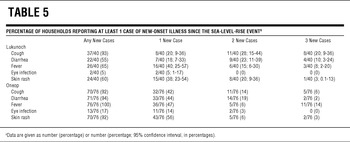
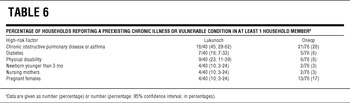
Respondents were surveyed about the incidence of new-onset symptoms consistent with infections that have occurred since the sea-level-rise event. These data were not categorized according to age. Many respondents described an increase in the incidence of such infections after the sea-level-rise event, although this frequency was not measured. Table 5 lists the percentages of households reporting at least 1 case of new-onset illness since the March 5, 2007, event. Table 6 lists the percentages of households reporting a preexisting chronic illness or vulnerable condition among household members.
Table 5. Percentage of Households Reporting at Least 1 Case of New-Onset Illness Since the Sea-Level-Rise Eventa

Percentage of Households Reporting a Preexisting Chronic Illness or Vulnerable Condition in at Least 1 Household Membera

DISCUSSION
The impact of the sea-level rise that occurred in the FSM seems to follow a pattern that has been predicted by experts to be a result of climate change. Global warming is predicted to result in an increase in the number and severity of many extreme weather and sea-level rise events. It is considered likely that a trend of increased incidence of extremely high sea levels has already occurred during the late 20th century and will continue through the 21st century as a result of climate change.2 The following trends are projected with high confidence2:
• Coasts will be exposed to such increasing risks as coastal erosion due to climate change and sea-level rise.
In low-latitude regions, crop productivity is expected to decrease, thus increasing the risk for hunger, particularly in Africa and Small Island Developing States.
By 2020, between 75 and 250 million people will be exposed to decreased sources of water as a result of droughts and sea-level rise.
The communities predicted to be most vulnerable to climate change are the poor coastal communities that are dependent on local water and food sources.23
Demographics
The population of Lukunor atoll can be generally described as young and impoverished. Inhabitants working within such a cash-poor subsistence economies could easily be expected to place in the lowest World Bank gross domestic product category (<$976 per year).4
On Lukunoch, 45% of the study population was younger than 18 years. On Oneop, this number was even higher, constituting 54% of the population. In comparison, the relative proportion of this age group in the population is double that for the same age group in the United States (21%).5 The proportion of the study population older than 60 years was 5% on Lukunoch and 4% on Oneop (comparable to the national estimate of 5%).6 This proportion is 3 times smaller than that of the same age group in the United States.
Structural Losses
Structural damage seems limited and involved mostly simply constructed open wells and traditional thatch “local houses” that were hand constructed of traditional materials and primary residences made of concrete and/or wood. Wells described as damaged were contaminated by salination and contained brackish water, but well structures were not physically disrupted.
Food Losses
The USFS agricultural assessment of the islands of Lukunoch and Oneop confirmed the loss of nearly all standing taro crops and many of the breadfruit trees on both islands. Livestock (mostly chickens and pigs) seemed mildly affected in the short-term but could be expected to compete with wildlife and humans for limited food and water sources in the future. Respondents described coping mechanisms that included a diet mostly composed of fish and coconut, supplemented on occasion with a few garden vegetables and (less preferably) with foraged greens. Respondents also reported eating partially rotted taro.
The USFS agricultural experts inspecting food availability on Lukunoch and Oneop found that no household food stores were present and expect crop production to be very low for the next several years before sufficient rainfall adequately dilutes the salinated island soil. The US Geological Survey estimates that it will likely require 1 year of normal rainfall to replenish the freshwater aquifer lens of these affected islands. It was deemed that anthropometric measurement would not add significantly to the evidence of major losses to the primary food supply of these populations.
Water Quantity and Quality
Access to fresh water for cooking, drinking, and hygiene did not seem to be a substantial public health concern among the populations of Lukunoch and Oneop. Lukunoch and Oneop households reported average daily water consumption less than the internationally accepted daily water ration for humanitarian assistance.7 However, these amounts may also represent adequate quantities of water consumed through ingestion and cooking. It is difficult to interpret reports of low consumption when much of the water requirements for cleaning and hygiene are also easily met by way of quick access to the ocean and salinated wells as sources of “gray water.” At the present levels of normal rainfall, even a poorly efficient use of water catchment systems seemed able to sustain the population's current needs for potable water. However, the island is now more vulnerable to water stress in the future because the contaminated aquifer is no longer available as a reserve during drought. Drought is also expected to occur in Micronesia with greater frequency and severity in the future as a result of climate change.3
Water quality did not seem to pose a significant health hazard to the disaster-affected populations at the time of this assessment. Nearly half of the households in Lukunoch reported using water purification techniques. Almost all households on Oneop reported treatment of their drinking water. The US Geological Survey tested the salinity of the water aquifer on Lukunoch and Oneop islands 10 weeks postinundation and found both island aquifers to be 7 times higher than accepted US drinking standards.8 The palatability of the ground water was poor; however, it was still being used for drinking. There is limited expected health impact from drinking the brackish tasting water.
Hygiene
Households from both islands reportedly used approximately half the soap than is currently recommended during an acute health emergency.7 This seems to be an indigenous practice, not impacted by the disaster event. During emergency conditions, however, hand washing is known to prevent the spread of skin, respiratory, and diarrheal infections.Reference Watson, Gayer and Connolly9Reference Malilay10Reference Noji11 This practice may make this population more vulnerable to outbreaks and future such disasters.
Sanitation
Although less than adequate for effective disease control, sanitation measures on Lukunoch and Oneop seemed unaffected by the sea-level-rise event. More than half of all households surveyed on both islands had toilet practices that resulted in the deposition of sewage on the open land or on the nearby beach or atoll reef. This indigenous practice may place inhabitants at higher risk for fecal-oral transmission of gastrointestinal infections on a regular basis, not merely after disasters.Reference Watson, Gayer and Connolly9
Health Status
Mortality
The death of 2 infants (one 6-month-old and one 5-month-old) is notable and deserves further surveillance to better establish the comparability of this statistic with baseline mortality rates that are not currently available for this population.
Morbidity
As illustrated in Table 5, a majority of households reported a new onset of multiple cases of illness consistent with skin, respiratory, and gastrointestinal infections occurring during the 10 weeks following disaster impact. However, preimpact baselines are unknown for the islands.
Many households included members of vulnerable populations known to be more susceptible to disaster-related morbidity and mortality.Reference Watson, Gayer and Connolly9Reference Malilay10Reference Noji11 These populations included people with chronic illness such as emphysema, asthma, and diabetes. The survey population also included people who require special care or feeding, such as physically disabled people, pregnant females, nursing mothers, and newborns. These factors may contribute to the overall vulnerability of these populations to future disasters.
Subsequent Reports of Other Sea-level Disasters in the Region
Since this March 2007 event, the US Federal Emergency Management Agency has performed 2 more preliminary damage assessments for sea-level-rise events: another in Micronesia in 2008, and one in the nearby Republic of Marshall Islands in 2009.Reference Jaynes12 On December 8 through 12, 2008, islands throughout all 4 states of FSM experienced widespread ocean inundation. The traditional chief of Kapingamarangi (a coral atoll located 300 miles south of Lukunoch and Oneop and severely impacted by the 2008 event) estimated that 90% of the taro was lost during the flooding there, a degree of crop loss similar to the magnitude that USFS experts observed on Lukunoch and Oneop just 18 months earlier.Reference Jaynes12
LIMITATIONS
Although this case report is less scientifically rigorous than controlled data involving a larger sample, it may be argued to have scientific value in that it permits reporting of new health effects with a high sensitivity for detecting novel situations (like climate change) in which historical precedence does not exist. The results of this survey are limited as a result of several sources of potential bias. First, the relatively small sample of the population on Lukunoch precludes accurate interpretation of those data. However, findings using an acceptable sample size on Oneop were consistent with results from the Lukunoch survey. Case reports are also commonly associated with recall bias. However, respondent replies regarding loss of food and water resources were verified by direct physical inspection by USFS and US Geological Survey experts. Finally, it is not possible to accurately interpret trends among morbidity and mortality data among such a small population and in the absence of preevent baseline health information for comparison.
CONCLUSIONS
On March 5, 2007, an acute-onset, sea level rise event resulting in coastal erosion, shoreline inundation, and saltwater intrusion occurred in two coral atoll islands of Micronesia. The findings of this study suggest that highly vulnerable populations of both Lukunoch and Oneop islands experienced disastrous losses in crop productivity and freshwater sources. While it is not possible to extrapolate the results of this study to all SIDS in general, the findings associated with this event are consistent with events that have been predicted to occur as a result of climate change.Reference Sorensen, Weisman and Lennon12 These findings reveal the need for effective public health research and sustainable interventions that will monitor and shape the health of small island populations predicted to be at high risk for adverse health effects due to climate change.
RECOMMENDATIONS
Effectively addressing the health risks of cli¬mate variability and change will require wide-ranging responses from federal and state agencies and departments. Costs would need to be determined by the individual agencies, but would likely exceed $100 million annually.Reference Ebi, Balbus and Kinney13 A comprehensive surveillance and moni¬toring system to address the health risks of climate change is necessary to provide the information needed to implement timely and appropriate programs and activities to reduce the health risks of climate change.Reference Ebi, Balbus and Kinney13 Key public health research categories that address these essential services include surveillance and monitoring; field, laboratory, and epidemiologic research; model development; development of decision support tools; and education and capacity building of the public and public health and health care professionals.Reference Frumkin, Hess and Luber14 The findings of this study suggest that the need for this research has become even more urgent.
Funding/Support: This survey was supported by funds from the Centers for Disease Control and Prevention, Coordinating Office for Terrorism Preparedness and Emergency Response.
Disclaimer: The material in this article reflects solely the views of the author. It does not necessarily reflect the policies or recommendations of the Centers for Disease Control and Prevention or the US Department of Health and Human Services.