Implications
Behavioural synchronization is a well-known phenomenon in gregarious species such as cattle. Behavioural synchronization has mainly been defined as the proportion of animals doing the same thing at the same time. However, the proportion depends on the prevalence of a behaviour. This is not the case with the overdispersion index. The overdispersion index is useful in analysing behavioural synchrony within groups of animals. It helps in estimating the strength of preferential relationship between animals and in improving animal facilities.
Introduction
Animals integrate information from their environment and social partners (Nicol, Reference Nicol1995; Veissier et al., Reference Veissier, Boissy, Nowak, Orgeur and Poindron1998). This may result in synchronization of behaviour within a group of animals either because animals simultaneously receive the same cues (e.g. food distribution or light and dark occurring at the same time for all animals in a group) or because of social facilitation (i.e. an animal engaging in a certain behaviour stimulates the other animals to do the same) (Clayton, Reference Clayton1978; Engel and Lamprecht, Reference Engel and Lamprecht1997). Social facilitation is particularly studied with respect to starting a feeding behaviour. Ponies will eat more when visual contact with other ponies is allowed (Sweeting et al., Reference Sweeting, Houpt and Houpt1985). Initiation of feeding by capuchin monkeys encourages the commencement of feeding in nearby conspecifics (Galloway et al., Reference Galloway, Addessi, Fragaszy and Visalberghi2005). Indeed, hens in battery cages synchronize their behaviour (Webster and Hurnik, Reference Webster and Hurnik1994), pigs synchronize their use of environmental enrichment objects (Docking et al., Reference Docking, Van de Weerd, Day and Edwards2008), ewes synchronize their grazing activities (Rook and Penning, Reference Rook and Penning1991) and cows synchronize their feeding and resting (Bouissou et al., Reference Bouissou, Boissy, Le Neindre and Veissier2001; Šárová et al., Reference Šárová, Špinka and Arias Panama2007).
The environment can affect the level of behavioural synchronization. For instance, cows are more synchronized at pasture than in a barn (O’Connell et al., Reference O’Connell, Giller and Meaney1989; Miller and Wood-Gush, Reference Miller and Wood-Gush1991). Cows prefer to keep a distance of at least 1 m between each other where possible (Sumner, Reference Sumner1991). To maximize their distance in a barn, they might not all perform the same behaviours at the same time, for example, some animals eat in the feeding area, whereas others lie down in the resting area. At pasture, cows have enough space to behave synchronously and still avoid contact (Miller and Wood-Gush, Reference Miller and Wood-Gush1991).
Management routines, such as feeding and milking, can affect the synchronized behaviour of a cow group in a barn. The number of cows eating together is highest immediately after a new distribution of feed (Miller and Wood-Gush, Reference Miller and Wood-Gush1991), and feed competition is most intense within the following 30 min (Friend and Polan, Reference Friend and Polan1974). In a conventional milking system, cows are milked at about the same time and also often are fed after milking at the same time. This may in turn increase their behavioural synchrony. By contrast, automatic milking may help cows to desynchronize their behaviour because milking is spread throughout the day. Indeed, Wagner-Storch and Palmer (Reference Wagner-Storch and Palmer2003) found that in an automatic milking unit the proportion of cows feeding together is lower than in a conventional milking unit. The functional and economic idea often accompanying automatic milking is to promote cows’ individualistic behaviour by having them distribute their activities – feeding, being milked and resting – evenly throughout the day. Individual milking times with an automatic system can reduce rush, aggression and idle standing. Encouraging cows to perform their maintenance behaviours individually has also been the reason behind decreasing the number of roughage feeding places in automatic milking units (Wagner-Storch and Palmer, Reference Wagner-Storch and Palmer2003).
Adequate lying time is very important for the welfare of cows. Dairy cows lie down approximately 13 h/day in a cubicle barn, and a lack of cubicles, less than one per cow, diminishes their lying time (Wierenga and Hopster, Reference Wierenga and Hopster1990) and predisposes them to stress (Friend et al., Reference Friend, Gwazdauskas and Polan1979). If the cows are short of time for resources, they are ready to defend their lying time at the expense of social contacts and eating (Munksgaard et al., Reference Munksgaard, Jensen, Pedersen, Hansen and Matthews2005). In addition, cows (Shiyomi and Tsuiki, Reference Shiyomi and Tsuiki1999) and sheep (Michelena et al., Reference Michelena, Gautrais, Gérard, Bon and Deneubourg2008) seem to be closer to one another when resting.
Behavioural synchrony may be costly to an individual if an important activity must be delayed it in order to conform to what the rest of the group is doing (Conradt and Roper, Reference Conradt and Roper2000). The cost of synchronization for an animal may be particularly high if the composition of the group varies, that is, if the members are of different ages, sizes or sex (Conradt and Roper, Reference Conradt and Roper2000). This is normally not the case in dairy cow groups. However, the level of behavioural synchrony varies in gregarious farm animals. Stressors, such as weaning and a lack of familiarity between animals, may modify behavioural synchrony. Veissier and Le Neindre (Reference Veissier and Le Neindre1989) observed that a group of heifers weaned from their dams are more synchronized in their activities than a group of heifers of similar age still with their dams. The strength of the bond between animals in a group also affects behavioural synchrony. In a heifer herd, animals that have known each other from birth spend more time together during feeding and grazing and search for more proximity while resting than heifers with a shorter history together (Bouissou and Hövels, Reference Bouissou and Hövels1976). Social motivation is indeed very important to group cohesion as shown in sheep by Michelena et al. (Reference Michelena, Gautrais, Gérard, Bon and Deneubourg2008).
In order to improve animal facilities, it thus seems important to determine which activities are synchronized and to what extent under different circumstances. However, data collection and recording methods play a key role when planning a new experiment of behavioural synchrony and when selecting the optimal method for measuring the amount of synchrony. We used an overdispersion method to analyse whether cows synchronize their lying behaviour, that is, whether the apparent synchrony is bigger than what could be obtained by chance alone. We also tested whether the synchrony between cows is bigger with conventional milking than with automatic milking with a reduction in the number of lying and feeding places.
Material and methods
Animals and management
The study protocol was approved by the ethics committee for the use of experimental animals at the University of Helsinki. The animals were milking Holstein dairy cows. All animals were housed under the same management and care, at the Suitia Barn, University of Helsinki, Finland. The cows were accommodated in two separate units: 30 cows under conventional milking and 27 cows under automatic milking. Conventionally, milked cows were milked twice daily, between 0500 h and 0600 h and between 1430 h and 1530 h. The cows were collected in the waiting area before the conventional milking commenced. They were then milked in a 2 × 5 herringbone parlour situated beside the unit. By contrast, cows undergoing automatic milking could be milked at 6-h intervals. A cow could walk from the lying area to the feeding area by passing through the milking unit or through an automatic selection gate in case <6 h had elapsed from its previous milking. All cows in the barn were fed ad libitum grass silage and they received concentrates according to their milk production. The silage was distributed twice daily, between 0700 h and 0800 h and between 1500 h and 1600 h. There were 33 roughage feeding places and 33 cubicles available to the 30 cows in the conventional milking unit and 10 roughage feeding places and 27 cubicles available to the 27 cows in the automatic milking unit. The concentrate was based on grain and rapeseed meal. It was provided by automatic concentrate feeders, two for each unit. All cows also received concentrates during milking. In both units, the cubicles had a width of 120 cm, a length of 173 to 227 cm and were equipped with rubber mattresses and littered with wood shavings. The flooring was slatted concrete. All cows had been in their respective milking units for more than 4 months before the start of the study. Cows had no access to a pasture or a yard during the experiment.
Behavioural observations
Behavioural observations were compiled over three consecutive weeks. Cows were observed for 4 days each week. The four 6-h observation periods were as follows: 2400 to 0600 h, 0600 to 1200 h, 1200 to 1800 h and 1800 to 2400 h. Each period was observed three times, once each week, yielding 12 6-h periods and 72 h in total. Both units were observed at the same time by two observers. The periods and units were balanced between the observers. When observing the conventional milking unit, the observer stood on a raised platform in the corridor. Automatically milked cows were observed from a 2-m wide feeding table that was situated in the middle of the unit. Every 5 min, the observer counted the number of cows lying down in a cubicle. The cows were not individually identified.
Statistical analyses
Data were analysed with an SAS 9.1 statistical program. Synchronization of lying behaviour or its opposite pole, independent behaviour, was modelled using binomial distribution. Binomial distribution is possible because the response is binary (1 = animal lying down, 0 = animal not lying down). The total number of lying animals is calculated, and binomial distribution assumes that observations are independent (i.e. behaviour of one animal does not depend on the behaviour of other animals). For binomially distributed data, the variance is np(1−p), where n is the sample size (i.e. number of animals) and p the probability that an animal is lying down. Because the probability is not the same during day and night, the four periods (2400 to 0600 h, 0600 to 1200 h, 1200 to 1800 h and 1800 to 2400 h) were analysed separately. Similarly, probability can vary from week to week, and therefore, weeks were analysed separately. An extra parameter was added to the formula of variance: φnp(1−p). If φ > 1, the variance is bigger than explicable by the binomial assumption. This is known as overdispersion. General linear model (logistic regression with logit-link function) was fitted to estimate p and φ. In practice, analysis was performed using the SAS/Logistic and the following SAS code:

where n is the total number of cows and y is the number of cows lying down. This analysis was repeated for both housing units, for all observation days and for all observation periods. The overdispersion parameter was estimated by the Pearson’s χ 2 statistic divided by its d.f. (Hilbe, Reference Hilbe2009). The option ‘scale = Pearson’ in the SAS code yields the Pearson’s χ 2 statistics and its d.f. The d.f. is the number of observation times minus 1. A numerical example: totally 25 cows are observed five times and the number of cows lying is 10, 11, 15, 21 and 22, which corresponds to high synchronization. The d.f. is 5 − 1 = 4 and Person’s χ 2 statistics is 21.12 according to the SAS/Logistic. The overdispersion parameter is now 21.12/4 = 5.28. Similarly, observations of 10, 11, 15, 15 and 16 cows lying leads to ratio of 4.70/4 = 1.18 when the total number of cows is 25. The relative difference of overdispersion (overdispersion automatic milking − overdispersion conventional milking/overdispersion conventional milking) was calculated and tested by the MIXED procedure of the SAS/STAT software using following model:

where yij is the relative difference of overdispersion, μ is intercept, αi is the random effect of time period (i = 1,…,12), βj is the fixed effect of milking system and εij is residual.
A two-way ANOVA was used to test whether (φ) is >1 on average.
Pearson’s correlation was run between the average percentage of cows lying and overdispersion index.
Results
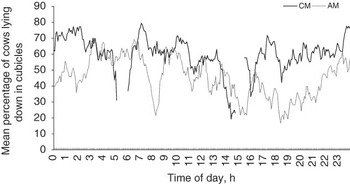
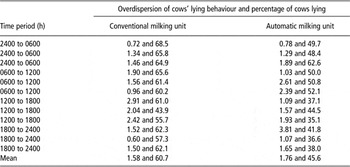
No cow was observed to lie down anywhere other than in the cubicles. The proportion of cows lying down fluctuated between 20% and 80% throughout the day (Figure 1). The average percentage of cows lying down was greater in conventional than in automatic milking unit (60.7% v. 45.6%; Table 1). On average, the overdispersion was 1.67 (s.e. = 0.16). Average overdispersion was significantly >1 (P < 0.01), which is the threshold value of overdispersion under which all synchronization is caused by chance alone. Overdispersion tended to be bigger in automatically than in conventionally milked cows (overdispersion 1.76 v. 1.58; Table 1). The mean relative difference in overdispersion between units was 28% (P = 0.09 for the effect of βj). There was no correlation between the average percentage of cows lying and overdispersion index (r = −0.11, P = 0.60).
Mean percentage of cows lying down in a conventional milking unit (–––; n = 30) and in an automatic milking unit (- - -; n = 27).

Overdispersion of lying behaviour and percentage of cows lying down in a conventional milking unit (n = 30) and in an automatic milking unit (n = 27)

When overdispersion is bigger than one, cows are more synchronized than by chance alone.
Discussion
The overdispersion index was used in this study to estimate the synchronization of lying behaviour between cows in the same group. Like many authors before (Miller and Wood-Gush, Reference Miller and Wood-Gush1991; Krohn et al., Reference Krohn, Munksgaard and Jonasen1992; Ketelaar-de Lauwere et al., Reference Ketelaar-de Lauwere, Ipema, van Ouwerkerk, Hendriks, Metz, Noordhuizen and Schouten1999), we found that synchronization of lying behaviour is a rather constant and important phenomenon in a group of cows.
We found that the proportion of cows lying down does not correlate with the overdispersion index of cows’ lying behaviour. The overdispersion index has several advantages relative to the mere calculation of the proportion of animals doing the same thing at the same time. In the latter, the proportion depends on the prevalence of behaviour. In other words, the more the behaviour is expressed, the greater the chance that a high proportion of animals are simultaneously performing that behaviour (Engel and Lamprecht, Reference Engel and Lamprecht1997). For example, Veissier et al. (Reference Veissier, Le Neindre and Trillat1989) found that the proportion of time engaged in a specific behaviour, the bout length of the behaviour and the number of animals exhibiting the same behaviour, that is, synchronization, are linked. The overdispersion index, by contrast, does not depend on the prevalence of an activity. Rook and Penning (Reference Rook and Penning1991) proposed a method to take into account the amount of synchrony occurring by chance. However, a drawback in this method is that observations need to be recorded for each animal separately to calculate the proportion of synchrony expected by chance using permutations. The overdispersion parameter, in turn, can be estimated easily using the standard statistical software and observations at a group level are adequate.
One caveat of the overdispersion method steams from the binomial process model, which assumes that the probability lying down is constant over the period of interest. In fact, we presumed that animals’ lying needs depend on the time of day, so our solution was to analyse the four 6-h periods separately, instead of one analysis for the whole 24-h period. We used a 5-min sampling interval in this study. However, adequate sampling interval probably should have been longer (Bernstein, Reference Bernstein1991), because our sampling interval was obviously shorter than the average duration of a lying bout. Some autocorrelation between samples may therefore exist (Engel, Reference Engel1996; Jauhiainen and Korhonen, Reference Jauhiainen and Korhonen2005).
Overdispersion can vary for two reasons: (i) random variation in response probabilities (i.e. some animals lie down more than others); and (ii) correlation between binary responses (i.e. synchronization of lying behaviour). The first reason is not relevant for comparing units because cows with different lying needs are present in both units. Thus, if the overdispersion parameter is not the same for both units, a difference in synchronization of lying behaviour exists between the units. Hence, the idea that the number of lying places could be lower in an automatic milking unit than in conventional one is not supported by our results, because lying behaviour of cows tended to be even more synchronized in automatic than in conventional milking unit. Whatever the timing of milking, cows seem to synchronize their lying behaviour.
Cows may synchronize their behaviour because of social facilitation. However, the concept of social facilitation has been introduced to explain why animals start an activity, not why they stop an activity. We evaluated only lying behaviour, that is, the absence of an activity and to our knowledge social facilitation has never been reported in cattle in this context (in sheep, see Gautrais et al., Reference Gautrais, Michelena, Sibbald, Bon and Deneubourg2007). Therefore, the environmental stimuli provided by the timing of milking (conventional milking: simultaneous for all cows or automatic milking: spread throughout the day across cows) or feeding were likely insufficient to modify the lying behaviour of cows, although all the cows milked automatically could not eat at the same time (due to less feeding places than for conventionally milked cows). Nevertheless, the sample studied here, one unit of each type, does not allow us to draw any firm conclusions in this regard.
The overdispersion method does not enable individual animal, that is, initiators or finishers of activities in animal groups, to be evaluated. However, we advocate that the overdispersion index is a well-grounded statistics for measuring behavioural synchrony within groups of animals and testing variation in synchronicity depending on the composition of animal groups (e.g. with varying degrees of familiarity, ages, sex and needs) or environmental factors such as stressors or resources availability.
Conclusion
Overdispersion should become a standard index for analysing the synchrony of behaviour in groups. In our study, cows lied down synchronously in both the conventional and automatic milking unit. The synchrony of lying, calculated by overdispersion, tended to be slightly bigger in automatic milking unit, although the proportion of cows lying down was on average greater in conventional milking unit. Synchronized lying behaviour seems to be a constant pattern in cattle, and thus, cows in all kinds of barns should have the possibility to lie down simultaneously.
Acknowledgements
We are grateful to the staff of the Suitia Barn, Helsinki University, for taking care of the animals. The Ministry of Agriculture and Forestry in Finland is thanked for financing the study.