

INTRODUCTION
Evangelicals are generally seen as orthodox believers who also hold conservative political attitudes. This especially goes for the United States where the bond between evangelicalism and the Republican Party has become stronger since the 1980's. Attracted by the conservative agenda of the Republican Party, evangelicals are not only culturally conservative, especially in their opposition to abortion and homosexuality (cf., for instance, Hunter Reference Hunter1984; Schmalzbauer Reference Schmalzbauer1993; Putnam and Campbell Reference Putnam and Campbell2010, 370–373, 384–388), but also increasingly hold conservative attitudes on economic issues. This kind of economic conservatism comes forward, for instance, in their growing opposition to government interference in the economy or their support for tax reduction (Deckman et al. Reference Deckman, Cox, Jones and Cooper2016). However, while evangelicals' conservative stances on cultural issues like abortion and homosexuality seem part and parcel of their distinctive religious identity, there is evidence that this is less the case for their conservative stance on economic issues. A recent comparison of the political attitudes of evangelicals in the United States and Brazil not only showed that Brazilian evangelicals are significantly less conservative on economic issues than their American coreligionists, but this comparison also revealed that the attitudes of Brazilian evangelicals on economic issues could not be predicted by their level of orthodoxy or level of religious commitment (McAdams and Lance Reference McAdams and Lance2013). These findings suggest that the way in which religion affects the political attitudes of evangelicals is in part dependent on the socio-cultural context they find themselves in.
In order to offer an additional illustration of how the political attitudes of evangelicals may differ according to the socio-cultural context they find themselves in, this study compares political attitudes of evangelicals with the attitudes of mainline Christians and non-church members in the context of the Netherlands. The Netherlands constitutes an interesting context in this respect, because it ranks among the most secular countries in the Western world with nowadays only a quarter of the population reporting to be a member of a Christian denomination (Bernts and Berghuijs Reference Bernts and Berghuijs2016, 23; cf. also Reitsma et al. Reference Reitsma, Pelzer, Scheepers and Schilderman2012). Such a secular context is likely to affect the political attitudes of Dutch evangelicals. For, as Norris and Inglehart (Reference Norris and Inglehart2004, 196–212) already showed, the process of secularization has weakened the relationship between religion and right-wing political orientations in most post-industrial societies, except for the United States. Not only has such a weakened relationship indeed been established for the Netherlands, but previous research has also revealed that even in view of cultural issues, like abortion or euthanasia, Dutch Catholics and mainline Protestants have become more liberal over time. Around 1995, Dutch Catholics and mainline Protestants had even become as culturally progressive or liberal as non-church members were (Scheepers, Peters, and Felling Reference Scheepers, Peters, Felling, Felling, Peters and Scheepers2000), which prompted some researchers to characterize these developments as a process of “cultural homogenization” (Becker et al. Reference Becker, Felling, Peters and Sanders1995). Only between non-church members, Catholics, and mainline Protestants, on the one hand, and the small proportion of orthodox Protestants, on the other, a cultural gap persisted.
Contrary to the United States, then, in the Netherlands there is no strong relationship between religion and conservative political attitudes; nor do orthodox believers constitute such a large proportion of the total number of Christians in Dutch society, although their relative number has been increasing due to the massive disaffiliation among Catholics and mainline Protestants.Footnote 1 Dutch evangelicals thus find themselves in a specific, very secular socio-cultural context although, as a result of the fragmented political landscape of the Netherlands, they are not without political influence. After the recent general elections, there are now three Christian parties represented in Dutch parliament. The Christian Democratic Party is the largest Christian party in the Netherlands. It has 19 of the 150 available seats in parliament and combines a conservative economic agenda with also a more liberal stance on certain cultural issues like, for instance, gay rights. With three seats in parliament, the Reformed Political Party is the smallest Christian party. It combines a conservative position on issues of migration or the presence of Islam with a conservative stance on issues like abortion, euthanasia, or homosexuality. In between is the Christian Union. This political party has five seats in parliament and combines a liberal, leftist economic agenda with a conservative stance on pro-life issues and homosexuality. While the electorate of the Christian Democratic Party mainly consists of mainline Protestants and Catholics and the electorate of the Reformed Political Party of specific segments of orthodox Protestantism, the Christian Union is most popular among evangelicals.
This specific background makes it interesting, we propose, to compare political attitudes of Dutch evangelicals with those of mainline Christians and non-church members and to examine to what extent their attitudes are really determined by their religious identity. Therefore, the following research questions are addressed in this study: (1) Do Dutch evangelicals hold more conservative political attitudes on economic and cultural issues than Catholics, mainline Protestants, and non-church members? and (2) Which decisive factors determine the supposed conservatism among Dutch evangelicals as compared to Catholics, mainline Protestants, and non-church members? By answering these questions, we intend to gain more insight in the way a very specific religious group, which is generally known as conservative and reactionary (cf. for instance, McGrath Reference McGrath1995; Boersema Reference Boersema and Erik2005; Stanley Reference Stanley2013), relates its religious convictions to certain political attitudes in the context of a modern, secular society like the Netherlands. Thus, we aim to fill a lacuna in previous knowledge, by adding insights on the political attitudes of evangelicals in a secular country.
THEORETICAL FRAMEWORK AND HYPOTHESES
We address both research questions by deriving several hypotheses from previous theoretical insights, which we, subsequently, test. Our first hypothesis relates to the first research question and regards the conservatism of evangelicals concerning economic and cultural issues. Conservatism is actually an ambiguous label. It concerns the appreciation of individual freedom, but this appreciation differs for the economic and the cultural domain (Felling and Peters Reference Felling and Peters1984; Middendorp Reference Middendorp1991; Scheepers, Peters, and Felling Reference Scheepers, Peters, Felling, Felling, Peters and Scheepers2000). Within the economic domain, a conservative position entails a positive appreciation of individual freedom. This political stance is, for instance, indicated by support for the free-market system, support for tax reduction or by opposition to government interference to stimulate individual entrepreneurship and economic growth. From a conservative view it is, furthermore, acknowledged that all of this may result in socio-economic inequality. However, this socio-economic inequality is considered to be an inevitable by-product of economic growth and thus a conservative position in the economic domain is also accompanied by a critical stance toward the provision of social services to alleviate poverty as well as by a critical view on the government's responsibility to reduce income differences (Felling and Peters Reference Felling and Peters1986; cf. also, Deckman et al. Reference Deckman, Cox, Jones and Cooper2016). Within the cultural domain, in contrast, conservatism relates to moral conservatism and actually boils down to support for the restriction of individual freedom. This political stance is, for instance, indicated by support for the restriction of civil liberties like the freedom of speech, by opposition to abortion, euthanasia, and suicide (so-called pro-life issues), as well as by the rejection of homosexual relationships and by a traditional view on the family as the only legitimate way of cohabitating (Becker et al. Reference Becker, Felling, Peters and Sanders1995). Now, as we will explain in more detail in the method section, in order to study the political attitudes of Dutch evangelicals we used existing, and in the Netherlands widely used, measures originally designed by the Dutch political scientist Middendorp (Reference Middendorp1991). As a result, we focus on attitudes toward the reduction of income differences as far as the economic domain is concerned, while we focus on attitudes toward pro-life issues and homosexual relationships when it comes to the cultural domain.
But do we expect to find differences in political attitudes between evangelicals, mainline Christians, and non-church members for both the economic and the cultural domain? Previous research is far from conclusive when it comes to the relationship between evangelicalism and cultural and especially economic conservatism. Deckman et al. (Reference Deckman, Cox, Jones and Cooper2016) have recently shown that American evangelicals have become more conservative over time in both the cultural and the economic domain. But this picture is different for Brazilian evangelicals, who are as conservative as their American coreligionists on cultural issues but not on economic issues (McAdams and Lance Reference McAdams and Lance2013). This difference has also been found between American and Canadian evangelicals (Bean Reference Bean2014a; Reference Bean2014b). Furthermore, Deckman et al. (Reference Deckman, Cox, Jones and Cooper2016) also explained that the growing economic conservatism among American evangelicals is a relatively recent phenomenon, related to the emergence of the Tea Party over the past decade. However, there is no such thing as a “natural affinity” between evangelicalism and right-wing politics or the moral majority. Swartz (Reference Swartz2012) pointed out that during the 1960s and 1970s, a substantial number of evangelicals even supported the Democratic Party and a more leftist political agenda.
When it comes to the Netherlands, previous research has only established a link between religion and cultural conservatism, but no clear link between religion and economic conservatism. Economic conservatism, Scheepers, Peters, and Felling (Reference Scheepers, Peters, Felling, Felling, Peters and Scheepers2000, 144) found, is particularly shaped by social class and education not by religious affiliation. In addition, the study of Stoffels (Reference Stoffels1990, 104–106), which is the only empirical study into the values and attitudes of Dutch evangelicals to date, even showed that evangelicals are slightly more liberal in their view on economic issues, like the reduction of income differences, compared to the Dutch population, while they are indeed far more conservative in their views on pro-life issues and homosexuality. Apart from these research results, in the Netherlands there is also no general negative perception of the welfare state as merely entailing support for the “underserving” poor. Such an anti-welfare state sentiment does prevail in the United States and is an important determinant, Bean (Reference Bean2014a, 112–132) argues, for the economic conservatism of American evangelicals who perceive government aid to the poor as a decline of religion's public role and as a denial of accountable individualism. In the Netherlands, in contrast, the rapid expansion of the welfare state after the Second World War is seen as an important expression of state sponsored, collective solidarity with traditionally only a marginal role for charitable organizations and churches. Although from the mid-1980's onward there has been a gradual shift from an emphasis on collective solidarity to individual responsibility, there is still a general consensus that the state should guarantee a social minimum for those who are in real need (Van Oorschot Reference Van Oorschot2006). This more positive appreciation of the welfare state as, at the bottom line, a matter of solidarity with the (real) poor, is similar to the way the welfare state is perceived in Canada where this more positive appreciation, as Bean (Reference Bean2014a; Reference Bean2014b) shows, urges evangelicals to take up their religious responsibilities toward the poor. Following these insight and research findings, we propose that differences between the political attitudes of evangelicals and other religious and non-religious groups in the Netherlands, will specifically relate to the cultural domain and especially to those moral issues where religion, both in the United States (Putnam and Campbell Reference Putnam and Campbell2010, 384–395) and the Netherlands (Scheepers, Peters, and Felling Reference Scheepers, Peters, Felling, Felling, Peters and Scheepers2000, 155), traditionally matters most: i.e., abortion and homosexuality. Hence, we hypothesize that:
Hypothesis 1:
Evangelicals will hold more conservative views on pro-life issues and homosexual relationships as compared to Catholics, mainline Protestants and non-church members, but they will not hold more conservative views on the reduction of income differences.
Regarding our second research question, we test four additional hypotheses based on two theoretical perspectives. In order to account for the assumed conservatism among Dutch evangelicals, we first adopt a socialization-theoretical perspective and focus on the family as the primary socialization context. The importance of the family in view of the transmission of religious as well as political convictions is well established (Troll and Bengtson Reference Troll, Bengtson, Burr, Hill, Nye and Reiss1979). When it comes to religion, research has convincingly shown that the religious commitment of parents positively affects the religiosity of their children (cf. for instance, Hoge and Petrillo Reference Hoge and Petrillo1978; Hunsberger and Brown Reference Hunsberger and Brown1984; Myers Reference Myers1996, and for the Dutch context, Andree Reference Andree1983; Vermeer, Janssen, and de Hart Reference Vermeer, Janssen and de Hart2011). This relationship is usually that strong, that being raised by religious parents in a religious family environment can be considered a necessary, though not sufficient, condition for the child's religious commitment in later life. However, parents do not only transmit their religious convictions to their children, but their political convictions as well. For the Netherlands, Need (Reference Need1997) has shown that children mostly follow the political preferences of their parents, also in their voting behavior. In addition, she has also shown that the religious background of parents plays a role here as well: the religious background of parents affects their own voting behavior, which, subsequently, affects the voting behavior of their children. Thus, she detected an indirect, religious and intergenerational effect on voting behavior, which appeared to be strongest among orthodox Protestants. A similar, indirect effect was found by Volleberg, Iedema, and Raaijmakers (Reference Vollebergh, Jurjen, Quinten, De Witte and Scheepers1999) in a longitudinal study into the transmission of conservative attitudes among Dutch adolescents and their parents. Their study revealed that parents who regularly attend church also hold more conservative attitudes concerning alternative forms of cohabitation, like homosexual relationships, which in turn endorses a similar conservative stance among their children. Thus, we believe it is plausible to assume, that there is a relationship between being socialized in a religious family and holding conservative political attitudes on certain cultural issues, especially among more orthodox Christians like evangelicals.
Furthermore, research into religious socialization has also shown that not all religious activities are equally important here. Children are more likely to adopt the religion of their parents and to maintain their religious commitment in later life, if they were socialized in a family in which church attendance, prayer, or Bible readings were regular religious activities. In contrast, parents who were just nominal church members, or who only discussed religious matters with their children, are significantly less successful in transmitting their religious identity on to their children (Hoge and Petrillo Reference Hoge and Petrillo1978; de Hart Reference De Hart1990; Vermeer, Janssen, and de Hart Reference Vermeer, Janssen and de Hart2011). Together with the view that processes of religious socialization may also affect one's political attitudes, these insights result in the following hypothesis:
Hypothesis 2:
Evangelicals who grew up in an overt religious family environment will hold more conservative views on pro-life issues and homosexual relationships, but they will not hold more conservative views on the reduction of income differences.
Our second theoretical perspective is the subcultural identity theory of religious strength, advanced by Smith (Reference Smith1998). This theory consists of a number of propositions Smith uses to explain the strength and vitality of evangelicalism in the United States. At the core of this subcultural identity theory is an alternative appreciation of cultural and religious plurality. In the 1960s and 1970s of the previous century, plurality was considered a threat to religion. It was seen as one of the major causes of secularization, since plurality results in the loss of an overarching religious plausibility structure, as Berger (Reference Berger1973) explained in one of his early works on secularization. This line of reasoning is turned upside down by Smith. Within the framework of his subcultural identity theory, cultural and religious plurality is no longer seen as a threat, but as an opportunity: it offers religious groups the opportunity to distinguish themselves from other groups and to sharpen their own religious identity. Subcultural identity theory thus is clearly indebted to social identity theory, which states that social groups construct their own identity on the basis of a comparison with positive and negative ‘reference groups' (cf. Tajfel Reference Tajfel1981; Reference Tajfel1982). A culturally and religiously plural environment, which is one of the hallmarks of modern society, in this way enhances the “(…) sociological capacity of religions to survive and thrive in the modern world — particularly those which are well-equipped culturally to construct distinctive subcultural identities” (Smith Reference Smith1998, 111). This also explains the relative success of evangelicalism, according to Smith. Evangelical congregations are able, far better than mainline denominations, to construct and articulate a subcultural identity, which separates them from other religious groups and reinforces their internal strength.
On the basis of subcultural identity theory, we test four more hypotheses. The first hypothesis relates to two important characteristics of evangelicalism: an emphasis on the absolute authority of the Bible and an emphasis on the cross of Christ as the necessary and sufficient basis of salvation (McGrath Reference McGrath1995, 59–68). Although evangelicalism is not a well-defined religious movement, the belief that the Bible contains the literal word of God and that salvation is only possible through the redemptive work of Jesus Christ is widespread among evangelicals (cf. for instance, Kellstedt and Smidt Reference Kellstedt and Smidt1991; Vellenga Reference Vellenga1991, 9–11). Both beliefs can be considered important evangelical identity markers, which also give present-day Dutch evangelicals a distinctive subcultural identity. Today, only a small proportion of the Dutch, viz. 14%, believes that the Bible contains the word of God, while only 23% believes that Jesus Christ is the son of God (Bernts and Berghuijs Reference Bernts and Berghuijs2016, 67–68, 220). Hence, Dutch evangelicals appear to be far more orthodox in their view on the Bible and the redemptive work of Jesus Christ as compared to the overall Dutch population and even compared to Catholics and mainline Protestants. Holding these more orthodox views thus is a distinctive characteristic of Dutch evangelicals. Since these views are found to be important predictors for conservative attitudes in the cultural domain among American evangelicals (McAdams and Lance Reference McAdams and Lance2013), we propose with regard to their Dutch counterparts that:
Hypothesis 3:
Evangelicals who believe that the Bible contains the literal word of God or that salvation is only possible through Christ will hold more conservative views on pro-life issues and homosexual relationships, but they will not hold more conservative views on the reduction of income differences.
However, given the fact that the aforementioned evangelical identity markers most clearly distinguish evangelicals from Catholics and mainline Protestants (Bernts and Berghuijs Reference Bernts and Berghuijs2016, 67–68), we additionally assume that especially these specific beliefs explain why evangelicals are more culturally conservative than Catholics and mainline Protestants. Thus, we hypothesize:
Hypothesis 4:
The belief that the Bible contains the literal word of God or that salvation is only possible through Christ has a stronger effect on the cultural conservativism of evangelicals than on the cultural conservatism of Catholics and mainline Protestants.
In the case of evangelicalism, a subcultural identity not only relates to upholding certain distinctive beliefs, but it also involves an orientation toward certain parachurch organizations. Smith (Reference Smith1998; cf. also, Stanley Reference Stanley2013, 29–36) shows that the emergence and success of the evangelical movement in the United States is also partly due to a certain degree of institutionalization, like: the establishment of theological seminaries, publishing houses, newspapers, and broadcasting companies. Such a process of institutionalization has also been important in the Netherlands for the emergence and continuation of the evangelical movement. Especially the establishment of the Evangelical Broadcasting Organization in 1967 turned out to be a milestone in the history of Dutch evangelicalism (Boersema Reference Boersema and Erik2005). In this way, a subcultural network of evangelical organizations, or an evangelical “pillar,” arose in the Netherlands, which was important in endorsing and spreading evangelical beliefs. A network of subcultural organizations thus may be important to prevent the accommodation to the surrounding culture and to stimulate subcultural persistence (Hippe and Lucardie Reference Hippe and Lucardie1998). On the basis of these insights we hypothesize that:
Hypothesis 5:
Evangelicals who are a member of the Evangelical Broadcasting organization or who read a Christian newspaper will hold more conservative views on pro-life issues and homosexual relationships, but they will not hold more conservative views on the reduction of income differences.
Our final hypothesis concerns the idea that the aforementioned hypotheses of having a distinctive subcultural identity may be muted by socio-economic status. Having a higher education, a higher income or even a paid job could mean that evangelicals have been exposed to the secularism and liberalism of the dominant culture at the cost of their support for the conservative ideology of their own subculture. This idea is tested by Schmalzbauer (Reference Schmalzbauer1993) who reported mixed results. With regard to the attitude toward homosexuality, evangelicals with a higher socio-economic status, the so-called “new class” evangelicals, were as conservative as lower class evangelicals. But with respect to a pro-life issue like abortion, Schmalzbauer indeed found that evangelicals with a higher socio-economic status were less conservative. More recently, Deckman et al. (Reference Deckman, Cox, Jones and Cooper2016) also pointed at the influence of personal economic circumstances, which prompted lower class evangelicals to take a less conservative stance when it comes to government interference in the economy. Thus, it is plausible to propose that a higher socio-economic status mitigates the power of a religious subculture to shape political attitudes. Therefore, our final hypothesis reads:
Hypothesis 6:
Evangelicals with a higher socio-economic status will hold less conservative attitudes on pro-life issues, homosexual relationships as well as on the reduction of income differences.
DATA AND MEASUREMENT
Sample
In order to test our hypotheses, we compare data from two subpopulations: evangelicals and respondents from a previously conducted national survey. The evangelical respondents were gathered by way of purposive sampling. In the Netherlands, citizen registries do not contain information on religious affiliation nor are all evangelical congregations united under a single denominational umbrella, which makes random sampling of evangelicals impossible. As an instance of purposive sampling, we first conducted an extensive web search and specifically looked for large thriving congregations, serving around 1000 attendees or more in an average week, whose mission statements are in line with the six fundamental convictions of evangelicalism listed by McGrath (Reference McGrath1995, 55–66): ascribing absolute authority to Scripture, affirming the majesty of Jesus Christ, recognizing the work of the Holy Spirit, stressing the need for personal conversion, giving priority to evangelism and being committed to the Christian community. In addition, we also examined whether these congregations exhibit such specific features like: no traditional church building, no traditional liturgy, services consisting mainly of singing songs of praise and a lengthy sermon, the use of pop/rock music et cetera. In the autumn of 2014, we had identified 12 congregations fitting our profile spread across the Netherlands except for the Southern provinces which are predominantly Catholic. Next we contacted the leadership of these congregations and asked if they were willing to participate in our research by distributing a link to an online questionnaire among their membership and/or attendees of 18 years or older. Eventually, six congregations participated and distributed this link during the period November 2014 – January 2015. This resulted in a total of 584 evangelical respondents who filled in our online questionnaire.Footnote 2 However, since we used a non-probabilistic sampling method (purposive sampling), we cannot tell to what extent this sample is representative for the total population of evangelicals in the Netherlands. Nevertheless, a comparison of the demographic profiles of the evangelicals in our sample and those that participated in the study of Stoffels (Reference Stoffels1990), until today the only available large-scale quantitative study into the beliefs and values of evangelicals conducted in the Netherlands, hardly reveals any differences and even confirms the relatively high socioeconomic status of the evangelicals in our sample in terms of education and to a lesser extent of income.
To be able to compare these evangelical respondents to Catholics, mainline Protestants, and non-church members, we also distributed the link to our online questionnaire among a representative sample of the Dutch population. This sample was drawn in 2011 in view of the “Religion in Dutch society 2011–2012” survey with previous waves of data collection in 1980, 1985, 1990, 1995, 2000, 2005 (cf. Eisinga et al. Reference Eisinga, Kraaykamp, Scheepers and Thijs2012). In January 2015, a letter of invitation to participate in our research was sent to 918 respondents who had stated in 2011–2012 that they were willing to participate in future research. This resulted in a total of 336 completed questionnaires, while 39 letters were sent back to us because the address was wrong or the respondent had deceased. In view of this response rate of 36.6%, we checked to what extent this new sample is (still) comparable to the original sample. A comparison of such general characteristics as education, marital status and income, characteristics which in the Netherlands have also been found to relate to conservative political attitudes (Vollebergh, Iedema, and Meeus Reference Vollebergh, Iedema and Meeus1997), shows that this is not entirely the case. Chi-square tests reveal that our new panel contains less lower educated and more higher educated respondents, more married respondents and less singles as well as less respondents in the lower income category. Thus, we decided to include marital status as a control variable in our study next to gender and age, while education and income are already included to test our sixth hypothesis.Footnote 3
Dependent Variables: Political Attitudes
We examine attitudes about one issue concerning the economic domain, i.e., the reduction of income differences, and two issues concerning the cultural domain: pro-life issues and homosexual relationships. We measured these attitudes using previously validated, and in the Netherlands widely used, instruments (Felling and Peters Reference Felling and Peters1984; Reference Felling and Peters1986; Middendorp Reference Middendorp1991, 98–103; cf. also, Eisinga et al. Reference Eisinga, Kraaykamp, Scheepers and Thijs2012, 44–48).
The attitude toward the reduction of income differences is measured with three questions. The first question inquires after the respondents' attitude toward class differences and the role of trade unions in this respect and comprises four items, like: “Trade unions have to adopt a much harder line if they really are to promote workers' interests” or “Differences between classes ought to be smaller than they are at present.” The original five point response scale was collapsed into three categories: (1) agree, (2) agree/disagree, and (3) disagree. The second question concerns the respondents' opinions regarding the reduction of income differences. Response categories were (1) income differences should decrease, (2) should stay the same, and (3) should increase. The third question inquires after the respondents' opinions regarding active government interference in order to reduce income differences. Response categories were (1) in favor, (2) no opinion, and (3) against. On the basis of factor analysis one item was removed, resulting in a final five item scale to assess the respondents' attitudes toward the reduction of income differences (explained variance 53.6%, Cronbach's alpha 0.77). For each respondent with scores on all five items an overall score was calculated by counting all conservative responses. With regard to income differences, then, a conservative attitude means that one is not in favor of reducing class differences, that one thinks that income differences should increase, and that the government should not interfere in order to reduce income differences. Thus, the scale for the attitude toward income differences runs from (0) not a single conservative answer to (5) all answers are conservative.
The attitudes toward pro-life issues were measured with five questions concerning the following issues: family planning, abortion, active euthanasia, and suicide (Cronbach's alpha 0.74). For example, the question with regard to family planning read: “A married couple chooses to have no children even though there are no medical reasons why they should not. Can you accept such an attitude or do you consider this unacceptable?” Response categories were (1) acceptable, (2) unacceptable, and (3) no opinion. For each respondent with scores on all five questions, an overall score was calculated by counting all conservative answers; i.e., the times a respondent indicates that the respective issues are unacceptable. Thus, the scale for the attitude toward pro-life issues runs from (0) all issues are acceptable to (5) all issues are unacceptable.
Finally, the attitude toward homosexual relationships was assessed by asking: “Do you consider the following way of cohabitation acceptable or not: living together as a homosexual with a steady partner?” Respondents could answer on a scale ranging from (1) very acceptable to (5) very unacceptable.
Independent Variable: Religious Affiliation
Respondents of the evangelical subpopulation were offered a list of nine evangelical congregations and were asked if they consider themselves to be a member of one of these congregations. If so, they were labelled evangelical. Respondents of the sample of the Dutch population were asked if they consider themselves to be a member of a Christian denomination and, if so, if they could indicate their religious affiliation on a list of 11 Christian denominations. Respondents who indicated to be a member of an evangelical congregation were also labelled evangelical, while the other respondents, after the remaining 10 denominations were collapsed into three categories, were labelled Catholic, mainline Protestant, and orthodox Protestant.Footnote 4 Respondents of the sample of Dutch population who indicated to be a non-church member were labelled none.
Independent Variables: Family Religious Socialization
In order to assess if the respondents were raised in an overt religious family environment, nine questions were used. Respondents could indicate if they were raised in a religious way and if a religious upbringing was important at home on a scale ranging from (1) not at all/very unimportant to (5) very religious/very important. Next to these questions another set of five questions inquired after religious practices taking place in the family context. Respondents could indicate their level of juvenile church attendance as well as the level of church attendance of their father and mother when they were 12 to 15 years old on a scale ranging from (1) almost never to (4) about once a week. In addition, respondents could also indicate if prayer and Bible reading were regular activities in their homes on a scale ranging from (1) never to (7) several times a day. Finally, it was assessed if both parents were evangelicals when the respondents were 12 to 15 years and if the respondents were deliberately, i.e., for religious reasons, sent to a religiously affiliated, secondary school by their parents.Footnote 5
Independent Variables: Evangelical Subcultural Identity
The respondents' evangelical subcultural identity relates to four aspects: having a literal understanding of the Bible, having a mono-religious orientation, reading a Christian newspaper, and membership of an evangelical broadcasting company. In order to assess the respondents' view on the Bible, they were offered four statements concerning the Bible and were asked with which statement they agreed most. If respondents agreed most with the statement “From cover to cover the Bible contains the infallible word of God,” respondents were labelled as having a literal understanding of the Bible (Stoffels Reference Stoffels1990, 151). The respondents' mono-religious orientation was measured with help of a scale comprising three items like: “Only in Christianity do people have access to true salvation” (Vermeer and Van der Ven Reference Vermeer and Van der Ven2004). Response categories ran from (1) strongly disagree to (5) strongly agree. For each respondent, a mean score for all three items was calculated (Cronbach's alpha 0.94). Apart from assessing these beliefs, we also asked if the respondents read one of the three major Dutch Christian newspapers and if they are a member of the Evangelical Broadcasting Organization.
Independent Variables: Socioeconomic Status
Socio-economic status refers to employment status, income and education. Employment status was measured with the help of the question: “Do you have a paid job at the moment?” Response categories were (0) no and (1) yes. Income regards the gross family income and was collapsed into the categories (1) lower income (2.000 Euro or less), (2) middle income (between 2.000 and 2.500 Euro), and (3) higher income (2.500 Euro or more). Education concerns the highest education completed and was collapsed into three categories (1) lower education (highest education is lower vocational school), (2) middle education (from lower secondary school to secondary vocational school), and (3) higher education (from O levels to PhD or doctorate).
Control Variables
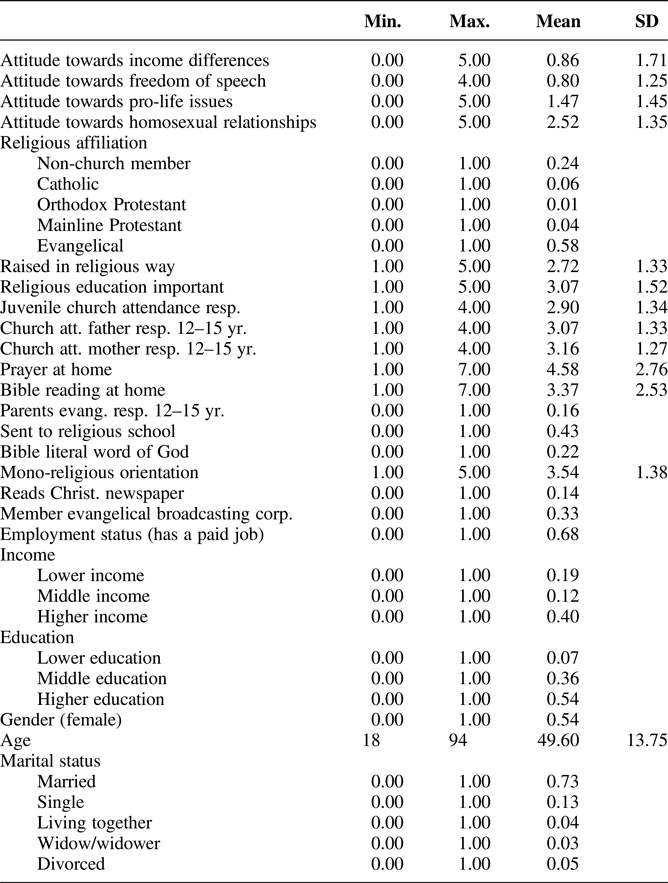
Gender relates to (0) male and (1) female. Age is 2014 minus the respondent's year of birth. Marital status relates to (1) married, (2) unmarried/single, (3) living together, (4) widow/widower, and (5) divorced. The descriptive statistics of all variables are presented in Table 4 in the Appendix.
RESULTS
Mean Scores Political Attitudes
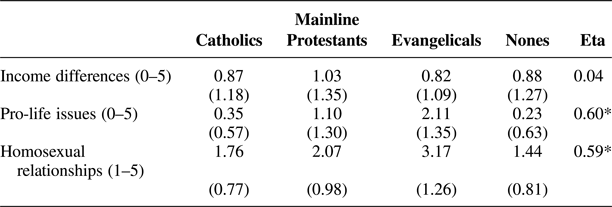
Table 1 compares the political attitudes of evangelicals with the attitudes of Catholics, mainline Protestants, and non-church members (nones). When it comes to the economic issue of the reduction of income differences, there are no significant differences between the four groups (F (3, 691) = 0.399, p > 0.05). None of the groups thinks that income differences should not be reduced with evangelicals even being the most in favor of reducing income differences. However, strong differences come forward with regard to pro-life issues and the acceptance of homosexual relationships. With regard to pro-life issues, evangelicals clearly are the most conservative. Evangelicals consider these issues (i.e., family planning, abortion, active euthanasia, and suicide) significantly more unacceptable than Catholics, mainline Protestants and nones (F (3, 701) = 129.957, p < 0.001), although also mainline Protestants differ significantly from the nones in this respect. This also goes for the acceptance of homosexual relationships. Again, evangelicals are the most conservative and they differ significantly from all other groups, but also mainline Protestants differ significantly from the nones when it comes to the acceptance of homosexual relationships (F (3, 644) = 110.884, p < 0.001).
Means of political attitudes concerning income differences, freedom of speech, pro-life issues and homosexual relationships for Catholics, mainline Protestants, Evangelicals, and nones (SD)
*p < 0.001.
These results confirm hypothesis 1. Evangelicals do indeed hold more conservative views than Catholics, mainline Protestants, and non-church members on such cultural matters as pro-life issues and homosexual relationships, while they are not more conservative concerning the economic issue of the reduction of income differences. Still, one interesting aspect of Table 1 should not be left unnoticed. As the standard deviations for pro-life issues (1.35) and homosexual relationships (1.26) indicate, the evangelicals participating in our study are far from unanimous with regard to these matters.
Bivariate Analyses
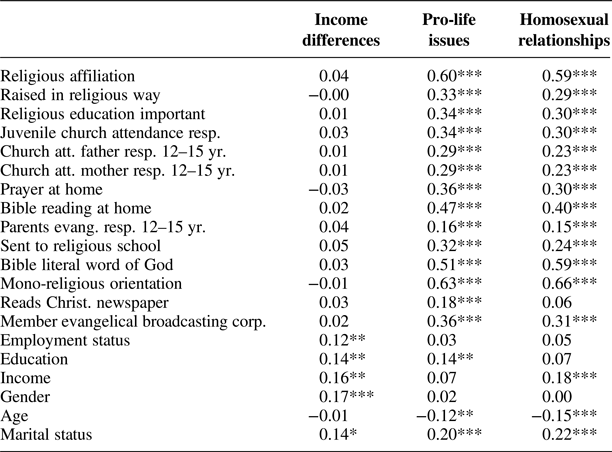
Our second research question inquires after the factors that are substantially related to the conservatism of evangelicals as compared to Catholics, mainline Protestants, and non-church members. To address this question we first have a look at the bivariate associations between the three political attitudes we distinguish and the aforementioned independent and control variables (cf. Table 2).
Correlations between four sets of variables and attitudes concerning income differences, pro-life issues, and homosexual relationships (Pearson r en eta)
*p < 0.050; **p < 0.010; ***p < 0.001.
When it comes to the attitude concerning the reduction of income differences, our results indicate that this conservative economic attitude is unrelated to religion. We only find weak but significant associations between this attitude and socio-economic factors (i.e., employment status, education, and income), gender, and marital status. This is completely in line with earlier findings in the Netherlands, which showed that there is hardly a link between religion and economic conservatism (cf. for instance, Scheepers, Peters, and Felling Reference Scheepers, Peters, Felling, Felling, Peters and Scheepers2000). Our results thus once again confirm that in the Netherlands economic conservatism is not a matter of religion but a matter of socio-economic status.
But this is different with regard to the political attitudes concerning the cultural domain. When it comes to the attitude toward pro-life issues, all religious factors are related to this attitude with the associations between this attitude and having a literal understanding of the Bible and a mono-religious orientation even being fairly strong. Next to an association with education, there are also associations with age, younger respondents are less conservative in this regard, and marital status. The attitude toward homosexual relationships again is related to almost all religious factors except for reading a Christian newspaper. Also the aforementioned aspects of an evangelical subcultural identity (i.e., having a literal understanding of the Bible and a mono-religious orientation) again are related most strongly to this attitude. Furthermore, the attitude toward homosexual relationships is also weakly related to income, age, with younger respondents again being less conservative in this regard, and marital status.
Most of the religious, socio-economic, and demographic factors we distinguish are related to the cultural conservatism of our respondents. But which factors, then, are most decisive in explaining the cultural conservatism among the evangelicals participating in our study as compared to Dutch Catholics, mainline Protestants, and non-church members? This second research question is addressed below with the help of multivariate analyses.
Multivariate Analyses
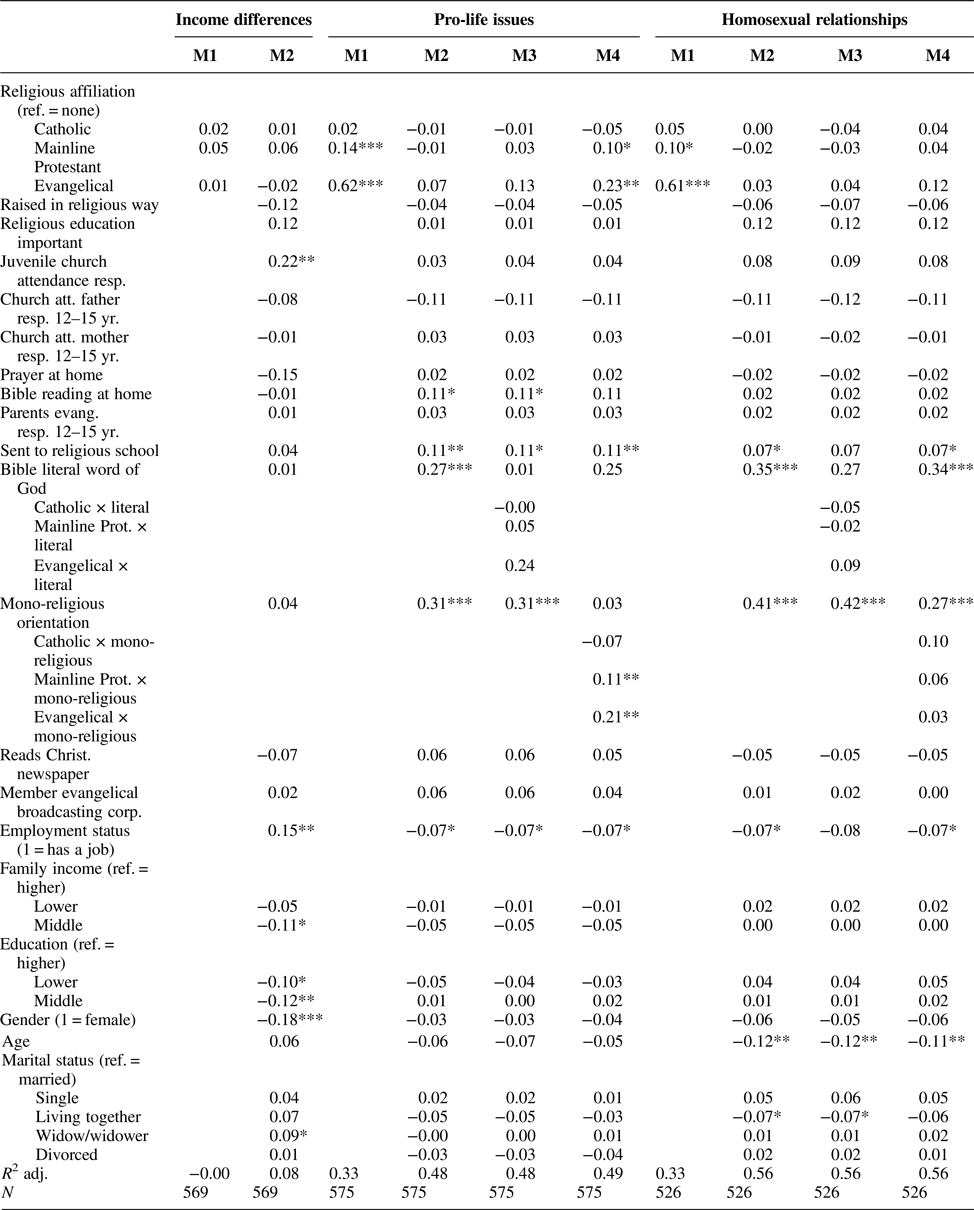
In order to identify the most decisive determinants for the conservatism among our evangelical respondents as compared to our Catholic, mainline Protestant, and non-religious respondents, we conduct a stepwise linear regression analysis for each political attitude. In the analysis regarding the attitude on income differences, we estimate two models; and in the analyses regarding the attitudes on pro-life issues and homosexual relationships we estimate four models. In a first model, we only estimate the effect of religious affiliation. Like Table 1, this model shows to what extent Catholics, mainline Protestants, and evangelicals hold more conservative attitudes than non-church members (the reference category). In a second model, we estimate the effect of religious affiliation again, but now add all other independent and control variables to the equation. If these additional variables have a significant effect on the political attitude in question and at the same time reduce the effect of being evangelical, it is possible to conclude that these independent variables explain (away) the conservatism among evangelicals (Davis Reference Davis1985, 40). With regard to the attitudes concerning pro-life issues and homosexual relationships, two sets of additional variables are added to the equation. In a third model, interaction terms for religious affiliation and biblical literalism are added; and in a fourth model, interaction terms for religious affiliation and having a mono-religious orientation. Adding these interactions terms to the equation enables us to ascertain if these distinctive beliefs indeed have a stronger effect among evangelicals than among Catholics and mainline Protestants, as predicted by our fourth hypothesis.
The results of the regression analyses are displayed in Table 3. With regard to the attitude toward the economic issue of the reduction of income differences, the results again confirm our first hypothesis. Model 1 shows that religious affiliates are not more conservative on economic issues than non-church members. Furthermore, as Model 2 shows, resistance against the reduction of income differences is mainly driven by socio-economic factors, i.e., having a higher income, a higher education, and having a paid job, as well as by demographic factors, being male and being a widow/widower, although respondents who attended church as youths are also more conservative in this respect.
Stepwise OLS regression analyses for attitudes concerning income differences, pro-life issues and homosexual relationships (β)
*p < 0.050; **p < 0.010 ; ***p < 0.001.
However, with respect to the conservative attitude of evangelicals toward pro-life issues religious factors do play an important role. Model 1 again confirms our first hypothesis: in view of pro-life issues, evangelicals are significantly more conservative than non-church members, although also mainline Protestants are more conservative than non-church members in this respect. Only Catholics are not more conservative than the nones. In addition, and in line with hypothesis 3, Model 2 also shows that having a literal understanding of the Bible and a mono-religious orientation strongly endorses a conservative attitude concerning pro-life issues. Next to these factors, two factors concerning family religious socialization, i.e., Bible reading at home and being deliberately sent to a religiously affiliated school, also affect the conservatism of evangelicals in view of pro-life issues, which is partial support for hypothesis 2. Finally, Model 2 also offers partial support for hypothesis 5, since having a paid job is indeed a negative predictor for holding conservative views on pro-life issues. Thus, the conservatism of evangelicals with regard to pro-life issues can be explained in terms of the influence of five factors, which completely reduce the effect of religious affiliation to non-significance. But evangelicals are not in every respect unique in this. Although Model 3 shows that biblical literalism has a stronger effect on a conservative attitude toward pro-life issues among evangelicals than among Catholics and mainline Protestants, the differences are not statistically significant. Only the effect of having a mono-religious orientation is significantly stronger among evangelicals in this respect, but this also goes for mainline Protestants. These results barely support hypothesis 4.
Religious factors are also important with regard to the attitude of evangelicals toward homosexual relationships. Having a literal view on the Bible and a mono-religious orientation are strong predictors for the rejection among evangelicals of homosexual relationships. This again supports hypothesis 3, although these factors also explain the rejection of homosexual relationships among mainline Protestants. Model 2 also offers some support for our second hypothesis regarding the influence of family religious socialization. As it turns out, being deliberately sent to a religiously affiliated school also drives a conservative stance toward homosexual relationships. However, and in line with hypothesis 5, having a paid job is negatively related to a conservative attitude in this regard and this also goes for age and marital status; i.e., younger people and those who are living together consider homosexual relationships more acceptable. Together these six factors completely reduce the effect of religious affiliation to non-significance, which suggest that these factors are the most decisive determinants for the conservative stance toward homosexuality among evangelicals. But contrary to hypothesis 4, evangelicals again are not that unique in this, since Models 3 and 4 do not reveal any significant interaction effect. Thus, biblical literalism and having a mono-religious orientation do not make evangelicals more conservative in view of homosexual relationships than Catholics or mainline Protestants.
To sum up, our results largely support hypothesis 1. The evangelicals in our study indeed hold more conservative attitudes on pro-life issues and homosexual relationships than Catholics, mainline Protestants, and non-church members, but they are not more economically conservative. Hypothesis 2, in contrast, is barely supported by our findings. Most aspects of a religious socialization in the family have no effect on the cultural conservatism of evangelicals. Only Bible reading at home and being sent to a religious school have a relatively weak effect on the conservative stance of evangelicals on pro-life issues and homosexual relationships. Hypothesis 3, on the other hand, is in large part supported by our results. Biblical literalism and having a mono-religious orientation offer a powerful explanation for the conservative stance of evangelicals toward pro-life issues and homosexual relationships. But hypothesis 4, we again have to reject. Although the effect of a mono-religious orientation on pro-life issues is stronger among evangelicals than among Catholics, there is no significant difference between evangelicals and mainline Protestants in this respect; nor are there statistically significant differences between the three religious groups with regard to the effects of biblical literalism. Also lacking is support for hypothesis 5, since the institutional aspects of an evangelical subcultural identity, like reading a Christian newspaper or being a member of the Evangelical Broadcasting organization, have no effect whatsoever on the conservatism of evangelicals. Finally, our results do offer some support for hypothesis 6. Income and education are not related to the conservatism of evangelicals, but having a paid job is indeed a weak and negative determinant for their conservative attitudes on pro-life issues and homosexual relationships.
CONCLUSION
In this study, we compared political attitudes of evangelicals with those of mainline Christians and non-church members, all living in the secular context of the Netherlands. To do this, we addressed two interrelated research questions: (1) Do Dutch evangelicals hold more conservative political attitudes on economic and cultural issues than Catholics, mainline Protestants, and non-church members? and (2) Which decisive factors determine the supposed conservatism among Dutch evangelicals as compared to Catholics, mainline Protestants, and non-church members? With regard to the first question, our results show that the evangelicals participating in our research are far more culturally conservative than economically conservative. More so than Catholics, mainline Protestants, and non-church members do evangelicals consider family planning, abortion, active euthanasia, suicide, and homosexual relationships unacceptable. But when it comes to their attitude concerning the reduction of income differences, they do not differ from other groups and even are somewhat more liberal in this respect. Thus, our evangelical respondents combine a somewhat leftist view on the issue of income inequality and the desirability of the reduction of income differences with a conservative stance on certain moral issues. In this respect, these Dutch evangelicals nicely fit the political profile of the Christian Union. As we already mentioned in the introduction, the Christian Union is one of the three Christian political parties in the Netherlands and is more left of center, next to the more right wing Reformed Political Party, and the right of center Christian Democratic Party. Not by accident, then, with 53.1% voting for the Christian Union this party is also the most popular political party among our evangelical respondents (Vermeer and Scheepers Reference Vermeer and Scheepers2017).
Our findings thus are in line with Swartz's (Reference Swartz2012) contention, that there is no natural affinity between evangelicalism and right-wing politics. As we already mentioned above, such a relationship was not found among Brazilian (McAdams and Lance Reference McAdams and Lance2013) nor among Canadian evangelicals (Bean Reference Bean2014a; Reference Bean2014b) and it is also not present among the evangelicals we studied. Consequently, the growing conservatism among American evangelicals in both the cultural and especially the economic domain, that was recently documented by Deckman et al. (Reference Deckman, Cox, Jones and Cooper2016), may be more typical for the United States and may indeed by the result of the growing polarization in American politics between the Democratic and the Republican Party and of the emergence of the Tea Party, as Deckman et al. suggest. In contrast, in the politically plural context of the Netherlands, where such a strong polarization between two political parties does not exist and partisanship is traditionally low (Scheepers, Peters, and Felling Reference Scheepers, Peters, Felling, Felling, Peters and Scheepers2000) and has persisted to be low also after the turn of the century (Linssen et al. Reference Linssen, Schmeets, Scheepers, Manfred te Grotenhuis, Eder, Mochman and Quandt2014), partisan leanings may be less influential on the political attitudes of the electorate and the conservatism of Dutch evangelicals may, therefore, be confined to those moral issues where religion traditionally matters most: i.e., pro-life and homosexuality. In this respect, it is also noteworthy that the somewhat more liberal attitude of our evangelical respondents toward the reduction of income differences is not informed by their religious background. This fits Smidt and Penning's (Reference Smidt and Penning1982) earlier findings, that religion especially endorses a conservative stance with regard to those issues that are perceived as being closely related to moral values. Apparently, then, only when there is a close relationship between evangelicalism and partisan leanings, as is the case nowadays in the United States, may the conservatism of evangelicals also relate to the economic domain above and beyond the cultural domain.
Our second question inquires after the most decisive determinants of the conservative attitudes of our evangelical respondents as compared to Catholics, mainline Protestants, and non-church members. As we have seen, religion does not matter much with regard to their stances toward the reduction of income differences, but it does matter with regard to their conservative attitudes toward pro-life issues and homosexuality. That is to say, especially their religious convictions matter here. Juvenile religious socialization experiences barely determine the cultural conservatism of these Dutch evangelicals and nor do the more institutional aspects of their subcultural identity. However, their biblical literalism and mono-religious orientation appear to be powerful determinants of their conservatism toward pro-life issues and homosexuality. The more these evangelicals endorse a literalist view on the Bible and believe that salvation can only be found in Jesus Christ, the more they hold conservative attitudes in this respect. In this regard, our evangelical respondents are quite similar to their coreligionists in, for instance, the United States or Brazil (McAdams and Lance Reference McAdams and Lance2013).
However, this rather strong effect of the religious convictions of our evangelical respondents on the conservative attitudes they hold, is slightly mitigated by employment status and in the case of their attitude toward homosexuality also, and also more strongly, by age. Apparently, younger evangelicals find homosexual relationship less unacceptable than their older coreligionists. This could indicate a cohort effect. Nowadays, younger evangelicals in the Netherlands are raised in a socio-cultural context in which homosexuality is widely accepted (Van den Akker, Van den Ploeg, and Scheepers Reference Van den Akker, Van den Ploeg and Scheepers2013). This may have shaped their views on homosexuality in a different direction than the views of older evangelicals who were raised in a socio-cultural context that was less friendly toward homosexuality. Such a difference between older and younger evangelicals on the matter of homosexuality was, for instance, also found by Pelz and Smidt (Reference Pelz and Smidth2015) in their study into generational differences among American evangelicals. With regard to pro-life issues, however, such a distinction between older and younger evangelicals does not come forward as age has no effect here. This could be due to the fact that issues like euthanasia or abortion are still far more controversial in Dutch society than homosexuality and that a cohort effect thus is less likely to occur in view of the attitudes Dutch evangelicals hold with regard to pro-life issues.
Still, notwithstanding these mitigating effects of employment status and age, the cultural conservatism of our evangelical respondents is driven most forcefully by their distinctive religious convictions. This is clearly in line with subcultural identity theory (Smith Reference Smith1998). But, contrary to our expectations, we hardly found evidence that these distinctive beliefs have a stronger effect on the cultural conservatism of evangelicals than on the cultural conservatism of Catholics and mainline Protestants. Only in case of pro-life issues does a mono-religious orientation more strongly drive the attitudes of evangelicals in a conservative direction, but this interaction effect was not found with regard to their attitude toward homosexuality. It is hard to tell why this is the case. One explanation could be that secularization has progressed that far in the Netherlands that those who remain committed to their churches are now also the more orthodox and firm believers. Consequently, having a literalist view on the Bible or having a mono-religious orientation may nowadays be less typical for Dutch evangelicals than we initially expected. Today these beliefs may have become hallmarks for church involvement as such and thus also determinants of a conservative attitude toward pro-life issues and homosexuality among a broader range of Christians than evangelicals alone. Further research is needed to see if this explanation really holds.
APPENDIX
Descriptive statistics