The art of the Epiclassic through Early Postclassic period (a.d. 700–1150) Toltecs, focused on their capital at Tula de Allende in Hidalgo, Mexico, remains one of the most neglected subjects for art historical analysis relative to other pre-Columbian Mesoamerican art traditions. This sad state of affairs seems to be in large part a result of the almost unanimously negative opinion of its austere aesthetic by twentieth-century critics (Mastache, cited in Jiménez García Reference Jiménez García1998:13), related to the privileging by the same modern commentators of the more naturalistic art of the Classic Maya. The Toltecs have long played the “barbarians” to the Maya “Greeks of the New World” in the discourse of pre-Columbian art history. If the Maya and Aztec have been sufficiently accepted by the contemporary Western art establishment and public to merit major exhibitions at the National Gallery and the Guggenheim, the Toltecs remain on the margins as the quintessential Mesoamerican ‘Other.’
This stereotyped appraisal of the form of Toltec art is usually accompanied by a reductionist view of its content as exclusively reflective of sacrifice and warfare. Such notions still prevail in much of the general literature despite the recent work of a diligent minority of scholars who have demonstrated that the Tula art tradition is not so limited in theme and meaning. In her 1989 dissertation and subsequent publications and presentations, Kristan-Graham (Reference Kristan-Graham1993, Reference Kristan-Graham and Kowalski1999, Reference Kristan-Graham2000, Reference Kristan-Graham2003, Reference Kristan-Graham, Kowalski and Kristan-Graham2007) has exploded the myth that Toltec art is solely concerned with militarism and human sacrifice. She identifies images of rulers and merchants, as well as themes of royal rites of passage and the commemoration of ancestors, alongside war imagery in the art and architecture of Tula. The work of Cobean and the late Alba Guadalupe Mastache at the site's ceremonial core, Tula Grande (Mastache and Cobean Reference Mastache and Cobean2000; Mastache et al. Reference Mastache, Cobean and Healan2002:87–142), and the earlier Epiclassic political/ceremonial center of Tula Chico (Mastache et al. Reference Mastache, Cobean, Healan, Fash and López Luján2009), likewise demonstrates that Tula's major monuments reflect broad concerns with rulership and power, rather than an exclusive preoccupation with warfare. As with other Mesoamerican elite art traditions since the Formative period, including the Maya, martial imagery at Tula represents just one aspect of the iconography of royal ideology at the site. In fact, despite the tendency of many commentators to stigmatize the art of Tula as exclusively sanguinary in content, not a single work from the site shows battle scenes, the taking of captives, or sacrifice in a direct, narrative fashion (Jiménez García Reference Jiménez García1998:428; Kristan-Graham Reference Kristan-Graham1989:11), though some images (the predatory birds and animals carrying hearts on the reliefs of Pyramid B) represent sacrifice in a more indirect way.
The persistent neglect and stereotyping of Toltec art is especially regrettable in light of the acknowledged important role of their innovative and synthetic style on the subsequent development of highland Mexican art, particularly that of the Mexica. The Aztecs did not share the opinions of the majority of modern art historians concerning the aesthetic merits of their predecessors: they used the term toltecatl to designate a master craftsman. While one need not revive their idealized view, the prevailing negative opinion is long overdue for reassessment.
But at the same time as the Aztecs valorized Toltec art, they have also been the source of problems in its interpretation, both by their actions and because of the hold of Nahua visual and historical sources over modern analyses of Toltec culture. The fragmentary nature of surviving art from Tula, repeatedly plundered by the Mexica into a ruin of ruins, represents an obstacle to understanding. So does a tendency for Toltec art to be viewed exclusively through readings extrapolated from later Aztec art and myth, in a rather literal extension of the Mexica claim to be the proper inheritors of the Toltec legacy. The mid-twentieth century excavations of Jorge Acosta and the ethnohistorical work of Wigberto Jimenez Moreno led to the identification of Tula with “the” Tollan of the Conquest era sources, with all of that fabled locale's connections with the Topiltzin Quetzalcoatl legend. For much of the twentieth century, Quetzalcoatl and associated deities formed the Procrustean bed onto which Toltec art was stretched to fit, often with a minimum attempt at reasoned argument for such interpretations. Such questionable iconographic readings from a past generation of scholarship persist in the literature, especially in presentations of a generalized or popular nature, despite recent work (Gillespie Reference Gillespie1989, Reference Gillespie, Kowalski and Kristan-Graham2007; Graulich Reference Graulich2002; Smith Reference Smith, Kowalski and Kristan-Graham2007) calling into question the historical reliability of the Topiltzin sagas.
The case of the coatepantli frieze is an example of a Toltec monument provided with such explanations by twentieth century pundits. As I intend to demonstrate, assuming the methodological validity of extrapolating back from the Conquest era, these traditional interpretations are inadequate on the grounds of comparative iconography. I attempt here to introduce, as a heuristic springboard for future research, alternative hypotheses for these images. These suggestions are based not only on the local context of Tula's art and architecture (and here I build on the foundational work of Kristan-Graham, Cobean, and Mastache), but also on comparative data from other Mesoamerican cultures contemporary with Tula's ascent and apogee. While the commonly accepted date for the Tollan-phase constructions visible at the ceremonial core of Tula Grande is Early Postclassic (a.d. 950–1150), the sculptural style associated with the Tollan phase certainly developed by the Epiclassic period (a.d. 700–900), as evidenced by reliefs excavated by Cobean at Prado phase Tula Chico (Mastache et al. Reference Mastache, Cobean, Healan, Fash and López Luján2009:Figures 20–24). The recent and as yet incompletely published archaeological work of Sterpone (Reference Sterpone2007) at Tula Grande suggests that the beginnings of construction at this locale also go back to the Epiclassic period, though his claims remain controversial.
Tula was part of a network of Epiclassic to Early Postclassic sites, from the Chalchihuites centers of Zacatecas on the northern frontier of Mesoamerica to Tula's “twin city” Chichen Itza in Yucatan, linked by trade, political alliances, and /or participation in shared religious practices (Ringle et al. Reference Ringle, Negrón and Bey1998) and political ideologies (López Austin and López Luján Reference López Austin, López Luján, Carrasco, Jones and Sessions2000). Both art styles and iconography traveled far and wide over these networks and were adapted and modified to fit the needs of local elites. Central Mexican Epiclassic sites like Cacaxtla and Xochicalco reflect these long distance connections quite clearly in their eclectic art, as does Tula itself. It is in this matrix of related sites and art styles that I find useful conceptual and iconographic parallels to the coatepantli. In particular, comparative material from La Quemada and the Chalchihuites sites at the northwestern edge of the network plays an important role in my arguments.
At the same time, my comparative method assumes the basic unity of cultures across space and through time that is the foundation of the construct of Mesoamerica. I therefore also employ broader pan-Mesoamerican comparisons (including some derived from ethnographic material), based on persistent and pervasive features of Mesoamerican culture, as part of my methodology. For example, Formative Zapotec and Classic Maya ancestor iconography seems to provide useful general parallels to the Toltec monument that is my focus. In making these comparisons, I am not suggesting direct contact or historical connections between the Toltecs and the other groups, though with the Classic Maya such contact is plausible. Each local manifestation of Mesoamerican civilization reflects the broadly shared ideas and traits that define it as Mesoamerican, while selecting, combining, and interpreting them in ways unique to the local context. Like the serpents and skeletons of the coatepantli and the individual site and the wider networks, local and pan-Mesoamerican traits are always intertwined. In Mesoamerican art, shared and common patterns, and active borrowings from contemporaries, are deployed and modified in different ways to suit local needs. I have tried to do this complexity justice. The parallels and interpretations I suggest here may eventually be challenged, but my wish in stating them is to generate models for future research to test, open up discussion, and draw attention to frequently reproduced but little studied monuments, rather than argue for any “definitive” interpretation.
THE MONUMENT
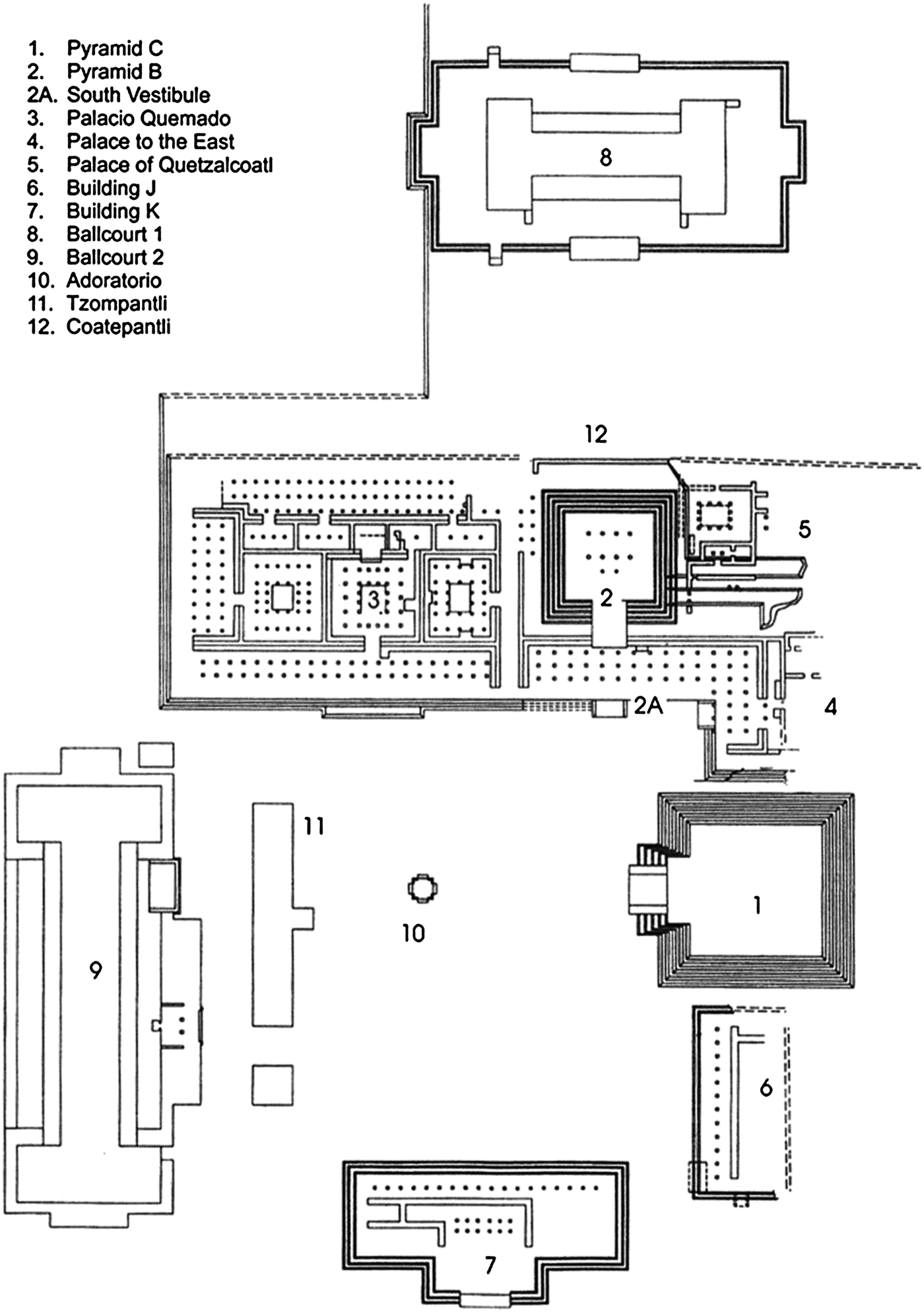
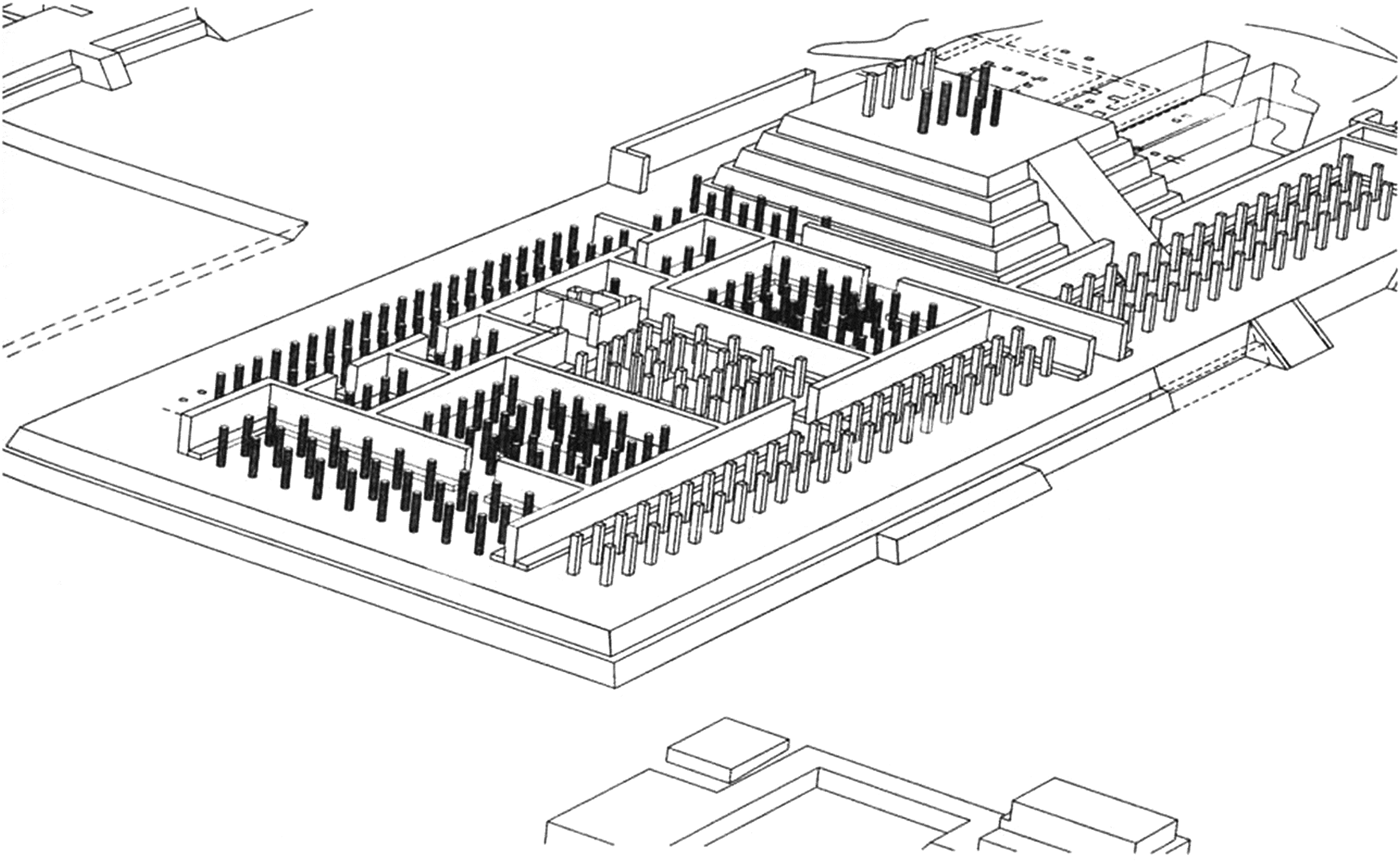
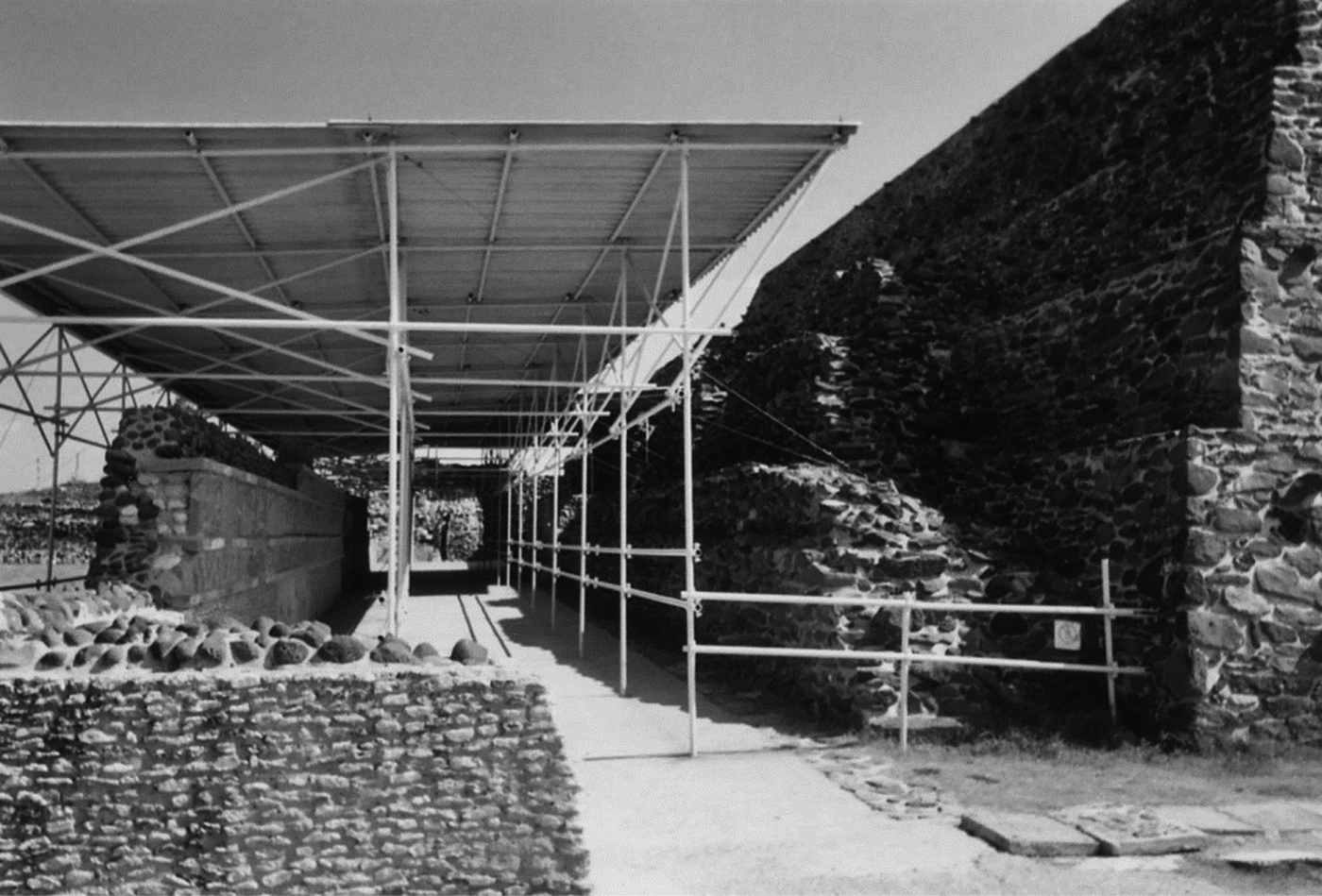
Diehl has accurately characterized the coatepantli “one of the best known structures” from the Toltec capital (Reference Diehl and Healan1989:17). It is a decorated 2.2–m-high freestanding wall running for some 40 m in length on an east-west axis along the north side of Pyramid B (Figures 1–3) in Tula Grande. It appears to function as a barrier or boundary separating Pyramid B and its associated plaza from the Plazoleta Norte and Ballcourt I to the north. The wall also seems to channel and restrict pedestrian traffic on the north side of Pyramid B, creating a narrow enclosed passage, presumably for elite ritual activities. The monument was christened a “serpent wall” in Nahuatl by Jorge Acosta, its excavator and chief restorer in the 1940s, after the common architectural feature at later Aztec ritual centers, most notably the Templo Mayor, serving as ritual boundaries and markers of sacred space. Jansen (Reference Jansen1997:32–33) and Jansen and Pérez Jiménez (Reference Jansen and Pérez Jiménez2007:51) identify the general Postclassic coatepantli concept as representing a liminal zone between the human world and the realm of gods and ancestors. Whether the Tula coatepantli reflects the same conception in form and function as these later monuments, however, remains open to question—an issue that will be further discussed below. The coatepantli appears to date to the latest phase of Early Postclassic period building at the site (Bey and Ringle Reference Bey, Ringle, Kowalski and Kristan-Graham2007:401), although Sterpone (Reference Sterpone2007:38) controversially places its adobe core back to a.d. 700–820, and believes that the extant wall originally extended to enclose Pyramid B. He puts the decoration, however, after a.d. 975, the date when he suggests that the wall was reduced to its current dimensions (Sterpone Reference Sterpone2007:43; see Mastache et al. Reference Mastache, Cobean and Healan2002:134 for contra).
Plan of Tula Grande (from Mastache et al. Reference Mastache, Cobean and Healan2002:Figure 5.8b). Reproduced by permission of Robert Cobean.

Perspective drawing of the Palacio Quemado and Pyramid B, with coatepantli at rear of Pyramid B (from Mastache et al. Reference Mastache, Cobean and Healan2002:Figure 5.31). Reproduced by permission of Robert Cobean.
Coatepantli and rear of Pyramid B. Photo by author.
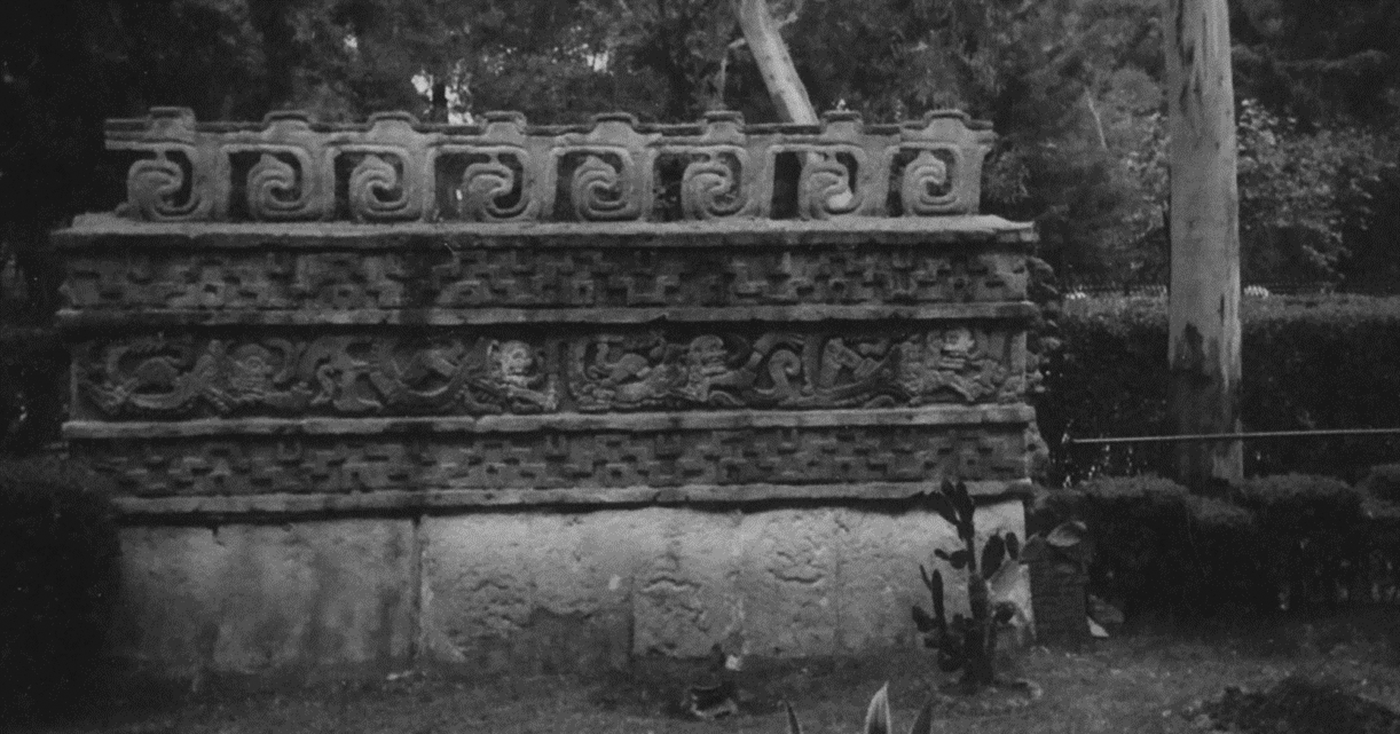
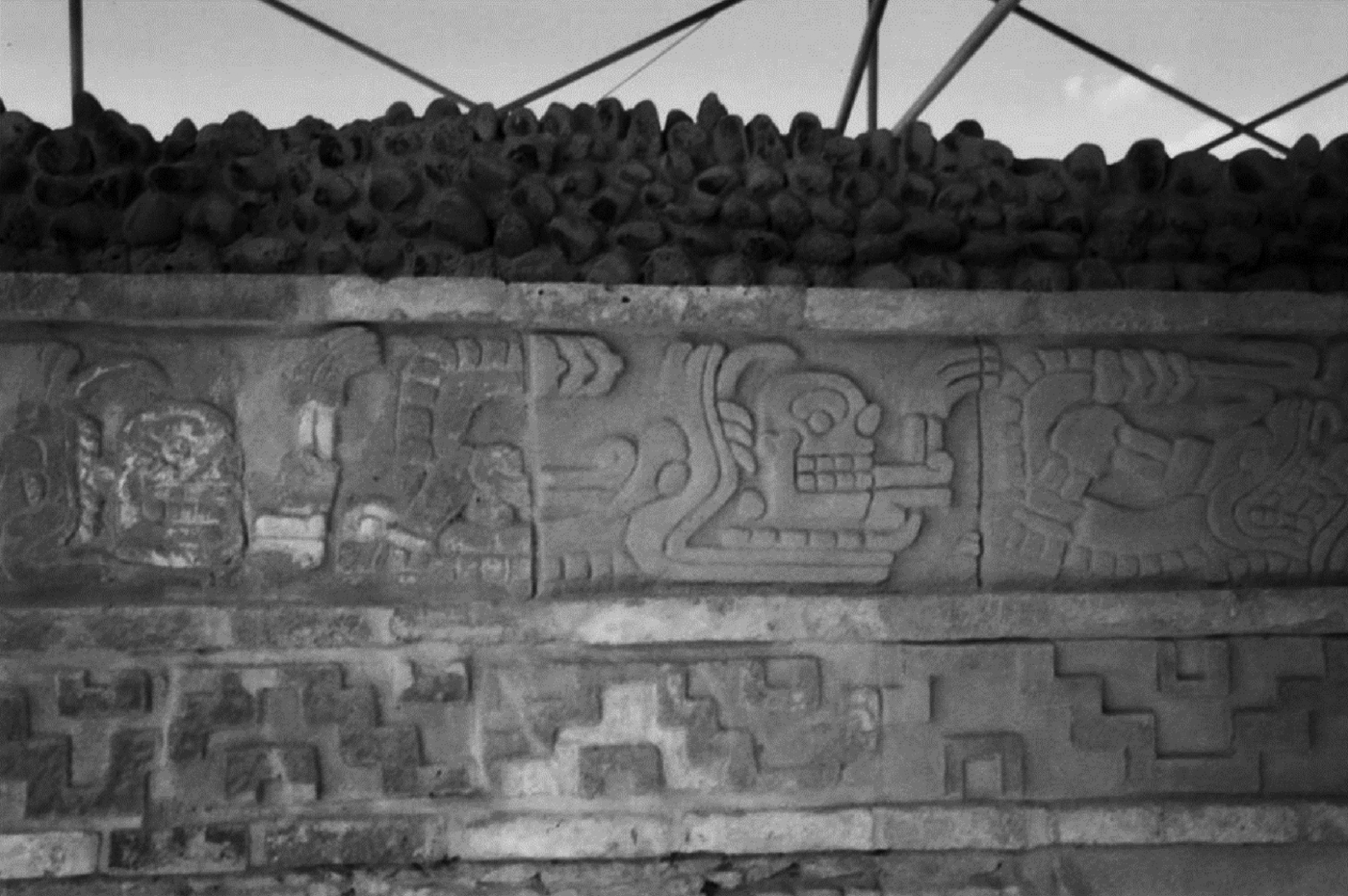
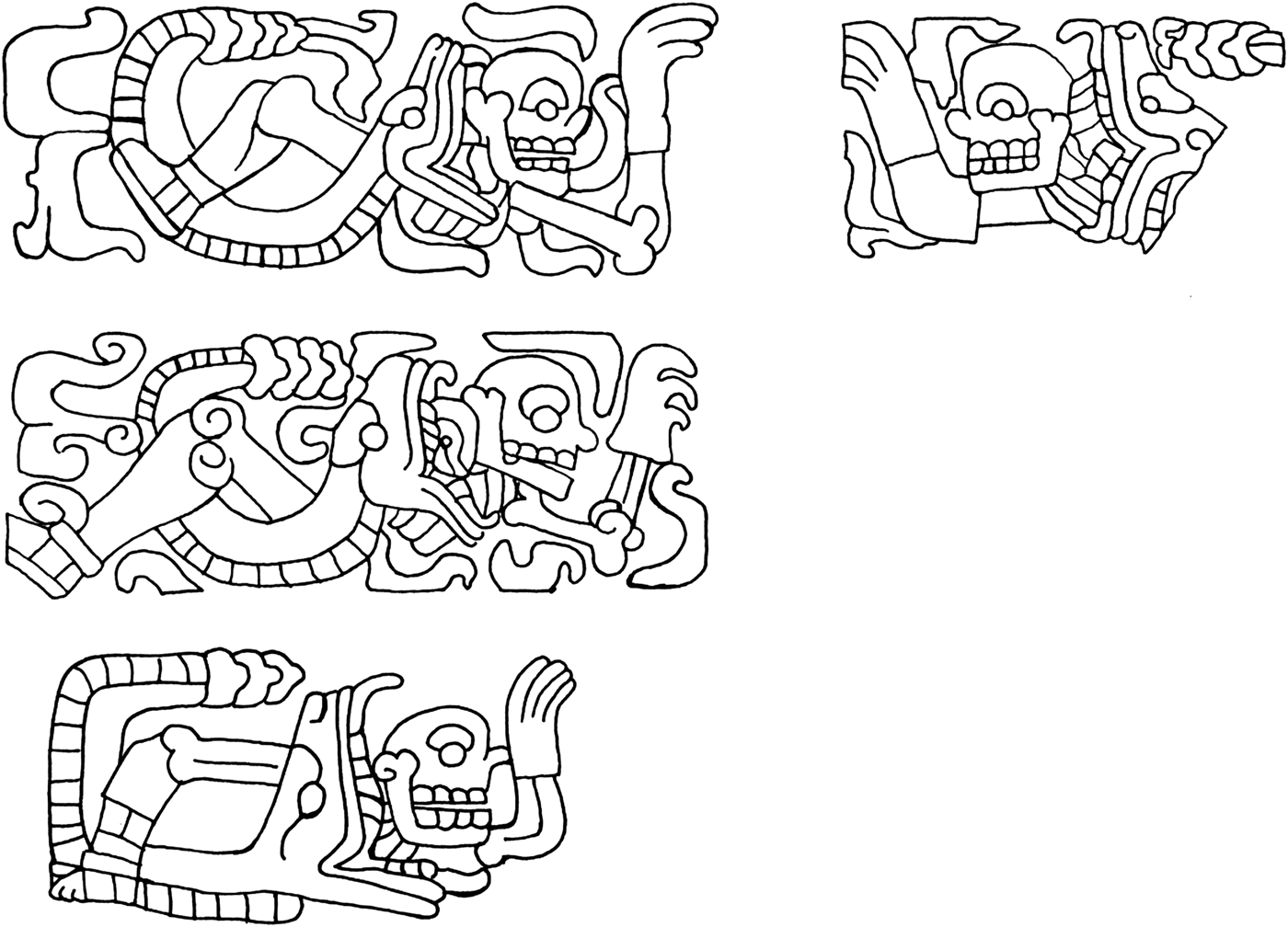
The coatepantli is capped by a series of 11 merlons (Figure 4) in spiral form. Slabs of local sedimentary stone (Jiménez García Reference Jiménez García1998:23), carved in relief and painted, formed the outer decoration of the wall, but by the time of Acosta's excavation the structure had collapsed and they were found face down on the adjacent surface (Acosta Reference Acosta1942–1944:156a). Their position as discovered by the excavators suggests that the collapse of the wall may have resulted from an earthquake, rather than intentional destruction. Two registers of stepped frets frame a central frieze of rattlesnakes and human skeletons retaining vestiges of flesh on their limbs and heads (Figures 5 and 6). The serpent-skeleton pairs on the east half of the coatepantli face west and those on the west face east, apparently converging on an unknown image or scene in the now destroyed center, perhaps removed by the Mexica in their later looting of Pyramid B.
Part of the east half of the coatepantli reconstructed in the Museo Nacional de Antropología. Photo by author.
Section of coatepantli frieze as restored by Acosta, Tula. Photo by author.
Serpents and skeletal personages from the coatepantli frieze. Drawing by Jay Scantling (after drawing by Javier Urcid, personal communication 2011).
The precise identification of the coatepantli snakes is disputed. Volutes appear on the rattles of all extant examples save for the easternmost slab. These are often read as plumes, but even if this is granted, there is still disagreement on the qualifications of the coatepantli ophidians as proper “feathered serpents.” Thus, Diehl (Reference Diehl1983:64) describes the snakes as feathered, while Baird (Reference Baird and Boone1985:118), although noting the alleged plumes on their tails, avers that they “do not appear to be feathered.” But feathers are not the only possible reading of the volutes. Miller and Taube (Reference Miller and Taube1992:65) interpret them as flames and thus the snakes as xiuhcoatl or Fire Serpents, a point to which I will return later. Close inspection also shows that they occur not just on the tails of the serpents but around the mouths of the skeletons as well, suggesting a “halo” (Javier Urcid, personal communication 2011) or a representation of breath.
There is a similar lack of interpretive unanimity in the literature concerning the action that seems to be signaled by the frieze. Depending on which author one consults, the serpents are variously said to be shown “swallowing” (Tozzer Reference Alfred1957:134), “eating” (Mastache et al. Reference Mastache, Cobean and Healan2002:134), more forcefully “devouring” (Diehl Reference Diehl and Healan1989:17; Dutton Reference Dutton1955:210; Kubler Reference Kubler1984:83), and/or “spewing” (Miller and Taube Reference Miller and Taube1992:51, 65) or even “belching” (Miller Reference Miller2006:185) the skeletal humans. Note the violence of much of the language of these interpretations, consistent with the appraisal of Toltec art as concerned purely with warfare. In more neutral terms, the bony figures have been read as exiting the maws of the serpents (de la Fuente et al. Reference de la Fuente, Trejo and Solanas1988:134, Catalogue No. 89). Dutton (Reference Dutton1955:210) and Baird (Reference Baird and Boone1985:118) are among the few commentators to stress that the skeletons' whole lower bodies are present, entwined with the snakes, which harmonizes with López Austin and López Luján (Reference López Austin and López Luján2001:196) reading of the serpents as “carrying partly skeletonized human figures.”
Acosta (Reference Acosta1964:Plate 1) published a hypothetical reconstruction of the color scheme of the painted reliefs on the eastern half of the wall, apparently the work of Agustin Villagra (Javier Urcid, personal communication 2011) based on his direct inspection of surviving vestiges of pigment and the field notes of Acosta's collaborator Hugo Moedano from when the slabs were first excavated. Baird (Reference Baird and Boone1985:118, Plate 6) later offered a slightly divergent reconstruction. The stepped frets and background were painted red, like the residual flesh of the skeletons, while the exposed bones of the skeletons and teeth of the serpents are white. The snakes are painted blue with yellow undersides or completely yellow, arranged so that two blue serpents are followed by one yellow one in a repeating sequence. The plumes/flames/volutes were also painted yellow.
Evidence that the stone slabs employed in the coatepantli frieze were recycled from other monuments (one is a reused stela; Stela 6 in de la Fuente et al.'s system), and of ill-fitted construction, has been used to support the traditional disparaging view of Toltec architecture and sculpture. Acosta (quoted in Diehl Reference Diehl and Healan1989:17), however, referred to these reliefs as “a gem of pre-Columbian art.” While doubtless few other students of Mesoamerican art history would permit themselves to make such a positive pronouncement on any work of Toltec art, the coatepantli reliefs are frequently reproduced in the plates and even on the covers of popular publications dealing with ancient Mesoamerica. Frequent reproduction, however, has not facilitated any in-depth, well-argued, or broadly accepted interpretation of their puzzling scenes.
Any interpretation of the coatepantli must take into account its context in close association with Pyramid B and as part of the architecture and relief sculpture decoration of Tula Grande as a whole. The dominant theme of the iconography of the temple reliefs atop Pyramid B seems to relate to Toltec rulers. Pyramid B, and Tula Grande's ceremonial plaza area in general, has been identified as the setting for rituals conducted by royalty (Kristan-Graham Reference Kristan-Graham1989:315–317, 333; Mastache et al. Reference Mastache, Cobean and Healan2002:104). Such ceremonial activities included royal rites of passage like accession and funerals, as well as the display of military power and the celebration of alliances. The coatepantli frieze, like other Toltec relief compositions from Tula Grande, shows repeated figures arranged in a horizontal register. In Kristan-Graham's (Reference Kristan-Graham and Kowalski1999:172) analysis of the composition and architectural setting of Tula's art, the repeated human images in the sculptured processions that extend over the banquettes and around the columns of Tula Grande represent elite “groups… depicted at liminal moments such as death and accession, vulnerable times when transfer of power and change in status can reaffirm an efficient bureaucracy and ideational system.” In further commenting on the processing figures in Tula's relief sculpture, she suggests that the images may have guided or mirrored actual ritual behavior within the sacred precincts of Tula Grande. While the human figures on the coatepantli are reclining rather than walking, it can be argued that their associated snakes are meant to be understood as moving in a procession, and the wall itself seems to restrict and channel pedestrian movement on the north side of an edifice dedicated to rulership. All of these contextual considerations imply that the coatepantli reliefs are in some way thematically related to royal rituals, but apart from readings as displays of military might, a review of the previous literature produces no such interpretations. Instead, the most commonly repeated identification of the subject of the coatepantli frieze is based on Mexica mythology.
A CASE OF MISTAKEN IDENTITY?
Acosta (Reference Acosta1942–1944:142–143, Reference Acosta1945:30, Reference Acosta1956–1957:107) interpreted the defleshed figures on the coatepantli as representations of Quetzalcoatl in his manifestation as the Morning Star, Tlahuizcalpantecuhtli (Lord of the Dawn or “Lord in the Dawning”), being swallowed by a serpent. In its “defeat” by the rays of the sun, the Morning Star seems to have been viewed as the celestial counterpart of sacrificed captives and defeated warriors (Baird Reference Baird and Boone1985:140). This identification is thus grist for the mill of the supposed Toltec obsession with war and sacrifice. In this, as in other interpretations of Tula's iconography, Acosta was heavily influenced by post-Conquest renditions of indigenous myths tying the Toltec capital to the legendary earthly rule of Topiltzin Quetzalcoatl, as well as by the alleged similarities of the transformations of Kukumatz in the Popol Vuh to the iconography of Pyramid B at Tula (Sterpone Reference Sterpone2007:37). The composition of the frieze, with skeletal figures facing in opposite directions, also suggested to Acosta the movements of a celestial body—an identification that has been frequently repeated by other authors across the ensuing decades (Davidoff Misrachi Reference Davidoff Misrachi1996; Diehl Reference Diehl1983:64, Reference Diehl and Healan1989:17; Tozzer Reference Alfred1957:113).
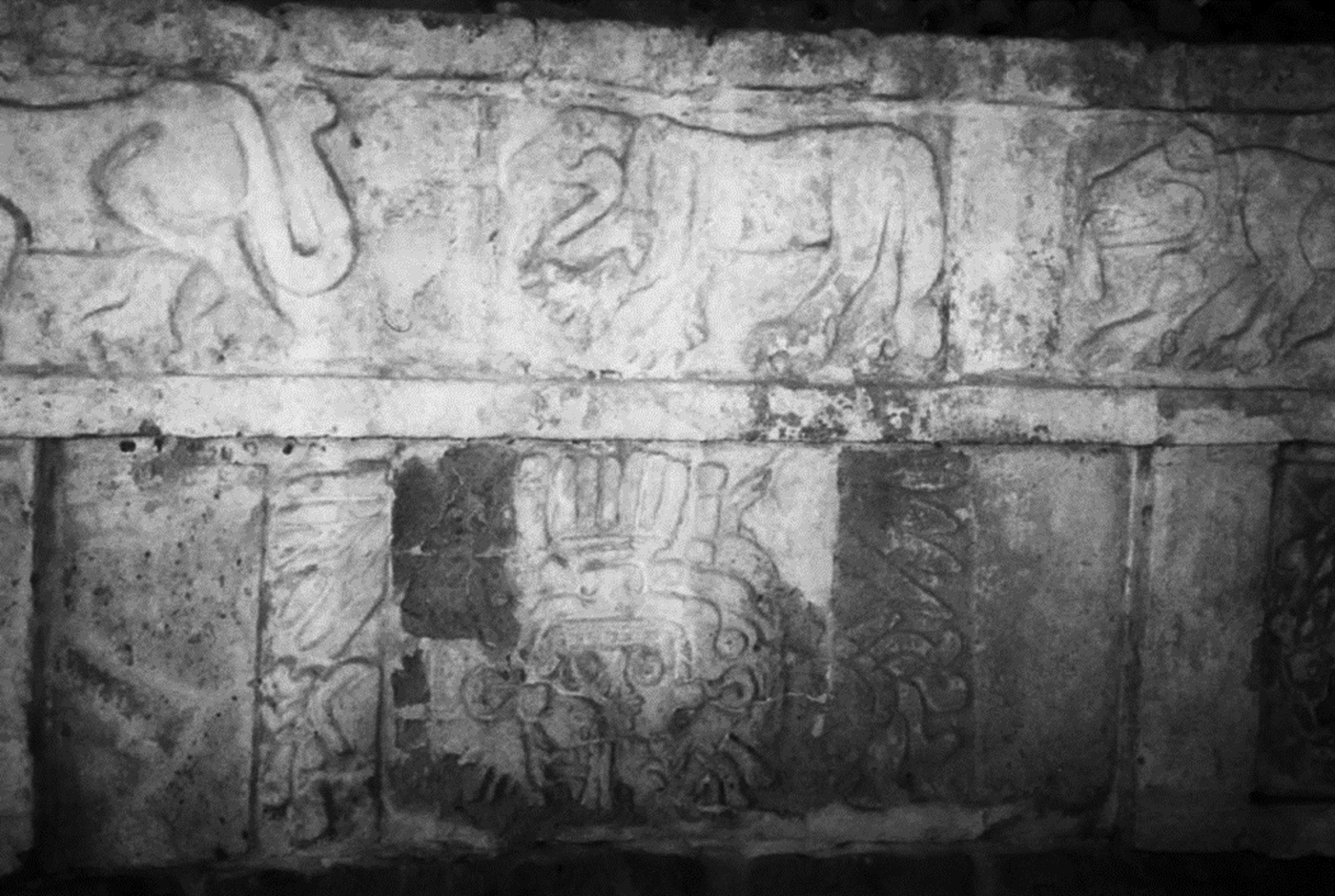
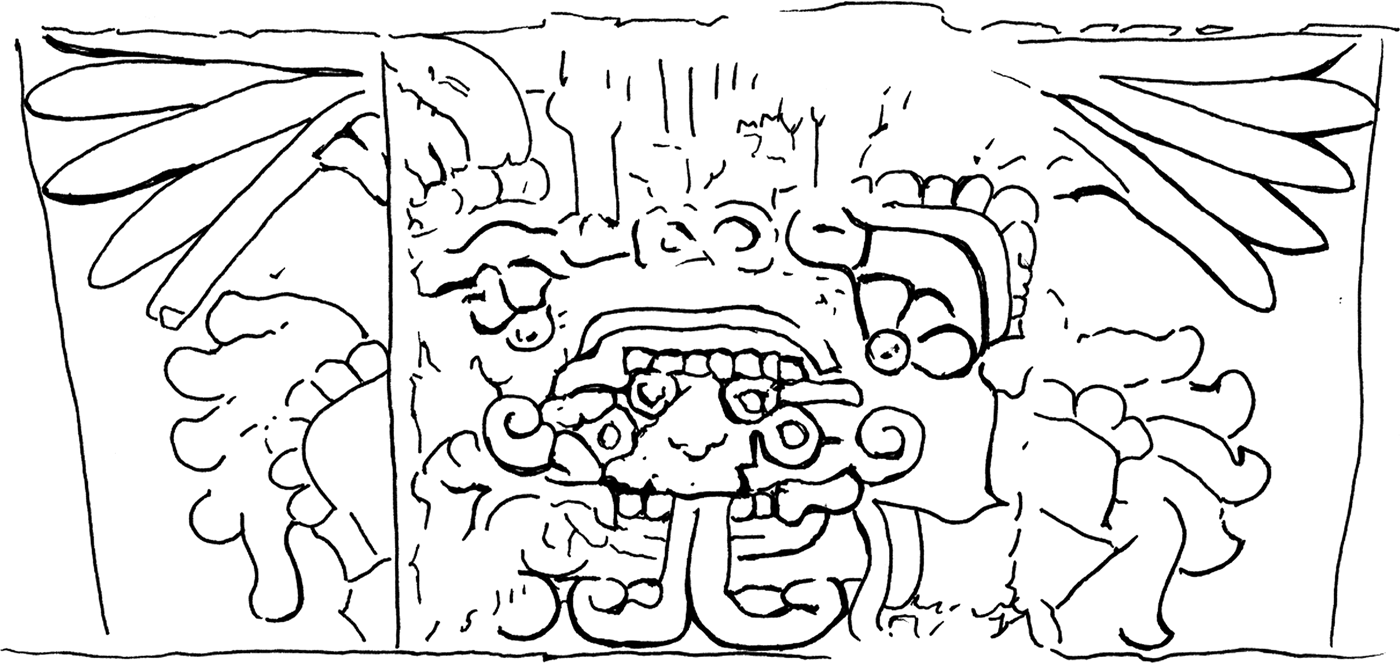
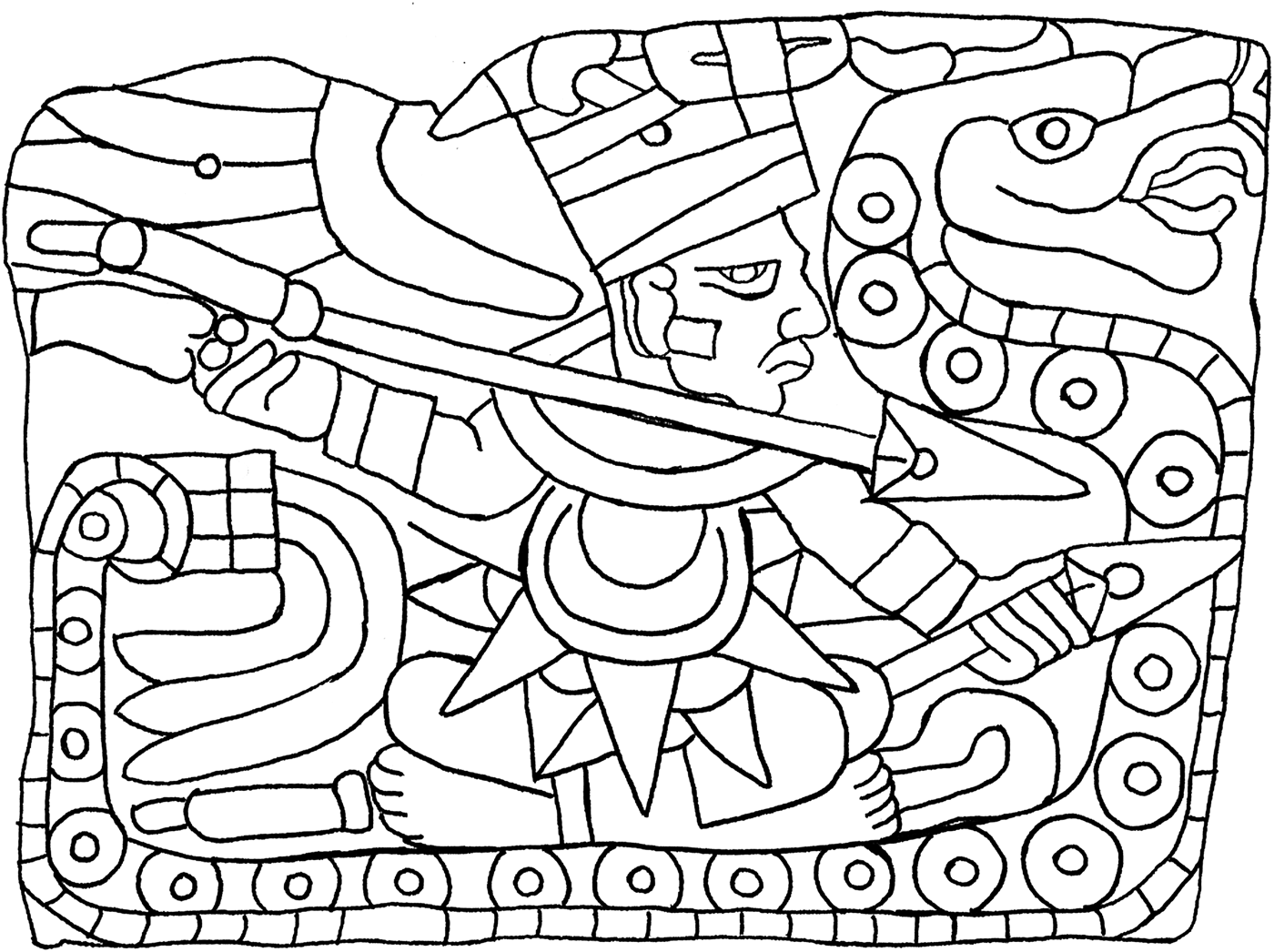
In seeming support of this identification of the coatepantli figures, mid-twentieth-century scholarship found another alleged representation of Tlahuizcalpantecuhtli in the relief sculpture of Tula. Across the narrow space from the coatepantli, the north side of Pyramid B features several surviving reliefs (de la Fuente et al. Reference de la Fuente, Trejo and Solanas1988:Catalogue Nos. 91a and 91b; Jiménez García Reference Jiménez García1998:268–269, Figure 116) of what Schele and Mathews (Reference Schele and Mathews1998:214), using a favorite Mayanist epithet, described as a “curious feathered beastie” in the form of a serpent with bird or reptile-like legs (Figures 7 and 8). A human figure emerges from its mouth, adding yet another organism to the mix. On the east side of the pyramid, several similar images survived later Aztec looting. These examples differ from the reliefs on the north side in that the human figure in the patchwork monster's mouth wears a butterfly-shaped nose ornament of Teotihuacan type (Jiménez García Reference Jiménez García1998:270, Figure 116b). The Pyramid B panels are usually dated to the last phase of the building's construction (Mastache et al. Reference Mastache, Cobean and Healan2002:96), although Sterpone (Reference Sterpone2007:27, 33, 38) pushes the reliefs, and at least the core of Pyramid B reconstructed by Acosta, back to a.d. 700–820, based on his not yet fully published work on the architectural stratigraphy of Tula Grande. Acosta also excavated an additional panel comprised of three slabs showing this creature (Jiménez García Reference Jiménez García1998:284–286, Figure 125) from a platform adjoining Pyramid C, the largest structure in the ceremonial core of the site, and it is possible that similar images may have adorned Pyramid C itself before the complete removal of its decorated façade by the Mexica (Mastache et al. Reference Mastache, Cobean and Healan2002:128). Similar reliefs of this hybrid also occur at other locales at Tula (Mandeville and Healan Reference Mandeville, Healan and Healan1989:184, Figure 12.11; Mastache et al. Reference Mastache, Cobean and Healan2002:128). The same zoomorph appears at Chichen Itza at the base of hundreds of columns in the Temple of the Warriors, the North Temple, the North, Northeast, and South Colonnades, as well as other structures (Tozzer Reference Alfred1957:71). It also occurs on reliefs in the Upper and Lower Temples of the Jaguars, the Mausoleum III, and on the outer walls of the Temple of the Warriors (Tozzer Reference Alfred1957:123).
Composite creature, Pyramid B. Photo by author.
Composite creature, Pyramid B. Drawing by Jay Scantling (after Jiménez García Reference Jiménez García2010:74, Photo 54).
This figure, labeled the “jaguar-serpent-bird compound” by Kubler (Reference Kubler1982:111, Reference Kubler1984:110), or simply “the composite creature” by Kristan-Graham (Reference Kristan-Graham1989), was identified by Acosta (Reference Acosta1956) as Tlahuizcalpantecuhtli, although Mastache and colleagues (Reference Mastache, Cobean and Healan2002:134) note that it lacks any clear traits of this divinity's iconography. Špracj (Reference Ŝpracj1996:87) attributes the identification of similar images of the composite creature at Chichen Itza as a form of Quetzalcoatl to Eduard Seler, but dismisses it as lacking solid basis. More recently, both Taube (Reference Taube1992b, Reference Taube2000:286) and Schele and Mathews (Reference Schele and Mathews1998:214) identify the composite creature at Tula as the War Serpent, a Classic Teotihuacan antecedent of the Mexica xiuhcoatl or Fire Serpent, a very different entity than the Lord of the Dawn. Although it is evidently not Tlahuitzacalpantecuhtli, I will later address whether this zoomorph may still be related to the symbolism of the coatepantli frieze.
The identification of the coatepantli skeletons with Tlahuizcalpantecuhtli likewise lacks convincing evidence. In both pre-Columbian and colonial Nahua painted manuscripts from central Mexico, this deity often appears with a skeletal mask or fleshless visage (for example, Codex Borgia 19, 26, 53, 54, 76 [Anders et al. Reference Anders, Jansen and García1995]; Codex Cospi 9r [Anders et al. Reference Anders, Jansen and Loo1994]). Seler (Reference Seler and Bowditch1904:360) interpreted his skeletal headdress in Codex Telleriano-Remensis as representing the god's face emerging from a skull, citing the tradition in the Annals of Cuauhtitlan that “Quetzalcoatl died when the star [Venus] became visible, and henceforth they called him lord of the dawn (Tlauizcalpecutli [sic]). They said that when he died…he wandered in the underworld and for four days more he was bone (dead or emaciated?).” But contrary to this account recorded in the Colonial period, Tlahuizcalpantecuhtli's body in the codices may be painted with the red and white stripes of a sacrificial victim like the related deity Mixcoatl, or completely white, but is not partially defleshed. (It is also interesting to note that the reference to bone is not found in the more recent translation of the Annals of Cuauhtitlan by Bierhorst [Reference Bierhorst1992:36]).
The small Mexica greenstone sculpture known as the Stuttgart Xolotl, now housed in the Würtembergisches Landesmuseum in the same German city (Pasztory Reference Pasztory1983:243, Plate 49), may show Tlahuizcalpantecuhtli with skeletal limbs and ribcage (Pohl Reference Pohl1998:194), an identification supported most recently by Coltman (Reference Coltman2009). But uncertainties surround this image. Seler, the original proponent of an interpretation of this carving as the Lord of the Dawn, wavered between its identification as this deity and his counterpart as the evening star, Xolotl, hence the modern name of the work. For Pasztory (Reference Pasztory1983:258–260), this figure does not resemble any of the skeletal deities of Aztec art, and lacks any exact parallels. She initially suggested it may represent a concept rather than a specific divinity, and its macabre imagery may be a response to disaster, perhaps even the Spanish Conquest. Its style is also extremely naturalistic, suggesting to her (Reference Pasztory1983:257–258) a late date, perhaps during the Conquest. More recently she (Pasztory Reference Pasztory2002:160) has called its authenticity into question, suggesting that it may be more recent in origin, although she provides no arguments or evidence for doing so. Coltman (Reference Coltman2009) and others, however, continue to accept the piece as genuine. Whatever the verdict on its date, the Stuttgart sculpture differs greatly from the Tula skeletons in its distinctive top-knot hair style, fangs, standing posture, and accompanying glyphs and ornaments.
There are many late pre-Conquest images of Tlahuizcalpantecuhtli in the eastern Nahua manuscripts of the Borgia Group and related “Mixteca-Puebla style” painted images, such as the painted altar of Tizatlan, Tlaxcala (Caso Reference Caso and García1993), for example. Fortunately for comparative purposes, Spranz (Reference Spranz1973:246–262) helpfully, if not exhaustively, dissected the iconography of this deity into a set of distinctive features, apparel, and body markings in his encyclopedic guide to Borgia Group divinities. It is clear that these identifying attributes of Tlahuizcalpantecuhtli as known from the Borgia Group codices are lacking in the coatepantli reliefs. In the Borgia Group screenfolds his face is usually, though not invariably, painted with a quincunx formation of white dots around his forehead, cheeks, and chin (Spranz Reference Spranz1973:247), the number and pattern reflecting Venus symbolism. In the Codex Fejervary-Mayer (13, 28; León-Portilla Reference León-Portilla2005), he is portrayed with these facial markings, black body paint, yellow hair (a solar attribute, appropriate for the Morning Star), gold pectoral, shield, and an atlatl with a flag. These and other attributes listed by Seler (Reference Seler and Bowditch1904:360–361)—a black mask bordered by white circles representing night, a crown of black feathers with balls of white down, red buccal paint—are not present in the coatepantli reliefs.
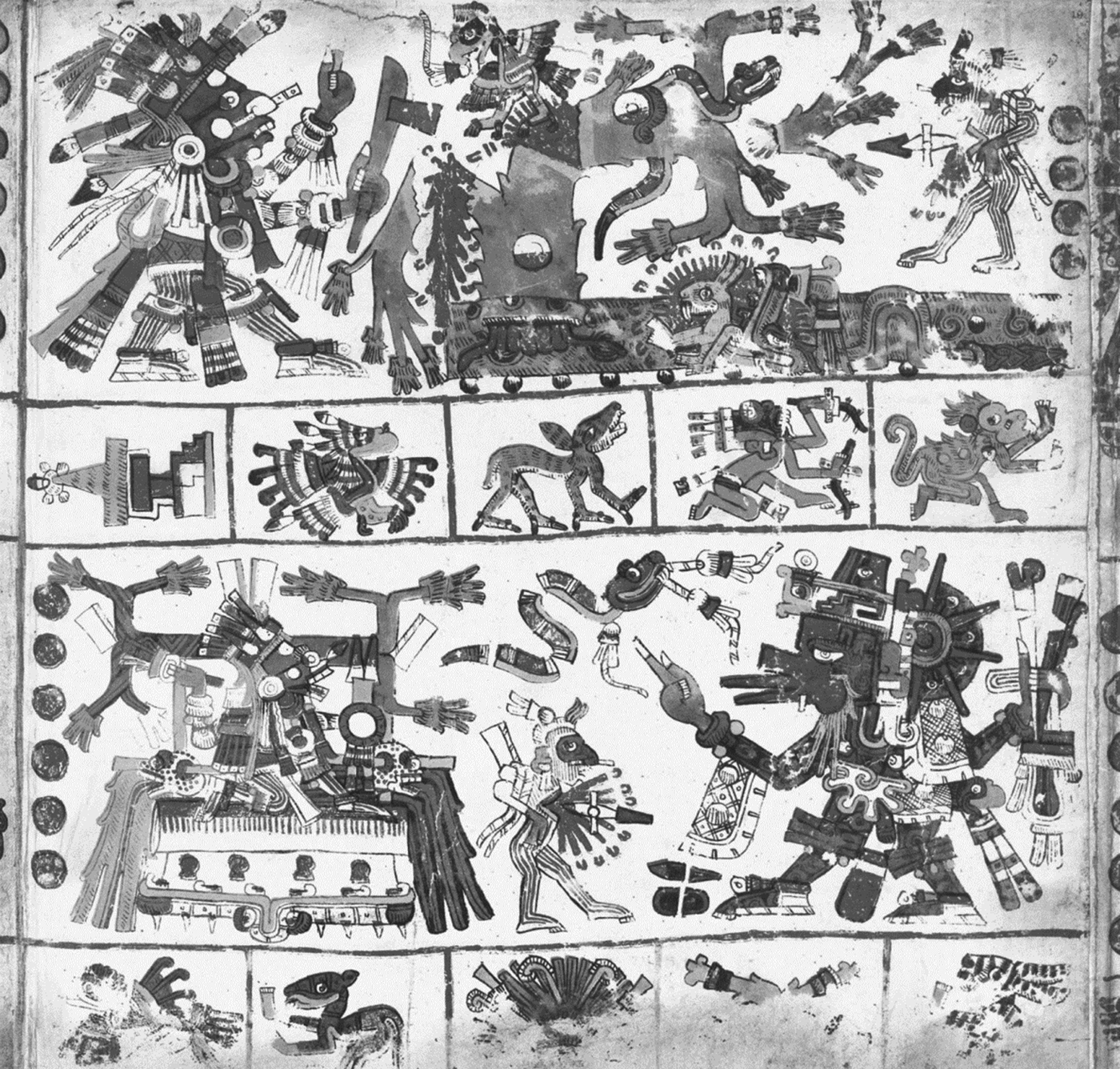
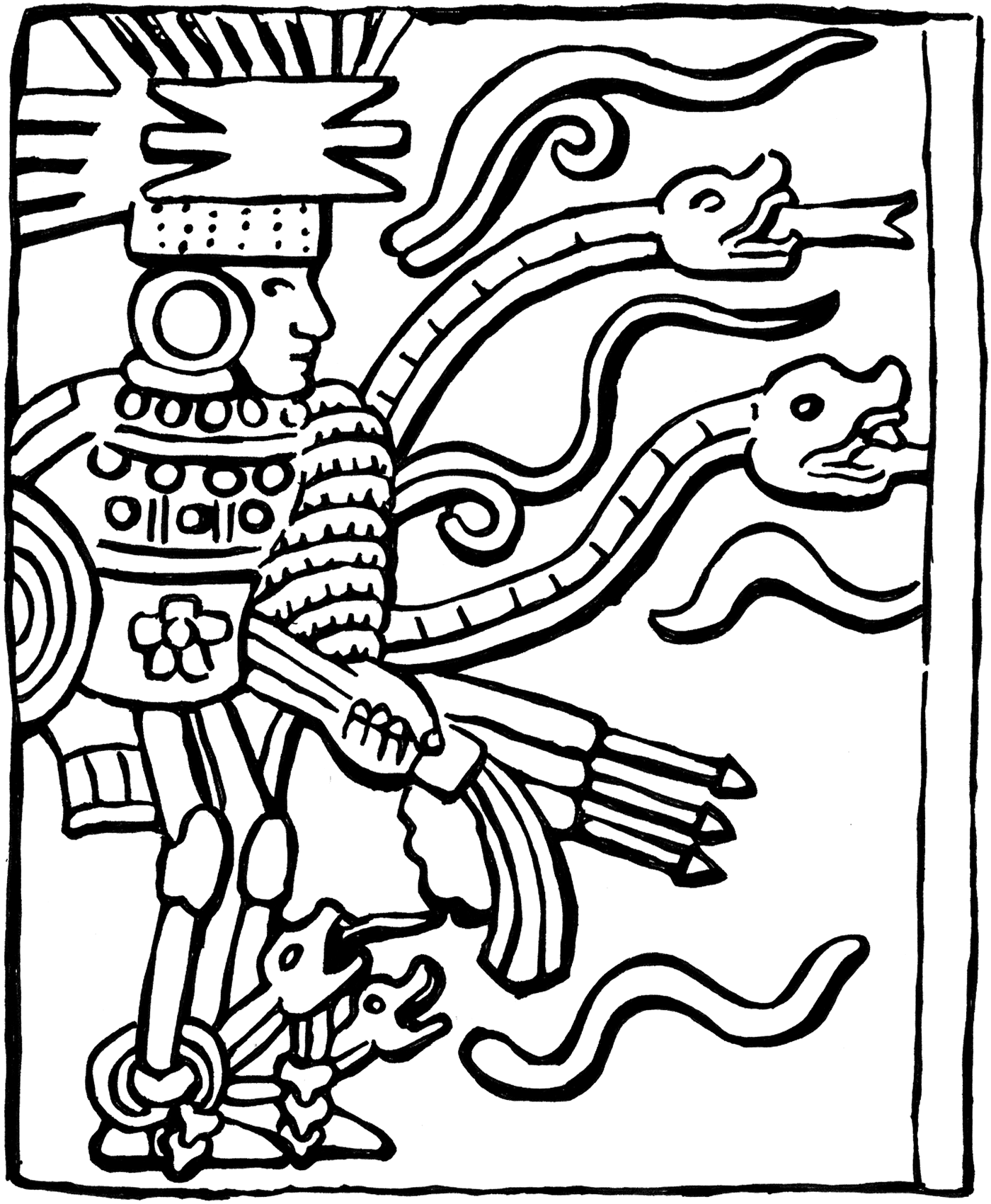
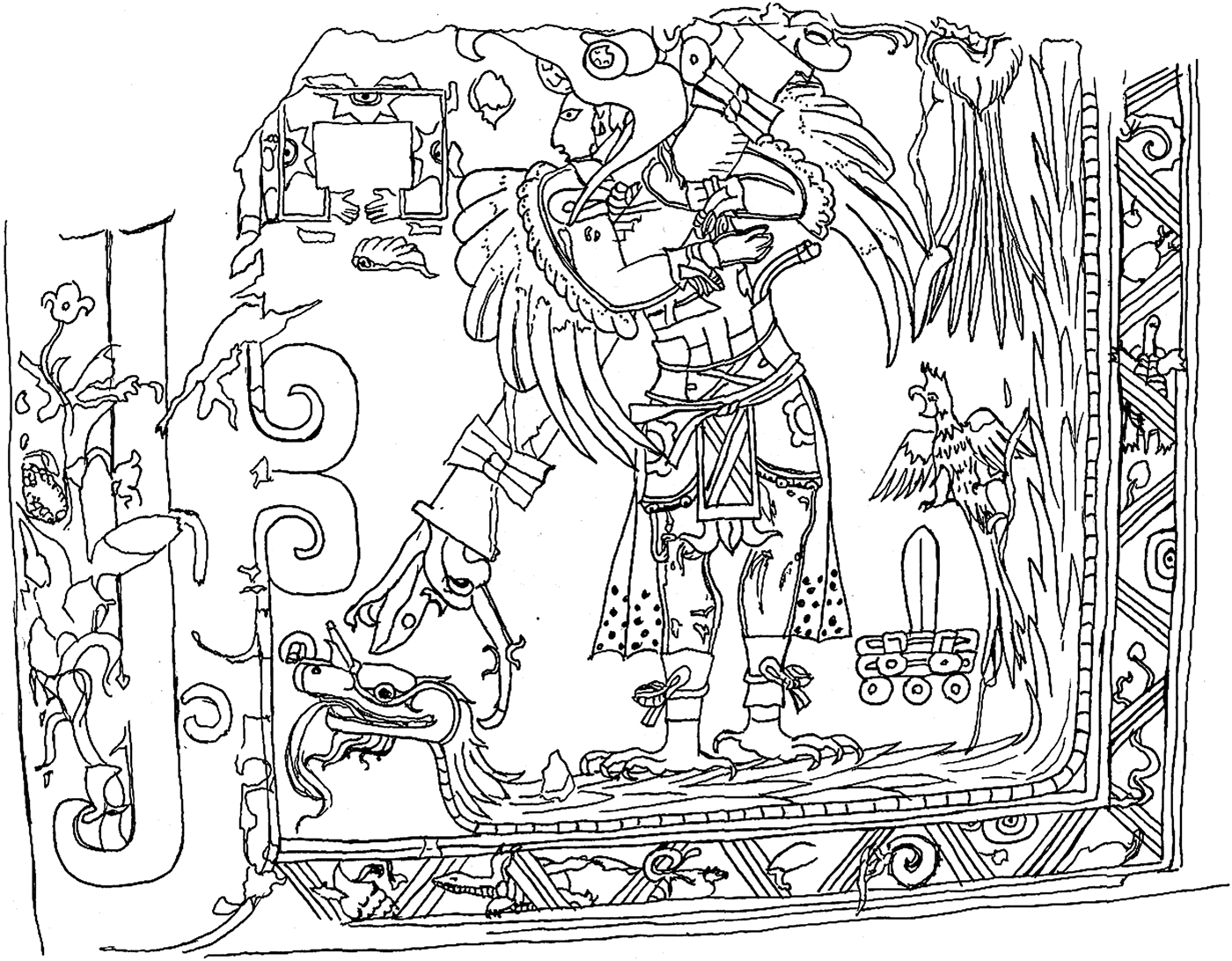
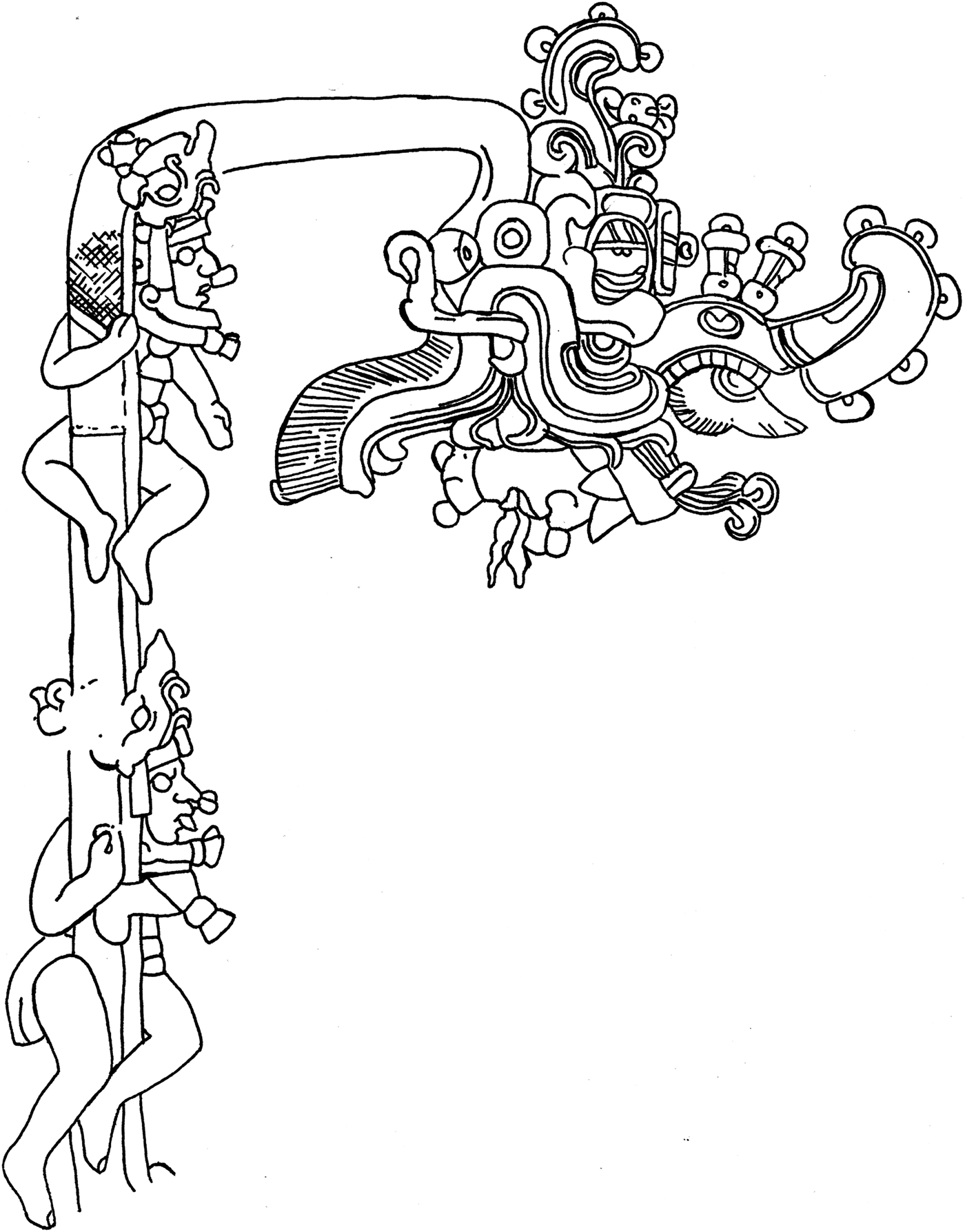
Tlahuizcalpantecuhtli is often depicted in the active posture of hurling darts at landscapes, place names, crops, humans, and fellow divinities (see, for example, Codex Borgia 53, 54; Codex Vaticanus B 23, 82 [Anders and Jansen Reference Anders and Jansen1993]), representing the malevolent influences attributed to Venus in Mesoamerica (Boone Reference Boone2007:151–154), rather than reclining. In the Codex Borgia his activities range from holding up the sky (49) to chopping down a tree which emits human blood (19; where he appears twice) (Figure 9). In one instance, a crocodile returns the god's aggression by biting off his foot (51). In a codex-style painting at Tizatlan, Tlahuizcalpantecuhtli stands in front of a serpent or crocodilian with a bloody mouth, perhaps an allusion to a similar encounter. He is not, however, shown emerging from its jaws.
Codex Borgia 19, with two images of Tlahuizcalpantecuhtli (bottom left and top left). Loubat facsimile edition image in public domain reproduced from Wikimedia Commons (commons.wikimedia.org/wiki/Codex Borgia).
None of these later paintings resemble the sculptured images of the coatepantli, nor do images of this god in Early Colonial period Mexica sources (for example, Codex Borbonicus 9 [Anders et al. Reference Anders, Jansen and García1991]; Codex Telleriano-Remensis 14v [Quiñones Keber Reference Quiñones Keber1995]). The only possible link to Tlahuizcalpantecuhtli or, rather, the Quetzalcoatl complex in general, on the coatepantli is not the frieze, but the merlons above, which are usually interpreted as representing conch shells. Yet, while cut conch shell ornaments are worn by Tlahuizcalpantecuhtli and Ehecatl in later manuscripts, at Tula they are not presented as ornaments or attributes of the skeletons themselves.
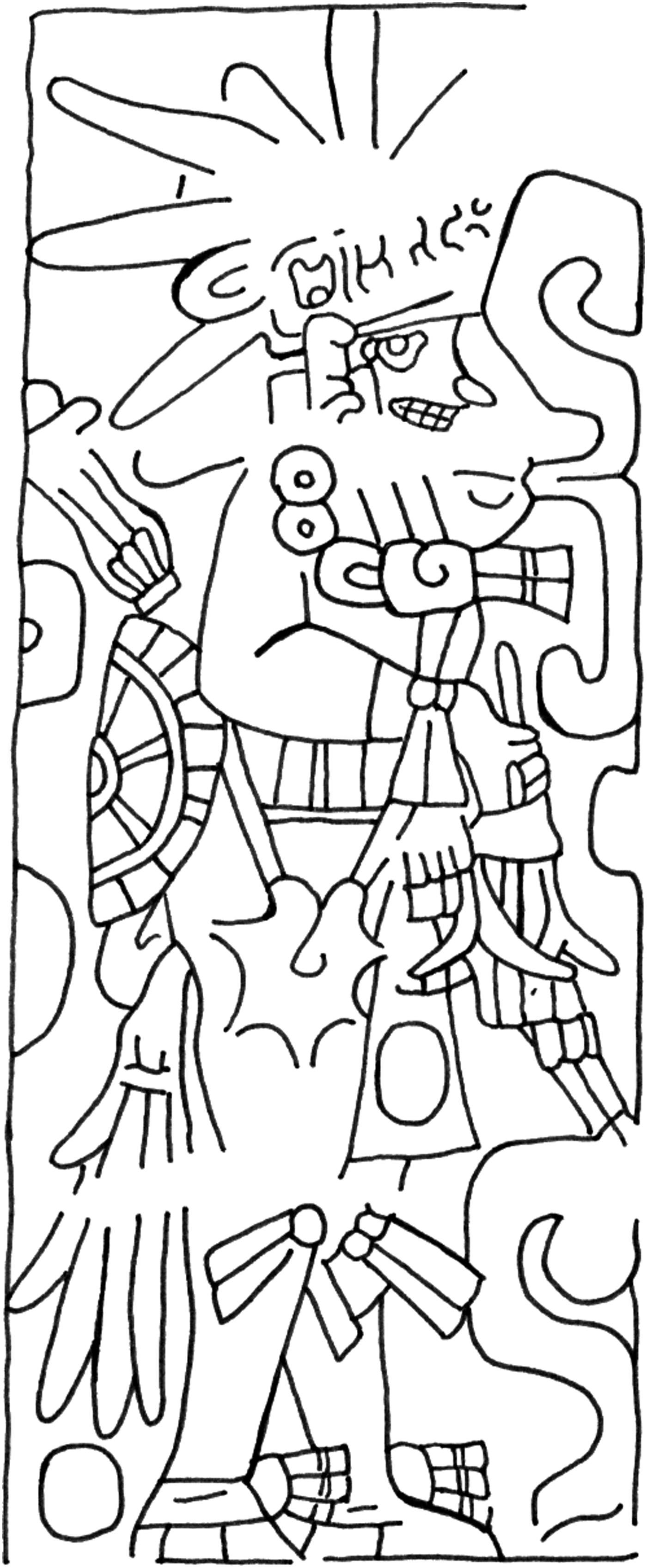
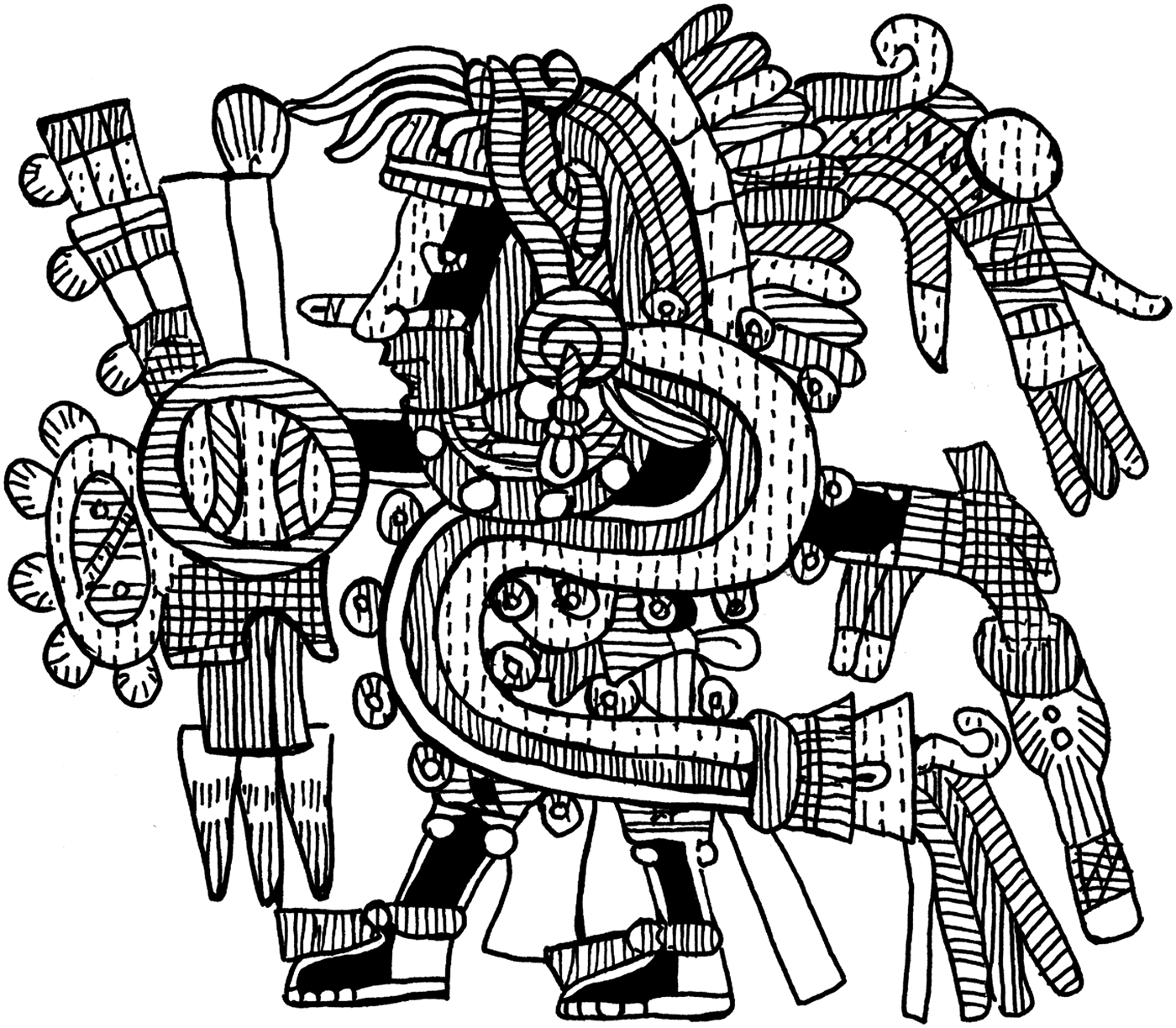
That Tlahuizcalpantecuhtli's iconography had already been fixed in its Late Postclassic form by the time of the coatepantli's construction is suggested by what is perhaps the earliest clear representation of this divinity, a Terminal Classic/Early Postclassic period relief on a column at Chichen Itza (Tozzer Reference Alfred1957:Figure 183) (Figure 10), identified by Taube (Reference Taube1992a:120–121; Reference Taube and Prem1994:223–224, Figure 15a). This sculpture portrays a standing figure whose skeletal face (or mask), atlatl, complex feathered headdress, cut conch shell ornament, and patterned headband correspond to manuscript images of the god from Late Postclassic to Colonial period central Mexico. Given the striking visual parallels in sculpture and architecture between Tula and its “twin city,” however that relationship is explained, one might also expect some iconographic consistency in depictions of the same divinity. But the Chichen Itza image does not resemble the coatepantli reliefs, and thus casts further doubt on Acosta's identification.
Tlahuizcalpantecuhtli at Chichen Itza. Drawing by Jay Scantling (after Taube Reference Taube1992a:121, Figure 63b).
A VIEW FROM THE NORTHERN FRONTIER
If the images of Tlahuizcalpantecutli in the codices do not provide useful analogs for the coatepantli reliefs, few alternative suggestions in the extant literature seem very helpful either. In a regrettably brief passage in a general work, Kubler (Reference Kubler1984:83) suggested that the coatepantli images refer to a “cult of dead warriors,” an intriguing if unelaborated speculation to which I will return later. Jones (Reference Jones1995:328) interprets the “gruesome scene of a serpent that has swallowed a dead person” as part of a strategy of Toltec propaganda. Reading the surrounding geometric designs as bracketing the snakes and skeletons between traditional mountain symbols (stepped frets) at the bottom and aquatic symbols (conch spiral merlons) on top, he discerns an attempt to sweeten the new Toltec message of conquest, supposedly conveyed by the devoured skeletons, with symbols of pre-Toltec fertility cults—pairing the mother with the ugly lover, to use his metaphor (Jones Reference Jones1995:328). His interpretation clearly reflects the traditional view of Toltec art as exclusively focused on militarism, but lacks supporting evidence. Sterpone (Reference Sterpone2007:43) suggests that the coatepantli reliefs are related to the Otomí moon goddess Sinana. While this suggestion is interesting in light of the long presence of the Otomí in the Tula region and the potential usefulness of Otomí mythology in interpreting archaeological remains from the area (Fournier and Bolaños Reference Fournier, Bolaños, Kowalski and Kristan-Graham2007), Sterpone similarly fails to present an argument or evidence for his claim. In a new book on the archaeology of funerary practices at Tula published shortly before this article went to press, Codron (Reference Codron2013:210–211) suggests that the skeletal figures on the coatepantli frieze are the dead devoured by the earth, as represented by the snakes and by the stepped designs, which she reads as mountains and caves. For her the scene alludes to the burial and decomposition of humans nourishing the earth. But, as I will discuss later in this article, it is by no means clear, and in fact is unlikely, that the skeletons are intended to be shown as being eaten. Serpents in Mesoamerican art are polyvalent symbols with many other connotations besides the chthonic, and while snakes are common in the art of Tula, none seem to clearly represent the earth. In addition, this reading of the coatepantli frieze leaves unanswered the question of why images of the earth nourishing itself on burials would occur in the architectural context of coatepantli.
Perhaps the only suggestion in the extant literature that may prove fruitful points to another area of Mesoamerica for visual and conceptual parallels. Diehl (Reference Diehl1983:50) traces what he describes as “death motifs” in this and other examples of Toltec art in the northwest Mexican states of Jalisco, Zacatecas, and Durango. Here the Classic through Epiclassic period Chalchihuites culture (a.d. 400–900) (Kelley Reference Kelley, Foster and Weigand1985:274) provides a number of possible antecedents to artistic and architectural features that appear in central Mexico for the first time at Tula. Colonnaded halls and sunken plazas, typical of the built environment at Tula, occur in earlier contexts in the north (Kristan-Graham Reference Kristan-Graham2000:2–3; Mastache et al. Reference Mastache, Cobean and Healan2002:70). This fact led Kristan-Graham to conclude that these forms have a symbolic value at Tula, perhaps establishing ancestral linkages to the northern frontier. Hers (Reference Hers1989, Reference Hers and Cornejo2001) also argues that the distinctive Toltec chacmool figures developed from Chalchihuites antecedents. Round structures at Tula may derive from northwestern models as well, rather than the Huastec origins usually suggested for them (Mastache et al. Reference Mastache, Cobean and Healan2002:70). The cult of Tezcatlipoca, whose earliest identifiable image appears at Tula, may likewise be of Chalchihuites origin (Diehl Reference Diehl1983:50; Holien and Pickering Reference Holien, Pickering and Pasztory1978; Kelley Reference Kelley, Cabrero, King and Jiménez2002:110; Weigand Reference Weigand2001:39; though see Olivier Reference Olivier2003:89–91 for contra). The possible northern affiliations of the Coyotlatelco ceramic complex in Epiclassic period central Mexico may be of relevance here as well (Mastache and Cobean Reference Mastache, Cobean, Diehl and Berlo1989:64–65; Mastache et al. Reference Mastache, Cobean and Healan2002:70–71). Such similarities and the chronological data might be interpreted as supporting indigenous histories recorded after the Spanish Conquest indicating that a portion of the Toltec population came from the Chichimec north. The shared features, however, likely also reflect the exchange and local appropriation of ideas among elites that characterize the Epiclassic and Early Postclassic throughout Mesoamerica.
It has been suggested that finds of disarticulated bones at Chalchihuites and related sites, some pierced as if for suspension as assemblages and architectural decoration (see, for example, Abbott Kelley Reference Abbott Kelley, Riley and Hedrick1978), reflect a “cult of death” among these northern peoples that is also seen in the art of Tula. Some of these remains probably represent similar processing and display of bodies to that documented for Mexica human sacrifice, while others may result from the curation of the bodies of venerated ancestors, whose partially articulated corpses may have been displayed above ground for long periods before eventual burial (Pickering Reference Pickering, Foster and Weigand1985:298–299). For example, excavations by Nelson (Reference Nelson2000) at the site of Los Pilarillos in Zacatecas produced a multiple burial containing the disarticulated remains of individuals of both sexes, including infants and elderly persons. These demographics, indicative of a broader range than the adult males expected from a population of sacrificed warriors, lead him to question the received archaeological wisdom that all such finds represent the remains of sacrificed war captives. As an alternative to this traditional model, he suggests that these northern Mesoamerican people conceived of their dead ancestors as ongoing participants in the social and cultic life of their communities and kept their remains as relics in an above-ground charnel display.
At La Quemada, attributed to the Chalchihuites culture broadly defined (Hers Reference Hers1989) or to the related Malpaso culture (Jiménez Betts Reference Jiménez Betts, Dahlgren and de Arechavaleta1995; Jiménez Betts and Darling Reference Jiménez Betts, Darling, Foster and Gorenstein2000), bones ornamented the outside walls of habitations as well as the interior of patios and temples and the roofs of covered walkways throughout the excavated portions of the site (Nelson Reference Nelson, Inomata and Webb2003:84, 86). Nelson and colleagues (Reference Nelson, Darling and Kice1992:305) excavated a temple at a location designated Terrace 18 where the bones of 14 people were either laid out on the floor or suspended from the roof. Because of the lack of cut marks and the friable condition of the bones, they hypothesize that rather than displayed trophies of war, these apparently exposed and naturally disarticulated skeletal remains belonged to elites or ancestors of the polity, displayed with honor in a charnel temple. They (Nelson et al. Reference Nelson, Darling and Kice1992:306) further suggest that although the collection of human bones employed as decoration excavated at the Chalchihuites (narrowly defined) Temple of the Skulls at Alta Vista (Abbott Kelly Reference Abbott Kelley, Riley and Hedrick1978) bore traces of cut marks, this structure might have been a mortuary temple as well, owing to architectural similarities with the La Quemada finds. Citing McAnany's (Reference McAnany1995) work on Maya ancestor worship regarding the importance and antiquity of ancestral cults in Mesoamerica, Nelson (Reference Nelson2000:25) relates it to his own on Chalchihuites funerary practices, acknowledging the heuristic value of hypotheses based on the ideology of ancestor veneration for the northern material. Perhaps such hypotheses have relevance for the interpretation of skeletal imagery at Tula as well.
Commenting on the apparent use of actual human bones as architectural ornament at La Quemada, Kristan-Graham (Reference Kristan-Graham, Kowalski and Kristan-Graham2007:561) remarks: “This reading not only makes sense of La Quemada's mortuary remains on ritual and symbolic levels, but it may also provide an answer to the intriguing question of why there is so little extant imagery at the site: perhaps the preponderance of human skeletal displays was deemed symbolically more resonant and visually more powerful than any type of painting or sculpture.” If, as she suggests, reliefs at Tula are analogous to the display of bones at Chalchihuites sites, perhaps reliefs of bones at Tula share some meanings with the use of actual bones as architectural decoration in the north. Architectural references at Tula deliberately linking the site to Alta Vista and La Quemada appear to reflect ancestral symbolism (Kristan-Graham Reference Kristan-Graham, Kowalski and Kristan-Graham2007:564). The skeleton reliefs may represent a similar allusion to the Toltec polity's north Mexican connections
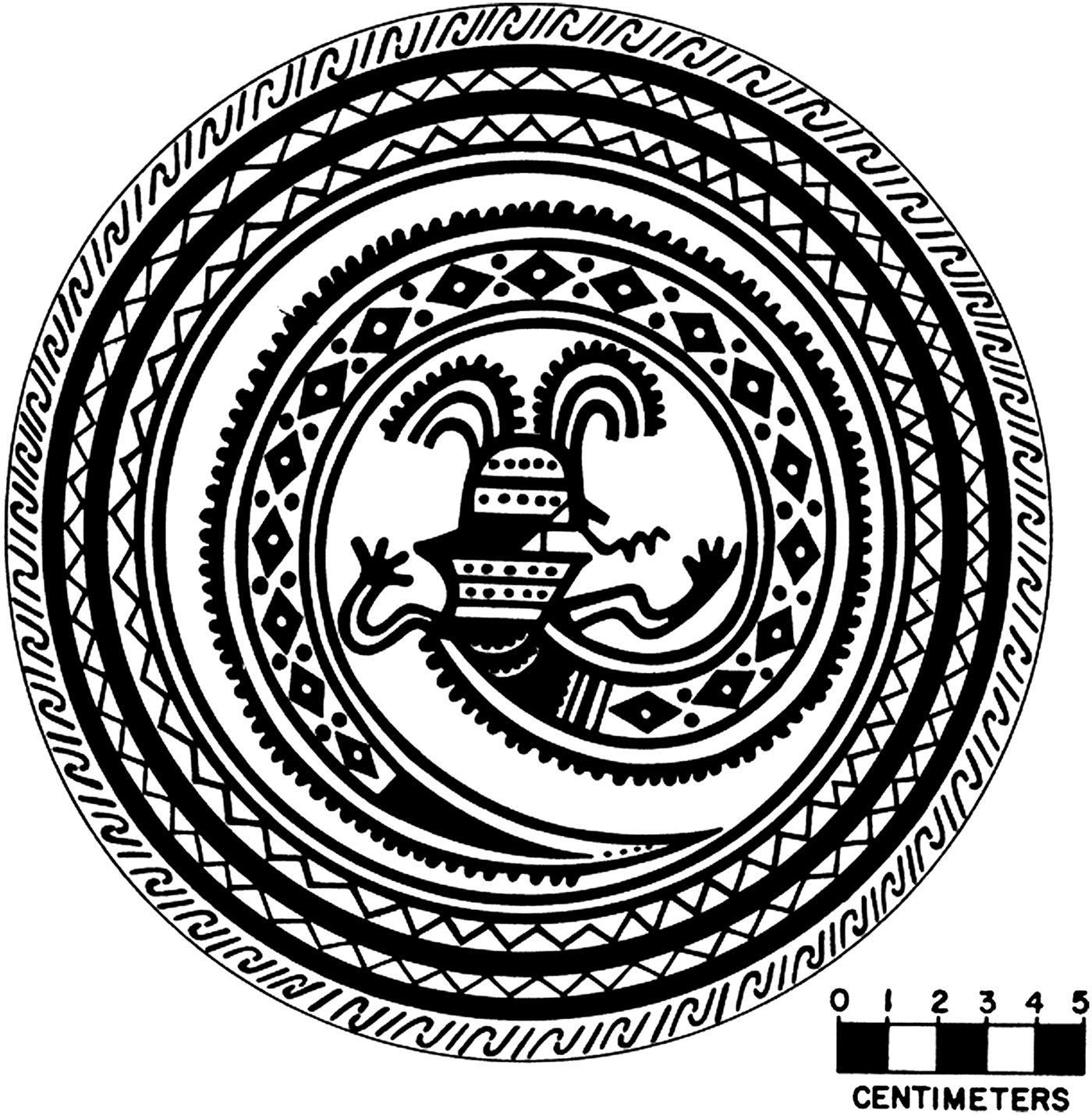
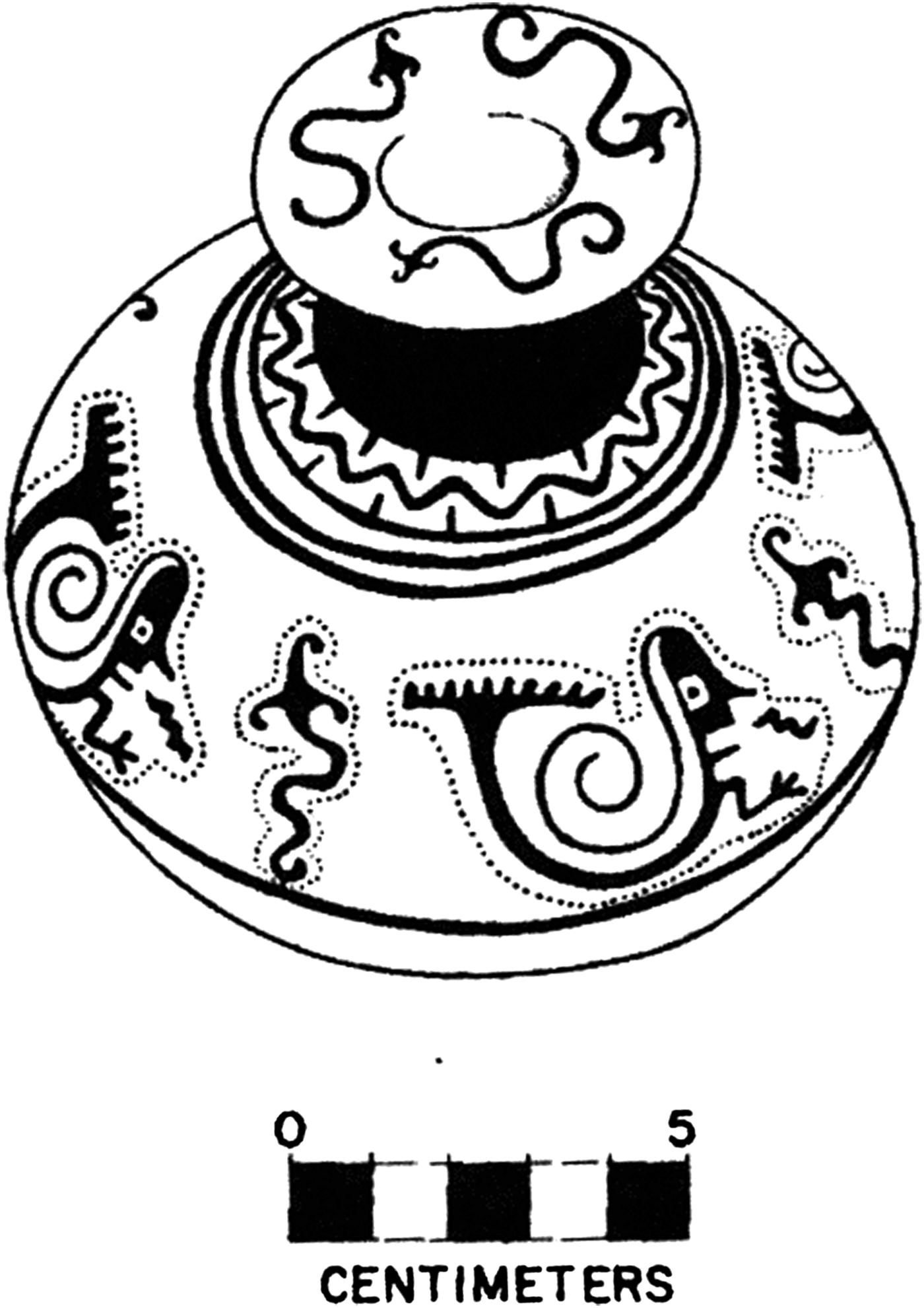
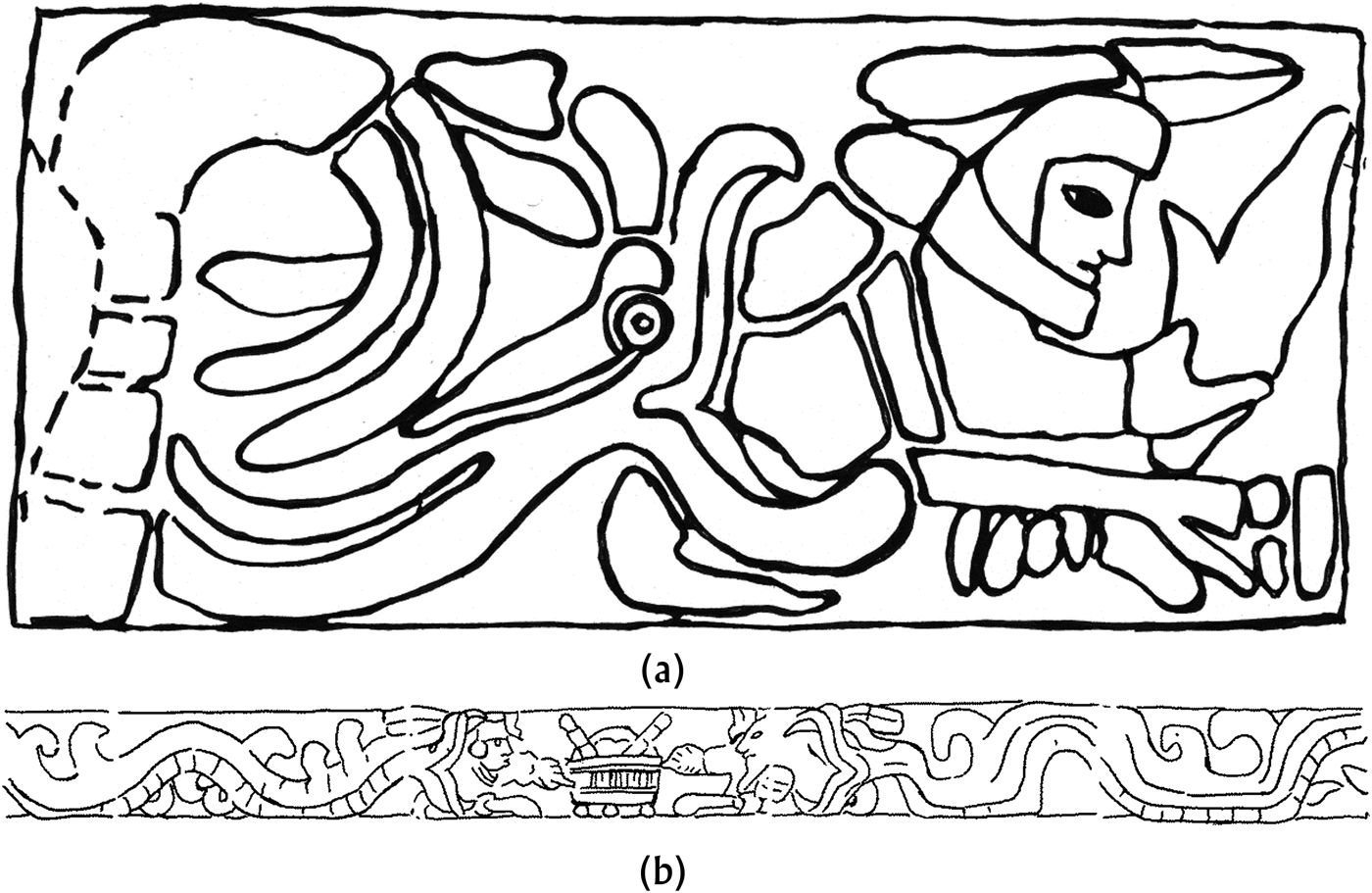
Possible antecedents or analogs to the coatepantli motifs (and the composite creature) may also be discernible in the imagery of Chalchihuites painted ceramics (Cynthia Kristan-Graham, personal communication Reference Kristan-Graham2000). Here, serpents, some “anthropomorphized” or with “anthropomorphic head and hands,” writhe, singly or in processions among geometric patterns (Kelley and Abbott Kelley Reference Kelley and Kelley1971:30, 73, 79, 89, 93, Plates 22a, 27b and 27d–f, 29 d) (Figures 11 and 12). Kelley and Abbott Kelley (Reference Kelley and Kelley1971:118) suggest an identification or conceptual linkage between these figures and Quetzalcoatl—at least the examples with what look like feathers. Other reptilian creatures in Chalchihuites ceramic iconography are referred to in the literature as “alligator” (Kelley and Abbott Kelley Reference Kristan-Graham1971:30, 59–60) or “crocodilian monsters” (Holier and Pickering 1978:153) and are linked via this identification to the Aztec deity/day sign Cipactli (Kelley and Abbott Kelley Reference Kelley, Kelley, Foster and Gorenstein2000:185), although most of these lack hind limbs (Kelley and Abbott Kelley Reference Kelley, Kelley, Foster and Gorenstein1971:45, 55, 65, 73, Plates 15, 17b, 18b, 18c, and 18 g, 22d–f). Their sinuous bodies reinforce their ophidian nature, and their forearms range in morphology from bird-like to human-like. In some instances, these Chalchihuites zoomorphs have human-like heads, even occasionally sporting feathered headdresses (Kelley and Abbott Kelley Reference Kelley, Kelley, Foster and Gorenstein1971:73, 90, Plates 22a and 22b, 30b).
Anthropomorphic serpent design, Suchil Red-on-Brown bowl (from Kelley and Abbott Kelley Reference Kelley, Kelley, Foster and Gorenstein1971:73, plate 22a). Reproduced by permission of Ellen Abbott Kelley.
Mercado Red-on-Cream vessel with anthropomorphic serpent designs (from Kelley and Abbott Kelley Reference Kelley and Kelley1971:93, Plate 29d). Reproduced by permission of Ellen Abbott Kelley.
This combination of serpentine bodies with humanoid limbs and heads in profile recalls the heads and arms of the skeletons framed by the jaws of the coatepantli serpents. Chalchihuites ceramics also feature bands of geometric decoration resembling the frieze of the coatepantli, including stepped frets and occasionally spirals (Kelley and Abbott Kelley Reference Kelley and Kelley1971:19, Plates 6a and 6e). In spite of these broad formal parallels, however, none of the published examples of ceramic designs includes a clear depiction of a human head framed by the snakes' jaws, nor do they show the lower half of a human body reclining entwined alongside the reptile as in the coatepantli reliefs. Rather, some of these composites portray a creature reminiscent of the composite creature or War Serpent at Tula in their mixture of avian aspects and serpent and crocodilian features (Braniff Cornejo Reference Braniff Cornejo, Dahlgren and Arechavaleta1995:184–185; Jiménez Betts Reference Jiménez Betts, Dahlgren and de Arechavaleta1995:53, Figure 5c).
BENEFICENT BONES
Perhaps, given the strong connections between Tula and the north, the skeletons carved in relief on the coatepantli stone wall are analogs to architectural decoration using real skeletal material. But, if so (and even if not), what is the role and significance of the bony protagonists of the Toltec relief? With the Chalchihuites parallels in mind, are they ancestors or war trophies, honored dead or captives? Both meanings are broadly consistent with the royal themes of Tula Grande, but which is indicated in this specific work?
The traditional interpretations of the coatepantli skeletal figures—as the celestial sacrifice par excellence Tlahuizcalpantecuhtli and/or as vanquished victims of the Tula polity—depend to some extent on a reading of skeletal imagery in Mesoamerican art as always carrying the same connotations as similar motifs in the history of Western visual culture. While it is true that skeletal features in Mexica art often distinguish gods of the underworld, hostile supernatural powers (like Tlahuizcalpantecuhtli), and victims of sacrifice, it is erroneous to assume that all such motifs signify the same concepts in Mesoamerica. On the contrary, a persistent and widely shared strand of pan-Mesoamerican ideology associates bones with regeneration, fecundity, and the living dead who embody and guarantee such qualities, ancestors.
Anthropological data from contemporary indigenous Mesoamerican peoples from the Huichol in the north to the Tzeltal of Chiapas indicates that they view skulls and bones as the seats or enduring seeds of a person's life essence. In Huichol belief, for example, bones are the source of life where the soul resides (Furst and Nahmad Reference Furst and Nahmad1972:12). On its journey to the afterlife, the soul of a deceased Huichol takes the form of a skeleton. Skeletonization in Huichol art is an iconographic attribute of both spirits of the dead and the living shamans who interact with them. Deceased shamans can be reborn in the form of quartz crystals, interpreted as conglomerations of the bones of dead healers. Peter Furst (Reference Furst and Townsend1998:173) extrapolates from these ethnographic observations to the pre-Columbian art of west Mexico, suggesting that skeletal imagery there often also has connotations of fertility and regeneration. Similar beliefs are found among the modern Otomí (Galinier Reference Galinier, Aronoff and Scott2004:102, 106), an ethnic group whose long presence in the Tula region has been noted. Far to the south, in contemporary Tzeltal belief, the skull is the seat of a person's life essence (Stross Reference Stross2007:4). Stross notes the continuity between this ethnographic data and earlier Maya beliefs and art as far back as the Classic period. He reproduces a well-known Classic Maya painted image of the resurrection of the Maize God on a ceramic plate, noting the depiction of a skull as the seed from which the reborn deity sprouts (Stross Reference Stross2007:11, Figure 9).
Jill Leslie Furst (Reference Furst1978, Reference Furst and Boone1982) interprets skeletonization in Postclassic Mixtec codex art as connected with the earth, maize, fertility, and generation rather than warfare (Furst Reference Furst and Boone1982:208–217, Figures 1–9). Noting the association of skeletal features (for example, fleshless jaws) with earth and fertility deities in the codices, she concludes that, at least in these contexts, they signify forces of life and growth rather than death (Furst Reference Furst and Boone1982:221). Citing Peter Furst's data, she suggests an analog for these Mixtec images in the Huichol belief in bones as soul-bearing seeds of regeneration and rebirth (Reference Furst1978:22–23, 318; 1982:221). Contemporary with the Mixtec codices but closer in space to the Toltec, this reading was also proposed for some of the skeletal imagery in the Codex Borgia by Nowotny (Reference Nowotny, Everett and Sisson2005:37).
Byland and Pohl (Reference Byland and Pohl1994:193–208) interpret some partially skeletal figures in the Mixtec codices as oracles serving as spokespersons for deceased kings, whose venerated remains were consulted by their descendants as mediators for problems of succession and other dynastic conflicts. Most prominent of these is Lady Nine Grass, whose fateful interventions in the careers of Lord Eight Deer and Lady Six Monkey are depicted in several of the major screenfold histories. Jill Furst (Reference Furst1978:318) interprets Nine Grass as a goddess of life and germination, but if ancestral bones and germinating seeds are symbolically equated, this need not conflict with Byland and Pohl's hypothesis.
Even the skeletal Mexica lord of the Underworld, Mictlantecuhtli, the greatly feared god of death, had associations with fertility and generation as well. López Luján (Reference López Luján and Carrasco2001:319) links these paradoxical attributes to the symbolism of bones as seeds and the skeletal fertility deities of the Codex Vindobonensis (Anders et al. Reference Anders, Jansen and Pérez Jiménez1992).
CONTEMPORARY BONES
In general, skeletal imagery in Mesoamerica across time can symbolize ancestors and forces of renewal as well as the sacrifice that is necessary to procure those forces of renewal from the gods. In more specific chronological terms, images of wholly or partially defleshed personages were particularly widespread throughout Mesoamerica during the Late Classic/Epiclassic through Early Postclassic periods, when the rise and florescence of the Tula art tradition (and the Chalchihuites sites) occurred. Like many other shared aspects of the iconography of these periods, this motif seems to have been widely disseminated across the far-flung networks of economic interactions, political alliances, and religious cults that characterize this phase of Mesoamerican cultural history. It is necessary to consider this comparative material as part of any comprehensive and conscientious attempt at understanding the meaning of the coatepantli reliefs. Yet, the regional variability in the specific form, context, and—without doubt—meaning of this general theme is quite considerable, and more specific parallels with the Tula coatepantli figures often difficult to discern. While skeletal imagery was widespread, it seems to have been deployed and interpreted in very different ways at the local level.
In the art of El Tajin, dated to the Epiclassic to Early Postclassic periods, skeletal beings are ubiquitous, ranging from the supposed death deities emerging from water and descending to receive the sacrifice of ball players on the South Ball Court reliefs (Koontz Reference Koontz2008:39, 50, Figures 3.1 and 3.8) to the costumed skeleton carved on the polygonal stela found in the fill of Structure 5 (Kampen Reference Kampen1972:7). In pose, costume, and context, however, most of these bony beings are quite different from those at Tula. One exception is a relief of a reclining skeleton with a tree sprouting from its body (Koontz Reference Koontz2008:74, Figure 4.3f; Taube Reference Taube and Prem1994:215, Figure 4c). This figure is part of a narrative composition where the El Tajin ruler 13 Rabbit presides over the birth of the World Tree from the body of the skeleton, in an illustration of the pan-Mesoamerican trope of life germinating from death, with parallels to the sprouting skull of the Maize God in Classic Maya art (Koontz Reference Koontz2008:101–102). Such imagery is consistent with depictions of human sacrifice at El Tajin, but the coatepantli skeletons lack the narrative context to determine whether this same specific meaning was intended at Tula, or whether the same broad idea of life springing from death is reflected in the coatepantli reliefs in the specific form of concepts related to ancestors and regeneration.
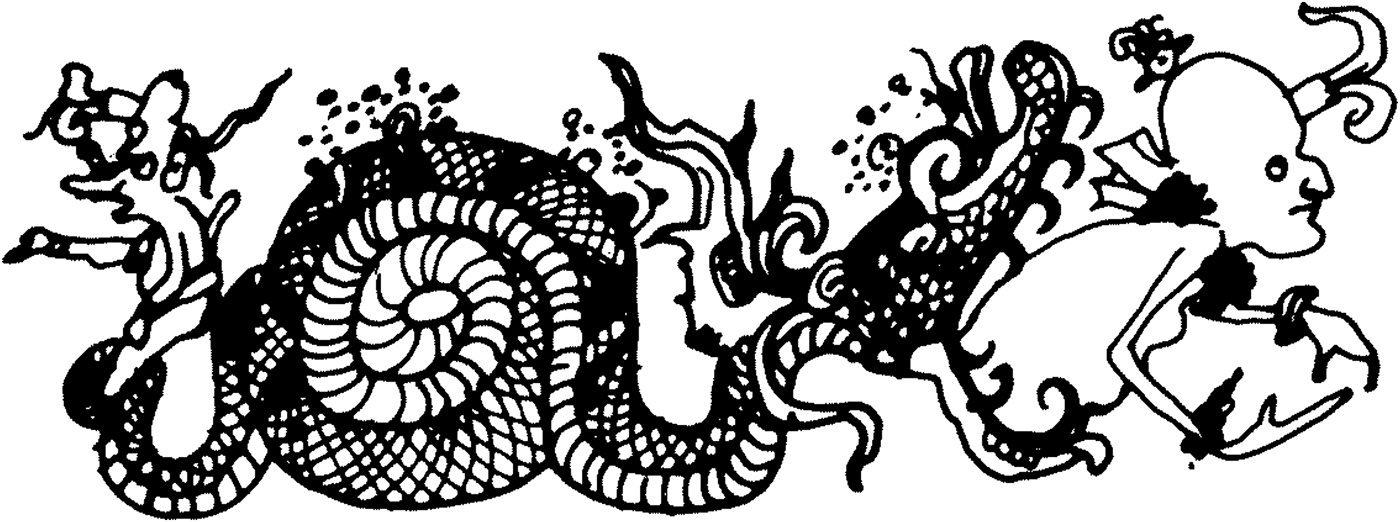
In the Cotzumalguapa sites of Epiclassic/Terminal Classic period Pacific coastal Guatemala, where stylistic similarities to Tula have long been noted but little explored in detail, skeletal imagery abounds. In particular, a partially skeletonized figure appears on stelae and other reliefs, accompanying elite persons engaged in sacrificing to descending ancestors or deities and ball game activities (Braun Reference Braun1977:295–302; Parsons Reference Parsons1969:106, 136, 143, Plates 32a and 42a). This image, called the “death manikin” by Parsons (Reference Parsons1969) and the “Manikin Death God” by Chinchilla Mazariegos (Reference Chinchilla Maziaregos1996:117), is smaller in scale than the human protagonists of the relief scenes, and in some instances (for example, Palo Verde Monument 3) is carried like a small effigy. This figure shares some general features with the coatepantli skeletal beings, besides its defleshed state. In some depictions (for example, Monument 3 at Bilbao), it is associated with snakes by wearing a serpent belt or gauntlet, though it never appears reclining alongside large serpents, and its hands and feet retain flesh like those of the coatepantli skeletons. On the Bilbao Monument 13 (Parsons Reference Parsons1969, Plate 42a), it is surrounded by “flames,” recalling the volutes in front of the faces of the coatepantli figures (Figure 13). It occurs in monumental contexts associated with sacrifice, ancestors, and rulership (Popenoe Hatch Reference Poponoe Hatch, Bove and Heller1989), analogous to the themes of the ceremonial complex at Tula Grande, and possibly with liminal states and the boundaries of sacred precincts (Braun Reference Braun1977:300–302). But its poses, gestures, costume (it frequently wears the yoke of a ball player), prominent ear ornaments, and odd horn-like elements on its head are quite different, suggesting only broad conceptual relations with the Tula images—its meaning as uncertain as that of the latter. Skeletons also appear in a “hocker” or birthing position in Cotzumalguapan art, in at least one case associated with a large serpent (Braun Reference Braun1977:Figure 173), another reminder of the association of death and fecundity, but again the specific meaning remains unclear.
Bilbao Monument 13, with death manikin at right. Drawing by Jay Scantling (after drawing by Javier Urcid, personal communication 2011).
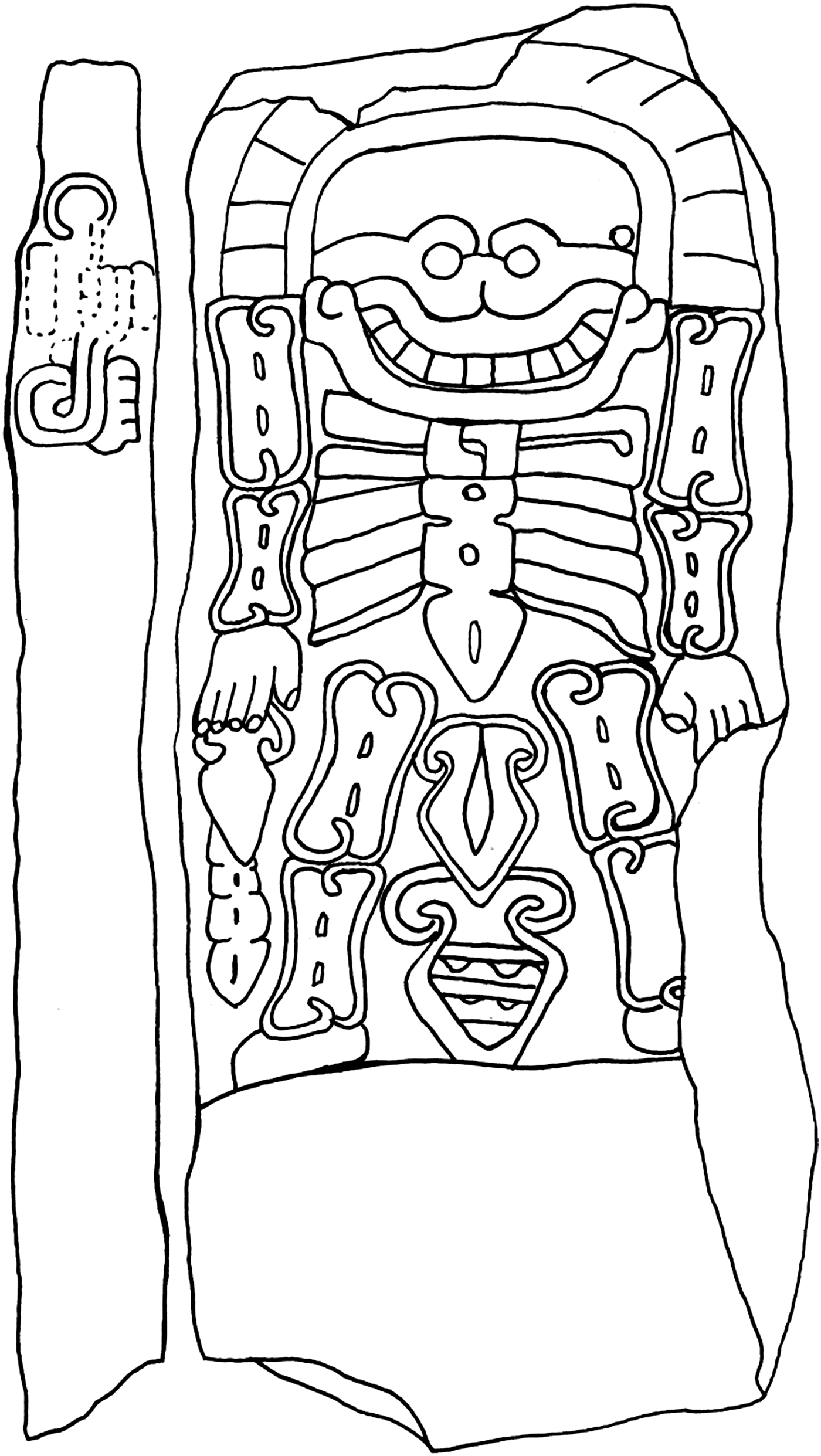
It was during the Late Classic to Postclassic transition that skeletal imagery in many media, reflecting the importance of ancestral remains in legitimating the ruling elite, became prominent in Oaxaca (Blomster Reference Blomster, Fitzimmons and Shimada2011:144). The association of ancestral cults and skeletal iconography in the Postclassic Mixteca, as noted in the discussion of the Mixtec codices above, may be of potential relevance to the coatepantli imagery, and contact between Tula and the Mixtec is supported by the archaeological evidence (Flannery and Marcus Reference Flannery, Marcus, Flannery and Marcus1983; Mastache et al. Reference Mastache, Cobean and Healan2002:48). The parallels, however, are broad and nonspecific. In Guerrero, several stone monuments of presumed Late Classic/Epiclassic date bear depictions of skeletonized humans (for example, the Mexiquito Stela [Reyna Robles Reference Reyna Robles, Niederberger and María Reyna Robles2002:366–368, 387, Figure 10]), where strange skeletal beings ascending and descending may have some distant affinities with Cotzumalguapan iconography. A standing skeletal figure holding a human heart carved on Piedra 1 at Terreno de Coimbre (Figure 14) likewise is compared by Gutiérrez and Pye (Reference Gutiérrez, Pye, Laporte, Arroyo and Mejía2007:933–934, Figure 12) to the death manikin in Cotzumalguapan art that is identified as a death deity. Again, the resemblances to the coatepantli images are very general; this looks like a very different entity.
Monument 1, Terreno de Coimbre. Drawing by Jay Scantling (after drawing by Javier Urcid, personal communication 2011).
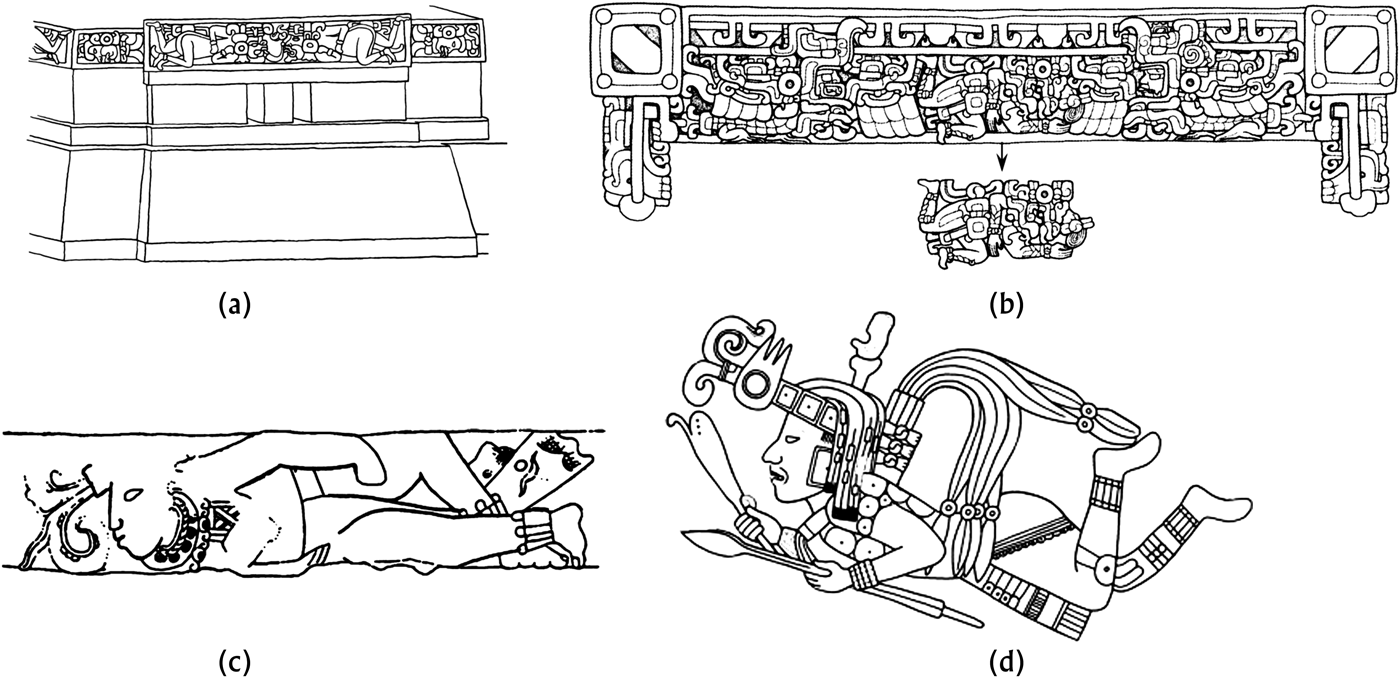
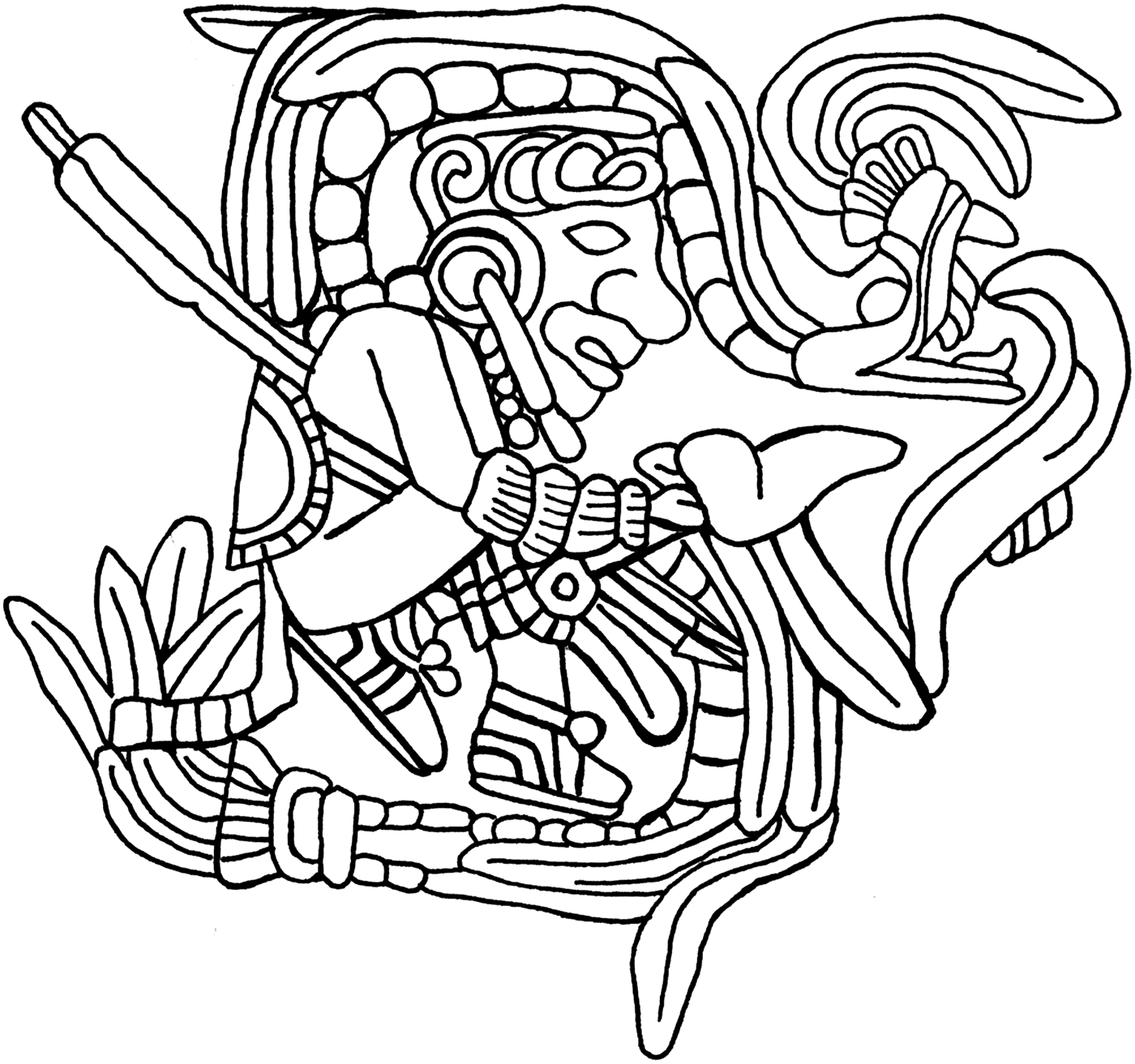
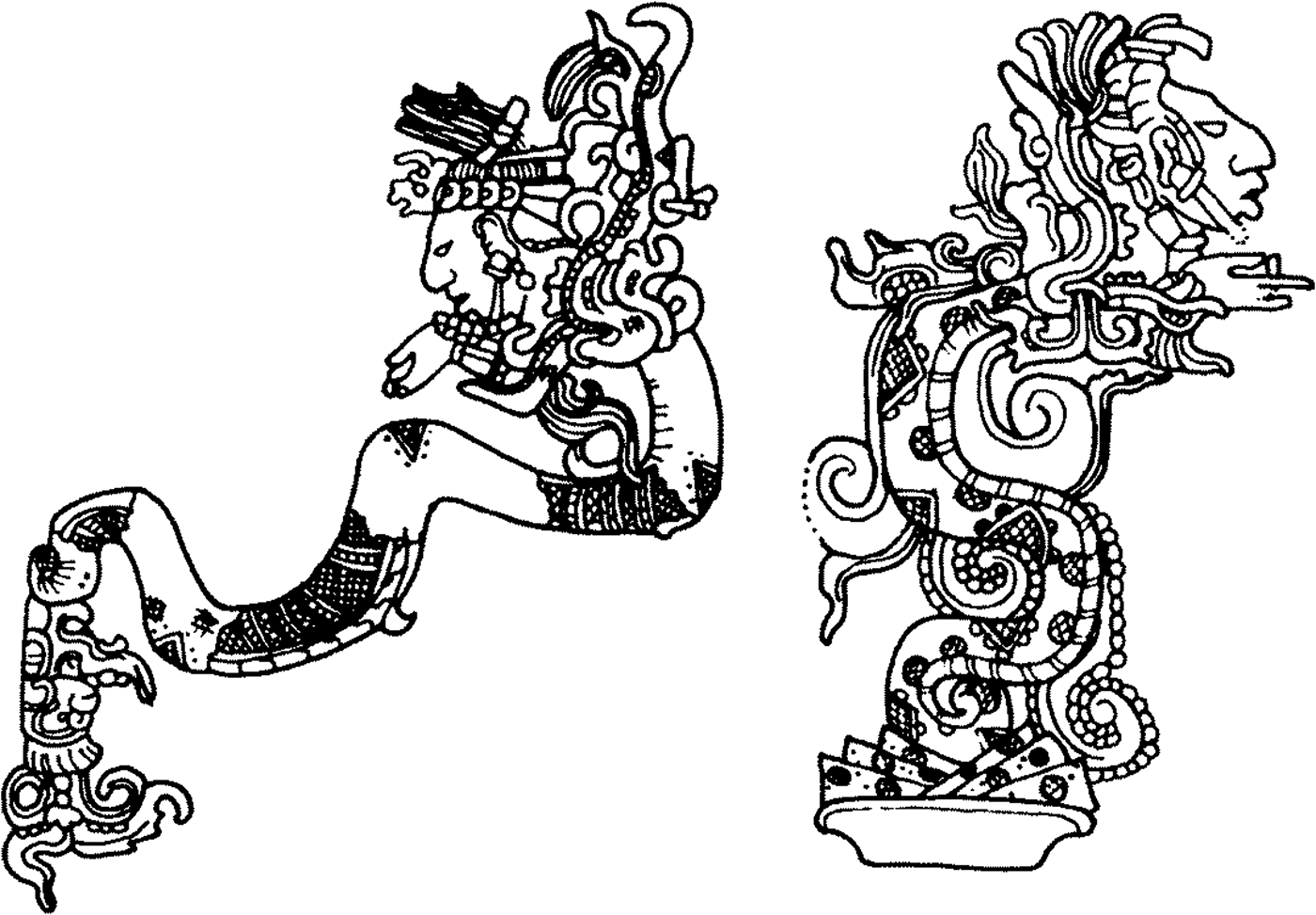
At Tula's “twin Tollan,” Chichen Itza, partially skeletal human figures and snakes are closely associated, albeit in a rather different fashion from the coatepantli reliefs. The images in question are warriors with defleshed arms, legs, and sometimes torsos, their ankles entwined with rattlesnakes while further serpents appear at the joints of their skeletal limbs (Figure 15). Twenty of these beings adorn the so-called Tzompantli (Tozzer Reference Alfred1957:102, 131, Figures 460–461), while similar characters appear in frescoes in the Temple of the Warriors (Tozzer Reference Alfred1957:Figure 430). These figures resemble those on the coatepantli insofar as typically displaying fully fleshed hands, but differ in usually retaining the skin of the face, in their erect posture, full costume, and heavy armaments. Occasionally, they carry trophy heads or atlatls (Miller Reference Miller, Tiesler and Cucina2008:178). Flame-like forms surround or emanate from these macabre beings, recalling the volutes associated with the coatepantli serpents. Probably by a circular comparison with the coatepantli, Tozzer (Reference Alfred1957:134) suggested that these figures may be connected with Tlahuizcalpantecuhtli, but they differ from the image of the same deity identified by Taube (Reference Taube1992a:120–121; Reference Taube and Prem1994:223–224) at Chichen Itza. Echoing Seler (Reference Seler1960–1961:364), Tozzer (Reference Alfred1957:134) also called this figure the “Dead Warrior,” recalling Kubler's comments on the coatepantli. This identification is rejected by Miller (Reference Miller, Tiesler and Cucina2008:178) because it occurs on the Tzompantli, but her argument is problematic. There is no compelling reason as to why this location should preclude Tozzer's interpretation; dead warriors would not be an incongruent motif for decorating a monument extolling sacrifice and military might. But the concept of “dead warriors” is as vague here as in Kubler's interpretation of the coatepantli: What kind of warriors? Sacrificed foreign captives? Local heroes, rulers, or ancestors?
Skeletal warrior from the Tzompantli, Chichen Itza. Drawing by Jay Scantling (after Tozzer Reference Alfred1957:Figure 460).
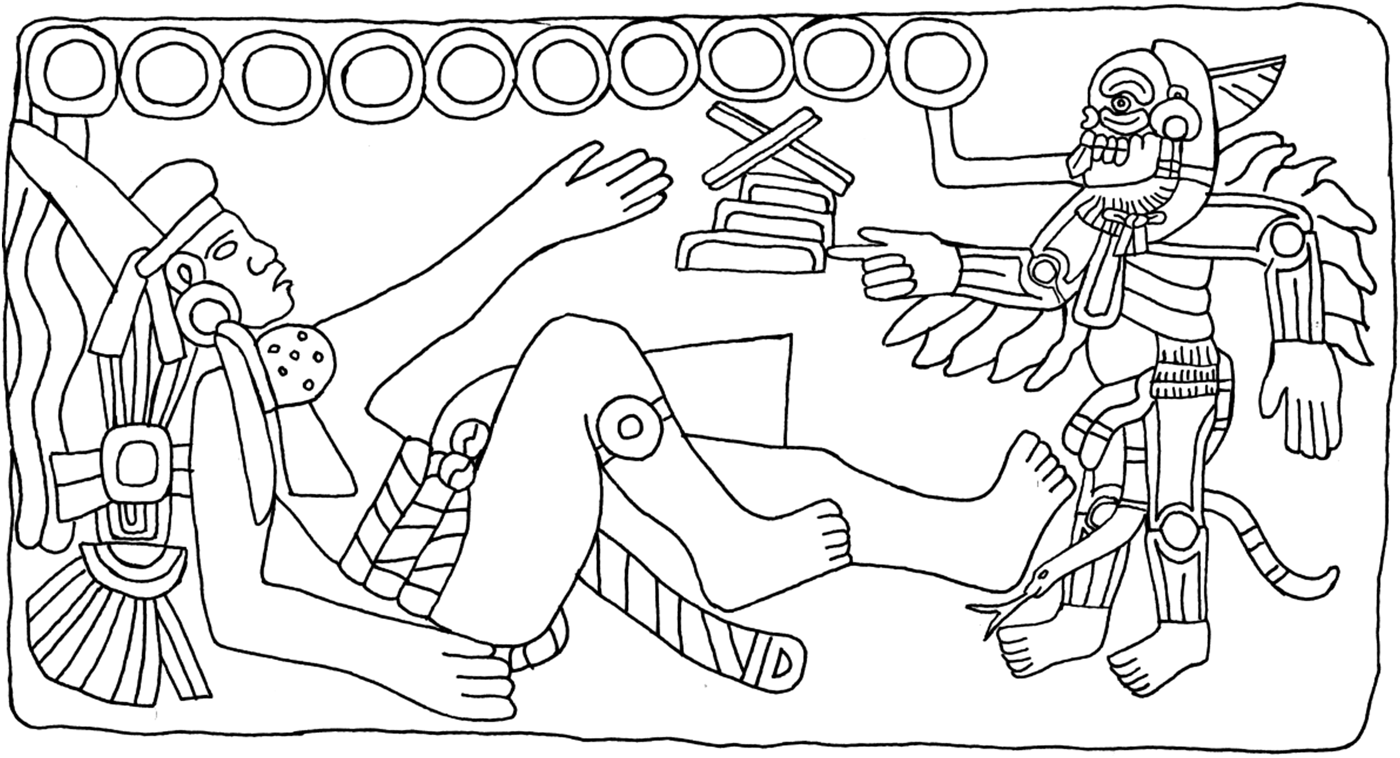
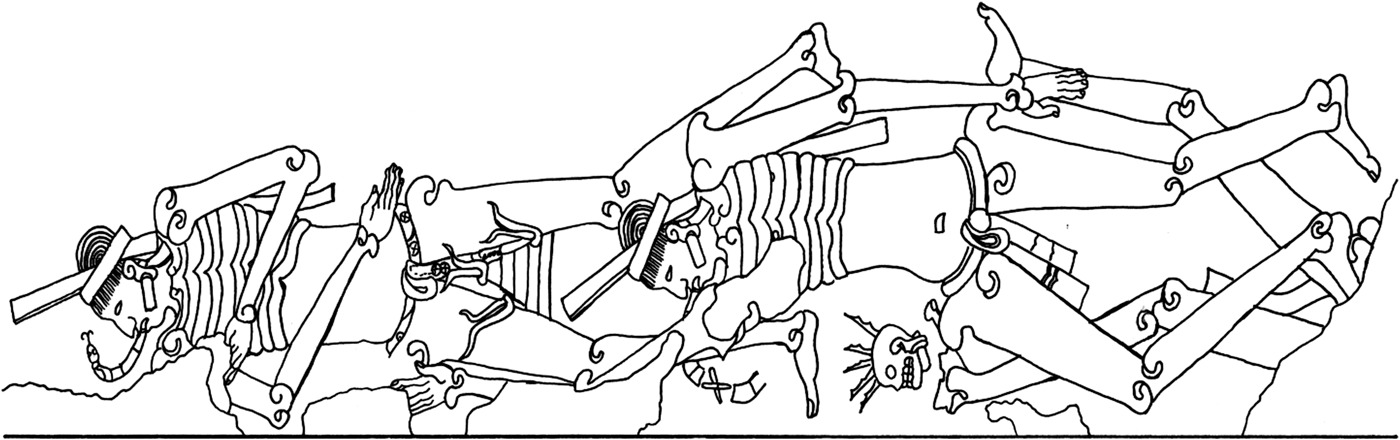
Finally, closer to Tula in geographical space, at the Epiclassic center of Cacaxtla in Tlaxcala, snakes occur with reclining skeletal figures (Brittenham Reference Brittenham2008:77–83; Urcid Reference Urcid, Robles and Guzman2010:Figure 27) painted on a step of a corridor under Complex 2, but in a different form than the combination on the coatepantli reliefs. These figures (Figure 16) have skeletal limbs and exposed rib cages, though their faces and lower abdomens retain their flesh, and they wear head bands and small loincloths. In a reversal of the usual reading of the coatepantli skeletons as emerging from the maws of the accompanying serpents, small snakes emerge from the mouths of these painted personages. Brittenham (Reference Brittenham2008:77–83) and Urcid (Reference Urcid, Robles and Guzman2010:Figure 27) interpret these figures as captives, an identification consistent with their location on a stair and paralleling Classic Maya placement of prisoner images on stairways. This interpretation is reinforced by the image of a flaming pyramid, resembling a Late Postclassic central Mexican sign of conquest, between one figure's legs, and probable toponym glyphs on the same stairway. These clear signs of conquest and captivity are not paralleled on the coatepantli, and the architectural context is quite different, suggesting differences in meaning as well. As with the Chichen Itza images, these Cacaxtla paintings share with the coatepantli reliefs a linking of the dead, war, and serpents, but these broad parallels do not allow us to generate more specific hypotheses about the Tula images.To do that, it is necessary to examine other reclining figures, albeit not skeletal, associated with serpents in the Tula art tradition, with striking parallels in iconography and placement to the coatepantli images.
Painting of partly skeletalized figures from step of corridor under Complex 2, Cacaxtla. Drawing by Jay Scantling (after drawing by Javier Urcid, personal communication 2011).
RECLINING FIGURES AND BONES AT TULA: ICONOGRAPHIC AND ARCHAEOLOGICAL CONTEXT
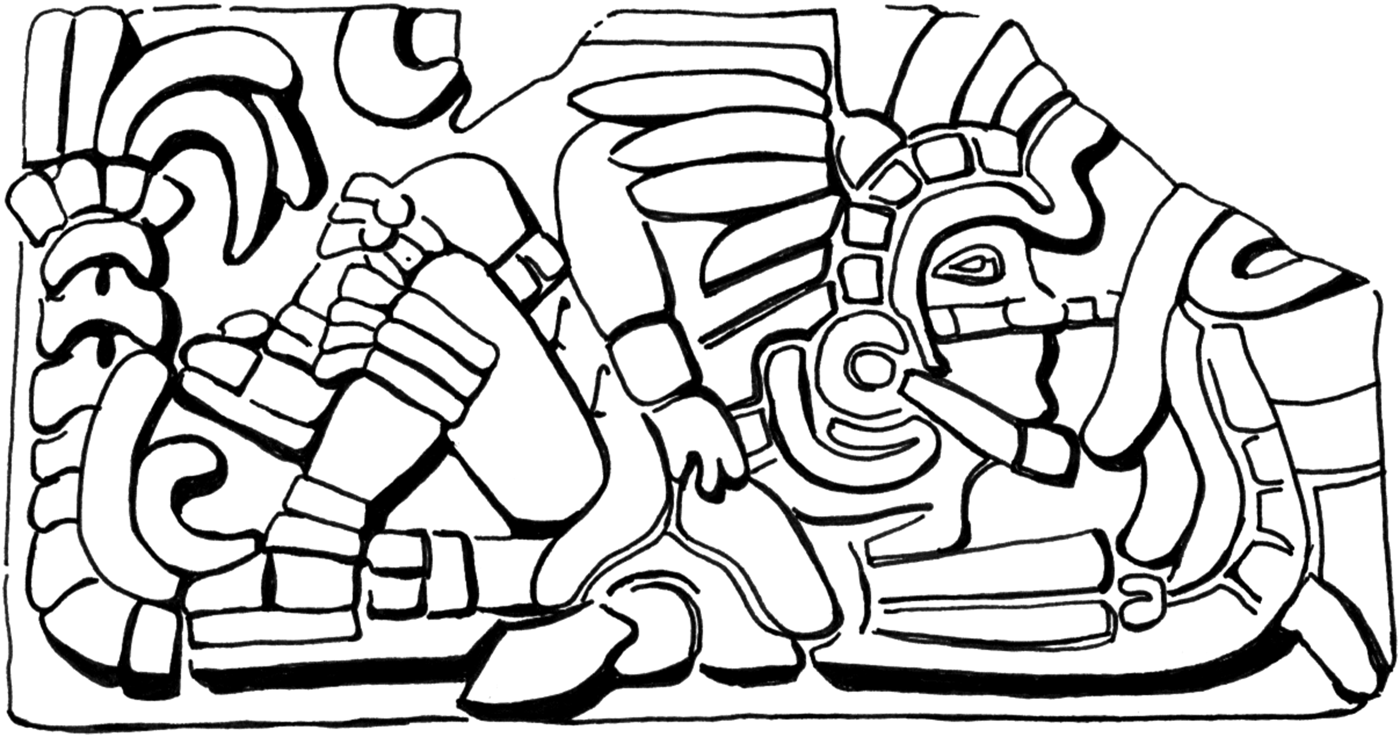
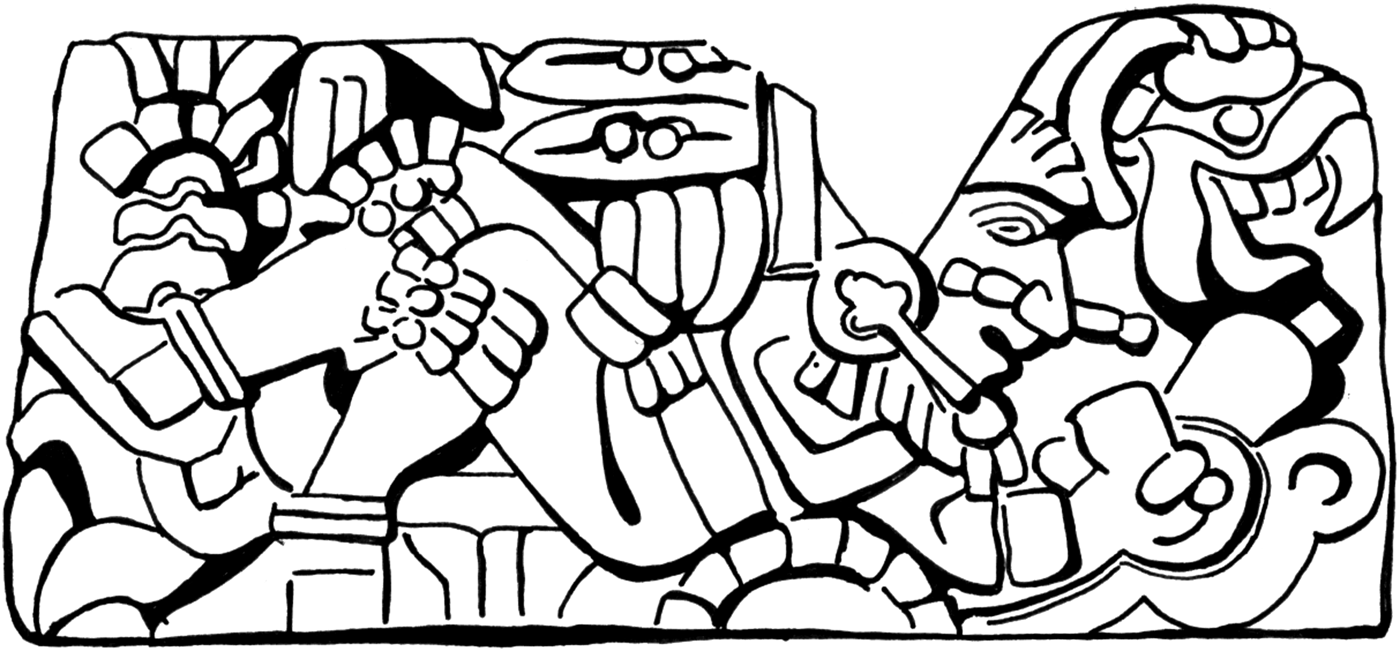
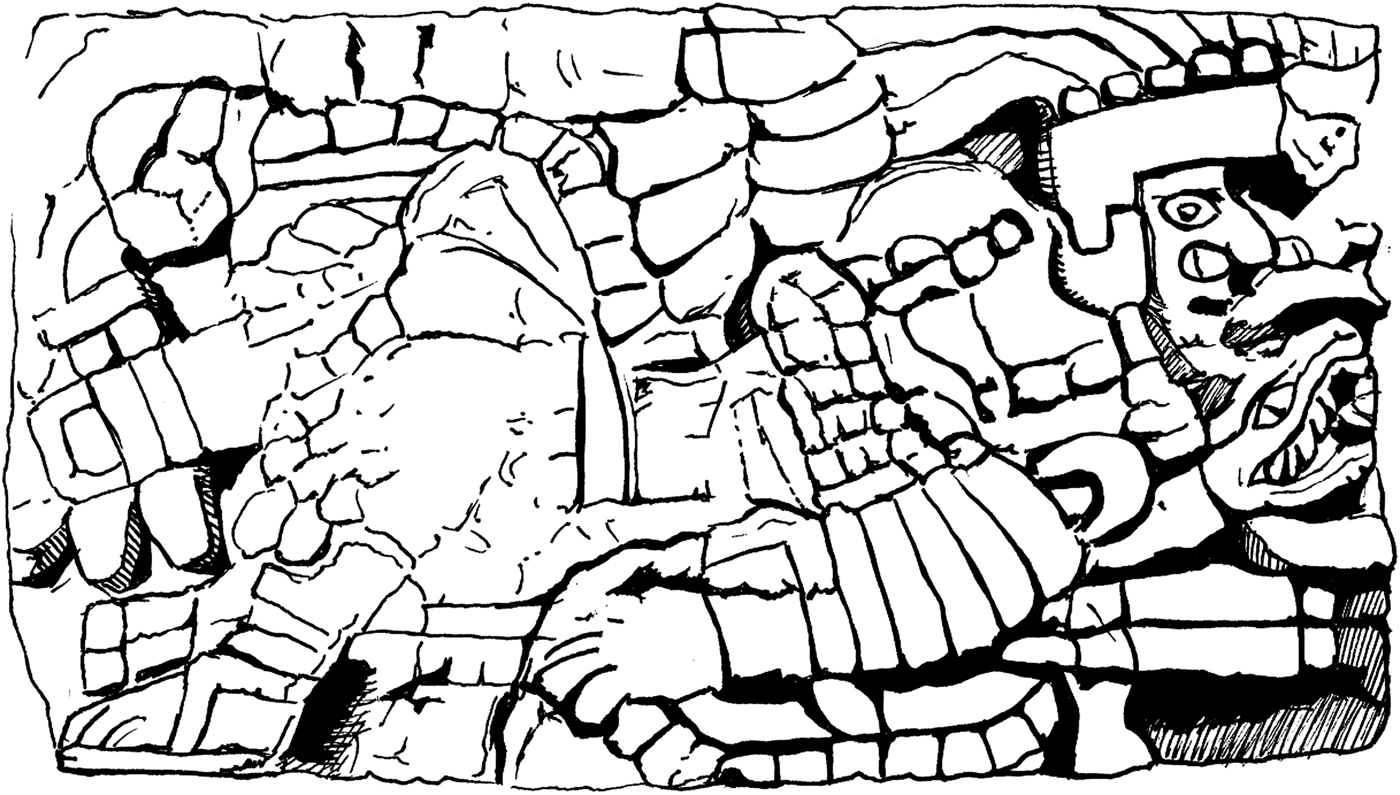
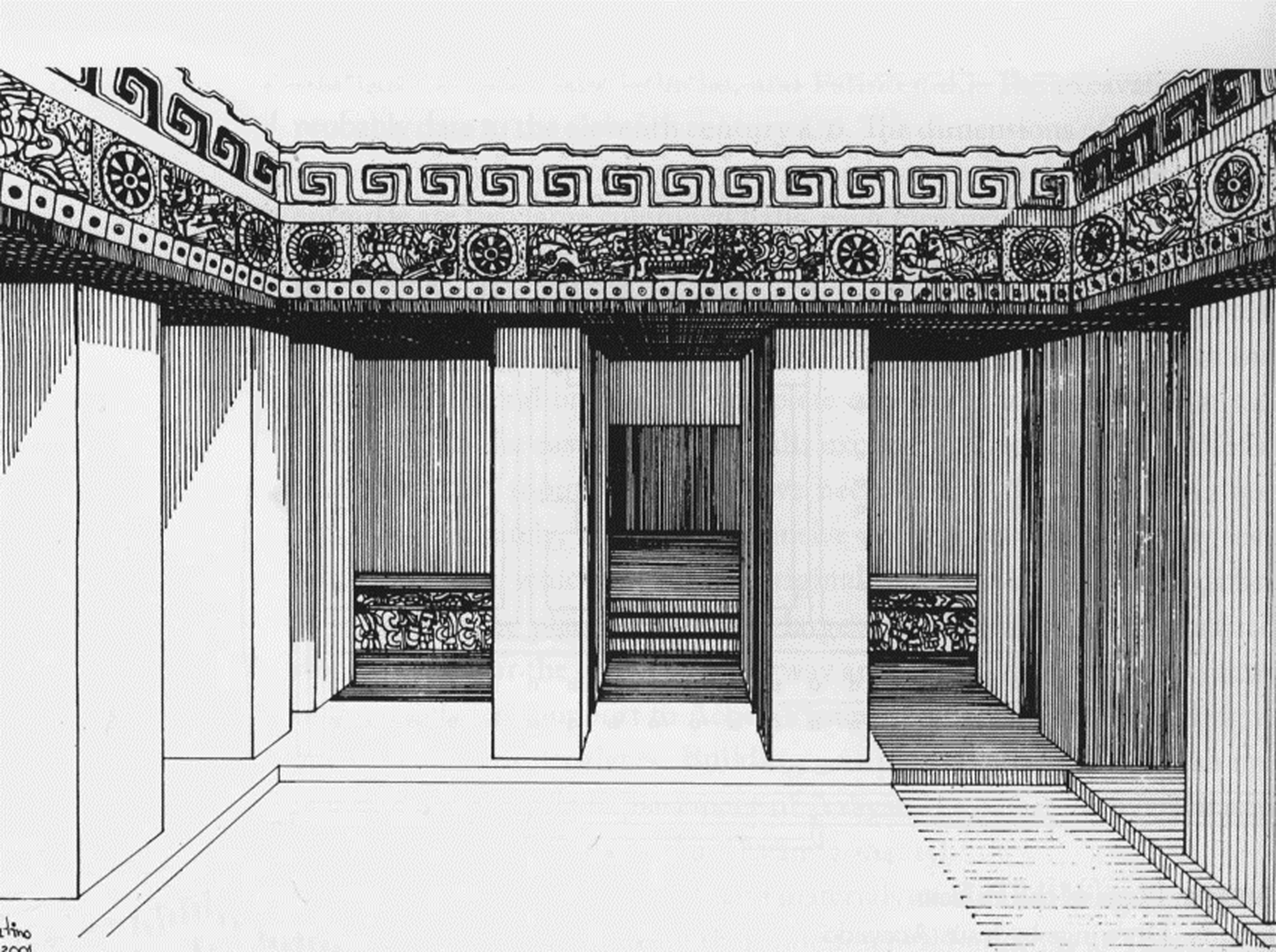
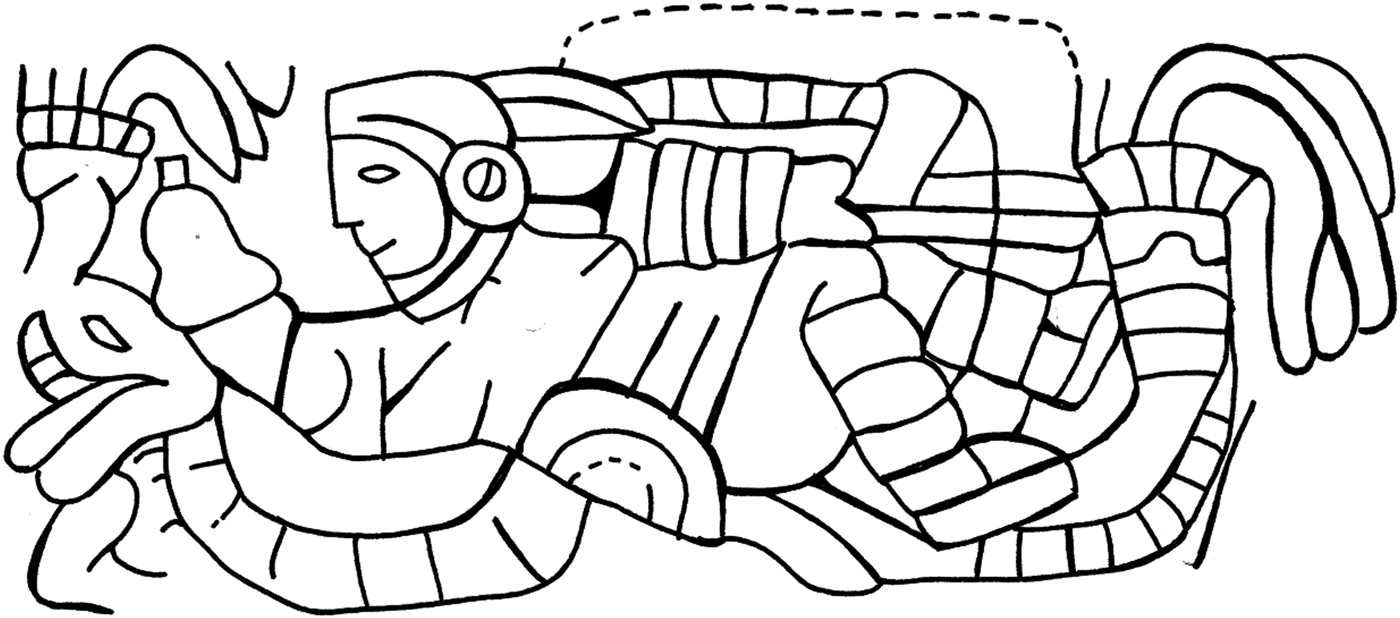
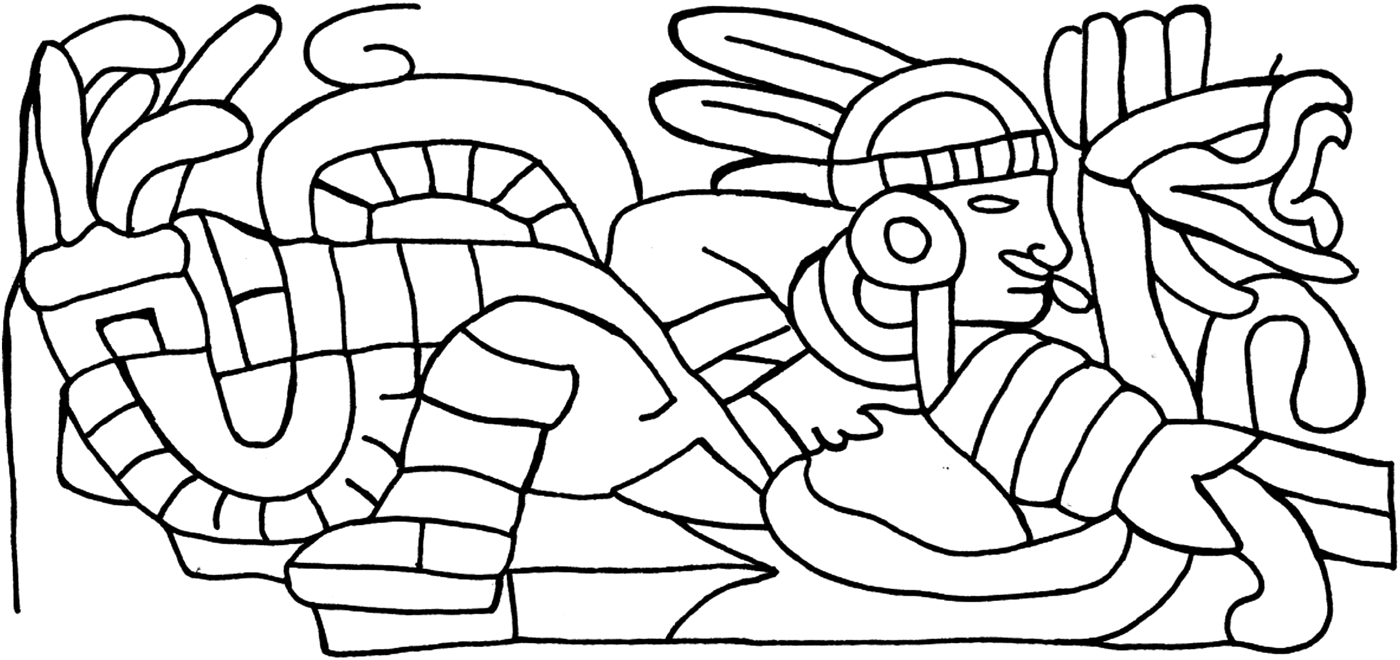
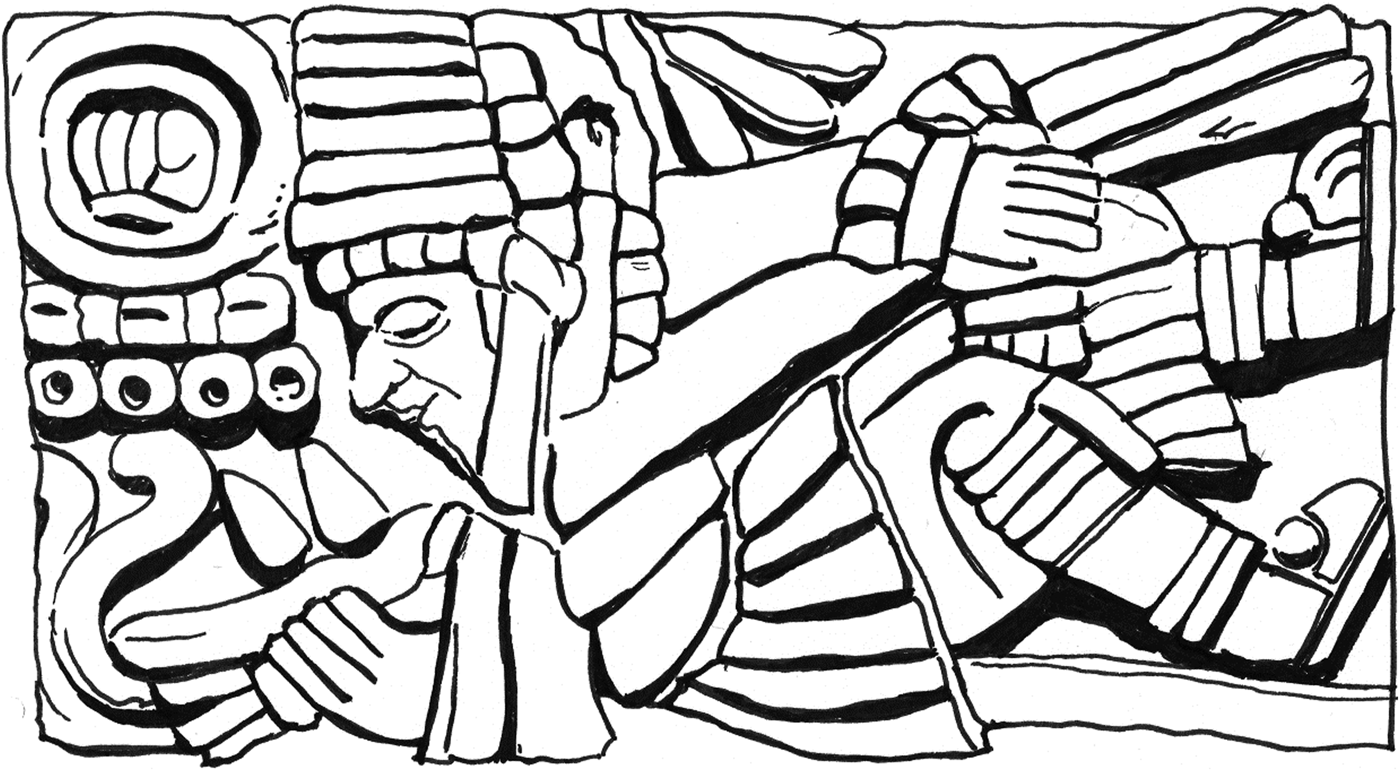
That the skeletal beings of the coatepantli reliefs may represent honored ancestral dead and not enemy captives is suggested by the similarity of their reclining poses, associated serpents, and the composition of the frieze to another set of recumbent figures in relief discovered at Tula. Acosta excavated a large group of reliefs of reclining males that had fallen from the upper walls of the open patios in Salas 1 and 2 of the Palacio Quemado (Mastache and Cobean Reference Mastache and Cobean2000:117–118). Remains of at least 20 of these panels were recovered in Sala 1 alone, of which seven were reconstructed. These reliefs (de la Fuente et al. Reference de la Fuente, Trejo and Solanas1988:Catalogue Nos. 106, 108; Jiménez García Reference Jiménez García1998:147–157, 160–163, 165, Figures 55–61, 67–68, 71; Kristan-Graham Reference Kristan-Graham1989:471, Figures 59–60) depict fully fleshed personages, dressed in royal regalia (Kristan-Graham Reference Kristan-Graham1989:282–283), and in some instances entwined with or overshadowed by rattlesnakes with feathers or volutes attached to their tails (Figures 17–19). These figures were positioned so as to appear to be looking from left and right toward images of solar disks and sacrificial basins or cuauhxicalli in the same registers, paralleling the arrangement of the coatepantli figures facing east and west toward a now destroyed central image. G-shaped adornments similar to the merlons atop the coatepantli decorate the tops of the patio walls above the bands of relief (Mastache et al. Reference Mastache, Cobean, Healan, Fash and López Luján2009:306, Figure 13; see color reconstruction in Gamboa Cabezas Reference Gamboa Cabezas2007:46) (Figure 20). The Palacio Quemado seems to date to the final phase of construction at Tollan phase Tula, thus coeval with the coatepantli (Bey and Ringle Reference Bey, Ringle, Kowalski and Kristan-Graham2007:402). Consistent with his revisionist view of Tula's chronology, Sterpone (Reference Sterpone2007:39, 46) dates some of the Palacio Quemado reliefs to an earlier period, though he maintains that they were reused in later phases of construction.
Reclining figure with serpent from Sala 1, Building 3, Palacio Quemado, Tula. Drawing by Jay Scantling (after Jorge Acosta, in Jiménez García [1998:147, Figure 55]). Reproduction authorized by Instituto Nacional de Antropología e Historia, Mexico City.
Reclining figure with serpent from Sala 1, Building 3, Palacio Quamado, Tula. Drawing by Jay Scantling (after Jorge Acosta, in Jiménez García [1998:149, Figure 56]). Reproduction authorized by Instituto Nacional de Antropología e Historia, Mexico City.
Reclining figure with serpent from Sala 1, Building 3, Palacio Quemado, Tula. Drawing by Jay Scantling (after Jiménez García 2010:48, photo 28).
Reconstruction of Sala 1 of the Palacio Quemado, Tula. Drawing by Fernando Getino Granados (Mastache et al. Reference Mastache, Cobean, Healan, Fash and López Luján2009:306, Figure 13). Reproduced by permission of Robert Cobean.
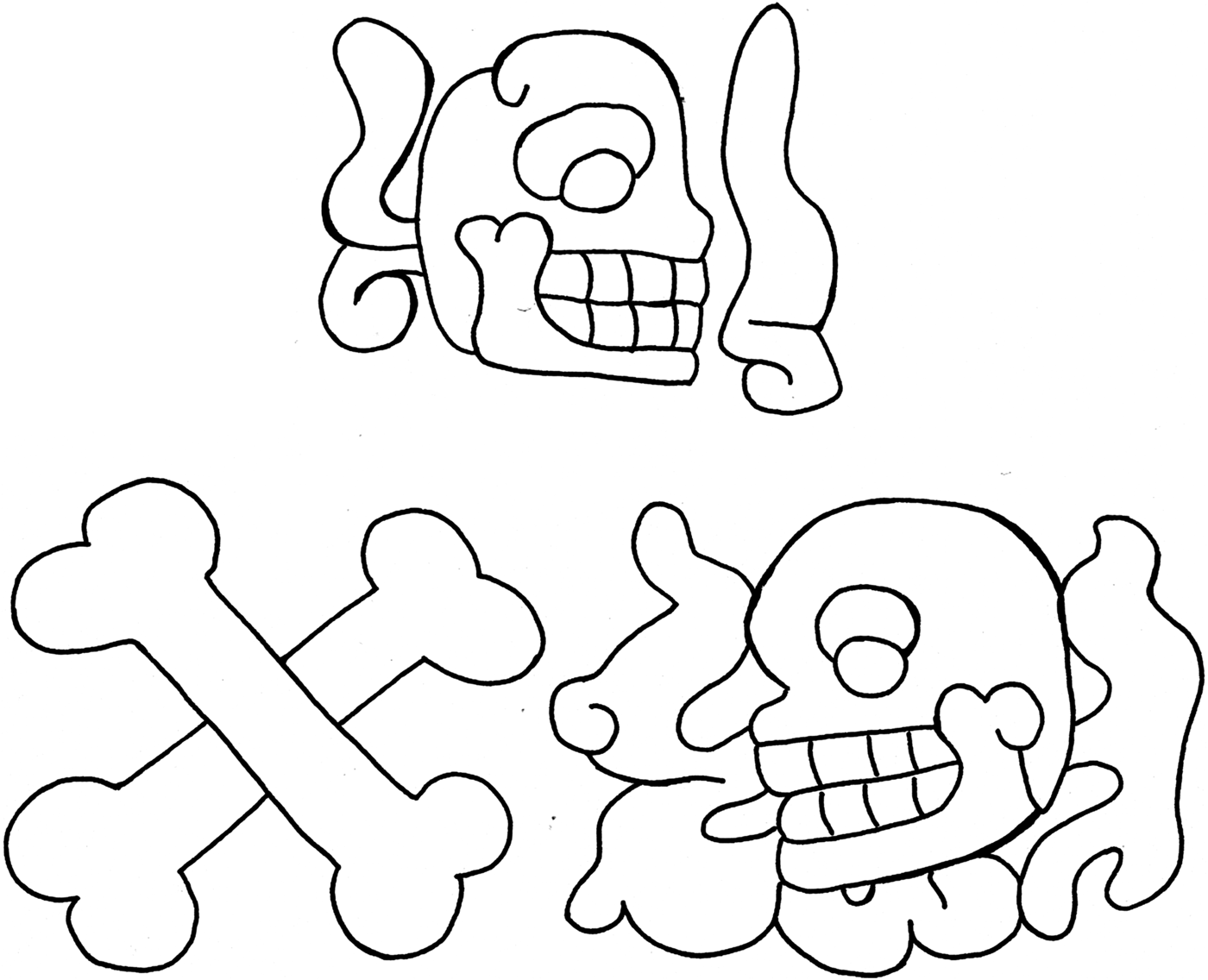
At Tula's semicircular temple at El Corral, similar reclining figures (Figures 21–22) decorate a small altar attached to the main temple platform. They form the lowermost of three friezes; the top one a scene of processing armed figures, the middle featuring a skull and crossed bones motif (de la Fuente et al. Reference de la Fuente, Trejo and Solanas1988:Catalogue No. 88; Jiménez García Reference Jiménez García1998:254–260, Figures 106–109) (Figure 23). The serpents accompanying the reclining personages have plume-like forms attached to their tails, possibly tying them to the coatepantli snakes. More richly attired reclining figures were excavated by Acosta from a platform south of Pyramid C (Jiménez García Reference Jiménez García1998:168–178, Figures 75, 77, 80–81) (Figure 24). One is accompanied by a calendrical name glyph, Nine Reptile Eye. Building J has yielded some examples that lack weapons, though one of these also bears a name glyph (Mastache et al. Reference Mastache, Cobean and Healan2002:128). Others derive from the Zapata 2 locale at Tula (de la Fuente et al. Reference de la Fuente, Trejo and Solanas1988:Catalogue No. 113; Jiménez García Reference Jiménez García1998:262–266, Figures 114–115), while yet others extant are of uncertain provenience within the site (de la Fuente et al. Reference de la Fuente, Trejo and Solanas1988:Catalogue Nos. 107, 110, 111, 113; Jiménez García Reference Jiménez García1998:182–189, Figures 83–85, 88–90). Recent excavations at Tula Chico produced fragments of similar reliefs from halls atop the larger of two pyramids on the north side of the plaza, demonstrating that this iconography (and the Toltec style in general) dates back to approximately a.d. 750–800, predating the Tollan phase (Mastache et al. Reference Mastache, Cobean, Healan, Fash and López Luján2009:313–314, Figures 20–22; Suárez Cortés et al. Reference Suárez Cortés, Healan and Cobean2007) (Figure 25). Similar reclining figures occur at Chichen Itza; for example, on the capitals of columns at the Las Monjas group (Bolles Reference Bolles1977:184; Tozzer Reference Alfred1957:575).
Reclining figure from El Corral altar, north side, Tula. Drawing by Jay Scantling (after Jiménez García Reference Jiménez García1998:255, Figure 106).
Reclining figure from El Corral altar, south side, Tula. Drawing by Jay Scantling (after Jiménez García Reference Jiménez García1998:258, Figure 108).
Skulls with breath/speech scrolls and crossed bones from El Corral altar, Tula. Drawing by Jay Scantling (after Jiménez García Reference Jiménez García1998:Figures 110–112).
Reclining figure from platform adjacent to Pyramid C, Tula. Drawing by Jay Scantling (after http://www.latinamericanstudies.org/toltec-panels.htm)
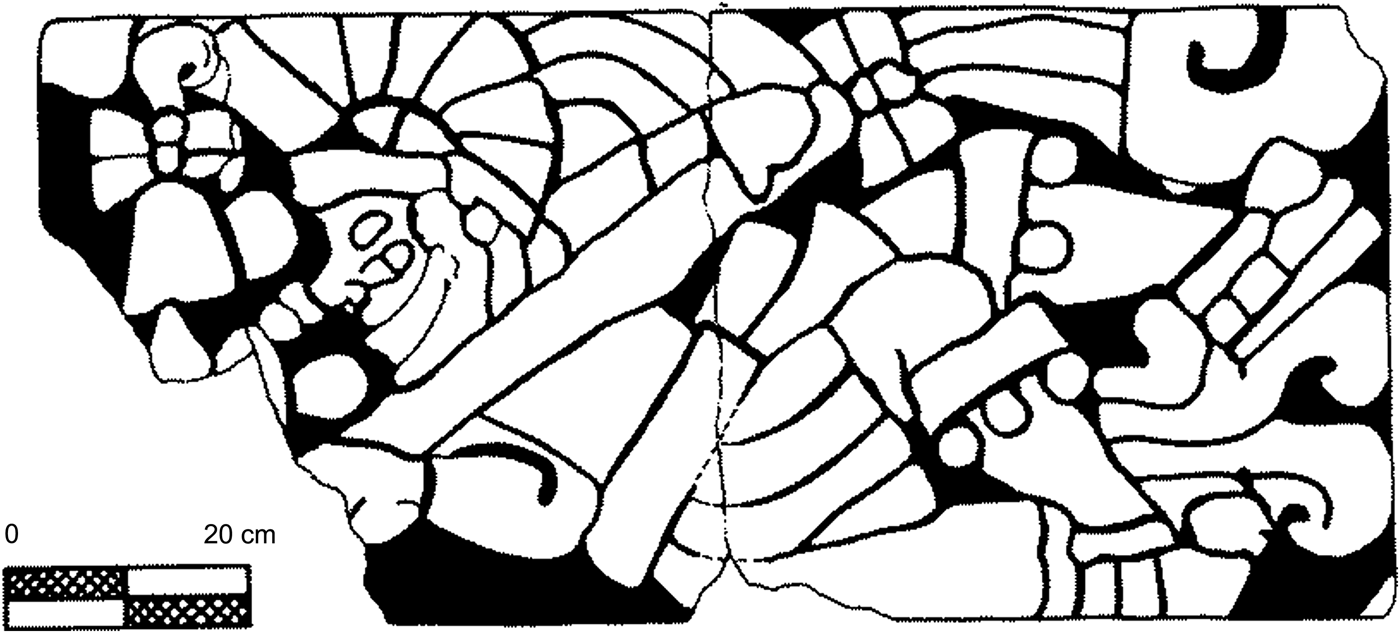
Reclining figure from Tula Chico. Drawing by Daniel Correa Baltazar and Elizabeth Jiménez García (Mastache et al. Reference Mastache, Cobean, Healan, Fash and López Luján2009:314, Figure 20). Reproduced by permission of Robert Cobean.
Attempts have been made to identify these figures as divinities; for example, the Mexica god of the setting sun, Tlalchitonatiuh (Tozzer Reference Alfred1957:116), but Baird (Reference Baird and Boone1985:123) notes that the Tula figures lack the distinguishing iconographic traits of this deity as displayed in the codices. Some have costume elements associated with Tlaloc, who seems to have functioned as a patron of royalty and of war at Tula, as well as providing an iconographic link to Teotihuacan (Mastache et al. Reference Mastache, Cobean and Healan2002:142, 304).
One may be tempted to equate these images from Tula with the standard Mesoamerican iconography of vanquished enemy captives, an impression not weakened by the associated depictions of cuauhxicalli in the Palacio Quemado reliefs. However, the position of the figures, looking toward the cuauhxicalli, parallels that of reclining figures emerging from serpents that were portrayed on reliefs from the North Colonnade at Chichen Itza (Figure 33a) (Tozzer Reference Alfred1957:123), and identified by Taube (Reference Taube, Golden, Houston and Skidmore2009:103) as “gods or the souls of heroic warriors” receiving the sanguinary offerings rather than serving as victims. In addition, the full regalia of the Tula relief figures contrasts sharply with the more minimal adornment of most captive images in Mesoamerican art. As Kristan-Graham (Reference Kristan-Graham1989:285) comments, “In Mesoamerica fallen figures usually are defeated enemies or prisoners, shown humiliated by their posture, wounds, bindings, nakedness and lack of weapons…Except for posture, the prone figures at Tula are represented as people of high status.” It may be argued, instead, that some Classic Maya images of royal prisoners slated for torture and sacrifice retain some of their original finery. Reliefs of captives decorating steps at Tonina (Miller and Martin Reference Miller and Martin2004:181, Plate 99) depict them still wearing ornaments, and the well-known depiction of King Kan Joy Chitam of Palenque as captive from the same site still wears some of his jewels (Miller and Martin Reference Miller and Martin2004:183, Plate 101). None, however, are as richly attired as the reclining figures from the Tula reliefs, which even retain their sandals in some instances, as do the coatepantli skeletons. Nor is it common for humiliated captives to bear weapons and staffs of office. On the contrary, Mastache and colleagues (Reference Mastache, Cobean and Healan2002:118) note similarities between the costumes of these figures and those of the living kings portrayed in relief on the pillars of Pyramid B, and suggest that the same historical personages may be depicted in both groups of images.
All of this supports Kristan-Graham's (Reference Kristan-Graham, Kowalski and Kristan-Graham2007:564) identification of the reclining figures as the honored fallen or ancestors of the Tula elite rather than abject human prey. So does Mastache et al.'s (Reference Mastache, Cobean and Healan2002:112, see also 304) conclusion that in the art of Tula, including these reliefs, “personages with the serpent behind them represent Toltec kings.” This association of snakes and elites ultimately goes back in central Mexico to the art of Teotihuacan (see, for example, Pasztory Reference Pasztory, Berrin and Pasztory1993:60). By extension, this association could signify the coatepantli skeletons as royal as well, despite their minimal (but including the sandals, not typical of stripped captives) garb. In Mesoamerican skeletal imagery related to ancestors, elaborate regalia is not always present (for example, the Maya parallels and Cholula paintings discussed below).
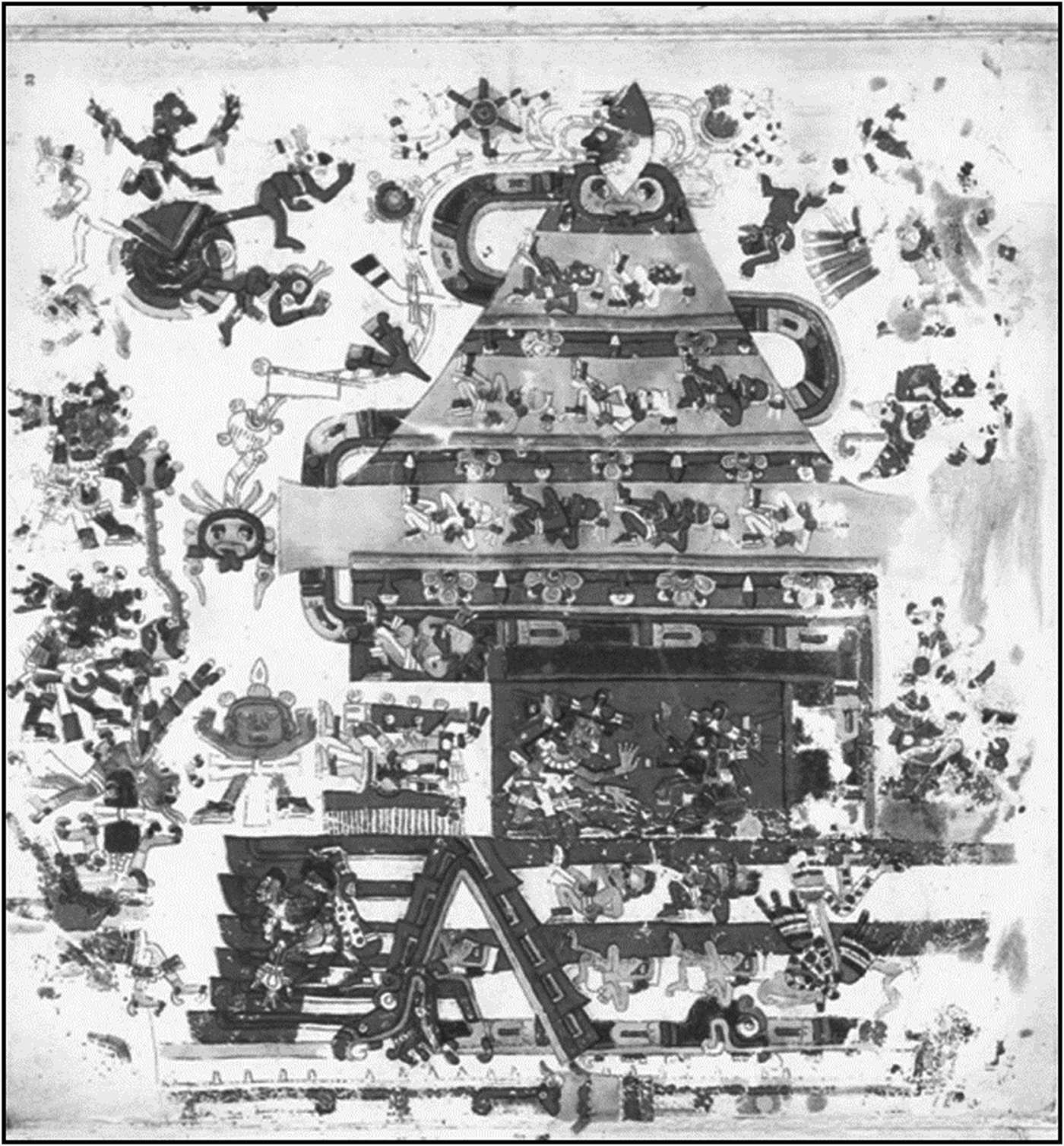
Based on the reclining figures, Kristan-Graham (Reference Kristan-Graham1989:286–290; Reference Kristan-Graham, Kowalski and Kristan-Graham2007:564) identifies one of the functions of the Tula Palacio Quemado as the locus of elite funerals much like the historic Aztec tlacochcalco quatiquiac, the reliefs serving as commemorative images of the honored dead. By extension, she identifies the El Corral reliefs as “fallen Tula leaders” (Kristan-Graham Reference Kristan-Graham1989:291). In further support of Kristan-Graham's interpretation of the Palacio Quemado and El Corral reliefs, Mastache and colleagues (Reference Mastache, Cobean and Healan2002:126; see also Mastache et al. Reference Mastache, Cobean, Healan, Fash and López Luján2009:322; Suáres Cortés Reference Suárez Cortés, Healan and Cobean2007:49) note that “in the Codice Borgia, the representations…of the ancestral sacrificed dead warriors (huehueteteo p. 33)” adorning the representation of a temple (Figure 26) are shown in the same reclining pose as the Palacio Quemado figures. Boone (Reference Boone2007:186) concurs with their identification of the reclining figures in this codex scene as honored and apotheosized warriors, transmogrified by their heroic ends into attendants of the sun god. Comparing these images with their discoveries of reclining figures in the structures at Tula Chico, Mastache et al. (Reference Mastache, Cobean, Healan, Fash and López Luján2009:322) identify the Prado phase reliefs, as well as their later Tollan phase counterparts, as evidence of dynastic ancestor veneration at Tula dating back to the beginnings of the polity.
Codex Borgia 33, temple with reclining warrior ancestors. Loubat facsimile edition image in public domain reproduced from Wikimedia Commons (commons.wikimedia.org/wiki/Codex Borgia).
I propose that additional support for the ancestral interpretation of reclining figures at Tula comes from the skull and bones motif associated with those at El Corral. While Hers (Reference Hers1989:114) attempts to interpret this image as a representation of a tzompantli not in evidence at this part of the site, it also occurs in Maya art, an observation first made by Tozzer (Reference Alfred1957:131) in comparing the El Corral skull and bones motif to a well-known Puuk example from Uxmal, where it is clearly linked with ancestor worship. In Maya iconography, skulls and long bones represent the ancestors (McAnany Reference McAnany1995:48). Perhaps the complete skeletons on the coatepantli signify similar concepts. While no direct connection need be implied, the plausibility of a link is not diminished by participation of Tula and Terminal Classic period Maya sites like Uxmal in the same elite networks.
The El Corral skulls are shown with what appear to be speech scrolls in front of their faces, symbolically indicating a living, active force or presence—the breath of life. If the volutes on the coatepantli reliefs, particularly those near the mouths of the skeletal figures, are not feathers or flames, they may signify a similar concept. Similar scroll-like forms surround some of the reclining figures from Sala 1 at the Palacio Quemado (Javier Urcid, personal communication 2011). The El Corral imagery also parallels the well-known relief at the Great Ball Court of Chichen Itza where a skull, shown in profile on a ball, emits scroll-like forms from its mouth. Colas and Voss (Reference Colas, Voss and Grube2000:188) plausibly interpret this image as representing the impregnating spittle/seed from the mouth of the Maize God through which the Hero Twins are engendered, consistent with the theme of bones as seeds of rebirth. Perhaps related to this fructifying metaphor, two Tula reclining figures from the Zapata 2 locale have trees growing from their torso (de la Fuente et al. Reference de la Fuente, Trejo and Solanas1988:Catalogue No. 113; Jiménez García Reference Jiménez García1998:262–266, Figures 114–115), in a general parallel to the El Tajin relief of the skeleton sprouting the World Tree. This imagery also recalls the equation of the royal dead with trees in Classic Maya art, from the Early Classic Berlin Tripod to Jaanab Pakal's sarcophagus at Palenque, where the king's ancestors sprout as trees in an orchard on the sides.
The archaeological associations of the El Corral reliefs reveal a clear link with ancestral cults. The El Corral altar bearing the reliefs contained two burials, discovered by Acosta, one a secondary interment (Diehl Reference Diehl and Healan1989:28). Excavations in the Canal locality Central Group residential area of Tula in the 1970s unearthed another altar, studded with carved stone skulls, which yielded evidence that it too had once contained a burial. Based on these observations, Healan (Reference Healan and Healan1989:147) suggests that both altars were used for rituals of ancestor veneration. Mandeville and Healan excavated a burial from yet another altar in the El Corral area of Tula in 1970. The skull had been removed some time after the original interment, possibly for curation as an ancestral relic (Diehl Reference Diehl1983:94; Mandeville and Healan Reference Mandeville, Healan and Healan1989:191–194). From all of this evidence, Cobean and Mastache (Reference Cobean, Mastache, Luján, Cobean and Mastache1995:210) conclude that the burials in these Tula altars were the remains of “ancestros importantes.”
The regular absence of long bones in adult burials of the Tollan phase, considered by Gómez Serafín (Reference Gómez Serafín, Sansores and Fernández Dávila1994:87) as a defining feature of the mortuary practices for this period, further suggests Toltec veneration and manipulation of ancestral remains. Besides the Chalchihuites material discussed earlier, parallels to this curation of long bones can be found in Oaxaca at the Late Classic Zapotec site of Lambityeco, where elite burials missing their femurs occur alongside sculptures of reclining dignitaries carrying such bones, apparently of ancestors (Lind and Urcid Reference Lind and Urcid2010:159, 161, 176). Similar practices are inferred by Gómez Serafín et al. (Reference Gómez Serafín, Sansores and Fernández Dávila1994:142) based on the presence of additional skulls and bones in some Tollan phase burials. If ancestral bones were ritually important at Tula, this may be reflected in the skeletal imagery of the coatepantli frieze.
RECLINING FIGURES AS ANCESTORS: PAN-MESOAMERICAN COMPARISONS
The consensus that the Tula reliefs of fleshed reclining personages represent elite ancestors, and my suggestion that by extension, the coatepantli skeletons with their similar poses, associated serpents, and possible reference to ancestral bones may as well, finds supporting parallels in pan-Mesoamerican art traditions across time. For the Zapotec, Urcid's (Reference Urcid, Robles and Guzman2010; see also Joyce Reference Joyce2009:136) persuasive reconstruction and interpretation of the Monte Alban danzantes identifies them not as mutilated and sacrificed war captives, but as members of an elite military order letting blood through autosacrifice. Among other lines of evidence, he notes that they are not bound and have no apparent captors, a critique that also applies to the captive/victim interpretation of the coatepantli figures. Rather, they appear to be offering their blood to reclining figures (Urcid Reference Urcid, Robles and Guzman2010:Figure 19) (Figure 27), some of whose poses, with flexed legs and arms extended in front of the face and torso, parallel both the coatepantli skeletons and the fleshed reclining rulers from Tula. Urcid uses later Zapotec, Maya, and Classic Veracruz parallels to identify these horizontal personages as ancestors. Among the Maya examples, he illustrates a Late Formative/Protoclassic frieze from Palace H-Sub 2 at Uaxaktun showing reclining ancestors (Urcid Reference Urcid, Robles and Guzman2010:Figure 28), a frieze with a single ancestral being from Substructure IIC-1 at Calakmul (Urcid Reference Urcid, Robles and Guzman2010:Figure 28), a flying or floating ancestor from Ucanal Stela 4, and an image of a past Copan ruler from the Hieroglyphic Stairway (Urcid Reference Urcid, Robles and Guzman2010:Figure 29) (Figure 28). The leg posture of the last, in particular, evokes the pose of the coatepantli skeletons. From the Late Classic Zapotec, he (Urcid Reference Urcid, Robles and Guzman2010:32, Figure 28) notes the reclining ancestors on the frieze of Tomb 6 at Lambityeco. From Veracruz, Urcid (Reference Urcid, Robles and Guzman2010:Figure 29) illustrates a reclining figure from a yugo (a stone ‘yoke’ worn by players of the Mesoamerican ritual ball game), accompanied by a severed head, presumably an offering to the ancestor, and a relief of a named personage from the Pyramid of the Niches at El Tajin. He suggests that this visual trope of showing ancestors as reclining is a pan-Mesoamerican trait dating as far back as the Early Formative and extending into the Late Postclassic (Urcid Reference Urcid, Robles and Guzman2010:32; see the Olmec and Aztec examples in his Figure 29).
Reclining danzantes, Monte Alban (from Urcid Reference Urcid, Robles and Guzman2010:Figure 19). Reproduced by permission of Javier Urcid.
Maya images of reclining ancestors. (a) Frieze from Uaxaktun Palace H-Sub-2. (b) Frieze from Substructure IIC-1 at Calakmul, with detail of reclining ancestor. (c) Deceased king from the Hieroglyphic Stairway, Copan. (d) Ucanal Stela 4. All images from Urcid (Reference Urcid, Robles and Guzman2010:Figures 28 and29). Reproduced by permission of Javier Urcid.
Elite figure with serpent, Building A, Cacaxtla. Drawing by Jay Scantling (after http://www.latinamericanstudies.org/cacaxtla-3.htm and http://www.bluffton.edu/~sullivanm/mexico/mexicocity/museo/museo4.html).
While Urcid (Reference Urcid, Robles and Guzman2010:Figure 30) observes that a number of Maya representations of captives (and the skeletal captives at Cacaxtla noted above) take similar poses, they are all distinguished from the ancestral images by context and by their visible bonds. In addition, a pose with one arm extended in front (like the coatepantli skeletons), with the other extended to the back, is common to the ancestral images (Urcid Reference Urcid, Robles and Guzman2010:32). While many ancestor figures wear elaborate regalia compared to the captives, this is not necessarily the case, as in the minimally clad but clearly named royal figure from the Hieroglyphic Stairway at Copan (Urcid Reference Urcid, Robles and Guzman2010:33). Thus, both the elaborately attired fleshed figures from the Palacio Quemado and the more minimally adorned coatepantli skeletons could represent variations on the same ancestral theme.
RIDE THE SNAKE
The arguments above from art history and archaeology provide support for the hypothesis that the reclining skeletal figures on the coatepantli frieze represent honored warriors, rulers, and/or ancestors. However, we need to further address the other half of these entangled images, the snakes accompanying the skeletons. As already noted, some of the fully fleshed reclining figures in Toltec art likewise appear with large serpents, following the long central Mexican tradition of the snake as royal symbol. This would suggest, by extension, that the coatepantli skeletons are also deceased elite figures, perhaps representing earlier generations than the fleshed figures, reduced to bone relics. Further interpretive possibilities emerge when comparative material is brought in from other parts of Mesoamerica, especially in contexts overlapping in time with Tula, where we see the close association of images of elites, dead or alive, with serpents.
At the central Mexican Epiclassic period sites of Cacaxtla and Xochicalco, serpents, feathered and otherwise, also appear to be related to royal dynasties, as emblems or patrons. At Xochicalco, elite figures are portrayed with feathered serpents on the carved façade of the Pyramid of the Plumed Serpents. The elites may be deceased: they do not rest on the ground line, leading Smith (Reference Smith and Hirth2000:60) to speculate that they are floating and thus, via parallels with Maya art, dead or deified. In her view, the serpents here function as bridges or portals to the underworld; those figures floating above the snakes may be en route to the realm of the dead, while those under the snakes are already in it. Additionally, she (Smith Reference Smith and Hirth2000:79) speculates that the Xochicalco rulers thus portrayed are intended to be shown symbolically united with the serpent, either at death or at their inauguration.
At Cacaxtla, in the frescos of Building A, a warrior or ruler in a bird costume (Figure 29) and another in a jaguar suit stand on large snakes (a feathered, bearded serpent and jaguar serpent, respectively) (Foncerrada de Molina Reference Foncerrada de Molina1993:Laminas VII and IX). The tails of these serpents rise above and behind the human figures. As at Teotihuacan, the serpents at Cacaxtla may be signifiers of royal or elite status or political authority. Foncerrada de Molina (Reference Foncerrada de Molina1993:145) explicitly compares these Cacaxtla images to the reclining (fleshed) figures with serpents from Tula, where the snakes have the same connotation, and Nicholson (Reference Nicholson, Carrasco, Jones and Sessions2000:55) calls the human-serpent pairs of Building A the earliest example of the motif in Toltec and later Aztec art of serpents accompanying elite figures as their apparent patrons. But, as at Xochicalco, the Cacaxtla serpents also appear convey some sort of action or signify a portal or transition between states of being. Miller and Taube (Reference Miller and Taube1992:50) compare the serpent accompanying the Building A “bird-man” to the serpent columns at Tula and Chichen Itza, which are similarly positioned with the snakes' heads on the ground and tails in the air, and interpret it as a conduit or portal bringing water and fructifying forces from the sky to the earth.
Quirarte (Reference Quirarte and Miller1983:208) describes the Building A figures as “riding” their ophidian associates, while Ringle et al. (Reference Ringle, Negrón and Bey1998:204, Figure 16) compare the Building A murals to an image of an elite warrior similarly “riding” a serpent on a jade from the Cenote of Sacrifice at Chichen Itza (Tozzer Reference Alfred1957:Figure 131; Proskouriakoff Reference Proskouriakoff1974:Plate II). On this portable carving (Figure 30), the seated figure, carrying an atlatl and wearing a Venus star skirt, sits cross-legged on the snake. Perhaps the serpents accompanying both the coatepantli skeletal figures and the other reclining figures from Tula share with these Cacaxtla and Chichen Itza images the significance of a means of supernatural conveyance as well as a signifier of status. Tozzer (Reference Alfred1957:Figures 131, 132a, and 132b) certainly saw a connection between the Cenote jade and the El Corral and Palacio Quemado reclining figures with snakes, reproducing them together for comparison.
Jade plaque from the Cenote of Sacrifice, Chichen Itza, showing warrior “riding” serpent. Drawing by Jay Scantling (after drawing by Javier Urcid, personal communication 2011).
Elsewhere at Chichen Itza, representations of standing elite warrior figures accompanied by snakes (both feathered serpents and others identified as Toltec “cloud serpents”) rising alongside them in an S-curve, the serpents' heads positioned over the heads of the humans, occur at the Upper Temple of the Jaguars, the Lower Temple of the Jaguars, and the Castillo (Tozzer Reference Alfred1957:Figures 105, 106, 108). In the Upper Temple of the Jaguars murals, the most prominent of these figures was dubbed “Captain Serpent” by Miller (Reference Miller and Hammond1977), and has been variously interpreted as a historical personage and as a deity. The Upper Temple of the Jaguars murals also show what Coggins (Reference Coggins Clemency, Coggins and Shane1984:165) calls “three celestial serpent warriors” involved in an attack on a town. As at Tula, at Chichen Itza serpents entwine with and overshadow processing elite figures on reliefs from the North and Northwest Colonnades, and a seated elite figure in the Temple of the Wall Panels (Tozzer Reference Alfred1957:Figures 111–115). These images from Chichen Itza resemble the standing warriors entwined with and standing on serpents depicted on a Toltec vessel, allegedly from Tula, in the Bilimek collection in Vienna (Figure 31) (Tozzer Reference Alfred1957:Figure 273). It seems clear that this association of serpents with warrior figures and rulership is another of the many striking similarities between the twin Tollans. In both centers, the snakes serve as signifiers of status, perhaps titles (Taube Reference Taube and Prem1994:221).
Elite warrior entwined with serpent, from a molded pottery vessel attributed to Tula from the Bilimek collection. Drawing by Jay Scantling (after drawing by Javier Urcid, personal communication 2011).
It thus appears that elite figures are commonly shown as entwined with, accompanied by, or “riding” serpents in art traditions coeval with that of Tula. Such an association of entwining snakes with royalty had an extensive history in Mesoamerica before and after the Epiclassic/Terminal Classic/Early Postclassic horizon of Tula. Javier Urcid (personal communication) has called my attention to parallels with a Late Formative to Early Classic (Jorrín Reference Jorrín, Brockington, Jorrín and Long1974:62) monument from coastal Oaxaca; Chila Stela 1. This shows a standing ruler entwined with a large serpent whose head rises above his headdress. Centuries later in Oaxaca, page 51 of Codex Vindobonensis shows compound serpentine theriomorphs (a Jaguar Serpent and Mountain Lion Serpent) entwined with ancestral figures named 4 Serpent and 7 Serpent. These serpents look like costume elements, and their heads function as helmets—jaws framing the faces of the anthropomorphic figures in a parallel to the coatepantli images (Jill Leslie Furst, personal communication 2005). Similar serpent costumes appear in the Codex Nuttall (Figure 32).
Figure with fire serpent costume, Codex Nuttall 29. Drawing by Jay Scantling (after Tozzer Reference Alfred1957:Figure 251).
These comparisons support my suggestion that the coatepantli and other reclining images accompanied by serpents at Tula may represent deceased elites. A possible additional parallel, in the juxtaposition of the concepts of rulership and death with snakes, might be found in the Classic Maya set of motifs grouped together under the rubric of Vision Serpents (Freidel et al. Reference Freidel, Schele and Parker1993; Schele and Freidel Reference Schele and Freidel1990; Schele and Mathews Reference Schele and Mathews1998; Schele and Miller Reference Schele and Miller1986). Interpreted by many Mayanists as representing visions conjured up by rulers via blood-letting rituals, Vision Serpents are read by many of the same scholars as supernatural conduits via which ancestors (albeit not shown in skeletal form) and other supernaturals manifest on the terrestrial plane through the open maws of these creatures. Appearing in narrative scenes in interaction with the descendants of the ancestral dead they seem to spit forth, Vision Serpents could also be abstracted out of such settings to stand alone as repeated motifs on decorated friezes and façades (Schele and Mathews Reference Schele and Mathews1998:47–48).
Credit goes to Tozzer (Reference Alfred1957:115, Figure 237) for first calling attention to this Maya parallel to the coatepantli figures, in the form of a relief from Structure 3E1 at Chichen Itza (Figure 33a). This shows a human figure exiting the mouth of what now is recognized as a Vision Serpent. He identified this figure with Tlahuizcalpantecuhtli based on the resemblance, though he noted that the Chichen Itza example is fully fleshed rather than skeletal. The comparison may still be useful, though the identification is incorrect. In the North Colonnade reliefs (Figure 33b) mentioned earlier, Vision Serpents disgorge heroic warriors who receive sustenance from cuauhxicalli in the parallel noted above to the serpent-entwined reclining figures from the Palacio Quemado.
Vision Serpents from Chichen Itza. Drawing by Jay MacKenzie (after Tozzer Reference Alfred1957:237a and 123b, respectively).
The Vision Serpent thus seems to share generally the linkage of serpents, the dead, and probably royalty with the coatepantli reliefs. In representations of ancestors and other supernaturals emerging from the Vision Serpent, the position of the head and arms of the figure of the figures framed by the reptile's maw recalls the coatepantli reliefs (Figures 34 and 35). It is thus tempting to postulate a specific connection between the two sets of images, but dissimilarities necessitate caution. As noted, there is much dispute in the literature as to whether the skeletal figures on the coatepantli are being swallowed by or expelled/emerging from the snakes' jaws, but Dutton (Reference Dutton1955) and Baird (Reference Baird and Boone1985) are certainly correct that the skeletons are in fact entwined with the snakes. Since the serpents accompanying warriors and elites in Epiclassic art and reclining figures at Tula are usually shown with their mouths open, the idea of passage through the mouth may not be intended in the coatepantli reliefs. However, the other representations of reclining figures entwined with serpents at Tula do not invariably depict the human's head framed by the snake's jaws as on the coatepantli frieze. Although Dutton (Reference Dutton1955:210) recognized that the skeletal humans are entwined with the snakes, this framing also led her to remark that the “skull issues from the throat of the serpent.” It is possible that the position of the skeletal figures is deliberately meant to read simultaneously as both entwined with/alongside the serpents and at least suggesting passage through the serpent's mouth, but this would be unusual for the art of Tula and for Mesoamerican art in general. In some Maya representations, gods or ancestors emerge from the Vision Serpent and grasp and are entwined with its body; for example, on the Hauberg Stela (Figure 36), variously dated to the Late Formative (a.d. 199) or the Early Classic (a.d. 344) (Freidel et al. Reference Freidel, Schele and Parker1993:196; Clancy Reference Clancy1999:57). Houston and colleagues (Reference Houston, Stuart and Taube2006:93–95) specifically interpret the Hauberg Stela figures alongside the Vision Serpent as royal ancestors whose sacrifice (presumably through their deaths in war) was viewed by their descendants as creating and sanctifying the royal lineage, in a manner akin to the sacrifice of the gods which brought the current creation into being. Perhaps the Tula reclining figures, fleshed and unfleshed, signify a similar conception of the role of fallen ancestral rulers in establishing and sustaining the Tula polity.
Classic Maya Vision Serpents. Drawing by Linda Schele. Copyright David Schele, courtesy of the Foundation for the Advancement of Mesoamerican Studies, Inc. (http://research.famsi.org/research/schele)
Ka'wi'il emerging from Vision Serpent. Drawing by Linda Schele. Copyright David Schele, courtesy of the Foundation for the Advancement of Mesoamerican Studies, Inc. (http://research.famsi.org/uploads/schele/hires/05/IMG0079.jpg)
Vision Serpent with entwined figures from the Hauberg Stela. Drawing by Jay Scantling (after Houston et al. Reference Houston, Stuart and Taube2006:96, Figure 2.39).
In addition, any similarity between the coatepantli figures and the Vision Serpent need not imply a direct, specific connection between Maya and Toltec traditions. It appears that concepts similar to those represented by the Maya Vision Serpent were already present in central Mexico at Teotihuacan, which may be a more likely proximate source of any analogous motifs or concepts at Tula. Taube (Reference Taube and Braswell2003a:288) points to a Maya-style fresco from the Tetitla housing compound showing a bearded feathered serpent with a smoking or fiery tail and an ancestor emerging from its jaws. Other Tetitla serpents are grasped by entwined human figures in another visual analog to the coatepantli reliefs. Since the Toltecs drew heavily on the artistic legacy of Teotihuacan, any association of the serpent motif with the dead could have derived from this rather than any putative Maya source.
My cautious conclusion is that the Classic Maya Vision Serpent may offer a general conceptual analogy for the coatepantli images in their juxtaposition of serpents, royalty, ancestors, and possibly the idea of a passage or portal, even if the skeletal figures at Tula are not portrayed as exiting the snakes' mouths. This harmonizes with the evidence from Cacaxtla, Xochicalco, and Chichen Itza that in art traditions linked to that of Tula, warriors and elites are accompanied by, entangled with, standing, sitting or “riding” serpents which seem to mark the high status of the human figures, and possibly signify some state of transition or passage.
FLAMES OR HALOS?
The serpents accompanying their “riders” in the previous section are a diverse lot, including feathered, jaguar, “cloud,” and other models. We have seen that some commentators interpret the coatepantli snakes as feathered, which would be consistent with the arguments and comparisons advanced above, but so would the alternative readings of the scroll-like elements. Taube identifies the coatepantli snakes as a precursor of the later Mexica xiuhcoatl or Fire Serpent, reading the volutes on their tails as flames issuing from their bodies (Miller and Taube Reference Miller and Taube1992:65). He (Taube Reference Taube1992b:63; Reference Taube2000:281) finds the terrestrial model for the xiuhcoatl in the rattlesnake, consistent with the morphology of the coatepantli serpents. A reading of the coatepantli snakes as xiuhcoatl would by no means clash with my suggestion that the coatepantli frieze represents ancestors and fallen heroes. In Mexica belief, xiuhcoatl were linked to the honored dead and fallen warriors, as well as sacrificial victims, and include caterpillar traits in their hybrid physiognomies, symbolizing the happy rebirth of warriors killed in battle. Like some of the serpents discussed in the last section, they also seem to be associated with transitions or conduits between states of being. Jansen and Pérez Jiménez (Reference Jansen and Pérez Jiménez2007:51) interpret xiuhcoatl in Postclassic central Mexican art as portals, markers of “the nahual experience.” In the Late Postclassic Mixtec codices, a variant of the xiuhcoatl, the yahui (Taube Reference Taube and Carrasco2001), sometimes portrayed with human figures in its jaws (for example, Codex Vindobonensis 8), is associated with shamans and transformers.
Both Taube (Reference Taube1992b; Reference Taube2000) and Schele and Mathews (Reference Schele and Mathews1998:214) identify the composite creature at Tula claimed, like the coatepantli reliefs, as an image of Tlahuizcalpantecuhtli, as the War Serpent, a Classic antecedent of the xiuhcoatl. It is thus possible that when Acosta claimed that both the coatepantli snakes/skeletons and the composite creature were images of Tlahuizcalpantecuhtli, he may have been correct that these two Tula motifs are closely related in meaning, even if he was wrong in the specifics of his identification. The Early Classic Maya adopted the Teotihuacan War Serpent as part of their supernatural menagerie of Vision Serpents, where it seems to connote specific political or dynastic links to Teotihuacan as well as a supernatural conduit. For example, Taube (Reference Taube2000:274) and Freidel et al. (Reference Freidel, Schele and Parker1993:208) identify the well-known depiction of a Vision Serpent on Lintel 25 from Yaxchilan as the War Serpent.
Interestingly in light of the parallels between the coatepantli snakes, Vision Serpents, and War Serpents/xiuhcoatl, Schele and Mathews (Reference Schele and Mathews1998:48–49) also interpret the composite creature/War Serpent at Tula as a legged variant of the Maya Vision Serpent known from Copan (see Baudez Reference Baudez1994:79, Figure 33) and Chichen Itza. Like the War Serpent as Vision Serpent at Yaxchilan and elsewhere, the Tula composite creature seems to make reference to the past glories of Teotihuacan. In addition to the morphology of the creature itself, close to Teotihuacan models, some of the humans emerging from the maws of the Tula examples feature goggle eyes and butterfly nose ornaments, costume elements associated with Teotihuacan. Taube (Reference Taube2000:286) speculates that these personages signify the ancient dead warriors of Teotihuacan. Here we have an intriguing echo of Kubler's conjecture about the coatepantli frieze, and consistent with an interpretation of both the coatepantli and composite creature images as related to ancestor veneration.
Thus Taube's reading of the coatepantli serpents is consistent with an interpretation of the frieze as representing the honored dead and elite ancestors of Tula. However, as already noted, it is based on the identification of the volutes on their tails (and around the skeletons) as flames. Though the yellow pigment with which these volutes were painted would appear to support this identification, we have seen that other authors read the same elements as feathers. Additionally, these forms seem to emanate not just from the snakes, but from the skeletal personages as well, sometimes placed as if issuing from the mouths of the skulls. Urcid (personal communication 2011) notes the presence of similar scrolls around some of the reclining figures from Sala 1 of the Palacio Quemado that are not accompanied by serpents, and scrolls are also associated with processing elite figures from the bench reliefs in Sala 2. Combined with the observation that one of the tails of the coatepantli rattlesnakes lacks any scrolls, this suggests to him that these volutes are not feathers, nor are they flames. He disputes Taube's identification of the coatepantli snakes as xiuhcoatl, pointing out that they lack the stepped tails and upturned snouts that characterize “Fire Serpent” depictions in Mesoamerican art from the Formative through the Late Postclassic. The stepped tail seems to be depicted on a probable Fire Serpent depiction at Tula, a merlon or almena published by de la Fuente et al. (Reference de la Fuente, Trejo and Solanas1988:Catalogue No. 150).
Instead, Urcid (personal communication 2011) suggests that the scrolls around the coatepantli snakes represent a type of halo, “perhaps even an iridescent halo (hence the yellow color).” This interpretation again is not inconsistent with the reading of the coatepantli images suggested above, since the apparent halos are associated with other images of Tula elites, living and deceased. Nimbuses or halos, albeit of different form, may also be associated with deified ancestors at Chichen Itza (Ringle Reference Ringle2004:170; Schele and Mathews Reference Schele and Mathews1998:225). A third interpretive possibility, that the volutes on the coatepantli frieze might signify breath, life, and the continuing vital presence of ancestors, was raised above in my discussion of the El Corral altar reliefs.
THE ARCHITECTURAL AND RITUAL CONTEXT
The above arguments from iconography support an interpretation of the coatepantli skeletal figures as royal dead and ancestors. To further test this hypothesis, we must return to the architectural context of the monument. As argued earlier in this paper, the coatepantli's physical proximity to Pyramid B suggests that the themes of the wall decoration are consistent with those of that building, and of Tula Grande in general, and reflect the ideology of rulership. One might expect its repetitive frieze to reflect content related to an aspect of royal ritual. If the coatepantli skeletons represent deceased ancestors or fallen heroes of the Toltec ruling lineage, possibly in the form of relics, this would add an additional dimension of dynastic legitimation ritual to the range depicted at the site.
The coatepantli's placement to the north of Pyramid B may also be cosmologically congruent with an ancestral interpretation of its decorative frieze. North was the direction of the road to the land of the dead among the Nahuatl-speaking peoples of central Mexico (Graulich Reference Graulich, Montellano and de Montellano1997:61). At Classic Cholula, the so-called “butterflies” frescoes of skulls juxtaposed with caterpillar-like (xiuhcoatl?) forms, interpreted by Uruñuela and associates (Reference Uruñuela, Plunket, Robles, Solís, Uruñuela, Plunket, Cruz and Rodríguez2005, Reference Uruñuela, Plunket, Robles, Fash and Luján2009) as ancestors, face north, consistent with their underworld associations (Uruñuela et al. Reference Uruñuela, Plunket, Robles, Fash and Luján2009:161, 165). These putative ancestral figures combining human skeletal and zoomorphic elements represent an anonymous collective of forbearers (rather than named individuals), presumably to provide a generic image suited to please (and co-opt) the multi-lineage and multiethnic population of the city. Such a heterogeneous population also characterized Tula, and a similar strategy may be reflected in the anonymity of the coatepantli figures. To the north of the coatepantli, Tula's Ball Court 1ies across the Plazoleta Norte. Maya ballcourts are plausibly interpreted as symbolic entrances to the underworld. Perhaps Tula's ballcourts, the second of which is on the west side of the main plaza (another direction associated in Mesoamerican symbolism with death and the Underworld), carried similar associations. Codron's (Reference Codron2013:210–211) suggestion that the stepped designs framing the coatepantli skeletons represent mountain caves as entrances to the Underworld is also consistent with the placement of the monument to the north. It is tempting to speculate that the northern placement of the coatepantli may also allude to real as well as mythic north and reference a subset of ancestors at Tula, those descended from Chalchihuites peoples who, to return to a starting point of the argument, venerated the skeletons of ancestors and used them as architectural decoration.
If the coatepantli serpents are representations of symbolic portals, a liminal zone through which the dead and living interact, this may intentionally parallel the symbolism of their architectural context, a wall demarcating the boundary of a royal sacred space. Given the northern Mesoamerican parallels suggested above for the coatepantli, it may be significant that the charnel displays excavated by Nelson and associates (Reference Nelson, Darling and Kice1992:311) at La Quemada were located on a terrace complex apparently marking the entrance to a ceremonial center and representing a liminal zone between sacred and nonsacred space. Like the coatepantli, this apparent ancestral display is also close to a ballcourt, and the excavators speculate that this physical proximity suggests conceptual links between the skeletal material and the latter structure (as entrance to the Underworld).
The ritual activities of the rulers of Tula around Pyramid B may have provided a narrative context for the apparent images of ancestors on the coatepantli. In this connection, Kristan-Graham (personal communication 2004) questions whether the merlons in the form of conch shells atop the coatepantli “add a symbolic auditory element to the wall. Sound, like the blowing of a trumpet, often marked the start of ritual; this would complement the wall's function as a marker of sacred space within a sacred precinct.” In Classic Maya iconography, the conch is linked with the Vision Serpent. Taube (Reference Taube, Ruiz, Sosa and de León2003b:426-427) identifies the unifying concept behind this linkage as the breath or spirit of life, associated with deceased ancestors and the wind. He observes that while Schele and Miller (Reference Schele and Miller1986:303, 308) saw the sound of the conch trumpet as summoning or heralding the manifestation of the Vision Serpent, the serpent may also have been equated with the breath or wind of the conch trumpet. He notes that this parallels the central Mexican association of the cut conch symbol with Quetzalcoatl in his guise as the wind. Whatever the meaning of the association, it is also found in central Mexico as early as the Classic, where the bodies of the Tetitla serpents bear markings in the form of conch signs (Taube Reference Taube, Ruiz, Sosa and de León2003b:429). He further points out instances in Classic Maya art of feathered serpents, associated with the breath, emerging from conch shells. In one instance, an image of a floating ancestor adorns an actual conch trumpet. Similar concepts about breath, snakes, and ancestors may be present in the pairing of the spiral merlons with the images of skeletons and serpents on the coatepantli.
CONCLUSION
The Tula coatepantli's images of skeletal figures may represent an echo or allusion to the practices of the putative northern progenitors of at least a portion of the Toltec population of using human remains, both sacrificial trophies and ancestral relics, as architectural ornaments. Alternately, they may reflect the sharing of ideological traits among the Chalchihuites centers and Tula. The reclining posture and association with serpents and volutes of the skeletal figures parallels other reliefs from Tula, showing fleshed individuals, identified as ancestors. The archaeological associations of one group of these latter reliefs, combined with other archaeological data from Tula, confirm that ancestor veneration was a significant aspect of religious ideology and ritual practice in the city. Parallels to ancestral images and depictions of fallen heroes in Zapotec, Classic Maya, and Mixteca-Puebla art support an ancestral interpretation of both sets of images at Tula.
The association of both the coatepantli skeletal humans and the fleshed reclining figures with serpents may represent in both instances a marker of high status, with many parallels in the art of Xochicalco, Cacaxtla, and Chichen Itza. Comparison with both this Epiclassic/Terminal Classic material and Maya Vision Serpents suggests the serpents may also signify supernatural portals or represent liminal states. Both hypothetical meanings for the coatepantli snakes fit whether they are interpreted as feathered serpents or Fire Serpents, or if the volutes are read as a halo or breath. The association of the coatepantli with Pyramid B with its theme of dynastic legitimation, and its placement to the north—the direction of the dead—of that building are consistent with the ancestral interpretation of its iconography.
On the basis of these arguments, I suggest that an interpretation of the coatepantli frieze skeletons as deceased royal ancestors and the honored dead represents a viable hypothesis, potentially useful for heuristic purposes. It appears to be better supported by the evidence than the traditional Tlahuizcalpantecuhtli identification, and modifies the traditional sacrifice interpretation, which is thereby enriched and focused to refer specifically to the honored ancestral dead of the polity. To what degree it can be verified as representing the full and intended aim of the artists and their patrons is questionable, given the lack of written sources, but it may be of use in developing models to elucidate other aspects of the sculptural programs at Tula. For example, the interpretation of reclining figures in the relief sculpture of Tula as ancestors may point towards an explanation of the chacmools at the site, whose origins and meaning remain mysterious. Attempts to interpret them as derived from Maya images of captives (Miller Reference Miller1985) or deities (Miller and Samayoa Reference Miller and Samayoa1998) are unconvincing in light of the northern origin of this sculptural form, and inconsistent with the royal diadem worn by these figures. Perhaps at Tula they represent the ancestral recipients of the offerings they hold, in a parallel to Urcid's reading of the Monte Alban danzantes. The parallels explored in this paper may also serve as springboards for further research into the multiple sources of Tula's art style.
Though Kubler would never have approved of using analogies separated as far in space and time from Tula as some of the examples cited here, if the reclining skeletons of the coatepantli represent glorified ancestors rather than abject enemy prisoners, then perhaps his skeletal suggestion about “a cult of dead warriors” may yet receive a further covering of flesh.
RESUMEN
Desde el trabajo de Acosta, los relieves de serpientes entrelazadas con y/o tragando/“regurgitando” esqueletos humanos en el coatepantli del sitio Tolteca de Tula (Hidalgo, México), han sido frecuentemente identificados como imágenes tempranas de la deidad Mexica Tlahuizcalpantecuhtli. Sin embargo, comparaciones entre estas esculturas Toltecas con la iconografía de esta divinidad en códices de los períodos posclásico tardío y colonial, especialmente los del grupo Borgia, no apoyan esta identificación. En base a las conexiones culturales evidentes entre el norte de Mesoamérica y los Toltecas, sugiero paralelismos entre los relieves del coatepantli, el despliegue público y conservación de restos humanos de los antepasados, y los sacrificios en los sitios de la cultura Chalchihuites. Evidencias iconográficas y arqueológicas sobre el culto a los ancestros en Tula refuerzan la identificación de las figuras del coatepantli como antepasados venerados en lugar de como enemigos. La postura reclinada de las figuras de esqueletos es semejante a la de otros relieves de Tula, que muestran personas no esqueletizadas identificadas como ancestros. Las asociaciones arqueológicas de un grupo de estos relieves, así como otros datos arqueológicos de Tula, confirman la veneración de los ancestros como un aspecto importante de la ideología religiosa y la práctica ritual en la ciudad.
Finalmente, examino la relación de las imágenes del coatepantli de Tula con otras representaciones de ancestros en el arte de Mesoamérica. La asociación de las figuras en el coatepantli con ofidios evoca a las serpientes en los relieves de figuras carnadas y reclinadas, y ambas pueden representar una marca de posición real, con paralelismos en Xochicalco, Cacaxtla y Chichen Itza. Estos paralelismos, y la comparación con “serpiente maya de las visiones” sugieren que las serpientes también podrían representar portales sobrenaturales. Planteo la hipótesis de que las figuras de esqueletos de Tula simbolizaban a gobernantes y guerreros estimados en vez de a deidades o enemigos vencidos de Tula.
ACKNOWLEDGMENTS
Thanks are due to Jill Leslie McKeever Furst, Cynthia Kristan-Graham, and the late H.B. Nicholson for reading earlier drafts of this paper and making many useful suggestions, and to Barbara Fein for comments on an earlier oral presentation of this material. I also wish to thank the Instituto Nacional de Antropología e Historia and the Foundation for Mesoamerican Studies, Inc. (FAMSI), Ellen Abbott Kelley, Robert Cobean, Elizabeth Jiménez García, Karl Taube, and Javier Urcid for permission to reproduce illustrations.