INTRODUCTION
At the end of the first and beginning of the second year infants use gestures to communicate for a variety of reasons before they produce their first words (Acredolo & Goodwyn, Reference Acredolo and Goodwyn1988; Bates, Benigni, Bretherton, Camaioni & Volterra, Reference Bates, Benigni, Bretherton, Camaioni and Volterra1979; Crais, Douglas & Campbell, Reference Crais, Douglas and Campbell2004; Masur, Reference Masur1983). They use pointing (i.e. extensions of the index finger toward an object), open-handed reaching (i.e. extensions of the arm with the hand open) and object extending (i.e. movements of the arm in the direction of the mother while holding an object) to request and comment. Furthermore, infants' early gestural production predicts their vocabulary development (Acredolo & Goodwyn, Reference Acredolo and Goodwyn1988; Bates et al., Reference Bates, Benigni, Bretherton, Camaioni and Volterra1979; Blake, Vitale, Osborne & Olshansky, Reference Blake, Vitale, Osborne and Olshansky2005; Brooks & Meltzoff, Reference Brooks and Meltzoff2008; Camaioni, Castelli, Longobardi & Volterra Reference Camaioni, Castelli, Longobardi and Volterra1991; Carpenter, Nagell & Tomasello, Reference Carpenter, Nagell and Tomasello1998; Goldin-Meadow & Morford, Reference Goldin-Meadow and Morford1985; Iverson & Goldin-Meadow, Reference Iverson and Goldin-Meadow2005; Masur, Reference Masur1982; Rowe & Goldin-Meadow, Reference Rowe and Goldin-Meadow2009a; Reference Rowe and Goldin-Meadow2009b). This may be especially true for the relation between infants' early pointing and their object label vocabularies (e.g. Iverson & Goldin-Meadow, Reference Iverson and Goldin-Meadow2005; Masur, Reference Masur1982). However, it is not clear why infants' gestures and lexical growth are associated. One possibility is that maternal responses may be a critical link or mediator between children's gestures and their lexical acquisition (cf. Brooks & Meltzoff, Reference Brooks and Meltzoff2008; Goldin-Meadow, Goodrich, Sauer & Iverson, Reference Goldin-Meadow, Goodrich, Sauer and Iverson2007; Masur, Reference Masur1982). For this reason, is is important to examine the kinds of responses mothers provide to gestures. The present study addresses this issue.
Because maternal responsiveness is positively linked with word learning, it is reasonable to propose that mothers' responses to infants' gestures might mediate their lexical acquisition. Several studies have found that mothers' general responsivity to infants' early behaviors is positively correlated with better language outcomes for infants (Baumwell, Tamis-LeMonda & Bornstein, Reference Baumwell, Tamis-LeMonda and Bornstein1997; Bornsetin, Tamis-LeMonda & Haynes, Reference Bornsetin, Tamis-LeMonda and Haynes1999; Rollins, Reference Rollins2003; Tomasello & Farrar, Reference Tomasello and Farrar1986; Yoder & Warren, Reference Yoder and Warren1998). In particular, mothers' object labeling that follows infants' attentional focus has been associated with word learning at the beginning of the second year of life, As many infants' early vocabularies are made up largely of object labels (Goldfield & Reznick, Reference Goldfield and Reznick1990; Nelson, Reference Nelson1973), such labeling would make it easier for children to map linguistic referents (Baldwin & Markman, Reference Baldwin and Markman1989; Bloom, Margulis, Tinker & Fujita, Reference Bloom, Margulis, Tinker and Fujita1996; Carpenter et al., Reference Carpenter, Nagell and Tomasello1998; Masur, Flynn & Eichorst, Reference Masur, Flynn and Eichorst2005; Tomasello & Farrar, Reference Tomasello and Farrar1986). If, as Goldin-Meadow and Wagner (Reference Goldin-Meadow and Wagner2005) have suggested, maternal responses to infants' gestures might influence word learning, then mothers should respond to gestures in ways known to facilitate word learning, such as providing follow-in object labeling. Brooks and Meltzoff (Reference Brooks and Meltzoff2008) specifically speculated that infants' points might be related to word learning because they give mothers an opportunity for object labeling at a time of shared attentional focus (cf. Goldin-Meadow et al., Reference Goldin-Meadow, Goodrich, Sauer and Iverson2007). However, neither Brooks and Meltzoff (Reference Brooks and Meltzoff2008) nor Goldin-Meadow et al. (Reference Goldin-Meadow, Goodrich, Sauer and Iverson2007) directly investigated this possibility. Therefore, one purpose of the current study was to examine the content of mothers' responses to infants' gestures to determine if they could begin to explain the relations between infants' gestures and vocabulary development.
There is some empirical support for the idea that mothers' verbal responses could be a mechanism for infants' lexical development, particularly their acquisition of object labels (Goldin-Meadow et al., Reference Goldin-Meadow, Goodrich, Sauer and Iverson2007; Marcos, Reference Marcos1991; Masur, Reference Masur1982). In a recent study of ten mother–child dyads, Goldin-Meadow and colleagues (Reference Goldin-Meadow2007) found that mothers often responded to infants' gestures at 1 ; 2 with words that ‘translated’ infants' gestures. Although Goldin-Meadow et al. (Reference Goldin-Meadow, Goodrich, Sauer and Iverson2007) do not report details about the kinds of words in these translations, the mothers most likely provided object labels because only gestures that referred to objects were coded. Goldin-Meadow and colleagues found that whether or not mothers translated an object-referencing gesture predicted the likelihood of infants' subsequent acquisition of a word for that object.
There is also evidence that mothers provide object labels (e.g. nouns such as ball) differentially based on the type of infant gesture (Marcos, Reference Marcos1991; Masur, Reference Masur1982). In an experimental task with seven infants aged 1 ; 0 to 1 ; 1, Marcos (Reference Marcos1991) found that mothers gave labels about 65% of the time after infants pointed. In a sample of four infants videotaped from 0 ; 9 to 1 ; 6, Masur (Reference Masur1982) found that mothers were more likely to label objects when their infants pointed (49% of responses) than when they reached for objects (23%) or extended objects (18%). Furthermore, the mothers' rates of providing object labels in response to pointing were predictive of the infants' cumulative object-labeling vocabularies. These findings suggest that mothers' responses to pointing might be highly facilitative of growth in infants' object-labeling lexicons and may help explain why the pointing gesture in particular is predictive of infants' vocabulary acquisition. Non-pointing gestures, including reaching and object extending, have not shown the same strength of relationship to vocabulary development (Blake et al., Reference Blake, Vitale, Osborne and Olshansky2005). Thus, the difference between mothers' responses to pointing versus other gestures merits more comprehensive and systematic consideration. The current study will contrast mothers' responses to infants' points, reaches and object extensions. Because these types of gestures are typically produced in different communicative contexts, experimental stimuli used to elicit infants' gestures in the current study were presented in three communicative contexts.
From the previous small-scale studies, it is also clear that a considerable number of mothers' responses to infants' gestures are not object labels. Fifty-one percent of responses in the study by Masur and about 35% in the study by Marcos did not include object labels. Yet, Masur (Reference Masur1982) did not describe the other types of labels, for example, action labels or internal state labels, that mothers might provide in response to infants' pointing or other gestures. Marcos (Reference Marcos1991), who only examined responses to pointing, found that a small proportion of mothers' responses to infants' points were questions or confirmation statements, but it is not known if those responses contained object, action or internal state labels. To begin to understand the relationship between infants' gestures and vocabulary acquisition, it would be important to consider the variety of labels mothers might provide.
In addition to object labels, it might be particularly valuable to analyze the internal state labels in mothers' responses to infants' gestures. These are words that describe infants' mental or perceptual states, including categories of perception (e.g. see), volition (e.g. want), cognition (e.g. think) and disposition (e.g. like) (Slaughter, Peterson & Carpenter, Reference Slaughter, Peterson and Carpenter2008; Taumoepeau & Ruffman, Reference Taumoepeau and Ruffman2006). Examining these would be worthwhile because mothers produce internal state labels during interactions with young infants and researchers have reported relations between the mental state language young children hear from caregivers and their later performance on tasks of mental understanding and/or their mental state vocabularies (Dunn, Brown, Slomkowski, Tesla & Youngblade, Reference Dunn, Brown, Slomkowski, Tesla and Youngblade1991; Meins, Fernyhough, Wainwright, Gupta, Fradley & Tuckey, Reference Meins, Fernyhough, Wainwright, Gupta, Fradley and Tuckey2002; Sabbagh & Callanan, Reference Sabbagh and Callanan1998; Taumoepeau & Ruffman, Reference Taumoepeau and Ruffman2006; Reference Taumoepeau and Ruffman2008). Slaughter et al. (Reference Slaughter, Peterson and Carpenter2008) reported that mothers referred to mental states during 18–25% of joint attention episodes when their infants were 0 ; 9, 1 ; 0 and 1 ; 3. Specifically, mothers in their study referred most often to infants' perceptual states. They referred infrequently to their own internal states. In a subsequent study, Slaughter, Peterson and Carpenter (Reference Slaughter, Peterson and Carpenter2009) found that children's total gestural repertoires at 0 ; 11 and 1 ; 1 to 1 ; 3 were related to their mothers' production of volition words during play at 1 ; 3. They did not, however, analyze whether these volition words were provided as responses to the infants' gestures. These studies demonstrate that mothers can be expected to use a range of internal state words when they talk to infants at the beginning of the second year and that gestures, especially gestures produced in varied communicative contexts, might be eliciting internal state words from mothers.
Moreover, researchers have found specific relations between the kind of mental state words mothers provide and the kind of mental state words infants learn. For example, Taumoepeau and Ruffman (Reference Taumoepeau and Ruffman2006) found that mothers' use of desire talk (e.g. want) while describing pictures of people expressing emotions at 1 ; 3 was related to children's use of emotion (e.g. happy) and desire labels at 2 ; 0, whereas mothers' provision of emotion and cognition labels (e.g. think) at 1 ; 3 was not related to infants' use of mental state labels at 2 ; 0. Because these studies showed that mothers produce a range of internal state labels when they talk with their young infants and that there are selective relations between internal state input and children's mental state vocabulary, the current study examined whether mothers provide different kinds of internal state labels as direct responses to infants' gestures. Therefore, in addition to object labels we included internal state labels, using Slaughter and colleague's (Reference Slaughter, Peterson and Carpenter2008) categories of perception, volition, cognition and disposition. Action labels (e.g. verbs such as open) were included for contrast. As a result, this study took the important step of describing a variety of maternal labeling utterances following three types of infant gestures – pointing, open-handed reaching and object-extending – in the same group of children.
A final issue to consider is the correspondence between the types of gestures infants produce and the communicative intent contexts which evoke them. Without describing the type of gestures, Carpenter et al. (Reference Carpenter, Nagell and Tomasello1998) reported that proto-declarative or commenting gestures were more strongly linked than proto-imperative gestures with vocabulary acquisition. Most experimental tasks designed to elicit proto-declarative gestures involve interesting and/or attractive pictures and/or objects placed out of children's reach to elicit attention, for example a stuffed animal that suddenly appears or animated toys at a distance (e.g. Carpenter et al., Reference Carpenter, Nagell and Tomasello1998; Franco & Butterworth, Reference Franco and Butterworth1996). Because these kinds of situations most frequently elicit points (Blake, O'Rourke & Borzellino, Reference Blake, O'Rourke and Borzellino1994; Franco & Butterworth, Reference Franco and Butterworth1996), Carpenter and colleagues' finding may be an alternative formulation of the well-documented association between pointing and vocabulary acquisition. In that case, pointing gestures should be most prevalent in a proto-declarative communicative context with interesting but inaccessible objects.
In contrast, experimental tasks designed to elicit proto-imperative gestures often involve highly desirable items that are just out of reach. They may also involve situations where children need assistance, for example, winding up a toy, placing it just out of reach and waiting to see if the child will request that it be wound again (e.g. Harding & Golinkoff, Reference Harding and Golinkoff1979). These situations have most often elicited reaching (Blake et al., Reference Blake, O'Rourke and Borzellino1994; Franco & Butterworth, Reference Franco and Butterworth1996). The less reliable association between reaching and vocabulary growth (Blake et al., Reference Blake, Vitale, Osborne and Olshansky2005) may account for the absence of a relation between proto-imperative gesturing and lexical development reported by Carpenter et al. (Reference Carpenter, Nagell and Tomasello1998) .
The association between proto-imperative contexts and reaching gestures may also have been influenced by certain aspects of the experimental design, especially the accessibility of the experimental stimuli. In such studies, infants did not have access to the experimental objects and were sitting in high-chairs so that they could not move around the room (e.g. Franco & Butterworth, Reference Franco and Butterworth1996). In one exception, Blake and colleagues (Reference Blake, O'Rourke and Borzellino1994) gave infants a plastic container that elicited object extensions. However, this gesture type was not separately analyzed. Although extensions of objects to the mother are often observed in mother–infant interactions and frequently interpreted as proto-imperative or requesting gestures (Bates et al., Reference Bates, Benigni, Bretherton, Camaioni and Volterra1979; Crais et al., Reference Crais, Douglas and Campbell2004; Harding & Golinkoff, Reference Harding and Golinkoff1979; Masur, Reference Masur1983), they were either not possible or not separately analyzed in previous studies. Thus, it would be important to arrange communicative contexts that do or might provide access to the experimental stimuli and to separately analyze pointing, open-handed reaching and object extending. This study is the first to consider all three gesture types in the same group of participants when communicative context is manipulated and experimental stimuli vary in accessibility. We predicted a form-to-function relation, with points more frequent in the proto-declarative context when objects were not accessible and object extensions more frequent in the proto-imperative context when objects were accessible and infants required assistance in their operation. As a contrast, we examined infants' behaviors in an ambiguous context where objects were potentially accessible. The experimental manipulation of communicative contexts was also designed to increase the likelihood that infants would use a variety of gesture types so that we could analyze mothers' responses to a range of gesture types.
Beyond examining correspondences between infants' gestures and communicative contexts, the main purpose of the current study was to examine mothers' responses to a variety of infants' gestures at 1 ; 1, when infants are building their early lexicons and mothers' verbal input might be especially important (e.g. Bornstein, Haynes & Painter, Reference Bornstein, Haynes and Painter1998; Huttenlocher, Haight, Bryk, Seltzer & Lyons, Reference Huttenlocher, Haight, Bryk, Seltzer and Lyons1991; Pan, Rowe, Singer & Snow, Reference Pan, Rowe, Singer and Snow2005). This age was also chosen as a time when children are typically communicating via gesture more than words (Bates et al., Reference Bates, Benigni, Bretherton, Camaioni and Volterra1979; Crais et al., Reference Crais, Douglas and Campbell2004; Masur, Reference Masur1983; Wetherby, Cain, Yonclas & Walker, Reference Wetherby, Cain, Yonclas and Walker1988). We described not only mothers' verbal versus non-verbal response rates but also the content of mothers' verbal responses. This study is the first to analyze a variety of labels mothers provide as a function of gesture type. We included mothers' provision of object labels, action labels, internal state labels and non-labels in response to infants' pointing, open-handed reaching and object extending. Although we had no specific predictions regarding mothers' differential provision of action or internal state labels, we expected to see more object-labeling responses following infants' pointing gestures. Such a result could have implications for understanding the relations between infants' gestural production and their lexical acquisition.
METHOD
Participants
Twenty-four infants, 12 boys and 12 girls, participated in the study with their mothers when they were 1 ; 1 (SD=0·46). Twenty-three of the dyads were Anglo-American and one dyad was African American. Mothers averaged 31 years old (range=19–40), and 23 of 24 reported living with the child's father. Eight mothers had a high-school diploma, and 16 had college degrees (7) or higher (9). Nineteen of the 24 mothers worked outside the home, and 12 of the infants were only children. No dyads in the final sample had a family history of language or learning difficulties or a native language other than English. One subject was excluded due to a family history of dyslexia, one subject was excluded due to a history of otitis media with effusion and fluctuating hearing loss, and one subject was excluded because their native language was not English.
All infants had expressive vocabulary sizes of 65 or fewer words (M=12·26; SD=15·67; range 0–65) as measured by the McArthur-Bates Communicative Development Inventory: Words and Gesture (MCDI) or parent interview and were not yet combining words (Fenson, Marchman, Thal, Reznick & Bates, Reference Fenson, Marchman, Thal, Reznick and Bates2007). Finally, all infants were reported to point on the MCDI or were observed to point and had no overt signs of developmental delay.
Procedure and stimuli
Infants interacted with their mothers in a laboratory at a university clinic, while experimenters observed from an adjacent room; all interactions were videotaped. To elicit infants' gestures, three pairs of stimuli (i.e. communicative temptations) were presented at predetermined intervals to create three communicative context conditions – proto-declarative, proto-imperative and ambiguous – under which the infants would be initiating communication and their mothers would be responding. Stimuli were presented in varying communicative contexts not only to examine infants' gesture types as a function of context but also to elicit a variety of gestures so that mothers' responses could be compared across gesture type. During this communication sample, mothers were instructed to play and interact with their infants as they typically would using a toy set that included a ball, stacking blocks, a stuffed animal, plastic ducks and bears, a car, a feeding/cooking set and a shape sorter. Mothers were also instructed to ignore the communicative temptations unless their infants noticed them. Then they were free to react. The three pairs of communicative temptations, listed in Table 1 according to the presentation schedule, are described in relation to the three communicative contexts.
Stimuli presentation schedule for manipulating communicative context
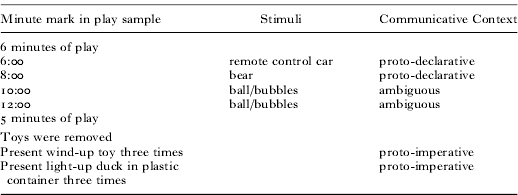
NOTE: Each stimulus was presented three times.
Proto-declarative stimuli
Two communicative temptations were chosen as prompts to create proto-declarative communicative contexts experimentally. At the 6-minute mark in the play session, infants saw a remote control car move three times during a 30-second period (i.e. on for 3 seconds and off for 10 seconds). At the 8-minute mark, a toy bear in a darkened, inaccessible cabinet lit up and danced to soft music three times during a 30-second period (i.e. on for 3 seconds and off for 10 seconds). Both were placed out of reach on a shelf located on the east wall of the room. These stimuli were chosen because inaccessible, animated toys presented at a distance have been found to elicit proto-declarative gestures from infants (Blake et al., Reference Blake, O'Rourke and Borzellino1994; Carpenter, Mastergeorge & Coggins, Reference Carpenter, Mastergeorge and Coggins1983; Carpenter et al., Reference Carpenter, Nagell and Tomasello1998; Franco & Butterworth, Reference Franco and Butterworth1996; Liszkowski, Carpenter, Henning, Striano & Tomasello, Reference Liszkowski, Carpenter, Henning, Striano and Tomasello2004).
Ambiguous stimuli
Two communicative temptations were chosen to create communicative contexts where the communicative intent of infants' gestures might be ambiguous to the mother (i.e. could be proto-declarative or proto-imperative). Two objects were placed on separate shelving units slightly out of infants' reach and were each presented three times, one at the 10-minute mark and one at the 12-minute mark, by simultaneously activating remote control lights and music for 30 seconds (i.e. on for 3 seconds and off for 10 seconds). Presentation of the two objects, a brightly colored bottle of bubbles and a brightly colored ball, was counterbalanced for order (first or second) and position (right or left shelving unit) across subjects. These stimuli were chosen to create an ambiguous communicative context based on the work of Franco and Butterworth (Reference Franco and Butterworth1996), who found that placing attractive objects that were slightly out of reach but appeared accessible to infants elicited gestures that could be judged as proto-declarative or proto-imperative.
Proto-imperative stimuli
Two communicative temptations were chosen to create communicative contexts where infants would most likely be gesturing for proto-imperative purposes. In a manner consistent with other studies, infants were given a wind-up toy that was difficult to operate without adult assistance and a light-up toy in a container that was hard for them to open to create proto-imperative contexts (Blake et al., Reference Blake, O'Rourke and Borzellino1994; Carpenter et al., Reference Carpenter, Mastergeorge and Coggins1983; Carpenter et al., Reference Carpenter, Nagell and Tomasello1998; Harding & Golinkoff, Reference Harding and Golinkoff1979; Wetherby et al., Reference Wetherby, Cain, Yonclas and Walker1988; Yoder, McCathren, Warren & Watson, Reference Yoder, McCathren, Warren and Watson2001). The proto-imperative stimuli were always presented three times each at the end of the play session so that the toy set was not present.
Coding responses to gesture
Infants' gestures
Infants' gestures that immediately followed all six communicative temptations were identified and categorized by type. The initial gesture that occurred from the onset of the stimulus (i.e. when the car, bear and lights were activated) until 3 seconds after the stimulus offset (i.e. when the car, bear and lights stopped) was coded. Researchers also coded all of infants' gestures that were directed toward the car, bear, ball, bubbles, wind-up toy and container at any time during the session. Because the number of gestures occurring at stimulus presentation was small, infants' gestures that occurred during the stimulus presentation interval and outside the stimulus presentation interval were subsequently analyzed together.
Infants' gestures were categorized as pointing, object extension/showing, open-handed reaching and other hand or body movements. Pointing included extensions of the index finger toward an object and excluded exploratory poking or manipulation. Object extension/showing included movements of the arm in the direction of the mother while holding an object and included instances where the infants gave objects to mothers. Open-handed reaching was defined as extensions of the arm with the hand open, excluding movements that were simply the first phase of grasping the object and did not need to include repeated opening and closing of the hand. A fourth category included all other hand or body movements that were considered communicative based on guidelines set by Bates, Camaioni and Volterra (Reference Bates, Camaioni and Volterra1975) and Wilcox, Hadley and Ashland (Reference Wilcox, Hadley, Ashland and Hanson1996), including representational gestures such as dancing motions. Infants' gestures were recorded separately by type.
For the proto-imperative context, coding of each gesture began when the toy (i.e. wind-up toy and the light-up duck in the plastic container) was placed near the child. Coders then watched the child for up to 30 seconds, or as long as the child maintained interest in the toy, and coded the first gesture the infant produced. Coding stopped after 30 seconds or when the child lost interest in the toy. This was done because infants often manipulated the toy for some time before gesturing to request assistance winding the toy or opening the container. Following Goldin-Meadow et al. (Reference Goldin-Meadow, Goodrich, Sauer and Iverson2007) and Tomasello, Carpenter and Liszkowski (Reference Tomasello, Carpenter and Liszkowski2007), eye contact to the mother was not necessary for the gesture to be considered communicative.
Mothers' responses to gesture
After infants' gestures toward the experimental stimuli were identified, coders recorded whether or not the mothers responded within the next 3 seconds. The first behavior (or set of behaviors) that mothers produced from the onset of each gesture until 3 seconds after the offset of each gesture or the onset of a new behavior was considered the mother's response. Responses to gestures met criteria for attention and contingency suggested by Masur (Reference Masur1987) . To meet criteria for attention, mothers gave evidence of having seen the gesture. To meet criteria for contingency, there was evidence that mothers' behaviors were evoked by the gesture, rather than occurring spontaneously. Each maternal behavior/utterance that followed infants' gestures was coded for the presence or absence of a response, for the presence or absence of gaze to the child, for the presence or absence of looking to the experimental stimuli, for the presence or absence of a vocalization and for the presence or absence of words. Gestures that received only non-verbal responses (e.g. laughter or smiling) or received no response were placed into a broad mutually exclusive category called ‘No Verbal Response’. This category was used to capture the number of infants' gestures that were not responded to with words. Gestures that received words were coded as ‘Verbal Responses’.
‘Verbal Responses’ were further coded as containing object labels, action labels, internal state labels or non-labels. Each maternal utterance was coded for the presence or absence of labels of the target object (e.g. duck, bear, car, ball, bubbles, music, noise, light), labels relevant to target actions (e.g. dance, move, open, go, wind, spin, turn) and labels of the infants' internal state (e.g. like, see, want, hear, think). These categories were not mutually exclusive in order to capture the variety of labels mothers used in their utterances after infants' gestures. Responses that contained only general all-purpose words or other word types were coded into a mutually exclusive verbal response category called non-labels. This category included references to secondary entities (e.g. shelf, container) or actions (e.g. do), exclamations/interjections/minimal social acknowledgements (e.g. wow, thank you, oops, uh-oh) and general all-purpose statements that did not contain any reference to specific aspects of the stimuli or the infants' internal state (e.g. again, more, what's that?). Using the taxonomy of Slaughter et al. (Reference Slaughter, Peterson and Carpenter2008), mothers' utterances that contained internal state labels were coded for the presence of four subcategory types: perception (e.g. see, hear), volition (e.g. want, need), cognition (e.g. think, know) and disposition (e.g. like, scared). Finally, internal state labels were coded for whether or not they referenced infants' internal states (e.g. You see a bear), mothers' internal states (e.g. I see a bear) or both (e.g. We see a bear).
Inter-rater agreement
Inter-observer agreement was obtained from records of two boys and two girls. Agreement for identifying each instance of infants' gestural production directed to the six stimuli was 97%; Cohen's kappa=0·971. Inter-observer agreement for categorizing infant gestures by type (points, open-handed reaches, object extensions, other) was 97%; Cohen's kappa=0·954.
Inter-rater agreement for classifying mothers' behaviors following infants' gestures as No Verbal Response and Verbal Response was 97%; Cohen's kappa=0·87. When coders agreed that mothers' responses to infants' gestures contained a Verbal Response, inter-rater agreement for coding the Verbal Response was as follows: object labels=100% (Cohen's kappa=1), action labels=100% (Cohen's kappa=1), internal state labels=100% (Cohen's kappa=1) and nonlabels=100% (Cohen's kappa=1). Inter-rater agreement for classifying mothers' internal state labels was 100%; Cohen's kappa=1. When coders agreed that an internal state label was present, agreement for classifying whose internal state was being referenced (i.e. infant, mother, both) was 100%; Cohen's kappa=1. When discrepancies occurred, both coders concurrently watched the videotape segment and discussed the segment until consensus was reached.
Analyses
For the repeated measures analyses of variance, missing scores for an individual in any context were replaced by group means. Mauchley's test of sphericity was used to test for assumptions of homogeneity of covariances and degrees of freedom in F tests were adjusted by the Greenhouse–Geisser epsilon in the cases where assumptions were violated (Howell, Reference Howell1987). Significant main effects from repeated measures analyses of variance were followed by post-hoc tests of pair-wise comparisons among means employing Bonferroni adjustments using SPSS 16.0. The analyses of variance employed proportions because infants' gestural rates varied and mothers' opportunities to respond to infants' gestures varied. Because preliminary ANOVAs revealed no significant effects involving gender, that factor was not included in analyses of infants' gestures or maternal responses.
RESULTS
Findings are presented in four sections. The first provides information about infants' provision of pointing, reaching, object-extending and other gestures during the interactions and examines the correspondence between the types of gestures and the communicative contexts which evoke them. The second presents analyses of mothers' rates of verbal responses to their children's points, reaches and object extensions by gesture type and by context. The third assesses mothers' production of object, action and internal state labels following different types of infant gestures. And the final section examines the content of mothers' internal state language following each kind of gesture.
Correspondences between communicative context and infants' gestures
The three communicative contexts elicited considerable gesturing by the infants, 210 total gestures. All but one child gestured to at least one target object. Overall, 17 children used at least one gesture toward the proto-declarative context objects, 23 infants made gestures toward the proto-imperative context objects, and 18 infants made gestures toward the ambiguous context objects. On average, children gestured 3·0 times (SD=2·6) toward the proto-declarative context objects, 3·6 times (SD=1·6) to the proto-imperative context objects, and 4·3 times (SD=4·0) to the ambiguous context objects.
The first analysis examined whether there was the predicted relationship between these communicative contexts and the kinds of gestures infants produced. Pointing gestures were expected to be most frequent in the proto-declarative context and object extensions most frequent in the proto-imperative context. The results of a 3 (Context: proto-declarative, proto-imperative, ambiguous)×4 (Gesture: point, reach, object extension, other) repeated measures ANOVA on the proportions of gestures of each type in each context found a significant interaction, demonstrating associations of context and gesture type (F(3·3, 76·6)=53·7, p<0·001, ηp2=0·7)Footnote 1 (see Table 2).
Mean proportions (and standard deviations) of infants' gestures in three communicative intent contexts

NOTE: Proportions were calculated using the total number of gestures infants produced in each communicative context as the denominator. Means with different subscripts were significantly different by pairwise comparisons with Bonferroni adjustments.
To analyze the contrasts of greatest interest, follow-up one-way repeated measures ANOVAs examining infants' gestural production were completed separately within each context. However, object extensions were omitted from the follow-up analysis of the proto-declarative context because they were not possible. In addition, we completed follow-up one-way analyses within the pointing and reaching gestures, but not within the object extension gesture because object extensions did not occur in contexts other than the proto-imperative.
The analysis assessing the kinds of gestures infants produced in the proto-declarative context found a main effect of gesture type (F(2, 44)=8·94, p=0·001, ηp2=0·28). As predicted, pair-wise comparisons revealed that infants pointed more often than they produced open-handed reaching or other gestures (p=0·009 and p=0·01, respectively). In fact, when the ‘other’ gestures are excluded, infants' pointing accounted for 75% of all communicative gestures in the proto-declarative context. In the comparable analysis of gestural production within the proto-imperative context, the significant main effect of gesture type (F(1·4, 32)=364, p<0·001, ηp2=0·94), revealed, as predicted, that infants were overwhelmingly more likely to use object extending (92% of the time) than pointing, reaching or other gestures (pair-wise comparison ps<0·001). Finally, in the ambiguous context infants did not show a pointing or reaching preference, confirming the intended ambiguous nature of the context. There was a significant main effect of gesture type (F(1·8, 41·1)=8·61, p=0·001, ηp2=0·27), because infants produced more pointing, reaching and other gestures than object extensions, which did not occur (all ps<0·02). Infants' provision of pointing, reaching and other gestures did not significantly differ in the ambiguous context.
The follow-up ANOVAs within gesture types also confirmed the strong gesture-to-context relationship. The analysis for the pointing gesture revealed a significant main effect of context (F(2, 46)=27·74, p<0·001, ηp2=0·55). Pair-wise comparisons showed that infants were more likely to produce points in the proto-declarative context than in the proto-imperative or ambiguous context (p<0·001 and p=0·01, respectively). Within the reaching gesture, the follow-up ANOVA revealed a significant main effect of context (F(2, 46)=19·8, p<0·001, ηp2=0·46). Pair-wise comparisons revealed that infants' reached more in the ambiguous context than in the proto-declarative and proto-imperative contexts (p=0·004 and p<0·001, respectively). The analysis for object extensions was not conducted because they occurred only in the proto-imperative context.
Mothers' verbal response rates to infants' object-related gestures
Parallel analyses by context and by gesture assessed mothers' rates of verbal responding (i.e. No Verbal Response, Verbal Response) to infants' object-related gestures. First, mothers' responses to infants' gestures in the three communicative contexts were analyzed via a 3 (Context: proto-declarative, proto-imperative, ambiguous)×2 (Response: No Verbal, Verbal) repeated measures ANOVA. Second, mothers' rates of responding to their infants' pointing, reaching and object-extending gestures were compared irrespective of communicative context with a 3 (Gesture: point, reach and object extension)×2 (Response: No Verbal, Verbal) repeated measures ANOVA.
The results of both analyses demonstrated a strong propensity for mothers to respond verbally to infants' gestures in all contexts (F(1, 22)=201·79, p<0·001, ηp2=0·90) and to all gesture types (F(1, 22)=152, p<0·001, ηp2=0·87) (see Table 3). Only 6 gestures out of 177 points, reaches and object extensions received no response (i.e. no verbal or non-verbal response), and only 16 gestures received a non-verbal response. Every mother responded to at least one infant gesture verbally. Mothers' responses on average included words 87% of the time. However, despite their high verbal response rates in general, mothers did vary in responsiveness across contexts (F(1·6, 34·9)=4·34, p=0·03, ηp2=0·17). A follow-up repeated measures one-way ANOVA within verbal responses revealed a significant main effect of context (F(2, 46)=4·4, p=0·02, ηp2=0·16). Mothers responded verbally more often in the proto-declarative context than the ambiguous context (pair-wise comparison p=0·02). Mothers' verbal response rates in the proto-imperative context did not significantly vary from their response rates in the other two contexts. Mothers' verbal response rates did not significantly vary by gesture type.
Mean proportions (and standard deviations) of maternal response rates to infants' gestures in three communicative contexts
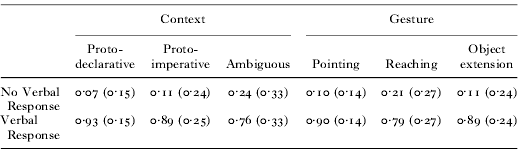
NOTE: Proportions for context were calculated using the total number of pointing, reaching and object extension gestures in the communicative context as the denominator. Proportions for gesture type were calculated using the total number of points, reaches and object extensions as the denominator.
Mothers' labeling responses to infants' gestures
Almost all mothers included at least one labeling utterance in their verbal responses to their infants' gestures. Only 3 of the 23 mothers who provided verbal responses produced only non-labeling utterances (e.g. What is that? Thank you.) and never included an object, action or internal state label in any of their responses. Those who did provide labeling utterances produced an average of 3·8 verbal responses that included a labeling word (range 1–15). The next analysis examined the kinds of labels mothers produced when they provided verbal responses. Because of the strong correspondence between infant gesture type and communicative context revealed in the first analysis and because mothers' high rates of verbal responses were equally evident when analyzed by either gesture type or context in the second analysis, maternal labeling responses are analyzed and presented here only by gesture type, for economy. However, the comparable analysis conducted by communicative context found the same pattern of results.
Mothers' labeling responses varied according to the type of infant gesture (see Table 4). The 3 (Gesture: point, reach, object extension)×4 (Labeling Response: object label, action label, internal state label, non-label) repeated measures ANOVA conducted on the proportions of verbal responses including each kind of label found a significant interaction (F(3·36, 77·2)=7·42, p=0·0002, ηp2=0·24). To interpret this interaction, follow-up one-way repeated measures ANOVAs were completed both within each gesture type to determine the kinds of labels most often produced as responses to each gesture and within each labeling response to assess differences in mothers' provision of each label across gestures.
Mean proportions (and standard deviations) of maternal labeling responses after three types of infants' gestures

NOTE: Proportions were created using the total number of points, reaches and object extensions that received a verbal response regardless of communicative context as the denominator. With the exception of non-label, categories were not mutually exclusive. Means with different subscripts were significantly different by pairwise comparisons with Bonferroni adjustments.
The follow-up one-way repeated measures ANOVAs within each gesture type found significant differences in the kinds of labeling responses provided. Results for pointing revealed that mothers provided more object labels, internal state labels and non-labels than action labels to infants' points (F(1·14, 42)=6·72, p=0·004, ηp2=0·23; pair-wise comparison ps<0·002). Following infants' reaches, mothers provided more non-labels than any other category (F(1·8, 41)=20·4, p<0·001, ηp2=0·47; pair-wise comparison ps⩽0·03). They also produced more object labels and internal state labels than action labels (ps<0·01). The analysis for object extensions revealed that mothers also used more non-labels than object labels and action labels (F(1·9, 45·7)=12·7, p<0·001, ηp2=0·36; pair-wise comparison ps<0·02). Although mothers produced a greater proportion of internal state labels than object or action labels, the difference was not significant.Footnote 2
Furthermore, the follow-up one-way ANOVAs for each kind of labeling response showed that the kinds of labels mothers provided differed across gestures. First, the follow-up analysis for non-labeling utterances showed that a smaller proportion of mothers' verbal responses to points than to reaches or object extensions excluded a label (F(1·6, 36·6)=3·93 p=0·04, ηp2=0·15). With non-labeling utterances occurring on average only 38% of the time, 62% of mothers' verbal responses to their children's pointing gestures included at least one object, action or internal state label. In contrast, mothers provided non-labeling utterances following infants' reaching and object-extending gestures the majority of the time (Ms=59% and 56%, respectively). The difference between pointing and reaching was significant (pair-wise comparison p=0·05).
The analysis for object labels revealed that mothers were more likely to provide object labels after pointing and reaching than after object extending (F(1·5, 33·7)=18·01, p<0·0001, ηp2=0·44; pair-wise comparison ps<0·001). Two-thirds of all mothers who responded verbally to a point and 54% of all mothers who responded verbally to a reach provided at least one object label, as compared to only 14% of all mothers who responded verbally to an object extension; differences between object extensions and both points and reaches were significant by Fisher's exact tests (ps<0·02).
However, mothers produced significantly more action labels following children's object extensions than following either pointing or reaching (F(1·1, 25·6)=10·4, p=0·003, ηp2=0·31; ps=0·01). Fifty percent of mothers who responded verbally to object extensions, but only 13% of mothers responding verbally to points and 23% of mothers responding verbally to reaches, produced at least one action label; the differences between object extensions and points was significant by a Fisher's exact test (p<0·04).
Mothers' provision of internal state labels did not statistically vary as a function of gesture type. On average, between 20% and 31% of their verbal responses to each gesture included an internal state label, and the majority of mothers responding verbally to their infants' points and reaches produced at least one internal state label (Ms=53% and 59%, respectively), although a minority of mothers did so in response to infants' reaches (M=38%).
Mothers' internal state labels to infants' gestures
The final analyses examined mothers' provision of four types of internal state labels, including perception (e.g. see, hear), volition (e.g. want, need), cognition (e.g. think, know) and disposition (e.g. like, scared), in their responses to different infant gestures. In all, 16 of the 23 mothers who produced verbal responses to an infant gesture provided from 1 to 10 internal state labels (M=2·62). Mothers' labels referenced their infants' internal states almost exclusively: 95% of mothers' internal state words referred to the infants' internal states, only 5% referred to mothers', and 0% to both partners' internal states.
Because of great variation among mothers and across gestures, mothers' provision of different kinds of internal state labels within each gesture type was assessed with non-parametric statistics, including Friedman's one-way analysis of variance and Wilcoxon signed rank tests.Footnote 3 As Table 5 shows, mothers provided a greater proportion of perception labels than any other kind of internal state label after infants' points. Although Friedman's test did not reach statistical significance, a Wilcoxon signed rank test comparing mothers' production of perception labels (51%) to volition labels (5%) after infants' points was significant (p=0·04).
Mothers' production of internal state label types varied after infants' reaches (Xr 2(3)=11·7, p=0·008). The overwhelming majority of their internal state labels referenced perception. Follow-up Wilcoxon signed rank tests showed that mothers used a significantly higher proportion of perception labels than the other internal state labels after reaches (ps<0·05). Mothers' use of volition labels and disposition labels occurred equivalently and infrequently, and mothers never used cognition labels after infants' reaches.
Friedman's analysis of object extensions revealed a contrasting pattern of internal state label production (Xr 2(3)=26·7, p<0·001). Following object extensions, mothers' internal state labels referred to volition 81% of the time, considerably more than to perception (15%) or disposition (4%) (ps=0·008 and 0·001, respectively). The preponderance of volition references following object extensions, which occurred exclusively in the proto-imperative context, indicates that mothers are accurately labeling the infants' inferred internal state of requesting help with the stimuli.
Differences in mothers' provision of each kind of internal state label across gestures were evaluated with Fisher's exact tests. The analysis for labels referring to perception found that the majority of mothers providing internal state labels in response to pointing and reaching (Ms=62% and 100%, respectively) provided at least one perception reference, but only 23% of mothers did so following object extensions; the difference between reaches and object extensions was significant (p<0·003). In marked contrast, the great majority of mothers providing internal state labels in response to object extensions referenced volition (M=92%), but only 25% of mothers responding to points and 40% of mothers responding to reaches did so; differences between object extensions and both other gestures were significant (ps⩽0·04). Disposition references were less common. Of the mothers who provided internal state labels in response to each gesture type, only 38%, 40% and 8% did so following points, reaches and object extensions, respectively. Internal state labels referencing cognition were even more rare; only one mother, in response to a pointing gesture, produced a cognition label.
Mean proportions (and standard deviations) of subcategories of internal state labels after three types of infants' gestures

NOTE: Proportions were created using the number of each gesture type that received an internal state label as the denominator. Mothers could use more than one type of internal state label within the same responsive utterance. Means with different subscripts across rows were significantly different by Wilcoxon Signed Ranks Tests (ps<0·05).
DISCUSSION
Infants' gestures have been linked with their vocabulary growth, motivating researchers to search for factors that might account for this relation (Carpenter et al., Reference Carpenter, Nagell and Tomasello1998; Goldin-Meadow, Reference Goldin-Meadow2007; Iverson & Goldin-Meadow, Reference Iverson and Goldin-Meadow2005; Masur, Reference Masur1982). Pointing gestures are of particular interest to researchers because the emergence of pointing and the frequency of pointing have been strongly related to vocabulary size (Bates et al., Reference Bates, Benigni, Bretherton, Camaioni and Volterra1979; Blake et al., Reference Blake, Vitale, Osborne and Olshansky2005; Brooks & Meltzoff, Reference Brooks and Meltzoff2008; Camaioni et al., Reference Camaioni, Castelli, Longobardi and Volterra1991; Masur, Reference Masur1982). Goldin-Meadow (Reference Goldin-Meadow2002) has postulated that these links between gesture and vocabulary exist because object-directed gestures elicit input from mothers that facilitates language learning. Brooks and Meltzoff (Reference Brooks and Meltzoff2008) have also theorized that pointing may elicit object labels from adults, thus influencing word learning. Three small-scale studies provide evidence that mothers' responses to infants' gestures often include object labels (Goldin-Meadow et al., Reference Goldin-Meadow, Goodrich, Sauer and Iverson2007; Marcos, Reference Marcos1991; Masur, Reference Masur1982). However, the nature and variety of maternal labeling and other responses to infants' gestures had not previously been examined systematically and comprehensively. This study is the first to describe not only the object labels, but also the action and internal state labels mothers provided in response to infants' pointing, open-handed reaching and object extending in the same group of infants. This is important because mothers' responses to infants' gestures may provide the key to understanding why infants' gestures are linked with their vocabulary development.
Our discussion of the major findings is organized around the three purposes of the study. First, it investigated whether the form of infants' gestures varied as the three communicative intent contexts were manipulated and infants were given access to some of the experimental stimuli. Second, mothers' verbal response rates were examined in relation to gesture type. Finally, the current study explored the kinds of verbal labels – object, action and internal state – mothers provided after infants' pointing, open-handed reaching and object-extending gestures.
Infants' gestures
Infants in the current study had a propensity to use a particular type of gesture dependent upon the communicative intent context. Infants pointed most often in the proto-declarative context when attractive and audible objects were presented out of reach. Pointing comprised 59% of all gestures produced in the proto-declarative context. The overall rate of pointing is comparable to that of Blake et al. (Reference Blake, O'Rourke and Borzellino1994) who found that approximately 56% of their 1 ; 0 infants' gestures were points in contexts they designed to be proto-declarative, where objects were also high and out of reach. With only pointing and reaching considered, we found that pointing accounted for 82% of gestures in the proto-declarative context. This rate of pointing is comparable to Franco and Butterworth's (Reference Franco and Butterworth1996), who found that about 8 out of 9 (89%) gestures were points as opposed to reaches in a similar context designed to be proto-declarative. These findings underscore the strong link between the pointing form and a proto-declarative intent. This association is important for interpreting results from several studies demonstrating positive relations between either pointing or proto-declarative gestures and children's later lexical acquisition, indicating the equivalence of these results (Brooks & Meltzoff, Reference Brooks and Meltzoff2008; Camaioni et al., Reference Camaioni, Castelli, Longobardi and Volterra1991; Carpenter et al., Reference Carpenter, Nagell and Tomasello1998; Masur, Reference Masur1982).
Infants' use of object extensions in the proto-imperative context was the most robust form-to-communicative context relation observed in the current study. Twenty-three of the 24 infants in the current study used object extensions to communicate their proto-imperative intent, and object extensions comprised 94% of all gestures produced in that context. For example, infants extended the wind-up toy to their mother when it stopped moving to signal their request to have the toy wound again. Not surprisingly, all mothers in the current study responded by acting on the experimental objects in the proto-imperative context, either winding the toy or opening the container. However, infants' gesture use in the proto-imperative context did not follow the same form-to-communicative context relationship reported by Franco and Butterworth (Reference Franco and Butterworth1996) and Blake et al. (Reference Blake, O'Rourke and Borzellino1994) . Infants in those studies used open-handed reaching more often in proto-imperative contexts, most likely because infants did not have the same kind of access to experimental stimuli as they did in the current study. Therefore, whether or not infants have access to experimental stimuli, as they often do during naturalistic mother–infant interactions, is an important variable to consider when interpreting infants' gestures as a function of communicative context, especially when examining proto-imperative gestures.
Infants' preference for using a particular type of gesture was less pronounced in the ambiguous context, where the objects were within the mothers' reach and available to be given to the children, reflecting our design of a communicative context that could elicit commenting or requesting. Franco and Butterworth (Reference Franco and Butterworth1996) also included a mixed or ambiguous condition, a remote-control car driven near the infant, and found that approximately 25% of infants' gestures were reaches and 75% were points. In contrast, we found that infants used more open-handed reaching (50%) than pointing (30%) in this context, although the difference was not statistically significant. Such differences in findings suggest that stimuli and conditions may influence outcomes and should be considered when evaluating experimental results.
Besides pointing, reaching and object extending, infants used a substantial number of ‘other’ gestures, including miscellaneous and representational gestures, more often than expected in the ambiguous and proto-declarative contexts. Although only one infant produced a representational gesture in the proto-imperative context, bobbing his head up and down to represent the action of a figure on the wind-up toy, 23% of infants' gestures in the proto-declarative context and 20% of infants' gestures in the ambiguous context were classified as ‘other’. Infants clapped, shook their heads and waved toward the experimental stimuli. But the most common type of ‘other’ gesture was representational ‘dancing’ to the bear which moved as music played. This gesture was imitated by mothers in ways that suggested that dancing to music was a very familiar routine for most of the dyads. The inclusion of music in the proto-declarative and the ambiguous contexts could account for the strong presence of ‘other’ gestures in this study.
Mothers' response rates to infants' gestures
Not surprisingly, mothers often responded to infants' gestures with words. They noticed infants' gestures and responded verbally at rates above 75% in all three contexts. These high verbal responses rates are consistent with those reported by Masur (Reference Masur1982), who found that mothers responded to gesture with words 64–96% of the time in a sample of four infants. However, mothers' propensity for giving a verbal response was different across communicative intent contexts. Mothers were less likely to respond to infants' gestures with words in the ambiguous context (76%) than in the proto-declarative context (93%) and the proto-imperative context (89%). Because of the concordance between gesture form and communicative context, mothers responded less often with words to reaching gestures (79%), which occurred most often in the ambiguous context, than to pointing (90%) or object extensions (89%), although this difference was not statistically significant. This could reflect mothers' uncertainty about the communicative intent of infants' reaching in the ambiguous context. At times, mothers might have been unsure if infants were commenting or requesting so chose not to ‘translate’ infants' gestures with words in the ambiguous context. Alternatively, mothers might have responded verbally less often to infants' reaches because they did not want to acknowledge or grant the inferred request, for example, to give the infant the bubbles.
Maternal labels after infants' gestures
Most importantly, when mothers responded to infants' gestures with words, the types of labels they provided varied across gesture types. As such, these maternal response patterns may begin to explain some of the relationships between infants' gestures and word learning (Brooks & Meltzoff, Reference Brooks and Meltzoff2008; Carpenter et al., Reference Carpenter, Nagell and Tomasello1998; Masur, Reference Masur1982).
Object labels were provided most often after pointing. Consistent with previous findings (Masur, Reference Masur1982), mothers gave more object labels after points than after object extensions. For example, they said, “It's a bear” or “Do you see a car?” They also provided slightly more object labels to points than to reaches, but the difference was not significant. Mothers also used fewer non-labels, verbal responses that did not contain any labels relevant to the stimulus objects, after pointing than after object extending or reaching. Following object extensions, they often said, “What is it?” or “I'll do it”. In fact, following object extensions, which occurred only in the proto-imperative context, mothers' responses included more non-labels than object, action or internal state labels. Reaching also elicited more non-labels than object, action or internal state labels. Thus, following points, infants not only heard more object labels than after object extensions, they also heard fewer words that did not specifically label what was being talked about.
Taken together, these findings may help explain one reason why pointing is the gesture most often associated with vocabulary size (Bates et al., Reference Bates, Benigni, Bretherton, Camaioni and Volterra1979; Brooks & Meltzoff, Reference Brooks and Meltzoff2008; Camaoini et al., Reference Camaioni, Castelli, Longobardi and Volterra1991). Because proto-declarative gestures are most often points, these findings may also help explain why Carpenter and colleagues (Reference Carpenter, Nagell and Tomasello1998) found that the emergence of proto-declarative gestures was more strongly linked to infants' vocabulary size than proto-imperative gestures. In this study it was points, rather than proto-imperative object extensions, that elicited the kind of maternal responses – object labels – that would be most likely to advance vocabulary at an age when lexicons are comprised predominantly of object-labeling words (Goldfield & Reznick, Reference Goldfield and Reznick1990; Nelson, Reference Nelson1973). Mothers are providing object labels after pointing at a time in development when most infants are actively acquiring object labels and immediately prior to the vocabulary spurt for nouns that typically occurs in the middle of the second year (e.g. Goldfield & Reznick, Reference Goldfield and Reznick1990; Nelson, Reference Nelson1973). Because this is not a longitudinal study and does not include a vocabulary outcome measure, we cannot conclude that mothers' object labels after pointing facilitate children's vocabulary growth in the early stages of word learning. But such a proposition is consistent with a small-scale study reporting that mothers' provision of object labels following their children's gestures was related to the children's cumulative noun lexicons (Masur, Reference Masur1982). It is also in keeping with findings that mothers' overall frequency of noun production was related to infants' noun vocabularies (Goodman, Dale & Li, Reference Goodman, Dale and Li2008).
In contrast to their provision of object labels, mothers used few action labels overall. The action labels they did produce occurred most often after object extensions, which was the dominant gesture type in the proto-imperative context. Their action labels included open, wind and twist, which accurately labeled the actions mothers needed to employ to operate the stimulus objects. The beginning of the second year is a time in lexical development when infants learning English have relatively few action labels in their vocabularies because their lexicons are largely made up of object labels and they are focused on acquiring nouns (Goldfield & Reznick, Reference Goldfield and Reznick1990; Nelson, Reference Nelson1973). Action labels and other non-nominals are generally acquired toward the end of the second year (Masur & Eichorst, Reference Meins, Fernyhough, Wainwright, Gupta, Fradley and Tuckey2002; Tomasello, Reference Tomasello, Tomasello and Merriman1995). Thus, following their object extension gestures, the action labels infants at 1 ; 1 are likely to hear may not be particularly helpful for word learning at that time. However, the role of mothers' action labels after infants' object extension gestures at later points in development when infants are more focused on verb learning deserves further attention.
We also found that mothers' verbal responses after infants' gestures included substantial proportions of internal state labels, and these referenced the infants' internal states rather than the mothers' almost exclusively. This study is the first to examine internal state labels as responses to infants' gestures. It has revealed that internal state labels are a large part of what infants hear after they gesture. These internal state labels were produced after all gesture types, not just after reaching when mothers might label a desire. Mothers responded to 31% of infants' points, 20% of reaches and 31% of object extensions with internal state labels. For example, they said “Do you want that?”, “What do you think?” and “You like bubbles”. In fact mothers responded with as many or more internal state labels as they did object labels across the three gesture types. This may help explain why Slaughter and colleagues (Reference Slaughter, Peterson and Carpenter2009) found that mothers' provision of mental state labels during play at 1 ; 3 was positively correlated with the number of gestures infants were reported to use at 1 ; 3. Infants' gestures elicit internal state labels from mothers.
Furthermore, mothers' provision of specific internal state labels was selective across gesture types. This is consistent with the findings of Slaughter and colleagues (Reference Slaughter, Peterson and Carpenter2008) that mothers used mental state words that express perception, volition, cognition and disposition differentially during joint attention episodes, although the focus of the current study is more narrow because it encompasses only joint attention episodes that include gesture. The type of internal state label mothers produced expressed the inferred communicative intent of infants' gestures. Mothers in the current study used volition labels (e.g. want) almost exclusively, 83% of the time, after object extension gestures. Mothers often expressed the inferred desire or request (e.g. “You want help?”). In contrast, mothers used perception labels most often after pointing (56% of the time). Mothers frequently verbalized their infants' inferred comment on a perceptual state (e.g. “You see a bear?”). Because the first kinds of internal state words children acquire are perceptual this may be further evidence for the link between infant pointing and vocabulary acquisition for the possible mediational role of mothers' responses to infants' gestures.
Mothers' differential production of internal state language after infants' gestures may have implications not only for children's learning of mental state words but also for their learning about the mental states of others. Several studies have reported relationships between the mental state language young children hear from caregivers and their later performance on tasks of mental understanding (Dunn et al., Reference Dunn, Brown, Slomkowski, Tesla and Youngblade1991; Sabbagh & Callanan, Reference Sabbagh and Callanan1998; Taumoepeau & Ruffman, Reference Taumoepeau and Ruffman2006; Reference Taumoepeau and Ruffman2008). Taumeopeau and Ruffman (Reference Taumoepeau and Ruffman2008) suggest that mothers' talk about mental states serves to scaffold children's social understanding. They argue that mothers need a way to monitor their infants' internal state so that they talk about infants' desires in a way that is “timed to fit with the child's existing understanding” (p. 285). The current study provides evidence that infants' gestures may be a mechanism by which mothers monitor infants' current mental state, select an internal state label and time their internal state talk to scaffold infants' social cognition. Therefore, it will be important to examine if mothers' early use of internal state labels after infants' gestures is specifically related to infants' acquisition of these words and/or their later understanding of internal states. If so, this could have implications for the selective role that mothers' responses to infants' gestures might play in mediating infants' early acquisition of internal state terms and in their development of different facets of internal state understanding.
In addition, it would be valuable to examine if mothers' verbal response patterns to infants' gestures are different from their response patterns to infants' communicative bids that do not contain gesture or in more natural situations where gestures are not directly and experimentally elicited. Goldin-Meadow (Reference Goldin-Meadow2002; Reference Goldin-Meadow, Goodrich, Sauer and Iverson2007) theorizes that infants' gestures indirectly influence their language-learning environment by eliciting responses that facilitate language. The current study found that pointing elicited object labels from mothers, but it does not determine if these responses are different from the responses mothers provide after infants' early proto-declarative communicative bids that do not contain gesture, such as vocalizing and gaze shifting. Therefore, these findings support broad assertions by Goldin-Meadow (Reference Goldin-Meadow2002; Reference Goldin-Meadow, Goodrich, Sauer and Iverson2007) and Brooks and Meltzoff (Reference Brooks and Meltzoff2008) that infants' gestures may indirectly influence their language-learning environment by eliciting verbal input that might be facilitative of vocabulary growth. A study comparing mothers' responses to infants' communicative bids that contain gesture with their communicative bids that do not contain gesture would contribute to understanding whether infants' gestures elicit maternal responses that are more facilitative of language development than other communicative bids.
And, finally, because this is not a longitudinal study, we cannot determine if these mothers' response patterns are related to their infants' vocabulary development. If mothers' responses are one explanation for the link between infants' gestures and their vocabulary growth, then there should be a relation between mothers' response patterns and infants' vocabulary growth. We would hypothesize that mothers' provision of object labels after infants' points would be associated with the number of object labels in infants' vocabularies and mothers' provision of internal state labels after infants' gestures would be associated with the number of internal state labels in infants' vocabularies. Following mothers and infants longitudinally to study if mothers' response patterns to infants' gestures correlate with infants' word learning would help answer this question. These are issues we plan to address in future studies.