I. INTRODUCTION
Birefringent crystals with suitable birefringence are important materials for fabricated polarizers, Q-switches, optical isolators, and so on. Reference Chartier1–Reference Zhang, Zhang, Pan, Yang, Wang, Bian, Hou, Yu, Zhang, Wu, Feng, Peng, Xu, Chang and Poeppelmeier8 Many advanced birefringent crystals have been found, such as CaCO3, Reference Ghosh9 YVO4, Reference Luo, Tkaczyka, Sampsonb and Dereniaka10 α-BBO, Reference Zhou, Xu, Chen, Zhong, Wang, Xu, Deng and Gan11–Reference Cyranoski13 etc. Among them, YVO4 has been widely used in the field of optical communication for its outstanding features, for instance, low cost, high temperature stability, high transmission rate in a wide wave length range (400–5000 nm) and good physical properties. Although many birefringent crystals are commercially available or proposed, there seems to be still lack of good crystals that can satisfy the requirements with the social development. Thus, the increasing attentions have been given for finding new birefringent crystals. Actually, birefringence is mainly related to anisotropic polarizability, which can be calculated by the first-principle method. Reference Bian, Yang, Pan, Zhang, Wu, Yu, Zhao and Jing14–Reference Kang, Luo, Huang, Ye, Lin, Qin and Chen16 Inspired by the large birefringence of YVO4, we expect that we can find a new material with good optical properties, like a moderate birefringence, in vanadates family. Furthermore, alkali metal cations often contribute to enlarge the cut-off edge, because they do not have the d–d or f–f electronic transitions in the closed d or f orbits which having negative influences on the energy band gap. Reference Luo, Ye, Zou, Lin and Cheng17 Based on the above reasons, we have conducted a systematic research in the Li2O–Na2O–V2O5 system.
After a series of systematic explorations in the Li2O–Na2O–V2O5 system, LiNaV2O6 with a large birefringence has been found. In this paper, its synthesis, crystal structure, crystal growth, UV–Vis–NIR diffuse reflectance spectrum and vibrational spectrum are reported. Furthermore, its further potential application as a birefringent material based on the ab initio calculations is also investigated.
II. EXPERIMENTAL PROCEDURES
A. Synthesis
Polycrystalline sample of LiNaV2O6 was synthesized by traditional solid-state reaction techniques. A stoichiometric ratio of LiNO3 (Xinjiang You Se Chemical Co., Ltd, 99.9%), NaNO3 (Xinjiang You Se Chemical Co., Ltd, 99.9%), V2O5 (Shenyang Xinxi Chemical Co., Ltd, 99.5%) was mixed thoroughly. This process of synthesis can be described by the following general chemical equation:
 $${\rm{LiN}}{{\rm{O}}_3} + {\rm{NaN}}{{\rm{O}}_3} + {{\rm{V}}_2}{{\rm{O}}_5} \to {\rm{LiNa}}{{\rm{V}}_2}{{\rm{O}}_6} + {{\rm{N}}_2}{{\rm{O}}_5} \uparrow \quad .$$
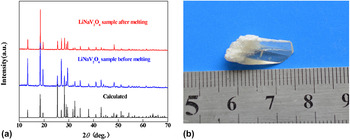
The initial material was slowly heated to 350 °C for 24 h to decompose the nitrate by reaction-driven processes. Then the reaction mixture was heated at 530 °C for 48 h with adequate grinding and mixing. The furnace was turned off and the samples cooled down at the rate of furnace temperature decline. In the end, the purity of the sample was characterized by powder X-ray diffraction (PXRD) analyses. Comparing the position of peaks, we found that the experimental PXRD pattern of LiNaV2O6 was in agreement with the calculated one based on its single crystal data, demonstrating that the obtained powder phase is pure [Fig. 1(a)].
(a) PXRD of calculated, before melting and after melting for LiNaV2O6. (b) Photograph of the LiNaV2O6 crystal. (The minimum scale of the ruler is 1 mm).

B. Crystal growth
Crystal growth of LiNaV2O6 was carried out in a resistant-heated furnace. The temperature of the furnace was controlled within 0.1 °C by an Al-708P controller and a Pt/Pt–Rh thermocouple. The small crystals of LiNaV2O6 were grown by the high-temperature solution method with a spontaneous nucleation technique. Then, the large, block, and transparent single crystals were grown by the top-seeded growth method from the stoichiometric ratio composition melt without the flux. The pure crystalline powder sample (40 g) was melted at 650 °C in a platinum crucible that was placed into a vertical, programmable temperature furnace. It was kept at this temperature for 48 h to ensure complete melting and homogeneity of the raw materials, and then cooled to 535 °C. To obtain some seed crystals, a platinum rod was dipped into the melt rapidly, and kept the temperature for 4–8 h. The obtained crystals were branchy with inclusions. After several crystal growth experiments optimization, suitable seed crystals were obtained (Fig. S1 in the Supplementary Material). For the large crystal growth, the seed crystal was introduced into liquid surface at 537 °C for 10 min to dissolve the outer surface of the seed crystal and become smooth, then cooled down to 535 °C at a rate of 0.2 °C/min, and held at this temperature for 10 h. When the growth of crystal ended, it was lifted out of the liquid surface. The furnace was then cooled to room temperature at a rate of 10 °C/h. As a result, a crystal of as-grown LiNaV2O6 shown in Fig. 1(b), with sizes up to 11 × 6 × 2 mm3 was obtained.
C. PXRD
PXRD analysis of LiNaV2O6 was performed at room temperature in the angular range of 2θ = 10–70° with a scan step width of 0.02° and a fixed counting time of 1 s/step using an automated Bruker D2 PHASER x-ray diffractometer (Bruker Corporation, Billerica, Massachusetts) equipped with a diffracted beam monochromator set for Cu–Kα radiation (λ = 1.5418 Å)
D. X-ray crystallographic studies
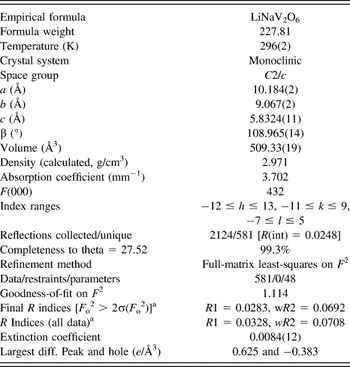
Transparent, block crystal of LiNaV2O6 with a size of 0.098 mm × 0.111 mm × 0.157 mm was mounted on a glass fiber for structure determination. The diffraction data were collected at room temperature on a Bruker Smart APEX II single-crystal diffractometer equipped with a CCD-detector (Mo-Kα radiation, λ = 0.71073 Å). 18 All calculations were performed with programs from the SHELXTL crystallographic software package. Reference Sheldrick19 The structures were solved by direct methods and refined by the full-matrix least-squares method in the SHELXL-97 system. 20 The structure was checked for missing symmetry elements with PLATON. Reference Spek21 Crystal data and structure refinement information are summarized in Table I. Atomic coordinates, equivalent isotropic displacement parameters (Å2) and bond valence sum (BVS) for LiNaV2O6 are listed in Table II. Selected bond distances (Å) and angles (°) for LiNaV2O6 are listed in Table SI in the Supplementary Material.
Crystal data and structure refinement information.

a R1 = Σ||F o| − |F c||/Σ|F o| and wR2 = [Σw(F o 2 − F c 2)2/ΣwF o 4]1/2 for F o 2 > 2σ(F o 2).
Atomic coordinates, equivalent isotropic displacement parameters (Å2) and BVS for LiNaV2O6. U(eq) is defined as one third of the trace of the orthogonalized U ij tensor.

E. Thermal analysis
The thermal analysis was carried out on a simultaneous NETZSCH STA 449C thermal analyzer instrument (NETZSCH Group, Selb, Germany), with a heating rate of 10 °C/min in an atmosphere of flowing N2 from 25 to 1200 °C.
F. Infrared (IR) spectroscopy
To understand the chemical bonding and molecular structure of LiNaV2O6, the IR spectrum was recorded on Shimadzu IR Affinity-11 Fourier transform infrared spectrometer (Shimadzu Corporation, Kyoto, Japan) in the 400–4000 cm−1 range. The sample is mixed thoroughly with dried KBr (8 mg of the sample, 550 mg of KBr).
G. Transmittance spectroscopy
Transmittance spectrum data of the LiNaV2O6 crystal were measured at room temperature with a Shimadzu SolidSpec-3700DUV spectrophotometer in the wave length range 190–2600 nm.
H. Computational descriptions
The electronic structures of the monoclinic LiNaV2O6 crystal were calculated via the density functional theory with the exchange-correlation functional of the generalized gradient approximation in the scheme of Perdew–Burke–Ernzerhof, Reference Clark, Segall, Pickard, Hasnip, Probert, Refson and Payne22 as implemented in the CASTEP package. Reference Perdew, Burke and Ernzerhof23 Norm-conserving pseudopotentials were used for each atomic species with the following valence configurations Reference Lin, Qteish, Payne and Heine24 : Li 2s 1, Na 2s 22p 63s 1, V 3d 34s 2, and O 2s 22p 4, respectively. A plane-wave cutoff energy of 820 eV was used throughout the calculations, and the Monk-horst–Packpoint mesh is 4 × 4 × 6. Reference Monkhorst and Pack25,Reference Perdew and Wang26 The crystallographic data of the title compound determined by single crystal XRD were used for band structure calculation, and no further geometry optimizations were performed. On the basis of the electronic structures, the imaginary part of dielectric function ε2 can be calculated, and its real part is determined by the Kramers–Kronig transform, from which the refractive indices (and the birefringence Δn) were obtained. Reference Chen, Wang, Wang and Xu27 The validity of the refractive indices calculation has been confirmed previously. Reference Kang, Luo, Huang, Ye, Lin, Qin and Chen16
III. RESULTS AND DISCUSSION
A. Crystal structure
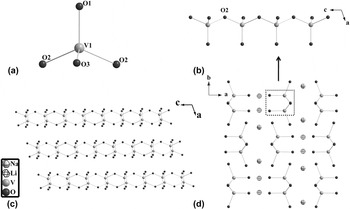
LiNaV2O6 was presented in 1980 for the first time as a clinopyroxene. Reference Bubnova, Filatov, Grunin and Zonn28 To further understand the relationship between structure and properties of this compound, the single-crystal XRD is used to reinvestigate its crystal structure. LiNaV2O6 crystallizes in the monoclinic system with space group C2/c, and there are one crystallographically unique Li atom, one crystallographically unique Na atom, one crystallographically unique V atom, and three crystallographically unique O atoms in the asymmetric unit. A notable feature in the structure is that the VO4 tetrahedra are the fundamental building blocks [Fig. 2(a)]. They are linked by the O(2) atoms to form an one-dimensional (1D) infinite [VO3]∞ chain along the b-axis [Fig. 2(b)]. Two neighboring [VO3]∞ chains arrange in an antiparallel model, and it is obvious that there exists an inversion center between the adjacent [VO3]∞ chains [Figs. 2(c) and 2(d)]. The Li and Na atoms are located at the gap formed by [VO3]∞ chains on ab plane [Fig. 2(d), Fig. S2 in the Supplementary Material]. From Fig. S3, in the Supplementary Material, we can notice that, the distance between neighboring [VO3]∞ chains (d = 3.0760 Å) along the a-axis is much longer than that along the b-axis (d = 0.9335 Å). So the density of V–O groups on bc plane is highest, whereas the [VO3]∞ chains on bc plane can be regarded as a pseudo [VO3]∞ layer to be investigated. These pseudo layers are antiparallel stagger along a-axis which can be seen from Fig. 2(c). And this kind of atom arrangement of the V–O anionic groups is more likely to gain large optical anisotropy.
The crystal structure of LiNaV2O6. (a) The [VO4] unit. (b) The [VO3]∞ 1D chain along b axis. (c) The pseudo [VO3]∞ layer. (d) The whole structure along c axis.

For cations, the Li atoms are in a six-coordination environment with the Li–O bond lengths ranging from 2.153(5) to 2.249(2) Å. The LiO6 octahedra connect further with each other via sharing two oxygen atoms to form 1D [LiO4]∞ chain [Fig. S3(b) in the Supplementary Material]. The Na atoms are also coordinated by six O atoms to form isolated NaO6 octahedra with the Na–O bond length from 2.347(3) to 2.627(3) Å [Fig. S3(d) in the Supplementary Material]. Two O(1) and two O(3) atoms form the equinoctial plane of the octahedron, which means that the deviation from the plane is 1.2069 Å. The drifting distance between Na and the plane is 0 Å and the axis of the octahedron is held by the other two O(1) atoms with O(1)–Li–O(1) = 175.979°. The LiO6 octahedra connecting the NaO6 octahedra form Li–Na–O 1D chain along the a-axis [Fig. S3(c) in the Supplementary Material], which inset into the V–O anionic groups to form a 3D framework [Fig. S3(a) in the Supplementary Material]. The results of bond valence calculations (Li, 0.999; Na, 0.812; V, 5.135) indicate that the Li, Na, and V atoms are in oxidation states of +1, +1, and +5, respectively (Table II). Reference Chen, Pan, Wu, Yang and Fan29–Reference Shan and Huang33
B. Thermal analysis
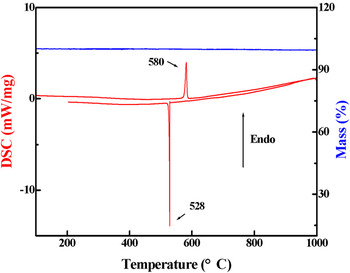
Thermal gravimetric analysis (TG) and differential scanning calorimetry (DSC) curves of polycrystalline samples of LiNaV2O6 are shown in Fig. 3. On the TG plot, it could be seen that there was no mass loss from room temperature to 1000 °C. Meantime, only one endothermic (580 °C) and one exothermic (528 °C) peak are observed from the heating curve and cooling curve, respectively, which indicate that LiNaV2O6 is a compound of congruent melting and there is no phase transfer phase transition between room temperature and the melting point. To further confirm the thermal behavior of the compound, the solid sample of compound is placed into a platinum crucible and heated to 650 °C to melt completely, and then slowly cooled to room temperature. Analysis of the PXRD pattern of the solidified melt reveals that the melted solid product exhibits a diffraction pattern identical to that of the initial LiNaV2O6 powder [Fig. 1(a)], which further demonstrates that LiNaV2O6 is a congruent melting compound. Therefore, large crystals of LiNaV2O6 can be grown from stoichiometric melt.
TG/DSC curves of LiNaV2O6.

LiNaV2O6 single crystal growth temperature is about 535 °C. In comparison, the growth temperature is about 1810 °C for YVO4, Reference Luo, Tkaczyka, Sampsonb and Dereniaka10 1100 °C for α-BBO, Reference Zhou, Xu, Chen, Zhong, Wang, Xu, Deng and Gan11 about 1300 °C for TiO2, Reference DeVore34 and 1300 °C for LiNbO3. Reference Zelmon, Small and Jundt35 To the best of our knowledge, the rather low growth temperature of LiNaV2O6 will favor the crystal growth by the top-seeded growth method. The growth temperature of 535 °C is the lowest among birefringent materials. And for crystal growth, it does not need harsh growth conditions (e.g., atmosphere protection, expensive iridium crucible, high power furnace, etc.). Thus, the growth of LiNaV2O6 from its stoichiometric melt is highly efficient with respect to time, cost, and energy.
C. Transmittance spectroscopy
The optical transmission range and the UV cutoff edge are very important for single crystals used in optical applications. Figure 4 shows the transmittance spectrum of the LiNaV2O6 crystal at room temperature. It can be seen that there is a wide transmittance range from 385 to 2500 nm. In particular, the UV cutoff edge (385 nm) is 15 nm shorter in comparison to that of YVO4 (400 nm), Reference Luo, Tkaczyka, Sampsonb and Dereniaka10 which predict that it is a potential birefringent material.
The transmittance spectrum of LiNaV2O6 crystal.

D. IR spectroscopy
The IR spectrum of the compound between 400 and 4000 cm−1 is shown in Fig. S5 in the Supplementary Material, and the assignments for the absorption peaks can be described as follows: the absorption band in the ranges of 1000–890 and 880–789 cm−1can be attributed to V–O bond vibrations, and the peak occurring at 750–642 cm−1 can be assigned to V–O–V vibrations. The peaks are well in accordance with those reported earlier. Reference Sivakumar, Chang and Halasyamani36–Reference Yeon, Sefat, Tran, Halasyamani and Zur Loye40
E. Theoretical calculations
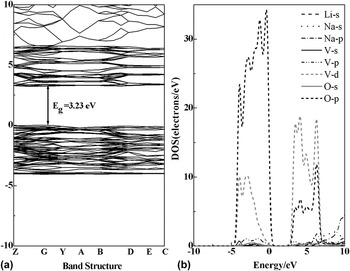
The band structure of the title compound is shown in Fig. 5(a). LiNaV2O6 is a direct gap compound with a gap of 3.23 eV which is consistent with the values obtained from the transmittance spectrum. Analysis of the partial density of states is helpful to understand the transitions from occupied states to unoccupied states and investigate the optical properties. As shown in Fig. 5(b), the upper region of the valence bands (VBs) is dominant by the O 2p orbitals and V 3d orbitals, and exhibits a wide hybridization from −5 to 0 eV, which reveals that the V–O interaction is the main contribution to the top of VB in LiNaV2O6. In the bottom of the conduction band, the main occupants are V 3d orbital and O 2s. Evidently, the VO4 anionic groups are the main contributors of the energy band gap and optical properties in this compound.
(a) Calculated band structures of LiNaV2O6. (b) Total DOS and PDOS of LiNaV2O6.

F. Linear optical properties analysis
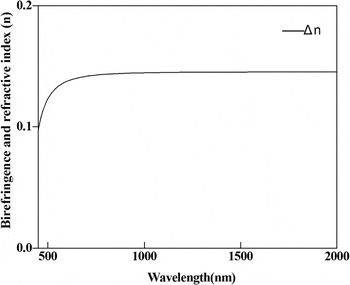
The calculated dispersion refractive indices display different anisotropies which can be described by the birefringence Δn (Fig. 6). The result shows that the birefringence of LiNaV2O6 is 0.137 at 589.3 nm. The large birefrigence owns to its structural features: each pseudo [VO3]∞ layer has its own optical anisotropy, and these pseudo layers are in parallel or antiparallel arrangement as shown in Fig. 2(c), which causes the superimposed effect of optical anisotropy and a large birefringence for LiNaV2O6. So it may have a potential application as a birefringent material.
The calculated birefringence of LiNaV2O6.

IV. CONCLUSIONS
In summary, the LiNaV2O6 compound has been synthesized by high-temperature solution reaction. The single crystal XRD exhibits that it has the crystal structures with space group C2/c. Analyses of the PXRD pattern and DSC curve suggest that LiNaV2O6 is a congruent melting compound, which is beneficial for single crystal growth. The single crystal with dimensions of 11 × 6 × 2 mm3 was obtained by the top-seeded growth method for the first time. More importantly, based on our understanding of the structure–property relationship of the LiNaV2O6 compound, it is found that the large birefringence is attributed to the pseudo [VO3]∞ layers, which make an increase in optical anisotropy and induce the large birefringence. Meanwhile, theoretical calculation predicts that its birefringence is about 0.136 at 589.3 nm. Thus, LiNaV2O6 may be a new birefringent material.
Supplementary Material
To view supplementary material for this article, please visit http://dx.doi.org/10.1557/jmr.2016.29.
CCDC reference number 1047986. Table of selected bond distances and angles, infrared spectrum and the structure of LiNaV2O6 are shown in the Supplementary Material.
ACKNOWLEDGMENTS
This work is supported by the National Natural Science Foundation of China (Grant No. U1303193), 973 Program of China (Grant No. 2014CB648400) and Xinjiang International Science and Technology Cooperation Program (20146001).