Introduction
Placental steroidogenesis has a key role in regulating levels of neuroactive steroid concentrations in the fetus during late pregnancy.Reference Hirst, Palliser, Yates, Yawno and Walker 1 These steroids include the progesterone derivative 3α-hydroxy-5α-pregnan-20-one (allopregnanolone). Allopregnanolone is a potent modulator of gamma aminobutyric acid type A (GABAA) receptors and markedly influences their inhibitory activity. This action suppresses central nervous system activity and maintains the generally low levels of excitability that typifies fetal life. Neuroactive steroids also inhibit apoptotic pathways, promote synaptogenesis and stimulate proper glial cell activity and myelin formation by oligodendrocytes,Reference Ghoumari, Ibanez and El-Etr 2 – Reference Purdy, Morrow, Blinn and Paul 4 all of which are critical for optimal fetal brain development.
Progesterone, supplied by the placenta, is essential for the maintenance of pregnancy with levels increasing steadily in the maternal circulation as gestation progresses.Reference Gilbert Evans, Ross, Sellers, Purdy and Romach 5 The placenta also makes a major contribution to circulating concentrations of allopregnanolone, with levels in maternal and fetal plasma also increasing towards term.Reference Bicikova, Klak and Hill 6 5α-reductases type 1 and 2 (5αR1 and 5αR2) catalyse the rate-limiting step in the metabolism of progesterone into intermediate hormone 5α-dihydroprogesterone. The enzyme 3α-hydroxysteroid dehydrogenase then reversibly converts this precursor to allopregnanolone. These isoforms have low homology and their activity differs with development. The type 1 isoform is found in many tissues at relatively stable levels, whereas type 2 is found mostly within the sex organs, the brain and the placenta during pregnancy and shows greater developmental regulation.Reference Normington and Russell 7 , Reference Poletti, Celotti, Rumio, Rabuffetti and Martini 8 Both 5αR isoforms are expressed in the human placenta with expression increasing with advancing gestation.Reference Vu, Hirst and Stark 9 After birth, and subsequent removal of the placental supply of progesterone and its metabolites, concentrations of neuroactive steroids fall dramatically in maternal as well as neonatal plasma of humans and sheep.Reference Gilbert Evans, Ross, Sellers, Purdy and Romach 5 , Reference Nguyen, Billiards, Walker and Hirst 10
Pharmacological inhibition of neuroactive steroid production by finasteride, a 5αR inhibitor, during pregnancy reduces allopregnanolone concentrations resulting in marked reductions in myelination, and an increase in cell death within fetal sheep and guinea pig brains.Reference Yawno, Yan, Walker and Hirst 11 , Reference Kelleher, Palliser, Walker and Hirst 12 Acute and chronic in utero stressors, including hypoxic episodes and intrauterine growth restriction (IUGR), are associated with poor neonatal outcome and adverse effects on long-term health.Reference Gadisseux and Gressens 13 , Reference Breeze and Lees 14 Previous studies in sheep and rats have shown that these insults raise fetal brain 5αR enzyme protein expression, as well as central and circulating neuroactive steroid concentrations.Reference Nguyen, Yan, Castillo-Melendez, Walker and Hirst 15 , Reference Westcott, Hirst, Ciurej, Walker and Wlodek 16 These findings suggest an upregulation of 5αR enzyme expression following compromise, leading to higher levels of protective neuroactive steroids acting to minimize adverse effects in the fetus.
Preterm birth is a leading cause of infant morbidity and mortality 17 and may lead to neurological and behavioral deficits.Reference Saigal and Doyle 18 However, these complications may not arise until later in neonatal life or childhood. In addition, chronic in utero stressors that often precede preterm birth may potentiate adverse outcomes after premature delivery.Reference Garite, Clark and Thorp 19
These stressors may raise neuroactive steroid production in the placenta; with a consequent reduction in the risk of developing neurological deficits, as occurs in the brain.Reference Nguyen, Billiards, Walker and Hirst 20 Therefore, elevated placental 5αR expression may indicate prior in utero fetal stress and thus provide a marker of in utero compromise and subsequently potential problems in neonatal or juvenile life. The objective of this study was to determine 5αR mRNA expression in placenta from term and preterm guinea pig neonates and compare expression with their outcome during the immediate 24 h after delivery, and to elucidate whether elevated expression was seen in neonates with poor outcome.
Methods
Time-mated, tri-color, outbred pregnant dams were obtained from the University of Newcastle Research Support Unit. Dams were randomly allocated to either a term delivery (GA69) or preterm delivery (GA62) group. Neonates were delivered no more than 24 h apart within the term and preterm groups (68–69 and 62–63 days, respectively). Term deliveries were performed as close to spontaneous term labour (∼71 days for our colony) as possible. Animals that displayed signs of cervical change predictive of delivery (assessed by pubic symphysis separation) were delivered at GA68 to avoid using animals in active labour.
Previous pilot studies from our group have seen a maximum survival of 5% of preterm guinea pig neonates delivered at GA62 without maternal betamethasone administration. Thus, dams received 1 mg/kg of betamethasone (Celestone Chronodose, Schering-Plough, North Ryde, NSW, Australia) subcutaneously 24 and 12 h before delivery, a dosing regime that improves survivability as is seen in humans. Anesthesia was induced in dams in a chamber with 4% isoflurane in 6 l medical grade oxygen. Anesthesia was maintained via mask inhalation of 2% isoflurane in 2 l oxygen, while pups were delivered via cesarean section. Following delivery dams were euthanized, and the placenta from each pup was weighed and snap frozen in liquid nitrogen.
All neonates had their airways cleared of fluid and received 50 μl of surfactant (Curosurf 80 mg/ml Poractant alfa, Douglas Pharmaceuticals, Baulkam Hills, NSW, Australia). Neonates received thermal support by heat lamps and pads and received a short period of continuous positive airway pressure to aid in establishing functional residual capacity. Once stable breathing was achieved all guinea pig neonates were weighed and sexed before being housed in a humidified incubator and monitored continuously. Neonates received 24 h care, and were scored every 2 h for their ability to maintain respiration, posture and activity. The scoring system was based on a scale of 1 to 4 for each criterion, with 1 being poor and 4 being good. A total score out of 12 was given to each neonate at the time of scoring. Preterm neonatal guinea pigs that did not survive to 24 h, due to cessation of respiration, formed a preterm non-survivor experimental group. Neonates who died within the first 2 h after delivery were excluded from this study (term n=0, preterm n=8). All remaining neonates were euthanized at the 24-h end point, and one male and one female neonate per litter used in this study, resulting in three study groups – term (n=22; male n=12, female n=10), preterm surviving (n=21; male n=10, female n=11) and preterm non-surviving (n=15; male=8, female n=7) neonates.
Frozen placental tissue was crushed on dry ice and RNA was extracted using a commercial kit (RNeasy Plus Mini Kit, Qiagen Pty Ltd, Chadstone, VIC, Australia) and quality tested before undergoing reverse transcription. Placental RNA (1 μg) was reversed transcribed to cDNA using Superscript III First Strand Synthesis Reverse Transcription kit (Invitrogen, Life Technologies Pty Ltd, Mulgrave, VIC, Australia). Real-time PCR, using SYBR green detection, was performed using primer sequences previously designed and validated by our group to detect guinea pig 5αR1 and 5αR2 sequences.Reference McKendry, Palliser, Yates, Walker and Hirst 21 Relative fold changes in expression were determined using the −2ΔΔCt method, with expression data normalized to β-actin for each sample.
Statistical significance was set at P=0.05. A Fisher’s exact test was used to assess survival data from the entire cohort of animals. Differences between means were analyzed by one-way ANOVA with subsequent Tukey multiple comparisons test to determine statistically significant differences between term, preterm survivor and preterm non-survivor placenta samples. All data are presented as mean±s.e.m.
Results
No statistically significant sex differences were found between neonates within the term and preterm groups and hence male and female data have been merged. Term pregnancies were delivered at 68.3±0.2 days while preterm neonates were delivered at 62.2±0.1 days. The gestational age at delivery of those neonates who did not survive the immediate neonatal period was not significantly different to those preterm neonates who did survive (62.4±0.2 v. 62.0±0.2 days, respectively, P=0.30). The range of survival for non-surviving neonates was 3–22 h, with a mean survival time of 8.16±1.24 h. Although the survival rates showed no significance between males and females, sex ratios of surviving v. non-surviving neonates were 1:1.5 for males and 1:1 for females for the overall cohort. Survival rates of the neonates were independent of the litter, with no patterns of reduced survival within litters.
No differences were found among placental weights collected from term and preterm guinea pigs. As expected, body weight (post mortem) of term guinea pig neonates (83.1±2.9 g) was significantly more than preterm survivors and non-survivors (64.0±1.9 and 62.9±1.2 g, respectively, P<0.0001). Body weight of the neonates did not differ significantly from time of delivery to the time of post mortem. Non-surviving preterm neonates had a reduced ability to maintain respiration, posture and activity than surviving preterm neonates (average scores 6.2±0.5 v. 8.1±0.3, respectively, P<0.0002). Both preterm groups expectedly performed worse in the 24-h time period than neonates born at term (average score 11.5±0.1, P<0.0001).
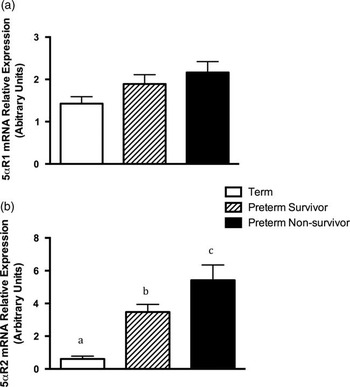
No significant differences were seen in placental 5αR1 expression at time of delivery between the term, preterm surviving and non-surviving groups (Fig. 1a). In contrast, 5αR2 mRNA expression was markedly lower in placenta collected at term compared with levels in the placenta from surviving and non-surviving prematurely delivered neonates (P=0.0004 and P<0.0001, respectively, Fig. 1b). Interestingly, expression in placenta from preterm non-surviving neonates was significantly greater than placenta from preterm neonates that did survive to 24 h (P=0.04). As mentioned above, no sex differences were found and when split by sex placental 5αR mRNA expressions followed the same patterns.
Placental 5α-reductase type 1 (a) and type 2 (b) mRNA expression from term (open bars), preterm surviving (striped bars) and preterm non-surviving (closed bars) guinea pig neonates. Relative expression presented as arbitrary units. Data presented as mean±s.e.m. Bars with different lower case letters are significantly different (P<0.05).

Discussion
Our findings are the first to show that placental neurosteroidogenic capacity is elevated in the placenta of non-surviving preterm guinea pig neonates. In utero compromises are often major contributors to adverse perinatal outcomes and underlying non-detected insufficiencies have been suggested to potentiate hypoxic/ischemic injury at birth.Reference Garite, Clark and Thorp 19 Guinea pigs occasionally have fetuses that suffer in utero death, which may be due to placental insufficiencies similar to that seen in human pregnancies. This suggests that some fetuses that do not die in utero may be exposed to periods of less severe hypoxia, which may be related to placental implantation. The present findings suggest elevated 5αR2 expression is indicative of insufficiency, potentially due to a hypoxic episode or multiple episodes, and underdevelopment that may have contributed to the reduced survival of the immature pups. The relative contribution of 5αR2 in the placenta and brain to central allopregnanolone concentrations is unclear, however, the placenta is likely to not only supply the allopregnanolone precursor progesterone but also contribute to the supply of allopregnanolone itself. During fetal life, 5αR2 has the key role in producing allopregnanolone, with expression developmentally regulated. After birth expression of 5αR2 in the brain declines with advancing postnatal age and neurosteroid production becomes more dependent on 5αR1.Reference Poletti, Negri-Cesi and Rabuffetti 22
Previous studies by us investigating the effects of betamethasone on 5α-reductase expression showed a marked reduction in 5αR2 mRNA in the placenta of betamethasone-treated fetuses.Reference McKendry, Palliser, Yates, Walker and Hirst 21 Hence, the current study administered betamethasone to dams before both term and preterm delivery to reduce variability among experimental groups. However, the McKendry study employed multiple administrations of betamethasone over a prolonged period. This chronic exposure could have potentially caused the significant reductions in placental 5αR2. Our study used fewer administrations over a shorter time period, mimicking protocols undertaken in human pregnancies at high risk of preterm delivery, to aid in lung maturation and increase the survival of the preterm guinea pig neonates. Studies using human placenta found no differences in preterm placental 5αR1 and 5αR2 expression with and without prior betamethasone exposure.Reference Vu, Hirst and Stark 9 Additionally, although it is known that betamethasone can be metabolized by the enzyme 11β-hydroxysteroid dehydrogenase type 2, this is slow compared with endogenous glucocorticoids.Reference Murphy, Fittock and Zarzycki 23 Therefore, levels of exposure between the term and preterm groups are likely to have been similar.
Allopregnanolone concentrations decline rapidly in sheep neonatal plasma and brain after birth, demonstrating the critical role of the placenta in producing allopregnanolone and its precursors during late gestation.Reference Nguyen, Billiards, Walker and Hirst 10 Concentrations in the brain, including the brainstem, also decline after birth, which increases excitability and may increase respiratory activity.Reference Nguyen, Billiards, Walker and Hirst 10 In this study the neonates that did not survive died of respiratory failure, often following repeated apnoeic episodes. Allopregnanolone levels in the neonatal rat brain are increased by chronic exposure to stress,Reference Kehoe, Mallinson, McCormick and Frye 24 albeit from a lower base, but these changes required repeated exposure and are unlikely to influence neonatal survival over the first 24 h of life. This supports the contention that in utero stress and consequent effects on development may have a major influence on outcome. The increased levels of 5αR2 gene expression observed in the placenta of non-surviving preterm neonates is consistent with the induction of the protective neurosteroid pathway, which may potentially be due to an in utero stressor, which was not sufficient to influence fetal weight.
Previous observations in sheep models suggest that moderate IUGR causes an increase in 5αR2 protein expression in the brain.Reference Nguyen, Billiards, Walker and Hirst 20 Although there were no differences in birth weight between this study’s preterm groups, less severe compromise toward the time of delivery may have raised 5αR2 transcription and lead to sub-optimal development. As brain to body weight ratio was not available at delivery, evaluation of asymmetric growth was not possible. Furthermore, the upregulation of neuroactive steroid pathways and an increase in neurosteroid-mediated trophic actions may have improved brain development but not other organ systems. This type of in utero stressor may have predisposed these non-surviving neonates to their poor outcome in the first 24 h after delivery, particularly when faced with premature delivery.
Despite the known contribution of the placenta to fetal neurosteroidogenesis, recent studies have focussed on 5αR expression within the fetal brain in response to gestational challenges such as IUGR and hypoxia, with the recent human placental studies characterizing 5αR 1 and 2 protein expression within uncomplicated term and preterm placentae.Reference Vu, Hirst and Stark 9 As such, this the first study to suggest that alterations in placental neuroactive steroid synthesis may be associated with an intrauterine compromise and a consequent poor outcome. Previous studies have shown that male preterm neonates are at a greater risk of morbidity and mortality than females.Reference Shapiro-Mendoza, Tomashek and Kotelchuck 25 This may potentially be reflected in their neuroactive enzyme protein levels and activity; and potentially steroid concentration profiles in times of compromise. Although allopregnanolone is the most well-characterized neurosteroid of pregnancy, we cannot rule out the influence of other neurosteroids such as cortisol-derived tetrahydro-deoxycorticosterone and testosterone-derived 3α-androstanediol, and how these may influence the sexes differentially. Future studies could also examine if sex differences are present in brain 5α-reductase protein levels and neuroactive steroid concentrations at birth or in the neonatal period. In conclusion, the finding of markedly higher 5αR2 mRNA expression in the placenta of neonates with poorer outcomes support the measurement of expression of this enzyme as a potential marker of in utero compromise that may have ongoing influences on postnatal development.
Acknowledgments
The authors thank Dr Meredith Kelleher and Dr Rebecca Dyson for their contribution to the animal studies.
Financial Support
This research was supported by the National Health and Medical Research Council grant 1044846.
Conflicts of Interest
None.
Ethical Standards
The authors assert that all procedures contributing to this work comply with the ethical standards of the National Health and Scientific Research Council Australian Code of Practice for the Care and Use of Animals for Scientific Purposes and have been approved by the University of Newcastle Animal Care and Ethics Committee.