One decade after its first appearance, Christopher Latham Sholes's invention began to circulate the globe, transported and adapted for non-English languages by typewriter companies such as Remington and Underwood. In their encounters with Arabic, Hebrew, Cyrillic, Mongolian, Burmese, and many other non-Latin scripts, typewriter engineers and entrepreneurs focused their efforts on making the minimum number of necessary modifications to the original, English-language device so as to bring these orthographies within the compass of Western typewriting technology. As the device stretched to absorb these writing systems—now able to handle the right-to-left orientation of Hebrew or the orthographic variation of Arabic letters—there was one market that remained frustratingly elusive: China. Because Chinese characters were nonalphabetic, engineers at Remington and elsewhere found themselves conceptually ill-equipped to solve the “problem” of Chinese typewriting by means of selective mechanical adjustments, the way they had with more than one hundred other languages. As a consequence, the history of Chinese typewriting was never enveloped into the broader history of Western multinational corporations (Mullaney, Reference Mullaneyforthcoming).
The history of Japanese multinationals is an altogether different one, however. Japan was home to two distinct approaches to typewriting, the first oriented exclusively towards the typing of Japanese kana—the twin syllabaries, hiragana or katakana—and the second oriented towards Japanese character-based writing, or kanji. In look and feel, this first family of machines was indistinguishable from those built by Remington, Underwood, or Olivetti. The second, however, was indistinguishable from the tray bed–based, Chinese-character machines being manufactured in China ever since the 1910s. Occupying this liminal position, Japanese engineers were in many ways less imaginatively confined than their Western counterparts, never requiring China's nonalphabetic script to reconcile itself to a keyboard-based system incapable of handling it. Instead, Japan succeeded where Remington failed by developing the very same “common usage character” (changyongzi) machines with which Chinese typists had long been familiar. Japanese companies made inroads into the Chinese market as early as the 1920s, a process that accelerated quickly with the expansion of Japanese empire-building in northeast China in 1931, and then with the outbreak of full-scale war in 1937. By the late 1930s and 1940s, Japan dominated the Chinese typewriter market, and would continue to do so into the early postwar period.
In this article, I will examine the history of Japanese typewriting and the critical role it played in the broader history of Chinese technolinguistic modernity.
Between Technolinguistic Worlds: Kana, Kanji, and the Ambivalent History of Japanese Typewriting
Beginning in the second half of the nineteenth century, Japan wrestled with the question of linguistic modernity, as exemplified in the history of Japanese telegraphy, telephony, industrialized printing, post, stenotype, and more (Inoue Reference Inoue2011; Jacobowitz Reference Jacobowitz2016; Maclachlan Reference Maclachlan2012; Yang Reference Yang2010, Reference Yang2011). As Ryōshin Minami (Reference Minami1982) has shown, Japan's printing industry was one of the country's earliest and most thoroughly mechanized. Beginning in 1876, the application of steam power to printing revolutionized the domestic newspaper industry, enabling Japanese publishers to keep pace with a voracious and growing appetite for daily newspapers (Minami Reference Minami1982, 618–19). During the second half of the nineteenth century, telephone and telegraph technologies were introduced (Yang Reference Yang2010, 68–69). In 1871, the same year Great Northern and Cable and Wireless promulgated the Chinese telegraph code, a telegraph code for Japanese kana was authored as well. Known alternately as the Japansk telegrafnøgle (Japanese telegraph key) or Denshin jigō (Telegraph signals) (Mullaney Reference Mullaney, Tsu and Elman2014; Rigsarkivet 1871), the code assigned short-and-long pulses to Japanese katakana syllables, arranged according to the predominant dictionary sequence of the era, the Iroha taxonomic system (named after the eponymous Heian-era poem).
The history of typewriting in Japan is inseparable from the broader history of nineteenth- and twentieth-century language reform and modernization efforts in East Asia, as well as the era's widespread critique of character-based writing. Once issued from far-off cities in the United States and Western Europe, calls for the abolition of Chinese characters soon took root in the neighboring countries of Korea and Japan. In a process of decentering the Middle Kingdom, in the apt terminology of Andre Schmid, a branch of Korean reformers began to particularize and de-universalize symbols and ideologies inherited from the Chinese cultural sphere. Believing that a “break with the transnational culturalism of the East Asian past was necessary,” these reformers reserved particular enmity for hanja—Chinese character-based script imported and applied to the Korean language many centuries prior—regarding it as a fundamental hindrance to the project of scientific (read Western) development (Schmid Reference Schmid2002, 67).
Japanese reformers mounted strikingly similar arguments during this same period. In 1866, Maejima Hisoka 前島密, translator at the Bureau for Development of Foreign Studies, presented a petition to the Shogun Yoshinobu entitled “Proposal for the abolition of Chinese characters” (Kanji gohaishi no gi 漢字ご廃止の議) in which he advocated the replacement of kanji with kana (Seeley Reference Seeley1991, 138–39). With the objectives of increasing the efficiency of writing and accelerating the pace of language education, Maejima established the company Keimōsha in 1873 to produce the all-kana newspaper Daily hiragana news (Mainichi hiragana shinbun). Whereas the paper failed within its first year, advocate of kana Shimizu Usaburō elaborated further upon Maejima's proposal in his 1874 essay “On hiragana” (Hiragana no setsu 平仮名の説) (Seeley Reference Seeley1991, 139).
The first Japanese typewriters were kana-only machines. In 1894, Kurosawa Teijirō (1875–1953) completed work on a hiragana typewriter patterned after the Western-style, single-shift keyboard machines growing in prominence worldwide. He soon turned his attention to the development of a katakana machine, which he completed in 1901. Basing his production on the Elliott model Smith-Corona machine, Kurosawa went on to name his machine the Japanese Smith Typewriter, or Sumisu Taipuraitā (Watabe Reference Hisako1929, 6–7).
Kana typewriting also opened the door to Western manufacturers, an opportunity they wasted no time in seizing. As early as 1905, Remington set out to bring Japanese into its immense and expanding repertoire of world scripts, seizing upon kana-only design as a means of entering the East Asian market while at the same time circumventing the problem of kanji. Salesmen were offered guidance in how to field potential questions about the conspicuous absence of kanji on the Remington machine. “The Kana, and especially the Katakana,” one executive explained, “represent the ancient Japanese tongue, but Japan, received from China many centuries ago most of her classical literature and advanced learning and adopted the Chinese character for her writing.” “In a word, it is impossible to make the machine write the multitude of Chinese symbols commonly used in even ordinary daily routine writing by the Japanese” (Hagley Museum 1905).
From its inception, the all-kana typewriter was a machine with a politics, wherein modernization was premised on cutting the Japanese language's ties with its Chinese orthographic heritage.Footnote 1 “All educated natives of Japan that we have consulted seem to agree,” Remington reported, “that the current method of writing Japanese is cumbersome and antiquated, and utterly unsuited to the present needs of their people.” What was called for in Japan was “replacing the present badly mixed system with a purely phonetic one.” “It is quite within the bounds of possibility that the advent of the Remington Typewriter for writing Katakana may point a way toward bringing about this change” (Hagley Museum 1906).
Remington soon faced competition from other globalizing firms. In February 1915, the Underwood Corporation sponsored the patent of its own katakana typewriter, developed by Yanagiwara Sukeshige (Sukeshige Reference Yanagiwara1916). Eight years later, Underwood sponsored another katakana typewriter patent, this one by Burnham Stickney, who had served as the patent attorney for Yanagiwara (Stickney Reference Stickney1925). Remington quickly fired back at its competitor at the Panama Pacific exposition in San Francisco in 1915, featuring its all-kana machine and an attractive young Japanese-American woman by the name of Tsugi Kitahara. “Greetings from the Panama-Pacific to our friends throughout the world,” the young woman is shown as saying on the company's promotional postcard, “writing the 156 languages for which Remingtons are made. – Tsugi Kitahara.”Footnote 2
Kanji typewriters were first developed approximately fifteen years after their all-kana predecessors. For their part, these machines were deeply connected to the vibrant counterpart to the all-kana movement: the common usage kanji movement. In 1873, journalist, political theorist, and translator Fukuzawa Yukichi (1834–1901) authored a three-volume educational text for children using fewer than one thousand characters. In the explanation of his work, entitled The teaching of words (Moji no oshie 文字の教え), Fukuzawa opined that somewhere in the range of two to three thousand kanji characters would prove more than adequate—with the balance of Japanese writing to be expressed in kana (Seeley Reference Seeley1991, 141). Between the time of Fukuzawa's Moji in 1873 and the May 1923 “List of Characters for General Use Presented by the Interim Committee on the National Language,” numerous scholars, statesmen, and educators weighed in on the question of “common usage kanji.” In his 1887 reference work The Three Thousand Character Dictionary, Yana Fumio proposed that around three thousand would be sufficient (Seeley Reference Seeley1991, 141, 146–47). Three decades later, a consortium of Tokyo- and Osaka-based newspaper publishers issued a joint statement on March 21, 1921, entitled “Advocating the restriction of the number of kanji” (Kanji seigen o teishō su 漢字制限を提唱す; Seeley Reference Seeley1991, 146).Footnote 3 Following the publication of the May 1923 issue, many of the same newspapers offered vocal support, pledging to adhere to this repertoire of kanji in their publications, to begin on September 1, 1923. This plan was laid to waste, however, in the destruction of the Kanto Earthquake, delaying the question for a number of years.Footnote 4
The first technological manifestation of this branch of Japanese language reform was the kanji typewriter invented by Sugimoto Kyōta (1882–1972). As early as 1914, he reported nearing completion of a working prototype, and in October of the following year, was heralded by the Tokyo Chamber of Commerce for the device that would come to be known quite simply as the “Japanese Typewriter,” or Hōbun Taipuraitā (Watabe Reference Hisako1929, 6–7). In November 1916, he filed his invention with the United States Patent Office, receiving his patent one year later (Kyōta Reference Sugimoto1916). It was not long before Sugimoto's typewriter met with competition, moreover. The Oriental Typewriter invented by Shimada Minokichi soon appeared on the market, as did the Otani Japanese Typewriter invented by Kataoka Kotarō and manufactured by the Otani Typewriter Company. Circa 1935, the Toshiba Company released its own Japanese typewriter, premised on a common usage character cylinder rather than a flat rectangular tray bed (Toshiba Japanese Typewriter 1935) (see figure 1).
Japanese kanji typewriters (Watabe Reference Hisako1929, front plate).

For all their diversity, these machines and their manufacturers shared certain design principles and entrepreneurial goals. In terms of structure, each machine included only a limited and carefully chosen selection of common usage Japanese kanji, organized phonetically according to the Iroha system (Nippon Typewriter Company 1917; Yamada Reference Yamada1980; Yamada and Tanaka Reference Yamada and Tanaka1977). In terms of marketing the machine, manufacturers centered their campaigns around a core set of shared principles: accuracy, beauty, labor-saving, paper-saving, legibility, and time-saving (Adal Reference Adal2011).
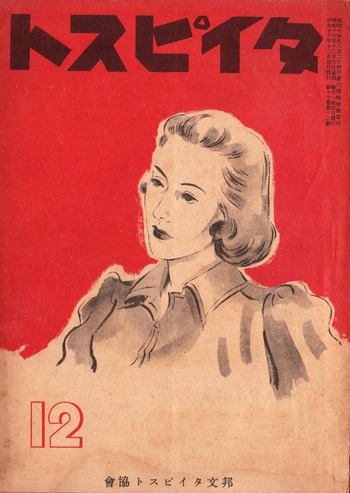
A pedagogical network built up around the kanji typewriter, as well, responsible for training an entirely new labor force. Japan's typing schools were attended almost exclusively by young women, the industry characterized by a feminization of the labor force on par with the more familiar contexts of Europe and the United States, as well as with other communications industries in Japan itself (Hunter Reference Hunter2011; Tōkyō Ōsaka ryōshi ni okeru shokugyō fujo chōsa 1927, 4–11). During the 1920s, Japanese typewriter manufacturers helped fortify the gendered parameters of the typing profession through the publication of the new periodical Taipisuto. Founded circa 1925, and published by the Japanese Typist Association (Hōbun Taipisuto Kyōkai), the monthly was part professional journal and part women's magazine, each issue featuring crisp, bold, art deco graphics, and cover art dedicated to the portrayal of the modern Japanese woman in all her many forms (whether outfitted in smart business attire, sporting costumes, or traditional kimono) (see figure 2 and figure 3).Footnote 5
Japanese typist Kay Tsuchiya, 1937 (author's collection).

Japanese typist magazine Taipisuto (Taipisuto 1942).

By the early 1930s, Japan was home to a variety of typewriter models, divided into two broad worlds: the world of kana typewriting, which partook in the globally recognizable culture of Remington, Underwood, and Olivetti; and kanji typewriting, which through its intimate affiliation with typewriting in China, was excluded from this global technolinguistic culture.
Japanese-Made Chinese Typewriters, or the Advent of the Modern Kanjisphere
Revisiting some of the earliest patent documents for Japanese kanji machines, one quickly encounters ambitions that extended well beyond Japan and the Japanese language. In his 1916 patent, Sugimoto Kyōta was careful to emphasize that his typewriter was “designed for the Japanese and Chinese languages” (Kyota Reference Sugimoto1917). When inventor Shinozawa Yūsaku of Tokyo filed a June 1918 patent claim, he likewise characterized the new typewriter as one adapted for “a language in which a large number of characters are used, such as the Japanese or the Chinese language” (Shinozawa Reference Shinozawa1919). Whether as an afterthought or a catalytic part of their invention process, one by one inventors of machines for the Japanese and Korean languages made explicit the larger aspirations and stakes of their projects: a market that encompassed East Asia as a whole.
That Japanese inventors should have conceptualized their projects in terms of a broader Chinese-Japanese-Korean market is hardly surprising. The Chinese market would have exerted an irresistible pull on the minds of inventors, offering up the prospect that a Japanese kanji machine could, in theory, readily be made to “handle” Chinese as well. Beyond the question of markets, moreover, there existed a longstanding history of shared cultural heritage between China, Japan, and Korea—the very “transnational culturalism” that many Korean and Japanese reformers had attempted to dismantle beginning in the late nineteenth century, but which typewriter inventors and engineers in the 1910s and 1920s were now setting out to rediscover and render profitable. As Douglas Howland and Daniel Trambaiolo explain, Chinese, Japanese, and Korean diplomats and embassies in the eighteenth century frequently employed “brushtalk” (C. bitan, J. hitsudan, K. p'ildam) as a medium of written conversation in contexts when oral communication was unavailable. Speaking little if any of the counterpart's language, the “solution to this difficulty—indeed the original design for these primarily entertaining encounters—was to converse by writing in hanzi, or kanji, the Chinese characters used by educated men for literary and official communications” (Howland Reference Howland1996, 44).
Whereas the very possibility of a “Chinese-Japanese” typewriter derived its conditions of possibility from the long history of the Sinic transnational sphere, the underlying assumptions and preoccupations that motivated this twentieth-century enterprise were starkly different from those found in the translingual exchanges of centuries past. For inventors and engineers, the elision of Chinese, Japanese, and Korean—or “CJK,” as it would come to be abbreviated during the second half of the twentieth century—was not motivated by affirmative notions of shared civilization (tongwen) or of a “language community defined by their collective competence with the Chinese writing of the brushtalks” (Howland Reference Howland1996, 54). It was motivated by the stark, turn-of-the-century logic of the collective technolinguistic problem that Japan and Korea were now understood to share with China precisely because of this shared cultural heritage. The nineteenth- and twentieth-century emergence of a radically new and powerful global information order had not only expelled China from the universe of technolinguistic modernity, then, but had also transformed Japan and Korea into unwitting co-participants in China's technolinguistic crisis. By virtue of their orthographic heritage—kanji, hanja, and hanzi—Japan, Korea, and China were conjoined in a newly conceived spatial-informational crisis zone. Here, I will refer to this as the kanjisphere.
Within the context of shared crisis, however, a powerful and subversive optimism was at play in this new vision of a modern kanjisphere—bringing us to a second vital difference that separates newer and older conceptualizations of the East Asian cultural sphere. Embedded within the practice of eighteenth-century brushtalk was a potent if often unspoken cultural hierarchy, one in which the medium of exchange was itself derived from, and thus privileged, literary Chinese. In the age of the modern kanjisphere, by contrast, China and the written Chinese language enjoyed absolutely no paradigmatic authority. To the contrary, once China and Chinese characters had been reconceptualized as a communicative problem—a puzzle in need of a solution rather than a medium of communicative possibility—this opened up a new, exciting, and lucrative possibility for Japanese and Korean inventors, one in which Japan and Korea could be transformed from the benefactors of Chinese cultural inheritance to sites where the puzzle of East Asian technolinguistic modernity might itself be solved. The “Chinese solution” was equally available to, and the purview of, Japanese and Korean engineers—as well as those who worked on Japanese and Korean questions from elsewhere on the globe. For inventors like Sugimoto and others, then, the modern kanjisphere was home to the exhilarating prospect that the solution of one's “own” problem—the creation of a kanji typewriter, or a hanja typewriter—carried with it a breathtaking and lucrative “positive externality”: the solution to the Chinese puzzle as well, with everything this implied financially, geopolitically, and culturally.
Over the course of the 1920s, Japanese manufacturers competed head-on with Commercial Press, China's foremost center of print capitalism during the era, and manufacturer of China's first commercially successful Chinese typewriter—the Shu-Style Chinese typewriter invented by Zhou Houkun and Shu Zhendong. Tellingly, it was only in this context where Japanese inventors and manufacturers jettisoned the commonly used katakana-inflected loan word taipuraitā タイプライタ and replaced it with the Chinese-character term daziji 打字機, attempting to establish Japanese-built machines as an identical yet superior solution to the puzzle of Chinese typewriting. The potential payoff of such competition should not be understated, moreover. If Japanese companies could succeed where Remington, Underwood, Mergenthaler Linotype, Olivetti, and other Western companies had tried and failed, the market that remained closed to the United States, Italy, Germany, and elsewhere might very well open up to Japan. Whereas Japan formed but a small part of the global culture of keyboard typewriting, that is, opportunity existed to become the technolinguistic hegemon of the modern kanjisphere. Chinese-language typewriters built by Japanese manufacturers were based upon identical design principles as their Chinese-built counterparts, Chinese observers would quickly learn, the machines outfitted with a tray bed matrix of approximately 2,500 characters, arranged into zones of greater and lesser frequency (Morita Reference Torao1934, 8–9; Oriental Typewriter Company 1923). Abandoning Iroha organization, and dispensing with kana symbols, these machines adopted conventional radical-stroke organization, the standard means by which Chinese typewriter tray beds—as well as dictionaries and other reference materials—were organized at the time. Such minor changes notwithstanding, these machines would have struck any observer as effectively identical to the apparatus developed by Commercial Press.
It was not market competition, but military might and war, that in the end secured Japan's preeminent place in the Chinese typewriter market, however. With Japan's invasion of northeast China, and the establishment of Manchukuo in particular, the recruitment of bureaucrats from mainland Japan to Manchukuo quickly followed. Typing institutes were promptly founded in Manchukuo, sites where cohorts of Chinese clerks-in-training would be instructed in the use of Japanese typewriters and Japanese-built Chinese typewriters, providing the much-needed secretarial infrastructure of the new state. The Fengtian Typing Professional School (Fengtian dazi zhuanmen xuexiao 奉天打字專門學校) was one such outfit, founded circa 1932 (Li c. Reference Xianyan1932).Footnote 6 Like their counterparts in Shanghai, Beijing, and other Chinese metropoles to the south, trainees would move through lessons and lexical geometries to help them develop an embodied familiarity of the tray bed and its layout. At the same time, the content of these lessons now reflected a decidedly different political vision—the Japanese vision of Manchukuo. In a 1932 volume introducing clerks and secretaries at the institute to the new clerical forms they could expect to encounter, editor and Fengtian Institute affiliate Li Xianyan guided readers through an assortment of intra- and inter-departmental forms, many of which must have seemed familiar to anyone with prior training. The fourth chapter of Li's textbook was something entirely different, however: a section dedicated to stationery and government forms “for use by the emperor” (huangdi yong zhi gongwen). Here in Manchukuo, Chinese typewriters would be used for the first time to write imperial communications, in this case on behalf of the Kangde Emperor—better known as Puyi, the child emperor of the Qing, deposed in the revolution of 1911 but restored some twenty years later by his Japanese patrons. To this end, students at the Fengtian Institute practiced typing imperial edicts (zhaoshu) and imperial rescripts (chokugo) (Li c. Reference Xianyan1932, 43–48).
Whether ethnopolitically or linguistically, typing schools in Manchukuo were complex situations. Here at the Fengtian Institute, but soon in sites across Manchukuo, Chinese typewriters built by Japanese engineers were to be used by Chinese typists, themselves trained in Japanese-sponsored institutes. Their communiques and memos were all in service of the Japanese client-state of Manchukuo, authoring texts on behalf of, among others, the rehabilitated Manchu emperor of the former Qing dynasty. No doubt aware of the politically charged nature of this complex arrangement, Li Xianyan included a preface in his manual carefully tailored for his Chinese readers:
Every country has its own particular official correspondence, as does each time period. They evolve in accordance with the condition of the country and with customs. To that end, in writing a book explaining stationery, one must also follow the times and reform. This is incontrovertible. Typists are personnel whose responsibility it is to record and copy public documents. As such, typists more than anyone must follow the times and learn new forms of stationery. Only then can they fulfill their duties and match the day and age. (Li c. Reference Xianyan1932, 1)
Li's was hardly a poetic or impassioned apology for collaboration. Rather, the dryness of his words matched the rather bloodless content of his textbook. Muted though they were, however, Li's comments on stationery and correspondence carried with them an unmistakable message: Here in the territory once known as northeast China, politics are not what they once were. You are studying to become a secretary in the state of Manchukuo, not China. You must follow the times.
Patriotic Piracy: Yu Binqi and His Chinese-Japanese-Chinese Machine
Chinese inventors and manufacturers watched as the Chinese typewriter—an icon of modernity whose development was embedded in language reform politics every bit as complex and contentious as those in Japan and Korea—steadily became the purview of Japanese multinationals. In 1919, an unnamed contributor to Shenbao worried aloud about China's weak patent regime, and the gateway this left open to Japanese businesses to bring their own “Chinese” machines to market (Shenbao 1919). Come the 1930s, Japan was seizing the market, not only to the north in Manchukuo, but also in Chinese metropoles. In little time, the means of Chinese textual production in the modern age might become the purview of East Asia's emerging power, and the single greatest threat to Chinese sovereignty in the era. What was to be done?
One answer came from an unlikely source: a swimmer and Ping-Pong champion by the name of Yu Binqi. Born in Sushan, Zhejiang, in 1901, Yu Binqi went on to graduate from the Southeast University of Commerce before pursuing postgraduate training in Japan at the National University of Commerce and the engineering program at Waseda University.Footnote 7 Following a brief stint in the military, his professional career took him further into the world of sports and physical education, first as the managing director of the Shanghai Central Stadium, later as a member of the swimming division of the Chinese National Physical Education Federation, and still later as head of the National Ping-Pong Association (Shanghai Notables 1943). Owing perhaps to this long career in sports, and his notoriety as a talented swimmer, Yu also enjoyed something of a heartthrob status, his debonair visage brightening the cover of Boyfriend magazine in 1932 (see figure 4).
Yu Binqi (Boyfriend 1932).

Yu Binqi was an amateur inventor, as well, having patented a new model of travel pillow, as well as an economical water heater. His most famous invention, however, was undoubtedly the Chinese typewriter he patented and manufactured in the 1930s. Yu Binqi's son, Yu Shuolin (1925–), was only a toddler at the time, but recalled memories of his father's workshop tucked away in the back room on the second story of their home. Yu Binqi had established a workshop in the Hongkou district of Shanghai, on Zhoujiazui Road. On the first floor, a meeting room was available to host guests and clients, with a private office in the back. On the second floor of the “foreign-style” or yangfang building was a bedroom, and behind the entire structure was a manufacturing workshop outfitted with a kitchen and some dormitory rooms for workers.
In the entrepreneurial style befitting this Shanghai urbanite, Yu Binqi founded his own institute of typing: the Yu Binqi Advanced Chinese Typing and Shorthand Profession Supplementary School (Yu Binqi Zhongwen Dazi Zhiye Xuexiao) (SMA Q235-3-503).
A typical cohort for Yu's school was roughly ten students. The school encouraged both male and female students to apply, provided that applicants possessed a high school-level education or the commensurate level of professional experience. Classes were to be completed over the course of five months, and addressed such subjects as the use of Chinese character indexes, mimeograph, machine repair, and a typing practicum. Tuition depended upon one's course of study, with typing classes and shorthand classes each costing thirty yuan, and machine repair classes costing thirty-five. Books and materials cost three yuan; room and board, twenty yuan; and “miscellaneous fees,” two yuan.
Yu Binqi was eager to find employment for graduates of his program—a cornerstone of his marketing strategy. By helping to place his graduates in government posts and private companies, he not only raised the prestige of the institute, but also opened up avenues through which to insinuate the Yu-style machine into the Chinese market. Yu's school boasted an impressive track record in this regard. Graduates of his program landed positions in metropolitan and provincial governments across China, including the Nanjing Inspectorate, the Fujian Provincial Government, and the Sichuan Provincial Government; and major Chinese corporations such as the Chinese Soap Company, Macao China Bank, and the National Commercial Bank (Zhejiang Xingye Yinhang).
At first glance, Yu Binqi would seem to have been China's answer to the Japanese manufacturing threat. Here was a dashing, cosmopolitan urbanite who practically overnight had established himself as a typewriter magnate, offering competition not only to Japanese companies, but his much better-funded counterparts at Commercial Press. A closer look at Yu Binqi's career reveals a more complicated trajectory, one whose Chinese national bona fides become less clear the deeper we dig. Yu Binqi called his invention a Chinese typewriter, and yet a more faithful appellation would have been a slightly modified Japanese machine. Specifically, Yu began studying the H-Style Japanese typewriter sometime around 1930, transforming one small component thereof and rechristening it the Yu Binqi Chinese Typewriter. The only part of the original Japanese machine to be modified was the “character positioning device” (zibiao 字標), a component of the machine that helped ensure accurate positioning of the character's impression on the printed page. Changes to this component constituted the sole basis of Yu Binqi's successful patent application (see Yu Reference Shuolin2010).
What began as a shrewd business strategy—to pirate a Japanese-made Japanese typewriter in order to compete with Japanese-made Chinese typewriters—took an unforeseen and precarious turn beginning in the early 1930s. Following the Japanese invasion of northeast China, and the bombardment of Shanghai, Yu Binqi became increasingly reticent to speak to people outside the family about his typewriting enterprise. As his son recalled, guests to the Yu family home were steered clear of the workshop, his father being aware of acute and growing anti-Japanese sentiment in the city. With widespread calls to boycott Japanese goods, the prospect of Yu Binqi working upon a retrofitted H-Style Japanese machine could have easily brought undesired attention to him and his family.
And indeed it did. In 1931, an unnamed informant alerted editors at Shenbao to the questionable origins of Yu Binqi's ostensibly “Chinese” machine, and even the dubious political affiliations of the entrepreneur himself. Although designated a “domestic” product, the informant suggested, Yu Binqi's machine may even have involved secret “collusion” with Japanese merchants (Shenbao 1931b). Such an accusation was certain to raise alarms, particularly with the launch of the “Resist Japan, Save the Nation” movement in which nationalist consumers organized to boycott Japanese products, ranging from fish to coal. One day following this accusation in the pages of Shenbao, Yu Binqi responded in his own defense. Presenting receipts to the Resist Japan Association, Yu swore that he would willingly die if anyone could prove that he had purchased raw materials from Japan, or had sought out Japanese workers (Shenbao 1931c). On November 11, the Standing Committee of the Resist Japan Association met at the offices of the Shanghai Chamber of Commerce to discuss the claims leveled against Yu Binqi, as well as his self-defense (Shenbao 1931a).Footnote 8
January 1932 brought a measure of relief for Yu when Shenbao reported as false the claims made against him. His typewriter had been patented by the Chinese government in 1930, the report explained, and was a domestic product of high quality that had since been adopted by banks, post offices, and other government offices (Shenbao 1932). While it remains uncertain how Yu Binqi managed to secure this positive and definitive response from the paper, Yu squandered no time in cementing his patriotic credentials. In the years to follow, Yu's company donated to national causes, particularly those involving humanitarian crises and natural disasters. In 1935, for example, his company pledged 25 yuan to Chinese flood victims for every machine sold between December and the following February, a policy he soon followed up with similar charitable efforts (Shenbao 1935).
The strategy paid off. In the summer of 1933, Yu Binqi appeared to be running short on capital, prompting him to seek collaborations with other Chinese entrepreneurs and factory directors. He made known his desire either to acquire domestic capital support somewhere in the range of ten to twenty thousand yuan, or perhaps to sell his typewriter patent to another domestic inventor (Shenbao 1933). Yu's call was answered the following year, with five Shanghai-based factories joining in the manufacture of Yu-style machines (Shenbao 1934b). By the fall of 1934, Shenbao ran articles on Yu referring to his impact as a “revolution” in Chinese typewriting (Shenbao 1934a).
On War and Paperwork: Japanese Typists on the Chinese Mainland
By the winter and spring of 1937, it must have seemed to Yu Binqi that he had finally sanitized the technological history of his machine and fortified beyond reproach his own patriotic credentials. With the passage of only a few short months, however, everything changed. In July 1937, Japan launched a full-scale invasion of eastern China, unleashing a war that would claim between twenty and twenty-five million lives before its conclusion eight years later.
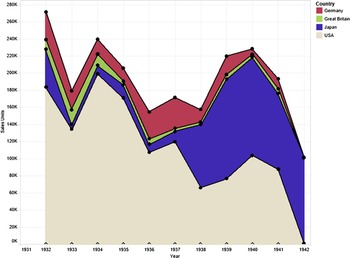
During this period, Japan took control of ever-larger swaths of China's information infrastructure (Yang Reference Yang2010). This was true not only for the manufacture and sale of Chinese typewriters but indeed for all typewriter models, Western, Chinese, or otherwise. Import statistics from the time period paint a stark picture, charting a trajectory of increasing and soon total domination by Japanese businesses. From 1932 until the close of 1937, the United States had dwarfed all other countries as the leading exporter of typewriters and typewriter parts to China, fulfilling demands for English-language machines by the foreign merchant community, and to English-speaking staffs of foreign concessions. In 1937, this long-established economic pattern began to transform. In the span of just one year, Japan's share of the typewriter import market rocketed, siphoning away market share from the United States each year from the close of 1937 until the beginning of 1941. Following its declaration of war against the United States in 1941, and its simultaneous military occupation of Southeast Asia, Japan achieved near total control over the flow of foreign machines into the Chinese market. American typewriter exports to China plummeted to practically nothing (see figure 5).

China became a vast market for Japanese-language kanji machines, with sales propelled by the bureaucratic demands of empire. Particularly from the fall of 1938 through 1942, during which time Japan shifted from primarily extractive policies toward the creation of a “colonial regime” (Coble Reference Coble2003), tales of patriotic Japanese typists—or aikoku taipisuto—began to appear in the Japanese press. On January 4, 1938, readers of the Tokyo Asahi shinbun learned of the “Six Patriotic Women” and their arrival in Tianjin, with regular reports coming in as the year unfolded (Asahi shinbun 1938). In 1939, the newspaper followed up with related news of a young typist headed to the South Seas, also in service of her country (Asahi shinbun 1939).
The self-sacrificing allure of the patriotic typist achieved perhaps unprecedented notoriety with the 1941 publication of The army typist (Jūgun taipisuto), a novella by Sakurada Tsunehisa 櫻田常久 (1897–1990). Already the recipient of the 1940 Akutagawa Prize for his novel Hiraga gennai 平賀源内, Sakurada narrated the tale of a young typist who accompanied Japanese soldiers to Zhangjiakou at the tender age of nineteen. Giving up the security of the Japanese metropole, she committed herself instead to bear the perils of Mongolia (Sakurada Reference Tsunehisa1941).
Japanese typing schools were founded in urban centers throughout the mainland occupation zone, Manchukuo, and Taiwan. As one report in Taipisuto relayed, by 1941 there was hardly a single company of any size in Taiwan that operated without a Japanese typist, a clerical force fed by an annual influx of some five hundred new typing personnel, trained in secondary schools, girls' schools, or by institutes associated with the Nippon Typewriter Company itself. Indeed, the head of the Taibei branch of the Nippon Typewriter Company made known his ambition to have their typewriter “enter every household … just like in Europe and America” (Taipisuto 1941a).
With the formation of the North China Development Company and the Central China Development Company, Japanese occupiers required ever more administrative and logistical support from the occupied Chinese population, including staff members and secretaries. Japanese authorities soon turned their attention to training Chinese operators on Japanese-language machines. In 1942, the Tianjin branch of the Oriental News commenced the first of a series of annual typing competitions, hosted by the Tianjin-based Japanese Chamber of Commerce, inviting Chinese men and women to participate in individual and group competitions. The second annual competition followed in 1943 at the Tianjin Matsushima Japanese Girls' High School, with male and female participants being measured on the common set of criteria, including speed and accuracy (TMA 1943).
Same Script, Same Race, Same Typewriter: The Rise of Wanneng
Japanese imperial expansion was undoubtedly a boon to Japanese typewriter sales. This market paled in comparison, however, to the one the Nippon Typewriter Company and others stood to gain by fortifying their Chinese-language divisions. By 1942, Nippon Typewriter could boast of extensive coverage in China, with divisions in Dalian, Xinjing, Fengtian, Anshan, Harbin, Jilin, Jinzhou, Qiqihaer, Shanghai, Beijing, Tianjin, Jinan, Nanjing, Zhangjiakou, Houhe, Taiyuan, Hankou, Jingcheng, and Taibei (Nippon Typewriter Company Divisions 1942). Further supported by its divisions in Japan, in cities such as Osaka, Nagoya, Sapporo, Sendai, Niigata, Kanazawa, Shizuoka, Hakodate, Ogura, and Fukui, the Nippon Typewriter Company had taken its place as one of the most important typewriter manufacturers in the world. It had achieved what Remington, Underwood, Olympia, Olivetti, and Mergenthaler Linotype had all failed to achieve, moreover: entrance, and what is more domination, of the Chinese-language market. For Commercial Press and Yu Binqi, the decline in market share would have been precipitous.
The flagship machine in Japan's domination of the Chinese market was the Bannō 萬能, Wanneng, or “All-Purpose” Typewriter, built by the Nippon Typewriter Company. Displayed in a 1940 advertisement from the Far East Trade Monthly, a slightly cumbersome yet more revealing moniker was the “Japanese, Manchu, Chinese, Mongolian All-Script Typewriter,” marking this device as the very materialization of Japan's “Greater East Asian Co-Prosperity Sphere,” and the colonial refrains of ethnic harmony and “same script, same race” (dōbun dōshū) (Yuandong maoyi yuebao 1940; see figure 6). The machine quickly became enmeshed within galas spotlighting the ethnic harmony of Manchukuo, for example, as in the “First Manchuria-Wide Typing Competition” held in Xinjing on May 12, 1941. Sponsored and supported by the Manchuria Energy Efficiency Association (Manshū Nōritsu Kyōkai), the Xinjing Chamber of Commerce, and the Manchukuo News Agency, eighty-four typists—seventy-seven Japanese and seven Manchurian, hailing from the cities of Dalian, Fengtian, Anshan, Benxihu, Mudanjiang, and Harbin, along with those of the host city—were invited to take part. The competition commenced with a ceremonial salute to both the Japanese and Manchurian flags (Taipisuto 1941b).
Advertisement for Japanese-made “All Purpose” Typewriter (with Japanese, Manchu, Chinese, and Mongolian versions; Yuandong maoyi yuebao 1940).

All of this had a deleterious effect on Chinese manufacturers. Wanneng became the machine of choice and compulsion in China, rapidly displacing both the Shu-Style Chinese Typewriter manufactured by Commercial Press and the Yu Binqi model. Commercial Press attempted to mount a response with the release of its Improved Shu-Style machine, featuring a larger platen, the use of an ink ball instead of an ink ribbon, and adjustable print-spacing better suited to alternating between Chinese and Western scripts (Gailiang Shu shi Huawen daziji shuomingshu 1938). Despite such efforts, Commercial Press could not compete. As for Yu Binqi, his once celebrated outfit became but a shell of its prior self. While still called a “manufacturing” plant, Yu's factory on Beijing East Road had neither the capital nor the market to continue building or selling typewriters. Instead, the plant eked out an existence by carrying out small-scale repairs, offering typing services, and melting down metal type.Footnote 9 For Yu himself, he seems to have taken refuge in the world of athletics, appearing in sporadic newspaper reports over the course of the war in connection with various sporting competitions and newly formed athletic organizations. Whether granting medals at the Shanghai Ping-Pong competition in 1943, or serving as chief timekeeper at the 39th Japanese Navy track and field competition in May 1944, Yu's life had changed remarkably, as did those of countless others during the war (Shenbao 1943a, 1943b, 1944).
On Complicity and Opportunity: Chinese Typing Schools under Japanese Occupation
Without manufacturing alternatives of their own, Chinese typewriter companies had little choice but to collaborate. As Parks Coble (Reference Coble2003, 113) and Timothy Brooks (Reference Brooks2007) have shown, Chinese capitalists operating under Japanese control were less riveted by concerns of patriotism and resistance, and more concerned with the survival of their family operations. For those in the business of Chinese typewriters in particular, this translated into a variety of economic activities through which to subsist and survive. For example, during the occupation, Chinese typewriters continued to require cleaning services provided by companies such as the C. Y. Chao Typewriting Maintenance Department (Zhao Zhangyun Daziji Xiuli Bu 趙章云打字機修理部; see also SMA 1943a, 1943c). Captured within the complicities of the era—Timothy Brooks's apt choice of words encapsulating the entanglements between Japanese occupiers, Chinese collaborators, Chinese non-collaborators, and outright resisters—Chinese companies and businessmen serviced the Sino-Japanese clerical world throughout the war, whether the Huanqiu Chinese Typewriter Manufacturing Company, the Chang Yah Kee Typewriter Company, or the Ming Kee Typewriter Company, among many others.Footnote 10
By 1940, Chinese typewriting had entered a period marked by deep contradictions. As an object and a commodity, the Chinese typewriter itself was thriving, backed by a formidable manufacturing and marketing network. As a symbol of modernity, the status of the machine had never before reached such heights, its identity as a technolinguistic advance becoming stabilized for arguably the first time in its history. The ends to which this symbol of linguistic modernity were now put, however, diverged sharply from those first imagined by earlier Chinese typewriter inventors Zhou Houkun; Qi Xuan; Shu Zhendong; and the executives at Commercial Press, the first mass manufacturer of such devices. This thriving network was created and managed by Japanese multinationals, calling into question the ostensibly Chinese identity of the machine. This symbol had now become enrolled into—perhaps even aligned with—the broader ambitions of Japan's multinational, multilingual empire.
Nowhere was this tension more evident and complex than in the classroom. Chinese typing institutes proliferated during the occupation, sites wherein groups of Chinese instructors trained increasing numbers of Chinese students to form a clerical workforce versed in the new technology. At one level, these institutes were spaces of opportunity, possibility, and social mobility—spaces in which young women and men gathered and, in a relatively short span of time and at costs more attainable than extensive formal education, attempted to position themselves for white-collar employment.
Whereas the cultures of these small-scale occupation-era institutes are challenging to recreate from available source materials, evidentiary glimpses offer us certain interpretive possibilities. First, these were mixed-gender spaces in which young and most likely unmarried men and women gathered and would have interacted. In Beijing, the Guangdewen Chinese Typewriting Supplementary School (Guangdewen Huawen dazi buxi xueshe 廣德文華文打字補習學社) was founded circa 1938. Overseen by twenty-seven-year-old Anfeng County native Wei Geng, who received his own education from the Art Institute of National Beiping University, one cohort of students in 1938 comprised seventeen young women and thirteen young men. Female members of the class ranged in age from sixteen to twenty-seven, with a median age of nineteen. Whereas the majority of female students boasted a middle school education, the spectrum varied widely: from those with no more than a lower school education, to one lone graduate of the French Catholic Yu Chen Women's Normal School, founded in 1817 in the present-day Xicheng district of the city. Male students were spread across a similar age spectrum, and with similar educational backgrounds. Ranging from seventeen to twenty, and with a median age of twenty, most of the male students in class arrived with a middle school education, flanked on both sides with a handful of participants with lesser or greater educational background (BMA 1938c).
Each day, registered students trained for a total of two hours, at a time to be arranged in accordance with their own schedules and the opening hours of the institute. Students enrolled in the accelerated program continued their studies for one-and-a-half months, paying a total of 15 yuan per month. Those in the normal class completed their work in two months, paying a total of 8 yuan per month. In certain cases, common backgrounds amongst students suggest the likelihood of certain conversations and connections. Among these thirty students at Guangdewen in the 1938 cohort, for example, Xie Fengzeng, a twenty-one-year-old young man from Shaoxing, hailed from the same middle school as Lin Yanzhu, his sixteen-year-old classmate.
Archival records from another Beijing-based school, the Jiyang Chinese Typewriting Supplemental School (Jiyang Huawen dazi buxi xuexiao 暨陽華文打字補習學校), alert us to a practice and a strategy that may have proven more widespread at the time, namely, the return of students from one year to the next (BMA 1938c). In 1937, one cohort of students enrolled eight female and four male students. These two groups ranged widely in terms of age, with female members of the class ranging from seventeen to twenty-seven, and male students ranging from eighteen to twenty-eight. Both groups of students exhibited identical educational backgrounds, with all but one student boasting a middle school education. Intriguingly, two students in the cohort—one female and one male—were college graduates, raising many questions about the social dynamics in the classroom. Upon concluding their training in 1937, all but one member of this cohort reenrolled in the class in 1938, being joined by seventeen new students. While their motivations fall well beyond our grasp, nevertheless the timing of this collective continuation prompts us to consider whether professional schools such as Jiyang offered potential refuges for weathering this tumultuous period in the immediate wake of the Japanese invasion, as well as maintaining perhaps a sense of continued professional identity. Whether motivated by these or other factors, nevertheless it is striking to contemplate what bonds must have formed between these eleven continuing students when they reconvened one year later. Whether Liu Fei, a seventeen-year-old girl whose family hailed from Changle County in Fujian, or Tian Xinyuan, a twenty-eight-year-old man from Tianjin, the sites and experiences encountered by many of these students must have been a palpable presence in the classroom come 1938 (BMA 1938c, 1939a).
What the archival record bears out, if only through sparse and incomplete glimpses, is that each of the many typing institutes operating during the war needs to be understood as an intimate and even exciting place in which young Chinese women and men mixed, and where many committed themselves to exercising some small measure of control over their own futures and livelihoods within the confines of this chaotic, destructive period.
At the same time, each of these Chinese institutes also constituted a politically compromised site, one in which students trained on Japanese-built machines; worked under the guidance of instructors with greater and lesser ties to Japan; and, in the most optimistic of scenarios, looked forward to taking up employment either in the collaborationist government, or in a private sector itself permeated by Japanese interests. At the Guangdewen school in Beijing, students trained on one of two Japanese-built Chinese typewriters: the Wanneng-Style Chinese Typewriter, or the Standard-Style Typewriter Japanese (BMA 1938c). At the East Asia Japanese-Chinese Typewriting Professional Supplementary School, founded by thirty-eight-year-old Sheng Yaozhang in no later than December 1938, students likewise trained on one of four Japanese-built Chinese machines: the Suganuma-Style Chinese Typewriter (菅沼式華文打字機), the Wanneng-Style Chinese Typewriter (萬能式華文打字機), the Horizontal-Style Chinese Typewriter (縱橫式華文打字機), or the Standard Style Chinese Typewriter (標準式華文打字機) (BMA 1938a). Meanwhile, students at the Jiyang Chinese Typewriting Supplemental School in Beijing also worked exclusively with Japanese equipment, studying the Chinese Typewriting Textbook published by the Nippon Typewriter Company for use with the company's Japanese-built Chinese machines (BMA 1938c).
Like the textbooks and apparatuses used in such schools, teaching staffs also had direct and indirect connections to Japan. At the Yucai Chinese Typing school, twenty-seven-year-old principal and Shaoxing native Zhou Yaru was herself a graduate of the East Asia Japanese-Chinese Typing School, and a former typist at Nippon-China Trade, Ltd (BMA 1939b). In the Xizhimen district of Beijing, twenty-three-year-old Li Youtang oversaw the Baoshan Chinese Typewriting Supplementary School, formed sometime around October 1938. As a graduate of the Tenrikyō School in Japan (Nihon Tōkyō tenrikyō-kō 日本東京天理教校), Li returned to Beijing to teach at the Beijing Japanese Tenrikyō Association (Beijing Riben tianli jiaohui 北京日本天理教會). Shortly thereafter, he teamed up with an associate, also surnamed Li, who like him had also come up through Japanese educational circles, graduating from a Japanese language school.Footnote 11 Together, the two formed Baoshan one year after the outbreak of full-scale war. Bringing this history full circle, as it were, was the East Asia Japanese-Chinese Typewriting Supplementary School and its founder Sheng Yaozhang. Hailing from Lianyang County in Fengtian Province, Sheng was himself a graduate of the Fengtian Japanese-Chinese Typing Institute, part of the same network encountered above, where in 1932 the instructor Li Xianyan first set down on paper his apology for clerical collaborationism (BMA 1943). Scarcely could Li have known the stark truth and full meaning of his statement: typists more than anyone must follow the times.
Copying Japan to Save China: The Rise of the Double Pigeon
The summer of 1945 witnessed the horrific and precipitous conclusion of an eviscerating global conflict. With Japanese urban areas now within range of Allied bombers, the winter and spring months witnessed large-scale saturation bombings of metropolitan areas, including the devastating March firebombing of Tokyo. On August 6, the United States released the first of two atomic bombs, obliterating the city of Hiroshima and killing somewhere in the order of 90 to 160 thousand inhabitants. Two days later, the Soviet Union declared war on Japan, opening up an entirely new military theater for the Japanese Imperial Army. This was followed on August 9 by the second atomic attack—this time against the city of Nagasaki. On August 15, Japan announced unconditional surrender.
The surrender of Japanese forces precipitated a massive repatriation process that, as Lori Watt (Reference Watt2009) has examined, would see nearly seven million Japanese nationals leave China, Manchukuo, and the former colonies. It was only in the immediate postwar period that Chinese typewriter manufacturers were able to regain control of the market—and yet even this “recovery” was far from a straightforward story. In the wake of the Second World War, what had once been the strategy of a lone, debonair athlete-turned-inventor soon became the collective strategy of the entire Chinese typewriting industry. One by one, Chinese businessmen who had once struggled with little hope against the Wanneng-style machine now simply began to copy it or sell it directly—all while quietly omitting its Japanese past.
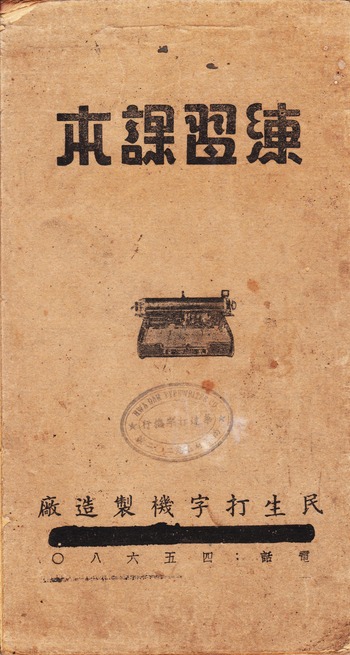
Many of these copycat efforts were undertaken by Chinese businessmen who had come of age under Yu Binqi, perhaps inspired by his example. In the late 1940s, Yu's former employee Chen Changgeng resurfaced to open his own typewriter manufacturing plant. Based in Shanghai, this plant would sell the “People's Welfare Typewriter” (Minsheng Daziji)—the company name lifted directly from the pages of Sun Yat-sen's “Three People's Principles.” On the cover of Chen's typing manual, however, the apparatus shown was none other than the Japanese-built Wanneng machine. Perhaps having removed the faceplate reading “Nippon Typewriter Company,” and supplanted it with one reading “Minsheng,” Chen's enterprise was nevertheless premised on the postwar seizure of Japanese typewriter manufacturing and its repackaging as a domestic Chinese product. Yu Binqi had taught Chen well (see figure 7).
The “People's Welfare Typewriter”—a Wanneng duplicate (Minsheng Daziji Zhizaochang, c. 1940s).

Chen Changgeng was not the only entrepreneur to stake his postwar entrepreneurial fortunes on the seizure and Sinicization of the Wanneng machine. The newly formed Chinese Communist regime began to seize Japanese typewriting interests as well, converting them into Chinese-owned enterprises. In 1951, the Tianjin Public Industry Authority took control of the Japanese Typewriter Company, reorganizing it as the Red Star Typewriter Company (Hongxing Daziji Chang)—a name which, like “People's Welfare” (Riben Daziji Chang) before it, was ideologically appropriate and properly patriotic.
Even with the widespread seizure and nationalizations of Japanese outfits, and steep limitations placed on imported machines, the Chinese state and business community could not fully stem the tide of Japanese influence in the domestic typewriter market. In Tianjin, the primary focus of the newly nationalized Red Star Typewriter Company remained the import of Japanese-made typewriters and calculators from Japan. In 1951, by one estimate, more than 4,000 typewriters and calculators were imported, mainly from Japan. “If import statistics from around the country are tallied,” the report read, “the loss to the national economy is indeed staggering” (TMA 1952, 16). “For those of us in the typewriter manufacturing industry, here upon the people's stage of the motherland, this has caused us immeasurable anguish and humiliation” (SMA 1951a).
In partnership with the new regime, the domestic Chinese typewriter industry mounted a response to Japanese market dominance, consolidating the highly diverse and fragmented network of Chinese companies into larger conglomerates (SMA 1951b). Ten separate Chinese typewriter companies set out to form what would be known as the Shanghai Chinese Typewriter Manufacturers Association (SMA 1951a, 1951b; Xinhuashe xinwen gao 1956). The second prong of their two-prong approach was to adopt and apply the same policy of imitation, or fangzhi, as Yu Binqi, Chen Changgeng, and others. This time, however, they would do so on a national scale, and with the support of the Chinese state. The designers of Double Pigeon explicitly based this machine it upon the Japanese-made Wanneng machine (SMA 1964, 4). In 1961, the Shanghai Calculator and Typewriter Company undertook a nation-wide investigation of its product line, sensing in particular that the Chinese typewriter it manufactured—which had been based upon a Japanese design—was out of date (SMA 1964, 4). The investigation in 1961 yielded some two dozen recommendations, and “explained that the old products were unsuitable for the requirements of current development” (SMA 1964, 4). On March 25, 1964, the resulting machine was presented at a conference to a group of company representatives, including those from the Shanghai Machinery Import-Export Company and the Shanghai typewriter market (see figure 8). “The Double Pigeon DHY-model Chinese typewriter,” internal reports explained in blunt terms, “is an alteration of the Wanneng-style Chinese Typewriter” (SMA 1964, 1).
The Double Pigeon Chinese Typewriter (Author's Collection).

Like other fabricators before them, the Shanghai Calculator and Typewriter Factory and its Communist state patrons quickly and quietly forgot the Japanese origins of their Chinese machine. Neither the history of Japan's technolinguistic domination, nor even of the war, would remain as the Japanese-built Wanneng Chinese Typewriter was reconfigured and reappraised as the Chinese-built Double Pigeon machine. These chapters from history would not be so much suppressed as left out, replaced instead by the new regime's images of patriotic Chinese typists, this time providing the paperwork of state-building, post-revolutionary consolidation, economic planning, and class struggle. In March 1956, the Chinese typewriter even made its first appearance within a Mao-era propaganda poster (Zhou 1956).
As exemplified in this story, the history of East Asian information technology during the first half of the twentieth century—and particularly from the 1920s through the 1960s—cannot be demarcated into easily discernible national categories. The Wanneng machine was itself a Japanese-built apparatus, and yet the linguistic and mechanical principles underlying its design, as well as the motivations propelling its development, were all inseparable from the deeper history of Chinese typewriting that long predated it. As for the Double Pigeon machine, the lines were similarly blurred. Although built by a consortium of Chinese manufacturers, businesspeople, and state authorities, the history of this machine was itself inseparable from Japan's wartime seizure of China's domestic typewriter market, and the history of Japanese occupation more broadly.
Acknowledgments
I wish to acknowledge the support and critical insight of a number of scholars. In place of an exhaustive list, which space does not permit, gratitude is expressed to Joshua Fogel, Miyako Inoue, Andrew Gordon, David Arnold, Christopher Reed, the University of Toronto Reading Group, Alexander Cook, Chiara Vernari, Michael Gibbs Hill, Kariann Yokota, Raja Adal, Claire-Akiko Brisset, Jeffrey Wasserstrom, Jennifer Munger, and two anonymous reviewers. I also gratefully acknowledge the support of the National Science Foundation, which helped make this research possible.