The media informs and influences individual political decisions.Footnote 1 Rather than drawing inferences based on the amount of general media consumption,Footnote 2 the goal in recent research concerning media effects on political behavior is to jointly assess the effects of specific media content consumed by citizens at a specific rate on their political behavior.Footnote 3 Hence, a growing body of research uses composite indicators to link analyses of media content to individual-level political attitudes and behaviors.Footnote 4 In addition to relying on the validity of self-reported news exposure,Footnote 5 the additional assumptions imply that information about specific media content (1) provides better measures of citizens’ news exposure, which (2) provides a better estimate of the impact of media content on political behavior.
The methodological challenge is to link media consumption and behavior in such a manner that all information is preserved and content features are accurately integrated with the media consumption measurement. In many such analyses, media content features are measured as the proportion of news items that falls into a specific coding category (for example, is it an EU-related topic, does it contain a conflict frame, does it contain a strategic frame, etc.). Media content information is then combined with the individual-level frequency of exposure, resulting in a measurement of the extent of exposure to a particular type of news rather than general media consumption.
Thus, the ambition of these media effects studies is to make inferences about how specific media content features affect political behavior. To do so, it is crucial to separate exposure to specific media content from general media exposure. If the operationalization of specific media content consumption is merely a proxy for general media exposure, we are making unsubstantiated conclusions about the effects of specific media consumption on political outcomes. In this article we address this problem, which has so far been given little attention.
We do so by examining the validity of the main results of an article recently published by Schuck, Vliegenthart and de Vreese (abbreviated SVdV from now on)Footnote 6 on the impact of news content framed in a conflictual manner on the propensity to vote. Their article is a state-of-the art analysis of the impact of specific news consumption on political behavior, and we sympathize with the authors’ research ambitions. It combines media information that was content coded for the whole 2009 European Parliament (EP) election campaign period and links this information to the frequency of news consumption. It then draws conclusions that are heavily based on the content features interacting with specific news consumption rather than the effects associated with general news consumption. Since it is a multi-country analysis, its results are even more relevant: the validity of the inferences is increased because the study accounts for systematic cross-country variation in individual behavior as well as media landscape features in each country.
We use two approaches to show that SVdV’s conclusion – that exposure to news conflict frames (rather than mere news exposure) in the 2009 EP elections affects voter turnout – does not hold. First, we show that the effects of specific news exposure (conflict framing) and general news exposure on voter turnout are impossible to distinguish. Secondly, through an extension, we show that the effects of exposure to conflict and non-conflict news frames are indistinguishable. In short, SVdV’s conclusions do not hold due to fundamental research design issues and the operationalization they employed. The heterogeneous effect of exposure to different news content features is crucial in such research, and also in their article, as SVdV argue that exposure to specific content – that is, the news presented in a conflictual manner – and not simply the level of news consumption, affects turnout. This differentiation also arbitrates between previous contradictory findings on the role of the media. We suggest that scholars in future studies explicitly address whether it is general self-reported news exposure that correlates with the outcome of interest rather than specific news content exposure, and pursue better designs to obtain reliable estimates of the effects of specific media coverage on political behavior.
The methodological issues discussed in this article are of particular relevance for studies interested in the impact of news frames. We also point to methodological difficulties and challenges for observational media studies in general, pertaining to the joint use of individual news consumption rate and media content as key predictors of political attitudes and behaviors.
Conflictual Eu News: An Empirical Illustration
In the article ‘Who’s Afraid of Conflict? The Mobilizing Effect of Conflict Framing in Campaign News’, SVdV theorize that exposure to EU- or EP-related news focusing on conflict will increase the likelihood of turning out in the EP elections, and that this effect is conditional on the general information environment – that is, the degree of positive vs. negative polity evaluations of the EU in the news.
SVdV use survey and media content data from twenty-one EU member states. The individual-level data contain turnout intention before the 2009 EP elections and self-reported turnout from a post-election survey. Media content data stems from the Providing an Infrastructure for Research on Electoral Democracy in the European Union project.Footnote 7 For both expectations put forward, SVdV report positive findings. We will show below that their approach is insufficient to derive such conclusions.
During our step-by-step reproduction and replication of SVdV’s presented empirical analysis, we discovered data and methods-related issues that required corrections.Footnote 8 On the one hand, these corrections help with the validity, transparency and interpretation of the results. On the other hand, they confirm that our broader concerns are not simply rooted in the particular data or analysis reported in the original article.
How ‘Specific’ is Exposure to the Specific Type of News?
While News Exposure is a simple summation of the weekly frequency with which an individual follows the specific media outlets (from 0–7 days, for five outlets, on average, per country), incorporating content-related information requires additional adjustment. The core operationalization of News Conflict combines both individual and content-related features, and SVdVFootnote 9 use the following formula to calculate this individual-level predictor:
 $$\eqalignno{ News\,Conflict{\rm}=\,&{\rm [(exposure}\,{\rm medium}\,{\rm 1}{\times}{\rm conflict}\,{\rm frame}\,{\rm index}\,{\rm medium}\,{\rm 1)} \cr {\rm } & {\rm {\plus} (}...{\rm ) {\plus} (exposure}\,{\rm medium}\,n{\times}{\rm conflict}\,{\rm frame}\,{\rm index}\,{\rm medium}\,n{\rm )] } $$
From the media content data, each outlet has a conflict frame index. This is the proportion of news items with a conflict frame out of the total news items during the campaign that were about the EU/EP elections.
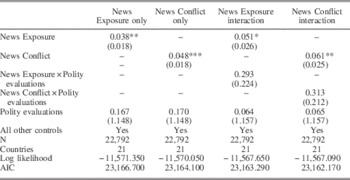
The first step carried out by SVdV includes a hierarchical model, with observations nested in countries, in which the probability to turn out in the EP elections is a function of both News Exposure and News Conflict. They also control for other variables. Next SVdV use models including only News Conflict: ‘[…] however, the model in Table 2 includes conflict news [but not mere news exposure] in light of previous findings’.Footnote 10 This may be because News Exposure had a substantively small effect, a negative effect and/or that adding News Conflict to the full model (in Table 1, SVdV) resulted in a significant improvement in model fit. We assess these decisions below, focusing on the substantive features.Footnote 11 In the subsequent steps of the analysis, SVdV evaluate whether the effect of News Conflict on turnout varies across countries, and whether that variation can be explained by country-level features of the media content, modeled as cross-level interaction between polity evaluations and News Conflict.
Multivariate Model Results: News Exposure vs. News Conflict

Note: *p<0.1; **p<0.05; ***p<0.01 (two-tailed).
The authors note that there is a substantial correlation between News Conflict and News Exposure, r= 0.89. Ideally, the inclusion of News Exposure would be required to tap into the specific effects of conflict. Using models with only one media predictor appears to be an empirical necessity, given the multicollinearity issue. Thus the decision of which predictor to use, and how it relates substantively to the excluded operationalization, becomes the most important step of the analysis – and basing this decision solely on model results with serious multicollinearity issues can be problematic.
SVdV do not discuss in detail the properties of the scenario with both predictors included in one model, but this model (Model 1 in SVdV) raises several interpretation difficulties. Within a single country, two individuals can have the same summed News Exposure score with different per-outlet consumption frequency, and this will translate into potential differences in their News Conflict scores. This difference is a function of both the variation in outlet conflict scores and how much their media consumption vector differs. The strict interpretation of coefficients would imply the classic formulation of: ‘everything else held constant’, the effect of News Exposure or News Conflict is the associated β coefficient. First, we know – given the correlation between the two predictors – that in most cases, News Conflict and News Exposure will change together. News Exposure has a small negative effect – we discuss below in detail why the magnitude is problematic – when News Conflict is held constant. This would entail at least some variation in News Exposure at each level of the News Conflict. In 65 per cent of the cases in the corrected dataset, one News Conflict value within a country is associated with one News Exposure value. More strikingly, in 97 per cent of the cases, the number of unique values of News Exposure for a fixed News Conflict value ranges between 1 and 3, which calls into question how meaningful the News Exposure coefficient (or that of News Conflict, for that matter) can be in the initial model reported by SVdV.
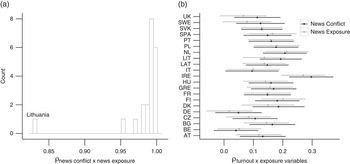
To address how serious the multicollinearity issue is, we estimated and report correlations for each country separately. As displayed in Panel a of Figure 1, these correlations are close to 1.0 in most countries, except Lithuania, which has the lowest degree of country-level conflict. The second-lowest correlation is for Belgium, but as the value is for country and not political system (Walloon vs. Flanders), this comes as no surprise. In short, this suggests that News Conflict is merely a rescaling of the News Exposure variable.
News Exposure and News Conflict, correlations
Note: Panel (a): Country-level Pearson’s correlations between News Conflict and News Exposure, twenty-one countries, corrected measures. Panel (b): Country-level polyserial correlations between News Conflict and turnout (black) and News Exposure and turnout (gray), twenty-one countries, corrected measures. Error bars: 95% confidence intervals.

The ‘weighted’ index nature of News Conflict results in substantially different ranges for News Exposure and News Conflict, but SVdV present, discuss and base their decisions on unstandardized coefficients. We show that when standardized (and hence comparable) coefficients are used, the dismissal of News Exposure in favor of News Conflict becomes less straightforward. The first indication that this choice of reporting is problematic is displayed in Panel b of Figure 1. When looking at the zero-order correlations in each country between turnout and the two exposure variables, we find – unsurprisingly, as there is close-to-perfect collinearity in most countries – that the bivariate relationships are very similar.
For the multivariate setting, we recoded the two predictors to account for the difference in scales, which convinced us that the decision made by SVdV on the basis of the unstandardized coefficients is erroneous. We group-mean centered the two predictorsFootnote 12 and divided them by their standard deviation. In Table 1 we report four models with the newly recoded variables.
All these models indicate that, when modeled separately, both News Exposure and News Conflict have very similar influences on the outcome variable. When we assess the standardized coefficients and their standard errors, we can see that they overlap. Furthermore, the aim of Figure 1, Panel B is to stipulate this at the bivariate level. Accordingly, the major difference in the magnitude of the effects was a simple artifact of the reporting chosen by the authors.Footnote 13 When the cross-level interaction is modeled, News Exposure is not statistically significant at the p<0.05 level, but absence of evidence is not evidence of absence, and using the thresholds proposed by SVdV, this effect is still statistically significant.
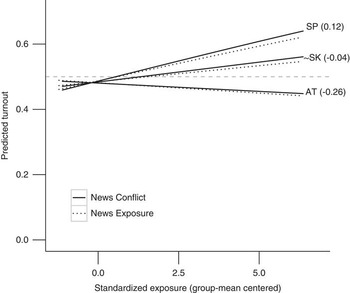
If the model comparisons or p-values larger than 0.05 leave room for skepticism, we can always look at substantive differences and implications. Figure 2 presents the slopes for Spain, Slovakia and Austria (as reported by SVdV in Figure 2) for News Conflict and News Exposure, estimated in separate models, using the full sample (twenty-one countries) and corrected News Conflict (see Online Appendix A). We fail to see support for their conclusion that exposure to conflict, instead of mere news exposure, increases the likelihood of participating in the EP elections.
News Conflict vs. News Exposure, cross-level interaction
Note: predicted turnout as a function of News Conflict (solid lines, based on News Conflict only cross-level interaction model, Table 2) and News Exposure (dotted lines, based on News Conflict only cross-level interaction model, Table 2) for different polity evaluation levels (SP=Spain, SK=Slovakia, AT=Austria). All other variables fixed at values described in the text and by SVdV, predictions based on fixed effects only. Predictors were group-mean centered and standardized (one SD, within country).

The Mobilizing Effect of Non-Conflictual News: An Illustration
While the high correlation between specific and general news exposure shows the problem related to estimating the impact of specific content on political behavior, this does not necessarily mean that the proposed approach of linking media content features with individual exposure is necessarily wrong. However, we show through an extension of SVdV’s work that the methodological contribution is unlikely to benefit the study of media effects on individual political behavior. Even if we assume that News Conflict measures both exposure and exposure to content, our example below – which focuses on non-conflictual news – is intended to show that substantively, we could easily formulate the same conclusions about two opposite contextual situations. We use this section to show that with such a proposed operationalization, even if we disregard all the discussion about multicollinearity or results reporting, we are losing most information in substantive terms that is about context (or media content). Hence, evaluating what news conflict operationalized as such actually measures is very problematic. In our reading of the claims made in the article, we should perhaps expect no relationship (or a negative relationship) when it comes to news non-conflict.
We use the original media dataFootnote 14 to recreate the conflict scores at the outlet level and then merge it with the European Election Study 2009 individual-level data. Using SVdV’s operationalization and the 2009 PIREDEU Media Study,Footnote 15 we calculate the outlet-specific conflict score, using all four content variables indicated by the authors. Note that these are dichotomous indicators, 0 for no conflict, 1 for conflict. Each outlet can be described by an average level of conflict in its EU reporting throughout the coding period. Similarly, each outlet can be described by the average ratio of non-conflictual news. The degree of News Non-conflict will be 1 − News Conflict. This means there should be a perfect negative correlation between these two outlet features. That is indeed the case in the Media Study, at both the outlet and country levels.Footnote 16
Next, using the formula provided by SVdV and the EES data, we created the individual-level News Conflict variable, as well as a News Non-conflict variable, following the same logic, but multiplying outlet-specific exposure by the outlet-specific News Non-conflict score. The correlation between these two variables is 0.85 on the full sample, with country-specific correlation coefficients for these two variables and mere news exposure reported in the last three columns of Table 1, Online Appendix C. From the theoretically grounded perfect negative correlation between the two variables at the outlet level, we have ended up with an extremely strong positive correlation in the individual-level data. This is a joint effect of both the proposed method of linking the two levels together and the measurement of conflict framing at the media-item level.
While we do not have turnout intention measured in an earlier wave, we expect that the only implication is that the media coefficients will be larger than those reported in the previous section or the original study. However, how they compare to each other – both effects and variables – is independent of the turnout intention variable.Footnote 17 Otherwise, we used and coded all individual- and country-level variables employed in the original analysis, following the coding description from SVdV.Footnote 18
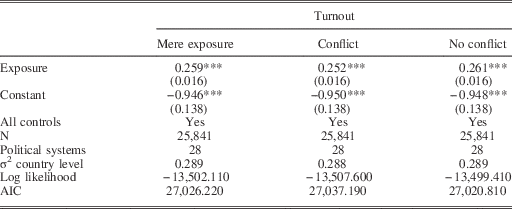
In Table 2 we present the results of interest from three turnout models on the EES data that mimic SVdV’s ‘fixed-effects’ model. Each model contains all individual- and country-level controls, with a varying intercept. Full model results are reported in Table 3, Online Appendix C. The row ‘Exposure’ contains the coefficients for the media variables, and each column head stipulates which exposure measure was used in the model. All three models indicate a positive effect of the exposure variables, independent of whether exposure is multiplied by conflict or non-conflict (see Online Appendix C for model formula and descriptive statistics). Again, this result is due to the fact that even after applying the proposed transformations, we are essentially looking at a simple news exposure measure. Furthermore, this also indicates that, given the coding at the news-item level, the proposed approach is unable to differentiate between qualitatively and quantitatively opposite media features; it supplies coefficients that are heavily conflated by mere exposure.
The Impact of Mere Exposure, Conflict and No Conflict, EES 2009

Note: Best-fitting model based on model comparison: news non-conflict. *p<0.1; **p<0.05; ***p<0.01 (two-tailed).
Conclusion
A decade ago, Slater argued that a weakness of using self-reported measures of news exposure is the ‘uncertainty about the content of the media, but that this uncertainty can largely be removed when content analyses of those media are conducted in conjunction with the survey of exposure self-reports’.Footnote 19 Over the years, a large body of literature has used this approach with great optimism, employing different solutions for linking these sources of information. In this article we question fundamental – but thus far unaddressed – properties of one approach, showing the deficiencies resulting from important methodological decisions.
Theories of how the media presentation of political news can affect individual attitudes and behavior have become more fine grained over time. Testing these theories requires the measurement and operationalization to accurately capture such fine-grained differences. Summarizing rich content data using features that reflect the prevalence of some frames marks the start of the groundwork for testing content-related heterogeneity. However, as we have shown, relevant and meaningful differences at the content level can get lost through the attempted linking of these features with individual exposure measures. While an explicit focus on content is both desirable and assures that we put meaning behind media consumption, the methodological steps to maintain the added content-related features deserve future attention. Otherwise, the rich content information is lost, and the gap between the refined theory and its empirical test widens to an extent that the added value disappears.
This was the case in the article chosen for illustration purposes. We had to realize that with the available measurement and proposed method we do not get very far, which calls into question the substantive contribution of the original article. To be more precise, we get to the same place when we focus on the effects of exposure to conflict vs. the effects of exposure to non-conflict. Using SVdV’s approach to integrating media and individual specific features, we are still basing most of our conclusions on mere media exposure. In substantive terms, we find that individuals with average media exposure are more likely to turn out to vote. This is hardly as impressive as being able to settle the cited debate over whether exposure to conflict has positive or negative effects. Thus we are left with a situation in which media and individual characteristics are both important separately, but how they were linked to create a more meaningful measure backfires, losing the added value on both levels.
The broader methodological implications of the original piece are important for researchers in terms of how one should combine media content features and individual exposure to such content. However, the proposed approach comes with problems. As in most cases, there are no easy solutions. However, the first – and arguably the most important – step in such analyses should be an extensive discussion of the measurement and empirical properties of how the content information is merged with individual exposure. As presented above, many of the detailed checks on the correlation patterns and the detailed comparison of the substantive implications already flag the issues of the operationalization. Once this step is carried out, it is clear that the operationalization needs enhancement, or the limitations should be explicitly stipulated.
Overall, based on the work that we have carried out so far, there are straightforward quantifiable and serious issues whenever the outlet-level features are thought of in terms of proportion or composition. While not completely independent of the distribution of these outlet scores, this issue will be serious even in the best and very unlikely scenarios. When outlet-level features are coded differently, a joint estimation of the weighted and unweighted measures might be possible (further simulations would be needed to address this issue), but in that case, the researchers should discuss the characteristics of the weighted index in precise detail. A beneficial next step for future research is to extend the analysis to such cases in order to establish whether the composite measures are indeed able to capture the desired content-related features. Through these extensions and further reliability and validity assessments of the linking approaches, researchers can pave the road toward a unified methodological approach to incorporating, and then comparatively assessing, the role of content conditional on exposure – or the role of exposure, conditional on content – in observational media studies. We believe such analyses will also inform where and how data collection, coding and study designs can be improved to assure that we are testing the theories we intend to.
To conclude, news exposure is not an empty shell, and there are profound reasons to believe that specific content in the news media matters for political outcomes in predictable ways. In most cases, mere media exposure is of little interest by itself and is useful due to its function as a proxy for exposure to specific content, for example exposure to news as a proxy for exposure to political content. Hence, there are important reasons for scholars to examine how specific content – in experimental as well as observational research – affects citizens’ political attitudes and behavior. For observational research, the challenge is to disentangle how specific content matters vis-à-vis other types of content.
Supplementary Material
To view supplementary material for this article, please visit http://dx.doi.org/10.1017/S000712341500006X