Advances in imaging, intensive care, and congenital heart surgery have contributed to an increasing number of children with CHD surviving to adulthood.Reference Marelli, Mackie, Ionescu-Ittu, Rahme and Pilote 1 It has been reported that the prevalence of adults with CHD is about 3000/million adults.Reference van der Bom, Bouma, Meijboom, Zwinderman and Mulder 2 The continuously growing number of adult patients with CHD has elicited heightened interest in their long-term functioning and quality of life.
Adult patients with moderate CHD undergo multiple interventions that might result in long-term complications and sequelae, which lead to poorer quality of life compared with the normal population.Reference Eslami, Macassa, Sundin, Khankeh and Soares 3 – Reference Simko and McGinnis 7 Beyond their medical issues, these patients also face various other social and emotional challenges related to employment, marriage, and modification of lifestyle.Reference Pahl and Grady 8 Unfortunately, their psychological conditions are often ignored and under-treated, even though they are at high risk for developing anxiety and mood disorders.Reference Kovacs, Saidi and Kuhl 9 With better social supports, these patients can cultivate better coping mechanisms and can enhance their psychological well-being to overcome physical, emotional, and lifestyle limitations.Reference Silva, Vaz and Areias 6 , Reference Teixeira, Coelho and Proença 10 , Reference Kulik and Mahler 11
In contrast, others studies have reported that the quality of life of these patients is similarReference Bons and Ploeg 12 – Reference Immer, Althaus, Berdat, Saner and Carrel 14 if not better than the general population;Reference Moons, Van Deyk and De Bleser 15 however, these findings were related only to certain dimensions of quality of lifeReference Areias, Pinto and Vieira 4 , Reference Teixeira, Coelho and Proença 10 and mainly in patients with mild heart defects.Reference Fekkes, Kamphuis and Ottenkamp 13
Although numerous studies have been conducted related to quality of life, there is still lack of consensus on the definition of quality of life.Reference Moons, Van Deyk, Marquet, De Bleser, De Geest and Budts 16 Gill and FeinsteinReference Gill and Feinstein 17 concluded quality of life as a uniquely individual perception, representing individual feelings towards one’s own health status and/or other non-medical aspects of life. In healthcare settings, the definition of quality of life can be grouped into five categories: normal life, satisfaction/happiness, accomplishment of individual goals, social utility, and natural capacity.Reference Ferrans 18
In our study, health-related quality of life (HRQoL) was operationally defined as a patient’s subjective experience in perceiving his or her health status and was measured using assessment of quality of life (AQoL-8D).
There is limited available literature that reviews the impact of different types of social support in the quality of life of adults with CHD, especially in the Asian cultural contexts. The purpose of this study was to review the types of social support – emotional/informational support, tangible support, affectionate support, and positive interactions – which would best predict the HRQoL and the physical and psychological dimensions of HRQoL of the adult patients with CHD. Demographic variables and clinical factors were also assessed to see whether they affected the HRQoL in this population.
Materials and methods
Patients
This study was conducted at the Institute Jantung Negara (National Heart Insititute), Malaysia, which is a referral cardiac hospital with an adult CHD programme. Patients who had acquired heart diseases, genetic disorders, had or were going to have heart or heart and lung transplants, and those <18 years of age were excluded from the study.
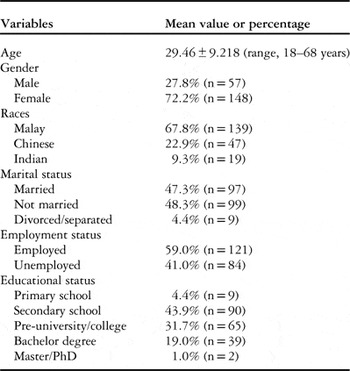
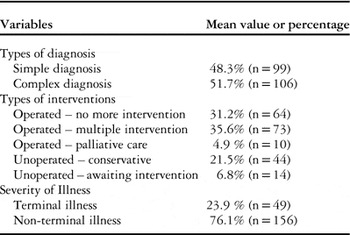
In total, 205 adult patients with CHD, aged 18 years and above, were enrolled into this study. The clinical parameters and demographic variables of the patients were documented (Tables 1 and 2).
Demographic characteristics of the patients.

Clinical characteristics of the patients.

The clinical parameters that were used focussed on the types of diagnosis, interventions, and severity of illness as defined below.
Types of diagnosis
Types of diagnosis were divided into simple and complex CHD. The definition based on the Task Force 1 of the 32nd Bethesda Conference was used, and lesions categorised as moderate and great severity were combined under complex CHD.Reference Warnes, Liberthson and Danielson 19
Types of interventions
The simple and complex lesions were further divided to reflect the interventions, operated or unoperated. If operated, they were subdivided into those who had single or multiple reparative surgical procedures and those with palliated procedures. Those who were unoperated at the time of review were divided into those not suitable for any further interventions (conservative) and those awaiting intervention.
Severity of illness
Severity of illness reflected the patients who had heart defects with or without terminal conditions. The operational definition of heart defects with terminal condition is heart condition that were not suitable for further surgical interventions due to the severe complexity of the defects or complications that have occurred, such as Eisenmenger syndrome, end-stage heart failure, and poor ventricular function. These conditions might affect the life expectancy of the patients.
Instruments
The questionnaire used covered three areas: clinical aspects and demographics, medical outcome studies – social support survey (MOS-SSS),Reference Saliba, Butera and Bonnet 20 and AQoL-8D.Reference Richardson, Elsworth and Iezzi 21 , Reference Richardson, Sinha, Iezzi and Khan 22
MOS-SSS
To develop MOS-SSS, Sherbourne and StewartReference Sherbourne and Stewart 23 conducted a 2-year longitudinal study. Through multi-trait scaling and confirmatory factor analysis, they constructed four functional support scales, which were emotional/informational support, tangible support, affectionate support, and positive interactions. Emotional and informational supports were combined because of substantial overlap. These functional support scales were grouped to form an overall functional social support index.Reference Sherbourne and Stewart 23
Emotional/informational support was perceived when patients received positive support, empathetic understanding, were allowed to express their emotions, and were given appropriate information when required. Tangible support was when they received behavioural assistance and materials such as a wheelchair.Reference Sherbourne and Stewart 23
Affectionate support was the degree of love and affection the patients received, whereas positive interaction was when they were able to have fun and relax with someone.Reference Sherbourne and Stewart 23
We used MOS-SSS as it has high reliability (αs>0.91) and high convergent and discriminant validity (with a range from 0.69 to 0.82).Reference Sherbourne and Stewart 23 A pilot study conducted at the National Heart Institute, Malaysia, supported the findings that α reliabilities of MOS-SSS were relatively high (α=0.929).
AQoL-8D
The purpose of the project was to develop a psychometrically appropriate instrument to study a wide range of health conditions and ensure the instrument was able to compute multi-attributable utility instruments for the economic evaluation of health-related intervention programmes.Reference Richardson, Elsworth and Iezzi 21 AQoL-8D has been shown to have high reliability, content, convergent, discriminant, and construct validity.Reference Richardson, Elsworth and Iezzi 21 , Reference Richardson, Sinha, Iezzi and Khan 22 The pilot study at the National Heart Institute, Malaysia, also showed high reliability (α=0.844) of AQoL-8D.
There are eight dimensions of HRQoL – independent living, senses, pain, self-worth, coping, relationships, happiness, and mental health – in the AQoL-8D and they can be further classified into two “super-dimensions” – Physical and Psychological. In the present research, the Physical and Psychological Super-Dimensions were studied instead of the eight dimensions of HRQoL. Independent living, senses, and pain were included into the Physical Super-Dimension, whereas self-worth, coping, relationships, happiness, and mental health were included in the Psychological Super-Dimension.Reference Richardson, Sinha, Iezzi and Khan 22
Data collections procedure
An informed signed consent was obtained from the adult inpatients and outpatients with CHD who met the inclusion criteria. These patients were invited to fill the MOS-SSS and AQoL-8D instruments. The data collectors accompanied the patients throughout the process, clarifying their doubts to minimise inaccuracies.
Statistical procedures
Statistical analyses of the data were executed using Social Package for the Social Sciences (SPSS), version 16.01.
On the basis of the purpose of the present study, various procedures were carried out. Pearson’s correlation was used to determine the relationship between social supports, quality of life, and their subscales. Multiple regression analysis was carried out to determine which type of social support was the best predictor of quality of life and the two “Super-Dimensions”.
A larger sample size (n=205) was required for statistical analysis based on Green’s formula (minimum 117 patients)Reference Green 24 and Harris’s rules-of-thumbs (minimum 130 patients).Reference Harris 25
Results
Social supports and HRQoL
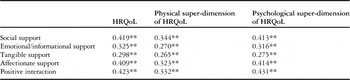
There were significant positive relationships between social supports and their subscales and HRQoL as well as the Physical and Psychological Super-Dimensions of HRQoL. These r values ranged from 0.265 to 0.431, with all p<0.01 (Table 3). The patients with higher social supports and its subscales had higher HRQoL and Physical and Psychological Super-Dimensions of HRQoL.
Relationship between social supports with their subscales and HRQoL and the Physical and Psychological Super-Dimensions of HRQoL.

HRQoL=health-related quality of life
n=205
**p<0.01
When they received emotional/informational supports – for example, empathy, positive support, and sufficient information from significant others and medical staffs – adult patients with CHD perceived a higher HRQoL. Sufficient behavioural assistance and material aid – tangible supports – also correlated with higher HRQoL.
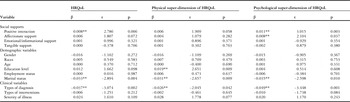
Multiple standard regression analyses (Tables 4 and 5) identified only positive interaction as a significant predictor of HRQoL. For Psychological Super-Dimensions of HRQoL, positive interaction and affectionate support were the main predictors. None of the types of social supports significantly predicted the Physical Super-Dimensions of HRQoL.
Predictors of patients’ HRQoL and the physical and psychological super-dimensions of HRQoL.

HRQoL=health-related quality of life**p<0.01
Predictors of patients’ HRQoL and physical and psychological super-dimensions of HRQoL.

HRQoL=health-related quality of life
Demographic variables and HRQoL
Marital status was the only predictor of HRQoL and the Psychological Super-Dimension of HRQoL (Tables 4 and 5). Adult patients with CHD who were married had statistically significant better HRQoL and its subscales. Employment status and educational level were not significant predictors of HRQoL.
Multiple regression analysis demonstrated marital status and educational level as significant predictors of the Physical Super-Dimension of HRQoL. Adult patients with CHD who had higher educational levels had a higher Physical Super-Dimension of HRQoL.
Clinical variables and HRQoL
Only types of diagnosis were shown to be a significant predictor of HRQoL and its subscales (Tables 4 and 5). Adult patients with CHD who had simple CHD had higher HRQoL in all dimensions compared with those with complex CHD, but it was not statistically significant. Types of interventions and severity of the illness were not shown to be significant predictors of HRQoL and its subscale.
Discussion
Social supports and HRQoL
On the basis of these findings, social support and all its subscales had significant positive relationships with HRQoL; however, the r values ranged from 0.265 to 0.431, representing a mild-to-moderate correlation. These results imply that higher social supports – emotional/informational support, tangible support, affectionate support, and interaction support – would lead to higher HRQoL and its subscales, which are similar to results of previous studies.Reference Silva, Vaz and Areias 6 , Reference Teixeira, Coelho and Proença 10
Positive interaction
Multiple regression analysis demonstrated positive interaction to be the main predictor of HRQoL and the Psychological Super-Dimension of HRQoL.
Adult patients with CHD are often viewed as vulnerable by society. They are over-protected, have limited social interaction with peers, and lack of authorityReference Silva, Vaz and Areias 6 and opportunities to have fun. Fun has been identified as one of the five basic individual needs based on Choice theory.Reference Glasser 26 Positive interactions occurred when patients experienced fun, relaxation, and enjoyment while interacting with others.
Positive interaction can be provided by improving communication within patients, families, healthcare workers, and society and by enrolling patients into supportive programmes such as counselling, support groups, expressive art, music, laughter therapy, and pet therapy. Creative expression helps patients relax and reduces their medical symptoms, leading to emotional healing.Reference Stuckey and Nobel 27 Enjoyment and laughter therapies also help divert their attention from suffering.Reference Erdman 28 Group counselling and support also enable these patients to interact and learn how others with similar diseases cope with stress and enjoy their life.
Apers et alReference Apers, Moons and Goossens 29 proposed that sense of coherence should be a target for interventions when dealing with patients who have CHD to improve their quality of life. Positive interaction through the above-mentioned methods may improve the sense of coherence – that is, comprehensibility, manageability, and meaningfulness – among these patients.Reference Apers, Moons and Goossens 29 , Reference Moons and Norekvål 30
Affectionate support
Affectionate support – support through expressions of love and respect – was the secondary predictor of the Psychological Super-Dimension of HRQoL. Expressions of love and respect help patients feel needed, make them happy, and enhance their sense of empowerment in managing their illness. In the clinical setting, couple-oriented interventions improved partner support, quality of their marriage, and reduced illness-related conflicts.Reference Martire, Schulz, Helgeson, Small and Saghafi 31 Psychosocial interventions involving family members and psycho-education were also found to be beneficial.Reference Hartmann, Bäzner, Wild, Eisler and Herzog 32
Emotional/informational and tangible support
In this study, emotional/informational support and tangible support positively correlated with all the dimensions of HRQoL; however, they were not statistically shown to be significant predictors of HRQoL and its subscale.
Emotional support such as empathy and encouragement to express their feelings are crucial when patients undergo emotional upheaval.Reference Filazoglu and Griva 33 , Reference Jacobson 34 During transition periods, informational support is given to help them understand the progression of their disease, the impact of the changes they are experiencing, types of procedures, and medications.Reference Filazoglu and Griva 33 – Reference Kools, Tong, Hughes, Jayne, Scheibly and Gilliss 35 Nevertheless, if the information provided by medical staffs, parents, or relevant parties is inconsistent, it will create more confusion.Reference Kools, Tong, Hughes, Jayne, Scheibly and Gilliss 35
If patients face physical limitations or are in a deficit stage, tangible support – behaviour assistance and material aid – would be needed in escalating physical recovery;Reference Filazoglu and Griva 33 , Reference Jacobson 34 however, patients with chronic illness, at times, might refuse social support – emotional/ informational and tangible supports – from others as they do not want to be obliged, controlled, or be a burden to their caregivers.Reference Claessens, Moons, De Casterlé, Cannaerts, Budts and Gewillig 36 This might explain our results.
Physical Super-Dimension of HRQoL
Coelho et alReference Coelho, Teixeira and Silva 37 reported that better social supports contributed to improvement of physical quality of life; however, in our study, none of the types of social supports significantly predicted the Physical Super-Dimension of HRQoL.
The adult patients with CHD in the present study may have adapted well to their physical limitations as they were born with the disease and have different standards compared with healthy individuals. The majority of patients were seen in the outpatient clinic, suggesting the possibility that they were not significantly functionally impaired.
Demographic variables and HRQoL
The present findings also showed that marital status was a significant predictor of HRQoL and its subscales; however, the level of education was only a significant predictor of the Physical Super-Dimension of HRQoL. Surprisingly, employment status was not shown to be a significant predictor of HRQoL and its subscales. Gender and age also were not significant predictors.
There is limited literature on the effect of marital status on HRQoL of adult patients with CHD. Moons et alReference Moons, Van Deyk and Marquet 38 proved that there were significant differences in HRQoL based on the marital status and education/jobs of the patients. From the Asian cultural perspective, studies have shown that Asians have a more collectivistic culture and marriage plays an important role in the individual’s identity and life.Reference Thio 39 These reasons might apply to the patients of this study, where the married adult patients with CHD are shown to have better HRQoL and its subscales.
Although several studies have demonstrated that women have lower quality of life compared with men,Reference Chen, Liao and Wang 40 gender was not a significant predictor of HRQoL and its subscales in our study and in some others too.Reference Van Deyk, Moons and Marquet 41 The difference in numbers between male (57) and female (148) patients might have contributed to these statistical indifferences. Despite studies highlighting age as a variable affecting quality of life,Reference Silva, Vaz and Areias 6 , Reference Saliba, Butera and Bonnet 20 it was also not a predictor in our study.
Level of education was a significant predictor of the Physical Super-Dimension of HRQoL, but not HRQoL and the Psychological Super-Dimension of HRQoL. With higher level of education, the adult patients with CHD are able to accumulate knowledge and skills to accommodate their physical limitations.
Employment was not shown as a significant predictor of HRQoL and its subscales. The extended family concept – collectivistic culture – in Asian cultureReference Thio 39 provides the financial support system needed by these patients. Even without employment, most of these patients are well supported by their families.
Clinical variables of HRQoL
Number of surgeries and severity of prognosis were often found to influence the quality of life of adult patients with CHD.Reference Silva, Vaz and Areias 6 , Reference Teixeira, Coelho and Proença 10 In our study, the type of diagnosis was the only variable significantly predicting HRQoL and its subscales. Patients with complex CHD had poorer HRQoL. These patients had worse psychosocial adjustment as they required constant care from their caregivers and had limited exposure to school and leisure activities. Patients with complex CHD were also found to have more negative thoughts and internalisation.Reference Coelho, Teixeira and Silva 37
Wray and SenskyReference Wray and Sensky 42 proposed that patients who received treatment have better quality of life; however, a few others have reported that patients who went through surgical treatment had lower quality of life, due to high level of anxiety, low functional capacity, and psychological maladjustment.Reference Ben-Zur, Rappaport, Ammar and Uretzky 43 , Reference Latal, Helfricht, Fischer, Bauersfeld and Landolt 44 In our study, types of interventions and the severity of illness were not significant predictors for all dimensions of HRQoL because the majority of patients involved in this study had recovered from the acute effects of surgery and interventions.
Interesting, the severity of illness was not a significant predictor of HRQoL. It maybe because the patients involved were mostly seen in our outpatient clinic and the majority were not patients who had heart defects with terminal condition. Moreover, the severity of illness does not necessarily reflect the functional class.Reference Moons, Van Devk, De Geest, Gewillig and Budts 45 These patients have yet to become significantly symptomatic or feel the limitations of their illness. If the disease did not affect their lifestyle much, the patients may not perceive the impact on their quality of life. It could also be due to a strong wish to be healthy, fear to disagree with doctors, or the reluctance to disclose their symptoms and their maladjustments to the healthcare professional and even to themselves.Reference Berghammer, Dellborg and Ekman 46 – Reference Hardy and Kell 48
Clinical implication
Instead of only focussing on the disease-based model of medicine, socio-cultural and humanistic aspects of patient care should be incorporated into the treatment.Reference Green, Carrillo and Betancourt 49 The findings of this study suggested that incorporating positive interaction, affectionate support, emotional/informational support, and tangible support into the management of these patients can help improve their quality of life. It also strengthens and broadens the roles of healthcare professionals who provide services to adult patients with CHD.
All types of social supports provided by healthcare professionals should be sustained. Provision of informational supports, especially the progression of their disease, the impact of the changes they are experiencing, types of procedures, and medicationsReference Kools, Tong, Hughes, Jayne, Scheibly and Gilliss 35 should be consistent and appropriate to patients’ development status, educational level, and readiness.
Healthcare workers could use demographic and clinical factors towards HRQoL to identify vulnerable patients. Affectionate support shown as a predictor of the Psychological Super-Dimension of HRQoL should incorporate couples/family/group therapy as part of the treatment plan. Couple-oriented interventions, family counselling, and psycho-education can be conducted to help patients with family conflict to lessen their psychosocial burden.Reference Martire, Schulz, Helgeson, Small and Saghafi 31 , Reference Hartmann, Bäzner, Wild, Eisler and Herzog 32
Apers et alReference Apers, Moons and Goossens 29 proposed sense of coherence as a target for interventions in dealing with patients with CHD to improve their quality of life. The element of sense of coherence included comprehensibility, manageability, and meaningfulness.Reference Apers, Moons and Goossens 29 , Reference Moons and Norekvål 30 Elements of enjoyment and relaxation when incorporated into the intervention enhance sense of coherence by providing positive interaction in the clinical settings. Having fun and relaxing with significant others counter the effects of stress and anxiety in these patients, thus enhancing their sense of manageability, providing motivation, and making their life more meaningful.
Training and workshops about communication skills shall be provided to healthcare workers to build up fun and caring culture. Patients at risks are suggested to be enrolled in psychosocial intervention programmes to incorporate elements of positive interaction such as counselling and expressive art therapy.
Spacious patient-friendly corners, expressive rooms, and prayer/quiet rooms are also needed within the hospital environment. Patients might need a space for temporary “escape” from their illness or to reflect.
On the basis of the present findings, further research on the psycho-educational group, which incorporates elements of positive interaction, informational/emotional support, and affectionate support, is needed to cultivate sense of coherence among adult patients with CHD and enhance their quality of life.
Limitations of the study
The patients who were recruited to this study were those who attended the CHD outpatient clinic only, which may have skewed towards adult patients with CHD who were less symptomatic and well adapted. The questionnaire was in English, hence contributing to inconsistencies in explanation and different interpretations among those who are English illiterate.
The distribution of number of patients in the selected variables was not balanced – for example, severity of illness (terminal condition: 23.9%; non-terminal condition: 76.1%). Moreover, the assessment did not include the criteria of early and late diagnoses – that is, being diagnosed before and after 10 years of age; thus, we cannot compare the effect of late diagnoses of adult patients with CHD with the early diagnosis.
Conclusion
Although social support and all its subscales have mild-to-moderate significant positive relationship with HRQoL and its subscales of adult patients with CHD, only positive interaction was a significant predictor of HRQoL. Both positive interaction and affectionate support were the crucial variables in predicting the psychological dimension of HRQoL; however, all types of social supports did not significantly predict the physical dimension of HRQoL.
With regard to demographic variables, marital status significantly predicted HRQoL and its subscales. Interestingly, educational level was the only significant predictor of the physical dimensional of HRQoL. Types of diagnoses also act as significant predictors of HRQoL and its subscales.
We conclude that elements of fun and relaxation, normally perceived to be limited to children, should be incorporated as part of the treatment plan provided to adult patients with CHD. Involving patients’ family and friends to partake in the care of these patients and provide a loving and caring environment is essential for good HRQoL.
Acknowledgements
The authors extend their gratitude to the adult patients with CHD who were involved in the study, doctors, nurses, and medical staff of the Pediatric and Congenital Heart Centre and colleagues in the research department, National Heart Institute Malaysia, for their assistance in recruiting the patients. Special thanks to Sr. Khoo Soon Gaik, Wong Suh Ching, and Tan Moo Lee for their assistance in the research. S.K. Tye, G. Kandavello, and K.L. Gan take responsibility for all aspects of the reliability and freedom from bias of the data presented and their discussed interpretation.
Financial Support
This research received no specific grant from any funding agency, commercial, or not-for-profit sectors.
Conflicts of Interest
None.
Ethical Standard
The authors assert that all procedures contributing to this work comply with the ethical standards of the Malaysian Guidelines for Good Clinical Practice and with the Helsinki Declaration of 1975, as revised in 2008, and has been approved by the ethical committee team from Institut Jantung Negara (National Heart Institute), Malaysia.