Introduction
Despite their size and widespread distribution around Antarctica, emperor penguins (Aptenodytes forsteri Gray) are a relatively recently discovered and rarely studied species. They were first seen during James Cook’s 1773–75 cruise. Although the ship’s naturalist, Johann Forster, misidentified them as king penguins (Aptenodytes patagonicus Miller). George Gray of the British Museum recognized emperor penguins as a separate species in 1844. However, it was not until 18 October 1902 that a breeding colony was confirmed at Cape Crozier by members of Scott’s Discovery expedition (Scott Reference Scott1905). Nearly 50 years passed before the emperor penguin’s remarkable breeding behaviour was observed in 1948 at Emperor Island in the Dion Islands, and then described and published in 1953 (Stonehouse Reference Stonehouse1952, Reference Stonehouse1953). Not long after, Jean Prévost conducted a similar study at the recently discovered colony at Pointe Géologie near the French station of Dumont d’Urville (Prévost Reference Prévost1961).
Cape Crozier remained the only known emperor penguin colony in the Ross Sea until J.O. Wilson noted the Beaufort Island colony from a passing ship in 1956 (Stonehouse Reference Stonehouse1964). Stonehouse reported on counts determined from aerial photographs taken from a US Navy helicopter over a decade later (Stonehouse Reference Stonehouse1966). John Dearborn discovered Coulman Island in 1957, and estimated more than 33 000 chicks present (from Dearborn’s personal notes). Later, Stonehouse counted the Franklin Island colony from US Navy aerial photographs taken in 1964 (Stonehouse Reference Stonehouse1968). Soon after, in 1964, Ian Stirling sighted Cape Washington during a distant flyby (Stirling & Greenwood Reference Stirling and Greenwood1970). Stirling guessed that there were 5000 birds present. Cape Roget was sighted from a helicopter in 1964, and visited the same year for a ground count (Cranfield Reference Cranfield1966). The most remote colony to be found was Cape Colbeck in 1962 during a geology and botanical expedition to Marie Byrd Land. Members of the team came down from the nearby hills on Christmas Day to note a large number of chicks in Bartlett Inlet. They never reported the discovery (Kooyman Reference Kooyman1994). Kooyman and co-workers rediscovered the Cape Colbeck colony in 1993, and returned to count it in the spring of 1994 (Barber-Meyer et al. Reference Barber-Meyer, Kooyman and Ponganis2008).
Although the performance of censuses and assessments of population trends of remote colonies in the Ross Sea are difficult, the data are significant in that the Ross Sea colonies constitute c. 25% of the world’s emperor penguin population (Fretwell et al. Reference Fretwell, LaRue, Morin, Kooyman, Wienecke, Ratcliffe, Fox, Fleming, Porter and Trathan2012). Annual censuses extend back to 1983, but there are frequent breaks until 2000. Our early censuses from 1983–2000 were based initially on ground counts of chicks, and then on aerial surveys of adults and, when possible, chicks. Here, we report the results from aerial surveys from 2000–12, a nearly continuous record of numbers of chicks or adults present at most of the seven Ross Sea emperor penguin colonies.
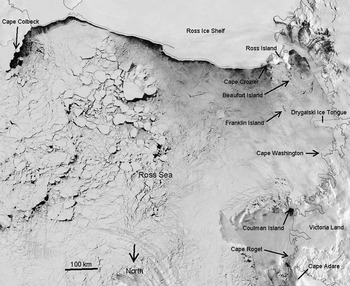
In those 29 years, 69 colony counts have been made, ranging from Cape Roget in the north-west corner of the Ross Sea to Cape Crozier in the south-west corner, to Cape Colbeck in the south-eastern corner (Fig. 1). It is the feathered triangle of emperor penguins, as well as of Adélie penguins. With the exception of the Pointe Géologie (French) and Taylor Glacier (Australian) colonies, these censuses are the longest records for any other emperor penguin colonies.
NASA WorldView satellite image of the Ross Sea from 7 November 2015 with the locations of the seven Ross Sea emperor penguin colonies labelled with names and arrows. Major geographical features are also identified.

Methods
These data were collected from aerial photographs during late October–early November 2000–12. Almost all counts were obtained from aerial photographs taken from a Twin Otter plane at 500 m altitude, usually from the co-pilot’s open window. From 2010 to the final count in 2012, access to the cockpit was not allowed due to insurance requirements, so the photographs were taken through a side window of the main fuselage. These windows were behind and below the engines mounted on the overhead wing. This position often put the camera view in the heat stream of the engines and degraded some of the photographss. In addition to the degradation by the heat stream, shooting through the optically poor Plexiglas compared to the open window reduced the clarity enough that only adults could be counted reliably in most of the photographs. In the few photographs or parts of photographs that chicks could be counted we used the ratio of chicks to adults to estimate the total chicks in the uncountable groups.
There were several exceptions to the Twin Otter aerial survey collections of data. Photographs obtained from Beaufort Island were either from a helicopter or on the ground. All numbers at Cape Crozier for adults and chicks were ground counts either by us in October or, especially for chick counts, by David Ainley’s team in December. Three of Cape Washington counts (2005, 2010, 2011) were from a 200 m bluff overlooking the colony. All images were obtained with 35 mm format Nikon N90 film camera until 2003, and various 35 mm format digital cameras from 2003–12.
Correlations of population size with the two local Ross Sea standard climate variables of sea ice extent and sea surface temperature and two large-scale variables of the Southern Oscillation Index and Southern Hemisphere Annular Mode were not analysed because no correlations were found in an earlier paper (Barber-Meyer et al. Reference Barber-Meyer, Kooyman and Ponganis2008). We had earlier hypothesized that the positive and negative relationships between chick abundances and sea ice extent and sea surface temperature would be dampened because reduced chick abundance might result from extensive sea ice increasing the foraging distance for adults rearing chicks (Barbraud & Weimerskirch Reference Barbraud and Weimerskirch2001, Croxall et al. Reference Croxall, Trathan and Murphy2002). Instead we relied on local effects as indicators of the abrupt changes of populations from year-to-year, as we proposed in our earlier paper (Barber-Meyer et al. Reference Barber-Meyer, Kooyman and Ponganis2008) that ‘chick abundance is most impacted by fine-scale sea ice extent and local weather events, which are best evaluated by on-site assessments’. These local effects were based on our aerial observations during the single trip surveys to the colonies and satellite images of the conditions in the immediate vicinity of the colonies.
Results
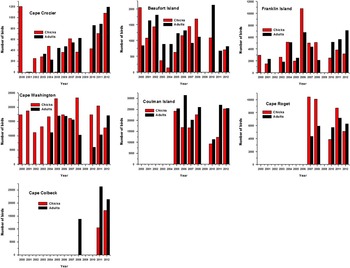
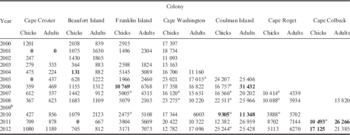
The results of the colony censuses are shown in Table I. Annual changes in the numbers of chicks and adults are presented in Fig. 2.
The annual number of chicks and adults at each of the seven Ross Sea emperor penguin colonies from 2000–12. Note that the Y-axes scales vary. In many years, there were no censuses at colonies that were more distant from McMurdo Station. On three occasions, there were no chicks at a colony site, at Cape Crozier in 2001 and 2005, and at Beaufort Island in 2011. There were no living adults on only one occasion, at Cape Crozier in 2001 after the impact of iceberg B-15.

Chick and adult censuses of the Ross Sea emperor penguin colonies, 2000–12. Bold numbers indicate census highlights discussed in the text.

a Count estimated on basis of chick-to-adult ratio determined from high quality images of both chicks and adults in subsections of the colony.
Accuracy of counts and estimations was 5–10% (Barber-Meyer et al. Reference Barber-Meyer, Kooyman and Ponganis2008).
b No counts were conducted in 2009.
There were 12 major highlights in the colony censuses, emphasized using bold in Table I.
Highlights 1 and 2
Two of the most remarkable observations were the precipitous fall in numbers of both chicks and adults in the Cape Crozier colony from 2000 to 2001.
Highlight 3
The Beaufort Island populations declined from a high of 2038 chicks in 2000 to a record low of 131 chicks in 2004.
Highlight 4
In 2005, the Cape Crozier colony failed to produce a single egg or chick.
Highlight 5
On Franklin Island, there was a peak chick production of 10 769 chicks counted during the survey on 30 October 2006.
Highlight 6
Despite a record low chick count of <17 000 chicks on Coulman Island in 2006, there was a high count of 31 432 adults.
Highlights 7 and 8
The lowest ever counts of chicks and adults at Coulman Island occurred in 2010.
Highlight 9
The Beaufort Island chick count fell to zero fledged in 2011 because of an unsuitable offshore location where the ice went out sometime before November.
Highlights 10 and 11
In 2011, the Cape Colbeck population had 10 493 chicks and 26 266 adults, including a major interior colony and a remote colony near the ice edge with 1123 chicks.
Highlight 12
The Cape Colbeck population rose to 17 125 chicks in 2012.
Highlight 13
One final highlight, although not summarized in Table I, is the successful counts of adults and chicks at all seven colonies in the Ross Sea in 2011 and 2012. The highest total count for all seven colonies in the Ross Sea was in 2012 with 65 220 chicks and 79 253 adults. In 2011, the numbers were similar with 56 512 chicks and 77 845 adults.
Discussion
In preparation for discussion of the census highlights, a short review of some basic details about the colonies follows. First, all the colonies in the Ross Sea occur within a few kilometres of the ice edge. There are two principal types of colonies, the restricted, confined colonies such as Cape Crozier and the expansive ‘suburb’ colonies such as Coulman Island. Cape Crozier, for example, is a tight colony with usually one but sometimes two separate groups. It has almost always been that way since its discovery in 1902. By the end of the season the colony area is highly coated with guano and the birds heavily stained with guano. Beaufort Island and Franklin Island are also single group or restricted colonies next to their respective islands with little opportunity to separate into groups, or even to move much from the original incubation site because of the limited fast ice next to the island. During the years that iceberg B-15A influenced the extent of sea ice, more space developed because of increased fast ice on the east side of the islands, and both colonies broke away from the incubation area and expanded into multiple groups. Such expansion into areas of weaker fast ice is not without risk. In 2010 at Franklin Island, the colony was offshore, and there was break-up of the sea ice in early December probably before the chicks were ready to fledge. The chicks may have been lost that year.
The mid-latitude and largest colonies of Coulman Island and Cape Washington are the suburbanite colonies that have unlimited expansion possibilities, and the birds take advantage of it. The Cape Washington colony fragments by early October and rapidly expands into distinct groups. Several groups move 5–10 km into Terra Nova Bay. The Coulman Island colony seems to be moving towards the ice edge 10–15 km distant from the core of the colony by September. By December, the suburbs of Coulman Island have moved up to 10 km from the original breeding location. Compared to the colonies that are forced to remain in one place, this move to fresh surfaces ensures that their feathers are less soiled and the snow is available as clean drinking water.
The Cape Colbeck colony is distinct from the other colonies. Despite a large area of fast ice within the protected Bartlett Inlet, the colony usually moves little before fledging. The lack of movement results in heavily guano-contaminated sea ice within the colony boundaries. So much so that in 2013 when one of us (GLK) arrived at Bartlett Inlet on 19 March (well after fledging and when the abandoned colony site was buried under nearly a metre of snow) we detected the colony site first by the odour, before we dug down and exposed the guano-covered surface of the colony.
It should also be noted that prior to these surveys in 2000–12, censuses at the Ross Sea colonies were conducted in December, often from ground counts of chicks (Barber-Meyer et al. Reference Barber-Meyer, Kooyman and Ponganis2008). The shift to early season was for two reasons: i) availability of aircraft and ii) at least one adult is present with the chick in late October. Occasionally, both adults may be with the chick in late October (as confirmed during ground operations). In addition, based on aerial photographs of compact adult groups without chicks, there may also be non-breeding adults present. The potential inclusion of such additional adult birds in our aerial counts may result in over estimation of the number of breeding adults, but will better reflect the breeding potential of the colony in comparison to counts late in the season when most of the non-breeders have left, and most of the breeding adults are absent because of the intense foraging necessary to feed the fast growing chick.
In addition, it is also noteworthy that chick-to-adult ratios change throughout the spring as adults spend more time foraging away from the colony. Consequently, dependent on hatching date and rate of chick development in any given year, although censuses were conducted in late October–early November in each year, the ratio of chicks to adults may vary even though the annual censuses were conducted at the same time of year (October–November). In some cases, there will be more chicks than adults present.
With this basic information, we will review the census highlights and the high variability in the chick and adult counts from year-to-year in the emperor penguin colonies of the Ross Sea.
Due to the impact of iceberg B-15 (Kooyman et al. Reference Kooyman, Ainley, Ballard and Ponganis2007), there were no live chicks or adults at the Cape Crozier colony in November–December 2001 (Highlights 1 and 2). The colony size gradually increased with fluctuating counts over the ensuing decade, including a failure to produce chicks despite the presence of adults in 2005 (Highlight 5). In 2012, counts were greater than 1000 for both chicks and adults for the first time since 2000. In 2014, the Cape Crozier colony reached a near record high of 1238 chicks (Ainley, personal communication 2016). The highest counts ever reported at Cape Crozier were 1325 chicks in 1961 (Stonehouse Reference Stonehouse1964) and 1280 chicks in 1962 (Woehler Reference Woehler1993).
In association with the presence of icebergs and extension of sea ice around the colony, the Beaufort Island colony decreased from 2038 chicks in 2000 to 131 chicks in 2004 (Highlight 3). It is noteworthy from the ground surveys in 2001 and 2004 that there were early die-offs of chicks of 410 and 360, respectively, presumably secondary to the extensive sea ice and distances required for adults to travel to and from the colony because of the barrier created by iceberg B-15A (Kooyman et al. Reference Kooyman, Ainley, Ballard and Ponganis2007). However, this is not the greatest die-off reported at Beaufort Island. In 1976, the first time the colony was visited on the ground, there were 1115 dead chicks found (Todd Reference Todd1980). In November 2011, presumably due to loss of sea ice that year, there were no chicks despite the presence of 667 adults close to Beaufort Island (Highlight 9).
The Franklin Island colony had a record high of 10 769 chicks in 2006, almost twice the highest counts at the island in any of the other years in this survey (Highlight 5). Such an isolated rise in the size of the colony may have been due to immigration of birds from other areas in that year.
The Cape Roget colony has often been difficult to reach. In the counts available, the colony appeared relatively stable. Chick counts were in the same range as in the 1990s (Barber-Meyer et al. Reference Barber-Meyer, Kooyman and Ponganis2008).
Until 2012, there had been a fluctuating decline at the world’s once largest colony at Coulman Island. At times, the Cape Washington colony had more chicks. In 2006, there was a record high number of adults (Highlight 6), but relatively low number of chicks at Coulman Island. In 2010, there was a record low number of both chicks and adults (Highlights 7 and 8). However, in 2012, Coulman Island was once again the largest of the colonies with more than 25 000 chicks.
At Cape Washington, the counts have fluctuated over this 12 year period. The lowest chick numbers were in 2002, 2003 and 2012; these counts were about half the highest counts throughout this period and in the 1990s (Barber-Meyer et al. Reference Barber-Meyer, Kooyman and Ponganis2008).
Cape Colbeck has been surveyed only three times since 1994 because of its distance from McMurdo Station. This medium-sized colony in 1994 (6358 chicks) (Barber-Meyer et al. Reference Barber-Meyer, Kooyman and Ponganis2008) became the putative second largest colony in 2012 with 17 125 chicks (Highlight 12). In 2011, there were 10 493 chicks (Highlight 11), including 1142 chicks in a remote colony near the ice edge (LaRue et al. Reference LaRue, Kooyman, Lynch and Fretwell2014). It was also notable in 2011 that the main colony, in addition to its usual location, had expanded into multiple surrounding suburbs. As at Franklin Island in 2010, the chicks in the remote colony near the ice edge may have been lost prior to fledging due to early break-up of sea ice in the vicinity. The large increase in size of this colony and the presence of a large remote colony near the ice edge in 2011 raise the question of site fidelity and the possibility of emigration in emperor penguins (LaRue et al. Reference LaRue, Kooyman, Lynch and Fretwell2014).
The adult count at Cape Colbeck in 2008 was 13 820, remarkably close to the estimate of 11 438 obtained in 2009 by satellite imagery (Fretwell et al. Reference Fretwell, LaRue, Morin, Kooyman, Wienecke, Ratcliffe, Fox, Fleming, Porter and Trathan2012). In 2011 and 2012, adult counts were even greater, more than 26 000 and 21 000, respectively. This rapid increase in adult counts from 2008–09 to 2011–12 is also supportive of emigration to Cape Colbeck from other sites. This postulate is not unlikely given that the main moult area for western Ross Sea emperor penguins is near Cape Colbeck (Kooyman et al. Reference Kooyman, Hunke, Ackley, van Dam and Robertson2000), and that post-moult penguins might encounter Bartlett Inlet during their travels.
Total chick and adult counts for all seven Ross Sea colonies were achieved in only the last two years of our study (Highlight 13), with the highest counts of 65 220 chicks and 79 253 adults in 2012. In 2009, the number of adults estimated by satellite imagery in the seven Ross Sea colonies was 67 554 (Fretwell et al. Reference Fretwell, LaRue, Morin, Kooyman, Wienecke, Ratcliffe, Fox, Fleming, Porter and Trathan2012) while in 2008 and 2011, the total number of adults in the Ross Sea colonies by our counts were 59 775 and 77 845, respectively. Given the differences in technology, these values are all remarkably similar and suggest that the Ross Sea supports c. 25–30% of the world’s emperor penguin population. In comparison to these recent counts, more than 68 000 chicks were counted in 1992 in four of the seven colonies (Cape Crozier, Cape Roget, Coulman Island and Cape Washington) (Barber-Meyer et al. Reference Barber-Meyer, Kooyman and Ponganis2008).
The high total four-colony count in 1992 was a result of exceptionally high numbers of birds at the two largest colonies of Cape Washington and Coulman Island (Barber-Meyer et al. Reference Barber-Meyer, Kooyman and Ponganis2008). Significantly, Coulman Island crashed the following year in 1993 from the high of nearly 35 000 chicks to fewer than 19 000 chicks (46%). This represents the largest single numbers decline of total chicks compared to any other known emperor penguin colony. As already mentioned, similar large changes over one to two years have occurred at Franklin Island (2005) and Coulman Island (2010). It is notable that for all of the western Ross Sea colonies, the coefficient of variation of the counts has ranged from 21–81% compared to the long-term record of Point Géologie counts of c. 13% (Micol & Jouventin Reference Micol and Jouventin2001).
These results leave compelling questions. What happened to all those breeders that were present at Coulman Island in 1992? Why did the counts at Coulman drop so dramatically in 2010 and quickly recover within two years? Where did all the birds come from to cause the Franklin Island colony to jump from 1966 chicks to 10 769 chicks and then back to 5005 chicks in a span of three years from 2005 to 2007? Such variation raises the possibility of lack of colony site fidelity and emigration between colonies. Possible emigration is also supported by recent genetic studies (Younger et al. Reference Younger, Clucas, Kooyman, Wienecke, Rogers, Trathan, Hart and Miller2015, Cristofari et al. Reference Cristofari, Bertorelle, Ancel, Benazzo, Maho, Ponganis, Stenseth, Trathan, Whittington, Zanetti, Zitterbart, Le Bohec and Trucchi2016). A lack of mate fidelity in emperor penguins (Bried et al. Reference Bried, Jiguet and Jouventin1999) may also contribute to a lack of site fidelity in this species.
Between 2001 and the end of 2009, there were a series of papers arguing that trends in climate change had profoundly and negatively affected the Pointe Géologie colony (Barbraud & Weimerskirch Reference Barbraud and Weimerskirch2001, Jenouvrier et al. Reference Jenouvrier, Caswell, Barbraud, Holland, Stroeve and Weimerskirch2009). From 1975 to 1976 the adult breeding population dropped 25%, recovered slightly in 1977, and then bottomed out in 1978 at c. 50% of the original breeding population of c. 6000 pairs. Since then, it has oscillated around a new mean of c. 3000 pairs with a coefficient of variation of only 13% (Micol & Jouventin Reference Micol and Jouventin2001). In comparison to the Ross Sea colonies this is a remarkably stable population. The original declines were attributed to low survivability in the adult population, especially the males. However, if for some reason birds tended to leave in the late 1970 s, they may not have returned because of the colony’s geographical isolation relative to the Ross Sea colonies. Evidence from satellite surveys indicates that the two nearest colonies are c. 250 km on either side of Pointe Géologie (Fretwell & Trathan Reference Fretwell and Trathan2009). Furthermore, in contrast to the Ross Sea colonies where we are suggesting that birds may move easily, the ice edge is 50–70 km from the Pointe Géologie colony and that is a deterrent for the casual visitor. Once birds left, they might not have been inclined to return. In this regard it is noteworthy that recent evidence indicates that emperor penguins do emigrate (LaRue et al. Reference LaRue, Kooyman, Lynch and Fretwell2014), and that emperor penguin colonies are indeed at the Mertz Glacier, c. 250 km from the Pointe Géologie colony (Ancel et al. Reference Ancel, Cristofari, Fretwell, Trathan, Wienecke, Boureau, Morinay, Blanc, Le Maho and Le Bohec2014).
It is also notable that accurate counts of emperor penguin colonies of the Ross Sea were not obtained routinely until after 1976. If there had been no counts of Pointe Géologie until after 1978, the population of breeders coming to the colony would be extremely stable from then until the present (Barbraud et al. Reference Barbraud, Gavrilo, Mizin and Weimerskirch2011). In short, the population dynamics of Pointe Géologie probably would be of minor interest, except for its unusual stability.
Conclusions
What do all these variations in inter-colony counts mean? We propose that there is a message in the apparent instability among the colonies if the general natural history of the species is considered. First, emperor penguins do not have a nest site so there is no investment in property as there is with other penguins. Second, there is no shared investment with a mate, and mate fidelity is the lowest of all penguins. Third, the birds may elect not to breed annually, and considering the long fast of the male of 120 days, this is not a surprise. These factors, the frequent fluctuations in individual colony annual counts and recent genetic analyses suggest that assessment of emperor penguin population trends in the Ross Sea requires counts at all seven colonies and not at single individual colonies.
Acknowledgements
This work was supported by NSF grants OPP 98-14794, OPP 02-29638 and OPP 0224957 to PJP, and DPP 83-16963, DPP 86-13729, DPP 87-15863, DPP 87-1584, OPP 9219872, OPP 96-15390 and OPP 0001450 to GLK, a Tinker Foundation Inc. grant for 2006 to GLK, and a SeaWorld Conservation Funds Grant to PJP in 2013. Cape Crozier counts by G. Ballard and D. Ainley were supported by OPP 09-44411. We are grateful to all those at NSF that helped make this work possible, those at Raytheon Antarctic Support Services, and in the early years to Antarctic Support Associates, for all the field support, and Kenn Borek Air and Petroleum Helicopters International for air support. Those that assisted in the field were vital to the project. They were: A. Ancel, Y. Cherel, D. Croll, M. Horning, C. Kooyman, T. Kooyman, G. Marshall, J. Mullins, K. Ponganis, G. Robertson, S. Smith, S. Stone, P. Thorson and R. van Dam. Satellite photos are from DigitalGlobe. Those students in the laboratory that did much of the counting from the aerial photographs are: N. Bickett, C. Senet, J. Smith, C. van Gorden and A. Wright. We are especially grateful to David Ainley and Grant Ballard who provided the late season counts of chicks at Cape Crozier in 2006 to 2014. We also thank the anonymous reviewers whose comments and suggestions greatly improved the manuscript.
Author contributions
Both authors developed the concepts and approach, performed data analysis, and prepared and edited the manuscript prior to submission.