Introduction
The academic debate on state failure reaches back to the early 1990s. It was, initially, a by-product of the political fall-out of the end of the Cold War. As the level of empirical and analytical sophistication in this debate has grown, so, too, has the number of states considered close to, or beyond, the point of failure. Yet, what this literature so far has failed to appreciate in full is that state failure is a regional phenomenon. That is, it predominantly occurs in clusters of geographically contiguous states that experience various degrees of failure. Understanding state failure, thus, means to understand analytically what it means to speak of state failure and of a region in this context, that is, to marry discourses on state failureFootnote 1 with those on regionsFootnote 2 and on that basis arrive at a definition of ‘state failure regions’. Empirical observation of such regions can then lead to establishing an analytical model for their study – both as dependent variable (that is, for the study of the causes of state failure) and as independent variable (that is, for the study of the consequences of state failure).
While the study of international security has seen a remarkable increase in engagement with these two concepts – state failure and regions – both literatures have remained largely unconnected.Footnote 3 State failure is primarily analysed at the level of the (nation-) state and is concerned with a search for its causes, while analyses of regional and, by extension, international security consider state failure only as one among many factors, albeit an increasingly important one because of its consequences. A third discourse, prevalent among scholars and practitioners of development, uses a somewhat different terminology (for example, fragile states, low-income countries under stress) to engage with the phenomenon of state failure and has paid more attention to its regional dimensions, but has only recently considered questions of security in greater detail.
Against this background, my aim is to begin to fuse these debates in a more systematic way and thereby to develop an analytical model on the basis of which we can gain a better understanding of state failure (in terms of both causes and consequences). The first section begins with a brief account of the debates on state failure, identifying commonalities in existing approaches to state failure before offering my own definition of the phenomenon. In section two, I engage with the relevant literature on ‘region’ as an analytical category and then offer a definition of ‘state failure region’. Section three proposes an analytical model for the study of state failure as a regional phenomenon. The last section concludes by summarising the main anticipated gains in knowledge and understanding if this approach were to be applied systematically and comparatively to the study of state failure.
1. Approaches to state failure
1 .1 The state failure debate in Political Science and International Relations/ International Security
Incidents of state failure in the first half of the 1990s were predominantly analysed through the prism of the security dilemma as applied to the domestic arena. Emerging anarchy in disintegrating multinational states in Central and Eastern Europe and the former Soviet Union, the newly independent states that emerged from them and most other countries of the region suddenly freed from the controls imposed on them by Soviet dominance of the communist bloc was seen as the main cause behind a range of ethnic conflicts.Footnote 4 Regardless of the merits of the explanatory value of the security dilemma to such events, it soon became clear that the causal chain anarchy (that is, state failure) → security dilemma → ethnic conflict was at best an oversimplification of more complex processes, at worst it had turned the sequence and nature of events upside down. Other authors recognised that state failure and ethnic violence were more often simultaneous rather than sequential phenomena.Footnote 5 Today, the predominant discourse is that state failure is accompanied, and caused, by ethnic and other forms of civil conflict, albeit not by them alone.Footnote 6
This debate reflected to a considerable extent policy concerns. Weak, failing, failed and collapsed states – the most common adjectives used in this context – were considered as sources of insecurity and instability beyond their own boundaries. Yet, while there was a policy and academic debate about state failure, the issue as a whole was primarily not seen in terms of posing a risk to international security, but merely as an ‘unfortunate’ phenomenon of either temporary significance (Central and Eastern Europe and former Soviet Union) or of a more endemic yet not particularly threatening nature (especially Africa). This is not to say that some scholars did not recognise the implicit long-term dangers to international security posed by state failure, but they remained at the margins of the debate at the time of their writing.Footnote 7
A dramatic change in the state failure debate occurred only after September 11. State failure was now seen as a major enabler of international terrorist networks and therefore became a key focus of both scholarly analysisFootnote 8 and policy development.Footnote 9 No longer were state failure and its consequences simply viewed through the prism of humanitarian emergencies and occasionally of threats to regional security and stability, but state failure had become an issue of utmost importance for international security. In the light of September 11, the implications of state failure have often been reduced to it being conducive to the spread of international terrorism. Increasingly, however, analysis of failed states has become more sophisticated, considering their relationship with international terrorism, proliferation of weapons of mass destruction, organised crime, and environmental and public health threats in a more subtle and differentiated manner.Footnote 10
The proliferation of studies of state failure has led to a wide range of different conceptualisations and definitions of the phenomenon. If one looks more closely at the conceptual elements in the body of Political Science/International Relations literature on state failure,Footnote 11 a first issue that emerges is the relative consensus that state failure is a gradual process and that states engulfed in it fall into four broad categories: weak, failing, failed and collapsed states. For all these different stages in the process of state failure, more or less elaborate indicators are developed. Rotberg describes failed states as ‘tense, deeply conflicted, dangerous and contested bitterly by warring factions’ and in most of which ‘government troops battle armed revolts led by one or more rivals’ whose roots lie in ‘ethnic, religious, linguistic, or other intercommunal enmity’.Footnote 12 A collapsed state, in Rotberg's view, ‘is a rare and extreme version of a failed state’ which ‘exhibits a vacuum of authority’.Footnote 13 State failure thus being a process comprising a continuum of various stages of weakness (weak, failing, failed, collapsed states) is judged on the basis of performance criteria of the state, that is, its ability to provide public goods across its territory and to its population. This is above all related to security and the rule of law, but also extends to health care, education, transport and communication infrastructure, a regulated financial and economic system, etc.Footnote 14 Distinguishing between territorial control and service provision, Jenne additionally introduces the notion of a fragmented state in which state failure is limited to certain contested stretches of territory which the central government does not control (that is, where it cannot enforce its monopoly on violence) and to which it does not extend its provision of public goods, or does so in a limited fashion only.Footnote 15
Using three criteria to measure state performance (security, welfare and legitimacy), Schneckener distinguishes consolidated/consolidating states from weak, failing and failed/collapsed ones, using security as the key indicator. He then elaborates on three sets of factors facilitating state failure: structural factors/root causes, aggravating/accelerating factors, and triggers. These can be found at three levels: international/regional (that is, external to the state concerned), state and sub-state.Footnote 16 Central for the analysis of state failure, according to Schneckener, are aggravating factors at the state level, hypothesising that elite behaviour is a key factor in the erosion or consolidation of state capacity.Footnote 17
Milliken and Krause distinguish between state failure as a functional dimension of stateness and state collapse as its institutional dimension.Footnote 18 Full-blown state collapse, in their view, involves ‘the extreme disintegration of public authority and the metamorphosis of societies into a battlefield of all against all’.Footnote 19 State failure is defined, similar to Schneckener, as failure ‘to provide security and public order, legitimate representation, and wealth or welfare’.
The State Failure Task Force, created in 1995, considered state failure as ‘a type of serious political crisis exemplified by events that occurred in the 1990s in Somalia, Bosnia and Herzegovina, Liberia, and Afghanistan.’Footnote 20 Rejecting a narrow definition of state failure as ‘instances in which central state authority collapses for several years [… of which] [f]ewer than 20 […] episodes occurred globally between 1955 and 1998’, a broader definition was adopted ‘to include a wider range of civil conflicts, political crises, and massive human-rights violations that are typically associated with state breakdown.’Footnote 21 This led the members of the taskforce to define state failure as one of four categories of events: revolutionary wars,Footnote 22 ethnic wars,Footnote 23 adverse regime changes,Footnote 24 and genocides and politicides.Footnote 25 On this basis, the Task Force authors identified 135 consolidated cases of state failure between 1955 and 1998. Among these, adverse regime transitions were the most frequent type of state failure, followed by ethnic wars, revolutionary wars, and ethnocides or politicides. The model developed by the members of the task force centres on three variables found crucial in predicting state failure: openness to international trade (a measure of international political and economic integration), infant mortality (indicative of living standards), and democracy. Though empirically capturing key aspects of the phenomenon of state failure, the logic of equating state failure with specific events is potentially flawed in that it assumes a priori that states fail in the presence of any of these events. However, there is evidence to the contrary in the sense that in any of these events the fully functioning state might be an essential participant: the genocides in Nazi Germany, Rwanda and Cambodia were committed by the state, the revolutionary wars in El Salvador and Colombia had the state as one of the conflict parties, and ethnic wars in places as diverse as Russia (Chechnya), Sri Lanka (Tamils), and Sudan (North-South), too, were not inter-group but group-state conflicts. While some of these cases can be salvaged by recourse to Jenne's notion of the fragmented state, others can not and do not qualify as failed states in the sense of a collapse of central state authority.
These and other accounts of the phenomenon also usually include categorisations of states according to their ‘location’ on the state failure continuum. These are snapshots of a particular moment in time and as such often static descriptions of a dynamic process of development that states undergo between weakness and collapse, and back.
1 .2 The development discourse on fragile states
Scholars and practitioners of development have been confronted with issues related to state weakness, failure and collapse for a long period of time and have engaged these issues primarily through the lens of development, or more precisely a lack thereof.Footnote 26 This is reflected in the terminology used and the definitional concepts adopted. Increasingly, however, policy prescriptions of development scholars and practitioners resemble those made in the context of Political Science and International Relations approaches to state failure and regional/international security more closely.
The development policy discourse, as exemplified in papers by overseas development agencies, the World Bank, the Organization for Economic Cooperation and Development (OECD), etc., seems to have converged on the term ‘fragile states’Footnote 27 to describe a range of phenomena associated with state weakness and failure, including state collapse, loss of territorial control, low administrative capacity, political instability, neo-patrimonial politics, conflict, and repressive polities.Footnote 28
According to a working definition adopted by the UK's Department for International Development, fragile states are ‘those where the government cannot or will not deliver core functions to the majority of its people, including the poor. The most important functions of the state for poverty reduction are territorial control, safety and security, capacity to manage public resources, delivery of basic services, and the ability to protect and support the ways in which the poorest people sustain themselves.’Footnote 29 The definition also explicitly notes that fragility is not limited to states affected by conflict (as implied by the State Failure Taskforce). Importantly from a policy perspective, features of fragile states are attributed both to capacity and willingnessFootnote 30 of the state to overcome fragility. Using World Bank Country Policies and Institutional Performance Assessment (CPIA) ratings, generated a proxy list of 46 fragile states which appeared at least once in the fourth and fifth quintiles between 1999 and 2003.Footnote 31
CPIA ratings also form the basis of the World Bank's own list of low-income countries under stress. These are defined as ‘fragile states characterized by a debilitating combination of weak governance, policies and institutions’. According to the World Bank there are around thirty such countries, three-quarters of them affected by on-going armed conflicts, but there is no precise list of these countries, apart from 12 that have so far been selected for World Bank projects.Footnote 32
The crucial trend in most of these definitions seems to be that, more than ever before, scholars and practitioners of development have established a clear link between development and security, the latter primarily in the sense of elementary physical security for people and property. Thus, Chauvet, Collier, and Hoeffler identify ‘two distinct senses’ in which states can fail: through not ‘maintaining a monopoly of organised violence’ and through providing ‘a quality of regulation [of private economic activity] and of public goods [for example, transport infrastructure, health, and education] which is markedly worse than that provided by other governments.’Footnote 33 Similarly, Picciotta et al. define a fragile state as one that ‘cannot manage the combined demands of security and development’, and conclude that ‘a judicious balance should be struck among the global, regional and local dimensions of the new security and development challenge.’Footnote 34
This recognition of the importance of a multi-level approach to the problem of state fragility is reflected widely by authors who consider dimensions and implications of state fragility beyond the boundaries of the state concerned.Footnote 35 Moreno Torres and Anderson, for example, state that in relation to West Africa ‘[n]o attempt to understand or address state weakness in the region can ignore the cross-border dimensions.’Footnote 36 Since the geographical scope of state weakness is not always coterminous with national borders, it makes sense to consider the regional or supra-state aspects of the conflict’ (emphasis in original) and add that this also applies to the South Caucasus, the Horn of Africa and the African Great Lakes region. The global impact of fragile states is thus obvious in a number of different aspects: inter-state wars, refugee flows across borders, conventional weapons proliferation, exacerbation of regional conflicts, global security threats in relation to international terrorism (safe havens, limited capacity to cooperate in international law enforcement efforts), trade in WMD materials, international organised crime, energy security, and a weakening of international control and regulation systems (environmental protection, spread of diseases).Footnote 37 Similarly, Picciotto et al. refer to so-called ‘problems without passports’: conflict spill-overs, transnational organised crime, trafficking in guns, drugs and humans, infectious diseases and environmental threats.Footnote 38 A study of the strategic frameworks for peacebuilding in the four so-called Utstein countriesFootnote 39 points out that ‘[e]xperiences in, for example, the western Balkans, West Africa, and the Great Lakes region show that the regional context of conflict is often fundamental to the prospects for peacebuilding’, but also noted that there was a general strategic deficit in project implementation in this respect.Footnote 40
While the development discourse is thus increasingly characterised by a number of shared assumptions about the importance of linking security, development and a broader regional vision in accounts of state fragility, and policy recommendations on how to deal with it, one of its significant shortcomings is a lack of a commonly agreed and universally applied definition of what constitutes a fragile state.Footnote 41 As a consequence, there is no joint list of fragile states among even major donor agencies.
1 .3 A consensus definition?
What unites most of the different definitions of state failure above is that they focus on the state failing to function in terms of its ends. That is, the underlying assumption is that the state does not provide certain expected outputs and therefore fails, to a smaller or larger extent in one or more dimensions of its supposed output. This, however, ignores that in order to deliver on particular ends, the state requires specific means. The failure to secure these means is thus the more fundamental failure and precedes output failures. The question thus arises about what the state's specific means are for securing its ends, and here it is useful to refer to Max Weber's definition of the state. In his 1918 Munich lecture Politics as Vocation, Weber (my emphasis and translation) notes that
Sociologically, […] the state cannot be defined in terms of its ends. There is scarcely any task that some political association has not taken in hand, and there is no task that one could say has always been exclusive and peculiar to those associations, which are designated as political ones: today the state, or historically, those associations which have been the predecessors of the modern state. Ultimately, one can define the modern state sociologically only in terms of the specific means peculiar to it, […] namely, the use of physical force. […] a state is a human community that (successfully) claims the monopoly of the legitimate use of physical force within a given territory.Footnote 42
Using this definition has several implications for the analysis of state failure. It proceeds from a definition of the state that is foundational for modern social science and focuses on minimal criteria of stateness/statehood. Failed states are thus those which do not exhibit these minimal criteria, that is, states that cannot successfully claim a monopoly over the legitimate use of physical force within a given territory and over a given population. Legitimacy, in the way that Weber uses the term, is relatively value-free, simply meaning that citizens accept that the state is the only source for the use of violence, regardless of their reasons to do so (essentially beliefs in tradition, charisma, or legality based on fear of retribution and hope for rewards). Weber also emphasises the express link between state as a human community and territory: for a state to claim territory as its own, it must be able to enforce the monopoly on the use of force within it.
Hence, I consider state failure synonymous with a lack of empirical sovereignty in all or parts of a territory for which a state claims (often successfully) juridical sovereignty.Footnote 43 In other words, defining state failure qua non-performance of certain functions (security, welfare, regulation, public goods, etc.) is not sufficient because it describes particular situations that can but need not result from a lack of empirical sovereignty. The failure of states to perform certain functions can be, but need not be, a symptom of state failure. In the same way in which states need not have failed for genocide to occur, their lack of will or capacity to extend welfare services is not necessarily related to the degree of empirical sovereignty they have across all or parts of the territory they claim.
Focusing on the failure of the state to secure a monopoly on the legitimate use of force does, however, allow conceptualising state failure as a continuum in the sense that most of the literature surveyed above does. The failure of states in this sense can be gradual in the way that the state loses its monopoly of violence in a spatial sense (that is, it is increasingly less able to exercise empirical sovereignty across the entire area for which it claims juridical sovereignty). This is the case with fragmented states. The other way in which we can observe a continuum is the degree to which the state is able to maintain its monopoly of force either permanently (for example, ‘after dark’) or to which it chooses to claim its monopoly against some, but not all its potential challengers (for example, surrendering to organised crime, but fighting secessionists or ideological insurgents).
This distinction between means and ends in the definition of state failure is important analytically: it means that state failure is a function of the contest for power and occurs where the state incumbents are challenged by rivals to such an extent that for parts or all of a state's territory the holders of empirical sovereignty cannot be determined or are not synonymous with those that claim juridical sovereignty (including situations in which no-one claims juridical sovereignty). Before building on this definition of state failure in Section 2, the next part of this article will briefly examine the way in which the concept of ‘regions’ has been used in security studies.
2. The concept of state failure regions
2 .1 The discourse on regions in International Security
Weber's definition of the state, on which this examination of state failure builds, emphasises that ‘territory is part of the definition.’Footnote 44 This is important in two ways. It provides a link with one element in the discourse on regions (that is, their territorial extent) and it connects with the concept of the fragmented state,Footnote 45 and thus allows distinguishing between stateness in an empirical and juridical sense. As I will demonstrate in this section of the article, there is thus also a link between state fragmentation and state failure region: states may become part of a larger state failure region because of their inability to enforce their empirical sovereignty across the entire territory over which they hold juridical sovereignty. In other words, functional links between sub-state territories in different states are instrumental for understanding the territorial extent of state failure regions.
Traditionally, regions have not figured prominently in international security studies, and if they did, rather unwieldy regions of the dimensions of continents or the Euro-Atlantic area were defined.Footnote 46 This has changed over the past decade-and-a-half or so, and regions have become a more prominent analytical category. Apart from studies in the field of international political economy, scholars have focussed on regions in different ways, including conceptual clarifications of the concept,Footnote 47 theories of regional security,Footnote 48 regional collective security arrangements,Footnote 49 and regional peacekeeping and conflict management.Footnote 50 Partly overlapping with these three areas of security studies in which regions have made a comeback are studies that, rather than primarily focussing on state actors and international organisations, extend their analyses to non-state actors, including ethnic groups, trade networks and transnational organised criminal organisations.Footnote 51 Thus, this literature offers a useful starting point for an examination of the regional context of state failure. For reasons of space constraints, I shall focus on a select number of, in my view, particularly relevant contributions.
Lemke modifies and extends power transition theory to the interactions of minor powers in what he calls local hierarchies. He thus constructs a ‘multiple hierarchy model’ in which the dynamics of war and peace at each level of the model (overall international system and local hierarchies) are broadly similar in the absence of great power intervention.Footnote 52 Membership in local hierarchies, in Lemke's system, is defined by state's abilities to reach each other militarily (that is, to be potentially able to conquer each other's capital), which in turn is quantified by a revised version of Bruce Bueno de Mesquita's loss-of-strength-gradient formula.Footnote 53 This allows him to construct local hierarchies within the more traditional IR regions – four in South America, three in the Middle East, four in the Far East (along with three additional dyadic local hierarchies), and nine in Africa.Footnote 54
Buzan and Wæver build on earlier work of their own and other scholars to develop a theory of international security in which so-called regional security complexes are the main building bloc.Footnote 55 Drawing on neo-classical realism and globalism, they develop a three-tiered scheme of the international security structure in the post-Cold War world with one superpower (USA) and four great powers (EU, Japan, China and Russia) acting at the system level and regional powers at the regional level.Footnote 56 A regional security complex is ‘defined by durable patterns of amity and enmity taking the form of sub-global, geographically coherent patterns of security interdependence’.Footnote 57 Geographic proximity is said to matter more in terms of military, political, societal and environmental dimensions of security, less so in relation to economic ones.Footnote 58 The four main elements of any regional security complex are its boundaries, its anarchic structure (requiring a minimum of two autonomous units within it), polarity (uni-, bi-, and multi-polar power distributions), and its socially constructed patterns of amity and enmity.Footnote 59 Similar to Lemke, Buzan and Wæver emphasise that outside power penetration of a regional security complex is a factor that has an impact on the already existing ‘pattern of rivalry, balance-of-power, and alliance[s] […] among the main powers within a region.’Footnote 60 Regional security complexes are not considered static, but evolving in either one of three ways – maintenance of the status quo, internal transformation (changes to anarchic structure, polarity and socially constructed patterns of amity and enmity within existing boundaries), or external transformation (splitting up of a regional security complex or merger of two pre-existing ones).Footnote 61
Buzan and Wæver, in contrast to Lemke, consider at least to some extent non-state actors in their analysis as well, and crucially so in the context of state weakness, noting that ‘[w]hen the states are weak and nonstate actors take on a relatively larger role, the question of the power of the units […] should logically be asked of all units, state and nonstate. If some of the “other” units were strong and formed stable constellations of threat and vulnerability – e.g., transnational tribal groups – this would very well qualify’ as a regional security complex.Footnote 62
Like Lemke's approach, Buzan and Wæver's analysis, does not capture fully the increasing significance of non-state actors and their interplay with, and manipulation of and by state actors internal and external to a given region. This has its reason primarily in the state-centric approach taken by this literature. As states remain the main units of observation, the structure of regions, and their very definition is defined in terms of state capacity. In Lemke's approach this is manifest in his definition of local hierarchies as determined by states' capacity to threaten each other militarily and in Buzan and Wæver's definition of regional security complexes as a function of the units' power to generate security interdependence on a regional level.Footnote 63
The security relevance of non-state actors is, however, captured in the work of other scholars. Barnett Rubin introduced the term ‘regional conflict formation’ into the debate in 2001, defining the phenomenon as ‘sets of transnational conflicts that form mutually reinforcing linkages with each other throughout a region, making for more protracted and obdurate conflicts’ and emphasising that they included ‘regional military, political, economic, and social networks, which are in turn linked to global networks’.Footnote 64 Peter Wallensteen uses a similar term – regional conflict complex – to describe the phenomenon that ‘three-quarters of all internal armed conflicts had an outside actor involved […] which is further testimony to there being a significant regional dimension’.Footnote 65
Mincheva, drawing on earlier work by, among others, Horowitz,Footnote 66 focuses on one particular type of trans-border actor, so-called ethno-territorial separatist movements, described as ‘a transborder movement, composed of territorially contiguous but politically bi-sected ethnic communities’ pursuing ‘claims that transcend state borders’ and thereby diffusing ‘communal action across borders’ and potentially causing ‘domestic communal conflicts [to] spill over [into] the (regional) international system.’ Such movements are further characterised as ‘the political organization of regionally concentrated groups [who] wish to demonstrate cultural cohesiveness and political solidarity by contesting the ethnic legitimacy of existing state boundaries’.Footnote 67 As irredentism and secessionism are both possible objectives of ethno-territorial separatist movements, they potentially affect more than one state in the region, thus possibly instigating ‘a series of inter-state conflicts and border disputes’.
Adamson presents a persuasive argument about how the increasing, globalisation-induced and -inducing mobility of people, goods, capital, ideas and information have combined to ‘produce transnational resource bases and constituencies that can be tapped into by non-state political entrepreneurs in the process of political mobilisation’.Footnote 68 The consequences of the political challenges posed by the cross-border networks thus created are particularly damaging in weakly institutionalised states which in turn become the sources of broader regional and global security threats.Footnote 69 ‘Because weakly institutionalised settings provide institutional incentives both for transnational political mobilisation and for the use of violence as a political tool by non-state actors, the weakness of states (including the lack of participatory institutions) comes to be seen as not simply a domestic problem for those states, but as a security threat.’Footnote 70
2 .2 Defining state failure regions
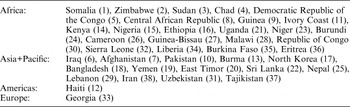
The Fund for Peace Failed States Index 2009 reveals, as did its predecessors, certain regional clusters in which state failure seems more prevalent (see Table 1). Unsurprisingly, sub-Saharan Africa has a high concentration of states vulnerable to failure. Within the geographic area of sub-Saharan Africa (and selected states straddling the boundary between sub-Saharan and North Africa) there are distinct clusters of states threatened by failure that are more closely linked to one another than to others (for example, in the Karamojo Cluster; Horn of Africa; West Africa; Great Lakes Region). On a smaller scale, parts of Central and South Asia are another state failure cluster – Tajikistan, Uzbekistan, Afghanistan and Pakistan – as is the Caucasus with Georgia (and the neighbouring republics in the south of the Russian Federation), Armenia and Azerbaijan.
It is important to note that even within such regional clusters state failure does not necessarily occur simultaneously in all states concerned. For example, Bosnia and Herzegovina experienced state failure during its civil war in the first half of the 1990s, Albania in 1997 following the collapse of a pyramid investment scheme, Serbia and Montenegro has seen continuous weakness for more than a decade and eventually split into two states, leaving Serbia fragmented in relation to Kosovo (followed by a subsequent, Western-backed, unilateral declaration of independence in 2008), while Macedonia was a weak state for most of the 1990s and at the brink of failure in 2001 during an armed rebellion by parts of its ethnic Albanian minority.
Likewise, one needs to note that there are also a number of geographically more isolated instances of state failure: for example, Sri Lanka and East Timor in Asia and the Pacific, and Haiti in the Americas. Yet, geographic contiguity should not be mistaken for actually existing patterns of interaction, while lack thereof does not necessarily invalidate the idea of region-level dynamics of state failure. For example, Indonesia, Papua New Guinea and Solomon Islands, in earlier years considered highly vulnerable to state failure, may be geographically close, but relevant interaction is more obvious in the case of Solomon Islands and Papua New Guinea/Bougainville (another case in point for local-regional connections), than between those two and Indonesia. A different perspective on the wider area of Southeast Asia and the Pacific would be to look at regional links through the prism of international terrorist and criminal networks that have tried and partly succeeded in establishing a foothold in various states, including Indonesia (Bali attacks), Philippines (Mindanao) and Thailand (Muslim provinces in the south). At the same time, the secessionist conflicts in Georgia (South Ossetia and Abkhazia), Armenia/Azerbaijan (Nagorno-Karabakh) and Moldova (Transnistria) may not be geographically contiguous, yet Russian involvement in all three of them indicates an obvious regional dimension. Furthermore, the links established between these conflicts and the resolution of the status of Kosovo also highlights global connections.
The thirty-eight states most vulnerable to failure according to the Fund for Peace Failed States Index 2009Footnote 71

Source: Fund for Peace, Failed States Index 2009Footnote 72
Bearing these empirical observations in mind, it is now necessary to progress towards an analytically more useful and conceptually more precise definition of region in the context of state failure. The existing literatures on regional dimensions of international security and on state failure reviewed above offer a good starting point for arriving at a definition of the regional in the state failure context. Military capability (Lemke), durable patterns of amity and enmity between state and non-state actors (Buzan and Wæver), sets of transnational conflicts forming mutually reinforcing linkages and including military, political, economic, and social networks at the regional level with links to the global level (Rubin), trans-border movements of politically organised, regionally concentrated groups contesting the legitimacy of existing boundaries (Mincheva) and transnational political mobilisation (Adamson) are all necessary elements in a definition of the regional dimension of state failure. Put in a more abstract way, regions are areas ‘in which interactions [are] more intense than at the global level’.Footnote 73 This means that we can empirically identify member states of a region as those who have closer ties with one another than with other countries, including in their own immediate neighbourhood.Footnote 74 Thus, for example, the Democratic Republic of the Congo (DRC) could not be considered a member of a state failure region in the wider Horn of Africa as, apart from Uganda (and sporadically Sudan), it has very little interaction with other states in this region, despite geographical contiguity.Footnote 75
State failure here is defined as inability of state institutions to enforce a monopoly on the legitimate use of force vis-à-vis an existing population and across the entire territory within the internationally recognised boundaries of a state. ‘Regionalising’ this process requires an assessment of the factors that both cause states to lose this essential means of their existence and to identify which categories in turn are affected by this, as well as to analyse which of these are external to a given state but located in its neighbourhood. This requires considering the key element of Lemke's definition of local hierarchies – states other than the great powers that pose a military threat to a given state – and combine it with Rubin's, Mincheva's and Adamson's emphasis on non-state actors operating at the regional level, that is, military, political, economic, social, and as a subcategory of the latter, ethnic networks, that is, the non-state sources of threat.
Two further elements, rarely mentioned in the literature outside the development discourse, are environmental factors and ‘economic proximity costs’ or spill-over costs.Footnote 76 In addition, and not unrelated to the last two sets of factors mentioned, are certain geographical conditions, such as states being landlocked and dependent on neighbours for trade access to the open sea, riparian states dependent on the same water supply source as their neighbours, and dependency on oil pipelines for energy supplies or revenues from transit rights. For example, state weakness in the wider Horn of Africa can potentially be exacerbated by several countries' dependency on a common water resource – the Nile.Footnote 77
Delineating the regional context of state failure in terms of threats emanating from other states with appropriate military capabilities and non-state actors posing a challenge to a given state's sovereignty (that is, its control over the territory within its internationally recognised boundaries) also implies that regions in the state failure context remain state centric, not only because states remain for the time being the predominant (if not the only) form of territorial organisation but also because state failure is only a meaningful category of analysis in the context of these units, with the obvious caveat that there are clear sub-state and regional, as well as global effects and interactions. Thus, spatially, state failure regions are entirely composed of (most likely contiguous) states, while functionally, or at the actor level, they include only specific states (those with an appropriate military capability) and additionally non-state actors who are capable of challenging existing states for empirical sovereignty. This means that, seen from the perspective of a state at risk of failure, its relevant region may include both militarily threatening states as well as states from within whose borders threatening non-state actors are able to operate be it because of mal-intent or loss of empirical sovereignty by that neighbour's institutions. According to the wider range of factors considered here, neighbouring states that are the source of potential environmental threats would also form part of the relevant region, if these are likely to undermine the states affected in their capacity to enforce their monopoly on the legitimate use of physical force on their territory.
Such a definition, therefore, conceptually extends beyond Lemke's local hierarchies, but is narrower than the vast regional security complexes established by Buzan and Wæver.Footnote 78 Both of these other conceptions of ‘region’ remain relevant, however. Lemke's concept provides a key ingredient in the definition of state failure region, while Buzan and Wæver's regional security complexes demarcate the outer limits of potentially contiguous and overlapping state failure regions. In the same way in which in Lemke's definition one state could potentially be a member of different local hierarchies simultaneously, states can also belong to different state failure regions. For example, a Greater Horn of Africa region would include Djibouti, Eritrea, Ethiopia, Somalia, Sudan, and Uganda, while the latter two could also be a component of neighbouring regions, respectively comprising Sudan, Chad, and the Central African Republic; and Uganda, the DRC, Rwanda, and Burundi.
3. Analysing state failure as a regional phenomenon: a levels-of-analysis approach
In 1961, J. David Singer published an article in World Politics entitled ‘The Level-of-Analysis Problem in International Relations’ in which he made a strong case for distinguishing between systemic (global) and subsystem (nation-state) levels for the analysis of various processes in the international system.Footnote 79 While Singer offers good general guidance on the level-of-analysis approach, his counsel is primarily geared towards deciding which one of the two levels that he identifies should be chosen, rather than giving scholars and analysts a choice of combining one or more levels in their analysis. Two years earlier, Kenneth N. Waltz, had offered a consideration of three images (that is, levels of analysis) in accounting for the occurrence of war, and had suggested that neither human nature nor the aggressive behaviour of states alone accounted for war, but rather that the nature of the international system and the expectation of violence within it led to war.Footnote 80 As Jack Levy has pointed out, the levels-of-analysis approach, in the tradition of Singer and Waltz, was subsequently mostly used in International Relations scholarship to classify ‘independent variables that explain state foreign policy behaviour and international outcomes.’Footnote 81 Levy also emphasises that ‘[i]t is logically possible and in fact usually desirable for explanations to combine causal variables from different levels of analysis, because whether war or peace occurs is usually determined by multiple variables operating at more than one level of analysis.’Footnote 82 Despite the traditional focus on states and their relations with one another, there is nothing inherent in the levels-of-analysis approach that would prohibit the extension of its application to non-state actors and structures and to a range of ‘issues’ that fall somewhere outside the actor and structure dichotomy.
The levels-of-analysis model that is proposed here for the study of state failure can be useful in two ways. It can be employed to study state failure as the dependent variable. In other words, it can be used to answer questions about which factors at any of the levels of analysis individually or in combination cause state failure. Yet, it can also serve its purpose as an analytical tool for research designs in which state failure is the independent variable; that is, to investigate questions about the impact of state failure on any one or more factors at any one or more levels of analysis.
The definition of state failure adopted here as synonymous with a lack of empirical sovereignty gives useful indications as to what levels of analysis are appropriate to consider. First, and most obvious, there is the level of the state itself where many of the contests for empirical sovereignty are conducted. Likewise, the discussion of state failure in much of the International Security literature makes it clear that state failure (and its consequences) is a serious and increasing threat to the stability and security of the international system as a whole.Footnote 83 These two levels of analysis – ‘unit’ and ‘system’ in neo-realist parlanceFootnote 84 – are relatively uncontested in the literature on state failure. Yet, the question is how useful they are as an analytical model for the study of such a complex phenomenon. My contention is that both these levels can become more useful if they are further disaggregated by adding a sub-state and a regional level. This can be justified empirically and analytically, as well as with reference to an existing body of literature.Footnote 85
State failure, in addition to being a phenomenon observable at the state level, also has a sub-state dimension as contests for empirical sovereignty are not always conducted across the entire territory for which juridical sovereignty is claimed.Footnote 86 In other words, not all such contests are necessarily about control of the entire state, but some of them can also be for parts of a given state's territory. This idea of the fragmented state (in other words, a state that only partially upholds a monopoly on the legitimate use of violence) is often connected with secessionist conflicts; that is, conflicts in which one party seeks to claim empirical and juridical sovereignty for a specific territory (such as Tamils in Sri Lanka, Kosovo Albanians in Serbia, Kosovo Serbs in Kosovo). Other instances of fragmented states are linked with natural resource exploitation and/or predation: for example, oil- or diamond-rich parts of a state's territory may experience locally-concentrated struggles for control of these resources involving local actors, state actors, and/or outside forces or their local proxies (such as the eastern part of the DRC). In some cases, local control of resources is instrumental for a full-scale assault on the empirical sovereignty of an existing state, that is, for complete state control (for example, Charles Taylor's struggle for control of Liberia).
For the purposes of studying state failure, the employment of ‘region’ as an analytical category is empirically appropriate and analytically useful because there are clear links between the local and state levels of analysis, on the one hand, anda regional level of analysis, on the other. For example, identity groups divided by state borders may support each other in various struggles for rights, development, a share in, or control over, local resources, secession, etc. This can affect groups who do not control any state themselves (for example, the Kurds), or who control the state in one country, but are minorities in another (for example, Serbs in Serbia, Croatia and Bosnia and Herzegovina). When it comes to religiously defined groups, majority-majority configurations are also conceivable, as is the case with Shi'a in Iran and neighbouring Iraq. Local-regional connections can also exist through distribution of natural resources – the uneven distribution of grazing land in the Karamojo cluster has led to frequent clashes between groups in an area straddling Ethiopia, Kenya, Uganda, and Sudan in which none of these four states exercise permanent empirical sovereignty. Diamond and precious mineral concentrations in the eastern part of the DRC have attracted criminal gangs in pursuit of easily lootable commodities from neighbouring Uganda, Rwanda, and Burundi. The latter example at the same time also exemplifies links between the state and regional levels: neighbouring states, in particular Uganda have used proxies and on some occasions regular armed forces to obtain control over local mines in the eastern DRC.
These empirical examples also establish a need to distinguish between a regional and a global level of analysis, rather than to subsume both of them into a single ‘external’ category. For example, links between the state level and regional level in Iraq clearly highlight the different impact of, and on, factors at the global level of analysis. Thus, the multinational coalition of forces in Iraq were differently affected by Iraq's failure as a state in the first years after the fall of Saddam Hussein, and had a different impact on it, than the terrorists of al-Qaeda. Also, the inability of Iraq to supply oil and gas at levels that one would expect in relation to its reserves in many ways benefits its resource-rich neighbours in the region (as well as other oil- and gas-producing countries elsewhere in the world), but carries a cost for the global economy.
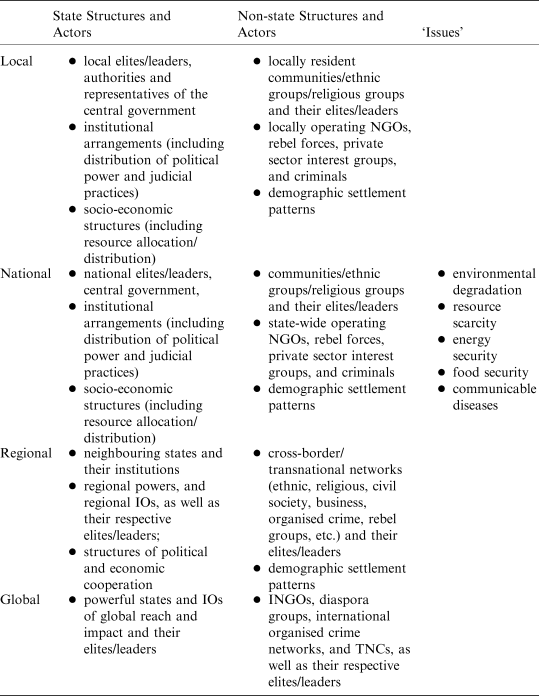
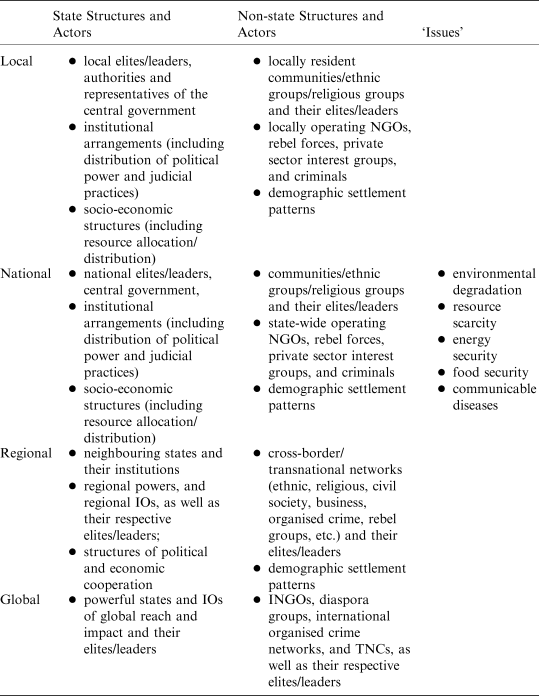
State failure is, thus, best studied as a phenomenon that is caused by, and has consequences for, agents and structures at sub-state, state, regional and global levels, as well as a range of ‘issues’ that cannot easily be classified as either actor- or structure related. These include environmental degradation, resource scarcity, energy security, food security, communicable diseases, etc., all of which by their very nature can not easily be ‘assigned’ to one particular level of analysis, but rather straddle several levels. As an analytical model, this approach is summarised in Table 2.
The levels-of-analysis approach to the study of state failure
Conclusion
Stewart Patrick has recently asserted that
[t]he scholarly community has an important role to play in elucidating the diverse sources and expressions of state fragility; clarifying and mapping the connection between particular forms of weakness and specific transnational ‘spillovers’; and placing any linkages in the context of an integrated global system in which causality may flow in multiple directions.Footnote 87
Studying state failure as a regional phenomenon, and developing the necessary analytical tools to do so, can bring a variety of gains in knowledge and understanding along those lines. The first such gain is closely related to a lack of consensus over what constitutes a weak, fragile, failing or failed state: there is some common ground among academics and practitioners about clear-cut cases of state collapse, and combining this consensus with a regional approach might make debates over other states that are variably considered to be somewhere on the road to failure/collapse with no precise agreement on the point at which they are superfluous. Defining a state failure region would empirically include these states regardless of what their momentary levels of empirical sovereignty are and highlight the fact that there is a broader regional problem in need of addressing. Consequently, second, ‘regionalising’ state failure leads to a more precise definition of what ‘region’ means in the context of state failure, that is, what the spatial and functional dimensions and extent of relevant regions are.
Thus, third, and closely related to the first two anticipated gains, understanding spatial and functional dimensions of regions in the state failure context can generate a better understanding of regional structures, actors and dynamics and of their impact on processes of state failure and vice versa. With regional dimensions more clearly defined and structures, actors and dynamics more clearly determined, that is, with a more thorough distinction of the regional from the state and global levels, ‘regionalising’ the state failure debate would also imply arriving at a more comprehensive understanding of the interplay between the different levels of analysis (local, state, regional, global) and the factors that can be attributed to them in causing, managing and preventing state failure.
Finally, using a regional approach to state failure can in future research be used for more systematic cross-regional comparisons in an effort to investigate similarities and dissimilarities across regional patterns of state failure, and the analytical model developed here offers an opportunity to do so.