INTRODUCTION
Leucothea multicornis (Quoy & Gaimard, Reference Quoy, Gaimard and Freycinet1825), originally described as Beroe multicornis, was reported as present ‘…en grand nombre dans la Méditerranée’ (Quoy & Gaimard, Reference Quoy, Gaimard and Freycinet1824–1826, p. 574). Chun (Reference Chun1878, p. 206), who described it (as Eucharis multicornis), considered the species ‘…eine charakteristischsten und am constantesten auftretenden pelagischen Formen’ in the Gulf of Naples. Lesson (Reference Lesson1843, p. 77), who recorded the species' presence (as Chiaja neapolitana) in the Gulf of Naples, waxed lyrical: ‘La nuit sa phosphorescence est telle qu'elle jette un vif éclat lumineux sur les vagues’. However, Delle Chiaje (Reference Delle Chiaje1841, p. 111), who also described the species from the Gulf of Naples (as Alcynoe papillosa), remarked on its sporadic occurrence: ‘nella Riviera di Chiaia da Aprile a Maggio 1829 ne ho riveduto qualcheduna nel 1840’.
Leucothea multicornis is widely distributed in subtropical and temperate waters (Oliveira & Migotto, Reference Oliveira and Migotto2006), and has been recorded in the Mediterranean from the Alboran Sea (Mills et al., Reference Mills, Pugh, Harbison and Haddock1996), Bay of Villefranche, France (Graeffe, Reference Graeffe1858), Sardinia (Fedele, Reference Fedele1940), Sicily (H. Milne Edwards, Reference Milne Edwards1857), Malta (Deidun, Reference Deidun2011) and the northern Adriatic Sea (Cori & Steuer, Reference Cori and Steuer1901; Steuer, Reference Steuer1903; Stiasny, Reference Stiasny1909, Reference Stiasny1910, Reference Stiasny1911, Reference Stiasny1912; Babić, Reference Babić1911; Krumbach, Reference Krumbach1911; Issel, Reference Issel1922, Reference Issel1925), where it was reported the species appears ‘…in swarms near the coast in December and April’ (Shiganova & Malej, Reference Shiganova and Malej2009, p. 64). Konsulov (Reference Konsulov1990, p. 98) reported the occurrence of ctenophores in 1986, 20–30 miles (32.187–48.280 km) off the Bulgarian coast of the Black Sea, which reappeared in 1988 in great masses. These were initially identified as Mnemiopsis leidyi A. Agassiz, 1865, but later considered ‘most probably’ L. multicornis. We believe that these ctenophores were indeed M. leidyi.
In the course of recent studies of the biota off the Mediterranean coast of Israel, photographs were taken of an unfamiliar ctenophore. Upon examination it was identified as L. multicornis. In the present paper we report the first record of the species from the Levantine Basin of the Mediterranean Sea.
RESULTS
SYSTEMATICS
Order LOBATA Eschscholtz, Reference Eschscholtz1825
Family LEUCOTHEIDAE Krumbach, 1925
Genus Leucothea Mertens, 1833
Leucothea multicornis (Quoy & Gaimard, Reference Quoy, Gaimard and Freycinet1825)
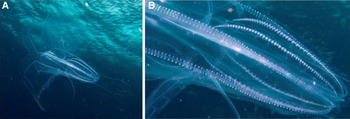
(Figure 1 A, B)
Beroe multicornis Quoy & Gaimard, Reference Quoy, Gaimard and Freycinet1824.
Eucharis multicornis—Eschscholtz, Reference Eschscholtz1829: 31; Chun, Reference Chun1878: 206; Reference Chun1880: 296, pl. 4 figure 7, pl. 5 figures 1–3, pl. 9; Cori & Steuer, Reference Cori and Steuer1901: 115; Stiasny Reference Stiasny1909: 290, Reference Stiasny1910: 586, Reference Stiasny1911: 518, Reference Stiasny1912: 605; Babić, Reference Babić1911: 228; Krumbach, Reference Krumbach1911: 315; Issel, Reference Issel1922: 10, Reference Issel1925: 11.
Alcynoe papillosa Delle Chiaje, Reference Delle Chiaje1841: 111, pl. 150.
Chiaja neapolitana Lesson, Reference Lesson1843: 77, pl. 4.
Chiaja palermitana H. Milne Edwards, Reference Milne Edwards1857: 287, pl. 14.
Alcinoë papillosa Graeffe, Reference Graeffe1858: 40, pl. 9, figure 1.
Leucothea multicornis—Rossi, Reference Rossi1971: pl. 4, figure 35f; Mills et al., Reference Mills, Pugh, Harbison and Haddock1996: 160; Shiganova & Malej, Reference Shiganova and Malej2009: 64, figure 2c; Deidun, Reference Deidun2011: 6, figure 2.
Leuchothea multicornis Fedele, Reference Fedele1940: 166.
Not Leucothea multicornis—Konsulov, Reference Konsulov1990: 98 [= Mnemiopsis leidyi, A. Agassiz, 1865].
Leucothea multicornis, photographed off Shavei Zion, Israel, May 2014 (photograph by B. Rothman): (A) total view of specimen; (B) close-up view, with cylindrical papillae.

MATERIAL EXAMINED
Mediterranean Sea: Israel, 3 km west of Shavei Zion, 32.98282°N 35.066214°E, water depth 26 m, 6 May 2014 and 16 May 2014. Specimens were observed and photographed, though not collected. The voucher photographs were deposited in the Steinhardt National Natural History Museum and Research Center, Tel Aviv University, Israel. Ashdod Port breakwater, 31.842566°N 34.634399°E, water depth 17–20 m, 30 May 2014 and 11 June 2014.
DIAGNOSIS
Body, about 20 cm in length, compressed along tentacular axis, surface bearing numerous cylindrical papillae (Figure 1A, B). Two delicate lobes subdivided in two, arising between mouth mid-length. Subtentacular ctene rows about half size of substomodeal ctene rows. Cteneal rows arising near aboral margin, the former extending to base of lobes, the latter to margin of lobes. Subtentacular meridional canals visible inside lobes. Apical organ at aboral end of pharynx. An extendable axial tentacle near mouth at each side of flattened pharynx, usually trailing aborally. Four long auricles arising at oral end of subtentacular ctene rows between mouth margin and base of lobes. Nearly translucent, cteneal rows shimmering.
REMARKS
Ever since the mid-1980s, when the annual swarms of the Erythraean invasive scyphozoan Rhopilema nomadica Galil, Reference Galil, Spanier and Ferguson1990 were noted in the Levant (Galil et al., Reference Galil, Spanier and Ferguson1990), the gelatinous macrozooplankton along the Mediterranean coast of Israel was tracked. The American comb jelly, Mnemiopsis leidyi, was first noted off Israel in 2009, when a swarm interfered with the operation of a desalination plant (Galil et al., Reference Galil, Kress and Shiganova2009), and has been intermittently observed along the Israeli coast ever since (Galil & Goren, Reference Galil, Goren, Goffredo and Dubinsky2013). The American brown comb jelly, Beroe ovata sensu Mayer, 1912, was first recorded off Israel in 2011 (Galil et al., Reference Galil, Gevili and Shiganova2011), and in the winter months of 2012 and 2013 aggregations of the native comb jelly Beroe cucumis sensu Mayer, 1912 were observed along the Israeli coast preying on the M. leidyi (Galil & Gevili, Reference Galil and Gevili2013). During May and June 2014, on different dates and locations, specimens of L. multicornis were noted for the first time along the Israeli coastline. We believe its sudden appearance is indeed a new record in the eastern basin of the sea as it is highly unlikely that such a large species, markedly different from all known ctenophores in the region, would remain unreported till the 21st Century.
Periodic outbreaks of gelatinous zooplankton have long been noted in the Mediterranean Sea (UNEP, 1991; CIESM, 2001; Boero, Reference Boero2013). Though lacking a long-term zooplankton monitoring programme, the evidence of recent increases in native and alien ctenophore abundance along the Levant coast is irrefutable. Both transient localized blooms and longer-term persistent increases have been documented, indicating changes in the structure and function of the Levantine ecosystem.
ACKNOWLEDGEMENTS
The authors are grateful to Dr Dragos Micu, National Institute for Marine Research and Development (NIMRD) ‘Grigore Antipa’, Constanta, Romania, for his help in obtaining a copy of Konsulov's publication and providing a translation. Partial support for this research was provided by the European Community's Seventh Framework Programme (FP7/2007-2013) for the project Vectors of Change in Oceans and Seas Marine Life, Impact on Economic Sectors (VECTORS) (B.S.G.).