Universities are facing what are arguably the biggest changes and challenges to the sector in its history (Altbach, Reisberg, & Rumbley, Reference Altbach, Reisberg and Rumbley2009; Ernst & Young, 2012). Among the challenges cited are: globalisation; increasing numbers (‘massification’) and diversification of students, and the subsequent changes to the objectives of university education; financial pressures and changing economic situations, including privatisation of higher education; the changing nature of knowledge and thus changes in the ownership, dissemination and creation of knowledge; and the pervasive impacts of technology (Altbach et al., Reference Altbach, Reisberg and Rumbley2009; Andrade, Reference Andrade2011; Biggs & Tang, Reference Biggs and Tang2011; Ernst & Young, 2012). It is within this context that sustainability educators are arguing for a transformational change of university curricula to contribute to more sustainable futures.
More than 20 years since the 1992 United Nations Conference on Environment and Development, and following the United Nations Environment Program's Decade of Education for Sustainable Development (2005–2014), we do not need to revisit the case for Education for Sustainable Development (ESD) in universities. Rather, we are left to wonder why, after all this time and discussion, ESD, or Education for Sustainability (EfS)Footnote 1 does not have a more prominent position in the curricula of universities. In 2011, Tilbury commented that, worldwide, ‘the majority of the universities engaged with sustainability are preoccupied with the greening of the campus’ (p. 19). Specifically considering the universities’ curriculum, Tilbury went on to conclude that ‘(t)here is evidence to suggest that HE (higher education) does not understand the true nature of the challenge. . . . Curriculum and pedagogy, which are at the core of HE experiences, need to be transformed if universities and colleges are to make a meaningful contribution to sustainable development’ (2011, p. 24), although some specific local instances of progress were acknowledged. Also reflecting on the status of EfS globally, lack of curriculum action was noted by Sterling and Maxey (Reference Sterling, Maxey, Sterling, Maxey and Luna2013, p. 6), who commented that:
(f)or many universities . . . the overarching context of sustainability . . . is simply not recognised. . . . (greening campus operations) is valuable and necessary, but not sufficient, and often only marginally influences curriculum and learning — long recognised as the most intractable part of the university's operation.
Moving to the institutional scale, Katayama and Gough (Reference Katayama and Gough2008, p. 421) find that:
Commitment to sustainable development at the university level does not guarantee uniformly committed teaching and the existence of committed teaching is not associated with increased institutional commitment in any very clear way.
While these conclusions refer to their study of British universities, indications are that the situation is similar in Australia (Christie, Miller, Cooke, & White, Reference Christie, Miller, Cooke and White2015; Lang, Thomas, & Wilson, Reference Lang, Thomas and Wilson2006). So, while there may be interest from universities, there is no clear evidence that EfS has been absorbed across the suite of educational offerings at any Australian university, or that EfS is an influential player at a majority of our universities. This is not to dismiss the impressive changes that have been achieved by many individuals (noted by Christie et al., Reference Christie, Miller, Cooke and White2015) in operations and academic areas, and the moves by universities to engage with EfS. However, in the light of assessments of the status of EfS and its rate of implementation, the factors that influence this implementation require analysis. Those who have been involved in promoting EfS for some time are likely to feel frustrated or worse at the low level of change that has been achieved to date. Newcomers to the EfS territory, who are passionate to see change, may be perplexed as to why EfS is not central to their university. We are also concerned at the slow rate of change, yet when we look at the complexities involved with introducing change into universities, it is commendable that some have achieved even subject/course level change.
Our research has grown from the work of others who have considered the curriculum change process within universities and its relevance to EfS; for example, Shephard (Reference Shephard2010), and Thomas, Hegarty, and Holdsworth (Reference Thomas, Hegarty and Holdsworth2012). Thomas et al. argue that effective change is the outcome of the alignment of the following factors: organisational change; academic development; curriculum, learning and teaching and pedagogy; the relationship between the curriculum and place (i.e., the campus); graduate attributes; and professional bodies and accrediting bodies. This framework demonstrates that effective curriculum change could be understood using the ‘jigsaw’ metaphor, where each piece of the institution — and its immediate networks — has an important role to play. Such an approach demonstrates that agency occurs through relationships, and we have endeavoured to incorporate such an approach into our analysis. As such, we see agency — in our case, the source of action pushing for change — as an attribute located both within and between actors. Our analysis of the literature, after defining change and outlining the complexity of the situation, therefore discusses how individual actors can effect change through engaging in top-down or bottom-up strategies, and the role that organisational culture plays in facilitating or hindering change.
We began with some broad research questions, such as: ‘How does transformative curriculum change happen in universities, and what can we do to make this happen?’ We specifically set out to seek insight from beyond the work on EfS implementation, to gain guidance from other fields. Available literature formed the basis of the research. We began searching academic databases (including Proquest, Web of Science, Science Direct) and Google Scholar, employing a snowball technique, initially using the keywords ‘curriculum change universities’. As we learned more about the issues from the papers we found, our keyword vocabulary diversified, allowing us to search for more relevant sources, and we also located key references that were cited by the papers we had found. Both peer-reviewed research and reports (grey literature) on change and, in particular, curriculum change in Western universities,Footnote 2 were accessed. This allowed us to arrive at a broad overview of the range of studies of curriculum change in universities, including the influential work of key authors.
We do not attempt to develop theory from these sources; rather, we offer a summary of the implications such insights and theories pose for EfS. We anticipate that the review of such work enables EfS practitioners to identify literature and theories that can help inform their curriculum change attempts, and that EfS researchers can use these theories to improve research on the implementation of EfS in universities.
We begin by outlining the literature's understanding of the nature of curriculum change and the barriers identified to achieving this within the university sector. Second, we review some of the drivers of curriculum change identified in the literature, followed by a discussion of the importance of identifying and working with institutional culture. The majority of curriculum change literature is designed for senior staff and management; however, we realise many of our readers striving for change may not occupy such positions. We therefore outline some research on the benefits, challenges and methods for striving for change ‘from below’, followed by a review of some principles to make top-down change more effective. Finally, we look to the ‘diversity agenda’, a project with similar pedagogical objectives that has had arguably more success than EfS, to establish any lessons we can learn. We anticipate that this literature review will provide practical insight for change agentsFootnote 3 into the most useful methods and techniques for facilitating the implementation of EfS more deeply within institutions, and more broadly across the sector, which we summarise in the conclusion. We also conclude with some questions that the review raises for EfS implementation that EfS researchers may be interested in pursuing.
Curriculum Change as Transformational Organisational Change
Implementation of EfS requires transformational curriculum change (Scott, Tilbury, Sharp, & Deane, Reference Scott, Tilbury, Sharp and Deane2012). The curriculum underlies what is learned by the learner and thus is entwined with the content of lesson plans and the broader pedagogy, and takes account of learning experiences that occur outside the classroom (Holdsworth & Thomas, Reference Holdsworth, Thomas, M'Sirdi, Namaane, Howlett and Jain2012). As a consequence, curriculum change is more than providing additional content to one course. Rather, we are looking at changes to subjects/courses, programs, disciplines, and university experiences. These changes are equivalent to organisational change, since individuals, groups and administrative structures are involved in the change process, as discussed by de la Harpe and Thomas (Reference de la Harpe and Thomas2009). This could be considered a straightforward planning exercise, yet Eckel and Kezar (Reference Eckel and Kezar2002) point out that the complexity of curriculum change requires transformational organisational change, which requires more nuanced approaches. Such transformational organisational change is characterised by Eckel, Hill, and Green (Reference Eckel, Hill and Green1998, p. 3) in their widely cited report for the American Council on Education as change that:
(1) alters the culture of the institution by changing select underlying assumptions and institutional behaviors, processes, and products; (2) is deep and pervasive, affecting the whole institution; (3) is intentional; and (4) occurs over time.
The effect of such transformational change is both institutional and personal; as Holley (Reference Holley2009, p. 334) observes, it affects ‘how members of the organization view themselves and the work in which they are engaged’. Hence, broadly speaking, curriculum change is a challenge.
Complications of Change in Universities
The lack of implementation of curriculum change — in our case, for EfS — is not a failure of knowing what to change; the problem is understanding how to institutionalise such change (Merton, Froyd, Clark, & Richardson, Reference Merton, Froyd, Clark and Richardson2009). Although much research exists exploring change in institutions, this research often refers to government institutions and corporations. However, universities have distinct characteristics such as revenue and opportunity constraints, complex governance structures, high levels of participation by staff, and lack of a specific group responsible for broad-scale change (de la Harpe & Thomas, Reference de la Harpe and Thomas2009). Consequentially, conventional organisational change literature does not translate directly to universities (Anderson & Johnson, Reference Anderson and Johnson2006; Eckel, Green, Hill, & Mallon, Reference Eckel, Green, Hill and Mallon1999). Kezar (Reference Kezar2001) argues that this organisational change theory falls into six categories, each drawing on different assumptions and analytical methods: evolutionary, teleological, life cycle, dialectical (political), social cognition, and cultural. Specifically, Kezar (Reference Kezar2001) argues that the political, social cognition and cultural models are most relevant to higher education, and most research on change in higher education draws on these. These models’ key features (respectively) are that: change is a bargaining process that negotiates the inherent power and ideological conflicts that arise; that change requires learning to develop new meanings and ways of knowing; and that change challenges values, beliefs and assumptions (Kezar, Reference Kezar2001).
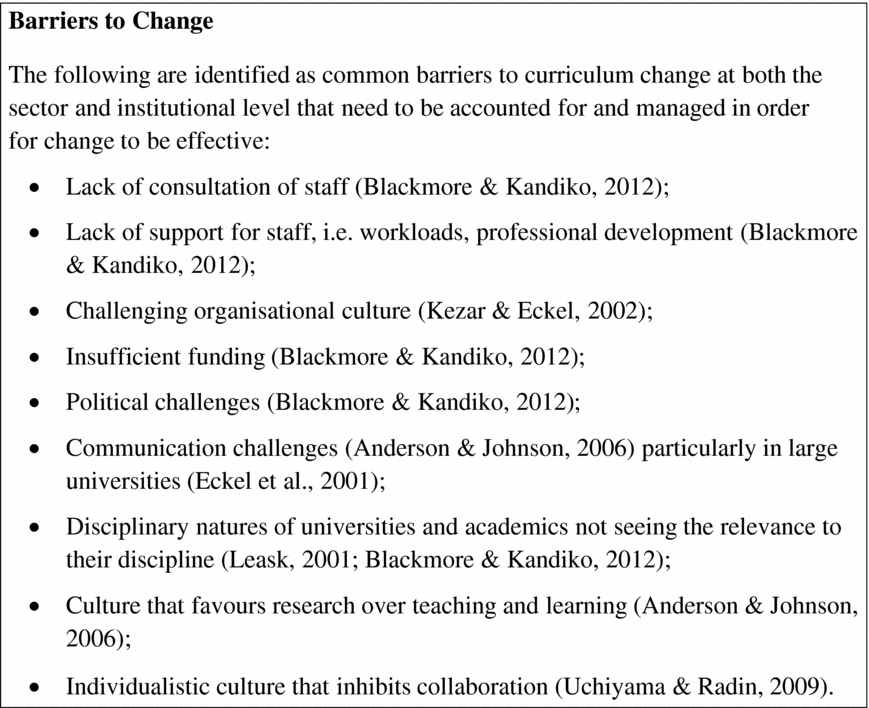
This recognises that universities are complex places with many actors that are subject to varying influences (Blackmore & Kandiko, Reference Blackmore, Kandiko, Blackmore and Kandiko2012). Glazer (Reference Glazer1968, p. 404) noted ‘it is rather easier to change the world than to change the university’, and a considerable body of research supports this sentiment (Arnold, Reference Arnold2004; Baldwin & Bauman, Reference Baldwin and Baumann2005; Blackmore & Kandiko, Reference Blackmore, Kandiko, Blackmore and Kandiko2012; Boyce, Reference Boyce2003; Eckel & Kezar, Reference Eckel and Kezar2002; Merton, Froyd, Clark, & Richardson, Reference Merton, Froyd, Clark and Richardson2009). While there is little research on change in universities in general, even less research focuses specifically on curriculum changes in universities (Anderson & Johnson, Reference Anderson and Johnson2006); however, that which does finds that the larger the university, the more complex the networks and thus the more challenging the change process (Anderson & Johnson, Reference Anderson and Johnson2006; Boyce, Reference Boyce2003; Eckel, Green, & Hill, Reference Eckel, Green and Hill2001). Researchers agree that changing the curriculum — or any organisational change — in higher education is a challenging task (Baldwin & Bauman, Reference Baldwin and Baumann2005; Boyce, Reference Boyce2003) and often fails to meet the expectations of the change agents (Arnold, Reference Arnold2004; Blackmore & Kandiko, Reference Blackmore, Kandiko, Blackmore and Kandiko2012; Eckel & Kezar, Reference Eckel and Kezar2002; Merton et al., Reference Merton, Froyd, Clark and Richardson2009) due to the gap between knowledge and ideas of what to change and capacity to institutionalise change (Merton et al., Reference Merton, Froyd, Clark and Richardson2009). Researchers have identified any number of barriers to curriculum change (see Figure 1) that may represent substantial challenges. They also represent developing insight into the change processes at universities, and therefore understanding of how change can be planned for. Development of such understanding is the focus of the following sections.
Barriers to change.

Concepts Promoting Change
Five broad drivers of curriculum change in universities have been identified by Arthur (Reference Arthur2007):
• market driven (e.g., student demand, employer demand);
• neo-institutional (pressure from governments or copying other successful higher education institutions);
• faculty/academic driven (‘bottom up’);
• student driven (‘bottom up’);
• centrally planned by senior management (‘top down’).
The first two are to a large extent outside the areas of influence of universities. However, the others are to a large degree under the control of universities themselves and are the focus of our interest.
The centrally planned or rational ‘strategic planning’ approach is where a small group of leaders articulate a vision and implement procedures and structures to achieve this. These models hold expectations for universities that assume that academics’ and the institutions’ behaviours are rational. Arnold (Reference Arnold2004) argues that these expectations may be unrealistic, as in reality, universities are political and actors will have their own agendas that will inevitably influence decision making. Recognising this situation, Simsek and Louis (Reference Simsek and Louis1994) reject the rational top-down approach, arguing that an interpretive philosophical approach is more effective in leading to genuine change. This approach acknowledges the variety of actors, their motivations, and that change is a journey rather than a goal. Rational approaches, Simsek and Louis (Reference Simsek and Louis1994) argue, lead to changes that are shallow and not necessarily the deep changes in values and assumptions that are required for transformational change.
Blackmore and Kandiko (Reference Blackmore, Kandiko, Blackmore and Kandiko2012) found that such central/top-down planning strategies are those which are most frequently employed by universities, and Eckel et al. (Reference Eckel, Green, Hill and Mallon1999) note that such top-down changes often happen faster. However, both articles concur with Simsek and Louis (Reference Simsek and Louis1994) that top-down change is fraught with challenges and may not be as pervasive. In contrast, Arnold (Reference Arnold2004) asserts that strategic planning that results in symbolic change rather than genuine behavioural change is still significant and may eventually lead to the desired change over time through reorienting academics’ values, beliefs and priorities.
Thus, taking into account the complexities of university politics and organisational structures may help to set more realistic goals (Arnold, Reference Arnold2004; Blackmore & Kandiko, Reference Blackmore, Kandiko, Blackmore and Kandiko2012; Simsek & Louis, Reference Simsek and Louis1994). Additionally, some researchers argue that change should be conceived of as a process, rather than as an outcome (Simsek & Louis, Reference Simsek and Louis1994; Walkington, Reference Walkington2002), in which case the otherwise seemingly irrelevant issues brought up by actors in discussion become components of the change agenda rather than a barrier. Andrade (Reference Andrade2011) argues that this also brings to light new opportunities and possibilities.
However, Simsek and Louis (Reference Simsek and Louis1994) argue against the common assertion that universities are ‘organised anarchies’, and transformational change is therefore always difficult or impossible; rather, they concluded that in their case study of an American university, transformational change did happen. Notably, the study covered a 10-year period and Simsek and Louis acknowledged that the change was not complete at the end of their research. Similarly, Blackmore and Kandiko (Reference Blackmore, Kandiko, Blackmore and Kandiko2012) note that curriculum change is possible, yet most projects’ formal implementation takes 5–10 years. Similarly, Kezar's (Reference Kezar2012) case studies required 10–15 years to achieve, or not achieve, what they had aimed for. Eckel et al. (Reference Eckel, Green and Hill2001) found similar timeframes, also arguing that change never ends; most of the 26 institutions whose change initiatives they followed had modified their change agenda within 3 years of the study beginning. Evidently the changes are not complete or finished once the implementation is finalised as the curriculum is continually modified and negotiated. Thus, for successful sustained change, continual organisational learning through monitoring, reflecting and ongoing motivation is required (Blackmore & Kandiko, Reference Blackmore, Kandiko, Blackmore and Kandiko2012; Boyce, Reference Boyce2003).
The Role of Organisational Culture
Eckel and Kezar (Reference Eckel and Kezar2002) argue that most curriculum change literature and guidelines, such as those discussed above, are either too broad and general, or too case-study specific to be of practical use to change agents. Their work advocates using culture as an intermediate level strategy to understand change efforts. In this context, culture can be thought of as ‘deeply embedded patterns of organizational behavior and the shared values, assumptions, beliefs, or ideologies that members have about their organization or its work’ (Peterson & Spencer, Reference Peterson and Spencer1990, p. 6).
Using the cultural lens can allow change makers to more effectively recognise how conflicts at the institutional level may arise (Tierney, Reference Tierney1988). Tierney's argument is that each higher education institution would have a different and specific culture that would need to be understood thoroughly, and that this understanding must be developed through analysis of the institution's environment, mission, socialisation processes, information dissemination, decision-making processes, and leadership. Tierney concludes by encouraging more research into cultural frameworks. In this context, Schein (e.g., Reference Schein2010) has identified three levels of culture: artifacts (observable, material or tangible structures, processes or behaviours); values and beliefs (intangible but conscious, articulated or espoused goals and aspirations); and underlying assumptions (unconscious, taken for granted). Schein's levels are frequently cited as a valuable framework for analysing institutional culture (e.g., Awbrey, Reference Awbrey2005).
Also useful is Berquist's model, which Eckel and Kezar draw on substantially. Berquist's model (as cited in Eckel & Kezar, Reference Eckel and Kezar2002) describes four common institutional cultures that universities may practise. In each of these four cultures, particular value sets can be identified, that is:
• collegial culture — valuing scholarly engagement, shared governance and decision making, and rationality;
• managerial culture — valuing efficiency, effective supervisory skills, and fiscal responsibility;
• developmental culture — valuing personal and professional growth of all members of the collegiate environment;
• negotiating culture — valuing establishment of equitable and egalitarian policies and procedures, valuing confrontation, interest groups, and mediation.
Each of Berquist's models may be present in a university, even if predominately associated with a specific aspect of the university (e.g., an academic department), and they may overlap (Eckel & Kezar, Reference Eckel and Kezar2002). Also, we are likely to see changes in the dominant culture over time and throughout the university. Further, the increasing size of universities brings with it an increased focus on a management culture: as Marginson and Considine (Reference Marginson and Considine2000, p. 4) report, the ‘(u)niversity purpose is now defined by forms of strong executive control’.
Based on the experience from case studies of American higher education institutions Eckel and Kezar (Reference Eckel and Kezar2002) found that significant curriculum change programs that violate an institutional culture would inevitably lead to change being unsuccessful. In this context, broad statements, such as needing ‘an effective vision from the top, coupled with consultation and engagement with teaching staff’, are not sufficient to effect change. Rather, curriculum change efforts need to reflect and respond to the cultural context of the institution and the wider social context, including the politics of the change agenda. As noted by Lattuca and Stark (Reference Lattuca and Stark2009, p. 301):
Successful leadership for such changes must recognize and build upon the college or university culture, including its institutional traditions, norms, and values; politics and power; individual and collective beliefs and attitudes related to proposed changes; and existing social relations and practices.
This is supported by research from Arnold (Reference Arnold2004), Arthur (Reference Arthur2007), Blackmore and Kandiko (Reference Blackmore, Kandiko, Blackmore and Kandiko2012), and Merton et al. (Reference Merton, Froyd, Clark and Richardson2009).
Bates, Khan, and Pye's (Reference Bates, Khan and Pye2000) four-phase culturally sensitive change process is a useful way to envision how to implement such cultural analysis into change processes. First, these authors suggest it is important to map/brainstorm the problem and desired state in cultural, as well as structural terms (they term this ‘cultural framing’) — here Schein's levels and Berquist's models may be useful. Second, test out new strategies without locking anything in (‘soft structuring’). Third, drawing on the outcomes and insight from the first two phases, formalise and operationalise the change proposal (‘hard wiring’); and finally, continue to reflect and evaluate the changes including through the cultural lens (‘retrospecting’).
Localising Curriculum Change: From the ‘Bottom-Up’
Most research on curriculum change within higher education focuses on top-down changes (Kezar, Reference Kezar2012). However, individual academics often implement curriculum change on their own initiative. The challenge for change agents is to facilitate more academics to change, which may involve influencing institutional policy, but this may not be necessary if change agents can inspire change from the bottom up. As Katayama and Gough (Reference Katayama and Gough2008, p. 421) comment, ‘the most effective “top-down” policy may prove to be that which best facilitates “bottom-up” activity’.
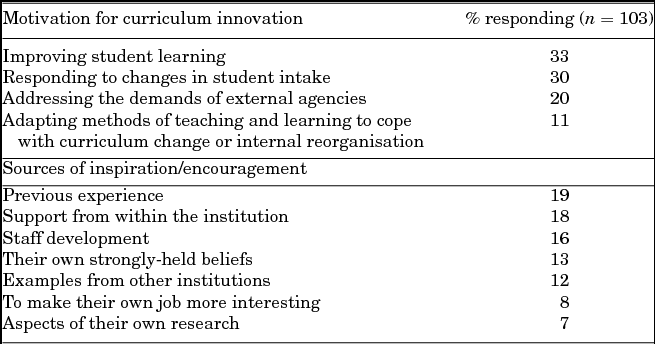
Hannan, English, and Silver (Reference Hannan, English and Silver2006) were interested in what motivates individual academics to innovate with pedagogy where there is no higher level incentive to do so. Data from interviews conducted by Hannan et al. (Reference Hannan, English and Silver2006) are summarised in Table 1, which indicate the importance of specific motivations and inspirations/encouragements for changing curriculum. The researchers also noted that funding seemed to be a facilitating rather than motivating factor. Further, they observed that most academics understood that focusing energy on teaching and learning, rather than pursuing research, was a career hazard, similar to Frost and Teodorescu's comments (Reference Frost and Teodorescu2001). The hazard, Frost and Teodorescu (Reference Frost and Teodorescu2001) point out, is due to the lack of value that is placed on teaching and learning in higher education institutions.
Motivations and Sources of Inspiration and Encouragement for Academics to Change Curriculum
Note: Sourced from Hannan et al. (Reference Hannan, English and Silver2006).
From the study by Hannan et al. (Reference Hannan, English and Silver2006), we can see that curriculum change agents can work on the basis that academics’ main motivation to innovate is their concern for students, in regard to both students’ learning and responding to their needs. Additionally, academics’ motivation may not have to rely on the institution, since their own experience and beliefs will be significant encouragement. However, the findings reported by Hannan et al. (Reference Hannan, English and Silver2006) were with staff who had been the initiators of curriculum innovation. Thus, their motivations may be different to those who are not innovators and may have other interests. Clark (as cited in Merton et al., Reference Merton, Froyd, Clark and Richardson2009, p. 225) argues that academics can be self-interested, other-interested, and/or ideal-supporting. Each group will likely have different motivations for changing curriculum, and change agents would need to provide or highlight incentives that can adapt to this range of agendas.
Combined with expressions of leadership and power from the top of an institution, such grass roots change initiatives may lead to changes that are more successful than if the initiators had been without support from the top. However, Kezar's (Reference Kezar2012) case studies of academics implementing change from the bottom up also identified some limitations of combinations with top-down processes: specifically, that the interests of the top may be fundamentally different and thus the involvement of the top may subvert the project; or, too much support may undermine the project by bringing in change too quickly.
To promote change through partnerships with management, the grass-roots change agents reported in Kezar's (Reference Kezar2012) case studies adopted a range of approaches, specifically:
• managing the timing of key actions and seizing opportunities;
• ‘translating’ or learning the language of those in authority;
• being members on committees;
• sensitising (introducing) those in power to the change initiative;
• having strong negotiation skills;
• creating coalitions with other initiatives; and
• getting support from outside.
They also identified several key challenges that they faced:
• the bottom-up participants not realising their interests were different from the top;
• the appearance that the top was usurping the initiative;
• too much scepticism from leaders of the change movement about those in power; and
• the grass-roots agents being perceived as selling out for engaging those in power (Kezar, Reference Kezar2012).
These insights provide a guide for other change agents; however, a factor in curriculum change initiatives missing to date, and a key stakeholder in the outcome, is the student body. Arthur (Reference Arthur2007) argues that change is likely to be most effective when students and academics work together as ‘insider activists’ taking account of institutional context and culture. Yet very few curriculum change projects reviewed by Anderson and Johnson (Reference Anderson and Johnson2006) indicated the intent to engage with students as potential sources of knowledge on good teaching/learning, or to measure the effectiveness of the staff leadership development via testing students’ learning.
Similarly, the role of sessional academics has largely been ignored. Very little of the literature on curriculum change in higher education discusses the role that sessional/casual academics play, despite them doing over 50% of teaching in Australian universities (Ryan, Groen, McNeil, Nadolny, & Bhattacharyya, Reference Ryan, Groen, McNeil, Nadolny and Bhattacharyya2011) and having substantially different roles and responsibilities within universities. Given the lack of data on sessional academics in Australia (Bexley, James, & Arkoudis, Reference Bexley, James and Arkoudis2011; Ryan et al., Reference Ryan, Groen, McNeil, Nadolny and Bhattacharyya2011) and their semi-visible status, it is unclear whether universities are engaging with their sessional teaching staff when developing and implementing curriculum changes. As sessional staff typically demonstrate high motivation and passion for teaching (Bexley et al., Reference Bexley, James and Arkoudis2011; Ryan et. al., Reference Ryan, Groen, McNeil, Nadolny and Bhattacharyya2011), working with them could potentially be a useful source of change.
Principles for Top-Down Change
While most research shows that top-down change is not the most desirable method, if change agents find themselves in positions of power within the university, research suggests the following general principles of effective curriculum change:
• Change should be conceived as a cycle/journey/process, rather than an outcome, and the vision must therefore be flexible (Holley, Reference Holley2009; Scott, Reference Scott and Carmichael2004; Walkington, Reference Walkington2002).
• The change process requires both individual action and collectivism (Walkington, Reference Walkington2002).
• Both top-down and bottom-up strategies are important but care must be taken to integrate them effectively (Blackmore & Kandiko, Reference Blackmore, Kandiko, Blackmore and Kandiko2012; Holley, Reference Holley2009; Southwell, Gannaway, Orrell, Chalmers, & Abraham, Reference Southwell, Gannaway, Orrell, Chalmers and Abraham2005; Walkington, Reference Walkington2002).
• The change process must involve consultation and connection with staff as well as the wider university community, particularly students (de la Harpe & Radloff, Reference de la Harpe and Radloff2006; Holley, Reference Holley2009; Scott, Reference Scott and Carmichael2004).
• Staff engagement and professional development are key, and this requires allocating time in their work plans (Blackmore & Kandiko, Reference Blackmore, Kandiko, Blackmore and Kandiko2012; Hannan et al., Reference Hannan, English and Silver2006; McKenzie, Alexander, Harper, & Anderson, Reference McKenzie, Alexander, Harper and Anderson2005).
• Both ‘carrots’ and ‘sticks’ are needed to implement change (Elton, Reference Elton2003; McKenzie et al., Reference McKenzie, Alexander, Harper and Anderson2005).
• Those required to implement the change need to ‘own’ the change, and this requires extensive consultation and negotiation, plus clear rationales, visions and story-telling once the path has been developed (de la Harpe & Radloff, Reference de la Harpe and Radloff2006).
• Clear and realistic goals and strategies for measuring progress are needed (de la Harpe & Radloff, Reference de la Harpe and Radloff2006).
Finally, Anderson and Johnson (Reference Anderson and Johnson2006) found that leadership that stems from expert knowledge rather than from a particular role is seen by faculty as facilitating a more democratic change processes that is likely to result in academics being more open to change.
Lessons From the Diversity Agenda
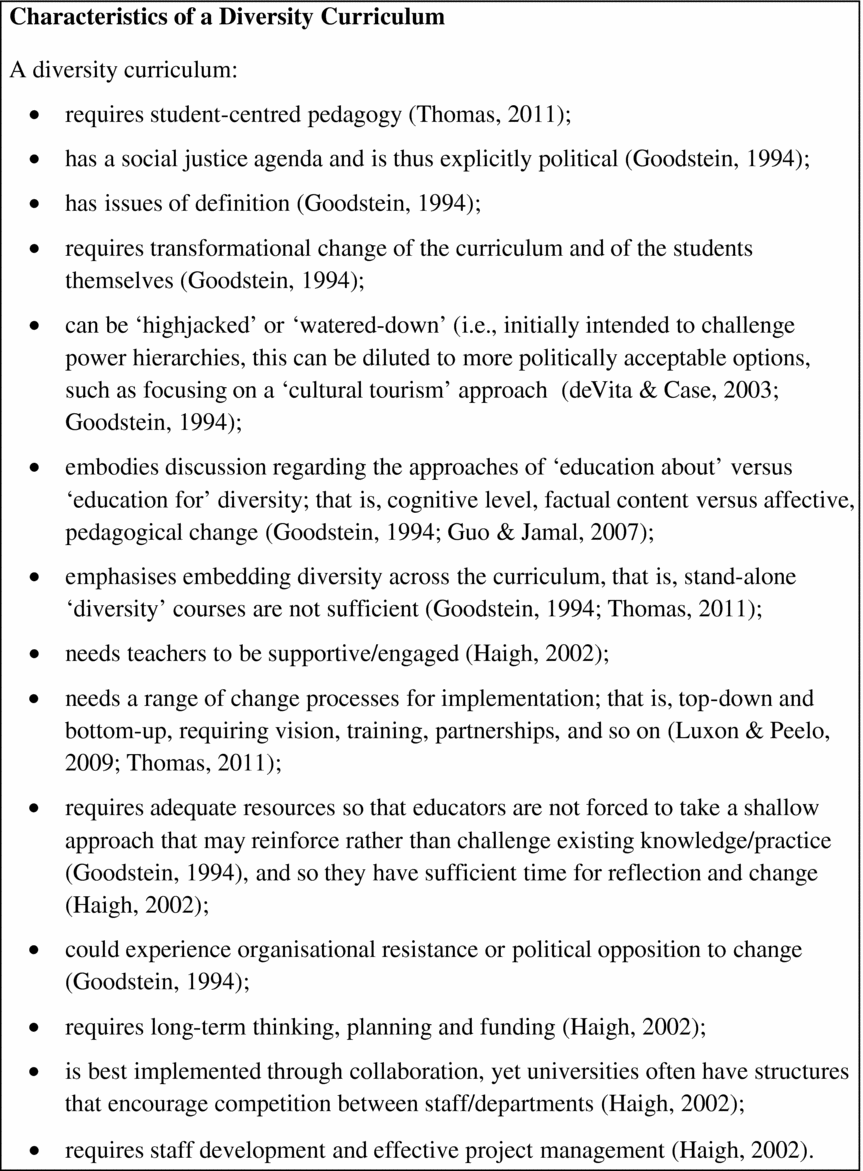
While change agents can hopefully draw on the previous sections’ insights to effect change within their institutions, this section covers literature relating to effecting change across the higher education sector. Diversifying the curriculum is a change project that shares many similarities with the EfS agenda (see Figure 2), and which seems to have been substantially adopted by universities. As a concept, diversity embraces globalisation, internationalisation, as well as class, gender, and disability issues. What we term the ‘diversity agenda’ includes the desire to include diversity in the curriculum (i.e., teaching about diversity and for diversity), as well as the ‘widening participation’ agenda (i.e., teaching to diversity) as both projects are related and influence each other. A comparison of the similarities and differences of the situations of the EfS and diversity agendas allows insight into the success of the diversity agenda.
Characteristics of a diversity curriculum.
Goodstein's (Reference Goodstein1994) paper identifies that the diversity agenda began in the early eighties, although Guo and Jamal (Reference Guo and Jamal2007) argue that this started as early as the 1920s. Thus, diversity has perhaps had an earlier birth date than EfS, given Agenda 21 (of 1992) is one of the earliest references to the importance of education for more sustainable futures. Goodstein (Reference Goodstein1994) argued that the diversity agenda has had an ad hoc implementation, due to efforts being led by champions, rather than having sufficient institutional support, although Back et al.’s 1996 study (as cited in Haigh, Reference Haigh2002, p. 52) found strong support for the diversity agenda, given that 30/35 Australian universities had some strategy for internationalisation in place. This compares to Lang et al.’s study, which found that it did ‘. . . not appear that specific, coordinated and systemic strategies for EfS have been developed by any Australian university’ (Reference Lang, Thomas and Wilson2006, p. 55). Similarly, the work of Christie et al. (Reference Christie, Miller, Cooke and White2015), Lang et al. (Reference Lang, Thomas and Wilson2006), and Thomas and Nicita (Reference Thomas and Nicita2002) found that most Australian higher education institutions had curricula that covered sustainability somewhere, but very few included it in all disciplines.
Curriculum associated with diversity has a number of characteristics that those involved in EfS will recognise as being familiar, such as needing to be embedded across the curriculum, having the potential to be ‘greenwashed’ or hijacked, and a strong social justice component — see Figure 2 for more detail. Given the similarities in the change agenda, why has diversity seen considerably more success than EfS? In the case of the diversity agenda the following factors have been cited as drivers for change:
Economic factors
• Student demand: increasing numbers of students from diverse backgrounds, including immigrants, nationals with non-ethnic sources of ‘diverse’ status, and international students (Ferguson, Reference Ferguson2011; Goodstein, Reference Goodstein1994; Haigh, Reference Haigh2002; Knight & de Wit, Reference Knight and de Wit2011), and particularly demand for inclusive curriculum resulting from the increased fees paid by international students in Australia (Ferguson, Reference Ferguson2011; Guo & Jamal, Reference Guo and Jamal2007; Luxon & Peelo, Reference Luxon and Peelo2009);
• Employer demand: employers wanting graduates who can work in ‘globalised’ settings (Haigh, Reference Haigh2002; Knight & de Wit, Reference Knight and de Wit2011).
Policy factors
• Government policies such as quotas and scholarships for ‘minority’ students (Ferguson, Reference Ferguson2011; Luxon & Peelo, Reference Luxon and Peelo2009);
• Legislation such as human rights and anti-discrimination policy; for example, Equal Employment Opportunity (Ferguson, Reference Ferguson2011).
Moral/values factors
• Academics and staff are generally motivated by intrinsic values such as the personal development of students, a social justice agenda, and/or quality of education (Goodstein, Reference Goodstein1994; Haigh, Reference Haigh2002).
In addition to these varied driving factors that are essentially external to specific curriculum, Thomas (Reference Thomas, Thomas and Tight2011) has identified three elements that have contributed to the successful implementation of the diversity agenda. The first is having clear key performance indicators such as the demographics of students joining, continuing, graduating and finding jobs. The second is Equal Employment Opportunity training for staff; and the third is the importance of establishing clear roles for all sectors of the university and how their work contributes to the bigger picture.
We might also speculate on an issue that is largely philosophical. This broader aspect is that the diversity agenda seems to reflect and draw on trends in society, and focuses on concerns that are somewhat compatible with globalisation such as multiculturalism and equity that can facilitate incorporation of more workers into the market economy. However, EfS, by giving weight to environmental and social matters challenges established economic orthodoxy and thus cultural and social norms. Perhaps this could be a factor in the success rates of the diversity curriculum change agenda relative to the sustainability agenda.
Conclusion: Implications for Implementation of Education for Sustainability
Our review of the literature on curriculum change in universities allows us to draw the following conclusions and recommendations for directing EfS implementation efforts. As we have indicated, researchers argue that university-wide change is complex, at times irrational, and takes a long time. At this stage it appears there is no one factor that would be critical for curriculum change in all situations. A range of factors may promote change or inhibit it, including key actors and their capacity for influence, the socio-economic context, the institutional culture, and academic politics. This is in line with research that demonstrates the complexity of implementing EfS curriculum change in universities. For example, Thomas et al. (Reference Thomas, Hegarty and Holdsworth2012) present EfS implementation in universities as a ‘jigsaw puzzle’ being influenced by several institutional sectors and processes; our literature review from beyond EfS demonstrates that factors beyond the institution are also influential. It seems that Hearn's (Reference Hearn1996, p. 145) comment from 20 years ago still has salience: regarding curriculum change, ‘it all depends’. While some general principles can be established through reading the literature, what this literature emphasises is that each change agenda needs to be tailored specifically to the institutional culture, roles of change makers, academic structure and socio-economic context, in order to be effective. Planning that disregards such understanding is likely to be unsuccessful, whereas taking these issues into account is more likely to have positive outcomes. This is both in terms of the extent of change and the engagement of the participants, which is important for their ownership of the change and support for its implementation.
Readers hoping for a simple answer to the question ‘How can I advocate curriculum change beyond my own teaching?’ will be disappointed at the lack of a ‘magic bullet’. However, there are strategies and avenues available to motivated individuals, whatever their role within the university; being conscious of these differentiated opportunities is an important place to start. A key insight is that cooperation and collaboration with a range of actors — including students, sessional staff, senior management, as well as front line academics — is integral for achieving both broad and deep change. However, transformational curriculum change requires time and effort, two resources that are in high demand within the sector. For the sustainability agenda it may be particularly frustrating to accept that change takes a lot of time, given the sense of urgency change agents may feel in response to crises such as climate change and mass extinctions. Any successes of the environment/sustainability movement — social, political, legal or economic — are likely to filter down into higher education curricula eventually. Highlighting existing links between change agendas and external trends, specifically economic and/or political drivers, may help speed up the change agenda. Here there are potential insights from diversity education, as discussed above. Economic, public policy, and moral factors help to shape the context for the need for specific fields of education. EfS advocates can look for opportunities to influence and be a driving force behind those factors (such as working with government committees) that may justify and inspire change within university curricula.
Importantly though, we hope that higher education can also be the change, rather than just following it. The world is changing rapidly on many fronts, particularly through changes in communication, and universities are being challenged to keep up. This climate of change may provide opportunities for EfS to be implemented alongside other changes that have been mandated by senior management or pushed upon universities by external forces. The challenge for EfS change agents is to recognise and seize these opportunities while ensuring that their agenda is tailored specifically to their own institution's context.
For researchers, this discussion is a starting point that can be read in conjunction with studies on curriculum change in EfS (e.g., Blewitt & Cullingford, Reference Blewitt and Cullingford2004; Filho & Carpenter, Reference Filho and Carpenter2006; Thomas et al., Reference Thomas, Hegarty and Holdsworth2012) or used to complement new empirical work, to answer questions raised by the discussion. Questions that are apparent include (but are not limited to): To what extent have past attempts at EfS implementation in universities been effectively tailored to the institutional culture? Could a failure to account for the role of institutional culture explain failures in EfS implementation? Are there specific university cultures that are prohibitive or welcoming of EfS, and if so, how can we identify and negotiate them? If EfS, as EfS practitioners envision it, is politically opposed to the political-economic ideology in which universities are currently situated, is it realistic to hope for institution or sector-wide implementation, or should we focus our efforts on supporting EfS champions? Can EfS implementation efforts — whatever their success status — be said to support some of the theories presented here, or is EfS unique? That is, do we require a theory of curriculum change that is specific to EfS?
Acknowledgments
The authors thank the anonymous reviewers for their constructive feedback.
Financial Support
This research received no specific grant from any funding agency, commercial, or not-for-profit sectors.
Conflicts of Interest
None.
Author Biographies
Blanche Higgins is a PhD Candidate in the Faculty of Education at Monash University in Melbourne, Australia. Blanche is a passionate sustainability educator, having taught the course Sustainable Futures in the School of Global, Urban and Social Studies at RMIT University for 4 years, convened the Melbourne Free University for Asylum Seekers program, and worked with non-profit community groups such as the Australian Youth Climate Coalition and the Australian Education for Sustainability Alliance over the years. Her current research is focusing on climate change education.
Ian Thomas is an Honorary Associate Professor at RMIT University in Melbourne, Australia. He has taught undergraduate and postgraduate environmental policy programs, and has written on environmental impact assessment, environmental policy and environmental management systems. In his research, Ian has investigated the issues of embedding environmental education and sustainability education in the curricula of universities, examined the status of tertiary environmental programs, and investigated employment of graduates from these programs. His recent research has focused on capacity building of academics to support curriculum change across a range of disciplines, and the graduate capabilities sought by employers, to embed EfS into university curricula.