Background
Major depression occurs in up to 5% of the elderly adults, is associated with increased suicide risk, aggravates existing medical conditions, increases functional disability, and negatively impacts cognition. In the U.S., the combined prevalence of minor and major depression in the elderly adults is estimated at 11% (Steffens et al., Reference Steffens, Fisher, Langa, Potter and Plassman2009). Causes of geriatric depression are multifactorial. Much recent literature has focused on the association of late-age onset depression and cerebrovascular disease, so-called “vascular depression” (Alexopoulos et al., Reference Alexopoulos, Meyers, Young, Kakuma, Silbersweig and Charlson1997). Less attention has been paid to factors associated with early-age onset depression among older adults. In particular, a life-long tendency toward depressed affect, poor stress tolerance, and higher levels of anxiety, together comprising the construct of neuroticism (Eysenck and Eysenck, Reference Eysenck and Eysenck1975; Costa and McCrae, Reference Costa and McCrae1985), has not been well studied in the context of geriatric depression.
While the term “neurotic” is used loosely by clinicians and the lay public, personality theorists have sought to provide clarity and definition to the term. For example, the Eysenck Personality Questionnaire includes a neuroticism/stability factor (Eysenck and Eysenck, Reference Eysenck and Eysenck1975). Costa and McCrae, as they studied personality and aging, developed the NEO-Personality Inventory (NEO-PI), with five personality factors, including neuroticism (Costa and McCrae, Reference Costa and McCrae1985). Within the NEO-PI, neuroticism as a construct was developed to identify individuals prone to psychological distress, and its “facets” (i.e. component subscales) consist of 1) Anxiety: level of free floating anxiety; 2) Angry hostility: tendency to experience anger and related states, e.g. frustration and bitterness; 3) Depression: tendency to experience feelings of guilt, sadness, despondency, and loneliness; 4) Self-consciousness: shyness or social anxiety; 5) Impulsiveness: tendency to act on cravings and urges rather than reining them in and delaying gratification; and 6) Vulnerability: general susceptibility to stress. Although neuroticism has been shown to decrease with aging (Costa and McCrae, Reference Costa and McCrae2006), it clearly has public health importance, as it limits quality of life and longevity (Lahey, Reference Lahey2009). It is also important to note that neuroticism is a construct related to but not identical to depression. The above “depression facet” of the NEO-PI refers to emotional reactivity rather than to a mood state. This distinction is important as we try to understand both the contribution of neuroticism to development of depression, as well as the unique contributions of neuroticism and depression to neural changes and outcomes of depression.
Neuroticism is associated with increased risk of depression across the lifespan, including older age (Kendler et al., Reference Kendler, Gatz, Gardner and Pedersen2006). It has also been shown to increase risk of poor mood outcomes in both non-geriatric depression (Quilty et al., Reference Quilty, Fruyt, Rolland, Kennedy, Rouillon and Bagby2008) and late life depression (Jang et al., Reference Jang, Clay, Roth, Haley and Mittelman2004; Steunenberg et al., Reference Steunenberg, Beekman, Deeg, Bremner and Kerkhof2007; Canuto et al., Reference Canuto, Giannakopoulos, Meiler-Mititelu, Delaloye, Herrmann and Weber2009), although there are negative studies (Petersen et al., Reference Petersen2002). Apart from effects on mood, neuroticism is associated with worse cognitive outcomes in older adults in some studies (Wilson et al., Reference Wilson, Bennett, Leon, Bienias, Morris and Evans2005; Reference Wilson, Arnold, Sschneider, Kelly, Tang and Bennett2006; Reference Wilson, Bennett, Leon, Bienias, Morris and Evans2007), though not in others (Wetherell et al., Reference Wetherell, Reynolds, Gatz and Pedersen2002; Jelicic et al., Reference Jelicic, Bosma, Ponds, Van Boxtel, Houx and Jolles2003). Studies have also focused on personality factors and risk of cognitive decline and dementia, and a recent meta-analysis of personality factors concluded that neuroticism increased risk for dementia, while conscientiousness reduced risk (Low et al., Reference Low, Harrison and Lackersteen2013).
Previously, we reported that neuroticism scores were higher in older adults with depression than non-depressed elderly individuals and that lower neuroticism scores were associated with improved depressive symptoms at 3 and 12 months (Hayward et al., Reference Hayward, Taylor, Smoski, Steffens and Payne2013). In the present study, we sought to extend these findings to examine clinical outcomes, including rates of depression remission, time to depression remission, and cognitive decline. In particular, we planned to test the hypothesis that presence of neuroticism among depressed elderly adults would decrease the rate of depression remission, as well as increased time to remission of depression in survival analyses. Additionally, we hypothesized that presence of neuroticism would be associated with greater subsequent cognitive decline among older depressed patients.
Methods
Development of the NCODE cohort
Beginning in November 1994, investigators at Duke University Medical Center began enrolling depressed patients aged 60 years and older in the NIMH-sponsored Mental Health Clinical Research Center for the study of Depression in Later Life (MHCRC) and into its longitudinal sister study. The latter study sought to examine neuroimaging factors related to depression outcomes. A neuropsychological evaluation was added in 1997. In conjunction with the newly established Conte Center for the Neuroscience of Depression in the Elderly, the longitudinal study (NCODE) was renewed in 2001 with a focus on both depressive outcomes and neurocognitive outcomes of depression.
Participants
Depressed participants enrolled in the study met criteria for a current episode of unipolar major depression and were age 60 years and older. Exclusion criteria included the presence of another major psychiatric illness such as schizophrenia, schizoaffective disorder, bipolar disorder, lifetime alcohol or substance dependence, and dementia. Patients with psychotic depression were included, as were those with comorbid anxiety disorders, as long as major depression was deemed by the study psychiatrist to be the primary psychiatric disorder. In addition to dementia, other neurological illnesses that could affect structural brain MRI scans were excluded, such as Parkinson's disease, multiple sclerosis, and seizure disorder. Individuals with contraindications to brain MRI were also excluded. Those who subsequently developed alcoholism were allowed to remain in the study. After complete description of the study to the participants, written informed consent was obtained.
Depression assessment
At baseline, a study geriatric psychiatrist interviewed each depressed participant and completed standardized clinical assessments, including the Montgomery Åsberg Depression Rating Scale (MADRS) (Montgomery and Åsberg, Reference Montgomery and Åsberg1979). Clinical assessments were repeated when clinically indicated, but at least every three months. For the present study, the MADRS is the main depression outcome measure. All raters were trained on completion of the MADRS, and high interrater reliability (κ > 0.9) was established.
Baseline cognitive screen
Participants were excluded if they had dementia or suspected dementia at baseline based on information available to the assigned NCODE geriatric psychiatrist, who examined the subject, reviewed medical records, and conferred with referring physicians for all patients. While most (n = 105 of 110, 95.5%) depressed patients enrolled to date had Mini Mental State Examination (MMSE, Folstein et al., Reference Folstein, Folstein and McHugh1975) scores 25 or above at baseline assessment, five severely depressed patients had scores below 25. For depressed patients with initial MMSE scores less than 25, NCODE protocol is to follow such patients through an acute (eight-week) phase of treatment to determine if cognition improves. Participants whose MMSE scores remain below 25 are not followed longitudinally in the NCODE study. Thus, in the clinical judgment of the study geriatric psychiatrist and by established NCODE protocol, dementia is effectively excluded at or close to baseline in all elderly depressed NCODE participants.
Neuropsychological assessment of cognition and dementia
The battery consisted of a cognitive screen for dementia and then a series of tests designed to enhance sensitivity and specificity to the detection of early-stage neurodegenerative disease. The general screen consisted of the CERAD battery (Morris et al., Reference Morris1989), an instrument that is reliable, valid, and has shown utility in longitudinal studies with well-established normative standards (Welsh et al., Reference Welsh1994). We added additional measures, including a digit span test to further assess attention and memory. For the present study, we examined cognitive change using the CERAD total score (CERAD-TS, Chandler et al., Reference Chandler2005).
Personality assessment
All participants completed the NEO-PI as manualized (Costa and McCrae, Reference Costa and McCrae1985), with raw scores converted to t scores. For this study, we focused on the neuroticism domain, for which we calculated a total neuroticism (TN) score. In addition, we combined the neuroticism facets of anxiety, depression, and hostility to determine a negative affect (NA) score, as has been previously reported (Schmitz et al., Reference Schmitz, Hartkamp, Baldini, Rollnik and Tress2002). Finally, we examined the vulnerability to stress (VS) facet score. TN, NA, and VS were all used as independent variables in our analyses.
Clinical follow-up of depressed participants
The NCODE study operates in a naturalistic treatment milieu using treatment guidelines established by the Duke Affective Disorders Program. Treatment modalities available include antidepressant medications, electro-convulsive therapy, and individual and group cognitive-behavioral psychotherapy. Treatment was monitored to ensure that clinical guidelines are followed appropriately. As indicated above, patients were evaluated when clinically indicated, and at least every three months while they were in the study. The protocol recommends that patients receive continuation treatment for at least one to two years (some indefinitely) once they achieve remission. Each patient was thus assured to receive the most appropriate care we were able to provide.
Referral of participants with cognitive impairment
Referral for additional cognitive evaluation occurs when participants present with cognitive complaints, if family members bring concerns to the study geriatric psychiatrist, or if the psychiatrist has a clinical suspicion of cognitive impairment or dementia. In these cases, the psychiatrist has the option to refer the patient to the Memory Disorders Clinic at Duke University Medical Center. When this happens, the study obtains copies of those medical records.
Statistical analysis
For bivariate measures, t tests and χ2 tests were performed as appropriate comparing individuals who remitted (defined as a MADRS score of six or less) to those who had not remitted at one year. MADRS scores were also examined up to the three-year visit by survival analysis. Cox proportional hazard models were performed to test the effect of the NEO variables on time to remission of depression using the χ2 test. ANCOVA models were constructed to determine the effect of neuroticism-associated variables (TN, NA, and VS) on the change in CERAD-TS from either baseline to one year or baseline to two years. Mixed models were also constructed to examine the between-subject effect of neuroticism-associated variables on the trajectories of CERAD-TS over three years. SAS software version 9.4 was used to perform all statistical analyses.
Results
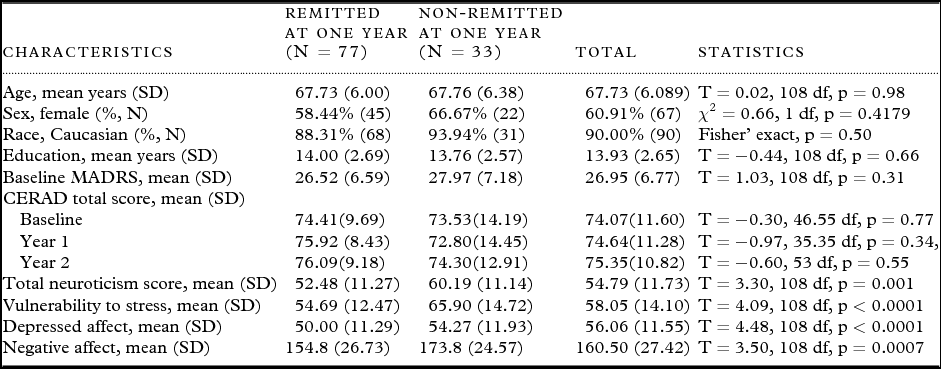
The sample consisted of 110 depressed individuals at baseline. As shown in Table 1, 77 patients (70.00%) achieved remission over the first year of the study. Mean baseline age was 68 years, 61% were women, and 90% were white. Mean baseline MADRS score was 26.95, indicating a moderately severe level of depression. For patients followed up to three years, the mean time to remission was 316.45 days (standard deviation = 381.01 days).
Baseline characteristics of the sample

CERAD = the Consortium to Establish a Registry for Alzheimer's Disease; MADRS = the Montgomery Åsberg Depression Rating Scale.
We compared neuroticism scores among remitters (MADRS ≤ 6, (N = 77)) and non-remitters (N = 33) at one year. In models controlling for baseline MADRS score, sex, and age, we found that non-remitters had higher scores on TN (t = 3.30, df = 108, p = 0.001), VS (t = 4.09, df = 108, p = 0.001), and NA (t = 3.50, df = 108, p = 0.0007).
We examined variables related to neuroticism and their effects on time to depression remission in Cox Proportional Hazards models over a three year period. Within this time, 86.24% of participants achieved remission. Specifically, we used the TN, NA, and VS scores as independent variables in models controlling for baseline MADRS score, sex, and age. We found that time to remission was significantly and positively related to higher TN (χ2 = 10.92, df = 1, p = 0.0009), higher VS (χ2 = 13.40, df = 1, p = 0.0003), and greater NA (χ2 = 13.04, df = 1, p = 0.0003). In separate models including age of onset, these neuroticism measures remained significantly associated with remission. Here, age of onset was not significant.
We also examined neuroticism measures and their relationship to subsequent change in cognitive score as measured by the CERAD-TS. In analyses controlling for baseline CERAD-TS, age, sex, and education, neither TN nor NA were associated with change in CERAD-TS from baseline to year 1 or baseline to year 2. There was a trend for VS to be associated with baseline to year 1 change (F = 3.59, DF = 1, 55, p = 0.064), and VS was associated with baseline to year 2 change (F = 4.56, DF = 1, 48, p = 0.038).
To determine whether there were threshold effects of neuroticism scores on cognitive outcomes, we used mixed models of neuroticism variables dichotomized at above and below the highest quintile of scores for TN, NA, and VS. These models included main effects of each neuroticism variable, a main effect of time in the study, age, sex, baseline MADRS score, and an interaction term of the neuroticism variable and time in the study. For TN, the interaction of upper quintile and time in the study was significantly associated with CERAD-TS over time (F = 8.40, df = 84, p = 0.0226). Neither interaction terms were significant for VS-by-time-in-study (F = 2.88, df = 67, p = 0.0946) or NA-by-time-in-study (F = 0.10, df = 66, p = 0.7471).
Conclusions
The major findings of this study were that three variables associated with the NEO-PI domain of neuroticism were associated remission of geriatric depression. Higher scores for TN, the construct of NA (comprising the neuroticism facets of anxiety, depression, and hostility), and VS were each associated with lower remission rates. We also examined neuroticism and cognitive change, and while our primary results were largely insignificant (no association with TN or NA, while VS was associated with baseline to two-year cognitive change, but not one-year change), we did find that those with the highest TN scores (highest quintile) had significantly lower CERAD-TS.
These findings extend our prior work that found greater neuroticism scores in older depressed patients compared with controls and that greater neuroticism scores were associated with higher depression scores over time in the depressed group (Hayward et al., Reference Hayward, Taylor, Smoski, Steffens and Payne2013). In the present study, we link neuroticism to the clinically relevant constructs of depression remission and cognitive decline. Our results are also consistent with prior studies of depression outcome both in the elderly (Ormel et al., Reference Ormel, Oldehinkel and Brilman2001) and across the age span (Enns and Cox, Reference Enns and Cox2005; Quilty et al., Reference Quilty, Fruyt, Rolland, Kennedy, Rouillon and Bagby2008).
The construct of neuroticism, though rooted in personality theory, may also be viewed through the prism of neuroscience. Neuroticism is associated with heightened fronto-temporal-limbic activation to emotional stimuli (Chan et al., Reference Chan, Norbury, Goodwin and Harmer2009). Emotional reactivity, especially in the context of stress, is thought to be a risk factor for development of depression or depressive relapse across the life span (Ramel et al., Reference Ramel, Goldin, Eyler, Brown, Gotlib and McQauid2007). Stress vulnerability is also gaining traction in the neuroscience literature as an important dimensional risk factor in the occurrence and maintenance of depression (Jacobs et al., Reference Jacobs, Kenis, Peeters, Derom, Vlietinck and Van Os2006). Among older adults, greater stress burden has been found to be increased in depression and to decrease remission rates among depressed populations (Karp et al., Reference Karp, Frank, Anderson, George, Reynolds and Mazumdar1993; de Beurs et al., Reference De Beurs, Beekman, Geerlings, Deeg, Van Dyck and Van Tilburg2001).
Our findings linking some aspects of neuroticism to cognitive decline should be considered preliminary. Many factors contribute to cognitive changes over time, and this is especially true in the context of late life depression, where the depressed state itself contributes to cognitive impairment. In our study, a two-year cognitive change was needed to detect a significant difference; a baseline to one-year change was not significant.
As mentioned above, the study has several limitations, including relatively small sample size and findings related to cognitive change of marginally positive significance. A study with a larger sample size might produce a more robust effect on cognitive outcome. Other limitations are reliance on one measure of neuroticism and inclusion of overlapping independent variables (i.e. the NA and VS are subsets of the TN variable). The naturalistic design of the study, in which we did not control for medications, is also a potential limitation, as treatment differences may contribute to variability in remission rate. Future studies should include larger samples followed for two or more years with mood and cognitive assessments with standardized treatments. In addition, neuroticism should be characterized by a variety of measures, some rooted in personality theory and others rooted in more modern neuroscience constructs. Another area for future inquiry should involve disentangling state effects of depression from trait effects of neuroticism. For example, should MADRS scores continue to predict cognitive decline while neuroticism does not, then this would support a powerful state effect of depression on cognition, a finding with both clinical and scientific importance.
From a clinical standpoint, our study supports assessment of neuroticism in the overall management of late life depression. More clinically useful tools are needed to assist clinicians, and thus more research is needed in this area. Patients with comorbid neuroticism may require psychotherapy instead of or in addition to psychopharmacology. Such patients may also need to be monitored closely for cognitive change over time.
In sum, we found further evidence linking neuroticism to mood outcomes of depression, with this study focusing on a geriatric sample. Our preliminary finding that links some features of neuroticism to cognitive change is intriguing and merits further study.
Conflict of interest
None.
Description of authors’ roles
D. C. Steffens formulated the research question, designed and carried out the study, and wrote the article. D. R. McQuoid conducted the statistical analyses. M. J. Smoski interpreted the data and wrote the article. G. G. Potter carried out the study and wrote the article.
Acknowledgments
This study was supported by U.S. National Institute of Mental Health grants R01 MH054846, R01 MH096725, and K24 MH070027.