1. Introduction
Active continental margins are complex regions consisting of a variety of morphotectonic domains such as accretionary wedges, marginal basins and highs, and magmatic arcs (Kopp, Reference Kopp2013). Tectonic erosion of the upper plate and subduction of oceanic plateaus can suppress one or more of the morphotectonic domains and lead to segmentation of the margin, adding complexity to the overall structure (e.g. Malavieille & Trullenque, Reference Malavieille and Trullenque2009). Active continental margins may further involve accretion of foreign oceanic or continental ribbons, a common process throughout the Earth history (Cawood et al. Reference Cawood, Kroner, Collins, Kusky, Mooney, Windley, Cawood and Kröner2009).
Recognizing the structure and dynamics of active continental margins in the case of fossil margins is often difficult if they were the locus of a protracted orogenic history. In this contribution we examine the history of the proto-Andean margin of Gondwana in the Sierras Pampeanas of Argentina, which turned active during late Cambrian – Early Ordovician time starting the Famatinian orogeny (e.g. Pankhurst et al. Reference Pankhurst, Rapela, Saavedra, Baldo, Dahlquist, Pascua, Fanning, Pankhurst and Rapela1998; Sims et al. Reference Sims, Ireland, Camacho, Lyons, Pieters, Skirrow, Stuart-Smith, Mrió, Pankhurst and Rapela1998; Steenken et al. Reference Steenken, Siegesmund, López de Luchi, Frei and Wemmer2006; Dahlquist et al. Reference Dahlquist, Pankhurst, Rapela, Galindo, Alasino, Fanning, Saavedra and Baldo2008, Reference Dahlquist, Pankhurst, Gaschnig, Rapela, Casquet, Alasino, Galindo and Baldo2013; Rapela et al. Reference Rapela, Pankhurst, Casquet, Dahlquist, Fanning, Baldo, Galindo, Alasino, Ramacciotti, Verdecchia, Murra and Basei2018). The term Famatinian Cycle was proposed by Aceñolaza & Toselli (Reference Aceñolaza and Toselli1973) to refer to a period of deformation, magmatism, metamorphism and sedimentation between late Cambrian and Middle Devonian time. However, later studies demonstrated that the main tectonic activity occurred between late Cambrian and Middle Ordovician time (e.g. Pankhurst et al. Reference Pankhurst, Rapela, Saavedra, Baldo, Dahlquist, Pascua, Fanning, Pankhurst and Rapela1998; Ramos et al. Reference Ramos, Dallmeyer, Vujovich, Pankhurst and Rapela1998). The Famatinian belt extends between Patagonia and Venezuela along the continent margin (see review in Ramos, Reference Ramos, Folguera, Reyes, Heredia, Encinas, Iannelli, Oliveros, Dávila, Collo, Giambiagi, Maksymowicz, Llanos, Turienzo, Naipauer, Orts, Litvak, Alvarez and Arriagada2018) and was part of the long Terra Australis orogen (c. 18 000 km) defined by Cawood (Reference Cawood2005) that fringed SW Gondwana during the early Palaeozoic Era. The width of this orogenic belt in the Sierras Pampeanas of Argentina is c. 500 km and it preserves excellent vertical sections (from roof to top of the magmatic arc), providing a unique opportunity to study this orogen (Fig. 1a). Evidence of deformation, metamorphism and magmatism between c. 490 and 440 Ma has long been recognized in the easternmost Sierras Pampeanas, in the Puna (Altiplano) of northern Argentina and in Patagonia, as well as in Chile (e.g. Bahlburg & Hervé, Reference Bahlburg and Hervé1997; Rapela et al. Reference Rapela, Pankhurst, Casquet, Baldo, Saavedra and Galindo1998; Pankhurst et al. Reference Pankhurst, Rapela and Fanning2000, Reference Pankhurst, Rapela, Lopez De Luchi, Rapalini, Fanning and Galindo2014, Reference Pankhurst, Hervé, Fanning, Calderón, Niemeyer, Griem-Klee and Soto2016; Büttner et al. Reference Büttner, Glodny, Lucassen, Wemmer, Erdmann, Handler and Franz2005; Dahlquist et al. Reference Dahlquist, Pankhurst, Rapela, Galindo, Alasino, Fanning, Saavedra and Baldo2008; Drobe et al. Reference Drobe, López de Luchi, Steenken, Wemmer, Naumann, Frei and Siegesmund2011; Steenken et al. Reference Steenken, López de Luchi, Dopico, Drobe, Wemmer and Siegesmund2011; Mulcahy et al. Reference Mulcahy, Roeske, McClelland, Ellis, Jourdan, Renne, Vervoort and Vujovich2014).
(a) Schematic geological map of the Sierras Pampeanas and the Precordillera (modified from Rapela et al. Reference Rapela, Verdecchia, Casquet, Pankhurst, Baldo, Galindo, Murra, Dahlquist and Fanning2016). Am – Sierra de Ambato; An – Sierra de Ancasti; CA – Cerro Asperecito; Ch – Sierra de Chepes; Fa – Sierra de Famatina; ME – Sierra de Maz and Espinal; LC – Las Chacras; SAn – Sierra de Ancaján; SB – Sierra Brava; SC – Sierras de Córdoba; SG – Sierra del Gigante; SNA – Sierra Norte-Ambargasta; WSP – western Sierras Pampeanas; ESP – eastern Sierras Pampeanas; SPP – Sierra de Pie de Palo; SSL – Sierra de San Luis; STN – Sierra del Toro Negro; UM – Sierra de Umango; Ve – Sierra de Velasco; VFLH – Sierra de Valle Fértil-La Huerta. (b) Simplified geological map of the Sierra de Pie de Palo showing the main lithological units and structures (modified after Ramos & Vujovich, Reference Ramos and Vujovich2000; Casquet et al. Reference Casquet, Baldo, Pankhurst, Rapela, Galindo, Fanning and Saavedra2001; Mulcahy et al. Reference Mulcahy, Roeske, McClelland, Jourdan, Iriondo, Renne, Vervoort and Vujovich2011; Ramacciotti et al. Reference Ramacciotti, Baldo and Casquet2015a).

The tectonic evolution of the Famatinian belt is still poorly understood. Several longitudinal (N–S) domains have been recognized on the basis of stratigraphic records, types of magmatism and radiometric ages (e.g. Bahlburg & Hervé, Reference Bahlburg and Hervé1997; Grosse et al. Reference Grosse, Bellos, de los Hoyos, Larrovere, Rossi and Toselli2011; Rapela et al. Reference Rapela, Pankhurst, Casquet, Dahlquist, Fanning, Baldo, Galindo, Alasino, Ramacciotti, Verdecchia, Murra and Basei2018), but their geodynamic significance is not yet well established. One of these such domains is unanimously considered a Cordilleran-type magmatic arc with I-type magmatism (gabbro to monzogranite), and crops out in the central part of the belt (Fig. 1a; e.g. Grosse et al. Reference Grosse, Bellos, de los Hoyos, Larrovere, Rossi and Toselli2011). Based on this magmatic arc, the Famatinian belt was conventionally interpreted as an orogen resulting from subduction along the continental margin (e.g. Bahlburg & Hervé, Reference Bahlburg and Hervé1997; Astini & Dávila, Reference Astini and Dávila2004; Coira et al. Reference Coira, Koukharsky, Guevara and Cisterna2009). Some authors (e.g. Ramos, Reference Ramos1988; Astini et al. Reference Astini, Benedetto and Vaccari1995; Astini & Dávila, Reference Astini and Dávila2004) have further related the early evolution of the Famatinian orogeny to the Ordovician collision of the allegedly exotic Laurentia-derived Precordillera/Cuyania terrane with the proto-Andean margin of Gondwana. This terrane is named after the Argentine Precordillera, which is located west of the Sierras Pampeanas in western Argentina (Fig. 1a) (for a review of this terrane and its extension into the Sierras Pampeanas, see Ramos, Reference Ramos2004). However, there is no consensus regarding the boundaries and time accretion of this terrane (see discussion section of this paper; Finney, Reference Finney2007).
This work focuses on the Sierra de Pie de Palo in the western Sierras Pampeanas of Argentina belonging to the western domain of the Famatinian orogeny (Rapela et al. Reference Rapela, Pankhurst, Casquet, Dahlquist, Fanning, Baldo, Galindo, Alasino, Ramacciotti, Verdecchia, Murra and Basei2018), to the west of the Cordilleran-type magmatic arc, which is well exposed in the Famatina and Valle Fértil ranges (Fig. 1). We present new whole-rock elemental chemistry, Sr- and Nd-isotopes, and geochronological (U–Pb SHRIMP zircon ages) data from granitoids and mafic rocks of the Sierra de Pie de Palo in order to assess the probable source of magmas and the tectonic significance of this magmatism. We also discuss the palaeogeographic implication of these igneous rocks for the early Palaeozoic evolution of the proto-Andean margin of Gondwana.
2. Geological setting
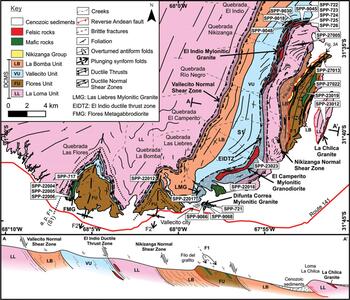
The Sierra de Pie de Palo is one of the westernmost ranges of the Sierras Pampeanas of Argentina (Fig. 1a) which resulted from the tilting and uplift of foreland blocks during the Cenozoic Andean orogeny (e.g. Jordan & Allmendinger, Reference Jordan and Allmendinger1986). The Sierra de Pie de Palo is a young (Andean) dome resulting from gentle folding of the pre-Andean basement. The basement consists of an E-dipping syn-metamorphic ductile thrust stack produced during the Famatinian orogeny with a dominantly top-to-the-W sense of movement (e.g. Casquet et al. Reference Casquet, Baldo, Pankhurst, Rapela, Galindo, Fanning and Saavedra2001; Mulcahy et al. Reference Mulcahy, Roeske, McClelland, Jourdan, Iriondo, Renne, Vervoort and Vujovich2011). Structural depth increases westwards towards the Pirquitas thrust (Fig. 1b) at the bottom of the pile. This basal thrust has a complex tectonic history (Ramos et al. Reference Ramos, Dallmeyer, Vujovich, Pankhurst and Rapela1998; van Staal et al. Reference van Staal, Vujovich, Currie and Naipauer2011). The tectonic nappes consist of a reworked Mesoproterozoic basement and a Neoproterozoic – upper Cambrian sedimentary cover that underwent tight recumbent folding (F1) and development of a penetrative syn-metamorphic foliation (S1; Fig. 2), almost coeval with underthrusting at ≥ 460 Ma (Casquet et al. Reference Casquet, Baldo, Pankhurst, Rapela, Galindo, Fanning and Saavedra2001). A younger fold phase (F2), which shows steep axial planes, is recognized in the southern Sierra de Pie de Palo. Extensional shear zones – apparently older than F2 – were described in the east (Casquet et al. Reference Casquet, Baldo, Pankhurst, Rapela, Galindo, Fanning and Saavedra2001) such as the Nikizanga Shear Zone, which has yielded a muscovite 40Ar/39Ar age of c. 440 Ma (Mulcahy et al. Reference Mulcahy, Roeske, McClelland, Jourdan, Iriondo, Renne, Vervoort and Vujovich2011). Cenozoic reverse faults further reworked the Palaeozoic assembly and are well exposed in the easternmost slope of the range (Fig. 2) (Bellahsen et al. Reference Bellahsen, Sebrier and Siame2016). Ordovician metamorphism in Ca-pelitic schist of the central part of the Sierra de Pie de Palo reached upper low- to medium-grade conditions (c. 1.3 GPa and 600°C) under a moderate to high P/T metamorphism, coeval with folding and thrusting (Baldo et al. Reference Baldo, Casquet and Galindo1998; Casquet et al. Reference Casquet, Baldo, Pankhurst, Rapela, Galindo, Fanning and Saavedra2001).
Geological map (upper) of southeastern Sierra de Pie de Palo showing the location of mafic rocks and granitoids studied here, and schematic geologicalal cross-section (lower). a.p. – axial planar foliation; DCMS – Difunta Correa Metasedimentary Sequence.

From west to east, the Sierra de Pie de Palo is mainly composed of the following lithostratigraphic units: Caucete Group, Pie de Palo Complex, Central Complex, Difunta Correa Metasedimentary Sequence and Nikizanga Group. The Mesoproterozoic basement comprises a Grenvillian (sensu lato) ophiolite complex in the west and a poorly known meta-igneous and metasedimentary complex in the central and western part of the range (Fig. 1b). Both were variably reworked by the Famatinian orogeny. The ophiolite units constitute the Pie de Palo Complex, exposed between the Pirquitas and Duraznos thrusts. It consists mainly of mafic and ultramafic rocks, with minor outcrops of felsic rocks (tonalite–trondhjemite–granodiorite) (Pankhurst & Rapela, Reference Pankhurst, Rapela, Pankhurst and Rapela1998; Vujovich & Kay, Reference Vujovich, Kay, Pankhurst and Rapela1998). The age of the igneous rocks of the complex ranges between c. 1030 Ma and c. 1245 Ma (Vujovich et al. Reference Vujovich, van Staal and Davis2004; Morata et al. Reference Morata, Castro de Machuca, Arancibia, Pontoriero and Fanning2010; Rapela et al. Reference Rapela, Pankhurst, Casquet, Baldo, Galindo, Fanning and Dahlquist2010; Mulcahy et al. Reference Mulcahy, Roeske, McClelland, Jourdan, Iriondo, Renne, Vervoort and Vujovich2011). The Central Complex, between the Duraznos and Morales ductile thrusts, consists of schists, quartzites, marbles, metavolcanic rocks, migmatites, orthogneisses and amphibolites (Casquet et al. Reference Casquet, Baldo, Pankhurst, Rapela, Galindo, Fanning and Saavedra2001; Mulcahy et al. Reference Mulcahy, Roeske, McClelland, Jourdan, Iriondo, Renne, Vervoort and Vujovich2011). One orthogneiss yielded an protolith age of c. 1280 Ma (Garber et al. Reference Garber, Roeske, Warren, Mulcahy, McClelland, Austin, Renne and Vujovich2014), while an anorogenic A-type orthogneiss yielded an protolith age of c. 774 Ma and was attributed to the early break-up of the Rodinia supercontinent (Baldo et al. Reference Baldo, Casquet, Pankhurst, Galindo, Rapela, Fanning, Dahlquist and Murra2006). The ages of Garber et al. (Reference Garber, Roeske, Warren, Mulcahy, McClelland, Austin, Renne and Vujovich2014) imply that the depositional age of metasedimentary rocks of the Central Complex was Mesoproterozoic or older.
The Neoproterozoic Difunta Correa Metasedimentary Sequence, first recognized by Baldo et al. (Reference Baldo, Casquet and Galindo1998), is best exposed in the central and eastern parts of the range (Fig. 1b). This sequence consists of medium-grade metamorphic rocks from four lithostratigraphic units (Ramacciotti et al. Reference Ramacciotti, Casquet, Baldo and Galindo2015b), consisting of metasiliciclastic rocks (metaconglomerate to metapelite) and thick marbles. Sedimentation was dated as Ediacaran (c. 620 Ma) on the basis of the Sr-isotope composition of marbles and U–Pb detrital zircon ages (Galindo et al. Reference Galindo, Casquet, Rapela, Pankhurst, Baldo and Saavedra2004; Rapela et al. Reference Rapela, Pankhurst, Casquet, Fanning, Galindo and Baldo2005; Ramacciotti et al. Reference Ramacciotti, Baldo and Casquet2015a).
The Cambrian section of the sedimentary cover is represented by the Caucete and Nikizanga groups. The Caucete Group (Borello, Reference Borello1969) crops out in the western slope of the range, at the footwall of the Pirquitas thrust (Fig. 1b). It is mainly composed of low- to medium-grade metamorphic rocks, such as metasandstones and marbles, and to a lesser extent metavolcaniclastic rocks. The Nikizanga Group, in the southeastern slope of the range (Fig. 2), consists of low- to medium-grade metamorphic rocks such as graphitic schist, phyllite, quartzite and marble (CD Ramacciotti, PhD thesis, Universidad Nacional de Córdoba, 2016). Both groups (Caucete and Nikizanga) were deposited between 525 and 490 Ma in a mixed carbonate-siliciclastic platform, fringing the SW Gondwana margin that extended at least from Patagonia to northwestern Argentina (Ramacciotti et al. Reference Ramacciotti, Casquet, Baldo, Galindo, Pankhurst, Verdecchia, Rapela and Fanning2018).
Mafic meta-igneous bodies (transposed sills and small stocks hosted mainly in metasedimentary rocks; this work) older than the Famatinian F1 folding, thrusting and regional metamorphism and syn-metamorphic peraluminous granitoids have long been recognized in the eastern slope of the Sierra de Pie de Palo (Fig. 2; Pankhurst & Rapela, Reference Pankhurst, Rapela, Pankhurst and Rapela1998; Mulcahy et al. Reference Mulcahy, Roeske, McClelland, Jourdan, Iriondo, Renne, Vervoort and Vujovich2011; Baldo et al. Reference Baldo, Dahlquist, Casquet, Rapela, Pankhurst, Galindo, Fanning, Fernández, Fernández, Cuesta and Bahamonde2012; this work). Their tectonic significance is reviewed in this contribution along with new geochemical and geochronological data.
3. Mafic rocks and granitoids of the Sierra de Pie de Palo
Although some Ordovician felsic rocks were described by some authors in the Sierra de Pie de Palo (Mulcahy et al. Reference Mulcahy, Roeske, McClelland, Jourdan, Iriondo, Renne, Vervoort and Vujovich2011; Baldo et al. Reference Baldo, Dahlquist, Casquet, Rapela, Pankhurst, Galindo, Fanning, Fernández, Fernández, Cuesta and Bahamonde2012), the mafic units of this age remained poorly known before this contribution. These mafic igneous bodies were overprinted by regional metamorphism and shearing, whereas the felsic units, with the exception of the La Chilca Granite, were variably affected by ductile shearing only. F1 folding of mafic rocks is recognized (Fig. 2). Mafic rocks are found in the upper nappe of the thrust stack to the east of the El Indio ductile thrust zone. They are metagabbros, metagabbrodiorites or amphibolites, depending on whether they show a metamorphic foliation or preserve the primary texture. Mafic bodies were originally dykes, sills or small intrusions that were transposed and converted through deformation into elongated bodies of up to 3000 m long and 200 m thick (Figs 2, 3a). They intruded the Difunta Correa Metasedimentary Sequence and the Nikizanga Group, and were themselves intruded by felsic magmas, implying that mafic rocks are older than the granitoids. The mafic rocks are coarse- to fine-grained (1 cm to 0.1 mm; Fig. 3), the metagabbros and metagabbrodiorites show inherited granular igneous texture (Figs. 3b, c), and the amphibolites show nematoblastic texture with foliation defined by amphibole orientation (Fig. 3d, e). Primary minerals were converted in all mafic rocks into a secondary low- to medium-grade metamorphic assemblage of Amph (tremolite and Mg-hornblende), with lesser amounts of Bt, Pl, Qz, Ttn, Zrn and Ilm (mineral abbreviations after Whitney & Evans, Reference Whitney and Evans2010).
Mafic rocks of southeastern Sierra de Pie de Palo. (a) Amphibolite lens wrapped by the foliation S1 that is parallel to S0 in the flank of an overturned fold in the Nikizanga Group (location in map, Fig. 2). (b) Weakly foliated metagabbro (the primary igneous texture can be still recognized). (c) Plane-polarized light (PPL) photomicrograph of non-foliated metagabbro, showing the primary granular texture composed of Amph – Pl – Qz – Bt – Ttn – Ilm. (d) Amphibolites in outcrop. (e) Photomicrograph (PPL) of one amphibolite showing metamorphic penetrative foliation.

Granitoids are mainly found within the El Indio ductile thrust zone, except for one small pluton (La Chilca Granite). The El Indio ductile thrust zone is a steep E-dipping NE–SW shear zone with a reverse top-to-the-W sense of motion (Fig. 4a, b), and probably represents the southern extension of the Higueritas shear zone described by Mulcahy et al. (Reference Mulcahy, Roeske, McClelland, Jourdan, Iriondo, Renne, Vervoort and Vujovich2011). The host rocks of the granitoids are sheared metasedimentary rocks of the Difunta Correa Metasedimentary Sequence and, locally, the mafic igneous rocks described above. Several granitoids are discussed here, described in the following.
Granitoids of the Sierra de Pie de Palo. (a) El Indio ductile thrust zone showing top-to-the-W sense of motion. Dark rocks correspond to metamorphic units of the Difunta Correa Metasedimentary Sequence. (b) Photomicrograph of mica-fish in the El Indio Ductile Thrust, showing sense of movement. (c) The Las Liebres Mylonitic Granite (LMG). (d) Cross-polarized light (XPL) photomicrograph of the LMG, showing the mylonitic texture with quartz ribbons and subgrained feldspar porphyroclasts. (e) The El Camperito Mylonitic Granodiorite (ECMG) hosted by marbles of the Vallecito Unit (Difunta Correa Metasedimentary Sequence). (f) Photomicrograph (PPL) showing the mylonitic texture of the ECMG. (g) The La Chilca Granite (LCG) hosted by quartz-schists of the La Loma Unit (Difunta Correa Metasedimentary Sequence). (h) Photomicrograph (XPL) of the LCG showing the hypidiomorphic, inequigranular texture.

The El Indio Mylonitic Granite consists of sheets of granodiorites to (mainly) granites with a general NE–SW orientation. This unit was described by Baldo et al. (Reference Baldo, Dahlquist, Casquet, Rapela, Pankhurst, Galindo, Fanning, Fernández, Fernández, Cuesta and Bahamonde2012) as consisting mainly of porphyritic to equigranular biotite-garnet monzogranite and aplite. The mineral assemblage is Qz – Kfs – Pl(An 20–28) – Ep(Czo) – Bt(Aliv 2.6, XFe 0.7, Ti 0.3) – Grt(Alm 70.1, Sps 21.5, Py 5.5, Grs 1.9) – Ms – Zrn – Ap – Opq. K-feldspar and garnet form porphyroclasts (c. 4 mm) in a mylonitic flow texture with abundant ribbon quartz.
The Difunta Correa Mylonitic Granite is a small lens-shaped intrusion near Vallecito town. It was affected by the southern extension of the El Indio ductile thrust zone and was described by Baldo et al. (Reference Baldo, Dahlquist, Casquet, Rapela, Pankhurst, Galindo, Fanning, Fernández, Fernández, Cuesta and Bahamonde2012) as a medium-grained leucocratic granite composed of Qz – Kfs(Or90.5) – Pl(An16.2 to An21) – Ms(Si 6.13, Aliv 1.87, XFe 0.6) – Bt(Aliv 2.5, XFe 0.69, Ti 0.3) – Grt(Alm 65.2, Sps 25.6, Py 5.5, Grs 3.5) – Zrn – Ap(F ~ 3%). It has a mylonitic texture defined by porphyroclasts of garnet and K-feldspar (c. 3 mm), aligned micas and several subgrained minerals. Garnet compositions in both the El Indio and Difunta Correa mylonitic granitoids are typical of igneous origin (Dahlquist et al. Reference Dahlquist, Galindo, Pankhurst, Rapela, Alasino, Saavedra and Fanning2007; Baldo et al. Reference Baldo, Dahlquist, Casquet, Rapela, Pankhurst, Galindo, Fanning, Fernández, Fernández, Cuesta and Bahamonde2012).
The Las Liebres Mylonitic Granite corresponds to a small transposed dyke (< 2 m thick) within the El Indio ductile thrust zone (Fig. 4c). Its mineral association is Qz – Kfs – Pl – Ms – Grt – Ep – Zrn – Opq. K-feldspar and garnet porphyroclasts (c. 5 mm) are surrounded by a fine-grained matrix mainly composed of quartz, plagioclase, epidote and muscovite (Fig. 4d).
The El Camperito Mylonitic Granodiorite forms a NE–SW elongated pluton c. 4 km long and 200 m wide, which intruded the marbles of the Difunta Correa Metasedimentary Sequence (Fig. 4e). It has the mineral assemblage Qz – Kfs – Pl – Bt – Ep – Ap – Zrn – Aln – Opq. The mylonitic texture is formed by c. 5 mm K-feldspar porphyroclasts, set in a fine-grained matrix mainly composed of quartz, plagioclase and biotite (Fig. 4f).
The La Chilca Granite is an elongated body (2 km long and 100 m wide) outside the El Indio ductile thrust zone. It discordantly cuts the hosting quartz schists (Difunta Correa Metasedimentary Sequence) and is covered by Tertiary sediments on the eastern side (Figs 2, 4g, h). The mineral assemblage of this granite is Qz – Kfs – Pl – Ms – Bt – Grt – Ep – Zrn – Opq and it is fine- to medium-grained (< 5 mm) (Fig. 4h). It is locally deformed by ductile shear zones. The age of this granite is unknown and it will not be discussed further here.
4. Sampling and analytical methods
Chemical analyses (major, minor and trace elements) and isotope determinations (Rb–Sr and Sm–Nd) were carried out on 25 samples of mafic rocks and granitoids from the southeastern Sierra de Pie de Palo. Sample numbers along with their location and rock names are given in Table 1.
Location, rock-type and type of analytical determinations carried out on mafic rocks and granitoids from the southeastern Sierra de Pie de Palo. LMG – Las Liebres Mylonitic Granite; LCG – La Chilca Granite; ECMG – El Camperito Mylonitic Granodiorite; EIMG – El Indio Mylonitic Granite; DCMG – Difunta Correa Mylonitic Granite.

Eighteen samples were analysed at Activation Laboratories Ltd (Actlabs, Ontario, Canada) following the 4E-Litho-research routine. Major elements were determined by inductively coupled plasma (ICP) atomic emission spectroscopy (AES), whereas minor and trace elements were determined by ICP mass spectrometry (MS). The remaining six samples were analysed by X-ray fluorescence (XRF) at the Laboratory of the Instituto de Geología y Minería, Universidad Nacional de Jujuy, Argentina, on a Rigaku FX2000 spectrometer with Rh tube. Ground and homogenized samples were fused with lithium tetraborate for major-element analyses. Results are given in online Supplementary Table S1 (available at http://journals.cambridge.org/geo) along with detection limits and standard measurement.
Rb–Sr and Sm–Nd isotope analyses were carried out on 13 samples (online Supplementary Table S2). Seven analyses from this group were mentioned but not published by Baldo et al. (Reference Baldo, Dahlquist, Casquet, Rapela, Pankhurst, Galindo, Fanning, Fernández, Fernández, Cuesta and Bahamonde2012). Concentrations of Rb and Sr, as well as Rb/Sr atomic ratios, were determined by XRF spectrometry at the X-Ray Diffraction Center of the Complutense University, following the methods of Pankhurst & O’Nions (Reference Pankhurst and O’Nions1973). Isotope analysis was carried out at the Geochronology and Isotope Geochemistry Center of the Complutense University of Madrid on a Phoenix automated multicollector mass spectrometer (sixsamples) and on an automated multicollector VG Sector 54 mass spectrometer (seven samples). Analytical procedures are described in Casquet et al. (Reference Casquet, Fanning, Galindo, Pankhurst, Rapela and Torres2010). Replicate analyses of the NBS-987 Sr-isotope standard yielded an average 87Sr/86Sr ratio of 0.71024 ± 0.00003 (2σ) and 0.71027 ± 0.00004 (2σ) respectively; accepted value, 0.71025 ± 0.00002 (Faure, Reference Faure2001).
Sm and Nd were determined by isotope dilution using spikes enriched with 149Sm and 150Nd and were separated from other rare Earth elements (REE) using bio-beads coated with 10% diethylhexyl phosphoric acid. Quoted errors are two standard deviations (2σ); the decay constant λ 147Sm was taken as 6.54 × 10⁻¹² a−1 (Lugmair & Marti, Reference Lugmair and Marti1978). Analytical uncertainties are estimated to be 0.006% for 143Nd/144Nd and 0.1% for 147Sm/144Nd ratios. Eight analyses of La Jolla Nd-standard were measured during sample analysis, and gave a mean 143Nd/144Nd ratio of 0.511845 ± 0.000001 (2σ) (Phoenix) and 0.511854 ± 0.000004 (2 s) (VG Sector 54); accepted value, 0.511859 ± 0.000007 (Lugmair & Carlson, Reference Lugmair and Carlson1978).
One metagabbrodiorite from Quebrada Las Flores (SPP-22004) and two samples of granitoids (SPP-22017, a mylonitic granite from the Las Liebres Mylonitic Granite; SPP-23023, a mylonitic granodiorite from the El Camperito Mylonitic Granodiorite) were collected for U–Pb SHRIMP zircon dating. Zircons were separated and concentrated using standard crushing, washing, heavy liquids and paramagnetic separation procedures as described by Rapela et al. (Reference Rapela, Pankhurst, Casquet, Fanning, Baldo, González-Casado, Galindo and Dahlquist2007). The zircon-rich heavy mineral concentrates were poured onto double-sided tape, mounted in epoxy together with chips of the Temora reference zircon, sectioned approximately in half, and polished. Cathodoluminescence images were used to describe the internal structures of the sectioned grains. Samples were analysed with SHRIMP RG, following the methods proposed by Williams (Reference Williams1998), at the Research School of Earth Sciences, The Australian National University (Canberra, Australia). Each analysis consisted of four scans through the mass range, and the reference zircon was analysed once every five unknowns. Data were reduced using Isoplot/Ex (Ludwig, Reference Ludwig2003) and are given in online Supplementary Table S3 (available at http://journals.cambridge.org/geo). Common Pb corrections for ages older than 800 Ma were made using 204Pb and for younger ages by means of 207Pb (Williams, Reference Williams1998). Analyses with high common Pb (> 5%), discordance > 10% and error age (1σ) > 5% were discarded and not considered in the probability density plots.
5. Whole-rock geochemistry
5.a. Elemental chemistry
5.a.1. Mafic rocks
Geochemical data from 12 samples of mafic rocks from the Sierra de Pie de Palo are shown in online Supplementary Table S1. Metagabbros and metagabbrodiorites (n = 9) are chemically similar to amphibolites (n = 3) except for the loss on ignition content (0.26–1.16% in the former and 1.02–2.42% in the latter), so they will be described together: SiO2 = 47.9–53.3%; Na2O + K2O = 1.8–2.9%; FeOt + MgO = 14.8–17.8%; and Mg no. (100×MgO/(MgO+FeOt) molar) = 49.9–71.3. In the Winchester & Floyd (Reference Winchester and Floyd1977) classification scheme, based on the ratios of immobile elements Zr/TiO2 versus Nb/Y (Fig. 5a), the mafic rocks cluster in the andesite/basalt field, suggesting only minor chemical modification after deformation and metamorphism. The mafic rocks are metaluminous with alumina saturation index (ASI) values of 0.55–0.65 and correspond to the tholeiitic series, as shown in the TiO2 versus FeOt/MgO diagram of Miyashiro (Reference Miyashiro1974) (Fig. 5b). This interpretation is strengthened in a normalized mid-ocean-ridge basalt (N-MORB) immobile element plot (Fig. 5c), where the mafic rocks exhibit a typical tholeiitic pattern (Pearce, Reference Pearce and Wyman1996). The concentration of Cs is between 0.2 and 0.7 ppm, Rb = 10–20 ppm, Ba = 82–147 ppm, Sr = 120–152 ppm, and the high-field-strength elements (HFSEs) show values of Nb < 3.6, Ta < 0.8 and Zr < 95 ppm. In the Nb–Zr–Y diagram of Meschede (Reference Meschede1986) the mafic rocks plot in the field of N-MORB and arc basalts (Fig. 5d). REE contents normalized to chondrite (Sun & McDonough, Reference Sun, McDonough, Saunders and Norry1989) exhibit flat patterns (LaN/YbN = 1.9–2.6), with slightly negative Eu anomalies (Eu/Eu* = 0.80–0.87) (Fig. 5e). The multi-element plot normalized to N-MORB (Sun & McDonough, Reference Sun, McDonough, Saunders and Norry1989) shows a slight enrichment in light REEs but high values of Cs, Rb, Ba, Th, U and K (Fig. 5f). The concentration of Sr, Nd, Nd, Zr and middle/heavy REEs are slightly low or similar to N-MORB. Remarkably, in spite of the conversion of mafic rocks to low- to medium-grade metamorphic mineral assemblages, they have largely preserved the original chemical composition with the exception of H2O.
Geochemical diagrams of mafic rocks from the Sierra de Pie de Palo and equivalents from elsewhere. (a) Winchester & Floyd (Reference Winchester and Floyd1977) classification of volcanic rocks. (b) Diagram to discriminate between tholeiitic and calc-alkaline series, after Miyashiro (Reference Miyashiro1974). (c) Rock/MORB multi-element plot of mafic rocks from Sierra de Pie de Palo and the field of tholeiites (shaded area) (Pearce, Reference Pearce and Wyman1996). (d) Tectonic discrimination diagram for mafic rocks of Meschede (Reference Meschede1986). WPA – within-plate alkali-basalts; WPT – within-plate tholeiites; VAB – volcanic arc basalts. (e) Chondrite-normalized REE patterns (Sun & McDonough, Reference Sun, McDonough, Saunders and Norry1989). (f) Multi-element plot normalized to N-MORB (Sun & McDonough, Reference Sun, McDonough, Saunders and Norry1989). Mafic units from SW Cerro Asperecito (Alasino et al. Reference Alasino, Casquet, Pankhurst, Rapela, Dahlquist, Galindo, Larrovere, Recio, Paterson, Colombo and Baldo2016) were added for comparison.

5.a.2. Granitoids
Geochemical data from 12 granitoids are shown in online Supplementary Table S1. They exhibit variable contents of SiO2 (65.5–76.4%), Na2O + K2O (7.4–11.6%) and CaO (0.7–3.1%). The CaO/Na2O ratios range from 0.23 to 0.88, and the Al2O3/TiO2 ratios from 39 to 242, except for one sample that shows a value of 1401. Nine of those samples have SiO2 contents of 71.6–76.4% (i.e. granites according to the TAS plot; not shown), one sample (SPP-723) is from a K-feldspar-rich facies, and the other two (SPP-9030 and SPP-23023) are mylonitic granodiorites with SiO2 content of c. 66%. All these rocks are slightly or moderately peraluminous (ASI = 1.01–1.16) and, except for the K-feldspar-rich facies, show a decrease in TiO2, MgO and CaO with increasing SiO2, although the more differentiated samples show a random arrangement (Fig. 6a–c). The Na2O does not show correlation with SiO2 (Fig. 6d). The concentrations of some mobile trace elements are: Cs = 1.8–12 ppm; Rb = 102–319 ppm; Sr = 59–1110 ppm; and Ba = 108–1820 ppm. Rb/Ba and Rb/Sr ratios range between 0.06–2.34 and 0.09–3.27, respectively. REE concentrations normalized to chondrite (Sun & McDonough, Reference Sun, McDonough, Saunders and Norry1989) show variable enrichment in light REEs (LaN/YbN = 1.4–21.1) and moderate negative Eu anomalies (Eu/Eu* = 0.35–0.81) (Fig. 6e). The multi-element plot normalized to primitive mantle (McDonough & Sun, Reference McDonough and Sun1995) displays negative anomalies of Nb, P, Ti and Ba, and positive anomalies of Hf, U, K and Pb (Fig. 6f).
Geochemical diagrams of granitoids from the Sierra de Pie de Palo and equivalents from elsewhere. (a–d) Harker variation diagrams showing decrease of TiO2, MgO and CaO with increase in SiO2, but randomly distributed in the more differentiated rocks. (e) Chondrite-normalized REE patterns (Sun & McDonough, Reference Sun, McDonough, Saunders and Norry1989). (f) Primitive mantle normalized multi-element plot (McDonough & Sun, Reference McDonough and Sun1995). Peraluminous granites from the Cerro Asperecito (Peñon Rosado Granite; PRG; Dahlquist et al. Reference Dahlquist, Galindo, Pankhurst, Rapela, Alasino, Saavedra and Fanning2007) were added for comparison. EIMG – El Indio Mylonitic Granite; LMG – Las Liebres Mylonitic Granite; DCMG – Difunta Correa Mylonitic Granite; LCG – La Chilca Granite; ECMG – El Camperito Mylonitic Granite.

5.b. Isotope geochemistry
5.b.1. Mafic rocks
Assuming a minimum crystallization age of 470 Ma (i.e. the peak age of the Famatinian magmatic arc, e.g. Pankhurst et al. 1998, Reference Pankhurst, Rapela and Fanning2000; Dahlquist et al. Reference Dahlquist, Pankhurst, Rapela, Galindo, Alasino, Fanning, Saavedra and Baldo2008; Ducea et al. 2010, Reference Ducea, Bergantz, Crowley and Otamendi2017), the mafic rocks show a range of initial 87Sr/86Sr470 values of 0.70656–0.70955 and 143Nd/144Nd470 values of 0.511984–0.512045 (online Supplementary Table S2). The corresponding ϵNd470 values are between +0.24 and −0.95 (Fig. 7), and single-stage depleted mantle Nd model ages (T DM) range from 1.32 to 1.74 Ga.
Initial (470 Ma) isotopic composition of mafic rocks and granitoids of the Sierra de Pie de Palo and other Famatinian igneous units and metasediments of the basement of the Sierras Pampeanas. 1, SW Cerro Asperecito amphibolites (Alasino et al. Reference Alasino, Casquet, Pankhurst, Rapela, Dahlquist, Galindo, Larrovere, Recio, Paterson, Colombo and Baldo2016); 2, Ordovician metaluminous granitoids taken from a compilation of Alasino et al. (Reference Alasino, Casquet, Pankhurst, Rapela, Dahlquist, Galindo, Larrovere, Recio, Paterson, Colombo and Baldo2016); 3, Cerro Asperecito peraluminous granitoids (Dahlquist et al. Reference Dahlquist, Galindo, Pankhurst, Rapela, Alasino, Saavedra and Fanning2007). The fields of the Pampean gneisses and Cambrian supracrustal metasediments were taken from Pankhurst et al. (Reference Pankhurst, Rapela and Fanning2000).

5.b.2. Granitoids
The granitoids (n = 8) yielded initial 87Sr/86Sr470 in the range 0.70562–0.71137 and 143Nd/144Nd470 in the range 0.511788–0.511950 (online Supplementary Table S2). The ϵNd470 values vary from −1.6 to −4.78 (Fig. 7), and the Nd two-stage model ages (2T DM; De Paolo et al. Reference De Paolo, Linn and Schubert1991) are between 1.33 and 1.57 Ga.
6. U–Pb SHRIMP zircon geochronology
Only three zircon grains, 100–150 μm in length, were recovered from the low-grade metagabbrodiorite collected at Quebrada Las Flores (SPP-22004; Fig. 2). They are sub-rounded to euhedral, prismatic with bi-pyramidal terminations, and show cores and overgrowths (Fig. 8). Three spots with Th/U ratios of 0.28–0.59 yielded ages of 1812, 639 and 537 Ma (see online Supplementary Table S3). The oldest (Palaeoproterozoic) age is discordant (23%) and is from an inherited core (xenocryst). Conversely, the youngest spot corresponds to a mixed xenocryst-overgrowth age (spot 1.1; 537 ± 5 Ma; Fig. 8), and sets an upper value for the crystallization age of the metagabbrodiorite at c. 540 Ma.
Tera–Wasserburg diagram showing spots analysed in a few zircon grains from one metagabbrodiorite (SPP-22004) and cathodoluminiscence (CL) images. C – core; Og – overgrowth. Circles and numbers correspond to spot analysed with ages and errors at the 1σ level (see online Supplementary Table S3).

A mylonitic granite from the Las Liebres Mylonitic Granite (SPP-22017) has zircon grains of ≤ 250 μm in length with a variety of shapes, from rounded to euhedral and prismatic with bi-pyramidal terminations (Fig. 9a). They usually show cores and large low-cathodoluminescence (low-CL) overgrowths with variable boundaries between them, from regular euhedral to irregular with resorption textures. Cores with resorbed boundaries are generally < 100 μm in length and exhibit oscillatory zoning or irregular to patchy zoning; they yielded U contents of 75–1104 ppm, and Th/U ratios of 0.06–1.45. We interpret these cores as xenocrysts partially dissolved by the magma. On the other hand, cores with euhedral boundaries are prismatic and show oscillatory zoning. They have U contents of 362–579 ppm, and Th/U ratios of 0.40–0.41 that would commonly be regarded as indicating a magmatic origin. In general, we consider Th/U ratios > 0.1 as igneous and < 0.1 as metamorphic following Rubatto (Reference Rubatto2002, Reference Rubatto, Kohn, Engi and Lanari2017), although this is not always true (e.g. Pidgeon & Compston, Reference Pidgeon and Compston1992; Rubatto et al. Reference Rubatto, Williams and Buick2001; Williams, Reference Williams2001; Grant et al. Reference Grant, Wilde, Wu and Yang2009). The euhedral cores are interpreted as antecrysts (see Jerram & Martin, Reference Jerram, Martin, Annen and Zellmer2008) due to the fact that their ages overlap within error with those of the overgrowths (see below). Low-CL overgrowths are euhedral prisms and internally homogeneous or with a faint oscillatory zoning; they can be large (up to 70% vol.; e.g. grain 3.1 in Fig. 9a) and yield high U contents (1329–7601 ppm) and low Th/U ratios (0.01–0.03).
Cathodoluminiscence (CL) images of the youngest zircons from the two granitoids (SPP-22017 and SPP-23023) showing cores (C) and low-CL overgrowths (Og). Zircons with shaded areas were used to infer the crystallization ages. Circles and numbers correspond to spot analyses and ages with errors at the 1σ level (see online Supplementary Table S3).

Sixty spots were analysed in SPP-22017, of which 17 were discarded due to either high common Pb (> 5%), discordance (> 10%) or age error (1σ > 5%), shown as white ellipses in Figure 10a. The other ages range from 437 to 1739 Ma (online Supplementary Table S3) with a main group (n = 9) between 437 and 474 Ma, and a broad peak between c. 950 and c. 1300 Ma (Fig. 10b). The latter peak and the few older ages indicate inheritance (as xenocrysts) from a source, or sources, containing Mesoproterozoic and older (Palaeoproterozoic) zircons. The main group of ages (437–474 Ma) corresponds to the overgrowths and a few cores. The oldest ages within this group are from one overgrowth (spot 8.1) and from one euhedral core that we interpret as an antecryst (spot 40.1; Fig. 9a). These two spots yielded 206Pb/238U ages of 474 ± 5 Ma and 468 ± 5 Ma, respectively, which we consider close to the crystallization age of the granite (i.e. c. 470 Ma; similar to El Indio and Difunta Correa mylonitic granites; Baldo et al. Reference Baldo, Dahlquist, Casquet, Rapela, Pankhurst, Galindo, Fanning, Fernández, Fernández, Cuesta and Bahamonde2012). With a common Pb value of 5.6%, spot 5.1 yields an age of 467 ± 5 Ma, consistent with the former two spots. The younger ages within the main group are attributed to Pb loss at ≤ 440 Ma (i.e. the youngest age found in this sample; see discussion section), which is probably related to the ductile shearing. Overgrowths are interpreted as igneous in spite of the low Th/U ratios resulting from the high U contents, which are more typical of metamorphic zircons. Similar U enrichment is reported for other weakly peraluminous granites (Marshall et al. Reference Marshall, Knesel, Bryan and Budd2011) and is related to the fractionation of Th-rich accessory minerals. The large relative volume of overgrowths along with the external idiomorphism of grains, the resorption texture of cores and the absence of evidence for metamorphic reactions involving Zr-bearing minerals in the host rock strengthen this interpretation.
(a, c) Tera-Wasserburg diagrams and (b, d) probability density plots of U–Pb SHRIMP zircon ages from granitoids. White ellipses in Tera-Wasserburg plots were discarded and not considered for the probability density diagrams; green ellipses correspond to the spots used to establish the crystallization age; and red ellipses to the remaining data. Error ellipses are provided at the 1σ level.

A mylonitic granodiorite from the El Camperito Mylonitic Granodiorite (SPP-23023; Fig. 2) has zircon grains of ≤ 200 μm in length, with a variety of shapes from rounded to euhedral and prismatic with bi-pyramidal terminations (Fig. 9b). As in the case of SPP-22017, the zircon grains usually show cores and low-CL overgrowths, with regular euhedral to resorbed boundaries. Cores with resorbed boundaries are generally < 100 μm in length and display oscillatory or irregular and patchy zoning. The U contents are 92–1255 ppm, and the Th/U ratios range over 0.02–0.99. We interpret these cores as xenocrysts resorbed by the granodioritic magma. Cores with outer euhedral boundaries are mostly prismatic and show oscillatory zoning, with U content of 304–813 ppm and Th/U ratios of 0.54–1.4, which are commonly magmatic values. Low-CL overgrowths in this sample are volumetrically less pronounced than in SPP-22017, and yielded high U contents in the range 688–1835 ppm and Th/U ratios of 0.11–1.13.
Fifty-seven ages were obtained from SPP-23023, of which only three were discarded (white ellipses in Fig. 1c) due to high common Pb (> 5%), discordance (> 10%) or age error (1σ > 5%). The ages obtained vary over the range 432–1543 Ma (online Supplementary Table S3) with a main group (n = 17) of age 432–493 Ma and minor peaks at c. 540, 1020 and 1150 Ma (Fig. 10d). Ages of 535–561 Ma (n = 4) correspond to mixed core-overgrowth spots. The older cores are inherited from a Mesoproterozoic source or sources as in SPP-22017. Among the main group of ages, four grains (23.1, 11.1, 16.1 and 56.1) are for mixed core-overgrowth areas and/or plot below the Tera–Wasserburg Concordia, suggesting analytical errors. Two concordant to nearly concordant overgrowths (spots 6.1 and 10.1) yielded 206Pb/238U ages of 465 ± 5 and 472 ± 5 Ma, respectively, that we interpret as close to the crystallization age of the granodiorite (i.e. c. 470 Ma). The younger ages are attributed to Pb loss at ≤ 432 Ma as in sample SPP-22017. Arguments in favour of an igneous origin for the overgrowths are similar to those given for the previous sample. Remarkably, the Th/U ratios of the overgrowths in this sample are even more commonly igneous (i.e. > 0.1).
7. Discussion
7.a. Age and origin of mafic magmas
Field relationships indicate that the Sierra de Pie de Palo mafic bodies dealt with here were emplaced before regional metamorphism and earlier than the granitoids, in the form of a dyke swarm and minor stocks with gabbro to gabbrodiorite composition. These mafic magmas were emplaced mainly into the sedimentary protoliths of the Difunta Correa Metasedimentary Sequence and the Nikizanga Group, which suggests shallow intrusion. The mafic rocks further underwent low- to medium-grade metamorphism at c. 13 kbar, and coeval contractional deformation (F1) at 470–460 Ma (Casquet et al. Reference Casquet, Baldo, Pankhurst, Rapela, Galindo, Fanning and Saavedra2001; Mulcahy et al. Reference Mulcahy, Roeske, McClelland, Jourdan, Iriondo, Renne, Vervoort and Vujovich2011; Garber et al. Reference Garber, Roeske, Warren, Mulcahy, McClelland, Austin, Renne and Vujovich2014). Metamorphism produced complete replacement of the primary igneous minerals, but did not significantly modify the whole-rock chemistry.
A tentative maximum crystallization age of c. 540 Ma was established from one mixed core-overgrowth analyses in one of the few zircons recovered from the metagabbrodiorite (SPP-22004), and is further constrained by the depositional age of the Nikizanga Group based on detrital zircon ages (490–525 Ma; Ramacciotti et al. Reference Ramacciotti, Casquet, Baldo, Galindo, Pankhurst, Verdecchia, Rapela and Fanning2018) and Sr-isotope dating of the Nikizanga Group marbles (c. 480–510 Ma; Galindo et al. Reference Galindo, Casquet, Rapela, Pankhurst, Baldo and Saavedra2004; Ramacciotti et al. Reference Ramacciotti, Casquet, Baldo, Galindo, Pankhurst, Verdecchia, Rapela and Fanning2018). As regional metamorphism occurred in the Sierra de Pie de Palo at c. 470–460 Ma (Casquet et al. Reference Casquet, Baldo, Pankhurst, Rapela, Galindo, Fanning and Saavedra2001; Mulcahy et al. Reference Mulcahy, Roeske, McClelland, Jourdan, Iriondo, Renne, Vervoort and Vujovich2011; Garber et al. Reference Garber, Roeske, Warren, Mulcahy, McClelland, Austin, Renne and Vujovich2014), and felsic magmatism at c. 470 Ma (see next section), mafic magmatism can be constrained to have occurred between c. 490 and 470 Ma (i.e. late Cambrian – Early Ordovician).
The geochemistry of the mafic rocks indicates that they belong to a metaluminous tholeiitic magma series. Based on the whole-rock chemical composition, two types of sources (pyroxenite and peridotite) have been proposed for the Ordovician mafic magmas in Cerro Asperecito, located north of the Sierra de Pie de Palo, and the western Famatinian Domain (Fig. 1; Alasino et al. Reference Alasino, Casquet, Pankhurst, Rapela, Dahlquist, Galindo, Larrovere, Recio, Paterson, Colombo and Baldo2016). The Hf/Sm and Sr/Y ratios of the analysed samples, which are useful to show whether garnet was present in the source and therefore to infer the presence of pyroxenitic sources (e.g. van Westrenen et al. Reference van Westrenen, Blundy and Wood2001; Ducea et al. Reference Ducea, Seclaman, Murray, Jianu and Schoenbohm2013; Lee, Reference Lee, Holland and Turekian2014; Liu et al. Reference Liu, Wu, Chung, Sun and Ji2014; Murray et al. Reference Murray, Ducea, Schoenbohm, DeCelles, Ducea, Carrapa and Kapp2015; Alasino et al. Reference Alasino, Casquet, Pankhurst, Rapela, Dahlquist, Galindo, Larrovere, Recio, Paterson, Colombo and Baldo2016), exhibit values of 0.9–1.8 and 5.4–9.8, respectively. These values are closer to those of basaltic melts generated from sources dominated by olivine-orthopyroxene (Hf/Sm c. 0.8 and Sr/Y c. 4 for garnet-absent peridotite-derived melts) than those melts derived from Grt-pyroxenitic sources (Hf/Sm c. 0.4 and Sr/Y c. 15; van Westrenen et al. Reference van Westrenen, Blundy and Wood2001; Lee et al. Reference Lee, Luffi, Le Roux, Dasgupta, Albaréde and Leeman2010; Alasino et al. Reference Alasino, Casquet, Pankhurst, Rapela, Dahlquist, Galindo, Larrovere, Recio, Paterson, Colombo and Baldo2016). This evidence, along with the N-MORB multi-element plot (Fig. 5f), points to a dominant peridotite source for the primary mafic magmas of the Sierra de Pie de Palo. The same type of source was proposed for the Cerro Asperecito amphibolites (Alasino et al. Reference Alasino, Casquet, Pankhurst, Rapela, Dahlquist, Galindo, Larrovere, Recio, Paterson, Colombo and Baldo2016). The presence of inherited zircons in the metagabbrodiorite (SPP-22004) suggests some interaction between basaltic magma and continental crust or inheritance. However, the incorporation of earlier granitic melt fractions along the ascending pathways was not enough to significantly modify the major-element composition of the mafic magmas (i.e. less than 5% by mass; e.g. Watson, Reference Watson1982; Huppert et al. Reference Huppert, Stephen and Sparks1985).
Because contamination with continental crust was apparently not significant, the Nd isotope composition of the mafic rocks (ϵNd470 = +0.24 to −0.95) could be mainly inherited from an enriched old (Mesoproterozoic–Palaeoproterozoic) subcontinental mantle from which the continental crust was extracted. Mesoproterozoic Nd model ages similar to those found in our mafic rocks (Nd T DM, 1.32–1.74 Ga) are typical of the pre-Famatinian continental crust (e.g. Casquet et al. Reference Casquet, Pankhurst, Rapela, Galindo, Fanning, Chiaradia, Baldo, González-Casado and Dahlquist2008; Steenken et al. Reference Steenken, López de Luchi, Dopico, Drobe, Wemmer and Siegesmund2011; Ramacciotti et al. Reference Ramacciotti, Casquet, Baldo and Galindo2015b).
7.b. Age and origin of felsic magmas
Subsequent to the mafic plutonism, felsic magmas were emplaced. Most of these granitoid bodies were emplaced within the late-F1 El Indio ductile thrust zone, and underwent variable contractional deformation that resulted in almost unstrained to mylonitic rocks. This magmatism occurred at c. 470 Ma in the Sierra de Pie de Palo (465 ± 5 to 474 ± 5 Ma), consistent with U–Pb SHRIMP ages previously reported for the El Indio Mylonitic Granite (470 ± 10 Ma) and the Difunta Correa Mylonitic Granite (474 ± 6 Ma; Baldo et al. Reference Baldo, Dahlquist, Casquet, Rapela, Pankhurst, Galindo, Fanning, Fernández, Fernández, Cuesta and Bahamonde2012) and other granitic bodies within the Higueritas shear zone (470 ± 6 Ma; Mulcahy et al. Reference Mulcahy, Roeske, McClelland, Jourdan, Iriondo, Renne, Vervoort and Vujovich2011). These ages coincide, within error, with the age of regional metamorphism and thrust stacking (i.e. 470–460 Ma; Casquet et al. Reference Casquet, Baldo, Pankhurst, Rapela, Galindo, Fanning and Saavedra2001; Mulcahy et al. Reference Mulcahy, Roeske, McClelland, Jourdan, Iriondo, Renne, Vervoort and Vujovich2011; Garber et al. Reference Garber, Roeske, Warren, Mulcahy, McClelland, Austin, Renne and Vujovich2014), suggesting, along with field evidence, syn-tectonic emplacement. The youngest ages found in overgrowths of both analysed samples (SPP-22017 and SPP-23023) probably resulted from Pb loss at c. 440 Ma (i.e. youngest zircons), which coincides with 40Ar/39Ar ages recorded by Mulcahy et al. (Reference Mulcahy, Roeske, McClelland, Jourdan, Iriondo, Renne, Vervoort and Vujovich2011) from the extensional Nikizanga shear zone in the eastern side of the Sierra de Pie de Palo.
Geochemical characteristics, such as peraluminosity and negative ϵNd values in addition to the abundance of zircon inheritance (up to 70% of measured grains), and the presence of igneous garnet and muscovite are consistent with derivation of the felsic magmas mainly by partial melting of metasedimentary rocks (Chappell & White, Reference Chappell and White2001; online Supplmentary Tables S1 and S2). In concordance, the Sierra de Pie de Palo granitoids show remarkably similar geochemistry to the Early–Middle Ordovician (469 ± 4 Ma) S-type granitoids (with Grt-Bt) from Cerro Asperecito in La Rioja province (Figs 6, 7; Dahlquist et al. Reference Dahlquist, Galindo, Pankhurst, Rapela, Alasino, Saavedra and Fanning2007). The random distribution of the more differentiated samples on Harker diagrams (Fig. 6a, d) further suggest that they were not formed by fractional crystallization of a single intrusion, but multiple batches of magmas occurred. This is consistent with the high variation observed in the Sr- and Nd-isotope composition. On the other hand, the variations in alumina and mafic components (FeOt + MgO + TiO2), as well as in the Rb/Ba and Rb/Sr ratios, indicate that the source of magmas was heterogeneous (Fig. 11a, b; Sylvester, Reference Sylvester1998; Patiño Douce, Reference Patiño Douce, Castro, Fernández and Vigneresse1999). The Pb/Ba ratios – an indicator of the temperature of granitic magma formation (Finger & Schiller, Reference Finger and Schiller2012) – yield values corresponding to moderate (c. 700–780°C) to high (c. 800–900°C) temperature for the Sierra de Pie de Palo samples, suggesting that magmas probably derived from different crustal levels (Fig. 11c).
(a) Diagram showing the relationship between alumina and mafic components (FeOt + MgO + TiO2) of the Sierra de Pie de Palo granitoids. Fields 1, 2 and 3 correspond to the composition of experimental melts derived from felsic pelites, mafic pelites and greywackes, respectively (compilation taken from Patiño Douce, Reference Patiño Douce, Castro, Fernández and Vigneresse1999). (b) Rb/Ba versus Rb/Sr diagram (after Sylvester, Reference Sylvester1998) showing the different sources (clay-rich and clay-poor) of the Sierra de Pie de Palo granitoids. (c) Ba versus Pb diagram after Finger & Schiller (Reference Finger and Schiller2012), suggesting that the Sierra de Pie de Palo granitoids were formed under different temperatures. Metapelites and metagreywackes compositions taken from Haak et al. (Reference Haak, Heinrichs, Boneß and Schneider1984), Inger & Harris (Reference Inger and Harris1993), Linner (Reference Linner1993), Nabelek & Bartlett (Reference Nabelek and Bartlett1998), Solar & Brown (Reference Solar and Brown2001) and Rene (Reference Rene2006). Difunta Correa Metasedimentary Sequence data from Ramacciotti et al. (Reference Ramacciotti, Baldo and Casquet2015a) and Caucete Group from Naipauer et al. (Reference Naipauer, Cingolani, Vujovich and Chemale2010). (d) Probability density plot of zircon ages from the two granitoids compared with a compilation of detrital zircons ages from the Difunta Correa Metasedimentary Sequence taken from Rapela et al. (Reference Rapela, Pankhurst, Casquet, Fanning, Galindo and Baldo2005) and Ramacciotti et al. (Reference Ramacciotti, Casquet, Baldo and Galindo2015b).

The Nd model ages (2T DM) of the Sierra de Pie de Palo granitoids (1.33–1.57 Ga) are in the range of the T DM values of the surrounding Difunta Correa Metasedimentary Sequence (1.33–1.64 Ga; Ramacciotti et al. Reference Ramacciotti, Casquet, Baldo and Galindo2015b), representative of the pre-Famatinian continental crust. Granitic magmas could therefore have formed by partial melting of this continental crust. This is consistent with the similarities observed between the inherited zircon age patterns of the Sierra de Pie de Palo granitoids and those of the metasedimentary sequence (Fig. 11d). However, the 87Sr/86Sri ratios of these granitoids (0.70561–0.71137), which are less radiogenic than the Difunta Correa Metasedimentary Sequence at 470 Ma (0.71211–0.72095; Ramacciotti et al. Reference Ramacciotti, Casquet, Baldo and Galindo2015b) and mostly similar to the mafic rocks, indicate that some degree of hybridization between crustal- and mantle- derived magmas and/or rocks probably took place at the thrust root.
7.c. Tectonic setting of magmatism
In a recent contribution Rapela et al. (Reference Rapela, Pankhurst, Casquet, Dahlquist, Fanning, Baldo, Galindo, Alasino, Ramacciotti, Verdecchia, Murra and Basei2018) proposed that the Famatinian magmatism of the Sierras Pampeanas consists of four different domains according to their position with respect to the arc: western, central (arc), eastern and foreland domains. These domains have distinctive geochemical and geochronological characteristics. The tectonic relationship between the central Famatinian domain and the other domains located in the east, where older igneous rocks have long been recognized (up to 490 Ma; Pankhurst et al. Reference Pankhurst, Rapela and Fanning2000), remains unknown. The western Famatinian domain includes the Sierra de Pie de Palo and SW Cerro Asperecito, among other ranges (Fig. 1a). Data presented in this work support this idea, as mafic rocks of the Sierra de Pie de Palo show geochemical and isotopic compositions similar to Ordovician deformed and metamorphosed mafic dyke swarms from SW Cerro Asperecito (Alasino et al. Reference Alasino, Casquet, Pankhurst, Rapela, Dahlquist, Galindo, Larrovere, Recio, Paterson, Colombo and Baldo2016), all representative of a magmatism with a tholeiitic trend (Fig. 5b, c).
The SW area of Cerro Asperecito near Villa Castelli town (see fig. 2 in Alasino et al. Reference Alasino, Casquet, Pankhurst, Rapela, Dahlquist, Galindo, Larrovere, Recio, Paterson, Colombo and Baldo2016) consists mainly of migmatitic gneisses and amphibolites that were originally a mafic dyke swarm (ϵNdt between −5 and +0.3; Nd model ages between 1.18 and 1.59 Ga; Alasino et al. Reference Alasino, Casquet, Pankhurst, Rapela, Dahlquist, Galindo, Larrovere, Recio, Paterson, Colombo and Baldo2016). Migmatitic gneisses contain detrital zircons of early Cambrian age (Rapela, Reference Rapela2000) and are probably a time-equivalent sequence to the Nikizanga Group of the Sierra de Pie de Palo.
Gabbros and diorites are also abundant in the deeper parts of the Cordilleran arc in Sierra de Valle Fértil (central Famatinian domain), and are mostly geochemically related to calc-alkaline tonalites and granodiorites that are widespread in the upper crustal levels of the arc (Pankhurst et al. Reference Pankhurst, Rapela and Fanning2000; Otamendi et al. 2009, Reference Otamendi, Ducea and Bergantz2012). Host rocks of this arc were pelitic migmatites with detrital zircon ages similiar to those of the Nikizanga Group and other post-Pampean Cambrian metasedimentary rocks further east (Ducea et al. Reference Ducea, Otamendi, Bergantz, Stair, Valencia and Gehrels2010; Cristofolini et al. Reference Cristofolini, Otamendi, Ducea, Pearson, Tibaldi and Baliani2012; Rapela et al. Reference Rapela, Verdecchia, Casquet, Pankhurst, Baldo, Galindo, Murra, Dahlquist and Fanning2016). Arc magmatism was largely coeval with the development of foliation, crustal thickening and high-temperature–low-pressure metamorphism resulting from advective heat at c. 800°C and 0.7 GPa (Dahlquist et al. Reference Dahlquist, Rapela and Baldo2005; Murra & Baldo, Reference Murra and Baldo2006; Gallien et al. Reference Gallien, Mogessie, Bjerg, Delpino, Castro de Machuca, Thöni and Klötzli2010, Reference Gallien, Mogessie, Hauzenberger, Bjerg, Delpino and Castro de Machuca2012; Cristofolini et al. Reference Cristofolini, Otamendi, Ducea, Pearson, Tibaldi and Baliani2012; Tibaldi et al. Reference Tibaldi, Otamendi, Cristofolini, Baliani, Walker and Bergantz2013). The main phase of the arc build-up here took place over a very short time through a c. 4 Ma magmatic flare-up (at 472–468 Ma), as constrained by high-resolution geochronology (Ducea et al. Reference Ducea, Bergantz, Crowley and Otamendi2017). An earlier tholeiitic mafic magmatic episode is however recognized in the deeper part of the arc that underwent granulite facies metamorphism with the formation of typical reaction coronas (coronitic gabbros). The pressure–temperature path was counterclockwise from c. 0.55 GPa and 950–1000°C to c. 0.7 GPa and 800°C at the pressure peak (Gallien et al. Reference Gallien, Mogessie, Hauzenberger, Bjerg, Delpino and Castro de Machuca2012). This earlier mafic magmatism therefore took place before both crustal thickening and main arc magmatism, and is probably correlated with the mafic rocks of the Sierra de Pie de Palo and Cerro Asperecito.
The Sierra de Pie de Palo mafic magmatism is probably equivalent to the late Cambrian – Early Ordovician allegedly extensional mafic magmatism recognized elsewhere in Sierras Pampeanas (Rossi et al. Reference Rossi, Toselli and Durand1992; Mannheim & Miller, Reference Mannheim and Miller1996; Otamendi et al. Reference Otamendi, Ducea and Bergantz2012; Dahlquist et al. Reference Dahlquist, Pankhurst, Gaschnig, Rapela, Casquet, Alasino, Galindo and Baldo2013; Ducea et al. Reference Ducea, Otamendi, Bergantz, Jianu, Petrescu, DeCelles, Ducea, Carrapa and Kapp2015; Alasino et al. Reference Alasino, Casquet, Pankhurst, Rapela, Dahlquist, Galindo, Larrovere, Recio, Paterson, Colombo and Baldo2016; Rapela et al. Reference Rapela, Pankhurst, Casquet, Dahlquist, Fanning, Baldo, Galindo, Alasino, Ramacciotti, Verdecchia, Murra and Basei2018).
The tectonic setting of the Sierra de Pie de Palo mafic magmatism has to be inferred from indirect evidence alone, because earlier structures were overprinted by the younger contractional phase and by the coeval moderate to high P/T metamorphism. As previously stated, mafic magmas were emplaced as shallow intrusions (a dyke swarm and small stocks) into sedimentary rocks. Moreover, mafic magmas were not differentiated by fractional crystallization or significantly contaminated by the host rocks, suggesting that the ascent to shallow levels of the crust was probably fast. Ramacciotti et al. (Reference Ramacciotti, Casquet, Baldo, Galindo, Pankhurst, Verdecchia, Rapela and Fanning2018) proposed the existence of a carbonate-siliciclastic platform fringing the SW Gondwana margin from Patagonia to NW Argentina during c. 520–490 Ma, which preceded the Famatinian subduction. In this view the continental platform collapsed when subduction started during 490–470 Ma, probably accompanied by decompression melting of the subcontinental mantle and uplift. In fact, no sedimentary rocks younger than 470 Ma are recorded in the Sierra de Pie de Palo. Because evidence of subduction-related magmatism has been recorded at c. 490 Ma elsewhere in the eastern Sierras Pampeanas (Rapela et al. Reference Rapela, Pankhurst, Casquet, Dahlquist, Fanning, Baldo, Galindo, Alasino, Ramacciotti, Verdecchia, Murra and Basei2018), we infer that the continental platform collapse started at around that age.
Sierra de Pie de Palo granitoids were emplaced at c. 470 Ma after the mafic magmatism during a contractional phase (F1), coeval with the Cordilleran arc magmatism (Ducea et al. Reference Ducea, Bergantz, Crowley and Otamendi2017). These felsic magmas intruded into the late-F1 El Indio ductile thrust zone, the probable southern extension of the Higueritas shear zone, which was active at c. 470 Ma and c. 455 Ma (Mulcahy et al. Reference Mulcahy, Roeske, McClelland, Jourdan, Iriondo, Renne, Vervoort and Vujovich2011). The contractional phase produced crust thickening by means of folding and thrusting (Casquet et al. 2001, Reference Casquet, Rapela, Pankhurst, Baldo, Galindo, Fanning and Dahlquist2012). This process was accompanied by partial melting of metasedimentary rocks at the root of the El Indio ductile thrust zone. However, some hybridization with more juvenile melts and/or rocks is likely on the basis of isotope composition.
7.d. Palaeogeographic implications
Ramos et al. (Reference Ramos, Dallmeyer, Vujovich, Pankhurst and Rapela1998) proposed merging the Pie de Palo block with the Argentine Precordillera into a larger block called Cuyania, a composite terrane immediately to the west of the Famatinian magmatic arc (i.e. west of the Bermejo fault; Fig. 1a). This block has long been considered exotic, allegedly rifted away from the Appalachian margin of Laurentia during early Cambrian time (e.g. Thomas & Astini, Reference Thomas and Astini1996). In this model, Cuyania was accreted to the SW Gondwana margin during Ordovician time as part of the lower plate of the Famatinian subduction (see fig. 6 in Ramos, Reference Ramos2004). This interpretation was challenged by several authors based on structural, geochronological and isotopic evidence (Galindo et al. Reference Galindo, Casquet, Rapela, Pankhurst, Baldo and Saavedra2004; Finney, Reference Finney2007; Mulcahy et al. Reference Mulcahy, Roeske, McClelland, Nomade and Renne2007, Reference Mulcahy, Roeske, McClelland, Jourdan, Iriondo, Renne, Vervoort and Vujovich2011; Ramacciotti et al. Reference Ramacciotti, Casquet, Baldo, Galindo, Pankhurst, Verdecchia, Rapela and Fanning2018). The Ordovician mafic and felsic magmatism described in this contribution can be best explained if the Sierra de Pie de Palo block was in the upper plate during the Famatinian subduction.
The Ordovician Famatinian orogen continues north in the Puna (Altiplano; Bahlburg & Hervé, Reference Bahlburg and Hervé1997), northern Chile (Pankhurst et al. Reference Pankhurst, Hervé, Fanning, Calderón, Niemeyer, Griem-Klee and Soto2016), and southern and central Peru (Loewy et al. Reference Loewy, Connelly and Dalziel2004; Chew et al. Reference Chew, Schaltegger, Košler, Whitehouse, Gutjahr, Spikings and Miškovic2007; Casquet et al. Reference Casquet, Fanning, Galindo, Pankhurst, Rapela and Torres2010; Ramos, Reference Ramos, Folguera, Reyes, Heredia, Encinas, Iannelli, Oliveros, Dávila, Collo, Giambiagi, Maksymowicz, Llanos, Turienzo, Naipauer, Orts, Litvak, Alvarez and Arriagada2018). In the Puna, a forearc setting was invoked by Zimmermann et al. (Reference Zimmermann, Niemeyer and Meffre2010) in the Cordón de Lila in Chile, outboard of the western Puna eruptive belt, long correlated with the Famatinian Cordilleran-type arc of the western Sierras Pampeanas (Bahlburg & Hervé, Reference Bahlburg and Hervé1997; Pankhurst et al. Reference Pankhurst, Rapela, Saavedra, Baldo, Dahlquist, Pascua, Fanning, Pankhurst and Rapela1998; Coira et al. Reference Coira, Koukharsky, Guevara and Cisterna2009). The basin consists of a thick succession of massive basalts and a few felsic rhyolitic lavas interbedded with turbidites deposited in a marine environment. The maximun depositional age of the turbidites-based U–Pb zircon dating is 487 ± 7 Ma; rhyolitic flows yielded ages of 468 ± 6 Ma and 471 ± 6 Ma (Zimmermann et al. Reference Zimmermann, Niemeyer and Meffre2010). The basalts are subalkaline Fe-rich and low-K tholeiites, and rhyolites are peraluminous (Coira et al. Reference Coira, Koukharsky, Guevara and Cisterna2009; Zimmermann et al. Reference Zimmermann, Niemeyer and Meffre2010). The maximum depositional age of the sediments, and the age of the felsic volcanic rocks are compatible with the range of ages recorded at the Sierra de Pie de Palo. We therefore speculate that sedimentary and volcanic rocks in the Cordón de Lila, outboard of the western Puna eruptive belt, can be traced southwards, representing a shallow equivalent of the Sierra de Pie de Palo mafic and felsic magmatism.
The Famatinian orogeny has also been recognized in NE Patagonia, where plutonic rocks analogous to the Middle Ordovician granites of the Famatinian section of NW Argentina were recognized (Pankhurst et al. 2006, Reference Pankhurst, Rapela, Lopez De Luchi, Rapalini, Fanning and Galindo2014). Thick metasedimentary successions were initially deposited in the Nahuel Niyeu basin during 520–510 Ma. In this case, magmatism is represented by a swarm of mafic dykes of tholeiitic chemistry that yielded a SHRIMP zircon age of 514 ± 3 Ma (Greco et al. 2015, Reference Greco, González, Sato, González, Basei, Llambías and Varela2017). This mafic magmatism in Patagonia may represent the collapse of the continental platform – and the beginning of subduction – at an earlier stage compared with the northern Pampean realm.
8. Conclusions
Mafic rocks and granitoids in the uppermost nappes of the Sierra de Pie de Palo provide information about the magmatic activity of the upper Cambrian – Lower Ordovician proto-Andean margin of Gondwana. Magmatic activity started in the Sierra de Pie de Palo as a tholeiitic mafic magmatism after deposition of the Nikizanga Group (at c. 490 Ma), probably related to collapse of a continental platform coeval with the beginning of subduction. Mafic magmatism preceded the regional moderate to high P/T metamorphism and the related penetrative contractional deformation. Mafic magmatism involved variable mantle sources, probably as a result of decompression melting. The older Nd-isotope model ages were probably inherited from an old Mesoproterozoic subcontinental mantle.
After tholeiitic mafic magmatism, slightly-to-moderately peraluminous granitoids were emplaced in the Sierra de Pie de Palo at c. 470 Ma during the contractional phase F1. This was coeval with folding, thrusting and a relatively high P/T metamorphism in the western Famatinian domain, and with development of a subduction-related Cordilleran-type magmatic arc on the east. The Sierra de Pie de Palo granitoids resulted mainly from the melting of deeply underthrusted fertile metasedimentary rocks along the El Indio ductile thrust zone, although some hybridization with more juvenile melts and/or rocks is likely on the basis of isotope composition.
The Ordovician magmatic activity shown in this paper further suggests that the Pie de Palo block was part of the upper plate during the Famatinian subduction, and not part of the exotic Precordillera terrane (lower plate).
Author ORCiDs
Carlos D. Ramacciotti, 0000-0002-0317-0019; Juan A. Dahlquist, 0000-0003-0846-7679
Acknowledgements
This paper is part of the first author’s doctoral thesis. Funding was provided by Argentine public grants PUE 2016-CONICET-CICTERRA, CONICET PIP 0229, FONCYT PICT 0472 and SECyT-2014-2015, and Spanish grants (CGL2009-07984) and GR58/08 UCM-Santander. This paper is a contribution to project CGL2016-76439-P of MINECO (Spain). Mark Fanning (ANU, Canberra) carried out the SHRIMP work. We thank all members of the PAMPRE research group. We are grateful to two anonymous reviewers whose comments improved the final version of this manuscript and to Dr Chad Deering for editorial handling.
Supplementary material
To view supplementary material for this article, please visit https://doi.org/10.1017/S0016756819000748.