

Introduction
Available data suggests some 1.2 million UK citizens live in other EU countries (R-EU) (House of Commons, 2017). Official figures from Eurostat and the UN suggest 309,000 of those are in Spain (House of Commons, 2017; United Nations, Department of Economic and Social Affairs, 2015; Migration Watch, 2016). Local estimates suggest it could be double that number, or more. Just over one-third of UK citizens in Spain are aged over 65 (Office for National Statistics, 2017: 5). Retired UK citizens in Spain currently rely on EU law to secure residence, pensions and, crucially, access to health care, with minimum administrative formality and no extra cost to themselves. This freedom is organised on the basis of a reciprocal system dating back to the 1960s, according to which people are entitled to migrate within the EU without detriment to their social security positions. Data from February 2016 shows that Spain is the EU country to which the United Kingdom makes the largest reimbursement (some £220 million annually) for health care given to its citizens.Footnote 1
Evidence presented to the House of Lords EU Select Committee shows significant uncertainty about the position of retired UK citizens in Spain following the June 2016 EU referendum and the UK government’s resolve to trigger Article 50 and leave the EU (House of Lords, 2016). The official report uses the word ‘distress’, and we do not think this is an over-statement or that people feel this way unreasonably. A significant group of potentially vulnerable individuals simply do not have any authoritative or reliable information about their legal position in terms of access to health care in the near future.Footnote 2 Health care is not an optional luxury, nor is it cheap. Thus far, the UK government has not provided any specific information or advice,Footnote 3 preferring to make assertions about future negotiated deals with the R-EU and to claim that to give more detail compromises its negotiating position.
Nor is such sought-after legal clarity easy to determine. Of course, we cannot know the details of the future UK/R-EU relationship: we do not yet even know the terms of the agreement by which the United Kingdom will leave the EU. It could be that such an agreement secures the position of UK citizens in the rest of the EU, including the access of retired UK citizens to the Spanish health care system on the same basis as current terms. But given the significance of migration to the UK government’s Brexit narrative, the UK Prime Minister’s position that ‘no deal … is better than a bad deal’ (May, Reference May2017), and the uncomfortable fact that negotiation is a two-way process in which both parties must reach a mutually compatible agreement, we think it is appropriate to plan on the basis of something less than this.
The reasonable questions to ask are these: If the UK leaves the EU without a negotiated deal (a ‘no-deal’ Brexit), what will be the position of these retired UK citizens in Spain seeking health care? This is a question of Spanish law. How does Spanish law treat resident retired people from non-EU/European Economic Area (EEA) countries with which there is no treaty on reciprocal health care? Are there any countries in that category? Does Spanish law include enforceable ‘acquired rights’ to health care? Do Spanish courts interpret any obligations in international law (from the UN or Council of Europe) as requiring Spain to provide health care to non-nationals, and, if so, in which situations? What procedures or mechanisms underpin any rights that exist? And, because health care is a devolved responsibility in Spain, we need to ask the following question also: Are the answers to any of these questions different in different Spanish autonomous regions?
None of this legal analysis is straightforward. What follows is our interpretation of the position, based on the available legal texts. We should make explicit that we are not offering formal legal advice. It goes without saying that the position is different for other R-EU countries.
The relevant Spanish law
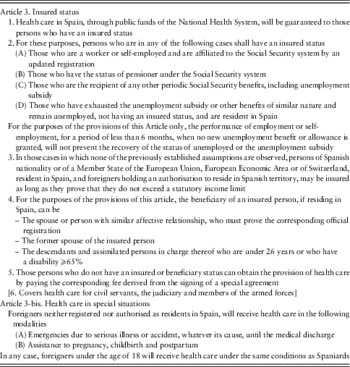
According to Article 3 and Article 3-bis of the Cohesion and Quality of the National Health System Act 2003 (significantly amended in 2012),Footnote 4 as a general rule, an insured status is required for access to the Spanish public health care system. As there are no official translations of this text,Footnote 5 we set it out in full here (Table 1).
Spanish cohesion and quality of the NHS Act 2003, as amended

Insured status under the 2003 Act
UK citizens who are living in Spain with a permanent residence permit may have ‘insured status’ under Article 3. For instance, UK citizens who worked in Spain as employees or were self-employed and are affiliated to the Spanish social security system,Footnote 6 and their families as defined in Spanish law, will be entitled, under Spanish law, even following a ‘no-deal Brexit’, to access public health care free of charge, on the same basis as insured Spanish citizens. Pensioners with annual incomes of over €100,000 pay 60% of prescription charges, capped at €60 a month, with lower co-payments and lower caps for less wealthy pensioners (UK Government, 2014). Their health care is funded through their contribution to the Spanish social security system. Provided their residence entitlements continue, their position will not change. It may be, however, that they have to reapply for a Spanish residence permit, as the basis for their current residence (nationality of an EU country) will no longer apply.
These entitlements extend also to their resident spouse, former spouse and children under 26 or older with a disability. Currently, the ‘members of their family’, as defined in EU law,Footnote 7 and ‘survivors’ of such insured UK pensioners are entitled to access the Spanish National Health Service (NHS) under EU Regulation 883/2004. But some family members, such as dependent parents, do not fall within the 2003 Act, so will cease to be covered.
Retired British people living in Spain, who have not worked in Spain, and are not affiliated to the Spanish social security system, but who have worked and paid national insurance contributions in the United Kingdom are also currently entitled to access the Spanish health care system under Regulation 883/2004, as if they were insured Spanish citizens. The Regulation applies to all EU nationals resident in the EU who are or have been covered by one or more national social security systems of EU countries, to ‘members of their family’ and their ‘survivors’.Footnote 8 In order to show that they fall within the Regulation, and satisfy administrative practices, UK citizens must have a permanent Spanish residence permit. For those individuals, the Regulation currently gives access to health care to those within its scope – including pensioners and their familiesFootnote 9 – as if they were socially insured in Spain.Footnote 10 Under a ‘no-deal Brexit’, Regulation 883/2004/EC will cease to apply to British citizens. Their national insurance contributions will no longer lawfully earn them the right to access health care in Spain. Equally it is possible that their residence entitlements will no longer be secure.
Under the Spanish Cohesion and Quality of the National Health System Act 2003, the Regulation 883/2004 regime is also applied to citizens who have contributed to social security schemes of an EEA country or Switzerland. In the now extremely unlikely event that the UK/R-EU future agreement includes EEA membership, the position of retired UK citizens resident in Spain would also not change in terms of access to health care.
Citizens of other countries, if they are authorised to reside in Spanish territory, ‘may be insured as long as they prove that they do not exceed a statutory income limit’.Footnote 11 In this case, they fall within the scope of the 2003 Act, and are entitled to Spanish health care. This is the position UK nationals will be in following a ‘no-deal Brexit’. The statutory income limit was set at €100,000 in 2012.Footnote 12 This is already quite high [the average income of a UK pensioner under age 75 is just over £18,000 (Department for Work and Pensions, 2016) (c €21,000) though pensioners who retire outside the United Kingdom are probably wealthier than those who remain in the United KingdomFootnote 13 ]. And moreover, the Spanish Constitutional Court has recently declared the limit to be unconstitutional.Footnote 14 If no income limit applies, the de jure position of EU/EEA citizens and non-EU/EEA citizens under the 2003 Act is the same, suggesting that the entitlements of access to health care would also remain the same under a ‘no-deal Brexit’, under which UK nationals will be non-EU/EEA citizens.
Nonetheless, there are significant de facto differences in their positions. These concern the administrative formalities with which citizens must comply in order to access the Spanish health care system.
In order to fall within the scope of the 2003 Act, it is necessary to provide evidence of permanent residence in Spain. EU/EEA citizens are entitled to a permanent residence permit on proof only that they have sufficient economic resources to meet the costs of living in Spain and that they enjoy coverage under a public or private health insurance system (with a ‘basket of services’ equivalent to those of the Spanish NHS). At the moment, that latter requirement is satisfied by reference to the UK NHS and the Regulation 883/2204 system, relying on the S1 (previously E-106, E-109, E-120 and E-121) form. But it is much more difficult for non-EU/EEA citizens to obtain a permanent residence permit in Spain, since they must also acquire a work permit at the same time. In the event of a ‘no-deal Brexit’, save perhaps a tiny minority, acquiring a work permit will simply be impossible for the ordinary retired UK citizens who live in Spain.
Moreover, under the administrative formalities surrounding the 2003 Act, non-EU/EEA citizens must also prove that they enjoy health coverage by their affiliation to the social security system of a state with a bilateral reciprocal agreement with Spain. Currently Spain has ~20 international treaties on social security issues. However, the ‘right to export’ national health coverage, so that patients are entitled to receive health care according to the Spanish NHS ‘basket’, is explicitly recognised in only seven cases (treaties with Andorra, Brazil, Chile, Ecuador, Morocco, Peru and Tunisia) (Spanish Court of Auditors, 2012). Otherwise, foreign nationals will receive only the health care benefits allowed by their home country (generally less than the Spanish ‘basket’). In any event, in the absence of such an agreement with the United Kingdom, non-EU/EEA citizens would be required to be covered by private health insurance, at their own expense. The administrative formalities necessary to secure rights under the 2003 Act, Article 3 (3) will in practice exclude UK nationals from access to the Spanish health care system following a ‘no-deal Brexit’.
The residual provision of the 2003 Act, Article 3 (5), permits those who are not insured under Article 3 (2) and are not beneficiaries under Article 3 (3) to access Spanish health care ‘by paying the corresponding fee derived from the signing of a special agreement’. This is an individual agreement between the Spanish social security system and the retired person. It is administered through the Spanish autonomous communities and only covers the ‘basic basket of services’ so that patients must pay 100% of the cost of their prescriptions. In addition to this, current rates for those who are older than 65 are €1884 per annum (€157 a month). There is a much lower fee for people under 65 (€ 720 per year, €60 a month).Footnote 15 The difference is perhaps intended to have a disincentive effect for retired people.
Again, de facto administrative requirements are important. To enter into these special agreements, Spanish law requires:Footnote 16 (i) accreditation of effective residence in Spain for a continuous period of at least 1 year immediately prior to the date of the request of the special agreement; (ii) registration, at the time of submitting the application to enter into the special agreement, in a municipality belonging to the territorial scope of the corresponding autonomous community with which the agreement is reached.
We have been unable to find data on how many of these agreements are already in place. Even though standard models of such agreements are available to all interested individuals, it cannot be ruled out that following a ‘no-deal Brexit’, accessing the Spanish NHS will only be feasible at considerable expense and administrative inconvenience, with all the uncertainty associated.
Exceptional cases under the 2003 Act (emergency care)
Non-insured non-nationals, even those without a temporary or permanent residence permit, are entitled to receive health care from the Spanish NHS in three exceptional cases: health emergencies, minors and pregnant women.Footnote 17 Retired people are by definition not minors, though may have dependents living with them who are. For the narrow category of health emergencies, even under a ‘no-deal Brexit’, British pensioners in Spain will be covered, so some of the worst fears of a disorderly Brexit concerning health care – to wit, that access to critical care in the event of a health emergency will be unavailable – are misplaced.
‘Acquired rights’?
The question of whether and if so how the concept of ‘acquired rights’ in international law will apply following Brexit has been ‘beset by confusion and misinformation’ (Douglas-Scott, Reference Douglas-Scott2016). The Vienna Convention on the Law of Treaties 1969 gives ‘acquired rights’ only to states, not to individuals. Individuals may enjoy ‘acquired rights’ under ‘customary international law’. But even if the ‘right to access public healthcare’ were such a right (and it is not at all obvious that it is), the enforcement of such ‘acquired rights’ by UK pensioners in Spain would rely on Spanish legal processes. These are unlikely to recognise any such rights in Spanish law.
The very recent Spanish experience, following the significant amendment of the Cohesion and Quality of the NHS Act 2003, undertaken to respond to the economic crisis, is illustrative. Before 2012, all immigrants, both legal and illegal, were entitled to health care in Spain. After the 2012 reform of the 2003 Act, no ‘acquired rights’ were recognised for those people who were living in Spain before 2012. The reform only contained a specific clause that postponed for four months the entry into force of such a provision.Footnote 18 In the case of a ‘no-deal Brexit’, it is possible that the Spanish authorities will recognise the need for a short transitional period, not as a legal entitlement, but as a principle of administrative convenience or even kindness. But there will be no enforceable ‘acquired’ legal rights to health care except as outlined above under the 2003 Act.
The ‘right to health care’ in Council of Europe or international law?
The UN Social and Economic Rights CovenantFootnote 19 and the Council of Europe’s European Social Charter,Footnote 20 to which Spain is a signatory, recognise the right to basic health care of every human being. In common with many countries, including the United Kingdom, however, Spain does not recognise even this minimum guarantee (‘basic health care’) as an enforceable right. The Spanish Constitutional CourtFootnote 21 held that these UN-European Social Charter provisions are non-binding rules and should be interpreted as mere aspirations.
Equally, reliance on the European Convention of Human Rights, Protocol 1, Article 1 on the right to ‘peaceful enjoyment of one’s possessions’ is highly unlikely to be successful. In some circumstances, social security entitlements can be ‘possessions’ in this context.Footnote 22 But in Ramaer and van Willigen,Footnote 23 the European Court of Human Rights found that the expectation, following changes to the Netherlands health system in 2006, that a Netherlands national resident in Spain would continue to enjoy health insurance under the Netherlands system, does not constitute a ‘possession’. The Strasbourg court distinguished other cases concerning social security benefits, noting that the applicant’s expectation was based not on a legal provision or act, but a hope. The Spanish courts have not explicitly ruled on whether a Spanish refusal of health care to non-EU nationals falls within the European Convention on Human Rights and Fundamental Freedoms, but if they are faced with such a claim, there is no reason to expect a difference of approach to that of the Strasbourg court. The view that there might be a legal entitlement to access the Spanish health care system outside of the requirements of the 2003 Act, in a post-‘no-deal’ Brexit position, cannot be described as anything stronger than a ‘hope’: it is unlikely to be deemed to be a ‘possession’.
Differences in the autonomous communities?
The Cohesion and Quality of the NHS Act 2003 is a national law which contains common legal standards for all the Spanish autonomous communities. Nonetheless, in general, health policy is a devolved power in Spain, so it is possible that different autonomous communities may adopt different approaches. Indeed, some regions, such as Cantabria, Valencia, the Balearic Islands, Aragon, Navarra, Catalonia and Euskadi, have adopted their own regional laws in order to assure access to health care regardless of the administrative situation of patients, including foreign patients. However, the national government has appealed these regional rules, arguing that health care policy concerning foreigners is an exclusive national power. It is likely that the Constitutional Court will uphold the appeals.
Other UK citizens in Spain
Finally, to be clear, we note that if the United Kingdom leaves the European Union without a negotiated deal, UK citizens who are temporarily in Spain (travelling for work or leisure) will no longer be able to access Spanish health care under the ‘Patients’ Rights Directive’,Footnote 24 or Regulation 883/2004 (through the European Health Insurance Card scheme). Private health insurance will be necessary, even for a short trip.
Conclusions
Under the legal framework explained above, it is extremely difficult for non-EU/EEA nationals to access the Spanish NHS, unless they are either working or have individually subscribed to an expensive special agreement with the Spanish social security authorities. That is why not many retired people from non-EU/EEA countries live permanently in Spain.
Without a specific UK/R-EU agreement which deals with the entitlements to health care of retired UK citizens in Spain, this is the position in which at least 100,000 UK pensioners who have retired to a Spanish ‘place in the sun’ will find themselves. It is impossible to see anything other than negative effects of Brexit on those citizens. Their future legal position is complex, and in some ways uncertain. Much depends on whether their existing residence status is maintained, or whether they must apply for permanent residence anew: this is not something under the control of the UK government. It is legally debatable whether Spain may lawfully enter into a bilateral agreement with the United Kingdom on the position of pensioners in Spain, or whether this must be a UK/R-EU agreement under ‘shared EU competence’. We are unable to explain the detail here, but the matter depends in part on whether Regulation 883/2004 and the arrangements under it constitute an ‘exercise’ of EU competence.Footnote 25 Whether such an agreement would be welcome to Spain (or the R-EU) depends on how the future (lack of) solidarity between people in the United Kingdom and people elsewhere in the EU is accommodated, given the UK government’s position on controlling migration. Prospects do not look propitious.
But ultimately some things are relatively clear: unless they are already insured in the Spanish system, retired UK citizens in Spain must either pay for a special agreement with the Spanish security authorities, at an extra cost of some €1800 per annum, plus the cost of 100% of their prescription charges, and undergo all the administrative elements entailed, or they will need private health insurance, which is likely to cost at least that, or considerably more (Spain Adviser, 2016).
Nonetheless, misinformation abounds. Some have claimed that UK citizens resident in R-EU countries would, on Brexit, have ‘acquired rights’ under the Vienna Convention on the Law of Treaties 1969: this rosy ‘best case scenario’ is just wrong. The worst case scenario is that UK citizens resident in Spain will have to reapply for their residence permits under the Spanish legislation applicable to non-EU/EEA citizens, with all the administrative inconvenience and cost entailed, both for the Spanish system and for the British citizens themselves. If they do, even once they have successfully reapplied, their personal health care costs will be considerably higher than they are at present, should they choose to remain in Spain.
Very obvious questions of capacity planning arise. The Spanish system will potentially need to gear up for a significant administrative effort. It would be prudent, given the worst case scenario of a ‘no-deal Brexit’, for the NHS in the United Kingdom to prepare to welcome significant numbers of pensioners home from their place in the sun.
Acknowledgements
The authors are grateful to Nicholas Fahy and Adam Oliver. All errors remain their own.