Introduction
Jenny Rowe

In October 2009, the Supreme Court became the highest court in the United Kingdom, replacing the role of the Appellate Committee of the House of Lords. The Law Lords sat for the last time on 30 July. When they were sworn in as Justices of the new Supreme Court on October 1 2009 it was an historic occasion, replacing some 600 years of judgments handed down from the House of Lords.
The Supreme Court will hear appeals on arguable points of law of the greatest public importance, for the whole of the United Kingdom in civil cases, and for England, Wales and Northern Ireland in criminal cases.
This is a landmark moment in constitutional reform and part of a series of changes announced in June 2003. These are detailed in the Constitutional Reform Act 2005, which also reformed the role of the Lord Chancellor.
The move of the Law Lords to the former Middlesex Guildhall on Parliament Square delivers the Government's vision of a clear, visible separation between judiciary and legislature, placing the UK on the same constitutional footing as most Western democracies.
There is a crucial difference between the Supreme Court of the UK and Supreme Courts such as the US Supreme Court. While the US Supreme Court can effectively strike down Acts of the Federal Parliament, the Supreme Court in the UK will not have this power. Its role is to interpret and clarify the law, not to make it, with the UK Parliament remaining sovereign.
The Supreme Court will comprise twelve Justices including the President and Deputy President. The Lords of Appeal in Ordinary (Law Lords) automatically become Justices of the new Supreme Court. The Senior Lord of Appeal (The Right Hon the Lord Phillips of Worth Matravers), will become its President and the Second Senior Lord of Appeal (The Right Hon the Lord Hope of Craighead) will be the Deputy President. Those justices who are Life Peers will remain members of the House of Lords, but be disqualified from sitting or voting in the House itself until they retire. In recent times the Law Lords have voluntarily excluded themselves from this but it was not always the case. Prior to World War II Law Lords regularly voted and took part in prominent political debates.
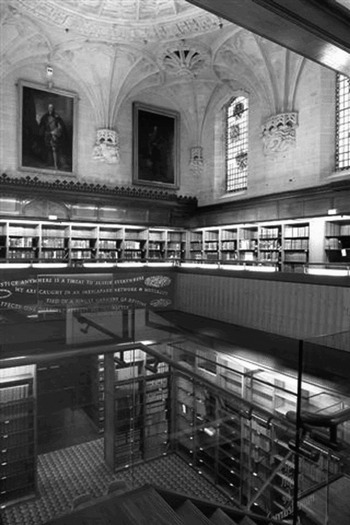
Quotations chosen by the Law Lords are a striking feature

After justices are sworn in, the Supreme Court assumes the jurisdiction of the Appellate Committee but also takes over the devolution jurisdiction from the Judicial Committee of the Privy Council (JCPC). The Supreme Court may be asked to give judgments on questions which relate to whether the acts of the devolved administrations in Scotland, Wales and Northern Ireland are within the powers given to them by the UK Parliament.
However the JCPC continues to be the final court of appeal in criminal and civil cases for certain independent Commonwealth countries (mainly the Bahamas, Trinidad and Tobago, Jamaica and Mauritius) and Crown dependencies (Jersey, Guernsey and the Isle of Man), as well as remaining UK overseas territories (Bermuda, Gibraltar and the Falkland Islands). The JCPC has now moved from its former home at 9 Downing Street and has its own courtroom in the same building as the Supreme Court. It is independent of the court but jointly supported by a range of services, including the new Library which has a collection of Commonwealth law reports.
The new court's role will be to educate and inform as well as adjudicate. Open to the public during working hours, members of the public will more easily be able to sit in on judgments than at the House of Lords and the court has been planned as an educational facility in its own right. A dedicated exhibition area tells the story of legal systems of the UK, with interactive features that allow visitors to follow previous high profile cases and make their own judgments.
The Justices of the Supreme Court will be more visible than the Law Lords ever were. For the first time in the UK, Supreme Court proceedings will routinely be filmed and footage made available to broadcasters. Negotiations are ongoing at the time of writing to ensure that we achieve our aim of informing the public about the work of the court in this way, without in any way jeopardising the delivery of justice.
The new home of the Supreme Court is an impressive building in an historic location, which has had links to justice and the law for nearly a millennium. Long before the earliest courthouse was built here, the site was occupied by Westminster Abbey's Sanctuary Tower and Old Belfry, where fugitives could seek refuge from their pursuers on an island at the junction of the Tyburn and the Thames.
The library is in many ways a centrepiece of the new Supreme Court and one of the major achievements of the project to make Middlesex Guildhall suitable for its new high profile role. I pay tribute to the team in the Ministry of Justice who drove the programme forward.
The Library – a vision realised
Library and information provision was of paramount importance in planning the new accommodation for the Supreme Court, once a location had been decided upon. At a very early stage the Law Lords had concluded that, as the main tool they used was words, the new library should be at the very heart of the building. Lord Rodger led much of the work for the Law Lords and worked to ensure all their needs were met at the new accommodation.
Middlesex Guildhall previously functioned as a Crown Court. By the end of the 1980s, it housed no fewer than seven court rooms, as well as administrative offices and 100 cells for prisoners.
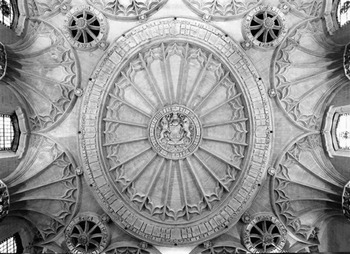
The ground floor of the former Crown Court One was partially removed during the renovation to create the library. The historic fabric of the court, the wall panelling and the impressive ceiling was retained. The resulting new library is a triple-height space created for the justices and their assistants to contemplate and study legal writings and case law. Looking up from the lower ground level of the building, the ceiling is magnificently rendered and painted to look like stone, with very intricate details.
The Library is a triple-height space created for the Justices and their assistants

The Library's beautiful ornate ceiling

An eye catching feature of the renovation is the library's wood and glass balustrade. This is engraved with quotations chosen by some of the Law Lords. They include: “Injustice anywhere is injustice everywhere”. “We are caught in an inescapable web of mutuality, tied in a single garment of destiny”. “Whatever affects one directly affects us all indirectly”. Martin Luther King, Aristotle, Plato, Cicero, Disraeli, Tolstoy, Megarry, Ralph Waldo Emerson, Ovid and Romans 2:14 are amongst the writings referenced in the engravings.
Inscribed on the ceremonial doors that lead to the library is the full text of the Magna Carta – overlaid with some words from the judicial oath: “I will do right by all manner of people, after the law and usages of the realm, without fear or favour, affection or ill will.”
The Magna Carta engraved library doors

The Supreme Court project gave us the opportunity to deliver considerable improvements to the library and archiving provision previously available to the Appellate Committee of the House of Lords. The creation of the Supreme Court has enabled us to locate in one place a significant collection of specialist books and journals for the new justices to refer to, with capacity for expansion.
As members of the House of Lords, the Law Lords had access to the main House of Lords' Library. As well as a large law collection in the main library the Law Lords had their own smaller resource (known as the Law Lords' Collection) of core legal textbooks, law reports and periodicals – available in a separate area close to their offices.
The Law Lords also kept a variety of books, journals and law reports in their rooms, some of which belonged to the library and some their own personal material. Until 2000, the administration and maintenance of the Law Lords' Collection was carried out by Judicial Office clerical staff, but the growth of the collection, and the increasingly complex information requirements of Law Lords, led to the main library taking over responsibility for the collection and a qualified librarian being appointed to oversee it.
By this year, the collection's size had reached around 1,300 books and 40 journals and law reports. Extra shelving had been installed over the years to accommodate the collection. However, its expansion meant capacity at the House of Lords was being pushed to the limit. The Law Lords' Collection has now transferred in its entirety to the Supreme Court for the new justices, their judicial assistants and court reporters. Books for the new library also came from other sources, including the old Bar Library at the Royal Courts of Justice, the Judicial Committee of the Privy Council, as well as some new purchases and donations.
The law is constantly evolving and growing and the library needed to be able to cope with an expansion of materials in the future. Our planning for adequate shelf space and storage of new books, journals and periodicals as collections grow means the justices will have all these resources in the new building for many, many years to come.
The role of the Library
The Library at the Supreme Court has two full time members of staff, a Librarian and a Deputy Librarian, and they will provide a wide range of information and library services to the new justices. Their role is to assist the justices, their judicial assistants and the court reporters with their requests and enquiries. They are responsible for collection development, book and journal acquisition, cataloguing, maintenance of serials and subscriptions, and access to databases.
Retrieving legal information, both in print and electronic formats, in response to enquiries and requests will be a large part of the library's function, as it was for the library at the House of Lords. When it comes to use of electronic resources and IT, the justices are diverse in their needs. Some are interested in the availability of online legal information, whereas others prefer more traditional print formats. The library's role is to facilitate their information requirements regardless.
One of the roles of the library will be to provide users with assistance and training in the use of electronic databases. Justices will have access to an extensive range of on-line subscription legal databases, including: Lexis Library, Westlaw, Lawtel, Jordans, Justis, the Electronic Immigration Network, Criminal Law Week, and HeinOnline.
A collection of statutes and statutory instruments is held in the library, plus a collection of legal textbooks covering a range of specialist legal areas, including criminal, taxation, and employment law and the law in relation to shipping and insurance.
The library has a range of law reports and journals amounting to some 80 titles. These include specialist law reports such as Lloyds Law Reports and the Nominate Law Reports, which are some of the oldest books in the Library. The Nominates were written by specialist law reporters and contain details of proceedings from the 1600s to the middle of the 19th Century.
The Law Reports Series (which began in 1865) is to this day still produced by the Incorporated Council of Law Reporting (ICLR). This series is available in full at the new library. Decisions from the House of Lords and the Privy Council appear in the Appeal Cases series, as will judgments from the Supreme Court of the United Kingdom.
I envisage that enquiries dealt with by the Library at the Supreme Court will be as varied as the range of cases to be heard by the justices. Enquiries may be in relation to a speech or article they are writing, as well as particular cases being heard at the court.
Justices may ask whether a particular statute is in force. What cases have been heard by a particular judge? What details there were of reported and unreported judgments overseas? Where they could locate current legislation in UK overseas territories or dependencies for a particular issue?
The Law Lords have relied heavily on external document supply services and inter-library loans, most notably from the Institute of Advanced Legal Studies. This route is especially useful for retrieving foreign and international law, as well as articles from lesser known and more obscure journals.
As well as the Law Lords' Collection, the Supreme Court is now also home to the Scottish Collection – which until now was housed in the House of Lords. This collection is provided by the Library of the Faculty of Advocates and consists of specialist legal books on Scots law. We have also had to ensure that any specialist needs regarding Northern Ireland have been catered for in the resources available to justices.
Conclusion
The work of the library and the library staff is already at the heart of the building and our hopes and ambition for future years. Without these resources the Supreme Court simply could not function. The library is integral to the core work of justices, their judicial assistants and other staff, so it is fitting that it is one of the most striking features of the new building.
In the coming years, there will undoubtedly be considerable scope for developing and further enhancing information services at the Supreme Court. The fast-paced and ever changing landscape of the law will demand this.