


Introduction
There is a broad agreement that institutions matter. Most research has focused on how they affect economic development and long-term economic growth (e.g. Acemoglu and Robinson, Reference Acemoglu and Robinson2012), perhaps paying less attention to the consequences for other important development outcomes. Although there is still disagreement on which institutions matter and how (Bardhan, Reference Bardhan2005; Hodgson, Reference Hodgson2025), there is a convergence of interest on two clusters of institutions: political and economic institutions. Yet relatively little is known as to how to adopt better quality institutions and reform poor-quality institutions, for which one needs to know how they change.
From a theoretical standpoint, there is a compelling argument that institutions are likely to persist over long periods. Institutions feature a self-sustaining set of social interactions and can be considered equilibria in a game-theoretic framework, leading to institutional persistence (Aoki, Reference Aoki2007). If institutional change were to occur endogenously, it would be slow and incremental, rather than through large-scale change. Similarly, following North (Reference North1990: Chapter 9), Kingston and Caballero (Reference Kingston and Caballero2009) argue that ‘the process of institutional change is also path-dependent because individuals learn, organizations develop, and ideologies form in the context of a particular set of formal and informal rules’. On the other hand, after a period of stasis, institutional change is likely to occur, driven by exogenous shifts such as changes in the global economy (Acemoglu and Robinson, Reference Acemoglu and Robinson2012) or by how social conflict is resolved (Acemoglu et al., Reference Acemoglu, Johnson, Robinson, Aghion and Durlauf2005a). Williamson (Reference Williamson2000) also argues that inefficient institutions will be replaced by efficient institutions due to the opportunism and bounded rationality of agents. Therefore, as theory provides no clear guidance, the debate on whether institutions persist or change is far from settled.
More evidence in this area is particularly valuable, for three reasons. Firstly, the literature on the origins and evolution of institutions offers some predictions on institutional change, but whether such predictions are reflected in the data is something we do not yet know. For example, are institutions persistent and, if so, to what extent? Are changes permanent or temporary? Is there an equilibrium level of institutions? Secondly, since political institutions and economic institutions both matter for long-term growth, the type and nature of their dynamic interrelationships is an important and understudied question. Do we expect co-movement of political and economic institutions, or are they likely to follow divergent paths? Thirdly, quantitative research has provided very limited evidence. It has mainly focused on explaining institutional variation across countries and, when exploring dynamic aspects, has relied on fairly short temporal variation. Documenting the stylized facts on the dynamics of institutions will therefore provide a useful basis for further research.
Indeed, the empirical literature on institutional change has largely focused on case-study evidence of institutional change drawn from a few selected countries. For example, Acemoglu et al. (Reference Acemoglu, Johnson and Robinson2005b) show that in 17th-century England, major institutional change occurred in the form of stronger property rights and limits on the monarch’s power after the Civil War of 1642 and the Glorious Revolution of 1688. This phenomenon was mostly related to the expansion of Atlantic trade in the 16th and 17th centuries, which led to a powerful economic bourgeoisie that could oppose the absolutist tendencies of the kings. While case-study evidence of the type proposed by Acemoglu et al. (Reference Acemoglu, Johnson and Robinson2005b) provides nuanced and deep insights into the historical processes and political economy factors that underpin large-scale institutional change in certain country contexts, they do not tell us much about the evolution of political and economic institutions across very different country and regional contexts over long periods. We complement the small-N approach of much of the previous empirical literature with a large-N analysis, which uses panel data for over 2 centuries for a large number of countries. We also contribute to a thin econometric literature studying various aspects of the dynamics of institutions (e.g. Krieger and Meierrieks, Reference Krieger and Meierrieks2016). In particular, our paper is close to O’Reilly and Murphy (Reference O’Reilly and Murphy2025) and Sobel and Coyne (Reference Sobel and Coyne2011), who explore the dynamic properties of political regime and ‘economic freedom’ variables. However, our study differs in terms of focus, methods, and objective. It systematically derives and tests a set of hypotheses from the influential literature on the political economy of institutions and economic growth, providing new empirical evidence on whether and how institutions change or persist, whether key political and economic institutions tend to co-evolve, and whether changes in political institutions cause changes in economic institutions in the long run.
To do this, we draw on panel time series methods allowing for cross-sectional dependence to accommodate local and global spillover effects of institutional change, where changes in political and economic institutions in one country can trigger similar changes in neighbouring countries (e.g. Acemoglu et al., Reference Acemoglu, Naidu, Restrepo and Robinson2019 show that democratization episodes in one country can lead to similar episodes in neighbouring countries). We also allow for unobserved heterogeneity at the country level of different forms to account for time-invariant effects related to cultural norms and geography and to accommodate the possibility that the dynamic relationship between institutions may be different in different countries with different economic structures and different levels of economic development. We use variables from the Varieties of Democracy (V-Dem) database capturing the quality of political and economic institutions over 200 years for a sample of 161 countries. Our measures of political institutions are electoral democracy and executive constraints, and our measures of economic institutions are the rule of law and property rights. The empirical analysis addresses the following questions: (1) Do institutions display inertia? if so, are measures stationary? Or do they change and hence are non-stationary? (2) Do political and economic institutions tend to co-evolve? (3) And, if they do, are changes in political institutions driving changes in economic institutions? Firstly, therefore, we test whether institutional quality measures are stationary. Secondly, we look at the long-run dynamic relationship between economic and political institutions and hence test for cointegration, providing evidence on whether political and economic institutions are in a long-run equilibrium. We finally assess whether changes in political institutions are likely to cause changes in economic institutions, or whether the causal relationship between the two sets of variables is more likely to be in the opposite direction.
The results offer four findings. Firstly, we find that non-stationarity cannot be rejected for measures of the rule of law, property rights, executive constraints, or electoral democracy, implying that institutions change in the long run. This may reflect the possibility that institutions change following the outcome of the distributive conflict between elites or between elites and the people (Acemoglu et al., Reference Acemoglu, Johnson, Robinson, Aghion and Durlauf2005a). Secondly, we find that economic and political institutions are cointegrated: there is a long-run relationship between the two. While in the short run they can drift apart, this will be temporary because they tend to co-evolve. Thirdly, the existence and nature of a long-run relationship may be different for different types of institutions: evidence of cointegration is strong between the rule of law and measures capturing constraints on executive and electoral democracy – less so when looking at property rights protection and political institutions. Finally, we find that long-run causality runs mostly from political institutions to economic institutions. We illustrate the cross-country results by discussing episodes of institutional change and persistence in Chile and Indonesia.
Institutions matter: but how do they change?
Although a lively debate continues on the extent and significance of their role, political and economic institutions are generally seen as important conditions for long-term development. On political institutions, part of the debate originally focused on whether, and how, political democracy affects economic growth. The literature has seen those arguing that there is an unambiguously positive effect (Acemoglu et al., Reference Acemoglu, Naidu, Restrepo and Robinson2019; Rodrik, Reference Rodrik2000) and others arguing for a more nuanced relationship (Bardhan, Reference Bardhan, Shapiro and Hacker1999; Przeworski and Limongi, Reference Przeworski and Limongi1993). The recent empirical literature has challenged the idea that political democracy measures have a large and robust positive effect on economic growth (Eberhardt, Reference Eberhardt2022; Paldam, Reference Paldam2024; Sen et al., Reference Sen, Pritchett, Sabyasachi and Raihan2017). Rather than looking at democracy as an indistinct body, a promising avenue for current research is ‘unpacking’ political regimes so as to look at the role of specific types of political institutions (e.g. Boese-Schlosser and Eberhardt, Reference Boese-Schlosser and Eberhardt2023). One such type is institutions that place limits on executive power, which are now regarded as an important driver of long-run economic development. One argument suggests that they are central to building effective states, being capable of providing and funding public goods and services that support economic growth. Executive constraints, for example, create the conditions for investing in fiscal capacity (Besley and Persson, Reference Besley and Persson2011). A second argument suggests that the existence of significant checks and balances on executive power is central to creating inclusive institutions, that is institutions that grant economic opportunities to a broad cross section of the population (Acemoglu et al., Reference Acemoglu, Johnson, Robinson, Aghion and Durlauf2005a).
On economic institutions, the consensus is that property rights protection and following the rule of law are important for igniting growth (e.g. Rodrik, Reference Rodrik2000). But, while protected property rights allow agents to secure a return on their investment and observance of the rule of law provides a stable contractual environment for transactions, important questions remain. For example, whose property rights should be protected and how (Chang, Reference Chang2011)? Acemoglu and Robinson (Reference Acemoglu and Robinson2019) propose a distinction between extractive and inclusive institutions. However, while this is another point that sees a broad consensus, there is much less agreement on what inclusive (political and economic) institutions means, that is how they can be defined in a way that is conceptually distinct from other types of institutions and that is amenable to measurement.Footnote 1
Be that as it may, quantitative research has provided many studies on the effects of institutions on economic growth, mostly supportive of the idea that institutions matter (e.g. Acemoglu et al., Reference Acemoglu, Johnson and Robinson2001; Rodrik et al., Reference Rodrik, Subramanian and Trebbi2004). There is, however, limited econometric evidence on how institutions change. The literature on the origins and evolution of institutions offers evidence on institutional change, but this is often qualitative and based on case studies.Footnote 2 A systematic econometric investigation would therefore complement qualitative accounts and, above all, would be useful to reveal whether any generalizations can be made on patterns of institutional change. Since institutions are long-run phenomena, resulting from historical processes, new econometric evidence in this area would be particularly valuable if it could document the evolution of institutions using measures that show substantial time series variation.Footnote 3 But should we expect institutions to change, and how?
Next, we look at what kind of guidance the literature offers. We focus on three questions. Do we see institutional persistence, or do institutions change? If they change, do different types of institutions tend to move together? If they do, do political institutions cause economic institutions, or vice versa?
Institutional persistence and change
Let us start with the possibility of institutional persistence. Acemoglu et al. (Reference Acemoglu, Johnson, Robinson, Aghion and Durlauf2005a) observe that countries with inefficient institutions do not reform them: they persist. Why? This may arise because of commitment problems: agents are unable to commit to any compensation for those who stand to lose. ‘Bad’ institutions can persist because the rich (poor) cannot commit to compensate the poor (rich) after old rules have been replaced with new ones (Acemoglu, Reference Acemoglu2003; Bardhan, Reference Bardhan2005). Taking this further, Acemoglu and Robinson (Reference Acemoglu and Robinson2008) argue that institutional reforms may be hindered by elites who benefit from existing economic institutions. Political elites who hold power may always have an incentive to maintain the political institutions that give them political power and the economic institutions supporting a distribution of resources that favours them. Therefore, economies may see a persistence of suboptimal economic and political institutions, since the elites who benefit from these institutions would not have any incentives to change them (Acemoglu and Robinson, Reference Acemoglu and Robinson2019; Acemoglu et al., Reference Acemoglu, Johnson, Robinson, Aghion and Durlauf2005a). This implies that institutional measures are stationary and, if a ‘shock’ occurs, it is reabsorbed after a while. Hence, changes are temporary.
However, although institutions may remain stable for prolonged periods, institutional change can occur. Acemoglu et al. (Reference Acemoglu, Johnson, Robinson, Aghion and Durlauf2005a) emphasize social conflict explanations of institutional change, where the struggle between ‘elites’ and the ‘people’ may lead to change via de jure and de facto political power. And changes can also occur following major technological, geopolitical, or historical events that can ‘accidentally’ force institutional change. One mechanism could be a significant alteration of relative prices (Bardhan Reference Bardhan1989: Chapter 1). Another could be a colonization strategy (e.g. Acemoglu et al., Reference Acemoglu, Johnson and Robinson2001), such as that of European colonizers, who were likely to set up ‘extractive institutions’ that were detrimental to economic development in colonies where they did not settle (such as in Africa and Asia), but ‘European-like’ institutions in colonies where they did settle (such as North America). Finally, the incidence of external conflicts – as argued by Besley and Persson (Reference Besley and Persson2011) – stimulates the demand for common-interest public goods (e.g. defence) and, in turn, increases the incentive for groups competing for power to invest in fiscal and legal institutions. Consequently, one would expect to observe non-stationary measures. And ‘shocks’ may result in permanent changes.
The long-run relationship between political and economic institutions
Turning to the second question, assuming institutions are not stationary, do they tend to co-evolve? We see that they could co-evolve because political institutions may tend to support economic institutions. Some democratic attributes, free and fair elections, separation of powers, and political checks and balances, tend to avert rent-seeking and thus prevent political and business elites from predating the economy (see North and Weingast, Reference North and Weingast1989, when discussing 17th-century England). This may be specifically the case with respect to property rights. According to Acemoglu (Reference Acemoglu2008), property rights can be either ‘democratic’ or ‘oligarchic’. In a democratic society, political power is more equally distributed, and, unlike oligarchic societies, poorer agents have the possibility to prevent the elite from erecting entry barriers and exploiting markets via monopoly power. The case of many developing economies is one where, reflecting the unequal balance of the political and economic power, market-economy institutions have not provided equal access to economic resources for a broad cross section of the population. The type of institutions an economy develops and how they evolve may depend on the distribution of power and resources that a country has, so that a relatively equal distribution of resources can create virtuous cycles where different institutions reinforce each other (see Acemoglu and Robinson, Reference Acemoglu and Robinson2019).
The experience of developed, capitalist democracies does suggest that democracy is hospitable to the rule of law, to fair tax systems, and to accountable management of the economy, and that it is associated with property rights protection for all citizens. Gerring et al. (Reference Gerring, Bond, Barndt and Moreno2005) argue that democracy has ‘historical’ effects, meaning that such effects materialize over a long period. The accumulated democratic stock fosters growth by delivering better governance, for example, via effective bureaucracies, opening up markets and institutions to previously excluded groups. In addition, in contexts where electoral accountability is imperfect, constraints to the executive can provide a ‘robust control’ mechanism to ensure that elites do not subvert the rule of law (Besley and Mueller, Reference Besley and Mueller2018). Further, weaker checks and balances on the executive are likely to be associated with more clientelist political systems, along with violations of the rule of law. In such systems, politicians are more likely to lean on law-enforcement authorities to selectively ‘adjust’ the rules in favour of specific groups of voters or potential voters (Lindberg et al., Reference Lindberg, Lo Bue and Sen2022). Hence, both greater electoral democracy and stronger executive constraints can go hand in hand with stronger rule of law.
Similarly, the idea of democracy delivering broad access to property rights, rather than a narrow one, is appealing. Nevertheless, democratization and property rights do not always go hand in hand. Their relationship is complex. If one is trying to explain the stability and predictability of property rights systems, it is useful to reconsider the role of democratic attributes in relation to the existence and intensity of distributive conflict. As Bardhan (Reference Bardhan, Shapiro and Hacker1999) and Przeworski and Limongi (Reference Przeworski and Limongi1993) have noted, the poor majority can use the diffusion of political rights to change the distribution, thus threatening the property rights of the rich minority. This can be the case, especially in unequal societies displaying significant income or asset concentration. This implies that agents do not necessarily need political democracy to feel that their investments are secure. Historically, strong protection of property rights has often been granted by autocratic regimes in East Asian economies (e.g. Indonesia), as well as by European fascist regimes. Bardhan (Reference Bardhan, Shapiro and Hacker1999) illustrates how, in the South Korea and Taiwan cases, the state was a powerful catalyst for industrialization, being organized as a competent technocratic structure insulated from clientelist ties, while Latin America and India did not have the same type of organization recruiting effective bureaucracies. This implies that, among economic institutions, the rule of law is more likely than property rights to have a long-run relationship with electoral democracy. This is a testable hypothesis, which we will investigate in the empirical analysis later.
The above discussion suggests that there are reasons to expect economies to see both persistence and change in political and economic institutions and that, similarly, these two types of institutions can move together in the long run or one can act as a ‘fetter’ so that the other displays inertia. Ultimately, as the literature suggests, we may expect different outcomes, and this is an empirical matter.
Do changes in political institutions cause changes in economic institutions?
If political and economic institutions have a long-run relationship where both co-evolve over time, is the relationship bidirectional or will changes in political (economic) institutions trigger changes in economic (political) institutions? Part of the literature suggests that ‘economic freedom’, such as greater reliance on free markets and protection of property rights, leads to political freedom (e.g. Boudreaux and Holcombe, Reference Boudreaux and Holcombe2017; Friedman, Reference Friedman2016; Lawson and Clark, Reference Lawson and Clark2010). However, this view has faced vigorous scrutiny (e.g. Bardhan, Reference Bardhan2007; Hoff and Stiglitz, Reference Hoff and Stiglitz2004), and the extant literature suggests that it is more likely that changes in political institutions will cause changes in economic institutions than the other way around. For example, Acemoglu and Robinson (Reference Acemoglu and Robinson2019) put forward a theory of why changes in political institutions drive changes in economic institutions. Economic institutions are not distribution-neutral: they not only determine the aggregate growth potential of the economy but also the distribution of resources in the country. This implies that economic institutions are politically determined, as the prevalent power relations will determine which set of economic institutions is more likely to emerge (Sen, Reference Sen2013). As Acemoglu and Robinson (Reference Acemoglu and Robinson2019: 24) argue: ‘politics drives economics and what leads to transition in economic institutions is change in political institutions, typically through the collective action of those who are excluded by extractive political institutions’. Again, this provides a testable hypothesis, which we will examine later.
Measuring economic and political institutions
Our analysis focuses on measures that have substantial time series variation (as well as covering a large sample of countries). We use the V-Dem dataset, which provides multidimensional and disaggregated data on the measures of institutional quality that capture the core characteristics of economic and political institutions (Coppedge et al., Reference Coppedge2020), presenting higher degrees of internal consistency (as shown in Boese, Reference Boese2019) and hence greater reliability in terms of cross-country and temporal comparisons. One of the major advantages of the V-Dem dataset is that it typically uses 25 experts per country and 5 experts per topic. This addresses a common criticism of institutional quality measures that they are affected by ‘coder bias’, that is one expert coding many or all institutions of a country may have negative or positive views of institutional functioning and so artificially under-or overrate institutions in different areas.Footnote 4 We choose the Rule of law and Property rights indices to measure economic institutions. And to measure political institutions, we choose the Executive constraints and the Electoral democracy indices. Time series plots, in the online Appendix, suggest that the series are nonstationary, and bivariate plots show evidence of co-movement between economic and political institutions.
Empirical strategy
To investigate non-stationarity, we employ the ‘CIPS’ test, a panel unit root test that allows for cross-section correlation. Panel unit root tests are applied to the variable series following the procedure given in Pesaran (Reference Pesaran2007). The test is based on a standard Augmented Dickey–Fuller (ADF) regression, augmented with cross-section averages of the dependent and independent variables to account for cross-section dependence. We report the Ztbar statistic (and its associated p-value) for the null hypothesis of non-stationarity in all countries’ variable series against the alternative hypothesis of stationarity in some countries’ variable series.
To establish whether there is bivariate cointegration between economic and political institutions, a suitable test – one which allows for greater flexibility in cross-sectional dependence – is provided by Gengenbach et al. (Reference Gengenbach, Urbain and Westerlund2009). The test is based on a conditional error correction model (ECM) of the form:
 $\eqalign{\Delta E{I_{it}} & = {\alpha _i}E{I_{it - 1}} + {{\gamma '}_{1i}}{ {P}}{{ {I}}_{{ {it - 1}}}}{ { + }}{{\gamma '}_{{ {2i}}}}{{ {f}}_{{ {it - 1}}}}{ { + }}\sum\nolimits_{{ {s = 0}}}^{{{ {p}}_{ {i}}}}{{\pi '}_{{ {1is}}}}\Delta { {P}}{{ {I}}_{{ {it - s}}}}{ { + }}\sum\nolimits_{{ {s = 1}}}^{{{ {p}}_{ {i}}}}{{\pi '}_{{ {is}}}}\Delta { {E}}{{ {I}}_{{ {it - s}}}}\cr & \quad{ { + }}\sum\nolimits_{{ {s = 0}}}^{{{ {p}}_{ {i}}}}{{\pi '}_{{ {3is}}}}\Delta {{ {f}}_{{ {it - s}}}}{ { + }}{\varepsilon _{{ {it}}}}}$
where EI can be the rule of law or property rights and, in turn, PI can be executive constraints or electoral democracy. The procedure in equation (1) is based on the common correlated effects mean group (CCEMG) estimator (Pesaran, Reference Pesaran2006) and extended in Chudik and Pesaran (Reference Chudik and Pesaran2015), whereby common factors f are approximated by cross-section averages, including cross-section averages of lagged ΔPI
it
and ΔEI
it
, depending on the lag length p
i
.Footnote
5
The test is for a null hypothesis of no error correction (EC) (hence no cointegration) against an alternative of EC (cointegration). The test statistic
 $\overline{\tau }^{*}$
is the average of the t-ratios for α̂
i
, from country regressions. The individual t-ratios, as well as their averages, have non-standard distributions under the null hypothesis, so Gengenbach et al. (Reference Gengenbach, Urbain and Westerlund2009) provide simulated critical values. The test is run for each CCEMG model with different deterministic terms (neither intercept nor trend; intercept; intercept and trend). Equation (1) models unobserved heterogeneity through country-fixed effect (α
i
) and time-varying common factors (f
i
), with factor loadings that can differ across countries. The country-specific heterogeneity captured by fixed effects may reflect time-invariant characteristics: social and cultural norms that facilitate or impede the adoption of developmental institutions (Berkowitz et al., Reference Berkowitz, Pistor and Richard2003; Roland, Reference Roland2004), or colonial heritage and geographical factors, including natural resource endowment and disease environment (e.g. Acemoglu et al., Reference Acemoglu, Johnson and Robinson2001). The common factors address the presence of strong cross-section dependence: a form of unobserved, time-varying heterogeneity, distinct from weaker forms of dependence (e.g. spatial correlation), which may be a source of endogeneity, leading to biased and inconsistent estimates (see Kapetanios et al., Reference Kapetanios, Pesaran and Yamagata2011). The common factors can be represented by a combination of a limited number of ‘strong’ factors and an unlimited number of ‘weak’ factors (Chudik et al., Reference Chudik, Pesaran and Tosetti2011). The former are global effects, which affect all countries irrespective of their location and (initial) level of institutional development, while the latter are local spillover effects, which may occur through geographic proximity, as well as social or economic interaction.Footnote
6
Geopolitical pressures and conflicts (regional or global), economic integration (e.g. trade agreements), pressure from international organizations to reform domestic institutions (e.g. via structural adjustment programmes), and financial crises (regional or global) are examples of common factors that may be at the origin of cross-section dependence and can affect both political and economic institutions. The impacts of these shocks and countries’ ability to respond differ across countries.
Apart from allowing us to test for cointegration, the ECM specification enables us to investigate the dynamic relationship between political and economic institutions. In particular, it allows a distinction between short-run and long-run effects and can easily encapsulate feedback effects between the two types of institutions. Moreover, the ECM specification allows us to investigate long-run causality. This is of particular interest here, since economic and political institutions may reinforce each other. If there exists a co-integrating relationship between the two, the Granger representation theorem (Granger, Reference Granger1988) states that long-run causality must run in at least one direction (equivalent to at least one variable adjusting to maintain an equilibrium relation), and the variables can be represented in the form of a dynamic ECM.
Results
After investigating non-stationarity, this section presents the results regarding the existence of a long-run equilibrium relationship between the variables, its dynamics, and the direction of long-run causality.
Unit root tests
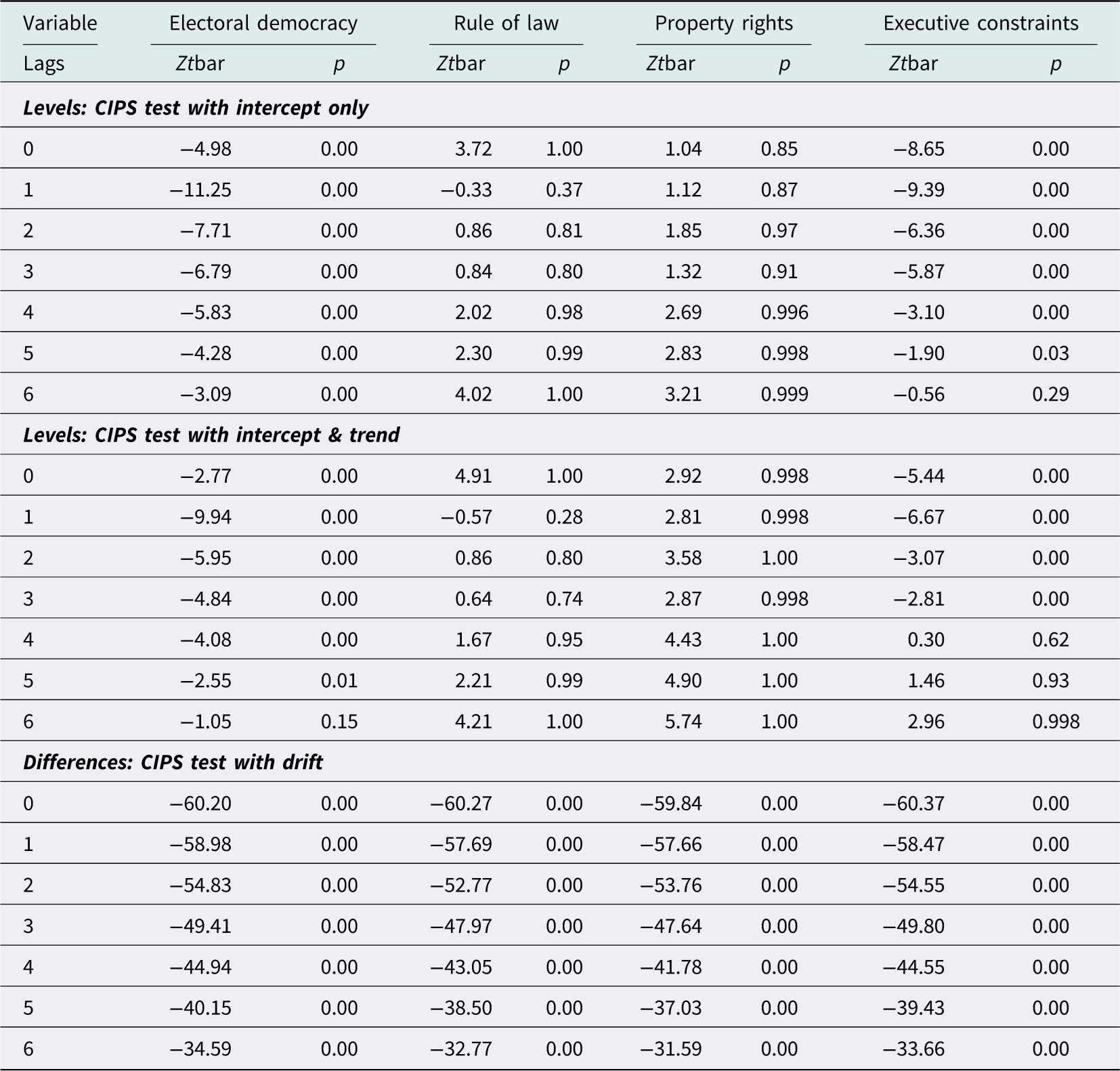
Table 1 presents the panel unit root test results. We find that, for variables in levels, non-stationarity cannot be rejected once the ADF equation is augmented with a sufficient number of lags to remove serial correlation and/or a linear trend.Footnote 7 Non-stationarity is rejected for all variables in first differences. Echoing Sobel and Coyne (Reference Sobel and Coyne2011), the finding of non-stationarity in levels implies that any shocks to the institutional variables would have persistent effects. Going back to our review of the literature on institutions, our finding that shocks to institutions are permanent, and not temporary, provides some support to explanations of institutional change that highlight the role of social conflict or of ‘critical junctures’, such as colonization, internal/external conflict, and economic crises in causing permanent shifts in institutions.
Panel unit root tests

Table 1. Long description
The table presents panel unit root test results for variables including Electoral democracy, Rule of law, Property rights, and Executive constraints. It is organized into three main sections: Levels with intercept only, Levels with intercept and trend, and Differences with drift. Each section contains rows for lags 0 through 6, with columns for Ztbar and p-values. The table shows the test results under different conditions, indicating the presence or absence of non-stationarity. For instance, in the Levels with intercept only section, Electoral democracy shows negative Ztbar values and p-values of 0.00 for all lags. Similar patterns are observed for other variables and sections, with specific Ztbar values and p-values provided for each lag.
Source: Authors’ calculations based on V-Dem data (Coppedge et al., Reference Coppedge2020).
Notes: H0: non-stationarity in all countries’ variable series; H1: stationarity in some countries’ variable series.
Cointegration
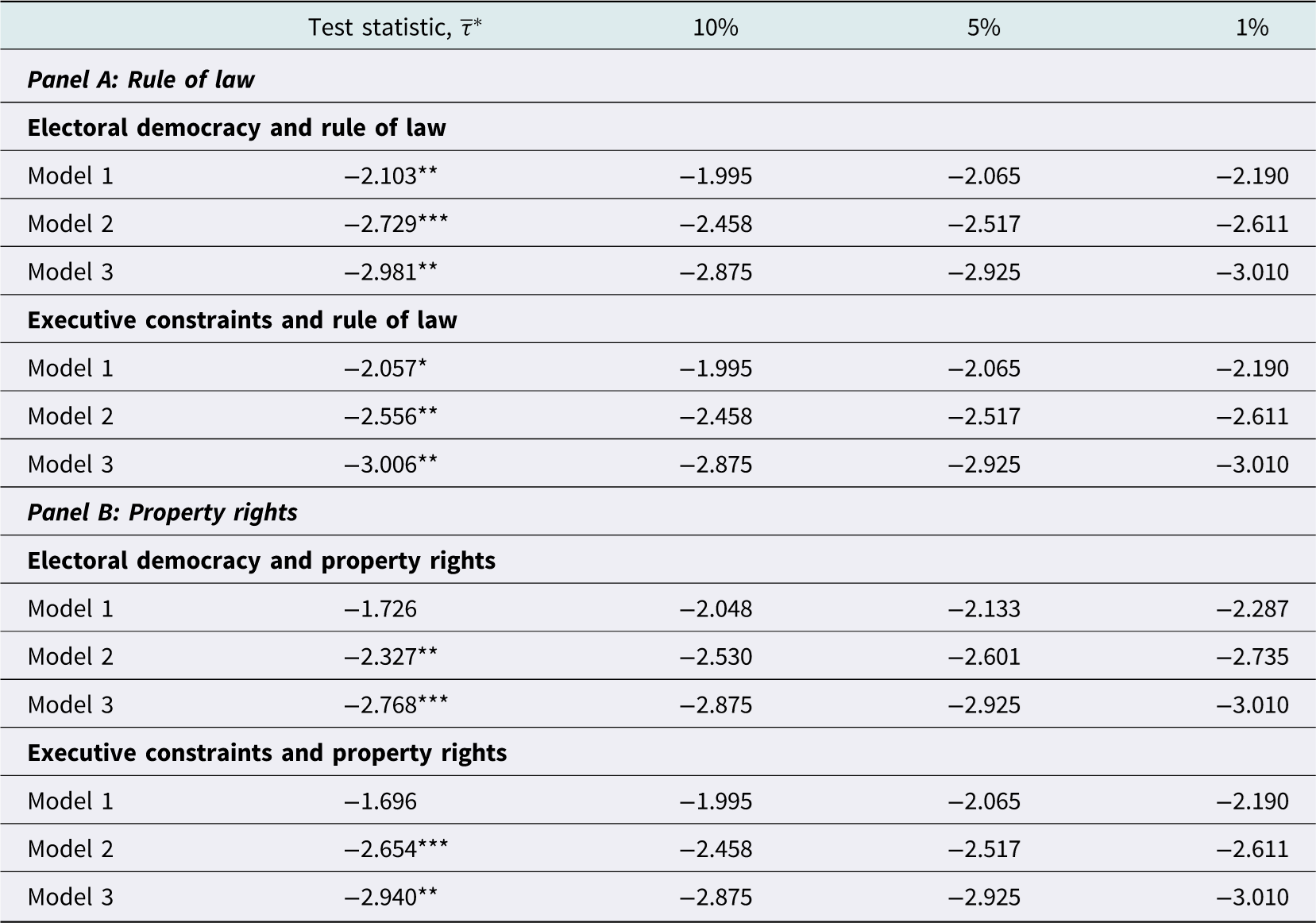
Table 2 reports results of the bivariate cointegration tests between economic institutions and political institutions based on the Gengenbach et al. (Reference Gengenbach, Urbain and Westerlund2009) cointegration test with one lag. Model 1 has no deterministic terms (no intercept or trend), model 2 includes only an intercept, and model 3 includes an intercept and a linear trend. Gengenbach et al. (Reference Gengenbach, Urbain and Westerlund2009) tabulate critical values for different combinations of N (number of countries), T (number of years) and m (number of regressors). Inference is based on comparing the test statistic,
 $\overline{\tau }^{*}$
, with the simulated critical values: if the absolute value of the test statistic is larger than the absolute value of the simulated critical values, we reject the null hypothesis of no EC (hence no cointegration).
Gengenbach et al. (Reference Gengenbach, Urbain and Westerlund2009) cointegration test

Table 2. Long description
A table comparing test statistics for rule of law and property rights across different models. The table has 12 rows and 5 columns. Column headers are Test statistic, $overline{tau }^{*}$, 10 percent, 5 percent, and 1 percent. Row labels include Panel A: Rule of law and Panel B: Property rights, with subcategories for Electoral democracy and Executive constraints. Each subcategory has three models with corresponding test statistics and critical values. Panel A: Rule of law includes Electoral democracy and rule of law, and Executive constraints and rule of law. Panel B: Property rights includes Electoral democracy and property rights, and Executive constraints and property rights. Each model has different test statistics and critical values at 10 percent, 5 percent, and 1 percent levels.
Source: Authors’ construction.
Notes: ***, **, and * indicate significance at 1%, 5%, and 10%, respectively. Significance will indicate rejection of the null hypothesis. H0: no error correction; hence, no cointegration. H1: error correction; hence cointegration. Models 1, 2, and 3 refer to an ECM without any deterministic terms, with intercept, and with intercept and trend, respectively. Critical values at 10%, 5%, and 1% are obtained from Table 3 of Gengenbach et al. (Reference Gengenbach, Urbain and Westerlund2009). For the results on electoral democracy and property rights (in Panel B), significance is based on the proportion of country-specific error correction terms, across all countries, that are statistically significant.
ECM estimates

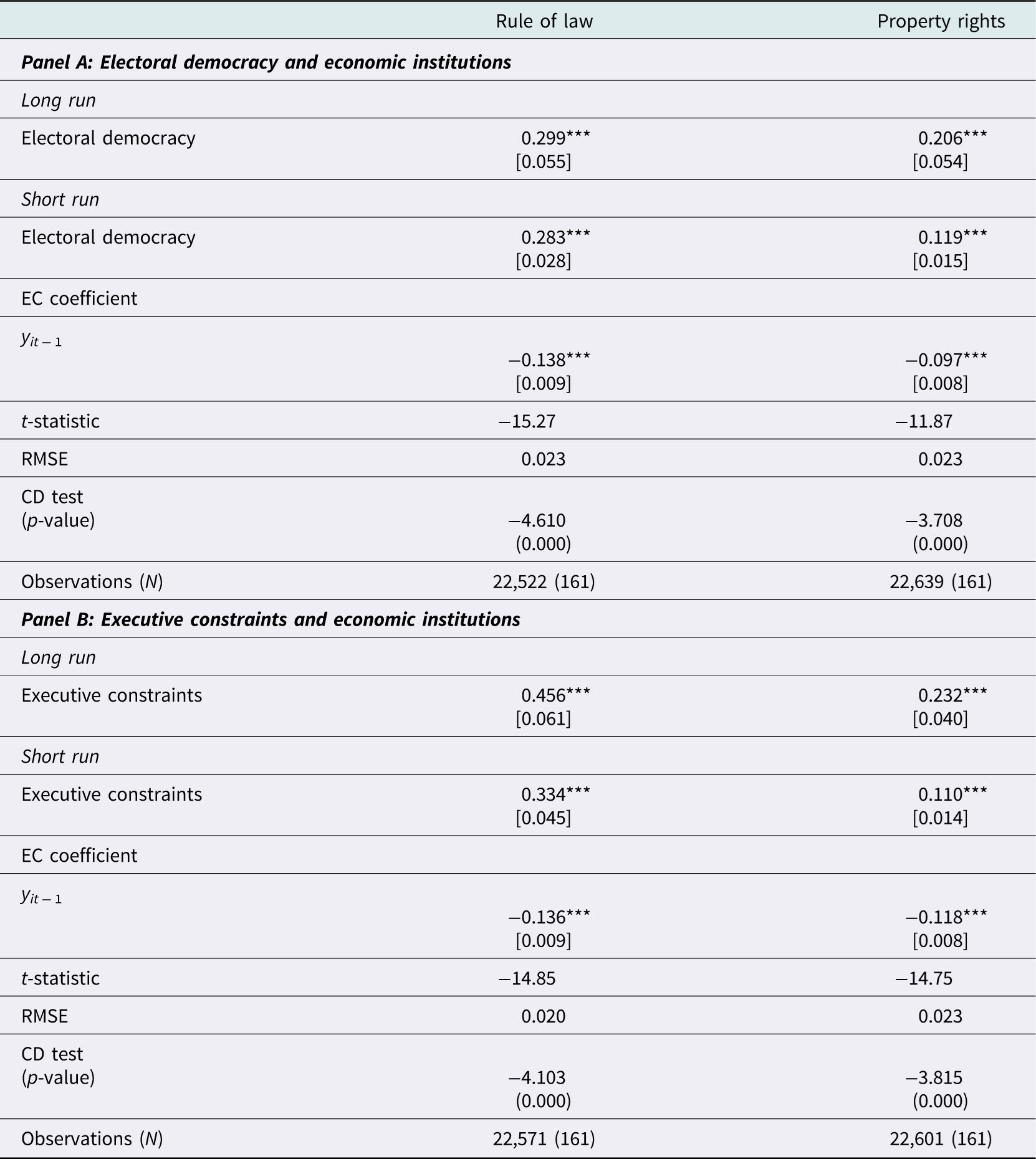
Table 3. Long description
The table presents cointegration test statistics for various models examining the relationship between rule of law and property rights with electoral democracy and executive constraints. It is divided into two panels: Panel A focuses on the rule of law, while Panel B focuses on property rights. Each panel is further divided into models for electoral democracy and executive constraints. The table includes three models for each relationship, with test statistics provided for each. Panel A: Rule of law. Row 1: Electoral democracy and rule of law, Model 1, 2.103, 1.995, 2.065, 2.190. Row 2: Electoral democracy and rule of law, Model 2, 2.729, 2.458, 2.517, 2.611. Row 3: Electoral democracy and rule of law, Model 3, 2.981, 2.875, 2.925, 3.010. Row 4: Executive constraints and rule of law, Model 1, 2.057, 1.995, 2.065, 2.190. Row 5: Executive constraints and rule of law, Model 2, 2.556, 2.458, 2.517, 2.611. Row 6: Executive constraints and rule of law, Model 3, 3.006, 2.875, 2.925, 3.010. Panel B: Property rights. Row 1: Electoral democracy and property rights, Model 1, 1.726, 2.048, 2.133, 2.287. Row 2: Electoral democracy and property rights, Model 2, 2.327, 2.530, 2.601, 2.735. Row 3: Electoral democracy and property rights, Model 3, 2.768, 2.875, 2.925, 3.010. Row 4: Executive constraints and property rights, Model 1, 1.696, 1.995, 2.065, 2.190. Row 5: Executive constraints and property rights, Model 2, 2.654, 2.458, 2.517, 2.611. Row 6: Executive constraints and property rights, Model 3, 2.940, 2.875, 2.925, 3.010.
Source: Authors’ construction.
Notes: Results based on ECM for 161 countries with the respective economic institutional variables as the dependent variable. The long-run and short-run averages are reported, with standard errors reported below the averages. RMSE is the root mean square error. The CD test is the Pesaran (Reference Pesaran2015) test distributed N(0,1) under the null of weak cross-section independence (p-values reported below). *, **, and *** indicate significance at 10%, 5%, and 1%, respectively.
We find a clear rejection of the null hypothesis for electoral democracy and the rule of law and for executive constraints and the rule of law. Similarly, we see evidence of cointegration for executive constraints and property rights and electoral democracy and property rights. This implies that there is a long-run equilibrium between economic and political institutions irrespective of the measure of economic institutions we use. However, the case of electoral democracy and property rights deserves closer scrutiny because, although we find that there is evidence of cointegration, this does not imply that there is always or everywhere a long-run equilibrium between the two variables. We look at the EC terms at the country level, instead of the test statistic
 ${{\bar \tau }^*}$
, which is calculated as an average from country regressions. The results show that the country-specific EC terms, across all 161 countries, are statistically significant in most cases, but not all (see Appendix Table A3). This means that heterogeneity can still be relevant and that a long-run equilibrium between electoral democracy and property rights may not always materialize, depending on the country context. And, ultimately, this offers support to the view that democracy and property rights do not always go hand in hand (e.g. Bardhan, Reference Bardhan, Shapiro and Hacker1999 and Przeworski and Limongi, Reference Przeworski and Limongi1993).
Short-and long-run effects
Next, we focus on the dynamics of the relationship between political and economic institutions. Having found evidence of cointegration, we want to see how economic institutions behave when deviating from the long-run equilibrium. The results are shown in Table 3.
Without exception, EC coefficient estimates are negative and significant, reflecting the fact that political and economic institutions are cointegrated. The EC coefficient captures the adjustment towards the long-run equilibrium, that is what proportion of the disequilibrium in the dependent variable in one period is corrected in the next period. In the case of political institutions constraining the executive power, this means that a deviation in the rule of law or property rights from the long-run equilibrium will be corrected by approximately 14 per cent or 12 per cent in the next period, respectively. A hypothetical shock to executive constraints would bring effects on the rule of law and property rights that are slowly absorbed. Such relatively slow adjustment of economic institutions gives an appreciation of how persistent such institutions are.
ECM estimates also allow us to see how political institutions impact the rule of law and property rights. In addition to the strong evidence of EC, the long-and short-run coefficients of executive constraints and electoral democracy are statistically significant throughout. These estimates represent average effects (short-and long-run) across the global sample of countries.Footnote 8 Their sign is positive and implies that, after accounting for the presence of heterogeneity across countries due to fixed effects or heterogeneous parameters, both types of political institutions are important to support economic institutions in the short and long run.Footnote 9
There is one remaining concern: the CD test results signal that cross-sectional dependence may still be present. Such concern is to some extent mitigated when using additional tests developed in Juodis and Reese (Reference Juodis and Reese2022) and Pesaran and Xie (Reference Pesaran and Xie2022), but it cannot be ruled out.Footnote 10 Hence, we extend the analysis by including two historical macroeconomic variables: historical Gross Domestic Product (GDP) and trade openness measures. Per capita GDP data are from the Maddison project database (Bolt and van Zanden, Reference Bolt and van Zanden2014). The measure of trade openness is the ratio of the total value of a country’s exports and imports (in 2014 US$ millions) and GDP, using data from Barbieri and Keshk (Reference Barbieri and Keshk2016), as published in the V-Dem dataset. Table A4, in the Appendix, reports ECM estimates including such variables. The statistical significance across specifications of the ECM term supports the hypothesis of cointegration and so confirms our earlier results. Short-and long-run estimates of executive constraints and electoral democracy, representing average effects, are also in this case significant. The noticeable difference is that the cross-sectional dependence test results now do not reject the null of cross-sectional independence.
Causality tests
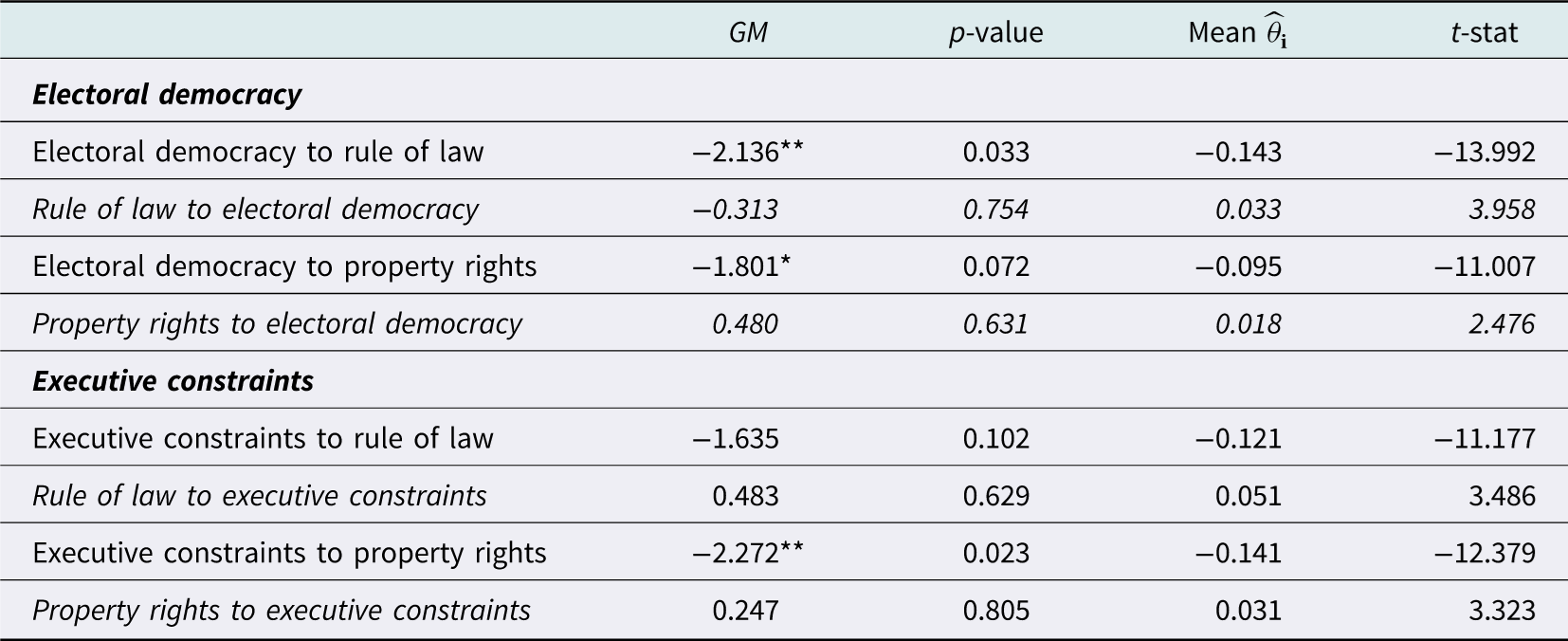
Table 4 presents tests for the direction of long-run causality. The group mean (GM) test allows us to ask whether the long-run causal effect is zero, on average, for the panel. The test statistic is for the null of ‘no long-run causal impact’, which in our case can be interpreted as the variable not adjusting to maintain long-run equilibrium. While primary interest is in the GM statistic, we also report the robust θ̂ i estimate and its associated t-statistic. At best, the panel robust θ̂ i complements the GM statistic. A combination of a high t-statistic on the average θ̂ i coefficients and a low t-statistic (below 1.96) in the ‘reverse causality’ equations can be interpreted as evidence of a long-run causal relationship from political to economic institutions.
Weak exogeneity tests

Table 4. Long description
A table with four rows and four columns comparing tests for the direction of long-run causality in electoral democracy and executive constraints. The columns are labeled GM, p-value, Mean θᵢ, and t-stat. The rows are grouped under Electoral democracy and Executive constraints. Row 1: Electoral democracy to rule of law, -2.136, 0.033, -0.143, -13.992. Row 2: Rule of law to electoral democracy, -0.313, 0.754, 0.033, 3.958. Row 3: Electoral democracy to property rights, -1.801, 0.072, -0.095, -11.007. Row 4: Property rights to electoral democracy, 0.480, 0.631, 0.018, 2.476. Row 5: Executive constraints to rule of law, -1.635, 0.102, -0.121, -11.177. Row 6: Rule of law to executive constraints, 0.483, 0.629, 0.051, 3.486. Row 7: Executive constraints to property rights, -2.272, 0.023, -0.141, -12.379. Row 8: Property rights to executive constraints, 0.247, 0.805, 0.031, 3.323.
Source: Authors’ construction.
Notes: we report the GM statistic from Canning and Pedroni (Reference Canning and Pedroni2008). GM is the group mean statistic, which is the average of the country-specific t-ratios on the disequilibrium term and is distributed N(0,1). The null hypothesis is of ‘no causal impact’ and is interpreted as the political institutions variable not having a long-run causal impact on the economic institutions variable. The rows in italic are for ‘reverse causality’: where causality runs from economic institutions to political institutions. We also report the robust θ̂ i and its associated t-statistic. A high t-statistic on the average θ̂ i is expected for the equations with economic institutions as a dependent variable: that is the rows not in italics. Conversely, a low t-statistic is expected in the ‘reverse causality’ equations.
There is clear evidence that long-run causality runs from constraints on the executive to property rights and from electoral democracy to the rule of law. In contrast, we find very little evidence that causality runs from economic to political institutions. In sum, the results favour the hypothesis that causality runs from political to economic institutions. However, we cannot rule out the possibility of bidirectionality. The lack of clear evidence of causality, in weak exogeneity tests, running from economic to political institutions, may not imply the absence of any significant long-run causality; it may rather reflect the presence of pervasive heterogeneity across countries, where a feedback effect from economic to political institutions may or may not materialize depending on context-specific conditions.
Institutional persistence and change in Chile and Indonesia
The cases of Chile and Indonesia complement the above cross-country evidence. Both countries are important emerging economies reliant, to a significant extent, on natural resources. And both are ex-colonies that have made significant economic progress since independence. But Indonesia is often cited as a case of growth with equity, while Chile is characterized by persistent structural inequalities. And this makes their comparison illustrative of how social conflict can affect institutional change.
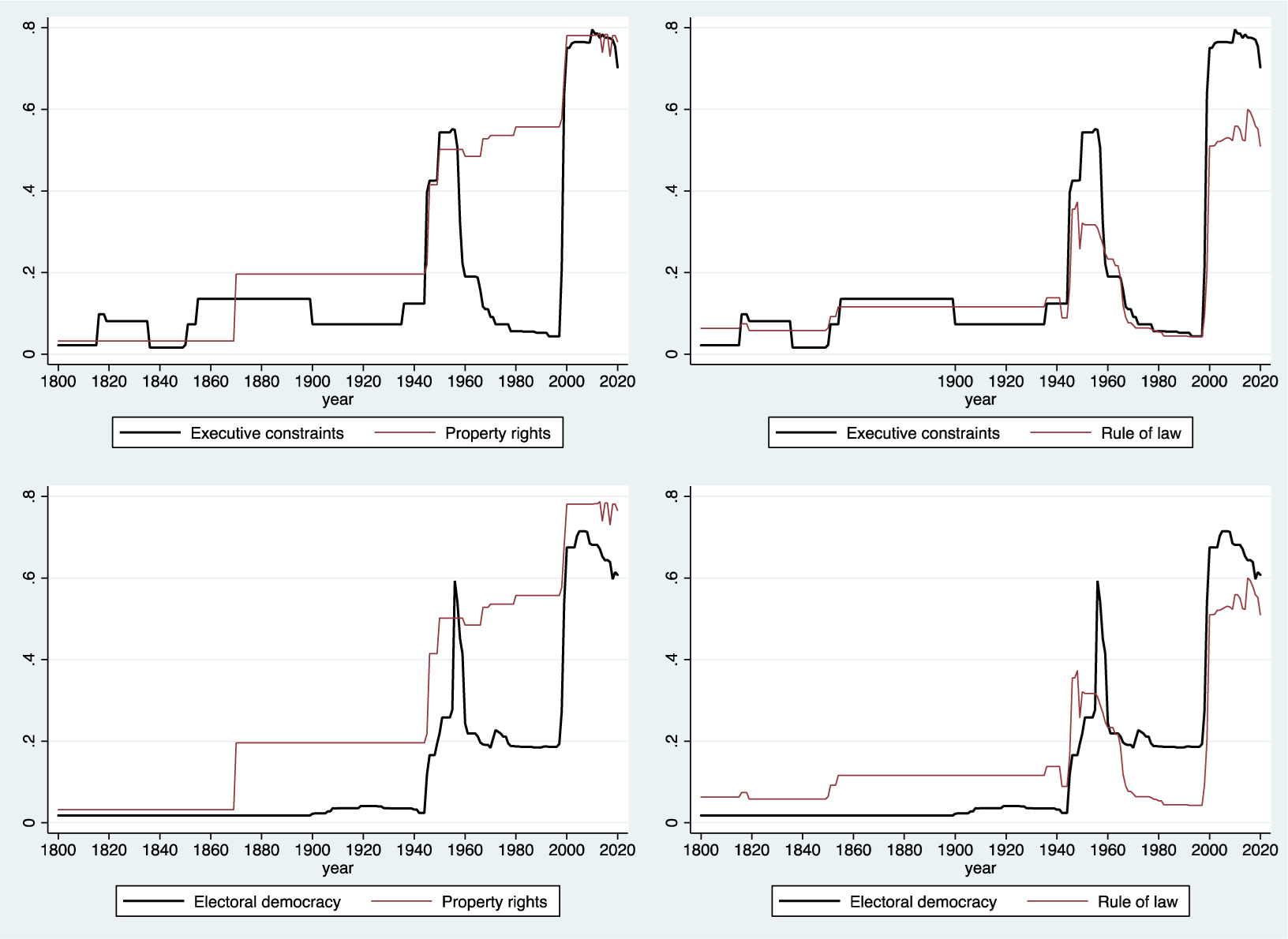
Indonesia was under Dutch colonial rule all through the 18th century and the first half of the 19th century. During this period, Indonesia was a mixed plantation and peasant export economy with a dominance of plantation exports (Lal and Myint, Reference Lal and Myint1996). Colonial economic policy was based on the maximum extraction of revenues from export crops (Lewis, Reference Lewis2007). Commitment to property rights was practically non-existent and the rule of law was weak under the colonial administration. As is evident from Figure 1, institutional quality was very low for both economic and political institutions, with hardly any change from the beginning of 18th century to the mid-19th century.
The Japanese occupation of Indonesia in 1942 effectively ended Dutch colonial rule. The Dutch attempted to re-establish colonial authority in 1945, leading to an armed struggle for independence. Indonesia gained independence in 1949, with nationalist forces led by Sukarno coming to power. The adoption of the Constitution in 1945 set out the basic principles of an independent Indonesian state and provided for the limited separation of executive, judicial and legislative powers. Consequently, all measures of institutional quality improved during this period, as observed in Figure 1.
Political and economic institutions in Indonesia.
Source: authors’ construction using V-Dem data (Coppedge et al., Reference Coppedge2020).

In the 1950s, Sukarno followed a policy of Guided Democracy, which was characterized by a personalized Presidential system of governance (Ibid.) with few checks on executive power. At the same time, Sukarno initiated radical policies of wholesale nationalization of foreign-owned assets and intensely inward-looking economic policies which had a disastrous effect on export orientation, leading to dwindling foreign reserves. In addition, there were deep macroeconomic imbalances leading to hyperinflation and economic decline in the first half of the 1960s (Hill, Reference Hill1996). In October 1965, there was a military coup against the Sukarno government and the coming of power of Major-General Suharto.
With the establishment of the ‘New Order’ government of Suharto, there was an emphasis on sound macroeconomic management and orthodox economic policies, and economic growth quickly rebounded (Hill, Reference Hill1996). However, constraints on the executive and commitment to the rule of law remained weak, and the oil boom of the 1970s led to the availability of resources ‘to sustain the political institutions and patronage networks of Indonesia’s rulers and their own personal enrichment’ (Robison and Hadiz Reference Robison and Hadiz2004: 53).
With the fall in oil prices in the first half of the 1980s, there was a need to mobilize new sources of investible resources from the private sector as well as to develop export industries, particularly in the manufacturing sector (Rosser, Reference Rosser2002). In a series of reform packages beginning in the mid-1980s, the Indonesian government deregulated trade and financial regimes, relaxed foreign investment restrictions, and opened a range of former state monopolies to private investment (Hill, Reference Hill1996). The deregulation process seemed to have further entrenched the emerging ‘politico-business’ oligarchies, and patron–client networks that sustained these oligarchies (Robison and Hadiz Reference Robison and Hadiz2004). Thus, the families that owned domestic conglomerates as well as the politico-business class in Indonesia moved into the sectors of the former state monopolies such as banking, finance, and infrastructure (Sen, Reference Sen, Athukorala, Patunru and Resosudarmo2014). These families also successfully concentrated their presence in sectors that were largely untouched by deregulation such as natural resource industries and domestic trading monopolies. In addition, they diversified their sources of funds from oil revenues to largely unregulated commercial bank loans and equity in international capital markets. Finally, they preserved their authority over the ‘strategic gate-keeping institutions of the state’, ensuring that they maintained control over the allocation of rents (Robison, Reference Robison1986). In this way, the patron–client networks that were there been politico-bureaucrats and oligarchic capitalists since the early years of the Suharto regime were significant strengthened in the 1980s to the early 1990s (as we can see from Figure 1, measures of institutional quality had fallen to their pre-independence levels by the 1990s). All through this period, there was further entrenchment of patron–client networks and ‘the harnessing of the state to the unconstrained interest of this privileged group of oligarchies’ (Robison and Hadiz Reference Robison and Hadiz2004: 11)
In July 1997, with the collapse of the Thai baht, capital outflows from Indonesia led to a large decline in the value of the Indonesian rupiah and a generalized financial crisis in East Asia. With the higher cost of external borrowing, there was widespread bankruptcies and debt defaults of oligarchs favoured by the Suharto regime and a sharp fall in economic activity. An IMF stabilization programme was introduced in October 1997; however, the financial crisis continued unabated, and by January 1998, the vast number of companies listed in the Indonesia stock exchange were technically insolvent (Lewis, Reference Lewis2007). The crisis came to a head with ongoing student protests, and General Suharto finally resigned.
The late 1990s saw a period of political instability and widespread institutional stagnation in Indonesia. In 1999, the first election after the collapse of the New Order government was held, and a multiparty coalition took power under the leadership of Wahid. However, persistent problems with the economy coupled with weak leadership led to the removal of Wahid and the advent of Megawati, the daughter of Sukarno, to the Presidency, in 2001. She quickly introduced far-reaching political decentralization laws, as well as other institutional reforms, such as Central Bank independence, an independent electoral commission, a fully elected parliament and the provision of the direct election of the President from 2003. Constraints on executive and electoral democracy improved significantly over this period, as well as the adherence to property rights and the rule of law. This is reflected in the sharp increase in these measures (see Figure 1).
A feature of the evolution of economic and political institutions in Indonesia is that both these sets of institutions have co-evolved, and their movements up or down have followed important moments in Indonesia’s economic and political history, as discussed above. The one discrepancy is when the commitment to property rights remained at a high level after the New Order government came to power in 1965 till its collapse in 1998, even though the constraints to executive, electoral democracy and the rule of law deteriorated in this period. This can be explained by the pro-market and pro-business orientation of the Suharto regime and a credible commitment to property rights in the New Order era, all through the 1970s and 1980s, a period when Indonesia grew rapidly (Hill, Reference Hill1996). This supports the evidence from the cross-country econometrics in the previous section that, among economic institutions, property rights is less likely to co-evolve with political institutions.
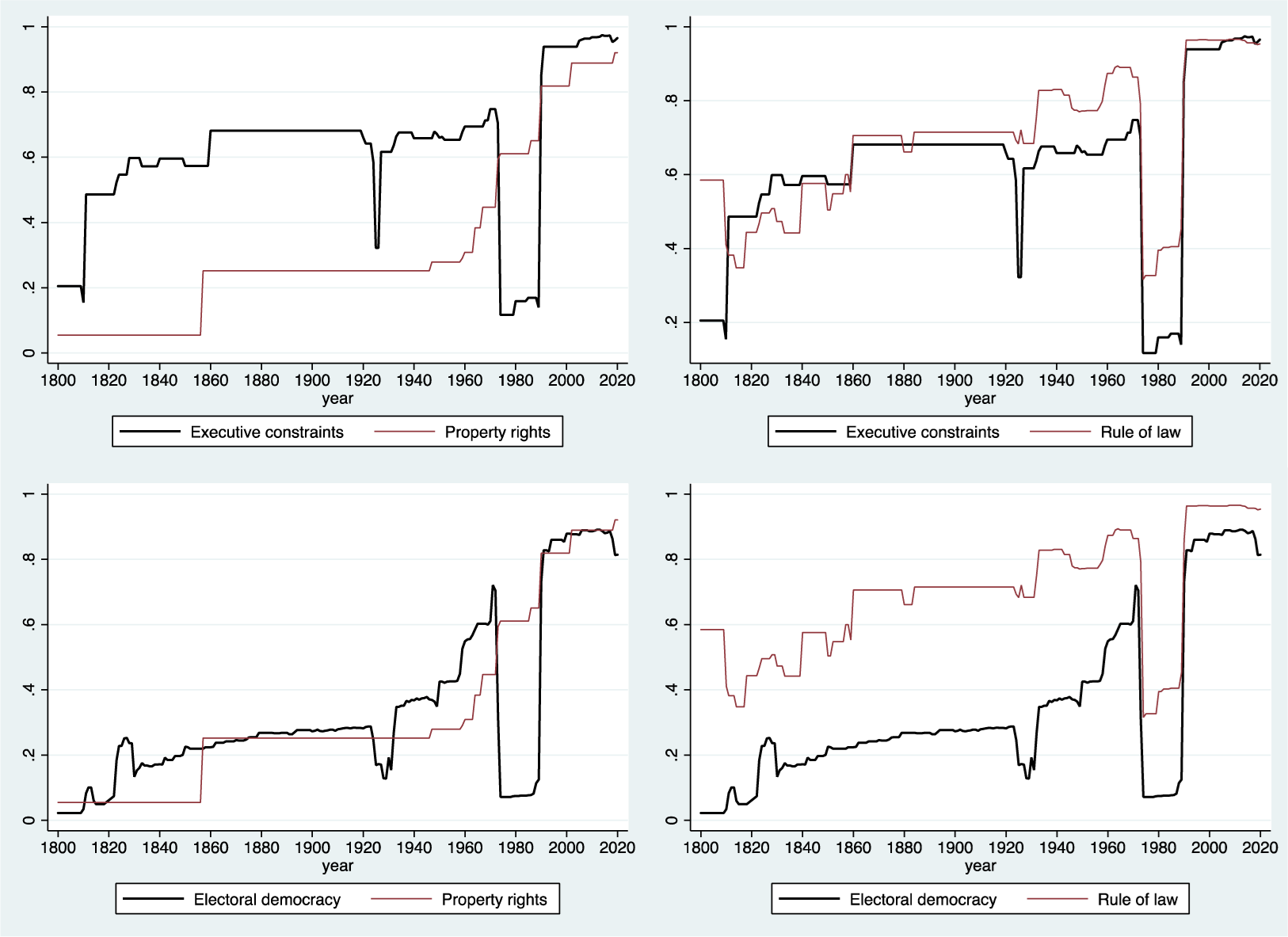
The case of Chile illustrates well how social conflict may change institutions and how they persist in response to a demand for institutional reforms. After a period of political instability preceding and following independence in 1818, Chile has seen initial, albeit partial, improvements in political and economic institutions, lasting from the 1830s until the 1860s. In particular, this was a period that saw little democratic improvement, as politics was largely dominated by the conservative forces of the Chilean oligarchy. But it saw a compromise among the members of the oligarchy, and a new constitution was achieved as a result (1833), which remained the basis of Chilean political life until 1925 (see Collier and Sater, Reference Collier and Sater2004, Chapter 3).Footnote 11 In particular, the period during 1851–1861, also as a result of increased economic prosperity, saw the emergence of a liberal faction within the ruling elites, which tried to reduce the privileges of landowners and the church. Figure 2 shows that, moving together, the executive constraints index and the rule of law significantly improved during this period.
Political and economic institutions in Chile.
Source: authors’ construction using V-Dem data (Coppedge et al., Reference Coppedge2020).

Figure 2. Long description
Panel A: A line graph shows the trends in executive constraints and property rights in Chile from 1800 to 2020. The x-axis represents the year, and the y-axis represents the index values. The black line represents executive constraints, while the red line represents property rights. Both lines show fluctuations over time, with notable increases in the latter half of the 20th century and early 21st century. Panel B: A line graph depicts the trends in executive constraints and the rule of law in Chile from 1800 to 2020. The x-axis represents the year, and the y-axis represents the index values. The black line represents executive constraints, while the red line represents the rule of law. Both lines exhibit significant changes, particularly around the mid-20th century and the late 20th century. Panel C: A line graph illustrates the trends in electoral democracy and property rights in Chile from 1800 to 2020. The x-axis represents the year, and the y-axis represents the index values. The black line represents electoral democracy, while the red line represents property rights. Both lines show notable increases in the latter half of the 20th century and early 21st century. Panel D: A line graph shows the trends in electoral democracy and the rule of law in Chile from 1800 to 2020. The x-axis represents the year, and the y-axis represents the index values. The black line represents electoral democracy, while the red line represents the rule of law. Both lines exhibit significant changes, particularly around the mid-20th century and the late 20th century.
This is followed by a prolonged period of institutional stasis, from the 1860s to the mid-1920s, where political and economic institutions scores show little change. However, during this period, an emerging middle class and, importantly, the diffusion of socialist ideals and labour movements became forces generating pressure for institutional reforms (see Collier and Sater, Reference Collier and Sater2004, Chapters 4 and 5). In particular, the period between 1891 and 1920 saw the formation of new political parties expressing the political instances of the middle and working classes (see Chapter 2 in Solimano and Zapata-Román, Reference Solimano and Zapata-Román2024). The reforms, however, did not touch the economic power of the traditional oligarchy. The period between 1924 and 1932 sees numerous cabinet changes, the introduction of a new, more progressive constitution increasing presidential powers (in 1925 and lasting until 1973) and, in 1927, General Carlos Ibáñez del Campo’s dictatorship (1927–1931). This is the first of two major episodes of political and institutional regression in Chilean history. This period sees a major drop in the executive constraints score (and political democracy), but much less for the rule of law (and no change in property rights protection).
The three decades after 1930 saw, unique in Latin America, a period of electoral democracy which often had the support of Marxist parties, albeit erratic. It was a period of multiparty governments based on multi-class alliances, which simultaneously pursued industrial growth and social reform. But they ultimately failed to offer economic modernization and social justice, with lasting consequences for Chile’s political development until the coup which brought down the government of Salvador Allende in 1973 (see Chapters 3 and 4 in Bethell Reference Bethell1993, and Chapter 2 in Solimano and Zapata-Román, Reference Solimano and Zapata-Román2024). This second and most severe episode of institutional regression illustrates how the demand for political and social change can be met by repression and how de jure and de facto political power operate in this context. As Acemoglu et al. (Reference Acemoglu, Johnson, Robinson, Aghion and Durlauf2005a) explain, Allende was empowered, under the Chilean Constitution, with a great deal of de jure political power. But the military, led by General Pinochet and favoured by a situation of economic turbulence, was able to over-ride formal political institutions by using brute force, a form of de facto political power.
This same episode of Chilean history also illustrates why the relationship between democracy and property rights can be a complex one. The advent of Pinochet’s dictatorship was a response to Allende’s democratic election, which was perceived as a threat to existing private property rights. Pinochet’s dictatorship saw the collapse of democratic political institutions, reflected in the V-Dem scores on political democracy and on executive constraints, but a simultaneous increase in the protection of private property rights. Using de facto power, the military was able to reverse the economic policies and economic institutions chosen by the Allende government (including land reform and mass nationalization of industry) and then implement their own preferred set of economic institutions emphasizing private property rights. But de facto power is transitory, linked in the Chilean case to the first oil shock and the economic recession of the 1970s that made the coup possible, and cannot be sustained indefinitely. Hence, in 1980, the Pinochet regime wrote a new constitution so as to consolidate the new set of economic institutions preferred by the elite in power, making the threat of socialism in Chile unlikely by under-representing urban areas, where the left was strong, in favour of conservative rural areas. In this way, the prospect of a return to democracy became less threatening to Chilean elites (see Acemoglu and Robinson, Reference Acemoglu and Robinson2006).
Conclusions
This paper provides historical panel time series evidence on institutional change for a global sample of countries using V-Dem variables. All regions are on a long-run upward trend: institutional quality across four key measures of the quality of political and economic institutions has historically improved everywhere since 1800. We also find for the same four measures that non-stationarity cannot be rejected. This implies that institutions change in the long run. Furthermore, we find evidence supporting the existence of a long-run equilibrium relationship between political and economic institutions. This is particularly evident for the rule of law, but less so for property rights, pointing to the possibility that the dynamic relationship between economic and political institutions may also be heterogeneous. Finally, we find that long-run causality runs mainly from political to economic institutions. We illustrate the cross-country econometric results also with two short case studies on Indonesia and Chile.
Our paper has four key implications for the literature on institutional change. Firstly, it shows that institutional persistence is not as common as has often been portrayed in the literature: institutions do change, and institutional change may well be the norm rather than institutional stasis, at least in the long term. Secondly, the fact that political and economic institutions co-evolve suggests that they may have strong complementarities (Hall and Gingerich, Reference Hall and Gingerich2009): changes in one set of institutions can have far-reaching effects on another set of institutions. Thirdly, our finding of a closer co-movement of electoral democracy with the rule of law than with property rights suggests that not all institutions move together, and that movement may depend on country-specific contexts. Finally, our finding of long-run causality from political to economic institutions complements the argument of Acemoglu and Robinson (Reference Acemoglu and Robinson2019): that inclusive economic institutions are unlikely to emerge in contexts where political institutions remain extractive in nature. Therefore, economic reforms that keep an extractive political equilibrium in place are unlikely to succeed in bringing about inclusive economic development (Acemoglu et al., Reference Acemoglu, Johnson, Robinson, Aghion and Durlauf2005a). A question for future research is whether the general improvement in institutional quality documented here has also translated into a reduction of differences in institutional quality across countries, that is whether there has been long-run convergence.
Supplementary material
The supplementary material for this article can be found at https://www.wider.unu.edu/sites/default/files/Publications/Working-paper/PDF/wp2024-39-online-appendix.pdf.


 Open access

